in User-generated Content:
The Case of Wikipedia
by
Maik Anderka
Dissertation to obtain the academic degree of
Dr. rer. nat.
Faculty of Media
Bauhaus-Universität Weimar
Germany
Advisor:
Prof. Dr. Benno Stein
Reviewer: Prof. Dr. Michael Granitzer
Date of oral exam: June 28, 2013
Abstract v
1 Introduction 1
1.1 Research Questions and Contributions . . . 3
1.2 Thesis Organization and Related Publications . . . 6
1.3 A Brief Introduction to Wikipedia . . . 9
1.4 Wikipedia and Quality: Where are We Now? . . . 15
2 A Breakdown of Quality Flaws 21 2.1 Data Base and Preprocessing . . . 22
2.2 Cleanup Tag Mining . . . 24
2.3 Wikipedia’s Quality Flaw Structure . . . 27
2.4 Extent of Flawed Content . . . 33
3 Quality Flaw Evolution 41 3.1 Identifying Tagged Revisions . . . 42
3.2 Evolution of Cleanup Tags . . . 46
3.3 Evolution of Tagged Quality Flaws . . . 50
3.4 Correction Time of Quality Flaws . . . 55
4 Quality Flaw Prediction 59 4.1 Problem Statement . . . 60
4.2 Article Features . . . 62
4.3 Modeling Quality Flaws . . . 67
4.4 Evaluation and Discussion . . . 70
4.5 Competition on Quality Flaw Prediction . . . 78
5 Conclusions 83 5.1 Research Answers and Contributions . . . 84
B Wikipedia Article Features 93
B.1 Content Features . . . 93
B.2 Structure Features . . . 98
B.3 Network Features . . . 101
B.4 Edit History Features . . . 102
References 104
Web applications that are based on user-generated content are often criticized for containing low-quality information; a popular example is the online encyclopedia Wikipedia. The major points of criticism pertain to the accuracy, neutrality, and reliability of information. The identification of low-quality information is an important task since for a huge number of people around the world it has become a habit to first visit Wikipedia in case of an information need. Existing research on quality assessment in Wikipedia either investigates only small samples of articles, or else deals with the classification of content into high-quality or low-quality. This thesis goes further, it targets the investigation of quality flaws, thus providing specific indications of the respects in which low-quality content needs improvement. The original contributions of this thesis, which relate to the fields of user-generated content analysis, data mining, and machine learning, can be summarized as follows:
(1) We propose the investigation of quality flaws in Wikipedia based on user-defined cleanup tags. Cleanup tags are commonly used in the Wikipedia com-munity to tag content that has some shortcomings. Our approach is based on the hypothesis that each cleanup tag defines a particular quality flaw.
(2) We provide the first comprehensive breakdown of Wikipedia’s quality flaw structure. We present a flaw organization schema, and we conduct an extensive exploratory data analysis which reveals (a) the flaws that actually exist, (b) the distribution of flaws in Wikipedia, and, (c) the extent of flawed content. (3) We present the first breakdown of Wikipedia’s quality flaw evolution. We
consider the entire history of the English Wikipedia from 2001 to 2012, which comprises more than 508 million page revisions, summing up to 7.9 TB. Our analysis reveals (a) how the incidence and the extent of flaws have evolved, and, (b) how the handling and the perception of flaws have changed over time. (4) We are the first who operationalize an algorithmic prediction of quality
flaws in Wikipedia. We cast quality flaw prediction as a one-class classification problem, develop a tailored quality flaw model, and employ a dedicated one-class machine learning approach. A comprehensive evaluation based on human-labeled Wikipedia articles underlines the practical applicability of our approach.
Introduction
Wikipedia is first and foremost an effort to create and distribute a free encyclopedia of the highest possible quality to every single person on the planet in their own language. (Jimmy Wales, Wikipedia founder)
The improvement of its information quality is a major task for the free online encyclopedia Wikipedia. Wikipedia is one of the largest and most popular user-generated knowledge sources on the Web: it is available in more than 285 languages, the English version contains about 4 million articles, and the Wikipedia community involves more than 36 million registered editors.1 More-over, wikipedia.org is the sixth most visited website, and hence, it is more popular than, for instance, Twitter, Amazon, and LinkedIn.2 The community of Wikipedia authors is heterogeneous, including people with different levels of education, age, culture, language skills, and expertise [65]. In contrast to printed encyclopedias, the contributions to Wikipedia are not reviewed by ex-perts before publication. Therefore, the most important and probably the most difficult challenge for Wikipedia pertains to its articles’ information quality. The improvement of content quality has been stated as one of five strategic priorities that have been established by the Wikimedia Strategy Task Force [61]. Wikipedia founder Jimmy Wales announced in a recent interview [93]: “Our goal is to make Wikipedia as high-quality as possible. [Encyclopædia] Britannica or better quality is the goal.”
The size and the dynamic nature of Wikipedia render a comprehensive manual quality assurance unfeasible. This is underlined by the fact that, at the time of writing this thesis, less than 0.1% of the English Wikipedia articles has been
1Wikistats 2.0, “List of Wikipedias,” last update October 11, 2012,
http://wikistats.wmflabs.org.
2Alexa Internet Inc., “Alexa Top 500 Global Sites,” accessed November 12, 2012,
labeled as featured, i.e., are considered to be written, comprehensive, well-researched, neutral, stable, and of reasonable length.3 A variety of approaches for automatic information quality assessment in Wikipedia has been proposed in the relevant literature, whereby a good deal of the existing research targets the classification task “Is an article featured or not?” [22, 46, 71, 77, 99, 100, 126, 143, 157]. Although the developed approaches perform nearly perfectly in distinguishing featured and non-featured articles, or stated generally, high-quality and low-high-quality articles, they provide virtually no support for high-quality assurance activities. The classification is based on meta-features that correlate with featured articles in general but cannot (and was not intended to) provide a rationale governing the respects in which an article violates Wikipedia’s featured article criteria. This goal, however, is addressed in this thesis. We try to pinpoint the flaws of an article that need to be fixed in order to improve its quality. There is already a large body of research that addresses the detection of van-dalism in Wikipedia articles (see for instance [112, 123, 124]). However, the majority of quality issues in Wikipedia is not caused due to malicious intentions but stem from edits by inexperienced authors; examples include poor writing style, unreferenced statements, or missing neutrality. In this thesis, we do not investigate vandalism but rather target the whole spectrum of quality flaws. We consider a quality flaw as any issue within a Wikipedia article that causes a violation of Wikipedia’s quality standards. A few prior studies exist that address quality flaws in Wikipedia, and, in contrast to our research work, they either investigate only small samples of articles [144] or analyze only a restricted set of flaws [63, 129]. This thesis is endeavoring to provide the first comprehensive study of quality flaws in Wikipedia.
The key objectives of this dissertation are twofold: 1. Analyzing quality flaws in Wikipedia.
The objective is to breakdown Wikipedia’s quality flaw situation by means of an exploratory data analysis. The focus is on both the current situation and the evolution of quality flaws.
2. Predicting quality flaws in Wikipedia.
The objective is to automatically identify quality flaws in Wikipedia articles using machine learning techniques.
3Wikipedia, “Featured articles,” last modified November 21, 2012,
1.1 Research Questions and Contributions
As mentioned above, the amount of featured articles in the English Wikipedia is less than 0.1%. This begs the question of what is wrong with the remaining 99.9%. We conduct an extensive exploratory analysis of the English Wikipedia to address this issue and to investigate the following three research questions:
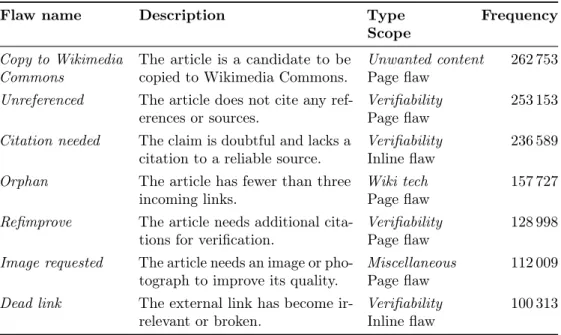
RQ 1. How to compile the set of quality flaws that occur in Wikipedia? A comprehensive compilation of quality flaws that occur in Wikipedia does not exist so far. We take advantage of the fact that Wikipedia users who encounter a flaw (but who are either not willing or who do not have the knowledge to correct it) can tag the article with a so-called cleanup tag. We implement an automatic mining approach to extract the existing cleanup tags from Wikipedia, which gives us the set of quality flaws that have so far been identified by Wikipedia users. RQ 2. What kinds of quality flaws exist in Wikipedia? We organize the flaws along the three dimensions flaw type, flaw scope, and flaw commonness. This organization reveals Wikipedia’s quality flaw structure and provides indications of a flaw’s importance as well as of the usefulness of the respective cleanup tag. In particular, the breakdown shows the kinds of flaws a user may encounter when searching information in Wikipedia.
RQ 3. How to quantify the extent of flawed content? We quantify the flawed content that has been tagged so far by investigating the incidence of cleanup tags over Wikipedia’s namespaces and Wikipedia’s main topics. Moreover, we propose a measure for estimating the actual extent of the flawed content, since due to the size and the dynamic nature of Wikipedia, it is more than likely that many flaws have not yet been tagged. Thus we are the first who give empirical evidence for the amount of low-quality content in Wikipedia.
The findings from research questions RQ 1–3 give insights into Wikipedia’s cur-rent quality flaw situation and support Wikipedia’s quality assurance activities by revealing weaknesses with respect to the quality of information. Specifically, our analysis reveals that 26.86% of the English Wikipedia articles contain at least one quality flaw, whereas 50.1% of the tagged quality flaws concern the articles’ verifiability, which is one of the most important principles of an encyclopedia. The actual frequency of the flaws is even higher, it is likely that one out of five articles does not cite any references or sources.
The dynamic nature of Wikipedia suggests that the quality flaw situation changes over time. We address this issue by investigating the entire revision history of the English Wikipedia from its launch in January 2001 until January 2012. Our analysis comprises all 508 243 744 revisions of the 25 981 062 pages that existed in January 2012. The contents of all revisions sum up to 7.9 TB (uncompressed),
which requires efficient and scalable technology to access and process the relevant data. We use the Wikipedia database backup dumps provided by the Wikimedia Foundation as the basis for our analyses and process the dumps on a Hadoop cluster using Google’s MapReduce. In particular, we analyze the occurrence of cleanup tags in the revisions of Wikipedia articles. The benefits of this approach are twofold: First, it shows how the incidence and the extent of (tagged) quality flaws have evolved. Second, it shows how the way the Wikipedia community perceives and handles quality flaws has changed over time. Our analysis targets the following specific research questions:
RQ 4. When did the first quality flaws emerge, and how have the number and the kind of flaws changed over time? The age, the number, and the kind of a cleanup tag give some indication of the importance as well as of the scope of the respective quality flaw. In particular, we expect the absolute number of cleanup tags to become stable at some (future) point, when each possible flaw is covered by a respective tag.
RQ 5. Has the frequency, the type, and the distribution of quality flaws changed over time? This question relates to the usage of cleanup tags. We expect that certain cleanup tags have been widely used, whereas others have been used infrequently or even not at all. This also gives some indication of the benefit of a certain tag for the Wikipedia community.
RQ 6. How long does it take until tagged quality flaws are corrected? It has been shown that certain types of vandalism were repaired faster than others [152]. Similarly, we expect that certain flaws get corrected faster than others; consider for instance a broken link and compare it to an article that is not written from a neutral point of view. In this regard, we quantify the mean correction time of a flaw, which gives some indication of the flaw’s complexity.
We provide the first comprehensive breakdown of the evolution of quality flaws in the English Wikipedia. Specifically, our analysis reveals that a number of cleanup tags has been used very infrequently or not at all. We also identify several quality flaws that have never been corrected or that have a very high correction time. Moreover, we show that inline (i.e., within the text) cleanup tags are more effective than tag boxes when it comes to the correction time. Our findings form the basis for valuable conclusions for the Wikipedia community, of which we believe that they will help to make future quality assurance activities more effective.
As motivated earlier, a comprehensive manual tagging of articles that require cleanup is unfeasible due to Wikipedia’s size and its constantly changing content. We use the articles that have been tagged so far as a source of human-labeled data, which is then exploited by a machine learning approach to automatically
predict quality flaws in untagged articles. In particular, we address the following research questions:
RQ 7. How to model quality flaws? The automatic prediction of quality flaws requires a model that captures the flaws’ characteristics based on measurable features. We implement 65 features that have been proposed in previous work on automatic quality assessment in Wikipedia, and we introduce 30 new features that directly target certain quality flaws. In particular, we distinguish the two modeling paradigms “intensional” and “extensional”. The former allows for an efficient as well as effective prediction of certain flaws that is based on rules, the latter resorts to the realm of machine learning.
RQ 8. How to predict quality flaws? An algorithmic prediction of quality flaws in Wikipedia has not been operationalized before. We suggest to cast quality flaw prediction in Wikipedia as a one-class classification problem: Given a sample of articles that have been tagged with flawf, decide whether or not an unseen article suffers fromf. We argue that common binary or multiclass classification approaches are ineffective for flaw detection, and we adapt a dedicated one-class classification machine learning approach to tackle this problem.
RQ 9. How to assess classifier effectiveness? The acquisition of significant test data is a difficult undertaking in the Wikipedia setting. A representative sample of Wikipedia articles that have been tagged to notcontain a particular flaw is not available. To assess the effects of a biased sample selection, we evaluate our classifier on both an optimistic test set, using featured articles as outliers, as well as a pessimistic test set, using random untagged articles as outliers. In addition, since the real-world flaw-specific class probabilities in Wikipedia are unknown, we analyze classifier effectiveness as a function of the flaw distribution.
Our flaw prediction approach is evaluated on the basis of 10 000 English Wiki-pedia articles that have been tagged with ten important quality flaws. Given the optimistic test set (using featured articles as outliers) and a balanced class distribution, eight flaws can be detected with a precision close to 1. The evalua-tion results underline the practical applicability of our approach: consider, for instance, a Wikipedia bot that autonomously identifies and tags flawed articles. Our evaluation is based on the corpus of the “1st International Competition on Quality Flaw Prediction in Wikipedia”; a competition that was initiated and co-organized by the author of this thesis and that took place in conjunction with the PAN 2012 lab held at the CLEF 2012 conference.4 The evaluation corpus comprises 1 592 226 English Wikipedia articles, of which 208 228 have been tagged to contain one of ten important quality flaws.
4The “1st International Competition on Quality Flaw Prediction in Wikipedia”:
The analyses in this thesis are performed in the context of the English Wikipedia, which is the largest and most popular language edition. However, we are confident that our research results are relevant to other Wikipedia language editions as well, but we do not demonstrate this relevance here. Finally, we believe that our findings can prove beneficial not only to Wikipedia but also to other wiki-based projects and to user-generated content in general.
1.2 Thesis Organization and Related Publications
This thesis is organized as follows: The remainder ofChapter 1 gives a brief introduction to Wikipedia, discusses Wikipedia’s definition of information quality, and reviews the state of the art in quality assessment.Chapter 2investigates research questions RQ 1–3. This chapter breaks down Wikipedia’s current quality flaw situation, based on the English Wikipedia snapshot from January 4, 2012.
Chapter 3investigates research questions RQ 4–6. This chapter breaks down the evolution of quality flaws, taking into account the entire history of the English Wikipedia from its launch in January 2001 until January 2012.
Chapter 4 investigates research questions RQ 7–9. This chapter tackles au-tomated quality flaw prediction and presents a dedicated one-class machine learning approach. This chapter provides also an overview of the “1st Interna-tional Competition on Quality Flaw Prediction in Wikipedia”.
Chapter 5concludes this thesis. This chapter summarizes main results, discusses them in relation to our research questions, and gives an outlook on future work. Moreover, it draws conclusions regarding the practical suitability of our findings and provides concrete recommendations for the Wikipedia community.
Appendix A provides a complete listing of the quality flaws that have been identified in the English Wikipedia, along with detailed statistics and further information about the individual flaws.
Appendix Bprovides in-depth descriptions and implementation details of Wi-kipedia article features, which were either proposed in prior studies on quality assessment in Wikipedia or are newly introduced in this thesis.
This dissertation is based on a number of publications, see Table 1.1. The chapters of this thesis go beyond the content of the respective publications and add significant details as well as new aspects. The most notable innovation is that all analyses that are based on Wikipedia data are carried out anew, using the English Wikipedia snapshot from January 4, 2012. Depending on the respective
release date, the publications are based on different Wikipedia snapshots.5 Using
a uniform and well-defined data base makes the individual findings comparable and guarantees their reproducibility. The snapshot is publicly available and was also used in the “1st International Competition on Quality Flaw Prediction in Wikipedia” mentioned above.
The remainder of this section briefly summarizes research by the author that is not covered in this thesis (Table 1.1 overviews the respective publications). Theory of models for information retrieval. We introduce the idea of collection-relative retrieval models, a paradigm where several important retrieval models fit in, including VSM, GVSM, ESA, and LSI [139]. This unifying view helps to better understand retrieval models, and it can be considered as a step towards a common theoretical framework for text retrieval. Among the retrieval models that have been proposed in the last years, the Explicit Semantic Analysis, ESA, received a lot of attention. We look at the foundations of the ESA from a theoretical point of view and employ a general probabilistic model for term weights, which reveals how the ESA actually works [4, 66]. Based on this model, we provide a theoretical grounding on how properties of the reference collection affect the ESA-based computation of similarities. Moreover, we give evidence that (a) the ESA model is a variation of the generalized vector space model, GVSM, and, (b) that the original conceptual motivation for the ESA model does not hold.
Cross-language information retrieval. We introduce Cross-language Explicit Semantic Analysis, CL-ESA, a multilingual generalization of the ESA model [122]. The model exploits a document-aligned multilingual reference collection, such as Wikipedia, to represent a given text as a language-independent concept vector. The relatedness of two texts in different languages is assessed by the cosine similarity between the corresponding concept vectors. We also propose a formal definition and an alternative interpretation for the CL-ESA model, which is relevant for real-world retrieval applications since it shows how the computational effort of CL-ESA can be shifted from the query phase to a preprocessing phase [7]. This variation of the CL-ESA is evaluated in the TEL@CLEF task of the CLEF 2009 ad-hoc track. Moreover, we contribute to an important variant of cross-language information retrieval, called cross-language high similarity search. Monolingual high similarity search can be tackled in sub-linear time, either by fingerprinting or by “brute force n-gram indexing”. We present theoretical and empirical insights that neither of these two approaches can be applied to tackle cross-language high similarity search, and that a linear scan is inevitable [8].
5Dates of the Wikipedia snapshots used in previous publications: January 16, 2010 [9]; January 15, 2011 [5, 10, 12, 101]; September 1, 2011 [11]; and January 4, 2012 [6].
Table 1.1:Publications by the author and their usage within this thesis.
Used in Venue Pages Publisher Year Reference
Chap. 2 WebQuality 8 ACM 2012 [5]
M. Anderka and B. Stein. A breakdown of quality flaws in Wikipedia.
Chap. 2 WWW 2 ACM 2011 [9]
M. Anderka, B. Stein, N. Lipka. Towards automatic quality assurance in Wikipedia.
Chap. 3 WPAC 9 online 2012 [11]
M. Anderka, B. Stein, M. Busse. On the evolution of quality flaws and the effectiveness of cleanup tags in the English Wikipedia.
Chap. 4 SIGIR 10 ACM 2012 [12]
M. Anderka, B. Stein, N. Lipka. Predicting quality flaws in user-generated content: the case of Wikipedia.
Chap. 4 CLEF 7 CLEF 2012 [6]
M. Anderka, B. Stein. Overview of the 1st international competition on quality flaw prediction in Wikipedia.
Chap. 4 CIKM 4 ACM 2011 [10]
M. Anderka, B. Stein, N. Lipka. Detection of text quality flaws as a one-class classification problem.
– SIGIR 2 ACM 2012 [101]
N. Lipka, B. Stein, M. Anderka. Cluster-based one-class ensemble for classification problems in information retrieval.
– CIKM 4 ACM 2011 [66]
T. Gottron, M. Anderka, B. Stein. Insights into explicit semantic analysis.
– ECIR 5 Springer 2010 [8]
M. Anderka, B. Stein, M. Potthast. Cross-language high similarity search: why no sub-linear time bound can be expected.
– CLEF 8 Springer 2009 [7]
M. Anderka, N. Lipka, B. Stein. Evaluating cross-language explicit seman-tic analysis and cross querying.
– TIR 5 IEEE 2009 [139]
B. Stein, M. Anderka. Collection-relative representations: a unifying view to retrieval models.
– SIGIR 2 ACM 2009 [4]
M. Anderka, B. Stein. The ESA retrieval model revisited.
– ECIR 9 Springer 2008 [122]
M. Potthast, B. Stein, M. Anderka. A Wikipedia-based multilingual re-trieval model.
1.3 A Brief Introduction to Wikipedia
Wikipedia is a free, web-based, collaborative, and multilingual encyclopedia project. It was launched in January 2001 by Jimmy Wales and Larry Sanger.6 Since 2003, Wikipedia is operated by the Wikimedia Foundation, a nonprofit charitable organization. The Wikipedia project is realized using the free software MediaWiki, which is developed by the Wikimedia Foundation. MediaWiki implements the wiki concept, introduced by Ward Cunningham [96], which provides the environment for collaborative content creation. Apart from very few exceptions, all content in Wikipedia can be edited by anybody, even anonymously. In contrast to printed encyclopedias, the contributions to Wikipedia are not reviewed by experts before publication—contributions to Wikipedia are published immediately.7
At first consideration, it may seem absurd that Wikipedia’s open editing model can produce a useful knowledge source. One reason why Wikipedia is not run down by vandals is that it is less time consuming to undo vandalism than it is to cause it—with the result that malicious behavior is discouraged [114]. The MediaWiki software maintains the full edit history of each Wikipedia article, which allows for restoring earlier versions of vandalized articles without great effort. It has been shown that vandalism and other types of damage are repaired relatively quickly by the community, and a huge amount even almost immediately [125, 152, 153].
The fundamental principles of the Wikipedia project are summarized in the so-called “five pillars”:8
1. Wikipedia is an encyclopedia.
2. Wikipedia is written from a neutral point of view.
3. Wikipedia is free content that anyone can edit, use, modify, and distribute. 4. Editors should interact with each other in a respectful and civil manner. 5. Wikipedia does not have firm rules.
6
Wikipedia, “Wikipedia,” last modified October 5, 2011,
http://en.wikipedia.org/wiki/Wikipedia. 7
There are some exceptions in particular language editions. In the German Wikipedia, for instance, only the latest “sighted versions“ are presented to common users. A sighted version is a revision of an article that is marked as being free of obvious vandalism. 8Wikipedia, “Wikipedia:Five pillars,” last modified September 11, 2012,
1.3.1 Size and Growth
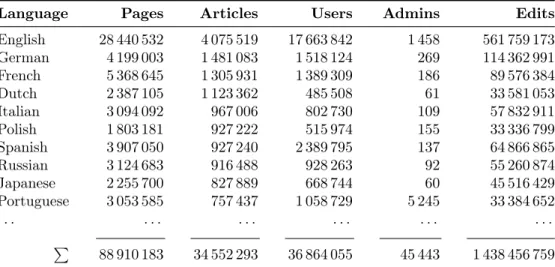
Wikipedia is often referred to as the largest collaboratively created reference work on the Web. At the time of writing this thesis, the Wikipedia project comprises 285 language editions with a total of nearly 89 million pages, of which more than 34 million are encyclopedic articles. More than 36 million registered users and an unknown number of anonymous users have performed over 1.4 billion edits. Table 1.2 summarizes key statistics of Wikipedia. The largest and most prominent language edition is the English Wikipedia, with a total number of more than 28 million pages and over 4 million encyclopedic articles. The English language edition is also the most popular one, its community comprises more than 17 million registered users, which corresponds to 47.92% of the registered Wikipedia users.
Table 1.2:Key statistics of the ten largest Wikipedia language editions. The bottom row shows the respective values summarized over all 285 language editions. The rows are ordered by the number of articles.
Language Pages Articles Users Admins Edits
English 28 440 532 4 075 519 17 663 842 1 458 561 759 173 German 4 199 003 1 481 083 1 518 124 269 114 362 991 French 5 368 645 1 305 931 1 389 309 186 89 576 384 Dutch 2 387 105 1 123 362 485 508 61 33 581 053 Italian 3 094 092 967 006 802 730 109 57 832 911 Polish 1 803 181 927 222 515 974 155 33 336 799 Spanish 3 907 050 927 240 2 389 795 137 64 866 865 Russian 3 124 683 916 488 928 263 92 55 260 874 Japanese 2 255 700 827 889 668 744 60 45 516 429 Portuguese 3 053 585 757 437 1 058 729 5 245 33 384 652 . . . . P 88 910 183 34 552 293 36 864 055 45 443 1 438 456 759
Source: Data from Wikistats 2.0, “List of Wikipedias,” last update October 11, 2012,
http://wikistats.wmflabs.org.
Early studies that analyzed the evolution of the English Wikipedia report on an exponential growth in the number of encyclopedic articles [3, 29, 31, 154, 157, 164]. The trend changed in 2007, and since then the growth rate declined, as is shown in Figure 1.1. Up to now, different statistical approaches have been proposed to model Wikipedia’s article growth [31, 48, 137, 141], with the result that the article count is expected to plateau in the near future.9 These
9For a comparative survey of approaches that model article growth in Wikipedia, refer to
2001 2002 2003 2004 2005 2006 2007 2008 2009 2010 2011 2012 Time 0 0.5 1 1.5 2 2.5 3 3.5 4
Articles (in millions) exponential growth
slowing growth Number of articles
Projected exponential
Figure 1.1: Number of encyclopedic articles in the English Wikipedia from January 2001 up to October 2012. The plotted data is taken fromhttp://en.wikipedia.org/ wiki/Wikipedia:Size_of_Wikipedia.
results led to a rather pessimistic future prospect and it is speculated that the growth of Wikipedia is limited [145]. Several studies explain the slowing growth of Wikipedia by increasing meta activities, such as coordination, content organization, and policy setting [30, 59, 86, 90]. Another explanation is that the opportunities to make novel contributions are limited [145] since Wikipedia already covers a wide range of topics [70, 87, 130]. These findings apply not only to the English Wikipedia, in fact, it is more than likely that a unique growth process underlies all language editions [164]. Despite the slowing growth, one of five critical targets that have been stated in Wikimedia’s movement strategic plan is to increase the number of Wikipedia articles to 50 million by 2015.10
1.3.2 Community
Almost all Wikipedia content can be edited immediately, by everyone, and with minimum effort. This open editing model begs the question of who actually writes Wikipedia. As mentioned above, there are currently more than 17 million registered English Wikipedia users, and also an unknown number of anonymous contributors. The reasons why people are motivated to contribute to Wikipedia on a voluntary basis have been extensively studied [65, 91, 115, 120, 132, 151, 160]. The main motivations that have been identified are that contributors enjoy a sense of community membership, benevolence, accomplishment, and
10Wikimedia Foundation, “Wikimedia Strategic Plan,” February 2011,
fun. Moreover, many people like the idea of establishing a freely available source of human knowledge and would like to contribute to subject matters in which they have expertise. It has also been shown that cooperation and coordination activities play an important part in fostering the motivation and the activity of individual Wikipedia editors [84, 88, 148, 152, 153]. Cooperation and coordination in Wikipedia are mainly realized via discussion pages and so-called WikiProjects. A WikiProject is composed of a collection of pages and a group of editors with the goal to improve the coverage and quality of a specific topic or family of topics within Wikipedia. At the time of writing this thesis, there are about 2 000 WikiProjects in the English Wikipedia.11
A survey [65] conducted in 2010 by the Wikimedia Foundation and the Col-laborative Creativity Group at UNU-MERIT12 shows that the community of
Wikipedia editors is heterogeneous, including people with different levels of education, age, and language skills. Moreover, an interesting finding of the survey is that the share of male contributors is substantially larger (86.73%). This gender imbalance has also been observed and further investigated by several recent studies [13, 60, 135]. Despite the huge number of registered Wikipedia users, it has been shown that only a small fraction, so-called elite- or power users, do the majority of work [3, 92, 116, 117, 119, 125, 133, 142]. In particular, less than 10% of the registered users perform more than 90% of the edits in the ten largest language editions of Wikipedia [118]. This fact is in contrast to the “wisdom of the crowd” phenomenon [146]. However, Kittur et al. [85] report on a shift of the workload to the common users, with a corresponding decline in the influence of the elite.
1.3.3 Significance
Wikipedia has become the primary source of knowledge for a huge number of people around the world. In October 2012, Wikipedia received on average 551 million page views per day, of which the vast majority (90.31%) account for the ten largest language editions.13 At the time of writing this thesis, wikipedia.org is the sixth most visited website according to the Alexa Traffic Rank.14 Thus, Wikipedia is more popular than for instance Twitter, Amazon,
11
Wikipedia, “Wikipedia:WikiProject,” last modified November 10, 2012,
http://en.wikipedia.org/wiki/Wikipedia:WikiProject. 12
UNU-MERIT is a joint research and training center of United Nations University (UNU) and Maastricht University.
13Wikimedia Statistics, “Page Views for Wikipedia,” accessed November 12, 2012,
http://stats.wikimedia.org/EN/TablesPageViewsMonthly.htm.
14Alexa Internet Inc., “Alexa Top 500 Global Sites,” accessed November 12, 2012,
2001 2002 2003 2004 2005 2006 2007 2008 2009 2010 2011 2012 Time 0 50 100 150 200 250 300 350 Publications
Figure 1.2: Number of Wikipedia-related publications per year. The plotted data is taken fromhttp://wikipapers.referata.com/wiki/List_of_publications, last update November 7, 2012.
and LinkedIn. More than half of the visits to wikipedia.org (58.78%) refer to the subdomain en.wikipedia.org, and hence, to the English language edition.15 Although the reliability of its content might be questionable, for many people it has become a habit to first visit Wikipedia in case of an information need. The importance of Wikipedia is also witnessed by a large body of relevant scientific publications. The huge amount of publicly available data and the fact that Wikipedia is collaboratively created solely by volunteers have attracted researchers of several academic disciplines. The project WikiPapers, which aims to create the most comprehensive literature compilation for research on wikis, lists currently 1 750 publications.16 The number of Wikipedia-related publications has grown continuously over the last decade, as shown in Figure 1.2. Wikipedia is often used as an example case in scientific studies to derive and validate general findings; for instance, to analyze the process of content creation by online communities [92], for studying social network aspects [15, 69], and to investigate the effects of cultural values on social media [113]. Moreover, especially in the fields of information retrieval and machine learning, a variety of approaches has been proposed that utilize Wikipedia as a knowledge base; for instance, to tackle the following problems: cluster labeling [32], link predic-tion [108, 109], multilingual informapredic-tion retrieval [122], text classificapredic-tion [155],
15Alexa Internet, Inc., “Wikipedia.org Site Info,” accessed November 12, 2012,
http://www.alexa.com/siteinfo/wikipedia.org.
16WikiPapers, “List of publications,” last modified November 7, 2012,
named entity disambiguation [72], text clustering [18, 76, 78], and measuring semantic relatedness [62, 66].
Wikipedia’s popularity renders the detection of quality flaws a relevant task of highest importance since erroneous information affects a huge number of readers as well as a variety of scientific approaches that utilize (possibly flawed) knowledge from Wikipedia.
1.3.4 Technical Aspects
The Wikipedia project is hosted by the Wikimedia Foundation, which operates two colocation centers in Tampa, Florida and another two in Amsterdam, Netherlands. As of November 19, 2012, the Wikimedia Foundation runs 659 servers, representing a total of 7 818 CPUs.17 The system architecture is realized
based on an extended LAMP18 environment that comprises the following core components:19
• Linux operating system (mainly Ubuntu).
• Web server and caching proxy server (Apache and Squid). • DNS server for geographical request distribution (PowerDNS). • Load-balancer for incoming and back-end requests (LVS).
• Database and memory object caching system (MySQL and memcached). • Main Web application (MediaWiki, written in PHP).
• Full-text search engine (Lucene customization).
For a detailed description of the components and further information on Wiki-pedia’s infrastructure, refer to Mituzas [111].
Most relevant for the analyses in this thesis is Wikipedia’s database. The relational database management system MySQL is employed to store the data of all Wikimedia projects, including Wikipedia. An individual MySQL database is used for each Wikipedia language edition. The database schema is defined by the MediaWiki software, and in the current MediaWiki version 1.21 it comprises
17
Wikimedia Foundation, “Wikimedia Grid Report for Mon, 19 Nov 2012,”
http://ganglia.wikimedia.org. 18
The acronym LAMP refers to the principal components generally used to build Web applications based on open source software: Linux operating system, Apache HTTP Server, MySQL database, and PHP (sometimes Python or Perl respectively). For further information on LAMP, refer to Lee and Ware [94].
19Wikimedia Foundation, “Wikimedia servers,” last modified October 9, 2012,
50 tables.20 (For further information on the evolution of Wikipedia’s database
schema, refer to Curino et al. [43].) Many tables relate to Wikipedia’s content pages and associated information (e.g., the tables page, text, category, and revision). Other tables include information related to users (e.g., user and user_groups), media files (e.g., filearchive and image), statistics and logging (e.g., site_statsand logging), caching (e.g., objectcache and querycache), and software internals (e.g., job and trackbacks), among others. The Wikipedia database can be accessed directly via the MediaWiki software (e.g., using the Web interface or the API) or via external services provided by the Wikimedia Foundation (e.g., the Wikimedia Toolserver or the database backup dumps). A comparative overview of approaches to access the Wikipedia database is given in Section 3.1.1.
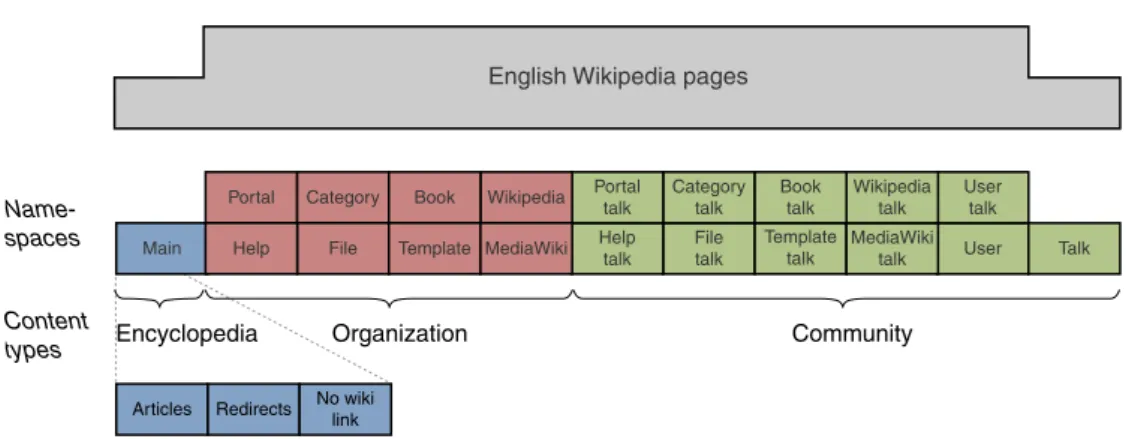
Many features of Wikipedia are provided by the underlying MediaWiki software. MediaWiki organizes the textual content into pages. Each page covers a certain topic and has a unique title. A page belongs to exactly one namespace and should be assigned to at least one category. Namespaces are a means to organize the pages from a technical point of view. At the time of writing this thesis, the English Wikipedia provides 20 namespaces. Categories are used for a topical organization of the pages. The categories themselves are organized in a hierarchical manner. A page is written in wiki markup, also called wikitext, which is a lightweight markup language. Wiki markup was designed with the goal to be easier to learn and to use than HTML. However, a complete and consistent specification of wiki markup is not yet available.21 Editing a page produces a new revision of the page. The complete revision history of all pages is stored in the Wikipedia database.
1.4 Wikipedia and Quality: Where are We Now?
Despite its size and popularity, Wikipedia is often criticized for containing low-quality information.22 The major points of criticism pertain to the content’s accuracy, completeness, and readability as well as to the neutrality and the reliability of information. During the last decade, great efforts have been made by researchers and practitioners to assess the actual quality of Wikipedia’s articles. This section overviews the relevant scientific literature as well as the20
MediaWiki, “Manual:Database layout,” last modified October 27, 2012,
http://www.mediawiki.org/wiki/Manual:Database_layout. 21MediaWiki, “Markup spec,” last modified May 30, 2012,
http://www.mediawiki.org/wiki/Markup_spec.
22For a compilation of critics of Wikipedia in the literature, refer to
respective guidelines and approaches that have been developed by the Wikipedia community and presents the state of the art in information quality assessment and -assurance activities in Wikipedia. Assessing the quality of Wikipedia articles, however, presumes that there is a consensus on what qualitymeans in this context. Before we go on to deal with Wikipedia’s definition of information quality it is useful to discuss the general concept of information quality.
1.4.1 General Definition of Information Quality
There is no consensus in the relevant literature about the distinction between data quality and information quality. Madnick et al. [105] mention that there is a tendency to usedata qualityto refer to technical issues (e.g., the integration of records from different databases) andinformation qualityto refer to nontechnical issues (e.g., the relevancy of information for a particular user). This fits the distinction between data and information that is known from information theorists: The termdatarefers to the plain facts, which need to be processed and interpreted to become (useful)information[24]. Here, this distinction is not made and the term information quality is used to refer to all kinds of issues. Although there is a large body of information quality research, for which Levis et al. [97] give a comprehensive overview, there is no single definition of the quality of information. A widely accepted interpretation of information quality is the “fitness for use in a practical application” [156]. Similar, Juran and Godfrey [82] interpret information “to be of high quality if they are fit for their intended uses in operations, decision making, and planning.” I.e., the definition of information quality depends on the particular context and use case.
Information quality is a multi-dimensional concept that combines several quality criteria [156]. A good deal of the existing information quality research focuses on the investigation of quality dimensions and particular classification schemes, for which Madnick et al. [105] give a comprehensive overview. Common infor-mation quality dimensions include accuracy, reliability, timeliness, objectivity, completeness, and relevance, for example.
Information quality is often investigated in an organizational context, see e.g., Lee et al. [95], and, especially in early years, many researchers target quality aspects in databases, see e.g., Madnick and Zhu [104]. In recent years, quality as-sessment of Web documents becomes more and more important, and information quality metrics have been incorporated into information retrieval approaches to improve the search effectiveness of Web search environments [19, 121, 162, 163]. The rise of the Web 2.0 brought an increasing diversity of produced content quality [17], and quality assessment of user-generated content and social media
gained particular interest [2, 35, 56, 103, 150]. Wikipedia is solely based on user-generated content, and it is one of the largest and most successful representatives of its kind.
1.4.2 Wikipedia’s Definition of Information Quality
As mentioned above, the definition of information quality depends on the particu-lar context. In Wikipedia the context is well-defined, namely by the encyclopedic genre. Crawford [41] defined the quality of an encyclopedic article by seven general criteria: scope, format, uniqueness, authority, accuracy, currency, and accessibility. However, these criteria were defined for traditional printed en-cyclopedias, and hence, they do not directly fit to Wikipedia. For example, the criteria authority and accessibility are not relevant in case of a free online encyclopedia. The encyclopedic genre forms the ground for Wikipedia’s core content policies: neutral point of view, no original research, and verifiability.23 The Wikipedia quality task force provides a working definition for the term quality: “the ability of a Wikipedia article to meet the expectations and needs of the article’s target audience, i.e. the readers of the article”.24 This definition is compliant with the general “fitness for use” paradigm of Wang and Strong [156] mentioned above. Although the quality task force defines certain requirements that specify the expectations and needs of an article’s target audience, the definition is rather unspecific and universal.
The information quality ideal of Wikipedia has been formalized—better: made communicable and quantifiable—within the so-called featured article criteria. Featured articles are considered to be the best articles Wikipedia has to offer. The featured article criteria of the English Wikipedia state that an article should have the following attributes:25
1. It is well-written, comprehensive, well-researched, neutral, and stable. 2. It provides a concise lead section, an appropriate structure, and consistent
citations.
3. It has images and other media where appropriate. 4. It has a reasonable length and level of detail.
23
Wikipedia, “Wikipedia:List of policies#Content,” last modified June 3, 2012,
http://en.wikipedia.org/wiki/Wikipedia:List_of_policies#Content. 24
Wikimedia Strategy, “Task Force/Wikipedia Quality/Definition of quality,” last mod-ified April 27, 2010, http://strategy.wikimedia.org/wiki/Task_Force/Wikipedia_ Quality/Definition_of_quality.
25Wikipedia, “Featured article criteria,” last modified August 9, 2012,
To some extent these criteria cover those defined by Crawford [41]. The concept of featured articles exists in many language editions, however, the respective criteria differ slightly. In addition to featured articles, a set of grades for which weaker criteria apply was developed within the Wikipedia Version 1.0 project. Table 1.3 shows the respective grading scheme, which represents a discrete definition of article quality in Wikipedia. (The grading scheme will be discussed in the next subsection.) Additional criteria and guidelines have been defined by certain WikiProjects to cover topical particularities.
Most of the existing criteria and guidelines are intended to assure Wikipedia’s quality standards, and hence, they define high-quality information. By contrast, the focus of this thesis is on quality flaws. As already mentioned, we consider a quality flaw as any issue within an article that causes a violation of Wikipedia’s quality standards.
1.4.3 Information Quality Assessment
In early years, researchers tried to assess the quality of Wikipedia by com-paring samples of articles with the corresponding entries in other well-known encyclopedias. In 2005, the journal Naturecarried out a study comparing 42 scientific articles from Wikipedia and Encyclopædia Britannica [64]. The articles were reviewed for accuracy by domain experts: the average number of errors per article was four in Wikipedia and three in Encyclopædia Britannica. The study concluded that “Wikipedia comes close to [Encyclopædia] Britannica in terms of the accuracy of its science entries.” [64] In 2006, Rosenzweig [128] judged 25 bibliographic Wikipedia articles against comparable entries in Mi-crosoft Encarta and in the American National Biography Online. He found that Wikipedia was as accurate as Microsoft Encarta but not as accurate as American National Biography Online. Another study carried out in 2008 by Rector [127] comparing nine historical Wikipedia articles with respective articles in Encyclopædia Britannica, the Dictionary of American History, and American National Biography Online conclude that Wikipedia was less reliable than the other reference works. Further studies have been conducted by several printed magazines comparing Wikipedia to Bertelsmann Enzyklopädie, World Book Encyclopedia, and Brockhaus Enzyklopädie, among others: in the majority of cases Wikipedia articles were comparable or even better in terms of accuracy, completeness, and currentness.26 Although the mentioned studies give some indications of Wikipedia’s information quality, the findings cannot be generalized since the analyzed samples must be considered as too small.
26For an overview of these studies including a summary of the main results, refer to
A comprehensive quality assessment attempt was initiated by the Wikipedia Version 1.0 project, which was set up in late 2004 with the goal of producing a high-quality offline release version of the English Wikipedia.27 In order to achieve this goal, an article quality grading scheme was developed, which allows for a quality-based selection of articles to be included in the release version. The grading scheme is shown in Table 1.3. Out of the 4 075 519 English Wikipedia articles (cf. Table 1.2) 3 454 234 have so far been assessed by Wikipedia users, which corresponds to 84.76%. The assessment activities are pushed by a multitude of WikiProjects, which often have a dedicated assessment team that is responsible for evaluating the articles in the project scope. The scheme comprises nine grades ranging from high quality (FA) to low quality (Stub). According to Table 1.3, a relatively small amount of the English Wikipedia articles (0.18%) is considered to be high quality (including the grades FA, A, and FL). On the other hand, more than half of the articles (54.13%) are classified as stubs. The assessment provides the most comprehensive overview of Wikipedia’s quality situation so far, however, an enormous manual effort is necessary both to evaluate the large number of articles and to maintain existing assessments after subsequent edits.
A variety of approaches to automatically assess information quality in Wikipedia has been proposed in the relevant literature [22, 44, 46, 49, 71, 77, 80, 98, 99, 100, 126, 143, 157, 159]. The approaches mainly differ in the underlying quality models, i.e., the feature number, the feature complexity, or the rationale to quantify quality. A good deal of the developed approaches employ machine learning techniques to classify Wikipedia articles into the quality grading scheme mentioned above. Especially the grades representing high-quality content are often used, e.g., to determine whether an article is featured or not. The respective approaches perform nearly perfectly in distinguishing featured articles from non-featured ones. However, the practical support for Wikipedia’s quality assurance process is marginal because featured articles are not identified, but are made.28
Moreover, nearly all of the developed approaches are based on meta-features that correlate with featured articles in general; for instance, the number of words in an article. Consequently, these approaches provide no indication of the shortcomings of non-featured articles. There are only a few prior studies that target the identification of specific quality flaws, and, in contrast to this thesis, they either investigate only small samples of articles [144] or analyze only a restricted set of flaws [63, 129].
27
Wikipedia, “Wikipedia:Version 1.0 Editorial Team,” last modified September 29, 2012,
http://en.wikipedia.org/wiki/Wikipedia:Version_1.0_Editorial_Team. 28
A featured article candidate is rigorously reviewed, discussed, and revised by many users, with the aim to improve it, and therefor,makeit a featured article. For further information, refer tohttp://en.wikipedia.org/wiki/Wikipedia:Featured_article_candidates.
There is also notable research that relates indirectly to quality assessment in Wikipedia: trust and reliability of articles [42, 161], author reputation [1, 152], automatic vandalism detection [112, 123, 124], and edit quality estimation [51].
Table 1.3:Article quality grading scheme used in the English Wikipedia along with a description of the respective criteria and the respective number of assigned articles. This grading scheme is used by theWikipedia:Version 1.0 Editorial Team. (For a more detailed description of the criteria refer to the source URL stated below the table.)
Grade Criteria description Articles
FA A featured article exemplifies Wikipedia’s very best work and is distinguished by professional standards of writing, presentation, and sourcing.
4 271
A The article is well-organized and essentially complete, having been reviewed by impartial reviewers from this WikiProject or elsewhere.
1 054
GA A good article is a satisfactory article that has met the good article criteria but may not have met the criteria for featured articles.
16 753
B The article is mostly complete and without major issues, but requires some further work to reach good article standards.
83 523
C The article is substantial, but is still missing important content or contains a lot of irrelevant material. The article should have references to reliable sources, but may still have significant issues or require substantial cleanup.
132 444
Start An article that is developing, but which is quite incomplete and may require further reliable sources.
904 086
Stub A very basic description of the topic. 2 206 104
FL A featured list exemplifies Wikipedia’s very best work. It covers a topic that lends itself to list format.
1 790
List Meets the criteria of a stand-alone list, which is an article that contains primarily a list, usually consisting of links to articles in a particular subject area.
104 209
P
3 454 234 Source: Wikipedia, “Wikipedia:Version 1.0 Editorial Team/Assessment,” last mod-ified October 26, 2012, http://en.wikipedia.org/wiki/Wikipedia:Version_1.0_ Editorial_Team/Assessment.
A Breakdown of Quality Flaws
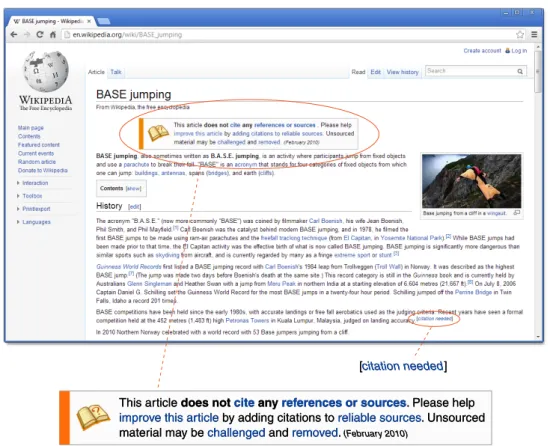
Cleanup tags are a means to tag quality flaws in Wikipedia. As shown in Figure 2.1, cleanup tags are used to inform readers and editors about specific problems in articles, sections, or certain text fragments. The tags are defined by the Wikipedia community and can be placed by every user. Cleanup tags have been utilized previously for different purposes, however, in contrast to this thesis, each of the prior studies targets only a single tag. Gaio et al. [63, 129] investigate the usage and the effectiveness of the cleanup tags Complex and NPOV (neutral point of view) in SimpleWiki1 and in the English Wikipedia respectively. Kittur et al. [86] use the cleanup tag Controversial to characterize conflict in Wikipedia. Apic et al. [14] propose an indicator of a country’s geopolitical instability based on the number of Wikipedia articles that have a link to the Wikipedia article of the respective country and that have been tagged with the cleanup tag NPOV disputes. Here, we investigate all existing cleanup tags to breakdown the quality flaws that have so far been identified by Wikipedia users.
Chapter organization. Section 2.1 describes the data underlying our analyses as well as the data preprocessing. Section 2.2 describes our cleanup tag mining approach. Section 2.3 presents the resulting set of quality flaws organized along the three dimensions flaw type, flaw scope, and flaw commonness. Section 2.4 presents the distribution of tagged flaws over Wikipedia’s namespaces and main topics; furthermore, this section describes our approach to estimate the actual extent of the flawed content.
Key contributions. We present the first comprehensive breakdown of Wikipedia’s quality flaw structure. Our analysis reveals the kinds of flaws that actually exist, the distribution of flaws in Wikipedia, and the extent of flawed content.
1SimpleWiki is a relatively small language edition of Wikipedia that is written in basic English: http://simple.wikipedia.org.
[citation needed]
[citation needed]
This article does not cite any references or sources. Please help improve this article by adding citations to reliable sources. Unsourced material may be challenged and removed. (February 2010)
This article does not cite any references or sources. Please help
improve this article by adding citations to reliable sources. Unsourced material may be challenged and removed. (February 2010)
Figure 2.1: The Wikipedia article “BASE jumping” with two cleanup tags. The tag box Unreferencedrefers to the whole article while the inline tagCitation neededrefers to a particular claim.
2.1 Data Base and Preprocessing
The analyses in this chapter are based on a snapshot instead of investigating Wikipedia up-to-the-minute. This guarantees reproducibility and makes our results comparable. The Wikimedia Foundation periodically compiles and provides Wikipedia snapshots in the form of database backup dumps. An automated backup process goes through the set of Wikipedia databases and dumps the data to files. The aim is to have a complete backup for each Wikipedia language edition every two weeks; except for the English Wikipedia, which has the largest database and should has a complete backup once a month.2 The parts of the backups that comprise content-related data are publicly disclosed.3
2
For further information about the dump process, including technical details, refer to
http://wikitech.wikimedia.org/view/Dumps. 3
Table 2.1:Statistics of the English Wikipedia snapshot from January 4, 2012.
Number of pages 25 981 062
Number of encyclopedic articles 3 865 587
Number of featured articles 3 438
Number of images 812 059
Number of registered users 15 993 675
Number of active users 133 219
(users who performed an action in the last 30 days)
Total number of edits 508 243 744
Average number of edits per page 19.56
Source: The statistics are based on the data provided by thesite_statstable, which is included in the database backup dumps of the Wikimedia snapshot.
User-related data are withheld for privacy reasons as well as data that relate to MediaWiki software internals. Therefore, the backups provided by the Wikimedia Foundation can be considered as partial snapshots of the Wikipedia databases at a certain date.4
As already mentioned in the introduction of this thesis, we use a snapshot of the English Wikipedia from January 4, 2012. The English language edition is most appropriate because it is the largest and most popular one (cf. Section 1.3.1). Table 2.1 summarizes key statistics of the snapshot. Nearly 26 million English Wikipedia pages existed at the time of the snapshot. More than 3.8 million pages are encyclopedic articles, and a subset of 3 438 articles (0.09%) are labeled as featured. The respective backup provided by the Wikimedia Foundation includes 18 so-called SQL dumps of which each comprises a single table of the English Wikipedia database in the form of raw SQL statements, totaling about 40 GB. Table 2.2 lists the 18 database tables.5 The tables comprise meta data about pages, categories, images, templates, users, and links. We import the 18 SQL dumps into a MySQL database, which gives us a local partial copy of the English Wikipedia database. The local database allows for efficient analyses, without causing traffic on the Wikimedia servers. Note that all of our analyses can be performed on the original Wikipedia database as well.
4
The snapshot date corresponds to the backup dump’s completion time. As the dump process takes some time, especially, for larger databases, there may be inconsistencies in the data of a single snapshot. Here, we neglect possible inconsistencies since it concerns typically only a few days. In case of the English Wikipedia, it takes eight to nine days for a backup run to complete.
5For further information about the database schema and a description of all tables, refer to
Table 2.2:The 18 tables of the Wikipedia database that are included in the English Wikipedia snapshot from January 4, 2012 in the form of SQL dumps.
Table Description
category Stores the existing Wikipedia categories. categorylinks Category membership of pages.
externallinks URLs and referring pages of external links. image Meta data about images and other media files. imagelinks Inclusions of images and other media files into pages.
interwiki Prefixes and URLs of other projects, e.g., Commons, Wikibooks etc. iwlinks URLs and referring pages of interwiki links (to other projects). langlinks Links to related pages in other languages.
oldimage Meta data about old revisions of images and other media files. page Meta data about each page, including id, title, and namespace. page_props Properties of pages (used by the MediaWiki software).
page_restrictions Protection levels of pages (used to disable editing for specific users). pagelinks Referring pages and target pages of (Wikipedia) internal links. protected_titles Protection levels of non-existent (unwanted) pages.
redirect Pages that are redirects, along with respective target pages. site_stats A number of statistics, including page, article, and edit counts. templatelinks Inclusions of pages, especially templates, into other pages. user_groups Group membership of users.
2.2 Cleanup Tag Mining
There is no single strategy to spot the entire set of all cleanup tags. Cleanup tags are realized based on templates, which are special Wikipedia pages that can be included into other pages. Although templates can be separated from other pages by their namespace (the prefix “Template:” in the page title), there is no dedicated qualifier to separate templates that are used to implement cleanup tags from other templates. A complete manual inspection is unfeasible as Wikipedia contains more than 450 000 different templates.6 We hence employ a two-step approach to compile the set of cleanup tags automatically:
1. an initial set of cleanup tags is extracted from two meta sources within Wikipedia, and
2. the initial set is further refined by applying several filtering substeps.
6Wikistats: Wikimedia Statistics, “Database records per namespace,” last modified Septem-ber 21, 2012,http://stats.wikimedia.org/EN/TablesWikipediaEN.htm#namespaces.
Step 1: Extraction
We exploit two sources within Wikipedia containing meta information about cleanup tags. The first source that we employ is the Wikipedia administration category ”Category:Cleanup templates”, which comprises templates that are used for tagging pages as requiring cleanup. The category also has several subcategories to further organize the cleanup tags by their usage, e.g., inline cleanup templates or cleanup templates for WikiProjects. The page titles of those templates linking to the category or some subcategory are obtained from the local Wikipedia database, using the tables categorylinksandpage(cf. Table 2.2), which results in 437 different cleanup tags.
The second source is the meta page ”Wikipedia:Template messages/Cleanup”, which comprises a manually maintained listing of templates that may be used to tag pages as needing cleanup. From a technical point of view, the page is a composition of several pages (transclusion principle). For each of these pages, the content of the revision from the snapshot time is retrieved using the MediaWiki API7. A total of 286 different cleanup tags are extracted from the wiki markup of the retrieved pages using regular expressions. Merging the findings from both sources gives 530 different cleanup tags.
Step 2: Refinement
We apply the following filtering substeps to the initial set of cleanup tags: Redirect resolving. A cleanup tag may have several alternative titles linking to it through redirects. For example, the tag Unreferenced has the redirects Unref,Noreferences, andNo refsamong others. We resolve all redirects using the tablesredirect and pageof the local Wikipedia database (cf. Table 2.2). Subtemplate removal. We discard particular subtemplates, namely experimental pages and documentation pages. Experimental pages are identified by the suffixes “/sandbox” and “/testcases” in the page title and are used for testing purposes only. Documentation pages are identified by the suffix “/doc” and provide a template description.
Meta-template removal. We discard templates that are solely used as building blocks, for instance, to instantiate other templates with a particular parameteri-zation. The two Wikipedia categories ”Category:Wikipedia metatemplates” and ”Category:Wikipedia substituted templates” are used to identify these templates. Moreover, we discard templates that implement technical features (categories ”Category:Search templates” and ”Category:Maintenance navigation”) as well
7The MediaWiki Web service API provides direct access to the Wikipedia databases. For further information, refer to Section 3.1.1 or tohttp://www.mediawiki.org/wiki/API.
as templates that are used for documentation and testing purposes (category ”Category:Template namespace templates”).
Altogether we collect a set of 458 cleanup tags.
Discussion
To evaluate our mining approach, we manually inspected the documentation pages of the 458 templates that have been identified as cleanup tags. A docu-mentation page gives information about purpose, usage, and scope of a template. Consider for example the tagUnreferenced(shown in Figure 2.1). The respective documentation page states that a tagged article “does not cite any references or sources” and that citations to reliable sources should be added in order to improve the article. This tag indeed relates to a particular cleanup task, and, since the verifiability of information is one of Wikipedia’s core content policies (cf. Section 1.4.2), it defines a quality flaw. Our evaluation reveals that of the 458 templates 445 are actually cleanup tags, and hence, define a particular quality flaw. The analyses in this thesis are based on the 445 quality flaws, which are listed in Appendix A.
The remaining twelve templates are listed in Table 2.3. None of them can be considered as a proper cleanup tag. The first ten templates in Table 2.3 are specific meta-templates that implement technical features. The template Geodata-check does not produce any output, and hence, it cannot be considered as a tag. The last template in Table 2.3 is a kind of placeholder that need to be replaced by the respective English cleanup tags. The twelve templates are identified by our mining approach because they are assigned to the category ”Category:Cleanup templates” (or to some subcategory respectively; see Step 1). However, the category’s documentation page states that: “This is a category of templates used for marking articles as requiring cleanup.”8 The twelve templates are no cleanup tags, and hence, their assignment to this category is incorrect. We initiated discussions on the respective talk pages of the twelve templates in order to correct the wrong assignments in Wikipedia.9 Note that after the miscategorizations are corrected our approach is able to identify the set of cleanup tags without any manual intervention.
Our mining approach does not guarantee completeness though, since the true set of cleanup tags is unknown in general. However, from a quantitative point of view we are confident that we identify the most common cleanup tags, and hence, the most important quality flaws.
8
Wikipedia, “Category:Cleanup templates,” last modified November 7, 2012,
http://en.wikipedia.org/wiki/Category:Cleanup_templates. 9
Table 2.3: The twelve templates that are identified by our mining approach but which are actually no cleanup tags. This issue is due to the incorrect assignment of the templates to the Wikipedia category ”Category:Cleanup templates”.
Template name Template description
Reflist-talk Shows a reference section for a talk page discussion within a bordered box.
Cleanup template docu-mentation see also sec-tion generic list
Produces a section containing a list of certain cleanup tags.
Edit Creates an “edit” link.
Editlink Creates an “edit this section” link. Editlink-right Creates a right-aligned “edit” link.
Tagged Creates a tag for the user page of an user who tagged a page but left no justification on the respective talk page.
Introduction cleanup maintenance templates
Produces a navbox containing a listing of certain cleanup tags.
Details removed Produces an inline statement stating that personal information has been removed to protect the user’s privacy.
Postchronicle Produces an inline statement stating that a link to a Post Chronicle has been removed.
Moveoptions Is used to substitute other content.
Geodata-check Tagging of geodata which needs further checking or correction. No output other than adding the tagged page to the category ”Category:Pages requiring geodata verification”.
... Originates from the French Wikipedia and is replaced byEmpty sectionorExpand sectionin the English language edition. (The template name is composed of three dots.)
2.3 Wikipedia’s Quality Flaw Structure
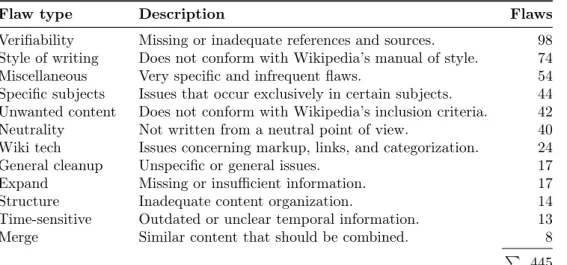
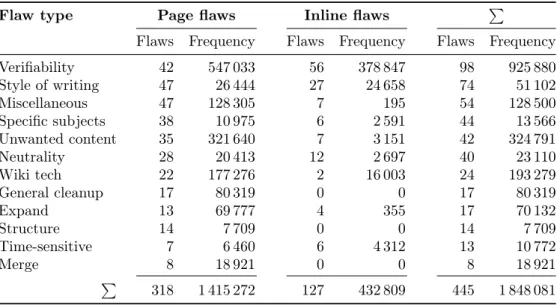
To better understand quality flaws in Wikipedia we organize the 445 flaws along three dimensions: flaw type, flaw scope, and flaw commonness.
2.3.1 Flaw Type
Several quality flaws relate to the same type. For instance the flawsUnreferenced and Citation needed(shown in Figure 2.1) both concern article verifiability. No organization scheme has been proposed before that covers the complete set of quality flaws in Wikipedia. We consider the problem types identified by Stvilia
et al. [144] as inappropriate in this respect, as they result from the manual analysis of only 60 Wikipedia talk pages and hence are very specific. Similarly, the set of ten flaw types proposed in [9] is too specific, as these types target a particular subset of only 70 flaws. At first sight, the featured article criteria (described in Section 1.4.2) may appear as a set of relevant flaw types. However,
there are several drawbacks related to this idea: the featured article criteria are not stable, they do not consider technical aspects, and they focus on particular-ities of high-quality articles. Another idea may be to utilize the organization of the cleanup tags on the meta page ”Wikipedia:Template messages/Cleanup” and consider the section headings as flaw types. However, this organization is mainly intended to serve navigational purposes, and hence, the respective sections are very specific. Ultimately, we organize the quality flaws along a newly formed set of twelve general flaw types, which are described in Table 2.4. Our set is an extension of the ten types proposed in [9], and to some extent it covers the featured article criteria, the problem types of Stvilia et al. [144], and the organization of the above mentioned meta page. The listing in Appendix A organizes the 445 quality flaws along our flaw types. The labeling is exclusive, i.e., each flaw belongs to exactly one type.
The flaw type Verifiability is of particular interest as the verifiability of in-formation is one of the most important principles of an encyclopedia. The flaws that belong to this type refer to articles that cite no references at all (e.g., Unreferenced, No footnotes, and Unreferenced section), to articles with inadequate and invalid references (e.g., Refimprove, Primary sources, andDead link), and to unsourced statements within articles (e.g., Citation needed,Who, and By whom). The flaw typeStyle of writing targets stylistic issues related to grammar, style, cohesion, tone, and spelling. Most of these issues are described in Wikipedia’s manual of style.10 The flaw typeMiscellaneous comprises flaws that are very specific and that occur relatively infrequently. Flaws that focus on a particular topic are organized under the flaw type Specific subjects. For instance, the flaw Plotstates that an article’s plot summary may be too long or excessively detailed, which may only apply to certain articles describing films or novels for instance. The flaw type Unwanted content comprises flaws that refer to content that is either not appropriate for an encyclopedia (e.g., Notability, Advert, andOriginal research) or that is better suited for a different project of the Wikimedia Foundation (e.g.,Copy to WikiquoteandCopy to Wikibooks).11 A fundamental principle of Wikipedia is that articles should be written from a neutral point of view, i.e., representing all significant views unbiased and
10
Wikipedia style guide: http://en.wikipedia.org/wiki/Wikipedia:Manual_of_Style. 11For further information on Wikipedia’s inclusion criteria, refer to: