A Spectral Clustering Algorithm Improved by P Systems
G. Chen, J. Hu, H. Peng, J. Wang, X. HuangGuangchun Chen, Juan Hu, Hong Peng*, Xiangnian Huang
School of Computer and Software Engineering Xihua University, Chengdu, 610039, Sichuan, China [email protected], [email protected] *Corresponding author: [email protected] [email protected]
Jun Wang
School of Electrical and Information Engineering Xihua University, Chengdu, 610039, Sichuan, China [email protected]
Abstract: Using spectral clustering algorithm is dicult to nd the clusters in the cases that dataset has a large dierence in density and its clustering eect de-pends on the selection of initial centers. To overcome the shortcomings, we propose a novel spectral clustering algorithm based on membrane computing framework, called MSC algorithm, whose idea is to use membrane clustering algorithm to realize the clustering component in spectral clustering. A tissue-like P system is used as its computing framework, where each object in cells denotes a set of cluster centers and velocity-location model is used as the evolution rules. Under the control of evolution-communication mechanism, the tissue-like P system can obtain a good clustering partition for each dataset. The proposed spectral clustering algorithm is evaluated on three articial datasets and ten UCI datasets, and it is further compared with classical spectral clustering algorithms. The comparison results demonstrate the advantage of the proposed spectral clustering algorithm.
Keywords: machine learning, spectral clustering, membrane computing, tissue-like P systems.
1 Introduction
Membrane computing initiated by Gheorghe Paun [17], was inspired from the structure and functioning of living cell as well as from the cooperation of cells in tissues, organs, and biological neural networks. Membrane computing is a class of distributed parallel computing models, known as P systems or membrane systems. In the past years, many variants of P systems have been proposed [7, 8, 11, 15, 16, 18, 19, 32, 41, 46], and they have been applied to dierent real-world problems [47], for example, combinatorial optimization [42, 44, 48], robots [1], image processing [4, 5, 22, 25, 40, 43], signal processing [23, 36, 45], knowledge representation [26, 34, 37], fault diagnosis [21, 28, 33, 35, 38, 39], ecology and system biology [3, 9, 10]. Most of membrane systems have been proved to be powerful (equivalent with Turing machine) and eective (able to solve the NP hard problems in a feasible time).
In the recent years, P systems were used to deal with data clustering problems. Zhao et al [49] presented an improved clustering algorithm, in which the rules in cell-like P systems were used to realize classical k-medoids algorithm. In Peng [24], evolution-communication P systems are used to deal with fuzzy clustering problems. In [27] and [29], two dierent mechanisms of P systems were considered to investigate automatic clustering problems. Liu et al [12] used a cell-like P systems with promoters and inhibitors to develop a k-medoids clustering algorithm.
In [20], fuzzy clustering problems were viewed as a multiobjective optimization problem and a tissue-like P system was designed to solve the optimization problem.
Spectral clustering is a popular method for solving clustering problems in a wide range of non-Euclidian spaces, linearly non-separable clusters and detecting non-convex patterns [13]. The key idea in spectral clustering is to achieve graph partitioning by performing eigen-decomposition of a graph Laplacian matrix. The obtained eigenvectors are used as the low dimensional rep-resentation of the data, and then the k-means algorithm is applied to generate the clusters. Spectral clustering approaches dier in how they dene and construct the Laplacian matrix and thus which eigenvectors are selected to represent the partitioning. Moreover, dierent objective functions are used to derive the best cut. Chan et al. [2] proposed the ratio cut to minimize the total cost of the edges crossing the cluster boundaries, normalized by the size of the k clusters, to encourage balanced cluster sizes. Shi and Malik [31] established the normalized cut (NCut), which can measure the dissimilarities among groups and within clusters. In [6], Ding et al. pro-posed min-max cut criterion, which can avoid to segment the smaller subgraphs that contains only a few vertices. According to dierent partitioning criteria and spectral mapping methods, many dierent methods have been developed to realize spectral clustering algorithms. Perona and Freeman [30] proposed PF algorithm based on iterative spectrum, which is the simplest spectral clustering algorithm. Ng et al. [14] proposed the NJW algorithm, which is based on the K channel segmentation. However, there are a number of shortcomings in spectral clustering algorithms, for example, it is dicult to nd the clusters with a large dierence in density and their clustering eect depends on the selection of initial centers.
This paper focuses on application of membrane computing model in spectral clustering to overcome the shortcomings and presents a novel spectral clustering algorithm based on a mem-brane computing model, called MSC algorithm. A tissue-like P system is considered as a com-puting framework, and a membrane clustering algorithm is developed based on the comcom-puting framework and is embedded in a classical spectral clustering algorithm. To the best of our knowledge, this is the rst attempt to use membrane computing model for improving spectral clustering algorithm.
The remainder of this paper is organized as follows. Section 2 reviews classical spectral clustering algorithm. Section 3 describes in detail the proposed membrane spectral clustering (MSC) algorithm. Experimental results and analysis are provided in Section 4. Conclusions is given in Section 5.
2 Spectral clustering and the NJW method
Spectral clustering method is a widely used graph-based approach for data clustering. Given a dataset X = {x1, x2, . . . , xn} in Rn×d with k clusters. We expect the dataset X will be transformed into a weighted undirected graph G = (V, E), in which V ={xi}ni=1 is the vertex
set composed of n data points, and E = {wij}ni,j=1 is the set of weighted edges, where wij indicates the pairwise similarity between thexi andxj. V and E contain all vertices and edges, respectively, LetW = (wi,j)1≤i,j≤n be the anity matrix. Usually,wij in anity matrix can be measured by a Gaussian function:
wij = ( e− d(xi,xj)2 σ2 , i6=j 0, i=j (1)
The degree matrixDis a diagonal matrix, whose elementDii is the degree of data pointxi, i.e.,
Dii= Pn
j=1wij. Based on the two matrices, we can obtain the Laplacian matrix,L. There are three forms of Laplacian matrices: (i) unnormalized Laplacian matrix (L =D−W), and two
normalized Laplacian matrices, (ii) symmetric Laplacian matrix (Lsym = D−1/2W D−1/2) and (iii) random-walk Laplacian matrix (Lrw =I−D−1W).
As a spectral approach for graph partitioning problem, NJW method is one of the most widely used spectral clustering algorithms. Its idea is to nd a new representation of patterns on the rst keigenvectors of the Laplacian matrix. Algorithm 1 gives the details of NJW method.
Algorithm 1 NJW method Input: X∈Rn×d, k ∈N
Output: V ={vi|i= 1,2, . . . , k}
1: Construct the anity matrixW ∈Rn×naccording to Eq. (16);
2: Compute the degree matrixD;
3: Compute the normalized Laplacian matrix Lsym=D−
1 2W D−
1 2;
4: Let 0 ≤ λ1 ≤ λ2 ≤ · · · ≤ λk be the k least eigenvalues of Lsym and p1, p2, . . . , pk be the corresponding eigenvectors; Construct the matrix P = [p1, p2, . . . , pk] ∈ Rn×k, where pi is
ith column vector;
5: Construct the matrixY fromP by renormalizing each rows ofP, i.e.,Yij =Pij/(PjPij2)1/2;
6: Treat each row of Y as a point in Rk, and cluster them into k clusters c1, c2, . . . , ck via k-means algorithm;
7: Output the clusters that corresponds to the original data set, v1, v2, . . . , vk, where vi = {xj|yj ∈ci}.
3 Spectral clustering algorithm based on membrane computing
framework
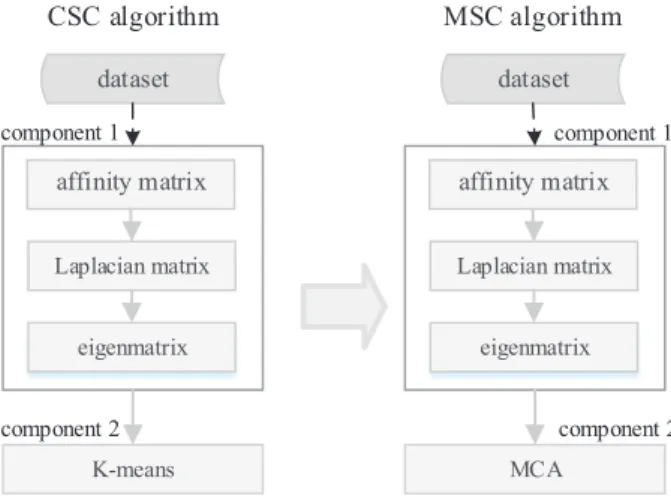
In this paper, we will try to use membrane computing algorithm (MCA) to replace the k-means component in classical spectral clustering algorithm to realize the optimal data parti-tioning. The spectral clustering algorithm optimized by membrane computing model is called MSC algorithm in this paper. By contrast, classical spectral clustering algorithm is called CSC algorithm. Figure 5 shows the structural comparison of CSC and MSC algorithms. From Figure 5, we can nd that rst component of MSC algorithm is the same to that of CSC algorithm, but MSC algorithm uses MCA algorithm rather than k-means algorithm in component 2. Therefore, in the following, we only describe the MCA algorithm. Since the core of MCA algorithm is a tissue-like P system, we rst describe the tissue-like P system, and then illustrate the proposed MCA algorithm.
3.1 A tissue-like P system
We design a tissue-like P system (consisting of q cells) as the computing framework of MCA algorithm:
Π = (O1, O2, . . . , Oq, R1, R2, . . . , Rq, R0, io)
whereOi is the set of objects inith cell,Ri is the set of evolution rules in ith cell, R0 is the set of communication rules between the cells, and the io = 0 indicates that the environment is the output region of the system.
Figure 2 shows the tissue-like P system, which consists of q cells labeled by 1,2, . . . , q
dataset affinity matrix Laplacian matrix eigenmatrix K-means dataset affinity matrix Laplacian matrix eigenmatrix MCA CSC algorithm MSC algorithm component 1 component 2 component 1 component 2
Figure 1: Structural comparison of CSC and MSC algorithms.
object in ith cell, i= 1,2, . . . , q, j = 1,2, . . . , m. The arrows in the gure indicate the
commu-nication of objects. The commucommu-nication of objects is between these cells and the environment. The environment is also the output region of the system. When the system halts, the object in the environment is the optimal solution (a set of optimal cluster centers).
1 2 q
0
Figure 2: The designed tissue-like P system.
Each object in the cells,Z, is used to represent a set of candidatekcluster centers,z1, z2, . . . , zk∈
Rd. Thus, object Z can be represented as ak×ddimensional vector:
Z = (z11, z12, . . . , z1d, . . . , zi1, zi2, . . . , zid, . . . , zk1, zk2, . . . , zkd) (2) where(zi1, zi2, . . . , zid) corresponds toith candidate cluster center,i= 1,2, . . . , k.
These objects in cells will be evolved during the computation. Initially, a set of objects is generated randomly. Based on data points in a data set, we can determine a lower bound and an upper bound for each dimension, Aj = min{x1j, x2j, . . . , xnj},Bj = max{x1j, x2j, . . . , xnj},
j = 1,2, . . . , d. Thus, zij = rand([Aj, Bj]), where rand() denotes a random function that can generate the random number in[Aj, Bj].
The tissue-like P system uses the communication rule of the form< i, a;λ,0>to update the
object in the environment, which means that object ain celliis transported to environment 0,
where λdenotes the empty object. The object in the environment is called the global optimal
object, denoted by Zbest. For each cell, communication rule is used to communicate its best object to the environment and update the optimal object. The updating formula can be given as follows:
Zbest=
Zi,best, if J(Zi,best)< J(Zbest)
Zbest, otherwise (3)
whereZi,bestis the best object inith cell. The object judgement is based on the following tness function: J(z1, z2, . . . , zk) = k X i=1 n X j=1 (uij)mkxj−zi k2 (4)
whereuij denotes membership degree ofxj belonging to ith class, andm is a power exponent. During the computation, tissue-like P system uses evolution rules to evolve the objects in cells. In this work, the velocity-location model of PSO is used as the evolution rules. The velocity-location model can be described as follows:
Vji=wZji+c1r1(Pji−Zji) +c2r2(Zbest−Zji)
Zj0i =Zji+Vji (5)
where Vji corresponds to the speed of Zji, Zj0i is the new value of Zji after evolving, and Pji
is the best position so far for jth object in ith cell; w is the inertia weight constant, c1 and
c2 are learning rate constants, and r1 and r2 are two random real numbers in [0,1]. In the
implementation of MCA algorithm, a linear decreasing strategy is used, i.e., w = (0.9− t
2T), wheretis the current iteration number and T is the maximum number of iterations.
In this paper, the maximum iteration number is used as halting condition. After the system halts, the best objectZbest in the environment is regarded as the solution. Finally, according to the optimal cluster centers, c1, c2, . . . , ck,N data points are classies intok clusters.
3.2 Membrane clustering algorithm
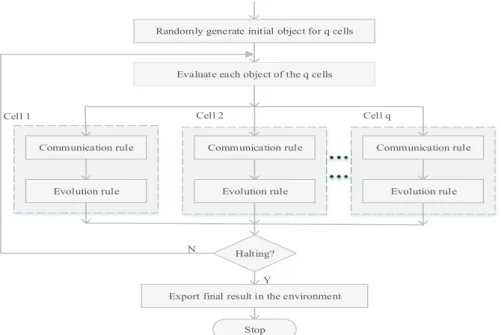
As stated above, MCA algorithm is used as second component of the MSC algorithm. The MCA algorithm uses the designed tissue-like P system to automatically search for the optimal cluster centers for a data set to be clustered. Under the control of the evolution and commu-nication rules, the P system continuously evolves the objects in cells and updates the global optimal object in the environment until the system halts. Figure 3 shows the ow chart of MCA algorithm.
Randomly generate initial object for q cells
Evaluate each object of the q cells
Communication rule Communication rule Communication rule
Evolution rule Evolution rule Evolution rule
Cell 1 Cell 2 Cell q
Halting? N
Export final result in the environment Y
Stop
4 Experimental results and analysis
4.1 Dataset
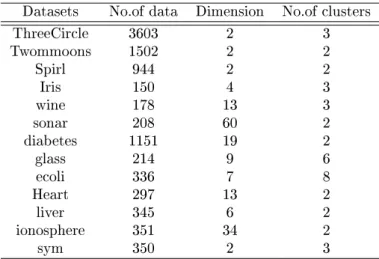
In order to evaluate the performance of MSC algorithm, three benchmark synthetic dataset and ten UCI dataset were used in experiments. The three synthetic dataset are Threecircles, Twommoons and Spirl respectively, shown in Figure 4(a)-(c). Table 1 gives the basic information for all data sets.
(a) (b) (c)
Figure 4: Three synthetic datasets. (a) Threecircle; (b) Twommoons; (c) Spirl. Table 1: Data sets used in experiments
Datasets No.of data Dimension No.of clusters
ThreeCircle 3603 2 3 Twommoons 1502 2 2 Spirl 944 2 2 Iris 150 4 3 wine 178 13 3 sonar 208 60 2 diabetes 1151 19 2 glass 214 9 6 ecoli 336 7 8 Heart 297 13 2 liver 345 6 2 ionosphere 351 34 2 sym 350 2 3 4.2 Experimental results
Three commonly used indexes of quality were used to measure the clustering performance. (1) Adjusted Rand Index (ARI): ρARI ∈[−1,1].
This index measures the agreement between two compared partitions, namely, the ground truth (denoted asU) and the estimated by the tested clustering approach (denoted asV),
and it is expressed by
ρARI =
a11−(a11+a01)(a11+a10)/a00
(a11+a01) + (a11+a10)/2−(a11+a01)(a11+a10)/a00 (6)
where a11 ∈ N is the number of sample pairs belonging to the same subset in U and in
V, a10 is the number of sample pairs belonging to the same subset in U and to dierent
to the same one in V, and a00 ∈ N is the number of sample pairs belonging to dierent
subsets inU and inV.
(2) Purity Index (PUR):ρP U R ∈[0,1].
This index matches the clustering partitionV with the ground truth U as a weighted sum
of the maximal precision values for each subset.
ρP U R = 1 N k X i=1 max j |vi∩uj| (7)
(3) Jaccard Index (JAC): ρJ AC ∈[0,1].
This index matches the similarity among two sets, U and V, as follows: ρJ AC =
a11
a11+a10+a01 (8)
In the experiment, two classical spectral clustering algorithms, K-SC and -SC, were
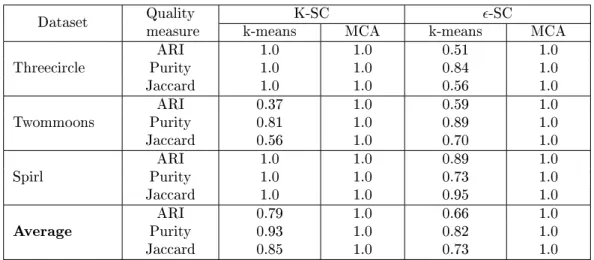
intro-duced to implement two MSC algorithms, where membrane clustering algorithm is used to replace k-means component in the original spectral clustering algorithms. Thus, two MSC algorithms and the corresponding classical spectral clustering algorithms were compared in experiment. Ta-ble 2 and TaTa-ble 3 show the comparison results of these algorithms on synthetic and UCI datasets, respectively. For each dataset, these tables provide the experimental results of four algorithms in terms of three indexes. Note that these experimental results are average value of 10 times independently running for each algorithm on a dataset. Moreover, we also provide the averages of these algorithms for each clustering index, respectively.
From table 2, we can see that the average value of MSC algorithm is the largest and can reach 1. The results show that the spectral clustering algorithm based on membrane computing framework has an obvious advantage in improving the average performance of spectral clustering algorithm. Comparison results of MSC and TSC on the UCI datasets show that K-SC and
-SC algorithms based on membrane computing framework can signicantly improve the Jaccard index, indicating that the proposed MSC algorithm is more robust and has a certain ability to deal with noise data. For the ARI and the Purity indexes, MSC algorithm achieves a comparable result in comparison to the classical algorithm.
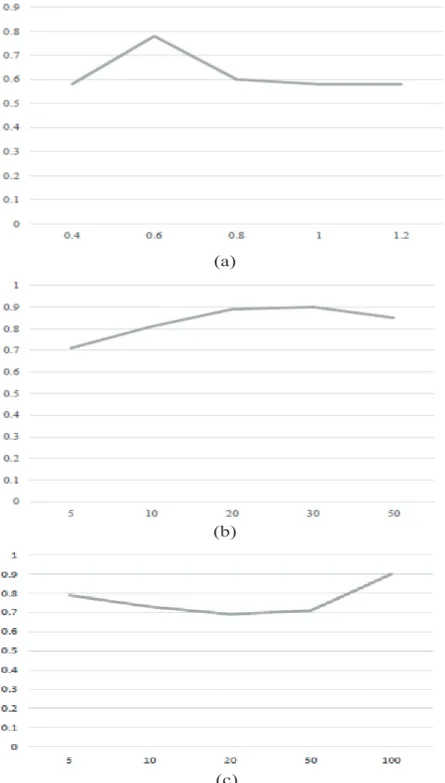
Iris dataset is used as an example to analyze the inuences of parameters in MSC algorithm. Figure 5 (a)-(c) shows the inuences of three parameters, including bandwidthof the Gaussian
kernel function, the number of cellsmand the maximum number of iterationsM axstep. As can
be seen from the gures, MSC algorithm is more sensitive tomand, and the curve of parameter M axstep rises slowly and nally tends to straight line, which indicates that the performance of
Table 2: Clustering quality assessment results (synthetic datasets). Dataset Qualitymeasure k-meansK-SC MCA k-means-SC MCA Threecircle PurityARI 1.01.0 1.01.0 0.510.84 1.01.0
Jaccard 1.0 1.0 0.56 1.0
Twommoons PurityARI 0.370.81 1.01.0 0.590.89 1.01.0
Jaccard 0.56 1.0 0.70 1.0
Spirl PurityARI 1.01.0 1.01.0 0.890.73 1.01.0
Jaccard 1.0 1.0 0.95 1.0
Average PurityARI 0.790.93 1.01.0 0.660.82 1.01.0
Jaccard 0.85 1.0 0.73 1.0
Table 3: Clustering quality assessment results (UCI repository datasets). Dataset Qualitymeasure k-meansK-SC MCA k-means-SC MCA Iris PurityARI 0.440.87 0.660.86 0.630.84 0.750.90
Jaccard 0.50 0.64 0.60 0.71
wine PurityARI 0.030.57 0.300.67 0.290.53 0.400.0
Jaccard 0.24 0.37 0.38 0.34
Sonar PurityARI 0.020.57 -0.010.51 0.000.55 -0.00580.50
Jaccard 0.34 0.48 0.34 0.48
diabetes PurityARI 0.160.70 0.010.53 0.160.70 0.530.0
Jaccard 0.43 0.51 0.43 0.50
glass PurityARI 0.170.51 0.360 0.160.52 0.010.36
Jaccard 0.25 0.26 0.33 0.26
ecoli PurityARI 0.370.56 0.200.45 0.480.66 0.420.70
Jaccard 0.32 0.29 0.42 0.65
Heart PurityARI 0.310.78 0.040.55 0.370.80 0.400.75
Jaccard 0.49 0.51 0.52 0.63
liver PurityARI 0.650 -0.020.58 -0.010.98 0.120.67
Jaccard 0.36 0.51 0.50 0.56
ionosphere PurityARI 0.150.70 0.010.64 0.130.68 0.250.73
Jaccard 0.44 0.54 0.41 0.55
sym PurityARI 0.560.68 0.750.87 0.490.75 0.380.54
Jaccard 0.79 0.72 0.43 0.43
Average PurityARI 0.280.66 0.200.61 0.280.70 0.230.61
(a)
(b)
(c)
Figure 5: Free parameter analysis over UCI datasets based on the Purity: (a) bandwidth of
the Gaussian kernel function; (b) the number of cellsm; (c) the maximum number of iterations M axstep.
5 Conclusion
In this paper, we used membrane computing framework to develop a novel spectral clustering algorithm, called MSC algorithm. The core component of MSC algorithm is a tissue-like P system which is composed of several cells and uses the improved PSO algorithm as evolution mechanism. We evaluated the performance of the proposed algorithm on three articial data sets and ten UCI datasets. The results show that compared with the classical spectral clustering algorithm, the proposed algorithm can improve the clustering performance. This study also demonstrates the eectiveness of using the membrane computing framework to solve data clustering problems. MSC algorithm used membrane clustering algorithm (MCA) instead of k-means component in classical spectral clustering algorithm, which searches for the optimal solution by both the evolution of objects in multiple cells and the communication of objects between the cells. It is well known that membrane computing is a distributed computing model. However, MSC algorithm is not implemented in parallel due to limitation of the computer's serial architecture. Therefore, our further work is to discuss the parallel implementation of MSC algorithm on GPGPU and/or FPGA.
Funding
This work was partially supported by the National Natural Science Foundation of China (No. 61472328), Chunhui Project Foundation of the Education Department of China (Nos. Z2016143 and Z2016148), Research Foundation of the Education Department of Sichuan province (No. 17TD0034), China, and the Innovation Fund of Postgraduate, Xihua University(no. ycjj2017073).
Bibliography
[1] Buiu, C.; Vasile, C.; Arsene, O. (2012); Development of membrane controllers for mobile robots, Information Sciences, 187, 33-51, 2012.
[2] Chan, P.K.; Schlag, M.D.F.; Zien, J.Y. (1993); Spectral k-way ratio-cut partitioning and clustering, DAC, 749-754, 1993.
[3] Colomer, A.M.; Margalida, A.; Pérez-Jiménez, M.J. (2013); Population dynamics P system (PDP) models: a standarized protocol for describing and applying novel bio-inspired com-puting tools, Plos One, 4, 1-13, 2013.
[4] Díaz-Pernil, D.; Berciano, A.; Peña-Cantillana, F.; Gutiérrez-Naranjo, M.A. (2013); Seg-menting images with gradient-based edge detection using membrane computing, Pattern Recognition Letters, 34(8), 846-855, 2013.
[5] Díaz-Pernil, D.; Peña-Cantillana, F.; Gutiérrez-Naranjo, M.A. (2013); A parallel algorithm for skeletonizing images by using spiking neural P systems, Neurocomputing, 115, 81-91, 2013. [6] Ding, C.; He, X.; Zha, H.; Gu, M.; Simon, H. (2001); Spectral min-max cut for graph partitioning and data clustering, Technical Report TR-2001-XX, Lawrence Berkeley National Laboratory, University of California, Berkeley, CA, 2001.
[7] Dzitac, I. (2015); Impact of membrane computing and P systems in ISI WoS. celebrating the 65th birthday of Gheorghe P un, International Journal of Computers Communications
[8] Freund, R.; Paun, G.; Pérez-Jiménez, M.J. (2005); Tissue-like P systems with channel-states, Theoretical Computer Science, 330, 101-116, 2005.
[9] Garcia-Quismondo, M.; Levin, M.; Lobo-Fernández, D. (2017); Modeling regenerative pro-cesses with Membrane Computing, Information Sciences, 381, 229-249, 2017.
[10] Gheorghe, M.; Manca, V.; Romero-Campero, F.J. (2010); Deterministic and stochastic P systems for modelling cellular processes, Natural Computing, 9(2), 457-473, 2010.
[11] Ionescu, M.; P un G.; Yokomori, T. (2006); Spiking neural P systems, Fundamenta Infor-maticae, 71, 279-308, 2006.
[12] Liu, X.; Zhao, Y.; Sun, W. (2016); K-medoids-based consensus clustering based on cell-like P systems with promoters and inhibitors, Bio-inspired Computing - Theories and Applications, 95-108, 2016.
[13] Luxburg, U.V. (2007); A tutorial on spectral clustering, Statistics and Computing, 17(4), 395-416, 2007.
[14] Ng, A.Y., Jordan, M., Weiss, Y. (2001); On spectral clustering: analysis and an algorithm, Proc Nips, 849-856, 2001.
[15] Pan, L.; Wang, J.; Hoogeboom, H.J. (2012); Spiking neural P systems with astrocytes, Neural Computation, 24(3), 805-825, 2012.
[16] Pan, L.; P un, G. (2009); Spiking neural p systems with anti-spikes, International Journal of Computers Communications & Control, 4(3), 273-282, 2009.
[17] P un, G. (2000); Computing with membranes, Journal of Computer System Sciences, 61(1), 108-143, 2000.
[18] P un, G.; Rozenberg, G.; Salomaa, A. (2010); The Oxford Handbook of Membrance Com-puting, Oxford Unversity Press, New York, 2010.
[19] P un, G. (2016); Membrane computing and economics: a general view, International Jour-nal of Computers Communications &Control, 11(1), 105-112, 2016.
[20] Peng, H.; Shi, P.; Wang, J.; Riscos-Núñez, A.; Pérez-Jiménez, M.J. (2017); Multiobjective fuzzy clustering approach based on tissue-like membrane systems, Knowledge-Based Systems, 125, 74-82, 2017.
[21] Peng, H.; Wang, J.; Ming, J.; Shi, P.; Pérez-Jiménez, M.J.; Yu, W.; Tao, C. (2018); Fault diagnosis of power systems using intuitionistic fuzzy spiking neural P systems, IEEE Trans-action on Smart Grid, 2018. Available at http://dx.doi.org/10.1109/TSG.2017.2670602. [22] Peng, H.; Wang, J.; Pérez-Jiménez, M.J. (2015); Optimal multi-level thresholding with
membrane computing, Digital Signal Processing, 37, 53-64, 2015.
[23] Peng, H.; Wang, J.; Pérez-Jiménez, M.J.; Riscos-Núñez, A. (2014); The framework of P systems applied to solve optimal watermarking problem, Signal Processing, 101, 256-265, 2014.
[24] Peng, H.; Wang, J.; Pérez-Jiménez, M.J.; Riscos-Núñez, A. (2015); An unsupervised learning algorithm for membrane computing, Information Sciences, 304(20), 80-91, 2015.
[25] Peng, H.; Wang, J.; Pérez-Jiménez, M.J.; Shi, P. (2013); A novel image thresholding method based on membrane computing and fuzzy entropy, Journal of Intelligent and Fuzzy Systems, 24(2), 229-237, 2013.
[26] Peng, H.; Wang, J.; Pérez-Jiménez, M.J.; Wang, H.; Shao, J.; Wang, T. (2013); Fuzzy reasoning spiking neural P system for fault diagnosis, Information Sciences, 235(20), 106-116, 2013.
[27] Peng, H.; Wang, J.; Shi, P.; Pérez-Jiménez, M.J.; Riscos-Núñez, A. (2016); An extended membrane system with active membrane to solve automatic fuzzy clustering problems, In-ternational Journal of Neural Systems, 26, 1-17, 2016.
[28] Peng, H.; Wang, J.; Shi, P.; Pérez-Jiménez, M.J.; Riscos-Núñez, A. (2017); Fault diagnosis of power systems using fuzzy tissue-like P systems, Integrated Computer-Aided Engineering, 24, 401-411, 2017.
[29] Peng, H.; Wang, J.; Shi, P.; Riscos-Núñez, A.; Pérez-Jiménez, M.J. (2015); An automatic clustering algorithm inspired by membrane computing, Pattern Recognition Letters, 68(15), 34-40, 2015.
[30] Perona, P.; Freeman, W. (1998); A factorization approach to grouping, Computer Vision ECCV'98, Springer, 655-670, 1998.
[31] Shi, J.; Malik, J. (2000); Normalized cuts and image segmentation, IEEE Transactions on pattern analysis and machine intelligence, 22(8), 888-905, 2000.
[32] Song, T.; Pan, L., P un, G. (2014), Spiking neural P systems with rules on synapses, Theoretical Computer Science, 529, 82-95, 2014.
[33] Tu, M.; Wang, J.; Peng, H.; Shi, P. (2014); Application of adaptive fuzzy spiking neural P systems in fault diagnosis of power systems, Chin. Jour. Elect., 23(1), 87-92, 2014.
[34] Wang, J.; Peng, H. (2013); Adaptive fuzzy spiking neural P systems for fuzzy inference and learning, International Journal of Computer Mathematics, 90(4), 857-868, 2013.
[35] Wang, J.; Peng, H.; Tu, M.; Pérez-Jiménez, M.J. (2016); A fault diagnosis method of power systems based on an improved adaptive fuzzy spiking neural P systems and PSO algorithms, Chin. Jour. Elect., 25(2), 320-327, 2016.
[36] Wang, J.; Shi, P.; Peng, H. (2016); Membrane computing model for IIR lter design, Infor-mation Sciences, 329, 164-176, 2016.
[37] Wang, J.; Shi, P.; Peng, H.; Pérez-Jiménez, M.J.; Wang, T. (2013); Weighted fuzzy spiking neural P system, IEEE Trans. Fuzzy Syst., 21(2), 209-220, 2013.
[38] Wang, T.; Zhang, G.X.; Zhao, J.B.; He, Z.Y.; Wang, J., Pérez-Jiménez, M.J. (2015); Fault diagnosis of electric power systems based on fuzzy reasoning spiking neural P systems, IEEE Trans. Power Syst., 30(3), 1182-1194, 2015.
[39] Xiong, G.; Shi, D.; Zhu, L.; Duan, X. (2013); A new approach to fault diagnosis of power sys-tems using fuzzy reasoning spiking neural P syssys-tems, Mathematical Problems in Engineering, 2013(1), 211-244, 2013.
[40] Yahya, R.I.; Hasan, S.; George, L.E.; Alsalibi, B. (2015); Membrane computing for 2D image segmentation, International Journal of Advances in Soft Computing and its Application, 7(1), 35-50, 2015.
[41] Zeng, X.; Zhang, X.; Song, T.; Pan, L. (2014); Spiking neural P systems with thresholds, Neural Computation, 26(7), 1340-1361, 2014.
[42] Zhang, G.; Cheng, J.; Gheorghe, M.; Meng, Q. (2013); A hybrid approach based on dieren-tial evolution and tissue membrane systems for solving constrained manufacturing parameter optimization problems, Applied Soft Computing, 13(3), 1528-1542, 2013.
[43] Zhang, G.; Gheorghe, M.; Li, Y. (2012); A membrane algorithm with quantum-inspired subalgorithms and its application to image processing, Natural Computing, 11(4), 701-717, 2012.
[44] Zhang, G.; Gheorghe, M.; Pan, L.; Pérez-Jiménez, M.J. (2014); Evolutionary membrane computing: a comprehensive survey and new results, Information Sciences, 279, 528-551, 2014.
[45] Zhang, G.; Liu, C.; Rong, H. (2010); Analyzing radar emitter signals with membrane algo-rithms, Mathematical and Computer Modelling, 52, 1997-2010, 2010.
[46] Zhang, X.; Pan, L.; P un, A. (2015); On the universality of axon P systems, IEEE Trans-actions on Neural Networks and Learning Systems, 26(11), 2816-2829, 2015.
[47] Zhang, G.; Pérez-Jiménez, M.J.; Gheorghe, M. (2017); Real-life Applications With Mem-brane Computing, Springer, 2017.
[48] Zhang, G.; Rong, H.; Neri, F.; Pérez-Jiménez, M.J. (2014); An optimization spiking neural P system for approximately solving combinatorial optimization problems, International Journal of Neural Systems, 24, 1-16, 2014.
[49] Zhao, Y.; Liu, X.; Qu, J. (2012); The k-medoids clustering algorithm by a class of P system, Journal of Information &Computational Science, 9(18), 5777-5790, 2012.