A review of research on the role and effectiveness
of business incubation for high-growth start-ups
Nicola Dee, David Gill, Robert Lacher, Finbarr
Livesey and Tim Minshall
No: 2012/01, January 2012
Centre for Technology Management Working Paper Series
These papers are produced by the Institute for Manufacturing, at the University of Cambridge Engineering Department. They are circulated for discussion purposes only and should not be quoted without the author's permission. Your comments and suggestions are welcome and should be directed to the first named author.
A review of research on the role and effectiveness of business incubation for
high-growth start-ups
Nicola Dee1, David Gill1,2, Robert Lacher1,3, Finbarr Livesey1 and Tim Minshall1,2,4
1
Institute for Manufacturing, Cambridge University Engineering Department
2
St John’s Innovation Centre Ltd. Cambridge
3
RWTH Aachen University
4
Institute for Technology, Enterprise and Competitiveness, Doshisha University
January 2012
© 2012 University of Cambridge Institute for Manufacturing. I.S.B.N.
Abstract
The aim of this paper is to provide an overview of current knowledge on the role and effectiveness of business incubation in supporting the development of new firms with high growth potential. The quantitative and qualitative literature published by the academic and practitioner communities is reviewed. From analysis of this literature, the following conclusions are drawn:
• In academic and practitioner publications alike there is widespread definitional and conceptual ambiguity in relation to business incubation.
• Given the variety of business incubator strategies, business models, stakeholders, et al., there is no standard measure for assessing incubator performance. The validity, comparability and generalisability of published findings of incubator performance need to be carefully considered.
• As the incubation industry has matured so understanding of its core purpose has become more sophisticated.
• Research on business incubation needs to be considered in the context of other bodies of knowledge; in particular cluster theory, regional innovation systems, entrepreneurship, investment, and firm growth.
These conclusions point to areas of further research including the development of comparable performance indicators – not absolute performance measures – for business incubation; the need to integrate incubation research more effectively within established areas of research; the linking the activities of business incubation to new ventures in emerging industries; and research on the provision of incubation services for device-based or other physical product-based start-ups.
Acknowledgements
This research was supported by the UK National Endowment for Science, Technology and the Arts (NESTA) and the UK Engineering and Physical Sciences Research Council (EPSRC) via the Innovative Manufacturing Research Centre (IMRC) Emerging Industries Programme at the University of Cambridge Institute for Manufacturing.
1
Introduction
The aim of this paper is to provide an overview of current knowledge on the role and effectiveness of business incubation in supporting start-ups with high-growth potential. This paper draws upon the results of a project commissioned by the UK National Endowment for Science, Technology and the Arts (NESTA), the results of which have been published as Dee
et al. (2011). The purpose of the NESTA-funded research was to review research on models of incubation that have by various metrics the greatest impact on building high growth, innovative firms. This paper also drew upon the interim results of – and contributes to – on-going research on the role of the availability of finance for new firms in supporting the emergence of new industries1.
For the purposes of this review, we use Hackett and Dilts’ definition of incubation as: “[..] a shared office-space facility that seeks to provide its incubatees (i.e. ‘‘portfolio’’ or ‘‘client-’’ or ‘‘tenant-companies’’) with a strategic, value-adding intervention system (i.e. business incubation) of monitoring and business assistance.” (Hackett and Dilts, 2004:57).
Within this definition, we also further refine our focus on to incubation activities that are primarily aimed at supporting new ventures seeking to create value from technology, and which have high growth potential.
This paper reviews the results of quantitative and qualitative research on business incubation published by the academic and practitioner communities. In order to address themes emerging from some of the publications reviewed, we widened our scope to make reference to the literature relating more broadly to the entrepreneurial process.
The remainder of this paper is divided into four sections. First, we present the context of business incubation and give a typology of incubation types in order to provide structure for our review. Second, we summarise and comment upon the literature relating to the performance of business incubation activities. Third, we focus our attention onto the literature relating to the strategies and operations of business incubation activities. Finally, we draw a series of conclusions from this analysis and recommend areas for further research.
1 In particular, the “Investment Frameworks” project within the EPSRC-funded Emerging Industries Programme at
the Cambridge University Engineering Department Institute for Manufacturing Innovative Manufacturing Research Centre http://www.ifm.eng.cam.ac.uk/imrc/eip/investment.html.
2
Context
Since the first recognised incubator established in Batavia, New York in 19592, there was a slow diffusion of incubator programmes in the 1960s/70s followed by a strong increase in numbers through and beyond the 1990s (Figure 1). Several factors drove this growth, and for technology-related incubation, three drivers for this include:
• In the UK, the development of multiple public funding streams for ‘third mission’ activities (i.e. commercialisation activities beyond the core teaching and research missions) within universities stimulated a marked increase in new venture spin-off activities from the late 1990s onwards (Gill et al. 2007; Minshall 2008). Similarly in the US, the 1980 Bayh-Dole Act helped stimulate the increase in the number of university spin-outs and start-ups, and related support activities (Hackett and Dilts 2004b).
• The emergence of the ‘new economy’ driven by the commercialisation of the Internet and development of the World Wide Web resulted in a dramatic increase in information and communication technology (ICT) related start-up activity (Nairn 2002) and in the provision of services to support the development of such ventures (Hansen
et al. 2000).
• The recognition by policymakers of the role that business incubation for technology start-ups could play in stimulating economic growth as one component within a regional innovation system. In particular, the belief that incubation had the potential to support employment creation in the medium to long term was noted in policy documents (OECD 1997; UNIDO 1999).
The establishment of industry associations such as the US National Business Incubation Association (NBIA3, established in 1984), the European Business Innovation Centre Network (EBN4, approved by the European Commission in 2002), and United Kingdom Business Incubation (UKBI5, established in 1998), led to increased interest in the assessment of the role and effectiveness of business incubation.
2 http://www.nbia.org/resource_library/history/index.php 3 http://www.nbia.org/
4 http://www.ebn.be/ 5 http://www.ukbi.co.uk/
Figure 1 Growth of the worldwide incubator industry (Barrow 2001)
The focus of academic research in this area has evolved as the incubation industry itself has matured (Figure 2). While incubators lost some favour following the collapse of the dot.com speculative bubble in 2000 owing to the numerous commercially unsuccessful web business related incubators, incubation has nonetheless prevailed as part of a wider innovation system (Hackett and Dilts 2004b)6.
Figure 2 Overview of incubator-incubation literature (Main topics in italics, research questions without italics) (Hackett and Dilts 2004b)
2.1
Objectives of incubation
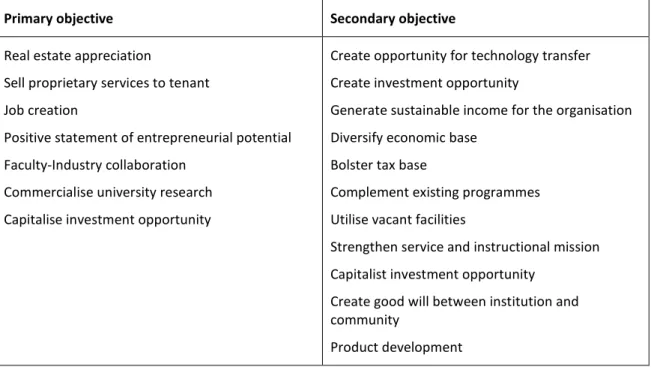
Two main rationales for incubation have emerged. The first view regards incubation as a way of addressing market failures which limit the ability of high-tech start-ups to overcome uncertainty and obstacles associated with the early stages of firm development (OECD 1997; Phan et al. 2005). Those who subscribe to the market failure view believe that failures stem from the relatively high costs and risks associated with providing support to high-tech start-up companies. Private sector institutions are unwilling to absorb the costs and risks if the potential to capture commercial value of the technology being exploited is too uncertain . The second view regards incubation as a catalyst to systematically accelerate the entrepreneurial process thereby institutionalising the support of ventures with potential for high growth (Hansen et al. 2000). In practice incubation has been associated with a variety of objectives (Allen and McCluskey 1990) (Table 1). Very often these objectives relate to the specific business environment (nationally and regionally) in which the incubator is located.
Primary objective Secondary objective
Real estate appreciation
Sell proprietary services to tenant Job creation
Positive statement of entrepreneurial potential Faculty-Industry collaboration
Commercialise university research Capitalise investment opportunity
Create opportunity for technology transfer Create investment opportunity
Generate sustainable income for the organisation Diversify economic base
Bolster tax base
Complement existing programmes Utilise vacant facilities
Strengthen service and instructional mission Capitalist investment opportunity
Create good will between institution and community
Product development Table 1 Incubation objectives (Allen and McCluskey 1990)
Regardless of an incubator’s specified objective, its main lever with which to achieve its objective is through its impact upon its tenants or incubatees. The primary incubator function has been described as increasing the chances of an incubatee firm surviving its formative years (Allen and Rahman 1985). Theoretically the incubator can also impact on individual tenants through improving their growth paths, as illustrated in Figure 3. This impact can last beyond the incubation period. As a result incubation can fulfil many of the objectives described in Table 1 through enhancing growth in the productivity and employment of its tenants both
during and after the incubation process, which in turn has an impact on the wider business environment.
Figure 3 Theoretical impact of an incubator on the irregular growth path of an individual tenant (Dee et al. 2011)
2.2
Typologies of incubators
The development of business incubation activities over the last 50 years has led to definitional and conceptual ambiguity regarding the scope and boundaries of the phenomenon (Lindelof and Lofsten 2002; Hackett and Dilts 2004b; Phan et al. 2005). Sources of definitional ambiguity include:
• The disagreement about whether an incubator is a distinct organisation or a more general entrepreneurial environment (Swierczek 1992; Hackett and Dilts 2004b; Phan
et al. 2005).
• The emergence of virtual incubators (‘incubators without walls’) which focus on setting up a support infrastructure of business services to incubatees who are not located within a physical incubator building (Lalkaka 2001; Miller and Bound 2011)7.
7 There are mixed views on whether ‘virtual incubators’, i.e. ‘incubators without walls’, are incubators at all (Bearse
1998 cited in Hackett and Dilts 2004). There has been a rise in a variety of ‘virtual incubators’ and acceleration programmes as incubator activities have diversified (Miller and Bound 2011). This study focuses on incubators with physical space. Anecdotally it has been suggested that physical space encourages more face-face interactions which build a greater level of trust than can be achieved online. This trust encourages more meaningful interactions and exchanges of knowledge and being part of the space increases the frequency of such interactions. How much ‘virtual incubators’ are able to achieve such interactions and exchanges of knowledge between peers and others will depend on a case-by-case basis (Dee et al. 2011).
• The different types of stakeholders (i.e. publicly operated incubators vs. privately operated incubators) and their diverse goals (CSES 2002).
• The distinction between incubators, venture capital firms and other start-up support structures (Aaboen 2009).
• The lack of clarity on which part of the venture development progress is being considered (Garnsey and Heffernan 2005a; McAdam and McAdam 2008).
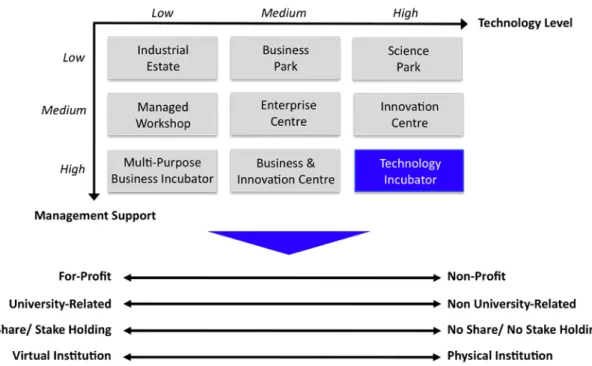
In a generic sense the term ‘incubator’ is often used to describe a wide range of organisations that help entrepreneurs establish and develop their ideas from inception through to commercialisation and the start-up of a new enterprise (CSES 2002). A broad definition of the term includes science parks, technology centres, business and innovation centres, virtual incubators, business accelerators, venture accelerators and a variety of other models. In an attempt to provide some focus, Figure 4 gives an overview of different incubator models with regard to their business support and technology level.
Figure 4 Typology of incubators (developed from ideas introduced in CSES (2002))
Besides the level of business support and technology, further distinction criteria for incubators can be classified with regard to whether they are (1) run for-profit or non-profit, (2) university related or non-university related, (3) stake holding or non-stake holding and (4) a physical or a virtual institution (see Figure 4).
Within the literature – and the industry - a variety of labels are often used in an interchangeable manner, which has led to problems in collecting and comparing data on incubators and has reduced the generalisability of research results (Hackett and Dilts 2004b). For the purpose of this research, the following definition of a business incubator from Hackett and Dilts is adopted:
“[..] a shared office-space facility that seeks to provide its incubatees (i.e. ‘‘portfolio-’’ or ‘‘client-’’ or ‘‘tenant-companies’’) with a strategic, value-adding intervention system (i.e. business incubation) of monitoring and business assistance. This system controls and links resources with the objective of facilitating the successful new venture development of the incubatees while simultaneously containing the cost of their potential failure” (Hackett and Dilts 2004b:57) .
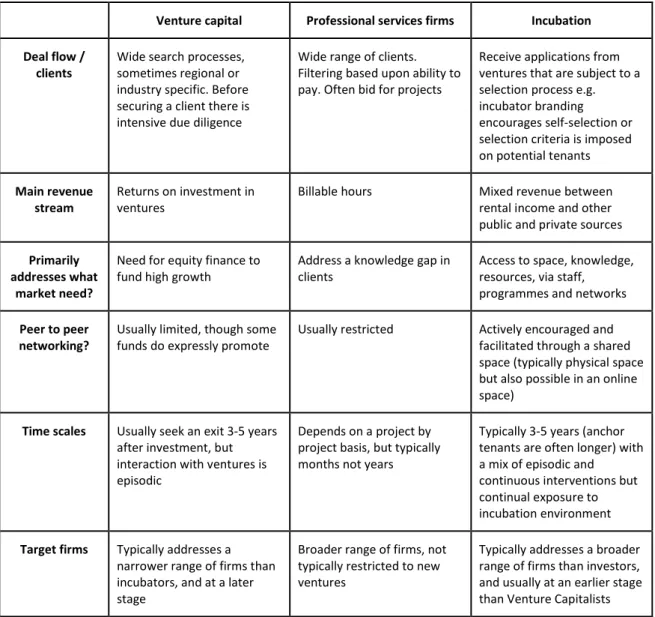
Incubation has also been loosely applied to various activities at different units of analysis. Increasingly organisations involved with the support of entrepreneurial activity risk being referred to as ‘incubators’, with some extending the term to geographic regions with unusually levels of entrepreneurial activity (Phan et al. 2005). Some venture capitalists that offer higher than average business support activities have also been termed incubators, particularly in the U.S. This confusion among investors, professional services firms offering business support, and incubators has prompted some studies that seek to compare these differing roles (Hsu 2007; Aaboen 2009). We have drawn upon these studies and produced a top-line comparison between incubation, venture capital and professional services firms to identify specific characteristics of business incubation (Table 2). For example, though usually not as intensive as for venture capitalists, the implementation of a selection process for tenants seems important in incubation. In addition to business assistance, the aggregation and interaction of incubatees co-located inside the incubator has been identified as unique to incubation (Hackett and Dilts 2004b). Table 2 supports this and suggests the distinctive features of incubation are a very mixed revenue stream, strong encouragement of peer to peer networking, addressing multiple needs of new ventures without prioritising just one, and offering continual exposure to the incubation environment and services.
Venture capital Professional services firms Incubation Deal flow /
clients Wide search processes, sometimes regional or industry specific. Before securing a client there is intensive due diligence
Wide range of clients. Filtering based upon ability to pay. Often bid for projects
Receive applications from ventures that are subject to a selection process e.g. incubator branding encourages self-selection or selection criteria is imposed on potential tenants
Main revenue
stream Returns on investment in ventures Billable hours Mixed revenue between rental income and other public and private sources
Primarily addresses what
market need?
Need for equity finance to
fund high growth Address a knowledge gap in clients Access to space, knowledge, resources, via staff, programmes and networks
Peer to peer
networking? Usually limited, though some funds do expressly promote Usually restricted Actively encouraged and facilitated through a shared space (typically physical space but also possible in an online space)
Time scales Usually seek an exit 3-5 years after investment, but interaction with ventures is episodic
Depends on a project by project basis, but typically months not years
Typically 3-5 years (anchor tenants are often longer) with a mix of episodic and continuous interventions but continual exposure to incubation environment
Target firms Typically addresses a narrower range of firms than incubators, and at a later stage
Broader range of firms, not typically restricted to new ventures
Typically addresses a broader range of firms than investors, and usually at an earlier stage than Venture Capitalists
Table 2 Identifying the uniqueness of incubation (Developed from Hackett & Dilts (2004b); Aaboen (2009); Hsu (2007)
3
Performance of business incubators
There is no standard methodology for measuring incubator performance which makes comparisons between studies challenging8 (Phan et al. 2005). Analysis of published studies reveals that these need to be considered in terms of:
• Author and publisher: While peer-reviewed academic publications should be
considered reasonably free from bias, reports published by individual incubators or
industry associations may wish to present an overly positive view of incubator performance.
• Research method: Three broad categories observed in our review are control group
analysis, benchmarking, and in-depth analysis. Each approach has strengths and weaknesses, and results from each are not typically comparable. As with all research projects, large-scale surveys lead to quantitative date that may reveal broad trends, while case study analysis may provide richer, qualitative insight onto complex issues but may be less generalisable.
• Focus of analysis: The focal areas in published analyses include performance outcomes
(for the tenants, the incubator, or the region), management policies (such as selection processes and quality of management team), or the additional services offered the incubator (such as investment readiness programmes and access to business networks).
In the following sections we review the literature in terms of each of these three broad themes.
3.1
Author and publisher
3.1.1
Data from incubator industry associations
Business incubator industry associations regularly assess the impact of business incubators and offer estimates of aggregate performance (e.g. UKBI (2009), NBIA (Knopp 2007), EBN (2009)). Many incubators are either wholly or partly publicly funded. In the competition to attract public funds many incubators need regularly to demonstrate ‘success’ which can lead to over-reporting successes and under-over-reporting failures especially when self-over-reporting (Hackett and Dilts 2004b).
Job creation remains a popular measure used to evaluate incubator performance9 (CSES 2002; Frontline 2002; SQWConsulting 2008). However, using job creation as a metric of incubator performance is problematic. New ventures will often try to reduce their fixed costs as they operate in conditions of uncertainty. Venture investors are acutely aware of the need to control spending by investee firms, which often means in practice delaying recruitment of full
9 While industry reports may have an optimistic view in promotion of their industries, data from the US show
between 44-91 jobs created per year per incubator (Arena et al. 2008). Earlier reports from UNIDO and OECD were cautious in their endorsement for incubators as sustainable employment creators (OECD 1997; UNIDO 1999).
time employees (FTEs) as long as possible and instead preferring the use of flexible contract workers (Vanacker et al. 2011). This can lead to conflicting goals as incubators try to satisfy the needs of public bodies through supporting job creation, but also the needs of investors by discouraging incubatees taking on additional risk through recruiting FTEs.
3.1.2
Quantitative academic studies
Despite the growth in literature on incubation, few studies have applied a robust evaluative approach to assessing the economic contributions of incubators. Many quantitative academic studies attempting to evaluate the impact of incubators on populations of firms have more conservative results than industry studies, and often contradictory findings. Furthermore some of these studies include data on science parks as well as business incubators and this makes comparisons between studies challenging. For example an analysis of a longitudinal UK data set of on- and off-science park matched firms, including two surveys in 1986 and 1992, shows a higher survival rate among firms on parks with a Higher Education Institute (72%) than without (53%), insignificant difference between closure rates, and growth in employment concentrated in the hands of a few businesses while mean employment growth rates were similar (Siegel et al. 2003a). In our review of studies using more recent data sets, we found few contributions offering additional insights. Chen’s (2009) study of Taiwanese incubators found no direct effect on new venture performance as a result of incubation, whereas Rothaermel and Thursby (2005) showed incubated firms were significantly less likely to experience outright failure. Lindelof and Lofsten (2002) discovered no difference in profitability between on- and off-park firms, but off-park sample had significantly lower growth in employment and sales turnover. Making sense of such findings requires scrutiny of the research designs employed and their limitations (Appendix B). For example Rothaermel and Thursby (2005) used a single incubator study that is a useful exploratory contribution to incubation research but with limits to generalisability.
This set of academic studies highlights the difficulty in answering what at first looks like a straightforward question – do incubators have a positive impact? As the outcomes of incubation may take many years to become apparent, as a company develops its markets and scales its production, how to discuss success varies from whether incubated ventures survive longer or have significant growth whilst being incubated. Many different approaches have been taken in significantly different time periods and contexts (Appendix A & B). Whist there are no highly negative outcomes, the positive outcomes are based around survival in the case of Rothaermel and Thursby (2005) or higher employment growth (Lindelof and Lofsten 2002). Aside from direct measures of success for incubated firms, the empirical evidence would
suggest that incubatees who interact with the incubator (both in terms of other companies and support staff) have stronger learning (Scillitoe and Chakrabarti 2010), while incubators who screen against a balanced set of indicators will have lower failure rates (Aerts et al. 2007). Taken together the studies are indicative of the approaches that may work, however given the relatively small number of studies and the lack of comparability between studies any conclusions should be treated as indicative at best.
3.1.3
Policymakers
Incubators are capable of extending their services beyond their community of incubatees, and incubatees extend their business beyond the walls of the incubator (OECD 1997; CSES 2002; Arena et al. 2008). As such, incubators attract attention from policymakers seeking to support national, regional or local economic growth.
When combined with a perspective of the incubation period generally being shorter than the life-cycle of a firm, the impact of an incubator on the wider business environment is likely to be greater than most measure recognises. While these business incubation effects can create considerable value in the wider business environment, they can be challenging to monitor. Wider impacts of business incubation beyond their direct affect on tenants include:
• Incubation outreach: Incubators can extend their reach through assisting nascent
entrepreneurs pre-incubation and supporting post-incubation entrepreneurs (Knopp 2007). UKBI recently estimated that 60% of incubators operate what they term as ‘outreach’ services that support and advise companies outside the incubator (UKBI 2009).
• Indirect effects: Indirect effects include displacement of non-incubated firms with
incubated firms, or additional jobs and wealth generation from supplying goods and services to incubator and tenants, or increased local spending from employee income of incubated firms (CSES 2002). A European study estimated a ratio of 1:1.5 for direct/indirect job creation from incubatees (CSES 2002). Another study suggests more conservative indirect effects with multipliers between 0.48 and 0.84 for the number of indirect jobs created from direct jobs from two incubators (Markley and McNamara 1996).
• Entrepreneurial learning: A proportion of incubatees will fail. Such new venture failure
spawns other opportunities that entrepreneurs are in a better position to pursue after learning from failure (Garnsey and Heffernan 2005b):
“If asked about the chief product of some of these firms, one might reply ‘entrepreneurs’” (Cooper, 1971 p.2 cited in Garnsey and Heffernan (2005b))
• Focal point: Given their intimate knowledge of the operational and strategic issues
facing their tenants, incubator managers may be viewed by policymakers as an accessible and informed representative of a regional or local community of start-ups (Dee et al. 2011).
3.2
Research methods
When considering the impact of incubators on new venture performance the fundamental research question is ‘whether’ and ‘how’ incubators enhance the performance of high-tech start-ups. Many of the early studies seeking to answer these questions are primarily descriptive, lacking conceptual and/or methodological grounding (Campbell et al. 1985; Hisrich and Smilor 1988). More recently, studies show a stronger empirical focus, using data from surveys, interviews and case studies (Lindelof and Lofsten 2002; Siegel et al. 2003b; Dettwiler
et al. 2006; Amezcua 2010). However, studies on incubator impacts are fragmented and do not feed into a consistent stream of research. Definitional ambiguity about incubators and other SME supporting structures, the diverse range of different incubator models and the lack of consensus on appropriate performance measures have led to different directions of research and limited generalisability of the findings.
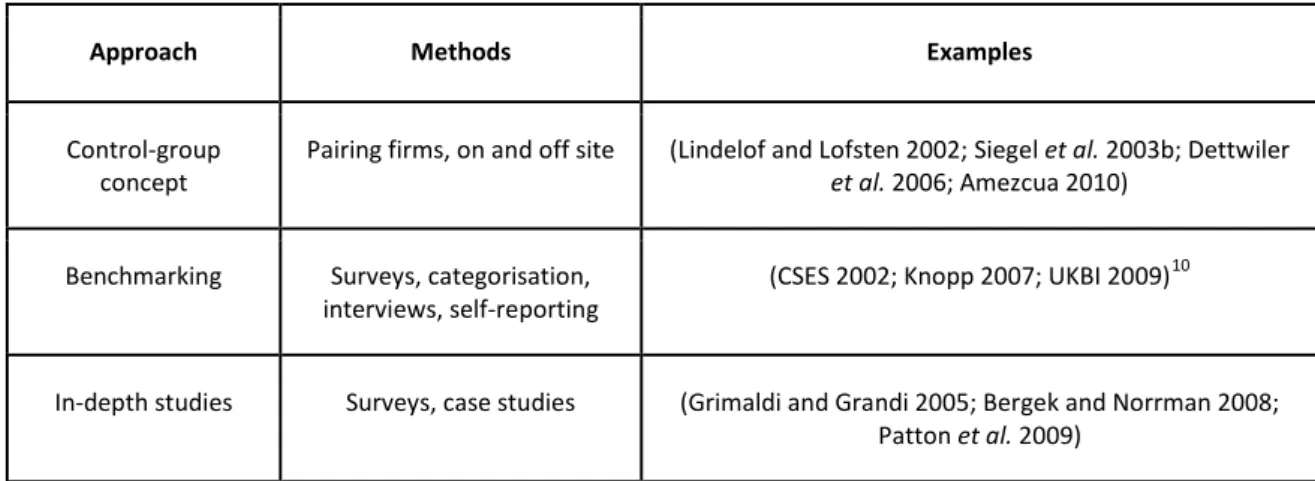
Research methodologies used to assess the impact of incubators on new venture performance can be divided into (1) studies that compare firms on and off incubators (control group concept), (2) studies that follow a comparative evaluation approach (benchmarking) and (3) studies that focus on an in-depth investigation of certain tenants, incubators or regions (in-depth studies).
Approach Methods Examples
Control-group
concept Pairing firms, on and off site (Lindelof and Lofsten 2002; Siegel
et al. 2003b; Dettwiler
et al. 2006; Amezcua 2010)
Benchmarking Surveys, categorisation,
interviews, self-reporting (CSES 2002; Knopp 2007; UKBI 2009)
10
In-depth studies Surveys, case studies (Grimaldi and Grandi 2005; Bergek and Norrman 2008; Patton et al. 2009)
Table 3 Review of research methodologies used to assess incubator performance
3.2.1
Control group concept: comparing firms on and off science parks
The control group concept is based on a comparison between a sample of high-tech firms located in technology incubators and a control sample of off-incubator firms along a series of performance dimensions. Examples of such research include Westhead (1997), Colombo and Delmastro (2002), Lindelof and Lofsten (2002), Siegel et al. (2003), Dettwiler et al. (2006) and Amezcua (2010). However, the results of such studies are limited to application to incubators for the following reasons:
• Control group studies underlie a strong selection bias making it difficult to distinguish to what extent a tenant company’s success can be attributed to incubators services or to the selection process of the incubator11.
• Many of the studies focus on science parks whose tenants may be more physically dispersed and as such the researchers are actually observing the impact of a wider regional factors on new venture performance.
• The performance measures used (e.g. revenue growth, employment growth, survival rate etc.) have their limitations with regard to assessing success of young ventures.
10 While these studies attempt to benchmark incubator performance, their main methodology is an in situ
assessment.
11 Bearse (1998) draws a comparison between selecting incubatees and selecting students for admission to Harvard
University. Specifically he asks whether Harvard students (the incubatees) succeed because of what Harvard (the incubator) does to them, or because Harvard selects only students who will succeed regardless of what Harvard does to them (Bearse 1998).
3.2.2
Benchmarking
Benchmarking studies follow a comparative evaluation approach, analysing comparative characteristics and metrics of different incubator programmes with similar core objectives and relate the performance outcomes to the activities of the incubator in order to identify best practice. Examples of studies that sought to develop benchmarking frameworks include Campbell et al. (1985), Smilor and Gill (1987), Hisrich and Smilor (1988) and Allen and McCluskey (1990). More recent works that have sought to provide varying emphases on different components of the incubator model include Hackett and Dilts (2004) and Bergek and Norrman (2008).
The most comprehensive benchmarking efforts are often those produced by industry associations. See, for example, UKBI (2009), NBIA (Knopp 2007), EBN (2009).
Benchmarking studies indicate that the incubator concept seems to provide a nurturing environment for the development of technology start-ups. However, most benchmark studies treat incubators as a ‘black box’ focusing mainly on outcome (e.g. survival rate, revenue growth rate, jobs created), which does not itself explain how and why some incubators appear to perform better than others. As a consequence most studies lack a detailed characterization of the value adding components of the incubation process.
Furthermore, organisations such as the NBIA, EBN or UKBI represent a diverse range of different incubator models with different modus operandi and goals. This makes a benchmark analysis challenging, as the identification of best practice requires distinguishing between different incubator models and measuring their outcomes in relation to their goals (Mosselman et al. 2004). The failure to take goals into account is problematic in two ways: First it follows from the definition of performance that comparisons should only be made between incubators that have the same goals. Secondly, if approaches fail to control for differences in incubator goals or take into account different goals at the same time, it is hard to tell whether differences in outcomes are the result of differences in incubator practices or merely due to differences in foci between incubators (Bergek and Norrman 2008). However, most industry reports fail to take into account different goals and different corresponding performance measures – instead they benchmark on an aggregated level and extrapolate their general incubator analysis to other incubator models.
A further problem of benchmarking studies is that measuring the performance of an incubator implicitly includes a measurement of the performance of the whole region surrounding the incubator. An incubator located in a region with high entrepreneurial activity and
infrastructure like Silicon Valley or Cambridge (UK) might outperform an incubator located in a remote location that does not enjoy the same favourable environmental conditions for entrepreneurship. Most benchmarking studies do not account for regional differences, thus making it challenging to distinguish the performance of the incubator institution itself from the performance of the surrounding ecosystem.
Finally, benchmarking studies underlie the same selection bias and limitations of performance measures as discussed earlier in context with control group studies.
3.2.3
In-depth investigation approaches
In-depth studies of incubator impacts focus on detailed investigation of a certain aspect of incubation through surveys or case studies on a selected sample of incubators or incubatees. In contrast to the control group concept and benchmarking approaches, in-depth studies often take an internal perspective to investigate the research question. Thus, the focus of these studies lies on the incubator or incubatee level. Examples of in-depth studies include Mian (1996), Rice (2002) and Bollingtoft and Ulhoi (2005).
In-depth studies provide important insights into the ‘mechanisms’ of incubator support and thus help to understand ‘how’ the incubator model works. A problem of in-depth approaches is that most studies focus on start-ups in general without making a distinction between different stages of development. However, start-ups may face different challenges and needs at different stages of their founding process. Furthermore, most approaches look at incubators as a self-sustaining entity without considering other coexisting start-up support structures such as business angels and VCs and their simultaneous impact on new venture performance.
3.2.4
Burden of data capture
While monitoring incubator activity is generally considered useful by incubators and their stakeholders, it can also become cumbersome and erode the ability of the incubator to perform to its maximum capacity. One study identified that incubator managers were ‘less effective’ when distracted from their core activities by excess monitoring or the need to secure funds for the business incubator (Rice 2002). The 2006 NBIA survey team believe the length of the survey12 was to blame for their lowest response rate since their surveys began.
An alternative approach was taken by the Swedish VINNKUBATOR programme (now InnovationsBron13) where they asked Fokus Analysis to develop an online assessment tool in
12 The survey included 31 multi-part questions requiring over 200 answers. 13 Information on the Fokus Analysis at www.innovationsbron.se
collaboration with incubators. The tool was to be of use to incubators for monitoring their own performance, but also enabled a centralised collection of data for review by public bodies. This approach seems to have been well received, and data is regularly collected. Nonetheless surveys and monitoring are very unlikely to measure all activities or outputs of business incubators, and attempts to do so would likely be cumbersome and time consuming.
3.3
Focus of analysis
Approaches to measure the performance of incubators can use either direct or indirect measures and most often focus on one of the following three categories: (1) performance outcomes, (2) management policies and their effectiveness and (3) incubator services and their value added.
3.3.1
Performance outcomes
Performance outcomes are normally assessed by using direct measures related to the tenant firm’s performance, the incubator programme’s growth and sustainability, or measures related to university and the local community.
A popular measure associated with the tenant company’s performance used by academic studies and industry reports is survival (Smilor 1987; Allen and McCluskey 1990; Mian 1997; Hackett and Dilts 2004b; Knopp 2007; UKBI 2009; Amezcua 2010). Survival is either measured as:
• the ratio of firms that are still in business when graduating from the incubator/total number of firms started in the incubator; or
• the ratio of the number firms exiting the incubator/number of firms discontinuing operations.
However, using survival as the sole measure of incubator outcomes has limited utility as incubators may also be designed to maximise firm and cluster outcomes other than the longevity of individual incubatees (Phan et al. 2005). Furthermore survival alone says little about company performance (e.g. whether the company is growing and whether it is profitable) or in other words, whether the incubator serves as an efficient accelerator or an inefficient life support system.
Other widely adopted measures associated with the tenant company’s performance are the firm’s sales growth (Mian 1997; Lindelof and Lofsten 2002; Dettwiler et al. 2006; Chen 2009; Amezcua 2010), profit growth (Mian 1997; Lindelof and Lofsten 2002; Dettwiler et al. 2006;
Chen 2009) or employment growth (Udell 1990; Mian 1997; Lindelof and Lofsten 2002; Dettwiler et al. 2006; Amezcua 2010). While these measures are popular and widely accepted for assessing established firms, it is questionable to which extent they are applicable to assess start-up performance. Technology start-ups follow irregular growth paths (Garnsey and Heffernan 2005a), most often do not create any revenue in the first years and take a long time to break-even. A longer term perspective including post graduation performance would be required to assess the performance of former tenant companies.
Popular performance measures addressing the incubator programme’s growth and sustainability are the incubator occupancy rate (Allen and McCluskey 1990), graduation rate14 (Udell 1990; Mian 1997; CSES 2002) or new firms created per year (Udell 1990). However, the value of these measures in assessing incubator performance also seems to have its limitations. For example, a 100% occupancy rate is not necessarily ideal since a key issue for an incubator should be to have enough flexibility to enable tenants to progress from one type of accommodation to another as they grow. Thus an occupation rate of 85% could imply better performance than an occupation rate of 100%.
3.3.2
Management policies and their effectiveness
Approaches measuring the management policies and their effectiveness include an assessment of the incubator’s managing practices and operational policies in light of the programme objectives. The success of the programme is assumed to depend upon the effective utilisation of resources (Sherman and Chappell 1998). Key performance indicators include whether the incubator has a distinct selection process in place (Kuratko and LaFollette 1987; Merrifield 1987; Bergek and Norrman 2008), the quality and support of the management team in place (Rice 2002), or the extent of realisation of the stated goals (Mian 1997).
3.3.3
Incubator services and their value added
Approaches to measure the performance through the incubator services and their value added focus on a review of the actual provision and their perceived value added to the tenant companies. Typical services considered include flexible office space and shared office services (Allen and Rahman 1985; Hisrich and Smilor 1988; Mian 1997; Rice 2002; Dettwiler et al.
2006), business assistance (Mian 1996; Rice 2002; Bergek and Norrman 2008), or provision to
14 The number of total graduates to date divided by the number of years of operation gives the average firm
incubation [many incubators don’t create new firms but take them on shortly after start-up] rate per year. This rate is further multiplied by 100 and divided by the number of tenants give the average percentage of tenants graduate per year defined here as the graduation rate (Mian 1997).
access networks (Smilor 1987; Mian 1996; Hansen et al. 2000; Rice 2002; Dettwiler et al.
2006).
3.4
Criticisms and limitations of performance measures
As the previous discussion shows, direct measures, such as survival, revenue growth, profit growth or occupancy rate have their limitations and do not seem to be useful in assessing the performance of incubators or incubatees. Nevertheless, they are frequently used in many academic studies and as key performance indicators by practitioners.
Definitional ambiguity has further led to problems collecting and comparing data on incubators and has reduced the generalisability of theoretical contributions. Many incubators have mixed revenue sources and depend on a variety of different stakeholders. Thus it is difficult to define a standard measure to assess incubator performance.
Furthermore many studies survey incubator managers as a central contact. However, incubator managers do not necessarily represent the views of the incubatees. Financial dependency may force incubator managers to demonstrate on-going success in order to justify continued subsidization. This might tempt incubator managers to overate success and underreport failures, thus negatively affecting the quality of data on incubator performance (Hackett and Dilts 2004b).
One approach to performance measurement that seeks to offer a more robust assessment of incubator value-add is that of real options (Hackett and Dilts 2004). A real options approach, originally used in corporate finance, applies option valuation techniques to capital budgeting decisions, so creating options for when to make, abandon, expand or contract a capital investment15. Five options are described under ‘initial outcomes’ (
Table 3
). That practice is less pure than theory is implicitly acknowledged by Hackett and Dilts (2004a):“However, facilitating the survival of incubatees or containing the cost of failure of the options to the sunk cost of creating the option minus any remaining option value, and
15The real option approach “[..] is based on the logic of financial options in that financial options are contracts that
create valuable flexibility; if you have a financial option, you have the flexibility to purchase, or sell, something at a pre-specified price at a later date, or to go with the market price at that future date. Like financial options, investments in real assets can provide firms the option to take an action at a later date if conditions are favourable, or to abandon further investment if conditions prove unfavourable.” http://lexicon.ft.com/Term?term=real-options-reasoning
reporting these successes, can result in the renewal of annual operating subsidies, a very important upside without which many incubators would close.” (Ibid. p51, emphasis added)
Antecedents Inputs Activities Outputs Initial
outcomes Intermediate outcomes Long term outcomes
Pre-venture initiative activities Entrepreneurs Inc uba tio n: N ew v ent ur e de ve lopm ent + ne w pr oduc t de ve lo pm ent + se lec tio n + m oni to ring a nd busi ne ss a ssi st anc e + re sou rce m un ifice nce 1. Incubatee is surviving and growing profitably In cr ea se d Or ga nis ati on P op ula tion C hu rn Community support for entrepreneurship Enabling technologies / innovations (including incubator) Incubated
companies 2. Incubatee is surviving and growing but not yet profitable Viable / becoming viable companies Exogenous conduct of basic research Critical technologies / innovations 3. Incubatee is surviving but not growing and not profitable Dead dying companies Events increasing individual entrepreneurial orientation 4. Incubatee operations terminated while still in the incubator: losses minimised Incubator
feasibility study 5. Incubatee operations
terminated in incubator: large losses
Table 4 Real options framework (Hackett and Dilts 2004a)
Real options theory can provide an additional theoretical insight into incubation practice. However, since incubatee options cannot be priced accurately until they are realised or expire (too many uncertainties prevail for accurate quantification), options theory is insightful rather than universally true. In relation to the use of real options for assessing incubator performance, an interview with one incubator manager reported in Dee et al. (2011) revealed the following observations:
• Most subsidy-providers would not operate within the options framework and would instinctively prefer an option 3 to an option 4 outcome (Table 3).
• Option theory does not take fully into account the potentially elastic timescales involved where incubation is concerned. The best ideas of tenants can be the ones that grow out of their original proposal and which need to go through numerous iterations before becoming a ‘killer app’.
• Another fundamental difference between the VC option model (relatively purist) and the incubator option model (much more pragmatic) is that VC funds have partners or shareholders, whereas incubators usually have multiple stakeholders. The VC's success is ultimately dependent on selling its cashed-in options for many multiples of the original option price, and wise VCs spend as little time as possible on the ‘living dead’. A shrewd incubator manager will team and ladle different sources of income to cross-subsidize different activities, something pure real-options theory does not allow for. This is legitimate in terms of fulfilling a mandate of supporting growth firms because of the high degree of uncertainty involved in taking on a new client.
• 'Selection' takes place at multiple intervals during (also before and after) the relationship and not just up front. Selection is not just about dealing with existing tenants either, it also involves long-term relationships with individuals who move out but may move back in, their advisers and investors – something very hard to put a price on, and so value as an option.
• The implication for policy purposes is not that all incubators should be run as short-term accelerators rewarded with equity ‘kickers’ like a VC, but that subsidy providers would benefit from being more sophisticated in measuring success and less reliant on proxy measures such as numbers of jobs created in a short space of time (Dee et al.
2011: 20-21).
4
How incubators influence outcomes in new venture performance
Research on the methods by which incubators can support the development of high-technology start-ups needs to be considered in the context of the literature on the entrepreneurial processes of high technology start-ups.4.1
Understanding of the entrepreneurial process
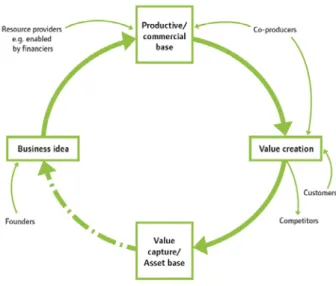
Garnsey et al. (2006) draw upon a wide review of literature and empirical evidence to develop a conceptual model for describing the entrepreneurial process of new, technology-based firms (Figure 6). This helps elucidate the ways an incubator could influence the trajectory of firm
development. Every firm customises the model taking account of its own resource base and perceived opportunities. New firms tend to be more focused on business ideas and gaining the resources needed to build a productive and commercial base, while more established firms focus on value creation and capture. Incubation can impact various aspects of the entrepreneurial process, from strategic input to the business model, to modifying or accelerating the entrepreneurial process through access to resource providers, entrepreneurial learning from peers, access to customers, advice on intellectual property rights to improve value capture, etc.
Figure 5: The entrepreneurial process (Garnsey et al. 2006)
The entrepreneurship literature reveals numerous additional factors that impact upon the manner by which incubators support the development of high technology start-ups. Such factors include the following:
• Firms with high growth episodes are disproportionately important to the emergence of industries, job creation and economic wealth (Acs et al. 2008; Garnsey and Mohr 2010)
• High growth firms are a small percentage of all new enterprises, but face distinctive problems (Anyadike-Danes et al. 2009)
• Firms rarely experience continuous growth, discontinuous high growth episodes are more common (Garnsey and Heffernan 2005a)
• High growth episodes usually result from a combination of internal firm factors and external factors in the business environment (Penrose 1959)
• Opportunities for ‘high growth’ are typically associated with uncertainty, as obvious opportunities for all leads to rapid exploitation that reduces the scope for ‘entrepreneurial rents’ (Perez 2004).
For incubators seeking to support high growth potential, high technology start-ups, these factors underpin and inform the selection of an appropriate strategy, and the design of its operations.
4.2
The strategy and operations of business incubation
In addition to the factors highlighted in the previous section, the selection of an appropriate strategy and associated configuration of operations for an incubator needs to be considered in terms of fit with its stakeholder aspirations, the geographic location of the incubator, the characteristics of its potential or actual incubatees, and the stage of evolution of the incubator itself.
An incubator will typically have a wide range of stakeholders, which may include multiple shareholders, and frequently multiple funders (CSES 2002). All of these may demand, to differing degrees, input to the design of strategy of the incubator and associated key performance indicators.
The location of an incubator is likely to have a profound influence on the choice of strategy and its successful implementation. Location can be considered in terms of absolute location (where the incubator is), relative location (what it is near) and cognitive distance (how integrated it is with its regional innovation system) (Asheim and Gertler 2005; Moodysson et al. 2006; Huggins 2008). Consideration also needs to be given to the characteristics of the regional innovation system and what this may mean in terms of availability of accessible resources (Asheim and Gertler 2005).
Within the literature on regional innovation systems, universities are often highlighted as influencing many aspects of innovation activities, including support for new and growing ventures (Saxenian 1987; Asheim and Gertler 2005; Walshok et al. 2010). The literature makes connections between presence of universities and the activities of proximate incubators but notes proximity to a university alone is unlikely to deliver value (Rothschild and Darr 2005; Ratinho and Henriques 2010). Universities and other research institutions may be able to offer incubatees access to advanced technology laboratories, equipment and other research and technical resources, but also offer access to ‘talent’ such as faculty, staff and students (Phillips 2002; Hackett and Dilts 2004b; Koh et al. 2005; Phan et al. 2005). However the accessibility of
university resources is likely to be influenced by the entrepreneurial orientation and support structures of the university and region (Clarysse et al. 2005).
Even within a region with a mature regional innovation system it can take time for incubators to become embedded in the local business environment. Once built the incubator aims to achieve high occupancy and stable demand for space, finally reaching a stage of more demand for space than it can service and becoming a centre of entrepreneurial gravity in the community (Allen 1988; Hackett and Dilts 2004b; Aaboen 2009) (Figure 7). Initially a young incubator is more likely to suffer from insufficient demand for its services and it may fail to reach a critical mass of its target clients (Tamasy 2007). As an incubator becomes more embedded and known, the recruitment of new tenants should become easier and with more potential tenants to choose from the more selective the incubator can be (Aaboen 2009). As an incubator develops it builds knowledge and networks that increasingly meet the needs of their tenants in combination with the resources and opportunities associated with the local business environment. This can lead to increasing specialisation by the incubator (Aaboen 2009).
The characteristics of actual or potential tenants also influence the choice of incubation strategy. An incubator may choose to focus on a specific niche or be more generalist. Niche incubators can be seen in sectors such as renewable energy16 and biotechnology17. The choice of niche will dictate what resources and services need to be provided, and the type of physical infrastructure provided. If the target niche requires a specific physical layout of buildings, and access to specialist capital equipment, this is likely to reduce the ability of the incubator to make significant changes in strategic direction in response to changing conditions and require potentially higher initial investment. In contrast, targeting potential incubatees from the consumer Internet and mobile applications sectors would result in the incubator needing only to provide more general-purpose office space and little need for capital intensive, fixed purpose infrastructure (Miller and Bound 2011).
16 This niche has a dedicated incubator industry association in the US: http://www.cleanenergyalliance.com. 17 Examples in the UK include: www.ipi.ac.uk/incubator, www.biocity.co.uk and www.babraham.com.
Figure 6 Life cycle of incubator (adapted from Aaboen 2009)
4.2.1
Physical resources
The incubator building and facilities can themselves be valued by entrepreneurs, especially if designed for business incubation (UKBI 2009). Shared facilities enable incubatees to use professional facilities (e.g. meeting rooms, reception, ICT etc.) without the burden of being wholly responsible for their cost. Incubation space can also be designed to encourage peer-to-peer networking through the provision of communal spaces, such as common rooms and canteens, located in visible and accessible areas. Early studies of incubation emphasised facilities and administrative services, with more recent contributions emphasising the importance of business support and networks (Hansen et al. 2000; Hackett and Dilts 2004b).
4.2.2
Service provision
The incubator delivers services and provides access to resources and networks typically via its own incubator staff and external consultants. Typical incubator services and resources reflect the needs of the entrepreneurial process (as shown earlier in Figure 6). For example strategic input to the business model, access to resources including capital, organisational and recruitment support to build the productive and commercial base, access to technical facilities, advice on capturing value from innovation through intellectual property rights, and so on (Mian 1996; Hackett and Dilts 2004b; Grimaldi and Grandi 2005; Patton et al. 2009). These services can be delivered in varying degrees of quality, quantity and intensity (Rice 2002). In addition to direct counselling and business services delivered through the incubator, the incubator often acts as a mediator between the entrepreneur and other resources and networks. It has been suggested that ‘better incubators’ offer an extensive network of powerful business connections that can be transformative to the development of its tenants (Hansen et al. 2000). If an incubatee lacks its own, then access to relevant entrepreneurial networks can be highly valued (Bergek and Norrman 2008). When firms lack credibility the role of a mediator to provide access to networks can be invaluable. It is suggested that as firms
become more established their networks become more calculated to fit the increased quantity and scope of resource needs (Hite and Hesterly 2001). The incubator can also offer institutional mediation e.g. for access to public grants and programmes (Bergek and Norrman 2008).
The characteristics of the tenants and their associated needs influence the choice of services that an incubator offers. For example, tenants will have different needs depending on their industry sector (Dee et al. 2008; EBN 2009; Garnsey and Mohr 2010). Their requirements will also differ depending on their prior entrepreneurial experience (Lacher and Minshall In review)18.
Tenants seem to become dissatisfied with incubator support when the incubators programme is predetermined rather than re-evaluated depending on changing needs (Ratinho and Henriques 2010)19. A prescriptive strategy enforced through rigid monitoring can erode the ability to apply lessons learnt and adapt to changing conditions (Teece et al. 1997). A critical function of incubators seems to be the ability to learn and adapt to the changing needs of their tenants:
“It is important for us to stress the usefulness of a variety of different incubators adhering to different incubating models, whose rationale lies behind the existence of companies with different business models and with different requirements” (Grimaldi and Grandi 2005:119).
4.2.3
Intangible benefits
Customers and suppliers can be wary of dealing with new ventures that are perceived to lack credibility and legitimacy (Bhidé 2000). The incubator can lend these through association with the venture (EBN 2009; UKBI 2009). Even the incubator’s address can be a benefit: just under 80% of respondents in a UKBI survey highlighted the fact that their business was located at a recognised, commercial address was perceived as valuable (UKBI 2009).
18 Although based on an in-depth analysis of the tenants from a single incubator, Lacher and Minshall (2011)
showed that companies without start-up experience sought support with functional skills e.g. marketing, IT, legal and government regulations in addition to market and opportunity understanding. Companies with start-up experience sought support in strategic information e.g. market and opportunities, customers, PR in addition to access to related R&D activity.
19 Ratinho and Henriques (2010) observe tenant dissatisfaction with Madeira Tecnopolo incubation programme.
Companies are admitted after winning an award that entitles them to a year’s business incubation services, but the services are rigid and often inappropriate for the firms. In the same study the Sogist Incubator was criticised for locking tenants into a 1 year lease which reverted to shareholding capital on the agreement of both parties. Successful companies did not agree to this while unsuccessful tenants needed an increase in capital. As a result Sogist has not acquired any shares. (Ratinho and Henriques 2010)
4.2.4
Selection processes
Rather than cater to all types of firms, business incubators typically introduce a selection process to target a particular group of firms. There seems to be agreement among researchers that selection is an important incubator management task (Hackett and Dilts 2004b; Bergek and Norrman 2008). In Europe 97% of incubators use a set of screening factors to evaluate potential tenants (Aerts et al. 2007). Implementing appropriate selection processes for entry into an incubator enables a better ‘fit’ between the services it provides and the needs of tenants. It is a task subject to errors owing to the challenge of distinguishing between the potential of entrepreneurs operating with different types of uncertainty (e.g. technological, market, regulatory etc.). It has been argued that this is reason enough to let as many entrepreneurs try as is reasonably possible since ‘important qualities, for instance if the person is coachable, are not possible to fully detect at a screening meeting’ (Aaboen 2009 p.661). Selection processes can be broadly split into those focused mainly on the idea or those focused primarily on the entrepreneur or team (Bergek and Norrman 2008) (Table 5). Another study exploring the link between screening practices and incubator performance suggests a significantly positive relationship between tenant failure and the S-index i.e. a high concentration on one screening dimension (financial factors, team or market) (Aerts et al.
2007). This implies screening processes should include a variety of factors. An alternative approach is for an incubator to carefully position their brand to enable ventures to self-select if they think the facilities and services are matched to their needs. As with a venture capital investor, incubators need ‘deal flow’. A selection process can only be imposed if the business incubator can afford to turn away potential tenants (Dee et al. 2011).
Selection strategies Survival of the fittest Picking the winners
Idea-focused selection
The portfolio will presumably consist of a quite large number of idea owners (or upcoming entrepreneurs) with immature
ideas related to a broad spectrum of fields.
Results in a highly ‘niched’ portfolio of thoroughly screened ideas within a quite narrow technological area – often sprung
from the research of highly ranked universities.
Entrepreneur-focused selection
The resulting portfolio will be diversified, and consist of entrepreneurs/teams with strong driving forces representing a broad
set of ventures.
The portfolio consists of a few handpicked and carefully evaluated entrepreneurs,
commonly with ideas coupled to the research areas of a nearby university.
Out of the incubators studied by Bergek and Norrman (16 Swedish VINNKUBATOR incubators) six were focused on the entrepreneur, seven on the idea with three having equal emphasis on both. Most had an emphasis on ‘picking the winners’ but also had pre-incubation processes with a qualification process of ideas. Only one had a survival-of-the-fittest approach where around 40% of candidates were accepted, though this incubator also had a significantly higher number of incubatees. Other incubators had a rejection rate of around 80% (Bergek and Norrman 2008).
4.2.5
Incubation business models
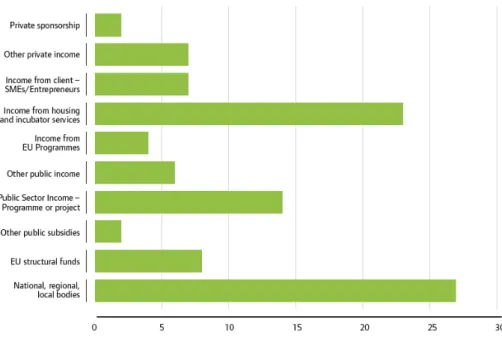
There are four main sources of revenue for business incubators: rent from tenants, fees from providing business support services to tenants and others, sharing in client successes through equity or royalty agreements, and sponsorship from public or private sources (Knopp 2007; EBN 2009). Most incubators have mixed income from a variety of sources (Figure 7), which can cause ‘principal-agent’ problems20. In the U.S. anchor tenants (businesses that do not receive incubation services but remain in the incubator facility) can provide a stable revenue stream and experienced mentors (Knopp 2007).
Figure 7 Sources of income reported by EBM members (EBN 2009)
Generating revenue from services when clients are resource constrained is often not sustainable without subsidies from public bodies. This impacts value capture from renting space and supplying business support services. Capturing value through taking equity in clients
20 A concept from Agency Theory where two parties (an Agent and a Principal) may have divergent goals and where
introduces delays in revenue, and can cause the incubator to behave more like an equity investor by prioritising short term financial returns rather than longer term performance (Hsu 2007; Dee and Minshall 2011). However, the alternative of relying on mixed income from public and private sectors can also lead to ‘principal-agent’ problems as incubators try to respond to multiple and often incompatible objectives while still staying faithful to the wider imperative of supporting high-potential firms. For instance, public programmes may target job creation while private investors generally seek to delay employment growth as long as possible because higher payroll costs increase cash bur significantly – and most incubatees are cash-constrained.
The literature gives little insight on whether business incubators could generate better returns for early stage investments than other kinds of investors. Early stage investments typically have poor returns compared to other types of equity investment, and European internal rates of return are lower than in the U.S. (BVCA 2009). In the U.S. nearly half (46%) of technology incubators reported taking equity in some or all of their tenants (23% in all clients, 23% in selected ones). In these incubators investors are usually an integral part of operations (Knopp 2007). On closer scrutiny of the ‘incubators’ identified by organisations like the NBIA, some have also been referred to as ‘investors’ and are motivated by financial returns on investment. These types of equity investments are likely to face similar problems as other early stage investments (Gill et al. 2007; Dee and Minshall 2011).
Corporate funded incubators can reduce the reliance on a mixed revenue stream, but will require incubatees that fit with the goals of the corporation. These incubators tend to have particular goals such as providing an environment for the nurture of ideas unable to thrive within the corporate environment, or to attract in new ideas from outside the corporate (Ford and Probert 2009; Ford et al. 2010). Strategic alignment with the corporate is often critical, as is separating corporate decision making from incubator decision-making.
A summary of business model characteristics of business incubators is given in Appendix C and Figure 9.
Figure 8 Illustration of key variables in the business models of business incubators (See Appendix C)
5
Conclusions and implications for further research
This paper has sought to review current knowledge relating to business incubation for high-tech start-ups. The paper has explored the business incubation research in terms of context (attempting to clarify objectives and provide a useable typology), the measurement of performance of incubators, and the strategies and operations via which the incubators support their incubatees. From this review, the following conclusions can be drawn:
• In academic and practitioner publications alike there is widespread definitional and conceptual ambiguity in relation to business incubation. This is in part due to insufficient effort being placed by both researchers and practitioners on crafting precise definitions. However, it is also a result of the maturation of the incubator industry and the resultant proliferation of diverse models of business incubation.
• Given the variety of business incubator strategies, business models, stakeholders, et al., there is no standard measure for assessing incubator performance. The validity, comparability and generalisability of published findings of incubator performance need to be carefully considered in terms of the authorship, research method, and focus of analysis.
• As the incubation industry has matured so understanding of its core purpose has become more sophisticated. If in 1985 “the universal purpose of an incubator [was] to increase the chances of an incubatee firm surviving its formative years” (Allen and Rahman 1985) a decade on the definition recognised the need to add value: “we define business incubator as a shared office space facility that seeks to provide its
incubatees […] with a strategic, value-adding intervention system of monitoring and business assistance” (Hackett and Dilts 2004b).
• Research on business incubation needs to be considered in the context of other bodies of knowledge; in particular cluster theory, regional innovation systems, entrepreneurship, investment, and firm growth. Considering incubation in isolation risks drawing simplistic conclusions and leads to inappropriate policy and management recommendations.
These conclusions point to the following areas where further research is needed:
• Research is needed to develop a robust, operationalisable, set of comparable performance indicators – not absolute performance measures – for business incubation.
• The literature on business incubation needs to be more effectively integrated within established areas of research such as cluster theory, regional innovation systems, entrepreneurship, investment, and firm growth.
• The specific issue of the selection of incubator business models appropriate in different and changing contexts is a potentially important area. Linking the activities of business incubation to new ventures in emerging industries presents particular challenges for both business model selection and integration with other actors in the regional innovation system.
• The re-emergence of start-up accelerators is helping ensure that consumer Internet and mobile application-based start-ups receive the support they need to grow their businesses. However the provision of incubation services for device-based or other physical product-based start-ups is a quite different, under-researched area but important area. Incubators of this second type will likely require heavier capital expenditure (for instance in specialist scientific of manufacturing/prototyping equipment) than do internet incubators.
The research that underpinned this review was stimulated in part by the high levels of interest in business incubation as a tool for regional economic development. In ending this review, it is perhaps useful to reflect upon comments made on the effectiveness of another policy tool that also sought to drive growth by fostering innovation – and which has features in common with