See discussions, stats, and author profiles for this publication at: http://www.researchgate.net/publication/259685995
Mapping learning and game mechanics for
serious games analysis: Mapping learning and
game mechanics
ARTICLE in BRITISH JOURNAL OF EDUCATIONAL TECHNOLOGY · FEBRUARY 2014
Impact Factor: 1.54 · DOI: 10.1111/bjet.12113
CITATIONS
12
DOWNLOADS907
VIEWS503
9 AUTHORS, INCLUDING: T. Lim Heriot-Watt University 84PUBLICATIONS 283CITATIONS SEE PROFILE Sandy Louchart Heriot-Watt University 63PUBLICATIONS 664CITATIONS SEE PROFILE Riccardo BertaUniversità degli Studi di Genova
86PUBLICATIONS 337CITATIONS SEE PROFILE
Alessandro De Gloria
Università degli Studi di Genova
157PUBLICATIONS 874CITATIONS SEE PROFILE
Available from: Sylvester Arnab Retrieved on: 13 August 2015
Pedagogy-driven design of Serious Games: An overall view on learning and
game mechanics mapping, and cognition-based models
Sylvester Arnab1, Sara de Freitas1, Francesco Bellotti2, Theodore Lim3, Sandy Louchart3, Neil Suttie3, Riccardo
Berta2 and Alessandro De Gloria2
1 Serious Games Institute, Coventry University, Coventry, UK
2 University of Genoa, Genoa, Italy
3 Herriot Watt University, Edinburgh, UK
The first author is a senior researcher at the Serious Games Institute UK currently involved in the coordination the R&D work package of the EU-Funded Games and Learning Alliance (GALA) network of excellence. His work is in the use of game-based techniques for learning and training.
Serious Games Institute, Coventry University Technology Park, Coventry, CV1 2TL, UK. Email:[email protected]
Abstract
This paper presents findings emerging from the EU-Funded Games and Learning Alliance (GALA)
Network of Excellence on serious games (SGs) that has a focus upon pedagogy-driven design of SGs.
The overall framework presented in this paper concerns some elements that we consider key for the design of a new generation of more pedagogically-effective and easily author-able SGs: pedagogical perspectives, learning goals mapping to game mechanics and cognition-based SGs models. The paper also includes two corresponding illustrative case studies, developed by the network, on (1) the
analysis of the Re-mission game based on the developed analytical framework of learning and game
mechanics and (2) the Sandbox SGs cognition-based model in the Travel in Europe project.
Practitioner notes:
What is already known about this topic:
Early studies have demonstrated the valuable contributions of game-based approaches in education
and training.
Early work has revealed particular strengths in some entertainment game mechanics, some of which look suited for serious and educational games.
There are however no established practices, framework, models in serious games design and development (mechanics, development framework, etc.).
Games and learning have separate mechanics and Serious Games Mechanics have yet to be
defined.
What this paper adds:
An overall and integrated view of pedagogy-driven considerations related to SG design.
The introduction to an analytical model that maps learning mechanics to game mechanics (LM-GM model) towards defining Serious Games mechanics essential for the design and development of games for learning.
The discussion on a cognition-based SG design model, the Sandbox SG model (SBSG), that seems
to have the potential to contextualise learning in a meaningful virtual environment.
Implications for practice and/or policy:
The two models will support the design of a game-based learning environment that encapsulates various learning theories and approaches (in particular considering education at schools and universities) be they objectivist, associative, cognitive or situative, and combine contents with mechanics that sustain interest and engagement.
The definition of Serious Games Mechanics will help bridge the gap between the expected learning outcomes and the desired positive engagement with the game-based learning environment.
Formal deployment of game-based intervention for training and education can be further
encouraged if pedagogy plays a key role in the design, development and deployment of serious games. The role of educators/practitioners in the development process is also key to encouraging the uptake of game-based intervention.
Introduction
The increasing use of pervasive and ubiquitous digital gaming technologies gives a significant opportunity for enhancing education methods, in particular thanks to the games’ ability to appeal a wide population. Yet, despite the digital games’ potential in terms of interactivity, immersion and engagement, much work must still be done to understand how to better design, administrate and evaluate digital games across different learning contexts and targets (Alvarez and Michaud, 2008; Ulicsac, 2010; de Freitas and Liarokapis, 2011). Also, games have now evolved exploiting a variety of modules ranging from social networking and multiplayer online facilities to advanced natural interaction modalities (ISFE, 2010).
A new typology of digital games has emerged, namely serious games (SG) for education and training, that are designed with a primary pedagogical goal. Samples such as America’s Army or Code of Everand have become increasingly popular, reaching large numbers of players and engaging them for long periods of time. Early studies undertaken in the US and Europe attest to the valuable contributions of game-based approaches in education (e.g. Kato et al., 2008; Knight et al., 2010). And improvements can be further achieved by better understanding the target audience, pedagogic perspectives, so to make learning experiences more immersive, relevant and engaging. A recent survey by the International Software Federation of Europe (ISFE, 2010) revealed that 74% of those aged 16-19 considered themselves as gamers (n=3000), while 60% of those 20-24, 56% 25-29 and 38% 30-44 considered themselves regular players of games. And the projected growth figures for SGs currently stand at 47% per year until 2015 (Alvarez and Michaud, 2008).
The importance of pedagogy at the heart of game development is alien to digital game development for entertainment. The absence of game mechanics and dynamics specifically designed and dedicated for learning purposes is an issue, which makes such intervention unsuited for educational purposes. Certainly, the SGs’ educational potential and actual effectiveness may vary appreciably as a consequence of the pedagogical choices made a priori by the game designer (Squire, 2005). Thus, a more thought-out design is key to meet the end-user and stakeholder requirements that are twofold, on the entertainment and education sides. On the one hand, it is undeniable that a fine-tuned pedagogy plays a major role in sustaining learning effectiveness (Bellotti et al., 2010). On the other hand, one of the biggest problems of educational games to date is the inadequate integration of educational and game design principles (e.g. Kiili, 2005; 2008; Lim et al., 2011) and this is also due to the fact that digital game designers and educational experts do not usually share a common vocabulary (Bellotti et al., 2011).
In this paper we report the working experience of the Games and Learning Alliance (GALA,
www.galanoe.eu) Network of Excellence, funded by the European 7th Research Framework
Programme, which brings together both the research and industry SG development communities, especially from the context of Technology Enhanced Learning in order to give the nascent industry
opportunities to develop, find new markets and business models and utilise IP and scientific and pedagogic outcomes.
This paper presents the GALA reflections on these topics that rely on a systematic review methodology (eg. Connolly et al., 2012) and the study of models and frameworks that have been developed by the GALA partners. The paper’s main added value consists in providing an overall and integrated view of pedagogically driven design of SGs. The paper begins with an examination of the pedagogical perspectives of SGs and highlights an analytical view of the importance of mapping game mechanics to pedagogical goals. A promising cognition-based model for SG development is discussed, demonstrating some specific development strategies, which are opening up new possibilities for efficient SG production. This paper highlights illustrative case studies on the Re-mission and Travel in Europe games, developed by the network and associate partners
Pedagogical perspective of SGs
Pedagogy lies at the heart of the distinction of what is considered as games for learning compared to other entertainment games. From a pedagogical perspective, SGs are not designed mainly for entertainment purposes (Michael and Chen, 2006), but to exploit the game appeal and the consequent player motivation to support development of knowledge and skills (Doughty et al., 2009). SGs offer an effective and engaging experience (Westera et al, 2008) and careful balancing to achieve symbiosis between pedagogy and game-play is needed (Dror, 2008a). Naively transcribing existing material and instructional methods into a SG domain is detrimental (Bruckman, 1999; Dror, 2008b). SGs should have knowledge transference as a core part of their game mechanics (Shute et al, 2009; Baek, 2010). Thus, understanding how game mechanics can relate to relevant educational strategies is needed. Pedagogy is the practice of learning theory, and applying learning theory in practice is a craft that has been developed in traditional education and training contexts for many hundreds of years. In SGs, however, the standard approach has been to take established theories of learning such as associative, cognitive or situative (de Freitas and Jameson, 2012), and to seek to extend these theories within virtual and game environments. Given the many theories of learning available as candidates for application, this approach is arbitrary and possibly ineffectual. However, it is fair to say that, in general, games have to date largely implemented task-centred and cognitive theories; in particular, experiential learning and scaffolded learning approaches have been tested in game environments. In a few cases game use has led to the development of new learning theories such as the exploratory learning model (de Freitas and Neumann, 2009); however well established theories mainly prevail. A key issue for SG design is to match the desired learning outcomes with the typical game characteristics. Games are quite varied in terms of features and can potentially offer different kinds of learning experience. So, it is urgent to understand how different game elements can contribute to an effective facilitation of learning and appropriate measures supporting effectiveness assessment are needed. Measures should include both learning outcomes (knowledge transfer including cognitive and skill-based abilities) and engagement (affective learning experience). Schiphorst (2007) stated that technology should be designed “as” experience and not only “for” experience. The reason why games are good learning environments is because they allow the learner to live through experiences, interact with learning objects and have social interactions with others including teachers and peers. Real value exists in designing learning experiences to support an exploratory and open-ended model of learning to encourage learners to make their own reflections and summations and to come to an understanding in their own way (de Freitas and Neumann, 2009).
These two aspects of SGs (engagement and learning) should be intrinsically intertwined in good serious games. The evaluation of engagement as separate from serious outcomes has been reported by Sweetser and Wyeth (2005). If a game cannot engage learners, then sourcing an adequate sample of experienced players with whom to assess learning outcomes becomes an impossible task (Sweetser and Wyeth 2005). The ability to support both aspects may bridge between the more task- and skill-centred formal educational approaches and the more constructivist and affective levels of learning experiences as enjoyed in game environments.
One of the main issues with respect to an effective deployment of games in formal and informal educational contexts of learning has been the adaptation of the game along lines of assessment and measurement that are suited to traditional learning institutions. To overcome this, game-based learning frameworks, such as the Four-Dimensional Framework (4DF) (eg. de Freitas and Oliver, 2006) and the game-based learning framework (Staaldruinen and de Freitas, 2011) have been proposed to allow games to be designed based on the considerations relevant to the traditional learning context. The move towards exploratory learning, problem-based learning and inquiry learning has been noted in the theory-based pedagogy literature (see extracts from learning theories collected in de Freitas and Jameson, 2012). But these methods and tools are neither yet well-suited nor integrated so to complement and enhance traditional teaching. The principles of learning and game-play, in fact, can be contradictory and making them effectively co-exist is the typical challenge of SG design (Huynh-Kim-Bang et al, 2011). This suggests that a high-level representation of pedagogical intents should be mapped to a low-level game mechanic implementation. And that appropriate design models are needed in order to facilitate and make the authoring work more efficient. We envisage that new pedagogic game-based approaches will better exploit the mapping of game content upon human behaviour and learning patterns.
Understanding the mechanics of learning and gaming
Another central concern in investigating the pedagogical efficacy of SGs is to understand whether the pedagogical approaches commonly identified with (and supported by) Technology Enhanced Learning can also be subscribed to the specific area of SG. A prime example is collaborative learning. Here, a number of cases have been examined which demonstrate how SGs that embed features reflecting and supporting a collaborative pedagogical approach have been used to enhance pedagogical effectiveness. This has been achieved either through adaption of existing multiplayer games to suit collaborative learning purposes or by design and development of SGs with these purposes in mind. (eg. Gersang (Kim et al., 2009), the Mug and Canal games (Mawdesley, 2010)). It can be readily seen from entertainment gaming that certain genres, such as role-playing, action, adventure and simulation, share similar interaction models and game-play dynamics between individual titles. Similarly, replicable and generic mechanics are a component of all SG: each game has mechanisms that govern interplay modes and rules that work to engage the player and motivate them to complete the game and ultimately to learn a task or cognitive skill. The disciplinary aspects within this area focus around differentiating between game and SG mechanics and finding ways that SG mechanics can be deployed to advance SG development and enhance learning in particular communities, for example children’s and higher education. Evaluation and guidelines for such deployments will be a key contribution of GALA - through frameworks, design kits and tools we aim to make the development and deployment of SGs more effective, easier to validate and more usable. Towards this generic aim of supporting greater impact for our research findings in SGs and more applicability of our tools for industry and academic partners, key research challenges and activities
are: differentiation of SG game mechanics from generic game mechanics; finding the best methods for deploying SG mechanics effectively and being able to validate these mechanics in a learning context.
Learning-Game mechanics (LM-GM) model
Game mechanics (GMs) are well understood within the context of entertainment games. Sicart (2008) cites a plethora of game mechanics definitions but concluded these were neither precise nor inclusive. Instead he formalised a systemic structure that defines game mechanics as methods invoked by agents for interacting with the game world. This provided an ontological distinction between rules and mechanics. Serious game mechanics (SGM) though have yet to be conclusively identified and described.
The academic approach to the term game mechanics though mainly describes how players interact with game rules and other formal properties such as goals, player actions and strategies and game states. This still leaves many uncertainties as to what SGMs are and if they operate at the same level of abstraction as those found in conventional entertainment games.
The main impact of defining this area and its research questions will be for SG developers and trainers using and creating SGs. The framework and tools that emerge would allow practitioners to design games more effectively and also provide a higher return on investment through time-saving replicable processes that have been tested in scientific ways and in the contexts of specific case studies.
SG mechanics must reflect the complex relationships between pedagogy, learning and entertainment/fun and that ultimately they need to merge educational and gaming agendas. Therefore, SGMs in this context are the game elements/aspects linking a pedagogical practice to concrete game mechanics directly related to a player’s actions. The user-centric description of game mechanics represents an attractive alternative to the game-centric representation of design patterns.
Literatures abound on human learning mechanism. Yet, no theory has singularly defined how we learn, since each individual exhibits different characteristics depending on the objective and circumstance. This is an important observation as one proceeds to map gaming to learning mechanisms. What it affords though is a means to understand which game mechanics complement learning. SGs are a conundrum (Cody et al, 2009) hence a pedagogy-game mechanic mapping will be particularly beneficial when considering the purpose and design of SG.
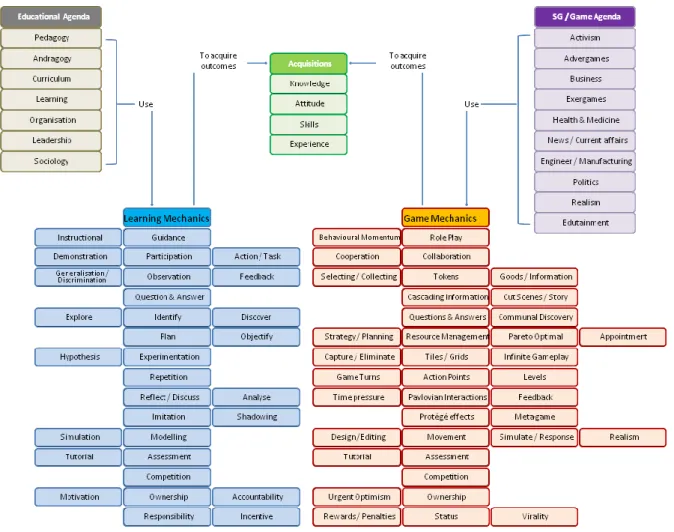
Given the traits mentioned, the GALA network therefore propose learning-game mechanic (LM-GM) model (figure 1) that can be used to either aid SG design or game analysis. Based on mechanics common in educational philosophies and games (both serious and otherwise) these elements form the framework of a variety of educational theories and the backbone of many game theories. Any one combination of these mechanics can be applied to classical laboratory classes or teaching science through to humanities and arts. The model provides a concise means to map how ludic elements link to pedagogy intent directly related to a player’s actions and gameplay, i.e. SG mechanics.
Figure 1: Common mechanics in learning and games are used to construct the learning-game mechanic (LM-GM) model
For simplicity, the reading of the LM-GM model can be viewed top down, with core components running vertically down from the lead nodes of learning mechanics and game mechanics respectively. Side nodes represent functional mechanics t o support the core.
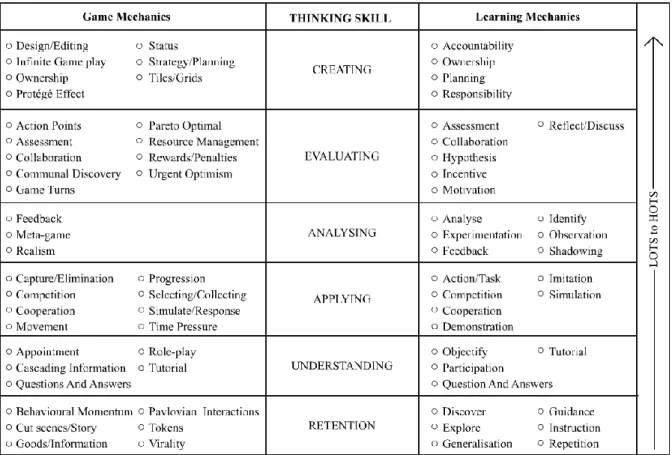
From a pedagogical perspective, one would argue that how a user learns is, in essence, more important than the domain specificity of the medium through which the learning is performed. Based on Bloom’s theory (Bloom, 1956), a simplified framework/ classification (table 1) can be used to link commonly found game mechanics to learning mechanism. As an example, this table emphasises upon task-centred learning rather than cognitive learning. Indeed, a game can be seen as a continuous assessment of gained knowledge as the player proceeds from level to level.
Table 1: Classifications based on Bloom’s ORDERED Thinking Skills
By exploring the LM-GM model, the GALA network aims to address the mismatch between game mechanics and educational components at the implementation level – this pertains to the effectiveness of SG, in particular in terms of efficient design and development. The model enables further questioning as to whether the games should adapt to existing pedagogical practices or whether they should be used to change practices since they form an entity which functions to educate and entertain through a single compelling experience. The impact from the SG mechanics investigations would draw out larger research themes on the intersections of games and pedagogy (both traditional and modern). It will also pave the way for a toolset rather than a black box for designing content specific SG. It is important to note though, the LM-GM framework is a formulaic means to design SGs, it is merely a method to analyse and suggest game mechanics that could stimulate deeper learning.
Case study 1: LM-GM analysis of Re-mission
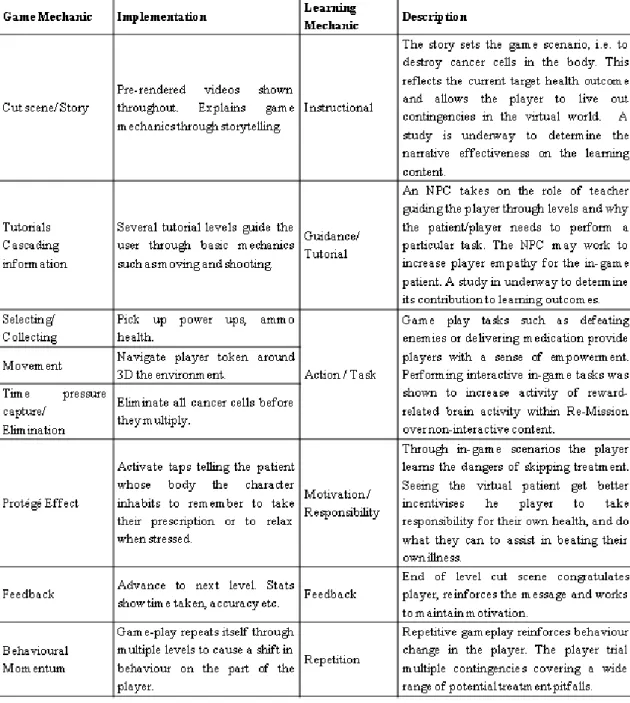
Re-Mission (Kato et al. 2008) game-play was analysed through the LM-GM model and the resulting mapping seen in table 2. The game and learning mechanics identified represent the game-play and the constructivist nature of learning experienced by the player in roughly sequential order from top to bottom.
Table 2: The analysis based on Re-Mission
Re-Mission is a third-person-shooter (TPS) genre. It is questionable if the game mechanics at their
implementation level are inherently pedagogically beneficial. Reported works on Re-Mission often do
not sufficiently detail measures related to productive learning as a result of the game mechanics. Indeed extraneous game mechanics are often designed into games to enhance game-play resulting in learning coming in tangentially. The case study was to ascertain whether SGM and games mechanics operate at the same level of abstraction within the game structure. The conceptual LM-GM framework aims to address issues related to effective SG design and provides a means to determine at which point game-play and pedagogy begin to intertwine.
To establish the game mechanic’s pedagogical intent it is necessary to understand that the content of Re-Mission was designed to address behavioural issues (Tate et al, 2009). Six core design principles were to be implemented:
P1. Choose a target health outcome: This defines the learning outcome for each game level; P2. Identify its key behavioural mediators: This defines the risk associations with poor adherence
P3. Define the psychological determinants of behaviour: This defines the behaviour that must change to address P2;
P4. Capture that perceptual field in the game-play: This was designed to remind that all may not be as well as thought, i.e. that cancer could still be prevailing;
P5. Live out contingencies in the virtual world instead of real life: This was designed such that the player can observe the consequences of poor medication behaviour;
P6. Always have fun (Behaviour = Knowledge x Motivation): The aim was purely to express that through fun the game can effectively generate overt behaviour change.
The executions of principles P3-P6 where learning outcomes are said to be implemented were of particular interest. From observation the game was designed to cycle through these principles for each individual health outcome, with each level targeting a different outcome. Analysing the game-play through the LM-GM framework resulted in the mapping that can be seen in Table 2. The game mechanics implemented represent the game-play experienced by the player in roughly sequential order from top to bottom. Anyone familiar with the third person shooter genre may quickly recognise this game-play "loop".
P5, which relates to the negative consequences for poor treatment adherence is particularly interesting. The LM-GM framework identified this as creating a protégé effect in the user where they learn the motivation for their own correct behaviour by teaching another the correct set of actions. This seems to be a core concept of the learning behind Re-Mission and there is no surprise that it can be found within the higher layers of the framework. This suggests that the pedagogical benefits arise from the context of play.
Although game mechanics have been identified, there is still an uncertainty if SGM operated at the same level of abstraction within the game structure. An examination through increasing layers of abstraction to determine the point at which they become inexorably tied into the relevant pedagogical construct is needed. Here, the concept of Djaouti et al. (2008) "game bricks” was applied to game-play rules as defined by the topology of rules defined by Frasca (2003). Of interest are the manipulation rules and goal rules. Manipulation rules define what the player can do in the game, and goal rules define the outcomes of manipulation rules. A categorisation of "interactions" as a constituent of a manipulation rule can now be grounded albeit without an associative pedagogical function. GMs generally express players’ agency in the game world via actions (Järvinen, 2008; Sicart, 2008). Any action must of course be expressed at a lower level through several rules. Learning must therefore be defined at a higher level.
It appears that the context of the implementation must be considered in order to move the GMs towards pedagogical constructs. Hence, SG mechanics must be considered to operate at a higher level than standard GMs. In Re-Mission, the mechanics associated with player actions fall under the protégé effect where the action of teaching others is used as a learning tool. The mechanics are now beginning to blend into pedagogy. In having a protégé one considers the player as engaged in the action of "teaching". Though not a learning outcome, the protégé effect cannot exist independently. In Re-Mission it was identified with imparting health related outcomes to the player, teaching them to take responsibility for their own health. This could lead us to a definition of SGMs as "a set of possible GMs that when applied to a specific context (game agenda in Figure 3), can be interchanged or combined to promote the same learning effects with regard to the user".
It can be assumed that any SGM linked to the action/task learning mechanism in the current iteration of the LM-GM framework should be classed as a game play facilitator. Hence, these are SGMs that allow for increased fun or challenge but are not intrinsically intertwined with the learning mechanisms presented. It is generally known that learning objectives do not simply translate to pedagogical approaches and learning activities. However, by examining Re-Mission from a bottom-up approach through its implemented mechanics it becomes possible to identify appropriate learning mechanisms using the LM-GM framework. Knowing the educational objectives and outcomes provides the previously unknown half of the puzzle. Thus, by conducting thorough similar analysis of successful SGs it should be possible to map the successful routes from objective level right down to the bare bones implementation of the SGMs. This work presents the first step in completing the larger puzzle and providing game designer and educators a more practical conceptual design tool to implementing educational mechanisms effectively in SGs.
Models for designing SGs
Are there models particularly suited to create a SG? This is a question that has not been extensively queried in literature. Often the design of a SG is still more a matter of art than of science. There is a need for scientific and engineering methods for building games not only as more realistic simulations of the physical world but as means that provide effective learning experiences (Greitzer et al., 2007). Derived from pure entertainment games such as Oblivion and Grand Theft Auto II, the Sand Box Serious Game (SBSG) model exploits a generalization of task-based learning (Willis, 1996; Willis and Willis, 1996) and is particularly suited to create knowledge paths in meaningful contexts typically implemented to support experiential and exploratory learning. This is the case – with some variations- of Travel In Europe and SeaGame (Bellotti et al., 2009a; Bellotti et al., 2011a), JDoc (Sliney and Murphy, 2008), and OceanQuest (Parker et al., 2005). Tasks are frequently implemented as mini-games (Frazer et al., 2007; Bellotti et al., 2009b). The Experience Engine (Bellotti et al., 2009b) is an ad-hoc artificial intelligence engine designed to deliver tasks in order to optimize each player’s experience and meeting teacher’s defined educational goals. Task-centred approaches put less emphasis upon higher order cognition. Therefore, it is important to carefully manage task scheduling, according to the actual user profile/status and teachers’ pedagogical objectives, and insert them holistically in the virtual world adventure.
The effectiveness of a task-based approach is evident in training contexts where instructivist-learning theories are more widely used. For instance, First Person Cultural Trainer – FPCT (Zielke et al., 2008) is an outstanding example of a SG used for cultural training in Afghanistan. FPCT is set in a “living world”, a model where the game’s virtual world is populated with non-player characters (NPCs) and players’ avatars interacting with each other to carry out complex tasks. The entire living world game space is fuelled by the knowledge-engineering process that translates the essential elements of the culture into programmable behaviours and artefacts (Zielke et al., 2008). Culturally
specific agent behaviour can be modelled using ORIENT (Aylett et al., 2009) - an agent architecture
based on the FAtiMA affective agent architecture. Similarly, Mascarenhas et al. (2009) present an agent architecture based on cultural factors, in particular rituals and values, as “they are a crucial aspect of human societies”.
Cognitive game design approaches include also those adopted in game design models such as the one
deployed for Roma Nova, where learners are included in the game design process allowing for a wider
adoption of learning theories in the virtual environment. The Roma Nova project is based on an ancient model of Rome (circa 340AD) and the game is aimed at school children 11-15 year olds. It
seeks to adopt scaffolded learning of virtual agents in the environment (e.g. Panzoli et al., 2010), quests and mission in the form of mini-games in the environment, cross curriculum teaching and learning (e.g. de Freitas and Liarokapis, 2011) and the use of cognitive dialogic learning models. This approach is more notable in education settings, and includes the adoption of realistic game models that replicate accurately particular living worlds such as Global Conflicts: Palestine by Serious Games Interactive and used for teaching history and citizenship to school children.
Less realistic game design models have been employed to good effect as well and one example of this trend is the Leadership Game used for soft skill leadership training in business settings, the game was developed by PIXELearning in the UK and has been used with large numbers of trainees (de Freitas and Routledge, 2012). An additional game design model is offered in game authoring tools, one
example of this is V-STEP’s RescueSim, which allows for the training of emergency management first
responders, which can be adapted to support other initiatives, such as the EU-Funded European Forest Fire Monitoring using Information Systems (EFFMIS) (see www.effmis.eu) focusing on best practices related to forest fire. The EFFMIS project developed an innovative mobile application to support the coordination of responses to forest fires fire fighters, which can be extended to use game technologies. The approach employed by RescueSim allows trainers to create different scenarios easily and on the fly.
Other models of SGs include: thematic simulations, such as for business (e.g., SimVenture,
MarketPlace, The Enterprise Game), military (e.g., America’s Army), management (e.g., SimCity4), dialogue-based (e.g., CancerSpace – Swarz et al., 2010), quiz-based (e.g., Myla – FAS 2003).
Case Study 2: The Sandbox Serious Game Model: a platform for pedagogical task
annotation and reusability
The Sand Box Serious Game (SBSG) concept (Squire, 2008) is a promising cognition-based model for effective and structured design of a specific class of SGs, relying on sequences of tasks and missions inside a meaningful virtual learning environment (Bellotti et al., 2010a). SBSG relies on research on cognitive processing – how information is stored, retrieved, and represented (Atkinson and Shiffrin, 1968; Tulving, 1972) – that stresses the importance of helping learners to develop well-connected knowledge structures representing relationships among facts and concepts. When the knowledge structure for a topic is well-connected, new information is more readily acquired, since the cognitive load is low (Greitzer et al., 2007).
Thus, designing a suitable cognitive-supporting structure is necessary when developing interactive applications aiming at knowledge acquisition and/or skill development. Analysing effective Sand Box model, a paradigm can be abstracted that tends to provide players with a suited knowledge structure for the targeted topic. In simpler terms, the model may consists of:
A concrete spatial organization - the Virtual World (VW) of the game - where knowledge is distributed. For instance, the 3D models can be completely geo-referenced and point-of-interests (PoIs) defined to allow tasks to be annotated and delegated.
Tasks may be distributed in the VW and by pointing and clicking an icon in the proximity of a
PoI, the player starts a task session (eg. minigames). Tasks can be simple trial activities that embody units of knowledge that can be discovered by the user and played in order to construct meaning, build lasting memories and/or deepen understanding (Bellotti et al., 2010b). An extensive use of tasks relies on the Task-Based Learning (TBL) pedagogical theory that highlights the importance of concrete, focused activities to construct knowledge and develop skills.
The Sandbox model when carefully adapted seems particularly suited to deliver educational content, since it invites the player to explore an area and face challenges there. The ELIOS Lab of UNIGE has
explored this concept implementing the Travel in Europe (TiE) SG prototype. The TiE SG high-level
plot is a cultural treasure hunt across the Europe. In the game, the player has to visit a fixed number of cities, accomplishing a mission in each one of them. A mission is characterized by a number of general questions, which the player should consider while exploring the city. In order to answer these questions, the player’s avatar explores the faithfully reconstructed urban environments in search of the target places indicated in the mission.
Major requirements and targets for TiE were the ability to engage users in virtual cultural activities, minimizing the game production costs through easy content development (also by teachers and learners themselves) and re-use. TiE implemented on a Sand Box platform that allows multiplayer online gaming in 3D environments and interaction with players’ avatars and with virtual characters (Bellotti et al., 2009a). The platform has been used in educational Sand Box on coastal safety (Bellotti et al., 2009a), road safety (Baldi et al., 2007) and cultural heritage (Bellotti et al., 2011a).
In the TiE model, tasks were pedagogically annotated. Authors annotated tasks by adding semantic-relevant meta-information about their type, content, supported user learning style, etc. (Bellotti et al., 2010b). This allows decoupling the tasks, that can be re-used in different SGs, from the definition of their delivery strategy in a specific SG, which is specified by the SG designer (who is different from
the content/task author) and automatically managed by a runtime engine, the Experience Engine (EE)
(Bellotti et al., 2009b). The EE, based on Computational Intelligence, is responsible for dynamically assigning tasks during a game session. In this approach, the domain-expert author focuses on the characterization of the tasks, and of the expected learning curve and the user needs, while the task sequencing that keeps into account the real user profile and runtime interaction is delegated to the EE. The user interacts with tasks through a virtual smartphone. This solution was evaluated in test sessions with young people and teachers using early prototype versions (Bellotti et al., 2008). Results pinpointed that players appreciate this interaction modality. This solution has the advantage of stressing the experience’s likelihood by keeping all the player activities inside the Virtual World.
Figure 2: Avatar and POIs within the VW (left) and a Smartphone interface for tasks interaction (right)
The TiE game has not been tested in extensive experiments with end-users yet. However, preliminary lab tests, in particular with secondary school and university students, have revealed the appeal of the game, also because of the inherent beauty of the cultural heritage that is surprisingly presented in a challenging and engaging way, through the simple mechanics of the mini-games and of the treasure hunt paradigm. The game thus looks particularly suited to a demography that is not immediately willing to pursue cultural activities. This highlights a key feature of SGs: the ability to exploit game features to engage people in useful serious activities and motivate them to explore new experiences. The developed experience and tools/methodologies open further research questions and perspectives. First, extensive user testing is needed in order to assess and analyse the support of the proposed framework for effective learning in an entertainment context. Second, the user-adaptivity (e.g. in terms of difficulty, learning styles, etc.) could be improved. Moreover, the emergence of living worlds populated by the NPCs equipped with Artificial Intelligence (AI) capabilities and characterized by relevant psychological features and cultural behaviours has opened new perspectives. In particular, it
would be interesting to explore new task typologies that rely on interactions between the player avatars, the NPCs and the 3D environment.
Conclusions and further research
The main focus of this paper was to explore the SG design requirements concerning pedagogic principles to ensure effective learning. In our early work, researchers have found that SG design has been linked with entertainment game design, particularly in the context of game architectures and mechanics adopted. In particular, early work has revealed particular strengths with game mechanics in common with entertainment games and some that are suited for serious and educational games. We were charged with defining on the one hand the remit of SG mechanics and SG design principles and on the other redefine the remit of pedagogic principles. In particular, the work of the researchers has illustrated how the role of SGs varies with the learning objectives and that it is essential to recognise the importance of a pedagogically-driven approach in designing, developing and deploying SGs for learning. The main rationale for employing game techniques to support learning is to capitalise on their engaging factor. But it is necessary to conjugate the entertainment mechanics with the educational contents and aims.
This is a central component of our on-going research in GALA, to try to define and detail the notion of learning in a game –a unique ‘immersive learning experience’ that can be used in a blended learning or professional training contexts. A major issue in this panorama is the mismatch between game mechanics and educational components/aims, which we believe needs further improving in view of a more successful and wider uptake of game-based learning solutions. In order to address this problem, a pedagogy-game mapping model, the LM-GM, has been drafted to enable further questioning as to whether the games should adapt to existing pedagogical practices, or they should define completely new practices, as they form an entity which functions to educate and entertain through a single compelling experience. Further work is required to develop the model/framework based upon rigorous pedagogic modelling, which should be implemented at the game design stage. Models are key for design, as they can provide a framework for efficient development of games, also facilitating the work of education professionals not experts of computers. The SBSG cognition-based model (and its enhancement to living worlds) has been shown to be very interesting for contextualised learning in a meaningful virtual environment.
In general, game-based learning should be able to encapsulate various learning theories and approaches (in particular considering education at schools and universities) be they objectivist, associative, cognitive or situative, and combine contents with mechanics that sustain interest and engagement. Both the LM-GM framework and the SBSG model have been designed in order to meet this requirement, being general tools that can be employed by the domain-expert author in order to implement different pedagogical strategies taking his/her own experience and the actual end-user and stakeholder needs into account.
The overall framework presented in this paper concerns pedagogical perspectives, mapping of learning goals to game mechanics and cognition-based SG models. We believe that these are key elements for the design of a new generation of more pedagogically-effective and easily author-able SGs. This is the perspective prescribed within GALA, where, in the next years, these frameworks and tools will be tested and validated and new frameworks and tools, models and approaches will be studied considering the emerging requirements from the stakeholder and user communities.
Acknowledgment
This work has been co-funded by the EU under the FP7, in the Games and Learning Alliance (GALA) Network of Excellence, Grant Agreement nr. 258169.
References
Bruckman, A. (1999). Can Educational Be Fun? Game Developer's Conference, San Jose, California,
March 17th.
Cody, M., Ritterfield, U. & Vorderer, P. (2009). Serious Games: Mechanisms and Effects. Routledge. Connolly, T. C., Boyle, E. A., Hainey, T., MacArthur, E., & Boyle, J. M. E. (2012). A Systematic Literature Review of Empirical Evidence on Computer Games and Serious Games. Computers and Education.
de Freitas, S. & Oliver, M. (2006). How can exploratory learning with games and simulations within the curriculum be most effectively evaluated? Computers and Education. 46 (3), 249-264.
de Freitas, S. & Neumann, T. (2009). The use of ‘exploratory learning’ for supporting immersive learning in virtual environments. Computers and Education. 52(2), 343-352.
de Freitas, S. & Liarokapis, F. (2011) Serious Games: A New Paradigm for Education? (pp 9-23). M.
Ma, et al. (Eds) Serious Games and Edutainment Applications. Springer: UK.
de Freitas, S. & Jameson, J. (2012) e-Learning Reader. London and New York: Continuum Press. Djaouti, D., Alvarez, J., Jessel, J. P., Methe, G. & Molinier, P. (2008). A Gameplay Definition through Videogame Classification. International Journal of Computer Games Technology, Hindawi Publishing Corporation.
Doughty, M., Kirman, K., Lawson, S & Linehan, C. (2009). Developing a serious game to evaluate and train group decision making skills. The 13th International MindTrek Conference (pp 106–113). ACM Press.
Dror, I. E. (2008a). Technology’s role in learning: Possibilities and pitfalls. Keynote Speaker at Rethinking the digital divide, The15th International Conference of the Association of Learning Technologies. Leeds.
Dror, I. E. (2008b). Technology enhanced learning: The good, the bad, and the ugly. Pragmatics and
Cognition. 16, 215–223.
Egenfeldt-Nielsen, S., Smith, J.H. & Tosca, S.P. (2008). Understanding Video Games: the Essential Introduction. Routledge.
FAS Federation of American Scientists. (2003). Learning Science and Technology R&D Roadmap. Tech. Rep., Washington D.C. URL: http://www.fas.org/learningfederation
Frasca, G. (2003). Simulation versus narrative: introduction to ludology. The Videogame Theory Reader (pp 221–236). Routledge, London, UK.
Frazer, A. Argles, D. & Wills, G. (2007). Is Less Actually More? The Usefulness of Educational
Mini-game. IEEE International Conference on Advanced Learning Technologies (pp. 533-537).
Greitzer F. L., Kuchar O. A., & Huston K. (2007). Cognitive Science Implications For Enhancing
Training Effectiveness In A Serious Gaming Context. Acm J. Educational Resources In Computing,
Vol. 7, No. 3.
Huynh-Kim-Bang, B., Labat, L-M. & Wisdom, J. (2011). Design Patterns in Serious Games: A Blue
Print for Combining Fun and Learning.
URL: http://seriousgames.lip6.fr/DesignPatterns/designPatternsForSeriousGames.pdf
Alvarez, J and Michaud , L. (2008). Serious Games – Advergaming, edugaming, training and more.
IDATE Consulting and Research. URL: http://www.scribd.com/doc/28528416/2008-Serious-Games-Report#
ISFE report (2010), Videogamers in Europe 2010, Interactive Software Federation of Europe. URL: http://www.isfe.eu/sites/isfe.eu/files/isfe_final_combined.pdf
Järvinen, A. (2008). Games Without Frontiers: Theories and Methods for Game Studies and Design.
Tampere: Tampere University Press.
Kato, P. M., S. W. Cole, et al. (2008). A Video game improves behavioural outcomes in adolescents and young adults with cancer: A randomized trial. Paediatrics. 122(2). 305-317.
Kiili, K. (2005) On Educational Game Design: Building Blocks of Flow Experience. Publications of Tampere University of Technology, no. 571. Doctoral thesis, Tampere University of Technology, Finland.
Kiili, K. & Lainema, T. (2008) Foundation for Measuring Engagement in Educational Games.
Journal of Interactive Learning Research. 19 (3). 469-488.
Kim B., Park H. & Baek Y. (2009). Not just fun, but serious strategies: Using meta-cognitive strategies in game-based learning. Computers and Education. 52 (4), 800-810.
Knight, J., Carly, S., Tregunna, B., Jarvis, S., Smithies, R., de Freitas, S., Mackway-Jones, K. & Dunwell, I. (2010). Serious gaming technology in major incident triage training: A pragmatic controlled trial. Resuscitation Journal. 81(9). 1174-1179.
Lim, T. & Louchart, S. (2011). Serious Games Mechanics TC Field Report, Deliverable 2.2, Games
and Learning Alliance (GALA).
Mawdesley, M., Long, G., Al-Jibouri, S. & Scott, D. (2011). The enhancement of simulation based
learning exercises through formalised reflection, focus groups and group presentation. Computers and
Mascarenhas, S., Dias, J., Afonso, N., Enz, S. & Paiva, A. (2009). Using rituals to express cultural differences in synthetic characters. The 8th international Conference on Autonomous Agents and Multiagent Systems. Budapest, Hungary.
Michael, D. & Chen, S. (2006). Serious Games: Games that educate, train and inform. Boston, Massachusetts: Thomson Course Technology.
Panzoli, D., Qureshi, A., Dunwell, I., Petridis, P., de Freitas, S. & Rebolledo-Mendez, G. (2010). Levels of Interaction (LoI): A Model for Scaffolding Learner Engagement in an Immersive
Environment. Intelligent Tutoring Systems (pp 393-395). Lecture Notes in Computer Science. 6095.
Parker, J. R., Chan S. & Howell, J. (2005). OceanQuest: A University-Based Serious Game Project.
Digital Games Research Association Conference (DiGRA 2005),Vancouver, BC, June 16-20.
Schiphorst, T. (2007). Really, really small: The palpability of the invisible. Creativity and Cognition. 7-16.
Shute, V. J., Ventura, M., Bauer, M. I. & Zapata- Rivera. D. (2009). Melding the power of serious games and embedded assessment to monitor and foster learning. In Ritterfeld, U., Cody, M. J. and Vorderer, P. (Eds.), Serious Games: Mechanisms and Effects (pp 295-321). Philadelphia, PA: Routledge.
Sicart, M. (2008). Designing game mechanics. International Journal of computer game research. 8(2). URL: http://gamestudies.org/0802/articles/sicart
Sliney A. & D. Murphy (2008). JDoc: A Serious Game for Medical Learning. International Conference on Advances in Computer-Human Interaction (pp 131-136).
Squire, K. (2005). Changing the Game: What Happens When Video Games Enter the Classroom.
Innovate: Journal of Online Education. 1(6).
Staalduinen, J. P. v. & de Freitas, S. (2011). A game-based learning framework: Linking game design and learning outcomes. In Khyne M. S. (Ed.) Learning to Play: Exploring the Future of Education with Video Games (pp29-54). New York, Peter Lang.
Swarz, J., Ousley, A., Magro, A., Rienzo, M., Burns, D., Lindsey, A.M., Wilburn, B. & Bolcar, S.
(2010). CancerSpace: A Simulation-Based Game for Improving Cancer-Screening Rates. Computer
Graphics and Applications, IEEE , 30(1), 90-94.
Sweetser P. & Wyeth P. (2005). GameFlow: A Model for Evaluating Player Enjoyment in Games.
ACM Computers in Entertainment. 3(3).
Tate, R., Haritatos, J., & Cole, S. (2009). HopeLab’s Approach to Re-Mission. International Journal of Learning and Media. 1, 29–35.
Westera, W., Nadolskl, R. J., Hummel, H. G. K. & Woperels, I. G. J. H. (2008). Serious games for
higher education: a framework for reducing design complexity. Journal of Computer Assisted
Tulving E. (1972), Organization of Memory, New York.
Ulicsak M. (2010). Games in Education: Serious Games- A Futurelab Literature Review URL:
http://media.futurelab.org.uk/resources/documents/lit_reviews/Serious-Games_Review.pdf
Willis, J. (1996). A Framework for Task-Based Learning. Harlow, U.K.: Longman Addison- Wesley.
Willis, J. & Willis, D. (1996). (Eds.). Challenge And Change In Language Teaching. Oxford: Heinemann Elt.
Zielke, M. A., Evans, M. J., Dufour, F., Christopher, T. V., Donahue, J. K., Johnson, P., Jennings, E. B., Friedman, B. S., Ounekeo, P. L. & Flores, R. (2009). Serious Games for Immersive Cultural
Figure 1: Common mechanics in learning and games are used to construct the learning-game mechanic (LM-GM) model