Advanced Visual Computing for
Image Saliency Detection
Yuchen Yuan
SID 440409539
Supervisor: Prof. David Dagan Feng
A/Supervisor: A/Prof. Weidong (Tom) Cai
A thesis submitted in fulfillment of the requirements for the degree of Doctor of Philosophy
School of Information Technologies
Faculty of Engineering & Information Technologies The University of Sydney
2
Abstract
Saliency detection is a category of computer vision algorithms that aims to filter out the
most salient object in a given image. Existing saliency detection methods can generally
be categorized as bottom-up methods and top-down methods, and the prevalent deep
neural network (DNN) has begun to show its applications in saliency detection in recent
years. However, the challenges in existing methods, such as problematic pre-assumption,
inefficient feature integration and absence of high-level feature learning, prevent them
from superior performances.
In this thesis, to address the limitations above, we have proposed multiple novel
models with favorable performances. Specifically, we first systematically reviewed the
developments of saliency detection and its related works, and then proposed four new
methods, with two based on low-level image features, and two based on DNNs. The
regularized random walks ranking method (RR) and its reversion-correction-improved
version (RCRR) are based on conventional low-level image features, which exhibit
higher accuracy and robustness in extracting the image boundary based foreground /
background queries; while the background search and foreground estimation (BSFE)
and dense and sparse labeling (DSL) methods are based on DNNs, which have shown
their dominant advantages in high-level image feature extraction, as well as the
combined strength of multi-dimensional features. Each of the proposed methods is
evaluated by extensive experiments, and all of them behave favorably against the
state-of-the-art, especially the DSL method, which achieves remarkably higher performance
3
learning based methods) on six well-recognized public datasets. The successes of our
proposed methods reveal more potential and meaningful applications of saliency
4
Declaration
I hereby declare that to the best of my knowledge, the content of this thesis is my own
work. This thesis has not been submitted for any other degree or academic award. I
certify that the intellectual content of this thesis is the product of my own work, and that
all the assistances I received in preparing this thesis have been acknowledged.
For the content of this thesis, Chapter 3 is published on [1]; I designed the main part
of the algorithm, conducted all of the experiments, and wrote the draft. Chapter 4 is
published on [2]; I designed the entire algorithm, conducted all of the experiments, and
wrote the draft. Chapter 5.4 and 5.5 are published on [3]; I designed part of the
algorithm, and conducted part of the experiments. Chapter 5.6 and 5.7 are published on
[4]; I designed the entire algorithm, conducted all of the experiments, and wrote the draft.
In addition to the statements above, in cases where I am not the corresponding author
of a published item, permission to include the published material has been granted by the
corresponding author.
Student Name: Date:
5
Acknowledgements
I would like to express my sincere gratitude to all the individuals and organizations that
have provided invaluable help to my PhD study.
First and foremost, I would like to show the deepest appreciation to my primary
supervisor, Prof. David Dagan Feng, for his all-around guidance and support throughout
my entire PhD study. His broad knowledge and keen perspective about the future
research trends have significantly inspired me for pursuing the cutting edge technologies
in my research field, as well as making self-actualization as the ultimate goal for my life.
It is my great honor to be his student.
I am particularly grateful to my associate supervisor, A/Prof. Weidong (Tom) Cai,
for his comprehensive guidance to my research works. It is because of him that I have
acquired considerable critical skills of detail handling in scientific researches. More
importantly, his advisements reach beyond research itself, and lead me to become a
better person. I consider myself very fortunate to have the opportunity working with him.
My appreciation extends to A/Prof. Jinman Kim for his generous assistance in my
paper revisions, research topic discussions, and especially his recommendation of me to
the internship at Microsoft Research Asia (MSRA).
I am grateful to Dr. Changyang Li for his instructions and supports to my research.
Thanks to him, I was able to quickly gather the necessary knowledge at the beginning of
my PhD study. And because of the high performance computing machine he provided,
6
I would like to thank my cooperators at Shanghai Jiaotong University, including Prof.
Zeguang Han, Dr. Yi Shi, A/Prof. Xin Zou and Dr. Xianbin Su, for their great help of
my involvements in bioinformatics and genomics. I am looking forward to the bright
prospects of the USYD-SJTU Research Alliance.
I greatly appreciate the supervision of A/Dean Eric Chang and A/Prof. Yan Xu
during my internship at MSRA. They have provided me a highly intensive industry
training, which not only promoted my technical skills immensely, but also readies me
for the challenges in my future works.
I would also like to thank my fellow students at the Biomedical and Multimedia
Information Technology (BMIT) group, especially Ke Yan and Lei Bi, for their help
during my daily researches.
Furthermore, I gratefully acknowledge the funding sources that have made my PhD
study possible, including University of Sydney International Scholarship (USydIS),
University of Sydney and Shanghai Jiaotong University (USYD-SJTU) Joint Research
Alliance, and Australian Research Council (ARC).
Last but not least, I would like to show my gratitude to my family, including my
grandparents, my parents, and my little sister, for their continuous support throughout
my whole life. I am grateful to my girlfriend Alice for her unconditional trust and
7
List of Publications
Journal Papers:
1. Y. Yuan, C. Li, J. Kim, W. Cai, and D. D. Feng. “Reversion correction and
regularized random walks ranking for saliency detection,” IEEE Transactions on Image Processing. (accepted to appear)
2. Y. Yuan, C. Li, J. Kim, W. Cai, and D. D. Feng, “Dense and sparse labeling with multi-dimensional features for saliency detection,” IEEE Transactions on Circuits and Systems for Video Technology. (accepted to appear)
3. Y. Yuan, Y. Shi, C. Li, J. Kim, W. Cai, Z. Han, et al., “DeepGene: an advanced cancer type classifier based on deep learning and somatic point mutations,” BMC Bioinformatics, vol. 17, no. 17, pp. 243-256, 2016.
4. Y. Yuan, C. Li, and D. D. Feng. “Energy-driven smoothing and prior statistical approximation for image segmentation,” IEEE Transactions on Circuits and Systems for Video Technology. (under major revision)
Conference Papers:
5. C. Li, Y. Yuan, W. Cai, Y. Xia, and D. D. Feng, “Robust saliency detection via regularized random walks ranking,” in Proceedings of the IEEE International Conference on Computer Vision and Pattern Recognition (CVPR), Boston, MA, USA, Jun. 2015, pp. 2710-2717.
8
6. Y. Yuan, Y. Shi, C. Li, J. Kim, W. Cai, et al., “DeepGene: an advanced cancer type classifier based on deep learning and somatic point mutations,” in International Conference on Genome Informatics (GIW), Shanghai, China, Oct. 2016, no. 96. 7. Y. Yuan, Y. Shi, X. Su, X. Zou, Q. Luo, et al., “Copy number aberration based
cancer type prediction with convolutional neural networks,” in International Symposium on Bioinformatics Research and Applications (ISBRA), Honolulu, HI, USA, May. 2017, track 2, no. 10.
8. K. Yan, C. Li, X. Wang, Y. Yuan, A. Li, et al., “Comprehensive autoencoder for prostate recognition on MR images,” in IEEE International Symposium on Biomedical Imaging (ISBI), Prague, Czech Republic, Apr. 2016, pp. 1190-1194. 9. K. Yan, C. Li, X. Wang, A. Li, Y. Yuan, et al., “Adaptive background search and
foreground estimation for saliency detection via comprehensive autoencoder,” in
IEEE International Conference on Image Processing (ICIP), Phoenix, AZ, USA, Sep. 2016, pp. 2767-2771.
10. K. Yan, C. Li, X. Wang, A. Li, Y. Yuan, et al., “Automatic prostate segmentation on MR images with deep network and graph model,” in IEEE Internaltional Conference of Engineering in Medicine and Biology Society (EMBC), Orlando, FL, USA, Aug. 2016, pp. 635-638.
9
Contents
List of Figures ... 14
List of Tables ... 20
1 Introduction ... 22
1.1 Background of Saliency Detection... 22
1.2 Significance of Research ... 24
1.3 Existing Challenges ... 25
1.3.1 Problematic Pre-assumptions ... 25
1.3.2 Ineffective Feature Integration ... 26
1.3.3 Absence of High-Level Feature Abstraction and Learning ... 27
1.4 Contributions ... 28
1.4.1 Conventional Low-Level Feature Based Saliency Detection ... 29
1.4.2 Improved Low-Level Feature Based Saliency Detection ... 29
1.4.3 Deep Neural Network Based Saliency Detection ... 30
1.5 Thesis Organization ... 32 2 Related Works ... 34 2.1 Saliency Detection ... 34 2.1.1 Bottom-Up Methods ... 34 2.1.2 Top-Down Methods ... 38 2.1.3 Other Methods ... 40 2.2 Image Segmentation ... 41
2.3 Object Proposal Generation ... 45
10
2.4.1 Fundamentals of Neural Networks ... 46
2.4.2 DNN Based Sparse Labeling ... 50
2.4.3 DNN Based Dense Labeling ... 51
3 Conventional Low-Level Feature Based Saliency Detection ... 52
3.1 Problem Formulation ... 52
3.2 Contributions ... 53
3.3 Related Works ... 53
3.3.1 Manifold Ranking ... 54
3.3.2 Random Walks ... 56
3.4 Saliency Detection with Regularized Random Walks Ranking (RR) ... 57
3.4.1 Background Saliency Estimation ... 58
3.4.2 Foreground Saliency Estimation ... 60
3.4.3 Saliency Map Formulation by Regularized Random Walks Ranking . 60 3.5 Experimental Results ... 63
3.5.1 Datasets ... 63
3.5.2 Evaluation Metrics ... 64
3.5.3 Parameters ... 65
3.5.4 Implementation ... 65
3.5.5 Evaluation of Design Options ... 65
3.5.6 Evaluation Against State-of-the-Art ... 66
3.5.7 Efficiency ... 74
3.5.8 Limitation ... 74
3.6 Summary ... 74
4 Improved Low-Level Feature Based Saliency Detection ... 76
11
4.2 Contributions ... 78
4.3 Related Works ... 79
4.3.1 K-Means Clustering ... 80
4.4 Saliency Detection with Reversion Correction and Regularized Random Walks Ranking (RCRR) ... 80
4.4.1 Saliency Reversion Correction ... 81
4.4.2 Regularized Random Walks Ranking ... 84
4.5 Experimental Results ... 88
4.5.1 Datasets ... 88
4.5.2 Evaluation Metrics ... 89
4.5.3 Parameters ... 91
4.5.4 Implementation ... 92
4.5.5 Evaluation of Design Options ... 92
4.5.6 Comparison with State-of-the-Art ... 94
4.5.7 Extensibility as A Saliency Optimization Algorithm ... 108
4.5.8 Efficiency ... 111
4.5.9 Limitation ... 111
4.6 Summary ... 111
5 DNN Based Saliency Detection ... 113
5.1 Problem Formulation ... 114
5.2 Contributions ... 115
5.3 Related Works ... 117
5.3.1 Auto-Encoder ... 117
5.4 Saliency Detection with Adaptive Background Search and Foreground Estimation (BSFE) Using Comprehensive Auto-Encoder... 118
12
5.4.2 Foreground Estimation ... 120
5.5 Experimental Results of BSFE ... 124
5.5.1 Datasets ... 124
5.5.2 Evaluation Metrics ... 124
5.5.3 Parameters ... 124
5.5.4 Implementation ... 125
5.5.5 Evaluation Against State-of-the-Art ... 125
5.6 Saliency Detection with Multi-Dimensional Features Using DNN Based Dense and Sparse Labeling (DSL) ... 134
5.6.1 Dense Labeling for Initial Saliency Estimation ... 136
5.6.2 Sparse Labeling for Initial Saliency Estimation ... 139
5.6.3 Sparse Labeling for Final Saliency Map ... 142
5.7 Experimental Results of DSL ... 146
5.7.1 Datasets ... 147
5.7.2 Evaluation Metrics ... 148
5.7.3 Implementation ... 149
5.7.4 Parameter Analysis of the DL Step ... 149
5.7.5 Parameter Analysis of the SL Step ... 150
5.7.6 Parameter Analysis of the DC Step ... 152
5.7.7 Contribution Comparison ... 152
5.7.8 Evaluation Against Conventional Methods ... 154
5.7.9 Evaluation Against Learning Based Methods ... 159
5.7.10 Efficiency ... 165
5.7.11 Limitation ... 165
13
6 Conclusions and Future Works ... 167
6.1 Conclusions ... 167
6.2 Future Works ... 169
References ... 171
14
List of Figures
FIGURE 1.1EXAMPLES OF SALIENT OBJECTS IN NATURAL IMAGES.. ... 23
FIGURE 1.2EXAMPLES SHOWING THE PROBLEMATIC PRE-ASSUMPTIONS IN CONVENTIONAL LOW-LEVEL FEATURE BASED SALIENCY DETECTION METHODS. ... 26
FIGURE 1.3THE CHALLENGES REGARDING LOW CONTRAST IMAGES AND COMPLEX IMAGES ... 28
FIGURE 2.1EXAMPLE SALIENCY MAPS OF PREVALENT BOTTOM-UP SALIENCY DETECTION METHODS ... 37
FIGURE 2.2EXAMPLE SALIENCY MAPS OF PREVALENT TOP-DOWN SALIENCY DETECTION METHODS ... 40
FIGURE 2.3ILLUSTRATION OF THE DIFFERENCE BETWEEN SALIENCY DETECTION AND GENERAL IMAGE SEGMENTATION. ... 42
FIGURE 2.4AN ILLUSTRATIVE DIAGRAM OF A “NEURON” IN DNN. ... 47
FIGURE 2.5A SMALL ILLUSTRATIVE NEURAL NETWORK WITH 3 LAYERS. ... 49
FIGURE 2.6A TYPICAL CNN ARCHITECTURE. ... 50
FIGURE 3.1THE EFFECT OF ERRONEOUS BOUNDARY REMOVAL IN SECTION 3.4.1. ... 58
FIGURE 3.2EXAMPLES THAT (3.16) LEADS TO MORE PRECISE SALIENCY OUTPUTS. ... 62
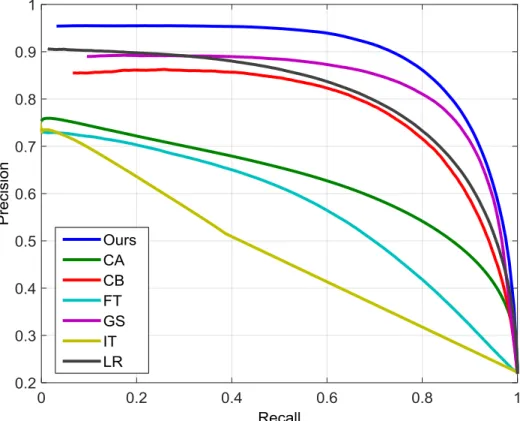
FIGURE 3.3PRECISION-RECALL CURVES ON THE MSRA10K DATASET WITH DIFFERENT DESIGN OPTIONS OF THE PROPOSED APPROACH. ... 66
FIGURE 3.4PRECISION-RECALL CURVES (PART 1) OF DIFFERENT METHODS ON THE MSRA10K DATASET. ... 67
15
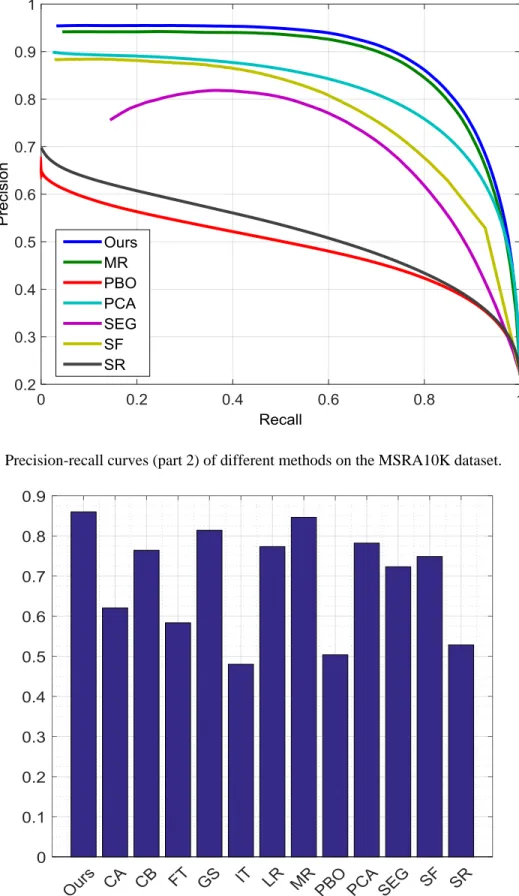
FIGURE 3.5PRECISION-RECALL CURVES (PART 2) OF DIFFERENT METHODS ON THE
MSRA10K DATASET. ... 68
FIGURE 3.6AVERAGE F-MEASURES OF DIFFERENT METHODS ON THE MSRA10K DATASET.
... 68
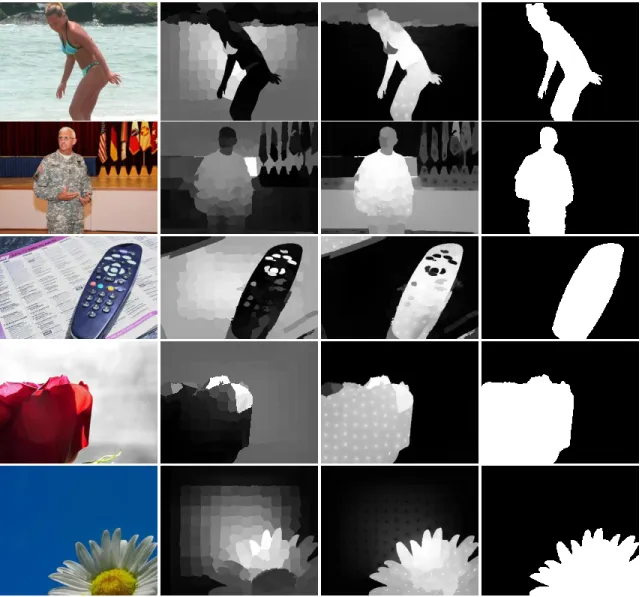
FIGURE 3.7SALIENCY MAP EXAMPLES OF DIFFERENT METHODS ON THE MSRA10K
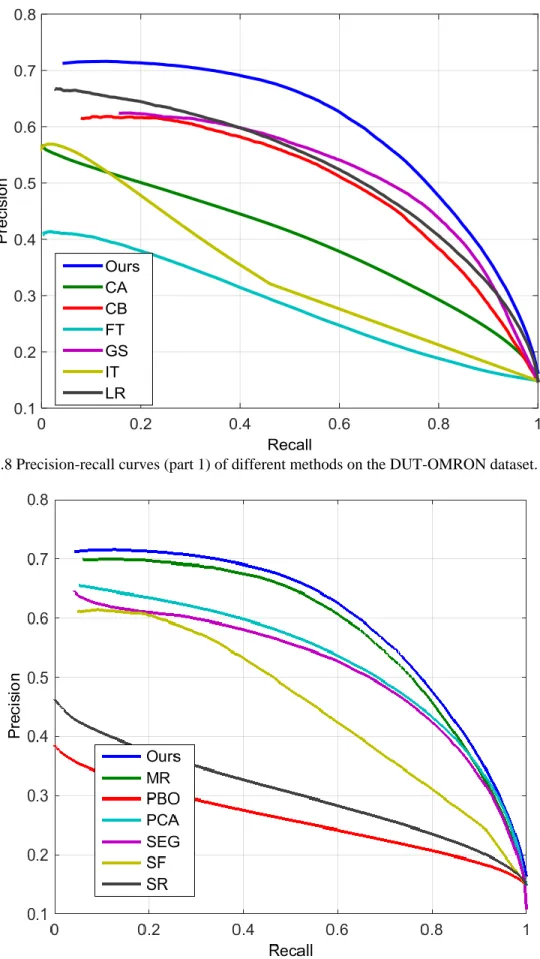
DATASET ... 69 FIGURE 3.8PRECISION-RECALL CURVES (PART 1) OF DIFFERENT METHODS ON THE
DUT-OMRON DATASET. ... 71
FIGURE 3.9PRECISION-RECALL CURVES (PART 2) OF DIFFERENT METHODS ON THE DUT-OMRON DATASET. ... 71
FIGURE 3.10AVERAGE F-MEASURES OF DIFFERENT METHODS ON THE DUT-OMRON
DATASET. ... 72
FIGURE 3.11SALIENCY MAP EXAMPLES OF DIFFERENT METHODS ON THE DUT-OMRON DATASET ... 73 FIGURE 4.1EXAMPLES SHOWING THE PROBLEM OF USING BOUNDARIES AS BACKGROUND
QUERIES WHEN THE SALIENT OBJECTS ARE BOUNDARY-ADJACENT ... 78 FIGURE 4.2EXAMPLES OF RC ... 84
FIGURE 4.3EXAMPLES OF RRWR ... 87
FIGURE 4.4AVERAGE F-MEASURES WITH DIFFERENT treverse USED IN RC ON THE MSRA10K DATASET ... 91 FIGURE 4.5AVERAGE F-MEASURES WITH DIFFERENT USED IN RRWR ON THE
16
FIGURE 4.6THE PRECISION-RECALL CURVES OF OUR METHOD, OUR METHOD WITHOUT
USING RC, AND OUR METHOD WITHOUT USING RRWR... 93
FIGURE 4.7THE AVERAGE F-MEASURES OF OUR METHOD, OUR METHOD WITHOUT USING RC, AND OUR METHOD WITHOUT USING RRWR. ... 94
FIGURE 4.8PRECISION-RECALL CURVES ON THE MSRA10K DATASET. ... 96
FIGURE 4.9F-MEASURES ON THE MSRA10K DATASET. ... 96
FIGURE 4.10MAE SCORES ON THE MSRA10K DATASET. ... 97
FIGURE 4.11PRECISION-RECALL CURVES ON THE ECSSD DATASET. ... 98
FIGURE 4.12F-MEASURES ON THE ECSSD DATASET. ... 98
FIGURE 4.13MAE SCORES ON THE ECSSD DATASET. ... 99
FIGURE 4.14PRECISION-RECALL CURVES ON THE SED DATASET. ... 100
FIGURE 4.15F-MEASURES ON THE SED DATASET. ... 100
FIGURE 4.16MAE SCORES ON THE SED DATASET. ... 101
FIGURE 4.17PRECISION-RECALL CURVES ON THE PASCAL-S DATASET. ... 101
FIGURE 4.18F-MEASURES ON THE PASCAL-S DATASET. ... 102
FIGURE 4.19MAE SCORES ON THE PASCAL-S DATASET. ... 102
FIGURE 4.20PRECISION-RECALL CURVES ON THE BAOS DATASET. ... 103
FIGURE 4.21F-MEASURES ON THE BAOS DATASET. ... 104
FIGURE 4.22MAE SCORES ON THE BAOS DATASET. ... 104
FIGURE 4.23SALIENCY MAP EXAMPLES OF STATE-OF-THE-ART METHODS AGAINST OUR RCRR METHOD ... 107
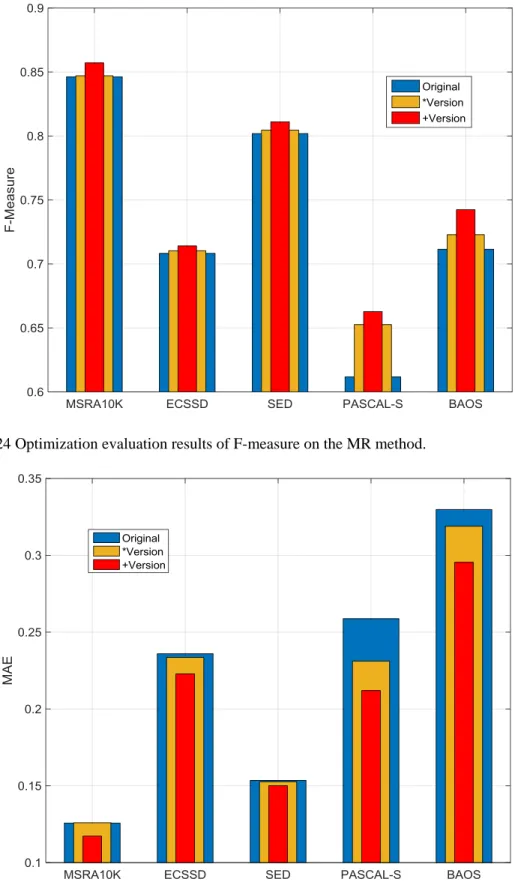
FIGURE 4.24OPTIMIZATION EVALUATION RESULTS OF F-MEASURE ON THE MR METHOD. ... 109
17
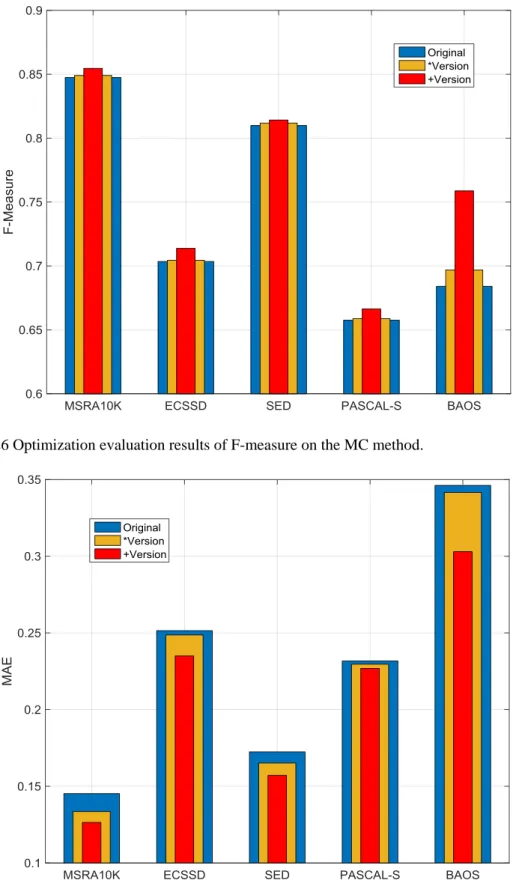
FIGURE 4.26OPTIMIZATION EVALUATION RESULTS OF F-MEASURE ON THE MC METHOD.
... 110
FIGURE 4.27OPTIMIZATION EVALUATION RESULTS OF MAE ON THE MC METHOD. ... 110
FIGURE 4.28EXAMPLE CASE SHOWING THE LIMITATION OF OUR PROPOSED RCRR METHOD ... 111
FIGURE 5.1ILLUSTRATION OF CHALLENGES ENCOUNTERED BY CONVENTIONAL LOW-LEVEL FEATURE BASED SALIENCY DETECTION METHODS ... 115
FIGURE 5.2FLOWCHART OF OUR PROPOSED BSFE METHOD. ... 119
FIGURE 5.3EXAMPLES OF THE BACKGROUND MASK BY THE BSSAE MODEL. ... 120
FIGURE 5.4FLOWCHART OF OUR PROPOSED BSFE METHOD. ... 123
FIGURE 5.5PRECISION-RECALL CURVES ON THE ECSSD DATASET. ... 126
FIGURE 5.6F-MEASURES ON THE ECSSD DATASET. ... 126
FIGURE 5.7MAE SCORES ON THE ECSSD DATASET. ... 127
FIGURE 5.8PRECISION-RECALL CURVES ON THE PASCAL-S DATASET. ... 127
FIGURE 5.9F-MEASURES ON THE PASCAL-S DATASET. ... 128
FIGURE 5.10MAE SCORES ON THE PASCAL-S DATASET. ... 128
FIGURE 5.11PRECISION-RECALL CURVES ON THE SED1 DATASET. ... 129
FIGURE 5.12F-MEASURES ON THE SED1 DATASET. ... 129
FIGURE 5.13MAE SCORES ON THE SED1 DATASET. ... 130
FIGURE 5.14PRECISION-RECALL CURVES ON THE SED2 DATASET. ... 130
FIGURE 5.15F-MEASURES ON THE SED2 DATASET. ... 131
FIGURE 5.16MAE SCORES ON THE SED2 DATASET. ... 131
FIGURE 5.17SALIENCY MAP EXAMPLES OF STATE-OF-THE-ART METHODS AGAINST OUR BSFE METHOD ... 133
18
FIGURE 5.18FLOWCHART OF OUR DSL METHOD ... 135
FIGURE 5.19FLOWCHART OF THE DL STEP. ... 136
FIGURE 5.20BILINEAR INTERPOLATION FROM THE CONV8 LAYER TO THE DECONV32 LAYER. ... 138
FIGURE 5.21EXAMPLE OUTPUTS OF THE DL STEP ... 139
FIGURE 5.22FLOWCHART OF THE SL STEP ... 140
FIGURE 5.23EXAMPLE OUTPUTS OF THE DL,SL, AND DC STEPS ... 146
FIGURE 5.24PRECISION-RECALL CURVES AGAINST CONVENTIONAL METHODS ON THE ECSSD DATASET. ... 155
FIGURE 5.25PRECISION-RECALL CURVES AGAINST CONVENTIONAL METHODS ON THE PASCAL-S DATASET. ... 156
FIGURE 5.26PRECISION-RECALL CURVES AGAINST CONVENTIONAL METHODS ON THE SED1 DATASET. ... 156
FIGURE 5.27PRECISION-RECALL CURVES AGAINST CONVENTIONAL METHODS ON THE SED2 DATASET. ... 157
FIGURE 5.28PRECISION-RECALL CURVES AGAINST CONVENTIONAL METHODS ON THE THUR15K DATASET. ... 157
FIGURE 5.29PRECISION-RECALL CURVES AGAINST CONVENTIONAL METHODS ON THE HKU-IS DATASET. ... 158
FIGURE 5.30PRECISION-RECALL CURVES AGAINST LEARNING BASED METHODS ON THE ECSSD DATASET. ... 160
FIGURE 5.31PRECISION-RECALL CURVES AGAINST LEARNING BASED METHODS ON THE PASCAL-S DATASET. ... 161
19
FIGURE 5.32PRECISION-RECALL CURVES AGAINST LEARNING BASED METHODS ON THE
SED1 DATASET. ... 161
FIGURE 5.33PRECISION-RECALL CURVES AGAINST LEARNING BASED METHODS ON THE
SED2 DATASET. ... 162 FIGURE 5.34PRECISION-RECALL CURVES AGAINST LEARNING BASED METHODS ON THE
THUR15K DATASET. ... 162 FIGURE 5.35PRECISION-RECALL CURVES AGAINST LEARNING BASED METHODS ON THE
HKU-IS DATASET. ... 163
FIGURE 5.36SALIENCY MAP EXAMPLES OF STATE-OF-THE-ART METHODS AGAINST OUR
20
List of Tables
TABLE 2.1INFORMATION STATISTICS OF BOTTOM-UP SALIENCY DETECTION METHODS .... 36
TABLE 2.2INFORMATION STATISTICS OF TOP-DOWN SALIENCY DETECTION METHODS. ... 39
TABLE 3.1ALGORITHM DESCRIPTION OF OUR PROPOSED RR METHOD ... 63
TABLE 3.2RUNNING TIME TEST RESULTS OF SELECTED METHODS (SECONDS PER IMAGE) . 74 TABLE 4.1ALGORITHM DESCRIPTION OF THE RC PROCESS ... 82
TABLE 4.2ALGORITHM DESCRIPTION OF OUR PROPOSED RCRR METHOD ... 87
TABLE 4.3F-MEASURE AND MAE EVALUATION RESULTS... 95
TABLE 5.1ALGORITHM DESCRIPTION OF OUR PROPOSED FOREGROUND ESTIMATION ... 123
TABLE 5.2HYPER-PARAMETERS FOR THE TRAINING OF BSSAE AND FESAE ... 125
TABLE 5.3ARCHITECTURE OF OUR DL NETWORK ... 137
TABLE 5.4ARCHITECTURE OF OUR LOCAL CNN ... 141
TABLE 5.5ARCHITECTURE OF OUR DC NETWORK ... 143
TABLE 5.6PERFORMANCES OF THE DL NETWORK AGAINST TWO STATE-OF-THE-ART DENSE LABELING MODELS ... 150
TABLE 5.7PERFORMANCES OF THE SL NETWORK WITH DIFFERENT LAYER NUMBER (#LAYER) AND PARAMETERS PER LAYER (#PARAM) ... 151
TABLE 5.8PERFORMANCES OF DSL WITH DIFFERENT SL FEATURE COMBINATIONS ... 151
TABLE 5.9PERFORMANCES OF THE DC STEP WITH DIFFERENT BASELINE MODELS ON THE TWO CHALLENGING DATASETS ECSSD AND PASCAL-S ... 152
21
TABLE 5.10PERFORMANCES OF DIFFERENT DESIGN OPTION CONFIGURATIONS ON THE TWO CHALLENGING DATASETS ECSSD AND PASCAL-S ... 153
TABLE 5.11QUANTITATIVE EVALUATION RESULTS OF DSL AGAINST CONVENTIONAL SALIENCY DETECTION METHODS ... 158 TABLE 5.12QUANTITATIVE EVALUATION RESULTS OF DSL AGAINST LEARNING BASED
SALIENCY DETECTION METHODS ... 163 TABLE 5.13EFFICIENCY COMPARISON (SECONDS PER IMAGE) ... 165
22
1
Introduction
1.1
Background of Saliency Detection
With the rapid uptake of smart devices and social networks, we are now immersed in
massive amounts of digital media data every day. Considering the scarcity of our
attention and time, it is urgent and advantageous to filter out only the most useful
message for further processing among all of the available data to us. This concept
equates to the saliency detection process when applied to images.
Saliency is usually referred to as local contrast [5-7], which typically originates from
contrasts between objects and their surroundings, such as differences in color, texture,
shape, etc. This mechanism measures intrinsically salient stimuli to the vision system
that primarily attracts human attention in the early stage of visual exposure to an input
image [6]. Intermediate and higher visual processes may automatically judge the
importance of different regions of the image, and conduct detailed processes only on the
“salient object” that mostly related to the current task, while neglecting the remaining “background” regions [8]. Figure 1.1 shows a few examples of natural images. As seen in Figure 1.1(c), the flower, the cookies, the girl, the cat and the toy car usually attract
the most visual attention in their corresponding images, and thus are regarded as salient
objects. On the other hand, Figure 1.1(b) shows illustrative results of saliency detection,
or the “saliency maps” in formal terms. The general objective of saliency detection is to
provide saliency maps of the input images as close to the ground truth as possible.
Chapter
23 Figure 1.1 Examples of salient objects in natural images. (a) original images; (b) example saliency detection results [2]; (c) ground truth.
24
1.2
Significance of Research
Human visual saliency detection has long been studied by cognition scientists and has
recently draw much of interest in the computer vision community mainly because of its
assistance in finding the objects or regions that efficiently represent a scene, and thus
harness complex vision problems such as scene understanding. Early researches of
saliency detection mostly focus on human eye fixation [5], [9], [10], which approximates
the visual attention of semantic objects in a given image, such as human faces, texts, or
daily objects [9], [11]. The detection results of eye fixations, however, are often
presented as sparse dots without details about the objects. On the other hand, the recent
researches of saliency detection are capable of locating and segmenting the whole salient
object with complete boundary details [12], and thus has received broad research
interests. The detection of the salient objects in images is of significant importance, as it
not only improves the subsequent image processing and analyses, but also directs the
limited computational resources to more efficient solutions. Saliency detection has
received recognized success in various areas, such as computer vision, graphics, and
robotics. More specifically, the proposed models have been broadly applied in object
detection and recognition [13-20], object discovery [21], [22], photo collage and
thumbnailing [23-25], image quality assessment [26-28], image segmentation [29-32],
content based image retrieval [21], [33-35], image editing and manipulating [30],
[36-38], image and video compression [39], [40], video summarization [41-43], visual
25
1.3
Existing Challenges
Since emergence, intensive researches have been conducted on saliency detection. The
majority of existing saliency detection methods is based on hand-crafted low-level
features. However, there are multiple critical issues on the existing methods that prevent
them from perfection.
1.3.1
Problematic Pre-assumptions
Among many conventional low-level feature based saliency detection methods, specific
pre-assumptions or prior knowledge are required in order to make them properly
functioning. Most of the pre-assumptions are largely empirical, e.g. image boundary
regions are assumed as background [52], [53], or image central [54], [55] regions are
assumed as foreground. These pre-assumptions are easily violated on broader datasets
with more unusual-patterned images, such as the example in Figure 1.2, where the upper
two images have salient objects on the boundary, while the lower two images have
background regions in the center. The atypical patterns of these images lead to the
failure of conventional low-level feature based methods, as seen in Figure 1.2(b). To
overcome the limitations above, multiple more robust improvements of the
26 Figure 1.2 Examples showing the problematic pre-assumptions in conventional low-level feature based saliency detection methods. (a) original images; (b) failed detection results by a conventional low-level feature based method [52]; (c) ground truth.
1.3.2
Ineffective Feature Integration
Among the hand-crafted low-level features in conventional methods, each one is usually
advantageous only on a specific aspect, e.g. color histogram is good at differentiating
27
[56] is good at object recognition with varied environments, etc. It is generally difficult
to combine different low-level features into a single algorithm to benefit from them all.
Although some integration trials have been made [57], [58], these specially designed
algorithms are nevertheless bulky and inefficient due to the large number of features
involved. On the other hand, a more effective means of feature integration has been
proposed, which will be discussed in Chapter 5.
1.3.3
Absence of High-Level Feature Abstraction and Learning
Without feature abstraction and learning, the conventional low-level feature basedmethods are likely to encounter difficulty regarding low contrast images and complex
patterned images. Some typical examples of this issue are exhibited in Figure 1.3, where
the upper two images lead to the failed results on low contrast images, while the lower
two images lead to the failed results on complex patterned images. On the other hand,
however, this drawback can be readily solved via high-level feature extraction and
learning. The recently prevalent deep neural networks (DNNs), especially the
convolutional neural networks (CNNs), are proved to be of great assistance in high-level
28 Figure 1.3 The challenges regarding low contrast images and complex images. (a) original images; (b) failed detection results by a conventional low-level feature based method [54]; (c) ground truth.
1.4
Contributions
To address the issues above in existing saliency detection methods, we have conducted
extensive research on three major aspects, and have proposed four novel saliency
detection methods to provide improved saliency detection performances. The major
29
1.4.1
Conventional Low-Level Feature Based Saliency Detection
We first explore better exploitations of the hand crafted features of conventionallow-level feature based saliency detection methods, and propose the regularized random
walks ranking (RR) method, which has the following contributions:
(1) To improve the background saliency estimation, we first filter out one of the four
boundaries of the input image that most unlikely belong to the background, unlike
conventional methods that use all four boundaries as background reference [52], [53].
This erroneous boundary removal process effectively eliminates the image boundary
with boundary-adjacent foreground superpixels, and thus neutralizes their negative
influences in the saliency estimations.
(2) To improve the foreground saliency estimation, we propose the regularized
random walks ranking algorithm, which consists of a pixel-wise graph term and a newly
formulated fitting constraint to take local image data and prior estimation into account.
This fitting constraint is able to utilize the entire saliency estimation results from the
former steps instead of the selected seed points alone. Besides, regularized random
walks ranking is independent of superpixel segmentation, and can generate pixel-wised
saliency maps that reflect full-details of the input image.
The RR method has been published on CVPR 2015 [1], and will be fully described
in Chapter 3.
1.4.2
Improved Low-Level Feature Based Saliency Detection
To improve the performance of the RR method in Section 1.4.1, we have conducted
30
correction and regularized random walks ranking (RCRR) method, which is a direct
upgrade of the RR method. RCRR has the following contributions:
(1) We propose the reversion correction (RC) process, which, unlike the RR method
that completely removes one of the problematic boundaries, locates and eliminates the
boundary-adjacent foreground superpixels, which is more accurate and can maximally
preventing the saliency reversions (will be discussed later) from emerging. This
mechanism also leads to increased robustness of the algorithm.
(2) We present the extensibility of our method as a saliency optimization algorithm,
which can be directly applied on existing saliency detection methods for performance
improvement purposes.
(3) We also propose the boundary-adjacent object saliency (BAOS) dataset, which is
comprised of 200 images that have large proportions of the salient objects on the image
boundaries. This dataset provides an objective evaluation for saliency detection methods’
performance on boundary-adjacent salient objects.
The RCRR method has been publish on IEEE TIP [2], and will be fully described in
Chapter 4.
1.4.3
Deep Neural Network Based Saliency Detection
Among various recent research works in computer vision, the deep neural network
(DNN) [59] has shown particular success in high-level feature extraction, which grants
us an excellent machine learning tool to overcome the difficulty of conventional
low-level feature based saliency detection methods when facing low contrast images and
31
adaptive background search and foreground estimation (BSFE) and the dense and sparse
labeling (DSL). The contributions of the two methods are listed below.
For BSFE:
(1) We propose an adaptive background extractor, which approximates background
regions semantically and cognitively, contributing to higher detection accuracy;
(2) We apply the auto-encoder (AE) hierarchically for foreground estimation, which
is guided by the background mask, to reconstruct the final saliency map with higher
performance.
And for DSL:
(1) We combine the DNN-based dense labeling (DL) and sparse labeling (SL)
together for initial saliency estimation, in which DL conducts dense labeling that
maximally preserves the global image information and provides accurate location
estimation of the salient object, while SL conducts sparse labeling that focuses more on
local features of the salient object;
(2) For the SL step, both low-level features and RGB features of the image are
applied as the network inputs. Such multi-dimensional input features enable the
complementary advantage of low-level features and RGB features, by which the image
is more accurately abstracted and represented;
(3) In the last deep convolution (DC) step, a 6-channeled input structure is proposed,
which provides significantly better guidance in generating the final saliency map. On the
one hand, the combined initial saliency estimations from the DL and SL steps provide
accurate location guidance of the salient object, effectively excluding any false salient
32
current to-be-classified superpixel, which leads to more consistent and accurate saliency
labeling.
The BSFE method has been published on ICIP 2016 [3], while the DSL method has
been published on IEEE TCSVT [4]. They will be fully described in Chapter 5.
1.5
Thesis Organization
The remainder of this thesis is organized as follows.
Chapter 2 gives a systematic review of the related works, including the
categorization of saliency detection methods, and the different prevalent applications of
DNN.
Chapter 3 introduces the RR method in detail, which includes research objective,
necessary prior knowledge (manifold ranking and random walks), step-by-step
methodology (background/foreground saliency estimation, and final saliency
formulation), and experimental results.
Chapter 4 introduces the RCRR method in detail, which includes research objective,
necessary prior knowledge (k-means clustering), step-by-step methodology (reversion correction and regularized random walks ranking), and experimental results.
Chapter 5 introduces the two DNN based methods, i.e. BSFE and DSL. The research
objectives and related works (auto-encoder, sparse labeling and dense labeling) of the
two methods are first presented, followed by the methodology (adaptive background
search and foreground estimation) and experimental results of BSFE, and then the
detailed description of DSL (dense labeling, sparse labeling and deep convolution) and
33
Chapter 6 summarizes the whole thesis, gives conclusions, and explores for potential
34
2
Related Works
In this chapter, we will systematically review the related works about this thesis, namely
the categorizations of saliency detection methods, developments of object detection, and
the most prevalent applications of deep neural networks.
2.1
Saliency Detection
From the perspective of computer vision, the methods of saliency detection are broadly
categorized into two major groups, namely the bottom-up methods and the top-down
methods. Besides that, more methods using unconventional models and features have
also been proposed in recent years.
2.1.1
Bottom-Up Methods
The bottom-up methods are largely designed for non-task-specific saliency detections
[60], in which low-level features are mainly involved as fundamentals for the detections.
These features are usually data-driven and hand-crafted.
Before the 2010s, the researches of saliency detection are in the stage of fundamental
developments, which draws interest across multiple disciplines including cognitive
psychology, neuroscience, and computer vision. At this time, usually only the most basic
features in conventional image processing, such as pixel color value, histogram,
frequency spectrum, etc., are exploited in the methods. As a pioneer, Itti et al. [5] present a center-surround model that integrates color, intensity and orientation at
different scales for saliency detection. Rahtu et al. [61] detect saliency by measuring the
Chapter
35
center-surround contrast of a sliding window over the input image. Bruce et al. [62] exploit Shannon’s self-information measurement on local context to compute saliency. In the work of Cheng et al. [63], [64], pixel-wise color histogram and region-based contrast are utilized in establishing the histogram-based and region-based saliency maps.
Duan et al. [65] measure global contrast based saliency with spatially weighted feature dissimilarities. Achanta et al. [66] propose a frequency-tuned method based on color and luminance, in which the saliency value is computed by the color difference with respect
to the mean pixel value. Fourier spectrum analysis has also been utilized in visual
saliency detection, such as in the works of Hou et al. [67] and Guo et al. [68].
Since the 2010s, more advanced models, and especially the graph based models,
have been introduced to saliency detection, which have greatly improved the overall
detection accuracy. It is also notable that the majority of conventional low-level feature
based saliency detection methods were proposed during this period. Jiang et al. [54] establish a 2-ring graph model that calculates saliency values of different image regions
by their Markov absorption probabilities. To overcome the negative influence of
small-scale high-contrast image patterns, Yan et al. [69] propose a multi-layer approach that optimizes saliency detection by a hierarchical tree model. Perazzi et al. [70] unify the contrast and saliency computation into a single high dimensional Gaussian filtering
framework. Wei et al. [71] apply background priors and geodesic distance to compute visual saliency. Yang et al. [52] exploit the graph-based manifold ranking in extracting foreground queries for the final saliency map, in which the four image boundaries are
used as background prior knowledge. In the work of Li et al. [1], the image boundaries are refined before being used as background prior knowledge, and a random-walk based
36
the saliency of different image cells is computed by synchronous update of their
dynamic states via the cellular automata model.
The statistics of prevalent bottom-up methods are listed in Table 2.1, and some
example saliency maps are shown in Figure 2.1. It is observed that the bottom-up
methods generally behave poorly on low contrast or complex patterned images.
Table 2.1 Information statistics of bottom-up saliency detection methods
# Method Published on Year Code
1 IT [5] TPAMI 1998 M 2 SR [67] CVPR 2007 M 3 SUN [73] JOV 2008 M 4 FT [66] CVPR 2009 C 5 SEG [61] ECCV 2010 M+C 6 RC/HC [63] CVPR 2011 C 7 SVO [74] ICCV 2011 M+C 8 CB [75] BMVC 2011 M+C 9 FES [76] IA 2011 M+C 10 SF [70] CVPR 2012 C 11 LR [77] CVPR 2012 M 12 CA [78] CVPR 2012 M+C 12 PCA [79] CVPR 2013 M+C 13 HS [69] CVPR 2013 EXE 14 MR [52] CVPR 2013 M 15 MC [54] ICCV 2013 M+C 16 DSR [80] ICCV 2013 M+C 17 GC [81] ICCV 2013 C 18 UFO [82] ICCV 2013 M+C 19 GR [83] SPL 2013 M+C 20 RBD [53] CVPR 2014 M 21 RR [1] CVPR 2015 M 22 BSCA [72] CVPR 2015 M 23 RCRR [2] TIP 2016 M
Abbreviation of journals and conferences: please refer to Appendix A; Abbreviation of code type: M - Matlab; C - C/C++; EXE - executable.
37 Figure 2.1 Example saliency maps of prevalent bottom-up saliency detection methods. (a) – (g): image case IDs.
38
2.1.2
Top-Down Methods
On the other hand, the top-down saliency detection methods are usually task-driven.
These methods break down the saliency detection task into more fundamental
components, and task-specific high-level features are frequently involved as prior
knowledge. Supervised learning approaches are commonly used in detecting image
saliency. In the work of Yang et al. [84], joint learning of conditional random field (CRF) is conducted in discriminating visual saliency. Lu et al. [85] apply a graph-based diffusion process to learn the optimal seeds of an image to discriminate object and
background. Mai et al. [86] train a CRF model to aggregate saliency maps from various models, which benefits not only from the individual saliency maps, but also from the
interactions among different pixels. And in the work of Tong et al. [87], samples from a weak saliency map are exploited as the training set for a series of supply vector
machines (SVMs) [88], which are subsequently applied to generate a strong saliency
map.
Since 2013, benefitted from the tremendous success of deep learning and other
high-level feature extraction techniques, more learning based methods arise with significantly
improved performances. Jiang et al. [57] regard saliency detection as a regression problem, which fuses regional contrast, property and backgroundness into a random
forest classifier for multi-level image saliency segmentation. Kim et al. [89] represent the saliency map as a linear combination of different high-dimensional color space,
where the salient regions and the background distinctively separated. Wang et al. [90] train two separate DNNs with image patches (DNN-L) and object proposals (DNN-G)
39
summation to create the final saliency map. Zhao et al. [91] establish a multi-context DNN model for superpixel-wise saliency classification, which exploits DNN for
per-superpixel saliency value classification. Li et al. [92] propose a similar multi-scale DNN model for feature extraction, the outputs of which are then aggregated for the final
saliency map. And in the work of Chen et al. [93], two stacked DNNs are utilized to build the saliency detection model, among which the first one provides a coarse saliency
estimation with the whole image as input, while the second one focuses on the local
context to produce fine-grained saliency map.
The statistics of popular top-down saliency detection methods are listed in Table 2.2,
and some example saliency maps are shown in Figure 2.2. We notice that compared with
the bottom-up methods in Figure 2.1, the top-down methods generally perform much
better on low contrast and complex patterned images, which is attributed to the
high-level feature extraction involved in their learning processes.
Table 2.2 Information statistics of top-down saliency detection methods.
# Method Published on Year Code
1 SA [86] CVPR 2013 M+C 2 DRFI [57] CVPR 2013 M+C 3 HDCT [89] CVPR 2014 M 4 BL [87] CVPR 2015 M 5 MCDL [91] CVPR 2015 Py+C 6 LEGS [90] CVPR 2015 M+C 7 MDF [92] CVPR 2015 M+C 8 DISC [93] TNNLS 2015 M+C 9 DSL [4] TCSVT 2016 M
Abbreviation of journals and conferences: please refer to Appendix A; Abbreviation of code type: M - Matlab; C - C/C++; Py - Python.
40 Figure 2.2 Example saliency maps of prevalent top-down saliency detection methods. (a) – (g): image case IDs.
2.1.3
Other Methods
In recent years, more applications of other innovative models and features have been
proposed in saliency detection. For instance, with the application of commercial
plenoptic cameras, Li et al. [94] propose a saliency detection method which exploits the
unique refocusing capability of light fields. Liu et al. [95] design an adaptive partial
differential equation (PDE) system learning from images, which is used to model the
evolution of visual saliency. Yang et al. [96] establish a visual tracking model of the salient object based on midlevel structural information captured in superpixels. The
41
tone-mapping that is used to convert high-frame-rate video into low-frame-rate video
while maximally preserving the saliency information contained. In the work of Vig et al.
[98], they propose the hierarchical feature learning method using a data-driven approach
to perform large-scale searching of optimal features; this method provide integrated and
biologically-plausible saliency detection outputs. The accuracy and robustness of the
methods above, however, are still under further validation.
2.2
Image Segmentation
Image segmentation, which includes semantic scene labeling and semantic segmentation,
is one of the well-developed research areas in computer vision [99]. While saliency
detection aims to locate the most salient object in an image, and treat the segmentation
task as a binary labeling problem, the objective of general image segmentation is to
mark each pixel in the image a label indicating the type of object class it belongs to
(background is treated as a separate class in this case). In other words, image
segmentation is a multi-class labeling problem. Figure 2.3 shows typical examples to
42 Figure 2.3 Illustration of the difference between saliency detection and general image segmentation. (a) original images; (b) ground truth for saliency detection; (c) ground truth for multi-class image segmentation.
The segmentation methods are usually categorized as unsupervised methods and
supervised methods. Reviews of both types can be found in [100-102]. Unsupervised
methods are conducted without any prior knowledge or user input, which encourages
their significantly high efficiency. These methods include thresholding [103], [104],
relaxation [105], edge detection [106], [107], region growing [107], [108], etc. Yet, after
many years of developments, unsupervised methods are still in need of higher accuracy
and robustness to produce satisfying results. On the other hand, supervised methods
primarily depend on their training datasets or user inputs as prior knowledge, the quality
of which will directly affect the quality of their segmentation results. These methods are
43
represented from the training datasets. However, due to their dependency of prior
knowledge, large-scale training data is usually required for higher performances, which
is hard to obtain before the segmentation tasks.
Recently, the computer-aided semi-supervised segmentation methods have emerged
as a popular compromise solution. The semi-supervised methods are generally able to
provide more accurate and efficient segmentation results with minimum user inputs,
hence have become the currently prevailing means of image segmentation. As a major
branch of semi-supervised image segmentation methods, the graph-based methods
exhibit remarkably elevated accuracy and robustness in comparison with other methods.
They usually take advantage of user inputs to directly indicate clues about the
foreground and background in the images. The segmentation problem is then solved by
applying various graph theories. These methods are primarily variations of five graph
theoretic techniques, namely graph cut, random walks, shortest path, power watershed,
and minimum spanning tree:
(1) The graph cut method and its variations generally aim to solve energy
minimization problems for low-level computer vision tasks. They can be reduced to
instances of the max-flow/min-cut theorem [111]. Existing implementations include
graph cut with cost functions [112], graph cut on Markov random filed (MRF) [113],
and graph cut on conditional random field (CRF) [114], etc. As a major extension, the
GrabCut method [115] applies user-specified bounding box with a Gaussian mixture
model to estimate the color distribution of the object, and achieves relatively accurate
results.
(2) The random walks method is initially introduced as a mathematical formalization
44
from any element in an image to each of the user-defined seed points, and determines
the cluster that an element most likely belongs to [117].
(3) The shortest path method aims to find a path between two vertices in a graph, in
which the sum of weights of the edges passed is minimized. Existing methods include
Dijkstra’s method [118], Bellman-Ford method [119], A* search method [120], and Johnson’s method [121], etc.
(4) The power watershed method inherits the basic ideas from the watershed method
[122]. It is a generalized framework that effectively extends from graph cuts, random
walks and shortest path methods. It is an integration of unary terms in a standard
watershed method to improve the segmentation results.
(5) The minimum spanning tree method is a subcategory of the spanning tree method
[123], which applies a tree structure that connects the vertices of a given graph together.
There are multiple methods available, including Boruvka’s method [124], Kruskal’s method [125], Prim’s method [126], and parallel method [127], etc.
For the graph-based semi-supervised methods above, user interactions are required.
These methods model the image as a weighted graph to reflect local intensity changes,
and a small number of user-provided seeds are applied to estimate the foreground and
the background regions. The final solution is usually achieved by minimization of the
corresponding energy function. For example, the graph cut method performs a
max-flow/min-cut analysis to find the minimum weight cut between the seeds of the
foreground and the seeds of the background. Another example is the random walks
method, in which the diffusion distances are calculated as the classification probabilities
45
In this thesis, the ideas of weighted graph, random walks and energy function
optimization are used to facilitate the saliency detection process, which will be discussed
in Chapter 3 and Chapter 4.
2.3
Object Proposal Generation
Object proposal generation, or objectness measurement, is a class of methods that
attempt to generate a small set (e.g. a few hundreds or thousands) of potential object
regions (called object proposals) in a given image, so that these object proposals can
cover the different objects in the image to the maximum extend, regardless of the
specific categories of these objects (i.e. generic over categories) [129-134]. The object
proposal generation is often adopted as a pre-processing stage before subsequent tasks.
Compared with conventional sliding window based object detection paradigm [135],
[136], object proposal generation has three major advantages:
(1) It better accords with human visual system which quickly perceives objects
before identifying them [137], [138];
(2) It greatly speeds up the computation by reducing the potential candidates of
search locations (e.g., from typically a few million candidates to less than a few
thousand candidates), especially when the number of object classes that need to be
detected is high;
(3) It also helps to improve the accuracy of the object detection task by allowing the
usage of more powerful classifiers during testing, since it restricts the detection only on
the object proposals [139].
Object proposal generation and saliency detection are closely correlated. On the one
46
measuring objectness of a region [130], [140]; in other words, an object is more likely to
be salient than a background region [141], [142]. On the other hand, the saliency
detection process applies objectness measurements to distribute high and low saliency
values to objects and background, which leads to higher accuracy [74].
In this thesis, the idea of object proposal is exploited to provide initial saliency
estimations, which will be discussed in Chapter 5.
2.4
Deep Neural Network (DNN)
Deep neural network is a branch of machine learning that has experienced drastic
developments in the last decade. First proposed by LeCun et al. in 1989 [143], the DNNs, and especially the convolutional neural networks (CNNs), are designed to model
high-level nonlinear data features by multiple complex processing layers [59]. Since
emergence, DNN has received remarkable success in image classification [144-146],
object detection [147], [148], semantic segmentation [149-151], face recognition [152],
[153], pose estimation [154], pedestrian behavior estimation [155], [156], and cancer
type / subtype classification [157] etc.
The current applications of DNN focus on two major categories, namely sparse
labeling and dense labeling. In this section, we will first briefly review the basic
principles of neural networks, and then introduce the applications of DNN on sparse and
dense labeling.
2.4.1
Fundamentals of Neural Networks
This section is based on the online course Unsupervised Feature Learning and Deep
47
labeled training examples ( ) ( )
(xi ,yi ). The neural networks provide a way of defining a complex, non-linear model hW b, ( )x , with parameters W b, to be fitted by the training data. The simplest neural network, which consists of only a single “neuron”, is shown in
Figure 2.4.
Figure 2.4 An illustrative diagram of a “neuron” in DNN. The X1~X3 stand for inputs, and “+1” stands for bias.
A neural network is usually established by hooking together many of the “neuron”
structures in Figure 2.4, so that the output of one neuron is the input of another. For
instance, Figure 2.5 shows a typical neural network with 3 layers. In this structure, the
“+1” are bias units; the leftmost layer is the input layer, usually takes in images or other data structures; the rightmost layer is the output layer, which can output a single label
(for sparse labeling) or a matrix-like label mask (for dense labeling); the middle layer is
a hidden layer, since its values are not directly observed during the training process.
The network has parameters ( ) ( ( ) ( ) ( ) ( )), where ( ) and ( ) denote the weight and bias associated with layer . The ( ) denote the activation value
of unit in layer . For (the input layer), ( ) is defined. The computation that the network represents is given by the equations below, which are called forward
propagation; the network is hence called feed-forward network:
𝑥
𝑥
𝑥
3+1
ℎ
𝑊 𝑏(𝑥)
Neuron
48 (2) (1) (1) (1) (1) 1 11 1 12 2 13 3 1 (2) (1) (1) (1) (1) 2 21 1 22 2 23 3 2 (2) (1) (1) (1) (1) 3 31 1 32 2 33 3 3 (3) (2) (2) (2) (2) (2) (2) (2) , 1 11 1 12 2 13 3 1 ( ) ( ) ( ) ( ) ( ) W b a f W x W x W x b a f W x W x W x b a f W x W x W x b h x a f W a W a W a b (2.1)
After the computation hits the output layer, there will be a cost function ( , )J W b
calculating the cost against the ground truth label. The cost is then propagated
backwards with gradients of each layer to update the parameters W b, , which is called backpropagation: ( ) ( ) ( ) ( ) ( ) ( ) ( , ) ( , ) l l ij ij l ij l l i i l i W W J W b W b b J W b b (2.2)
During training, the forward propagation and backpropagation are conducted
alternately to update the network parameters, until the cost is small enough, or the
49 Figure 2.5 A small illustrative neural network with 3 layers. The X1~X3 stand for inputs, and “+1” stands for bias.
In practice, instead of the fully connected network in Figure 2.5, the convolutional
neural network (CNN) is more prevalently used. CNN is also a type of feed-forward
neural network, which models the animal visual perception. Instead of full connection,
the connection between different layers of CNN is realized by 2D-convolution. Figure
2.6 exhibits a typical architecture of CNN.
ℎ
𝑊 𝑏(𝑥)
Layer L1
𝑥
𝑥
𝑥
3+1
+1
Layer L2
Layer L3
𝑎
( )𝑎
( )𝑎
3( )50 Figure 2.6 A typical CNN architecture.
Compared with fully connected network, CNN benefits from the shared weights of
each convolution filter among layers, which greatly reduce the overall size of the
network. CNN is also renowned for being space invariant, which contributes to its
significantly elevated robustness. Given these advantages, CNN receives broad
applications in various computer vision tasks.
In this thesis, CNN is applied in all of our DNN models, which will be introduced in
Chapter 5.
2.4.2
DNN Based Sparse Labeling
Sparse labeling is the fundamental application of DNN in classification tasks. The idea
is to generate a single class label for each input sample [159], such as an image. Many
state-of-the-art network models are designed under this scheme, including AlexNet
[144], OverFeat [145], Clarifai [160], VGG [161], GoogLeNet [146], and ResNet [162],
etc. Recently, initial studies have emerged towards the application of DNN on saliency
sparse labeling. For instance, Wang et al. [90] train two separate DNNs with image patches and object proposals for local and global saliency; Zhao et al.[91] establish a multi-context DNN model for superpixel-wise saliency classification; and Li et al. [92]
51
propose a multi-scale DNN model for feature extraction, the outputs of which are then
aggregated for the final saliency map.
2.4.3
DNN Based Dense Labeling
On the other hand, the dense labeling is a newly arising application of DNN that has
drawn much attention. Unlike sparse labeling, dense labeling aims to predict a complete
label mask (instead of a single label) based on the input sample, with either identical or
reduced size. Since much more per-sample label information can be generated than
sparse labeling, DNN-based dense labeling has greatly facilitated many previously
challenging tasks such as object detection and semantic segmentation, in terms of both
accuracy and efficiency. In [147], Szegedy et al. propose the idea of DNN-based object detection via DNN regression and multi-scale refinements. Girshick et al.[148] combine CNNs with bottom-up region proposals to localize and segment objects. Long et al.[150] propose the idea of fully convolutional network (FCN), which achieves dramatic
improvements in semantic segmentation. And in the work of Chen et al.[151], responses from CNNs are combined with fully connected CRF, which overcomes the poor
localization property of CNN itself.
There have been multiple methods in exploring for the application of DNN on
saliency detection, such as [90-93]. The details about how DNN greatly facilitated the
performance of our proposed DSL method will be discussed in Chapter 5. We will also
see that in general, the DNN-based methods greatly outperforms conventional low-level
52
3
Conventional Low-Level
Feature Based Saliency Detection
In the first two chapters of this thesis, the general background of saliency detection is
introduced, which covers the origins of saliency detection, the challenges faced in
existing methods, and the related works in various aspects. Starts from Chapter 3, we
will present our proposed saliency detection methods in detail.
In this chapter, we propose a novel conventional low-level feature based saliency
detection method, the regularized random walks ranking (RR) method. Section 3.1
summarizes the challenge we are going to address; section 3.2 lists our contributions and
the two major steps in our proposed RR method; section 3.3 reviews the models of
manifold ranking and random walks as related works; section 3.4 illustrates the
methodology step by step; section 3.5 includes experimental results and discussion; and
finally, section 3.6 concludes this chapter.
3.1
Problem Formulation
As introduced in Chapter 1.3.1, in the field of saliency detection, many graph-based
algorithms heavily depend on the accuracy of the pre-processed superpixel segmentation,
which leads to significant sacrifice of detail information from the input image. On the
other hand, a part of existing methods are based on problematic pre-assumptions to
guide the saliency estimation, which are easily violated on broader datasets with more
unusual-patterned images. As a typical example, the MR method [52] adopts the four
boundaries of the input image as background reference, which is implausible in many
Chapter
53
cases. In other words, one or more boundaries may be adjacent to the foreground object
and undesirable results may emerge if we still use them as background queries, as shown
in Figure 1.2. Another drawback of MR is that it depends on the pre-processed
superpixel segmentation, whose inaccuracy may directly lead to the failure of the entire
algorithm. Besides, assigning the same saliency value to all pixels in a superpixel node
cannot exploit the full potential of the detail information from the original image.
3.2
Contributions
To address the issues above, we propose a novel bottom-up saliency detection method
that takes the advantage of both region-based features and image details. Our method
has two main steps:
(1) We first optimize the image boundary selection by the proposed erroneous
boundary removal step.
(2) By taking the image details and region-based estimations into account, we then
propose the regularized random walks ranking (RR) to formulate pixel-wised saliency
maps from the superpixel-based background and foreground saliency estimations.
Experimental results on two public datasets indicate the significantly improved
accuracy and robustness of our proposed algorithm, in comparison with 12
state-of-the-art saliency detection methods.
3.3
Related Works
In this section, as preliminary knowledge introduction, we provide a brief review of the
manifold ranking model and the random walks model, which are closely related to our