WikiLeaks Document Release
http://wikileaks.org/wiki/CRS-RL30153February 2, 2009
Congressional Research Service
Report RL30153
Critical Infrastructures: Background, Policy, and
Implementation
John D. Moteff, Resources, Science, and Industry Division October 10, 2008
Abstract. This report discusses in more detail the evolution of a national critical infrastructure policy and the institutional structures established to implement it. The report highlights five issues of Congressional concern: identifying critical assets; assessing vulnerabilities and risks; allocating resources; information sharing; and, regulation.
h ttp ://wiki le ak s.or g/w iki/CRS-RL30153
Critical Infrastructures:
Background, Policy, and Implementation
Updated October 10, 2008
John D. Moteff
Specialist in Science and Technology Policy
Resources, Science, and Industry Division
h ttp ://wiki le ak s.or g/w iki/CRS-RL30153
Background, Policy, and Implementation
Summary
The nation’s health, wealth, and security rely on the production and distribution of certain goods and services. The array of physical assets, functions, and systems across which these goods and services move are called critical infrastructures (e.g., electricity, the power plants that generate it, and the electric grid upon which it is distributed).
The national security community has been concerned for sometime about the vulnerability of critical infrastructure to both physical and cyber attack. In May 1998, President Clinton released Presidential Decision Directive No. 63. The Directive set up groups within the federal government to develop and implement plans that would protect government-operated infrastructures and called for a dialogue between government and the private sector to develop a National Infrastructure Assurance Plan that would protect all of the nation’s critical infrastructures by the year 2003. While the Directive called for both physical and cyber protection from both made and natural events, implementation focused on cyber protection against man-made cyber events (i.e., computer hackers). However, given the physical damage caused by the September 11 attacks, physical protections of critical infrastructures has received increased attention.
Following the events of September 11, the Bush Administration released Executive Order 13228, signed October 8, 2001, establishing the Office of Homeland Security. Among its duties, the Office shall “coordinate efforts to protect the United States and its critical infrastructure from the consequences of terrorist attacks.” In November 2002, Congress passed legislation creating a Department of Homeland Security. Among its responsibilities is overall coordination of critical infrastructure protection activities. In December 2003, the Bush Administration released Homeland Security Presidential Directive 7, reiterating and expanding upon infrastructure protection policy and responsibilities. In June 2006, the Bush Administration released a National Infrastructure Protection Plan. This Plan presents the process by which the Department of Homeland Security intends to identify those specific assets most critical to the United States, across all sectors, based on the risk associated with their loss to attack or natural disaster, and then to prioritize activities aimed at maximizing the reduction of those risks for a given investment.
This report discusses in more detail the evolution of a national critical infrastructure policy and the institutional structures established to implement it. The report highlights five issues of Congressional concern: identifying critical assets; assessing vulnerabilities and risks; allocating resources; information sharing; and, regulation. This report will be updated.
h ttp ://wiki le ak s.or g/w iki/CRS-RL30153
Latest Update Information . . . 1
Introduction . . . 1
Federal Critical Infrastructure Protection Policy: In Brief . . . 2
The President’s Commission on Critical Infrastructure Protection . . . 3
Presidential Decision Directive No. 63 . . . 4
Restructuring by the Bush Administration . . . 8
Pre-September 11 . . . 8
Post-September 11 . . . 9
Department of Homeland Security . . . 14
Initial Establishment . . . 14
Second Stage Review Reorganization . . . 15
Post-Katrina Emergency Management Reform Act of 2006 . . . 16
Policy Implementation . . . 17
Government — Sector Coordination . . . 17
Appointment of the National Infrastructure Advisory Council . . . 20
Internal Agency Plans . . . 21
National Critical Infrastructure Plan . . . 22
Information Sharing and Analysis Center (ISAC) . . . 24
Identifying Critical Assets, Assessing Vulnerability and Risk, and Prioritizing Protective Measures . . . 26
Issues and Discussion . . . 28
Identifying Critical Assets, Functions, and Systems . . . 28
Assessing Vulnerabilities and Risk . . . 29
Allocating Resources . . . 31
Information Sharing . . . 33
Regulation . . . 35
Appendix . . . 36
Federal Funding for Critical Infrastructure Protection . . . 36
FY2009 Budget Request and Appropriations for Infrastructure Protection and Information Security Program and Other Relevant DHS Budget Activities . . . 38
h ttp ://wiki le ak s.or g/w iki/CRS-RL30153
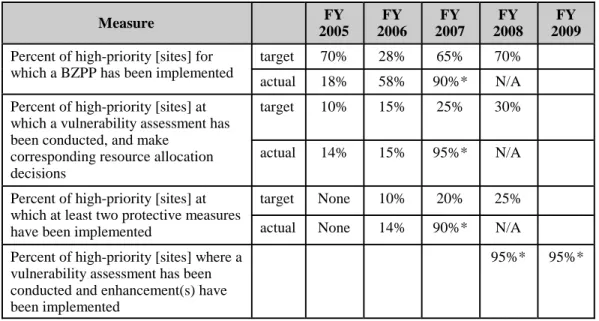
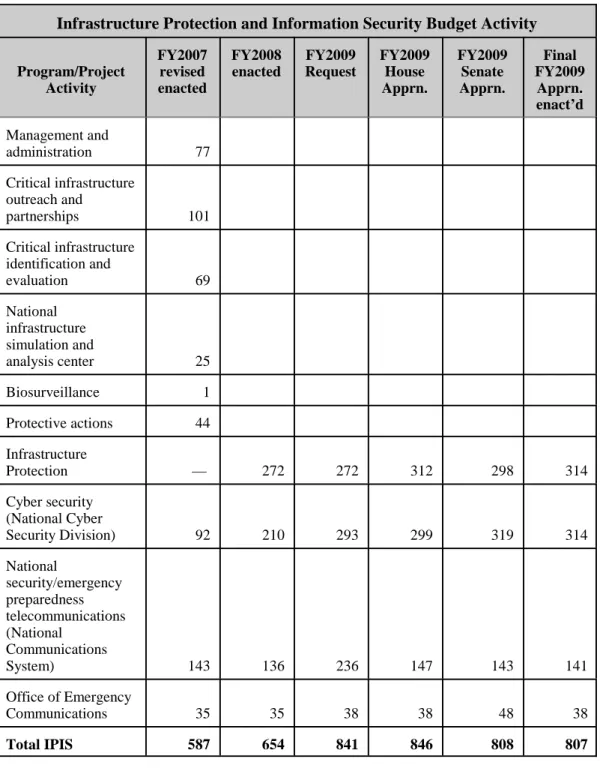
Table 1. Lead Agencies per PDD-63 . . . 5 Table 2. Current Lead Agency Assignments . . . 18 Table 3. Performance Measures for the Infrastructure Protection and
Risk Management Program . . . 31 Table A.1. Critical Infrastructure Protection Funding by Department . . . 37 Table A.2 Funding for the Infrastructure Protection and Information
h ttp ://wiki le ak s.or g/w iki/CRS-RL30153
1 As a reminder of how dependent society is on its infrastructure, in May 1998, PanAmSat’s
Galaxy IV satellite’s on-board controller malfunctioned, disrupting service to an estimated 80-90% of the nation’s pagers, causing problems for hospitals trying to reach doctors on call, emergency workers, and people trying to use their credit cards at gas pumps, to name but a few.
2 The electricity blackout in August 2003 in the United States and Canada illustrated the
interdependencies between electricity and other elements of the energy market such as oil refining and pipelines, as well as communications, drinking water supplies, etc.
Background, Policy, and Implementation
Latest Update Information
Funding data related to critical infrastructure protection has been updated to include appropriations contained in P.L. 110-329, the Consolidated Security,
Disaster Assistance, and Continuing Appropriations Act, 2009 (see Appendix). This
update also includes a short discussion of the approval by DHS of an 18th critical
infrastructure sector, the Critical Manufacturing Sector (see Policy Implementation, Government-Sector Coordination).
Introduction
Certain socioeconomic activities are vital to the day-to-day functioning and security of the country; for example, transportation of goods and people, communications, banking and finance, and the supply and distribution of electricity and water. Domestic security and our ability to monitor, deter, and respond to outside hostile acts also depend on some of these activities as well as other more specialized activities like intelligence gathering and command and control of police and military forces. A serious disruption in these activities and capabilities could have a major impact on the country’s well-being.1
These activities and capabilities are supported by an array of physical assets, functions, information, and systems forming what has been called the nation’s critical infrastructures. These infrastructures have grown complex and interconnected, meaning that a disruption in one may lead to disruptions in others.2
Disruptions can be caused by any number of factors: poor design, operator error, physical destruction due to natural causes, (earthquakes, lightning strikes, etc.) or physical destruction due to intentional human actions (theft, arson, terrorist attack, etc.). Over the years, operators of these infrastructures have taken measures to guard against, and to quickly respond to, many of these threats, primarily to improve
h ttp ://wiki le ak s.or g/w iki/CRS-RL30153
3 Besides loss of life, the terrorist attacks of September 11 disrupted the services of a number
of critical infrastructures (including telecommunications, the internet, financial markets, and air transportation). In some cases, protections already in place (like off-site storage of data, mirror capacity, etc.) allowed for relatively quick reconstitution of services. In other cases, service was disrupted for much longer periods of time.
4 White House, Homeland Security Presidential Directive Number 7, Critical Infrastructure Identification, Prioritization, and Protection. Released December 17, 2003. A more general
definition is given in statute (P.L. 107-71, Sec. 1016): “... systems and assets, physical or virtual, so vital to the United States that the incapacity or destruction of such systems and assets would have a debilitating impact on security, national economic security, national public health and safety, or any combination of those matters.”
reliability and safety. However, the terrorist attacks of September 11, and the subsequent anthrax attacks, demonstrated the need to reexamine protections in light of the terrorist threat, as part of an overall critical infrastructure protection policy.3
This report provides an historical background and tracks the evolution of such an overall policy and its implementation. However, specific protections associated with individual infrastructures is beyond the scope of this report. For CRS products related to specific infrastructure protection efforts, the reader is encouraged to visit the Homeland Security Current Legislative Issues webpage and look at the Critical Infrastructure Security link.
Federal Critical Infrastructure Protection Policy:
In Brief
As discussed further below, a number of federal executive documents and federal legislation lay out a basic policy and strategy for protecting the nation’s critical infrastructure. To summarize, it is the policy of the United States to enhance the protection of the nation’s critical infrastructure. Critical infrastructure has been defined as those systems and assets, the destruction or incapacity of which would:
! cause catastrophic health effects or mass casualties comparable to those from the use of weapons of mass destruction,
! impair Federal departments and agencies’ abilities to perform essential missions or ensure the public’s health and safety,
! undermine State and local government capacities to maintain order and deliver minimum essential public services,
! damage the private sector’s capability to ensure the orderly functioning of the economy...,
! have a negative effect on the economy through the cascading disruption of other critical infrastructure,
! or undermine the public’s morale and confidence in our national economic and political institutions.4
The federal government will work with states, localities, and the owners and operators of critical infrastructure (in both the private and public sector) to identify those specific assets and systems that constitute the nation’s critical infrastructure.
h ttp ://wiki le ak s.or g/w iki/CRS-RL30153
5 See White House. Office of Homeland Security. National Strategy for Homeland Security,
p. 33, “Private firms bear primary and substantial responsibility for addressing the public safety risks posed by their industries....”
6 Op. cit., p. 33, “The plan will describe how to use all available policy instruments to raise
the security of America’s critical infrastructure and key assets to a prudent level....In some cases the Department may seek legislation to create incentives for the private sector to adopt security measures.... In some cases, the federal government will need to rely on regulation.”
7 Executive Order 13010. Critical Infrastructure Protection. Federal Register. Vol. 61, No.
138. July 17, 1996. pp. 3747-3750. Concern about the security of the nation’s information infrastructure and the nation’s dependence on it preceded the establishment of the Commission.
8 Given the growing dependence and interconnectedness of the nation’s infrastructure on
computer networks, there was concern that computers and computer networks presented a new vulnerability and one that was not receiving adequate attention.
9 President’s Commission on Critical Infrastructure Protection, Critical Foundations: Protecting America’s Infrastructures, October 1997.
Together, these entities will assess those assets’ vulnerabilities to the threats facing the nation (natural or manmade, i.e., all hazards), determine the level of risk associated with possible attacks or the impacts of natural events on those assets, and identify and prioritize a set of measures that can be taken to reduce those risks. Primary responsibility for protection, response, and recovery lies with the owners and operators.5 However, the federal government holds open the possibility of
intervening in those areas where owners and operators are unable (or unwilling) to provide what it, the federal government, may assess to be adequate protection or response.6
The reader who is not interested in the evolution of this policy and the organizational structures that have evolved to implement it can proceed to the Policy
Implementation and/or Issues sections of this report.
The President’s Commission on Critical
Infrastructure Protection
This report takes as its starting point the establishment of the President’s Commission on Critical Infrastructure Protection (PCCIP) in July 1996.7 Its tasks
were to: report to the President the scope and nature of the vulnerabilities and threats to the nation’s critical infrastructures (focusing primarily on cyber threats);8
recommend a comprehensive national policy and implementation plan for protecting critical infrastructures; determine legal and policy issues raised by proposals to increase protections; and propose statutory and regulatory changes necessary to effect recommendations.
The PCCIP released its report to President Clinton in October 1997.9
Examining both the physical and cyber vulnerabilities, the Commission found no immediate crisis threatening the nation’s infrastructures. However, it did find reason to take action, especially in the area of cyber security. The rapid growth of a
h ttp ://wiki le ak s.or g/w iki/CRS-RL30153
10 See The Clinton’s Administration’s Policy on Critical Infrastructure Protection: Presidential Decision Directive 63, White Paper, May 22, 1998. Available at the Federation
of American Scientists website: [http://www.fas.org/irp/offdocs/pdd/pdd-63.htm]. This site was last viewed on April 2, 2009.
computer-literate population (implying a greater pool of potential hackers), the inherent vulnerabilities of common protocols in computer networks, the easy availability of hacker “tools” (available on many websites), and the fact that the basic tools of the hacker (computer, modem, telephone line) are the same essential technologies used by the general population indicated to the Commission that both threat and vulnerability exist.
The Commission generally recommended that greater cooperation and communication between the private sector and government was needed. The private sector owns and operates much of the nation’s critical infrastructure. As seen by the Commission, the government’s primary role (aside from protecting its own infrastructures) is to collect and disseminate the latest information on intrusion techniques, threat analysis, and ways to defend against hackers.
The Commission also proposed a strategy for action:
! facilitate greater cooperation and communication between the private sector and appropriate government agencies by: setting a top level policy-making office in the White House; establishing a council that includes corporate executives, state and local government officials, and cabinet secretaries; and setting up information clearinghouses;
! develop a real-time capability of attack warning;
! establish and promote a comprehensive awareness and education program;
! streamline and clarify elements of the legal structure to support assurance measures (including clearing jurisdictional barriers to pursuing hackers electronically); and,
! expand research and development in technologies and techniques, especially technologies that allow for greater detection of intrusions.
The Commission’s report underwent interagency review to determine how to respond. That review led to a Presidential Decision Directive released in May 1998.
Presidential Decision Directive No. 63
Presidential Decision Directive No. 63 (PDD-63)10 set as a national goal the
ability to protect the nation’s critical infrastructure from intentional attacks (both physical and cyber) by the year 2003. According to the PDD, any interruptions in the ability of these infrastructures to provide their goods and services must be “brief,
h ttp ://wiki le ak s.or g/w iki/CRS-RL30153 11 Ibid.
infrequent, manageable, geographically isolated, and minimally detrimental to the welfare of the United States.”11
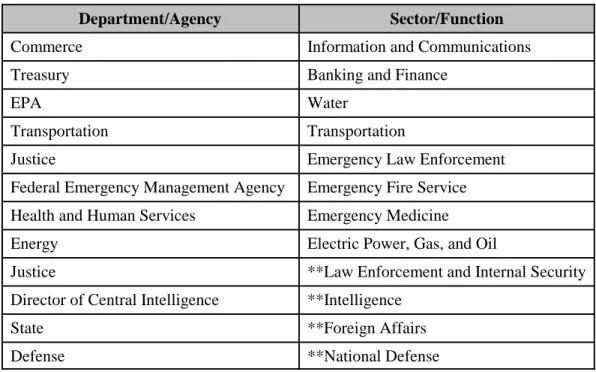
PDD-63 identified the following activities whose critical infrastructures should be protected: information and communications; banking and finance; water supply; aviation, highways, mass transit, pipelines, rail, and waterborne commerce; emergency and law enforcement services; emergency, fire, and continuity of government services; public health services; electric power, oil and gas production, and storage. In addition, the PDD identified four activities where the federal government controls the critical infrastructure: internal security and federal law enforcement; foreign intelligence; foreign affairs; and national defense.
A lead agency was assigned to each of these “sectors” (see Table 1). Each lead agency was directed to appoint a Sector Liaison Official to interact with appropriate private sector organizations. The private sector was encouraged to select a Sector
Coordinator to work with the agency’s sector liaison official. Together, the liaison
official, sector coordinator, and all affected parties were to contribute to a sectoral security plan which was to be integrated into a National Infrastructure Assurance
Plan. Each of the activities performed primarily by the federal government also were
assigned a lead agency who was to appoint a Functional Coordinator to coordinate efforts similar to those made by the Sector Liaisons.
Table 1. Lead Agencies per PDD-63
Department/Agency Sector/Function
Commerce Information and Communications
Treasury Banking and Finance
EPA Water
Transportation Transportation
Justice Emergency Law Enforcement
Federal Emergency Management Agency Emergency Fire Service
Health and Human Services Emergency Medicine
Energy Electric Power, Gas, and Oil
Justice **Law Enforcement and Internal Security
Director of Central Intelligence **Intelligence
State **Foreign Affairs
Defense **National Defense
h ttp ://wiki le ak s.or g/w iki/CRS-RL30153
12 The National Coordinator position was created by Presidential Decision Directive 62,
“Combating Terrorism.” PDD-62, which was classified, codified and clarified the roles and missions of various agencies engaged in counter-terrorism activities. The Office of the National Coordinator was established to integrate and coordinate these activities. The White House released a fact sheet on PDD-62 on May 22, 1998.
13 President Clinton designated Richard Clarke (Special Assistant to the President for Global
Affairs, National Security Council) as National Coordinator.
The PDD also assigned duties to the National Coordinator for Security, Infrastructure Protection, and Counter-terrorism.12 The National Coordinator
reported to the President through the Assistant to the President for National Security Affairs.13 Among his many duties outlined in PDD-63, the National Coordinator
chaired the Critical Infrastructure Coordination Group. This Group was the primary interagency working group for developing and implementing policy and for coordinating the federal government’s own internal security measures. The Group included high level representatives from the lead agencies (including the Sector Liaisons), the National Economic Council, and all other relevant agencies.
Each federal agency was made responsible for securing its own critical infrastructure and was to designate a Critical Infrastructure Assurance Officer (CIAO) to assume that responsibility. The agency’s current Chief Information Officer (CIO) could double in that capacity. In those cases where the CIO and the CIAO were different, the CIO was responsible for assuring the agency’s information assets (databases, software, computers), while the CIAO was responsible for any other assets that make up that agency’s critical infrastructure. Agencies were given 180 days from the signing of the Directive to develop their plans. Those plans were to be fully implemented within two years and updated every two years.
The PDD set up a National Infrastructure Assurance Council. The Council was to be a panel that included private operators of infrastructure assets and officials from state and local government officials and relevant federal agencies. The Council was to meet periodically and provide reports to the President as appropriate. The National Coordinator was to act as the Executive Director of the Council.
The PDD also called for a National Infrastructure Assurance Plan. The Plan was to integrate the plans from each of the sectors mentioned above and should consider the following: a vulnerability assessment, including the minimum essential capability required of the sector’s infrastructure to meet its purpose; remedial plans to reduce the sector’s vulnerability; warning requirements and procedures; response strategies; reconstitution of services; education and awareness programs; research and development needs; intelligence strategies; needs and opportunities for international cooperation; and legislative and budgetary requirements.
The PDD also set up a National Plan Coordination Staff to support the plan’s development. Subsequently, the Critical Infrastructure Assurance Office (CIAO, not to be confused with the agencies’ Critical Infrastructure Assurance Officers) was established to serve this function and was placed in the Department of Commerce’s Export Administration. CIAO supported the National Coordinator’s efforts to integrate the sectoral plans into a National Plan, supported individual agencies in
h ttp ://wiki le ak s.or g/w iki/CRS-RL30153
14 FedCIRC was renamed the Federal Computer Incident Response Center and has since
been absorbed into the Department of Homeland Security’s National Cyber Security Division.
15 FIDNET initially generated controversy both inside and outside the government. Privacy
concerns, cost and technical feasibility were at issue. By the end of the Clinton Administration, FIDNET as a distributed intrusion detection system feeding into a centralized analysis and warning capability was abandoned. A comparable capability has been developed, called the Einstein Program, that addressed the privacy concerns of FIDNET. Under Einstein, participating agencies retain complete control of network data in strict accordance with Federal laws and polices. Agencies gather and subsequently share security data directly with DHS, based on reporting requirements established by the Office of Management and Budget. In turn, DHS prepares a strategic, cross-agency assessment, which is then shared back with all federal civilian agencies. According to the DHS FY2009 budget justification documents, additional funds were requested to expand the Einstein program to include all federal agencies and to use improved sensors to monitor network traffic. This was part of a broader cyber security initiative aimed at better securing federal information systems.
developing their internal plans, helped coordinate national education and awareness programs, and provided legislative and public affairs support. Coordinating the development of and maintaining the National Plan is now part of the Department of Homeland Security Infrastructure Protection and Information Security (IPIS) program.
Most of the Directive established policy-making and oversight bodies making use of existing agency authorities and expertise. However, the PDD also addressed operational concerns. These dealt primarily with cyber security. The Directive called for a national capability to detect and respond to cyber attacks while they are in progress. Although not specifically identified in the Directive, the Clinton Administration proposed establishing a Federal Intrusion Detection Network
(FIDNET) that would, together with the Federal Computer Intrusion Response Capability (FedCIRC), established just prior to PDD-63, meet this goal.14 The
Directive explicitly gave the Federal Bureau of Investigation the authority to expand its existing computer crime capabilities into a National Infrastructure Protection
Center (NIPC). The Directive called for the NIPC to be the focal point for federal
threat assessment, vulnerability analysis, early warning capability, law enforcement investigations, and response coordination. All agencies were required to forward to the NIPC information about threats and actual attacks on their infrastructure as well as attacks made on private sector infrastructures of which they become aware. Presumably, FIDNET15 and FedCIRC would feed into the NIPC. According to the
Directive, the NIPC would be linked electronically to the rest of the federal government and use warning and response expertise located throughout the federal government. The Directive also made the NIPC the conduit for information sharing with the private sector through an equivalent Information Sharing and Analysis
Center(s) operated by the private sector, which PDD-63 encouraged the private
sector to establish. Later, many of these functions were transferred to the Department of Homeland Security. The U.S. Computer Emergency Response Team (U.S.
CERT) and the National Operations Center (NOC), discussed later in this report,
h ttp ://wiki le ak s.or g/w iki/CRS-RL30153
16 Testimony by Michael Vatis before the Senate Judiciary Committee, Subcommittee on
Technology and Terrorism. October 6, 1999. This effort was transferred to the Department of Homeland Security.
Quite independent of PDD-63 in its origin, but clearly complimentary in its purpose, the FBI established a program called INFRAGARD to private sector firms. The program facilitates information exchange between FBI field offices and the surrounding business communities. Its initial focus was network security. After September 11, its focus includes both cyber and physical security. INFRAGARD is geographically-oriented rather than sector-oriented. Each FBI field office has a Special Agent Coordinator who gathers interested companies of various sizes from all industries to form a chapter. Any company can join INFRAGARD. Local executive boards govern and share information within the membership. Chapters hold regular meetings to discuss issues, threats, and other matters that impact their companies. Chapters may also engage in contingency planning for using alternative systems in the event of a successful large scale attack on the information infrastructure. The program was transferred to the NIPC, before it was absorbed by the Department of Homeland Security. The program is now managed by the FBI’s Cyber Division.
It should also be noted that the FBI had, since the 1980s, a program called the
Key Assets Initiative (KAI). The objective of the KAI was to develop a database
of information on “key assets” within the jurisdiction of each FBI field office, establish lines of communications with asset owners and operators to improve physical and cyber protection, and to coordinate with other federal, state, and local authorities to ensure their involvement in the protection of those assets. The program was initially begun to allow for contingency planning against physical terrorist attacks. According to testimony by a former Director of the NIPC, the program was “reinvigorated” by the NIPC and expanded to include the cyber dimension.16 The Department of Homeland Security is now responsible for creating a data base of critical assets.
Restructuring by the Bush Administration
Pre-September 11
As part of its overall redesign of White House organization and assignment of responsibilities, the in-coming Bush Administration spent the first eight months reviewing its options for coordinating and overseeing critical infrastructure protection. During this time, the Bush Administration continued to support the activities begun by the Clinton Administration.
The Bush Administration review was influenced by three parallel debates. First, the National Security Council (NSC) underwent a major streamlining. All groups within the Council established during previous Administrations were abolished. Their responsibilities and functions were consolidated into 17 Policy Coordination Committees (PCCs). The activities associated with critical infrastructure protection were assumed by the Counter-Terrorism and National Preparedness PCC. At the
h ttp ://wiki le ak s.or g/w iki/CRS-RL30153
17 Senior NSC Official Pitches Cyber-Security Czar Concept in Memo to Rice. Inside the Pentagon. January 11, 2001. p. 2-3.
18 For a discussion of the debate surrounding this issue at the time, see CRS Report
RL30914, Federal Chief Information Officer (CIO): Opportunities and Challenges, by Jeffery Seifert.
19 President Bush selected Tom Ridge to head the new Office.
time, whether, or to what extent, the NSC should remain the focal point for coordinating critical infrastructure protection (i.e., the National Coordinator came from the NSC) was unclear. Richard Clarke, himself, wrote a memorandum to the incoming Bush Administration advocating that the function should be transferred directly to the White House.17
Second, there was a continuing debate about the merits of establishing a government-wide Chief Information Officer (CIO), whose responsibilities would include protection of all federal non-national security-related computer systems and coordination with the private sector on the protection of privately owned computer systems. Shortly after assuming office, the Bush Administration announced its desire not to create a separate federal CIO position, but to recruit a Deputy Director of the Office of Management and Budget that would assume an oversight role of agency CIOs. One of the reasons cited for this was a desire to keep agencies responsible for their own computer security.18
Third, there was the continuing debate about how best to defend the country against terrorism, in general. The U.S. Commission on National Security/21st Century (the Hart-Rudman Commission) proposed a new National Homeland Security Agency. The recommendation built upon the current Federal Emergency Management Agency (FEMA) by adding to it the Coast Guard, the Border Patrol, Customs Service, and other agencies. The Commission recommended that the new organization include a directorate responsible for critical infrastructure protection. While both the Clinton and Bush Administration remained cool to this idea, bills were introduced in Congress to establish such an agency. As discussed below, the Bush Administration changed its position in June 2002, and proposed a new department along the lines of that proposed by the Hart/Rudman Commission and Congress.
Post-September 11
Soon after the September 11 terrorist attacks, President Bush signed two Executive Orders relevant to critical infrastructure protection. These have since been amended to reflect changes brought about by the establishment of the Department of Homeland Security (see below). The following is a brief discussion of the original E.O.s and how they have changed.
E.O. 13228, signed October 8, 2001 established the Office of Homeland
Security, headed by the Assistant to the President for Homeland Security.19 Its mission is to “develop and coordinate the implementation of a comprehensive national strategy to secure the United States from terrorist threats and attacks.”
h ttp ://wiki le ak s.or g/w iki/CRS-RL30153
20 For more information on how the Homeland Security Council and the Office of Homeland
Security were structured, see CRS Report RL31148, Homeland Security: The Presidential
Coordination Office, by Harold Relyea.
21 Executive Order 13231 — Critical Infrastructure Protection in the Information Age.
Federal Register. Vol. 86. No. 202. October 18, 2001.
22 President Bush designated Richard Clarke.
Among its functions is the coordination of efforts to protect the United States and its critical infrastructure from the consequences of terrorist attacks. This includes strengthening measures for protecting energy production, transmission, and distribution; telecommunications; public and privately owned information systems; transportation systems; and, the provision of food and water for human use. Another function of the Office is to coordinate efforts to ensure rapid restoration of these critical infrastructures after a disruption by a terrorist threat or attack.
The EO also established the Homeland Security Council. The Council is made up of the President, Vice-President, Secretaries of Treasury, Defense, Health and Human Services, and Transportation, the Attorney General, the Directors of FEMA, FBI, and CIA and the Assistant to the President for Homeland Security. The EO was later amended to add the Secretary of Homeland Security. Other White House and departmental officials can be invited to attend Council meetings.20 The Council
advises and assists the President with respect to all aspects of homeland security. The agenda for those meetings shall be set by the Assistant to President for Homeland Security, at the direction of the President. The Assistant is also the official recorder of Council actions and Presidential decisions.
In January and February 2003, this E.O. was amended (by Executive Orders 13284 and 13286, respectively). The Office of Homeland Security, the Assistant to the President, and the Homeland Security Council were all retained. However, the Secretary of Homeland Security was added to the Council. The duties of the Assistant to the President for Homeland Security remain the same, recognizing the statutory duties assigned to the Secretary of Homeland Security as a result of the Homeland Security Act of 2002 (see below).
The second Executive Order (E.O. 13231) signed October 16, 2001, stated that it is U.S. policy “to protect against the disruption of the operation of information systems for critical infrastructure...and to ensure that any disruptions that occur are infrequent, of minimal duration, and manageable, and cause the least damage possible.”21 This Order also established the President’s Critical Infrastructure
Protection Board. The Board, consisting of federal officials, was authorized to
“recommend policies and coordinate programs for protecting information systems for critical infrastructure...” The Board also was directed to propose a National Plan on issues within its purview on a periodic basis, and, in coordination with the Office of Homeland Security, review and make recommendations on that part of agency budgets that fall within the purview of the Board.
The Board was chaired by a Special Advisor to the President for Cyberspace
h ttp ://wiki le ak s.or g/w iki/CRS-RL30153
23 The White House, The National Strategy for the Physical Protection of Critical Infrastructures and Key Assets. February 2003. p. 71.
National Security and the Assistant to the President for Homeland Security. Besides presiding over Board meetings, the Special Advisor, in consultation with the Board, was to propose policies and programs to appropriate officials to ensure protection of the nation’s information infrastructure and to coordinate with the Director of OMB on issues relating to budgets and the security of computer networks.
The Order also established the National Infrastructure Advisory Council. The Council is to provide advice to the President on the security of information systems for critical infrastructure. The Council’s functions include enhancing public-private partnerships, monitoring the development of ISACs, and encouraging the private sector to perform periodic vulnerability assessments of critical information and telecommunication systems.
Subsequent amendments to this E.O. (by E.O. 13286) abolished the President’s Board and the position of Special Advisor. The Advisory Council was retained, but now reports to the President through the Secretary of Homeland Security.
In July 2002, the Office of Homeland Security released a National Strategy for
Homeland Security. The Strategy covered all government efforts to protect the
nation against terrorist attacks of all kinds. It identified protecting the nation’s critical infrastructures and key assets (a new term, different as implied above by the FBI’s key asset program) as one of six critical mission areas. The Strategy expanded upon the list of sectors considered to possess critical infrastructure to include public health, the chemical industry and hazardous materials, postal and shipping, the defense industrial base, and agriculture and food. The Strategy also added continuity of government and continuity of operations to the list, although it is difficult to see how the latter would be a considered sector. It also combined emergency fire service, emergency law enforcement, and emergency medicine as emergency services. And, it dropped those functions that primarily belonged to the federal governments (e.g. defense, intelligence, law enforcement). It also reassigned some of the sectors to different agencies, including making the then proposed Department of Homeland Security lead agency for a number of sectors — postal and shipping services, and the defense industrial base. It also introduced a new class of assets, called key assets, which was defined as potential targets whose destruction may not endanger vital systems, but could create a local disaster or profoundly affect national morale. Such assets were defined later to include national monuments and other historic attractions, dams, nuclear facilities, and large commercial centers, including office buildings and sport stadiums, where large numbers of people congregate to conduct business, personal transactions, or enjoy recreational activities.23
The Strategy reiterated many of the same policy-related activities as mentioned above: working with the private sector and other non-federal entities, naming those agencies that should act as liaison with the private sector, assessing vulnerabilities, and developing a national plan to deal with those vulnerabilities. The Strategy also mentioned the need to set priorities, acknowledging that not all assets are equally critical, and that the costs associated with protecting assets must be balanced against
h ttp ://wiki le ak s.or g/w iki/CRS-RL30153
24 Homeland Security Council. National Strategy for Homeland Security. October 2007. 25 This report will continue to use the term “Lead Agency” to refer to the agency assigned
to work with a specific sector.
the benefits of increased security according to the threat. The Strategy did not create any new organizations, but assumed that a Department of Homeland Security would be established (see below). The Strategy was updated in October 2007.24 With the
exception of a somewhat greater recognition of the role improving resilience can play in reducing the nation’s risk, the strategy related to critical infrastructure saw little change.
On December 17, 2003, the Bush Administration released Homeland Security
Presidential Directive 7 (HSPD-7). HSPD essentially updated the policy of the
United States and the roles and responsibilities of various agencies in regard to critical infrastructure protection as outlined in previous documents, national strategies, and the Homeland Security Act of 2002 (see below). For example, the Directive reiterated the Secretary of Homeland Security’s role in coordinating the overall national effort to protect critical infrastructure. It also reiterated the role of Sector-Specific Agencies (i.e., Lead Agencies)25 to work with their sectors to
identify, prioritize, and coordinate protective measures. The Directive captured the expanded set of critical infrastructures and key assets and Sector-Specific Agencies assignments made in the National Strategy for Homeland Security. The Directive also reiterated the relationship between the Department of Homeland Security and other agencies in certain areas. For example, while the Department of Homeland Security will maintain a cyber security unit, the Directive stated that the Director of the Office of Management remains responsible for overseeing government-wide information security programs and for ensuring the operation of a federal cyber incident response center within the Department of Homeland Security. Also, while the Department of Homeland Security is responsible for transportation security, including airline security, the Department of Transportation remains responsible for control of the national air space system.
The only organizational change made by the Directive was the establishment of the Critical Infrastructure Protection Policy Coordinating Committee which will advise the Homeland Security Council on interagency policy related to physical and cyber infrastructure security.
The Directive made a few other noticeable changes or additions. For example, the Department of Homeland Security was assigned as Lead Agency for the chemical and hazardous materials sector (it had been the Environmental Protection Agency). The Directive required Lead Agencies to report annually to the Secretary of Homeland Security on their efforts in working with the private sector. The Directive also reiterated that all federal agencies must develop plans to protect their own critical infrastructure and submit those plans for approval to the Director of the Office of Management and Budget by July 2004.
The Bush Administration policy and approach regarding critical infrastructure protection can be described as an evolutionary expansion of the policies and approaches laid out in PDD-63. The fundamental policy statements are essentially
h ttp ://wiki le ak s.or g/w iki/CRS-RL30153
26 Computer security advocates have sought to highlight cyber security issues by maintaining
a separate organization high within the bureaucracy. There now exists both an Assistant Secretary for Cyber Security and Telecommunications and an Assistant Secretary for Infrastructure Protection, both reporting to the Undersecretary for National Protection and Programs. While the latter is concerned with both physical and cyber security issues, the former is focused on cyber security issues.
the same: the protection of infrastructures critical to the people, economy, essential government services, and national security. National morale was added to that list. Also, the stated goal of the government’s efforts is to ensure that any disruption of the services provided by these infrastructures be infrequent, of minimal duration, and manageable. The infrastructures identified as critical were essentially the same (although expanded and with an emphasis placed on targets that would result in large numbers of casualties). Finally, the primary effort is directed at working collaboratively and voluntarily with the private sector owners and operators of critical infrastructure to identify critical assets and provide appropriate protection.
Organizationally, there remains an interagency group for coordinating policy across departments and for informing the White House (Homeland Security Council, supported by the Critical Infrastructure Protection Coordinating Committee). Certain agencies have been assigned certain sectors with which to work. Sectors are asked to organize themselves to assist in coordination of effort and information sharing. A Council made up of private sector executives, academics, and State and local officials was established to advise the President. Certain operational units (e.g., the Critical Infrastructure Assurance Office (CIAO) and elements of the National Infrastructure Protection Center (at the FBI)) were initially left in place, though later moved to and restructured within the Department of Homeland Security (DHS), where, now, the Undersecretary for National Protection and Programs is responsible for coordinating the implementation of policies and programs (see below). However, DHS takes a much more active role in identifying critical assets, assessing vulnerabilities, and recommending and supporting protective measures than did these earlier operational units. Also, the manpower and resources devoted to these activities have greatly increased.
One major difference between PDD-63 and the current Administration’s efforts is a shift in focus. PDD-63 focused on cybersecurity. While the post-September 11 effort is still concerned with cybersecurity, its focus on physical threats, especially those that might cause mass casualties, is greater than the pre-September 11 effort. This led to some debate and organizational instability initially. The early executive orders discussed above segregated cyber security from the physical security mission with the formation of the Office of Homeland Security and the President’s Critical Infrastructure Protection Board. Dissolution of the Board and the subsequent establishment of the Critical Infrastructure Protection Policy Coordinating Committee, responsible for advising the Homeland Security Council on both physical and cyber security issues, would appear to reunite these two concerns within a single White House group.26
h ttp ://wiki le ak s.or g/w iki/CRS-RL30153
27 The NISAC was established in the USA PATRIOT Act (P.L. 107-56), Section 1062. The
Center builds upon expertise at Sandia National Laboratory and Los Alamos National Laboratory in modeling and simulating infrastructures and the interdependencies between them.
28 The NCS is not a single communication system but more a capability that ensures that
disparate government agencies can communication with each other in times of emergencies. To make sure this capability exists and to assure that it is available when needed, an interagency group meets regularly to discuss issues and solve problems. The NCS was initially established in 1963 by the Kennedy Administration to ensure communications between military, diplomatic, intelligence, and civilian leaders, following the Cuban Missile Crisis. Those activities were expanded by the Reagan Administration to include emergency preparedness and response, including natural disaster response. The current interagency group includes 23 departments and agencies. The private sector, which own a significant share of the assets needed to ensure the necessary connectivity, is involved through the
National Security Telecommunication Advisory Committee (NSTAC). The National
Coordinating Center, mentioned later in this report, and which serves as the telecommunications ISAC, is an operational entity within the NCS.
29 The other operational directorates included Science and Technology, Border and
Transportation Security and Emergency Preparedness and Response.
Department of Homeland Security
Initial Establishment
In November 2002, Congress passed the Homeland Security Act (P.L. 107-296), establishing a Department of Homeland Security (DHS). The act assigned to the new Department the mission of preventing terrorist attacks, reducing the vulnerability of the nation to such attacks, and responding rapidly should such an attack occur. The act essentially consolidated within one department a number of agencies that had, as part of their missions, homeland security-like functions (e.g., Border Patrol, Customs, Transportation Security Administration). The following discussion focuses on those provisions relating to critical infrastructure protection.
In regard to critical infrastructure protection the act transferred the following agencies and offices to the new department: the NIPC (except for the Computer Investigations and Operations Section), CIAO, FedCIRC, the National Simulation
and Analysis Center (NISAC),27 other energy security and assurance activities within DOE, and the National Communication System (NCS).28 These agencies
and offices were integrated within the Directorate of Information Analysis and
Infrastructure Protection (IA/IP) (one of four operational Directorates established
by the act).29 Notably, the Transportation Security Administration (TSA), which is responsible for securing all modes of the nation’s transportation system, was not made part of this Directorate (it was placed within the Border and Transportation Security Directorate); nor was the Coast Guard, which is responsible for port security. The act assigned the rank of Undersecretary to the head of each Directorate. Furthermore, the act designated that within the Directorate of Information Analysis and Infrastructure Protection, there were to be both an Assistant Secretary for Information Analysis, and an Assistant Secretary for Infrastructure Protection.
h ttp ://wiki le ak s.or g/w iki/CRS-RL30153
Among the responsibilities assigned the IA/IP Directorate were:
! to access, receive, analyze, and integrate information from a variety of sources in order to identify and assess the nature and scope of the terrorist threat;
! to carry out comprehensive assessments of the vulnerabilities of key resources and critical infrastructure of the United States, including risk assessments to determine risks posed by particular types of attacks;
! to integrate relevant information, analyses, and vulnerability assessments in order to identify priorities for protective and
support measures;
! to develop a comprehensive national plan for securing key resources and critical infrastructures;
! to administer the Homeland Security Advisory System;
! to work with the intelligence community to establish collection priorities; and,
! to establish a secure communication system for receiving and disseminating information.
In addition, the act provided a number of protections for certain information (defined as critical infrastructure information) that non-federal entities, especially private firms or ISACs formed by the private sector, voluntarily provide the Department. Those protections included exempting it from the Freedom of Information Act, precluding the information from being used in any civil action, exempting it from any agency rules regarding ex parte communication, and exempting it from requirements of the Federal Advisory Committee Act.
The act basically built upon existing policy and activities. Many of the policies, objectives, missions, and responsibilities complement those already established (e.g., vulnerability assessments, national planning, communication between government and private sector, and improving protections).
Second Stage Review Reorganization
Secretary Chertoff (the second Secretary of Homeland Security), as one of his Second Stage Review recommendations, proposed restructuring the IA/IP Directorate and renaming it the Directorate of Preparedness. The IA function was merged into a new Office of Intelligence and Analysis. The IP function, with the same missions as outlined in the Homeland Security Act, remained, but was joined by other existing and new entities. The renamed Directorate included elements from Office of State and Local Government Coordination and Preparedness, including its principal grant-making functions and some of the preparedness functions of the Federal Emergency Management Agency (FEMA). A new position of Chief Medical Officer was created within the Directorate and the U.S. Fire Administration and the Office of National Capital Region Coordination were transferred into the Directorate. In addition, the restructuring called for an Assistant Secretary for Cyber Security and
Telecommunications (a position sought by many within the cyber security
h ttp ://wiki le ak s.or g/w iki/CRS-RL30153
30 See report language, H.Rept. 109-241, accompanying H.R. 2360, September 2005, p. 29. President for Cyberspace Security) and an Assistant Secretary for Infrastructure Protection.
According to the DHS press release, the mission of the restructured Directorate was to “facilitate grants and over see nationwide preparedness efforts supporting first responder training, citizen awareness, public health, infrastructure and cyber security, and [to] ensure proper steps are taken to protect high-risk targets.”
Other recommendations resulting from the review that impacted infrastructure protection included moving the Homeland Security Operations Center, now called the National Operations Center, out of the old IA/IP Directorate and placing it within a new Office of Operations Coordination; and, a new Directorate of Policy, which is described as serving as the primary Department-wide coordinator of policies, regulations, and other initiatives. The conference committee report on the Department’s FY2006 appropriations (H.Rept. 109-241) approved these changes.30
Post-Katrina Emergency Management Reform Act of 2006
The Post-Katrina Emergency Management Reform Act of 2006 (referred hereon as the Post-Katrina Act) was passed as Title VI of the Department of Homeland Security Appropriations Act, 2007 (P.L. 109-295). The Post-Katrina Act reunited the Department’s preparedness activities with its response and recovery activities within a restructured Federal Emergency Management Agency (FEMA). The Post-Katrina Act explicitly preserved the restructured FEMA as a distinct entity within the Department. The Post-Katrina Act also transferred the Preparedness Directorate’s Office of Grants and Training to the restructured FEMA. The Post-Katrina Act left the remaining activities, including those associated with the Office of the Chief Medical Officer and the critical infrastructure protection activities associated with the Assistant Secretary of Infrastructure Protection and the Assistant Secretary for Cyber Security and Telecommunications, in the Preparedness Directorate. The Post-Katrina Act also established the Office of Emergency Communications and required that it report to the Assistant Secretary for Cyber Security and Telecommunications. The Office of Emergency Communications has within its responsibilities a number of activities associated with assisting interoperable communications among first responders.
On January 18, 2007, Secretary Chertoff submitted to Congress a description of the Department’s reorganization pursuant to the Post-Katrina Act, and additional changes made pursuant to the Secretary’s authority provided in the Homeland Security Act (P.L. 107-296, Section 872). Under this latter authority, the Secretary renamed the Preparedness Directorate the National Protection and Programs
Directorate (NPPD), still to be headed by someone of Undersecretary rank. The
NPPD includes the Office of the Undersecretary, the Office of Cybersecurity and Communications (including the new Office of Emergency Communications), the Office of Infrastructure Protection, the Office of Risk Management and Analysis (formerly a division of the Office of Infrastructure Protection), and the Office of
h ttp ://wiki le ak s.or g/w iki/CRS-RL30153
31 U.S.-VISIT is the Department’s effort to verify the identity of people entering and exiting
the United States.
32 Department of Homeland Security. Designation of the National Infrastructure Protection
Plan Critical Manufacturing Sector. Federal Register. Vol 73, No. 84. April 30, 2008. pp23476-23478.
33 These include iron and steel, ferro alloys, alumina and aluminum, and other non-ferrous
metal production; engine, turbine, and power transmission equipment; and, motor vehicle, aerospace products, railroad rolling stock, and other transportation equipment.
Intergovernmental Programs. In addition, the Secretary moved the U.S.-VISIT program into the NPPD.31
The Secretary also, pursuant to his Section 872 authority, transferred the Chief Medical Officer to head a new Office of Health Affairs. This new Office reports to the Secretary through the Deputy Secretary. This reorganization consolidated activities associated with the Department’s bio-defense efforts, including the transfer of the Biosurveillance program, formerly part of the Infrastructure Protection and Information Security (IPIS) Program (see Appendix). Except for the transfer of the Biosurveillance program, the IPIS program, which represents the core of the Department’s effort to coordinate the nation’s critical infrastructure protection activities, remained in the National Protection and Programs Directorate.
Policy Implementation
Government — Sector Coordination
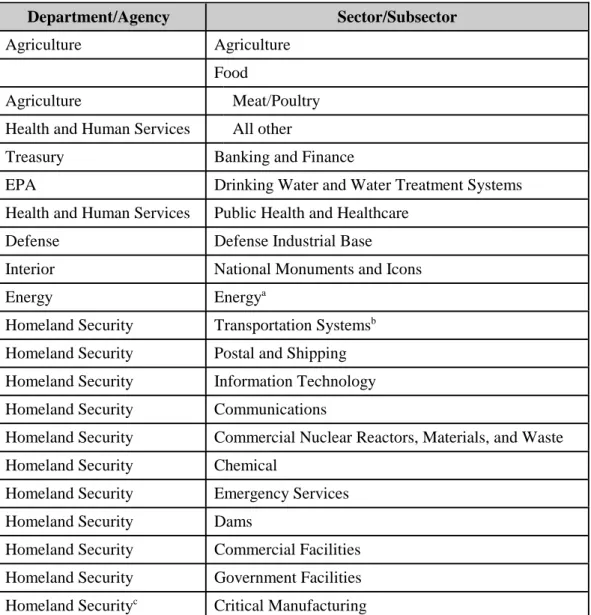
The number and breakdown of sectors and lead, or sector specific agencies, have expanded and changed since the assignments made by PDD-63 (see Table 1). As mentioned above, the Bush Administration has expanded the number of sectors considered to possess critical infrastructure and made some changes in assignments. In March 2008, DHS announced that it was designating what would be an 18th critical infrastructure sector, Critical Manufacturing.32 The sector includes certain
sub-groups from the primary metal, machinery, electrical equipment, and transportation equipment manufacturing industries.33 The designation was made by
the Secretary by authority granted him in HSPD-7, and represents the first exercise of that authority. Table 2, below, shows the current list of sectors and their lead agencies.
PDD-63 called for the selection, by each Lead Agency, of a Sector Liaison Official (representing the Lead Agency) and a Sector Coordinator (representing the owners/operators of each sector). While most agencies quickly identified their Sector Liaison Official, it took more time to identify Sector Coordinators. Different sectors present different challenges for coordination. Some sectors are more diverse than others (e.g., transportation includes rail, air, waterways, and highways; information and communications include computers, software, wire and wireless communications) and raise the issue of how to have all the relevant players
h ttp ://wiki le ak s.or g/w iki/CRS-RL30153
represented. Other sectors are fragmented, consisting of small or local entities. Some sectors, such as banking, telecommunications, and energy have more experience than others in working with the federal government and/or working collectively to assure the performance of their systems.
Table 2. Current Lead Agency Assignments
Department/Agency Sector/Subsector
Agriculture Agriculture
Food
Agriculture Meat/Poultry
Health and Human Services All other
Treasury Banking and Finance
EPA Drinking Water and Water Treatment Systems
Health and Human Services Public Health and Healthcare
Defense Defense Industrial Base
Interior National Monuments and Icons
Energy Energya
Homeland Security Transportation Systemsb
Homeland Security Postal and Shipping
Homeland Security Information Technology
Homeland Security Communications
Homeland Security Commercial Nuclear Reactors, Materials, and Waste
Homeland Security Chemical
Homeland Security Emergency Services
Homeland Security Dams
Homeland Security Commercial Facilities
Homeland Security Government Facilities
Homeland Securityc Critical Manufacturing
a. While noted here as a single sector, in practice it is represented by two relatively separate sectors: electric power (except for nuclear power facilities); and the production, refining, and some distribution of oil and gas. The Department of Energy is the lead agency for both. However, the Department of Homeland Security (through the Transportation Security Administration) is the lead agency for the distribution of oil and gas via pipelines. Nuclear power is considered its own sector.
b. While noted here as a single sector, Transportation includes all modes of transportation: rail, mass transit (rail and bus), air, maritime, highways, pipelines, etc. The Transportation Security Administration within the Department of Homeland Security, in collaboration with the Department of Transportation, is the lead agency for all but the maritime subsector, for which the Coast Guard, also within the Department of Homeland Security, acts as lead agency. c. According to the Federal Register announcement, the Department of Homeland Security will act
h ttp ://wiki le ak s.or g/w iki/CRS-RL30153
In addition to such structural issues are ones related to competition. Inherent in the exercise is asking competitors to cooperate. In some cases it is asking competing industries to cooperate. This cooperation not only raises issues of trust among firms, but also concerns regarding anti-trust rules.
Over time, Sector Coordinators were selected for most of the sectors identified under PDD-63. Typically, a representative from a relevant trade organizations was chosen to act as sector coordinator. For example, the Environmental Protection Agency selected the Executive Director of the Association of Metropolitan Water Agencies to act as Sector Coordinator for the water sector. In the case of the law enforcement sector (no longer identified as a separate sector), the National Infrastructure Protection Center helped create a Emergency Law Enforcement Services Forum, consisting of senior state, local, and non-FBI law enforcement officials. In the case of banking and finance, the Sector Coordinator was chosen from a major banking/finance institution, who doubled as the Chairperson of the Financial Services Sector Coordinating Council, an organization specifically set up by the industry to coordinate critical infrastructure protection activities with the federal government.
In December 1999, a number of the sectors formed a Partnership for Critical
Infrastructure Security to share information and strategies and to identify
interdependencies across sectoral lines. The Partnership was a private sector initiative. The federal government was not officially part of the Partnership, but the Department of Homeland Security (and CIAO before that) acted as a liaison and provided administrative support for meetings. Sector Liaisons from lead agencies were considered ex officio members. The Partnership helped coordinate its members input to a number of the national strategies released to date and were to provide input into the National Plan called for in PDD-63.
While initially working with this organizational structure, the Bush Administration promoted a new Critical Infrastructure Protection Partnership Model. Resembling the Financial Services Sector Coordinating Council approach, this newer Model expanded the sector liaison and sector coordinator model of PDD-63 into
Government Coordinating Councils and Sector Coordinating Councils for each
sector. The primary objective was to expand both owner/operator and government representation within all sectors. Now, for example, the Water Sector Coordinating Council consists of two owner/operator representatives, along with one non-voting association staff, from each of the following participating organizations: the Association of Metropolitan Water Agencies, the American Water Works Association, the American Water Works Association Research Foundation, the National Association of Clean Water Agencies, the National Association of Water Companies, the National Rural Water Association, the Water Environment Federation, and the Water Environment Research Foundation. The Water Government Coordinating Council is chaired by the Environmental Protection Agency, the Lead Agency, but also includes the Department of Homeland Security, the Food and Drug Administration, the Department of Interior, and the Center for Disease Control. Government Coordinating Councils can also include state, local, and tribal government entities. The Sector Coordinating Councils are to establish their own organizational structures and leadership and act independently from the federal government. Also, under this model, the Partnership for Critical
h ttp ://wiki le ak s.or g/w iki/CRS-RL30153
34 See U.S. Congress. General Accountability Office. Critical Infrastructure Protection: Progress Coordinating Government and Private Sector Efforts Varies by Sectors’ Characteristics. GAO-07-39. October 2006.
35 See Federal Register. Vol. 71 No. 57. pp. 14930-14933. March 24, 2006.
36 See [http://www.dhs.gov/xprevprot/committees/editorial_0843.shtm]. This site was last
visited on April 2, 2008.
37 White House Press Release, dated January 18, 2000.
38 Executive Order 13231 — Critical Infrastructure Protection in the Information Age.
Federal Register. Vol. 66. No. 202. October 18, 2001. pp. 53063-53071. The NIAC is established on page 53069.
39 See White House Press Release, September 18, 2002.
Infrastructure Security has been designated the Private Sector Cross-Sector
Council. The Sector Coordinating Councils are to provide input into both the
National Infrastructure Protection Plan and the individual Sector Specific Plans (see below). Many of the issues governing the progress made in identifying and working with the sector coordinators model of PDD-63 continue with the sector coordinating councils.34
In March 2006, the Department of Homeland Security used its authority under the Homeland Security Act (P.L. 107-296, Section 871) — to form advisory committees that are exempt from the Federal Advisory Committee Act (P.L. 92-463) — to establish the Critical Infrastructure Partnership Advisory Council
(CIPAC).35 The Federal Advisory Committee Act requires advisory committees
generally to meet in open session and make written materials available to the public. The purpose of waiving this act for the CIPAC is to facilitate more open discussion between the sector coordinating councils and the government coordinating councils (if not with the public). DHS acts as the Executive Secretariat. Members include owner/operators that are members of their respective sector coordinating councils or belong to an association that is a member of the coordinating council. Members also include federal, state, local, and tribal government entities that belong to their respective government coordinating councils. While the CIPAC is exempt from the Federal Advisory Committee Act, DHS stated in its public notice that it will make meeting dates and appropriate agendas available. There is a CIPAC webpage on the DHS website.36
Appointment of the National Infrastructure Advisory Council
The Clinton Administration released an Executive Order (13130) in July, 1999, formally establishing the National Infrastructure Assurance Council. Just prior to leaving office, President Clinton put forward the names of 18 appointees.37 The
Order was rescinded by the Bush Administration before the Council could meet. In Executive Order 13231,38 President Bush established a National Infrastructure
Advisory Council (with the same acronym, NIAC) whose functions are similar to those of the Clinton Council. On September 18, 2002, President Bush announced his appointment of 24 individuals to serve on Council.39 The E.O. amending 13231
h ttp ://wiki le ak s.or g/w iki/CRS-RL30153
40 The current membership and activities of the National Infrastructure Advisory Council
can be found on the DHS website. See [http://www.dhs.gov/xprevprot/committees/ editorial_0353.shtm]. Site was last visited on April 2, 2008.
41 The use of Project Matrix’s methodology continues under HSPD-7.
makes some minor modifications to NIAC. Primarily, the Council now reports to the President through the Secretary of Homeland Security.40
Internal Agency Plans
There had been some confusion about which agencies were required by PDD-63 to submit critical infrastructure plans. The Directive required every agency to develop and implement such a plan. A subsequent Informational Seminar on PDD-63 held on October 13, 1998 identified two tiers of agencies. The first tier included lead agencies and other “primary” agencies like the Central Intelligence Agency and Veteran’s Affairs. These agencies were held to the Directive’s 180-day deadline. A second tier of agencies were identified by the National Coordinator and required to submit plans by the end of February 1999. The “secondary” agencies were Agriculture, Education, Housing and Urban Development, Labor, Interior, General Services Administration, National Aeronautics and Space Administration and the Nuclear Regulatory Commission. All of these “primary” and “secondary” agencies met their initial deadlines for submitting their internal plans for protecting their own critical infrastructures from attacks and for responding to intrusions. The Critical Infrastructure Assurance Office (CIAO) assembled an expert team to review the plans. The plans were assessed in 12 areas including schedule/milestone planning, resource requirements, and knowledge of existing authorities and guidance. The assessment team handed back the initial plans with comments. Agencies were given 90 days to respond to these comments. Of the 22 “primary” and “secondary” agencies that submitted plans, 16 modified and resubmitted them in response to first round comments.
Initially, the process of reviewing agency plans was to continue until all concerns were addressed. Over the summer of 1999, however, review efforts slowed and subsequent reviews were put on hold as the efficacy of the reviews was debated. Some within the CIAO felt that the plans were too general and lacked a clear understanding of what constituted a “critical asset” and the interdependencies of those assets. As a result of that internal debate, the CIAO redirected its resources to institute a new program called Project Matrix. Project Matrix is a three step process by which an agency can identify and assess its most critical assets, identify the dependencies of those assets on other systems, including those beyond the direct control of the agency, and prioritize. CIAO offered this analysis to agencies, including some not designated as “primary” or “secondary” agencies, such as the Social Security Administration and the Securities and Exchange Commission. Participation by the agencies was voluntary.41
In the meantime, other agencies (i.e., those not designated as primary or secondary) apparently did not develop critical infrastructure plans. In a much later report by the President’s Council on Integrity and Efficiency (dated March 21, 2001), the Council, which was charged with reviewing agencies’ implementation of