Verifying Data Integrity in Peer-to-Peer Video Streaming
Ahsan Habib, Dongyan Xu, Mikhail Atallah, Bharat Bhargava
CERIAS and Department of Computer Sciences Purdue University, West Lafayette, IN 47907 {habib, dxu, mja, bb}@cs.purdue.edu
Abstract
In this paper, we study the verification of data integrity during peer-to-peer video streaming sessions. Chal-lenges include the timing constraint of streaming, as well as the untrustworthiness of peers. We show the inad-equacy of existing authentication protocols and propose a more efficient protocol which utilizes message digest and probabilistic verification. We then propose One Time Digest Protocol (OTDP) and Tree-based Forward Di-gest Protocol (TFDP) to further reduce the communication overhead. Finally, a comprehensive comparison is presented comparing the performance of existing protocols and our protocols, with respect to overhead, security assurance level, and packet loss tolerance.
1
Introduction
Consider the following media distribution system: a central server (say, Hollywood) first starts the streaming distri-bution of some media data. When there are sufficient clients (or ‘peers’) in the system that have received the media data, they will begin distributing the media to other peers. However, the distribution is supervised by Hollywood: it authenticates requesting peers and gives them credentials to obtain media streaming from other peers. Meanwhile, the supplying peers will perform media streaming only if proper credentials are presented. Due to limited bandwidth of peers, a peer-to-peer (P2P) streaming session may involve more than one supplying peer.
In such a system, data integrity verification poses challenges. First, the peers cannot be assumed trust-worthy. Thus, the requesting peer needs a point of reference to verify the data it receives from other peers. Second, the objective of checking data integrity is not only to verify that the data are not corrupted, but also to validate that the data are really what one has requested. For example, if a peer requests the movie Matrix, data integrity verification should ensure that it is getting uncorrupted data of Matrix, not those of Star Wars. Third, due to the timing constraint of streaming, the integrity check has to be performed efficiently without causing significant delay.
Unfortunately, existing protocols for data integrity verification are either expensive or inapplicable for P2P streaming. A comprehensive analysis and comparison will be presented in Section 4. In this paper, we adopt
the method of message digest, and propose three protocols that involve different traoff strategies between de-gree of assurance, computation and communication overhead. We show that probabilistic verification provides high assurance of data integrity and incurs low computation overhead. We propose One Time Digest Protocol (OTDP) and Tree-based Forward Digest Protocol (TFDP) which further reduce the communication overhead. Our protocols work well with unreliable transport protocols. This is achieved by using multiple hashes or Forward Error Correction (FEC) codes (applied only to digests, not data). By both analysis and simulation (using the 1.3 GB Matrix movie), we show that our protocols outperform existing protocols.
The rest of the paper is organized as follows: Section 2 discusses related work. Section 3 presents our protocols and discusses protocol parameter configuration in order to obtain desired level of security. Analysis and simulations are presented in Section 4. Finally, Section 5 concludes this paper.
2
Related Work
One common way to verify data integrity is to let the server sign every packet or the hash of every packet with its private key using RSA [9] digital signature. A peer then caches the packets as well as the signatures. The signatures will be provided to other peers that request the data, and verified via server’s public key. RSA signature verification incurs high computation overhead at the peers. Although one-time and fast signature schemes such as [6, 8] can reduce computation and/or communication overhead, these signatures are only secure for a short period of time. Rohatgi [10] proposedk-time signature scheme which is more efficient than one-time signature scheme. Still, the scheme requires 300 bytes for each signature.
Wong and Lam [11] studied data authenticity and integrity for lossy multicast flows. They proposed Merkele’s signature tree to sign multicast stream. In this scheme, the root is signed to amortize one signature over multiple messages. Each packet contains the digests of all nodes necessary to compute the digest of the root and the signature of the root. As a result, the space requirement is high: 200 bytes in each packet using 1024-bit RSA for a tree of 16 packets. Our TFDP also uses Merkele’s tree. However, we significantly reduce the overhead by first sending the digests of one subtree before sending any data.
Perrig et al. [7] proposed TESLA and EMSS for efficient and secure multicast. TESLA embeds the signature of packetpiand the key to verify packetpi−1in packetpi. The key of packetpi is sent in packetpi+1. The adversary
will see the key but it is too late to forge the signature. TESLA requires strict ordering of packets, which makes it inappropriate for P2P streaming where packets are transmitted from multiple supplying peers. If supplying peers generate keys and sign the digests like TESLA, it might not be acceptable to other receiving peers. The efficient multi-chained stream signature (EMSS) tolerates packet loss by sending multiple hashes with each packet.
Park et al. [5] proposed SAIDA which leverages erasure codes to amortize a single signature operation over multiple packets. In SAIDA, a block of a packets carries the encoded digests and signature of the block. The signature and digests are recoverable, if the receiver gets anyb packets. The main advantage of FEC is that it is robust against bursty packet losses. In our protocols, FEC codes are used to encode digests, not data. We show that our protocols incur much lower overhead than SAIDA yet it achieves satisfactory loss resilience.
Horne et al. [4] proposed an escrow service infrastructure to verify data in P2P file sharing environment. An escrow server is responsible for file verification and for payment to peers that offer file sharing. However, it is not appropriate for video streaming due to the unacceptable latency and overhead of verifying every single segment via the escrow server. Castro et al. [2] address different security issues in P2P network routing. They show that
self-certifying data can help secure P2P routing. However, they do not consider P2P transmission of time-sensitive
data. To the best of our knowledge, there has been no prior study specifically targeting data integrity verification for P2P video streaming.
3
Proposed Solution
We use message digest instead of digital signature, because the latter has high computation overhead and generates long signatures. All our protocols require that a requesting peer collects certain references from the central server for data integrity verification. And they all are based on the following model.
Peer P0 requests a media file and receives the stream from a set of peersP = {P1, P2, . . . , Pm}, where m is the total number of peers that participate in the streaming session. We assume a media file is divided into a set of M segments1 as S = {s
1, s2, . . . , sM}. Each segment consists of l packets. We express segment si =
{pi1, pi2, . . . , pil}, wherepij is thej-th packet of segmenti. The hash of a segment is calculated with a secret key such asH(si, K) =h(K, si, K), wherehdenotes a hash function.
3.1 Block-oriented Probabilistic Verification (BOPV) Protocol
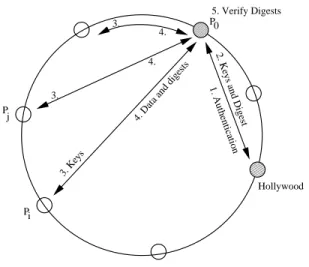
The BOPV protocol, shown in Figure 1, runs as follows:
Step 1: PeerP0authenticates itself to the central server Hollywood.
Step 2: The server providesP0a secret keyKi ∈Kfor each segmentiand message digest of the segment as Di =h(Ki, Hi1, Hi2, . . . , Hil, Ki), (1) whereHij is the hash of packetjof segmenti. The server groups the segments and providesP0 onlyndigests
1
4. Data and digests
5. Verify Digests
3. Keys
4. 3.
2. Keys and Digest 4. 3. 1. Authentication j P i P 0 Hollywood P
Figure 1: Steps of the protocol to receive data and verify digests by peerP0.
out of theNsegments in each group. These digests are used as a reference to verify the data downloaded from other peers. The authentication is done securely.
Step 3:P0gives each supplying peer one or more keys depending on how many segments the peers will provide. Step 4: Each supplying peer uses the keys to generate digests and sends them toP0with the segments.
Step 5: For verification,P0computes the hash function (Equation (1)) itself and matches the results against the
digests it receives from the server. If there is a match, all packets in the segment are verified.
P0can generate those keys by itself instead of getting it from the server. However, it requiresP0to compute two
hashes to verify each segment.
An example: If the server divides the movie Matrix of size 1.3 GB into segments of size 1 KB (to tolerate loss),
this generates 20 MB digest assuming each hash is 160 bits long.P0may not want to download this amount of data
before starting the streaming. However, if each segment contains 16 packets, Equation (1) reduces the volume of digests by 16 times. To further reduce the overhead, the server forms segment groups, with each group containing N segments. For each group, the server randomly selectsnsegments out of theN segments to generate digests and gives them toP0. Each supplying peer does not know which segments will be tested byP0 and they send digests
of all segments. P0 verifies only the segments it gets digests from the server. Verifying 8 out of 16 segments will
reduce the communication cost by 200%. Thus, the 20 MB communication overhead is reduced to 0.625 MB. If we further increase the segment size to 128, we can lower the integrity verification traffic to 80 KB.
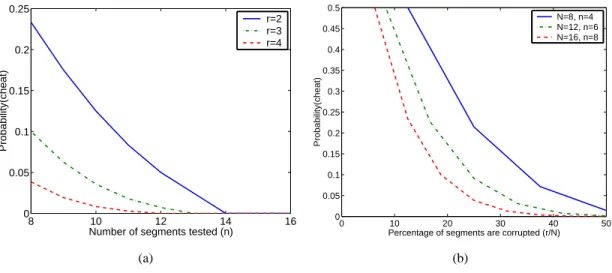
The probabilistic verification provides adjustable level of security and reduces computation overhead. In gen-eral, if a peer wants to tamper withr segments out of (N −n) segments, the probability of successful cheating isP r(cheat) = ( N −r n ) (N n) = (N−r)!×(N−n)!
(N−n−r)!×N! . Figure 2 shows how the probability to cheat varies with number of
8 10 12 14 16 0 0.05 0.1 0.15 0.2 0.25
Number of segments tested (n)
Probability(cheat) r=2 r=3 r=4 (a) 0 10 20 30 40 50 0 0.05 0.1 0.15 0.2 0.25 0.3 0.35 0.4 0.45 0.5
Percentage of segments are corrupted (r/N)
Probability(cheat)
N=8, n=4 N=12, n=6 N=16, n=8
(b)
Figure 2: Probability of cheating without getting caught in different number of segments. (a) Increasing number of segment to test (b) Increasing percentage of corrupted segments.
n=8. If a peer tampers with one segment, the chance of being detected is only 50%. However, if a peer tampers with 4 segments, then more than 96% chanceP0 will detect that. In other words,P0 will get 12 good segments (out of
every 16 segments) with probability 0.96. This probability will reach 0.99 ifn=9. Therefore, the level of security can be adjusted by tuning the values ofnandN.
One limitation of the above protocol is: if any packet is lost, the requesting peer will not be able to verify the entire segment containing the lost packet. An adversary peer can intentionally drop one packet from each segment and the whole streaming process is vulnerable. To deal with packet losses due to an unreliable transport protocol, we apply the following two techniques.
Multiple Hashes (MH): EMSS [7] achieves robustness against packet losses by sending multiple hashes of
other packets with the current packet. We explore the similar idea to achieve robustness of our scheme. In this approach, the peers send each packetpij = [Mij, Hi,j+1%l, . . . , Hi,j+t%l],wheretdefines the loss threshold, and Mij is the data ofj-th packet for segmenti. Like Golle et al. [3], we can insert hashes in strategic locations in a segment so that the chain of packets are more resilient to bursty packet losses.
To verify the packets of a segment si, peerP0 checks which packets of the segment it received and which of
them are lost. When a packet is lost, its hash will be found in other packets unless total packet loss of a segment exceeds the thresholdt.P0computes hashes of packets received and uses the hash provided by the sending peer for
lost packets. These values are plugged in Equation (1) and if this digest matches the digest provided by the server, the peer accepts the data otherwise it rejects them.
in-stead of data block. We apply similar idea to encode the digests using Reed-Solomon code. Efficient implementation of Reed-Solomon code has been reported in [1]. For each segment, the peers encode the digests intoapackets out of whichbpackets are sufficient to decode the digests. This scheme is robust against bursty packet losses because any bpackets can recover the digests of allapackets. With these digests,P0verifies the integrity of the received packets
of a segment using Equation (1).
We apply FEC to all our protocols. In Section 4, we compare the performance of our protocols (with FEC) and SAIDA.
3.2 One Time Digest Protocol (OTDP)
To eliminate the downloading of digests in Step 1 of Figure 1, we propose the One Time Digest Protocol (OTDP). In this protocol, the server generates the digests with keyed hash as shown in Equation (1) for a set of keysK. The server distributes all digests to different peers off-line. The keys are not given to the peers. A peer can not alter any digest because it does not know the keys. The OTDP modifies the basic protocol in Figure 1 as follows:
Step 1: When P0 requests a media file, it searches the P2P network to determine the supplying peers. P0
authenticates itself with the server.
Step 2: The server providesP0a set of keys based on the search results. Step 3:P0tells peers to send data and digests.
Step 4: Each peerPisends both data and digests toP0.
Step 5: P0 verifies each segment with appropriate keys. P0 maintains some backup peers if some peers fail to
provide data for any reason.
In OTDP,P0 downloads only a set of keys which is fairly small n volume comparing with the digests of all
segments. The integrity verification is secure due to the property of secure hash function. Error correction codes are used to protect digests. The probabilistic verification can be used to reduce computation overhead ofP0. The
limitation of OTDP is that one digest can be used only once. When a set of keys is revealed to a peer, these keys can not be used later; otherwise a peer can forge digest. However, the cache of movie data that a peer has is reusable. When a peer wants to be a provider, it collects a fresh set of digests from the server off-line. The server is required to have an efficient key management scheme to assign keys to different parts of a movie. When some segments are used in streaming, the server will have to invalidate those keys and digests.
3.3 Tree-based Forward Digest Protocol (TFDP)
To avoid the download as in Step 1 of the BOPV protocol and to reuse the same hashes, we propose Tree-based Forward Digest protocol. This protocol uses Merkele’s tree and is similar to Tree-chaining proposed by Wong and
Lam [11] for multicast flows. However, our protocol does not sign the root of every subtree belongs to each segment. We only compute digests to form the Merkele’s tree. Another difference is that our protocol creates one tree for a media file, instead of a separate tree for each segment. In Section 4, we show that this tree significantly reduces communication overhead. H3 16 15 14 13 12 11 9 10 8 7 6 5 4 3 2 H5 P1 P2 P3 H15 H14 H13 H12 H11 H10 H9 H4 H2 H1 H6 H7 H8 1
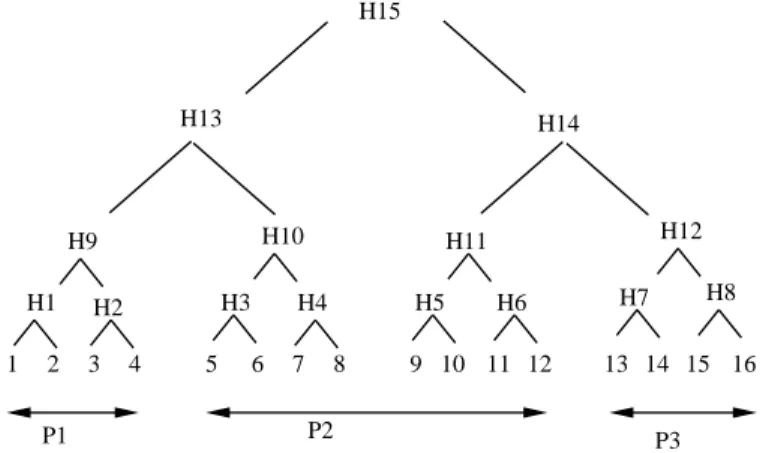
Figure 3: Tree structure of 16 segments whereP1has first four,P2has next 8,P3has the rest. Before streaming,P1sends the following
digests:H1,H2,H3,H4,H10, andH14.
Initially, the server generates the Merkele’s signature tree for a media file. The leaves of the tree can be a segment (a set of packets) or a single packet. All non-leaf nodes of the tree represent digests of leaves of their corresponding subtrees. The server imposes and enforces a minimum number of segmentsNmin a peer needs to cache. And the number of segments cached by a peer is always a multiple ofNmin. We provide a simplified example with 16 segments andNmin = 4. P1 has first four,P2 has next 8,P3 has the rest as shown in Figure 3. When P0 wants
to down segments fromP1,P1first provides all digests of the segments it hasH1,H2,H3,H4and other digests to
compute the digest of the root. In this case, those areH10, andH14. P0computesH15with these information and
then verifies with the digest supplied by the server. If there is a match, the belief inH15is transported to all hashes
provided byP1. The data sent byP1 can be verified segment by segment using these digests. The TFDP runs as
follows:
Step 1:P0authenticates itself to the server.
Step 2: The server provides the peer credentials and the digest of the root of the Merkele’s tree. Step 3:P0tells a peerPito forward the digests that are used to verify the supplied data.
Step 4: Each peerPi provides the digests of all leaves of the subtree it has and digests of all other nodes to compute the root. These are obtained from the server.
Step 5: If the computed digest atP0 matches the digest obtained from the server,P0 will allowPi to send the data.P0can trust the digests of each segment sent byPibecause the computed digest matches the digest of the root.
Step 6:Pisends data andP0can verify every segment individually.
To reduce the delay in Step 4, we can tune the value ofNmin. For example, ifNminis 64 segments and each segment contains 16 packets, then Step 4 downloads64×16 + log(NM
min)digests, which is equal to 1035 digests
with a volume of 20 KB for our example. Downloading this digest takes very little time for P0. All digests are
downloaded using TCP to ensure none of them is lost. The communication overhead is proportional to the height of the tree.
The main advantage of TFDP is that downloading digests is distributed over all peers and the server only provides the digest of the root. This scheme does not use separate key for each segment or peer. Instead, a unique identifier is used for each movie to compute the digests.
Allow Download Download # of Hash # of Hash Sign Verify sign Decode at Security
packet server→P0 P→P0 at server atP0 at server at peers atP0
loss (Bytes) (Bytes)
Tree chaining YES 0 20M llogl+ 128M l M(2l−1) M(2l−1) M M — 100%
BOPV NO (20 +K)M v 20M M v M v — — — variable
BOPV+MH YES (20 +K)M v 20M l(t−1) M v(l+ 1) M v(l+ 1) — — — variable
BOPV + FEC YES (20 +K)M v 20M lα M v(l+ 1) M v(l+ 1) — — M/α variable
OTDP YES KPm 20M lα M(l+ 1) M v(l+ 1) — — M/α variable
TFDP YES 20 20X 2M l Xv — — — variable
SAIDA YES 0 (20l+ 128)M α M(l+ 1) M(l+ 1) M M M/α 100%
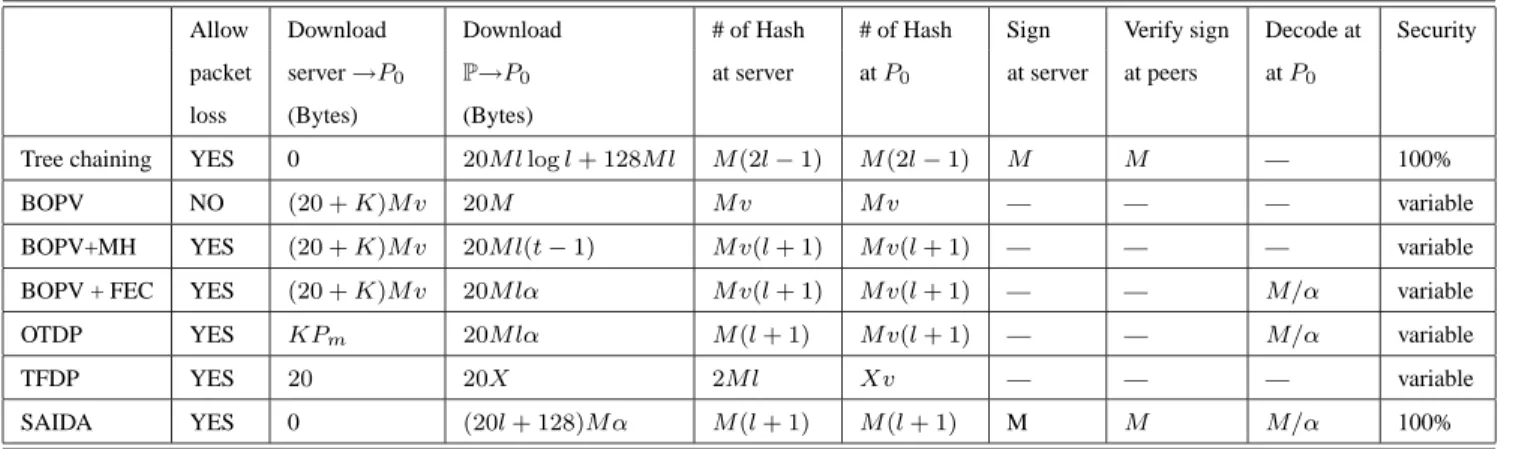
Table 1: Comparison among different schemes to authenticate a stream. Mis total number of segment in a file,lis the size of a segment
in packets. v= n
N, probability to verify a segment. α =
total packets sent per block
total packets need to reconstruct the block,Kis the size of a key,Nminis the
minimum number of segment a peer caches, andX =M l+ M
Nminlog(
M
Nminl).
4
Analysis and Results
In [5], the authors show that SAIDA performs better than EMSS [7] and augmented chaining [3] in bursty packet loss tolerance. In this paper, we compare our protocols with SAIDA and Tree chaining [11]. We evaluate the overhead of Block-Oriented Probabilistic Verification (BOPV) with its variations that integrate multiple hashes (MH) and FEC codes. The One Time Digest Protocol (OTDP) and Tree-based Forward Digest Protocol (TFDP) use FEC to achieve robustness against bursty packet losses. Table 1 presents an analytic comparison among these schemes. Before discussing the comparison, we first describe the setup. We use openSSL crypto library to calculate SHA-1 hash, RSA sign, and RSA verify. We use the Cauchy-based Reed-Solomon code [1] as forward error correction code to evaluate our protocols and SAIDA. The computation time for hash, sign, verify, encode, and decode is obtained using a 700 MHz PC with 256 MB RAM running Linux without any background process.
20 40 60 80 100 120 30 35 40 45 50 55 60 Segment size (l)
Communication Overhead (MBytes)
Tree Chain BOPV+MH BOPV+FEC OTD TFD SAIDA
(a) Communication overhead
20 40 60 80 100 120 20 40 60 80 100 120 140 160 Segment size (l)
Computation Overhead (sec)
Tree Chain BOPV+MH BOPV+FEC OTDP TFDP SAIDA (b) Computation overhead
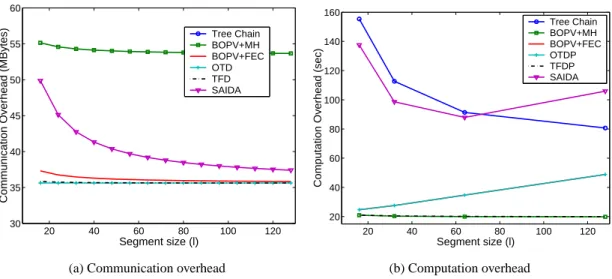
Figure 4: Overheads among Tree chaining, BOPV with multiple hashes and FEC, OTDP, TFDP, and SAIDA for movie Matrix of size, F=1.3 GB. The BOPV+FEC and OTDP have same computation overhead. Left figure does not show Tree chaining to highlight others.
Figure 4 shows the analytical comparison using Table 1 for the movie Matrix. The communication overhead is the total volume of digestsP0needs to download from other peers and the server. The computation overhead is for
hash computation, signature verification, and FEC decoding. The figure shows that communication overhead can be reduced significantly if FEC is used to encode digests and signatures. The FEC increases the computation overhead when segment size grows, because it needs to decode more packets within a block. The Tree chaining has extremely high communication overhead (260 MB, forl=16, not shown in Figure 4). Its computation overhead is reduced by caching digests carried by previous packets and using them to verify upcoming packets of a block. The BOPV with multiple hashes has the lowest computation overhead. Notice that, it has significant communication overhead com-paring to others with FEC. The SAIDA has low communication overhead, however, the cost of verifying signature increases its computation overhead. The TFDP has slightly high computation overhead than BOPV+MH because TFDP sends few more digests for everyNminsegments so that the receiver the verify the digest of the root.
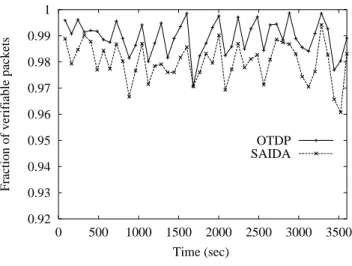
We also conduct simulations using the ns-2 simulator. In this simulation, one peer receives streaming media from five peers at the same time. The inbound link of the requesting peer is lossy. As SAIDA, we use Two-state
Markov loss model (modified version of ns-2) to introduce bursty packet loss in the shared link. The parameters of
Markov model isP r{no loss} = 0.95andP r{loss} = 0.05. The shared link incurs packet loss rate of 25%. We calculate the fraction of verifiable packets byM1 PMi=1number of verifiable packets in segmentnumber of packets received in segment i
i , for both SAIDA and OTDP. We compare SAIDA and OTDP in the simulation. The TFDP uses TCP to download digests and thus it can verify all packets received. The outcome of the simulation is shown in Figure 5. The digests and signatures are encoded to tolerate 37.5% packet loss rate. We observe that due to burstiness, some segments have low packet
verifiability. The reason why OTDP performs better is that SAIDA sends slightly more data than OTDP due to RSA signature for each segment.
0.92 0.93 0.94 0.95 0.96 0.97 0.98 0.99 1 0 500 1000 1500 2000 2500 3000 3500
Fraction of verifiable packets
Time (sec)
OTDP SAIDA
Figure 5: Packets verification probability atP0.
5
Conclusion
For P2P video streaming, data integrity verification is an important security issue. However, it receives less attention than other P2P security issues. In this paper, we propose efficient protocols to verify data integrity during P2P video streaming sessions. Our probabilistic packet verification protocol tunes the security and corresponding overhead. The proposed One Time Digest Protocol (OTDP) and Tree-based Forward Digest Protocol (TFDP) have very low communication overhead and tolerate high packet losses with reasonable computation overhead. The FEC codes can reduce the communication overhead. However, we show that it increases the computation overhead when many packets are aggregated into one block in order to amortize a signature over large block. Our simulation shows that a peer can verify 97% of packets even under a packet loss rate of 25%.
References
[1] Cauchy-based reed-solomon codes. available at http://www.icsi.berkeley.edu/˜luby/.
[2] M. Castro, P. Druschel, A. Ganesh, A. Rowstron, and D. S. Wallach. Security routing for structured peer-to-peer overlay networks. In proc. Symposium on Operating Systems Design and Implementation (OSDI’02), Dec 2002.
[3] P. Golle and N. Modadugu. Authenticating streamed data in the presence of random packet loss. In proc. Network and Distributed System Security Symposium (NDSS ’01), pages 13–22, Feb. 2001.
[4] B. Horne, B. Pinkas, and T. Sander. Escrow services and incentives in peer-to-peer networks. In proc. ACM Electronic Commerce (EC), Oct 2001.
[5] J. M. Park, E. Chong, and H. Siegel. Efficient multicast packet authentication using signature amortization. In proc. IEEE Symposium on Security and Privacy, May 2002.
[6] A. Perrig. The BiBa one-time signature and broadcast authentication protocol. In proc. ACM Conference on Computer and Communi-cations Security, pages 28–37, Philadelphia, PA, Nov 2001.
[7] A. Perrig, R. Canetti, J. D. Tygar, and D. X. Song. Efficient authentication and signing of multicast streams over lossy channels. In proc. IEEE Symposium on Security and Privacy, pages 56–73, Nov 2000.
[8] L. Reyzin and N. Reyzin. Better than BiBa: Short one-time signatures with fast signing and verifying. In proc. 7th Australasian Conference ACSIP, Sept 2002.
[9] R. L. Rivest, A. Shamir, and L. M. Adleman. A method for obtaining digital signature and public key cryptosystems. In Commnunication of the ACM, pages 120–126, Feb 1978.
[10] P. Rohatgi. A compact and fast hybrid signature scheme for multicast packet. In proc. ACM Conference on Computer and Communica-tions Security, pages 93–100, Nov 1999.
[11] C. K. Wong and S. S. Lam. Digital signatures for flows and multicasts. In proc. International Conference on Network Protocol (ICNP), Oct 1998.