360 FEEDBACK FROM ANOTHER ANGLE
Human Resource Management, Spring 2001, Vol. 40, No. 1, Pp. 3–20 © 2001 John Wiley & Sons, Inc.
David W. Bracken, Carol W. Timmreck, John W. Fleenor, and Lynn Summers
How do you know if a 360 process has been implemented successfully? What are the factors that influence its success? How can those factors be controlled by those responsible for its implemen-tation? Despite its popularity, there has been little effort to build a comprehensive model that addresses these fundamental questions about 360 feedback. In a quest for such a model, we identify a host of key factors organized according to whether they exert their influence proximally or distally. We discuss how each factor contributes to successful implementation. After identify-ing how design features of a 360 process affect these key factors, we recommend how to enhance the probability of implementing 360 feedback successfully and sustaining the process over time. © 2001 John Wiley & Sons, Inc.
Introduction
Despite the proliferation of 360 (multisource) feedback processes (where individuals receive anonymous, questionnaire-based feedback from peers, subordinates, supervisors, cus-tomers, and other co-workers), the jury is still out on the answers to two questions: (1) How well does it work, and (2) Is it a good idea? And the answer to the second question is very much determined by the answer to the first. These questions become more salient as or-ganizations contemplate using the results for decision-making, such as performance ap-praisals, pay determinations, succession plans, job placement, or even downsizing (Bracken, Dalton, Jako, McCauley & Pollman, 1997), although we maintain that even “development-only” systems also ulti-mately depend on “good” information to have any hope of success.
During the past few years, the literature on 360 feedback has expanded rapidly, includ-ing books,1 book chapters,2 and special issues
of Human Resource Management (Tornow, 1993a) and Group and Organization Manage-ment (Church & Bracken, 1997). The gen-eral sense in this proliferation is much like the blind men groping the elephant, each ar-riving at a different conclusion depending on the “angle.” We do not see any of these offer-ings providing a comprehensive model of the underlying factors that lead to successful 360 feedback processes.
The reasons behind effective (and inef-fective) 360 feedback systems are elusive. In interviews of 27 administrators of multisource processes who had previously indicated that they were using or planning to use the feed-back for appraisal purposes, we (Timmreck & Bracken, 1997) found that in more than half of the cases, multisource feedback was
work-The reasons behind effective (and ineffective) 360 feedback systems are elusive.
ing successfully in conjunction with perfor-mance management. We tended to focus on the “half full” interpretation that multisource feedback for decision making can work under the right conditions.
Maxine Dalton, quoted in Lepsinger & Lucia (1997b), points instead to the “half empty” interpretation that some systems do indeed “fail” (although she overstates the fail-ure rate). In reviewing our findings, it was very difficult to determine the reasons for failure (i.e., discontinuation); they were cer-tainly many, diverse, and sometimes unclear, ranging from changes in management, to le-gal advice, to rebellion in the ranks, just to name a few. We also had a nagging feeling that some of the dead/dying processes prob-ably deserved their fate due to insufficient care in their implementation.
We suggest that the field needs a system-atic review of 360 feedback and development of a model that includes the factors contribut-ing to its success, or lack thereof. As Table I indicates, “success” is defined differently de-pending on the constituent group one is trying to satisfy. Raters, for example, would consider a 360 process successful if ratees appeared to accept the feedback and change their behav-iors, if their working relationships with ratees improved, if they were not retaliated against for providing honest feedback, and if the over-all feedback climate improved. Similarly, each of the other principal constituencies (ratees, bosses, and the organization itself) has its own definition of the factors that contribute to suc-cessful implementation of the process.
While acknowledging these different and sometimes conflicting definitions of “suc-cess”, we propose that ultimately it is deter-mined by the organization, and can be defined as a process that:
Creates focused, sustained behavior change and/or skill development in a sufficient num-ber of people so as to result in increased organization effectiveness.
Our definition purposely excludes behav-ior change targeted at one individual at a time. While it is possible that one person’s 360 feed-back could affect organizational effectiveness if that individual were strategically placed, we
have chosen to address what we believe to be the more significant (and challenging) oppor-tunity via system-wide implementations of 360 feedback. We also propose that this definition of success will not be achieved if the organi-zation does not at least consider the success definitions of all the constituent groups.
The complexity of 360 feedback lies in the many ways it can be implemented and the ul-timate effect implementation has on the ac-curacy, usefulness, and acceptance of the feedback (Bracken, 1994; Brutus, Fleenor & London, 1998b; Lepsinger & Lucia, 1997a). We propose that each decision made in the implementation of 360 feedback has implica-tions for the success of the process, and that it is our responsibility to assist users in mak-ing informed decisions as to the possible rami-fications of their decisions.
With this in mind, we present a new model of successful 360 feedback that can be used by practitioners to design effective (i.e., valid) multisource processes in their organizations. Our bias is to create a model that will with-stand the scrutiny of users of 360 feedback for decision making, but also will improve purely developmental processes. Without bringing to bear any new research of our own, we present the entire process as a system with interacting and dynamic elements. By provid-ing a model that is often prescriptive, accom-panied by the rationale for recommendations, we hope to equip the practitioner with the tools to make informed decisions during 360 design and implementation.
A New Model of Validity for 360 Feedback Traditionally, notions of validity have come from relatively controlled, static measurement settings, the most classic of which is pre-em-ployment testing. Standards for testing go to great lengths to standardize the test param-eters, focusing on the test environment, a vali-dated instrument, and consistent use of re-sults in decision making. Once a person be-comes an employee, the organization might do further assessments, such as an assessment center or some derivative, where it still strives for standardization but introduces a potential source of unreliability by relying on observ-ers/raters to generate the scores.
The complexity of 360 feedback lies in the many ways it can be implemented and the ultimate effect implementation has on the accuracy, usefulness, and acceptance of the feedback.
Constituent Group Rater Ratee Boss Organization Definitions of Success
• Perception that feedback was accepted and ratee behavior improved
• Improved working relationship • No negative repercussions • Improved feedback climate
• Received feedback that was fair, constructive, valid, actionable, credible, reliable
• Improved communications • Improved working relationship • Improved feedback climate • Improved performance
• Access to timely, quality feedback appropriate for use in performance management and/or
development
• Feedback aligned with organization goals and/or values (i.e., relevant, important)
• Improvement in ratee’s behavior consistent with the process’ objectives
• Improvement in ratee’s workgroup • Improved feedback climate • Not overly intrusive (time, cost)
• Sustained focused behavioral change in large number of individuals that leads to organizational effectiveness
• Viability of the process (sustainable) • Improved feedback climate
• Legal defensibility
• Supports learning environment
Factors Contributing to Success • Anonymity
• Ratee accountability • Multiple administrations
• Policies and practices communicated • Hotline to report problems
• Consistency • Confidentiality • Rater training
• Rater accountability (i.e., honesty) • Consistent rater selection
• Sufficient number of raters with knowledge (i.e., census)
• Valid, reliable instrument
• Organization commitment (e.g., resources) • Access to raters for follow-up
• Development and action planning
• Boss receives data that are clear, actionable, relevant
• Boss receives training on proper use of data • Ratee accountability for follow-through • Organization commitment (e.g., resources) • Process is a business priority
• Process is administered regularly, consistently • All bosses held accountable
• Valid, reliable instrument
• Efficient data collection, reporting • Top management commitment • System-wide implementation • Resources to develop valid process • Sufficient resources to sustain the process • Valid, reliable instrument
• Alignment
• Efficient, cost effective data collection, processing and reporting
Some of the traditional definitions of valid-ity imply that they are referring to a measure-ment “event” using some kind of instrumeasure-ment:
“… a measuring instrument is valid if it does what it is intended to do.” (Nunnally, 1978)
“… the degree to which inferences from scores are justified or supported by evi-dence.” (SIOP, 1987)
Clearly, these definitions fall short of ad-dressing the many factors that affect the “va-lidity” of a process that might include the use of an “instrument” but ultimately depends upon other sources (e.g., raters) for reliable data. In addition, we maintain that it is insuf-ficient for an instrument to be judged “valid” in a vacuum. An apparently “valid” instrument can be rendered “invalid” if the information it provides is misused, ultimately not doing “what it is intended to do.”
The Success of a 360 Feedback Process as Defined by Its Different Constituents. TABLE I
The measurement process that comes closest to 360 feedback in its challenges and the resulting validity issues is the performance appraisal. The appraisal traditionally relies heavily on the skills of one individual, the supervisor, to generate reliable, valid informa-tion, which is often subsequently used for decision making (e.g., pay, promotions, devel-opment). Some guidelines for valid perfor-mance appraisal are offered by Bernardin & Beatty (1984), and include contextual vari-ables such as rater training and ensuring ad-equate opportunity to observe that apply equally well to 360 feedback.
Three-sixty feedback is a very complex pro-cess that draws both the good and bad fea-tures of testing, performance appraisal, large-scale data collection (e.g., employee sur-veys), assessment centers, and employee de-velopment. Like performance appraisals and assessment centers, 360 feedback depends on the capability to generate reliable data from unreliable sources (i.e., people). Whereas rater training is required for assessment center rat-ers and strongly recommended for supervisors doing appraisals (Bernardin & Beatty, 1984; Malos, 1998), the potential magnitude of the task of training raters for a 360 feedback pro-cess often prevents it from happening (Timmreck & Bracken, 1995). Not only are these raters often inexperienced, they also are typically not held accountable for the quality of their ratings, unlike supervisors in appraisal settings (London, Smither & Adsit, 1997).
Another characteristic of many 360 feed-back processes that make them similar to ap-praisals but different from other measurement systems is their ongoing, repeated administra-tion. An ongoing, repeated 360 process is a dynamic procedure where participants (raters, ratees, managers) have experiences that will shape their future interaction with the pro-cess. These experiences and their conse-quences can either enhance or decrease the effectiveness of the process.
There are some definitions of validity for 360 feedback that seem to acknowledge this systems perspective:
“… a measure of the usefulness of a proce-dure, technique, or device.” (Jones & Bearley, 1996)
“… validity is integrity.” (Van Velsor, Leslie & Fleenor, 1997)
These two definitions appear to recog-nize that the validity of a process cannot be known until the process is implemented, and that a value judgment must be made as to whether validity depends on its “usefulness” or its “integrity”.
We propose our own definition of validity for 360 feedback processes, which we feel is specific to this particular area of practice:
Sustained, observed improvement in behav-iors valued by the organization.
In this definition, we stop short of requir-ing outcomes beyond behavior change. There is certainly demand for “bottom line” evi-dence for 360 feedback, and gradually some is forthcoming (Gross & Levy, 1998). While this type of research is needed, we see in-stances where behavior change is sufficient as an end product. An example would be where the behavioral model on which the 360 process is built is derived from the organization’s values statements. We would argue that, in those situations, an individual who changes his or her behavior to be con-sistent with these values as a result of receiv-ing 360 feedback has contributed evidence of the validity of the process. Note that this definition can include behaviors which are not specifically assessed in the instrument but are developed in the total process.
Two Types of Validity Factors When we think of factors that might cause a 360 feedback process to generate “bad” (in-valid) outcomes (i.e., no behavior change, misguided behaviors), one category of such factors would, of course, include things that happen around the questionnaire and its ad-ministration. While such factors are undoubt-edly important, we propose that successful 360 feedback implementations are not one-time events. Our definition of “success” re-quires sustained behavior change (London & Tornow, 1998; Wimer & Nowack, 1998). When viewed from this longer-term perspec-tive, there is a whole set of other factors that The measurement process that comes closest to 360 feedback in its challenges and the resulting validity issues is the performance appraisal.
can invalidate or improve the process. These factors may not surface until the second or later administrations.
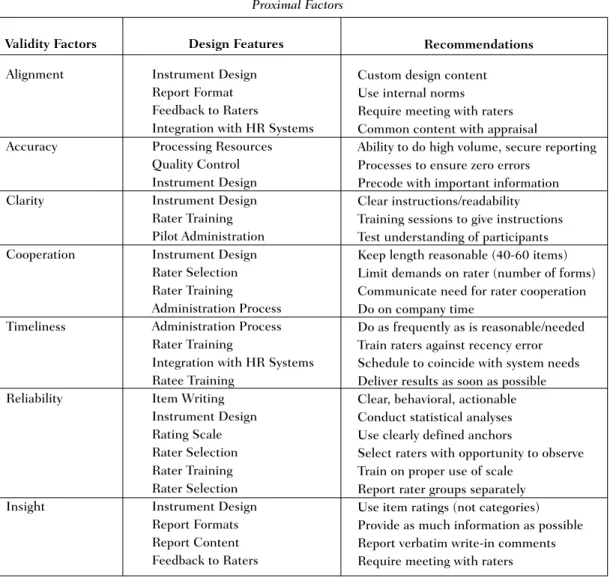
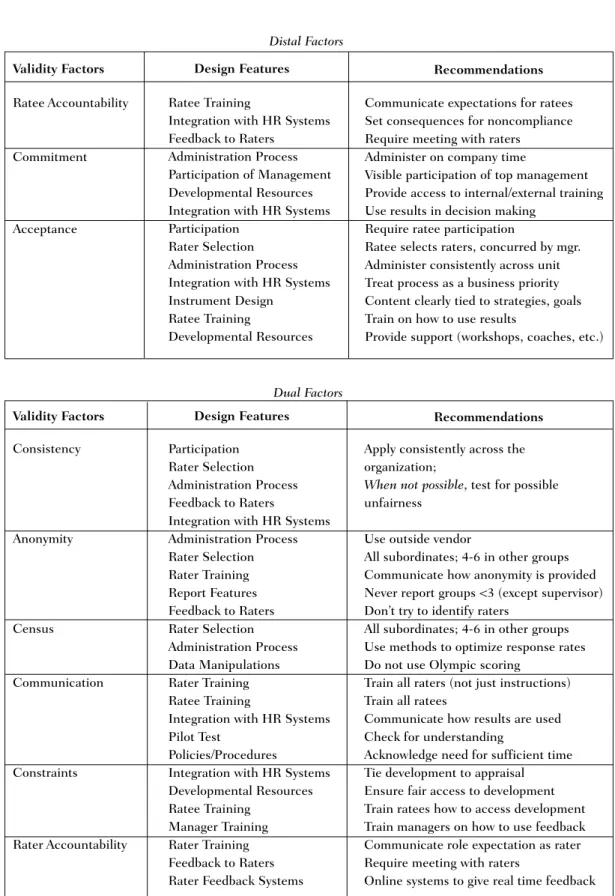
Table II lists factors that determine the validity of 360 feedback, sorted into two pri-mary categories, proximal and distal, with a third category representing a mix of the two. Proximal factors occur at Time 1, the initial administration. These factors exert an imme-diate effect on the validity of the feedback for participants in the present administration. Distal factors reflect the fact that things hap-pen (or don’t haphap-pen) at Time 1 whose effects are not realized until Time 2, a subsequent administration of 360 feedback to the same population within a reasonable period of time (i.e., two years or less). As shown in Table II,
some factors are so powerful as to have ef-fects at both Time 1 and Time 2 as proximal
and distal factors (i.e., dual factors), but in different ways that will be described below.
Whether proximal, distal or both, each factor has implications for the design of the 360 process. (For further discussions of de-sign features, an excellent treatment is pro-vided by Dalessio, 1998.3) Table II
illustrates the major design features poten-tially affected by each validity factor and some associated recommendations.
Proximal Factors
Proximal factors affect the quality of the feed-back at the time of its current administration,
Alignment Accuracy Clarity Cooperation Timeliness Reliability Insight Instrument Design Report Format Feedback to Raters
Integration with HR Systems Processing Resources Quality Control Instrument Design Instrument Design Rater Training Pilot Administration Instrument Design Rater Selection Rater Training Administration Process Administration Process Rater Training
Integration with HR Systems Ratee Training Item Writing Instrument Design Rating Scale Rater Selection Rater Training Rater Selection Instrument Design Report Formats Report Content Feedback to Raters
Custom design content Use internal norms Require meeting with raters Common content with appraisal
Ability to do high volume, secure reporting Processes to ensure zero errors
Precode with important information Clear instructions/readability Training sessions to give instructions Test understanding of participants Keep length reasonable (40-60 items) Limit demands on rater (number of forms) Communicate need for rater cooperation Do on company time
Do as frequently as is reasonable/needed Train raters against recency error Schedule to coincide with system needs Deliver results as soon as possible Clear, behavioral, actionable Conduct statistical analyses Use clearly defined anchors
Select raters with opportunity to observe Train on proper use of scale
Report rater groups separately Use item ratings (not categories) Provide as much information as possible Report verbatim write-in comments Require meeting with raters 360 Feedback Validity Factors and Associated Design Features.
Proximal Factors
Validity Factors Design Features Recommendations
TABLE II
We propose that successful 360 feedback implementations are not one-time events.
TABLE II
Ratee Accountability
Commitment
Acceptance
Ratee Training
Integration with HR Systems Feedback to Raters
Administration Process Participation of Management Developmental Resources Integration with HR Systems Participation
Rater Selection Administration Process Integration with HR Systems Instrument Design
Ratee Training
Developmental Resources
Communicate expectations for ratees Set consequences for noncompliance Require meeting with raters
Administer on company time
Visible participation of top management Provide access to internal/external training Use results in decision making
Require ratee participation
Ratee selects raters, concurred by mgr. Administer consistently across unit Treat process as a business priority Content clearly tied to strategies, goals Train on how to use results
Provide support (workshops, coaches, etc.)
Consistency Anonymity Census Communication Constraints Rater Accountability Participation Rater Selection Administration Process Feedback to Raters
Integration with HR Systems Administration Process Rater Selection Rater Training Report Features Feedback to Raters Rater Selection Administration Process Data Manipulations Rater Training Ratee Training
Integration with HR Systems Pilot Test
Policies/Procedures
Integration with HR Systems Developmental Resources Ratee Training
Manager Training Rater Training Feedback to Raters Rater Feedback Systems
Apply consistently across the organization;
When not possible, test for possible unfairness
Use outside vendor
All subordinates; 4-6 in other groups Communicate how anonymity is provided Never report groups <3 (except supervisor) Don’t try to identify raters
All subordinates; 4-6 in other groups Use methods to optimize response rates Do not use Olympic scoring
Train all raters (not just instructions) Train all ratees
Communicate how results are used Check for understanding
Acknowledge need for sufficient time Tie development to appraisal Ensure fair access to development Train ratees how to access development Train managers on how to use feedback Communicate role expectation as rater Require meeting with raters
Online systems to give real time feedback
Dual Factors Distal Factors
Validity Factors Design Features Recommendations
Validity Factors Design Features Recommendations
i.e., they have an immediate effect. In some ways, every proximal factor can have a distal (long term) effect due to issues such as loss of confidence in the process, which in turn af-fects the willingness of participants (both rat-ers and ratees) to commit to future adminis-trations. In fact, a proximal factor can be suf-ficiently botched to have the distal effect of terminating the process. Here are a few fac-tors that are primarily proximal:
Alignment. This is probably the most di-rect and traditional definition of validity; that is, the extent to which the content of the feed-back (e.g., competencies, skills, behaviors) is relevant to the success of the individual and, in turn, to the organization. If we are measur-ing the “wrong” thmeasur-ings, then the process is by definition invalid.
Alignment is most powerful and defen-sible when tied to the strategies, values, and goals of the organization, then translated into competencies and/or desired behaviors for the entire employee population. 360 feedback instruments derived from some less obvious models of behavior, or standardized off-the-shelf instruments, require that validity be demonstrated for that specific organization and its employees (Dalessio, 1998; Van Velsor et al., 1997).
One of the advantages of well-designed 360 feedback processes is that alignment can be reinforced three times. The first opportu-nity is in the instrument design, as described above. A second opportunity for alignment occurs if the ratee meets with the raters (in-cluding the “boss”) to share results and devel-opment plans, in the process ensuring that the interpretation is correct and that the develop-ment plans are consistent with the expecta-tions of the raters and the organization (Lepsinger & Lucia, 1997a; Walker & Smither, 1999). A third opportunity for alignment oc-curs if the feedback is integrated into a hu-man resource system, such as perforhu-mance appraisal, and the results are reviewed and action taken in the context of organization goals and values (Jako, 1997). Missing or mis-managing any one of these opportunities to ensure alignment certainly reduces, if not ne-gates, the validity of the process.
A fairly common sentiment in 360 feed-back circles is that organizations are trying to
create a feedback climate where question-naires will become unnecessary (Dalton, 1998). If one truly believes that 360 feedback reinforces alignment by signaling the organization’s direction and associated behav-iors, then 360 feedback processes will always have a place. If, for example, the organization is trying to sustain “organizational learning”, which involves rapid response to changes in the external environment, 360 feedback can be invaluable in reinforcing the new direction and ensuring that employees are giving feed-back to each other on the “right” behaviors.
Accuracy. Here we are referring to the actual process of collecting and processing data and reporting the feedback—with no er-rors. This is an obvious but not so simple sine qua non of 360 feedback, exacerbated by the practice of providing feedback from relatively small groups of employees to a large number of ratees (Bracken, 1994). Lepsinger & Lucia (1997a) provide sample causes and solutions for accuracy problems. Suffice it to say that this is where “Murphy’s Law” is in full force.
Clarity. Even if raters are motivated and able to “perform” their role as feedback pro-viders, it is incumbent on the administrators to ensure that raters are given clear informa-tion as to how to fulfill that role (i.e., correctly complete the survey and return it in a timely fashion to the right place). Other typical er-rors that raters unknowingly commit include miscoding (or misunderstanding) who they are rating, misusing the response scale, and pro-viding inappropriate write-in comments. It must be ensured that participants simply un-derstand what they are supposed to do—a task at once difficult to do and to know when it hasn’t been successful. The most obvious ex-ample is clear instructions, but good commu-nications and training also can go a long way towards a successful implementation (Leslie & Fleenor, 1998).
Cooperation. The quality of feedback is very much dependent upon the motivation of the raters to participate, both in an absolute sense as reflected in response rates, and in a relative sense as reflected in the quality of their responses. The design features targeted here are those that determine the magnitude of the task, such as survey length and the number of surveys a given rater must complete. Various
One of the advantages of well-designed 360 feedback processes is that alignment can be reinforced three times.
symptoms of poor quality are unreturned sur-veys, incomplete sursur-veys, and potential (per-haps unknown) effects of rater fatigue on the feedback. It is our experience that instrument designs using importance ratings and “gap analysis” (observed vs. expected performance) are of questionable value and serve largely only to add more burden on the raters with an as-sociated impact on the quality and quantity of their responses.
Timeliness. A proximal factor that is often compromised in practice—timeliness in pro-viding feedback—is important both for accu-racy and acceptance by the ratee. For example, King & Downey (1998) report that delays in providing feedback can be a factor in increas-ing ratincreas-ing error, particularly when evaluatincreas-ing specific behaviors (vs. overall performance). A vast majority of 360 feedback processes are administered on an annual basis (Timmreck & Bracken, 1995), and raters can be expected to exhibit recency error. One method we have seen that attempts to avoid this particular type of error has been in team-based organizations where project teams form and disband on an ongoing basis. In some cases, 360 feedback is collected at the completion of each project, accumulated over the year, and then fed back to each ratee as cumulative results for all projects worked on during that period. While this addresses the timeliness issue identified by King & Downey (1998) as leading to rater errors, it does not solve the problem of de-layed feedback to the ratee and the implica-tions for acceptance of the feedback. Giving the results to the ratee immediately can work as long as rater anonymity (real and perceived) is not threatened due to small group sizes and the ratee is supported in the full and proper use of the feedback.
Reliability. The survey instrument serves as the primary—albeit artificial—communication vehicle between raters and ratees. In addition, some action should result from the collected feedback, whether it is development planning, training, or administrative decisions, such as compensation, staffing and succession plan-ning, which can possibly add legal consider-ations. Some acceptable level of reliability for 360 ratings, therefore, must be demonstrated. We are discovering that implementing 360 feedback causes us to question what
reliabil-ity means in this context, how it should be measured, and what is “acceptable” reliability (Bracken, 1996; Dalessio, 1998). For example, test-retest measures can be called into ques-tion due to real or perceived changes in ratee behavior in the intervening time (Tornow, 1993b) and/or changes in the raters them-selves (e.g., attitudes, knowledge, opportunity to observe).
Another indicator of reliability is provided by measures of internal consistency, such as coefficient alpha for dimension scores (Van Velsor et al., 1997). However, recent findings also challenge our traditional thinking. Facteau (1998) presents data suggesting that factor structures may differ between rater groups using the same instrument, which im-plies that different dimensions would be needed for each rater group (e.g., subordi-nates, peers, bosses, etc.). To some observers (e.g., Dalessio, 1998), this is not a surprising finding. More recent and encouraging find-ing of equivalence across rater sources (Maurer, Raju, & Collins,1998; Frame, Ayman, Raju, & Goff, 1999; Woehr, Sheehan, & Bennett, 1999), even taking ratee gender into consideration (Frame et al., 1999), con-tradict the Facteau (1998) conclusions and support the robustness of some instruments. We challenge Facteau (1998) and others examining measurement equivalence to first assure us that the instrument itself is not at fault. For example, we might expect vague items to be more susceptible to differences in meaning (and associated constructs) than very specific behavioral items. For example, we pro-pose that items that begin with the following verbs (among others) are doomed to failure: “manages,” “oversees,” “values,” “knows,” “supports,” “ensures,” “supervises,” “under-stands,” and “believes.” The same would be true for double and triple barreled items which are proliferating in the attempt to shorten questionnaires. Unfortunately, Facteau was unable to share the actual instrument that produced different factor structures.
Another possible cause of this phenom-enon could be the way raters interpret and use the rating scale (Maurer et al., 1998). In the case of the Facteau (1998) study, a five-point frequency scale (“always” to “never”) was used. Putting aside for the moment potential seri-Giving the results to the ratee immediately can work as long as rater anonymity (real and perceived) is not threatened due to small group sizes and the ratee is supported in the full and proper use of the feedback.
ous deficiencies in frequency scales (Bracken & Paul, 1993), we wonder if frequency inter-acts with opportunity to observe (e.g., peers having less opportunity than subordinates) to create this artifact. Systematic research on rat-ing scales is needed due to the lack of an ac-cepted standard and the resulting proliferation of scale formats (Timmreck & Bracken, 1995). Another common indicator of reliability is inter-rater agreement. In the case of 360 feedback, we can consider agreement between and within rater groups with different perspec-tives. Meta-analyses by Harris & Schaubroeck (1989) and Conway & Huffcutt (1997) both indicate moderate levels of inter-rater agree-ment within groups, although subordinates are often found to have the lowest reliabilities. Additionally, Fleenor, McCauley, & Brutus (1996) reported acceptable intraclass corre-lations for peers (.43 to .69) and subordinates (.47 to .70). Greguras & Robie (1998) go one step further and prescribe larger rater groups (9 subordinates, 8 peers, and 4 managers) than those normally found in practice to produce acceptable (.70) reliabilities with a five-point scale. We believe that such numbers should not be dismissed as unreasonable, and are consistent with our observations about cen-sus administration discussed below. At the same time, the Greguras & Robie (1998) re-sults are reminiscent of the findings of Mount, Judge, Scullen, Sytsma & Hezlett (1997) that supervisor ratings are of higher reliability than peers or subordinates to the extent that the separate reporting of only supervisor scores is justified. In other words, they propose that only supervisor ratings should be broken out separately on the feedback reports—all other rating groups should be combined into an over-all group.
Finally, agreement between rating sources has typically been shown to be low. This is not unexpected because it represents the very reason we do 360 feedback (i.e., different per-spectives on performance) (Tornow, 1993b). On the other hand, Brutus, Fleenor, & Lon-don (1998a) calculated agreement between the supervisor, one randomly selected peer, a randomly selected subordinate, and the self rating using rwg(j) (James, Demaree & Wolf, 1984) and found values ranging from .95 to .97 across six industries! These results
pro-vide support for the findings of Mount et al. (1997) that there appears to be as much agree-ment across rater groups as within rater groups with 360 ratings.
The implication of such findings for the implementation of 360 feedback is unclear. While breaking out the results by rater group may or may not make statistical sense, these groups do represent an important reality in the organization, and ratees usually expect to see these data. As noted in the discussion of Align-ment and Insight (below), it is often critical that participants fully understand the significance of the ratings obtained from these groups, facili-tated both by report breakouts and discussions with raters during the action-planning phase.
Insight. In order for the ratee to take ac-tions which are aligned with both the organization’s desires and the feedback of the raters, he/she should be provided with the maximum amount of reliable information. The implications are primarily for the instrument design and report format but could include additional opportunities for insight created by meeting with raters, for example.
Some instruments solicit ratings at a cat-egory level, maybe providing a definition or behavioral examples to supposedly assist the rater. Some online systems allow the rater to link to a list of behaviors by clicking on the category label. Each of these approaches places an inordinate amount of faith in the raters, assuming that they do indeed read and use this information. More importantly, the ratee has no basis for determining the spe-cific actions which have resulted in their scores. Systems that ask for (or require) writ-ten comments from raters cannot be expected to solve this problem and in effect would ac-tually increase the burden for the rater.
Some report formats provide only mean scores with no indication of response distri-bution, presumably in an effort to protect rater anonymity and fears of retribution. While it is clearly important to maintain real and per-ceived anonymity of raters (as discussed be-low), we are doing a disservice to the ratee and hence the validity of the system if the ratee is forced to make decisions based on data pre-sented in an incomplete fashion. Report fea-tures which help understanding include displays of actual rating distributions
(frequen-In order for the ratee to take actions which are aligned with both the organization’s desires and the feedback of the raters, he/she should be provided with the maximum amount of reliable information.
cies), indicators of range (min/max, standard deviations), internal/external norms, and write-in comments. Agawrite-in, each feature has its pros and cons and can place significant importance on the need for ratee training.
Distal Factors
Distal factors are products of Time 1 or inter-vening events whose effects are not realized until the second administration (Time 2). More often than not, the effects of distal fac-tors are not anticipated and some surprises (pleasant or unpleasant) occur at Time 2. This indicates the usefulness of conducting evalu-ations immediately after Time 1 using focus groups or questionnaires to anticipate and maybe head off the threats to validity caused by problematic distal factors.
Ratee Accountability. Successful 360 feed-back requires accountability for each of the three constituent groups: the raters (to pro-vide honest feedback), the ratees (to use the feedback), and the organization (to support the process), whose “representative” is the “boss” (London et al., 1997). The distal fac-tor we are addressing here is ratee account-ability. While raters may have some preconceived notion of the probability that the ratee will use the results productively (and give or not give the benefit of the doubt accord-ingly the first time through), it is not until the ratee has the first opportunity to use the re-sults that raters have the chance to see how the feedback is being used by the ratee. We have observed that rater participation and hon-esty will be differentially affected at Time 2 based on what they observed to happen at Time 1. To the extent that raters become less motivated to return surveys or give honest feedback, the reliability of feedback at Time 2 will be negatively affected. Conversely, raters who see that their feedback is being used pro-ductively should be expected to either start or continue to fulfill their accountability for giv-ing accurate, honest feedback.
Ratee accountability is at the very heart of the debate over 360 feedback for develop-ment-only versus use for decision making (e.g., appraisal, pay, staffing, succession planning) (Bracken et al., 1997; Fleenor & Brutus, 2001). Table III shows many of the typical
fea-tures of development-only versus decision-making 360 processes. While there are many exceptions to these observations, they seem to be true more often than not (Bracken, 1996). One of these differences addresses the expectations for ratees in using the results. In development-only uses, ratees are usually given the final decision on what is done with the feedback. They usually receive the only copy of the feedback report and are not re-quired (or even encouraged) to share results with raters or with their supervisor. Many of the development-only proponents would go so far as to say that this guarantee of confidenti-ality is a requirement for objective consider-ation and use of the feedback by the ratee (Dalton, 1996; 1997).
Unfortunately, experience suggests that, under these conditions, little behavior change is likely to occur for the majority of partici-pants (Hazucha, Hezlett, & Schneider, 1993; Kluger & DeNisi, 1996). 360 feedback sys-tems, when used for decision making, provide the results to the supervisor and often require the ratee to share results with the raters (e.g., subordinates) as well. This has a dual benefit. First, it increases the probability that the ratee will seriously consider the results and gener-ate a development plan, which in turn can be used to secure the supervisor’s support. Sec-ondly, it “engages” the raters by showing them that their feedback is being used, and that their responsibility for helping the ratee doesn’t end when they turn in a questionnaire. In these meetings, the ratee asks for clarification of the feedback and seeks support for the proposed development plan. This notion seems to be confirmed by Walker & Smither (1999) who report that, over a five year period of annual administration, managers who consistently held feedback sessions to discuss their upward feedback with direct reports improved more than other managers.
An extremely important issue, therefore, is the clear determination of the purpose of the process before any design begins (Bracken, 1996; Lepsinger & Lucia, 1997a; Wimer & Nowack, 1998). Practitioners should consider design features based on the purpose of their 360 feedback process, and realize that it is dif-ficult to serve both purposes with one system. The possibility of parallel processes being run Ratee accountability is at the very heart of the debate over 360 feedback for development-only versus use for decision making
for different purposes is an attractive alterna-tive (Bracken, 1996; Tornow & London, 1998).
Commitment. Commitment is defined here as accountability demonstrated by the sponsors and administrators of the 360 pro-cess. Evidence of commitment comes in many forms, including public support of the process, a long-term commitment to achieving success, participation in the process, sharing of feed-back results by senior managers, providing sufficient staff and resources for quality imple-mentation, providing training for raters and ratees, and offering developmental resources for participants.
Acceptance. We believe that ratees must accept the feedback before acting on it in the spirit intended (i.e., consistent with individual and organizational goals.) Ratees (first timers in particular) predictably go through phases of shock, anger, and rejection of the results before being able to accept the feedback. This
certainly speaks to the need to acknowledge ratee reactions during the feedback process, and to have methods for helping individuals who cannot easily work through these stages, a far too common occurrence.
Dual Factors (Proximal and Distal)
Some factors operate both proximally and dis-tally. These are complex factors that affect validity in a number of ways and over time.
Consistency. Acceptance and conform-ance in a 360 feedback setting, as in many other situations, are greatly influenced by perceptions of fairness. In many cases, the most accessible and verifiable evidence of fairness is found in consistency or lack thereof. Examples include: Is everyone re-quired to participate? How are raters se-lected? Do I have to show my results to my supervisor? Will my results affect my
per-Organization Core competencies Shorter (30-50 items) Encourage between-person comparisons Required
As required (e.g., annual) Between-person (normative) comparisons
Participant and supervisor Expected or required Required
• Performance management • Succession planning • Staffing
• Pay (e.g., bonuses) “Owner” of the feedback
Questionnaire content Length of questionnaire Response scales Ratee participation Administration schedule Report format Copy of results
Share results with raters? Action plan Typical uses Participant Job-specific competencies Longer (80+ items) Encourage within-person rankings of skills Voluntary
Ad hoc (on request) Within-person (skill ranking) comparisons Participant only Optional or discouraged Recommended • Employee development • Career planning • Training 360 Feedback Design Features by Purpose.
Decision Making Development-Only
Design feature Purpose
TABLE III
Adapted from Bracken (1996)
Acceptance and conformance in a 360 feedback setting, as in many other situations, are greatly influenced by perceptions of fairness.
formance evaluation? Do I have to share my results with my raters?
Inconsistent application engenders feelings of unfairness. For example, if some ratees are required to be assessed by all of their subordi-nates while others are free to ask some but not all of their subordinates to rate them, the sys-tem is likely to be perceived as unfair, and may indeed be unfair! Systems that are perceived to be unfair will not be supported by raters and ratees alike and will die a timely death.
Consistency operates proximally to the extent that participants (raters and ratees) understand, believe, and accept communica-tions and policies about the process going into Time 1. It operates distally first as they see if those initial communications were accurate and then as they see how the feedback is used. For example, if they discover that everyone who was supposed to participate did not, or discover that most key managers seem not to be doing anything with their feedback, the validity of the process when administered at Time 2 will be diminished due to less reliable feedback from raters and less commitment and acceptance on the part of ratees.
Some inconsistencies that appear to be benign on the surface may also have the effect of creating unreliability (and threatening va-lidity) when placed under scrutiny, thereby hav-ing a proximal effect. One example was reported by a company where part of the organization had the supervisors hand out their naires while another part had the question-naires mailed to the raters. Not surprisingly, but unfairly as it turns out, the supervisors who handed out their surveys got higher ratings! Other anecdotal observations suggest that rat-ers give different scores when responding on a computer than when using paper and pencil versions (personal communication, M. Edwards, 1997). In both cases it is reasonable to expect claims of unfairness for ratees who are potentially adversely impacted by inconsis-tent practices and the resulting decisions, with the obvious legal implications.
Anonymity. Most 360 feedback systems provide for the anonymity of the raters. In fact, some would contend that, if raters are not anonymous, then it is not what has come to be known as “360 feedback” but something else, such as peer review, T-groups, or
some-thing comparable where participants give feed-back face to face. Some would also argue that this is preferable to anonymous feedback, and that ideal feedback systems should not require anonymity nor questionnaires for the feedback providers (Dalton, 1998).
Most practitioners believe that anonymous feedback will be more honest than open feed-back, especially when subordinates are asked to rate their supervisors. If anonymity is en-sured through communications and instruc-tions, more reliable (honest) feedback at Time 1 might be expected if a climate of trust ex-ists—that is, if the raters believe that anonym-ity is ensured. But, if through the experiences of raters at Time 1, they come to believe that anonymity is not assured, then less honesty can be expected at Time 2 with a correspond-ing decrease in reliability and validity (Antonioni, 1994; London & Wohlers, 1991). We purposely differentiate anonymity from confidentiality (Van Velsor, 1998), and encourage others to do the same. Confidenti-ality requires that the results (i.e., data, re-ports, comments) are shared only with those who have access according to predetermined and communicated policies. Some would con-tend that strict confidentiality where only the ratee sees the results is a requirement for be-havior change (Dalton, 1997). We hold to the opposite belief that a ratee who is not required to share results and action plans with some significant party (i.e., supervisor, direct reports, peers) is unlikely to demonstrate behavior change (Hazucha, Hezlett & Schneider, 1993).
Census. The most reliable feedback will be collected from the population of coworkers (and customers) who have the best opportunity to observe the ratee, not a just a sample of observ-ers. (As noted, the potential impact of requiring raters to complete an excessive number of evalu-ations needs to be considered and handled by policy and procedures; there are solutions to this problem.) The issues we describe below often leave us with relatively small numbers in rater groups, especially when reported separately by perspective (e.g., peers, subordinates). Serious problems can occur (e.g., low reliability) when feedback is based on the resulting sample rather than on a census (Greguras & Robie, 1998), with corresponding implications for acceptance of the feedback by the ratee.
Systems that are perceived to be unfair will not be supported by raters and ratees alike and will die a timely death.
Some of the design features that lead to a lack of rater census include:
1. Policy. The organization sets an up-per bound limit as to how many rat-ers can be selected by the ratee. This practice clearly treats the ratee as the least important “customer” of the pro-cess, giving greater consideration to the raters (by limiting the number of surveys to complete) and the organi-zation (by limiting the cost, both soft and hard).
2. Response rates. Even if policies are implemented that encourage or re-quire census rater selection (e.g., all direct reports), anything less than a 100% response rate reduces the re-spondent pool, resulting in greater measurement error and potential loss of confidence in the results on the part of the ratee. The implications for sys-tem design here are focused on pro-cesses that prevent or demotivate participation (e.g., survey length, im-proper instructions, perceived lack of anonymity, perceived risks, lack of opportunity, etc.).
3. Data reduction. Even when policies and practices encourage census selec-tion and 100% response rates, some reporting procedures turn a potential census into a sample through the ar-bitrary elimination of responses. Of-ten called “Olympic scoring” (Edwards & Ewen, 1996; Lepsinger & Lucia, 1997a; 1997b), these processes result in the removal of high and low scores under the premise that these re-sponses are somehow less accurate. As discussed by Bracken (1996), this premise seems fatally flawed. Here we add the argument that reducing the number of reported responses further increases measurement error and re-duces ratee acceptance.
The proximal impact of not using a cen-sus approach is at least threefold. Most obvi-ously, it affects the reliability of the feedback due to reporting from small numbers with potentially astronomical measurement error
(Greguras & Robie, 1998). Most likely, ratees also will perceive the feedback as less reli-able as well. Secondly, there may an unknown amount of influence on a rater’s feedback when he/she feels “exposed” as part of a small cadre of selected raters, who may wonder why they were selected and if they need to pro-vide ratings that reflect the opinions of other employees who were not selected. And, as noted already, the third issue is the impact of Olympic scoring on the reliability of re-ported results. An additional organizational issue that is raised by not using a census of subordinates is the resulting feeling of exclu-sion by those not asked for feedback. The excluded subordinates will feel less engaged (i.e., valued) in the total process, perhaps negatively affecting both their willingness to assist the ratee in developmental activities (with implications for Alignment) and the quality of their ratings if they are selected for a subsequent process. We would contend, for example, that raters become better ob-servers after they have experienced the feed-back process one or more times, through their increased awareness of the desired behaviors. We always worry about the acceptance of the feedback (and commitment to behavior change) when the feedback is perceived as being unreliable by the ratee. In addition to ratee acceptance, a sampling approach may inhibit the ratee from meeting with raters (es-pecially subordinates) to discuss results, a very important step in maintaining the viability of an ongoing feedback process (Walker & Smither, 1999).
Communication. Communication is a ve-hicle for stating the “contract” with the pro-cess participants—raters and ratees alike. As with all contracts, there are expectations for both sides of the agreement, including expec-tations for how the raters and ratees will per-form in support of the process. In the descriptions of Consistency and Anonymity above, it should be clear that the communi-cations at Time 1 are key to establishing trust and understanding in the minds of the raters, who must be able to provide honest, accurate feedback. They in turn expect the organiza-tion to fulfill its side of the contract in the way it protects the raters and supports the development of the ratees.
An additional organizational issue that is raised by not using a census of subordinates is the resulting feeling of exclusion by those not asked for feedback.
Williams & Lueke (1998) confirmed that Perceived System Knowledge (PSK) (Williams & Levy, 1992) is positively correlated with participant reactions to the 360 feedback sys-tem, self-efficacy to change, and higher in-tentions to improve, as well as being negatively correlated with situational constraints (see below). PSK showed no relation to amount of experience with the 360 feedback process, indicating the importance of good communi-cation and understanding from the start.
Constraints. Because our definition of va-lidity requires that observed behaviors change, we must acknowledge that ability and motivation are not enough; the individual must also have the “opportunity” to perform (i.e., exhibit new behaviors). Lack of oppor-tunity to perform, or constraints, can come in the forms of lack of time to practice new skills, lack of resources, or lack of informa-tion (Peters & O’Connor, 1985; Wimer & Nowack, 1998). Constraints can also come in the form of lack of support, or even fear of negative consequences, from a boss who doesn’t value the new behaviors. Constraints might also be perceptual, such as the belief that the new behaviors will not be accepted in the existing culture. With a 360 feedback process, Williams & Lueke (1998) confirm that the degree of perceived constraints is negatively correlated with satisfaction and intention to change.
Rater Accountability. It has been long es-tablished that people can be reliable, accu-rate observers and reporters of the behavior of others. The challenge continues to be how to enable and motivate them to do so, par-ticularly in the open, uncontrolled environ-ment of the workplace. Murphy & Cleveland (1995) go as far as to maintain that differences between actual and rated performance should not be considered to be measurement error but “forces in the organization that discour-age accurate rating” (p. 29). Unfortunately, that turns 360 feedback into something more like a climate survey.
On the ability side of the equation, cer-tain types of rater training have been shown to improve accuracy (Hauenstein, Facteau, & Schmidt, 1999; Woehr & Huffcutt, 1994). Typically, in the 360 feedback arena, the con-cern is higher on the motivational side. How
do we motivate raters so that their ratings reflect their observations? The “carrot” ap-proach to motivation is to show the rater the value of being honest through communica-tion and follow through by the ratee. A “stick” approach is to discard clearly invalid rating patterns (e.g., ratings all of the same value). Online administrations may give us the op-portunity to give raters immediate feedback on their rating distributions.
It is unlikely that organizations would (or should) sacrifice anonymity in order to estab-lish direct accountability (i.e., requiring rat-ers to justify their ratings). London et al. (1997) propose that having raters participate in the review of the ratee’s results in the spirit of ongoing development creates a moderate level of accountability, an indication to the raters that their role is not fulfilled by simply completing a questionnaire. This view of 360 feedback as an ongoing process, not an event, is central to the views we are also presenting. We are concerned about blanket state-ments that ratings produced under conditions of accountability and/or use for decision mak-ing are less accurate than those collected un-der “safe” conditions (e.g., for developmental purposes). While there is evidence that scores are indeed higher in the former (accountable) situations (Antonioni, 1994), there is no ba-sis to conclude that either situation produces
moreaccurate ratings. In their review of the literature on this topic, Haeggberg & Chen (1999) are unwilling to make any directional hypotheses about the effect of accountabil-ity since the research to date has been to-tally inconclusive and contradictory. Their research suggests the need to differentiate between observational accuracy and rating accuracy, which is analogous to the ability vs. motivational components of rater perfor-mance noted above.
Conclusion
We have presented a comprehensive model of factors that we believe determine the “valid-ity” (as defined by us) of a 360 feedback pro-cess. We contend that both proximal and dis-tal factors can either bolster or adversely af-fect the validity of a 360 feedback process. Each validity factor has implications for the With a 360
feedback process, Williams & Lueke (1998) confirm that the degree of perceived constraints is negatively correlated with satisfaction and intention to change.
design features of the system, shown in Table II. We acknowledge that it is probably impos-sible to optimize all the validity factors simul-taneously. On the other hand, we suggest that all validity factors need to be considered si-multaneously, and that the implications of design feature decisions be carefully weighed in this context. A 360 system that is poorly designed could (and should) not be sustained for any period of time. We feel that a process must be sustained to be successful (again by our definition). We strongly suggest that prac-titioners carefully consider the factors in Table II when designing and implementing 360 feed-back systems, and furthermore publish their findings as they become available. An attempt to further translate these factors into design decisions has been published as “Guidelines for multisource feedback when used for deci-sion making” (Bracken & Timmreck, 2001).
A central theme in our systems approach is that it is impossible to simultaneously op-timize all elements. As practitioners make decisions and the resulting tradeoffs, a key consideration is the question of “Who is the customer?” Our sense is that too many or-ganizations are designing their 360 pro-cesses with an implicit acknowledgment that the rater is the primary customer as evi-denced by very short instruments and/or very small rater group sizes, for example. Another take on such practices is that cost contain-ment is paramount, placing the organization ahead of the ratee as a customer. While each constituent group must be considered, we would propose that our definition of suc-cess requires that the ratees’ needs should come before the raters and organization.
We realize that our model of the effec-tiveness of 360 feedback is deficient in some important ways, not the least of which is that it does not recognize the individual differ-ences in the ratees, either demographically or experientially (Brutus, Fleenor & McCauley, 1999). For example, several stud-ies (Atwater, Roush & Fischthal, 1995; Smither, London, Vasilopoulos, Reilly, Millsap, & Salvemini, 1995; Walker & Smither, 1999) have reported that only par-ticipants who were initially rated poorly showed significant improvement in their per-formance over time. Our model, like many in our field, is designed to apply as widely as possible and to increase the overall prob-ability of behavior change. To the extent that we can “change a lot of people just a little”, we believe that overall organizational effec-tiveness will be improved.
Multi-source feedback looks deceptively easy. It is like watching a proficient athlete and saying “I could do that” without any knowledge of the training and preparation required for excellence. In much the same way, an effective 360 feedback system that creates sustainable, focused behavior change requires both good tools and good implemen-tation. Systems that fall short in one or more of the factors cited in this article will prob-ably not “hurt” anyone, and may actually sur-vive in a benign way. The problem is that they will not create behavior change, at least in the manner envisioned by the organization. At best they are a waste of money. At worst they divert time and resources towards ac-tivities that will not bear fruit and may cause employee morale problems.
Multi-source feedback looks deceptively easy. It is like watching a proficient athlete and saying “I could do that” without any knowledge of the training and preparation required for excellence.
DAVID W. BRACKENis Director of Research Consulting for Mercer Delta Consulting,
LLP in New York City. He is best known for his work in the area of multisource (360 degree) feedback with emphasis on its use for decision making. He is senior editor and contributor to The Handbook of Multisource Feedback (with co-editors Carol W. Timmreck and Allan H. Church). He holds an A.B. degree from Dartmouth College and M.S. and Ph.D. degrees in industrial and organizational psychology from Georgia Tech. CAROL W. TIMMRECK is an organization development consultant in Shell Oil Company,
where she has been responsible for the development and annual implementation of multisource feedback processes for nearly all of Shell’s USA managers. She co-founded The Multisource Feedback Forum, a consortium of large companies with active MSF processes. She has addressed numerous national audiences on the topic of multisource feedback, and is a co-editor and contributor to The Handbook of Multisource Feedback. She received her Ph.D. degree in industrial and organizational psychology from the University of Houston.
JOHN W. FLEENORis Director of Knowledge Management at the Center for Creative
Leadership. As leader of feedback research at the Center, he was responsible for man-aging research on the development and use of 360-degree feedback instruments. He is a co-author of three books and numerous articles and book chapters on multisource feedback. He is a member of the editorial board of Human Resource Management Jour-nal and is listed in Who’s Who in the Management Sciences. His Ph.D. is in industrial and organizational psychology from North Carolina State University, where he is an adjunct member of the psychology faculty.
LYNN SUMMERSis co-founder and vice president of research at Performaworks, Inc.,
located in Raleigh, NC. Performaworks is an outsource provider of Web-based perfor-mance management services (www.performaworks.com). He has served as staff psy-chologist at Baltimore Gas & Electric, VP of training and management development at Hardee’s Food Systems, head of the HR program at Peace College, and book review editor of Personnel Psychology. His doctorate in industrial and organizational psychol-ogy is from the University of South Florida.
Antonioni, D. (1994). The effects of feedback ac-countability on upward appraisal ratings. Person-nel Psychology, 47, 349–356.
Atwater, L., Roush, P., & Fischthal, A. (1995). The influence of upward feedback on self and fol-lower ratings of leadership. Personnel Psychol-ogy, 48, 35–59.
Bernardin, H.J. & Beatty, R.W. (1984). Performance appraisal: assessing human behavior at work. Boston: Kent.
Bracken, D.W. (1994). Straight talk about multirater feedback. Training and Development, 48, 44–51. Bracken, D.W. (1996). Multisource (360-degree) feedback: Surveys for individual and organiza-tional development. In A.I. Kraut (Ed.), Organi-zational surveys: Tools for assessment and change (pp. 117–143). San Francisco: Jossey-Bass. Bracken, D.W., Dalton, M. A., Jako, R.A., McCauley,
C.D., & Pollman, V.A. (1997). Should 360-degree feedback be used only for developmental purposes? Greensboro, NC: Center for Creative Leadership.
Bracken, D.W., & Paul, K.B. (1993, May). The ef-fects of scale type and demographics on upward feedback. Paper presented at the 8th Annual Con-ference of the Society for Industrial and Organi-zational Psychology, San Francisco, CA. Bracken, D.W., & Timmreck, C.W. (2001). Guidelines
for multisource feedback when used for decision making. In D. Bracken, C. Timmreck, & A. Church (Eds.), The handbook of multisource feedback (pp. 495–510). San Francisco: Jossey-Bass.
Bracken, D., Timmreck, C., & Church, A. (Eds.). (2001). The handbook of multisource feedback. San Francisco: Jossey-Bass.
Brutus, S., Fleenor, J.W., & London, M. (1998a). Does 360-degree feedback work in different industries? A between-industry comparison of the reliability and validity of multi-source performance ratings. Jour-nal of Management Development, 17, 177–190. Brutus, S., Fleenor, J.W., & London, M. (1998b).
El-ements of effective 360-degree feedback. In W. Tornow & M. London (Eds.), Maximizing the
value of 360-degree feedback: A process for suc-cessful individual and organizational develop-ment (pp. 11–27). San Francisco: Jossey-Bass. Brutus, S., Fleenor, J., & McCauley, C. (1999).
De-mographic and personality predictors of congru-ence in multi-source ratings. Journal of Management Development, 18, 417–435. Church, A.H., & Bracken, D.W. (Eds.). (1997).
Spe-cial issue: 360-degree feedback systems. Group & Organization Management, 22(2).
Conway, J., & Huffcutt, A. (1997). Psychometric prop-erties of multisource performance ratings: A meta-analysis of subordinate, supervisor, peer and self-ratings. Human Performance, 10, 331–360. Dalessio, A.T. (1998). Using multi-source feedback for employee development and personnel deci-sions: Practice and research. In J.W. Smither (Ed.), Performance appraisal: State-of-the-art methods for performance management (pp. 278– 330). San Francisco: Jossey-Bass.
Dalton, M.A. (1996). Multirater feedback and condi-tions for change. Consulting Psychology Journal, 48, 12–16.
Dalton, M.A. (1997). When the purpose of using multi-rater feedback is behavior change. In D. Bracken et al.(Ed.), Should 360-degree feedback be used only for developmental purposes? Greensboro, NC: Center for Creative Leadership. Dalton, M.A. (1998). Best practices: Five rationales for using 360-degree feedback in organizations. In W. Tornow & M. London (Eds.), Maximizing the value of 360-degree feedback: A process for successful individual and organizational devel-opment (pp. 59–77). San Francisco: Jossey-Bass. Edwards, M., & Ewen, J. (1996). 360˚ feedback: The powerful new model for employee assessment & performance improvement. New York: AMACOM. Facteau, J.D. (1998, April). Are performance appraisal ratings obtained from different rating sources comparable? Paper presented at the 13th Annual Conference of the Society for Industrial and Or-ganizational Psychology, Dallas, TX.
Fleenor, J., & Brutus, S. (2001). Multisource feed-back for personnel decisions. In D. Bracken, C. Timmreck, & A. Church (Eds.), The handbook of multisource feedback (pp. 335–351). San Francisco: Jossey-Bass.
Fleenor, J., McCauley, C., & Brutus, S. (1996). Self-other rating agreement and leader effectiveness. Leadership Quarterly, 7, 487–506.
Frame, M.C., Ayman, R., Raju, N.S., & Goff III, M. (1999, April). Executive level multi-rater perfor-mance ratings: Measurement equivalence across source and gender. Paper presented at the 14th Annual Conference of the Society for Industrial and Organizational Psychology, Atlanta, GA. Greguras, G.J., & Robie, C. (1998). A new look at
within-source interrater reliability of 360-degree feedback ratings. Journal of Applied Psychology, 83, 960–968.
Gross, F.A., & Levy, P.E. (1998, April). Do 360-de-gree feedback appraisals predict managerial ef-fectiveness? Paper presented at the 13th Annual Conference of the Society for Industrial and Organizational Psychology, Dallas, TX.
Haeggberg, D., & Chen, P.Y. (1999, May). Can ac-countability assure the accuracy of upward ap-praisals? Paper presented at the 14th Annual Conference of the Society for Industrial and Organizational Psychology, Atlanta, GA. Harris, M., & Schaubroeck, J. (1989). A
meta-analy-sis of self-boss, self-peer, and peer-boss ratings. Personnel Psychology, 41, 43–62.
Hauenstein, N.M.A., Facteau, J.D., & Schmidt, J.H. (1999, May). Rater variability training: An alter-native to rater error training and frame-of refer-ence training. Paper presented at the 14th Annual Conference of the Society for Industrial and Or-ganizational Psychology, Atlanta, GA.
Hazucha, J.F., Hezlett, S.A., & Schneider, R.J. (1993). The impact of 360-degree feedback on manage-ment skills developmanage-ment. Human Resource Man-agement, 32, 325-351.
Jako, R.A. (1997). Fitting multi-rater feedback into organizational strategy. In D. Bracken et al. (Ed.), Should 360-degree feedback be used only for developmental purposes? Greensboro, NC: Cen-ter for Creative Leadership.
James, L.R., Demaree, R.G., & Wolf, G. (1984). rwg: An assessment of within-group interrater agree-ment. Journal of Applied Psychology, 78, 306-309. Jones, J.E., & Bearley, W.L. (1996). 360º feedback: Strategies, tactics, and techniques for develop-ing leaders. Amherst, MA: HRD Press. King, C.B., & Downey, R.G. (1998, April). Cognitive
processes in performance appraisal: Prior impres-sions and delayed evaluations. Paper presented at the 13th Annual Conference of the Society for In-dustrial and Organizational Psychology, Dallas, TX. Kluger, A., & DeNisi, A. (1996). The effects of feedback interventions on performance: A historical review, meta-analysis, and a preliminary feedback interven-tion theory. Psychological Bulletin, 119, 254–284. Lepsinger, R., & Lucia, A.D. (1997a). The art and science of 360˚ feedback. San Francisco: Pfeiffer. Lepsinger, R., & Lucia, A.D. (1997b, September). 360 feedback and performance appraisal. Training and Development, 62–70.
Leslie, J.B., & Fleenor, J.W. (1998). Feedback to managers: A review and comparison of multi-rater feedback instruments for management de-velopment (3rd ed.). Greensboro, NC: Center for Creative Leadership.
London, M., Smither, J.W., & Adsit, D. J. (1997). Ac-countability: The Achilles’ heel of multisource feedback. Group & Organization Management, 22, 162–184.
London, M., & Tornow, W.W. (1998). 360-degree feedback—More than a tool! In W. Tornow &