c
RUNTIME SUPPORT FOR IRREGULAR COMPUTATION IN MPI-BASED APPLICATIONS
BY XIN ZHAO
DISSERTATION
Submitted in partial fulfillment of the requirements for the degree of Doctor of Philosophy in Computer Science
in the Graduate College of the
University of Illinois at Urbana-Champaign, 2016
Urbana, Illinois Doctoral Committee:
Professor William D. Gropp, Chair Professor Laxmikant V. Kal´e Professor Marc Snir
Abstract
In recent years there are increasing number of applications that have been using irregular computation models in various domains, such as computational chemistry, bioinformatics, nuclear reactor simulation and social network analysis. Due to the irregular and data-dependent communication patterns and sparse data structures involved in those applications, the traditional parallel programming model and runtime need to be carefully designed and implemented in order to accommodate the performance and scalability requirements of those irregular applications on large-scale systems.
The Message Passing Interface (MPI) is the industry standard communication library for high performance computing. However, whether MPI can serve as a suitable programming model / runtime for irregular applications or not is one of the most debated aspects in the community. The goal of this thesis is to investigate the suitability of MPI to irregular applications.
This thesis consists of two subtopics. The first subtopic focuses on improving MPI runtime to support the irregular applications from perspective of scalability and performance. The first three parts in this subtopic focus on MPI one-sided communication. In the first part, we present a thorough survey of current MPI one-sided implementations and illustrate scalability limitations in those implementations. In the second part, we propose a new design and implementation of MPI one-sided communication, called ScalaRMA, to effectively address those scalability limitations. The third part in this subtopic focuses on various issuing strategies in MPI one-sided communication. We propose an adaptive issuing strategy which can adaptively choose between delayed issuing strategy and eager issuing strategy in MPI
runtime to achieve high performance based on current communication volume in MPI-based application. The last part in this subtopic is to tackle the scalability limitations in the virtual connection (VC) objects in MPI implementation. We propose a scalable design to reduce the memory consumption of VC objects in MPI runtime.
The second subtopic of this thesis focuses on improving MPI programming model to better support the irregular applications. Traditional two-sided data movement model in MPI standard designed for scientific computation provides a paradigm for user to specify how to move the data between processes, however, it does not provide interface to flexibly manage the computation, which means user needs to explicitly manage where the compu-tation should be performed. This model is not well suited for irregular applications which involve irregular and data-dependent communication pattern. In this work, we combine Active Messages (AM), an alternative programming paradigm which is more suitable for irregular computations, with traditional MPI data movement model, and propose a gen-eralized MPI-interoperable Active Messages framework (MPI-AM). The framework allows MPI-based applications to incrementally use AMs only when necessary, avoiding rewriting the entire MPI-based application. Such framework integrates data movement and compu-tation together in the programming model and MPI can coordinate the compucompu-tation and communication in a much more flexible manner. In this subtopic, we propose several strate-gies including message streaming, buffer management and asynchronous processing, in order to efficiently handle AMs inside MPI. We also propose subtle correctness semantics of MPI-AM to define how MPI-AMs can work correctly with other MPI messages in the system, from perspectives of memory consistency, concurrency, ordering and atomicity.
TABLE OF CONTENTS
LIST OF TABLES . . . viii
LIST OF FIGURES . . . ix
CHAPTER 1 INTRODUCTION . . . 1
1.1 Plan of Study . . . 3
1.1.1 Improvements to MPI Implementations for Irregular Applications . . 4
1.1.2 Improvements to MPI Standard for Data-driven Computations . . . . 4
1.2 Outline of the Thesis . . . 5
CHAPTER 2 BACKGROUND . . . 6
CHAPTER 3 TACKLING SCALABILITY CHALLENGES IN MPI ONE-SIDED INFRASTRUCTURE . . . 11
3.1 Overview . . . 12
3.2 Survey of RDMA Capabilities on Modern Networks . . . 14
3.2.1 Window Address Calculation . . . 15
3.2.2 Memory Protection Keys . . . 16
3.2.3 Remote Notification . . . 17
3.2.4 Summary of Network RDMA Capabilities . . . 17
3.3 State-of-the-Art of MPI Implementations and Scalability Challenges . . . 18
3.3.1 Implementation Choices for MPI RMA Operations . . . 18
3.3.2 Window Creation . . . 19
3.3.3 RMA Synchronization . . . 23
3.3.4 Data Movement Operations . . . 27
3.3.5 Consolidating the State-of-the-Art . . . 31
3.4 Design and Implementation of Scalable MPI One-Sided Infrastructure . . . . 31
3.4.1 Window Creation . . . 32
3.4.2 RMA Synchronization . . . 35
3.4.3 Data Movement Operations . . . 40
3.4.4 Resource Management Strategies . . . 44
3.4.5 Making Efficient RMA Progress . . . 45
3.4.6 Trade-offs Between Scalability and Performance . . . 46
3.5 Experimental Evaluation . . . 46
3.5.1 Microbenchmarks . . . 48
3.5.3 Evaluation with Mini-apps . . . 54
3.6 Related Work . . . 55
3.7 Conclusion . . . 56
CHAPTER 4 ADAPTIVE ISSUING STRATEGY FOR MPI ONE-SIDED COMMUNICATION . . . 58
4.1 Overview . . . 59
4.2 Adaptive Strategy Design . . . 60
4.2.1 LOCK-UNLOCK Synchronization . . . 60
4.2.2 POST-START-COMPLETE-WAIT (PSCW) Synchronization . . . . 62
4.2.3 FENCE Synchronization . . . 63
4.2.4 Comparison with Existing Algorithms . . . 65
4.3 Experimental Evaluation . . . 66
4.3.1 Latency Impact . . . 67
4.3.2 Overlapping Impact . . . 68
4.3.3 Performance Impact in Mini-Apps . . . 70
4.4 Related Work . . . 71
4.5 Conclusion . . . 72
CHAPTER 5 SCALABLE VIRTUAL CONNECTION INITIALIZATION . . . 74
5.1 Overview . . . 74
5.2 Linear Memory Growth in Virtual Connections . . . 75
5.3 Lazy Initialization of Virtual Connections . . . 76
5.4 Experimental Evaluation . . . 77
5.4.1 Scalable Memory Use . . . 78
5.4.2 Performance Impact . . . 78
5.4.3 Application Impact . . . 79
5.5 Conclusion . . . 80
CHAPTER 6 GENERALIZED MPI-INTEROPERABLE ACTIVE MESSAGES . . . 82
6.1 Overview . . . 83
6.2 Background and Related Work . . . 84
6.3 Restrictions of Accumulate-Style Active Messages . . . 85
6.3.1 Data Access . . . 86
6.3.2 Message Segmentation and Temporary Buffers . . . 88
6.3.3 Lack of Concurrency . . . 89
6.3.4 Interoperation with Other MPI Messages . . . 89
6.4 Design and Implementation of Generalized MPI-Interoperable Active Mes-sages Framework . . . 90
6.4.1 Data Streaming in Active Messages . . . 90
6.4.2 Data Buffering Requirements . . . 91
6.4.3 Generalized Interface . . . 92
6.4.4 Workflow of MPI-Interoperable Active Messages . . . 99
6.5 Experimental Evaluation . . . 106
6.5.1 Microbenchmarks . . . 106
6.5.2 Graph 500 Benchmark . . . 112
6.6 Conclusion . . . 114
CHAPTER 7 OPTIMIZATION STRATEGIES FOR MPI-INTEROPERABLE ACTIVE MESSAGES . . . 116
7.1 Performance Shortcomings of MPI-Interoperable Active Messages . . . 117
7.1.1 Synchronization Stalls in Data Buffering . . . 117
7.1.2 Inefficiency in Data Transmission . . . 119
7.2 Optimization Strategies . . . 120
7.2.1 Efficient Data Buffering Schemes . . . 120
7.2.2 Improving Efficiency in Data Transmission . . . 123
7.3 Experimental Evaluation . . . 129
7.3.1 Effect of Exclusive User Buffers . . . 129
7.3.2 Comparison between MPIX AM and MPIX AMV . . . 134
7.4 Conclusion . . . 135
CHAPTER 8 ASYNCHRONOUS PROCESSING OF MPI-INTEROPERABLE ACTIVE MESSAGES . . . 136
8.1 Classification of Asynchronous Active Messages with MPI Runtime . . . 138
8.2 Design and Implementation of Asynchronous MPI-Interoperable Active Messages . . . 139
8.2.1 Network Solution . . . 140
8.2.2 Shared Memory Solution . . . 140
8.2.3 Thread Safety and Process Safety . . . 142
8.3 Experimental Evaluation . . . 142
8.3.1 Communication Latency . . . 143
8.3.2 Overlapping Effects . . . 144
8.3.3 Interoperability Performance . . . 146
8.3.4 Stencil Kernel Benchmark . . . 147
8.4 Conclusion . . . 148
CHAPTER 9 CONCLUSION . . . 149
LIST OF TABLES
3.1 Different capabilities provided by modern network hardwares . . . 17
3.2 Baseline memory usage for window metadata . . . 22
3.3 Metadata needed in each operation state . . . 29
3.4 Consolidating the best of the state of the art into MPI-RMA-base . . . 32
3.5 Comparison of metadata sharing schemes . . . 34
3.6 Trade-offs between scalability and performance in ScalaRMA . . . 47
4.1 Overlapping results on breadboard . . . 70
LIST OF FIGURES
2.1 Comparing one-sided and two-sided communication paradigms . . . 8
2.2 Synchronization modes in MPI RMA interface . . . 9
3.1 FENCE algorithms used in existing MPI implementations . . . 24
3.2 Graph 500 benchmark results with RS-based algorithm . . . 25
3.3 Optimization in queued locks strategy . . . 26
3.4 Operation states transition . . . 28
3.5 Fence algorithms used in ScalaRMA . . . 35
3.6 RMA table . . . 37
3.7 Speculative issuing strategy . . . 39
3.8 Multi-layered Design for MPI RMA operations . . . 41
3.9 Multi-level strategy for making RMA progress . . . 45
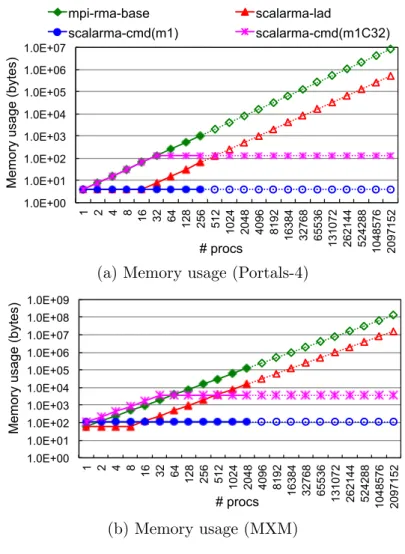
3.10 Memory usage of different window metadata schemes in MPI WIN CREATE. . 49
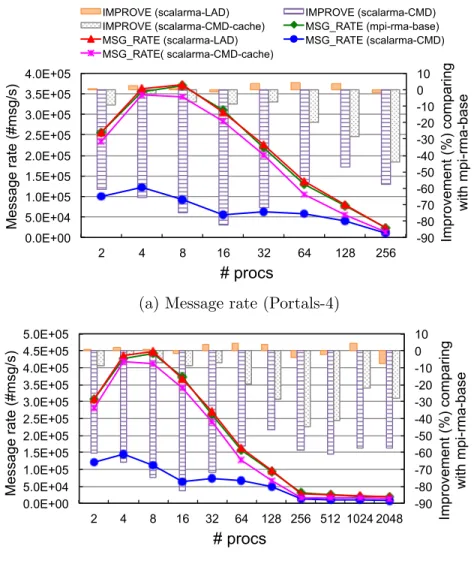
3.11 Message rate of different window metadata schemes in MPI WIN CREATE . . 50
3.12 Comparison between two FENCE algorithms in ScalaRMA (MXM) . . . 51
3.13 Performance of piggybacking and speculative issuing strategies (MXM) . . . 53
3.14 Impact of speculatively issued operations . . . 54
3.15 Message rate with increasing message size, number of operations and num-ber of processes (MXM) . . . 55
3.16 Experimental results of Graph 500 . . . 57
4.1 AdaptiveFENCE. . . 65
4.2 Single-op results on SMP and breadboard . . . 67
4.3 Many-ops results on SMP . . . 68
4.4 Many-ops results on breadboard . . . 69
4.5 Graph 500 results on breadboard . . . 71
4.6 Halo exchange results on breadboard . . . 71
5.1 Per process memory consumption . . . 78
5.2 Netpipe ping-pong performance results . . . 79
5.3 Per process memory consumption in Sequoia AMG benchmark . . . 80
6.1 Prototype of AM buffer attach / detach routines . . . 92
6.2 Prototype of AM handler . . . 94
6.3 Prototype of AM creation and registration routines . . . 95
6.5 Code example of AM . . . 100
6.6 MPI-AM workflow . . . 101
6.7 Communication latency and operation throughput with different numbers of segments per AM packet . . . 107
6.8 Throughput: impact of system buffer size . . . 109
6.9 Execution time: impact of system buffer size . . . 110
6.10 Throughput: impact of ordering . . . 111
6.11 Throughput: Impact of concurrency . . . 112
6.12 Graph 500 comparative performance results . . . 113
7.1 Handshake operation for reserving user buffers . . . 119
7.2 Example of attaching / detaching of AM buffers . . . 122
7.3 Prototype of vector-based AM user-defined function . . . 124
7.4 Prototype of vector-based AM trigger routine . . . 126
7.5 Different strategies of origin output data layout . . . 127
7.6 Communication latency . . . 130
7.7 Operation throughput for remote search . . . 131
7.8 Scalability performance for remote search . . . 132
7.9 Contention performance for remote search . . . 133
7.10 Operation throughput of MPIX AMand MPIX AMV . . . 134
8.1 Working scenario of asynchronous progress engine . . . 141
8.2 Latency of single AM operation . . . 143
8.3 Latency of multiple AM operations . . . 144
8.4 Overlapping effects of AM asynchronous progress engine . . . 145
8.5 Interoperability performance . . . 146
CHAPTER 1
Introduction
As we move from the current multi-petaflop machines to Exascale computing, the primary constraint that impacts all aspects of hardware, software and design of application is the power usage of the machine. Data movement is the main consumer of the power and the community believes that this trend will not change. Consequently, applications and system software are reacting by migrating from traditional regular computational models involving regular data structures such as dense matrix to more sparse computational models involving irregular computational and communication patterns.
Irregular computation and communication models have already gained significant impor-tance in recent years. Such models are widely used in applications from various domains such as bioinformatics (SWAP [1], Kiki [2]), computational chemistry (MADNESS [3] [4], NWChem [5]), and graph algorithms in social network analysis. Newer applications in other domains such as material science and nuclear reactor research are also looking to investigate more irregular computational models to improve their data movement efficiency ([6] [7]).
Irregular models differ from traditional computational models in many ways. For example, they are often organized around sparse structures such as sparse matrices or graphs rather than dense matrices. Similarly, their data movement is often irregular and data-driven rather than relying on a static predictable communication pattern. Furthermore, the growth rate of data movement cost with respect to system size or problem size is typically significantly
higher than that of the computation cost. Given the trend towards irregular computations, there is a large debate in the community with respect to whether traditional communica-tion models that have been designed for more tradicommunica-tional communicacommunica-tion patterns would be suitable to irregular computation.
Message Passing Interface (MPI) [8] is the industry standard communication library for high performance computing, with implementations available on virtually every parallel sys-tem in the world. Despite MPI’s great success in high performance computing, whether it can serve as a runtime system for irregular applications or not is one of the most debated aspects in the community, especially as we move to exascale systems.
Some researchers believe that MPI can sufficiently well support higher-level programming models and runtimes that support irregular computations. For instance, there are several tasking models and irregular applications in the literature: ADLB [9], Scioto [10], NWChem [5], MADNESS [3]. Other researchers, however, doubt MPI’s ability to succeed in such environments due to several reasons:
• Scalability: MPI has traditional been viewed as a communication library suitable (or “optimized”) for regular or structured communication patterns such as stencil compu-tations or distributed dense matrix compucompu-tations. However, as we move to irregular communication patterns, such as those used within graph-centric applications (e.g., in the bioinformatics domain), researchers wonder if MPI is still a suitable runtime system. A commonly mentioned example in the literature is the failure of MPI in scaling to large problem sizes with the Graph 500 benchmark [11]. Specifically, most MPI implementations run out of internal resources when scaling the Graph 500 bench-mark on large systems due to internal resource management issues within the MPI implementation.
• MPI communication semantics: The MPI standard provides mechanisms to move data using several communication patterns, including two-sided (MPI SEND, MPI RECV), collective (MPI BARRIER,MPI BCAST) and one-sided communication. Even
though there are different communication patterns being provided in MPI, there is still a concern that MPI solely focuses on the mechanisms for data movement and leaves the control of what data needs to be moved (e.g., whether it is better to fetch data and compute locally or send data and trigger computation remotely) to a higher-level runtime system or application. Some people’s opinion is that this is the responsibility of high-level runtime systems and should not be handled by MPI library, whereas other people believe that MPI could absorb a more data-driven communication style (such as active messages) into its communication semantics.
In summary, despite the debate in the community, we do not believe that the suitability of MPI for irregular applications is a black-or-white question. Rather, we believe that there exists a whole spectrum of grayscale, where MPI would lie. The goal of this thesis is not to prove or disprove either point of view, but to perform a detailed study as to where in this spectrum MPI lies. The idea of this thesis is to influence future MPI implementations and standards to understand the implications of irregular applications and propose what if anything needs to change to efficiently support such applications.
1.1
Plan of Study
The thesis focuses on two pieces. The first part focuses on improving the MPI implementation to better support irregular applications through improved scalability and performance. The second part focuses on potential extensions to the MPI standard to be more data-driven allowing for simultaneous migration of computation and data in an “active-messages” like model.
1.1.1
Improvements to MPI Implementations for Irregular
Appli-cations
Current MPI implementations suffer from several shortcomings and challenges in the context of irregular computations. One challenge is scalability. Irregular computation involves large number of outgoing asynchronous operations and MPI runtime needs to maintain the states for all of them. This can potentially cause the runtime to consume most of internal resources and leave no resources for the application. A scalable and sustainable resource management strategy that can maintain internal resources meanwhile not sacrificing the performance too much is necessary. Furthermore, since one process can communicate with many other peers concurrently in the application, the runtime has to maintain the states for all possible communication peers which potentially can cause O(P2) memory consumption. With the rapid growth of the size of HPC systems in the world [12], steps must be taken to avoid linear growth of memory consumption with respect to system scale.
1.1.2
Improvements to MPI Standard for Data-driven
Computa-tions
The second part of the thesis focuses on extending the MPI programming model to better support the irregular applications. Traditional programming approaches that were designed for environments where computation is regular and its cost is typically significantly larger than the data movement cost are not well suited for irregular computation. The Active Mes-sages (AM) model [13] is an alternative parallel programming paradigm that can potentially bridge this gap. It allows the sender to move a small piece of data to the receiver and to trigger computation upon arrival of the data, without the receiver explicitly receiving the data. Such a model can be more natural to use in some, though not necessarily all, scenarios in irregular computation. A generalized framework is needed which can combine both tradi-tional MPI and AM capabilities in the MPI runtime, so that an application can be modified
incrementally to use AMs only when necessary, avoiding being rewritten entirely. Given such a framework, interesting questions rise including: How to make AMs work correctly with MPI infrastructure? How to optimize the performance of the framework in different applica-tion scenarios? And since AM is working in an one-sided manner, what is the performance impact for an asynchronous progress engine to process the incoming AMs? In this work we propose a generalized MPI-interoperable AM (MPI-AM) framework to address these issues.
1.2
Outline of the Thesis
The rest of this thesis is organized as follows: Chapter 2 presents the related background this thesis relies on; Chapter 3, Chapter 4 and Chapter 5 describe the problems in MPI runtime with respect to scalability and performance, and corresponding solutions; Chapter 6, Chapter 7 and Chapter 8 present the work on combining MPI with Active Messages model and discusses critical issues raised including message streaming and buffering, correctness semantics, performance optimization and asynchronous processing. Chapter 9 presents the conclusion of this thesis.
CHAPTER 2
Background
Because the work described in this thesis is largely relying on MPI communication paradigms, with an emphasis on the semantics of MPI one-sided communication, in this section we provide related background on MPI communication paradigms so that the reader can better understand the semantics MPI standard provides.
MPI standard provides various communication paradigms for upper layer applications and runtimes to use, including two-sided communication (e.g. MPI SEND and MPI RECV), collective communication (e.g. MPI BARRIER, MPI BCASTand MPI REDUCE), and one-sided communication (e.g. MPI PUT and MPI GET).
In MPI two-sided communication, both sender and receiver are required to explicitly par-ticipate in the communication: the sender invokes anMPI SENDcall, and the receiver invokes a correspondingMPI RECV call. Only when MPI SEND is completed on the sender, the data is safely sent out from the sender’s buffer; similarly, only when the matching MPI RECV is completed on the receiver, the data is safely received in the receiver’s buffer. Collective com-munication coordinates date movement and synchronization among a group of processes in a communicator. Even though such communication can be implemented using two-sided calls, MPI provides convenient interfaces for user to directly perform such commonly used commu-nication patterns (e.g. MPI BARRIER,MPI BCAST, MPI REDUCE) and MPI implementations can implement those communication patterns using optimized collective algorithms.
Both two-sided and collective communication paradigm have been supported since MPI-1 standard. They combine data movement and synchronization together, and the programmer is clear about when communication is finished and when data in sender’s and receiver’s buffers can be safely accessed. Even though theoretically every MPI application can be implemented by using two-sided communication, in practice such an implementation brings significant overhead. The two-sided communication requires that the parameters in MPI SEND and MPI RECVto be matched with each other. Consequently, the programmer must plan for data layout and communication pattern on both the sender side and receiver side—a significant inconvenience in writing the application where data access patterns are not determined but dynamically change throughout the execution, resulting in complex code structure. On the other hand, the receiver must explicitly poll for potential incoming messages, and the runtime system must guarantee the ordering of two-sided messages, which incurs significant overhead to the application.
In order to overcome these issues, MPI-2 standard added a new communication paradigm, called one-sided communication, also known as remote memory access, or RMA. One-sided communication is a message passing paradigm that allows one process, the “origin” process (i.e., the process who initializes one-sided operations), to specify all communication param-eters, for both the local side and the remote side; the “target” process (i.e., the process who is remotely accessed by origin process) does not need to explicitly make any call in order to processing incoming one-sided operations. Typical example of communication calls in-cludesMPI PUTand MPI GET. One-sided communication was extended in MPI-3 with richer functionality and better accommodation with the latest hardware.
Compared with two-sided communication, one-sided communication decouples data move-ment and synchronization. The runtime system is able to move the data without requiring the remote process to synchronize, and the delay on the receiver process does not effect the process on the sender, as illustrated in Figure 2.1. This capability is achieved by having every process expose a part of its memory to the other processes from the beginning. The
sender process can directly read from or write to this memory, and processes involved in the communication define the synchronization points before one-sided communication begins and after it ends.
Sender Receiver MPI_SEND MPI_RECV D E L A Y Delay happened on receiver causes sender delayed
(a) Two-sided communication
Origin Target MPI_PUT D E L A Y Delay happened on target does not affect origin MPI_GET (b) One-sided communication
Figure 2.1: Comparing one-sided and two-sided communication paradigms
In order to allow the origin process to directly access the data on the target side, the target process needs to first expose a memory region, called a “window”, before-hand, which is remotely accessible by all other processes. A window may be created in four ways: MPI WIN CREATE, MPI WIN ALLOCATE, MPI WIN ALLOCATE SHARED, and MPI WIN CREATE DYNAMIC.MPI WIN CREATErequires the user to pass an existing memory region to the function call and creates a window in that region;MPI WIN ALLOCATEallocates a memory region by itself and creates a window in it;MPI WIN ALLOCATE SHAREDis similar toMPI WIN ALLOCATE except that it is used by processes within the same node and creates a window in a shared-memory region among those processes; MPI WIN CREATE DYNAMIC creates an empty window and allows the user to dynamically attach memory buffers to the window afterwards.
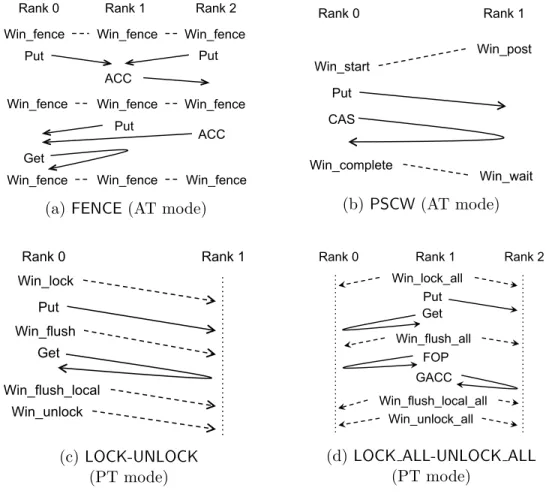
After a remote accessible window has been defined, the origin process needs to initialize a one-sided communication “epoch” in which the one-sided communication occurs. The epoch defines when one-sided operations can be issued and when modifications by one-sided opera-tions are completed on the origin and target processes. Two synchronization modes—“Active Target (AT)” mode and “Passive Target (PT)” mode—are defined in the MPI standard and must be called at the beginning and end of a one-sided communication epoch. Figure 2.2
Win_fence Win_fence Win_fence
Win_fence Win_fence Win_fence
Win_fence Win_fence Win_fence Rank 0 Rank 1 Rank 2
Put ACC Put Put ACC Get
(a)FENCE (AT mode)
Win_start Win_post Win_complete Win_wait Rank 0 Put Rank 1 CAS (b) PSCW (AT mode) Win_lock Win_unlock Rank 0 Put Rank 1 Get Win_flush Win_flush_local (c) LOCK-UNLOCK (PT mode) Win_lock_all Win_unlock_all
Rank 0 Rank 1 Rank 2
Put Get Win_flush_all FOP GACC Win_flush_local_all
(d)LOCK ALL-UNLOCK ALL
(PT mode)
Figure 2.2: Synchronization modes in MPI RMA interface
illustrates how those synchronization modes work. The Active Target mode requires that both the origin and the target processes invoke the synchronization calls. MPI offers two types of Active Target synchronization: FENCEandPOST-START-COMPLETE-WAIT(PSCW). The Passive Target mode only requires the origin process to make the synchronization call, which also contains two types: LOCK-UNLOCK, andLOCK ALL-UNLOCK ALL. Note that there are two types of locks defined in the PT mode: (a)MPI LOCK SHARED: multiple process can acquire a lock on the same target concurrently; (b) MPI LOCK EXCLUSIVE: only one process can acquire a lock on the target process.
MPI defines six types of data movement operations: MPI PUT, MPI GET, MPI ACCUMULATE, MPI GET ACCUMULATE, MPI FETCH AND OP, and MPI COMPARE AND SWAP. MPI PUT transfers the data from the origin process to the target window. MPI GET transfers the data from the target window to the origin
pro-cess. MPI ACCUMULATE combines the data from the origin process with the data on the target window by triggering certain predefined computations on the target process. MPI GET ACCUMULATE is similar to MPI ACCUMULATE except that it returns the original value of the target data. MPI FETCH AND OP is a special case of MPI GET ACCUMULATE in which it accumulates only one basic element from the origin buffer to the target buffer. In this thesis we call MPI ACCUMULATE, MPI GET ACCUMULATE, and MPI FETCH AND OP as “MPI ACCUMULATE-like operations”, since all of them involves an computation to accu-mulate origin data and data on the target side. MPI COMPARE AND SWAP also moves one basic element from the origin buffer to the target buffer. However, it moves two elements: the origin element and the compare element. It first compares the compare element with the target element; if they are identical, it replaces the target element with origin element and returns the original target value. MPI GET ACCUMULATE, MPI FETCH AND OP and MPI COMPARE AND SWAP perform a “read-modify-write” style of one-sided operation between the origin and target processes.
CHAPTER 3
Tackling Scalability Challenges
in MPI One-Sided Infrastructure
Irregular applications often involve massive outstanding asynchronous messages, in which each process can potentially communicate with large amount of peers. Such characteristics make the scalability and performance of handling massive asynchronous communication in MPI runtime to be crucial for the performance of the irregular applications. In this chapter, we describe the challenges existing in the current MPI runtime, with respect to scalability and performance in two aspects: MPI one-sided communication and initialization of virtual connection objects. We propose corresponding solutions to make the MPI runtime be capable of addressing those challenges in order to efficiently support irregular applications on large scale systems.
MPI one-sided communication, also known as Remote Memory Access (RMA), is becoming increasingly popular in many applications particular those that rely on irregular communi-cation patterns. One-sided communicommuni-cation provides a different execution model, compared to traditional two-sided or group communication, which is better suited for some classes of applications. However, current implementations of MPI one-sided communication are noto-rious for their inability to scale to large systems or problem sizes. In this section, we first present a thorough study of various MPI one-sided communication implementations, includ-ing their strengths and shortcominclud-ings. Next, we present a new MPI one-sided communication
system, called ScalaRMA, that addresses the scalability problems of these implementations and provides a highly scalable MPI one-sided communication runtime. The driving goal of ScalaRMA is to achieve perfect scalability with respect to constant maximum resource usage, irrespective of problem or system size. We present our investigation and show that doing so with little to no performance degradation is possible in most, but not all, cases. In cases where this is possible, we present a detailed analysis of the workings of ScalaRMA, including a thorough performance evaluation and profiling information internal to the MPI implementation. In cases where this is not possible, we present aspects within the MPI-3 standard and / or the network hardware implementation that make this challenging.
3.1
Overview
The MPI Forum introduced one-sided or remote memory access (RMA) communication, as an alternative to the traditional two-sided and group communication operations, in MPI-2. In MPI-3 [8], the RMA capabilities of MPI went through a significant revamp leading to newer, cleaner, and more performance-capable RMA semantics. In the RMA model, one process (i.e., the origin) can directly and implicitly access the memory on another process (i.e., the target) without requiring any explicit communication calls from the target. Such a model provides a different execution paradigm than traditional two-sided or group commu-nication, making it an attractive alternative for some applications.
In the recent past, several applications, particularly those with irregular communication patterns, have started investigating MPI RMA as an alternative to their existing usage of MPI. Such a move is motivated primarily by the fact that MPI RMA does not require pro-cesses to be “cooperative”; that is, the origin does not need to explicitly match a call on the target. This approach improves the ease of writing applications especially when commu-nication is irregular and data-driven, because the programmer no longer needs to carefully plan the communication pattern. For example, in NWChem [5], a large quantum chemistry
application, massive asynchronous messages need to be communicated and a process typi-cally does not know whom to receive the message from. Thus, it uses RMA to implement a model where each process can dynamically fetch data to local memory, compute, and write the computed output to a target remote memory region.
Despite its growing prominence, current implementations of MPI RMA are notorious for their inability to scale to large systems or problem sizes. A commonly mentioned example in the literature is the failure of MPI to scale to large problem or system sizes with the Graph 500 benchmark [11]. Specifically, most MPI implementations run out of internal resources when scaling Graph 500 to large problem or system sizes. Irregular communication, such as that evidenced in Graph 500, involves a large number of outgoing asynchronous operations, and the MPI runtime needs to maintain the state of each one of them. This requirement can potentially cause the runtime system to consume large amounts of internal resources and leave no resources for the application. Clearly needed are scalable and sustainable resource management strategies that can manage internal resources. Similarly, since each process can communicate with many other peers in the application, the runtime has to maintain state for all possible communication peers, a situation that potentially can cause O(P) memory consumption.
While significant research has been done on improving MPI RMA, such work is fragmented over a number of different MPI implementations. Such fragmentation makes it hard to create a baseline of comparison for additional improvements that we will propose in this section. Therefore, before we discuss any new research contributions of this section, we first present a thorough study of various MPI RMA implementations. In particular, we survey the strengths and shortcomings of these implementations and consolidate the best of these capabilities into a common “state-of-the-art” baseline MPI implementation. Next, we present a new highly scalable MPI RMA implementation, called ScalaRMA, that addresses the scalability problems of these implementations. Our experimental evaluation compares ScalaRMA with the consolidated baseline MPI implementation.
The primary objective of ScalaRMA is to achieve perfect scalability with respect to con-stant maximum resource usage, irrespective of problem or system size. Through the course of our investigation, however, we identified that doing so with little to no performance degra-dation is possible in most, but not all, cases. In cases where such perfect scalability is not possible, we present aspects within the MPI standard and / or the network hardware im-plementation that make achieving this goal challenging. We also propose potential future enhancements to network hardware to alleviate some of these issues.
3.2
Survey of RDMA Capabilities on Modern
Net-works
Remote direct memory access (RDMA) for network hardware is a common and significant feature occurred on most modern network architectures today. However, each network pro-vides these capabilities in a slightly different manner, making it important for upper layer runtime to understand those differences and design suitable algorithms for each network. In this section, we present a survey of RDMA capabilities on six different networks: Mellanox InfiniBand [14] [15], Portals-4 on Bull BXI [16] [17], the Tofu network architecture [18], the Cray Aries [19], the IBM Blue Gene/Q network (BG/Q) [20] and RDMA over Converged Ethernet (RoCE) [21]. For Mellanox InfiniBand, our survey is based on the ConnectX-4 hardware. Portals-4 is technically not a hardware specification but an API specification, and currently no hardware implements it. However, several network hardware implementa-tions of Portals-4 have been announced, such as the BXI interconnect from Bull. Our survey is based on the available open literature on BXI. The Tofu network architecture is based on Fujitsu’s K computer and the follow-on Fujitsu FX100 computer [22]: these are two separate generations of the Tofu network, for the purposes of this survey we consider them as the same. For Cray Aries, our survey is based on the Cray XC30 system used on NERSC Edison. BG/Q is the third generation in the IBM Blue Gene line of massively parallel
supercomput-ers and our survey on IBM network is based on it. RoCE is a network protocol that allows RDMA over an Ethernet network; our survey is based on the RoCE version 2 protocol. Of the various capabilities hardware capabilities provided by these networks, three out of them are of particular interest to us in this work of achieving scalability: window address calcu-lation, memory protection keys, and remote notification. In the following sections, we will introduce each of them.
3.2.1
Window Address Calculation
The calculation of window address in communication operations of MPI RMA are often based on a model of “scaled offset”. This means that the user on the origin side provides an offset within the window buffer on the target side and a “scaling factor” (or called displacement unit) that determines where the data needs to be written to or read from. Note that the offset is in scaling factors. Such a model, however, does not directly map to what current network hardwares provide. Some networks, such as Mellanox InfiniBand, accept only an absolute address to which data can be written to or read from: we classify them as “HW-addr”-based networks. In such cases, the MPI implementation needs to maintain the associated start or base address and scaling factor for each target process and translate the user-provided information to what the network hardware expects (absolute address). In order to do this translation, the MPI implementation needs to maintain O(P) base addresses and scaling unit sizes.
Other networks, however, provide a richer model where the MPI implementation can di-rectly provide the offset (in bytes) to the network hardware during an RDMA operation: we classify them as “HW-offset”-based networks. For such networks, MPI implementations no longer have to maintain an O(P) data structure for the base addresses but do need to maintain an O(P) data structure for the scaling factors. Fortunately, in practice, most ap-plications provide the same scaling factor on all processes, thus requiring onlyO(1) memory. Portals-4 is an example of such networks.
We can envision a network architecture that could allow the MPI implementation to di-rectly provide the offset in units of the scaling factor, even though such hardware does not exist today. We classify such future network architecture as “HW-scalad-offset”-based net-works. Given such network hardware, the MPI implementation no longer needs to maintain any O(P) data structure for window address calculation at all. Such architecture is listed here because of completeness, but we do not propose any new techniques based on it in this work.
3.2.2
Memory Protection Keys
Occurrence of RDMA in network architecture allows multiple processes to directly access the memory region on the target side. While it is a very convenient feature for the upper layer runtime and application to use, it also brings a security concern. Considering secure HPC environments where multiple users may share the same supercomputer or the non-HPC environments where multiple users may share the same node, in those cases, protection between users is required. In order to guarantee the security among different users, some networks provide a scheme where the target side generates a protection key for its own memory, and only processes that have access to the corresponding protection key can access the memory region of that target.
Mellanox Infiniband is an typical example of such kind of networks, where a memory protection key, called an “remote key (rkey)”, is required for the origin side in order to access a location on memory region with RDMA on target side. Furthermore, this key is asymmetric. This means that each process may generate a different key, therefore the origin side has to store a key for each potential target, which results in potential O(P) memory usage. Other networks, like Tofu, requires no keys to access the memory region on target. Even though it is scalable, such network requires separate security protection scheme against unauthorized accesses.
3.2.3
Remote Notification
As we introduced before, RDMA operations are performed by the network hardware on target memory region without any involvement of the processor on target side. While this model is true for all networks, their notification mechanism is different with each other. Some networks, such as Mellanox InfiniBand, Cray Aries and IBM BG/Q, provide origin-side notification for both reading operations (GET) and writing operations (PUT), but target-side notification only for writing operations (PUT). Other networks, such as Portals-4 and Tofu, provide both origin-side notification and target-side notification for all kinds of RDMA operations.
This subtle difference in remote notification has a significant impact on how one MPI im-plementation would design synchronization algorithms for MPI RMA runtime. Specifically, if the network hardware provides target-side notification, the MPI implementation can de-sign an algorithm where the target side can count the number of operations that are issued on it, therefore the origin side can avoid wait for remote completion for issued operations. More details of such designs are described in Section 3.4.
3.2.4
Summary of Network RDMA Capabilities
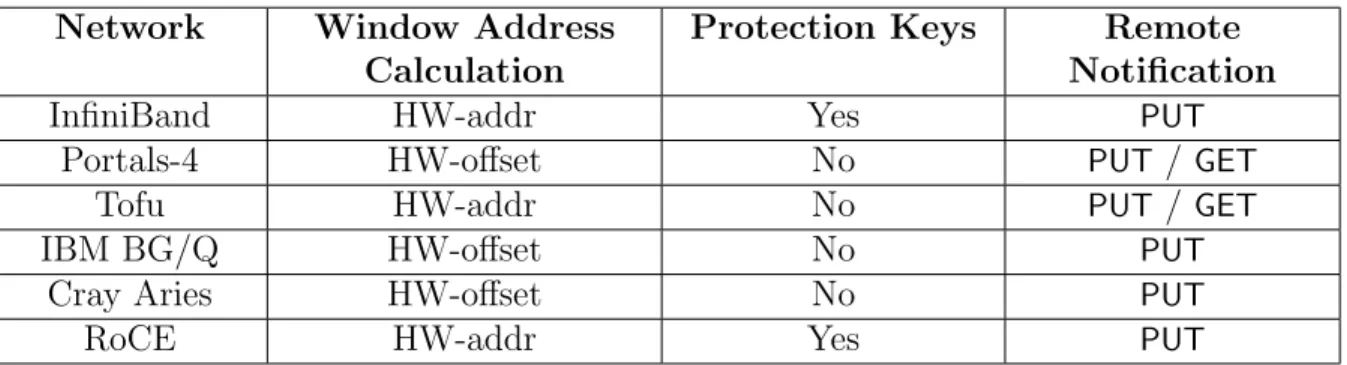
Table 3.1 summarizes the different hardware capabilities provided by each of the networks surveyed, from perspectives of window address calculation, memory protection keys and remote notification.
Table 3.1: Different capabilities provided by modern network hardwares Network Window Address
Calculation
Protection Keys Remote Notification
InfiniBand HW-addr Yes PUT
Portals-4 HW-offset No PUT/ GET
Tofu HW-addr No PUT/ GET
IBM BG/Q HW-offset No PUT
Cray Aries HW-offset No PUT
3.3
State-of-the-Art of MPI Implementations and
Scalability Challenges
Most MPI implementations have several areas, in aspects of window creation, synchroniza-tion and communicasynchroniza-tion, that use nonscalable data structures, and there is no upper bound for the internal resources consumed by those data structures. This makes MPI runtime tend to use up all internal resources when problem size or system scale is large, not say leaving any resources for the application. In those cases, the application even cannot finish running. MPI runtime needs to be carefully investigated and re-designed in order to guarantee the sustainable and scalable execution of the application, meanwhile avoids sacrificing the perfor-mance too much. Here we describe the scalability challenges we observed when investigating existing MPI implementations.
Existing MPI implementations have several scalability limitations in their RMA infras-tructure. Some of these limitations are common in all implementations while some of them are not the common issue but exist in one or two MPI implementations. In this section, we first introduce different implementation choices for MPI RMA operations, and then we in-vestigate three existing open-source MPI implementations: MPICH (3.1.4) [23], Open MPI (1.10.2) [24], and MVAPICH (2.2b) [25]. The goal of this section is to identify the best choices of the different capabilities needed within MPI RMA and to consolidate them into a common “state-of-the-art” baseline of MPI implementation. The baseline will be referred to as “MPI-RMA-base” in the rest of this thesis.
3.3.1
Implementation Choices for MPI RMA Operations
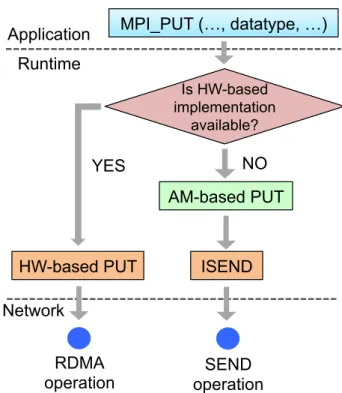
Two implementation choices exist for MPI RMA operations in existing MPI RMA imple-mentations: hardware-based (HW-based) operation, which is implemented by directly us-ing hardware RDMA functionality, and active-message-based (AM-based) operation [13], in
which a software handler is invoked on the target process to execute the incoming operation.
• HW-based operation: it typically can achieve higher performance than do AM-based implementation but are restrictive. Most networks implement simple RDMA commu-nication (such as writing or reading contiguous data) in hardware. But more complex communication such as that involving accumulating noncontiguous data segments is often not implemented in hardware.
• AM-based operation: it works as follows. An origin process issues a one-sided operation using a nonblockingSEND operation; a set of message handlers is predefined on the target process; and there is a receiving progress on the target process to process incoming messages (progress is triggered whenever the target process makes an MPI call). When an one-sided operation arrives, a corresponding message handler will be triggered in the receiving progress to process that operation.
Since HW-based operations is restrictive, most MPI implementations use a combination of HW-based and AM-based implementations where an operation uses hardware RDMA when available and otherwise falls back to AMs. We note that RMA between processes on the same node is often implemented by using direct memory accesses to a shared-memory region. We treat such operations as HW-based operations.
3.3.2
Window Creation
In MPI RMA interface, each RMA window is created with its own base address, window size, scaling factor size, and window handle. In MPI one-sided communication, the origin process needs to quickly access such information about remote processes in order to issue data movement operations. Most MPI implementations locally stores those information for all ranks on the window which requires O(P) memory consumption per window on each process.
Window creation is the “setup phase” where memory region on target processes are made available for remote accesses. Like introduced in Chapter 2, MPI provides four ways of creating a window: MPI WIN CREATE, MPI WIN ALLOCATE, MPI WIN CREATE DYNAMIC and MPI WIN ALLOCATE SHARED. In each of these window creation models except for MPI WIN CREATE DYNAMIC, the user needs to specify a scaling factor (i.e., displacement unit) and window base address (or window creation call generates a base address by itself), which is used to calculate the location of the data an RMA operation would access. Window creation calls are collective. During this phase, the MPI implementation needs to exchange necessary metadata information between different processes, allowing them to access mem-ory region among each other. This metadata includes user-specified information such as the start address of the target buffer on the window and size of scaling factor, as well as network-hardware-specific metadata such as memory protection keys, as introduced in Section 3.2.2. The amount of memory required for storing such metadata information is the focus of this section.
As mentioned in Section 3.3.1, RMA operations are typically implemented as a combina-tion of HW-based and AM-based operacombina-tions. These different kinds of operacombina-tions have unique characteristics as to what metadata they require. Specifically, AM-based operations require neither the user-specified nor the hardware-specific metadata for the target at the origin process. The origin process can simply send the origin-side data in the active message, while the active message handler that executes on the target process can look up the target-specific information on the target side. Open MPI, for example, implements AM-based operations in this way, thus using O(1) memory for the associated metadata. MPICH and MVAPICH, on the other hand, store the window base address for each target process even for AM-based communication, thus using O(P) memory for the associated metadata. We consider the Open MPI implementation as the state-of-the-art in this context, and adopt that model for the consolidated MPI-RMA-base implementation.
metadata to be kept track of. Specifically, if the network hardware requires “HW-addr”-based communication (like Mellanox InfiniBand), the MPI implementation needs to keep track of the window base addresses of each of the target processes, thus requiring O(P) storage for the corresponding metadata. Similarly, if the network hardware requires an asymmetric memory protection key for each target process (like Mellanox InfiniBand), that needs to be kept track of at the origin as well, again requiring O(P) storage for the metadata. All three MPI implementations that we surveyed (Open MPI, MPICH, and MVAPICH) use O(P) memory in this case, which we adopt for the consolidated MPI-RMA-base implementation. Such metadata, however, is not required on network hardware that requires “HW-offset”-based communication (e.g., Portals-4). For such networks, the Open MPI implementation uses an O(1) storage for the metadata. However, the MPICH implementation stores the window base address for each target process, thus effectively ignoring the “HW-offset” ca-pability of the network and using an O(P) storage for the metadata. We consider the Open MPI implementation as the state of the art in this context, and we adopt that model for the consolidated MPI-RMA-base implementation.
With respect to the user-provided metadata, if the user specifies different size of scaling factor for each process, such information also needs to be kept track of at the origin process as well, thus requiring O(P) storage for the metadata. All three MPI implementations that we surveyed (Open MPI, MPICH, and MVAPICH) useO(P) memory in this case, which we adopt for the consolidated MPI-RMA-base implementation.
These memory requirements are summarized in Table 3.2. AM-based operations should only requireO(1) memory since they do not need the origin to keep track of the user-specified or hardware-specific metadata. On the other hand, for HW-based operations, the amount of metadata required depends heavily on the capabilities of the network. Networks that require asymmetric memory protection keys require O(P) memory. Networks that require “HW-addr” based communication only require O(1) memory when the base address of the target window can be looked up efficiently (e.g., if the allocation is symmetric where all
Table 3.2: Baseline memory usage for window metadata Window creation calls
AM-based operation HW-based operation Asymmetric keys Symmetric or no keys HW-offset HW-addr HW- scaled-offset MPI WIN CREATE DYNAMIC
O(1) O(P)
O(1)
O(1)
MPI WIN ALLOCATE SHARED O(P*)
MPI WIN CREATE + same scaling unit size
O(1) O(P) MPI WIN CREATE +
different scaling unit size
O(P) MPI WIN ALLOCATE +
same scaling unit size
O(1) MPI WIN ALLOCATE +
different scaling unit size
O(P)
* P is smaller than or equal to the number of processes within one node. We consider
it as constant memory usage.
targets have the same base address); otherwise, their memory usage would go up to O(P). As discussed in Section 3.2, the MPI implementation and network interface need to trans-late the offset in scaling units in one-sided operations to an absolute address on the target window. This step requires either the MPI runtime or the network interface to use O(P) memory in order to maintain the necessary window metadata: namely, the base addresses and sizes of scaling units. In some situations, however, such memory consumption can be completely avoided in the MPI runtime. First, for hardware that is HW-scaled-offset (as discussed in Section 3.2), the runtime system does not need to maintain any window meta-data because no translation is required. Second, if all operations are AM-based operations, the runtime system does not need to maintain any metadata because the origin process can send the offset in scaling units to the target and the target can calculate the absolute ad-dress by itself. Third, both MPI WIN CREATE DYNAMIC and MPI WIN ALLOCATE SHARED use constant memory for window metadata.
When these conditions are not satisfied, the runtime system needs to maintain window metadata for all other processes. Nevertheless, in some specific situations, the runtime
sys-tem still can save O(P) memory usage. Specifically, it does not need to always maintain base addresses. In the case of MPI WIN CREATE, either the runtime system or the hardware network needs to maintain base addresses in order to calculate absolute addresses. For the HW-offset network, which can maintain them by itself and accept offset in bytes as input argument, the runtime system does not need to maintain base addresses at all. When a window is created by MPI WIN ALLOCATE, memory usage of base addresses can be com-pletely avoided by using a “symmetric allocation” strategy, which can generate the same base addresses on all processes.
3.3.3
RMA Synchronization
In this section, we describe the synchronization algorithms used in existing MPI implemen-tations and scalability challenges in different algorithms.
Active Target Algorithms. We first discuss algorithms used in Active Target mode. The MPI-3 standard states that the return of the epoch-ending routine MPI WIN FENCE on the origin process guarantees that all operations issued are locally completed, whereas its return on the target process guarantees that all operations targeting that process are completed. Two algorithms are used in MPICH, Open MPI, and MVAPICH: the BARRIER-based algorithm and theREDUCE SCATTER-based (RS-based) algorithm.
In theBARRIER-based algorithm (Figure 3.1a), startingMPI WIN FENCE performs a BAR-RIERamong all processes on the window; all posted operations are issued immediately (“eager issuing”); theMPI WIN FENCEwaits for remote completion for all issued operations and per-forms anotherBARRIERat the end. This algorithm is scalable. However, it imposes a stricter synchronization than what the MPI standard requires: it forces a starting call to be blocking, which is not required by the MPI-3 standard, and origin processes have to wait for remote completion, a requirement that is stricter than the local completion required in the MPI-3 standard. Existing MPI implementations use this algorithm for HW-based operations.
Each process Barrier Wait for remote completion Barrier OP (issued) OP (issued) Starting Win_fence Ending Win_fence
(a) BARRIER-based algorithm
Each process
Wait for my AT counter to be 0 Issue all OPs and decr
targets’ AT counter
Reduce_scatter
Wait for local completion OP (queued) OP (queued) Ending Win_fence Starting Win_fence (b)RS-based algorithm
Figure 3.1: FENCE algorithms used in existing MPI implementations
In the RS-based algorithm (Figure 3.1b), starting MPI WIN FENCE does nothing and re-turns immediately; all posted operations are queued in the runtime system (“lazy issuing”); MPI WIN FENCEfirst performs a REDUCE SCATTER to get the number of processes that will issue operations to it and initializes a local Active Target (AT) counter with that value. Next it issues all pending operations, in which the last operation to each target decrements the target’s AT counter; then it waits for local completion of all issued operations and the local AT counter to be 0, which means all operations targeting it have been completed. This algorithm implements exact semantics as required by the MPI-3 standard and does not have extra synchronization overhead. However, it has two disadvantages. First, a RE-DUCE SCATTER call requires a O(P) data structure to be used. Second, since there is no synchronization at the beginning and all operations are queued until the end, the runtime system has to maintain an unlimited amount of operation metadata (issuing parameters). Existing MPI implementations use this algorithm for AM-based operations. If the imple-mentation can utilize the remote side notification feature from hardware, this algorithm also can be used with HW-based operations.
0.0E+00 1.0E+06 2.0E+06 3.0E+06 4.0E+06 5.0E+06 6.0E+06 2 4 8 16 32 64 128 256 512 1024 2048 T EPS #procs mpich-3.1.4
(a) Strong scaling (problem size: 222) 0.0E+00 1.0E+05 2.0E+05 3.0E+05 4.0E+05 5.0E+05 6.0E+05 7.0E+05 2 4 8 16 32 64 128 256 512 1024 2048 T EPS #procs mpich-3.1.4 (b) Weak scaling (problem size: 219 to 229)
Figure 3.2: Graph 500 benchmark results with RS-based algorithm
Figure 3.2 shows examples of running the Graph 500 benchmark with the RS-based algorithm. The benchmark is broken when the runtime system tries to maintain too much operation metadata.
Passive Target Synchronization. In this section, we discuss the algorithms used in Passive Target mode, including maintaining lock state correctly in LOCK-UNLOCK and LOCK ALL-UNLOCK ALL and managing concurrent passive lock.
In Passive Target (PT) mode, the MPI runtime system needs to maintain a “target object” for each target to store two kinds of state: a flag indicating whetherMPI MODE NOCHECKis set and an error-checking flag to prevent issuing two concurrent locks to the same target. On the other hand, if MPI WIN LOCK or MPI WIN LOCK ALL is implemented as a nonblocking call, a target object is also needed to store state indicating whether a lock is granted. Such target objects require O(P) memory in the worst case.
Several processes may try to acquire a lock on the same target simultaneously, which has already been granted exclusively to someone else. In such a case, those processes have to wait for the lock to be released and then compete for that lock. Open MPI uses a “network polling” strategy for HW-based implementations. In MPI WIN LOCK the origin process acquires a lock by repeatedly checking a memory location on the target process by issuing RDMA
operations (COMPARE AND SWAP) until the lock is granted; inMPI WIN UNLOCKthe origin releases the lock by writing to that memory location using an RDMA PUT. This strategy generates considerable network traffic in the blocking call MPI WIN LOCK, and it cannot guarantee fairness among all competitors. On the other hand, MPICH and MVAPICH use a “queued locks” strategy. Each process issues a lock query message to a target process in MPI WIN LOCK; on that target process, a lock will be granted to the query that arrives first, whereas all other unsatisfied lock queries are queued up; when the current lock is released, the target process grants the lock to the next query in the queue. This strategy involves no extra traffic because each competitor issues only one message to the target, and it guarantees fairness among all competitors. However, there is no upper bound on how many lock queries will be queued on the target; in the worst case, it can be O(P).
Two optimization are available with the queued locks strategy, as shown in Figure 3.3. One is “piggybacking locks (PB)”: the origin merges the lock query with the first operation and issues it. Another is “speculative issuing (SI)”: the origin speculatively issues the first operation without receiving acknowledgment of a granted lock; if the lock is not granted but is queued on the target, that operation is queued on the target also until the corresponding lock is granted. Queuing of speculative operations also leads to unlimited resource usage.
lock ACK lock query origin target op1 lock op1 op2 op3 op2 op3 … … (a) No optimization lock query + op1 origin target op1 lock op2 op3 op2 op3 … … lock ACK (b) PB optimization lock query lock ACK origin target op1 lock op2 op3 op2 op3 … … op1 (c) SI optimization
3.3.4
Data Movement Operations
In this section, we first defines five states of RMA operation, then we describe the strategies used to issue HW-based operations and AM-based operations in existing MPI implementa-tions and scalability challenges.
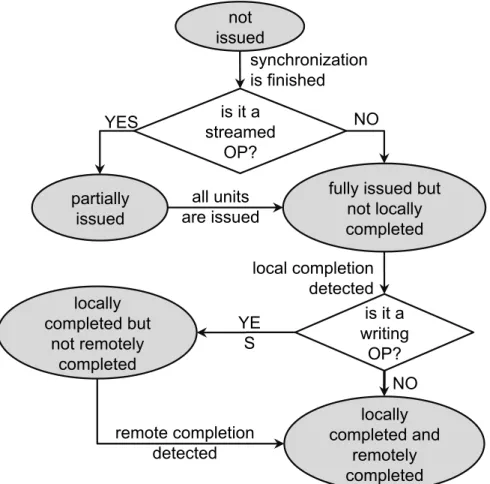
Operation States. After an RMA operation is posted on the origin, it can be in five states. The initial state is “not issued”, in which synchronization has not been finished, operation cannot be issued, and the runtime system must maintain issuing parameters for that operation, including buffer address, count, datatype, and computation type (MPI ACCUMULATE-like operations). When synchronization is finished, the runtime system can start to issue that operation. For a large MPI ACCUMULATE-like operation, MPI implementations may stream it into multiple smaller units and issue them out one by one; in such cases, the operation state is switched to “partially issued”. For units that have not been issued out, the runtime system needs to maintain issuing parameters; for units that have been issued out, it needs to maintain the metadata required for detecting local and remote completion. When the entire operation is issued out, the operation state is switched to “fully issued”. In such cases, the runtime system no longer needs to maintain any issuing parameters, but it needs to maintain the metadata for local and remote completion. When local completion is detected—for example, data is completely issued out from the origin buffer in MPI PUT—the operation state is switched to “locally completed”. When remote completion is detected—for example, the origin process receives a notification from the target that all data in MPI PUThas arrived on the target—the operation state is switched to “remotely completed”, and the runtime system no longer needs to maintain any metadata for that operation. The state transition is shown in Figure 3.4.
As shown in Table 3.3, it is clear that runtime always needs to maintain metadata for every operation except for the final state. Whenever the operation state is changed, some
not issued is it a streamed OP? partially issued
fully issued but not locally completed is it a writing OP? locally completed but not remotely completed locally completed and remotely completed synchronization is finished YES NO all units are issued local completion detected YE S NO remote completion detected
Figure 3.4: Operation states transition
metadata is no longer needed and can be dropped, but some still needs to be maintained by the runtime. Because there is no upper bound on how many operations will be posted in an application, the memory consumption of metadata can be very large and is likely to use up all internal resources of MPI runtime. A proper resource management strategy is required to keep the memory usage for operation metadata at a constant level.
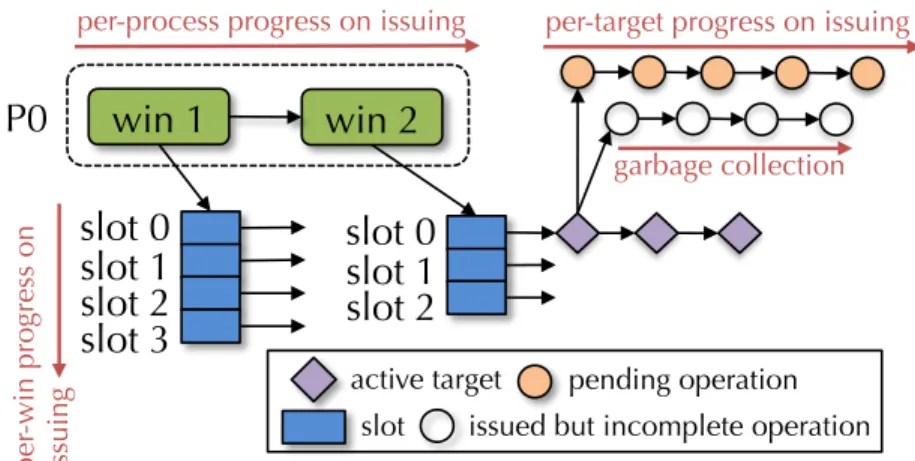
Operation Issuing Strategies. In the irregular computation, one process usually issues large number of asynchronous operations. If those operations are not issued out by the runtime, or are issued but not completed immediately, the MPI runtime needs to maintain the states for them.
de-Table 3.3: Metadata needed in each operation state Operation states Metadata Issuing parameters Metadata for local completion Metadata for remote completion Not issued ! % % Partially issued ! ! ! Fully issued % ! ! Locally completed % % ! Remotely completed % % %
laying issuing till the ending synchronization, in which case the runtime can save synchro-nization overhead by piggybacking synchrosynchro-nization message with RMA operations, and does optimization of coalescing operations. Another strategy, which is more naive with the RDMA operations, is to issue out the operation as soon as possible. Most current MPI implemen-tations choose the first way to issue the RMA operations, which potentially causes large number of operations to be maintained in the runtime simultaneously.
Another issues is that, currently most MPI implementations implement RMA operations using software method, which essentially use SEND / RECV underlying to implement func-tionality of RMA. This enforces the MPI runtime to take charge of all outgoing operations and maintain the states of them until they are completed. Similar with the problem of issuing strategy, since there are no upper bound for how many operations are going to be issued in the application, the internal resources are very easy to be used up. When MPI is running on top of the hardware which provides the one-sided capability, MPI runtime should offload the handling of RMA operations to the hardware as much as possible and let the hardware to detect the completion state, releasing itself from the responsibility of maintaining all operations internally.
eager issuing and delayed issuing. These two strategies are used in other synchroniza-tions [26] also. The eager issuing strategy issues every operation as soon as possible and does not need the runtime to maintain issuing parameters for each operation; however, it requires both starting and ending synchronization calls to be blocking. Lazy issuing stores issuing parameters for each operation in an “operation object” and queues up all operation objects in the runtime system until an ending call. By doing so, synchronization in the starting call can be avoided; but it can cause serious problem in memory usage because the number of queued operation objects can potentially use up all internal resources when the problem size is large. Existing MPI implementations use eager issuing for HW-based operations and delayed issuing for AM-based operations.
Metadata for Local and Remote Completion. As discussed above, after an RMA operation is completely issued out, the runtime system or hardware needs to maintain metadata in order to detect the local and remote completion for that operation. For HW-based operations, such metadata is maintained by hardware, and the runtime system does not need to care about it. For AM-based operations, the MPI runtime needs to use a “request object” to keep track of issued but incomplete operations. MPICH, Open MPI, and MVAPICH have no resource management strategy in the runtime system to manage request objects, which can easily use up internal resources; for example, the origin process may issue numerous AM-based operations, but the target process may be busy with local computation and cannot make progress to complete those operations. On the other hand, currently all metadata for outgoing AM-based operations are managed by the runtime system, an inefficient process because hardware can manage some of them. The runtime system should offload as many operations as it can to the hardware queue and maintain them only when operation metadata exceeds the hardware queue capacity.
Note that some synchronization calls do not require remote completion semantics, such as MPI WIN FENCE, MPI WIN COMPLETE and MPI WIN FLUSH LOCAL, in which metadata
for remote completion is not needed and the last state can be ignored.
Issuing MPI ACCUMULATE-Like Operations. In MPI ACCUMULATE-like op-erations, when origin data arrives on the target, the runtime system allocates a temporary buffer, places data in that buffer, and then performs computation between the temporary buffer and target buffer. Existing MPI implementations have two scalability problems. One is about derived datatypes. Existing MPI implementations allocate a temporary buffer that has the same datatype and count as does origin data, an approach that wastes a lot of memory if the datatype is sparse. Another problem is that the lack of an upper bound on the size of the temporary buffer because origin data can be extremely large. Open MPI does not support operations with derived datatypes, whereas both MPICH and MVAPICH have both these problems for MPI ACCUMULATE-like operations.
3.3.5
Consolidating the State-of-the-Art
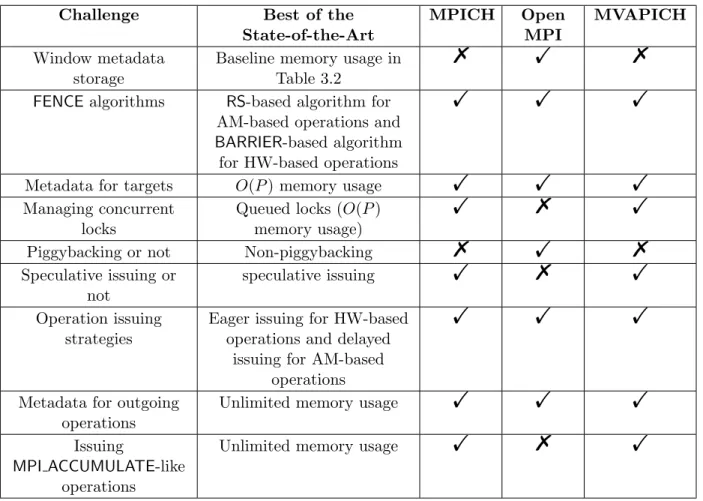
We consolidate the state-of-the-art of RMA infrastructures from MPICH, Open MPI and MVAPICH into one single baseline implementation: MPI-RMA-base. The final feature set of the consolidated MPI-RMA-base implementation is presented in Table 3.4.
3.4
Design and Implementation of Scalable MPI
One-Sided Infrastructure
In this section, we propose a new design of the MPI RMA runtime, called ScalaRMA, to address the scalability challenges discussed in Section 3.3. We describe the design of ScalaRMA from three aspects of MPI RMA: window creation, synchronization, and data movement operations.
Table 3.4: Consolidating the best of the state of the art into MPI-RMA-base
Challenge Best of the
State-of-the-Art MPICH Open MPI MVAPICH Window metadata storage
Baseline memory usage in Table 3.2
% ! %
FENCEalgorithms RS-based algorithm for AM-based operations and
BARRIER-based algorithm for HW-based operations
! ! !
Metadata for targets O(P) memory usage ! ! ! Managing concurrent
locks
Queued locks (O(P) memory usage)
! % !
Piggybacking or not Non-piggybacking % ! % Speculative issuing or
not
speculative issuing ! % ! Operation issuing
strategies
Eager issuing for HW-based operations and delayed
issuing for AM-based operations
! ! !
Metadata for outgoing operations
Unlimited memory usage ! ! ! Issuing
MPI ACCUMULATE-like operations
Unlimited memory usage ! % !
3.4.1
Window Creation
As discussed in Section 3.3.2, although we can eliminate O(P) memory usage of window metadata in many situations, in some situations the runtime system still has to consume
O(P) memory.
ForMPI WIN ALLOCATE, we apply “symmetric allocation” on each process so that every process generates the same window base address and does not need to maintain metadata for base addresses anymore. Previous work [27] uses the similar techniques but does not consider shared-memory allocation capability inMPI WIN ALLOCATE. In ScalaRMA, we support both symmetric allocation and shared-memory allocation: the root process first decides a base address and broadcasts it to every other processes. Each process then uses that base address to calculate the correct starting address of the shared-memory region and passes it to the
mmap() function.
For the rest of window creation routines, We propose solutions according to different patterns of window information. When the value of window information has certain patterns, for example, the base addresses on all ranks are the same due to symmetric allocation, or window information is set to the same value on all ranks or on odd / even ranks by user, we store the information in a compressed manner. When window information has no patterns, we propose two methods to store the information:
• Information sharing: multiple processes share the same window metadata copy. Each process fetches necessary metadata via local load on shared memory orMPI GET operation on network.
• Information caching: each process is attached with a local “cache” which contains the information that is actively used. When the process cannot find information in the current window’s cache, it will issue one-sided operations to server processes to fetch the information to the local cache.
In information sharing, depending on how metadata copies are shared among processes, two schemes can be used: (1) fixed number of metadata copies being shared and (2) fixed number of processes sharing the same copy. In the first scheme, the total number of copies is fixed, and therefore the overall memory consumption for the window metadata is constant. However, the communication cost of fetching the metadata is not flat: in the worst case, one process has to talk with P processes in order to fetch metadata. In the second scheme, the memory usage of the metadata copy is not fixed but increases linearly with the number of processes. On the other hand, since the number of processes sharing the same copy is fixed, the communication cost remains constant. Note that in the second scheme the perfor-mance can be optimized by configuring the metadata copy in a topology-aware manner, and each process needs to talk only with neighbors within a given physical location. Figure 3.5 compares the differences between these two schemes.