Pacific Sporting
Pacific Sporting Needs Assessment © Australian Sports Commission 2004 http://www.ausport.gov.au
© Australian Sports Commission 2004
This work is copyright. Apart from any uses as permitted under the Copyright Act 1968, no part of this publication may be reproduced by any process without written permission from the Australian Sports Commission. Requests and enquiries concerning
reproduction should be addressed to:
The Manager
Business Development Australian Sports Commission PO Box 176
BELCONNEN ACT 2616
Email: [email protected]
The views expressed in the country reports are those of the respondents and are not necessarily those of the Australian Government nor the ASP Sports Program. The ASC acknowledges the cooperation of the governments as well as Oceania National Olympic Committees, National Olympic Commitees, National Paralympic Committees and national sporting federations of the ASP partner countries that assisted in the
preparation of this study. The ASC also acknowledges Mr Robert Phillpot for his assistance with the literature review.
For general enquiries regarding the Australian Sports Commission:
Tel: (02) 6214 1111 Fax: (02) 6251 2680 Email: [email protected] Web site: www.ausport.gov.au
ISBN 1 74013 069 3
All images Australian Sports Commission unless stated otherwise
Designed by GRi.D Communications, Canberra
Produced by Australian Sports Commission Publications staff
Contents
1 Executive summary 1
2 Literature review 9
Introduction 10
Pacific human development indicators 11
The value of sport 17
Sport and international recognition 22
Sport and the economy 22
Summary and conclusion 23
3 Country/territory reports 25
American Samoa 27
Cook Islands 29
Fiji 33
Federated States of Micronesia 37
Guam 43
Kiribati 45
Marshall Islands (Republic of the) 49
Nauru 55
Niue 59
Palau 63
Papua New Guinea 67
Samoa 71
Solomon Islands 75
Tonga (Kingdom of) 79
Tuvalu 83
Appendixes 93
1 Summary of the social profile of countries 94
participating in the ASP Sports Program
2 Acronyms 95
Bibliography 96
Executive summary
1
Chapter 1
Executive summar
y
P
acific Spor
ting Needs Assessment
2
Chapter 1
Executive summary
Pacific Sporting Needs Assessment © Australian Sports Commission 2004 http://www.ausport.gov.au
Introduction
At the Pacific Islands Forum in August 2003, the Prime Minister of Australia, the Hon. John Howard MP, announced that the Australian Government would be undertaking the first-ever comprehensive assessment of sport development in the South Pacific region. This report is the outcome of that announcement. The Australian Government
commissioned the needs assessment as part of the Australia–South Pacific (ASP) Sports Program, which has been providing sport development assistance at both the elite and community levels in 14 Pacific island countries since 1994. A key goal of the assessment was to identify some of the areas of priority that the ASP Sports Program could address in the coming years so that it would remain effective in meeting the needs of recipient countries within the resources available.
The Australian Sports Commission conducted the needs assessment, comprising a literature review, questionnaires and in-country consultations in late 2003 and early 2004. The Australian Sports Commission was supported by the Department of Foreign Affairs and Trade, and AusAID as partners in the management of the ASP Sports Program.
The Asia Pacific School of Economics and Management at the Australian National University assisted with the literature review. The aim of the review was to compile and assess the available literature on the role that sport plays or may play in meeting the community development objectives of developing countries.
Questionnaires were also developed and distributed to key stakeholders in each
participating country. The completed questionnaires provided the basis for the in-country consultations carried out by staff members of the Australian Sports Commission. The consultations were an opportunity to discuss in detail the findings of the questionnaires. The process assisted in developing a more comprehensive understanding of the needs of the Pacific region sporting community.
Executive summar
y
P
acific Spor
ting Needs Assessment
3
Purpose
The needs assessment was designed to provide a record of the sporting needs of Pacific region countries and to enable those countries, in partnership with the ASP Sports Program, to respond more effectively. Results of this report will facilitate changes to the ASP Sports Program. Country-specific programs will be developed to more accurately address the needs of each country.
The needs assessment identifies and discusses the broad development issues facing Pacific region countries, while focusing specifically on those serviced by the ASP Sports Program. Although not direct recipients of the program, American Samoa and Guam were also included in this study as they are members of the Oceania National Olympic Committees. It is important to note, however, that this report does not imply that the ASP Sports Program will address all of these issues. National governments, National Olympic Committees and donors should find the needs assessment a useful tool for developing strategies to promote the growth of sport. The ASP Sports Program will continue to work with key stakeholders to address identified priorities outlined in this report.
Some of the key development issues facing the region can be categorised as follows:
■ governance ■ security ■ health ■ education
■ employment ■ population growth.
The research outlined in the literature review provides details of these development issues as they relate to each of the countries within the ASP Sports Program. The importance of the issues within each of these categories differs from country to country. Through the Human Development Index developed by the United Nations Development Programme the countries of the Pacific region were grouped into three broad categories of development based on their 1998 index ranking. These are:
1 Fiji and the smaller island states of Cook Islands, Palau, Niue, Samoa, Nauru, Tonga and Tuvalu rank the highest in terms of development
2 the Micronesian states of Kiribati, Marshall Islands and Federated States of Micronesia rank in the middle
3 the larger Melanesian countries of Vanuatu, Solomon Islands and Papua New Guinea rank at the low end of the index.
The needs assessment identifies
and discusses the broad
development issues facing Pacific
region countries, while focusing
specifically on those serviced by
the ASP Sports Program.
Executive summar
y
P
acific Spor
ting Needs Assessment
4
Major findings
The literature review found that sport plays an important role in underpinning broad development objectives because it is proven to be effective, non-threatening, efficient and good value. While it is clear that sport alone cannot solve the region’s development issues, it is an important component of a wide-ranging development program given its ability to transcend social, educational, ethnic, religious, historical, political and language barriers.
The review identified evidence supporting the significant and direct role sport may play in the areas of health and community development. The review found that sport may also contribute effectively to reducing antisocial behaviour, fostering community and national identity, and forging strong international recognition. Sport is increasingly recognised as a tool to foster national integration because of its broad relevance to education, health and politics. Evidence suggested that sport makes positive contributions in other areas of community development, including promoting the rights of women and achieving international recognition as well as economic benefits.
Recognising that sport can be a valuable vehicle to deliver overseas development assistance, the assessment then examined in detail the individual needs of the sporting community in each country within the ASP Sports Program. Each country’s sporting needs are as diverse as the countries themselves. This diversity is a reflection of factors such as a country’s level of development, economic climate, population, geography (dispersion and disparity) and health indicators.
However, some common themes emerged. These relate to broad sport development issues that many of the countries identified as priority areas. That said, it is important to recognise each country’s differences and ensure that subsequent programs reflect an understanding of this diversity and are tailored accordingly. For example, a school sport and physical education program developed for the Cook Islands might be different to a school sport program developed for Nauru. Due to economic constraints, it may be tempting to deliver a generic physical education program throughout all countries. However, the long-term success and sustainability of the program will be determined by the relevance to the country as well as a reciprocal commitment from that country.
Principal sport development issues
The principal sport development issues that emerged from the needs assessment are:
■ national sport policies
■ sport education programs, including coach education, sport administration and sport science/sport medicine
■ physical education and school sport programs
■ volunteer recruitment, development and retention
■ women-in-sport initiatives
■ sport for people with a disability
■ sport facilities.
Executive summar
y
P
acific Spor
ting Needs Assessment
5 National sport policies
In most countries within the region, there are two main governing bodies responsible for sport at the national level: the national government and the National Olympic Committee. The roles of these organisations differ within each country. In most cases, the National Olympic Committee has a larger budget than the Ministry of Sport.
The absence of national sport policies (including implementation plans) makes it difficult to define the roles of the National Olympic Committee and the national government in the delivery of sport programs. In some instances, this results in the duplication of programs, where both the government and the National Olympic Committee run similar programs leading to an inefficient allocation of scarce
resources. In other instances, it results in a void or absence of activity in a particular program area.
In this context, a national sport policy is different to a government policy document and different again to a development plan. A national sport policy establishes the development priorities of a country and defines the roles and responsibilities of the key stakeholders. It is a document owned by all stakeholders. It results in an efficient allocation of resources and sets measurable and achievable goals.
Sport education
Access to sport education has emerged as an important component of sport development in the Pacific region. The cost of establishing a sport education program is beyond the capacity of most countries within the region. Consequently, sport education, in particular coach education and accreditation, is limited to those who attend courses run by international federations, or to those coaches who participate in training programs overseas.
The establishment of a regional sport education program offers a cost-effective solution that would facilitate the consistent training of more coaches, administrators and sport science/sport medicine practitioners.
A national sport policy establishes
the development priorities of
a country and defines the roles
and responsibilities of the key
stakeholders.
Executive summar
y
P
acific Spor
ting Needs Assessment
6
Physical education and school sport
Physical education and school sport are growing as a priority in the Pacific region’s education system, particularly at the primary level (Years 1–6). While many countries have indicated a desire to introduce physical education into the school curriculum, there is a general lack of expertise in the area of curriculum development. As a result, while many countries have time allocated for physical education, classes occur sporadically.
The level of physical education in schools varies throughout the region. Accordingly, the assistance required in this area also varies. Assistance in physical education should be developed in close consultation with the education departments of the respective countries. In addition to the significant cost of developing physical education programs in the region, there is the cost of equipment required to deliver the curriculum. A curriculum that is heavily dependent on expensive equipment will fail. Innovative approaches to curriculum development are therefore required and cannot simply be an adaptation of the curriculum of more developed countries. The programs that are developed must be fully transportable and deliverable in urban as well as outer island schools and communities.
Volunteer recruitment, development and retention
The needs assessment showed that Pacific region countries suffer from an acute shortage of people to assist with the organisation and implementation of sporting activities. This problem is compounded as volunteer numbers are dropping in many countries. A volunteer recruitment, development and retention program is essential if sport in the Pacific region is to develop or even maintain current performance and activity levels. Such a program would:
■ seek to attract more people as sport volunteers (recruitment)
■ show them and sporting organisations the benefits and rewards of being a sport volunteer (retention)
■ have a significant training and development component to help provide
volunteers with the confidence, skills and expertise to conduct sporting activities and run sporting organisations.
Women in sport
Women in sport has emerged as a sport development priority throughout the region in recognition of the role that sport can play in promoting the rights of women.
Many countries have recently set up women-in-sport groups that are formally linked with their respective National Olympic Committee. While the assistance required by countries in this area is as varied as the countries themselves, the need for strategic advice and resource assistance are common themes.
Executive summar
y
P
acific Spor
ting Needs Assessment
7 Sport for people with a disability
Disability sport programs in the region are generally under-resourced. Despite recognition that disability sport programs have positive community development ramifications, there is a perception that these programs can only be run at a high cost. The reality is that an inclusive sport program services able-bodied athletes as well as people with a disability, and is a cost-effective solution to sport-for-all programs in the region.
Many countries now recognise the importance of disability sport programs but struggle to raise the requisite funding. Even when funding is available, there remains a lack of applicable resources and expertise in working with athletes with a disability. In countries where resource and training assistance has been provided, disability sport programs have been successful.
An increase in assistance to disability sport programs in all countries in the Pacific region is required. Successful disability sport programs have significant community development implications and are an integral component of an inclusive sport-for-all community program.
Sport facilities
The standard and breadth of sporting facilities in the region vary widely. Fiji now has world-class facilities developed for the 2003 South Pacific Games, whereas countries such as Nauru, Kiribati and Tuvalu lack basic facilities such as athletics tracks. Finding adequate land to develop sport facilities is also an issue in some countries.
Building such facilities requires substantial financial contributions from the national government as well as donor countries, particularly in the smaller states. Because of the cost, detailed planning is required to ensure facilities achieve maximum use.
Regardless of the standard or proliferation of sport facilities in the region, each
country faces other related issues. Many of the major sport facilities in the Pacific region have been donated by foreign governments through their overseas development
assistance programs. As a result, knowledge of facilities management remains rudimentary in most countries, with maximum use not being achieved.
Successful disability sport
programs are an integral
component of an inclusive
Literature review
2
Chapter 2
Literature re
vie
w
P
acific Spor
ting Needs Assessment
10
Chapter 2
Literature review
Pacific Sporting Needs Assessment © Australian Sports Commission 2004 http://www.ausport.gov.au
Introduction
This chapter analyses the key social factors influencing the development of Pacific island countries, by examining human development indicators as they relate to the Pacific region. It then assesses the value of sport in overseas development assistance programs that aim to assist in strengthening human development indicators. The chapter concludes by identifying issues that were considered in the in-country consultation phase of the assessment.
To begin, it is worth noting that the Pacific region is not homogeneous, but one that is culturally diverse. The region is often grouped as Polynesia, Melanesia (lying mostly below the equator) and Micronesia (lying above the equator). Melanesia is by far the largest cultural group, accounting for over 85 per cent of the total population, or more than 6 million of the region’s 7 million people (Secretariat of the Pacific Community 1998). It is generally recognised that the countries of Papua New Guinea, Solomon Islands, Vanuatu and Fiji constitute Melanesia. Polynesia covers an area encompassing Hawaii to the north, New Zealand to the southwest and Easter Island to the southeast. The area comprises Tonga, Samoa, American Samoa, Niue, Tuvalu, Cook Islands, and Wallis and Futuna. Micronesia (which comprises Palau, the Federated States of Micronesia, the Marshall Islands, Nauru, Guam, Kiribati and Northern Marianas) is a collection of mostly small atolls, all experiencing over-population and health difficulties, and the aggravation of social decay caused by the evaporation of old cultures (Islands BusinessJanuary 2003). However, there are still great differences in the size of these countries and their populations, resource endowments and environmental conditions. Other than their geographic proximity, small atoll states such as Tuvalu, with a population of about 10 200 and land area of 26 square kilometres, have little in common with larger countries in the region, such as Papua New Guinea, with a population of 5.7 million and vast endowments of arable land, forests and minerals (United Nations Development Programme 1999).
Appendix 1 to this report provides a summary of the social profile of the countries participating in the ASP Sports Program.
The Pacific Human Development Report,issued by the UN Development Programme in 1999, highlights the urgent requirement across the region to better meet the needs and aspirations of the next generation of Pacific island people and identifies in particular that ‘the previous generation mostly came to adulthood at a time of widening opportunities, brought about through newly expanded school systems, public sector growth and the localisation of jobs. The present generation faces less optimistic prospects as school systems fail to secure them employment, public sector job contracts, and private sector growth is slow and uncertain’ (United Nations Development Programme 1999).
Literature re
vie
w
P
acific Spor
ting Needs Assessment
11 There is evidence that sport may contribute to community development and assist
in alleviating some of the worst side-effects of the erosion of traditional cultures in the region. A report produced by the Australian Institute of Criminology, in conjunction with the Australian Sports Commission, entitled Sport, Physical Activity and Antisocial Behaviour in Youth, found that while it is unlikely that sport and physical activity programs have a major and direct impact on reducing antisocial behaviour, they form an important mechanism through which personal and social development may occur that positively affects behaviour (Cameron and MacDougall 2000).
The next section of this chapter identifies human development indicators that are relevant to the Pacific islands. The indicators demonstrate the need for sustained overseas development assistance in the region.
Pacific human development indicators
The Pacific Human Development Reportanalyses recent progress towards sustainable development made by 14 Pacific island states: Cook Islands, Fiji, Kiribati, Marshall Islands, Federated States of Micronesia, Nauru, Niue, Palau, Papua New Guinea, Samoa, Solomon Islands, Tonga, Tuvalu and Vanuatu.
The United Nations Development Programme’s basic objective of development is to create an environment for people to enjoy long, healthy and creative lives. Technical considerations of the means to achieve human development and the use of statistical aggregates to measure national income and its growth have at times obscured the fact that the primary objective of development is to benefit people. Human development is a process of increasing people’s choices. The most critical ones are to lead a long and healthy life, to be educated and to enjoy a decent standard of living. Additional choices, highly valued by many people, range from political, economic and social freedom to opportunities for being creative and productive, and enjoying personal self-respect and guaranteed human rights (United Nations Development Programme 1990).
The 1990 Human Development Reportintroduced the Human Development Index (HDI) that measures development by combining data on length of life, access to knowledge and income (United Nations Development Programme 1990). The importance of life expectancy at birth lies in the common belief that a long life is valuable in itself and in the fact that various indirect benefits (adequate nutrition and good health) are closely associated with longer life expectancy. Literacy figures are only a crude reflection of access to education, particularly to the good-quality education so necessary for productive life in modern society. The HDI therefore includes adult literacy combined with
There is evidence that sport
may contribute to community
development and assist
in alleviating some of the worst
side-effects of the erosion of
Literature re
vie
w
P
acific Spor
ting Needs Assessment
12
primary, secondary and tertiary enrolments. Income is still an important indicator and the index’s measure for this uses the logarithm of real GDP per capita for the income indicator. This measure is enhanced by using purchasing-power-adjusted real GDP per capita figures, which provide better approximations of the relative power to buy
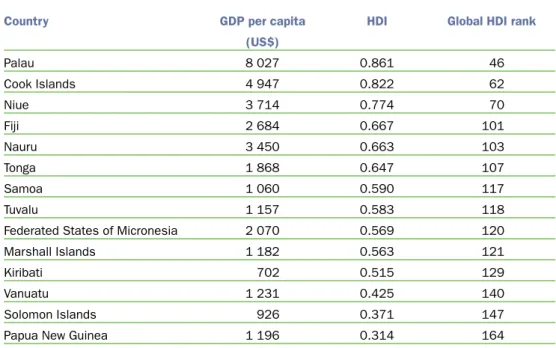
commodities and to gain command over resources for a decent living standard. Table 1 shows GDP per capita, and the HDI for each of the countries. Each country’s global ranking is also shown.
Table 1
Pacific Human Development Index, 1998
Country GDP per capita HDI Global HDI rank (US$) Palau 8 027 0.861 46 Cook Islands 4 947 0.822 62 Niue 3 714 0.774 70 Fiji 2 684 0.667 101 Nauru 3 450 0.663 103 Tonga 1 868 0.647 107 Samoa 1 060 0.590 117 Tuvalu 1 157 0.583 118
Federated States of Micronesia 2 070 0.569 120
Marshall Islands 1 182 0.563 121
Kiribati 702 0.515 129
Vanuatu 1 231 0.425 140
Solomon Islands 926 0.371 147
Papua New Guinea 1 196 0.314 164
Source: United Nations Development Programme 1999,Pacific Human Development Report 1999: Creating opportunities, Suva, p. 13.
Pacific Sporting Needs Assessment © Australian Sports Commission 2004 http://www.ausport.gov.au
Technical considerations of the
means to achieve human
development have at times
obscured the fact that the primary
objective of development is to
Literature re
vie
w
P
acific Spor
ting Needs Assessment
13 The index values shown in Table 1 range from internationally high to internationally low.
The highest-ranking country, Palau, has an HDI similar to Panama and Venezuela. Papua New Guinea has one similar to Djibouti and Chad, two of the poorest countries in Africa. The 1998 index values presented in the table therefore show a very large range of development conditions in the region. It also shows there are three groups of countries (United Nations Development Programme 1999):
1 Fiji and the smaller island states of Cook Islands, Palau, Niue, Nauru, Samoa, Tonga and Tuvalu rank highest
2 the Micronesian states of Kiribati, Marshall Islands and Federated States of Micronesia rank in the middle
3 the large Melanesian countries of Vanuatu, Solomon Islands and Papua New Guinea rank at the low end of the index.
Health indicators
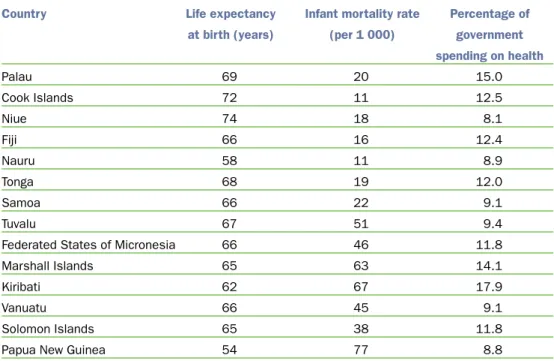
It is recognised that good health is an important element for sustainable human development. Infant mortality has declined significantly throughout most of the region. While life expectancy is generally good in the region, there is an apparent increase in mid-adult mortality, especially for males. The main reasons for this increase are associated with the upsurge in so-called ‘lifestyle’ diseases and accidental deaths, and the resurgence and emergence of infectious and vector-borne diseases (for example, malaria). In particular some non-communicable diseases, including diabetes, have reached epidemic levels in some countries. In Fiji, diabetes cases occupy 15 to 20 per cent of all hospital beds. Hypertension and other circulatory diseases are also increasing, caused primarily by diets high in fats and sugar. Besides its related illnesses, alcohol abuse is a cause of deaths from accidents and violence (United Nations
Development Programme 1999). The studies considered in this report suggest that sport programs have a positive impact on these health issues.
The trend of increasing non-communicable lifestyle diseases is a particular concern because the diseases affect people in their economically productive years. A major cost of this pattern of ill health and death is the loss of skills, experience and productivity for communities. These types of illnesses can cause premature or sudden death, often leaving families without their primary income earner. Improved nutrition and primary health care need to be a high priority for development assistance in the region.
Literature re
vie
w
P
acific Spor
ting Needs Assessment
14
Table 2
Pacific human development indicators — health, 1998
Country Life expectancy Infant mortality rate Percentage of at birth (years) (per 1 000) government
spending on health Palau 69 20 15.0 Cook Islands 72 11 12.5 Niue 74 18 8.1 Fiji 66 16 12.4 Nauru 58 11 8.9 Tonga 68 19 12.0 Samoa 66 22 9.1 Tuvalu 67 51 9.4
Federated States of Micronesia 66 46 11.8
Marshall Islands 65 63 14.1
Kiribati 62 67 17.9
Vanuatu 66 45 9.1
Solomon Islands 65 38 11.8
Papua New Guinea 54 77 8.8
Source: United Nations Development Programme 1999,Pacific Human Development Report 1999: Creating opportunities, Suva, p. 106.
Education indicators
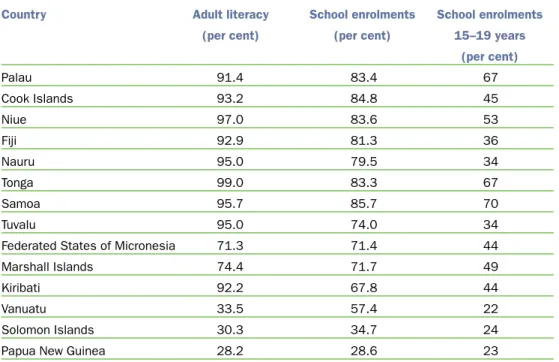
The priorities and needs for education vary significantly in the region. Table 3 shows adult literacy and school enrolments, and highlights the differences among countries. For example, in Vanuatu, Solomon Islands and Papua New Guinea, access to basic primary education is a serious problem (United Nations Development Programme 1999). The relationship between education and sporting needs varies widely across the region depending mainly on the adequacy of facilities. Generally though, the relevant literature indicates that sport programs are likely to contribute to better educational outcomes.
Literature re
vie
w
P
acific Spor
ting Needs Assessment
15
Table 3
Pacific human development indicators — education, 1998
Country Adult literacy School enrolments School enrolments (per cent) (per cent) 15–19 years
(per cent) Palau 91.4 83.4 67 Cook Islands 93.2 84.8 45 Niue 97.0 83.6 53 Fiji 92.9 81.3 36 Nauru 95.0 79.5 34 Tonga 99.0 83.3 67 Samoa 95.7 85.7 70 Tuvalu 95.0 74.0 34
Federated States of Micronesia 71.3 71.4 44
Marshall Islands 74.4 71.7 49
Kiribati 92.2 67.8 44
Vanuatu 33.5 57.4 22
Solomon Islands 30.3 34.7 24
Papua New Guinea 28.2 28.6 23
Source: United Nations Development Programme 1999,Pacific Human Development Report 1999: Creating opportunities, Suva, p. 110.
Employment indicators
Probably the most critical issue confronting Pacific island countries lies in how to provide the population with a secure and sustainable livelihood that meets people’s needs while countering the increasing problem of poverty. Economic and demographic trends indicate that the gap between the demand for, and the availability of, paid employment will almost certainly grow due to the fast-growing labour force and the limited economic potential of these countries (United Nations Development Programme 1999).
There are essentially two long-term employment problems:
1 for lesser-developed countries, the problem is how to re-orient large semi-subsistence communities to become more commercially productive
2 in more developed countries, the issue is how to resolve the problem of the ‘educated unemployed’ and to ensure that people with skills have a real choice between
migrating overseas or remaining at home to work.
The situation is complicated due to the different circumstances of each of the Pacific island countries. However, what is clear across the entire region is that employment in the formal sector is unlikely to grow in the foreseeable future to cater for the majority of Pacific island workers. What is needed is a focus on creating more employment in the informal sectors of the economy (United Nations Development Programme 1999). Sport as an industry in the Pacific islands is growing and employment opportunities in both the private and public sectors are becoming more prevalent. Sport programs and events can also stimulate associated employment, such as food and beverage sellers at a local sporting event.
Literature re
vie
w
P
acific Spor
ting Needs Assessment
16
Demographic and youth indicators
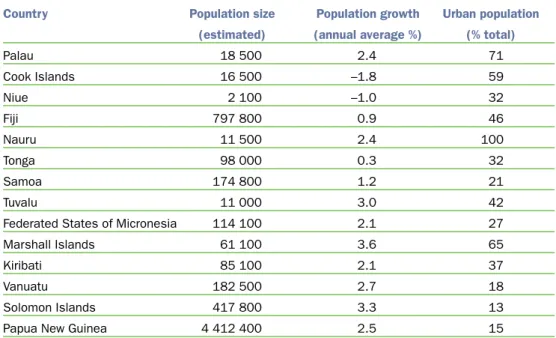
Table 4 depicts recent population growth for countries in the region. Emigration from some countries mitigates an otherwise high population growth. Some of the countries with the weakest social indicators also have the highest population growth rate, for example, Solomon Islands, Vanuatu and Nauru. The governments of these countries are already struggling to provide basic health and education services. For a relatively low cost, sport programs may potentially improve primary health across the community (especially for urban dwellers) and contribute towards better educational outcomes.
Perhaps the greatest concern across the region is how to better meet the needs and aspirations of the next generation of Pacific island people. In 1998, there were 1.4 million young people aged 15 to 24 years, representing 20 per cent of the region’s population. By the year 2010, this number will have increased by at least 300 000 (United Nations Development Programme 1999). Many young people therefore face a future of unemployment and underemployment, without much chance to experience the dignity and discipline that work brings.
Table 4
Pacific human development indicators — demographic, 1998
Country Population size Population growth Urban population(estimated) (annual average %) (% total)
Palau 18 500 2.4 71 Cook Islands 16 500 –1.8 59 Niue 2 100 –1.0 32 Fiji 797 800 0.9 46 Nauru 11 500 2.4 100 Tonga 98 000 0.3 32 Samoa 174 800 1.2 21 Tuvalu 11 000 3.0 42
Federated States of Micronesia 114 100 2.1 27
Marshall Islands 61 100 3.6 65
Kiribati 85 100 2.1 37
Vanuatu 182 500 2.7 18
Solomon Islands 417 800 3.3 13
Papua New Guinea 4 412 400 2.5 15
Source: United Nations Development Programme 1999,Pacific Human Development Report 1999: Creating opportunities, Suva, p. 113.
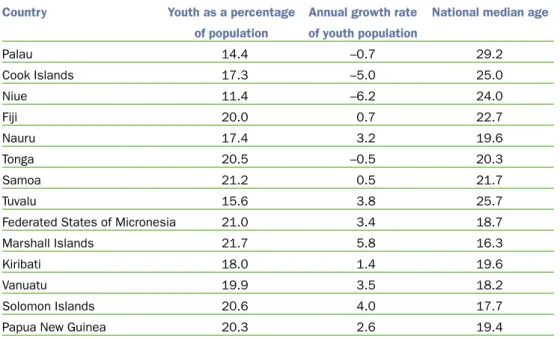
Across the region, a high proportion of young people with few employment prospects suggests that antisocial behaviour within communities is likely to increase. It is therefore important to consider whether sport programs might assist in reducing this problem. Table 5 shows the average annual growth rate of the youth population. Some of the countries with weak health indicators and limited educational opportunities have a very high rate of growth in this part of the population, for example Solomon Islands and Nauru. These countries, in particular, have very limited employment opportunities.
Literature re
vie
w
P
acific Spor
ting Needs Assessment
17
Table 5
Pacific human development indicators — youth, 1998
Country Youth as a percentage Annual growth rate National median age of population of youth population
Palau 14.4 –0.7 29.2 Cook Islands 17.3 –5.0 25.0 Niue 11.4 –6.2 24.0 Fiji 20.0 0.7 22.7 Nauru 17.4 3.2 19.6 Tonga 20.5 –0.5 20.3 Samoa 21.2 0.5 21.7 Tuvalu 15.6 3.8 25.7
Federated States of Micronesia 21.0 3.4 18.7
Marshall Islands 21.7 5.8 16.3
Kiribati 18.0 1.4 19.6
Vanuatu 19.9 3.5 18.2
Solomon Islands 20.6 4.0 17.7
Papua New Guinea 20.3 2.6 19.4
Source: United Nations Development Programme 1999,Pacific Human Development Report 1999: Creating opportunities, Suva, p. 109.
The value of sport
If sport contributes to the overall development of a community, it is worthwhile to review the social impact it can make. That is, what specific benefits can be gleaned by
promoting sport among developing countries? This section reviews the health and social impact of sport.
Governments in industrial countries have recognised the economic and social benefits of sport (Sport England 1999). However, most research has focused on the relationship between sport and health outcomes. Recently in Australia, there has been an interest in the evaluation of sport programs, particularly on the health and
social impacts of these programs.
In a review of the Australian Government’s involvement in sport and recreation in Australia, it was found that ‘the Commonwealth Government gets a good return on its investment in sport and recreation and that there are further benefits to be gained from an enhanced role in sport and recreation’ (Commonwealth of Australia Sport 2000 Taskforce, 1999). The review identified a number of benefits from the Government’s investment in sport, which include:
■ the building of national identity and national pride
■ community development and integration
■ crime prevention
■ health
■ education
Literature re
vie
w
P
acific Spor
ting Needs Assessment
18
The general benefits of sport and physical education development programs have been well documented in numerous studies and most often include:
■ significant health benefits
■ enormous contribution towards community development
■ contribution towards personal development
■ educational benefits
■ economic benefits
■ achieving international recognition
■ generation of national pride
■ vehicle for reconciliation
■ a tool for social mobility
■ contribution to the breakdown of barriers
■ a tool for communication (Glenwright 2002).
It is evident from the literature review that indicator development on outcomes from sport and recreation programs (for the general population and even more so for indigenous populations) is in its infancy. The research evidence on the links between sport and recreation programs and various health and social outcomes is also fairly limited. To date, most of the research has focused on exploring the links between physical activity and various health outcomes, rather than on any of the broader social effects.
Health benefits of sport
Of all the values of sport and physical education, the promotion and maintenance of health must be one of the most widely recognised and significant. The World Health Organization has identified the following:
■ Regular physical activity reduces the risk of dying from heart disease (33 per cent of global deaths).
■ Physical activity reduces the risk of developing heart disease, type 2 diabetes (90 per cent of world diabetes cases) and colon cancer. Evidence also suggests that physical activity probably provides protection against breast cancer.
■ Physical activity helps control weight and prevent/reduce hypertension (affecting 20 per cent of the adult world population).
■ Physical activity helps to reduce osteoporosis.
■ Physical activity reduces stress, anxiety and feelings of depression.
■ Physical activity enhances functional capacity and independent living in older persons.
■ Physical activity and ‘sport for all’ programs promote social interaction and contribute to social integration.
It has also been argued that a high health standard translates into higher domestic productivity and greater national prosperity (Boit 2002). However, it is also suggested in the literature that the greatest benefit will be derived by encouraging sedentary people
Literature re
vie
w
P
acific Spor
ting Needs Assessment
19 to take part in sport (Blair and Connelly 1996). This is particularly important in the
Pacific island countries where increased urbanisation is leading to a more sedentary lifestyle for a rapidly increasing proportion of the population. There is also significant literature to support the claim that sport contributes to psychological wellbeing. Therefore, the long-term health effects of sport and physical activity have far-reaching benefits for the development of a country besides the immediate health benefits.
Impact of sport on character
Extensive literature, dating back to the early 1900s, documents the impact of sport and physical activity in improving character. While the difficulty in empirically
ascertaining the benefits of sport on educational and personal development remains a topic of debate among sociologists, it has been recognised that participation in sport can be positively associated with a society’s desired educational outcomes (Eitle and Eitle 2002). It is believed that sport and physical activity serve as tools for the discovery and development of recreation skills. However, there is no consensus in the literature as to whether sport can directly affect educational outcomes. Sport and physical education expose children to a variety of tasks, not the least of which are the knowledge and understanding of a game’s rules as well as learning specific motor skills required to perform a particular task. Such competencies should complement those skills acquired through more recognised cognitive education (Eitle and Eitle 2002). Similarly, sport and physical education contribute to a child’s creative talents. This is of particular significance in developing countries, where limited resources available for education result in a limited curriculum with an emphasis on passing examinations — a system that lends itself to the stifled development of a child’s inventiveness and individual creativity (Eitle and Eitle 2002). It is also important to educate athletes about the benefits sport can bring to a community including promoting tolerance, fair play and respect for all.
Sport and antisocial behaviour
Research on Aboriginal communities in Australia found that sporting events, such as carnivals, did result in changes in behaviour (Tatz 1995). However, Tatz also found that the positive effects were largely limited to the length of the event and that more integrated strategies are needed to produce lasting benefits (Cameron and MacDougall 2000). The literature, therefore, indicates that sport programs need to be long term and sustainable to have any lasting impact on crime rates.
Sport and physical education
contribute to a child’s creative
talents. This is of particular
significance in developing
countries.
Literature re
vie
w
P
acific Spor
ting Needs Assessment
20
Impact of sport on the community
Studies have identified how sport extends to broad sections of the population more than perhaps any other social activity and is able to transcend social, educational, ethnic, religious, historical, political and language barriers (Riordan 1986). With a broad relevance to education, health, culture and politics, sport may serve a unique purpose in nation building and assist in fostering national integration (Riordan 1986). Individual and team success in sport can foster a sense of belonging and nationhood among the people of a country, even when perhaps internal divisions are present. A recent study showed how achievement in sport, particularly in smaller countries, is a significant factor in bringing credit and prestige to a country in the eyes of its citizens (Evans and Kelly 2002). In particular, some studies have found that ‘sporting activities at the grassroots level have the potential to motivate, inspire, and forge a community spirit in the face of the ever-present scourges of poverty, unemployment, substance abuse, domestic violence, ill health and apathy’ (Cairnduff 2001).
Other studies have also identified how social controls within the community contribute towards counterbalancing criminal activities. Social controls are found in traditional and modern social structures, and participatory activities, such as sport, give people a sense of community identity and purpose, and help prevent them from engaging in antisocial activities. Sport may provide a means of encouraging a ‘sense of community identity’ and thereby help reduce antisocial behaviour.
The past decade has seen an explosion of interest in the concept of social capital. Increasingly, academic studies have posited social capital (defined by Putnam [2000] as ‘the collective value of all social networks and the inclinations that arise from these networks to do things for each other’) as the ‘missing link’, which explains variations in government performance both within and among countries.
While the concept of social capital is the subject of debate in the social sciences, some interesting evidence exists. Researchers for a project carried out for Sport England were directed to investigate the possibility of developing local indicators of social capital that might be used as outcome indicators for sport. From this study there is some evidence that sport and especially sport associations and clubs contribute to societies’ stock of social capital (Woolcock 1998).
Robert Putnam (1993) has published another example of the study of social capital. InMaking Democracy Work, he examines differences in regional performance between
Pacific Sporting Needs Assessment © Australian Sports Commission 2004 http://www.ausport.gov.au
Sport extends to broad sections of
the population more than perhaps
any other social activity and is able
to transcend social, educational,
ethnic, religious, historical, political
and language barriers.
Literature re
vie
w
P
acific Spor
ting Needs Assessment
21 northern and southern Italy, concluding that good government is found where social
capital and civil society is most developed. In his study, Putnam identified a significant relationship between the number of soccer clubs and strong social capital. In Bowling Alone, Putnam (2000) turned his focus to the United States arguing that declining civic engagement is an indicator of fraying social relations and, in turn, deteriorating economic and political performance in that country.
With these studies as useful background, there is evidence that social capital in the Pacific island countries is in decline, and strengthening community-level sport associations may be one means of addressing this problem.
Impact of sport in promoting the rights of women
It has been documented how the success of women athletes has contributed significantly to the emancipation of women, particularly in those societies where women have traditionally been discouraged from participating in sport. In fact, some multi-ethnic communities have made a concerted effort to use sport to break down prejudices (Riordan 1986).
At the Los Angeles 1984 Olympic Games, Nawal El Moutawakel became the first woman from an Islamic nation to win an Olympic gold medal when she won the 400-metre hurdles. She was also the first Moroccan, of either sex, to win an Olympic gold medal. Nawal’s Olympic success brought her widespread recognition throughout her country, so much so that the King of Morocco decreed that all girls born on the date of her victory were to be named in her honour. In 1997, she became the Minister for Sport and Youth in Morocco and was the first Muslim woman ever elected as an International Olympic Committee member.
Even more significant was the legacy of her victory and the influence it had on the Moroccan Government, which recognised the benefits of investing in grassroots sport for girls as well as boys. The result has been a generation of female Moroccan athletes reaching the pinnacle of international competition, including Nezha Bidouane who was the 1997 400-metre hurdles world champion and Zohra Ouaziz who won the silver medal at the 1999 world athletics championships in the 5000 metres.
Women have a relatively low status in a number of countries in the Pacific region. If the experience of Morocco is an example, participation by women in sport associations may help to improve their position and involvement in the community.
Success of women athletes
has contributed significantly
Literature re
vie
w
P
acific Spor
ting Needs Assessment
22
Sport and international recognition
Studies show that the success of a country’s individuals or teams in sport cannot only foster a sense of belonging and nationhood among the peoples of a country, it can also generate a positive, vibrant image and an identity for that country internationally (Monnington 2002). This aspect may be particularly relevant for the Pacific island countries that struggle to create a sense of national identity.
The success of Senegal at the 2002 FIFA World Cup exemplifies the international importance of sporting achievements in the eyes of a country. Senegal matched the performance of Cameroon at the 1990 World Cup by making the quarter-finals after defeating France in the first round. After this victory, and throughout the remainder of the tournament, the President of Senegal, Abdoulaye Wade, was quick to acknowledge the significance of this performance, heralding it as the beginning of a new era for Senegal.
While everyone may not agree with the correlation between sport and politics, the ramifications and symbolism of Senegal’s World Cup success were well stated by mid-fielder Khalilou Fadiga, ‘Now everyone can find Senegal on a map. We may have a small country, but we are a great people’.
Sport and the economy
Studies undertaken at the international level indicate that every US$1 million spent on sport and physical activity generates a saving of US$3.2 million in national medical costs (Third International Ministerial Conference on Physical Education and Sport held in Punta Del Este in 1999). This is, however, an estimate for industrial countries and the benefits may not be as defined for developing countries. Nonetheless, a coordinated national sport system provides economic benefits in other areas such as employment opportunities. Sport and physical education are now an industry in the Pacific region. Sport provides employment opportunities in schools, National Olympic Committees, international federations, national sport federations and organising committees of major international events, with the benefits of the latter still limited to those countries that have the resources to organise large events, such as Fiji hosting the 2003 South Pacific Games.
Pacific Sporting Needs Assessment © Australian Sports Commission 2004 http://www.ausport.gov.au
Studies undertaken at the
international level indicate that
every US$1 million spent
on sport and physical activity
generates a saving of
US$3.2 million in national
medical costs.
Literature re
vie
w
P
acific Spor
ting Needs Assessment
23
Summary and conclusion
This review considered the current literature on the relationship between sport and development with a specific focus on the Pacific island countries. While there is a plethora of research on sport in industrial countries, little focus has been given to sport’s role within the developing world, and most notably, in the Pacific islands. The primary aim of this review was to compile the available data on the possible role and impact of sport on Pacific island countries in order to identify its potential role for encouraging broad-based development. As a basis for this review, the available data on social, economic, health and demographic indicators of each country were examined. The role of sport in international aid programs was outlined, and the available research on the importance and effect of sport in developing countries was presented. Finally, the most significant studies on the relationship between sport and social indicators were summarised.
Pacific island countries continue to face some particularly difficult development problems, many of which are related to capacity constraints.
It would appear that sport contributes to the development of the Pacific island countries. Yet, sport itself is not a panacea, but rather an instrument for development that has proven to be effective, non-threatening and efficient. In two particular areas — health and community development — sport can play a significant and direct role. Community-level sport plays a role in improving health at a much lower cost than more complex and expensive medical care. Meanwhile, sport associations at the community level help to strengthen social capital and the sense of community, as well as reinforce social norms. The literature shows that the impact of sport correlates to the time given to implement programs. Short-term programs do not have the same resonance as longer-term ones. To have any lasting impact, sport programs need to be sustainable at the local level and meet genuine community needs. There needs to be a sense of community ownership, and the capacity and determination within the community to continue with the program over the long term.
There are various ways in which development assistance programs may be delivered, but the principles for an effective program are well understood. To meet the specific needs of individual countries in the Pacific region, there may be a need to develop targeted sport development programs. Key issues that such programs should address are:
■ What priority areas (for example, health, community development or economic development) should be the focus for sport development programs?
■ What types of organisations are best placed to deliver the programs?
■ What are the main capacity constraints faced by these organisations?
■ What type of aid-delivery mechanism is best suited to provide the assistance identified?
■ What are the most suitable social indicators available for the region to monitor the main impacts of the program?
Finally, the literature suggested the continued need to monitor and evaluate outcomes of sport programs to ensure that they meet the overall development objectives of the region. A set of relatively simple social indicators (preferably ones that are already established throughout the region) should be chosen to monitor the impact of a sport development program.
Pacific Sporting Needs Assessment © Australian Sports Commission 2004 http://www.ausport.gov.au Pacific Sporting Needs Assessment © Australian Sports Commission 2004 http://www.ausport.gov.au
Country/territory reports
3
Chapter 3
Chapter 3
Country/territory reports
This chapter contains sections on each country and territory that participates in the ASP Sports Program. The information is a result of an extensive process that included the development and completion of questionnaires and in-country consultations with key stakeholders. The stakeholders consulted in the preparation of the report included national governments, National Olympic Committees, National Paralympic Committees, national sport federations and community groups.
The reports provide insight into the current status of sport in each participating country and territory, as well as identifying priority areas for development. The priority areas vary across the countries and territories and are a useful tool in developing a strategy for an effective development assistance program.
While not recipients of ASP funding, American Samoa and Guam have participated in specific ASP initiatives and have therefore been included.
P
acific Spor
ting Needs Assessment
Countr
y repor
ts
26
Pacific Sporting Needs Assessment © Australian Sports Commission 2004 http://www.ausport.gov.au
The reports provide insight
into the current status of sport
in each participating country
and territory.
27
Introduction
American Samoa is situated in the mid-South Pacific, within sight of Samoa. It has an area of 199 square kilometres and a population of 57 291. Although it is a territory of the United States, it has its own independently recognised National Olympic Committee. The American Samoa National Olympic Committee (ASNOC) was formed in 1985 and recognised by the International Olympic Committee in 1987. It first competed in the Olympic Games in Seoul in 1988.
American Samoa is not a direct recipient of assistance through the ASP Sports Program, but it benefits from the program through its membership in the Oceania National Olympic Committees. Sport in American Samoa is heavily influenced by its association with the United States, with many of the country’s top athletes travelling to the United States on college scholarships. While this pathway is recognised as a positive contribution to American Samoan society, it results in a major drain of the country’s top sporting talent.
Structure of sport
ASNOC is responsible for the preparation of teams for regional competitions such as the South Pacific Games and the South Pacific Mini Games, as well as the Summer and Winter Olympic Games. In individual sporting championships for the Oceania region, all major American Samoa sports are members of ASNOC. Member sports travel to these championships through their affiliation with ASNOC and their respective Oceania International Sport Confederation.
The national government runs the
Department of Parks and Recreation. This department has the responsibility of building and maintaining sporting fields. There are five gymnasiums on the island. One
gymnasium is situated on the campus of the American Samoa Community College. The other four gymnasiums are located on the four major high-school campuses. Sporting teams contract the schools for the use of the gymnasiums. There is a national stadium, built in 1997 for the fifth South Pacific Mini Games. High-school American football is played at the stadium from September to
27
Territory
■
American Samoa
■ Capital Pago Pago
P
acific Spor
ting Needs Assessment
December every year. For the remainder of the calendar year, the stadium is mostly used by the rugby union and soccer federations to host local tournaments. In 2003, soccer hosted an Oceania junior soccer qualifier tournament.
Sport and physical education
Physical education is not part of the primary-school curriculum and American Samoa relies on the sport federations to provide sport programs for those aged 8 to 12 years. At the high-school level, a physical education class is offered to all students each week.
Women in sport
ASNOC worked with several administrators to establish a women-in-sport program. Representatives have participated in regional and world women-in-sport conferences. A women-in-sport association is now operating and it is hoped that this will provide the impetus to advance women-in-sport issues.
Junior sport programs
Several sports have superior junior sport programs including baseball, basketball, golf, soccer and volleyball. Junior golf has been active for more than 30 years and some outstanding local golfers have come out of this program. Baseball has had its ‘Little League’ program for 18 years. There are now more than 12 baseball players from this program enrolled in US colleges through baseball scholarships. Volleyball has also seen successes, especially in the junior girls program. Over the past four years, there have been more than 20 college scholarships awarded to girls through this program. Basketball has a regular program for juniors
that begins every June and ends in August. This coincides with the school break when many parents look for programs and activities in which their children can participate and learn athletic skills.
Other programs and activities
ASNOC has an annual Athlete of the Year Banquet. The banquet recognises athletes, coaches and teams for outstanding performances.
The yearly Olympic Day Run has proven to be a resounding success with the support of Coca Cola®. Over the past ten years, the Olympic Day Run has blossomed into a very popular event.
Priority areas for the future
■ Training facilities — the major focusof ASNOC activities now and in the medium term will be establishing training facilities for its member associations. ASNOC is currently negotiating to purchase freehold land. Funding is being sought through the Oceania National Olympic Committees’ funding program and other avenues.
■ Training programs — in association with the establishment of training facilities, training programs for athletes and coaches are a priority in order to provide the expertise to run and use facilities to maximum benefit.
■ Physical education in schools — American Samoan sport authorities, like their counterparts in many other countries in the region, would like their national government to have physical education and sport as part of the school curriculum, with teacher education programs
incorporating suitable training.
Countr
y repor
ts
28
Pacific Sporting Needs Assessment © Australian Sports Commission 2004 http://www.ausport.gov.au
Several sports have outstanding
junior sport programs.
29
Introduction
The Cook Islands is a geographically diverse country comprising low coral atolls in the north, and volcanic hilly islands in the south. It is in free association with New Zealand. Under the terms of this agreement, Cook Islanders hold New Zealand citizenship and have free access to New Zealand. It has a total land area of 240 square kilometres, a population of 17 800 (2003) and an exclusive economic zone of 1.83 million square
kilometres.
Sport, like many activities in the Cook Islands, is challenged by the geographic diversity of the country. Internal travel is expensive and many of the islands are accessible only by boat — some journeys can take five days. Accordingly, the delivery of programs outside the main island of Rarotonga is expensive and difficult.
The Cook Islands Sports and National Olympic Committee (CISNOC) was recognised by the International Olympic Committee in 1986 and competed in Seoul at the 1988 Olympic Games. It first attended the Commonwealth Games in 1974 in Christchurch, New Zealand.
Structure of sport
There are two peak bodies responsible for sport in the Cook Islands: the Ministry of Youth, Sport and Recreation, and CISNOC.
CISNOC is responsible for the preparation of teams for international competitions such as the Olympic Games, Commonwealth Games, South Pacific Games and South Pacific Mini Games. CISNOC and the Cook Islands Government share a unique relationship. CISNOC is, effectively, the delivery arm for the programs of the government. This means that many of the government’s community and grassroots sporting initiatives are delivered by CISNOC through its Sports Development Unit. Such an agreement reduces the risk of duplication and offers an effective program through reduced costs.
CISNOC currently employs five full-time staff: a finance manager, sport manager, two sport development officers and an
administrative officer. In 2003, CISNOC underwent a management audit and
restructure coordinated through the Business Volunteer Program of the Australian Executive Service Overseas Program.
29
Country
■
Cook Islands
■ Capital Avarua
P
acific Spor
ting Needs Assessment
CISNOC has 27 affiliated sports (13 Olympic sports and 14 non-Olympic sports).
Sport and recreation are among 11 key strategic areas in the Cook Islands Government’s National Youth Policy (2003–06) — recognising the importance of sport in the development of youth. The policy identifies a series of intervention strategies designed to increase the participation of young people in sport and recreational activities. These strategies are delivered primarily by CISNOC in conjunction with the national sport federations and the governments of the outer islands. Strategies include the establishment of a national sport academy to provide support services to elite athletes and coaches, establishment of an outreach program to deliver sport initiatives to outer islands, and establishment of a youth scholarship program for aspiring and potentially elite young athletes. There are ten island sport associations that work with both CISNOC and the Cook Islands
Government to facilitate the delivery of sport programs in the outer islands.
Sport and physical education
Sport and physical education are growing in stature in the Cook Islands. Recognising the importance of physical education and health, the Ministry of Education receives
assistance from the New Zealand Government in the form of a health and physical education adviser in the Curriculum Advisers Unit.
The adviser is working to establish a
curriculum for health and physical well-being, which are among the eight essential learning areas in the Cook Islands curriculum.
The Cook Islands Teachers Training College was re-opened in 1999 and is seeking accreditation through the New Zealand Qualifications Authority. In 2003, for the first time, comprehensive health and physical education training was offered to teachers. Physical education is now a compulsory component of teacher training.
Countr
y repor
ts
30
Pacific Sporting Needs Assessment © Australian Sports Commission 2004 http://www.ausport.gov.au
Non-structured school sport takes place on Friday afternoons. School sport programs are generally coordinated by the national sport federations and tend to take place in the lead-up to major national competitions. There is no structured, ongoing school
sport program.
Physical education is approaching the stage where it will have a modern curriculum that cannot be taught due to the lack of resources. The resource issue is pertinent throughout the Cook Islands education system and it is not limited to physical education. In order for the benefits of the new curriculum to be realised, there needs to be increased input of resources to complement the curriculum.
Sport for people with a disability
Disability sport in the Cook Islands is rudimentary. There is no National Paralympic Committee and all disability sport initiatives are driven by CISNOC in conjunction with the Cook Islands Disabled Association. Disability sport activities are limited due to lack of funding. Athletes with a disability compete in athletics at regional games. This occurred for the first time at the 2002 Manea Games and will continue at future regional games.
CISNOC is exploring the possibility of establishing a disability sport commission within its existing framework. This
commission will require financial and resource assistance from external sources because CISNOC will not receive additional funding from the government to operate the commission. As a new initiative, the commission will require significant resource and training assistance.
Women in sport
The women-in-sport movement is particularly active and the country is viewed as a
regional leader in this area. The Cook Islands Women in Sport Commission runs a variety of programs designed to increase the participation of women in sport at all levels.
Of the five full-time employees at CISNOC, two are women.
In 2001, the Cook Islands hosted the first regional women-in-sport workshop. The event attracted high-profile speakers including International Olympic Committee Vice-President Anita de Franz among a host of representatives from the Pacific.
Future activities planned by the commission include sport administration courses specifically designed for women, as well as coaching courses in targeted sports. The purpose of these workshops is to specifically encourage and increase the number of female coaches and administrators. The commission is also planning to hold another regional women-in-sport workshop in the near future.
Junior sport program
CISNOC, through its Sports Development Unit, conducts junior training and coaching sessions throughout the year in the schools and colleges, coinciding with the sports that are played during that term of school: term 1, volleyball and soccer; term 2, netball and rugby union; term 3, athletics; and term 4, tennis and basketball.
In addition to the programs run by CISNOC, several national federations conduct junior development programs with assistance from the Sports Development Unit. The national soccer federation is viewed as the most active, with its junior structure well in place and achieving solid participation growth.
Other programs, activities and issues
High on the agenda for the development of sport is the establishment of a centre of excellence for elite athletes and coaches.
The proposed centre would provide high-level athlete and coach support services, including sport science, sport medicine and video analysis, as well as access to information resources through the Oceania Sport Information Centre and the Australian Sports Commission’s National Sport Information Centre. The government, CISNOC and the national sport federations share concern about the level of access to such resources.
CISNOC has a very successful national games structure. At the elite level, the Cook Islands Games are held every four years. These games attract many participants from across the country. In addition, a series of regional games are held every four years. Events include the Manea Games, the Purapura Games and the Tumutevarovaro Games.
Priority areas for the future
■ Centre of excellence — the Cook Islands sport system is ready to establish a centre of excellence to facilitate the development of elite and potentially elite athletes and coaches. The country has an excellent competition structure through national and regional games in addition to the competitions run by the 27 national federations. The challenge is to provide sufficient resources for athletes identified through this competition pathway to develop into elite athletes who can compete on the international stage. The support structures that need to be provided by a centre of excellence include: access to the latest resources through the Australian Sports Commission’s National Sport Information Centre and the Oceania Sport Information Centre (Suva, Fiji); athlete testing and monitoring services;
Countr
y repor
ts
P
acific Spor
ting Needs Assessment
31
The women-in-sport movement is
particularly active and the country
is viewed as a regional leader in
this area.
P
acific Spor
ting Needs Assessment
basic sport medicine support; and
up-to-date coaching techniques. Significant assistance in terms of resources and training will be required to assist the Cook Islands in the establishment of a centre of excellence. CISNOC is negotiating with the government on a location for the centre.
■ Sport education — like many countries in the Pacific region, the Cook Islands cannot justify the expense of establishing a national coach accreditation structure. As a consequence, coaches at all levels from junior and community through to elite, have difficulty gaining access to training and education programs. A regional coach education curriculum would be a benefit to sport development in the Cook Islands, particularly for the outer island communities that often miss out on training opportunities because of the cost of travel.
■ Physical education and school sport — the Cook Islands has received significant assistance from the New Zealand Government and it is anticipated that a national physical education curriculum will be in place in 2005. The effectiveness of this new curriculum can be enhanced through a comprehensive teacher training program through the Cook Islands Teacher Training College. Additional resources are needed to facilitate delivery of the curriculum in schools, particularly in the outer islands.
■ Women in sport — there is an excellent structure for women in sport that receives support from CISNOC. The benefits of the program would be enhanced by increased access to international resources and best practice models in addition to a women-in-sport ambassadors program. The benefits of such assistance would have regional implications as the Cook Islands is seen as a regional leader in this area.
■ Disability sport — a disability sport program is in the developmental stage, although disability sport events are now being introduced at the regional and national games. There is certainly a capacity within CISNOC to deliver disability sport programs through the Sports Development Unit, but this would require additional staff training and resource development.
■ Outreach program — the community development programs delivered by CISNOC, through the Sports Development Unit, are constrained by tight budgets. This affects the capacity of the unit to deliver programs to the outer islands. Alleviating this is not simply a matter of seeking additional financial support. Rather, it requires an effective and sustainable approach to delivering sport programs to outer island communities. By establishing an outreach program, the benefits of the work achieved by the unit can be enjoyed by the wider Cook Islands population.
Countr
y repor
ts
32
Pacific Sporting Needs Assessment © Australian Sports Commission 2004 http://www.ausport.gov.au
A regional coach education
curriculum would be a benefit
to sport development in
33
Introduction
The archipelago of Fiji comprises about 330 islands and 500 islets in the South Pacific Ocean. Fiji lies approximately 730 kilometres northeast of Sydney and 1930 kilometres south of the equator. The majority of the population of 800 000 live on the two biggest islands: Viti Levu (70 per cent) and Vanua Levu (20 per cent). Fiji has an exclusive economic zone of 1 260 000 square kilometres.
Fiji is recognised as a regional leader in sport. It has a well-established national approach to sport development and achieves consistently high results on the international sporting stage in