Available online at http://www.iaeme.com/ijaret/issues.asp?JType=IJARET&VType=11&IType=12 ISSN Print: 0976-6480 and ISSN Online: 0976-6499
DOI: 10.34218/IJARET.11.12.2020.236 © IAEME Publication Scopus Indexed
ROBUST IMAGE WATERMARKING USING
DWT SWAPPING AND ARTIFICIAL NEURAL
NETWORK
Shweta Singh and Dr. Laxmi Singh
Department of Electronic and Communication Engineering, RNTU- Rabindranath Tagore University, Bhopal, Madhya Pradesh ABSTRACT
Digital social platform increase the importance of image in daily life. Hence privacy of content plays an important role when content get live, so data owner put signature inform of watermark for claiming its proprietorship. This work has proposed embedding and extraction technique which increase the accuracy of watermark extraction. Proposed model utilize the frequency region of the image for embedding by swapping the LSC (Least Significant Coefficient) and MSC (Most Significant Coefficient). As per watermark information and noise level embedding of information perform swapping in LSC and MSC. After embedding each vector of DWT was used for training the Error Back Propagation Neural Network. This trained neural network extract watermark at receiver side of work. Use of neural network for watermark recovery increase watermark work performance under different attack as well. Real image dataset was used for checking the performance of proposed watermarking model. Results shows that proposed DWT Swapping and Neural Network has increase different evaluation parameter values.
Keywords: Artificianl Neural Network, Digital Image Processing, DWT, Information Extraction, Watermarking
Cite this Article: Shweta Singh and Dr. Laxmi Singh, Robust Image Watermarking Using DWT Swapping and Artificial Neural Network. International Journal of Advanced Research in Engineering and Technology, 11(12), 2020, pp. 2496-2505. http://www.iaeme.com/IJARET/issues.asp?JType=IJARET&VType=11&IType=12
1. INTRODUCTION
With the advancement in the digital world, many services are been provided using it, most of the services fully depends on the digitization like social media and social networking, e-commerce websites etc. but as every coin has two sides there it is, there has created the problems of privacy or proprietary stolen. So, to protect the proprietorship of the owner and solve this problem experts invented many techniques for this. Thus, one of the mots common method for the privacy is the cryptography, which helps in hiding the information for the thief and other third person. In cryptography the information or data is sent in form of any digital
data, photograph, video, music by hiding the information in it to protect its originality [1,2]. This technique comes with the ease of the availability of data in internet and can easily be modified by certain software for the copyright.
Thus, creation of the concern towards the copywriting issues and proprietorship protection there is one such method again which is becoming most popular, due to its convenience and free cost. As internet is the place where users visit to access the information, pictures, videos, music or any other data. The internet is source where people can easily access in just a click and without paying a penny than prefer to visit physical shop by buying required data [3, 4]. The user needs to store those internet access data in the virtual space. This can create the nuisance for copyright violation as because of the readily available information.
As in case one visits the technology specialize shop, one can get plethora of music digital recording devices. While the average man can get only analog device, but there would be compromise with the quality as it lacked to original [5]. Conversely, ready availability of the music at the internet source, gets any one to create duplicate by just loss in standards and quality. Thus, the creation of the duplicate by combination of digital recording device and internet material sources easily violence the copyright without any compensation to appropriate owner [6]. Ergo, owners of this are interested to allow for technological help to protect products by providing adequate protection.
Recently, the most common and most advanced method used for the content protection form the digital media copyright violation is the cryptography. In this field, the most developed method is cryptography. In this method, the files would be encrypted using the particular password or data which is known as encryption key. Then those files are sell out to the payed customers. The customers are provided with the decryption key by the distributor which is needed to access those files [7]. The controversy is the what if that payed customer would distribute those files through the internet after getting the decryption key. Thus, conclusion is made cryptography can protect the files up to only certain extent that is interception can be protected but can protect up to end user.
2. RELATED WORK
Mohammed A. M. Abdullahet. al. in [17] has proposed a watermarking technique by embedding binary data in DCT middle band frequency region. In this paper, the image was blocked into fix size whereas per watermark bit DCT middle band fix co-ordinates values were swapped. Swapping of this was dependent on certain conditions, so the same set of conditions were maintained at the receiver side for watermark extraction. This work faces low watermark absorption with low resistance against spatial attacks.
Kazuki Yamato et al. in [18] has proposed a between-class variance concept for embedding image in the edge region of the image. The author has first applieddiscriminant analysis method for converting image into binary format then apply BCV technique which classifies pixel into the edge and non-edge region. Change in the spatial region of the image was done for hiding data into image edge region. Here low space available for watermark while embedding in edge region is easy to trace the secret information.
Angela Piper et al. in [19] generate watermark from the input image only and embed in the low-frequency band of the image. In this paper, a fragile watermarking technique was proposed which preserve images against JPEG compression attack. Here paper has not covered another type of attack, while the execution time of this work was also quite high.
HaniehKhalilian et al. [20], Proposed a fractal code based self reconstruction algorithm where the input image was sent in a highly noisy area. So the loss of information was assumed which was recovered by extra packets of fractal code. Tempering of the image was also preserved too by hashing the hash key as secret information. This paper has improved the
robustness in losy environment but it required extra bandwidth with computational complexity.
In [21] the author has proposed a Singular value Decomposition technique to find resemble data in the original image. Authors of this paper divide the image into fix size patch and replace those patch with KSVD patch. This increases the image security in the network while encryption of watermark was also done before embedding. Here searching forthe correct patch from KSVD library was time taken. Dictionary storage at sender or receiver side was also bulky.
3. PROPOSED METHODOLOGY
In this section proposed EBPNN explanation was done which focus on embedding and extraction of the watermark in a cover image Entire work was done in two stages of hiding digital information and extraction of digital information by using a spiking neural network with the scrambling Here it was desired that while extraction of secret information whole data remain secure In Fig 1 entire proposed work block diagram was clarified
Figure 1 Block diagram of proposed work. Y Original Image Pre-Processing DWT Low Band to Nx8 Matrix Watermark Image
Last four values to be greater than first four in LL First four values to
be greater than last four in LL LL Band Embedded Image W=1? For Each watermark Bit N
3.1. Proposed Embedding Process
Pre Processing Image is a matrix of pixel value collection as per format is set in between fix range like 0 255 0 1 0 360 etc So perusing pixel value of that picture lattice is done in this progression of the proposed show As whole work focuses on the image which has pixel value in the scope of 0 255 So read an image implies making a framework of the same Measurement of the image at that point fill the matrix cell to the pixel value of the image at the cell in the grid.
3.2. DWT Discrete Wavelet Transform
Figure 2 DWT of the Lena image from [8]
In this work DWT frequency feature was used Here fig 2 shows detail steps of DWT where work has embedded watermark in LL region of the image. This block of the image is obtained by filtering the image rows from the low pass filter then pass same to the low pass filter but here column is filter for the analysis. This block containsa flat region of the image which does not have any edge information, so this is term as an approximate version of the image.
3.3. Embedding of Watermark
Swapping concept was used for embedding the input data into image. So two cases were arise first was either pixel was white in other word of binary term 1 Or pixel was black color or 0. In this embedding as per pixel value difference between the LSB and MSB was develop. So for white color pixel LSB>MSB while for black color pixel MSB>LSB. Hence if block already have this difference value than no swapping was need otherwise swapping of LL band vector was perfrom. Size of this vector is of 8 coefficients. Hence as per secret information data was hide in a swapping manner. Number of swapping pixels range from one to four for 8 coefficient vector.
3.4. Training of Error Back Propagation Neural Network Let us assume a three-layer neural network.
Now consider i as the input layer of the network while j is considered as the hidden layer of the network. Finally, k is considered as the output layer of the network.
If wij represents a weight of the between nodes of different consecutive layers.
So the output of the neural network depends on the below equation:
Xj= xi .wijbj (7)
where, 1 i n; n is the number of inputs to node j, and bj is the biasing for node j
Once the system gets output than it getsto compares with the desired watermark value in this case instead of 0 or 1 work has assumed the 0 or 100 value output. Hence the network will learn the weights between layers and constant threshold range from 0 to 100. This error needs to be correct by adjusting the weight values of each layer by eq. 8 to 12, [35]. So estimation of error was done by Eq. 8.
) ) ) ) ) ) (8)
Similarly, other values can be calculated to find another set of derivatives using the above equation.
For each input to neuron calculate the derivative concerning each weight using equation. Now let us look at the final derivative by Eq. 9.
∑ ) ) )) ) (9)
Now by using the chain rule, final derivates were calculated for the below equation. Here multiplication of each derivative was done in eq. 10
(10)
So overall can be obtained by getting the value of weight from the above equation, here all set of weight which need to be update are change by eq. 11 values.
[ ] (11)
The SNN weight updates were done by the above matrix of .
(12)
So end of the above iteration steps over when error obtained from the output layer get nearer to zero or some constant such as 0.0001.
Proposed Algorithm
Input: CI, W // CI:Carrier Image, W: Watermark
Output: EI, TNN // EI: Embedded Image, TNN: Trained Neural Netwrok
PIPre-Processing(CI) // PI: Pre-Processed Image
[LL LH HL HH]DWT(PI)
BWPre-Processing(W) // BW: Binary Watermark
Loop 1:n // n: number of watermark bit
If BW[n] is 1
Loop 1:m // m: number of bit in V to swap
If V[C]LSB is not greater than V[C]MSB
V[C]Swap(V[C]LSB, V[C]MSB)
EndIf
EndLoop
TD[V 1] // TD: Training Data for EBPNN
Else
Loop 1:m // m: number of bit in V to swap
If V[C]MSB is not greater than V[C]LSB
V[C]Swap(V[C]MSB, V[C]LSB) EndIf EndLoop TD[V 0] EndIf CC+1 // C: Counter of vector in LL EndLoop LLVector-Coefficient(V) TNNEBPNN-Training(TD) EIIDWT([LL LH HL HH) 3.5. Extraction of Watermark
In this phase of model embedded image was pass and DWT operation was apply which give an LL band. LL band were further process to get vector of 8 values coefficient for testing of neural network. Now neural network will give an output of hidden data in form of 1 or 0. So as per training of neural by 8 value coefficient vector neural network gives an output of desired secret data pixel value / color / bit.
4. EXPERIMENT AND RESULTS
Proposed Image watermarking by Swaping and Neural Network (IWSNN) was developed on MATLAB software where input image was embedded by watermark algorithm and after embedding image pass in extraction algorithm. Real set of standard images were taken for experiment where watermark of 32x32 size was taken. Experimental values of proposed model was compared with previous work done in [15], and swapping method. Performance of proposed model was done on ideal condition and attack condition of spatial, geometrical.
4.1. Result
Table 1 PSNR Based Comparison between proposed and previous work [15]. Images IWSNN Swapping Method Previous
work [15]
Tree 34.5896 16.6907 20.2361
Bowl 40.0917 26.8305 20.3744
Lena 0.655 26.871 20.2018
In ideal condition when no attack was done on embedded image PSNR value of the different watermarking algorithm was shown. It was obtained that proposed model has high PSNR value as compared to previous existing method while proposed model has high PSNR value as compared to swapping method only. This enhancement of IWSNN model was achieved by embedding at LL band of DWT feature. Hence embedding at LL band by swapping at less position has increased the PSNR value as compared to other methods of watermarking.
Table 2 MSE based comparison between proposed and previous work [15]. Images IWSNN Swapping Method Previous work [15] [] Tree 22.6004 1393.19 615.846 Bowl 6.36663 134.907 596.539 Lena 9.41343 133.652 620.729
In ideal condition when no attack was done on embedded image MSE value of the different watermarking algorithm was shown. It was obtained that proposed model has high PSNR value as compared to previous existing method while proposed model has high PSNR value as compared to swapping method only. This enhancement of IWSNN model was achieved by embedding at LL band of DWT feature. Hence embedding at LL band by swapping at less position has increased the MSE value as compared to other methods of watermarking.
Table 3.White noise Gaussian attack on embedded image.
PSNR Values
Images IWSNN Swapping Method [15] Previous work [15]
Tree 20.0947 19.5455 20.2418
Bowl 20.3247 19.6007 20.3799
Lena 20.1427 19.5787 20.1964
MSE Values
Images IWSNN Swapping Method Previous work [15]
Tree 636.23 721.984 615.029
Bowl 603.406 712.873 595.791
Lena 629.235 716.486 621.505
Extraction Rate Values
Images IWSNN Swapping Method Previous work [15]
Tree 0.130859 0.28125 0.503906
Bowl 0.142578 0.246094 0.504883
Lena 0.18457 0.314453 0.508789
NC Values
Images IWSNN Swapping Method Previous work [15]
Tree 0.923 0.831 0.659
Bowl 0.916 0.855 0.657
Lena 0.889 0.807 0.656
White nose attack was applied on embedded image after applying watermarking algorithms and results were showned in table 4 at receiver side. It was showed that proposed
model IWSNN has high PSNR, SNR value even after attack on the image. Similarly watermark extraction parameters are also high. Use of neural network for watermark extraction increase the pattern finding intelligency at receiver side and maintain the accuracy of work as well. It was showed in table 4 that NC value of IWSNN was high as compared to swapping method and previous work in [15].
Table 4 Filter attack on embedded image.
PSNR
Images IWSNN Swapping Method
Previous work [15] [15] Tree 30.4419 27.8808 28.2079 Bowl 31.934 29.2164 20.3799 Lena 33.1641 29.803 30.2884 MSE
Images IWSNN Swapping Method Previous work [15]
Tree 58.7346 105.925 98.2398
Bowl 41.656 77.8819 595.791
Lena 31.3812 68.0425 60.847
Extraction Rate
Images IWSNN Swapping Method Previous work [15]
Tree 0.040039 0.236328 0.501953
Bowl 0.011719 0.22168 0.504883
Lena 0.051758 0.235352 0.509766
NC
Images IWSNN Swapping Method Previous work [15]
Tree 0.978 0.862 0.668
Bowl 0.994 0.873 0.657
Lena 0.97 0.863 0.656
Filter attack was applied on embedded image after applying watermarking algorithms and results were showned in table 5 at receiver side. It was showed that proposed model IWSNN has high PSNR, SNR value even after attack on the image. Similarly watermark extraction parameters are also high. Use of neural network for watermark extraction increase the pattern finding intelligence at receiver side and maintain the accuracy of work as well. It was showed in table 5 that NC value of IWSNN was high as compared to swapping method and previous work in [15].
Table 5 Rotation attack on embedded image.
PSNR
Images IWSNN Swapping Method Previous work [15]
Tree 8.48242 8.47203 8.4904
Bowl 13.1103 13.0442 13.1084
Lena 11.2812 11.2523 11.2929
MSE
Images IWSNN Swapping Method Previous work [15]
Tree 9222.28 9244.37 9205.36
Bowl 3177.23 3226 3178.66
Lena 4841.31 4873.58 4828.22
Extraction Rate
Images IWSNN Swapping Method Previous work [15]
Tree 0.227539 0.302734 0.500977
Bowl 0.223633 0.318359 0.504883
Lena 0.283203 0.31543 0.491211
NC
Images IWSNN Swapping Method Previous work [15]
Tree 0.865 0.816 0.661
Bowl 0.871 0.805 0.659
Geometrical attacks were applied on the image by rotation attack embedded image obtained from embedding algorithm. It was showed that proposed model IWSNN has high PSNR, SNR value even after attack on the image. Similarly watermark extraction parameters are also high. Use of neural network for watermark extraction increase the pattern finding intelligency at receiver side and maintain the accuracy of work as well. It was showed in table 4 that NC value of IWSNN was high as compared to swapping method and previous work in [15].
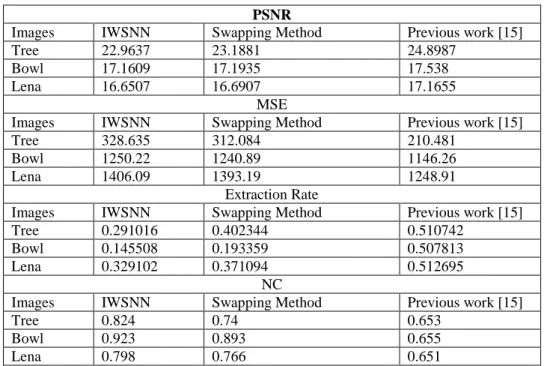
Table 6 Histogram attack on embedded image.
PSNR
Images IWSNN Swapping Method Previous work [15]
Tree 22.9637 23.1881 24.8987
Bowl 17.1609 17.1935 17.538
Lena 16.6507 16.6907 17.1655
MSE
Images IWSNN Swapping Method Previous work [15]
Tree 328.635 312.084 210.481
Bowl 1250.22 1240.89 1146.26
Lena 1406.09 1393.19 1248.91
Extraction Rate
Images IWSNN Swapping Method Previous work [15]
Tree 0.291016 0.402344 0.510742
Bowl 0.145508 0.193359 0.507813
Lena 0.329102 0.371094 0.512695
NC
Images IWSNN Swapping Method Previous work [15]
Tree 0.824 0.74 0.653
Bowl 0.923 0.893 0.655
Lena 0.798 0.766 0.651
It was showed that proposed model IWSNN has high PSNR, SNR under histogram attack environment. Similarly watermark extraction parameters are also high. Use of neural network for watermark extraction increase the pattern finding intelligency at receiver side and maintain the accuracy of work as well. It was showed in table 4 that NC value of IWSNN was high as compared to swapping method and previous work in [15].
5. CONCLUSIONS
Watermarking in digital content need robustness from attacks present in network and most of work were fail to recover embedded information. So this paper has resolve this proble by involving the neural network for watermark extraction at receiver end. Proposed model IWSNN has utilized the DWT coefficient method for watermark embedding by swapping LSB values with MSB as per hiding information (watermark) bits. Pattern of these coefficient values were pass in the error back propogation neural network model for training. Results shows that poposed model has high PSNR value even after embedding. It was also found that PSNR and MSE values of IWSNN was % higher in attack environment (Noise) as well. Watermark extraction at receiver side was also % high in geometrical attack as compared to other extraction algorithm. In future researcher can adopt other type of neural network for extraction which may improve extraction results.
REFERENCES
[1] Priya Porwal, Tanvi Ghag, Nikita Poddar, Ankita Tawde Digital Video Watermarking Using Modified Lsb and Dct Technique. International Journal of Research In Engineering And Technology Eissn: 2319-1163.
[2] Kazuki Yamato, Madoka Hasegawa, Yuichi Tanaka‡ and Shigeo Kato. “Digital Image Watermarking Method Using Between-Class Variance”. 978-1-4673-2533-2/12/$26.00 ©2012 IEEE.
[3] Ashwary Rajpoot , Ranjana Batham , Navin Chourasia “Spatial Domain Base Image Watermarking By Edge Features”. IJCSEC- International Journal Of Computer Science And Engineering Communications. Vol.2, Issue 5, Oct 2014, ISSN: 2347–8586
[4] Mr Mohan A Chimanna 1,Prof.S.R.Kho “Digital Video Watermarking Techniques For Secure Multimedia Creation And Delivery” Vol. 3, Issue 2, March -April 2013, Pp.839-844839. [5] Paweł Korus, Student Member, IEEE, And Andrzej Dziech. “Efficient Method For Content
Reconstructionwith Self-Embedding”. IEEE Transactions On Image Processing, VOL. 22, NO. 3, MARCH 2013.
[6] Ioan-Catalin Dragoi, And Dinu Coltuc, Local-Prediction-Based Difference Expansion Reversible Watermarking, IEEE Transactions On Image Processing, VOL. 23, NO. 4, APRIL 2014.
[7] L. M. Vargas and E. Vera, “An Implementation Of Reversible Watermarking For Still Images” IEEE Latin America Transactions, VOL. 11, NO. 1, FEB. 2013.
[8] Mohammed A. M. Abdullah, Satnam S. Dlay, Wai L. Woo, and Jonathon A. Chambers. “A Framework for Iris Biometrics Protection: A Marriage between Watermarking and Visual Cryptography”. IEEE Access Year: 2016, Volume: 4 Pages: 10180 – 10193.
[9] Kazuki Yamato, Madoka Hasegawa, Yuichi Tanaka‡ And Shigeo Kato. “Digital Image Watermarking Method Using Between-Class Variance”. 978-1-4673-2533-2/12/$26.00 ©2012 IEEE.
[10] Angela Piper1, Reihaneh Safavi-Naini. “Scalable Fragile Watermarking For Image Authentication”. Published In IET Information Security, On 31st December 2012.
[11] Paweł Korus, Student Member, IEEE, AndAndrzej Dziech. “Efficient Method For Content Reconstruction with Self-Embedding”. IEEE Transactions On Image Processing, VOL. 22, NO. 3, MARCH 2013.
[12] HaniehKhalilian, Student Member, IEEE, And Ivan V. Bajic Video “Watermarking With Empirical PCA-Based Decoding” Ieee Transactions On Image Processing, Vol. 22, No. 12, December 2013.
[13] S. Huang, W. Zhang, W. Feng and H. Yang, Blind watermarking scheme based on neural network, Proceedings of the 7th IEEE World Congress on Intelligent Control and Automation (2008), 5985–5989.
[14] Ahmed A. Abd El-Latif, Bassem Abd-El-Atty, M. Shamim Hossain, Md. Abdur Rahman, Atif Alamri, B. B. Gupta. “Efficient Quantum Information Hiding For Remote Medical Image Sharing”. Digital Object Identifier 10.1109/ACCESS.2017.
[15] Qingtang Su, Decheng Liu, Zihan Yuan, Gang Wang, Xiaofeng Zhang, Beijing Chen, And Tao Yao. “New Rapid and Robust Color Image Watermarking Technique In Spatial Domain”. IEEE Access March 25, 2019.
[16] Congxu Zhu, And Kehui Sun. “Cryptanalyzing and Improving A Novel Color Image Encryption Algorithm Using RT-Enhanced Chaotic Tent Maps”. IEEE Access VOLUME 6, 2169-3536, 2018.
[17] Donghui Hu, Dan Zhao, Shuli Zheng. “A New Robust Approach For Reversible Database Watermarking With Distortion Control”. IEEE Transactions On Knowledge And Data Engineering, 2019.

![Figure 2 DWT of the Lena image from [8]](https://thumb-us.123doks.com/thumbv2/123dok_us/230803.2522604/4.892.251.613.312.644/figure-dwt-lena-image.webp)
![Table 2 MSE based comparison between proposed and previous work [15].](https://thumb-us.123doks.com/thumbv2/123dok_us/230803.2522604/7.892.179.718.744.1111/table-mse-based-comparison-proposed-previous-work.webp)