Procedia Technology 23 ( 2016 ) 361 – 368
Available online at www.sciencedirect.com
ScienceDirect
2212-0173 © 2016 Published by Elsevier Ltd. This is an open access article under the CC BY-NC-ND license (http://creativecommons.org/licenses/by-nc-nd/4.0/).
Peer-review under responsibility of the organizing committee of ICIAME 2016 doi: 10.1016/j.protcy.2016.03.038
3rd International Conference on Innovations in Automation and Mechatronics Engineering,
ICIAME 2016
Multi-Objective Optimization of Vehicle Passive Suspension
System using NSGA-II, SPEA2 and PESA-II
Bhargav Gadhvi
a,*, Vimal Savsani
a,b, Vivek Patel
a aPandit Deendayal Petroleum University, Gandhinagar, India bPostdoctoral fellow at Thompson Rivers University, Kamloops, CanadaAbstract
This paper presents a constrained multi-objective optimization study of vehicle passive suspension system which is modeled as a passive half car ride model. For multi-objective optimization the most widely used multi-objective evolutionary algorithms such as NSGA-II, SPEA2 and PESA-II are employed. The potential of the MOEAs in obtaining the better Pareto front of optimal solutions and in maintaining the diversity among the optimal solutions is tested by conducting 2 and 3-objective optimization studies. The results show that NSGA-II is able to yield a better Pareto front in terms of minimizing the objective vector but SPEA2 and PESA-II has a better diversified set of optimal solutions. Overall, all three algorithms have performed equally in optimizing the problem with the nature of the equations is second order ordinary differential equations.
© 2016 The Authors. Published by Elsevier Ltd.
Selection and/or peer-review under responsibility of the Organizing Committee of ICIAME 2016.
Keywords: Multi-objective optimization; half car ride model; NSGA-II; SPEA2; PESA-II
1.Introduction
Vehicle suspension system has primarily two objectives to be performed while riding and these are, to provide good ride comfort to the occupants in the vehicle and to equip the vehicle with good road holding or handling.
Optimizing the vehicle’s suspension system to fulfil both these objectives is a difficult task as the objectives are
* Bhargav Gadhvi. Tel.: +91-942-973-4513; fax: +91-792-327-5030.
E-mail address: [email protected]
© 2016 Published by Elsevier Ltd. This is an open access article under the CC BY-NC-ND license (http://creativecommons.org/licenses/by-nc-nd/4.0/).
conflicting with each other and thus the optimization problem suits the multi-objective optimization problem (MOOP) or Pareto optimization problem. MOOPs can be solved using efficient Pareto based or multi-objective optimization algorithms (MOOA). MOOAs are usually, but not limited to, multi-objective or Pareto versions of or extensions of single objective evolutionary algorithms (EAs), swarm intelligence algorithms, population based nature inspired algorithms or metaheuristics. Out of many published MOOAs some algorithms have experienced very high attention in many science, engineering, and business applications due to their powerful capabilities in obtaining the Pareto front closest to the true Pareto front. Three such MOOAs or also known as multi-objective evolutionary algorithms (MOEAs) as they employ EAs as the basic search techniques, namely an elitist based non-dominated sorting genetic algorithm (NSGA-II) by Deb, Pratap [1], strength Pareto evolutionary algorithm (SPEA2) by Zitzler, Laumanns [2], and region based Pareto Envelope based Selection Algorithm (PESA-II) by Corne, Jerram [3] are employed to solve the MOOP of the vehicle passive suspension system. Various applications of such potential MOOAs are nicely described in [4].
Different vehicle ride models can be used to model the vehicle passive suspension system. The simplest of all is the quarter car ride model which is 1/4th of the car, this model has two linear degrees of the freedom one for the sprung mass which is the mass of the vehicle suspended above the suspension system i.e. vehicle chassis mass and the other degree of freedom is for the un-sprung mass which is the mass of the vehicle suspended below the suspension system i.e. mass of the suspension components, breaks, rotors, etc. Quarter car model has been extensively used in the studies of optimization of passive, semi-active and active suspension systems [5-8] due to its simplicity. Since quarter car model does not take into account of any rotational degrees of freedom such as pitching of the vehicle which has a big effect on the ride comfort, its usage is limited to fairly simple suspension design optimization problems. A better approach is to use half car ride models with or without the driver’s seat which are also known as heave-pitch models. Though half car ride models also do not take roll and yaw motions of the vehicle into considerations but these two motions have merely any effect while vehicle is riding on a straight road (with no cornering). However, for such complex analysis where a vehicle’s performance is to be tested on the tracks with cornering and non-uniform road irregularities on both the front tires or on the tracks with road obstacles in cornering one should adopt a full car ride model.
This paper focuses on the performance and potential of the intelligent MOEAs as described above in converging
to a global optimal solution of the vehicle’s passive suspension system represented as half car ride model. A half car
ride model with five degrees of freedom; namely vertical linear motion of the driver’s seat, sprung mass, front
wheel, rear wheel and rotational (yaw) motion of the sprung mass; is adopted from the references [9, 10]. The work by [9] concentrated on application of genetic algorithms [11] to optimize the single objective optimization problem of actively suspended half car ride model. The present paper extends the optimization problem used in [9] to formulate a multi objective constrained optimization problem. Three objectives taken for the optimization are (i) ride
comfort improvement of the driver’s seat i.e. minimization of the root mean square (RMS) values of the vertical linear acceleration [12] felt by the driver’s seat, (ii) better road holding of the front tire i.e. minimize the variation of
the dynamic force between front tire and road or to minimize the front tire’s deflection [12] and (iii) similarly better road holding of the rear tire. The six design variables optimized are stiffness and damping constants of the driver’s seat and of the front and rear suspensions. The MOOP is optimized by intelligent MOEAS namely, NSGA-II, SPEA2 and PESA-II and their obtained Pareto fronts and extreme points of Pareto fronts are compared and discussed in the section of multi-objective optimization of half car ride model.
2.Passive Half Car Ride Model
A half car ride model with five degrees of freedom (q = [q1, q2, q3, q4, q5]) is adopted from [9, 10] and presented in fig. 1. Here, m1, m2, and mt are the masses of seat, sprung mass and tires, I2 is mass moment of inertia of sprung mass, qi, ki and ci are the displacements, spring and damping constants of the respective masses. Since the passive model has been optimized in this study and hence we neglect the active components cf and cr of the suspensions from modeling. The equations of motion were derived using the energy method of the passive model and are given as,
F
F
(2)>
@
2 5 1 1 2 5 1 1 2 5 4 3 I q b k q q bq c q q bqb d F
aF
(3) 4 4 4 4 t t B t B m q F k q q c q q (4) 3 3 3 3 t t A t A m q F k q q c q q (5) 4 4 2 5 4 4 2 5 4 F k qb d
q q c qb d
q q (6) 3 3 2 5 3 4 2 5 3 F k qa
q q c qa
q q (7)Fig. 1. Five degrees of freedom half car model adopted from [9].
In the equations of motion ((1) to (5)) F4 and F3 are the front and rear suspension forces and are given by equations (6) and (7) respectively. The equations of motion are set of five, second order ordinary differential equations and for solving these MATLAB/Simulink model was developed which uses ODE solver based on the fourth order Runge-Kutta numerical method.
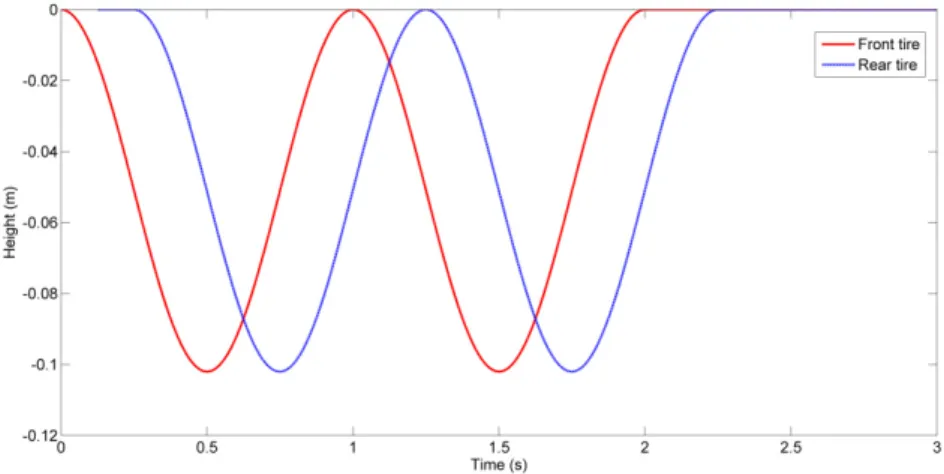
To excite and simulate the half car ride model, the double bump road profile of [9] is used and is shown in fig. 2. The profile has two consecutive depressions of the sinusoidal type with depth (h) of 0.102 m, wavelength (λ) of 24.4
m. Vehicle’s velocity (v) is assumed to be 24.4 m/s, vehicle dimensions as shown in fig.1 are taken as a = 2.03 m, b = 0.25 m and d = 0.76 m and thus time lag between two tires and excitation frequency are given respectively as,
a b d v W (8) 2Sv O Z (9)
3.Multi-Objective Optimization of Half Car Ride Model
This section describes the terminologies and definitions used in multi-objective optimization, an overview of the intelligent MOEAs employed in this paper to optimize the MOOP of the half car ride model and finally the results of the optimization study are presented and discussed.
Fig. 2. Road profile with two consecutive depressions 3.1.Terminologies in multi-objective optimization
A fundamental difference between the single objective optimization problem (SOOP) and the multi-objective optimization problem (MOOP) is, solution of SOOP is usually a single optimum solution i.e. a single set of design variables which gives the optimum value of the corresponding objective function, however, MOOP aims to optimize more than one objectives (mostly conflicting with one-another) simultaneously and thus optimization of such problems yields a set of trade-off solutions (Pareto optimal points) which are non-dominated to one another in context of their corresponding set of objective function values.
In general, an optimal point (X*) that belongs to the feasible region in design variable space is said to be Pareto optimal or Pareto minimal (for minimization problem) [13] with respect to all the points (X) in the feasible region (except the optimal point) iff (i) all the values of the objective functions evaluated at X* (F(X*)) are less than or equal to the ones evaluated at X (F(X)) and, (ii) at least one objective function value found at X* (F(X*)) is less than the one found at X (F(X)). In addition F(X*) is said to be a dominant vector over (F(X)). Set of such Pareto optimal points (design vectors) is known as the Pareto optimal set, and set of objective vectors obtained using Pareto optimal set is known as Pareto front. Thus the algorithms to solve multi/many-objective optimization problems seek for obtaining the Pareto front as an outcome of the optimization process yielding a set of non-dominated trade off points. Moreover, MOOAs should also preserve a good diversity among the obtained Pareto optimal solutions by employing an appropriate diversity preserving methods.
3.2.Overview of NSGA-II, SPEA2 and PESA-II
NSGA-II [1] uses an elitism based non-dominated sorting method for ranking and sorting each individual and uses a crowding distance approach in its section operator for keeping the diversity among the obtained Pareto optimal solutions [4]. In non-dominated sorting, firstly the objective functions are evaluated for each solution and then based on the calculated dominance count and ranks the whole population is sorted into different non-domination levels. Secondly the population is sorted in ascending order and then for each objective the smallest and the largest function values are selected as boundary values and an infinite crowding distance value is assigned to them. The crowding distance between any two neighboring solutions is then calculated based on the normalized difference in the objective function value [14].
SPEA2 [2] uses an external archive which includes the previously found non-dominated solutions and is updated after every generation and for each solution a strength value is computed. Based on this computed strength values the fitness of each individual is computed [4]. The fitness assignment strategy of SPEA2 considers for each solution, the number of solutions that dominate it and that are dominated by it. Further for maintain the diversity it uses the
nearest neighbor density approach and for preserving the boundary solutions it uses the archive truncation method. NSGA-II and SPEA2 are two most widely used MOEAs for comparing the performance of the newly developed MOOAs [4].
PESA-II [3] proposed the region based selection and the unit of selection is a hyperbox in the objective space and selective fitness is assigned to the hyperboxes. This approach was used to reduce the computational cost of Pareto ranking.
3.3.Optimization problem and procedure
The multi-objective constrained optimization problem of optimizing the front and rear suspension systems’ parameters and stiffness and damping coefficients of the driver’s seat for minimizing the root mean squared values of (i) the vertical acceleration experienced by the driver’s seat, (ii) the front tire deflection and (iii) the rear tire deflection is as stated below.
Find the Pareto optimal sets of design variables (optimal design vector) *
>
1 1 4 4 3 3@
T X k c k c k c which minimizes,>
1 2 3@
T F X f X f X f X (10) Subject to, 2 1 1( )
10.3m/ s 0 gq t
d (11) 2 4( )
B( )
0.0508 m 0 gq t
q t
d (12) 3 3( )
A( )
0.0508 m 0 gq t
q t
d (13) 4 1( )
2( )
5( )
0.0508 m 0 gq t
q t
bq t
d (14) 5 2( )
5( )
3( )
0.127 m 0 gq t
aq t
q t
d (15) 6 2( )
5( )
4( )
0.127 m 0 gq t
bdq t
q t
d (16) Here, 2 0 1 1 1 T X f q dt T³
(17)>
@
2 0 2 4 1T B X f q q dt T³
and>
@
2 0 3 3 1 T A X f q q dt T³
(18)The developed MOOP is an extension of the SOOP as described in [9], and g1 is a constraint on the absolute value of seat acceleration, g2, g3andg4 are the constraints on tire deflection and g5, and g6are the constraints on suspension deflection. The objective vector F consists three objective functions f1, f2andf3 which are the RMS values of the seat acceleration, front suspension deflection and rear suspension deflection respectively. All the entities other than the design variables are treated as constants and are as shown in table 1 along with the design variable bounds.
The procedure followed for the multi-objective optimization of the half car ride model is as follows.
Step 1: Initialize the algorithm parameters, design variable bounds, vehicle constants and stopping criteria of MOEA.
Step 2: Start the MOEA (NSGA-II or SPEA2 or PESA-II) and compute the parent generation. For computing offspring generations go to step 3.
Step 3: MOEA calls the Matlab/Simulink half car ride model for getting the evaluations of the objective vector from the set of solutions provided by MOEA and go to step 4.
Step 4: MOEA obtains the Pareto set of solutions and go to step 5. Step 5: If stopping criteria is satisfied then stop otherwise move to step 3. Table 1. Vehicle constants and design variable bounds.
Parameter Value Unit Design variable Bounds Unit
m1 132 kg k1 [8756 87563] N/m m2 20140 kg ct [350 8756] Ns/m I2 4630 kg m2 k4 [35025 175127] N/m mt 44 kg c4 [875 14010] Ns/m kt 262700 N/m k3 [35025 175127] N/m ct 876 Ns/m c3 [875 14010] Ns/m
3.4.Results and Discussion
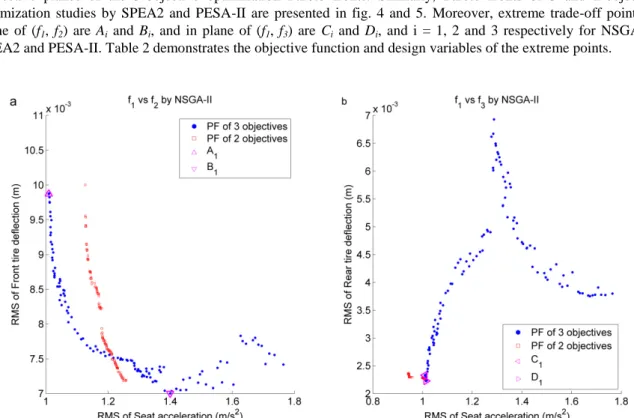
Fig. 3 (a) shows the plane (f1, f2), and (b) shows the plane (f1, f3) of the 3-objective optimization Pareto fronts. In addition the Pareto fronts obtained from 2-objective optimization studies of f1, f2 and f1, f3 are superimposed over the respective planes of the 3-objective optimization Pareto fronts. Similarly, Pareto fronts of 3 and 2-objective optimization studies by SPEA2 and PESA-II are presented in fig. 4 and 5. Moreover, extreme trade-off points in plane of (f1, f2) are Ai and Bi, and in plane of (f1, f3) are Ci and Di, and i = 1, 2 and 3 respectively for NSGA-II, SPEA2 and PESA-II. Table 2 demonstrates the objective function and design variables of the extreme points.
Fig. 3. Pareto fronts obtained from NSGA-II (a) Plane of (f1, f2); (b) Plane of (f1, f3)
As can be seen from the fig. 3, 4 and 5 that for 3-objective optimization study that SPEA2 has a wide spread of Pareto optimal set of solutions as compared to the other two MOEAs. The reason behind this can be attributed to the diversity preserving mechanism of the SPEA2. In 2-objective optimization study for (f1, f2) plane SPEA2 and
PESA-II has a set of more diversified Pareto optimal solution than NSGA-PESA-II, but in plane of (f1, f3) all three algorithms an extremely narrow spread of optimal solutions. Interestingly for 3-objective optimization in plane of (f1, f3) both SPEA2 and PESA-II yield the same extreme point for minimizing f1, and f3, though their extreme points in plane of (f1, f2) are different.
As can be seen from table 2 that NSGA-II is capable to yield marginally better optimal solutions to minimize the objective vector as compared to SPEA2 and PESA-II. Since f2 and f3 are tire deflection of front and rear tires respectively and thus the Pareto front of plane (f2, f3) is not important to make a decision regarding optimized design parameters of individual suspensions and so these Pareto fronts are not presented in the study.
Fig. 4. Pareto fronts obtained from SPEA2 (a) Plane of (f1, f2); (b) Plane of (f1, f3)
Table 2. Comparison of the Pareto front extreme points. Design point k1 (N/m) c1 (Ns/m) k4 (N/m) c4 (Ns/m) k3 (N/m) c3 (Ns/m) f1 (m/s2) f2 (m) f3 (m) A1 86676.238 2019.967 35036.435 13881.11 35109.751 7895.7921 1.00930 0.00987 0.00233 B1 9567.6192 2324.460 35037.002 8333.334 70525.164 875 1.40008 0.00700 0.00472 C1 86676.238 2019.967 35036.435 13881.11 35109.751 7895.7921 1.00930 0.00987 0.00233 D1 85663.618 2016.102 35025.046 14009.997 35027.899 6966.8448 1.01461 0.00955 0.00222 A2 8756 6837.525 35025 13774.184 35025 6033.49073 0.94994 0.00915 0.00235 B2 9974.312 707.076 35026.872 9698.9135 84546.0162 1017.7189 1.89411 0.00699 0.00553 C2 8756 6837.525 35025 13774.184 35025 6033.4907 0.94994 0.00915 0.00235 D2 8756 6837.525 35025 13774.184 35025 6033.4907 0.94994 0.00915 0.00235 A3 58245.977 5877.996 35311.992 13349.881 35512.850 4908.1879 1.01603 0.00880 0.00276 B3 56440.967 5379.648 35070.210 9138.676 89607.612 875 1.31555 0.00716 0.00567 C3 58245.977 5877.996 35311.992 13349.881 35512.850 4908.1879 1.01603 0.00880 0.00277 D3 58245.977 5877.996 35311.992 13349.881 35512.850 4908.1879 1.01603 0.00880 0.0027
4.Conclusions and Future Work
In this paper the potential of the most widely used MOEAs such as NSGA-II, SPEA2 and PESA-II is investigated to optimize the multi-objective optimization problem of the passive vehicle suspension system modeled by the passive half car ride model travelling over the road profile of two successive sinusoidal depressions. The optimization study for 2 and 3-objective optimization was carried out and results showed that the Pareto fronts obtained from NSGA-II yielded extreme trade-off optimal points giving marginally better optimum values of the objective vector as compared to SPEA2 and PESA-II. However, SPEA2 and PESA-II dominate NSGA-II in maintaining the diversity of the Pareto optimal solutions. The effects of the competitive diversity preserving methodologies should be tested over their conventional counterparts of the respective MOEAs for obtaining a wide spread of optimal solutions for the optimization problems having differential equations.
References
[1] Deb K, Pratap A, Agarwal S, Meyarivan T. A fast and elitist multiobjective genetic algorithm: NSGA-II. Evolutionary Computation, IEEE Transactions on 2002;6:182-97.
[2] Zitzler E, Laumanns M, Thiele L, Zitzler E, Zitzler E, Thiele L, et al. SPEA2: Improving the strength Pareto evolutionary algorithm. Eidgenössische Technische Hochschule Zürich (ETH), Institut für Technische Informatik und Kommunikationsnetze (TIK); 2001.
[3] Corne DW, Jerram NR, Knowles JD, Oates MJ, editors. PESA-II: Region-based selection in evolutionary multiobjective optimization. Proceedings of the Genetic and Evolutionary Computation Conference (GECCO’2001; 2001: Citeseer.
[4] Coello CC, Lamont GB, Van Veldhuizen DA. Evolutionary algorithms for solving multi-objective problems: Springer Science & Business Media; 2007.
[5] Gadhvi B, Savsani V, editors. Passive Suspension Optimization Using Teaching Learning Based Optimization and Genetic Algorithm Considering Variable Speed Over a Bump. ASME 2014 International Mechanical Engineering Congress and Exposition; 2014: American Society of Mechanical Engineers.
[6] Gobbi M, Mastinu G. Analytical description and optimization of the dynamic behaviour of passively suspended road vehicles. Journal of sound and vibration 2001;245:457-81.
[7] Chi Z, He Y, Naterer GF. Design optimization of vehicle suspensions with a quarter-vehicle model. CSME Transactions 2008;32:297-312. [8] Alkhatib R, Jazar GN, Golnaraghi M. Optimal design of passive linear suspension using genetic algorithm. Journal of Sound and vibration 2004;275:665-91.
[9] Baumal A, McPhee J, Calamai P. Application of genetic algorithms to the design optimization of an active vehicle suspension system. Computer methods in applied mechanics and engineering 1998;163:87-94.
[10] Haug EJ, Arora JS. Applied optimal design: mechanical and structural systems: John Wiley & Sons; 1979. [11] Goldberg DE, Holland JH. Genetic algorithms and machine learning. Machine learning 1988;3:95-9.
[12] Hays J, Sandu A, Sandu C, Hong D. Parametric design optimization of uncertain ordinary differential equation systems. Journal of Mechanical Design 2012;134:081003.
[13] Jamali A, Atashkari K, Nariman-zadeh N. Multi-objective Uniform-diversity Genetic Algorithm (MUGA): INTECH Open Access Publisher; 2008.
[14] Tian H, Yuan X, Ji B, Chen Z. Multi-objective optimization of short-term hydrothermal scheduling using non-dominated sorting gravitational search algorithm with chaotic mutation. Energy Conversion and Management 2014;81:504-19.
![Fig. 1. Five degrees of freedom half car model adopted from [9].](https://thumb-us.123doks.com/thumbv2/123dok_us/806195.2601914/3.816.145.687.92.583/fig-degrees-freedom-half-car-model-adopted.webp)