Computational Analysis of
Structure-Activity Relationships
From Prediction to Visualization Methods
Dissertation
zur Erlangung des Doktorgrades (Dr. rer. nat.) der Mathematisch-Naturwissenschaftlichen Fakultät der Rheinischen Friedrich-Wilhelms-Universität Bonn
vorgelegt von
Anne Mai Wassermann aus Göttingen
1. Gutachter: Univ.-Prof. Dr. rer. nat. Jürgen Bajorath 2. Gutachter: Univ.-Prof. Dr. med. Joachim Schultze Tag der Promotion: 05. Juli 2012
Abstract
Understanding how structural modications aect the biological activity of small molecules is one of the central themes in medicinal chemistry. By no means is structure-activity relationship (SAR) analysis a priori dependent on compu-tational methods. However, as molecular data sets grow in size, we quickly approach our limits to access and compare structures and associated biological properties so that computational data processing and analysis often become essential.
Here, dierent types of approaches of varying computational complexity for the analysis of SAR information are presented, which can be applied in the con-text of screening and chemical optimization projects. The rst part of this thesis is dedicated to machine-learning strategies that aim at de novo ligand prediction and the preferential detection of potent hits in virtual screening. High empha-sis is put on benchmarking of dierent strategies and a thorough evaluation of their utility in practical applications. However, an often claimed disadvantage of these prediction methods is their black box character because they do not necessarily reveal which structural features are associated with biological ac-tivity. Therefore, these methods are complemented by more descriptive SAR analysis approaches showing a higher degree of interpretability. Concepts from information theory are adapted to identify activity-relevant structure-derived descriptors. Furthermore, compound data mining methods exploring prespeci-ed properties of available bioactive compounds on a large scale are designprespeci-ed to systematically relate molecular transformations to activity changes. Finally, these approaches are complemented by graphical methods that primarily help to access and visualize SAR data in congeneric series of compounds and allow the formulation of intuitive SAR rules applicable to the design of new compounds. The compendium of SAR analysis tools introduced in this thesis investigates SARs from dierent perspectives.
Acknowledgments
I would like to thankmy PhD supervisor Prof. Dr. Jürgen Bajorath for his continuous inspira-tion, valuable mentorship, and thoughtful advices on scientic and personal questions
Prof. Dr. Joachim Schultze for taking the time to review this thesis as a co-referent
Dr. Martin Vogt who was always approachable for my questions and answered them with immeasurable patience, kindness, and attention to detail
Dr. Hanna Geppert, Dr. Lisa Peltason, and Dr. Dagmar Stumpfe who intro-duced me to dierent aspects of chemoinformatics and from whom I learned in numerous ways
my dear friend and colleague Dr. Mathias Wawer for his reliable support, his sincere scientic opinion on countless occasions, and the many good times we shared in our oce
Dilyana Dimova, Kathrin Heikamp, and Dr. Britta Nisius for pleasant and productive collaborations that contributed to the completion of this thesis Boehringer Ingelheim Pharma for funding
Contents
1 Introduction 1
2 Molecular Representations and Compound Databases 11
2.1 Molecular Representations . . . 11
2.1.1 Linear Notation . . . 12
2.1.2 Molecular Descriptors . . . 12
2.1.3 Fingerprints . . . 14
2.2 Public Domain Compound Databases . . . 16
3 Ligand Prediction for Orphan Targets 19 3.1 Support Vector Machine Theory . . . 21
3.1.1 Classication in Original Feature Spaces . . . 22
3.1.2 Classication in Transformed Feature Spaces . . . 23
3.1.3 From Classication to Ranking . . . 25
3.2 Chemogenomics-Oriented SVM Strategies . . . 25
3.2.1 SVM with Target-Ligand Kernel . . . 26
3.2.2 SVM Linear Combination . . . 28
3.2.3 Homology-Based SVM . . . 29
3.3 Target and Ligand Kernels . . . 30
3.4 Data and Calculations . . . 32
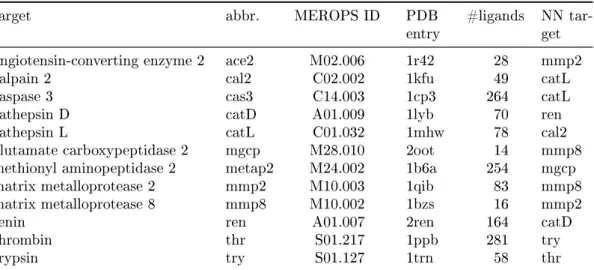
3.4.1 Target and Ligand Systems . . . 32
3.4.2 Search Calculations . . . 34
3.5 Results . . . 36
3.5.1 Global Kernel Performance . . . 36
3.5.2 Target-Dependent Kernel Performance . . . 38
3.5.3 Nearest Neighbor Eects . . . 41
3.6 Conclusions . . . 42
4 Preferential Detection of Potent Hits in LBVS 45 4.1 Data, Search Strategies, and Calculations . . . 46
4.1.1 High-Throughput Screening Data Sets . . . 46
4.1.2 Support Vector Machine Search Strategies . . . 46
4.1.3 Search Calculations . . . 49 i
4.2.2 Control Calculations . . . 53
4.3 Conclusions . . . 54
5 Selection of Compound Class-Specic Descriptors 57 5.1 Shannon Entropy . . . 58
5.2 Dierential Shannon Entropy . . . 61
5.3 Mutual Information-DSE . . . 64
5.4 Applications . . . 66
5.4.1 Descriptor Ranking and Correlation Analysis . . . 66
5.4.2 Comparison of Top-Ranked DSE and MI-DSE Descriptors 67 5.5 Conclusions . . . 70
6 Activity Cli Survey 71 6.1 Data and Calculations . . . 72
6.1.1 Data Sets . . . 72
6.1.2 Activity Cli Calculations . . . 72
6.2 Results . . . 74
6.2.1 Global Activity Cli Distribution . . . 74
6.2.2 Target Family Distribution . . . 75
6.2.3 Activity Cli Directionality . . . 76
6.2.4 Polypharmacological Clis . . . 78
6.3 Conclusions . . . 78
7 Relating Molecular Transformations to Potency Eects 79 7.1 MMPs and Molecular Transformations . . . 80
7.1.1 Hussain and Rea Algorithm . . . 81
7.2 Activity Cli-Introducing Chemical Replacements . . . 83
7.2.1 Compound Data Sets . . . 83
7.2.2 Transformation Selection Criteria . . . 84
7.2.3 Results . . . 85
7.2.4 Summary . . . 90
7.3 Bioisosteric Replacements . . . 91
7.3.1 Compound Data Sets . . . 92
7.3.2 Transformation Selection Criteria . . . 92
7.3.3 Results . . . 93
7.3.4 Summary . . . 100
7.4 Target-Family Directed Bioisosteric Replacements . . . 101
7.4.1 Compound Data Sets . . . 101
7.4.2 Transformation Selection Criteria . . . 101
7.4.3 Results . . . 102
7.5 Conclusions . . . 106 ii
8 Structure-Activity Relationship Patterns in Series of Analogs 109
8.1 Methodology . . . 110
8.1.1 R-group Deconvolution and Signature Formation . . . . 110
8.1.2 DRCG Design and Visualization . . . 111
8.2 SAR Patterns . . . 116
8.3 Applications . . . 119
8.3.1 Compound Data Sets . . . 119
8.3.2 Melanocortin Receptor 4 Antagonist Series 1 . . . 119
8.3.3 Melanocortin Receptor 4 Antagonist Series 2 . . . 121
8.3.4 Norepinephrine Transporter Inhibitor Series . . . 124
8.3.5 Dopamine D1 Receptor Antagonist Series . . . 126
8.4 Conclusions . . . 128
9 Selectivity Determinants in Series of Analogs 129 9.1 Methodology . . . 130
9.1.1 CAG Data Structure . . . 130
9.1.2 Adaptation to Multi-Target SAR Analysis . . . 132
9.2 Derivation of SAR Rules . . . 135
9.2.1 Substituent Preference Orders . . . 135
9.2.2 Design of Target-Selective Compounds . . . 138
9.3 Applications . . . 139
9.3.1 Compound Data Sets . . . 139
9.3.2 Serine Protease Inhibitor Series 1 . . . 139
9.3.3 Serine Protease Inhibitor Series 2 . . . 143
9.4 Conclusions . . . 145
10 SAR Transfer 147 10.1 Methodology . . . 149
10.1.1 Identication of Alternative Scaolds . . . 149
10.1.2 Identication of Corresponding Analogs . . . 150
10.1.3 Potency-Based Compound Ordering and SAR Transfer Score . . . 151
10.2 Applications . . . 153
10.2.1 SAR Transfer Detection for Selected Analog Series . . . 153
10.2.2 Systematic SAR Transfer Detection . . . 160
10.3 Conclusions . . . 163
11 Summary and Conclusions 167
Bibliography 171
A Software and Databases 183
C Potency-Directed LBVS Additional Information 195
D Class-Specic Descriptors Additional Information 199
E Molecular Transformations Additional Information 203
F R-Group Table 213
List of Abbreviations
1D one-dimensional
2D two-dimensional
3D three-dimensional
AID PubChem assay identier
CAG combinatorial analogue graph DAG directed acyclic graph
DRC directed R-group combination DRCG directed R-group combination graph DSE Dierential Shannon Entropy
EC50 half maximal eective concentration
ECFP extended-connectivity ngerprint
GO Gene Ontology
GPCR G protein-coupled receptor H-bond hydrogen bond
hAR human adenosine receptor HTS high-throughput screening
IC50 half maximal inhibitory concentration
ID identier
Ki inhibitor dissociation constant
LBVS ligand-based virtual screening v
MCS maximum common subgraph
MDDR MDL Drug Data Report
MI mutual information
MMP matched molecular pair
MMPA matched molecular pair analysis MOE Molecular Operating Environment
mtSAR multi-target structure-activity relationship pKi negative decadic logarithm of Ki
QSAR quantitative structure-activity relationship SAK structure-activity kernel
SAR structure-activity relationship
SMILES Simplied Molecular Input Line System SPP similarity-property principle
SSR structure-selectivity relationship SVM support vector machine
Tc Tanimoto coecient
TGD typed graph distance
TLK target-ligand kernel
uPA urokinase
VS virtual screening
Chapter 1
Introduction
Chemoinformatics encompasses the development and application of computa-tional methods to solve chemical problems. Although the term chemoinformat-ics was only introduced about a decade ago, it refers to a research eld with a long tradition because individual areas of chemoinformatics, such as chemi-cal structure representation and searching, molecular modeling, and computer-assisted structure elucidation, have their origins back in the 1960s [1]. Since then, the interest in computational methods in chemistry has continuously grown. The rising popularity is largely ascribed to increasing amounts of data that are produced and cannot be dealt with without computational means [2]. In particular, the introduction of combinatorial chemistry and high-throughput screening (HTS) has triggered the need for computational data management and analysis which is facilitated by continuing advances in computational power. These technological innovations have also paved the way for the establishment of chemoinformatics methods in the pharmaceutical industry.
Pharmaceutically-oriented chemoinformatics focuses on small molecules and their interactions with targets, i.e., their biological activity. A prime ob-jective of chemoinformatics methods is the identication of compounds with desired biological activities that might ultimately become drug candidates. To these ends, it is of central importance to analyze and understand the rela-tionship between chemical structure and biological activity of small molecules. Currently available approaches to structure-activity relationship (SAR) analysis are multifaceted and of rather dierent methodological complexity. A general distinction can be made between methodologies that primarily help to access and visualize SAR data obtained from HTS or chemical optimization campaigns and those that ultimately predict biological activities. In this thesis, both kinds of methodologies are employed for the analysis and exploitation of SARs.
Prediction Methods in SAR Analysis
Virtual screening (VS) techniques process large databases of compounds in sil-ico and are often considered as a cost-ecient complement to HTS [3]. Ligand-based VS (LBVS) utilizes information from known bioactive molecules to iden-tify novel structures exhibiting the desired bioactivity. From a conceptual point of view, LBVS is based on the similarity-property principle (SPP) [4] that was articulated by Johnson and Maggiora in 1990 and states that overall structurally similar molecules should have similar biological properties. This `holistic' view of molecular similarity [5] provides the basis for similarity searching [6]. Following this approach, one or multiple known bioactive molecules are used as reference compounds for comparison with database compounds of unknown bioactivity. The degree of `whole molecule'-similarity between a database compound and the reference set is quantitatively assessed through the representation of en-tire compounds by sets of structure-derived descriptors and the application of a mathematical function that measures the similarity between descriptor sets. Database compounds are then ranked in order of decreasing similarity to the reference set. According to the SPP, top-ranked molecules are most likely to exhibit the desired bioactivity and constitute prime candidates for biological testing. In compound classication approaches, test molecules are usually com-pared to active and inactive reference compounds and assigned to the class to which they are more similar.
A more rened view of molecular similarity is used in the analysis of phar-macophores [7] or quantitative structure-activity relationships (QSARs) [8]. These methods focus on `local' similarities [5] in the study of biological activity determinants. Pharmacophore analysis aims at generating a hypothesis about the spatial arrangement of groups of functionalities in a molecule that render it active by forming interactions with a biological target of interest. These feature arrangements determine the pharmacophore model that is subsequently used in database screening to prioritize molecules with similar geometric features. QSAR correlates biological activities of congeneric compounds with selected structural features and/or properties represented as numerical chemical descrip-tors. For a set of reference molecules, a numerical relationship between potency and selected descriptors is established to deduce a regression model that takes descriptor values of any compound as input and returns its predicted activity value. It follows that the selection of activity-relevant descriptors is highly crit-ical for the prediction quality of QSAR models. Furthermore, QSAR models are usually built from series of structurally closely related compounds. There-fore, test compounds of a dierent chemotype than the reference molecules fall outside of the applicability domain of most QSAR models and their activity cannot be reliably predicted [9].
3
Limitations of Prediction Methods
Over the past few years, the integration of machine-learning and articial intel-ligence concepts has led to increasingly sophisticated QSAR and LBVS methods with improved prediction accuracies [10,11]. Nevertheless, in many cases, these methods still fail to produce reliable predictions for test compounds, even in the presence of highly similar reference compounds [12]. These observations can be explained by the limited validity of the concept underlying these approaches: although the SPP is intuitive and a central paradigm in medicinal chemistry, it is frequently observed that small modications of chemical structure can signicantly alter compound activity [13]. This nding can be rationalized by the specicity of molecular recognition processes that require a high degree of complementarity between interacting surfaces. For example, the precise t of a molecule into a binding site and the formation of key interactions with a target can easily be hindered by a small structural modication that changes molecular shape or charge distribution. The term activity cli refers to compound pairs showing high structural similarity but large dierences in activity [14]. Activity clis are exploited by medicinal chemists in hit-to-lead and lead optimization projects where small structural modications are systematically applied to an initial hit compound in order to achieve improved compound potency [13]. On the other hand, activity clis strongly complicate molecular similarity analysis and represent challenges for QSAR and LBVS applications, often making them a hopeless endeavor [12]. In light of the limited applicability of quantitative prediction and compound classication methods and their strong dependency on the nature of the SARs present in the activity class under study (vide in-fra), it is attractive to extend the spectrum of available SAR analysis methods with descriptive approaches that aim at the extraction of interpretable SAR information from compound data sets. These methods are primarily designed to guide compound design in hit-to-lead and lead optimization campaigns but do not generalize extracted patterns to new data in an automated manner. Furthermore, these approaches circumvent the black box character of many prediction methods that do not enable the user to trace back prediction re-sults to molecular structure and do not reveal which structural features are ultimately activity-relevant.
Data Mining and Visualization Techniques in
SAR Analysis
Various computational data mining and visualization methods have been devel-oped to systematically identify interesting SAR features in activity-annotated compound data sets and present them in an interpretable way [15]. Scopes of
these methodologies are highly variable, ranging from the mere structuring of SAR data to the automated extraction of actual SAR information [16]. For ex-ample, standard clustering which is often applied in the analysis of large screen-ing data sets makes use of whole-molecule similarity to group structurally simi-lar compounds together. Often, single clusters contain congeneric series of com-pounds that show only small structural variations. In these cases, a subsequent visual inspection of clustered structures may lead to the recognition of SAR pat-terns, but the retrieval of interpretable SAR information is left to the medicinal chemist [15,16]. More informative are substructure-centric approaches that pro-vide direct access to bioactivity values associated with structural fragments. A data structure called scaold tree [17] systematically generates molecular build-ing blocks from sets of bioactive compounds by rst prunbuild-ing all side chains and then iteratively removing rings from molecular structures. The organization of the generated substructures in a hierarchy and their annotation with bioactiv-ity values of the compounds from which they were extracted [18] enables the identication of activity-prevalent molecular frameworks (also termed scaolds) which can subsequently be exploited to design novel active compounds [19]. Such data mining approaches are not limited to the study of compounds sharing the same bioactivity. For example, the systematic comparison of substructures across dierent targets and target families allows to distinguish fragments that exclusively occur in ligands sharing a specic bioactivity [20,21] from molecular entities that promiscuously bind to many dierent targets [22, 23] and pose a high risk of adverse drug reactions [24]. For later stages of medicinal chemistry eorts that focus on the optimization of series of structurally similar com-pounds, understanding potency eects of chemical substitutions is of central importance. For this purpose, computational approaches have been designed that either highlight interesting activity patterns for a particular chemotype under study [25] or systematically investigate eects of common chemical sub-stituents on ligand potency across dierent activity classes [26,27].
Conceptually dierent from the above mentioned methodologies are so-called SAR proling methods that integrate the analyses of the structural simi-larity of and potency dierences between bioactive compounds and characterize the nature of the SARs underlying a compound set [16]. In principle, three dif-ferent SAR categories are distinguished [28]. Continuous SARs are found in sets of compounds where gradual structural changes result in only small to moderate changes in compound potency, and increasingly diverse structures fall within the same potency range. In compound sets showing a discontinuous SAR type, small changes in compound structure lead to large-magnitude changes in po-tency. Activity clis represent the extreme form of SAR discontinuity. However, continuous and discontinuous SARs are not mutually exclusive and often co-occur in dierent subsets of a compound class. The SAR in these data sets is therefore termed heterogeneous. Knowledge about the SAR type inherent to a
5
class of compounds is of paramount importance and of high practical utility. Whereas discontinous SARs are considered as an indicator for the evolvability of compound sets and can be used for the prioritization of hits for further opti-mization, continuous SARs are a prerequisite for the successful applicability of QSAR and LBVS methods (vide supra). Numerical functions have been devised to quantitatively describe the nature of SARs [29, 30] and have only recently been complemented by a number of graphical visualization methods that pro-vide an intuitive access to global and local SARs underlying compound data sets and reveal the presence of interpretable SAR rules [31].
Research Topics
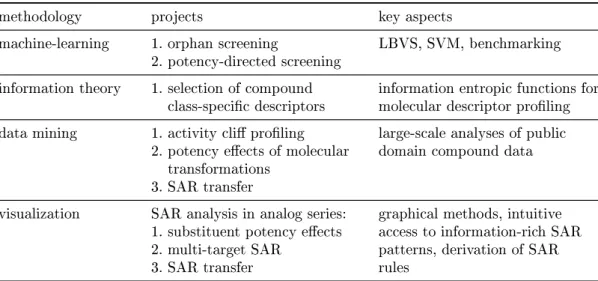
In this thesis, various aspects of SAR analysis are investigated and compu-tational methodologies that aid in the elucidation and exploitation of SAR information in dierent ways are presented. These approaches can be grouped thematically into the four areas of machine-learning, information theory, data mining, and visualization techniques. In the following, a brief overview of all research projects presented in this dissertation is given. A classication of the projects according to key methodological aspects is provided in Table 1.0-1.
Support Vector Machines in Orphan and
Potency-Directed Screening
The term support vector machine (SVM) [32] refers to a machine-learning tech-nique that has gained wide popularity in LBVS because of its ability to build complex but robust prediction models. Though originally introduced for classi-cation, SVMs have been adapted to generate rankings of test databases and sort compounds by decreasing likelihood of being active [33]. We were interested in the specic tailoring of SVM strategies to two particularly challenging tasks in LBVS: orphan and potency-directed screening.
Orphan screening [11] aims at the identication of ligands for targets for which no known ligands are available. LBVS is usually not applicable in the absence of known active molecules. However, recent studies have introduced LBVS approaches that employ ligand information from similar targets to predict ligands for orphan targets [3437]. Here, the key question is how to best dene target similarity and weight the inuence of ligands from dierent targets in the prediction model. To address this question, we employed dierent strategies to integrate a variety of target similarity functions and/or dierently composed ligand reference sets into SVM learning and systematically compared them in simulated virtual screening trials on two dierent target protein systems.
Potency-directed screening approaches the question as to how compound potency information can be integrated into LBVS as an additional search
pa-rameter. In contrast to QSAR modeling, LBVS typically does not take com-pound potency into consideration, although the ability to direct search calcu-lations towards the recognition of potent hits would certainly be attractive for practical applications. Therefore, we designed SVM-based strategies that do not only learn to separate active from inactive molecules but also distinguish between highly, intermediately, or weakly active compounds by incorporating categorized potency labels of reference molecules into model training. To assess their ability to enrich database selection sets with potent hits, the strategies were benchmarked on four HTS data sets.
Selection of Compound Class-Specic Descriptors
Descriptors that capture compound class-specic and biological activity-relevant information are of high interest for the exploration of structure-activity relation-ships and a major determinant for the success of LBVS and QSAR applications. The identication of compound class-specic information generally requires the comparison of descriptor value ranges and information content in a set of com-pounds having a desired property and data sets where all or at least the majority of compounds lack this property. This is in principle possible through adapta-tions of the Shannon entropy concept [38] from information theory. However, previous adaptations of this concept for descriptor proling are insucient to select discriminatory descriptors for data sets that dramatically dier in size. To circumvent these diculties, we transformed a previously introduced infor-mation entropic strategy into mutual inforinfor-mation analysis, a related concept, and investigated its utility to identify discriminatory descriptors on more than 160 activity classes.
Systematic Proling of Activity Clis
Activity clis are considered to contain high SAR information content and have important implications for drug discovery eorts from more than one point of view (vide supra). Although activity clis have been intensely studied in individual compound sets, an open question is how they are globally distributed across available bioactive compounds and protein targets. Furthermore, the frequency of multi-target clis, i.e., pairs of similar compounds showing large potency dierences for multiple targets, is currently unknown. Therefore, we designed and carried out a large-scale data mining study that systematically searched for single- and multi-target activity clis in public domain compounds with reported activity against human targets.
7
Potency Eects of Molecular Transformations
In medicinal chemistry, potency eects of structural modications are often studied on a case-by-case basis for series of structurally related compounds. However, it would also be interesting to know whether certain structural mod-ications have a higher propensity to retain or considerably change compound potency than others, irrespective of the chemotype or specic bioactivity of the compound they are applied to. To investigate this question, we used the framework of matched molecular pairs (MMPs) [39] to systematically extract molecular transformations from publicly available compound data annotated with activity values against human targets. An MMP is dened as a pair of two structurally related compounds that dier only at a single localized site and are hence distinguished by a dened substructure. Hence, a characteris-tic of an MMP is that the compounds forming the pair are related to each other by a well-dened transformation. Identied molecular transformations were then associated with potency changes and dened criteria were applied to identify chemical substitutions that frequently introduce activity clis or con-sistently produce only small to moderate changes across dierent compound classes and biological targets. Furthermore, potency-retaining structural modi-cations, herein referred to as bioisosteric replacements, were also investigated at the level of individual target families.
SAR Analysis of Analogous Compound Series
In compound optimization during later stages of medicinal chemistry eorts, SAR exploration primarily aims at the analysis and design of analogs of ac-tive compounds with further improved properties. A central issue in lead op-timization is the improvement of compound potency. SARs for analog series are traditionally studied using R-group tables that contain the core structure common to a series of analogs and rows displaying the substituents of indi-vidual compounds. Although user-friendly extensions of R-group tables have been developed, SAR features resulting from combinations of R-groups at mul-tiple substitution sites cannot be analyzed in a straightforward and consistent manner. For this reason, we aimed to develop a visualization method that is specically tailored towards a systematic exploration and intuitive interpreta-tion of SAR features involving dierent R-groups and their combinainterpreta-tions. To assess the potential of our newly designed data structure to uncover SAR rules, we inspected multiple data sets for the occurrence of predened information-rich SAR patterns.
Another important theme in lead optimization is the study of molecular specity of active compounds. Although many currently marketed drugs are known to interact with multiple targets [40], cross-reactivity can also lead to severe side eects and might be a major reason for the failure of many drugs in
Table 1.0-1: Research projects
methodology projects key aspects
machine-learning 1. orphan screening LBVS, SVM, benchmarking
2. potency-directed screening information theory 1. selection of compound
class-specic descriptors information entropic functions formolecular descriptor proling data mining 1. activity cli proling large-scale analyses of public
domain compound data 2. potency eects of molecular
transformations 3. SAR transfer
visualization SAR analysis in analog series: graphical methods, intuitive access to information-rich SAR patterns, derivation of SAR rules
1. substituent potency eects 2. multi-target SAR
3. SAR transfer
clinical trials [41]. Therefore, rendering compounds with multi-target activity target-selective is a major goal of chemical optimization eorts and requires the systematic comparison of SARs for multiple target. However, the computational study of multi-target SARs (mtSARs) is still in its infancy. To these ends, we developed a methodological framework for the study of mtSARs that comprises a uniform R-group decomposition of analogs, their comparison on the basis of pharmacophore feature edit distances, and their organization in a previously reported hierachical structure [42] that reects SAR discontinuity at substitu-tion sites and their combinasubstitu-tions. We then tested the approach for its ability to identify substitution sites that are selectivity determinants and to determine preference orders for chemical modications to improve target selectivity.
In light of the objective of comprehensively improving compound proper-ties in lead optimization before moving a drug candidate to later stages of drug discovery, it frequently happens that a compound series displaying an otherwise promising SAR fails to reach further development, perhaps due to inescapable metabolic or toxicological issues. In such situations, one would ideally like to build upon prior knowledge, utilize available SAR information, and evaluate the possibility of an SAR transfer, i.e., the exploration of an alternative com-pound series that displays similar SAR characteristics and potency progression but lacks the liabilities associated with the original chemotype. SAR transfer is also interesting from the point of view that combining the SAR analyses of two chemically dierently explored series with transferable SAR might reveal more information than their separate examination. However, a comprehensive literature search did not reveal computational methods available to aid in the identication of such parallel series. This motivated us to design a data min-ing approach that enables the identication of alternative analog series with
9
dierent core structures, corresponding substitution patterns, and compara-ble potency progression. We applied the methodology to search for alternative chemotypes for selected analog series and to systematically assess SAR transfer potential in a public compound repository.
Thesis Outline
This thesis is structured as follows. Chapter 2 introduces fundamental concepts of molecular representations in chemoinformatics including the linear notation of molecular graphs, numerical chemical descriptors, and ngerprints. Further-more, a standard similarity measure for the comparison of small molecule n-gerprint representations is briey described. The second part of the chapter discusses the increasing availability of public domain bioactivity data and gives a short overview about major compound databases that are of paramount im-portance for computer-aided drug discovery and chemoinformatics.
Chapter 3 reports ligand prediction for orphan targets using support vector machines. First, dierent approaches to orphan screening are summarized and an introduction into SVM theory is given. Then our study investigating the role of target information in nding ligands for orphan targets is reported in detail and implications of the results for practical applications are discussed.
Chapter 4 describes the adaptation of SVM strategies from orphan screen-ing to potency-oriented LBVS. The design and results of our benchmark study on four HTS data sets are presented and the practical utility of potency-directed SVM strategies for early-stage drug discovery is discussed in light of our nd-ings.
Chapter 5 addresses the selection of descriptors capturing compound class-specic information. Concepts from information theory are presented and their potential to identify discriminatory descriptors is compared on a large array of activity classes. Furthermore, representative examples are chosen to illustrate benets and shortcomings of individual methods in detail.
Chapter 6 investigates the occurrence of activity clis in public domain compound data. Special emphasis is put on activity cli distributions in dier-ent target families and a frequency analysis of multi-target activity clis.
Chapter 7 introduces the concept of matched molecular pairs and highlights its utility as a consistent reference framework for the identication of molec-ular transformations. A public domain compound repository is systematically searched for molecular transformations that are related to resulting potency changes. Sets of chemical replacements with a high potential to introduce ac-tivity clis or produce compounds with similar potency levels are identied.
Chapter 8 reports a newly designed graph structure representing entire series of analogs in a consistent manner. Graph components are designed to represent well-dened SAR patterns and provide immediate access to
activity-relevant substitution sites and R-group combinations. Exemplary analyses of dierent analog series illustrate how SAR determinants are identied on the basis of interactive graphical analysis and how such insights can be utilized to design new analogs.
Chapter 9 discusses the adaptation of a previously introduced hierarchical tree-like graph structure for a parallel SAR analysis of multiple targets. Two exemplary applications are reported that illustrate the ability of the approach to derive simple rules for the design of substitutions that are likely to yield target-selective compounds.
Chapter 10 presents a novel computational approach to study the transfer of SAR information from one chemical series to another. The new methodology can be applied to search for alternative analog series if one series is known or, alternatively, to systematically assess SAR transfer potential in compound databases. For both settings, exemplary applications are reported. Possibilities to further rationalize the process of SAR transfer are outlined.
Chapter 11 summarizes major ndings and general conclusions of the work presented in this dissertation.
Chapter 2
Molecular Representations and
Compound Databases
This chapter discusses basic concepts of molecular representations and similar-ity analysis, which are recurrent themes throughout this thesis, and reports on public domain repositories of compound structures and activity data as indis-pensable tools for pharmaceutical research in academic environments.
The analysis of structure-activity relationships requires dened represen-tations of compounds that can be related to their biological activity. Further-more, in many instances, the extraction of SAR information from compound data sets frequently relies on pairwise structural comparisons of small molecules and, hence, on the application of similarity measures that assess the degree of structural relatedness between compounds. In this chapter, frequently employed representations for small molecules are introduced in section 2.1, with a focus on ngerprint representations and their similarity assessment. Because publicly available bioactivity data provides essential resources for structure-activity data mining and the evaluation of chemoinformatics and drug design methods, sec-tion 2.2 is dedicated to the descripsec-tion of dierent categories of freely accessible compound databases.
2.1 Molecular Representations
Probably the most well-known description of compounds is the molecular graph representation. In a chemical graph, the atoms composing a molecule are rep-resented as nodes and bonded atoms are connected by edges indicating the type of bond, e.g., a single, double, or aromatic bond. A graph does not rep-resent three-dimensional structure information but the topology of a molecule. The graph can also be annotated with stereochemical information, which de-nes the relative spatial arrangements of selected atoms. To process and store molecular graphs on a computer, they are often encoded as connection tables
that are composed of an atom list and a bond list. In the atom list, the atoms of the molecules are provided in a sequential order, whereas the bond list species connections between pairs of atoms.
2.1.1 Linear Notation
A more compact and readable description of molecular graphs are linear nota-tions, such as the popular Simplied Molecular Input Line System (SMILES) [43], which capture the structure of a molecule in form of an unambiguous text string using alphanumeric characters. They allow the ecient storage and fast processing of large numbers of molecules. The SMILES language uses the following basic rules for encoding molecules [43]:
1. Atoms are represented by their atomic symbols. Hydrogen atoms saturating free valences are not explicitly denoted.
2. Neighboring atoms stand next to each other and bonds are characterized as being single (-), double (=), triple (#), or aromatic (:). Single and aromatic bonds are usually omitted.
3. Enclosures in parentheses specify branches in the molecular structure. 4. For the linear representation of cyclic structures, a bond is broken in each
ring and the connecting ring atoms are followed by the same digit in the textual representation.
5. Atoms in aromatic rings are indicated by lower case letters.
Figure 2.1-1 uses intuitive examples to illustrate the general concepts of the SMILES language. Although SMILES strings are unambiguous in the descrip-tion of chemical structures, they are not unique because multiple valid SMILES representations exist for the same molecular graph, as also illustrated in Figure 2.1-1. To facilitate the comparison of molecular structures by SMILES rep-resentations and enable a fast check for molecular identity, algorithms have been introduced that ensure that the same SMILES string, also termed canon-ical SMILES, is always calculated for a given molecular graph [44]. Canoncanon-ical SMILES strings are often used to ensure uniqueness of molecules in a database.
2.1.2 Molecular Descriptors
The majority of chemoinformatics methods rely on the representation of molec-ular structure and properties by numerical descriptors. Such descriptors are suitable as input for statistical and data mining methods. Accordingly, prop-erty descriptors are frequently employed in diversity analysis, representative
2.1. Molecular Representations 13
N C CCC=C N#CC CC(F)CC CC(C)CC(=O)OC
Atoms Bonds Branches
Rings Aromaticity Clc1cc(Cl)ccc1 c1c(Cl)cccc1Cl OC1CCCCC1 C1CCCCC1O c1ccc2ccoc2c1 o1c2c(cccc2)cc1 C1=CCC2CCCCC2C1 C12C(CCCC1)CC=CC2
Figure 2.1-1: SMILES concepts Examples for the illustration of basic SMILES syntax rules are provided. Each molecular structure is annotated with one or multiple valid SMILES strings.
compound subset selection, combinatorial library design, and QSAR investiga-tions.
Literally thousands of dierent molecular descriptors of greatly varying mathematical complexity are available [45]. Molecular descriptors are often classied as one-, two-, or three-dimensional (1D, 2D, or 3D), depending on the molecular representation from which they are calculated [3]. 1D descriptors are derived from the chemical formula. Examples include bulk properties, such as molecular weight, or simple atom counts. 2D descriptors are typically derived from a molecular graph representation and comprise, for example, topological descriptors or computational approximations to experimental measurements, such as solubilities or dipole moments. 3D descriptors are based on molecular conformations and often account for molecular surfaces, volumes, or surface-derived properties.
Typically, combinations of many descriptors are calculated for molecular data sets that then constitute chemical reference spaces where each descriptor adds a dimension to the space. In this reference space, the position of a molecule is determined by its descriptor values that serve as coordinates and similarity between molecules is dened by their spatial proximity that can be calculated by various measures [6]. Many descriptor spaces that are utilized in chemoin-formatics are high-dimensional. However, for applications such as compound classication or QSAR, the dimensionality of chemical reference spaces is often reduced in order to focus on features that are most descriptive and
predic-1 1
1 1
1 0 1 0 0 0 1 0 0 0 1 0 0 1 0 1 0 0 0 0 0 1 0 0 keyed fingerprint pharmacophore fingerprint
circular fingerprint a) b) c) donor acceptor cationic anionic 1 1 0 0 0 0 0 0 0 0 0 0 0 circular fingerprint 1
Figure 2.1-2: Fingerprints (a) In a keyed structural ngerprint, each bit accounts for the presence of a dened structural fragment. Here, bit positions encoding an aromatic ring, a carbonyl group, a heteroatom-containing ring, and a nitrogen attached to three carbon atoms are highlighted. (b) In a pharmacophore ngerprint, each bit accounts for the spatial arrangement of a dened atomic feature combination. Here, bits that account for dened geometric arrangements of the combinations donor - acceptor - anionic and donor - acceptor - cationic are highlighted. (c) In circular ngerprints, local atom environments are mapped to individual bit positions. Around a selected atom, three circular layers up to a diameter of four bonds are drawn, and the extracted substructural fragments are shown on the right. Attachment points constituting non-hydrogen atoms are marked by an asterisk.
tive for a given data set and to provide a basis for chemical interpretation of the results.
2.1.3 Fingerprints
Fingerprints are a special form of a complex descriptor capturing feature dis-tributions as bit string representations [46]. Apart from a general classica-tion into 2D and 3D ngerprints in analogy to the categorizaclassica-tion for molecu-lar descriptors, four broad classes of ngerprints are distinguished: keyed and path-based ngerprints, pharmacophore-based ngerprints, binary circular n-gerprints, and circular ngerprints considering counts [47].
2.1. Molecular Representations 15
Keyed ngerprints consist of a xed number of bits where each bit accounts for the presence (i.e., the bit is set to one) or absence (the bit is set to zero) of a predened structural fragment, as shown in Figure 2.1-2a. A popular ex-ample is the publicly available set of 166 MDL structural keys, also known as MACCS keys.1 Path-based ngerprints extract all unique linear fragments up
to a prespecied atom number from a molecular graph that are then projected into a xed-sized bit vector. Despite their conceptual dierences, keyed and path-based ngerprints were found to produce similar compound rankings in similarity searching [47].
Figure 2.1-2b illustrates the design principle of a pharmacophore ngerprint where each bit monitors the presence of a predened geometrical arrangement of atomic features. To encode a molecule in this bit string format, each atom is assigned to one of multiple predened pharmacophore features (e.g., hydrogen (H-)bond acceptor or donor) and then all possible combinations of (usually two to four) pharmacophore features and their (binned) pairwise atom distances are recorded. In 2D pharmacophore ngerprint design, atom distances are usually calculated as graph distances (i.e., the number of bonds in the shortest path between two atoms) whereas 3D pharmacophore ngerprints calculate atom dis-tances using 3D atomic coordinates. For all spatial feature arrangements present in a molecule, the relevant bits are set to one. The typed graph distance (TGD) ngerprint implemented in the chemical computing software Molecular Oper-ating Environment (MOE) represents a two-point pharmacophore-type nger-print that is calculated from the 2D molecular graph. It is composed of 420 bits accounting for 15 binned distances between atom pairs in a molecule, with each atom assigned to one of seven possible features (anion, cation, donor, acceptor, hydrophobe, polar, none of the aforementioned).
Circular ngerprints are designed to capture local atom environments. Around each atom in a molecule, circular atom environments up to a speci-ed bond distance range are calculatspeci-ed, and each resulting structural fragment is assigned to a xed position in the ngerprint. Whereas binary circular n-gerprints encode only the presence or absence of specic atom environments, circular ngerprints using counts also consider the frequencies of occurrence of these environments. Extended-connectivity ngerprints (ECFPs) [48] imple-mented in the scientic software Pipeline Pilot are currently the most popular binary circular ngerprints. ECFP4 captures three dierent substructures with bond diameters zero, two, and four around each atom of a molecule, as schemat-ically depicted in Figure 2.1-2c.
Fingerprint comparisons between two compounds are often used to quantify their molecular similarity. A variety of dierent similarity coecients has been
1Symyx Software, San Ramon, CA, USA; URL: http://www.symyx.com/
Software (e.g., for the calculation of ngerprints) and databases used in this work are sum-marized in Appendix A.
introduced for this purpose, with the Tanimoto coecient (Tc) being the most frequently employed similarity measure for binary ngerprints [46]. For two molecules A and B, the Tc calculates ngerprint overlap by
Tc(A, B) = c
a+b−c (2.1)
where a corresponds to the number of bits set on in the ngerprint representa-tion of molecule A, b is the number of bits set on in the ngerprint representarepresenta-tion of B, and c reports the number of bits set on in both ngerprints. It follows that the Tc yields values in the range from zero (minimal similarity) to one (maximal similarity). The Tc is frequently employed in similarity searching to assess similarities between reference and test (database) compounds.
2.2 Public Domain Compound Databases
Dierent from genome sequencing projects that are often carried out by large publicly funded consortia, most drug discovery-relevant compound data has been generated in proprietary pharmaceutical environments (although the amount of data originating from academic settings is currently on the rise). Consequently, such data have only been sparsely distributed in the public do-main. Only recently, a few pharmaceutical companies have begun to release rather signicant amounts of small molecule activity data [49]. However, lim-ited compound data availability has been, and continues to be, a problematic issue for computer-aided drug discovery and chemoinformatics [50]. Only over the past few years have public domain data repositories evolved to the extent that compound data mining is beginning to yield discovery-relevant insights.
One can roughly distinguish between ve categories of public domain com-pound repositories. For each category, prototypic databases are discussed.
1. First, there are collections of largely non-annotated drug-like molecules. The ZINC database [51] contains millions of compounds oered by chemical vendors and provides modeled 3D conformations of these molecules.
2. Other databases collect biological screening data. As a consequence of the Molecular Libraries Initiative of the US National Institutes of Health [52], the repository PubChem BioAssay [53] has become the major source of compound screening data.
3. In addition, there are databases compiling drug and clinical trials data in-cluding, rst and foremost, the online resources of the US Federal Drug Administration2 and also databases such as DrugBank [54].
2.2. Public Domain Compound Databases 17
4. A variety of relatively small specialized databases have also been intro-duced that contain compound information for specic protein families in-cluding, for example, ligands of G protein-coupled receptors (GPCRs) [55] or peptide-like and other small molecule inhibitors of proteases [56].
5. Finally, with BindingDB [57, 58] and ChEMBL [59], two large databases have been introduced that contain activity measurements and target an-notations for compounds from dierent stages of medicinal chemistry pro-grams. In general, the information contained in current ligand-target data-bases is extracted from the medicinal chemistry literature and patent re-sources. BindingDB and ChEMBL contain dierent types of anity data (i.e., inhibitor dissociation constants (Ki), half maximal inhibitory
concen-trations (IC50), half maximal eective concentrations (EC50), etc.) for a broad spectrum of target classes, with inhibitory/antagonistic potency data for kinases, proteases, and GPCRs being most abundant in both databases. Importantly, these databases are not only a source of drug discovery-relevant information, but also research tools for method development in computa-tional medicinal chemistry and chemoinformatics. The scientic activities of many academic research groups critically depend on the public avail-ability of such data and, as detailed later, compound data sets extracted from BindingDB and ChEMBL have been abundantly used throughout this thesis.
An important caveat that should be considered when using data from public compound databases is that molecular representations for compounds from dif-ferent sources are most likely not consistent. Therefore, all compound data sets used in projects of this dissertation must be standardized using tools provided in MOE or Pipeline Pilot. The standardization process includes, for example, the removal of salts and the protonation of strong bases and deprotonation of strong acids. Although such modications might potentially alter activity de-terminants in molecules, this process is indispensable to ensure uniformness of molecular representations.
Source Information
Chapter 3
Ligand Prediction for Orphan
Targets
Traditionally, drug discovery research has a strong single-target focus and lead optimization eorts predominantly aim at the design of target-selective small molecules for therapeutic intervention [63]. However, evidence is accumulating that many pharmaceutically relevant compounds do not, as originally thought, engage in specic single-target interactions but act on multiple targets to elicit their biological eects [64, 65]. The benecial eect of multi-target inhibition can be explained by the nding that single-point modications of biological systems are often compensated by other mechanisms [66], which might make single-target drugs less eective than one might anticipate based on their high potency values measured in vitro. In light of these observations, the analysis of compound activity against biological networks becomes increasingly important and is reected by the emerging trend in drug discovery to depart from the single-target focus and test compounds against multiple targets. This approach is related to chemogenomics [67] that is commonly understood as the systematic exploration of interactions between all therapeutic protein targets and possible small molecule drugs.
As alternatives to brute-force compound screening, computational methods have increasingly been investigated to aid in this process. For example, target shing aims at the identication of all likely targets for a small molecule and involves proling of compounds against arrays of target-directed computational models such as Bayesian classiers [68]. Other studies have employed a more integrated view on ligand-target interactions. For example, Schuenhauer et al. have introduced homology-based similarity searching that investigates how similarity searching can be utilized to identify ligands interacting with the same target and also ligands binding to homologous targets [34]. Such studies take into account that homologous proteins usually have similar binding sites and therefore also structurally related ligands. This concept is particularly attractive
for the identication of ligands for orphan targets, i.e., targets for which no ligand information is available, which was traditionally beyond the scope of LBVS methods. Furthermore, homology-based similarity searching has recently been complemented by the adaptation of machine-learning methods to orphan screening.
In particular, multi-task learning using support vector machines (SVMs) has produced promising results in simulated orphan screening trials [35,36,69] and yielded better search performance than homology-based similarity search-ing in exhaustive benchmark calculations [35]. SVMs were originally developed for binary object classication. In a typical chemoinformatics SVM applica-tion, training compounds belonging to two dierent classes (e.g., active and inactive) are projected into chemical feature space and the SVM subsequently derives a hyperplane in this space to separate the two classes. Test compounds are classied based on which side of the hyperplane they fall. Alternatively, if the aim is a ranking of the test database, compounds are sorted by their signed distance to the hyperplane [33, 70]. Furthermore, the use of kernel functions in SVM learning enables the classier to derive a more complex (non-linear) decision boundary and generalize to cases in which the two classes are not lin-early separable. Kernel functions can also be thought of as similarity functions that determine how training and test objects are compared in SVM learning and classication. Multi-task learning tries to improve the generalization per-formance of a classier by learning multiple related tasks simultaneously while using a shared representation of the tasks. Multi-task learning is especially ben-ecial in comparison to independent training strategies if high commonalities exist among the learning tasks and training examples for individual tasks are rare. In the context of chemogenomics and orphan screening, the integration of multiple related tasks corresponds to the parallel learning of ligand characteris-tics for multiple targets with the similarity of targets dening the relatedness of the tasks. Learning in combined target-ligand space can be elegantly achieved by using `true' and `false' target-ligand pairs as training examples (instead of active and inactive compounds for a single target) and is facilitated through the design of target-ligand kernel functions that account for pairwise similarities of target-ligand combinations. A target-ligand kernel is frequently calculated as the product of separate kernel functions for pairs of proteins and pairs of ligands. State-of-the art protein kernels used in ligand prediction include, for example, a sequence homology-based classication kernel [35]. Furthermore, among var-ious ligand descriptors that can be used, 2D ngerprints have been found to be ecient small molecule representations for SVMs [70]. Fingerprint similarity can be captured, for example, by calculating the scalar product of bit vectors. However, many other types of kernel functions combining biological target and chemical ligand information can be envisioned, and one might expect that the
3.1. Support Vector Machine Theory 21
biological information content captured by the design of such kernel functions plays a major role for SVM-based ligand prediction.
To investigate the role of kernel functions for the prediction of ligands for orphan targets, we implemented a variety of target-ligand kernels with a par-ticular focus on target kernels capturing dierent types of target information including sequence, secondary structure, tertiary structure, biophysical prop-erties, ontologies, or structural taxonomy. Using two dierent SVM strategies that learn from multiple targets, these kernels were tested in ligand predictions for simulated orphan targets in two target protein systems characterized by the presence of dierent inter-target relationships [71]. For comparison, we also implemented a standard SVM trained on compounds active or inactive against the protein that is most closely related to the orphan target. The methodolog-ical background, design and results of our study are reported in this chapter. Section 3.1 gives an introduction to SVM theory. In section 3.2, specic SVM adaptations to learning from multiple targets are discussed and the three dif-ferent SVM strategies that we used for orphan screening are presented. Section 3.3 reports the design of dierent kernel functions that are the focus of in-vestigation. Section 3.4 presents the study design including the assembly of appropriate test systems and search calculations that were carried out for test-ing the various kernel functions in combination with our three dierent SVM strategies. Results of our study are reported in section 3.5 and conclusions and general implications of the results for practical orphan screening are discussed in section 3.6.
3.1 Support Vector Machine Theory
The term support vector machine refers to a supervised machine learning technique [32, 72]. A computational model is built based on a training set to associate class labels of objects with feature vectors. SVM learning for the purpose of virtual compound screening makes use of training examples
{xi, yi} (i = 1, . . . , n) with xi ∈ Rd being the feature vector (ngerprint
rep-resentation) and yi ∈ {−1,+1} the class label (positive or negative; active or
inactive) of training compound i. An SVM derives the normal vector w (with
Euclidean norm ||w||) and the scalar b (called bias) to dene a hyperplane H
that best separates positive from negative training examples:
H :hw,xi+b= 0 (3.1)
1 w margin w b w H1 H H2
Figure 3.1-1: Maximum margin hyperplane Two classes are separated by the max-imum margin hyperplane H that is dened by its normal vector w and its distance to the
origin(|b|/||w||). Support vectors are highlighted in red and located on hyperplanesH1and
H2 parallel to the decision hyperplane H.
3.1.1 Classication in Original Feature Spaces
For linearly separable training data, an innite number of hyperplanes exist to correctly classify the data. As shown in Figure 3.1-1, the hyperplane selected by the SVM is the one that maximizes the distance (called margin) from the nearest training data points, thereby minimizing the so-termed structural risk of overtting the training data and enhancing the generalization performance of the classier. Without loss of generality, the following inequality constraints to be met by the training data for correct classication can be formulated:
yi(hw,xi+b)≥+1 ∀i (3.2)
The molecules for which equality holds in equation 3.2 are nearest to the hyper-plane H and are termed support vectors. The distance from H to the support vectors from the positive and the negative training class is1/||w||, meaning that
maximizing 1/||w|| or minimizing ||w||, given the conditions in equation 3.2,
yields the maximum margin hyperplane. If a perfect linear separation of train-ing examples is impossible, no solution for the optimization problem is found. To overcome this problem, violations of the strict constraints specied in equa-tion 3.2 are permitted by the introducequa-tion of slack variables ξi, which allows
training examples to be located within or on the incorrect side of the margin. The value of the slack variable ξi correlates with the degree of misclassication
of the incorrectly positioned training compound i, as illustrated in Figure 3.1-2. A cost factor C is introduced for penalizing training errors and is adjustable to nd a compromise between an optimal t for the training data and the size of
3.1. Support Vector Machine Theory 23
the margin. The newly introduced parameters ξi and C lead to the following
reformulation of the minimization problem: minimize: V(w, ξ) = ||w||2 +CX
i
ξi (3.3)
subject to: yi(hxi,wi+b)≥1−ξi with ξi ≥0 ∀i (3.4)
Optimization problems under constraints can be solved by the introduction of Lagrange multipliers [72], which yields a convex quadratic programming prob-lem amenable to standard methods:
maximize: LD = X i αi− 1 2 X i,j αiαjyiyjhxi,xji (3.5) subject to: X i αiyi = 0 with 0≤αi ≤C ∀i (3.6)
Solving the Lagrangian optimization problem results in the normal vector
w = P
iαiyixi with αi being non-negative Lagrange multipliers. Since only
support vectors (i.e., those vectors falling on the edge, within, or on the incor-rect side of the margin) are assigned factorsαi greater than zero, the position of
the hyperplane is exclusively determined by these critical vectors, which facil-itates computations in high-dimensional feature spaces. Once the optimization problem formulated in equations 3.5 and 3.6 has been solved and wand b have
been deduced, a test moleculexis classied on the basis of the decision function
f(x) = sgn n X i=1 αiyihxi,xi+b (3.7)
This means that compounds with f(x) = +1 are assigned to the positive class
and those with f(x) = −1 to the negative class. Geometrically, the sign
indi-cates on which side of the hyperplane a test molecule falls.
3.1.2 Classication in Transformed Feature Spaces
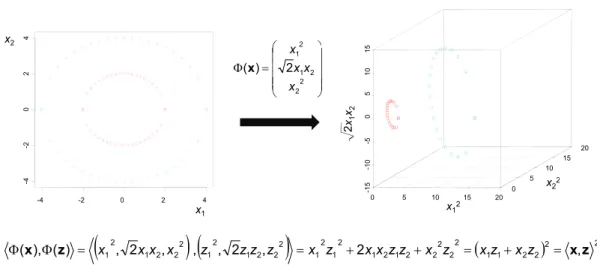
In many cases, a planar surface might not be capable of separating the data cor-rectly. To solve this problem, the data can be projected into a high-dimensional space H, which might make a linear separation of the training data possible. If
one assumes that the projection is accomplished using a mapping Φ :Rd→ H,
then the optimization problem specied in equation 3.5 requires the calcu-lation of scalar products in H, which is expressed by
Φ(xi),Φ(xj)
. How-ever, the replacement of scalar products in H by suitable kernel functions, i.e., K(xi,xj) =
Φ(xi),Φ(xj)
, removes the need for an explicit formulation of the high-dimensional feature space H, which is referred to as the kernel-trick [73]
w w
1 2
Figure 3.1-2: Hyperplane for imperfect separation Slack variables (ξi) permit the misclassication of some training compounds and correlate with their distance to the margin, as indicated by dashed lines in red.
and illustrated in Figure 3.1-3. The embedding function Φ(x)does not have to
be known because the scalar product in the decision function f(x) can also be
replaced by the kernel function:
f(x) = sgn n X i=1 αiyiK(xi,x) +b (3.8)
Frequently used kernels for the comparison of ngerprint representations, also termed ligand kernels Kligand(·,·)in the following, are the linear kernel (i.e.,
the standard scalar product), the Tanimoto kernel [74] encoding the Tanimoto coecient as a kernel function, and the Gaussian or radial basis function kernel [75]. Klinear(xi,xj) =hxi,xji (3.9) KTanimoto(xi,xj) = hxi,xji hxi,xii+hxj,xji − hxi,xji (3.10) KGaussian(xi,xj) = exp −γ|xi−xj|2 (3.11) The Gaussian kernel depends on the parameter γ (also called width) that
im-plicitly regulates the number of support vectors dening the maximum margin hyperplane. The number of support vectors increases with an increasing value of γ and raises the risk of overtting the training data. On the other hand,
selecting a too small value for γ results in a very smooth decision boundary
that does not classify the training data with sucient accuracy [33]. Hence, similarly to the cost factor C, the choice of an appropriate parameter value is critical to SVM classication performance.
3.2. Chemogenomics-Oriented SVM Strategies 25 4 x2 2 x -1 0 -5 0 5 1 0 1 5 5 10 15 20 4 -2 0 2 x2 = Φ 2 2 2 1 2 1 2 ) ( x x x x x x2 2 x1 x2 0 5 10 15 20 -1 5 0 5 -4 -2 0 2 4 -4 x1 x1 2 x22
(
) (
)
( )2 2 2 2 1 1 2 2 2 2 2 1 2 1 2 1 2 1 2 2 2 1 2 1 2 2 2 1 2 1 , 2 , , , 2 , 2 , ) ( ), (x Φ z = = + + = + = xz Φ x xx x z zz z x z xx zz x z xz x zFigure 3.1-3: Kernel trick Data points are projected into a higher-dimensional space by using the reported embedding function Φ(x). The transformation makes the two classes linearly separable. For the determination of the decision boundary, scalar products must be calculated in the transformed feature space. However, the explicit transformation of data points and subsequent calculation of scalar products in the higher-dimensional space can be avoided because
Φ(x),Φ(z) corresponds to and can be replaced by the polynomial kernel
K(x,z) =hx,zi2.
3.1.3 From Classication to Ranking
To adapt SVM to virtual compound screening, the transformation of the clas-sication into a ranking function is highly desirable. This can be achieved in a straightforward manner by dening the rank of a test molecule x according
to the distance from its projection Φ(x) to the separating hyperplane
deter-mined in H. Thus, test molecules are ranked from the most distant compound
on the positive space to the most distant compound on the negative half-space. This ranking methodology corresponds to removing the signum function in equation 3.8 and sorting molecules in decreasing order of
g(x) =
n
X
i=1
αiyiK(xi,x) (3.12)
As a constant term, the bias b can be removed from the ranking function.
3.2 Chemogenomics-Oriented SVM Strategies
In the following, two dierent SVM strategies that learn from multiple targets and have previously been applied to orphan screening are briey explained: SVM using target-ligand kernel (SVM TLK) and SVM linear combination (SVM LC). The two strategies are conceptually dierent since SVM TLK is a prime example for multi-task learning (vide supra), whereas SVM LC does
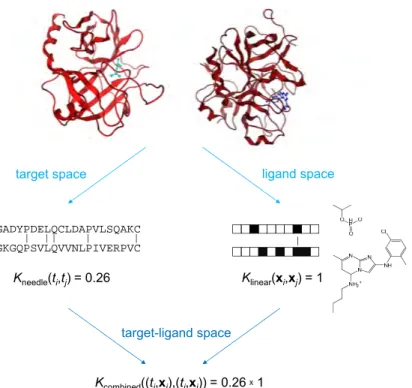
target space ligand space Kneedle(ti,tj) = 0.26 SSGADYPDELQCLDAPVLSQAKC NVGKGQPSVLQVVNLPIVERPVC Kcombined((ti,xi),(tj,xj)) = 0.26 1 target-ligand space Klinear(xi,xj) = 1
Figure 3.2-1: Target-ligand kernel The comparison of two target-ligand pairs via a target-ligand kernel function is divided into two independent tasks. In this case, the similarity of protein targets is quantied by sequence comparison, while ligand similarity is assessed through comparison of ngerprint representations. The product of the two similarity scores is taken to recombine target and ligand information. The gure is adapted from [71]. not learn from multiple training sets simultaneously but builds separate classi-cation models that are subsequently integrated into a single ranking function. Both methods were found to produce similar results in virtual screening trials that aimed at enriching small database selection sets with ligands for simulated orphan targets [35]. Furthermore, a much simpler approach to orphan screening using a standard binary SVM is introduced.
3.2.1 SVM with Target-Ligand Kernel
In recent chemogenomics-oriented studies [3537], not only compounds but also true and false protein-compound pairs were used to train SVMs in order to en-able learning and classication for multiple targets in parallel. For doing so, scalar products between target-ligand pairs occurring in the objective func-tion of the SVM optimizafunc-tion problem (equafunc-tion 3.5) and the decision funcfunc-tion (equation 3.7) are replaced by suitable kernel functions accounting for the sim-ilarity of protein-small molecule pairs in combined target-ligand space. Anal-ogously to the mapping of molecules into high-dimensional descriptor spaces,
3.2. Chemogenomics-Oriented SVM Strategies 27
a target-ligand pair (ti,xi) is projected into a high-dimensional target-ligand
space using an implicit embedding functionΦ(ti,xi)given by the kernel function
Ktarget-ligand (ti,xi),(tj,xj)
=Φ(ti,xi),Φ(tj,xj)
(3.13) To capture interactions between features of a molecule (represented by feature vector Φligand(xi) in high-dimensional ligand space) and features of its protein
target (represented by Φtarget(ti) in high-dimensional target space), it was
sug-gested to represent the target-ligand pair by the set of all possible products of features of the target and the ligand, which corresponds to the tensor product of their feature vectors [36]:
Φ(ti,xi) = Φtarget(ti)⊗Φligand(xi) (3.14)
Inserting this denition for Φ(t,x)into equation 3.13 yields Ktarget-ligand (ti,xi),(tj,xj)
=
Φtarget(ti)⊗Φligand(xi),Φtarget(tj)⊗Φligand(xj)
(3.15) The application of linear algebra leads to the following factorization of the scalar product between two tensor product vectors:
Φtarget(ti)⊗Φligand(xi),Φtarget(tj)⊗Φligand(xj)
= Φtarget(ti),Φtarget(tj) × Φligand(xi),Φligand(xj) (3.16) Equation 3.16 shows that the comparison of two target-ligand pairs can be re-duced to the separate assessment of target and ligand similarities in target and ligand space, respectively, which also avoids the computationally prohibitive cal-culation of tensor product vectors. The use of kernels functions further reduces the complexity of the problem and leads to equation 3.17, generally dening the target-ligand kernel as the product of two separate kernels for the target pair and the ligand pair:
Ktarget-ligand (ti,xi),(tj,xj)
=Ktarget(ti, tj)×Kligand(xi,xj) (3.17)
The design principle of target-ligand kernels is illustrated in Figure 3.2-1. Inde-pendent kernels for protein and ligand representations are used to account for pairwise target and ligand similarities and combined to calculate the similarity of the protein-molecule pairs in target-ligand space.
For orphan screening, a model is built using true and false target-ligand pairs. The false target-ligand pairs are usually derived by combining the same targets that are found in the known target-ligand pairs with randomly selected compounds from the screening database, assuming that most database com-pounds are inactive. All test comcom-pounds are then combined with the orphan
...
t1 t2 t3 t4 tn targets true pairs false pairs?
inactive molecules L1 L2 L3 L4 Ln ligands?
...
training phase classification phase
ranking fe a tu re 2 fe a tu re 2 ranking direction feature 1 fe a tu re 2 feature 1 fe a tu re 2
Figure 3.2-2: Orphan screening with SVM TLK Targets in the reference set are paired with their known ligands and presumably inactive compounds taken from the screening database to build positive and negative training examples, respectively, for SVM learning. A decision boundary is derived in combined target-ligand space. Test compounds are subsequently paired with the orphan target, projected into target-ligand space, and sorted by their signed distance to the hyperplane.
target and classied by the derived decision function. Analogously to the trans-formation applied to conventional small molecule classiers, a ranking of ligands for an orphan target can be obtained by sorting the orphan target-ligand pairs according to their signed distance from the maximum margin hyperplane (see equation 3.12). Orphan screening using SVM TLK is illustrated in Figure 3.2-2.
3.2.2 SVM Linear Combination
SVM LC was introduced to learn a model for a particular target tj, which
sets it apart from the SVM TLK approach that learns to generally classify target-ligand pairs as true or false. Nevertheless, SVM LC is distinct from con-ventional small molecule classiers in that it makes use of ligand sets with dierent bioactivities for learning. For each target ti in the training set, an
classica-3.2. Chemogenomics-Oriented SVM Strategies 29 learned hyperplane for target t1 learned hyperplane for target t2 assumed hyperplane for orphan target t3
K(