www.ijaera.org 2016, IJA-ERA - All Rights Reserved 48
Operations Research Method in Engineering
Projects
Man Djun, Lee, Shahidul, M.I.,Houssein Elaswad, Abdullah Yassin & Syed Tarmizi Syed Shazali
Faculty of Engineering, University Malaysia Sarawak, Malaysia
Abstract: This paper presents a review on concept and frameworks of operations research to be used
in conducting engineering projects and researches. This paper brings technique of using operations research method in solving industrial problem scientifically for achieving higher productivity and performance. The research technique of this study is based on scholarly literature review on operations research (OR). The researchers studied about 100 papers and about 10 percent of these published before year 2000; and 90 Information have also gathered from four case studies in on industrial operations. This method is tested in a small-scale desalination plant to evaluate its potential applications. Studied have revealed seven steps that are being used systematically in conducting research in industrial operation for identifying problem and to formulate solutions. The steps are i) investigation to define Problem, ii) conceptual model building with operating parameters, iii) mathematical model building with operating variables, iv) simulation, v) laboratory scale experiment for testing model, vi) pilot scale testing for validating model and vii) solution implementation and monitoring. The findings of this study the case study plant was operated at a sustainable level with CU of 69% (<50%), machinery operating reliability of 85% (<75%), economic efficiency of 1.25 (>1) which is potential to be developed into commercial plant. This study would serve as foundation for conducting further study systematically in the field of engineering and would be useful guideline for industrial practitioners in solving operations problem. Applying OR method in engineering industry or research enable researchers to gain insight and understand the system by using conceptual and mathematical modelling. Performing sustainability test before implementation aims to improve the success chance of solution implementation with confidence level of 95% and significance test (p<0.05). The novelty of this work is adding a few new information in engineering domain that could provide guideline for systematic future research and industrial problem solving activities.
Keywords: Operations Research, Engineering, Research Methodology, Industry Problem Solving
I. INTRODUCTION
International Journal of Advanced Engineering Research and Applications (IJA-ERA)
Volume – 2, Issue – 2 June – 2016
www.ijaera.org 2016, IJA-ERA - All Rights Reserved 49 applying the methods to get results; there is not much explanations found on how to apply OR method
in research studies and problem solving in industries. This indicates there is gap existed on how OR method can be applied systematically in conducting studies and solving industrial problems in engineering domain. In this regards, this study is designed to fill this gap.
II. CONCEPT OF OPERATIONS RESEARCH IN ENGINEERING
OR combines techniques from various fundamental discipline such as physics, biology, psychology and mathematics in problem solving. The success of OR method is that it is a systematic approach to solving problems by provide a framework for constructing conceptual and mathematical models finding the best solutions with respect to given measurable parameters (variables), and implementing the solutions [11]. OR covers a wide range of problem-solving techniques and methods applied in various domain, the popular techniques are such as simulation, mathematical optimization, queuing theory, Markov decision processes, economic methods, data analysis, statistics, neural networks, expert systems, and decision analysis. All of these techniques requires mathematical model building to describe the system. Due to the computational and statistical nature of most fields, OR also employ techniques from computer science such as simulations as pre-test for most solutions before lab scale testing. In this regards, OR researchers must have necessary expertise in the relevant field before conducting research studies using OR method.
OR often places emphasis on production systems as this is where OR first begins to be introduced. Production systems problems may arise in settings that include manufacturing, telecommunications, health-care delivery, facility location and layout, and staffing. Solving these problems requires a solid foundation in operations research fundamentals. Additionally, the solution of production systems problems frequently draws on expertise in more than one of the primary areas of operations research. In this aspects, OR contributes to improves the effectiveness or efficiency of an industry by the following attributes [12]:
Problem Identification and modelling
Find solution through research
Input-output optimization of production process
Productivity improvement
Waste material reduction from the process
Modelling for waste material recycling
Energy efficiency modelling
Decrease production cost
Increase revenue
Manage and reduce risk
Improve product quality
Reduce production cycle time
Increase plant capacity utilization
www.ijaera.org 2016, IJA-ERA - All Rights Reserved 50 As an example, a company may need to minimize the production cost or maximize production output
to stay competitive. This scenario calls for OR technique called optimization. The goal of optimization is to enable decision maker to formulate strategies in short time and effective manners for a feasible solution. In an optimization problem, the objective is usually to minimize or maximize a function over a set of variables subject to constraints. In linear programming, optimization problems follow the following mathematical form (Equation 1 to Equation 3):
Maximize objective function, Z= 𝐶1𝑋1+ ⋯ + 𝐶𝑛𝑋𝑛 (1)
Subject to constraints 𝑎1𝑋1+ ⋯ + 𝑎𝑛𝑋𝑛 < 𝑏1 (2) 𝑎𝑚𝑋1+ ⋯ + 𝑎𝑚𝑋𝑛 < 𝑏𝑚
𝑋1 > 0, … . , 𝑋𝑛 > 0 (3)
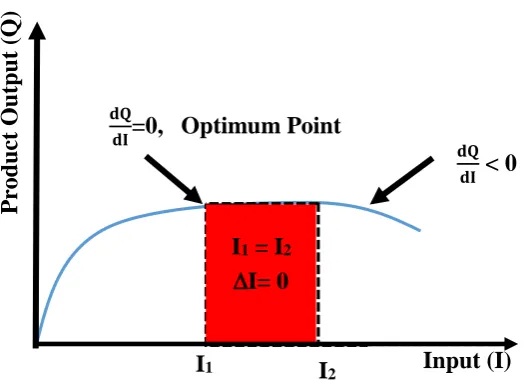
The graphical representation of typical input-output production optimization is shown in Figure 1.
Figure 1: Input-Output Optimization
From Figure 1, the optimum point is where the production process with input amount of I1 able to produce the maximum output. Note that any input beyond optimum point I1 will not produce higher amount of output; inputs between I1 to I2 or the red shaded areas under the curve are called non-value added inputs that contribute to increase production cost and reduce competitiveness of production system. In this aspects, OR method able to identify and eliminate the production bottleneck to contribute to increase production capacity utilization.
III. OPERATIONS RESEARCH IN INDUSTRY
OR has made significant contributions over the years in engineering domain. Some examples of the contributions are shown according to engineering field.
a) Telecommunication
The contributions of OR in telecommunication engineering can be witness as early as World War in deployment of radar, submarine interception and other war strategies; the primary reason for existence and development of OR [13]. Today, telecommunications have become the success factor in many
𝐝𝐐 𝐝𝐈 < 0
Input (I)
P
rod
u
ct Ou
tpu
t (
Q)
𝐝𝐐
𝐝𝐈=0, Optimum Point
I1 I2
International Journal of Advanced Engineering Research and Applications (IJA-ERA)
Volume – 2, Issue – 2 June – 2016
www.ijaera.org 2016, IJA-ERA - All Rights Reserved 51 industries. For example, ticketing system for airlines, accurate airplane location for airport controllers,
call centers efficiency and others. In this aspect, OR is being used for applications such as computing optimal usage of limited resources, optimization of wireless routing, queuing models to reduce network congestions [14].
b) Manufacturing
In manufacturing industry, logistics is essential for all industries from transporting resources from supply chain to shipping of finished products to consumers. OR contributes to improve logistics management by formulating strategies such as plant and warehouse location, distribution network optimization, supply chain management, inventory management and others [2], [15]. On the other hand, OR also contributed to manufacturing engineering through application such as scheduling, routing, workflow improvements, bottleneck elimination, facility and operations planning [12]. Recently, it is reported that OR is essential in reducing wastage during production process to contribute to economic and environmental sustainability [16].
c)Construction
Recently, construction industry faces challenging tasks such as expected shorter project completion time, more sophisticated construction projects and sustainable development [17]. In this regards, OR contributes to improving project management by employing techniques such as Critical Path Methods (CPM) and Project Evaluation Review Technique (PERT), reduce better logistics for quality delivery through network optimization, traffic simulations, bottleneck elimination, public transport scheduling and planning [18], [19]
IV. APPLICATION OF OPERATIONS RESEARCH IN ENGINEERING PROJECT
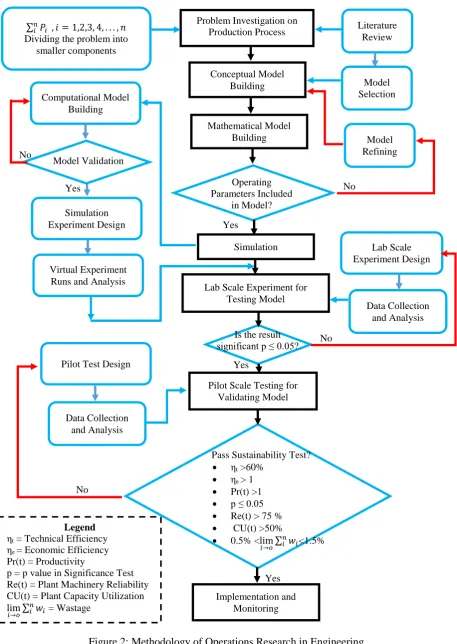
www.ijaera.org 2016, IJA-ERA - All Rights Reserved 52 Figure 2: Methodology of Operations Research in Engineering
Problem Investigation on Production Process Conceptual Model Building Mathematical Model Building Simulation
Lab Scale Experiment for Testing Model
Pilot Scale Testing for Validating Model
Implementation and Monitoring
∑ 𝑃𝑛𝑖 𝑖 , 𝑖 = 1,2,3, 4, . . . , 𝑛 Dividing the problem into
smaller components Literature Review Model Selection Computational Model Building Simulation Experiment Design Virtual Experiment Runs and Analysis
Yes No No Model Refining Lab Scale Experiment Design Data Collection and Analysis
Pilot Test Design
Data Collection and Analysis Yes Yes No Yes No Operating Parameters Included in Model?
Pass Sustainability Test?
ηt >60% ηe > 1 Pr(t) >1
p ≤ 0.05
Re(t) > 75 %
CU(t) >50%
0.5% <lim
𝑖→𝑜∑ 𝑤𝑖 𝑛
𝑖 <1.5% Legend
ηt = Technical Efficiency
ηe = Economic Efficiency
Pr(t) = Productivity
p = p value in Significance Test Re(t) = Plant Machinery Reliability CU(t) = Plant Capacity Utilization
lim
𝑖→𝑜∑ 𝑤𝑖 𝑛
𝑖 = Wastage Model Validation
International Journal of Advanced Engineering Research and Applications (IJA-ERA)
Volume – 2, Issue – 2 June – 2016
www.ijaera.org 2016, IJA-ERA - All Rights Reserved 53 a) Operation Research Method Used to Identify Problem Involved in Engineering Project
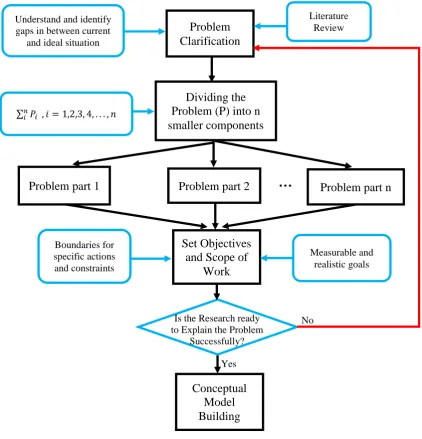
The purpose of problem investigation is to have clear pictures of relevant problem with the support from literature review. Gaps between current and ideal situation will be identified for problem clarification process [20]. The problem is then being divided into smaller parts to reduce the complexity for analysis [23]. A clear concise and practical specific objective should be set to solve each individual problem. The steps involved in OR problem investigation is shown in Figure 3 [22].
Figure 3: Steps for Problem Investigation
The interesting note of OR approach is that OR deals with multidisciplinary and multifunctional team. In this regards, coordination and teamwork is the critical factor of success [22].
b) Conceptual Model Building to Generate Information on Problem for Designing Solution Problem
Clarification
Dividing the Problem (P) into n smaller components
Problem part 1 Problem part 2 Problem part n
Set Objectives and Scope of
Work
Conceptual Model Building
Literature Review
∑ 𝑃𝑛 𝑖
𝑖 , 𝑖 = 1,2,3, 4, . . . , 𝑛
Measurable and realistic goals Understand and identify
gaps in between current and ideal situation
Boundaries for specific actions and constraints
Is the Research ready to Explain the Problem
Successfully?
No
Yes
www.ijaera.org 2016, IJA-ERA - All Rights Reserved 54 In the second of the OR methodology, problem is being translated into a conceptual model with
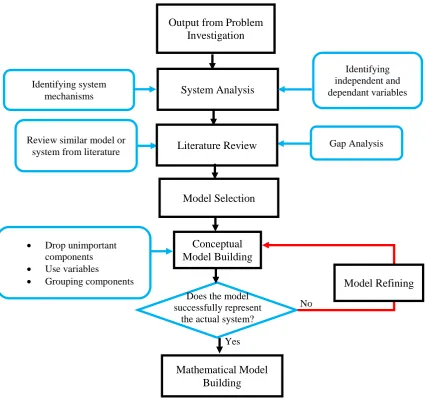
parameters that can then be objectively analysed. Conceptual modeling is the process of capturing selected characteristics of a system or a process and then combining these into an abstract representation of the original [9], [16], [24]. Literature review on similar models in previous work is the basis for building conceptual model. The main idea here is a simplified model is easier to analyze the original system, and as long as the model has certain accuracy, any changes done on the system is applicable to the original system [25]. The model is then being refined throughout the whole process to improve the quality of the model [26]. The steps for conceptual modelling is shown in Figure 4.
Figure 4: Steps in Conceptual Model Building
c) Mathematical Model Building with Engineering Projects’Variables
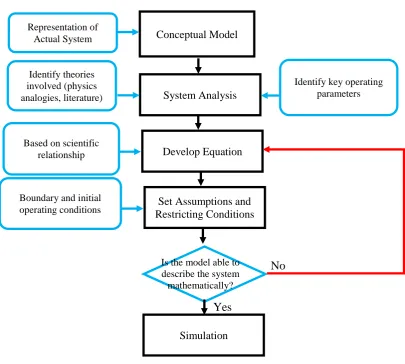
The next stage of OR methodology is mathematical building. A mathematical model is a set of logical mathematical statements [27]. From conceptual model, the patterns and linkages are observed and being translated into mathematical language to develop scientific understanding of current system [28].
Output from Problem Investigation
System Analysis
Review similar model or system from literature
Model Selection
Conceptual Model Building
Does the model successfully represent
the actual system?
Mathematical Model Building
Model Refining
Yes
No
Drop unimportant components
Use variables
Grouping components Identifying system
mechanisms
Identifying independent and dependant variables
International Journal of Advanced Engineering Research and Applications (IJA-ERA)
Volume – 2, Issue – 2 June – 2016
www.ijaera.org 2016, IJA-ERA - All Rights Reserved 55 Mathematics is the common language of scientists and engineers and mathematical model enable
researchers to analyse and predict behaviour of production process to check whether the behaviour is desirable. The steps for developing mathematical model from conceptual model are shown in Figure 5 [29]. Some examples of studies using mathematical modelling are found in [30] and [16]. Both studies used mathematical modelling to evaluate performance of manufacturing industries and they found that mathematical modelling is significant tools for evaluating manufacturing production performance by relating the inputs.
Figure 5: Steps for Mathematical Model Building
d) Simulation to Predict the Performance of Engineering Project’s Solution
Simulation has gain significant popularity in research studies and evident can be found in simulation studies publications over year 2000 [31]. Simulation is the process of conducting experiments on model of a real system to understand the behaviour of the system and evaluate the effect of solution for the operations of the system [32]. Simulation is an important tool for OR as it allows studying the impact of changes in the system in cases before any actual experiment takes place. The advancement in computer simulation allows mathematical model developed in earlier stage to be handled computationally using numerical methods and overcomes the empirical problem of data availability as Model
Translation
Conceptual Model
System Analysis Identify theories
involved (physics analogies, literature)
Identify key operating parameters
Develop Equation
Set Assumptions and Restricting Conditions Boundary and initial
operating conditions
Yes
Simulation
No Is the model able to
describe the system mathematically? Based on scientific
relationship Representation of
www.ijaera.org 2016, IJA-ERA - All Rights Reserved 56 computer simulation software could generates its own data. The steps in performing simulation is
shown in Figure 6 [25], [33]–[35].
Figure 6: Stages in Performing Simulation
At the beginning, mathematical model built from previous stage will be translated into computational model depending on simulation software used. The computational model is then being tested in simulated environment where it is designed as close to actual environment as possible. The simulation experiment could be run many times or iterations to get accurate results or until the desired results are obtained. Analysis and validation are performed and if the results are not desired, refining of any of the previous stage is required [36]. The cycle is continued until the desired result is obtained and proceed to the next stage which is actual lab scale experiment for testing the model [37].
e) Lab Scale Experiment for Testing Model Developed by Operations Research Method
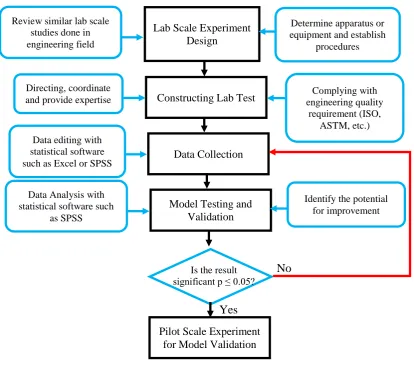
In this stage, the lab scale experiment will be designed to test the developed model. Indeed, lab scale experiments are popular especially in engineering to provide quantitative proof that the model has potential to succeed on a full-scale basis [8], [38]–[41]. The lab scale experiment will be designed based following the criteria from simulation model to validate the simulation model in actual environment. Lab scale experiments have the advantage of less cost and less time consuming. Often, conducting actual experiments in engineering, building a full scale prototype is often time consuming and costly. At the end of the lab testing and results analysis, significant test must be done to validate the model significance. The steps for conducting lab scale experiment for model testing is shown in Figure 7 [42]–[44].
Computational Model Building
Mathematical Model
Simulation Experiment Design
Virtual Experiment Runs and Analysis
Recommend Further Course of
Action
No
Yes
Collect and process actual system data such as input variables
Model Validation
Establish experimental conditions such as run length, warm-up period Perform statistical tests
such as sensitivity analysis and examined by system experts to improve
model credibility
Analyze results and determine if additional experiments are required
Actual System
Interpret and present results such as obtaining
International Journal of Advanced Engineering Research and Applications (IJA-ERA)
Volume – 2, Issue – 2 June – 2016
www.ijaera.org 2016, IJA-ERA - All Rights Reserved 57 Figure 7: Steps for Conducting Lab Scale Experiment for Model Testing
f) Pilot Scale Experiment for Validating Model Developed by Operations Research Method
Pilot scale experiment is small version of planned study or a miniature version of actual scale study to validate a model or an idea [45]. The purpose of pilot experiment is summarised below [46]:
Developing and testing effectiveness of research equipment
Performing feasibility study
Design and evaluate research protocol
Evaluate the chances of success
Collect pilot data for model validation
Evaluate the data analysis techniques to uncover potential problems
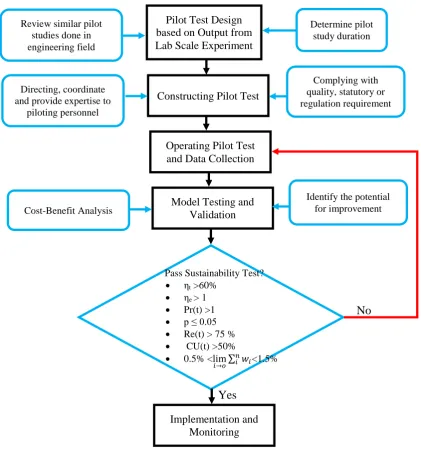
Convincing funding bodies about the feasibilities and explore the commercial potential Indeed, pilot studies have play a key role in contributing to the success of many engineering research studies and evidences are found in these studies [10], [47]–[50]. The steps for conducting pilot study is shown in Figure 8. It is essential to conduct a series of sustainability test to validate the pilot model. The sustainability indicators from Figure 2 are depicted from [10], [16], [51]. The purpose of
Lab Scale Experiment Design
Constructing Lab Test Review similar lab scale
studies done in engineering field
Determine apparatus or equipment and establish
procedures
Directing, coordinate and provide expertise
Complying with engineering quality
requirement (ISO, ASTM, etc.) Data Collection
Model Testing and Validation Data Analysis with
statistical software such as SPSS
Identify the potential for improvement
Yes
Pilot Scale Experiment for Model Validation
No Is the result
significant p ≤ 0.05? Data editing with
www.ijaera.org 2016, IJA-ERA - All Rights Reserved 58 sustainability test is to evaluate the degree of sustainability before actual solution implementation and
useful to formulate operating strategy for optimizing the input usage and reduce wastage.
Figure 8: Steps for Conducting Pilot Study for Model Validation
g) Engineering Project’s Solution Implementation and Monitoring
The last stage of OR methodology is implementing the final refined solution and established control over the problem. The implementation phase requires development of operating procedures or manuals for operations and schedule for completion. In this regards, this stage requires knowledge dissemination to the operating and monitoring team through trainings and report writing.
Pilot Test Design based on Output from Lab Scale Experiment
Constructing Pilot Test Review similar pilot
studies done in engineering field
Determine pilot study duration
Directing, coordinate and provide expertise to
piloting personnel
Complying with quality, statutory or regulation requirement
Operating Pilot Test and Data Collection
Model Testing and Validation Cost-Benefit Analysis
Identify the potential for improvement
Pass Sustainability Test?
ηt >60% ηe > 1 Pr(t) >1
p ≤ 0.05
Re(t) > 75 %
CU(t) >50%
0.5% <lim
𝑖→𝑜∑ 𝑤𝑖 𝑛
𝑖 <1.5% Yes
Implementation and Monitoring
International Journal of Advanced Engineering Research and Applications (IJA-ERA)
Volume – 2, Issue – 2 June – 2016
www.ijaera.org 2016, IJA-ERA - All Rights Reserved 59
V. PRACTICAL IMPLICATIONS OF OPERATIONS RESEARCH METHODOLOGY IN
ENGINEERING
The developed OR methodology can be implemented in any engineering related industry and research projects to perform systematic analysis and provide solution for sophisticated engineering problem. To use this model, few skills are required, namely, modelling, simulation, experiment design and planning. Additionally, people with know-how in OR techniques are essential to use this model. The benefits for applying OR method in engineering industry or research are:
Simplifying sophisticated industry and engineering related problems
Gain insight and understand the system by using conceptual and mathematical modelling
Perform feasibility test on solution before implementing it to reduce the risk of failing and save time and cost.
Each step of the method is a feedback process; any trouble or difficulty in each stage can be diagnosed and room for improvements is allowed
Sustainability test to improve the success chance of solution implementation with confidence level of 95% and significance test (p<0.05).
Data collected before actual solution implementation stage can be used for improving the solution and operating performance.
VI. APPLICATION OF OPERATIONS RESEARCH METHOD IN SMALL SCALE
DESALINATION PLANT
One of the successful OR applied engineering research project is shown in this section as example. The selected successful case studies is: Sadong Jaya Small Scale Water Desalination Plant located at Samarahan, Sarawak, Malaysia.
a) An Overview on Sadong Jaya Small Scale Desalination Plant
Kampung Pemdam, a small village in Samarahan District with population about 200 residents are suffering from the lack of fresh water supply for cooking and drinking. Batang Sadong or the Sadong River nearby the village is saline in nature with water characteristics, turbidity of 3100NTU and salt content of 35,000ppm. To overcome this problem, it is proposed to build a small scale water desalination plant to supply potable water by utilizing Sadong River water as feed water and applied OR technique to optimize the plant for achieving economic and environmental sustainability. The idea is that by utilizing all capacity of production machinery, the plant is able to produce optimum amount of product water, reduce wastage of inputs such as energy, feed water and others to reduce environmental impact of the small scale water desalination plant [10].
b) Conceptual Model Building for Sadong Jaya Desalination Process
www.ijaera.org 2016, IJA-ERA - All Rights Reserved 60 Figure 9: Conceptual Input-Output Model for Small Scale Desalination Plant
c) Mathematical Model Building for Sadong Jaya Desalination Process
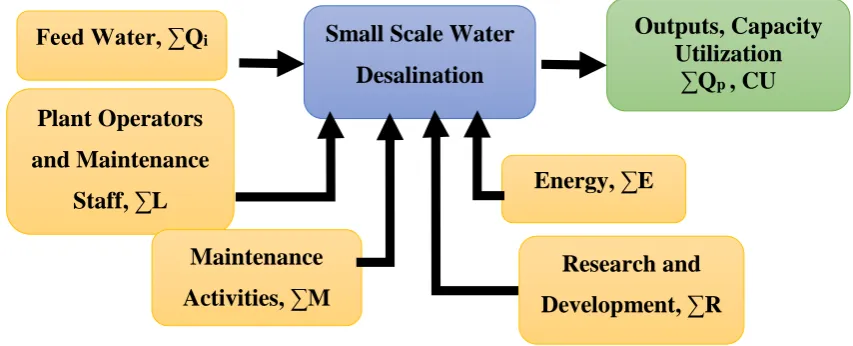
From conceptual model from Figure 9, the mathematical models are shown in Equation 5 and Equation 6. The small scale water desalination process is analogous to the theory of production [52] and thus production function can be formed:
𝑄𝑝 = 𝐴. 𝑅∝1. 𝑄𝑖∝2. 𝐿∝3. 𝑀∝4. 𝐸∝5 (5)
Where Qp = Product water output
A = Inputs to outputs transformation factor R = Research and development expenditure
L = plant operators and maintenance staff expenditure M = maintenance activities expenditure
E = Energy cost for small scale water desalination process
This model is valid for ∝1+∝2+∝3+∝4+∝5 =0, ∝1+∝2+∝3+∝4+∝5 >0 and ∝1+∝2+∝3+∝4+∝5 <0. By applying the theory of capacity equation to conceptual model at Figure 9, the capacity utilization of small scale desalination operation can be evaluated by the Equation 6 below [53].
𝐶𝑈 = 𝑄𝑝
𝑄𝑖 (6)
Where CU = capacity utilization of small scale water desalination plant Qp = Product water output measured by flowrate (m3/hour)
Qi = Feed water input measured by flowrate (m3/hour)
d) Lab Scale Experiment Conducted for Model Testing in Sadong Jaya Desalination Plant by Using Operations Research Method
The lab scale model of water desalination machineries was built and placed in Faculty of Engineering, University Malaysia Sarawak to test the model. The findings from the lab scale experiment indicated
Small Scale Water
Desalination
Process
Outputs, Capacity Utilization
∑Qp , CU Plant Operators
and Maintenance
Staff, ∑L
Feed Water, ∑Qi
Maintenance
Activities, ∑M
Energy, ∑E
Research and
International Journal of Advanced Engineering Research and Applications (IJA-ERA)
Volume – 2, Issue – 2 June – 2016
www.ijaera.org 2016, IJA-ERA - All Rights Reserved 61 that the model is significant (p<0.05) to solve the water problem and product water output
optimization.
e) Operations Research Method Used to Validate Pilot Plant Operations
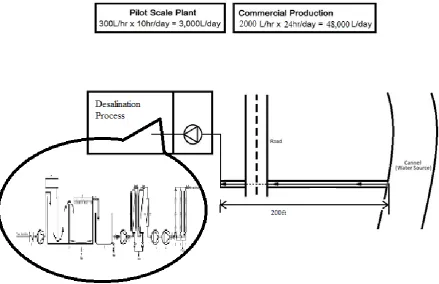
Pilot plant was built at Kampung Pendam, Sadong Jaya to test the model with output of 3,000L/day. The small scale water desalination plant consists of several components: water intake, bio-reactor, dual media filter, UFM and desalination membrane pack. The small scale water desalination plant operations schematic diagram is shown in Figure 10. The plant was operated at a sustainable level with CU of 69% (<50%), machinery operating reliability of 85% (<75%), economic efficiency of 1.25 (>1) and the output quality of potable water is conforming to Malaysian potable water standard. The findings indicated that the pilot plant has potential to be developed to commercial plant.
Figure 10: Schematic Diagram for Sadong Jaya Small Scale Water Desalination Plant
f) Operations Research Method Used to Monitoring of Sadong Jaya Desalination Plant
The full scale Sadong Jaya desalination plant is operating and supplying 50,000 Litre per day of fresh water to resident of Kampung Pendam, Sadong Jaya to support about 100 families. The plant operations are monitored and trainings are provided to plant operating personnel constantly. The plant machineries are also being maintained in every two months for maintaining optimal fresh water production. The product water quality is being checked on daily basis to conform to Malaysian potable water quality.
VII. CONCLUSION
www.ijaera.org 2016, IJA-ERA - All Rights Reserved 62 model building, iii) mathematical model building, iv) simulation, v) laboratory scale experiment for
testing model, vi) pilot scale testing for validating model and vii) solution implementation and monitoring. Literature indicates that OR method is indeed suitable for problem solving in industry and conducting research in engineering. The benefits of applying OR method in engineering are researchers able gain insight and understand the system by using conceptual and mathematical modelling and provide solution for each discrete problem. Sustainability test is performed before implementation aims to improve the success chance of solution implementation with confidence level of 95% and significance test (p<0.05). In this regards, this study would be useful tool for engineering practitioners and other relevant stakeholders in conducting research and development in engineering. This work will definitely add new knowledge to the present engineering domain. In conclusion, the current study suggests for in-depth further work to increase the depth of OR problem solving framework in this study.
Conflict of Interest: The authors declare that they have no conflict of interest.
Ethical Statement: The authors declare that they have followed ethical responsibilities
REFERENCES
[1] M. Fakhimi, “Operations research within UK healthcare: a review,” Journal of Enterprise Information Management, vol. 26, no. 1, pp. 21–49, 2013.
[2] H. Luss and M. B. Rosenwein, “Operations Research applications: Opportunities and accomplishments,” European Journal of Operational Research, vol. 97, no. 2, pp. 220–244, 1997.
[3] R. Fildes, K. Nikolopoulos, S. F. Crone, and A. Syntetos, “Forecasting and operational research: a review,” Journal of the Operational Research Society, vol. 59, no. 1, pp. 1150–1172, 2008.
[4] S. Hemanta, “Capacity utilization in small scale industries of India: some empirical evidence from under developed industrial structure,” Journal of Social and Economic Statistics, vol. 1, no. 1, pp. 39–53, 2012. [5] M. I. Shahidul and S. T. Syed Shazali, “Dynamics of manufacturing productivity: lesson learnt from labor intensive industries,” Journal of Manufacturing Technology Management, vol. 22, no. 5, pp. 664– 678, 2011.
[6] S. C. Ray and K. Mukherjee, “Direct and indirect measures of capacity utilization: a non parametric approach of US manufacturing,” 2006.
[7] C. H. Ting, M. I. Shahidul, S. T. S. Shazali, and Y. Abdullah, “Measuring Contextual Impact of Maintenance on Machinery Capacity Utilization and Environment,” in 6th Engineering Conference, 2013.
[8] M. I. Shahidul, S. Tarmizi, A. Yassin, A. K. Othman, H. Zen, T. C. Hung, and M. D. Lee, “Modeling the Energy Extraction from In-stream Water by Multi Stage Blade System of Cross Flow Micro Hydro Turbine,” Procedia Engineering, vol. 105, no. Icte 2014, pp. 488–494, 2015.
[9] H. M. A. Elaswad, M. I. Shahidul, S. T. S. Shazali, and A. Yassin, “Modelling output growth measurement of machinery manufacturing SMEs,” Sci. Int. (Lahore), vol. 27, no. 5, pp. 4063–4070, 2015.
[10] I. Shahidul, C. H. Ting, M. D. Lee, and S. Begum, “Seawater Desalination for Environment and Economic Sustainability: A Case Study at Sadong Jaya Pilot Plant,” International Journal of Engineering Research and Management (IJERM), vol. 2, no. 8, pp. 69–74, 2015.
[11] P. A. Jensen and N. J. Hoboken, Operations research: models and methods. John Wiley & Sons, 2003. [12] D. a Heger, “An Introduction to Operations Research – Benefits , Methods & Application,” Fortuitous
Technology, pp. 1037–1039, 2006.
[13] M. G. C. Resende and P. M. Pardalos, Handbook of Optimization in Telecommunications. Springer, 2006.
[14] P. Cortés, “Operations Research and Telecommunication Systems Management : A Successful Alliance,” Journal of Telecommunication System Management, vol. 1, no. 1, pp. 1–2, 2012.
[15] Y. J. Wu and I. C. Huang, “Operations research practice on logistics management in Taiwan : An academic view,” European Journal of Operational Research, vol. 182, pp. 428–435, 2007.
International Journal of Advanced Engineering Research and Applications (IJA-ERA)
Volume – 2, Issue – 2 June – 2016
www.ijaera.org 2016, IJA-ERA - All Rights Reserved 63 Azrin, and A. F. K. Adzlan, “Measuring Production Capacity Utilization and Its Impact on
Manufacturing Performance and Environment,” in Energy and Environment, 2013.
[17] E. K. Zavadskas, “Operations research in areas of civil engineering and sustainable development : EURO working group activities,” Organization, Technology and Management in Construction, vol. 5, no. 1, 2013.
[18] B. D. Craven and S. M. N. Islam, Operations research methods: related production, distribution and inventory management applications. Prentice Hall, 2005.
[19] M. Bielli and P. Reverberi, “New operations research and artificial intelligence approaches to traffic engineering problems,” European Journal of Operational Research, vol. 92, no. 3, pp. 550–572, 1996. [20] P. Marksberry, J. Bustle, and J. Clevinger, “Problem solving for managers: a mathematical investigation
of Toyota’s 8-step process,” Journal of Manufacturing Technology Management, vol. 22, no. 7, pp. 837– 852, 2011.
[21] S. Cavaleri, J. Firestone, and F. Reed, “Managing project problem solving patterns,” International Journal of Managing Projects in Business, vol. 5, no. 1, pp. 125–145, 2012.
[22] J. Rajgopal, “Principles and applications of operations research,” in Maynard’s Industrial Engineering Handbook, 5th Editio., Mc Graw-Hill, 2004, pp. 27–44.
[23] A. Lowy, “Nine paradoxes of problem solving,” Strategy & Leadership, vol. 39, no. 3, pp. 25–31, 2011. [24] F. N. Kerlinger, Behavioral research: a conceptual approach. New York: Rinehart & Winston, 1979. [25] S. Robinson, R. Brooks, K. Kotiadis, and D.-J. Van Der Zee, Conceptual modeling for discrete-event
simulation. 2011.
[26] S. Robinson, “Conceptual modeling for simulation: issues and research requirements,” in Proceedings of the 38th conference on Winter simulation, 2006.
[27] C. L. Dym, “Principles of Mathematical Modeling,” American Journal of Physics, vol. 48, no. 11, p. 994, 1980.
[28] C. L. Dym, “What Is Mathematical Modeling?,” Mathematical Modelling: a way of life. Chichester: Ellis, pp. 3–12, 2004.
[29] G. Marion and D. Lawson, “An introduction to mathematical modelling,” Scotland, 2008.
[30] M. A. Elaswad, M. I. Shahidul, S. T. S. Shazali, and Y. Abdullah, “Evaluate contributions of engineering management to output: a model building approach for manufacturing SMEs,” International Journal of Engineering Research and Management (IJERM), vol. 2, no. 8, pp. 28–37, 2015.
[31] M. Jahangirian, T. Eldabi, A. Naseer, L. K. Stergioulas, and T. Young, “Simulation in manufacturing and business: A review,” European Journal of Operational Research, vol. 203, no. 1, pp. 1–13, 2010. [32] A. Grasas, A. A. Juan, and H. Ramalhinho, “Operations research and simulation in Master’s degrees: a
case study regarding different universities in spain,” in Proceedings of the 2013 Winter Simulation Conference, 2013.
[33] R. G. Sargent, “Verification and Validation of Simulation Models,” Simulation, pp. 37–48, 2003. [34] A. Maria, “Introduction to modelling and simulation,” in Winter Simulation Conference, 1997, pp. 7–
13.
[35] M. Jahangirian, T. Eldabi, L. Garg, G. T. Jun, A. Naseer, B. Patel, L. Stergioulas, and T. Young, “A rapid review method for extremely large corpora of literature: Applications to the domains of modelling, simulation, and management,” International Journal of Information Management, vol. 31, no. 3, pp. 234– 243, 2011.
[36] W. L. Oberkampf, T. G. Trucano, and C. Hirsch, “Verification, validation, and predictive capability in computational engineering and physics,” Applied Mechanics Reviews, vol. 57, no. 5, p. 345, 2004. [37] A. M. Law, “How to build valid and credible simulation models,” in Proceedings of the 2008 Winter
Simulation Conference, 2008, pp. 39–47.
[38] N. Che Mat, Y. Lou, and G. G. Lipscomb, “Hollow fiber membrane modules,” Current Opinion in Chemical Engineering, vol. 4, pp. 18–24, 2014.
[39] Y. Ju, I. Hong, and S. Hong, “Multiple MFI measurements for the evaluation of organic fouling in SWRO desalination,” Desalination, vol. 365, pp. 136–143, 2015.
www.ijaera.org 2016, IJA-ERA - All Rights Reserved 64 [41] D. M. Warsinger, J. Swaminathan, E. Guillen-Burrieza, H. A. Arafat, and J. H. Lienhard V, “Scaling
and fouling in membrane distillation for desalination applications: A review,” Desalination, vol. 356, pp. 294–313, 2014.
[42] P. Caccamo, B. Chanut, T. Faug, H. Bellot, and F. Naaim-bouvet, “Small-scale laboratory tests on granular avalanches overflowing a flat obstacle: flow regimes, dead zone and induced forces,” Advanced in modern aspects of mechanics (EDCM), p. 4, 2010.
[43] L. Frederickson, M. Dordevich, and F. Miller, “Lab-scale experimentation and CFD modeling of a small particle heat exchange receiver,” Energy Procedia, vol. 49, pp. 363–372, 2013.
[44] R. Hesketh and C. Slater, “Innovative and economical bench-scale process engineering experiments,” International Journal of Engineering …, vol. 16, no. 4, 2000.
[45] R. Pal, A. Sengupta, and I. Bose, “Role of Pilot Study in Assessing Viability of New Technology Projects: The Case of RFID in Parking Operations.,” Communications of the Association for Information Systems, vol. 23, no. September 2008, pp. 257–276, 2008.
[46] E. van Teijlingen and V. Hundley, “The importance of pilot studies.,” Guildford, 2001.
[47] S. Islam and S. T. S. Shazali, “Determinants of manufacturing productivity: pilot study on labor-intensive industries,” International Journal of Productivity and Performance Management, vol. 60, no. 6, pp. 567–582, 2011.
[48] M. E. Williams, “A Brief Review of Reverse Osmosis Membrane Technology,” 2003.
[49] B. L. Pangarkar, M. G. Sane, and M. Guddad, “Reverse Osmosis and Membrane Distillation for Desalination of Groundwater: A Review,” ISRN Materials Science, vol. 2011, pp. 1–9, 2011.
[50] N. Prihasto, Q.-F. Liu, and S.-H. Kim, “Pre-treatment strategies for seawater desalination by reverse osmosis system,” Desalination, vol. 249, no. 1, pp. 308–316, 2009.
[51] M. D. Lee and M. I. Shahidul, “Dossier of manufacturing and environmental sustainability: an empirical model,” International Journal of Engineering Research and Management (IJERM), vol. 3, no. 3, pp. 12– 16, 2016.
[52] C. W. Cobb and P. H. Douglas, “A Theory of Production,” vol. 18, no. 1, pp. 139–165, 1928.