Original Research Article
Factors influencing perception and knowledge of exclusive breast
feeding practices among nursing mothers in rural area of
Thane district of Mumbai
Abhay S. Srivastava
1, Kanchan B. Gawande
2*
INTRODUCTION
Proper feeding practices are of significant importance for the growth, development, health, nutrition and survival of infants and children. Nurturing practices adopted by the family will decide the health of the baby after birth.1 Risk of acquiring an illness increases if the child is fed poorly. Early nutrition deficits are also linked to long term impairment in growth and health, which is directly or indirectly responsible for one third of approximately 9.5
million deaths that occurred in 2006 in children under 5 years of age.
Based on data from WHO it has been shown beyond doubt that breastfeeding has well established short term benefits, particularly in scaling down of morbidity and mortality due to childhood infections in first two years of life. Optimal breastfeeding practices could prevent hospital admissions due to diarrhoea and lower respiratory tract infections. Systematic review from
ABSTRACT
Background: Exclusive breastfeeding (EBF) is recommended as the best feeding alternative for infants up to six months and has a protective effect against mortality and morbidity. Exclusive breastfeeding (EBF) is one of the optimal infant and young child feeding practices. Globally, <40% of infants under 6 months of age are exclusively breastfed. According to NFHS4 data (2015-16) the prevalence of EBF in the rural area of Maharashtra was 60.6% which was far less than the 100% recommended by the United Nation Children Emergency Fund. Study was conducted to find the mothers knowledge and perception on breast feeding practices and other factors which influences breast feeding practices in the study area
Methods: A cross sectional descriptive study was employed. From the population of 8000, by applying convenient sampling technique, 152 mothers attending the primary health centre with children less than 2 years of age were enrolled after taking informed consent.
Results: The prevalence of exclusive breast feeding was 63.15%. There was a significant association between socio‑ demographic characteristics of mothers such as occupation (p<0.05), type of family (p<0.05) and the practice of exclusive breastfeeding.
Conclusions: As it was found that exclusive breast feeding was practiced well by mothers who were housewives which shows that employment was the major obstacles for breast feeding.
Keywords: Exclusive breast feeding, Primigravida, Nursing mothers
Department of Community Medicine, 1Government Medical College, Aurangabad, 2Indira Gandhi Government Medical College, Nagpur, Maharashtra, India
Received: 24 March 2018
Revised: 08 May 2018
Accepted: 09 May 2018
*Correspondence:
Dr. Kanchan B. Gawande,
E-mail: [email protected]
Copyright: © the author(s), publisher and licensee Medip Academy. This is an open-access article distributed under the terms of the Creative Commons Attribution Non-Commercial License, which permits unrestricted non-commercial use, distribution, and reproduction in any medium, provided the original work is properly cited.
WHO on long term benefits of breastfeeding suggest a preventive effect on blood pressure related problems, substantial protection (34% reduction) from diabetes, 24% reduction in overweight and/or obesity. Breastfeeding was also associated with an overall increase of intelligence score.2
India falls short to achieve any exceptional progress in infant feeding practices, with only a slight increment in EBF rates amongst infants 0-6 months of age – From 41.2% in 1998-1999(NFHS-2) to 46.3% in 2005-2006 (NFHS-3) to 46% in 2015-2016 (NFHS-4).3
Various factors affect breastfeeding practices in India which can be classified into five groups viz Health care related, socio-demographic, psychosocial, community and policy related. Insufficient milk production, higher socio economic status, influence of paternal education and maternal employment are some of the commonest reasons for shorter duration of breastfeeding.
The present study was conducted for assessment of knowledge and perception of breast feeding practices among nursing mothers and to find factors which influence breast feeding practices in the study area.
METHODS
The study employed descriptive cross-sectional method, conducted over a period of 4 months from March 2017 to June 2017. The study population was nursing mothers with children less than 2 years of age residing in the villages under field practice area in Thane district of Mumbai. The inclusion and exclusion criteria for selected participants were; biological mothers with babies less than 2 years who reside in study area and showed interest in participating were recruited. In terms of exclusion criteria, primigravida or married female who don’t have even a single baby or mothers with children more than 2 years of age were excluded from the study.
There are 29 villages under the field practice area of the centre, which constitute population of approximately 8000, nursing mothers within the study area who had attended the primary health centre for any health related services were interviewed with structured questionnaire. Depending upon the inclusion and exclusion criteria 152 such mothers were interviewed and enrolled in the study. The essence of the study was explained to participants using an information sheet. Informed consent was taken before enrolment of the subjects.
Data was collected regarding sociodemographic factors, knowledge and perception of mothers about breast feeding practices. Data were analysed using frequency and chi-square tables. Statistical significance for all testing was set as 0.05.
RESULTS
In Table 1, maximum (87.50%) numbers of respondents were in the age group of 21 to 30 years of age. 86.85% were Hindu by religion. 88.82% of respondents married at or after 18 years of age. 77.63% of mothers had 1 to 3 ANC visits. 13.81% were illiterate while 48.06% were educated up to secondary level. Maximum (75.79%) respondents were housewife and belong to nuclear family (55.93%). 35.52% of respondent belongs to lower middle class of socioeconomic status.
Table 1: Socio-demographic characteristics of participants.
Variables Frequency
(n=152) Percent (%)
Age (years)
21 to 30 133 87.50
31 to 40 19 12.50
Religion
Hindu 132 86.85
Muslim 20 13.15
Age at marriage
<18 17 11.18
≥18 135 88.82
No. of ANC visits
1 to 3 118 77.63
4 to 6 29 19.07
>6 5 03.30
Educational status
Illiterate 21 13.81
Primary 54 35.52
Secondary 73 48.06
Higher secondary and
above 4 02.63
Occupation
Housewife 114 75.79
Semi-skilled worker 09 05.92
Skilled worker 09 05.92
Unskilled worker 11 07.23
Clerk, shop owner, farm
owner 09 05.92
Professional 00 00.00
Type of family
Nuclear 85 55.93
Joint 64 42.10
Extended 3 01.97
Socioeconomic class
Upper class 1 00.65
Upper middle class 47 30.92
Middle class 38 25.00
Lower middle class 54 35.52
Lower class 12 07.89
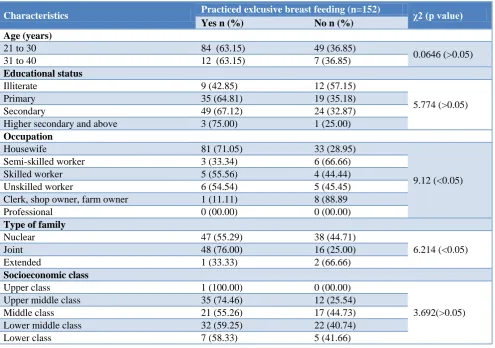
age group practiced exclusive breast feeding and there is no significant difference between two groups (p>0.05). 67.12% of mothers educated up to secondary level and 75% of mothers educated up to higher secondary and above level were practicing exclusive breast feeding.
71.05% of housewives practiced exclusive breast feeding. 76% of mothers from joint family practiced exclusive breast feeding. 74.46% of mothers from upper middle class practiced exclusive breast feeding.
Table 2: Relationship between socio-demographic factors and exclusive breastfeeding.
Characteristics Practiced exlcusive breast feeding (n=152) χ2 (p value)
Yes n (%) No n (%)
Age (years)
21 to 30 84 (63.15) 49 (36.85)
0.0646 (>0.05)
31 to 40 12 (63.15) 7 (36.85)
Educational status
Illiterate 9 (42.85) 12 (57.15)
5.774 (>0.05)
Primary 35 (64.81) 19 (35.18)
Secondary 49 (67.12) 24 (32.87)
Higher secondary and above 3 (75.00) 1 (25.00)
Occupation
Housewife 81 (71.05) 33 (28.95)
9.12 (<0.05)
Semi-skilled worker 3 (33.34) 6 (66.66)
Skilled worker 5 (55.56) 4 (44.44)
Unskilled worker 6 (54.54) 5 (45.45)
Clerk, shop owner, farm owner 1 (11.11) 8 (88.89
Professional 0 (00.00) 0 (00.00)
Type of family
Nuclear 47 (55.29) 38 (44.71)
6.214 (<0.05)
Joint 48 (76.00) 16 (25.00)
Extended 1 (33.33) 2 (66.66)
Socioeconomic class
Upper class 1 (100.00) 0 (00.00)
3.692(>0.05)
Upper middle class 35 (74.46) 12 (25.54)
Middle class 21 (55.26) 17 (44.73)
Lower middle class 32 (59.25) 22 (40.74)
Lower class 7 (58.33) 5 (41.66)
Table 3: Mothers knowledge and perception about breast feeding practices.
Variables Frequency (n=152) Percent (%)
Reasons for delay in initiation of BF
Religious misbelieves 27 17.78
No milk secretion 35 23.02
Physical discomfort/drowsiness 36 23.68
Pre-lacteal feed used 54 35.52
Reasons for not feeding colostrum
Religious reasons 34 22.36
Advice from elderly 31 20.39
Considered bad 29 19.07
Child cannot suck 30 19.73
Others 28 18.42
Prevalent pre-lacteal feeding practices in study area
Honey 79 51.97
Jaggery water 22 14.47
Ghee 13 08.56
Sugar water 38 25.00
Variables Frequency (n=152) Percent (%)
Knowledge of benefits of breast milk
Nutritious 71 46.72
Prevents Infection 38 25.00
Increases bonding 16 10.52
Lactational amenorrhea 04 02.63
Don’t know 23 15.13
Source of information about breast feeding
Elderly female in the family 38 25.00
Doctor 34 22.36
Nurse 24 15.78
Others 57 37.56
In Table 3, an equal proportion of mothers i.e. 23% delayed initiation of breast feeding due to either no milk secretion or physical discomfort. 19.07% of mothers were not feeding colostrum because they considered it bad while in 19.73% of mothers child was not able to suck. 51.97% of mothers were giving honey and 25% of mothers used sugar water as pre-lacteal feed. 46.72% of mothers had knowledge that breast milk is nutritious food for child. 25% of mothers got the information regarding breast milk from the elderly female in the family while 37.56% of mothers received this information from other sources which included friends, neighbours, close and distant relatives and other health personnel like ASHA and AWW.
DISCUSSION
The overall prevalence of exclusive breast feeding in the present study was 63.15% which was comparable with the result from the previous studies from Ethiopia (70.5%).4 The study carried out by Radhakrishnan among rural women of Tamilnadu, found the prevalence of exclusive breast feeding was only 34%.5 While in the study carried out in Taif city of Sudan the prevalence of EBF was only 19%.6
The majority of (87.50%) participants were in the age group of 21 to 30 years, belonging to nuclear family (55.93%) and studies up to secondary level (48.06%). Similar results were obtained from the study carried out by Wagh in Akola district of Maharashtra where maximum were in the age group of 24 to 29 years (51.21%), 62.20% of participants belongs to nuclear family and 50% of participants were studies up to secondary level.7
Maximum participants belongs to Hindu religion (86.85%), and 75.79% of participants were housewives by occupation. While in the study carried out by Wagh in Akola district of Maharashtra, 32.92% of participants were Hindu by religion and 62.20% were housewives by occupation.7
35.52% of respondent belongs to lower middle class of socioeconomic status.
The proportion of women practicing exclusive breast feeding was equal for the both the age group i.e. 63.15%. 67.12% of participant who were studied up to secondary level practiced exclusive breast feeding. There is an inverse relation between education status breast feeding practices. The relation between education and exclusive breast feeding practices was not statistically significant (p>0.05). Similar results were found in the study carried out by Yadavannavar among the rural women of Bijapur, Karnataka were breast feeding practices decrease with increased in educational status of women.8 71.05% of women who were housewives practiced exclusive breast feeding while women who involved in some kind of work show significantly lower percentage of practicing EBF. 76% of women from joint family practiced exclusive breast feeding. Exclusive breast feeding were practiced maximally by women belonging to upper and upper middle class of socioeconomic status while the proportion was low among middle, lower middle and lower class of socioeconomic status. The relation between socioeconomic status and exclusive breast feeding practices was not statistically significant (p>0.05). In the study by Yadavannavar among the rural women of Bijapur, Karnataka, 100% of women from upper and upper middle class of socioeconomic status practiced exclusive breast feeding while the proportion was low among middle, lower middle and lower class which are the similar to the present study.8
the knowledge that breast milk is nutritious for babies and 25% knows that breast milk prevent babies from infection. In the study carried out by Nigam in the tertiary care hospital of Indore city, 59% of participants believes that breast milk is nutritious to babies while 34% knew that breast milk prevents babies from infection.10 25% of mothers got the information regarding breast feeding from the elderly female in the family while 22.36% got it from doctor. Similar results were obtained from the study carried out by Yadavannavar among the rural women of Bijapur, Karnataka, where the prevalent source of information was elderly female in the family which was 62.91% followed by doctor which was 11.66%.8 In the study carried out by Bagul A. in the urban slums of Nagpur city, 65.78% of mothers received knowledge of breast feeding from the elderly female in the family while 34.22% from health personnel.9
CONCLUSION
Mothers did not follow WHO recommendation to timely initiate breastfeeding. As it was found that exclusive breast feeding was practiced well by mothers who were housewives which shows that employment was the major obstacles for breast feeding.
Recommendations
Health education concerning advantage of timely initiation of breast-feeding and promotion of exclusive breast feeding should be emphasized. The health education regarding expressed milk should be taught to working mothers.
Funding: No funding sources Conflict of interest: None declared Ethical approval: Not required
REFERENCES
1. World Health Organization. Global strategy for infant and young child feeding. The optimal duration of exclusive breastfeeding. Fifthy-fourth world Heal Assem. 2001;(1):1–5.
2. Horta BL, Victora CG. Long-term health effects of breastfeeding. World Heal Organ. 2013;129(8– 9):57–64.
3. National Family Health Survey-4 or NFHS-4. 4. Radhakrishnan S, Balamuruga SS. Prevalence of
exclusive breastfeeding practices among rural women in Tamil Nadu. International J Health Allied Sci. 2012;1:2:64-7.
5. Dorgham LS, Hafez SK, Kamhawy HE, Hassan WB. Assessment of Initiation of Breastfeeding, prevalence of Exclusive Breastfeeding and their Practices in Taif KSA. Life Science J. 2014;11(1):1-9.
6. Wagh SV, Wagh SS, Raut MM, Dambhare DG, Sharma DA. A Study of Breastfeeding Practices in Vidarbha Region of Maharashtra India. Innovative J Med Health Sci. 2013;238-41.
7. Yadavannavar MC, Patil SS. Socio cultural factors affecting breast feeding practices and decisions in rural women. Int J Plant Med Environ Sci. 2011;1(2):46-50.
8. Bagul AS, Supare MS. The Infant Feeding Practices in Urabn Slum of Nagpur, India. J Clin Diagnos Res. 2012;6:9:1525-7.
9. Nigam R, Nigam M, Wavre RR, Deshpande A, Chandorkar RK. Breastfeeding Practices in Baby Friendly Hospitals of Indore. Indian J Paediatr. 2010;77(6):689-90.