THE KNOWLEDGE, SKILLS AND COMPETENCIES FOR EFFECTIVE PUBLIC AFFAIRS PRACTICE: A UK STUDY
SARAH BOWMAN
A thesis submitted in partial fulfillment of the requirements of The University of West London for the degree of Doctor of Philosophy
ABSTRACT
This thesis adds conceptual and practical value to the field of public affairs
(PA). It connects scholarship from the fields of competencies, careers and
knowledge, with the theory and practice of PA. The review of literature clearly
demonstrated that a gap existed. This then provided a basis for a mixed
methods study that enabled the creation of a model of contemporary UK PA
practice; a PA knowledge architecture that supports practice; a conceptual PA
competency typology on which a competency framework can be built; and an
illustrative PA competency framework that reflects a twenty-first century
profession.
The study was guided by a critical realist worldview that suggests reality is
complex and to understand any phenomena a broad a set of research
instruments is necessary. The study, therefore, integrated qualitative and
quantitative techniques. The qualitative study consisted of 31 interviews with
PA practitioners and those involved in policy making that allowed the
gathering of rich data mirroring the complexity of work and policy construction.
A survey of 50 practitioners also informed the study by helping to illuminate
relationships and added greater depth. The research also integrated content
analysis by reflecting on four competency frameworks against best practice
scholarship to provide practical insights.
Findings suggest an evolving field that combines both cohesion and diversity
broad set of agreed competencies and knowledge. This is shaped by
postmodernist trends in identity and knowledge construction rather than that
which mirrors the traditional concept of what defines a profession.
Limitations relate to its scope: a UK focus. Further studies in different cultural
and political settings need to be encouraged and perhaps longitudinal studies
developed to look at the longer-term impact of whether a competency
ACKNOWLEDGEMENTS
There are a number of people who I would like to thank and acknowledge that
have assisted me toward the completion of this thesis.
I would like to thank my supervisors Dr. Tony Olden and Dr. Alastair Evans.
They have both assisted me over the years and offered guidance and insight
at all stages of the process. In particular, they have shown true patience to
enable me to complete.
I thank all those practitioners who gave freely of their time to take part in this
study. I was always aware that I was asking extremely busy people to take
time out to be interviewed or to take part in the survey. All those who I met
along the way were always genuine, interested and helpful. I hope I have
done justice to what you have shared with me and to our field of work.
Trying to complete a thesis such as this part-time is always difficult. So, I
would like to thank my boys Robbie and Alfie for all those times I did not help
with spelling tests, burnt the pizza or got side-tracked because I was writing.
Most of all, I promise I will never sit in a car park again trying to write whilst
CONTENTS
Chapter One
Introduction
1.1. Background to the study 1-5
1.2. Research issue 5-8
1.3. Research aim, objectives and questions 9-10
1.4. Overview of research methodology and analysis 10-11
1.5. Scope of study and contribution 12
1.6. Importance of the study 12-13
1.7. Structure of thesis 13-14
Chapter Two
Literature Review
2.1. Introduction to the chapter 15-16
2.2. Understanding public affairs 16
2.2.1. Defining and exploring public affairs and its environment
16-20
2.2.2. A body of knowledge and its link to professionalism 21-29 2.2.3. Exploring and defining a public affairs body of
knowledge
29-36
2.2.4. Public affairs knowledge roots: a closer examination
36
Concepts from political science 37-38
Concepts from culture and society 39-41
Concepts from communications 41-51
Concepts from the organisation 51-54
2.2.5. An emergent public affairs body of knowledge 55-56 2.2.6. Ethics in a public affairs body of knowledge 56-63 2.2.7. A public affairs body of knowledge, competencies
and concept of creole
63-68
2.2.8. Theory and practice: a return to professionalism 68-72
2.3. Understanding knowledge 72
2.3.1. Tacit and explicit knowledge 72-76
2.3.2. Deconstructing knowledge and theory 76-77
2.4. Understanding competence and competency 78
2.4.1. Terms of reference 78-79
2.4.2. Typologies and frameworks 79-89
2.4.3. Organisational versus professional competencies 89-98
2.4.4. Epistemological tensions 98
2.5. Concluding themes and reflections against research questions
98-100
Chapter Three
_____________________________________________________
Methodology
3.1. Introduction to the chapter 101
3.2. Research philosophy: Epistemological context 101-108
3.3. Critical realism: A way forward 108-110
3.4. Research strategy: Critical realism and mixed methods
110-115
3.5. Research methods: Primary data gathering 115-117
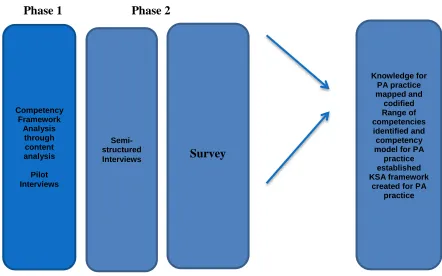
3.5.1. Phase One (Pilot) 117
Mapping competency frameworks 117-118
Pilot Interviews 118-119
3.5.2. Phase Two (Part A) 120
Inductive Enquiry through semi-structured
interviews
3.5.3. Phase Two (Part B) 129
Survey 129-144
3.6. Data Analysis 144
3.6.1. Qualitative data analysis 144-150
3.6.2. Quantitative data analysis 150-152
3.7. Limitations, credibility and ethical considerations 152
3.7.1. Critical realism impacts 152-153
3.7.2. Reliability and validity 153-156
3.7.3. Generalisability and replicability 156-157
3.7.4. Ethical considerations 157-159
3.8. Conclusion 159-160
Chapter Four
Insight from Practical Competency Framework Investigations
4.1. Introduction to the chapter 161-163
4.2. General guidance on competency development 163-168
4.3. Practical application to the professions 168
4.3.1. Government Communications Network 169-172
4.3.2. Association of Certified Chartered Accountants 172-175
4.3.3. Institute of Civil Engineers 175-178
4.3.4. Royal Pharmaceutical Society 178-181
4.3.5. Reflections from practical applications 181-187
4.4. Public affairs competency frameworks 187-189
4.5. Conclusion and themes emerging 189-191
Chapter Five
_____________________________________________________
Findings from Interviews
5.1. Introduction to the chapter 192-195
5.2.1. Theme: Evidence-based 197-198
5.2.2. Theme: Environmental complexity 198-199
5.2.3. Theme: Integration and widening of skills 199-200
5.2.4. Theme: Management consultancy 200-201
5.3. Clarity of purpose but with some ambiguity and tension
201-203
5.3.1. Theme: Intellectual capital grounded in political expertise
203-205
5.3.2. Theme: Sector and organisation impacts on public affairs practice
205-210
5.3.3. Theme: Professionalisation strains 210-214
5.4. A body of knowledge visible but lacks realization and depth
214-216
5.4.1. Theme: Policy insight and intuition 216-217
5.4.2. Theme: Applied communication skills 217-218
5.4.3. Theme: Commercial knowledge of growing importance
218-219
5.4.4. Theme: Limited awareness of conceptual knowledge
219-220
5.5. Broad competency agreement within a fragmenting practice
220-221
5.5.1. Theme: Importance of emotional intelligence and social awareness
222-224
5.5.2. Theme: Need for organisational and political awareness
224
5.5.3. Theme: Functional competencies of a strategic communicator underpin practice
224-226
Chapter Six
_____________________________________________________
Findings from Questionnaire
6.1. Introduction to the chapter 228-232
6.2. Overview of respondents 232-235
6.3. Individual variable analysis 235-253
6.4. Examining relationships between variables 253-257
6.5. Relating data to objectives of the survey 257-259
6.6. Concluding reflections 259-260
Chapter Seven
_____________________________________________________
Discussion
7.1. Introduction to the chapter 261
7.2. A stratified world and a stratified practice 261
7.2.1. Evolution of public affairs 261-263
7.2.2. Relationship management 263-267
7.2.3. Counsel and consultancy 267-269
7.2.4. Mix of tools and techniques 270-273
7.2.5. Situational aspects of public affairs 273-278 7.3. Internal tension and contradictions: cohesion and
diversity
278
7.3.1. Increasing maturity 278-279
7.3.2. Practice tensions 279-283
7.3.3. Broad agreement on competencies 283-284
7.3.4. A new form of professionalism 284-287
7.4. Knowledge complexity and interdisciplinary challenges
287
7.4.1. Defining knowledge is problematic 287-289
7.4.2. A tripartite view of knowledge 289-297
7.5. Competencies: A multi-layered approach 303
7.5.1. Terminological imprecision 303-304
7.5.2. Widening yet agreement on skills 304-307
7.5.3. Behaviours and ethics 307-309
7.5.4. Public affairs differentiation 309-316
7.5.5. Finding the language of practice 316-326
7.6. Personal agency, structure and praxis: A multi-dimensional career in a post-modern world
326
7.6.1 An integrated and strategic practice 326-328
7.6.2. A postmodern lens to view the field 328-331
7.6.3. New forms of career strategies 331-333
7.6.4. Making a virtue of cohesion and diversity 333-335
7.7. Conclusion 335
Chapter Eight
_____________________________________________________
Conclusion and Areas of Contribution
8.1. Introduction to the chapter 336
8.2. Areas of contribution 336-338
8.3. The shape of current public affairs practice and how if at all it has changed? (RQ1)
338-346
8.4. Identifying the knowledge that underpins public affairs practice (RQ2)
346-354
8.5. Exploring what public affairs practitioners do and the skills necessary (RQ3)
355-361
8.6. Understanding the behaviours necessary for public affairs practice (RQ4)
361-365
8.7. A competency framework for public affairs (RQ5) 365-371 8.8. Implications of the findings on the study and
practice of public affairs
371-373
8.9. Suggested implications of a critical realist perspective on public affairs practice
8.10. Conclusion: Final reflections on areas of contribution and recommendations for future research
376-379
APPENDICES
______________________________________________________________
Systematic Literature Review: Overview of Approach A Public Affairs and Public Relations Competency Lists: An
illustration
B
Extracts from Professional Competency Frameworks C
Summary of Interview Respondents and Interview Guide D
Copy of Questionnaire and underpinning typology E
An illustrative competency framework for public affairs F
LIST OF TABLES
Table 2.1. Summary of public affairs definitions and conceptualization
19-20
Table 2.2. Summary of characteristics of a profession (Downie, 1990)
22
Table 2.3. Summary of knowledge fields relevant to public affairs
37
Table 2.4. Simplified model of Grunig and Hunt’s (1984) Four Models of PR
45
Table 2.5. Summary of competency research (Fleisher, 2007; Watson Helsby, 2012; VMA, 2012)
66
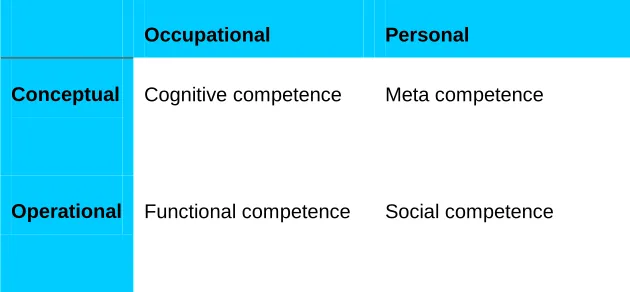
Table 2.6. Typology of competence (Delamare Le Deist and Winterton, 2005)
82
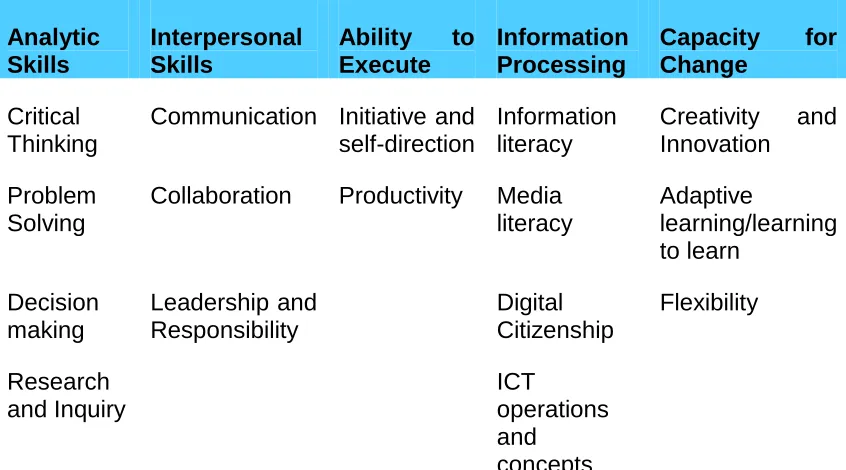
Table 2.7. List of 21st century competencies (Finegold and Notabartolo, 2010)
85
et. al. 2011)
Table 2.9. ECOPSI Research Report Competency Summary (2013)
96
Table 3.1. Summary of pilot interview interviewees 119
Table 3.2. Summary of interview respondents 122
Table 3.3. Table of interview questions 128-129
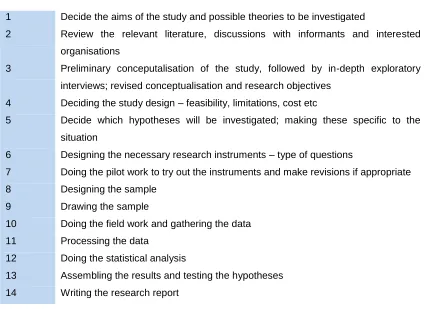
Table 3.4. Oppenheim (1992:8) 14-step survey design 130 Table 3.5. Survey construction supporting how public affairs
understands knowledge
136-137
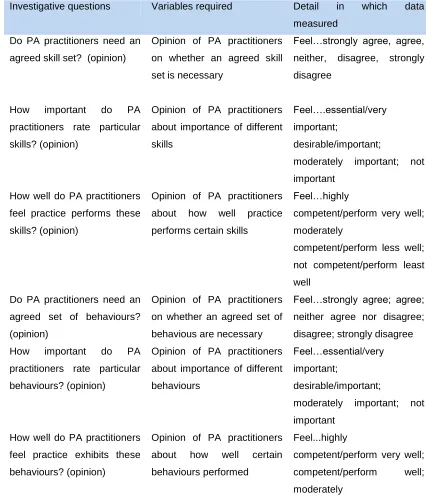
Table 3.6. Survey construction supporting how public affairs understands behaviours and skills
137-138
Table 3.7. Survey construction supporting how public affairs understands effectiveness and professionalism
138
Table 3.8. Usability of knowledge root questions 141 Table 3.9. Steps in analysis employing thematic analysis
(Attride-Stirling, 2001)
147
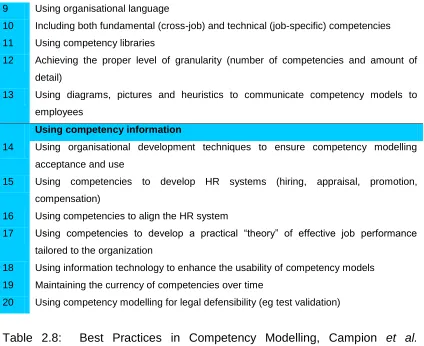
Table 4.1. Best practice in competency modeling (Campion
et. al. 2011) (as used in 2.10)
167
Table 4.2. Summary of professional competency frameworks against criterion
182
Table 4.3. Connect Public Affairs Competency Table 188 Table 5.1. Summary of participants for interview analysis 192 Table 5.2. Aggregate dimension construction for a changing
landscape and a changing practice
196
Table 5.3. Aggregate dimension construction for clarity of purpose but with some ambiguity and tension
203
Table 5.4. Aggregate dimension construction for a body of knowledge visible but lacks realization and depth
215
Table 5.5. Aggregate dimension construction for broad competency agreement within a fragmenting practice
221
Table 6.1. Simplified comparison of high and low ranked challenges facing public affairs
Table 6.2. Simplified cross-reference comparison between importance and performance of public affairs skills
239
Table 6.3. Simplified cross-reference comparison between importance and performance of public affairs behaviours
243
Table 6.4. Ranking of statements in terms of knowledge helpfulness in understanding public affairs
245
Table 6.5. Ranking of components in terms of importance in defining PA as a profession
247
Table 6.6. Ranking of statements in terms of importance in understanding PA professionalism
249
Table 6.7. Simplified ranking of different statements on transparency
252
Table 7.1. Adapted Finegold and Notabartolo (2010) Competency Model
314
Table 7.2. Delamare Le Deist and Winterton Typology (2005)
321
Table 7.3. A suggested adaption of the Delamare Le Deist and Winterton (2005) Typology
322
Table 8.1. An adaption: Delamare Le Deist and Winterton Typology (2005) illustrating a public affairs knowledge architecture
353
Table 8.2. An adaption: Delamare Le Deist and Winterton Typology (2005) illustrating a public affairs knowledge architecture and meta competencies (skills)
359
Table 8.3. An adaption: Delamare Le Deist and Winterton Typology (2005) illustrating a public affairs knowledge architecture and meta competencies (skills and behaviours)
LIST OF FIGURES
______________________________________________________________
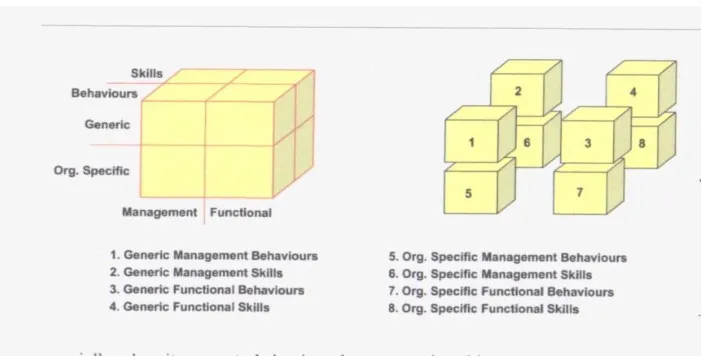
Figure 2.1. Typology comprising eight different types of competencies (Soderquist et al. 2010)
80
Figure 2.2. Holistic model of competence (Delamare Le Deist and Winterton, 2005)
82
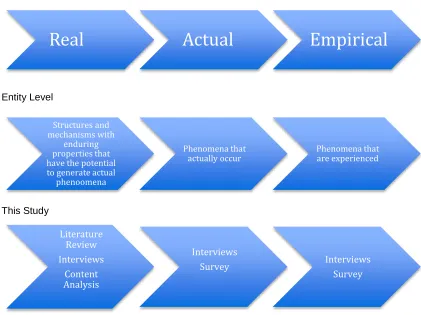
Figure 3.1. The three ontological domains (Bhaskar, 1978) and relationship to this study
113
Figure 3.2. Summary of the research process 116
Figure 3.3. Thematic Analysis (Attride-Stirling, 2001) 146 Figure 3.4. Example of data structure (Corley and Gioia,
2004)
149
Figure 8.1. Representation of areas of contribution 336 Figure 8.2. Twenty-first century PA practice: A model 343 Figure 8.3. A public affairs body of knowledge pyramid: A
tripartite knowledge architecture
351
Figure 8.4. A public affairs competency framework: The competency wheel
CHAPTER ONE: INTRODUCTION
_____________________________________________________
1.1. Background to the Study
Public affairs (PA) is ‘a specialised practice that focuses on relationships which will have a bearing on the development of public policy’ (White and
Mazur 1995: 200), but there are many definitions of the discipline and no
agreement on the theoretical concepts and personal competencies that
underpin it (Fleisher 2007; Toth, 2006). Yet PA is having a growing influence on all our lives. The Hansard Society’s Friend or Foe report (2007) suggested
all types of organisations in the UK used PA and that it played a central role in
the development and delivery of policy. This in itself was not problematic
providing it was done so responsibly and transparently.
According to the Association of Professional Political Consultants (APPC) in
2015 there were an estimated 4000 people who defined themselves as PA
practitioners in the UK. These included those working directly for
organisations (in-house teams), as well as those working in consultancy. In
addition, there are over 40,000 members of the Chartered Institute of Public
Relations (CIPR) whose roles encompass all aspect of communications many
of which may involve PA. These numbers, however, exclude those who are
not signed-up to either professional body as in the UK individuals do not have
to be a member of a professional body in order to offer communications
advice. So, those involved in delivering aspects of PA may be substantially
higher. This lack of formal accreditation is one that vexes the
(PR Week, 6 February, 2014). Although these numbers are still significantly
less than other occuptions that have professional status – for example the UK’s Institute of Civil Engineers represent 80,000 members worldwide – there
is now a weight of numbers of those involved in delivering PA activities. This
coupled with high profile public interest in the discipline makes an exploration
of the practice worthwhile.
The public interest in lobbying has been prompted in part by the continual
decline in the reputation of politicians. This came to a head following the Telegraph’s reporting of MP’s expenses in 2009. Since then there have been
a number of confirmed cases of politicians demonstrating inappropriate
behaviour, including lodging fraudalent expense claims. High profile cases include Liam Fox’s resignation as Defence Secretary in 2011, and the former
Transport Secretary, Stephen Byers, being caught on camera in 2010 saying he was ‘a cab for hire’ who would work for £5000 a day. More recently in 2015
senior politicians Sir Malcolm Rifkind and Rt Hon Jack Straw have fallen
victim of media ‘stings’ suggesting the type of fees they would charge for
enabling access to decision makers.
These scandals, however, relate to those being lobbied, rather than those
doing the lobbying yet some PA practitioners too have also brought the
profession into disrepute, for example, Tim Collins at Bell Pottinger who
allegedly offered rogue regimes access to politicians as reported in the
Guardian by Patrick Wintour (6 December, 2011). Although there have been
the bulk of the problem lies more with the politician rather than the lobbyist,
but the two are perceived to be part of the same problem – those in power
and those close to power are in it for themselves.
Against this backdrop, the industry came together in 2010 to establish the UK
Public Affairs Council (UKPAC). The aim of the Council is to promote and
uphold effective self-regulation for those professionally engaged in PA and emerged from the Public Administration Select Committee’s
recommendations for there to be a public register of lobbyists. The Council is
made up of representatives from the Association of Professional Political
Consultants (APPC), the Chartered Institute of Public Relations (CIPR) and
the Public Relations and Communication Association (PRCA) many of whose
members are actively engaged in lobbying. All lobbyists are encouraged to
register. At the same time, all three professional bodies have voluntary codes of conduct – in particular, the APPC who focus on the importance of integrity
in PA practice.
Despite this, government has persisted in its intention to establish a statutory
register. The Transparency of Lobbying, Non-party Campaigning and Trade
Union Administration Act 2014 came into force on 25 March 2015 paving the
way for a statutory register of lobbyists controlled by the Office of the
Registrar of Consultant Lobbyists. Part One of the Act necessitates
consultant lobbyists to formally register. At the time, the Act garnered
criticism from the PA industry and others including bodies such as The
transparency at all. It excludes in-house lobbying teams and only provides
limited information. Nor does it tackle the issue of MPs behaving badly. A
view reiterated in an ALT blog post in April, 2016. Iain Anderson, former Chair
of the APPC in February 2015 in response to Transparency International’s
Lifting the Lid report also made clear that the Act does nothing to improve
transparency and focuses on the wrong targets and will not prevent MP
scandals.
In part as a result of media coverage of these issues, the British public increasing perceive ‘the establishment’ as corrupt and in need of monitoring.
The Edelman Trust Barometer 2015 reinforced this view arguing that trust in
government, business and the media was at an all time low, suggesting that
less than half of the UK population trust a political leader to return £10 if they
lent it to them.
Yet policy formation continues as does the PA role within it. A new style of
coalition government in 2010 and a change in the legislative make-up with a
significant number of new MPs all impacted on the delivery of PA requiring the
need to reassess relationships and understand policy co-creation. Also, this
decade has seen the complexity and inter-connectedness of the modern
world become increasingly apparent not least with the economic crisis and a
decline in deference that places societal issues and grassroots voices higher
up the scale of importance. This has brought changes to the nature of
The 2015 general election did nothing to alter this increasingly complicated
world apart from re-establishing traditional majority government, and the
recent BREXIT vote has again thrown up different questions for PA practice in
terms of rethinking where decision making in the future may reside. Back in
2010, Schepers argued that new ways of business-government cooperation
was needed and new skills were required. This has even more relevance
today than it did then. As suggested by Spencer (2011), PA is about
managing uncertainty and unknown unknowns and this is particularly
pertininent as the UK enters a changing political landscape.
1.2. Research issue
McGrath, Moss and Harris (2010), reflecting on the discipline, argued that PA
in the future required skilled practitioners able to analyse, interpret and
anticipate trends and developments and also be able to provide strategic
counsel to organisations. The researcher believes that the question of what
constitutes effective PA competencies needs to be explored in detail to
improve policy and governance, enhance organisational value and individual
professionalism, as well as restoring trust and the reputation of the discipline.
Trust is aligned to the behaviours of PA practitioners and connects to the idea
of individual self-awareness. The ability to build trusting relationships requires
high levels of self-efficacy in order for individuals to evaluate their own
behaviours, values and worldviews to improve effectiveness. It is the
mechanism of competencies that is appealing as a way of embedding and
According to the UK Chartered Institute of Personnel Development (CIPD),
competency can be defined as both the behaviours and technical attributes
individuals must have to perform effectively at work. The idea of
competencies as a way of driving individual performance emerged during the
1980s in both the UK and USA as a response to organisational challenges
and increased competitiveness presented by globalisation and the impact of
technology on the workplace. The seminal work of Boyatzis (1982) became
the start of a significant movement in human resource management (HRM)
towards identifying the skills and behaviours necessary for particular job roles
and areas of expertise. Over the last 30 years the concept of competencies
has become common place and competency frameworks seen as a vehicle to
drive high organisational performance.
In the UK, the Industrial Relations Services (IRS) Benchmarking
Competencies Survey (2010), the most recent survey they have conducted
specifically on competencies, revealed that more than two-thirds of the 168
employers surveyed used competencies for at least some groups of
employees. Those that did not cited issues such as time consuming to
research, develop and introduce, and lack of support from senior managment. The most widely used type of competency tended to focus of ‘soft skills’
associated with behaviours and values rather than technical ‘how to’
functional skills.
Work on competencies has traditionally been associated with organisations
the last 15 years the concept has increasingly gained mileage as a mechanism to underpin the skills and behaviours of the ‘professions’ – that is
areas of work that require a specific qualification and accreditation to enable
the individual to be employed in that field. This is often associated with
practice-based firms that are organised in a partnership structure. This is best
illustrated by accountants, lawyers, engineers and architects for example all of
whom need to be members of their respective professional bodies in order to
practice. This is also the case if these individuals are employed by other
organisations. Additionaly, it relates to professions that are embedded in other
structures such as the medical profession in the NHS. This use of
competencies is evidenced by the growth of competency frameworks that are
promoted by these professional bodies.
The later part of the twentieth century has also seen the rise of the
knowledge-based economy with occupations such as management
consutancy and those classified by what Drucker (1989) called knowledge
workers – those whose critical work resource within their essential
value-creating task is knowledge. The growth of this type of work has led to the
emergence of newer occupations aspiring to obtain professional status
including public relations, advertising and PA. As such, the role of
competencies in the professionalisation debate is becoming increasingly
topical and something which bodies such as the CIPR and APPC are looking
Athough competencies are seen as providing value, their idea is not without
criticism (Frank et al., 2010; Iles, 2001). These broadly fall into three areas of
concern - issues around their focus on past and current skills and attributes
rather than those necessary for the future; the often bureaucratic nature of the
process that underpins competency frameworks; and the fear that such an
approach creates clones reducing creativity and difference which are
important to stimulate new and fresh approaches that challenges the norm
and can lead to transformation. This paper will address these concerns and
reflect on what this means in practice. One practical response by human
resource professionals to some of these concerns is the slight variation in the
use of strengths-based approaches as put forward by Garcea, Isherwood and
Linley (2011) helping to get individuals to reflect on their competencies and
where they feel their strengths lie and what they enjoy. This will also be
explored as part of the knowledge and skills debate.
What does all of this mean to this study? In many respects this research explores the micro (individual self-wareness and knowledge of one’s own
character and motives), meso (organisational) and macro (societal) levels of
PA and aspires to add conceptual and practical value, as well as theoretical
depth to the subject. Toth (2006) challenges researchers to test various
theoretical views of PA, and Fleisher (2007: 285) suggests ‘the task of
identifying, defining, describing the characteristics and measuring competencies in nearly all PA activity areas… is one ripe for academic
1.3. Research aim, objectives and detailed questions
The aim of this research is to investigate the evolving nature of PA in order to
establish the contemporary knowledge, skills and competencies for effective
PA practice.
There are three key objectives for this research that are supported by five
specific research questions (RQs).
To understand the PA Body of Knowledge (BoK) necessary for
effective PA practice (supported by RQ1, RQ2)
To capture the competencies required for effective PA practice
(supported by RQ1, RQ3, RQ4)
To devise a competency framework to help deliver PA effectiveness
and professionalism (supported by RQ1, RQ2, RQ3, RQ4, RQ5)
RQ1: What is the shape of current PA practice and how if at all has it
changed?
RQ2: What is the knowledge that underpins practice?
RQ3: What do PA practitioners do and what are the skills necessary?
RQ4: How should PA practitioners behave?
RQ5: What does a contemporary competency framework look like for PA?
In support of this, the thesis addresses areas around what body of knowledge
underpins practice both from a conceptual and practical perspective and the
notion of explicit and tacit knowledge. It looks at the relationship between
itself as a profession. It explores PA effectiveness and how this can be
codified, evaluated and measured. It attempts to identify the behaviours and
technical skills necessary to practice PA in a changing and evolving policy
environment and endeavours to draw these together in a workable and
granular framework that can pull out the benefits and mitigate the weaknesses
presented by competency approaches. Finally, it seeks to find out how
practitioners understand their role and expectations of it.
1.4. Overview of research methods and analysis
The study is guided by a critical realist worldview drawing on the work of
Bhaskar (1989) who suggests there are three domains of reality. The first is
experienced (empirical); aspects that occur but are not necessarily
experienced (actual); and finally, the deep structures and mechanisms that
generate phenomena. In other words, the world is complex and due
consideration must be given to the structures and processes that underpin
reality. This is important to the field of PA where the discipline is at the centre
of a wide variety of processes, structures and relationships both within the
organisation, and between organisations and the policy environment which
itself is a complex web of connections between all those inputting into the
decision-making process. Here there are overt and covert relationships and
power dynamics that shape a range of social interactions.
Consequently, there is a need to understand PA from a broad set of
perspectives not all of which are readily experienced or observed. As a
and quantitative techniques supporting the views of Tashakkori and Teddlie
(2003) who feel that integrating methods can be helpful if they provide better
opportunities to address specific research questions.
The study consists of four strands. Initially a systematic literature review
contributes primarily inductively to help identify emerging themes and
concepts in the domain of PA and the separate field of competency
scholarship. There are elements of deductive enquiry in that the literature is
extensive and as argued by Reichertz (2010) previous developed knowledge
cannot be ignored. It falls, therefore, more into the abductive tradition.
This enables the study to take a theory building approach but it is not used to
formally test a specific hypothesis emerging from the literature. This enables
a theory driven but not a theory testing investigation to take place in the
second strand of the study through in-depth interviews. This qualitative
approach is supported by a quantitative survey that helps to elucidate
concepts and ideas. The study also explores competency frameworks of four
professional bodies to add additional insight and reflects on a PA specific
framework developed by one PA agency. Such a theory building approach
falls more firmly into the critical realist stance and draws on ideas around
tendencies rather than empirical generalisations (Lawson, 2003). Data
analysis is guided by the principles of Gioia (2004, 2012) that seeks to provide
rigour to inductive research and is supported by statistical analysis using
basic SPSS to help provide additional insight and help illuminate relationships
1.5. Scope of study
The study addresses the UK PA function that by its nature has a Western
perspective, but given the complexity of governance there is an international
dimension. Although data relates primarily to the Westminster and Whitehall
structures, those operating in the devolved institutions have been included but
this is a general study looking at UK PA holistically rather than a detailed
analysis of one particular institution.
1.6. Importance of the study
This research is relevant from four perspectives. Firstly, it is important to the
reputation of PA practice. The discipline engenders extremes of views as to
whether it is moral, ethical and healthy for democracy, or whether it hinders
and corrupts the democratic process. The research builds on the views of
scholars such as Fitzpatrick and Bronstein (2006) and Berg (2012) that
advocacy plays a valuable role. Individuals with better self-awareness
understand how their behaviours contribute to the reputation of practice.
Secondly, it addresses the need for a better understanding of practice and the
environment in which it operates stimulating greater intellectual depth. In this
respect, it continues the work of Schepers (2010) and McGrath, Moss and
Harris (2010) who call for an improved PA knowledge base. It also connects
to the ideas around self-efficacy that describe the way people see the world
and behave and explores what role this plays in this new breed of practitioner
Thirdly, there have been concerns amplified by the UK media surrounding
financial misconduct of MPs and poor behaviour of PA practitioners. In order
to address these the government tightened up the regulatory framework under
which MPs operate and introduced a new lobbying regulation. A practice that
better understands itself and its responsibilities is more likely to evoke
confidence and contribute to shaping a regulatory environment that is
workable rather than have poorly thought out restrictions imposed on it.
Finally, the study addresses a gap in the PA body of knowledge by
synthesising scholarship from complementary fields of study to provide fresh
conceptual and practical contributions.
1.7. Structure of thesis
This thesis starts by exploring the literature around the domain of PA,
knowledge and competencies with Chapter Two providing an overview of the
scholarship. Chapter Three then outlines the detailed research philosophy,
methodological choices and their justification, together with an overview of the
data analysis processes and wider issues to do with reliability, validity and
ethical issues associated with the study. These early chapters set the
context for the study.
Next the thesis moves into research findings. Chapter Four provides insight
from relevant competency frameworks to inform thinking and illustrate
analysis from the qualitative component of this study – the in-depth interviews
- helping to draw out key concepts and themes. Chapter Six adds additional
statistical and quantitative input from the practitioner survey.
From here the study moves into a detailed discussion and reflection of these
findings in Chapter Seven that synthesises information from the literature with
various data sources to capture the nature of contemporary PA practice.
Then Chapter Eight concludes by demonstrating how this study has
addressed the original aim, objectives and research questions. It explicitly
identifies three specific conceptual contributions to the field and one practical
contribution in the form of an illustrative competency framework for practice. It
also looks at the implications of the study on the theory and practice of PA
CHAPTER TWO: LITERATURE REVIEW
____________________________________________________
2.1. Introduction to the chapter
This review connects literature from the fields of PA, knowledge and
competencies and touches on complementary areas around professionalism,
professional identity and careers. It initially explores PA before drilling down to
investigate relevant knowledge traditions and specific underlying theories that
it is argued support practice drawing on political science, culture and society,
communications, organisational studies and economics. This enables an
initial exploration of the suggested body of knowledge (BoK) that supports PA
practice before allowing a greater analysis of the relationship between
knowledge and professionalism. Notions of professionalism are also then
reviewed alongside some of the previous work on PA competencies.
This chapter then explores the ideas that underpin the notion of knowledge
including tacit and explicit knowledge and the concepts of theory and
meta-theory that allow greater insights into what is meant by knowledge. The
review then moves on to take a closer look at HRM scholarship and the role of
competencies in enhancing individual and organisational performance. It
looks at typologies and the segmentation of different forms of competencies to
help illuminate the subject allowing greater reflection against PA.
It concludes by drawing out themes relevant to this study that cross the
various fields of scholarship and provides context to the explicit research
by Huff (2009) and Tranfield, Denyer and Smart (2003). Details of this
approach can be found in Appendix A, and further discussion on how the
literature informed and shaped the study can be found in Chapter Three on
the methodology.
2.2. Understanding Public Affairs
2.2.1. Defining and exploring PA and its environment
Many scholars (Fleisher, 2002, 2007; Hillman, 2002; Paluszek, 1995; Schuler,
2002; Toth, 2006) have tried to define PA, but common to all is the
understanding that PA is about building relationships with those who shape
public policy. Though, as Toth (2006) points out, public policy itself is poorly
defined. Buchholtz suggests PA is: ‘a specific course of action taken
collectively by society or by a legitimate representative of society, addressing
a specific problem of public concern that reflects the interests of society or particular segment of society’ (1988: 53). Practically speaking the researcher
suggests that in today’s modern world public policy shapes and affects all
aspects of our lives and involves the laws, regulations and conventions that
govern our existence. It is heavily entwined with the political systems,
democratic values and markets in which it operates and as such is shaped by
a range of institutional factors, as argued by Bauer (2015).
An additional complication is the inter-changeability of the terms PA, lobbying
and corporate political activity (CPA) in scholarship and practice. As
Anastasiadis (2006) argues, lobbying struggles with terminological confusion,
of the earliest and easiest definitions of lobbying is by Milbraith (1963:8) who
states: ‘lobbying is the stimulation and transmission of a communication, by
someone other than a citizen acting on his own behalf, directed to a governmental decision maker with the hope of influencing his decision’. This
has parallels to Buchholtz’s (1988) later definition. On one-level it is simple.
Lobbying is about advocacy primarily involving direct contact. Yet Harris and
Moss (2001) argue that PA is not just about advocacy but rather it is about
interfacing with a wide set of stakeholders and uses a range relationship tools.
As such it is part of Public Relations (PR) – the discipline that builds
relationships between an organisation and its publics, though the connection
between the two is not always clear-cut. Its close association as being part of
PR tends to have more of its heritage in the US than the UK (Somerville and
Aroussi, 2016) and according to Moloney (2000) many UK lobbyists are
concerned with their inclusion in PR. Though, when looking at the UK
Lobbying Register, it explicitly states that: ‘Lobbying is a discipline within
public relations where the general intention is to inform and influence public
policy and law. Lobbyists are practitioners who execute planned and
sustained efforts to deliver specific objectives within this broad profile of activity’ (n.d.).
To aide clarity this paper uses the concept of PA as an umbrella term that
embraces the concept of lobbying, as well as wider relationship building
activities with those who shape policy. It does not include aspects of CPA in
respect of political donations and fundraising or direct political party
Scholars such as Berger (2001) put forward elitist worldviews in that it is
corporate interest groups who mainly influence policy through their economic
power. This plays into the negative view of PA. Others like Grunig and
Jaatiinen (1998) suggest that in reality most political systems fall between
pluralism and corporatism. With pluralism, there is pure advocacy and private
interest competing for access and government resources and with
corporatism there is pure collaboration and a sense of the collective. They
suggest the concept of societal corporatism that incorporates pressure
politics, negotiation and collaborative interests. Such a worldview seems to
be more in keeping with the complexity of modern governance. Any study of
PA, therefore, needs to factor in the macro environment in which it operates,
in particular the expectations and values of the society in which it is situated.
The importance of the macro environment to PA is mirrored by the evolving
nature of PA research. Griffin (2005) reflecting on US PA empirical studies
and scholarship between 1965 and 2004 found there to have been three
overlapping thematic research approaches (or waves). Studies initially looked
at understanding the foundations of PA, then moved on to address some of
the managerial challenges of PA practice. Latterly it addresses the blurred
boundaries of modern-day PA that go beyond government relations to
incorporate ideas around the firm and its network of stakeholders and how
this impacts on the political arena.
To note is the significant North American bias in Griffin’s analysis, in part
USA and Canada. Nonetheless the concept of blurred boundaries is relevant.
More recent research and commentary has continued to explore this issue
(Boddewyn, 2012; Oberman, 2008; Toth, 2006) and is looked at in detail in
section 2.2.3. of this review. It could also be argued that some commentators
such as McGrath, Moss and Harris (2010) have taken this further by
suggesting that PA is now one of co-creation of policy that leads to a blurring
of not just organisation-stakeholder boundaries but organisation-government
boundaries.
The table below summarises the different conceptualisations of PA by building
on the analysis of McGrath, Moss and Harris (2010) to incorporate additional
scholars and brings it up to date to include the work of Boddewyn (2012).
Authors Date Key
Descriptor/metaphor
Implied core role for PA
Descriptor of the role
Post 1982 Window-out and
window-in Political boundary spanner PA ensure management have an understanding of political realities (window-in) and equally that their views are known amongst key political figures (window-out) Meznar and
Nigh
1995 Buffer or Bridge Interfacing role Boundary spanner
PA helps cushion the organisation from outside attack and reach out to key stakeholder groups
Hillman and Hitt 1999 Relational v transactional
Political exchange activity v political relationship building
PA can either engage in short term political engagement, lobbying or longer term relationship building with government Harrison 2000 Tri-partite usage:
Marketing v Public Relations v
Tri-partite role: Sales v Reputation v
PA can be involved in loud
Information Lobbying quiet (discreet) activities. As marketing, PA can drive sales. As PR, it can lead to enhanced reputation and as information it can mitigate the impact of legislation.
Toth 2006 PA is PR Relationships with
non-economic stakeholders
Building public policy relationships
Oberman 2008 Catalyst Driving
competitive advantage
PA turns socio-political resources into operational ones Van Schendelen Fleisher 2010 1998
Political alignment Aligning corporate and public policy
PA focuses on facilitating and building
relationships and interaction with actors in the political and social environment so as to align corporate and public policies. McGrath, Moss
and Harris
2010 Public issues lifecycle Identification and prioritization of issues that impact on the
sustainability of the firm
PA focuses on issues management and bridging organisation, society and government
Boddewyn 2012 Embeddedness Management of
non-market relationships
embedded in
society
PA is the
management of the firm’s relationships with the institutions and organisations (political, social and cultural) operating in the non-market environment
Table 2.1. Summary of PA definitions and conceptualisation ©Roberts-Bowman (2017) incorporating the work of McGrath, Moss and Harris (2010: 339)
What this table reveals, is that the discipline is not without a research base
2.2.2. A body of knowledge and its link to professionalism
Research into defining and understanding PA exists but there is little
consensus regarding a definitive PA-BoK necessary for professional PA
practice (Fleisher, 2007). A BoK can be defined as the collection of
processes and knowledge areas that underpin the professional domain. The
concept of a professional and professionalism is a field of research in itself,
but it is necessary to reflect on some of the key thinking as the concept of
knowledge appears to be integral to the ideas of what constitutes a
profession, the concept of professionalism and professional practice.
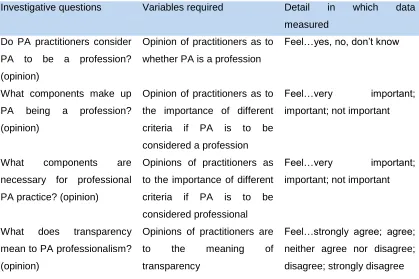
Although this paper is not explicitly addressing the question of whether PA is
a profession, it is looking at the competencies for professional practice, so
aspects of what a profession looks like needs investigation.
Friedson (1970) argues a profession is a field of work that has a dominant
position in the division of labour so that it has control over most of its actions.
This is a helpful starting point as according to Downie (1990), one of the
leading scholars in this area, there are significant problems in trying to come
up with a definition of a profession given the range of contexts in which the
word professional is used. He references ideas such as professional
footballers (as opposed to amateurs) or a professional job (for one well done).
He argues that although the concept of a profession suggests it is a full-time
occupation and an individual earns his living by a body of knowledge and
skills, there are occupations that satisfy this but are not normally considered
to be professions such as farmers or printers. For Downie (1990) the ideal
1 The professional has skills or expertise which proceed from a broad knowledge base 2 He or she provides a service to clients by means of a special relationship that consists
of an attitude (a desire to help plus a sense of integrity) and a bond (constituted by the role relationship which he or she has with the client). The relationship is authorised by an institutional body and legitimised by public esteem.
3 To the extent that the public does recognise the authority of the professional he or she has the social function of speaking out on broad matters of public policy and justice, going beyond duties to specific clients.
4 In order to discharge these functions, he or she must be independent of the influence of the state of commerce
5 He or she must also be educated as distinct from merely trained in a narrow sense 6 In so far as criteria 1-5 are satisfied a profession is morally and legally legitimate
Table 2.2. Summary of characteristics of a profession by Downie. Source: Downie (1990: 54)
This takes a very philosophical perspective on the concept of a profession
looking more towards an evaluative process whereby a profession performs a
specific socially valuable function.
Based on the sociology of professions, a sub-field of sociology, other
perspectives have been developed. Some early scholars (Hughes, 1958; Millerson, 1964; Vollmer and Mills,1966) explored the idea of ‘traits’ with
professions having characteristics such as a specialised skill or service,
intellectual and practical training, professional autonomy, collective
responsibility or ethics. A key sociological perspective in the professionalism
debate is the concept of jurisdiction (Abbott, 1988). This enables the control of
tasks that are defined by a specific system of knowledge that enable a
boundary to be erected through accreditation, qualifications and codes of conduct. Pieczka and L’Etang (2001) suggest that this concept is vital to PR
(and by implication PA). These occupations have traditionally found it difficult
to define their knowledge base and therefore are unable to control entry to the
Of relevance is the concept of corporate professionalism explored by Kipping,
Fitzpatrick and Muzio (2006) in which they outlined the growth of
knowledge-based occupations (such as management consultancy and strategic advisors
of which one could argue PA is one). As Drucker (1989) suggests, knowledge
workers are workers whose critical work resource within their essential
value-creating tasks is knowledge. Kipping, Fitzpatrick and Muzio (2006) assert that
what is needed is a new corporate form of professionalism that recognises the
traditional pattern of collective organisation (formal credentials and
accreditation) may not always be sustainable and other mechanisms of quality
assurance may need to be developed and perhaps soft regulation. In this
context, it is the reputation of the corporate entity that becomes important to
the idea of professionalism and the type of in-house training and development
that it offers to its employees and what this conveys to external stakeholders.
A variation on the concept of knowledge worker as it relates to PR (and PA) has been conceptualized by L’Etang (2004) who calls PR professionals
‘discourse workers’. That is workers who communicate on behalf of
organisations using rhetorical strategies. This has its origins in the idea of
discourse theory and the work of Foucault (1972) who argues ‘the world is made up of a ‘cluster (or formation) of ideas, images and practices which
provide ways of talking about forms of knowledge and conduct associated with a particular topic, social activity or institutional site in society’ (Hall,
1997:6). Scholars such as Roper (2012) argue control of discourse can be
associated with ideological control and power. It can be argued, therefore,
more critical. These are areas that will be explored more fully shortly but for
now it is important to grasp the importance of understanding professionalism
against this backdrop of a rise of different forms of work practices.
The idea of new forms of professionalism and what constitutes a profession is
one that is becoming topical across many fields. Furbey, Reid and Cole
(2001) looked at changes in housing management and suggested that in
order to professionalise practitioners needed enhanced personal attributes
(such as empathy) and shared occupational knowledge. They argued the
occupation was a fragile domain against the criteria of professional status as
outlined by Downie (1990). They reflect on the move away from professional
domains that give rise to legitimacy claims to embrace concepts such as
professional networks and communities that may be better suited to diverse
fields. This does not necessarily mean these networks ignore distinctive
qualities and competencies, but these are placed within organisational
contexts that require higher degrees of plasticity or adaptability recognising
that different types of organisations may require different types of housing
roles and individuals to perform them. This has relevant parallels to PA
practice.
The work of Noordegraff (2016) also sheds some light here. He argues that
what constitutes professional work is changing because organisational
contexts are changing. Professional work is now embedded within cost and
customer service orientations and is becoming increasingly scrutinised. Work
more stratification as fields respond to the complexity of the market.
Professional careers are also becoming increasingly adapted and
internationalised due to the impact of technology and global forces. He
argues that new forms of public professionalism are being established with
previously protected autonomies questioned and replaced by professionals
exhibiting not stable but ephemeral identities. As such professionalism is
becoming more connective. This perhaps links to the previous ideas around
networks and communities.
If one takes Windsor’s (2005) view of PA as not being unified, then ideas
around networks, community and plasticity may have merit. A refreshed view
of what constitutes a profession is also being explored within traditional fields
such as public health, law and education (Ackroyd, Kirkpatrick and Walker 2007). With such profession’s increasingly the focus of political intervention
and market forces, then the role of the organisation in which they work and
how it responds to these interventions becomes increasingly dominant. This
starts to question some of the traditional notions of what constitutes a
profession such as autonomy and public perception.
Another aspect concerning professionalism is the idea of professional identity
and how individuals view themselves as part of a particular field. This relates
to having a distinct set of skills as suggested by Downie (1990) or perhaps
having some form of common traits as put forward by sociologists. Ibarra
(1999), building on Schein (1978), defined professional identity as ‘the
motives and experiences in terms of which people define themselves in a professional role’ (1999:764-765).
Here it is professional identity that is a signifier to others that an individual has
special and unique abilities (Van Maanenn and Barley, 1984). As Pratt,
Rockman and Kaufmann (2006) point out professionals are defined by what
they do rather than the organisation they work for and career success is often
dependent on successful professional identity construction (Arthur, Inkson
and Pringle 1999; Hall, Zhu and Yan 2002). This seems to throw up some
tension when reflecting on the idea of corporate professionalism as outlined
earlier (Kipping, Kirkpatrick and Muzio, 2006). Irrespective of the role of the
organisation, it is the concept of professional identity that is important for
contemporary careers given the increasing complexity of work, technological
change, globalisation and other social and cultural influences. Indeed, career
scholars such as Baruch (2004) suggest that careers are no longer linear but
rather are spiral and multi-dimensional. This is an area that will be further
explored in this review.
Professional identity can be formed in a number of ways. Slay and Smith
(2011) argue that professional identity is linked to personal identity. This is
shaped in three ways. Firstly, through the result of socialisation processes
and discourse regarding the meaning associated with a profession (Fine,
1996; Hall, 1987). Secondly, identity is modified and adapted during career
transitions (Ibarra, 1999; Nicholson, 1984) and finally life itself shapes who we
socialisation that helps to develop the skills and acquire the knowledge
associated with being a member of a profession and it helps stimulate
associated norms and behaviours. This process transcends different
organisational contexts (Lankau and Scandura, 2007).
The idea of professionalism and professional identity are potentially complex
issues for PA. Windsor (2005) argues that PA comprises neither a unified
discipline nor a profession as it takes many forms depending on the political
environment, the type of organisation and industry sector in which it operates.
It could, therefore, be suggested that establishing some form of professional
identity could be challenging.
Also, PA has reputational issues. In 2015 lobbyists ranked bottom of the
Gallup Annual Survey that looked at perceptions about the honesty and ethics
of various professions. Only 7% rated lobbyists as high or very high for
ethical standards compared to 85% for nurses. There are also issues to do
with accreditation to a professional body and qualifications, as neither are
currently required to operate as a PA practitioner in the UK and there is
continued debate about whether lobbying can be taught (Goldman, 2012).
Scholars such as McGrath (2005, 2015) suggest that it can and this will be
explored shortly when the areas that underpin a possible PA body of
knowledge are considered.
Taken together defining PA as a strict profession under the definition of
for education and training and the esteem in which the field is held. If,
however, one takes more of a sociological position then perhaps PA does
display certain traits and characteristics of a profession with perhaps common
skills and a growing sense of its own worth, irrespective of Windsor’s (2005)
concerns. There are also new concepts of professionalism that open up fresh opportunities for reflection. As Noordegraff (2016:803) points out ‘new
images of professionalism are difficult to clarify, as professional fields will undoubtedly become more varied and heterogeneous’. This changing
backdrop provides a timely opportunity to reassess PA and the concept or
professionalism as there is a growing critical mass of those who operate in PA
to warrant it being explored more fully.
Against this backdrop of professionalism, Fleisher (2007) specifically outlines
the need to develop a PA-BoK that, he argues, is a key milestone towards
professionalisation of any discipline. He suggests a profession or
professional requires demonstrating a collective service orientation whereby
the benefits of the roles are readily visible to the public, respectable position
of the occupation in the labour market, specialised knowledge, generalised
knowledge of other complementary fields and active participation in
membership societies. These are slightly looser characteristics than those
purported by Downie (1990) and fall more within the sociological viewpoint.
Whether from a sociological, philosophical or newer perspective, the words
professional and professionalism imply efficiency, effectiveness and
effectiveness can be learned and should focus on doing the right things,
whereas efficiency relates to doing things right. To achieve this, some form of
system of knowledge appears necessary to deliver these aspirations.
2.2.3. Exploring and defining a PA Body of Knowledge
Research suggests that there are two broad views the shape a PA-BoK should take. Schuler (2002) suggests the need for a ‘grand unification theory’
(GUT) to underpin practice. The idea of a GUT originates in physics and
relates to a theory, model or concept that unifies all other ideas into one single
force. Others like Hillman (2002) argues that PA requires a ‘multi-eclectic method of inquiry’ and a pluralistic approach to theory building. It is unrealistic
to search for one single unifying concept that underpins PA as the discipline is
too complex, requiring it instead to be viewed from many different
perspectives with a diverse theoretical base.
This debate connects to recent developments in the growing research field of
meta-theory looked at in section on knowledge in 2.3.2. of this review. Wallis
(2010) argues that meta theory can be helpful in trying to understand the
underlying assumptions and structures that underpin forms of theory, often
making implicit assumptions explicit as argued by Dervin (1999).
Alternatively, there are those who take the view that it is about integrating
multiple theories (Anchin, 2008; Ritzer, 1988). In either approach, it is
ultimately about creating a theory of theories and this may be one useful way
Getz (2001) was the first to reflect on the literature surrounding political
involvement and why firms engage in the political arena. She highlights
theories from political science, economics, sociology and management that
help to understand and shape political action by organisations. She draws on
various threads running through these knowledge areas including what
motivates an organisation to participate in the political process, the strategies
and tactics used and the capacity organisations have for rational action.
The shape that PA takes links to the ideas suggested by Vining, Shapiro and
Borges (2005) that PA is about building a firm’s issue-specific lobbying
strategy which requires effective planning, management and communication
skills against an understanding of the political environment. They suggest that
government is an additional industry force. Building on the idea of Michael Porter’s Five forces (1980), Vining, Shapiro and Borges (2005) suggest that
government can often dominate and impact on the other forces of industry
competitors, threat of substitutes, potential entrants and the power of
suppliers and buyers. A commercial understanding in this wider policy
context is essential.
A useful way of reflecting on the role of PA and its relationship to commercial
aspirations was undertaken by Harrison (2000) who explored the tri-partite
nature of PA practice and why firms engage in PA. She suggested there were
three types of lobbying activity. Lobbying as marketing in which the main
objectives are to increase sales, differentiate the company and improve
Then there is lobbying as PR with the aim to increase reputation, re-position
the organisation and increase awareness with the view to target very specific
publics including the community and consumers. Then there is lobbying as
information that focuses on issues management, the avoidance of regulation
and influencing legislation. The audiences are narrow, addressing very
specific opinion formers, decision makers and interest groups. Often these
types of campaigns can be quiet with numerous face-to-face meetings.
Indeed, there has been work done on the mechanics of what makes effective PA practice. Dahan (2009) talks of the 4 P’s of PA which include identifying
the problem; clarifying the procedures necessary to address the problem;
having policy awareness to understand how to tackle the problem; and
knowing the players – those critical to resolving the issue and those that
influence them. This builds on the earlier work of Vining, Shapiro and Borges
(2005) that proposed a five-point inter-connected process that looks at the
types of argument alternatives necessary (use of facts, science); target
alternatives (which decision makers and influencers); venue alternatives
(where in the governance system does the ultimate decision reside); delivery
alternatives (such as direct lobbying) and finally,