Animal Technology and Welfare
In press, to appear in volume 13: 1 (April 2014)
Final Revision – NOT EDITED by the journal
……….
Mouse identification methods and potential welfare issues: a survey of current practice in the UK
NH Mazlan1, N López-Salesansky2, CC Burn2 and DJ Wells1
1Department of Comparative Biomedical Sciences,The Royal Veterinary College, Royal College
Street, London NW1 0TU, UK; 2Department of Production and Population Health,The Royal
Summary 1
Marking mice to identify individuals is routine practice in laboratory animal facilities, but little is 2
known about the current methods of choice or their perceived animal welfare, logistical or 3
experimental design consequences. Therefore, an online survey on mouse identification was sent to 4
laboratory animal establishments throughout the UK. The survey link was sent to 83 recipients, 5
generating 62 responses from 54 animal establishments. Most establishments were academic (61%) 6
and over 50% of the responses were from unit managers and/or named animal care and welfare 7
officers. The two most commonly used identification methods were ear punch or ear notch (85%) 8
and marker pen application (63%). The use of microchips had been discontinued by 20% of 9
institutions. Toe clip, was considered to be severely stressful or/and painful by 53% of the 10
respondent while microchips (45%) and tail tattoo (35%) were regarded as being moderately 11
stressful or/and painful. Ear punch or ear notch was the most commonly used method for tissue 12
collection for genotyping. Potential welfare issues associated with each identification method are 13
discussed in the context of the survey results. 14
Keywords Mouse identification; laboratory animal welfare; refinement; standardisation; 15
husbandry 16
17
Introduction 18
Most biomedical research is carried out on rodents, especially mice (mice were used in 71% of the 19
3.8 millions scientific procedures commenced in Great Britain in 2011).1 Since mice are usually
20
housed in visually homogenous groups, individual identification is often required. A wide range of 21
methods have been used to identify individual mice, with some methods being more invasive in 22
nature than the others. Permanent identification methods include ear notch, ear punch, ear tag, toe 23
clip, tattoo and microchip. Temporary identification can be achieved by the use of hair dyes, fur 24
invasive (breaking the skin), while most non-permanent methods are usually non-invasive. 26
Regardless of being invasive or non-invasive, all procedures involve restraint of the animal which is 27
itself normally stressful,2,3 although it may be possible to modulate the degree of anxiety and stress
28
through the use of alternative handling and restraint methods.4
29
Identification marking schemes are rarely included in the Methods sections of scientific 30
publications, but arguably they could be regarded as “Welfare-related assessments and 31
interventions that were carried out before, during, or after [an] experiment”, which are suggested 32
for inclusion by the ARRIVE guidelines.5 The invasive and/or intrusive nature of the methods means
33
they have the potential to differentially affect mouse welfare, and are a possible source of variation 34
that could affect experimental results. 35
Earlier in 2013, two working groups of the Federation of European Laboratory Animal 36
Science Association (FELASA) have published separate reports on their survey findings and 37
recommendations on animal identification and rodent genotyping. The FELASA Working group on 38
animal identification found that ear notch/clip (20 out of 42 responses) and ear tag (15 out of 42 39
responses) were the most used methods in the USA/Canada and in Europe, while toe clip and ear 40
tattoo were the least used methods. The group recommended using an identification method with 41
minimal adverse effects on the animals while considering the type of research involved, although the 42
precise methods of choice were not named.6 From a survey covering 25 European countries, the
43
FELASA working group on rodent genotyping found that tail biopsy (121 out of 158 respondents) was 44
the most used method for sampling/genotyping, while ear punch/notch (72 out of 158 respondents) 45
and ear tag (39 out of 158 respondents) were the methods of choice for identifying genetically 46
modified rodents. That working group recommended using a method that is able to simultaneously 47
identify an individual animal and provide tissue for genotyping.7
48
A literature review was carried out to find available information on mouse identification 49
identification, identification methods, marking methods, genotyping, microchip, transponder, toe 51
clip, tattoo, ear tag, ear notch, ear punch and marker pen. The related references cited within the 52
selected literature were also reviewed. A simplified overview of the advantages and disadvantages 53
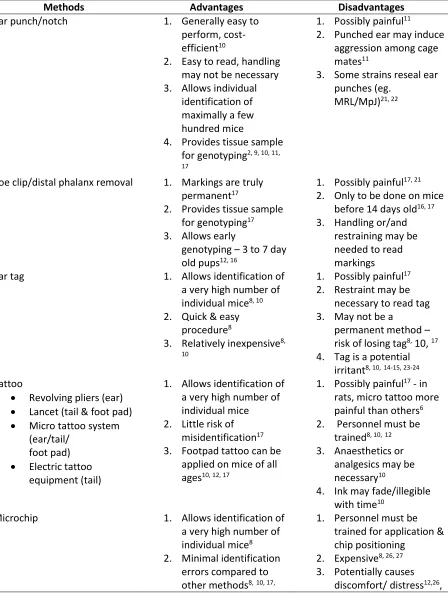
of each mouse identification and genotyping method are detailed in Table 1. In summary, most 54
articles on different mouse identification and/or genotyping methods focused their investigation on 55
the acute effects on mice, the ease of performing each method, reliability and durability of each 56
method. Also, different institutions or even different researchers have their own set preference of 57
mouse identification and genotyping method. 58
Table 1 59
There has been only limited investigation of the welfare consequences of each method for 60
identifying mice. For example ear punching is a routine husbandry procedure but it is likely to cause 61
stress during restraint, and because it penetrates the sensitive tissues, it may cause acute pain at the 62
time of marking and potentially a degree of chronic pain afterwards. Indeed, mice vocalised more 63
during ear-notching (30% of 26 mice) than a sham procedure (8% of 24 mice).8 There is also evidence
64
in other mammals; rats showed significantly greater mean arterial pressure during the period 1-16h 65
after ear-notching than after micro-tattooing or ear-tattooing9 while ear-tagged and ear-notched
66
piglets showed increases in pain-related behaviours, vocalisations, salivary cortisol and blood lactate 67
than controls.10
68
There is scope for refinement in marking methods. For example, in genetically modified 69
mice, a biopsy is needed for genotyping, and it is possible to combine the biopsy with marking 70
methods such as ear punch, ear notch or toe clip. Combining biopsy for genotyping with 71
identification marking method would require only one potentially stressful event rather than two.7
72
Given the numbers of mice used in experimental procedures annually and the need for the 73
improvements by choosing or modifying an identification method to minimise pain, stress and other 75
negative welfare consequences. It is important to note that improvement to laboratory animal 76
welfare will often not just benefit the animal (humane implication), but can also benefit the scientific 77
community (scientific implication) by promoting valid, reliable and reproducible experimental data 78
that are not being confounded by the element of pain and stress experienced by the animal.11
79
We conducted a survey on mouse identification to assess the current practice in the 80
laboratory establishments throughout the UK, and perceived animal welfare, practical and scientific 81
issues related to different identification methods. To our knowledge the survey is the most 82
comprehensive to date (in terms of participation from one country), provides novel information 83
summarising perceptions and practice in mouse identification in UK animal units. 84
Materials and methods 85
An online survey was created using SurveyGizmo (Online Survey Software & Questionnaire 86
Tool) and the survey link was sent by e-mail to a mailing list targeting facility managers and Named 87
Animal Care and Welfare Officers (NACWO) of laboratory animal establishments. Other personnel 88
who are routinely involved in handling laboratory animals such as technical staff, scientists and 89
Named Veterinary Surgeons (NVS) could also take part on behalf of the facility manager or the 90
NACWO. Each response was anonymous unless the respondents chose to include their affiliation, so 91
we made it clear that we only needed one response from each animal establishment for the survey 92
results to be meaningful. We also promised to maintain the anonymity of individual institutions and 93
individual respondents. 94
The survey comprised of 11 questions on mouse identification methods (Supplementary 95
Material 1). Aside from straight forward questions on the current practice of identification and 96
genotyping, there were also questions which required the respondents to rate stress or/and pain 97
very easy and quick) associated with each identification method. Respondents were also asked to 99
name the best identification method for experimental standardisation and rate the criteria of an 100
ideal identification method (three points from being less important to very important). 101
The survey was carried out in two phases in the period of February to June 2012. Ethical 102
approval for the survey was granted by the RVC Ethics and Welfare Committee (URN 2012 0052H). 103
Results 104
Survey coverage 105
We obtained 62 survey responses from 54 animal units from all over the UK: England (44 animal 106
units), Northern Ireland (1 animal unit), Scotland (7 animal units) and Wales (2 animal units). 107
Background of respondents 108
Academic institutions made up the highest percentage (61%) of establishment type surveyed, 109
followed by government scientific research institutions (GSRI) (17%), pharmaceutical establishments 110
(13%), contract research organizations (CRO) and other types of establishments (4% each), while 1 111
respondent chose not to give any affiliation details (Figure 1a). 112
Figure 1 113
Most of the respondents taking part in the survey were unit managers and NACWOs, 55% 114
and 48% out of the total number of 60 respondents, respectively (Figure 1b). Most of the time, the 115
unit manager and the NACWO of a laboratory animal establishment were the same person (81% of 116
NACWOs were also the unit manager). 117
Most respondents (67%) were between 35 and 54 years old (Figure 1c). Half of the 118
respondents were females, 43% were males, while the remaining 7% chose not to include the 119
Mouse identification methods 121
A range of different mouse identification methods were used in laboratory animal establishments 122
throughout the UK. The most commonly used methods were ear punch or ear notch (85%), marker 123
pen (63%), microchip (31%) and ear tag (22%) (Figure 2a). 124
Figure 2 125
56% of the establishments had discontinued the use of some identification methods due to 126
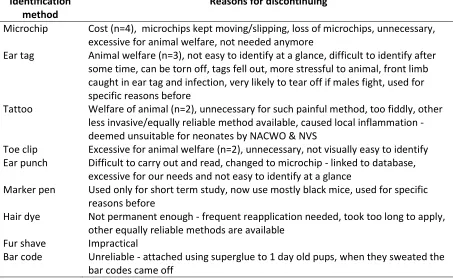
different reasons (described in Table 2). Among the methods that had been discontinued were 127
microchip (37%), ear tag (30%), tattooing (23%) and toe clip (17%) (Figure 2b). 128
Table 2 129
Most mice were identified at the age of two to four weeks (61%) or between four to six 130
weeks (15%) (Figure 2c). 131
Perception of potential animal suffering, personnel preference, level of ease associated with each 132
identification method and preferred identification method for standardisation 133
The method perceived by respondents as causing the greatest harm to mouse welfare was toe 134
clipping, with 53% of the respondents rating it as being severe, while 28% stated that they did not 135
know about the degree of stress or/and pain of a toe clip procedure, and 19% rated the procedure 136
as being moderately stressful or/and painful. 35% of the respondents regarded tail tattoo as causing 137
moderate stress or/and pain, another 25% stated that they did not know about the degree of stress 138
or/and pain, while 22% rated tail tattoo as being severely stressful or/and painful. The highest 139
percentage of respondents regarded the microchip as being moderately stressful or/and painful 140
(45%), while another 38% rated it as a mild procedure. Marker pen (82%), ear punch or ear notch 141
(70%), hair dyes (63%), fur shave or fur cut (67%), and ear tag (41%), were rated by most 142
Figure 3 144
Ear punch or ear notch had the highest percentage of respondents rating it as being most 145
preferred (57%), followed by microchip (34%) and marker pen (30%). The methods which most 146
respondents rated as being least preferred were toe clip (74%), ear tag (71%) and toe tattoo (64%) 147
(Figure 3b). 148
Identification methods rated as being very easy to carry out were marker pen (78%), hair 149
dyes (56%), fur shave or fur cut (55%) & ear punch or ear notch (52%). All tattooing methods were 150
regarded as being quite hard to carry out as 26% to 46% respondents gave this rating for each 151
tattooing method (Figure 3c). 152
A large percentage of the respondents listed microchip (76%) and ear punch (76%) as the 153
best identification methods for standardisation (Figure 3d). 154
Criteria of an ideal identification method 155
The criteria rated as being ‘very important’ by the most respondents were reliability (92% of 156
respondents), ease of reading the identification number or code achieved (89%), and having minimal 157
welfare concern (87%). Also, 75% of the respondents thought it was very important for an 158
identification method to be long lasting, and 71% of them thought ease of application was another 159
very important criterion for an ideal identification method (Figure 4). 160
Figure 4 161
Genotyping 162
The three most commonly used methods to collect DNA sample for genotyping genetically modified 163
mice in the UK were ear punch or ear notch (85%), tail snip (46%) and blood sampling (22%). Hair 164
pluck and toe clip were also used by 4% each of the animal units taking part in the survey (Figure 5a). 165
A high percentage (92%) of animal units practicing ear punch or toe clip to collect tissue 167
samples for genotyping stated that they also utilized both methods for the purpose of identification 168
(Figure 5b). 169
In the three cases where ear punch was not used to satisfy both purposes, respondents 170
reported the following reasons; genotyping was only done on future breeding stock, or sometimes 171
mice arrived already tagged or notched and researchers could not get genotyping results from ear 172
notch sample obtained during identification so they performed a tail biopsy for genotyping. 173
When asked if they had found any disadvantages when attempting relatively non-invasive 174
sampling procedures (hair pluck and mouth or rectum swab) to obtain DNA samples for genotyping, 175
12 out of 20 respondents reported that they found no disadvantages while the other eight reported 176
they had found disadvantages. Five respondents gave details on the disadvantages as listed: ‘hair 177
pluck to collect DNA sample cannot serve as an identification method’, ‘hair pluck is still invasive to 178
animal and easy to contaminate’, ‘some groups reported that their equipment was not sensitive 179
enough to complete genotyping using samples obtained by non-invasive methods, or they are afraid 180
of cross-contamination’, ‘hair sampling large number of mice resulted in contamination, and they 181
still need to be identified’ and ‘mouth swab was not very good in giving clear genotyping results’. 182
Discussion 183
Looking at the survey results, it appears that some identification methods were more preferred by 184
animal technicians or researchers than others. For example, ear punch or ear notch was used as an 185
identification method in about 85% of participating animal units. Indeed, ear punch or ear notch is a 186
quick procedure which requires only simple tools and therefore has lower running costs than other 187
identification methods such as tattooing using a tattooing machine or implantation of a microchip.12
188
Other methods such as fur shave or fur cut and tattooing were least used in the animal units 189
surveyed. Fur shaving is not permanent12, 13 while tattooing requires specific equipment and
sufficient training6,14 thus making them less favourable compared to other permanent identification
191
methods. 192
Ear punch or ear notch (which was the method of choice in most animal units) was rated as 193
a method which causes only mild stress or/and pain by 70% of respondents, putting it on a par with 194
other non-invasive identification methods such as fur shave or fur cut, hair dyes and marker pens. 195
This suggests that most people who work with mice assume that there is very little stress or/and 196
pain experienced by mice during ear punch or ear notch, despite some evidence suggesting the ear 197
punch is a potentially painful procedure as indicated by increased mean arterial pressure (in rats)9
198
and vocalisation8. This perception could be due to the fact that the procedure for ear punch or ear
199
notch is very quick with little opportunity for handlers to notice any sign of stress or/and pain. 200
Observing for the signs of stress or/and pain after returning mice to their home cage following the 201
procedure is not usually practiced and analgesia is not normally given. Further research may be 202
necessary to clarify whether or not ear punch or notch causes significant pain to mice. 203
Besides being non-permanent, non-invasive techniques could be the identification methods 204
that involve the least stress or/and pain. From the survey results, it was evident that marking using 205
marker pens, which were perceived by 82% of respondents to be a mild procedure, was practiced 206
widely (63%) in UK animal units. However, nothing is known about possible adverse effects of 207
marker pen inks for mice, which need to be investigated further, given that rats have been shown to 208
react in a complex manner. Tail-marked rats appeared bolder in an elevated plus maze, and yet they 209
showed more pronounced aversion-related Harderian gland secretion (chromodacryorrhoea) in 210
response to handling compared with unmarked cage mates; and (unmarked) rats avoided open pens 211
significantly more than closed pens in a choice test, suggesting that the solvent odour is aversive to 212
them.15 There is also the possibility for toxicity or chemicals entering mouse’s body which may
213
interfere with research results.6
Permanent identification methods such as toe clip and ear punch or ear notch will cause a 215
variation in pain and stress levels due to variations in the handling duration, number of painful 216
events (clips, punches and/or notches) and the amount of tissue being removed, according to their 217
designated identification number. On the other hand, every animal may experience similar levels of 218
pain and stress with other permanent identification methods such as ear tag and microchip. So, from 219
this point of view, ear tag or microchip might be a more preferable permanent identification method 220
for experimental standardisation. In agreement with the points mentioned above, the survey results 221
showed that most respondents had chosen microchip (76%) and ear punch (76%) as the best 222
identification methods for standardisation. The FELASA Working Group on animal identification 223
considered metal ear tags (used by 22% of respondents here) as being the worst choice of 224
identification method due to pain and distress as well as posing a risk for inducing various tissue 225
reactions.6 However, the literature has suggested that tissue reactions due to metal ear tags could
226
arise from inaccurate placement of the tags or by using metal ear tags in a mouse strain known to be 227
susceptible to squamous cancers.16, 17
228
Whenever tissue samples are needed for genotyping genetically modified mice, ear punch or 229
ear notch would be the recommendation, as performing one invasive procedure to satisfy two goals 230
is a refinement in experimental procedures,7 unless less invasive procedures are possible, such as a
231
mouth swab for genotyping and marker pen for identification, if these are indeed found to cause less 232
stress. The FELASA working group on genotyping recommended ear punch or ear notch as the 233
method of choice starting from 14 days of age, only when permanent identification and tissue for 234
genotyping are needed.7 Currently, ear punch or ear notch seems to be the method of choice for
235
collecting tissue sample to genotype mice in the UK since 85% out of 54 animal units reported its use 236
for genotyping. In fact, 90% of all units who perform ear punch or toe clip to genotype genetically 237
modified mice reported that they utilize ear punch or toe clip as a mean of identification too. In 238
out of 149 respondents from 15 European countries including the UK reported using ear punch or 240
ear notch for genotyping genetically modified mice (weanlings or older).7
241
In our survey, we found that only two out of 54 animal units performed a toe clip for 242
genotyping purposes. There was not a single animal unit who reported the use of toe clipping for 243
mouse identification. By looking at questions in which we asked the respondents to rate the 244
procedure according to the level of stress or/and pain it causes, it was evident that respondents 245
regarded toe clip and all tattooing methods as causing a higher level of stress or/and pain than other 246
methods (Figure 3a). Relatively, they are also not easy to perform and would require a significant 247
training period before one can master the skill and gain sufficient experience. Although there are 248
articles reporting that three to seven days old mice showed little reaction to toe clip and that the 249
procedure did not significantly impair their grip strength, motor abilities, coordination and 250
balance,14, 18 these results suggest that many do not regard the toe clip is as good as, or even better
251
than, an ear punch or ear notch. 252
Toe clipping is still a controversial, highly debated procedure in the UK. The 253
BVAAWF/FRAME/RSPCA/UFAW Joint Working Group on Refinement recommended not to use toe 254
clipping, unless as an absolute last resort and that it should only be performed in mice below the age 255
of two weeks old.13 On the other hand, Norecopa’s (Norwegian Consensus Platform for
256
Replacement, Reduction and Refinement of animal experiments) Board has stated that toe clipping 257
should not be permitted even with the refinement described by the Norwegian Animal Research 258
Authority (allowing only one toe to be clipped on each hind leg).19 However, in the latest edition of
259
the Guide for the Care and Use of Laboratory Animals by the National Research Council (USA), the 260
clause on toe clipping has changed from “toe clipping as a method of identification should be used 261
only when no other individual identification method is feasible and should only be performed on 262
altricial neonates”20 to “as a method of identification of small rodents, toe-clipping should be used
263
neonatal mice up to 7 days of age as it appears to have few adverse effects on behaviour and well-265
being at this age (Castelhano-Carlos et al. 2010; Schaefer et al. 2010), especially if toe clipping and 266
genotyping can be combined”.21 The change suggests that toe-clipping is now viewed in a different
267
perspective after no scientific evidence of behavioural or motor impairment was found in two 268
studies. In their recent publications, the FELASA Working Groups on animal identification and 269
genotyping recommended distal phalanx removal (toe clip) for identification and genotyping in 270
young pups approximately seven days old, by removing only the most distal phalanx of one toe per 271
paw. 6,7
272
The survey results demonstrated that there was a high level of welfare awareness among 273
animal care personnel, as 87% of the respondents rated “minimal welfare concern” as a very 274
important criterion of an ideal mouse identification method. Also, the use of several identification 275
methods had been discontinued due to welfare concerns (Table 2). Ten respondents reported that 276
they preferred to use other equally reliable identification methods that are more welfare friendly or 277
less invasive in nature. Their concern for mouse welfare during identification gives a positive 278
indication that they would be willing to improve their current practice if scientific evidence to 279
support such a change on welfare grounds is presented. 280
There are certainly more questions that could have been added to the survey to make it 281
more comprehensive, but at that point of time we felt that the questions were sufficient to establish 282
the basic information on the current practice of animal identification in the UK. It would be useful to 283
add a question on the number of mice kept in each facility and a few questions on the use of 284
analgesic or anaesthetic during identification. Although there is a possibility of anaesthesia being 285
aversive,6 there is evidence that procedures such as ear tattooing in rabbits cause pain and
286
application of EMLA cream prior to the procedure is effective in preventing pain associated with the 287
procedure.22 Furthermore, the BVAAWF/FRAME/RSPCA/UFAW Joint Working Group on Refinement
288
recommended the application of local anaesthetic spray prior to tail tattooing.13 Another plan for
future work is to target specific groups, such as animal unit staff, researchers and NVS, since the 290
results from this survey comprised mostly of answers from Unit Managers and NACWO. Although 291
some animal unit staff, NVS, scientists and a deputy facility manager took part in the survey, the 292
number was fairly small and underrepresented, which makes a fair comparison impossible. In the 293
future we would be interested to find out whether results from different groups would vary. 294
Since the survey, the Federation of European Laboratory Animal Science Associations 295
(FELASA) Working Groups has published two reports with recommendations on rodent identification 296
and genotyping.6, 7 It should be noted that these reports may subsequently have influenced
297
identification marking in the UK and elsewhere. Nevertheless, the survey has indeed given some 298
useful baseline information on mouse identification methods used in the UK, and how they are 299
perceived, particularly by Unit Managers and NACWOs. The welfare consequences of the commonly 300
used identification methods have not been extensively studied, so further research is required to 301
compare the most commonly used mouse identification methods, namely ear punch or ear notch, 302
marker pen, microchip and ear tag. 303
Acknowledgements 304
We would like to thank everyone who has given their valuable time and input to answer the survey 305
on mouse identification carried out by the Royal Veterinary College. NHM was funded by a 306
References
1. Home Office Science. Statistics of Scientific Procedures on Living Animals Great Britain 2011,
http://www.homeoffice.gov.uk/publications/science-research-statistics/research-statistics/other-science-research/spanimals11/spanimals11?view=Binary (2012, accessed 21 January 2013).
2. Cinelli, P., Rettich, A., Seifert, B., Burki, K. and Arras, M. (2007). Comparative analysis and physiological impact of different tissue biopsy methodologies used for the genotyping of laboratory mice. Laboratory Animals, Vol 41, No. 2, 174-84.
3. Balcombe, J.P., Barnard, N.D. and Sandusky C. (2004). Laboratory routines cause animal stress. Contemporary Topics in Laboratory Animal Science, Vol 43, No. 6, 42-51.
4. Hurst, J.L. and West, R.S. (2008). Taming anxiety in laboratory mice. Nature Methods, Vol 7, No. 10, 825-6.
5. Kilkenny, C., Browne, W.J., Cuthill, I.C., Emerson, M. and Altman, D.G. ( 2010). Improving bioscience research reporting: the ARRIVE guidelines for reporting animal research. PLoS Biology, Vol 8, No. 6, e1000412.
6. Dahlborn, K., Bugnon, P., Nevalainen, T., Raspa, M., Verbost, P. and Spangenberg, E. (2013). Report of the Federation of European Laboratory Animal Science Associations Working Group on animal identification. Laboratory Animals, Vol 47, No.1, 2-11.
8. Williams, W.O., Riskin, D.K. and Mott, A.K. (2008). Ultrasonic sound as an indicator of acute pain in laboratory mice. Journal for American Association of Laboratory Animal Science, Vol 47, No. 1, 8-10.
9. Kasanen, I.H., Voipio, H.M., Leskinen, H., Luodonpaa, M. and Nevalainen, T.O. (2011). Comparison of ear tattoo, ear notching and microtattoo in rats undergoing cardiovascular telemetry. Laboratory Animals, Vol 45, No. 3, 154-9.
10. Leslie, E., Hernández-Jover, M., Newman, R. and Holyoake, P. (2010). Assessment of acute pain experienced by piglets from ear tagging, ear notching and intraperitoneal injectable
transponders. Applied Animal Behaviour Science, Vol 127, No. 3-4, 86-95.
11. Poole, T. (1997). Happy animals make good science. Laboratory Animals, Vol 31, 116-124. 12. Wang, L. (2005). A primer on rodent identification methods. Lab Animal (NY), Vol 34, No. 4,
64-7.
13. Robinson, V., Morton, D.B., Anderson, D., et al. (2003). Refinement and reduction in production of genetically modified mice. Laboratory Animals, Vol 37, Suppl.1, S1-S49.
14. Castelhano-Carlos, M,J., Sousa, N., Ohl, F. and Baumans, V. (2010). Identification methods in newborn C57BL/6 mice: a developmental and behavioural evaluation. Laboratory Animals, Vol 44, No. 2, 88-103.
15. Burn, C.C., Deacon, R.M. and Mason, G.J. (2008). Marked for life? Effects of early cage-cleaning frequency, delivery batch, and identification tail-marking on rat anxiety profiles. Developmental Psychobiology, Vol 50, No. 3, 266-77.
16. Cover, C.E., Keenan, C.M. and Bettinger, G.E. (1989). Ear tag induced Staphylococcus infection in mice. Laboratory Animals, Vol 23, No. 3, 229-33.
18. Schaefer, D.C., Asner, I.N., Seifert, B., Burki, K. and Cinelli, P. (2010). Analysis of physiological and behavioural parameters in mice after toe clipping as newborns. Laboratory Animals, Vol 44, No. 1, 7-13.
19. Norecopa. Toe clipping in mice: An evaluation of the method and
alternatives,http://www.norecopa.no/norecopa/vedlegg/Norecopa-toeclip.pdf (2008, accessed 26 July 2012).
20. National Research Council USA. 1996. Guide for the Care and Use of Laboratory Animals. The National Academy Press, Washington DC.
21. National Research Council USA. 2011. Guide for the Care and Use of Laboratory Animals: Eighth Edition. The National Academies Press, Washington DC.
22. Keating, S.C.J., Thomas, A.A., Flecknell, P.A. and Leach, M.C. (2012). Evaluation of EMLA cream for preventing pain during tattooing of rabbits: Changes in physiological, behavioural and facial expression responses. PLoS ONE, Vol 7, No. 9, e44437.
23. Li, X., Gu, W., Masinde, G., et al. (2001). Genetic control of the rate of wound healing in mice. Heredity, Vol 86, No.6, 668-74.
24. Rajnoch, C., Ferguson, S., Metcalfe, A.D., Herrick, S.E., Willis, H.S. and Ferguson, M.W.J. (2003). Regeneration of the ear after wounding in different mouse strains is dependent on the severity of wound trauma. Developmental Dynamics, Vol 226, No. 2, 388-97.
25. Karsak, M., Gaffal, E., Date, R., et al. (2007). Attenuation of allergic contact dermatitis through the endocannabinoid system. Science, Vol 316, No. 5830, 1494-7.
27. Kort, W.J., Hekking-Weijma, J.M., Tenkate, M,T., Sorm, V. and VanStrik, R. (1998). A microchip implant system as a method to determine body temperature of terminally ill rats and mice. Laboratory Animals, Vol 32, No. 3, 260-9.
28. Warn, P.A., Brampton, M,W., Sharp, A., et al. (2003). Infrared body temperature measurement of mice as an early predictor of death in experimental fungal infections. Laboratory Animals, Vol 37, No. 2, 126-31.
Table 1. Overview of the advantages and disadvantages of mouse identification and genotyping methods. Relevant references are given in superscript numerals where possible.
Methods Advantages Disadvantages
Ear punch/notch 1. Generally easy to
perform, cost-efficient10
2. Easy to read, handling may not be necessary 3. Allows individual
identification of maximally a few hundred mice
4. Provides tissue sample for genotyping2, 9, 10, 11, 17
1. Possibly painful11
2. Punched ear may induce aggression among cage mates11
3. Some strains reseal ear punches (eg.
MRL/MpJ)21, 22
Toe clip/distal phalanx removal 1. Markings are truly permanent17
2. Provides tissue sample for genotyping17
3. Allows early
genotyping – 3 to 7 day old pups12, 16
1. Possibly painful17, 21
2. Only to be done on mice before 14 days old16, 17
3. Handling or/and restraining may be needed to read markings
Ear tag 1. Allows identification of
a very high number of individual mice8, 10
2. Quick & easy procedure8
3. Relatively inexpensive8, 10
1. Possibly painful17
2. Restraint may be necessary to read tag 3. May not be a
permanent method – risk of losing tag8, 10, 17
4. Tag is a potential irritant8, 10,14-15, 23-24
Tattoo
Revolving pliers (ear) Lancet (tail & foot pad) Micro tattoo system
(ear/tail/ foot pad) Electric tattoo
equipment (tail)
1. Allows identification of a very high number of individual mice 2. Little risk of
misidentification17
3. Footpad tattoo can be applied on mice of all ages10, 12, 17
1. Possibly painful17 - in
rats, micro tattoo more painful than others6
2. Personnel must be trained8, 10,12
3. Anaesthetics or analgesics may be necessary10
4. Ink may fade/illegible with time10
Microchip 1. Allows identification of
a very high number of individual mice8
2. Minimal identification errors compared to
1. Personnel must be trained for application & chip positioning
2. Expensive8, 26, 27
3. Allow registration of data in computerized tracking systems25, 26
tumours17, 27
4. Handling or/and restraining needed to read chip-code
Fur shave/cut 1. Easy to apply (no
special skills/training needed)8
2. Easy to read8
3. Less likely to be painful8
4. Low cost8
1. Temporary, may only last for 14 days10 up to 3
weeks11
2. Need frequent handling to clip the hair17
3. Can only distinguish a limited number of mice8
4. Some shavers are noisy – possibly stressful to mice
Coat dyes/bleach 1. Easy to apply (no special skills/training needed)
2. Easy to read8
3. Less likely to be painful8
4. Low cost8
1. Temporary10
2. Need frequent handling to reapply dyes17
3. Can only distinguish a limited number of mice8
4. Potential toxicity8, 11, 17
Marker pen 1. Applicable to all ages8
2. Easy to apply (no special skills/training needed)
3. Easy to read8
4. Less likely to be painful8
5. Low cost8
1. Temporary, frequent remarking is necessary10
2. Potential adverse response to solvents in pens8
Table 2. Reasons for discontinuing certain identification methods. Each reason was suggested by only one respondent, unless stated.
Identification method
Reasons for discontinuing
Microchip Cost (n=4), microchips kept moving/slipping, loss of microchips, unnecessary, excessive for animal welfare, not needed anymore
Ear tag Animal welfare (n=3), not easy to identify at a glance, difficult to identify after some time, can be torn off, tags fell out, more stressful to animal, front limb caught in ear tag and infection, very likely to tear off if males fight, used for specific reasons before
Tattoo Welfare of animal (n=2), unnecessary for such painful method, too fiddly, other less invasive/equally reliable method available, caused local inflammation - deemed unsuitable for neonates by NACWO & NVS
Toe clip Excessive for animal welfare (n=2), unnecessary, not visually easy to identify Ear punch Difficult to carry out and read, changed to microchip - linked to database,
excessive for our needs and not easy to identify at a glance
Marker pen Used only for short term study, now use mostly black mice, used for specific reasons before
Hair dye Not permanent enough - frequent reapplication needed, took too long to apply, other equally reliable methods are available
Fur shave Impractical
Figure 1a. Type of institution taking part in the survey (n=54; GSRI, government scientific research institution; CRO, contract research organisation).
Figure 1b. Respondent’s position (n=60; NACWO, named animal care and welfare officer; NVS, named veterinary surgeon).
Figure 1c. Respondent’s age (n=60), with each slice labelled as the age category, followed by the number of respondents.
Figure 2a. Mouse identification methods used in UK animal units (n=54).
Figure 2b. Discontinued identification methods (n=30).
Figure 2c. Mouse age during identification (n=54), with each slice labelled as the age category, followed by the number of respondents.
Figure 3a. Identification methods according to animal stress or/and pain level as perceived by respondents.
Figure 3b. Identification methods according to respondent preference.
Figure 3c. Identification methods according to their ease of application. The number of responses for each method is given in Supplementary Material S2.
Figure 3d. Perceived best identification method for standardisation (n=62).
Figure 4. Criteria of an ideal identification method. The number of responses for each criterion is given in Supplementary Material 2.
Figure 5a. Tissue collection methods for genotyping (n=54).