University of Pennsylvania
ScholarlyCommons
Publicly Accessible Penn Dissertations
Summer 8-13-2010
A Distributed Storage and Query Subsystem for
Collaborative Data Sharing
Nicholas E. Taylor
University of Pennsylvania, [email protected]
Follow this and additional works at:http://repository.upenn.edu/edissertations
Part of theDatabases and Information Systems Commons
This paper is posted at ScholarlyCommons.http://repository.upenn.edu/edissertations/239
For more information, please [email protected]. Recommended Citation
Taylor, Nicholas E., "A Distributed Storage and Query Subsystem for Collaborative Data Sharing" (2010).Publicly Accessible Penn Dissertations. 239.
A Distributed Storage and Query Subsystem for Collaborative Data
Sharing
Abstract
Cooperative management of data is a difficult challenge. In the absence of a central authority, there is often no single data format, and users may not even agree on what is true and what is not. The data is typically not static and will evolve over time, leading to issues of staleness and conflicting changes. Dedicated machines to run a management system may not be available, and furthermore the machines supplied by the users to run the system may be unreliable or only transiently available. A reliable system must be built over these machines, and should be self-configuring and self-tuning, to avoid placing an undue burden on end users that are unwilling or unable to manage it themselves.
The Orchestra collaborative data sharing system responds to these challenges by providing a general approach for propagating updates between a heterogeneous collection of peer databases, which are connected by high-level rules that specify the correspondences between them. The system maintains these correspondences while enforcing trust conditions to filter the data from other databases, maintaining transactional atomicity, and respecting database integrity constraints. In this thesis, I detail my work on the semantics of transactional atomicity and dependency in this context, which lead to a general reconciliation algorithm; I also describe the prototype centralized and peer-to-peer implementations of Orchestra. I then develop a specialized reliable peer-to-peer storage and query processor that will enable the logging and computation needed to maintain an Orchestra instance to be distributed. I show ways to extend this system to recover from node failure, to perform load balancing to ensure even distribution of work, and to compensate for node heterogeneity and data skew.
Degree Type
Dissertation
Degree Name
Doctor of Philosophy (PhD)
Graduate Group
Computer and Information Science
First Advisor
Zachary G. Ives
Keywords
collaborative data sharing, peer-to-peer systems, distributed databases, load balancing, failure recovery
Subject Categories
A DISTRIBUTED STO
GE AND UERY SUBSYSTEM
FOR COLLABO
TIVE DATA SHARING
Nicholas E. Taylor
A DISSERTATION
in
Computer and Information Science
Presented to the Faculties of the University of Pennsylvania
in
Partial Ful llment of the Requirements for the
Degree of Doctor of Philosophy
2010
Zachary G. Ives, Associate Professor of Computer and Information Science Supervisor of Dissertation
Jianbo Shi, Associate Professor of Computer and Information Science Graduate Group Chairperson
Dissertation Commi ee
Brian F. Cooper, Principal Research Scientist, Yahoo! Research
Susan B. Davidson, Professor of Computer and Information Science
Andreas Haeberlen, Assistant Professor of Computer and Information Science
A Distributed Storage and uery Subsystem for Collaborative Data Sharing
COPYRIGHT
Nicholas E. Taylor
Acknowledgements
e work described in this dissertation would not have been possible without the assistance,
guidance, advice, and support of many people. In particular, I would like to extend my very heartfelt
thanks to my advisor, Zack Ives. You were always helpful and accessible, and gave me the freedom to
do what I wanted to do with only a few gentle nudges in the right direction. I really appreciate all the
work you did on my behalf.
I would like to thank my thesis commi ee, Professors Susan Davidson, Andreas Haeberlen, and
Boon au Loo of the Computer and Information Science Department, and Brian Cooper from
Ya-hoo! Research, who read and gave helpful comments on several versions of this thesis. Your service is
very much appreciated. I would also like to thank my WPE-II commi ee members, Susan Davidson,
Boon au Loo, and Jonathan Smith, for their efforts and assistance.
I would also express my thanks to the many other wonderful professors at Penn that have taught
me and provided guidance and mentoring. In particular, I would like to recognize Val Tannen, Susan
Davidson, Amir Roth, Boon au Loo, Sampath Kannan, and Zack Ives.
I also really appreciate the constructive criticism, proofreading, technical assistance, and
cama-raderie of my fellow doctoral students at Penn. I especially appreciate the GRW-561 gang, with whom
I spent countless hours over the past six years: TJ Green, Greg Karvounarakis, Nate Foster, and Svilen
Mihaylov. I’d also like to extend a special thanks to the other students of the Database Group, in
par-ticular Marie Jacobs and Mengmeng Liu, and to my PhD classmate chums, namely Jenn Wortman
Vaughan, Jeff Vaughan, Drew Hilton, Aaron Bohannon, Kuzman Ganchev, and Karl Mazurak.
I’d like to thank to the support staff that have made my life at Penn much easier. In particular,
I’d like to thank Mike Felker, the CIS graduate coordinator; Cheryl Hickey, our administrative
coor-dinator; Lillian omas and Mark West from the Moore Business Office; and our Database Group
I’d like to thank my parents for their support, and for showing me that science (albeit the more
wet kind) is both interesting and fun.
I’d like to thank the many friends that I’ve made during my grad school career. You guys, especially
Jeff, Jenn, Dave, Rob, Drew, Kristin, Colleen, Michelle, and Heather, made Philly a fun place to call
home for the past six years.
Last, but certainly not the least, I’d like to thank Dan for pu ing up with me, especially when I’ve
been grouchy and stressed out about this thesis. You’ve really kept me going though this past year,
and I can’t tell you how much your support has meant to me.
is work was supported by NSF grants IIS-0477972, IIS-0713267, and IIS-0513778, and DARPA
grants HRO001-0-1-0016 and HRO1107-1-0029. Amazon.com, Inc. kindly supplied us free use of
ABST CT
A Distributed Storage and uery Subsystem for Collaborative Data Sharing
Nicholas E. Taylor
Supervisor: Zachary G. Ives
Cooperative management of data is a difficult challenge. In the absence of a central authority, there
is o en no single data format, and users may not even agree on what is true and what is not. e
data is typically not static and will evolve over time, leading to issues of staleness and con icting
changes. Dedicated machines to run a management system may not be available, and furthermore
the machines supplied by the users to run the system may be unreliable or only transiently available.
A reliable system must be built over these machines, and should be self-con guring and self-tuning,
to avoid placing an undue burden on end users that are unwilling or unable to manage it themselves.
e O collaborative data sharing system responds to these challenges by providing
a general approach for propagating updates between a heterogeneous collection of peer databases,
which are connected by high-level rules that specify the correspondences between them. e
sys-tem maintains these correspondences while enforcing trust conditions to lter the data from other
databases, maintaining transactional atomicity, and respecting database integrity constraints. In this
thesis, I detail my work on the semantics of transactional atomicity and dependency in this context,
which lead to a general reconciliation algorithm; I also describe the prototype centralized and
peer-to-peer implementations of O . I then develop a specialized reliable peer-to-peer storage
and query processor that will enable the logging and computation needed to maintain an O
-instance to be distributed. I show ways to extend this system to recover from node failure, to
per-form load balancing to ensure even distribution of work, and to compensate for node heterogeneity
Contents
1 Introduction 1
1.1 Motivation . . . 3
1.2 Outline . . . 5
2 e Collaborative Data Sharing Model 8 2.1 Participants, Schemas, and Mappings . . . 9
2.2 System operation . . . 11
2.3 Cloud Substrate for O . . . 22
3 Reconciliation: Algorithms and Implementation 25 3.1 CDSS Properties . . . 26
3.2 Reconciliation . . . 34
3.3 Reconciliation Algorithms . . . 45
3.4 Update Store . . . 52
3.5 Experimental Analysis . . . 59
3.6 Conclusions and Analysis . . . 67
4 Reliable, Declarative Peer-to-Peer Storage and Computation 68 4.1 System Architecture and Requirements . . . 71
4.2 Hashing-Based Substrate . . . 75
4.3 Versioned Data Storage . . . 79
4.4 Reliable Query Execution . . . 87
4.5 Experimental Evaluation . . . 98
5 Load Balancing 120
5.1 Partitioning Flexibility . . . 123
5.2 Partitioning as Constrained Optimization . . . 127
5.3 Experimental Analysis . . . 135
5.4 Conclusions . . . 162
6 Related Work 163 6.1 Data Transformation and Integration . . . 163
6.2 Consistency and Data Sharing . . . 171
6.3 Distributed Query Processing . . . 180
6.4 Load Balancing in Distributed Hash Tables . . . 188
7 Future Work 192 7.1 e CDSS Model . . . 192
7.2 Distributed Storage and Querying . . . 193
7.3 Load Balancing . . . 195
8 Conclusions 197
List of Figures
1.1 Logical Model of a CDSS . . . 4
1.2 Physical Model of a CDSS . . . 5
2.1 Example CDSS Instance . . . 10
2.2 Basic architecture of O . . . 13
2.3 Provenance Graph . . . 20
2.4 Internal CDSS representation of a relation . . . 22
3.1 Sample bioinformatics CDSS . . . 26
3.2 Example Reconciliation . . . 33
3.3 Example transaction dependency graph . . . 38
3.4 Comparison of reconciliation algorithms and update stores . . . 46
3.5 Epoch publication in the DHT store . . . 56
3.6 Example transaction retrieval in the DHT store . . . 57
3.7 Effect of number of participants on execution time . . . 62
3.8 Effect on execution time of reconciliation interval . . . 63
3.9 Effect of number of participants on state ratio . . . 65
3.10 e effect on state ratio of varying reconciliation interval . . . 65
3.11 Effect of transaction size on state ration . . . 66
4.1 Basic architecture of O . . . 71
4.2 Schemes for partitioning the DHT key space among the participants . . . 75
4.3 Storage scheme . . . 83
4.5 Final versioned relation structures . . . 86
4.6 Example versioned relation lookup . . . 86
4.7 Distributed query plan for Example 3. . . 91
4.8 Distributed query plan for Example 4. . . 93
4.9 Running time: STBenchmark, 800K tuples/relation, 1-16 nodes . . . 101
4.10 Running time: TPC-H Scale Factor 0.5, 1-16 nodes . . . 101
4.11 Normalized running time: STBenchmark, 800K tuples/relation, 1-16 nodes . . . 102
4.12 Normalized running time: TPC-H Scale Factor 0.5, 1-16 node . . . 102
4.13 Network traffic: STBenchmark, 800K tuples/relation, 1-16 nodes . . . 104
4.14 Network traffic: TPC-H Scale Factor 0.5, 1-16 nodes . . . 104
4.15 Per-node network traffic: STBenchmark, 800K tuples/relation, 1-16 nodes . . . 105
4.16 Per-node network traffic: TPC-H scale factor 0.5, 1-16 nodes . . . 105
4.17 Running time vs. data size, STBenchmark, 8 nodes . . . 106
4.18 Running time vs. data size, TPC-H, 8 nodes . . . 106
4.19 Network traffic vs. data size, STBenchmark, 8 nodes . . . 107
4.20 Network traffic vs. data size, TPC-H, 8 nodes . . . 107
4.21 Running time vs. per-node bandwidth, 8 nodes, TPC-H scale factor 4 . . . 108
4.22 Running time vs. added network latency, 16 nodes, TPC-H scale factor 1 . . . 109
4.23 Running time vs. number of higher-latency nodes, 16 nodes, TPC-H scale factor 1 . . . 110
4.24 Running time vs. latency variability, 16 nodes, TPC-H scale factor 1 . . . 110
4.25 Running time vs. number of slow nodes, 16 nodes, TPC-H scale factor 1 . . . 111
4.26 Total traffic on EC2 nodes, TPC-H scale factor 10 . . . 113
4.27 Per-node traffic on EC2 nodes, TPC-H scale factor 10 . . . 113
4.28 Execution time on EC2 nodes, TPC-H scale factor 10 . . . 114
4.29 Normalized execution time on EC2 nodes, TPC-H scale factor 10 . . . 114
4.30 Total traffic on EC2 and cluster nodes, TPC-H scale factor 2 . . . 115
4.31 Per-node traffic on EC2 and cluster nodes, TPC-H scale factor 2 . . . 115
4.32 Execution time on EC2 and cluster nodes, TPC-H scale factor 2 . . . 116
4.33 Performance of incremental recovery . . . 117
4.34 Execution time overhead of incremental computation . . . 118
5.1 Partitioning of the DHT key space . . . 123
5.2 Optimized partitioning of the DHT key space . . . 125
5.3 Example Minion input le . . . 133
5.4 Initial quality of partitionings. . . 137
5.5 Initial quality of partitionings as system size changes . . . 138
5.6 Effect of optimization time on balancing quality . . . 139
5.7 Effect of replication factor on balancing quality . . . 141
5.8 Effect of number of nodes on balancing quality . . . 142
5.9 Effect of number of nodes on optimization time . . . 143
5.10 Replication and more nodes . . . 144
5.11 Effect of number of chunks on balancing quality . . . 145
5.12 Relations for BioJoin benchmark . . . 148
5.13 Effect of balancing on TPC-H performance . . . 150
5.14 Effect of balancing on BioJoin performance . . . 151
5.15 Effects of node heterogeneity on performance of TPC-H queries . . . 153
5.16 Effects of node heterogeneity on performance of star schema queries . . . 154
5.17 Effects of node heterogeneity on performance of BioJoin query . . . 155
5.18 Effects of data skew on performance of TPC-H queries . . . 157
5.19 Effects of data skew on performance of star schema queries . . . 158
5.20 Performance comparison with Derby, large server . . . 159
5.21 Performance comparison with Derby, proportional data . . . 160
5.22 Performance comparison with commercial RDBMS . . . 161
6.1 Virtual data integration . . . 164
6.2 Data warehousing . . . 165
6.3 Schema mappings in Piazza . . . 170
6.4 Branching in a version control system . . . 173
List of Algorithms
3.1 R U procedure . . . 48
3.2 C S helper function . . . 49
3.3 F C helper function . . . 50
3.4 D G helper function . . . 50
3.5 U C helper function . . . 51
Chapter 1
Introduction
ith the advent of the Internet, it is much easier than ever before for people to share information.
Unfortunately, the mere availability of data doesn’t mean that it is directly usable. Variations in how
the information is forma ed, the representation used, how people interpret it, and even opinions
about what is true and what is false make it difficult to share information between different sites,
organizations, or companies. In full generality, translating data is a very difficult problem. Highly
structured information, however, such as that stored in a database, typically has a consistent
seman-tic interpretation; this is necessary in order to pose complex queries over it. Translation between
databases can therefore o en be done in an automatic or at least semi-automatic fashion.
Data integration, as the process of combining information from different databases is known, is
a rich eld that has been the focus of much work by the database community over the past several
decades. Various approaches have been taken, exploring both the theoretical limits of data
integra-tion, and the complexities of implementing data integration systems. In this thesis, I describe my
contributions to O , a Collaborative Data Sharing System (CDSS), which has been under
development at the University of Pennsylvania since 2003.
While O builds upon and is inspired by previous data integration work, its focus is
somewhat different. O places a strong emphasis on data consistency, data provenance,
and ease of use. An instance can grow organically and scale gracefully as new users join it, both in
terms of the logical speci cation of the relationships between databases and the actual system that
implements that logical speci cation. O implements a data sharing model in which
e cloud service has two main tasks: to permanently archive all versions of the participants’ database
instances, and to enable exchange of data between participants’ instances, resolving any con icts that
may arise and translating data as needed between database schemas. e service is self-con guring
and highly reliable through a peer-to-peer architecture emphasizing automatic failover, data
replica-tion, and good processing performance.
In order to implement this vision of a CDSS, O needs a variety of interacting
compo-nents. A key challenge in building O is to enable to avoid the need for dedicated servers,
maintenance, and support staff while ensuring high availability. We therefore implement all of O
-over a “cloud” of low-powered nodes provided by the participants. Individual nodes in
this cloud may fail or become temporarily unavailable, but O should continue to enable
data sharing among all of its users. erefore, all of the following components must execute over this
cloud of nodes:
• anupdate exchangeengine, that generates derives queries to translate updates between databases
from the high-level mappings that connect them,
• aversioned storage systemthat archives and disseminates data and updates to data,
• aquery systemthat executes the queries generated by the update exchange engine over the
ver-sioned storage, and
• adependency and con ict checking systemthat enforces data consistency.
In this thesis, I discuss the design and implementation of these O components, with
par-ticular emphasis on the distribution of work over a collection of unreliable, possibly geographically
dispersed, nodes.
Being a large project project, O was joint work with a number of fellow graduate
stu-dents and faculty members. In particular, the design of the update exchange engine (and the work on
the provenance of data and updates upon which it depends) was the work of others. I will review this
work as background for mine. e majority of the thesis will focus on the remaining components.
I will describe the implementation of a reliable peer-to-peer storage and querying system, and show
that it offers high performance and resilience to failure. I will also discuss O ’s consistency
model, and how we use dependency tracking and integrity constraints to maintain a high level of data
1.1 Motivation
e problem of sharing structured data among multiple sites has a long history, and it has been visited
in many different se ings. ere is, however, a general assumption that the end goal is to create a
single data instance across all sources, and to perhaps provide a different view for each user. e
main focus of such work is therefore on translating data between the different sources to achieve this.
Data consistency is either ignored, or performed a er-the-fact through data cleaning or data “repair”
schemes, which can end up making somewhat arbitrary choices between possible alternatives.
Collaborative data sharing begins with the general observation that a single data instance
repre-senting global truth is, in many cases, neither possible nor desirable. Truth, like beauty, can be in the
eye of the beholder, or at least dependent on what one’s precise interpretation of the meaning of a
data item is, and beliefs about other related data. e solution to the needs of collaborating users is
therefore not to provide one globally consistent data instance, but rather to give each participant a
custom, internally consistent instance with the data that this particular participant accepts as
authori-tative, translated into its native format. is instance should contain data “overlapping” with that at
other sites, as well as certain data items that diverge from the others. Translating data between data
instances is still an important component of collaborative data sharing, but it must be done in a way
that allows divergence and incomplete translation to respect users’ beliefs, preferences, and interests.
A major challenge in supporting this data sharing model lies in the fact that every database
in-stance is subject to updates, in the form of transactions. e assignment of multiple updates to a
single transaction indicates that these updates are in some way related, and should either be applied
together or not at all (i.e. they areatomic transactions, the term typically used in the database
litera-ture). Not all of these transactions may originate from sources trusted by all parties. Furthermore,
some of the transactions may be inapplicable to a data instance, due to integrity constraints or
incom-patibility with other transactions also under consideration. Hence, each site must decide whether to
acceptan update (in effect, synchronizing a portion of its data instance with the origin of the
up-date), torejectit as being untrusted (causing a divergence), or in some cases todeferprocessing an
update (if there are multiple con icting updates with no clear preference). An update-centric model
is important, as opposed to simply querying the resulting data values, because it allows sites to reject
removals or replacements. However, it adds signi cant complexity, because one update may depend
m1
m2
m3
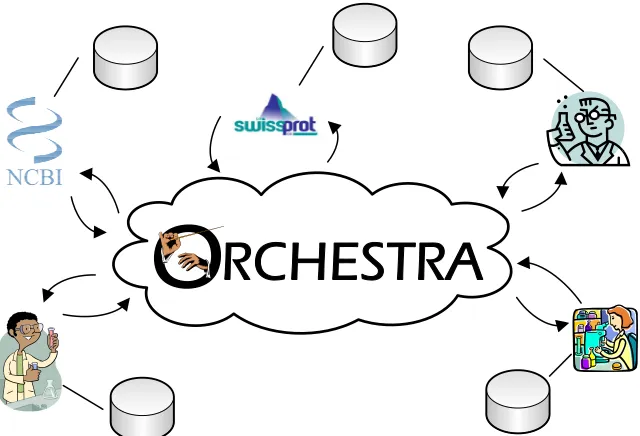
Figure 1.1: Logical conceptual model of a Collaborative Data Sharing System. Data at different sites are related by high-level, declarative mappings. Some sites are only connected indirectly through the composition of multiple mappings.
for update propagation must consider these interactions, as well as different levels of trust, in concert
with the problem of translating between differing schemas.
isloose coupling of collaborating databases enables new applications that were not supported
by prior data integration work. We also wish to reduce the burden of system setup as much as
possi-ble, allowing short-lived,ad hocsystems. Fixed, global schemas should be avoided. is allows peers
to share any of their data, since no limitations are imposed by a global schema, and eases the
bur-den of joining the system. A new participant need just provide a mapping to the database with the
most similar schema, instead of to some potentially complex global schema. Additionally, the system
implementation should be autonomous and scale seamlessly as databases join and leave the system.
ere should be no need for a dedicated central server, a database administrator, or really any kind
of tuning of any kind.
At the University of Pennsylvania, there has been an ongoing effort both to develop the
theoreti-cal underpinnings of collaborative data sharing, and to design and develop O , an efficient
CDSS implementation. Figure 1.1 shows the logical model of a CDSS, wherein multiple independent
sites are related by declarative schema mappings. e mappings relate speci c sites, and data can ow
through a composition of mappings; there is no global uni ed schema. Figure 1.2 presents a model of
the implementation of the O CDSS. ough the mappings are speci ed in a peer-to-peer
communi-O
RCHESTRA
Figure 1.2: Physical implementation of the O CDSS. Each site maintains its own data in-stance, which is updated by communicating with the CDSS.
cation. Each participant has a local data instance, which the system maintains by applying translated
updates from other participants.
1.2 Outline
As mentioned previously, a system the scale of O is much too large and complicated for
one person to design and implement. Other students and faculty members developed the basic
re-quirements for O from bioinformatics use cases, worked through the theoretical
under-pinnings of translating and exchanging updates, and created an initial implementation based on these
ideas. While the important steps validated the feasibility of O , they were largely focused
on update translation; they did not consider transactional atomicity or integrity constraints.
Addi-tionally, the work was implemented over a single relational database, which was used as storage for
both updates and participants’ data instances. In this thesis, I show how to add features to O
-to address these shortcomings. In particular, I make the following contributions:
• A de nition of transactional dependency and mutual consistency between updates in a CDSS,
trans-actional dependencies and user preferences,
• A reliable versioned storage layer, built over a distributed hash table, that is suitable to hold the
persistent state needed for a peer-to-peer implementation of O , and
• A reliable, high-performance peer-to-peer query processing layer, capable of executing the
queries needed to translate updates between participant schemas.
is thesis begins with a more detailed motivation of the collaborative data sharing approach.
Chapter 2 also gives a detailed introduction to the collaborative data sharing system model, and
de-scribes the components of O that were implemented by others. In particular, it details how
theupdate exchangeprocess, introduced in Green et al. (2007a), translates updates in one schema into
updates over another schema, and describes how this process enables incremental maintenance of the
participant databases in an O instance.
Chapter 3 describes the development ofreconciliationin O , the process by which a
par-ticipant’s local instance is updated with new changes from other participants. I de ne a notion of
de-pendencybetweentransactions, which is necessary to fully respect transactional atomicity. ese
de-pendencies are then respected when considering which transactions can be accepted, as are integrity
constraints, such as primary keys. I then develop an efficient algorithm to determine a maximal set of
mutually compatible, constraint-satisfying transactions, while respecting user preferences. I
exper-imentally validate the performance of this algorithm and explore its effects on various properties of
O instances.
Chapter 4 introduces the second component of this thesis, a peer-to-peer storage and query
pro-cessing substrate based on the distributed hash table. is substrate allows the storage and data
pro-cessing needs of O to be distributed across the participants in the system, instead of using
a centralized relational database; additionally, due to its peer-to-peer nature, it is simple to set up
and maintain, and can continue to operate in the presence of node failures. Because of the complex
queries that can result from mapping composition, good performance is a critical goal. Additionally,
for correct O system operation, the substrate must meet strict reliability requirements for
both storage and querying. Taken together, these challenges require a novel approach to peer-to-peer
databases, one with an emphasis on reliability and high performance instead of scalability to
to mutable data, even in the presence of replication lag and transient node and connectivity failures.
ese techniques use versioned storage and and a multi-level index structure to verify that the correct
version of each data item is used. I explore means to reduce the overhead of creating, updating, and
using this index structure. is approach to reliable storage is complemented by techniques for
effi-cient query processing over the reliable data access layer, including support for incremental
recom-putation of results if a node or connectivity failure occurs during query execution. I experimentally
validate query performance using a variety of workloads and under a variety of conditions,
includ-ing constrained bandwidth and high latency networks. I demonstrate the system’s scalability both to
large amounts of data and to large numbers of physical nodes. I also show the system’s resilience to
failure and the bene t of incremental recovery of query results.
Chapter 5 expands on the ideas presented in Chapter 4 to add support for load balancing to
im-prove query performance. It also avoids the need for the custom data distribution scheme using in
Chapter 4, which is more susceptible to churn than the partitioning schemes using in much prior
peer-to-peer work. I show how the redundant storage of data items in the distributed substrate
(nec-essary for reliability reasons) provides exibility in routing requests for those data items to particular
nodes. By altering the partitioning of data items among nodes, we can achieve good performance
without increased susceptibility to churn. We can also alter the partitioning to assign more data to
more powerful nodes, and can compensate for data skew by considering the number of data items
assigned to each node instead of more abstract routing properties. I show how data partitioning can
be posed as a general constrained optimization problem, and solved by a general purpose constraint
solver. I also demonstrate the bene t of using optimized partitionings generated in this fashion to
compensate for routing imbalance, node heterogeneity, and data skew using several query workloads.
Chapter 6 discusses related work in a variety of areas, including data integration, consistency of
distributed data, peer-to-peer systems, and distributed query processing. Chapter 7 offers
Chapter 2
e Collaborative Data Sharing Model
e collaborative data sharing system (CDSS) was initially proposed in Ives et al. (2005), which
de-scribed the se ing and basic operation, though le as open questions how many of the operations
would be performed. Subsequent papers re ned and expanded the model, and provided efficient
implementations of its operations. e rst such paper is Taylor and Ives (2006), which forms the
basis of Chapter 3 of this thesis and describes an efficient distributed implementation of O
-for the special case where all participants share the same schema. Later work, including Green
et al. (2007a), Green et al. (2007c), Ives et al. (2008), Karvounarakis and Ives (2008), Karvounarakis
(2009), and Green (2009) explore the theoretical questions that arise when considering translation
between schemas, and demonstrate that these can be implemented efficiently in a centralized
rela-tional database. Taylor and Ives (2010), which forms the basis for Chapter 4 of this thesis, describes a
distributed query processing and data storage system designed to provide a base for a fully functional,
distributed O implementation.
In this chapter, I describe the basic features of the O CDSS. is chapter is structured
as follows:
• Section 2.1 describes the O model, with an emphasis on how mappings relate data
from different participants.
• Section 2.2 begins with a high-level description of the O system operations.
• Section 2.2 described theupdate exchangeprocess by which updates over one schema are
• Section 2.2 describes the O provenance model, which is both used internally and
presented to users so they can understand the origin of data in the system.
• Section 2.3 describes how the components of O described in this chapter interact
with work described in Chapters 3, 4, and 5 of this dissertation. is work completes the
O picture, and provides a distributed “cloud”-based substrate for the O
CDSS.
Where the model in Ives et al. (2005) differs from that of later work, I present the more recent CDSS
model.
2.1 Participants, Schemas, and Mappings
A CDSS instance consists of a number of autonomousparticipants, sometimes also referred to assites
or evenpeersto emphasize their physical isolation or the decentralized nature of the systems. Each
participantpfrom the set of all participantsPhas its own local schemaΣp, which is a set of relations.
ese relations are the participants’local data instances, and are stored in a relational database instance
Ipby the participant. ey contain the data that the participant is interested in querying and also the
data that the participant desires to share with the other participants.
e global schemaΣ= ∪p∈PΣpis the union of all of the peer schemas. Each site is thought of
as having a unique schema, even if its relations are named and structured the same as those of other
sites. e relations inΣare related by a collection of mappingsMin global-local-as-view (GLAV) form (Friedman et al., 1999), or equivalently in the form of tuple-generating dependencies (TGDs),
as described in Fagin et al. (2005). GLAV mappings are more powerful than the global-as-view and
local-as-view approaches used in earlier data integration work, such as Levy et al. (1996) and
Garcia-Molina et al. (1997) respectively. roughout this thesis, we will express GLAV mappings as TGDs
using a syntax similar to Datalog (Ullman, 1988, chap. 3). Mcan be viewed as a set of constraints on the global system instance. is web of mappings, in which some databases are only indirectly
connected, is inspired by and based on the approach used in peer data management research, and
described in Halevy et al. (2003) and Kementsietsidis et al. (2003). We discuss all of these related
p
1R(a,b,e)
S(b,c)
p
3R(a,b,e)
S(b,c)
p
2T(a,b,c)
p
4U(d,b,c)
AtoD(a,d)
m
1m
2m
3m
4Figure 2.1: Example CDSS Instance
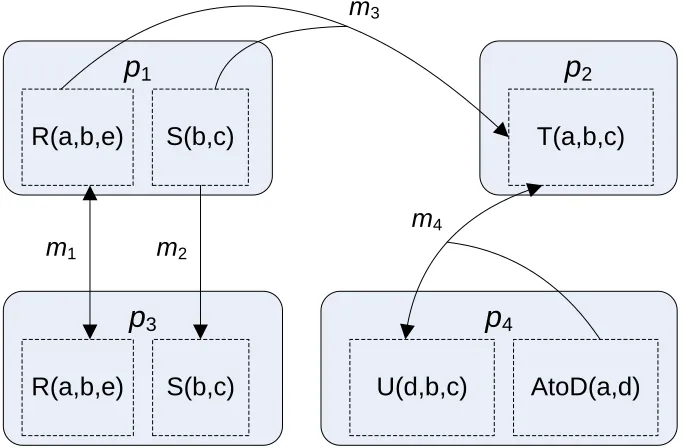
Suppose participantsp1,p2,p3, andp4are in a CDSS. As shown in Figure 2.1,p1andp3have
the same relationsRandS. Mappingm1keepsp1’sRandp3’sRin sync, whilem2copies changes
fromp1’sStop3’s. p3may make local changes to it’s copy ofS, butp1will never see them. ese
mappings can be expressed as follows:
p1.R(a, b, e)↔p3.R(a, b, e) (m1)
p3.S(a, b)←p1.R(a, b) (m2)
More interesting is the relationship betweenp1andp2. Here, two relations fromp1are joined to
create a single relation inp2:
p2.T(a, b, c)←p1.R(a, b, e)∧p2.S(b, c) (m3)
Note that, likem1, this is only a unidirectional mapping. e relationship betweenp2andp4also
involves a join, but here it is a bidirectional mapping:
p2.T(a, b, c)∗ ↔p4.U(d, b, c)∗∧p4.AtoD(a, d) (m4)
In this case, theAtoDtable translates between the IDaisTand the IDdinU. e use of a such a
relations may be updated to satisfy the mapping. In this case, the correspondence table will never be
updated automatically. More details about bidirectional mappings can be found in Karvounarakis
and Ives (2008).
e GLAV mappings used in O are surprisingly versatile and can express a wide
va-riety of relationships between tables, many of which are demonstrated in this example. ey can
normalize or denormalize relations, i.e. split a wide relation into multiple relations using a key or
reconstruct a wide relation from several normalized ones. ey can project away a ributes that are
needed in one database but not in another. Mappingm3in the example combinesRandSfromp1
into the wide relationT inp2, while at the same time projecting away a ributee. ey can
trans-late database-speci c identi ers using a human-curated correspondence table, as in the example’s
mappingm4. With the addition of simple scalar functions, they can perform arithmetic, string
op-erations, and other forma ing transformations. ese are not shown in the example, since they are
not of theoretical interest, but many of the scalar operations supported by traditional database
sys-tems nicely complement “pure” Datalog. For example, one could imagine combining two separate
a ributes for a person’s rst name and surname into a single eld using string concatenation, or
per-forming the inverse by spli ing on whitespace. In a scienti c se ing, one could imagine converting
from Ångströms to nanometers by dividing by ten. In short, GLAV mappings are surprisingly
versa-tile, and their use in O builds upon their successful use in the aforementioned peer data
management systems.
2.2 System operation
In general, O operation is as disconnected as possible, for several reasons. Based on the
operational preferences of collaborators in the biological sciences, it was imperative that queries be
kept private, to avoid being “scooped.” For example, if the set of genes a user references in queries
were made public, and it were well-known that the user is involved in cancer research, it might hint
that the user believed those genes to play a role in cancer development. To avoid this problem, each
participantpmaintains its own private instanceIp, which is stored locally, and over which all queries
are posed; in this way no information about the queries ever leaves the database holdingIp. e
CDSS is responsible for integrating data from other participants intoIp. Additionally, of course,
database systems capable of executing complex queries efficiently can be used. Each participant
peri-odically imports data from the rest of the system by performing aimportoperation to bring in newly
published trusted updates from other participants and apply them toIp.
Each participantpalso makes changes toIp, which are grouped into atomic transactions. Initially
these changes are stored to a local update log, and can be shared with the rest of the CDSS when the
participant chooses to perform apublishoperation. We chose a batched publish operation (instead
of publishing all transactions as they are performed) for several reasons. First, in some scenarios,
such as the bioinformatics example of Ives et al. (2005), it is desirable to publish data only a er some
other event, such as a paper publication or a patent application; by using a batched publish operation
we enable this. Second, it allows updates to be performed during a transient network failure; only
during the publish operation and the aforementioned import operation does a participant need to
be connected to the rest of the system.
O takes the disconnected mode of operation one step further. In addition to not
re-quiring that any given peer have access to the network when querying its data instance, it also requires
that the synchronization operations not depend on any particular other participant being available
and connected to the network. If there are many participants and even a small probability thateach
of them is temporarily unavailable, it becomes very unlikely thatallof them are available at any given
moment. erefore, we cannot simply rely on a participant to store the authoritative archive of the
updates it has published. Also, to ensure a complete record of system state is available, and to enable
new participants to join at a later date, all published updates must be maintained permanently, even
if the participant that published them has le the system.
Instead of having each participant store the updates it has published, all operations in O
-involve communicating with a globalupdate store. It must at least provide access to the global
update log, and may perform additional computation to reduce the processing load of the
synchro-nization operations on a participant. e update store can be implemented in several ways. Clearly,
one option is to simply store the update log in a relational database, which is a natural and simple
way to store what is essentially relational data. is approach was taken by Green et al. (2007a) and
Taylor and Ives (2006) consider it as one of two alternatives, as described in Chapter 3. e la er
also considers a distributed, peer-to-peer storage system for the update log.
However the updates are stored, the system is responsible for maintaining a permanent record of
Data storage, partitioning, and distributed lookup
Reliable distributed versioned storage Publication
Cloud
servers + storage All participants DBMS
update log Imported
updates
Updates from p Data transformation query:
Translates updates from others into p’s schema
Conflict detection query: Retrieves transactions,
conflict sets
Distributed query execution
Update exchange Reconciliation
Participant p with local DB
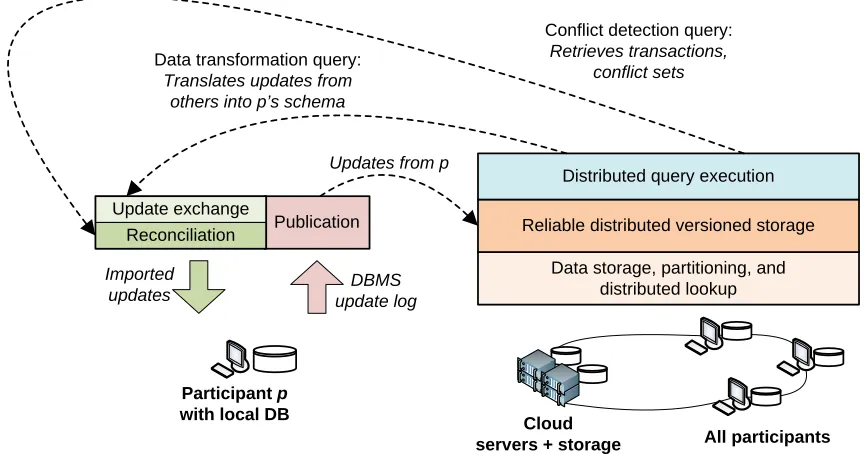
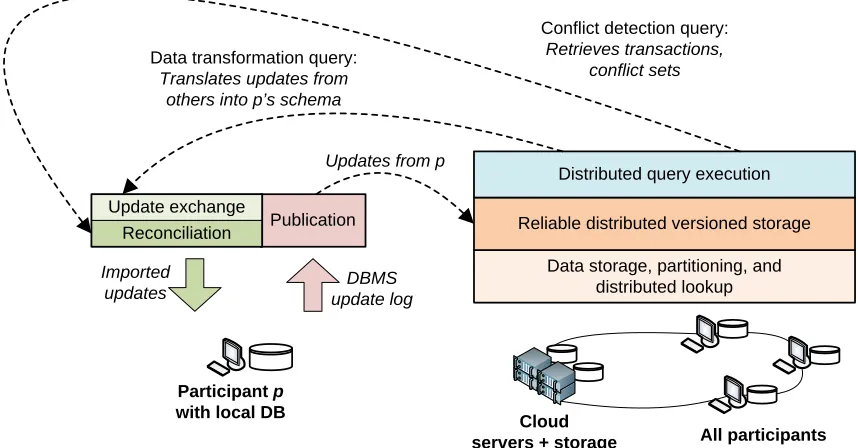
Figure 2.2: Basic architectural components in the O system, as a participant publishes its update logs and imports data from elsewhere. e boxes on the le show the key components of O , introduced in Taylor and Ives (2006) and Green et al. (2007a), and described in Chapters 2 and 3. e boxes on the right show how the components of O interact with and execute over a distributed “cloud” of nodes. is distributed storage and querying engine is the focus of Chapters 4 and 5, which expands on the ideas of Taylor and Ives (2010).
maintains an atomicepochcounter, which is incremented for each publish or import operation. Each
published group of updates is tagged with its epoch, and the epochs during which each participant
performed an import are also recorded. In this way, it is easy to tell which updates are new during a
given import operation, as they will have epochs a er the preceding one and before the current one.
Figure 2.2 shows O ’s architecture, and sketches the data ow involved in its main
op-erations. Each participant (illustrated on the le ) operates a local DBMS with a possibly unique
schema, and uses this DBMS to pose queries and make updates. It invokes O when it has
a stable data instance it wishes to “synchronize” with the world: this involvespublishingupdates from
the local DBMS log to the CDSS’s versioned storage (which contains the update log), andimporting
updates from elsewhere. e implementation of these operations on the right can for the moment
be ignored; we will return to these challenges in later portions of this thesis.
e publish operation is typically simple, and simply involves copying data into the system’s
dis-tinctions between a CDSS and a traditional version-control system. Importation, on the other hand,
is a complex process involving several steps. Brie y, the steps are
1. Retrieve newly published updatesfrom the update log. We describe two simple implementa-tions of this in Section 3.4, and devote Chapter 4 to a more general distributed implementation
of the update log.
2. Translate the new updatesinto the importing participant’s schema. We describe theupdate exchangeprocedure used to do this in Section 2.2.
3. Filter updates using trust conditionsto respect the importing participant’s restrictions on data it is willing to accept. is at rst glance may seem relatively trivial. However, maintaining
a record of the derivation orprovenanceof an update translated from multiple input tuples is
complicated but necessary to do sophisticated ltering. We will discuss this problem in detail
in Section 2.2.
4. Filter updates for consistencyby choosing a maximal set of updates that satis es transactional dependencies and respects integrity constraints. is process is known asreconciliation. We
put off a discussion of reconciliation until Chapter 3, which both de nes concretely what the
ltering process should consider and gives a concrete algorithm to perform it.
5. Apply selected updatesto synchronize the participant’s local instance with the rest of the sys-tem.
In this chapter, as in Green et al. (2007a), we assume that each update is in its own transaction,
that updates do not violate integrity constraints, and that updates are insertions or deletions, not
modi cations of existing tuples. Additionally, each relation is treated as a set. Duplicate insertions
of the same tuple do not cause constraint violations; they are instead treated as different supporting
evidence for the same tuple. ese relaxations ensure that that the ltering done by the reconciliation
process would not eliminate any updates, and in fact makes all updates independent of each other and
allows them to be applied in any order. In Chapter 3, we will consider how dependencies between
Update Translation and Update Exchange
Much of the complexity in translating updates lies in the fact that that correspondences are speci ed
between relations, as in prior data exchange work like Fagin et al. (2005), presenting a kind of logical
mismatch. Applying updates from one participant to another’s data therefore entails translating those
updates in order to maintain satisfaction of the mappings between them. Let us consider again the
scenario shown in Figure 2.1. Since the mappings betweenp1andp3are identity mappings,
trans-lating an update overp1.Rto one overp3.Ris trivial. More complex is the question of translating
updates fromp1top2. O adopts thedelta rulesapproach of Gupta et al. (1993). Each
relation is modeled as three relations, its current contents, sayR, additions to it,R+, and deletions
from itR−. Delta rules creates new mappings relating the base, insertion, and deletion relations in
the source of a mapping to those relations in the target. For example, mappingm3would become
T+(a, b, c)←R+(a, b, e)∧S(b, c)∧ ¬S−(b, c)
T+(a, b, c)←R(a, b, e)∧S+(b, c)∧ ¬R−(a, b, e)
T+(a, b, c)←R+(a, b, e)∧S+(b, c)
T−(a, b, c)←R−(a, b, e)∧S(b, c)
T−(a, b, c)←R(a, b, e)∧S−(b, c)
e updates fromT+andT−can then be applied toT. e closure of the mappings can also be used
to translate updates. For example, updates fromp1may be translated and applied top4, withoutp2
having to accept them. In this case, the delta rules for the composition ofm3andm4is even more
complex:
T+(a, b, c)←R+(a, b, e)∧S+(b, c)∧AtoD+(a, d)
T+(a, b, c)←R+(a, b, e)∧S+(b, c)∧AtoD(a, d)∧ ¬AtoD−(a, d)
T+(a, b, c)←R+(a, b, e)∧S(b, c)∧AtoD+(a, d)∧ ¬S−(b, c)
T+(a, b, c)←R(a, b, e)∧S+(b, c)∧AtoD+(a, d)∧ ¬R−(a, b, e)
T+(a, b, c)←R(a, b, e)∧S(b, c)∧AtoD+(a, d)∧ ¬R−(a, b)∧ ¬S−(b, c)
T+(a, b, c)←R(a, b, e)∧S+(b, c)∧AtoD(a, d)∧ ¬R−(a, b)∧ ¬AtoD−(a, d)
T+(a, b, c)←R+(a, b, e)∧S(b, c)∧AtoD(a, d)∧ ¬S−(b, c)∧ ¬AtoD−(a, d)
T−(a, b, c)←R−(a, b, e)∧S(b, c)∧AtoD(a, d)
T−(a, b, c)←R−(a, b, e)∧S(b, c)∧AtoD(a, d)
Clearly, even relatively simple mappings, as in this example, can generate a large number of update
translation rules. is makes quick, efficient evaluation of these rules an important feature of any
practical CDSS implementation. We will return this challenge in Chapter 4.
An example showing these rules in operation may help to make them more understandable. Let
us consider, for simplicity, only peersp1andp2. Suppose the instances were initially empty, and then
p1inserts some tuples, giving the following delta relations:
R+
‘x’ 10 7.6
‘x’ 10 9.4
‘y’ 20 8.3
‘z’ 30 2.9
R− S+
10 ‘A’
20 ‘B’
20 ‘C’
S−
e delta rules approach would then create the following derived delta relations:
T+
‘x’ 10 ‘A’
‘y’ 20 ‘B’
‘y’ 20 ‘C’
T−
Applying these deltas would result in the following instance forp1andp2:
R
‘x’ 10 7.6
‘x’ 10 9.4
‘y’ 20 8.3
‘z’ 30 2.9
S
10 ‘A’
20 ‘B’
20 ‘C’
T
‘x’ 10 ‘A’
‘y’ 20 ‘B’
‘y’ 20 ‘C’
Suppose then that p1 performed a modi cation S(20,‘B’) → S(20,‘BB’), and deleted
R(‘x’, 10, 7.6)andS(20,‘B’), causing the following delta relations:
R+ R−
‘x’ 10 7.6
S+
20 ‘BB’
S−
10 ‘A’
e delta rules would then create the following delta relations forT:
T+
‘y’ 10 ‘BB’
T−
‘x’ 10 ‘A’
‘y’ 20 ‘B’
ApplyingR−,S−, andT−would give the following combined instance:
R
‘x’ 10 9.4
‘y’ 20 8.3
‘z’ 30 2.9
S
10 ‘A’
20 ‘BB’
20 ‘C’
T
‘y’ 20 ‘BB’
’y’ 20 ’C’
is instance is mostly correct, but the tupleR(‘x’, 10,’A’)should be inT, and is not. is is
be-cause it had derivations that used two different tuples fromR, and the deletion inadvertently canceled
out both of them. To address this problem, the original work in Gupta et al. (1993) proposed two
different algorithms, one based on counting the number of derivations for each tuple, and another
known asDRedthat compensates for this over-deletion by trying to rederive any tuples it deleted.
e counting algorithm cannot be used in this case, as there may be cycles in the mappings, leading
to in nite counts.DRedcan be used, and is considered in Green et al. (2007a).
However, to be er understand the complete derivation of all data in the system, each tuple is
tagged with a record of which tuples it was derived from and how they were used in the mappings.
isprovenanceinformation must be maintained as the updates are propagated through the system.
In the next section, we describe the O provenance model. is provenance model is rich
enough to allow for mode sophisticated incremental maintenance approach to handle deletions of
tuples. Essentially, the provenance is incrementally maintained, and when there are no longer any
complete derivations of a tuple, it is deleted. We describe this in detail in the next section, a er a
discussion of the provenance model.
Provenance Maintenance and Trust Conditions
e O provenance model is based on theprovenance semiringsdescribed in Green et al.
(2007b). Provenance semirings are very powerful, and generalize the provenance models of
of various tuples in an instance of our running example. e schema and mappings for the example
are shown in Figure 2.1. Let us then consider an example where, as in the previous section,p1inserts
the following data intop1.Randp1.S:
p1.R
‘x’ 10 7.6 t1
‘x’ 10 9.4 t2
‘y’ 20 8.3 t3
‘z’ 30 2.9 t4
p1.S
10 ‘A’ t5
20 ‘B’ t6
20 ‘C’ t7
p4also inserts the following data:
p4.U
‘N’ 20 ‘C’ t8
‘O’ 35 ‘D’ t9
p4.AtoD
‘q’ ’O’ t10
‘x’ ‘L’ t11
‘z’ ‘M’ t12
No other peer inserts any data. Note that these “base” tuples have been tagged with identi erst1
tot12. A er the updates are translated and applied to the other peers, the resulting system instance
is as follows:
p1.R
‘x’ 10 7.6 z1=t1+m1(z16)
‘x’ 10 9.4 z2=t2+m1(z17)
‘y’ 20 8.3 z3=t3+m1(z18)
‘z’ 30 2.9 z4=t4+m1(z19)
p1.S
10 ‘A’ z5 =t5
20 ‘B’ z6 =t6
20 ‘C’ z7 =t7
p2.T
‘q’ 35 ‘D’ z13=m4(z9·z10)
‘x’ 10 ‘A’ z14=m3(z1·z5) +m3(z2·z5) +m4(z24·z11)
‘y’ 20 ‘B’ z15=m3(z3·z6)
p3.R
‘x’ 10 7.6 z17 =m1(z1)
‘x’ 10 9.4 z18 =m1(z2)
‘y’ 20 8.3 z19 =m1(z3)
‘z’ 30 2.9 z20 =m1(z4)
p3.S
10 ‘A’ z21 =m2(z5) 20 ‘B’ z22 =m2(z6) 20 ‘C’ z23 =m2(z7)
p4.U
‘L’ 10 ‘A’ z24=m4(z14·z10)
‘N’ 20 ’C’ z8 =t8
‘O’ 35 ’D’ z9 =t9+m4(z13·z10)
p4.AtoD
‘q’ ‘O’ z10=t10 ‘x’ ‘L’ z11=t11 ‘z’ ’M’ z12=t12
Observe that each tuple in the output instance is tagged with a provenancezi. is represents the
single-step provenanceof that tuples, i.e. all of the tuples and mappings from which it can be
imme-diately derived. Addition indicates alternate derivations of the same tuple, and multiplication
indi-cates that a derivation uses multiple tuples. e provenance of base tuples includes their identi ers,
in addition to any ways they may be derivable through mappings. For example, the provenance of
p1.R(‘x’, 10, 7.6)indicates that this tuple was manually inserted, but is also derivable though
map-pingm1from a tuple with provenancez16. e tuplep2.T(‘y’, 20,‘B’)is derivable though
map-pingm3using two tuples, one of which has provenancez3and the otherz6.
In effect, the provenance expressionsz1. . .z24form a system of equations. In a simpler case (i.e. if the mappings were not bidirectional, or there are no cycles in the mappings), there would be a nite
solution to this set of equations. Indeed, there is for certain tuples. For example,z20has nite value m2(t6). However, for most tuples in the system, cycles in the mappings cause there to be no nite
solution. e use of a system of equations allows a nite representation of this in nite solution.
One can also think of each of these single-step provenance expressions as adding nodes and edges
to what Green et al. (2007a) refers to as theprovenance graph. is directed graph has tuple nodes,
which represent values in the relations, mappings nodes, which connect tuple nodes to tuples that can
be derived from them, and token nodes, which annotate base tuples with their provenance tokens. A
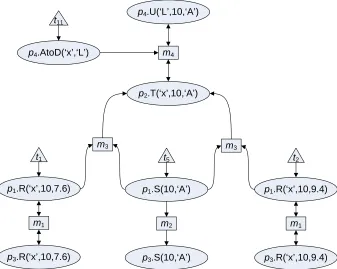
provenance graph for part of our running example can be seen in Figure 2.3.
Participants in a O instance supply trust conditions stating which mappings, tuples,
and peers (or any combination thereof) they trust. In our example,p2might distrust any tuple inp1.R
p1.R(‘x’,10,7.6)
p3.R(‘x’,10,7.6) m1
t1
p1.S(10,‘A’)
p3.S(10,‘A’) m2
t5
p1.R(‘x’,10,9.4)
p3.R(‘x’,10,9.4) m1
t2 p2.T(‘x’,10,‘A’)
m3 m3
p4.U(‘L’,10,‘A’)
m4 p4.AtoD(‘x’,‘L’)
t11
Figure 2.3: Provenance graph for a subset of our running example. Oval nodes are tuples, rectangular nodes are mappings, and triangles are token nodes indicating base data.
not present, and therefore the provenance expressionm3(z1·z5)would also evaluate to not present. However,z14would still be present, since it also contains the termm3(z2·z5), andp2does trustz1.
ereforep2.T(‘x’, 10,‘A’)would appear inp2’s instance.
It is relatively trivial to also use the provenance information for incremental maintenance.
Sup-pose we have the example instance shown above. Ifp1then deletesp1.R(‘x’, 10, 7.6), this has the
effect of se ingz1to being not present, which would also set them3(z1 ·z3)component ofz14to being not present. However, there is an alternative derivation ofp2.T(‘x’, 10,‘A’)that usesz2 instead, so that component of the provenance still evaluates to present and the tuple remains.
A more interesting case is ifp1deletes bothp1.R(‘x’, 10, 7.6)andp1.R(‘x’, 10, 9.4). en,
bothz1andz2become not present. However,z14still has a non-empty provenance, so it is neces-sary to consider whetherz24andz11are still present. However, evaluatingz24means that we must evaluatez14, which is still unknown. Here, the situation is complicated by cyclic mappings (actually bidirectional mappings, but this is equivalent to a pair of unidirectional mappings that form a cycle).
tu-ples to the derived tuple that satis es certain constraints. is graph is a special case of the AND-OR
graph commonly studied in computer science. e mapping nodes are AND nodes, where all of the
inputs must be still derivable for the node to be derivable. e tuple nodes are OR nodes, meaning
that at least one input must be derivable for the tuple to be derivable. All derivations must start from
the provenance tokens a ached to base tuples. Maintenance in the presence of cyclic mappings can
be though of as garbage collection, where tuples with no paths to garbage collection roots (the base
tuples) are deleted. e actual methods used for this are not germane to this thesis, but are detailed
in Green et al. (2007a). Should a later update make provide a new path from base tuples to a derived
tuple, then the derived tuple would be reinserted, just as if it were a truly new tuple.
In the interests of clarity, in the presentation here there were noexistentiallyquanti ed variables
in the mappings. O does support such mappings, which arise naturally in many situations,
such as in the example if mappingm3were inverted. If data were propagated fromp2top1, thee
value inp1.Rwould need to come from somewhere. Additionally, the introduction of existentials
can cause in nitely-sized data instances if system semantics are not carefully de ned. A discussion
of these and related issues is beyond the scope of this thesis; an interested reader is referred to the
discussion in Green et al. (2007a).
Internal System Structure
As described above, updates propagate through a network of mappings, subject to satisfaction of
trust conditions. However, in this slightly naïve presentation, there is no clean way for a participant
to delete a tuple that arrives at it through the mappings. A deletion would simply cause the mapping
to be temporarily unsatis ed, and the tuple would reappear at the next reconciliation.
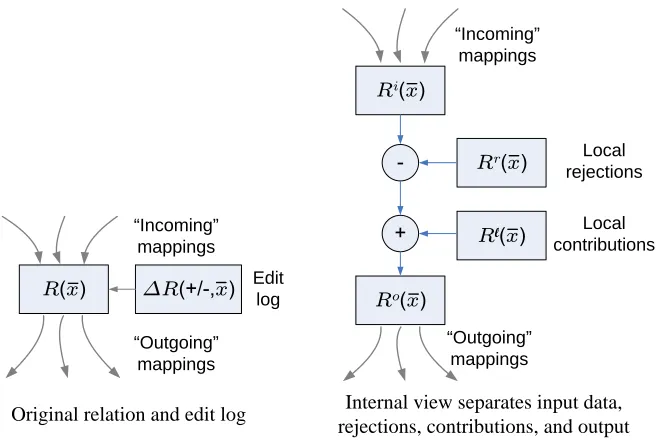
As described in Green et al. (2007a), each logical relationRin an O instance is
repre-sented internally by four relations. e relations are shown in Figure 2.4. Brie y, they are:
• Ri, theinput table. All mappings that logically place data inRare rewri en to instead place data
in here.
• Rℓ, thelocal contributions tableof the peer that ownsR. is contains the tuples inserted by that
≥
Rix
R x
Rr x
Rlx
Rox
“Incoming” mappings
“Outgoing” mappings
“Incoming” mappings
“Outgoing” mappings
Local rejections
Local contributions
∆R x Editlog
Original relation and edit log Internal view separates input data, rejections, contributions, and output
∆ ∆
Σ
Figure 2.4: Internal CDSS representation of a relation turns each relation into four separate relations. Figure from Green et al. (2007a).
• Rr, therejections tableof the peer that ownsR. ese are tuples that arrive atRithrough
map-pings, but which the peer has decided are incorrect.
• Ro, theoutput table. is is the result of combining the effects ofRi,Rℓ, andRrusing the
map-pingsiRandℓRbelow. is table is used as the input to all mappings that read data fromR, and
is also the local instance used to answer queries posed by the peer that ownsR.
e mappings that relate these internal tables are:
Ri(x)∧ ¬Rr(x)→Ro(x) (iR)
Rℓ(x)→Ro(x) (ℓR)
e use of different tables is an elegant way to satisfy both traditional data exchange consistency
semantics and at the same time provide the necessary feature of being able delete undesired data.
2.3 Cloud Substrate for O
is chapter has motivated the collaborative data sharing model, and described at a high level the O
-CDSS that many people at the University of Pennsylvania have worked hard to design and
implement. We described how the system generates queries to translate updates between schemas,
encode provenance, and determine which data items are trusted. All of this work assumes that there
is a scalable storage system to hold the participants’ relations and updates, and a scalable query
pro-cessor to execute the queries the system generates.
e main focus of this thesis is this query processor and storage system. We describe how to
build the substrate necessary to enable high-performance, high-availability storage and data
trans-formation. e system is distributed, to make it scalable, and peer-to-peer, to make it easy to set up
and maintain. We also consider the presence of transactions and con icting updates, which were not
covered in the work summarized in this chapter.
Recall that Figure 2.2 shows the major components of O . is thesis details the design
and implementation of these interacting components.
Publication As discussed in this chapter, publication shares a participantp’s updates with the rest of the system. is involves updatingp’s update log in thereliable versioned storage, described
below.
Update exchange We presented an overview of update exchange in this chapter. A more complete discussion is found in Green et al. (2007a). Update exchange poses queries over the published
data in thereliable versioned storage, using ourdistributed query executionengine. ese queries
translate updates into the reconciling participantp’s schema. ey are then input to the
recon-ciliationprocess, outlined below.
Reconciliation Reconciliation, the process by whichpchooses a consistent subset of newly available transactions to apply, was brie y mentioned in this chapter. Reconciliation receives translated
updates from theupdate exchangelayer, supplemented with information about transactions and
con icting updates from queries posed over thedistributed query executionlayer. Based on user
preferences, a subset of the translated transactions are applied top’s instance, which
respect-ing transactional atomicity and dependencies. Reconciliation is the focus of Chapter 3 of this
thesis, which describes the semantics of our reconciliation procedure and gives efficient
algo-rithms for its implementation.
dis-tributed query execution system for reconciliation. Chapter 4 builds on these ideas to
de-velop a general-purpose, distributed query execution engine, with an emphasis on reliability,
that can be used to execute the queries generated by both reconciliation and update exchange.
is query processor executes over thereliable distributed versioned storage, which we overview
below.
Reliable distributed versioned storage edistributed query execution engine described above re-quires reliable access to mutable data in order to support the query processing needs ofupdate
exchangeandreconciliation. edata storagelayer described below only provides best-effort
con-sistency. As described in Chapter 4, we use an indexing scheme to ensure that queries, posed
relative to a particular version of the distributed database, execute over precisely that version
of the database.
Data storage, partitioning, and distributed lookup We built thereliable distributed versioned storage layer over a simpler data storage and partitioning layer. We started with a well-known
peer-to-peer data structure, the Distributed Hash Table (DHT), because of its self-con guring nature,
native support for replication of data, and well-studied properties. However, DHTs are
tra-ditionally used in much larger se ings, with tens or hundreds of thousands, or even millions,
of nodes. Many design decisions made in traditional DHTs re ect this. In Chapters 4 and 5,
we explore ways to tweak the DHT model in order to improve query performance and load
balancing over the smaller “clouds” of nodes that O uses.
Together with the work reviewed in this chapter, the techniques presented in this thesis enable a
com-plete O implementation. We increase the power of the O data model by adding
integrity constraints. We show that it is possible to create a high-performance, reliable O
implementation, and that we can do so using a cloud of nodes instead of centralized hardware. In
Chapter 3
Reconciliation: Algorithms and
Implementation
Chapters 1 and 2 of this thesis introduced O , a collaborative data sharing system which
has been under development at the University of Pennsylvania for more than ve years. ey also
described in some detail the overall operation of the O system. However, they did not
discuss issues of transactional atomicity, dependencies between updates, integrity constraints, and
con icting data. In this chapter, we detail thereconciliationprocess, which chooses a maximal set of
compatible transactions to apply when a participant synchronizes with an O instance. We
also discuss ways of storing and retrieving those transactions.
is chapter is structured as follows:
• Section 3.1 reiterates the portions of the collaborative data sharing model that are relevant to
reconciliation, and gives the rationale behind our approach to reconciliation.
• Section 3.2 de nes the semantics of reconciliation, rst for a simpler case without update or
deletion, and then for the more complex case with modi cation. Our formalization
empha-sizes local autonomy, making forward progress, and providing intuitive behavior. We support
coexistenceof multiple instances, with consistency de ned bytrust policies,compatibility, and
transactional dependency.
• Section 3.3 provides algorithms to implement the semantics de ned in Section 3.2. It also
I1(ProteinFn)
I3(ProteinFn)
I2(ProteinFn)
Participant p1
Participant p2
Participant p3
p1: Updates from p2
get priority 1
p2: Updates from p3
get priority 1
p1: Updates from p3
get priority 1 3
1 2
ProteinFn
ProteinFn
ProteinFn
p2: Updates from p1
get priority 2
p3: Updates from p2
get priority 1
Figure 3.1: Collaborative data sharing system se ing with three bioinformatics data warehouse par-ticipants sharing data on protein functions
storage and retrieval of updates.
• Section 3.4 shows how to provide two implementations of the update store. One uses a
server-based RDBMS, and the other uses a custom peer-to-peer storage and computation layer. e
la er was the inspiration for the general-purpose peer-to-peer work described in Chapter 4.
• Section 3.5 gives a performance analysis of these algorithms and update store implementations
on bioinformatics-based workloads.
is chapter de nes a model and methodology for reconciliation when all participants share a
singledatabase schema, in the presence of transactions, disagreement, and trust relationships. e
complementary problem of translating updates across schemas in order to incrementally maintain
data instances was discussed in Chapter 2 of this thesis. In the full O implementation, the
reconciliation procedures are identical, as updates are translated into the reconciling participant’s
schema before being considered by the reconciliation process.
3.1 CDSS Properties
An O system, such as the example shown in Figure 3.1, consists of a number of
collabo-rating participants (p1, . . . , p3in the gure), each of whom controls and edits its own data instance