American Journal of Modern Physics
2015; 4(3-1): 27-31Published online March 10, 2015 (http://www.sciencepublishinggroup.com/j/ajmp) doi: 10.11648/j.ajmp.s.2015040301.16
ISSN: 2326-8867 (Print); ISSN: 2326-8891 (Online)
Energy Levels Calculations of
22-23
Na and
24-26
Mg Isotopes
Using Shell Model Code OXBASH
S. Mohammadi, S. Arbab, E. Tavakoli
Department of Physics, Payame Noor University, PO BOX 19395-3697 Tehran, Iran
Email address:
[email protected] (S. Mohammadi)
To cite this article:
S. Mohammadi, S. Arbab, E. Tavakoli. Energy Levels Calculations of 22-23Na and 24-26Mg Isotopes Using Shell Model Code OXBASH.
American Journal of Modern Physics. Special Issue: Many Particle Simulations. Vol. 4, No. 3-1, 2015, pp. 27-31. doi: 10.11648/j.ajmp.s.2015040301.16
Abstract:
In this paper, the energy levels of Na and Mg isotopes have been calculated. Calculations were carried out in the SD model space with 13 different potentials using the shell model code OXBASH by applying spin-parity of valance nucleons. OXBASH is a computing code for carrying out calculation of nuclear structure based on shell model. We compared calculated energy levels with experimental results and find the best energy and potential for each isotope.Keywords: OXBASH Code, SD Space, Energy Levels, Sodium and Magnesium Isotopes
1. Introduction
Obtaining the nuclear structure and energy levels of nuclei is one of the criteria to improve investigations of nuclei properties. Nuclear models have the property to help us to better understanding of nuclear structure which contains main physical properties of nuclei, and shell-model is one of the most prominent and successful nuclear models. This model can be compared with the electron shell model for atoms. As atomic behavior and properties can be described with valance electrons which exist out of a closed shell, similarly, valance nucleons (protons or neutrons) in a nucleus which are placed out of close shells (with magic numbers 2,8,20,28,50,82 and 126) play important roles in determining nuclear properties. Nuclei with magic numbers are very stable and have completely different properties comparing with their neighbors.
Existence of spatial levels is determined by Pauli Exclusion Principle. By knowing nuclear potentials for all nucleons in a nucleus, one can calculate energy levels.
The object of this paper is to calculate the energies of Na and Mg isotopes by using OXBASH code. This program is a set of commands for carrying out shell-model calculations with dimensions up to about 100,000 in the J-T scheme and about 2,000,000 in the M-scheme .We applied the 2005-8 version of this code which can be used on any Windows PC without the use of any other software.
2. Theory and Calculation
OXBASH is a powerful computer code to calculate the energy levels of light and medium nuclei. By using it, we can measure the energy levels of the nucleus and compare it with experimental data. One of the most important challenges in nuclear physics is to calculate and measure energy levels of medium and heavy nuclei by using shell model theory. As a result, it is important to check computer codes in this area. There are many codes written for this purpose such as: Nutshell, REDSTICK, ANTOINE, OXBASH, etc. In this paper we are using OXBASH code, a code which has been developed in this field for many years.
Experimental studies on the stability of some nuclei show that nuclei with protons or neutrons numbers (2, 8, 20, 50, 82, etc.) are more numerous and stable. In other words, the existence of these magic numbers suggests shell model structure in nuclear physics similar to atomic physics. In this paper, the energy levels of Na and Mg isotopes have been measured using the code OXBASH.The program includes a set of computational code which is based on the ability to measure the energy levels by forming ground state matrices with dimensions up to 2000000 and JT matrix with dimension up to 100,000. The version of this code is 2005-8 which can be installed and used on any operating system without using any other additional software.
Space model SD
28 S. Mohammadi et al.: Energy Levels Calculations of 22-23Na and 24-26Mg Isotopes Using Shell Model Code OXBASH
and magnesium isotopes, SD model space is the suitable model for these calculations. This model consists of 2 / ،1 / و1 / valence orbitals. Figure 1 shows the PF and SD model spaces according to shell model theory.
Figure 1. PF and SD model spaces
The basis of Hamiltonian in shell model calculations is normalized Green matrix. For SD model space in OXBASH code, 13 different interaction potentials to perform computations on different nuclei is included [4].
The first normalized G matrix was introduced in 1960 which its results were in good agreement with experimental data for A = 18 to A = 38 nuclei [9, 10], however, with increasing nucleon numbers, solving this matrix was very difficult [11]. In 1976 for the bottom layer of SD model space, the Hamiltonian CWH [7, 8] was introduced and in 1984 the potential W was introduced for the entire layer SD [12].
OXBASH code is a computer program that is described with a set of model spaces and interactions to apply in shell model calculations with high dimensions.
In order to use this code one should specify the model space and interaction. In other words after choosing appropriate model space which is chosen considering valance nucleons,
this code constructs a set of possible ground states and then makes JT matrix based on linear combination of ground states which give suitable T and J values. Finally by choosing the desirable interaction potential it constructs the Hamiltonian of the problem and carries out the calculations and as a default gives 10 lowest energies.
The applied model space illustrates the orbitals which are considered in calculations using main shells in shell-model theory.
Considering the number of valance nucleons of these isotopes, the suitable space for related calculations of these nuclei is SD space. The SD model space includes the 1s1/2, 1d5/2 and 1d3/2 orbitals and 13 different interaction potentials which are considered in this model space are: SDBA, KUOSD, KUOSDM, BKUOSD, PW, CW, W, CWH, KUOSDH, SDM, W, HBUSD, HBUMSD and SU3SD.
N has 6 valence nucleons, isospin T = 0, positive parity and angular momentum of the isotope varies from zero to 1. N has 7 valence nucleons, isospin T = 1, positive parity and angular momentum of the isotope varies from 1/2 to 23/2.
Mg has 8 valence nucleons, isospin T = 0, positive parity and angular momentum of the isotope varies from zero to 12. Mg has 10 valence nucleons, isospin T = 1, positive parity and angular momentum of the isotope varies from 0 to 13.
The basis of the Hamiltonian in shell model calculations is the suitable normalized Green matrix for the problem [4, 5]. In this paper calculations carried out for all 13 potentials separately for the above isotopes.
The first normalized G matrix for SD space model has been suggested in 1960 and its results were in good agreement with experimental spectrum for A=18 to A=38 [1, 2, 3] but in case of temperature increase it fails [6]. CWH Hamiltonian was suggested for the lower part of SD layer in 1976 [7, 8] and the W potential introduced for total SD layer in 1984 [6].
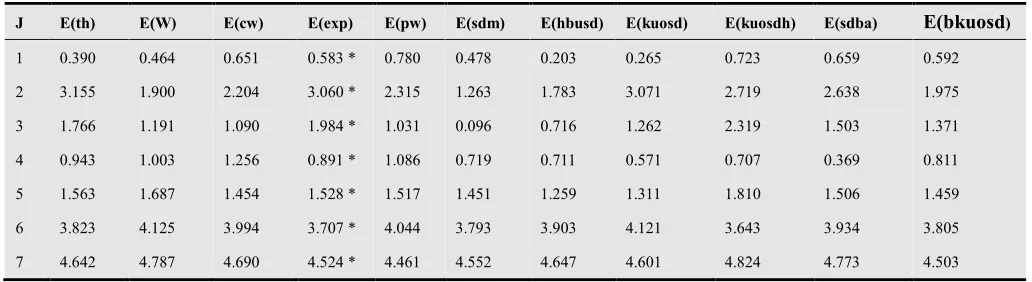
Table 1 show results obtained by executing OXBASH code in SD space model for different interacting potentials for 22
Na
and figure 2 shows its related curves.
Table 1. 22Na energy levels calculations with different potentials.
J E(th) E(W) E(cw) E(exp) E(pw) E(sdm) E(hbusd) E(kuosd) E(kuosdh) E(sdba) E(bkuosd)
1 0.390 0.464 0.651 0.583 * 0.780 0.478 0.203 0.265 0.723 0.659 0.592
2 3.155 1.900 2.204 3.060 * 2.315 1.263 1.783 3.071 2.719 2.638 1.975
3 1.766 1.191 1.090 1.984 * 1.031 0.096 0.716 1.262 2.319 1.503 1.371
4 0.943 1.003 1.256 0.891 * 1.086 0.719 0.711 0.571 0.707 0.369 0.811
5 1.563 1.687 1.454 1.528 * 1.517 1.451 1.259 1.311 1.810 1.506 1.459
6 3.823 4.125 3.994 3.707 * 4.044 3.793 3.903 4.121 3.643 3.934 3.805
7 4.642 4.787 4.690 4.524 * 4.461 4.552 4.647 4.601 4.824 4.773 4.503
American Journal of Modern Physics 2015;
Table 2.
Na=23,N=12,Z=11,T=1
NO J E (th)
1 1/2 2.324
2 3/2 2.747
3 5/2 .412
4 7/2 2.131
5 9/2 2.795
6 11/2 5.391
7 13/2 6.259
The resulted data for 24Mg has been shown in table 3 and figure
Table 3
Mg24 ,N=12,Z=12 ,T=0
J E(th)
0 -87.090 1 7.764 2 1.509 3 5.097 4 4.378 5 7.883 6 8.263 7 12.283 8 12.088 9 16.628 10 19.104 11 23.575 12 25.122
American Journal of Modern Physics 2015; 4(3-1): 27-31
2.23Na energy levels calculations with different potentials.
E(exp) E(w) E(pw) E(cw)
2.391 1.987 2.169 2.227
2.982 3.422 3.515 3.598
0.440 1.570 1.540 1.553
2.076 2.839 2.444 2.546
2.704 3.627 3.549 3.830
5.533 5.290 5.621 5.556
6.237 6.105 6.735 6.477
Figure 2. Energy levels Calculation of 22Na.
Figure 3. Energy levels Calculation of 23Na.
has been shown in table 3 and figure 4.
3. 24Mg energy levels calculations with different potentials.
E(w) E(cw)
-87.090 -87.494
7.764 7.774
1.509 1.563
5.097 5.163
4.378 4.422
7.883 7.901
8.263 8.470
12.283 12.536
12.088 12.248
16.628 12.277
19.104 19.465
23.575 24.660
25.122 26.079
29
E(cw) E(sdm)
2.227 1.799 3.598 3.089 1.553 1.401 2.546 2.452 3.830 3.393 5.556 6.064 6.477 6.168
E(exp)
30 S. Mohammadi et al.: Energy Levels Calculations of
Finally, the resulted data for 26Mg has been shown in table 4
Table 4
Mg26 ,N=14,Z=12 ,T=1
J E(th)
0 -105.536
1 5.833
2 1.929
3 3.921
4 4.533
5 7.038
6 8.194
7 9.908
8 11.770
9 15.632
10 17.153
11 22.091
12 24.669
13 31.339
3. Conclusions
We have compared calculated results for energy levels which are obtained by running OXBASH code for 13 different
Energy Levels Calculations of 22-23Na and 24-26Mg Isotopes Using Shell Model Code OXBASH
Figure 4. Energy levels Calculation of 24Mg.
Mg has been shown in table 4 and figure 5.
4. 26Mg energy levels calculations with different potentials.
E(w) E(cw)
-105.536 -106.333
5.833 6.124
1.929 2.069
3.921 4.348
4.533 4.599
7.038 7.536
8.194 8.720
9.908 10.529
11.770 12.800
15.632 17.038
17.153 18.794
22.091 23.960
24.669 26.148
31.339 33.988
Figure 5. Energy levels Calculation of 26Mg.
We have compared calculated results for energy levels code for 13 different
interacting potentials in SD space model for two Na and Mg nuclei and comparing them
As it shows, the results for W interaction overall are in good agreement with experimental data meanwhile i
comparison between levels shows good fit interactions.
s Using Shell Model Code OXBASH
E(exp)
-105.528 5.690 1.809 3.940 4.319 6.978 8.202 9.829 12.479 --- --- --- --- ---
American Journal of Modern Physics 2015; 4(3-1): 27-31 31
References
[1] T.T.S. Kuo and G.E. Brown, Nucl. Phys. 85, 40 (1966)
[2] T.T.S. Kuo, Nucl. Phys. A103, 71 (1967)
[3] B.H. Wildenthal, E.C. Halbert, J.B.McGrory and T.T.S. Kuo, Phys. Rev. C 4,1266 (1971).
[4] Oxbash for Windows, B. A. Brown, A. Etchegoyen, N. S. Godwin, W. D. M. Rae, W. A. Richter, W. E. Ormand, E. K. Warburton, J. S. Winfield, L. Zhao and C. H. Zimmerman, MSU-NSCL report number 1289.
[5] The Nuclear Shell Model Towards the Drip Lines, B. A. Brown, Progress in Particle and Nuclear Physics 47, 517 (2001)
[6] B. H. Wildenthal, Prog. Part. Nucl. Phys. 11, 5 (1984).
[7] W. Chung, Pd. D. thesis, Michigan State University (1976).
[8] B.H. Wildenthal in Elementary Modes of Excitation in Nuclei, Proceedings of the International School of Physics Enrico Fermi, course 69, edited by A. Bohr and R.A. Broglia (North-Holland,1977), p. 383; B.H. Wildenthal and W. Chung in Mesons in Nuclei, edited by M. Rho and D.H. Wilkinson, (North-Holland, 1979), p. 723
[9] K.-H Speidel et al, phys let B 6591001, 2008. [10] K.-H Speidel et al, phys Rev C 78, 017304, 2008. [11] B.H.Wildenthal, Prog. Part. Nucl. Phys. 11,5, 1984.