Password-authenticated key exchange using
efficient MACs
Maurizio A. Strangio
Department of Computer Science, Systems and Production, University of Rome “Tor Vergata”, Rome, ITALY Email: [email protected]
Abstract— This paper is concerned with password-authenticated key agreement protocols. Designing such pro-tocols represents an interesting challenge since there is no standard way of choosing a password that achieves an optimum trade-off between usability and security. Indeed, passwords belonging to a highly structured language are essentially equivalent to low entropy strings.
A fundamental goal is that of obtaining secure and efficient protocols, with optimum computational complex-ity, round complexity and communication efficiency. These properties make them ideal candidates for mobile devices.
We present DH-BPAKE1 which is an improved version of the protocol presented in previous work (DH-BPAKE). The construction builds upon the encrypted key exchange protocol of Bellovin and Merritt augmented with a key confirmation round based on the use of efficient message authentication codes.
We discuss in detail the security properties of the two efficient message authentication schemes which form the basic building blocks of the protocol. In addition, we formally prove the security of protocol DH-BPAKE1 in a modified version of the model of Boykoet al..
Index Terms— key agreement protocols, password based authentication, message authentication scheme
I. INTRODUCTION
In general, password-authenticated key agreement pro-tocols are hard to design since an adversary eavesdropping on the network can first store the messages exchanged in a run of the protocol and later try to replay them off-line using many different candidate passwords chosen from adictionary, until she encounters a correspondence with the set of transcripts that were captured. Some poorly designed protocols may be also vulnerable to partition attacks [17], [18], where entire subsets of the password space can be ruled out in a single attack. With a well designed protocol, we want to eliminate the possibility of mounting an off-line dictionary attack and constrain the adversary to actively participate in at least one run of the protocol (on-line) for each password guess.
With the proliferation of wireless networks (e.g. in public hot-spots, at home, at work) and mobile devices there will be a greater demand for secure wireless com-munications in the near future. When roaming users meet in a public area (e.g. airport) and need to synchronise
This paper is based on “An Optimal Round Two-Party Password-Authenticated Key Agreement Protocol,” by M.A.Strangio, which ap-peared in the Proceedings of the 1st IEEE Int’l Conference on Avail-ability, Reliability and Security, Vienna, AUSTRIA, April 2006. c2006 IEEE.
the data on their mobile devices they may either use any available wireless service (e.g. WLAN) or a local wireless technology (e.g. Bluetooth—in this case, it would be easy for them to agree on a shared password on-the-fly). However, there is no standard way of choosing a password that achieves an optimum trade-off between usability and security. Indeed, passwords belonging to a highly structured (human) language (and therefore easy to remember) are equivalent to low entropy strings. Fur-thermore, open-air networks are inherently insecure since eavesdropping is “free” (e.g. war driving with open source software tools and a portable computer).
Optimizing resource usage is an important issue from both the perspective of the user and of the network provider. On one hand, users can benefit from the in-creased processing power and memory capacity of mo-bile devices (except for battery duration which is now becoming a major concern). On the other hand, although bandwidth is growing in wireless networks the number of available connections is still limited (implying expen-sive services for the customer). For these reasons, it is desirable to design secure key agreement protocols with optimum computational complexity, round complexity and communication efficiency.
In this paper we present protocol DH-BPAKE1 which is an improved version of the protocol (DH-BPAKE) developed in previous work [21]. Protocol DH-BPAKE1 is essentially based upon basic encrypted Diffie-Hellmann key exchange with an additional communication round that provides explicit key confirmation (whereby each party is convinced that its intended communication part-ner holds the same session key).
that support simultaneous message transmission between principals (in a single round of the protocol). Fortunately such networks exist; for example, a wireless network is inherently full-duplex and therefore offers the possibility of realistic simultaneous communication (provided the communicating devices have two radios).
The rest of this paper is organized as follows. In section II we compare the major features of protocol DH-BPAKE1 with several similar protocols. Section III introduces some background material and provides a detailed description of the protocol. An in depth security analysis is presented in Section IV. The final section contains the concluding remarks and future work.
II. RELATED WORK
There is a large body of work in the literature con-cerning password-authenticated key agreement protocols. One interesting line of research was opened by Bellovin and Merritt [2] which presented a password-authenticated key exchange protocol based on the encryption of Diffie-Hellmann public keys. The papers of [1], [3], [6], [7], [9], [10], [12], [13], [20] significantly continue and extend the work of Bellovin and Merritt.
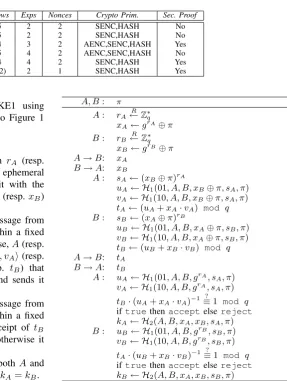
Table I summarizes the properties of several password-authenticated key agreement protocols that provide some form of key confirmation. The protocols are equivalent in terms of the number of communication rounds, as shown in column one. However, protocol DH-BPAKE1 requires only two rounds when run in an full-duplex network. Column two counts the number of exponentiations that each principal must perform in order to run the protocol. Column three shows that protocol DH-PBAKE1 requires the least number of nonces to be generated. Column four gives evidence of the cryptographic primitives used as the basic building blocks in all the protocols with SENC standing for “symmetric encryption”, AENC for “asymmetric encryption” and HASH for “hash function”. Finally, column five reveals whether there exists a formal security proof developed for each of the protocols.
III. PROTOCOLSPECIFICATION
A. Preliminaries
IfX is a finite set thenx←R X denotes the sampling of an element uniformly at random fromX. Ifαis neither an algorithm nor a setx←αrepresents a simple assignment statement.
The symbol⊕denotes bitwise exclusive or on strings of equal length.
Let H1 : {0,1}∗ → Z∗q and H2 : {0,1}∗ → {0,1}`
denote two cryptographic hash functions where ` is the security parameter.
We consider the finite field Zp where p is a large prime and G a q-order subgroup of Zp with q|p−1. The element g is the generator of G. We omit “mod q” from expressions when it is clear from context that we are working inG. The public domain parameters are thus
Φ = (G, p, q, g).
The security of many cryptosystems is based on the conjectured unsolvability of the Discrete Logarithm (DLP) and Computational Diffie-Hellman (CDHP) prob-lems in certain groups.
Assumption 1 (DLP): The group G satisfies the DL assumption if for all probabilistic polynomial time (PPT) algorithms Awe have:
Pr[x←R Z∗q;Y ←g x:
A(Φ, Y)=x]<
where the probability is taken over the coin tosses of A (and random choices of x).
Assumption 2 (CDHP): The groupGsatisfies the CDH assumption if for all PPT algorithms Awe have:
Pr[x, y←R Z∗q;Y ←g
x;Y ←gy :A(Φ, X, Y)=gxy]<
where the probability is taken over the coin tosses of A (and random choices of x, y).
In a concrete security analysis we consider the maxi-mum probability over all adversaries A running in time bounded by t, in this case we say thatG is (t, )-secure with respect to the DLP (resp. CDHP).
A MAC is a 3-tuple hkey(·),tagκ(·),verκ(·)iof poly-nomial time algorithms where:
- key(·)is a randomized key generation algorithm that returns a keyκwhen the input is 1`;
- tagκ(m) is a (randomized) algorithm that accepts message m ∈ {0,1}∗, key κ in input and returns
a tagτ;
- verκ(τ) is a (deterministic) tag verification algo-rithm that accepts (m,τ) in input and returns 1 iff tagκ(m) =τ otherwise it returns 0.
We also require a correctness condition where for all m
in the message space if tagκ(m) = τ then verκ(m, τ) should output 1.
Consider the message authentication scheme MAChu,vi
defined on the fieldZ∗q, for a primeq, where the keyκis a pair of elements hu, viinZ∗q,τ=taghu,vi(m) =u+mv modq andverhu,vi(m, τ) = (u+mv)−1·τ modq.
Also consider the message authentication scheme MACκ defined on the field Z∗q, for a prime q, where the key κ is an element of Z∗q, τ = tagκ(m) = MSBk[(m+κ)−1 modq]andverκ(m, τ) =MSBk[(m+
κ) mod q]−1·τ modq. The function MSBk[·] returns the k most significant bits of its argument. We will use keys, denoted by π, that correspond to passwords pw that are efficiently mappable to elements of Z∗q (e.g.
π=H1(pw)).
B. Description of protocol DH-BPAKE1
TABLE I.
COMPARISON WITH OTHER PASSWORD-AUTHENTICATED KEY AGREEMENT PROTOCOLS.
↓Protocol/Property→ Flows Exps Nonces Crypto Prim. Sec. Proof
DH-EKE [2] 5 2 2 SENC,HASH No
SPEKE [9] 5 2 2 SENC,HASH No
OKE [14] 4 3 2 AENC,SENC,HASH Yes
GLNS [8] 5 4 2 AENC,SENC,HASH No
PAK [6] 4 4 2 SENC,HASH Yes
DH-BPAKE1 4(2) 2 1 SENC,HASH Yes
The main actions of protocol DH-BPAKE1 using MAChu,vi are summarised as follows (refer to Figure 1
for the details):
1) Principal A (resp. B) selects a random rA (resp.
rB) inZ∗q, computes the Diffie-Hellman ephemeral public key grA (resp. grB), encrypts it with the
passwordπand sends the ciphertextxA (resp.xB) toB (resp.A);
2) If A (resp.B) does not receive any message from
B (resp.A) (after sending its own) within a fixed time-slot, it aborts the protocol. Otherwise,A(resp.
B) carries on by computing the keyhuA, vAi(resp. huB, vBi), constructs the tag tA (resp. tB) that authenticates message xA (resp. xB) and sends it toB;
3) If A (resp.B) does not receive any message from
B (resp.A) (after sending its own) within a fixed time-slot, it aborts the protocol. On receipt of tB principal A accepts if the tag verifies otherwise it aborts;
4) The protocol successfully completes if both Aand
B accept holding the same session key kA=kB.
On-line computation for each principal requires two ex-ponentiations (e.g. forA:xA, sA), one modular inversion and two multiplications (inZ∗q) and five evaluations of the hash functions H1,H2. The computational complexity is
reduced if pre-computation is possible since the exponen-tiations can be computed off-line.
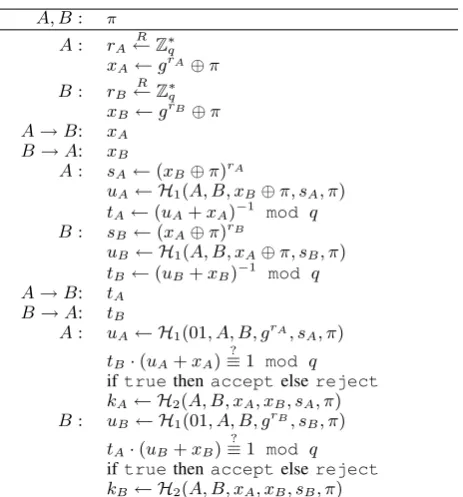
The specification of protocol DH-BPAKE1 using MACπ is described in Figure 2. For this protocol on-line computation for each principal again requires two expo-nentiations, one modular inversion and one multiplication (in Z∗q) and only three evaluations of the hash functions H1,H2.
IV. SECURITYANALYSIS
A. Security of the MACs
In this section we examine with greater detail both the message authentication schemes introduced earlier since the security of protocol DH-BPAKE1 depends on the properties of these primitives. We start with the definition of a secure MAC.
Definition 1 (Secure MAC): A message authentication scheme is (t, )-secure if, for all adversariesArunning in
A, B: π
A: rA R ←Z∗q
xA←grA⊕π
B: rB R ←Z∗q
xB←grB⊕π
A→B: xA
B→A: xB
A: sA←(xB⊕π)rA
uA← H1(01, A, B, xB⊕π, sA, π)
vA← H1(10, A, B, xB⊕π, sA, π)
tA←(uA+xA·vA) mod q
B: sB ←(xA⊕π)rB
uB← H1(01, A, B, xA⊕π, sB, π)
vB← H1(10, A, B, xA⊕π, sB, π)
tB←(uB+xB·vB) mod q
A→B: tA
B→A: tB
A: uA← H1(01, A, B, grA, sA, π)
vA← H1(10, A, B, grA, sA, π)
tB·(uA+xA·vA)−1 ?≡1 mod q
iftruethenacceptelsereject
kA← H2(A, B, xA, xB, sA, π)
B: uB← H1(01, A, B, grB, sB, π)
vB← H1(10, A, B, grB, sB, π)
tA·(uB+xB·vB)−1 ?≡1 mod q
iftruethenacceptelsereject
kB← H2(A, B, xA, xB, sB, π)
Figure 1. Description of protocol DH-BPAKE1 using MAChu,vi
time bounded by t, the following holds:
Pr
κ← {R 0,1}`; hm, τi ← Atagκ(·):
verκ(m, τ) = 1∧m6∈ M
<
where Mis the set of messages that Asubmitted to its oracletagκ(·).
As far as perfect secrecy is concerned, it is impossible to achieve a zero-value for the above probability. This is due to the fact that for any MAC the adversary can always guess a random key κ0 ← {R 0,1}` and output hm,tagκ0(m)iwithout querying its oracle. It is
straight-forward to verify that the success probability of such an adversary is at least1/2`. Furthermore, it is also possible for the adversary to guess a random string τ0 ← {R 0,1}n and outputhm, τ0ifor any validmin the message space; the probability that τ0 is a valid tag is at least 1/2n. Summing this all up, we have that for any MAC with key length ` and tag length n, an adversary can always forge a valid message/tag pair with probability at least
A, B: π
A: rA R ←Z∗q
xA←grA⊕π
B: rB R ←Z∗q
xB←grB⊕π
A→B: xA
B→A: xB
A: sA←(xB⊕π)rA
uA← H1(A, B, xB⊕π, sA, π)
tA←(uA+xA)−1 mod q
B: sB←(xA⊕π)rB
uB← H1(A, B, xA⊕π, sB, π)
tB←(uB+xB)−1 mod q
A→B: tA
B→A: tB
A: uA← H1(01, A, B, grA, sA, π)
tB·(uA+xA)
?
≡1 mod q iftruethenaccept elsereject
kA← H2(A, B, xA, xB, sA, π)
B: uB← H1(01, A, B, grB, sB, π)
tA·(uB+xB)
?
≡1 mod q iftruethenaccept elsereject
kB← H2(A, B, xA, xB, sB, π)
Figure 2. Description of protocol DH-BPAKE1 using MACπ
However, since an unbounded adversary that can ask infinitely many queries to its oracle can easily forge a tag, a meaningful notion of security requires a limit on the number of queries. This leads to the following definition: Definition 2 (Secure MAC): A message authentication scheme is -secure after q tags if, for all adversariesA, keys κand messages mthe following holds:
Pr[tagκ(m) =τ|tagκ(m1) =τ1, . . . ,tagκ(mq) =τq]<
wheremiare the messages thatAsubmitted to its oracle tagκ(·).
Armed with the above notions we now prove the following theorem ( [11]).
Theorem 1: The keyed message authentication scheme MAChu,vi is 1/q-secure after a single tag. Concretely,
Pr[MAChu,vi(m0) =τ0|MAChu,vi(m) =τ, m06=m, τ06= τ]≤1/q.
Proof: Consider arbitrary m, τ such that MAChu,vi(m) = τ; there are exactly q pairs u, v ∈ Zq satisfying the equation u+m·v = τ since for every choice of either u or v there is one and only one corresponding value of the other variable, therefore Pr[MAChu,vi(m) =τ] =q/q2= 1/q.
Since Pr[MAChu,vi(m) = τ] 6= 0, by definition of
conditional probability we have
Pr[MAChu,vi(m0) =τ0|MAChu,vi(m) =τ] =
Pr[MAChu,vi(m0) =τ0∧MAChu,vi(m) =τ]
Pr[MAChu,vi(m) =τ]
Now consider hm0, τ0i 6= hm, τi, it is straightfor-ward to verify that a single pair u, v exists such that MAChu,vi(m0) =τ0∧MAChu,vi(m) =τ or equivalently,
that the system of two equations u+m·v = τ ∧u+
m0·v=τ0 has only one admissable solution. Therefore, Pr[MAChu,vi(m0) =τ0∧MACπ(m) =τ] = 1/q2.
Using the above results we conclude that Pr[MAChu,vi(m0) = τ0|MAChu,vi(m) = τ] = 1/q.
The security of the MACπ scheme is derived from the δ-Computational Modular Inversion Hidden Num-ber Problem (δ-CMIHNP) [5] which enunciates that given n known random pairs (mi,MSBk[(mi +π)−1 modp]) there is no efficient algorithm that outputs (m,MSBk[(m+π)−1 mod p]) with m 6= mi if k <
δlog2p (δ = 1/3). In other words, if the most k
significant bits of m are known, for many random m, then the problem of finding π is conjectured hard if
k < (log2q)/3. The next theorem immediately follows from the above results.
Theorem 2: The keyed message authentication scheme MACπ is a (t, δlog2p)-secure under (randomly) known
message attacks.
Although the above result is weaker than the standard notion of security for MACs, which requires resistance against an adversary that can adaptively sumbit queries to its oracle, it seems sufficient for the security of protocol DH-BPAKE1. Furthermore, it is an open issue whether such a strong notion is required for the security of the protocol (and in particular for the key confirmation mechanism).
B. Security of protocol DH-BPAKE1
The security of the protocol is analysed in the formal model of Boyko et al [6] which extends the model of Shoup [19] to the password-authenticated setting. We introduce additional modifications to account for the full-duplex communication model. In the password-authenticated setting principals share a secret (eventually agreed upon with some out-of-band mechanism); this is the standard “something you know” authentication paradigm. However, as already discussed, the main diffi-culty arises from the fact that users tends to choose low entropy passwords which are easier to guess with respect to cryptographic keys.
We consider static corruptions, meaning that adver-saries make their decision as to whom to corrupt indepen-dently of the network traffic. As a consequence, the ad-versary has complete control over a set of corrupted users fixed in advance and these remain so in the game played by the adversary to break the protocol. Through out the paper we will only consider resource-bound adversaries. Furthermore, the adversary is given complete control over the network (this is a plausible hypothesis when considering the Internet or a public wireless network). Therefore, she can intercept, modify, delete, replay, etc all messages traversing the communication links.
The definition of security is essentially identical to the formulation suggested in [19]. We recall it here:
a) for every efficient real world adversary A, which faithfully delivers the protocol messages between compatible protocol instances both these instances accept holding the same session key;
b) for every efficient real world adversary A, there exists an efficient ideal world adversary A∗ such
that the transcriptstranA andtran∗Aare
computa-tionally indistinguishable.
This definition will become clear below as we precisely explain all the concepts involved (ideal and real worlds, transcripts, simulatability).
C. Security Model
Security is defined via simulation as follows. The ideal world adversaryA∗ can specify user instances that
should be “connected” according to some predetermined rules; such instances obtain a common session key, but keys are otherwise uncorrelated and are concealed from the adversary. In the ideal world there is no TTP, nor certificates, signatures, ciphers or even protocol message flows, there is only the abstraction of a service a key agreement protocol affords to a higher layer protocol. There also is a real world adversary A which is given certain capabilities in the real network.
Random variables (transcripts) are generated by both the real (tranA) and ideal (tranA∗) world adversaries;
these variables log the relevant events as they happen. Security via simulation is defined by requiring that for every real world adversaryA, there exists an ideal world adversaryA∗ such thattran
A, tranA∗ are
computation-ally indistinguishable.
Because the ideal world adversary is essentially benign, the above notion of simulatability implies that a real world adversary is constrained to behave like the ideal world adversary and therefore the protocol is secure. Indeed, the fundamental intuition in the ideal world is that the key agreement is performed by means of a trusted third party (called ring master). The ring master generates all the session keys and delivers them to each user as if there existed a perfectly authenticated and secure communication channel between them. Hence, we expect a real world protocol to be secure if it can be efficiently simulated in the ideal world.
All the capabilities of the adversary in a real execution (deriving from the nature of the protocol or from the environment) are given to the adversary in the ideal world. There is a non negligible probability that an adversary can guess a password and succeed in spoofing a user. As a consequence, the model should explicitly include passwords [6]. Otherwise, it would be necessary to specify the probability of distinguishing real world from ideal world transcripts, given the number of impersonation attempts the real world adversary made (with each attempt corresponding to a guess of the password).
D. Security Model - Ideal World
We now turn to describe the ideal world. There is a set of honest users Υ ≡ {Ui|i = 1,2, . . .} that will
be often referred to by the index “i”. A user Ui may initiate multiple protocol runs (user instances) with one or more users. At any given time, the (eventually empty) set {Iij|j = 1,2, . . .} contains the protocol instances (indexed by j) currently running on Ui’s machine. The ring master has access to a random bit stringR(called the environment), unknown to the adversary, which models information shared by users in a higher level protocol. The ideal world adversary can specify any one of the following operations:
(initialize user,i,IDi): assigns the identity IDi to user
Ui.IDi must not have been already assigned to another user. In addition, a password (chosen from the dictionary D) is assigned to pw[IDi, IDi0] by the ring master for
each user Ui0. IfUi0 has already been initialised then set
pw[IDi, IDi0]←pw[IDi0, IDi]. We make no hypothesis
on the distribution of the passwords. The simplest model would have a dictionaryDand let all passwords be chosen uniformly at random from that set. This operation can be applied only to users that have not been yet initialised. It models the out-of-band communication required to setup passwords between users;
(set password,i,ID0,pw0): assigns the passwordpw0, spec-ified by the adversary, to pw[IDi, ID0]. ID0 must not have been already assigned to any user and, after this operation, it cannot be assigned to another user (in an ini-tialise useroperation). This operation allows the adversary to setup passwords between any user and herself;
(initialize user instance,i,j,P IDij): accepts in input a user instance Iij and the intended communicating partner’s identity P IDij. User Ui must have been previously initialised, but not instance Iij. If P IDij is not set to the identity of an initialised user, then we require that a
set passwordoperation has been previously performed for
i andP IDij (and hence there can be no future initialize user operation withP IDij as the user id);
(test instance password,i,j,pw0): returns whether pw0 = pw[IDi, IDi0] where pw0 is provided by the adversary. This operation may be asked only once for an initialised instance (or on a terminated instance) and if no start session operation has been invoked for the instance. No records are written to tranA∗. The test instance password is supposed to capture active on-line and off-line dictionary attacks against the protocol. Indeed, the unfeasibility of an off-line dictionary attack is modeled by a (passive) adversary not being allowed to issue atest instance passwordoperation on a successful key exchange between honest users. On the other hand, it is impossible to prevent an active adversary to guess the password and participate in a protocol run (e.g. with an honest user); this is modeled by allowing the adversary to ask onetest instance password operation per protocol instance;
(abort session,i,j): aborts the execution of an initialised protocol instance Iij;
(start session,i,j,i0,j0,connect): specifies how a session
ring master setsKij, Ki0j0 both equal to a random value
from {0,1}`2 (where `2 is a security parameter). This
operation is legal if (i) Ii0j0, Iij are initialised instances;
(ii) P IDij = IDi0; (iii) P IDi0j0 = IDi and (iv) no test instance passwordoperation has been invoked of both instances;
(start session,i,j,compromise,key): specifies how a ses-sion key is generated for a compromised instance Iij. The ring master sets Kij =key. This operation is legal provided P IDi0j0 is not assigned to a user (it follows
that this operation cannot be performed on “connected” protocol instances) or if there has been a set password
operation involving Ui;
(application,f, f(R,{Kij})): allows the adversary to ob-tain any information about the session keys {Kij} and the environment R. It models leakage of information on a session key in a real protocol (e.g. using the key to encrypt messages). The efficiently computable functionf
is specified by the adversary.
(implementation,comment): allows the adversary to write a comment to the random variable tranA∗. It is required
to make ideal world views that are equivalent to real world views.
In the model of [19] a start session operation with a
connect connection assignment requires the existence of a partner instance as the argument of acreateconnection assignment. However, in the real world an instance that was subject to acreateconnection assignment may never actually “connect” to its intended partner. This accounts for unilateral (entity) authentication only; needless to say, in peer-to-peer communications mutual authentication of parties is an essential requisite.
We no longer need to specify roles in our model nor does it make sense to distinguish between an initiator instance (the instance that sends the first message) and a responder instance, since the actions performed by each participant in the protocol are completely symmetric and message delivery is asynchronous.
Key authentication is explicit when two principals have established the exact identity of their partner by using specific authentication primitives (e.g. signatures, MACs); therefore it is the authenticated principals that will es-tablish the session key. Conversely, key authentication is implicit when the claimed identities of both principals correspond to their real ones although principals are given no explicit evidence of this fact (but key authentication is implied by both agreeing on the same session key). As we have defined it, thestart sessionoperation with aconnect
connection assignment models both implicit and explicit key authentication.
The approach taken by [6] to account for implicit key authentication is to introducedanglingconnection assign-ments. However, observe that (1) after sending a message, an instance can simply abort the protocol execution if it does not receive the expected reply message within a predefined “time-slot”. We use timeouts explicitly in our model albeit they are usually implementation specific;
(2) an instance that accepts and returns the session key to the higher level protocol that invoked it can simply leave the authentication phase to that protocol (e.g. the calling application could pass session ids resulting from an authentication protocol as arguments to the key agree-ment protocol). We believe the above conditions can lead to more efficient protocols, since all connection-related resources (e.g. memory) are immediately released. One also gets more secure protocols because not only they are less prone to denial of service attacks but if an instance aborts before accepting, there is no session key to expose.
E. Security Model - Real World
We now turn to describe the real world adversary. A protocol instance Iij is a probabilistic state machine. When running, its state is updated as it receives a mes-sage, it then generates a response message and reports its status. The status is assigned any one of the following values: (a) accept, the instance has terminated and has output a session keyKij; (b)reject, the instance abruptly terminates due to some error condition and does not output a session key; (c) continue, the instance is idle, waiting to receive an input message. The real world adversary can specify the following operations:
(initialize user,i,IDi): assigns the identityIDi to userUi.
IDimust not have been already assigned to another user. In addition, a random value from the dictionary D is assigned to pw[IDi, IDi0] by the ring master (for each
user i0). This operation can be applied only to users that have not been yet initialised;
(set password,i,ID0,pw0): assigns the passwordpw0, spec-ified by the adversary, to pw[IDi, ID0]. ID0 must not have been already assigned to different user and, after this operation, it cannot be assigned to another user (in an initialise user operation);
(initialize user instance,i,j,P IDij): accepts in input a user instanceIij and its intended communicating partner identity P IDij. User Ui must have been previously initialised, but not Iij. IfP IDij is not set to the identity of an initialised user, then we require that aset password operation has been previously performed foriandP IDij (and hence there can be no futureinitialize useroperation withP IDij as the user ID);
(deliver message,i,j,M sg,statusij): allows the adversary to deliver messageM sgto an initialised user instanceIij and returns statusij;
(application,f, f(R,{Kij})): allows the adversary to ob-tain any information about the session keys and the environment (R). It is analogous to the corresponding ideal world operation;
the environment is to model information shared by users in higher layer protocols.
An additional operation is given to the adversary:
(random oracle,i, x,Hi(x)): the argument-response pairs
x,Hi(x) are stored in a list Hi-list; if x was never queried before the response is a random value, otherwise the response is the value in the list that corresponds to the given argument x. We call indirect queries those made to the random oracle by the logic of the protocol (and are therefore hidden to the real world adversary) while direct queries are those asked by the adversary. Note thatapplicationoperations are not allowed access to random oracles, i.e., higher level protocols cannot access the random oracle used in the key agreement protocol.
We now prove the following theorem.
Theorem 3: Protocol DH-BPAKE1 is a secure password-authenticated key agreement protocol in the random oracle model assuming MACπ is a secure message authentication scheme.
Proof: Condition a) of Definition 3 is straightfor-ward to verify. It remains to prove the simulatability requirement (condition b) of Definition 3). The idea is to build a simulatorS of the real world protocol so that the transcript resulting from the adversary A∗ attacking
the simulator is computationally indistinguishable from the transcript of an adversary Aattacking the real world protocol. Recall that the model uses passwords explicitly generated by the ring master. This implies that in any security proof we need to construct a simulator that knows the actual value of a password. We describe the actions of the simulator for each possible operation of the adversary in the real world.
Let DH(X, Y) denote the Diffie-Hellman secret gxy
computed from X = gx and Y = gy. Let ` = |q| be the security parameter. We say that two initialised instances Iij and Ii0j0 are compatible if P IDij =IDi0
and P IDi0j0 = IDi. Let IDi = i, IDi0 = i0 and
pw∗ = pw[i, i0]. Let sidi, sidi0 be the concatenation (in
lexicographic order) of all messages exchanged byIijand
Ii0j0 in a protocol run. If sidi = sidi0 we say that two
compatible instances Iij and Ii0j0 have had a matching
conversation.
The simulator must try to detect guesses of the pass-word made by the real world adversary and transform them into test instance passwordoperations. The simula-tor “emulates” in the ideal world the operations issued by the real world adversaryA as follows:
(deliver message,i0, j0, xi, statusi0j0): There are the
fol-lowing subcases to consider:
(i) Message xi was sent by an initialised and com-patible instance Iij (with IDi = i, P IDij =
i0), therefore generate xi0
R
← {0,1}` set
statusi0j0 ← continue and perform operation
(deliver message,i, j, xi0, statusij) before timeout
expiration (the simulation would still be perfect even after timeout expiration since it is handled as in case (v));
(ii) Message xi was sent by an initialised in-stance Iij with IDi = i and P IDij not assigned to a user: perform operation (start session,i0, j0,compromise,key) where key is the real session key extracted from instance Ii0j0;
(iii) Message xi was sent by an initialised instance Iij with IDi = i, and a (set password, i, P IDij, pw∗) operation was called: perform operation (set password,i, IDi0j0,pw∗) wherepw∗is the password
extracted from the corresponding real world opera-tion;
(iv) Message xi was sent by an initialised instance Iij but IDi 6= i or P IDij 6= i0: perform operation (abort session,i0, j0) (this is exactly what happens in the real world).
(v) Message xi is not received byIi0j0 before timeout
expiration: perform an abort operation and write (implementation,“timeouti0j0”) to tranA∗ (this is
exactly what happens in the real world);
(deliver message,i, j, xi0, statusij): this operation is
anal-ogous to the preceding case due to the symmetry of the protocol actions;
(deliver message,i0, j0, ti, statusi0j0): ti was not forged
since it is the tag of a secure MAC; there are two subcases to consider:
(a)Ii0j0 has had a matching conversation with the
compat-ible instanceIij: messagesxi, ti are sent by an initialised instance Iij with IDi = i, P IDij = i0 and were respectively generated as xi
R
← {0,1}` and t i
R ← Z∗q. The value oftiis computed as the result of the (indirect) query:
H1(i, i0, xi0⊕pw∗,DH(xi⊕pw∗, xi0⊕pw∗),pw∗)
(to obtain the value ui) and since xi0 is a freshly
cho-sen random string, ti will be indistinguishable from the value in the real world. Since there was a matching conversation, Ii0j0 has sent messagesxi0, ti0 toIij where xi0
R
← {0,1}`, t i0
R
← Z∗q, therefore perform a (start session,i, j, i0, j0,connect) operation and setstatusi0j0 ← accept. At this point the ring master extracts the session key (to obtain the value of ki = ki0) and assigns it
to both Kij and Ki0j0. Since all messages xi, ti, xi0, ti0
are freshly chosen random elements, it is unlikely that the value assigned to the session key was ever output by the random oracle before, therefore this value will be indistinguishable from the session key in the real world. Theconnectoperation is legal sincetest password instanceoperations correspond to impersonation attempts of the real world adversary using the passwordpw∗. Such attempts require direct queries of the random oracle H1
at the point:
hi, i0, xi, xi0,DH(xi⊕pw∗, xi0⊕pw∗),pw∗i
instances that have had a matching conversation (since the messagesxi, ti, xi0, ti0 are all freshly chosen random
values), therefore it is unlikely that they have been stored in the list L1 with their respective responses (otherwise Ii0j0 would not have had a matching conversation with
the compatible instance Iij);
(b) Ii0j0 has not had a matching conversation with the
compatible instance Iij: there are four subcases to con-sider:
(i) Message ti was sent by an initialised instance Iij withIDi=i,P IDij is not assigned to a user and instance Ii0j0 accepts (in the real world): perform
(start session,i0, j0,compromise,key) where key is the real session key extracted from instanceIi0j0;
(ii) Message ti was sent by an initialised instance
Iij with IDi = i, and a (set password, i,
P IDij, pw∗) operation has been issued (and instance Ii0j0 accepts): perform operation (set password,i, IDi0j0,pw∗) wherepw∗is the password
extracted from the corresponding real world opera-tion;
(iii) Message ti was sent by an initialised instance Iij but IDi 6= i or P IDij 6= i0: perform operation (abort session,i0, j0) (this is exactly what happens in the real world).
(iv) Messagetiwas not received byIi0j0 before timeout
expiration: perform an abort operation and write (implementation,“timeouti0j0”) to tranA∗ (this is
exactly what happens in the real world);
(deliver message,i, j, ti0, statusij): this operation is
anal-ogous to the preceding case due to the symmetry of the protocol actions;
(initialize user instance,i, j, P IDij): this operation is sim-ply passed on to the ideal world;
(application,f, f(R,{Kij})): this operation is simply passed on to the ideal world;
(set password,i, ID0,pw0) store pw0 and answer as usual (the operation is passed on to the ideal world);
(random oracle,1,hi, i0, xi0⊕pw∗, W,pw∗i,H1): where W = gxy for some random x, y and the argument-response pairs are stored in the list L1. If the argument
was never used before, the response is a random value, otherwise the response is the value in the list that cor-responds to the given argument. This operation occurs in the real world transcript tranA∗ only when the two
instances Iij and Ii0j0 are compatible and have had a
matching conversation. In this case the response is k←R {0,1}`2 (`2 is another security parameter polynomially
related to `). We argue that the adversary A has a negligible probability of asking the random oracle H1
a query in the point hi, i0, xi, xi0, griri0,pw∗i such that
hxi⊕pw∗, xi0⊕pw∗, griri0i forms a DH tuple. Indeed,
let ask-DH denote the event that such a query is made with non negligible probability PrA[ask-DH], then one can
build an algorithm F that solves the CDHP. Algorithm F is given an instance (X = gx, Y = gy) ∈ G of the
CDHP, and must determine Z=DH(X,Y).F will “embed” this instance in the conversation of two protocol instances
Iij, Ii0j0 that have had a matching conversation and have
exchanged the messages xi, xi0. The algorithm runs as
follows:
1) F is given (X, Y) ∈ G. It chooses passwords for all parties (also playing the role of ring master); 2) F will run the simulator, answering operations as
follows:
- Whenever there are (deliver message,i0, j0, xi, statusi0j0) and (deliver message,i, j, xi0, statusij) operations and Iij
and Ii0j0 are compatible instances, choose u ←R Z∗q, v
R
← Z∗q and generate xi, xi0 as xi=guX⊕pw∗, xi0 =gvY ⊕pw∗;
- Whenever there is a query of the form H1(i, i0, U ⊕pw∗, V ⊕pw∗, W,pw∗) answer
with a random string if it was never asked before otherwise return the previous response. If the query is asked as the result of a matching conversation between two compatible instances
Iij and Ii0j0 withIDi =i, IDi0 =i0 the DH
tuple (U, V, W) is stored in the listL1;
- All other operations are treated as usual (i.e. they are passed on to the simulator);
3) When the simulator ends,Fchooses a random tuple from L1 (this list is not empty since PrA[ask-DH]
is non negligible). It findsx, ysuch thatU =gxX andV =gyY and outputsW/YuXvDH(U, V). Now, the probability that F chooses the Diffie-Hellman tuple corresponding to eventask-DHis1/nhwherenhis an upper bound on the number of queries asked to H1.
Therefore if eventask-DHoccurs thenFsolves the CDH instance (X, Y) given in input since it outputs the correct value for DH(X,Y). This implies that PrA[ask-DH]≤nh.
(random oracle,2,hi, i0, x
i, xi0, ti, ti0, W,pw∗i,H2): this
case is treated similarly to the preceding one. We also enunciate the following result.
Theorem 4: Protocol DH-BPAKE1 is a secure password-authenticated key agreement protocol in the random oracle model assuming MAChu,vi is a secure
message authentication scheme.
The proof of this theorem is analogous to the proof of Theorem 3.
V. CONCLUSIONS ANDFUTUREWORK
protocol for smartphones to verify the effectiveness of our results.
ACKNOWLEDGMENTS
The author is grateful to the anonymous reviewers for their detailed comments and helpful suggestions.
REFERENCES
[1] M. Bellare and P. Rogaway. The AuthA protocol for password-based authenticated key exchange. Contribution to IEEE P1363, 2000.
[2] S. Bellovin and M. Merritt. Encrypted Key Exchange: Password based protocols secure against dictionary attacks.
In Proceedings IEEE Symposium on Research in Security and Privacy, pages 72–84, 1992.
[3] S. Bellovin and M. Merritt. Augmented encrypted key exchange: A password-based protocol secure against dic-tionary attacks and password file compromise.In Proceed-ings of the 1st ACM on Computer and Communications Security, pages 244–250, 1993.
[4] S. Blake-Wilson, D. Johnson, and A. Menezes. Key agree-ment protocols and their security analysis. In Proceedings of the 6th IMA Int.l Conf on Cryptography and Coding, LNCS 1355:30–45, 1997.
[5] D. Boneh, S. Halevi, and N. Howgrave-Graham. The modular inversion hidden number problem.Proceedings of the 7th International Conference on the Theory and Appli-cation of Cryptology and Information Security: Advances in Cryptology, LNCS 2248:36–51, 2001.
[6] V. Boyko, P. MacKenzie, and S. Patel. Provably se-cure password authenticated key exchange using Diffie-Hellmann. In Proceedings of EUROCRYPT 2000, LNCS 1807:156–171, 2000.
[7] E. Bresson, O. Chevassut, and D. Pointcheval. New security results on encrypted key exchange. In Proc. 7th PKC’04, LNCS 2947:145–158, 2004.
[8] L. Gong, M. Lomas, R. Needham, and J. Saltzer. Pro-tecting poorly chosen secrets from guessing attacks. IEEE Journal on Selected Areas in Communications, 11(5):648– 656, 1993.
[9] D. Jablon. Strong Password-only Authenticated Key Ex-change. SIGCOMM Computer Communication Review, pages 26(5):5–26, 1996.
[10] D. Jablon. Extended Password-only Key Exchange im-mune to Dictionary Attacks. In Proceedings of the WEWTICE’97 Workshop on Enterprise Security, pages 248–255, 1997.
[11] J. Katz. Introduction to Cryptography - Course Lecture Notes. http://www.cs.umd.edu/∼katz/crypto/, 2004. [12] K. Kobara and H. Imai. Pretty-simple
password-authenticated key-exchange under standard assumptions.
IEICE Transactions, pages 2229–2237, 2002.
[13] T. Kwon. Authentication and key agreement via mem-orable password. In Proceedings of NDSS Symposium Conference, 2001.
[14] C. E. Landwehr. Protecting unattended computers without software. Proceedings of the 13th Annual Computer Security Application Conference, pages 274–283, 1997. [15] A. Menezes, P. V. Oorschot, and S. Vanstone. Handbook
of Applied Cryptography. CRC Press, 1997.
[16] M. Mitzenmacher and E. Upfal. Probability and Comput-ing: Randomized Algorithms and Probabilistic Analysis. Cambridge University Press, United Kingdom, 2005. [17] S. Patel. Information leakage in encrypted key exchange.
In Proceedings of the DIMACS Workshop on Network Threats, 1997.
[18] S. Patel. Number theoretic attacks on secure password schemes. In Proceedings IEEE Symposium on Security and Privacy, pages 236–247, 1997.
[19] V. Shoup. On Formal Models for Secure Key Exchange. Technical Report RZ 3120, IBM Research, 1999. [20] M. Steiner, G. Tsudik, and M. Waidner. Refinement and
extension of encrypted key exchange. Operating Systems Review, 29(3):22–30, 1995.
[21] M. Strangio. An Optimal Round Two-Party Password-Authenticated Key Agreement Protocol. 1st IEEE Pro-ceedings of the ARES06, 2006.
Maurizio Adriano Strangio recently received a Ph.D. from the University of “Tor Vergata”, Rome. He also obtained his MS degree in computer science from the University of Bari, in 1989.