Effectiveness of the Plan of Specialized Sport in
Students of Schools of Imam Reza in the 94-95 Year
M.R Ismaeelzadeh, S Soltani, M Khorsandi Fard, M.R Anjomshoa, M Piri,
M Tavakkol
Department of Physical Education and Sport Science, Islamic Azad University, Mashhad Branch, Mashhad, Iran
ABSTRACT: The present study aimed to evaluate effectiveness of the plan of specialized sports for school students of Imam Reza in Mashhad. The statistical population included all students, parents, administrators, assistants and physical education teachers of Imam Reza schools that their number was 3,500. Given the importance of the views of all people, all people were selected as sample. The research tools included four questionnaires to assess the effectiveness of specialized sports school students, from their perspective and their parents, and administrators, assistants and physical education teachers and coach evaluation, that their validity by ten professors of Sport management was approved. The reliability of the questionnaire, for questionnaire for parents of students 0.94, 0.95 for the questionnaire managers, assistants and physical education teachers, and 0.90 for questionnaire of students, and 0.89 for the performance questionnaire of coaches, calculated and approved. To analyze the data, descriptive statistics test, Kolmogorov-Smirnov tests, Wilcoxon and Friedman were used. The results showed special sport plan from the perspective of any of the groups of participating in the study was not significant.
Keywords: Effectiveness, Specialized Sport, Students
INTRODUCTION
The effectiveness, the degree of achievement of the objectives have been determined. In other words, the effect shows how much of the efforts made to correspond with the results (Taylor, 2007). Argyris (1996) defined Effectiveness as the knowledge of manager to have a privileged position in interacting with their environment and the opportunity to achieve the objectives. The effectiveness is a process that starts from the plan, and includes all activities that in order to achieve organizational goals, and determines to what extent do they desired has been done (Borman, 2005). Effective school, is that school, has developed and preserves high quality of the educational programs, for system-wide goals and objectives. In these schools all students regardless of family or social context, experience the improvement during the course of life and the ultimate success in achieving the goals of the fit measurement techniques (Bruce, 2001). One of the first goals of education, training person as a human being independent and purpose and autonomously. Physical education with an emphasis on developing the physical, mental, emotional and social life, if effectiveness, will play an important role in the education process. Considering the importance and role of physical education in the process of education, the role of physical education in the field of education (cognitive, emotional and psychomotor) the attention and emphasis placed (Erickson et al., 2008). Physical education programs in schools, should have such characteristics like, the proportion of children with developmental and physical fitness, create a broad and comprehensive skills in children, including children's free time and involves all individual differences and their different talents strengthening of spirituality, human traits and values of children (Dismore, 2005).
Development of physical education programs in schools to favorable human and material resources and needs careful and basic planning. The available evidence suggests that optimal planning in education, shortage of teachers of PE, especially in primary schools, the limited number of hours of sport lessons, shortage of scientific books and difficulty of access, lack of expertise and lack of knowledge and awareness of teachers in training, lack of equipment and adequate facilities and standards and poor management or lack of cooperation by managers in previous years. In addition, management and continuous control on the education of PE and PE teachers' performance evaluation and gain the support of parents, as well as from access to educational purposes. According to most scholars' views of education, in the training and education, have paid attention to all aspects of human existence, physical education can be truly regarded as one of the pillars of political education. But today, most practitioners of physical education believe the teaching of physical education in schools did not find their true position and not run in satisfactory level. The difference between reality and truth leads to separation of the main objectives of physical education programs in schools, which predisposing psychological disorders and psychological problems (Wuest & Bucher, 2003).
shortage of teachers of physical education and lack of sports facilities during the past years. Attention and participation of administrators and PTA in providing effective programs physical education and strengthen the sports schools in the country leads to change dramatically in the program (Marx, 2009).
Physical education activities in schools, will follow development of neuromuscular skills, development of physical and, mental and social abilities. By creating an exercise habits during the education, occurs opportunities of physical activity in life. Thus, healthy life chances for people increases and increased quality of life. The objectives of physical education in schools is that for the purposes of public education, including the development and prosperity of physical, mental and emotional the students. In other words, of Physical Education curriculum, in addition to promoting physical fitness and motor skills through practice in class, as well increase the interest of students to actively participate in sports activities, their orientation to improve physical fitness and basic movements, tend to sanitation in sports, the tendency to acquire and develop skills in sports, and safety in sports activities. These objectives are based on the various dimensions of student growth, it is the importance of physical education among other courses (Housner, 2009).
In this regard, Metzler and Jeerdsma (2000) technique class office, the importance of individual differences, the ability to plan and deliver lessons to factors affecting productivity applications classroom of Physical Education. Abdullah Hamed Nasser (2008) in examining the current and desired status of Physical Education, and students 'attitudes to of Physical Education in schools in Saudi Arabia, report incorrect assessment, and failure of evaluation system, is the most important reason for the lack of sport, and improve students' attitudes in schools. Koca et al (2005) and Erickson et al (2008) in separate studies report exercise was useful to self-actualization and socialization of students. Wayne and Young (2004) reported that character and teaching methods of physical education teachers was useful to the students' inclination towards physical activity and their attitude to sport. Gibbons and Humbert (2008), Fauee et al (2009) and Dismore (2005) in their research emphasized the positive 'attitude of students in Japan, England and Canada to sports and physical education, and teaching methods had improved students' attitudes. The result of research of Fauee et al (2009) also suggests that if physical education programs are consistent with students' interests and tastes, can significantly affect attitudes and their views, to physical activity. Ekholm (2013) and Levermore (2008) in their researches showed exercise respectively effective tool in improving the social and cultural situation in the society.
Physical education classes and sports, for nurturing students is of utmost importance, because these classes according to natural needs them, and they like in this classes to be more attention to them. For this reason, unlike other speculative activities of the school, which they mainly have cognitive development goals participate in classes, may have different objectives derived from the needs of their instinctive different ages to participate in of Physical Education classes, whit the development of physical, cognitive and emotional of students as well as their needs and goals from participating in physical education classes and sports, developed and change or have a certain priority. Therefore this research aims to investigate and evaluation of specialized sport in schools of Imam Reza in Mashhad.
METHODOLOGY
Present study according to the methods of subject and purpose is descriptive survey, and according to the purpose of the research is applied. The research population consisted of all students, parents of students, administrators, assistants and physical education teachers and sports coaches in specialized sports schools project of Imam Reza (AS) affiliated to the Cultural Foundation of Astan Quds Razavi and given the importance of the views of all participants were evaluated by counting all methods. The research tools included three questionnaires to assess the effectiveness of specialized sports school students, from the perspective of students and their parents and administrators, assistants and physical education teachers, and has internal dimensions of technical efficiency, effectiveness and impact of cultural and social attitude. A questionnaire was designed to evaluate the performance of coaches in specialized sport project. The validity were approved by ten experts of sports management, and experts of Razavi Cultural Foundation. The reliability of the questionnaire, for questionnaire for parents of students 0.94, 0.95 for the questionnaire managers, assistants and physical education teachers, and 0.90 for questionnaire of students, and 0.89 for the performance questionnaire of coaches, calculated and approved. To analyze the data, descriptive statistics test, Kolmogorov-Smirnov tests, Wilcoxon and Friedman were used. To analyze the data, the software SPSS21 was used.
Finding
To describe the variables, the index of mean, median and standard deviation were used and results were presented in Table 1.
Table 1. Describing the variables
Variables Mean Median Standard Deviation Vision of Students
Social and cultural effectiveness 2.12 2.17 0.69 Overall effectiveness 2.19 2.15 0.56
Vision of Parents
Technical effectiveness 2.13 2 0.63 Attitudinal effectiveness 2.35 2.25 0.68 Social and cultural effectiveness 2.25 2.23 0.59 Overall effectiveness 2.25 2.30 0.59
Vision of Managers, Assistants and Physical Education Teachers
Technical effectiveness 2.32 2.30 0.757 Attitudinal effectiveness 2.28 2 0.72 Social and cultural effectiveness 2.34 2.25 0.75 Overall effectiveness 2.41 2.06 0.688
According to Table 1 it can be seen that mean score of the effectiveness of specialized sport and its dimensions, from the perspective of all three groups is less than the average. To check the status of sports performance of coaches in specialized sport project in schools of Imam Reza, average, median and standard deviation were used.
Table 2. Review the status of the coaches of specialized sports project in Imam Reza schools Variables Mean Median Standard Deviation Average overall performance of coaches 2 1.9 0.451 Average performance of coaches in Squash 1.5 1.58 0.74 Average performance of badminton coaches 1.8 1.98 0.63 Average performance of basketball coaches 1.7 1.74 0.68 average performance of table tennis coaches 1.6 1.85 0.590 Average performance of tennis coaches 2 2.38 0.59 Average performance of swimming coaches 1.6 1.60 0.54 Average performance of football coaches 2.1 2.35 0.68 Average performance of mini-basketball coaches 2.5 1.82 0.94 Average performance of volleyball coaches 2.3 2.10 1.254
According to Table 2 indicates overall performance of specialized sports coaches in project of Imam Reza (AS) schools is less than the average. In addition it can be seen that the performance of coaches in all athletic fields, from the perspective of specialized evaluators, is less than desirable level. Kolmogorov-Smirnov test for normality of data were used in this study.
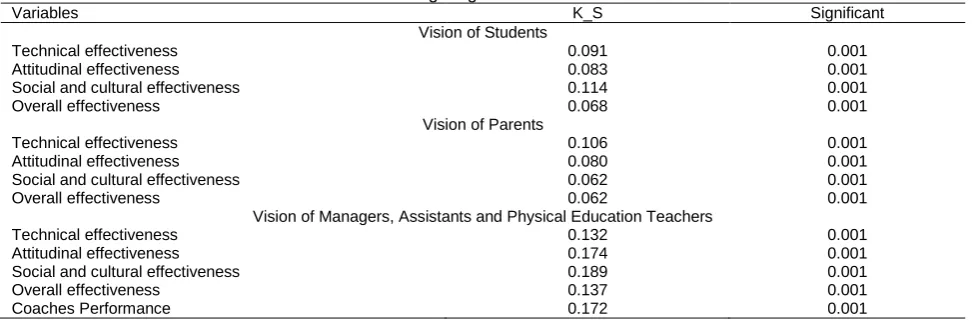
Table 3. Investigating the distribution of data
Variables K_S Significant
Vision of Students
Technical effectiveness 0.091 0.001 Attitudinal effectiveness 0.083 0.001 Social and cultural effectiveness 0.114 0.001 Overall effectiveness 0.068 0.001
Vision of Parents
Technical effectiveness 0.106 0.001 Attitudinal effectiveness 0.080 0.001 Social and cultural effectiveness 0.062 0.001 Overall effectiveness 0.062 0.001
Vision of Managers, Assistants and Physical Education Teachers
Technical effectiveness 0.132 0.001 Attitudinal effectiveness 0.174 0.001 Social and cultural effectiveness 0.189 0.001 Overall effectiveness 0.137 0.001
Coaches Performance 0.172 0.001
According Kolmogorov-Smirnov test results, the hypothesis of normal distribution of data in variables is rejected and nonparametric tests were used to assess these variables.
Table 4. Significant the research variables by using the Wilcoxon test
Variables Z Significant
Vision of Students
Overall effectiveness -11.634 0.08 Vision of Parents
Technical effectiveness -10.125 0.364 Attitudinal effectiveness -4.115 0.98 Social and cultural effectiveness -7.299 0.094 Overall effectiveness -7.929 0.254
Vision of Managers, Assistants and Physical Education Teachers
Technical effectiveness -4.547 0.427 Attitudinal effectiveness -2.457 0.122 Social and cultural effectiveness -3.246 0.98 Overall effectiveness -3.254 0.08 Coaches effectiveness -5.672 0.356
According to Table 4 can be seen that specialized sport project and its dimensions, from the perspective of groups of the studied, have not significant impact. From the perspective of the participants to rank the research variables Friedman test was used.
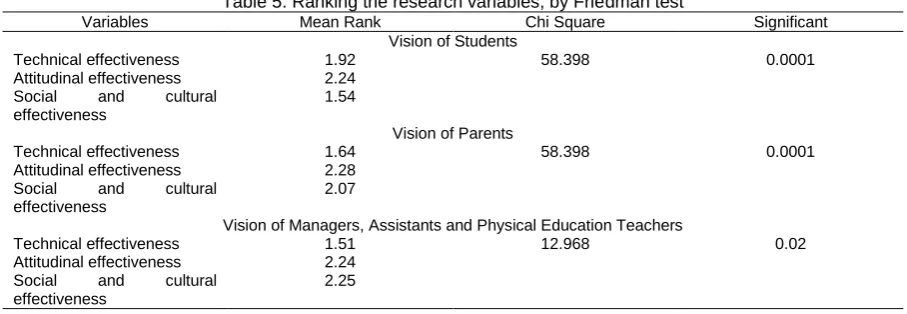
Table 5. Ranking the research variables, by Friedman test
Variables Mean Rank Chi Square Significant Vision of Students
Technical effectiveness 1.92 58.398 0.0001 Attitudinal effectiveness 2.24
Social and cultural effectiveness
1.54
Vision of Parents
Technical effectiveness 1.64 58.398 0.0001 Attitudinal effectiveness 2.28
Social and cultural effectiveness
2.07
Vision of Managers, Assistants and Physical Education Teachers
Technical effectiveness 1.51 12.968 0.02 Attitudinal effectiveness 2.24
Social and cultural effectiveness
2.25
As well as the views of the groups of participating in the study were compared with each other and the results presented in Table 6.
Table 6. Compare the views of the research participants by two-sample t-test
Z Significant Compare of Students and Parents -2.016 0.54 Compare of Students and Managers, Assistants and Physical Education Teachers -4.781 0.254 Compare of Parents and Managers, Assistants and Physical Education Teachers -4.323 0.09
According to Table 6 can be seen, there is no significant difference between the views of the groups of participating in the research, about the effectiveness of specialized sport.
CONCLUSION
project of schools of Imam Reza (AS) in the implementation of this project is significant not satisfactory. The lack of effectiveness of specialized sport from the perspective of students and parents as well as because of poor performance of coaches. In many studies, including Metzler and Jeerdsma (2000), Wayne & Young (2004) and Borman and Kimball (2005) the role of the coach, on the development of sports attitude and technical and cultural effects of sports-related items, in separate research and different communities, are significantly effective. Due to the poor performance of coaches, and failure to implement specialized sport at an optimum level by coaches, can be a lack of effectiveness and influencing sports attitudes, technological advancement, and improve students' social and cultural situation, due to the weak performance of coaches. Fauee et al (2009) The importance of physical education programs align with the interests of students, was useful in improving the quality of physical education, which is Countercurrent with the findings of our research, and specialized sport project, despite engage students favorite athletic fields, the desired effects not obtained, and this disruption as well, due to coaches unsatisfactory performance, lack of proper planning and lack of hours of physical education.
The results showed that mangers and physical education teachers knew specialized sport project of schools of Imam Reza (AS) lacks effectiveness of the technical dimension, attitude, sports, and cultural and social dimensions, and this plan is not effective in students. The findings also showed that views of managers, assistants and physical education teachers with students and parents of students with respect to the effectiveness of specialized sport of schools of Imam Reza (AS) is not a significant difference and as well as the views of students and parents of students also not have significant differences. These findings suggest that attitudes of managers, assistants and physical education teachers, students and parents in line with the specialized sport project and its dimensions, and all test subjects in total, know specialized sport project is lacks optimal effectiveness. The point of view of physical education teachers in different studies, show that in some studies, physical education teachers evaluated favorable conditions, and in some studies consider undesirable. The effectiveness of schools, particularly physical education, according to the findings of many studies, can be effective in improving the technical capabilities of students. As well as hours of exercise and physical education, is affective in the development of sports attitude, and improve socialization, and education cultural issues, as well as to citing a lot of research. But this effectiveness depends on many factors including the quality of physical education classes, the quantity of hours of physical education, performance of coaches and exercise teachers, sports facilities and spaces and how to use them, plan physical education classroom, teaching physical education teachers. The development of sports facilities and spaces can be effective, but with the proper use and utilization of limited resources, and improve the attitude and motivation of students, we can increase the quality and effectiveness of physical education classes, and only facilities are not able to respond. Therefore, it is necessary to improve the effectiveness of physical education classes in schools, comprehensive development, and improving teaching methods, and increase the quality of education, and improve motivate students, and whit this way, the effectiveness of physical education in schools significantly improved.
REFERENCES
Abdullah Hamed Nasser AL-L, B. A., M.S., (2008), Middle and High School Students' Attitudes toward Physical Education in Saudi Arabia, A dissertation submitted in partial fulfillment of the requirements for the degree of Doctor of Philosophy, University of Arkansas.
Argryis C. (1996). Organizational Learning , Reading Mass-Addison Wesley Cameron , Kims & Whetten. Hoy Vaynk -& cisil. J. Miske. (1991). Theory Research and practice in educational admininstration , Mc Graw-Hill , Inc Townsend.
Borman,G.D.and Kimball,S.M (2005). Teacher quality and educational equality: do teachers with higher standard-based evaluation ratings close student achievement gaps? The Elementary School Journal, Volume 106: 3-20
Bruce, W. Deacon. (2001). Physical education curriculum review report. Ministry of Education, British Columbia. Dismore (2005).Japenese and English School Students'Views of Physical Education: A comparative
study.International Journal of Sport and Health Service, 4: 74-85
Ekholm, D. (2013). "Sport and crime prevention: individuality and transferability in research". Journal of Sport for Development, 1(2), pp: 26-38.
Eriksson, M. Nordqvist, T. & Rasmussen, F. (2008). Associations between Parents’ and 12-year-old Children’s Sport and Vigorous activity: The Role of Self-Esteem and Athletic Competence, Journal of Physical Activity and Health, 5: 359-373.
Fauee, O., Jamalis, M., Yusef, A, Zarina, M., and Omar, Dev. (2009). College Students perception on physical education classes during school days, European Journal of Social Sciences, 7(4):69-76
Gibbons L. Humbert L (2008).What are middle _school girls looking for in physical education, Canadian Journal of Education, 31, 1:167- 186.
Housner, L.D., (2009). "Integrated Physical Education: A Guide for The Elementary Classroom Teacher". West Virginia University (2ndED.). pp:89-92.
Koca, C., Hiilya, F., Demirhan, G (2005). Attitudes toward physical education and class preferences of turkish adolescents in terms of school gender composition, Academic Journal Article from Adolescence, 40(158): 365-375.
Levermore, R. (2008). "Sport: a new engine of development?" Progress in Development Studies, 8(2), pp: 183– 90.
Marx, A.C., (2009). "An Interdisciplinary Approach to Physical Education & Sport: an in Class Activity (teaching tips)". JOPERD,Vol :10,No:2, pp:78-90.
Metzler, m and Jeerdsma B.L(2000)IIReacher Education Program Assessment and the Gsupete Assessment ProjectII Journal of Teavhing in Physical Education. 5: 359-373.
Taylor, (2007).Evaluation of an Elementary School Wellness Concept in Rural East Tennesse. master thesis ,East Tennessee State University.
Wayne,A.J.and Youngs (2004) P.Teacher characteristics and student achievement gains:a review,Review of Educational Researc, Volume 73: 89-122