ORIGINAL ARTICLE
ASSESSING STANDING BALANCE USING BALANCE REHABILITATION UNIT AND
NINTENDO WII BALANCE BOARD IN YOUNG AND OLDER HEALTHY ADULTS
*Nor Haniza Abdul Wahat, 1,2, Shazarina Othman1 and Devinder Kaur Ajit Singh3
1Audiology Program, Centre for Rehabilitation and Specials Needs, Faculty of Health Sciences, Universiti Kebangsaan
Malaysia, Jalan Raja Muda Abdul Aziz, 50300 Kuala Lumpur, Malaysia
2Institute of Ear, Hearing & Speech (INSTITUTE-HEARS), Faculty of Health Sciences, Universiti Kebangsaan Malaysia, Jalan
Raja Muda Abdul Aziz, 50300 Kuala Lumpur, Malaysia
3Physiotherapy Program, Centre for Rehabilitation and Specials Needs, Faculty of Health Sciences, Universiti Kebangsaan
Malaysia, Jalan Raja Muda Abdul Aziz, 50300 Kuala Lumpur, Malaysia
*Corresponding author: Nor Haniza Abdul Wahat
Email: [email protected]
ABSTRACT
Ageing is associated with changes in body balance mechanism. The gold standard assessment for body balance is posturography. However, because of the high cost constraints, not many health centers are equipped with the equipment. Nintendo Wii balance board (WBB) has been reported as a potential tool to be used to assess body balance and sway. Also, because WBB is more economical and portable, it has greater potential to be used in primary health centers and community settings. The objective of this study was to compare balance measures using BRU™ and WBB among young and older healthy adults during quiet standing. Thirty three young (26.9±5.6 years) and 33 older adults (65.6±4.4 years) were randomly tested on both equipments. Subjects performed 30sec trial for each of the four testing conditions: quiet standing on a firm or compliant surface (foam) with eyes-open and closed. The results showed significant differences in balance measurements between all four testing conditions and age groups using both equipments.This study also found significant positive correlations between the COPand sway velocity, SV (of the BRU™) and COB (of the WBB) in all test conditions. These results indicated that WBB coupled with its commercially available software could potentially be used as a screening tool for balance assessment in primary health centres.
Key words: Wii balance board (WBB), Balance Rehabilitation Unit (BRU™), centre of pressure (COP), centre of base (COB), sway velocity (SV)
INTRODUCTION
Many factors are known to influence human’s balance ability. Among them are: age, gender, height, weight, foot size, level of physical activity, fatigue, past injury to the lower body, cognitive function, existing diseases affecting balance, medication and alcohol intake1,2. Aging is associated with declined in human’s balance ability. Ni Scanaill et al.3reported that reduction in overall human’s balance ability are due to decline in: (1) sensory input to the balance system, (2) the ability of information integration and processing related with the balance system and (3) musculoskeletal system in maintaining body’s stability.
The consequences of decreased balance ability among older adults may be debilitating. Thisprocessoccurs in individual at different
ratesanditcouldincrease therisk of falls.Lange et al.4reported the possibility of falls are higher in those with history of falls as aging involved decrement in visual acuity, muscle strength, coordination and reflexes. It is believed that decrement in neurological function causes greater tremor in older than younger adults, in quiet standing. Balance disorders generally cause larger body sway while standing upright and it can be used as risk falling predictor, especially for older adults.
instability. It provides information on centre of pressure (COP) area and sway velocity (SV) which are used for diagnosing body balance and to monitor progress during rehabilitation.
Recently, written custom software interfaced with Wii Balance Board (WBB) (Nintendo Wii, Kyoto, Japan) has been reported as a potential tool to be used in assessing body balance as it is portable and cost-effective5,6It focuses on physical activities through WiiFit™ which incorporates WBB to record static and dynamic balance ability and provide relevant results of body mass index, centre of gravity (COG) and left–right symmetry.
However, WBB written custom software is not commercially available and it comes with higher cost and skill in developing it. Therefore, there is a need to assess the balance function with the use of commercially available software. To date, there is no comparative study on the differences in
balance measurements
betweenBRU™posturography and WBB with the use of commercially available software. Therefore, the aim of this study was to determine the possible differences in the balance measurement obtained from both systems, by comparing the results in two diffferent age groups.
METHODOLOGY
Participants
This was an experimental cross sectional study. Thirty-three healthy young adults and 33 healthy elderly (mean age 26.9±5.6 years and 65.6±4.4 years, consecutively) were recruited, based on the age classification by the Age of Majority Act 19717and the United Nations8 Before the study enrollment, brief case history was conducted. Subjects'selection criteria were: age between
18-40 years (for young adults) and 60-75 years (for elderly), weight less than 150kg (not exceeding maximum allowable WBB weight capacity), able to stand unsupported, no known balance problem, neurology, or any premorbid conditions that may cause balance problems and was not on any medications affecting equilibrium. Written informed consent was received from each subject and this study was conducted with the ethical approval from UKM (UKM 1.5.3.5/244/NN-076-2012).
Measurement setup
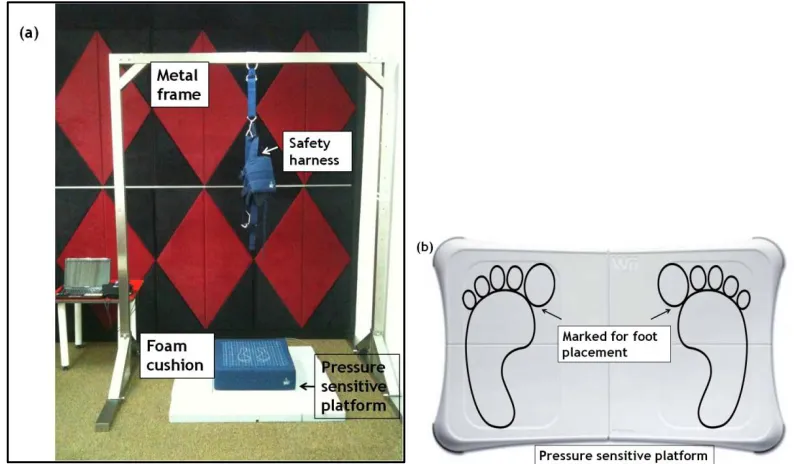
The BRU™ consists of a 40cmx40cmx15cm pressure sensitive platform with 4 inbuilt sensors, overhead safety harness and a foam cushion. It measures the area of a 95% confidence ellipse of the COP excursion in the anteroposterior and mediolateral directions and averaged SV of the COP during the 4 different conditions. The platform was marked with an 8cm horizontal line and 12cm vertical line for foot placement.
Fig 1: (a) The study setup used for the BRU™. Marked for foot placement was made on the WBB pressure sensitive platform to ensure standardization in between trials (b).
Procedures
All subjects were instructed to stand with their arms by their side, facing forward, on the BRU™ platform and the WBB. Their feet were placed on the pre-marked foot placement area. The quiet standing tasks were: (a) standing on platform with eyes-opened (PEO), (b) standing on platform with eyes-closed (PEC), (c) standing on foam cushion with eyes-opened (FEO) and (d) standing on foam cushion with eyes-closed (FEC). The order of the four tasks and the sequence of BRU™ and WBB were randomised.
During each trial, the subjects were asked to stand unperturbed for 30sec. They were given 30sec resting intervals in between trials. An average of two trials were analysed. The measured parameters were COP area (cm²) and SV (cm/s) from the BRU™ and COB area (cm²) from the WBB.
Statistical analysis
All statistical analysis was performed using SPSS version 21.0. Three major assumptions made for the analysis were: normality assumption, equality of covariance matrices, and assumption of sphericity. To meet the normality assumption, a mixed design ANOVA was employed to determine the effect of the 4 standing tasks on the BRU™ and WBB recordings in the two groups. The Box’s Test was used to meet the equality of covariance matrices assumption. If the matrices were similar,
this test should not be significant. A conservative alpha level of 0.001 was used for the Box's Test9,10.The assumption of sphericity was assessed using the Mauchly’s Test. If the sphericity assumption was not met (p<0.05), the Greenhouse-Geisser was used in order to assess the observed F-ratio. The correlation between the COP and COB areas were estimated with Spearman Rank’s correlation (rs) since normality could not be assumed.
RESULTS
All subjects successfully completed the tasks. There was gradual increment in the young and elderly subjects’ performance across all tasks, indicating consistent decreased ability in their standing balance tasks, from the simplest test condition (i.e. PEO) to the most difficult test condition (i.e. FEC), for both BRU™ and WBB.
[F(1,64)=24.35,p<.001,ƞ2=0.25] and the four test conditions[Greenhouse-Geisser adjusted F(1.68,107.67)=189.99,p<.001,ƞ2=0.75]. There was also significant interaction between testing conditions and age groups [Greenhouse-Geisser
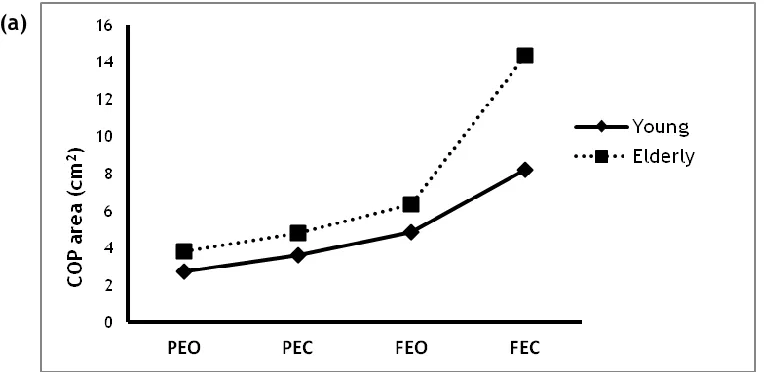
adjusted F (1.68,107.67) =5.89, p<.05,ƞ2=0.08]. The BRU™'s COP and SV results signify that the young subjects performed significantly better than the older subjects in all four standing tasks (Fig. 2 (a) and (b).
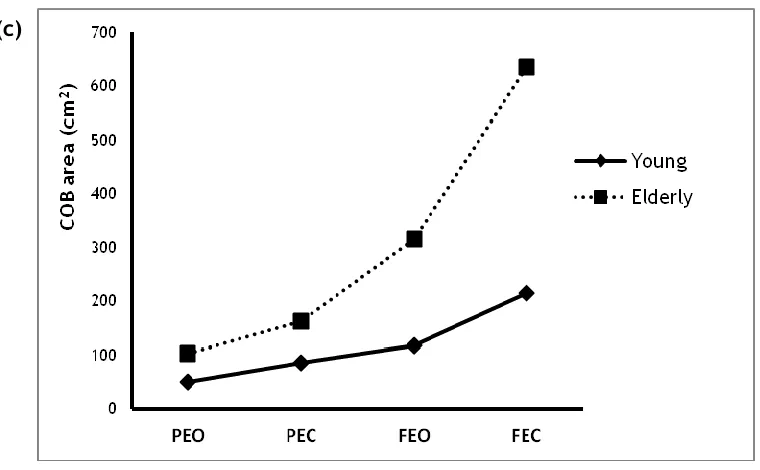
Fig 2: Comparison of the young and older groups' performance for the (a) BRU™ COP area (cm2), (b) SV
(cm/s) and (c) WBB COB area (cm2) in four different standing tasks (eyes-opened and eyes-closed with
and without the foam). There were significant differences (p< 0.001) in between the groups' performance and also in between all four standing tasks (p< 0.05).
(a)
Analysis for the WBB's COB area also showed significant difference for both age groups [F (1,64) =22.65, p<.001,ƞ2=0.26] and all test conditions [Greenhouse-Geisser adjusted F (1.56,99.63) =44.98, p<.001,ƞ2=0.41]. The interaction between the test conditions and groups were also significant [Greenhouse-Geisser adjusted F (1.56,99.63) =13.28, p<.001,ƞ2=0.17. The significantly better performance of the young versus older groups with the WBB is shown in Figure 2 (c).
Table 1 shows the COP area has a significant positive relationship to COB area, with moderate to good correlation strengths in all test conditions. COP area has a significant positive relationship to
COB area, with moderate correlation strength for PEO and PEC (ρ(66) =0.253-0.254,p<0.05), and with good correlation strength for FEO(ρ(66)=0.498,p<0.001) and FECconditions (ρ(66)=0.410,p<0.05). It was also found that the SV also has a significant positive correlation to COB area, with moderate to good correlation strength, except in PEO condition. SV's variable has significant positive relation to COB's area, with moderate correlation strength for PEC(ρ(66) =0.315,p<0.05), while good correlation strength for FEO and FEC (ρ(66)=0.433-0.600,p<0.001). These findings indicated significant positive correlations between the COP and SV (of the BRU™) and COB (of the WBB) in all test conditions.
Table 1: Spearman correlations between the BRU™’s COP and SVand WBB’s COB
Test Conditions Pressure Centre Area Sway Velocity (SV)
PEO 0.254* 0.165
PEC 0.253* 0.315*
FEO 0.498** 0.600**
FEC 0.410* 0.433**
(* Significance at p<0.05, ** Significance at p<0.001)
DISCUSSION
Results from this study supported previous findings on balance changes associated with aging. The interaction between the four test conditions (PEO, PEC, FEO, FEC) and different age groups were
significant (p<0.05). We showed that the COP and COB measurements and the SV performance for all four test conditions were significantly different among younger and older adults. This is evident from Figure 2 (a), (b) and (c) which demonstrated that all three measured parameterswere
significantly higher in older adults. The significant decreased in their balance performance was likely due to aging and this is evident by the measured increment in the COP, SV and COB. It was proposed that reduction in balance performance in the older adults are generally due to age-related deterioration in postural control system or may be due to presence of underlying pathology in an individual11. Other possible reasons for this significant findings were anatomical and physiological changes that may results in balance decrement in older adults. These include impairments in cognitive function, reduction in visual acuity, vestibular and somatosensory input, motor responses, deterioration in sensory integration system, muscles and nervous system resulting in decreased muscle strength, muscle volume and response time as well as decreased movement efficacy. The amplitude of physiological tremor when standing was greater among older adults compared to younger adults. This was believed to be due to deterioration in neurological function associated with aging. In addition, abnormalities in the peripheral and CNS also contributes to increment in body sway. Changes in blood circulation may reduce blood flow to the brainstem, cerebellum or cerebrum that may caused lesions to the nervous system or apparent ischemic signs. Disorders affecting the inner ear or vestibular organs, neurological diseases and high blood pressure are reported among possible factors contributing to imbalance. The use of medications among older adults makes them more susceptible to the possible side effects of the drugs, such as dizziness and imbalance.Eventhough for this study we have ruled out any premorbid conditions or use of medications that may cause imbalance among the subjects, this postulation remains sparse to possibility of underlying pathology that is unknown to the subjects.In addition, the reflexive control strategies used by older adults may contribute to this finding. They are inclined to use hip strategy to maintain their balance especially in the absence of visual cues or when there is referenced support swayed. Hip strategy involves movement of the head and hips in opposite directions to overcome the weight shifts from the COG or when the base of support is small. For younger adults, the ankle strategy is used if there is a slow perturbation in balance. Therefore, the increased in body sway is smaller than those who used hip strategy to maintain balance. It was also reported that increment in body sway performance are caused by inability of older adults to ignore misleading sensory
signals or to effectively choose a reliable sensory information to control their body posture and weight re-shifting than younger adults .
Kalisch et al.12 concluded that WBB could detect balance progressive increased with age-related degradation in older adults by correlation analysis. Older adults have the tendency for balance impairment in a more demanding and challenging tasks which may lead to fall. However, they reported insignificant correlation between age and balance performance for simple tasks such as standing on WBB with eyes-opened and closed. These findings were not in line with our study which showed that WBB responses were significantly different between younger and older adults in all four test conditions, both in a simpler (PEO) and demanding tasks (FEC). The dissimilarity in the results may due to differences in the research methods and data analysis. Kalisch et al.12 used raw sensor data to transform to ‘xy’ Cartesian coordinate system for obtaining the COP. This study used the value of COB, which is obtained directly from the 'Physiofun' software.
Unlike static posturography system, WBB's COB measurement is based on the changes in the percentage of body weight recorded on each force footplate. WBB platform consists of two separate force footplates for the placement of each foot. Therefore, the relative pressure on the heel and ball of foot could be determined. COB is determined from measurements of vertical force recorded by four sensors. This data was provided in the 'x' and 'y' coordinates (COBx, COBy) which represents the percentage change in the weight distribution and the direction of that change13-15.
Visual information was reported to be the most important input for body balance16-19. However, it was argued that healthy individuals are more dependent on somatosensory information (70%), followed by vestibular (20%) and visual system (10%)20. This was based on relative increment in the number of body sway while standing on a compliant surface, compared to firm surface, with eyes opened. When they stand on compliant surface, there is increment insensory weighting to the vestibular and vision information, andsimultaneous decrement to somatosensory input. However, Whipple et al.21 agreed that visual system has influenced on the balance system and redundancy of this system's input could compensate for other sensory deficits.
Our results also showed increased in the COP and COB areas and SV while standing on compliant foam surfaces. Foam surfaces changed the proprioceptive feedback which is obtained from standing on firm surfaced, and provide more dynamic and complex tasks. This method was reported to be suitable for measuring the dynamic balance while standing in healthy participants. The difficulties for the test parameter increased when two sensory inputs were altered; standing on a foam cushion with absence of visual input. In older adults, there was a significant decline in their balance ability when standing on a foam cushion with their eyes closed. This indicated that combined sensory deficits caused imbalance. Altered somatosensory information through the use of compliant surface affect ones balance control.Standing on a foam with eyes closed is a highly relevant test for determining the efficiency of the vestibular system because it is not only able to distinguish younger and older adults balance ability, but also differentiate between healthy individuals and patients with balance disorders regardless of their age. The dependency on vestibular information increased when standing on a foam. It reduces the relative contribution of somatosensory information to the balance system and improve the precision of the visual components measurement. Patients are more dependent on somatosensory input compared to vestibular input when on a firm surface. Woollacott22 found that older adults could maintain balance when either visual or somatosensory input was reduced or eliminated, but the balance started to be affected when the input from both sensory systems decreased and the main source of vestibular input was used to maintain their balance.
Contrary to our study, Liaw et al.23 found no significant difference between age groups during quiet standing. Older adults had lower average stability either with eyes opened or closed and on firm or compliant surfaces. They also reported no significant differences between three age groups; young, middle and older adults. Panzer et al.24 concluded that quiet standing testdid not produce evidence of postural instability associated with aging.The aging process was related with increased in body sway but it did not show stability deficits due to aging. It may occur as a result of lack of vigilance while maintaining upright position.
We have shown significant positive correlation between COP and COB area inalltesting conditions. Thislinearrelationship,in whichan increased in COPareahas also resulted in higher COB areawere in line with earlier researcher. Huurnincketal.25study using WBB, positioned on top of a force plates for real-time balance
measurement. The
resultsshowedtheWBBmeasurement is accuratein measuringthe trajectory ofthe COP, amplitudeandvelocitywhile standingonone leg. Althoughthere are limitations onWBB, they found very high correlation (r>0.99) between the force plateandWBB. The difference between this study and the study by Huurninketal.25was the technique of data collection, in which this studyperformedseparate measurement whiletheydid real-time measurement.The technique differenceswas notan issuebecausethey reported no differencein measurement's technique; either separateorreal-time measurements. Other studies also showed high correlationbetweenWBBandforce plates. They concluded
thattheCOBestimationsobtainedfromWBBisalmost similar tothe COP obtainedfrom theforceplate5,15,26,27.
Our findings support and strengthen the theory of aging and provide information about the postural ability for healthy, young and older adults. We have also showed that both equipments were able to demonstrate that body sway increased with age and there were significant differences in balance measurements between the two groups.
CONCLUSION
and this information could be used in tailoring to specific rehabilitation program. TheWBB coupled with its commercially available software has potential to be applied clinically as screening tool in the primary health centre as it is very cost effective, readily be used and portable as opposed to BRU™. However, BRU™ with the use of various visual stimulation, could be used for more complicated diagnostic assessment and rehabilitation in the secondary health centre.
ACKNOWLEDGEMENTS
The study was conducted under the Universiti Kebangsaan Malaysia (UKM)- GUP-2011-122 research grant support.
REFERENCES
1. Sherina MS, Lekhraj R, Mustaqim A. Functional status of the elderly in a rural community in Malaysia. Malaysian J Public Health Med 2004; 4(1):55-8.
2. Minhat HS, Amin RM, Shamsuddin K. Late-life leisure constraints among Malaysian elderly: A qualitative approach. Malaysian J Public Health Med 2012; 12(2):24-30.
3. Scanaill CN, Garattini C, Greene BR, et al. Technology innovation enabling falls risk assessment in a community setting. Ageing Int 2011; 36(2):217-31.
4. Lange B, Flynn S, Chang CY, et al. Development of an interactive stepping game to reduce falls in older adults. Int J Disability Human Dev 2011; 10(4):331-5.
5. Hubbard B, Pothier D, Hughes C, et al. A portable, low-cost system for posturography: A platform for longitudinal balance telemetry. J Otolaryngol Head Neck Surg 2012; 41(1):S31.
6. Yamako G, Chosa E, Totoribe K, et al. Quantification of the sit-to-stand movement for monitoring age-related motor deterioration using the Nintendo Wii Balance Board. PLoS One 2017; 12(11). http://journals.plos.org/plosone/article?id =10.1371/journal.pone.0188165(accessed 1 November 2017).
7. Act 21, Age of Majority Act 1971. 2006. http://www.agc.gov.my/agcportal/upload s/files/Publications/LOM/EN/Act%2021.pdf 8. United Nations: World Population Ageing 2009. New York: United Nations: Department of Economic and Social Affairs, Population Division. Report number: ESA/P/WP/212; 2009: 9–15.
9. Field A. Discovering Statistics using SPSS. Sage Publications 2009.
10. Pallant J. SPSS Survival Manual. New York: Mc-Graw Hill Publications 2010.
11. Abrahamova D, Hlavacka F. Age-related changes of human balance during quiet stance. Physiol Res 2008; 57(6):957.
12. Kalisch T, Kattenstroth JC, Noth S, et al. Rapid assessment of age-related differences in standing balance. J Aging
Res 2011.
http://dx.doi.org/10.4061/2011/160490 (accessed 1 November 2017).
13. Nichols DS, Glenn TM, Hutchinson KJ. Changes in the mean center of balance during balance testing in young adults. Phys Ther 1995;75(8):699-706.
14. Clark RA, Bryant AL, PuaY, et al. Validity and reliability of the Nintendo Wii Balance Board for assessment of standing balance. Gait Posture 2010;31(3):307-10.
15. Bartlett HL, Ting LH, Bingham JT. Accuracy of force and center of pressure measures of the Wii Balance Board. Gait Posture 2014;39(1):224-8.
16. Briggs RC, Gossman MR, Birch R, et al. Balance performance among non-institutionalized elderly women. Phys Ther1989;69(9): 748–56.
17. Duarte M., Zatsiorsky VM. Effects of body lean and visual information on the equilibrium maintenance during stance. Exp Brain Res 2002;146(1): 60–9.
19. Kouzaki M, Masani K. Postural sway during quiet standing is related to physiological tremor and muscle volume in young and elderly adults. Gait Posture 2012; 35(1): 11–7.
20. Peterka RJ. Sensorimotor integration in human postural control. J Neurophysiol 2002; 88: 1097–118.
21. Whipple R, Wolfson L, Derby C, et al. Ten altered sensory function and balance in older persons. J Gerontol 1993; 48(Special Issue):71-6.
22. Woollacott MH. Age-related changes in
posture and movement. J
Gerontol1993;48: 56-60.
23. Liaw MY, Chen CL, Pei YC, et al. Comparison of the static and dynamic balance performance in young, middle-aged, and elderly healthy people. Chang Gung Med J 2009;32(3):297-304.
24. Panzer VP, Bandinelli S, Hallett M. Biomechanical assessment of quiet standing and changes associated with aging. Arch Phys Med Rehabil 1995;76(2):151-7.
25. Huurnink A, Fransz DP, Kingma I, et al. Comparison of a laboratory grade force platform with a Nintendo Wii Balance Board on measurement of postural control in single-leg stance balance tasks. J Biomech 2013;46(7):1392-5.
26. Chang JO, Levy SS, Seay SW et al. An alternative to the balance error scoring system: Using a low-cost balance board to improve the validity/reliability of sports-related concussion balance testing. Clin J Sport Med 2014;24(3):256-62.