Triconnected Planar Graphs
TANVEERAWAL1MD. SAIDURRAHMAN2
Department of Computer Science and Engineering Bangladesh University of Engineering and Technology
Dhaka -1000, Bangladesh 1[email protected]
Abstract. Given a connected graphG= (V, E), a setVr ⊆V ofrspecial vertices, three distinct base
verticesu1, u2, u3∈V and three natural numbersr1, r2, r3such thatr1+r2+r3=r, we wish to find a partitionV1, V2, V3ofV such thatVicontainsuiandrivertices fromVr, andViinduces a connected
subgraph ofGfor eachi,1 ≤ i≤ 3. We call a vertex inVra resource vertex and the problem above
of partitioning vertices ofGas the resource 3-partitioning problem. In this paper, we give a linear-time algorithm for finding a resource tripartition of a 3-connected planar graphG. Our algortihm is based on a nonseparating ear decomposition ofGandst-numbering ofG. We also present a linear algorithm to find a nonseparating ear decomposition of a 3-connected planar graph. This algorithm has bounds on ear-length and number of ears.
Keywords: Algorithm, Nonseparating ear decomposition, Planar graph, Resource tripartitioning, Re-source bipartitioning,st-numbering, Triconnected graph.
(Received December 25, 2009 / Accepted July 02,2010)
1 Introduction
Let G = (V, E) be a connected graph of |V| = n
vertices. Among thesen vertices ofG, some belong to a special class of vertices that we call resource ver-tices. LetVr ⊆ V be the set of resource vertices and
|Vr| =r. Letu1, u2, u3 ∈V be three designated ver-tices andr1, r2, r3 be three natural numbers such that r1+r2+r3=r. Our goal is to find a partitionV1, V2, V3 ofV such that u1 ∈ V1, u2 ∈ V2, u3 ∈ V3,Vi
con-tains ri resource vertices andVi induces a connected
subgraph ofGfor eachi,1≤i≤3. We call this
par-titioning of vertices a resource 3-parpar-titioning ofG. For
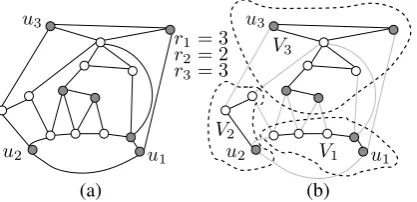
example, Figure 1(a) shows a connected graphGwith n= 15, r = 8vertices, where each resource vertex is
drawn by white circle. Figure 1(b) illustrates a resource 3-partition ofGforr1= 3, r2= 2, r3= 3.
The resource tripartitioning problem is a special case
u1
u1 u2
u2
u3 u3
V1 V2
V3 r1= 3 r2= 2 r3= 3
(a) (b)
of resourcek-partitioning problem, for k = 3. A
re-sourcek-partitioning is defined as partitionV1, V2, . . . , Vk
ofV with a setVr⊆V ofrresource vertices, base
ver-ticesu1, u2, . . . , uk∈V, knatural numbersr1, r2, . . . , rk
such that�ki=1ri =r, whereui ∈ Vi, Vi containsri resource vertices andViinduces a connected subgraph
ofGfor eachi,1≤i≤k.
Resource partitioning has significant applications in various areas. In computer networks, we may consider printers, routers, scanners etc. as resources. Resources need to be partitioned to balance loads on these resources and to prevent network traffic bottleneck. Furthermore, in multimedia networks, it is desired to assign a server to a specific group of clients for balancing loads among the servers. Again, in electrical power distribution sys-tems, resource partitioning has another real-time ap-plication to serve consumers better. Here, distributed resources include a variety of energy sources like tur-bines, photovoltaics, fuel-cells and storage devices with various capacities. Distribution of these resources among the demand centers offers increased reliability, lower cost of power delivery and additional supply flexibility. Resource partitioning has its application in the fault-tolerant routing of communication networks [13, 22] and in computational aspects, too. For example, in grid computing we wish to divide a complex task such as computation of fractals into several subtasks and then we wish to delegate each of these subtasks to a com-puting element in the grid such that a comcom-puting ele-ment in the grid might not be overwhelmed with tasks from various other clients. This concept is applicable to telecommunication networks, fault tolerant systems, various producer-consumer problems and so on.
A related problem is a k-partitioning problem in
which we are given a graphG= (V, E), kdistinct base
vertices u1, u2, . . . , uk ∈ V, and k natural numbers n1, n2, . . . , nk such that�ki=1ni = |V|, we wish to
find a partitionV1, V2, . . . , Vkof the vertex setV such
thatui ∈ Vi; |Vi| = ni; Vi induces a connected
sub-graph ofGfor eachi,1≤i≤k.
Thek-partitioning problem isN P-complete in gen-eral [7]. Although not every graph has a k-partition,
Gyo¨ri and Lov´asz independently proved that everyk
-connected graph has ak-partition for anyu1, u2, . . . , uk
andn1, n2, . . . , nk[9, 14]. However, their proofs do not
yield any polynomial time algorithm for actually find-ing ak-partition of ak-connected graph. For the case k= 2,3,4, following algorithms have been known:
(i) There is a linear-time algorithm to find a biparti-tion of a biconnected graph [19, 20].
(ii) There is anO(n2
)time algorithm to find a 3-partition
of a triconnected graph [20].
(iii) There is a linear-time algorithm to find a 4-partition of a four connected planar graph with base vertices located on the same face of the given graph [17]. On the other hand, polynomial-time algorithms have not been known for the casek≥4. A polynomial-time
algorithm for anykis claimed in [15], but is not
cor-rect [17]. If all the vertices are resource vertices then resourcek-partitioning andk-partitioning problem are
the same. Thus resourcek-partitioning problem is also N P-complete. [18] claims the resourcek-partitioning
problem to beN P-hard but their claim is not correct.
The following algorithms are known for finding a re-sourcek-partition of a graph fork= 2,3,4.
(i) There are linear-time algorithms to find resource bipartitions of path-reducible graphs, series-parallel graphs and connected graphs where all resource vertices are contained in the same biconnected com-ponent [18].
(ii) There is anO(n2)time algorithm to find vertex-subset tripartitions (equivalent to resource triparti-tions [18]) of triconnected and 3-edge-connected graphs [21].
(iii) There is anO(n)algorithm to find a resource
four-partition of a4-connected planar graph with four
base vertices located on the same face of a planar embedding1.
But there exists no polynomial-time algorithm for resourcek-partitioning of graphs fork >3. In this pa-per, we give a linear algorithm for finding a resource tripartition of a 3-connected planar graph based on a “nonseparating ear decomposition" of the given graph. “Nonseparating ear decomposition" is a generalization of “canonical decomposition" [1]. “Canonical decom-position" is applied in convex grid drawing of planar graph [5]. “Canonical decomposition" i.e. “canoni-cal ordering" has applications in producing straight line grid drawings with polynomial sizes for planar graphs. A “canonical decomposition", a “realizer", a “Schny-der labeling" and an “or“Schny-derly spanning tree" of a plane graph play an important role in straight-line drawings, floorplanning, graph encoding etc. [2, 4, 6, 10, 12]. Miura et. al. proved that a “canonical decomposition", a “realizer", a “Schnyder labeling", an “orderly span-ning tree" and an “outer triangular convex grid draw-ing" are notions equivalent with each other [16]. Hence
“nonseparating ear decomposition" is a generalization of “canonical decomposition", a “realizer", a “Schnyder labeling", an “orderly spanning tree" and an “outer tri-angular convex grid drawing". Using a “nonseparating ear decomposition" of a 3-connected graphG, Cheriyan and Maheshwari finds three “independent spanning trees" rooted at a vertexrinG.
The rest of the paper is organized as follows. Sec-tion2gives some definitions. In section3, we present a constructive proof for the existence of a nonseparating ear decomposition through two verticesa, band
avoid-ing a third vertexc of a triconnected planar graph G
for any a, b, c. In section4, we present a linear-time
algorithm for finding a resource tripartitioning of a 3-connected planar graph based on a nonseparating ear decomposition ofG. Finally section5is a conclusion.
2 Preliminaries
In this section we define several graph theoretical terms used in this paper.
LetG(V, E)be a connected simple graph with
ver-tex setV(G)and edge setE(G). We denote bynthe
number of vertices inGand bymthe number of edges
inG. Thusn=|V(G)|, m=|E(G)|. An edge joining
verticesu, vis denoted by(u, v). The degree of a vertex
vin a graphG, denoted byd(v), is the number of edges incident tov inG. The connectivityκ(G)of a graph
Gis the minimum number of vertices whose removal results in a disconnected graph or a single-vertex graph
K1. We say thatGisk-connected ifκ(G)≥k. We call a vertex ofGa cut vertex if its removal results in a
dis-connected graph or a single-vertex graph. We call two vertices ofGa separation pair if their removal results in
a disconnected graph or a single-vertex graph. A walk,
v0, e1, v1, . . . , vl−1, el, vl, in a graphGis an
alternat-ing sequence of vertices and edges ofG, beginning and
ending with a vertex, in which each edge is incident to two vertices immediately preceding and following it. If the verticesv0, v1, . . . , vl are distinct (except possibly v0, vl), then the walk is called a path and usually
de-noted either by the sequence of verticesv0, . . . , vl or
by the sequence of edgese1, e2. . . , el. The length of a
path islwhich is one less than the number of vertices on the path. A path or walk is open if v0 �= vl. A
path or walk is closed ifv0 = vl. A closed path
con-taining at least one edge is called a cycle. For a path
P, Vin(P)denotes the internal vertices ofP, i.e., all the
vertices except the endpoints. ForW ⊆V, we denote
byG−W the graph obtained fromGby deleting all
vertices inW and all edges incident to them.
Letsandtbe any two vertices of a connected graph G. Anst-numbering of Gis a numbering of its
ver-tices by integers1,2, . . . , nsuch that a vertexsreceives
number 1, a vertextreceives numbernand every other vertex ofGis adjacent to at least one lower-numbered vertex and at least one higher-numbered vertex. An in-teresting property ofst-numbering of a graph is shown in the following fact.
(st1) If a graphGhas anst-numberingπ=v1, v2, . . . , vn, then both the subgraphs ofGinduced byv1, v2, . . . , viandvi+1, vi+2, . . . , vnare connected for each i,1≤i≤n.
Not every connected graph has anst-numbering but the
following Lemma [8] holds.
Lemma 2.1 LetGbe a biconnected undirected graph
and(s, t)be any edge ofG. ThenGhas anst-numbering
π=v1, v2, . . . , vn such thatv1=sandvn =t, andπ
can be found in linear time.
An ear decomposition of a biconnected graphGis a decompositionG = P0∪P1∪. . .∪Pk, wherePk
is a path or cycle and Pi,0 ≤ i ≤ k−1, is a path
with only its two distinct end vertices in common with
Pk∪Pk−1∪. . .∪Pi+1. An ear is a path. An open ear is a path with two distinct end vertices. We call an ear a trivial ear if the length of the ear is one. We call an ear a non-trivial ear if the length of the ear is greater than one. Leta, b, c be three vertices inGandPi be
open paths onG. We denote byGi the subgraph ofG
induced by the edges ofP0∪P1∪. . .∪Pi, byG¯ithe
subgraph ofGinduced by the edges ofPi+1∪Pi+2∪ . . .∪Pk. SoGk=G. ThenP0, P1, . . . , Pkis a
nonsep-arating ear decomposition (nsed) through verticesa, b
and avoiding vertex c if the following five conditions hold.
(nsed1) If(a, b)∈E(G), thenPkis a cycle containing
the edge(a, b). Otherwise,Pkis a path inGwith
the verticesa, bas endpoints.
(nsed2) The first non-trivial ear has only one internal vertex and the internal vertex isc.
(nsed3) For eachi,0≤i < k, Piis a path connecting
2 distinct vertices ofG¯i andVin(Pi)�V( ¯Gi) = φ.
(nsed4) For eachi,0≤i≤k, Giis connected.
(nsed5) For eachi,1 ≤i ≤k, each internal vertex of
Pihas a neighbor inGi−1. Let augmented graph,G∗
i = (V( ¯Gi), E( ¯Gi)∪{(a, b)})
and augmentedPk, Pk∗ = (V(Pk), E(Pk)∪ {(a, b)}).
For both ofP∗
k andG∗i,(a, b) ∈/ E(G)and(a, b)
be-comes an outer edge ofG¯i. Note thatP∗
P∗
k ∪Pk−1∪. . .∪Piis biconnected for eachi,0≤i≤ k.
(a) (b)
c c
a
a P b b
k
Pi
Pi P
i+1 Pi+1
P0
P0 P1
P1
Pk−1 Pk−1
Gi
¯
Gi G
∗ i
P∗ k
Figure 2: Nonseparating Ear Decomposition.
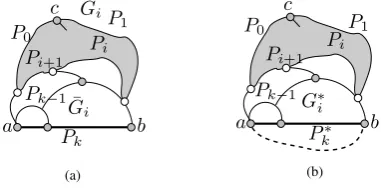
Figure 2 shows a nonseparating ear decomposition througha, band avoidingc,Pk is drawn by thick lines.
Figure 2(a) showsGiandG¯i, the white vertices are
con-tained both inGiandG¯i. Figure 2(b) showsGi, G∗i and P∗
k, the white vertices are contained both inGiandG∗i.
A graph is planar if it can be embedded in the plane so that no two edges intersect geometrically except at a vertex to which they are both incident. A plane graph is a planar graph with a fixed embedding. A plane graph divides the plane into connected regions called faces. We regard the contour of a face as a clockwise cycle formed by the edges on the boundary of the face. We denote the contour of the outer face of graphGbyCo(G).
We writeCo(G) = w1, w2, . . . , wh, w1if the vertices w1, w2, . . . , whonCo(G)appear clockwise in this
or-der, as illustrated in Figure 3. We call a vertex an outer vertex and an edge an outer edge, if the vertex and edge respectively lie onCo(G). We call a pathP in a
bicon-nected plane graphGa chord-path ofGifP satisfies
the following conditions.
(i) Pconnects two outer verticeswp, wq, p < q;
(ii) {wp, wq}is a separation pair ofG;
(iii) Plies on an inner face; and
(iv) P does not pass through any outer edge and any
outer vertex other than the endswpandwq.
w1 w2 w3 w4
w5
w6 w7 w8 w9
w10
w11
P1 P2 P3
P4
Figure 3: A plane graph with chord-pathsP1, P2, P3, P4
The plane graphGin Figure 3 has four chord-paths P1, P2, . . . , P4drawn by thick lines. A chord-pathP is
minimal if none ofwp+1, wp+2, . . . , wq−1is an end of a chord-path. Thus the definition of a minimal chord-path depends on which vertex is considered as the starting vertexw1ofCo(G). P1andP3in Figure 3 are minimal, whileP2andP4are not minimal. Let{v1, v2, . . . , vp}, p≥3, be a set of three or more outer vertices consec-utive onCo(G)such thatd(v1)≥3, d(v2) =d(v3) = . . . =d(vp−1) = 2, andd(vp)≥3. Then we call the set{v2, v3, . . . , vp−1}an outer chain ofG. The graph in Figure 3 has two outer chains{w4, w5}and{w8}. We call an outer chain{v2, v3, . . . , vp−1}ofGa good outer chain if the outer chain does not contain any ver-tex ofV(Pk). An outer chain{v2, v3, . . . , vp−1}ofG is a bad outer chain if the outer chain contains a vertex ofV(Pk). We call an outer edge (u, w)ofGa good
outer edge if(u, w)∈/ E(P∗
k), d(u)≥3andd(w)≥3
inG, andu∈V(Gi)orw∈V(Gi).
We say that a plane graph Gis internally
tricon-nected ifGis biconnected and, for any separation pair
{u, v} ofG,uandv are outer vertices and each
con-nected component ofG− {u, v}contains an outer ver-tex. In other words,Gis internally 3-connected if and
only if it can be extended to a 3-connected graph by adding a vertex in an outer face and connecting it to all outer vertices. If a biconnected plane graphG is
not internally 3-connected, thenGhas a separation pair {u, v} of one of the three types illustrated in Figure 4. If an internally 3-connected plane graph G is not 3-connected, thenGhas a separation pair of outer ver-tices and hence G has a chord-path whenG is not a single cycle.
I
I I
u
u u
v v v
Figure 4: Biconnected graphs which are not internally 3-connected
A resource bipartitioning of a connected graphG
of |V| = n vertices can be defined as follows. Let Vr⊆V be the set of resource vertices and|Vr|=r. Let u1, u2∈V be two designated vertices andr1, r2be two natural numbers such thatr1+r2 =r. Our goal is to find a partitionV1, V2ofV such thatu1∈V1, u2∈V2, Vi containsri resource vertices andVi induces a
con-nected subgraph ofGfor eachi,1 ≤ i ≤ 2. The
source bipartitioning problem is a special case of re-sourcek-partitioning problem, fork= 2. We have the
following lemmas on resource bipartitioning.
Lemma 2.2 A resource bipartition of a biconnected graph
Lemma 2.3 Lets, tbe the two base vertices in a
con-nected graphG. IfG∪ {(s, t)}is biconnected, then a resource bipartition ofGcan be found in linear time. Proof. We can find a resource bipartition of the bi-connected graphG∪ {(s, t)}in linear time by Lemma 2.2. As the vertices(s, t)would belong to two different partitions, clearly a resource bipartition ofG∪ {(s, t)} is a resource bipartition ofG. Q.E.D.
In section3, we provide the constructive proof of the
existence of a nonseparating ear decomposition through two verticesa, band avoiding a third vertexcof a
tri-connected planar graphGfor anya, b, c.
3 Nonseparating Ear Decomposition
In this section, we show a constructive proof for the ex-istence of a nonseparating ear decomposition through two verticesa, band avoiding a third vertexcof a tri-connected planar graphGfor anya, b, c.
Lemma 3.1 Letu1, u2, . . . ul be the outer facial
ver-tices of an internally 3-connected planar graphGand
S = {up+1, up+2, . . . , uq−1}be an outer chain ofG, thenG−Sis internally triconnected.
Proof. Letup, uqbe the two ends of a minimal
chord-pathP ofGsuch thatp < q. Assume for the sake of
contradiction thatG−S is not internally triconnected.
ThenG−Shas either a cut-vertex or a separation pair
{u, v}. We first consider the case whereG−S has a
cut-vertexv. Thenvmust be an outer vertex ofG−S
andv �=up, uq. Otherwise,Gwould not be internally
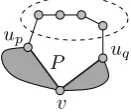
triconnected. Then the minimal chord-pathPmust pass throughv, as illustrated in Figure 5, contrary to the def-inition of a chord path.
v up
uq P
Figure 5:Ppasses through an outer vertex inG¯i
We now consider the case whereG−Shas a sep-aration pair{u, v}having one of the three types shown in Figure 4. Then{u, v}would be a separation pair of
Ghaving one of the three types illustrated in Figure 4.
HenceGwould not be internally triconnected, a
contra-diction. Q.E.D.
Theorem 3.2 Leta, b, cbe any three vertices in a
tri-connected planar graphG. ThenGhas a
nonseparat-ing ear decomposition througha, band avoidingcand
it can be found in linear time.
Proof. Without loss of generality we may assume that
cis on the outer boundary ofG. If(a, b)∈E(G), then letPkbe an inner facial cycle passing through(a, b)and
not passing throughc. If(a, b)∈/E(G)and both ofa, b
are outer vertices ofG, then letPk be the outer facial
path fromatobnot passing throughc. If(a, b)∈/E(G)
and at least one ofa, bis an inner vertex ofG, then let
Pk be the path froma tob that does not contain any
outer edge and go throughc. SinceGis 3-connected, Pkexists in all of the three cases mentioned above and
(nsed1) holds forPk.
Lete1, e2, . . . , elbe the neighbours ofcwherel = d(c). We set P0, P1, . . . , Pl−3 as (c, e1),(c, e2), . . ., (c, el−2)respectively. We setPl−2= (el−1, c, el).Pl−2 is the first non-trivial ear and it has exactly one internal vertex which isc. Hence (nsed2) holds. SinceP0, P1, . . . , Pl−2 are open ears andVin(Pl−2)�V( ¯Gl−2) = φ, (nsed3) holds for Pj,0 ≤ j ≤ l −2. As for each j,0 ≤ j ≤ l−2, Gj is connected, (nsed4) holds for Pj,0≤j≤l−2. AsP0, P1, . . . , Pl−3are trivial ears and the internal vertexcofPl−2 has at least a neigh-boure1inGl−3, (nsed5) holds forPj,0 ≤j ≤l−2.
Clearly G¯j or G∗
j is internally triconnected for each j,0≤j≤l−2.
Assume for inductive hypothesis that the earsP0, P1, . . . , Piforl−2≤i≤k−2have been chosen
appro-priately so that (nsed2) holds for the first non-trivial ear
Pl−2and (nsed3), (nsed4), (nsed5) hold for each index j,0≤j≤i. FurthermoreG∗
jorG¯jis internally
tricon-nected for each indexj,0 ≤j ≤i. We now show that
there is an earPi+1 inG¯i such that (nsed3), (nsed4),
(nsed5) hold andG∗
j orG¯j is internally triconnected
for the indexj =i+ 1. Letu1, u2, . . . ulbe the outer
facial vertices ofG¯iorG∗
i. We have the following cases
to consider. Case 1:G¯iorG∗
i is 3-connected.
We only consider the case whereG¯iis 3-connected,
since the proof for the case whereG∗
i is 3-connected
is similar. SinceG¯iis 3-connected, every vertex ofG¯i
has degree at least three. There is at least a vertexu
onCo( ¯Gi)such thatu∈V(Gi)anduhas a neighbour
wonCo( ¯Gi)such that(u, w)∈/ E(Pk). Otherwise, at
least one ofa, bwould be an inner vertex ofGandPk
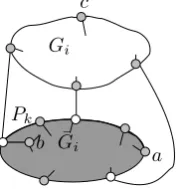
would contain an outer edge ofG(see Figure 6(a)) or both ofa, bwould be outer vertices ofGandPkwould
contain an inner edge ofG(see Figure 6(b)), a
contra-diction. Then(u, w)is a good outer edge ofG¯i, as
il-lustrated in Figure 7. We setPi+1 = (u, w). As(u, w) is a trivial open ear, (nsed3) holds forPi+1. As(u, w)is a good outer edge ofG¯i,Gi+1 remains connected and
triconnected.
(b) (a)
Gi Gi
¯ Gi ¯
Gi
c c
a b a
b
Pk Pk
Figure 6:Pkis not set according to the rules in base case
Gi
¯ Gi
c
a b
Pk
Figure 7:G¯iorG∗i is 3-connected.
Case 2: (a, b) ∈/ E(G) and G¯i or G∗i is not
3-connected.
We first consider the case where(a, b)∈/ E(G)andG¯i
is not triconnected. Sincei+ 1 ≤k−1,G¯iis not a
single cycle and hence there is a chord-path ofG¯i. Let up, uqbe the two ends of a minimal chord-pathPofG¯i
such thatp < q. As{up, uq}is a separation pair ofG¯i,
thenq≥p+ 2. We have the following two subcases to consider.
Case 2a:Pkis not onCo( ¯Gi).
We have the following two subcases to consider. (i)G¯ihas an outer chain{up+1, up+2, . . . , uq
−1}. If {up+1, up+2, . . . , uq−1} is a good outer chain, we choosePi+1 = (up, up+1, up+2, . . . , uq−1, uq). As up�=uqandVin(Pi+1)
�
V( ¯Gi+1) =φ, (nsed3) holds forPi+1. AsGis triconnected and each internal vertex ofPi+1has degree two inG¯i, each of the internal
ver-tices ofPi+1has a neighbor inGi. SoGi+1is also con-nected. Thus (nsed4) and (nsed5) hold forPi+1. From Lemma 3.1G¯i+1is internally triconnected.
We thus assume that {up+1, up+2, . . . , uq−1} is a bad outer chain ofG¯i. In this caseG¯i− {up, uq}has 2
components. There is at least a vertexvinG¯i−{up, uq}
in the component not containingu∈ {up+1, up+2, . . . , uq−1}such thatv ∈V(Gi)andd(v)≥3inG¯i.
Oth-erwise, Gwould not be triconnected or d(v) = 2 in ¯
Gi andv would be contained in a good outer chain,
a contradiction. The vertex v has a neighbour w ∈
V( ¯Gi)− {up+1, up+2, . . . , uq−1}such thatd(w)≥3 inG¯iand(v, w)∈/E(Pk). Otherwise,d(w) = 2inG¯i
andwwould be contained in a good outer chain, a con-tradiction. Then(v, w)is a good outer edge ofG¯i, as
illustrated in Figure 8. We setPi+1 = (v, w). Clearly (nsed3), (nsed4), (nsed5) hold forPi+1, andG¯i+1 re-mains internally triconnected.
(ii)G¯ihas no outer chain. c
a
b w v
up
uq up+1
uq−1 Gi Pk
¯ Gi
Figure 8:{up+1, up+2, . . . , uq−1}is a good outer chain ofG¯i.
$\ba
c
up u
q
up+1 u
q−1 Gi
Figure 9:{up+1, up+2, . . . , uq−1}is not an outer chain ofG¯i
In this case every vertex in{up+1, up+2, . . . , uq−1} has degree at least three inG¯i. Otherwise, G¯i would
have an outer chain. Furthermore, there is at least a ver-texu∈ {up+1, up+2, . . . , uq−1}such thatu∈V(Gi). Otherwise, {up, uq} would be a separation pair of G
andGwould not be triconnected. Ifuhas a neighbour wonCo( ¯Gi)such thatd(w) ≥ 3inG¯i and(u, w) ∈/ E(Pk), we setPi+1 = (u, w). Then(u, w)is a good outer edge ofG¯iand (nsed3), (nsed4), (nsed5) hold for Pi+1, andG¯i+1 remains internally triconnected. Ifu has no such neighbourw, then there is at least a ver-texvinG¯i− {up, uq}in the component not containing u∈ {up+1, up+2, . . . , uq−1}such thatv∈V(Gi)and d(v) ≥ 3 inG¯i. Otherwise, Gwould not be
tricon-nected or d(v) = 2in G¯i andv would be contained
in a good outer chain, a contradiction. The vertex v
has a neighbourw∈V( ¯Gi)− {up+1, up+2, . . . , uq−1} such thatd(w) ≥ 3inG¯i and(v, w) ∈/ E(Pk).
Oth-erwise,d(w) = 2inG¯iandwwould be contained in
a good outer chain, a contradiction. Then(v, w) is a
(nsed3), (nsed4), (nsed5) hold forPi+1, andG¯i+1 re-mains internally triconnected.
Case 2b:Pkis onCo( ¯Gi)orCo(G∗i).
If removal ofPihas leftPkonCo( ¯Gi), we augment ¯
GitoG∗i as stated before. Otherwise, Pk has already
been onCo( ¯Gi)andG¯ihas already been augmented to G∗
i. Hence it is sufficient to consider only the case for G∗
i. We have the following subcases to consider.
(i)G∗
i has an outer chain{up+1, up+2, . . . , uq−1}. In this case{up+1, up+2, . . . , uq−1}is a good outer chain. Otherwise, Pk is not onCo( ¯Gi). We choose Pi+1= (up, up+1, up+2, . . . , uq−1, uq). Clearly (nsed3),
(nsed4), (nsed5) hold forPi+1, andG¯i+1remains inter-nally triconnected.
(ii)G∗
i has no outer chain.
In this case every vertex in{up+1, up+2, . . . , uq−1} has degree at least three inG∗
i. Otherwise,G∗i would
have an outer chain. Furthermore, there is at least a ver-texu∈ {up+1, up+2, . . . , uq−1}such thatu∈V(Gi). Otherwise, {up, uq} would be a separation pair of G
andGwould not be triconnected. Clearlyuhas a
neigh-bourw∈ {up, up+1, up+2, . . . , uq−1, uq}such that(u, w) /
∈E(Pk). Then(u, w)is a good outer edge ofG∗ i. We
setPi+1 = (u, w). Clearly (nsed3), (nsed4), (nsed5) hold forPi+1, andG¯i+1remains internally triconnected.
Now it remains to consider the case where(a, b)∈/ E(G)andG∗
i is not triconnected. In this case, we choose Pi+1similar to the subcase (2b) with the exception that we do not need any augmentation.
Case 3:(a, b)∈E(G)andG¯iis not 3-connected.
In this case we choosePi+1similar to the case where (a, b)∈/ E(G)andG∗
i is not triconnected.
Thus the existence of a nonseparating ear decompo-sition ofGthrougha, band avoidingcfor anya, b, cis proven. An algorithm for finding a nonseparating ear decomposition based on the proof above can be imple-mented. We have to keep track of outer chains, mini-mal chord-paths and candidate degree three vertices of
¯
Gi. Each face is traversed at most a constant number
of times. So run time is linear. Hence the Theorem 3.2
follows. Q.E.D.
We call the algorithm obtained from this construc-tive proof for the existence of a nonseparating ear de-composition ofGthrougha, band avoidingc for any a, b, cAlgorithm Find_Decomposition.
Lemma 3.3 Leta, b, cbe three vertices in a triconnected
planar graphGandn, mdenote the number of vertices
and the number of edges in Grespectively. Then the
nonseparating ear decomposition ofGthrougha, band
avoidingcproduced by Algorithm Find_Decomposition
has the following properties.
(a) if(a, b)∈E(G), then
(i) length of any ear is at least one and at most the length of the longest facial cycle ofG.
(ii) the number of ears ism−n+ 1. (b) if(a, b)∈/ E(G), then
(i) length of any ear is at least one and at most the larger one of the length ofPkand one less
than the length of the longest facial cycle of
G.
(ii) the number of ears ism−n+ 2.
Proof. (a)(i) From the constructive proof of Theorem 3.2, it can be found that each earPi, i �= k, is either
a single edge or a path with all of its internal vertices belonging to an outer chain ofG¯i
−1. So the length of a non-trivial earPi can be at most 1 less than that of
the longest facial cycle. But as(a, b)∈E(G), the ear
Pk is set as an inner facial cycle passing through the
edge (a, b)and not passing through c. Therefore, Pk
may have the length of the longest facial cycle. Hence length of any ear is at least one and at most the length of the longest facial cycle ofG.
(a)(ii) We employ an induction onn. A graph must
have at least n = 4vertices and m = 6edges to be
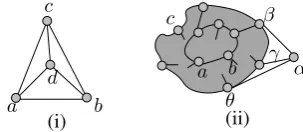
3-connected. A nonseparating ear decomposition of the graph in Figure 10(i) is as follows. P0 = c, a.P1 = d, c, bandPk=2 =a, d, b, a. So we have3 = 6−4+1 = m−n+ 1ears for anya, b, cofG.
c c
a
a
b
b
d α
β
γ
θ
(i) (ii)
Figure 10: (i) A triconnected graph with four vertices and six edges (ii)Gαwithn�
vertices andm�edges.
Assume that n ≥ 5 and the result is true for all
triconnected planar graphs having n vertices. With-out loss of generality we may assume thatcis on the outer boundary ofG. We now add a vertexαon the outer face of G. LetGα = G�{α}. To make Gα
3-connected without losing planarity,d(α)number of edges are added fromαto itsd(α)number of
neigh-bours on Co(G), where3 ≤ d(α) ≤ |Co(G)|. Gα
hasn� = n+ 1vertices andm� = m+d(α)edges.
To find a nonseparating ear decomposition ofGα(see
Figure 10(ii) ) we use the decomposition as in G
un-til the vertex β or γ or θ is contained in Gi. Then
Gα. P
x = β, α.Px+1 = γ, α, θ. Then we take the ears as in the decomposition in G. Hence there are
d(α)−1 new ears more than those in the decomposi-tion ofG. So total number of ears in the nonseparating ear decomposition ofGαism−n+ 1 +d(α)−1 = m+d(α)−(n+ 1) + 1 = m� −n� + 1. Hence the induction holds.
(b)(i) Now as(a, b) ∈/ E(G), then the earPk is a
path fromatob. Clearly length of any ear is at least one and at most maximum of the length ofPkand one
less than the length of the longest facial cycle ofG. (b)(ii) Consider the graphG�i= (V(Gi), E(Gi)
� (a, b)).
From Lemma 3.3(a)(ii)G�ihasm �
−n+ 1ears, where |E(G�i)|=m
�
=m+ 1. Hence the number of ears is
m−n+ 2. Q.E.D.
In section4, we provide an algorithm to find a
re-source 3-partition of a graphGhaving a nonseparating
ear decomposition through two verticesa, band
avoid-ing a third vertexcfor anya, b, c.
4 Resource Tripartition
In this section we give an algorithm to find a resource 3-partition of a planar graphGhaving a nonseparating ear decomposition through two verticesa, band avoiding a third vertexcfor anya, b, c.
LetHibe the subgraph induced byVin(P0)∪Vin(P1)∪ . . .∪Vin(Pi)andH¯ibe the subgraph induced byV − Vin(P0)∪Vin(P1)∪. . .∪Vin(Pi). We have the fol-lowing lemma.
Lemma 4.1 LetP0, P1, . . . , Pq be the non-trivial ears
of a nonseparating ear decomposition of a planar graph
G througha, b and avoiding c. Then for anyW ⊂
Vin(Pi), Hi−W is connected fori,0≤i≤q.
Algorithm Resource_Tripartition
Input: A planar graphG = (V, E)which has a
nonseparating ear decomposition through two ver-ticesa, band avoiding a third vertexcfor anya, b, c,
three designated distinct verticesu1, u2, u3and three natural numbersr1, r2, r3such that
�3
i=1ri=r.
Output: A resource 3-partition ofG. begin
Find a nonseparating ear decompositionP0, P1, . . . , Pkthroughu1, u2and avoidingu3ofG;
LetP0, P1, . . . , Pq be the non-trivial ears of this
nonseparating ear decomposition ofG;
Letibe the minimum integer such thatVin(P0)∪ Vin(P1)∪. . .∪Vin(Pi)contains at leastr3resource vertices, where eachPiis a non-trivial ear,0≤i≤ q;
Letebe the excess number of resource vertices in Vin(P0)∪Vin(P1)∪. . .∪Vin(Pi)overr3; There are the following two cases: (1)e= 0, and (2)e≥1;
Case 1:e= 0.
{ In this case,Hicontainsr3resource vertices, and ¯
Hicontainsr1+r2resource vertices. } LetV3=Hi;
Find a resource bipartitionV1, V2of the biconnected graphH¯i∪ {(u1, u2)}such thatu1∈V1, u2∈V2, V1 containsr1 resource vertices andV2 contains r2resource vertices, and bothV1, V2 induce con-nected subgraphs;
{ We can find a resource bipartition ofH¯i∪{(u1, u2)}
in linear time by Lemma 2.3}
returnV1, V2, V3as a resource 3-partition ofG. Case 2:e≥1.
{ In this case,Hicontainsr3+eresource vertices, andH¯i = ¯Hi
−1−Vin(Pi)containsr1+r2−e resource vertices. Sincee ≥ 1,Vin(Pi)contains at least two resource vertices,|Vin(Pi)| ≥ 2 and henceVin(Pi)is an outer chain ofH¯i
−1. } LetCo( ¯Hi−1) =w1, w2, . . . , wh, w1wherew1= u1;
Assume thatVin(Pi) ={wp+1, wp+2, . . . , wq−1} is an outer chain ofH¯i
−1;
Find anst-numberingv1, v2, . . . , vzofH¯i∪{(u1, u2)} such thats=v1=u1andt=vz=u2;
Letwp=vp� andwq =vq�;
Assume thatp� < q�, otherwise, interchange the
roles ofu1andu2;
Letv1, v2, . . . , vp� containxresource vertices;
There are the following three subcases: (a)r1≤x, (b)x+e≤r1, and (c)x < r1< x+e;
Subcase 2a:r1≤x.
{ In this subcase, the last e� vertices containing eresource vertices in the outer chainVin(Pi)are
added toH¯ias the deficienteresource vertices. }
LetV1 ={v1, v2, . . . , vn1}be the firstn1vertices containingr1resource vertices in thest-numbering ofH¯i∪ {(u1, u2)};
LetV2� ={vn1+1, vn1+2, . . . , vz} be the
remain-ing vertices containremain-ingr2−eresource vertices in ¯
Hi, wherewq =vq� ∈V �
2;
{ By the fact (st1) of anst-numbering bothV1and V2�induce connected graphs. }
LetW ={wq−1, wq−2, . . . , wq−e�}be the set of
the laste� vertices containingeresource vertices
inVin(Pi);
LetV2=V
�
2∪W;
{ Sincewq−1is adjacent towq ∈V �
LetV3=Hi−W;
{V3 is connected by Lemma 4.1, and hasr3 re-source vertices. }
returnV1, V2, V3as a resource 3-partition ofG. Subcase 2b:x+e≤r1.
{In this subcase, the firste� vertices containinge
resource vertices inVin(Pi)are added toH¯ias the
deficienteresource vertices. }
Let V1� = {v1, v2, . . . , vn1} be the first n1 ver-tices containingr1−eresource vertices in thest -numbering ofH¯i∪ {(u1, u2)}, wherewp=v
p� ∈
V1�;
LetV2 = {vn1+1, vn1+2, . . . , vz}be the
remain-ing vertices containremain-ingr2resource vertices inH¯i;
{ By the fact (st1) of anst-numbering bothV�
1and V2induce connected graphs. }
LetW ={wp+1, wp+2, . . . , wp+e�}be the set of
the firste� vertices containingeresource vertices
inVin(Pi);
LetV1=V
�
1 ∪W;
{ Sincewp+1is adjacent towp∈V �
1, V1induces a connected graph withr1resource vertices. } LetV3=Hi−W;
{V3 is connected by Lemma 4.1, and hasr3 re-source vertices. }
returnV1, V2, V3as a resource 3-partition ofG. Subcase 2c:x < r1< x+e.
{ In this subcase,e≥2; the firstbvertices
contain-ingr1−xresource vertices and the lastcvertices containinge−(r1−x)resource vertices inVin(Pi) are added toH¯ias the deficienteresource vertices.
}
LetW = {wp+1, wp+2, . . . , wp+b} be the set of
the firstbvertices containingr1−xresource ver-tices inVin(Pi);
LetW� ={wq−1, wq−2, . . . , wq−c}be the set of
the lastcvertices containinge−(r1−x)resource vertices inVin(Pi);
{ Since|W|+|W�| = b+c < |Vin(Pi)|,W ∩
W� =φ,|W∪W�|=b+candW∪W�contains
eresource vertices. }
LetV1={v1, v2, . . . , vp�} ∪W;
LetV2={vp�+1, vp�+2, . . . , vz} ∪W �
;
{V1 andV2containsr1 andr2 resource vertices respectively,wp =vp� ∈V1,wq =vq� ∈V2, and bothV1andV2induce connected subgraphs. } LetV3=Hi−W ∪W
�
;
{V3 is connected by Lemma 4.1, and hasr3 re-source vertices. }
returnV1, V2, V3as a resource 3-partition ofG. end;
Since st-numbering can be obtained in O(n)time
by Lemma 2.1, the running time of the above algo-rithm isO(n)if a nonseparating ear decomposition of
Gthroughu1, u2and avoidingu3can be found in linear time. Thus we have the following theorem.
Theorem 4.2 A planar graphGhaving a
nonseparat-ing ear decomposition through two vertices a, b and
avoiding a third vertexcfor anya, b, chas a resource
3-partition. Furthermore, if a nonseparating ear decom-position ofGthrough two verticesa, band avoiding a third vertexcfor anya, b, ccan be found in linear time, a resource 3-partition ofGcan be found in linear time. Hence from Theorem 3.2, we obtain a linear algo-rithm to find a resource 3-partition of a 3-conneced pla-nar graphGby using the nonseparating ear
decomposi-tion ofGthrougha, band avoidingcdescribed in sec-tion 3.
5 Conclusion
In this paper, we present a linear-time algorithm for finding a resource tripartition of a planar graph for which a nonseparating ear decomposition through two vertices
a, band avoiding a third vertexcfor anya, b, ccan be
found in linear time. We also present a linear algorithm for constructing a nonseparating ear decomposition of a triconnected planar graph. The interesting features of the nonseparating ear decomposition produced by our algorithm regarding the number of ears and bounds on length of ear can have significant applications. Using our algorithm for finding a nonseparating ear decom-position, we obtain a linear algorithm to find resource tripartitions of triconnected planar graphs. Applying our algorithm for finding a nonseparating ear decom-position with an algorithm in [3], we can also achieve a linear algorithm to find three “independent spanning trees" in 3-connected planar graphs rooted at a vertex
r. However, the following problems related to resource
partitioning are still open.
(a) Developing algorithms for finding resource
k-partitions of graphs fork≥4.
(b) Developing algorithms to find resourcek-partitions of graphs fork≥2where resources are specified for the partitions.
Acknowledgement
References
[1] Battista, G. D., Tamassia, R., and Vismara, L. Output sensitive reporting of disjoint paths. Al-gorithmica, 23:302–340, 1999.
[2] Chen, H. L., Liao, C. C., Lu, H. I., and Yen, H. C. Some applications of orderly spanning trees in graph drawing. In Proc. Graph Drawing 2002 (GD 2002), LNCS, volume 2528, pages 332–343, 2002.
[3] Cheriyan, J. and Maheshwari, S. N. Finding non-separating induced cycles and independent span-ning trees in 3-connected graphs. Journal of Al-gorithms, 9:507–537, 1988.
[4] Chiang, Y. T., Lin, C. C., and Lu, H. I. Orderly spanning trees with applications to graph encod-ing and graph drawencod-ing. In Proc.of 12th Annual ACM-SIAM symp. on Discrete Algorithms, pages 506–515, 2001.
[5] Chrobak, M. and Kant, G. Convex grid drawings of 3-connected planar graphs. International Jour-nal of ComputatioJour-nal Geometry and Appl., 7:211– 223, 1997.
[6] Chrobak, M. and Payne, T. A linear-time algo-rithm for drawing planar graphs on a grid. Inform. Process. Lett., 54:241–246, 1995.
[7] Dyer, M. E. and Frieze, A. On the complex-ity of partitioning graphs into connected sub-graphs. Discrete Applied Mathematics, 10:139– 153, 1985.
[8] Even, S. and Tarjan, R. Computing an st -numbering. Theoretical Computer Science, 2:339–344, 1976.
[9] Gyo¨ri, E. On division of connected subgraphs.
In Proc. of 5th Hungarian Combinational Coll., pages 485–494, 1978.
[10] He, X. Grid embedding of 4-connected plane graphs. Discrete and Computational Geometry, 17:339–358, 1997.
[11] Jou, L., Suzuki, H., and Nishizeki, T. A linear algorithm for finding a nonseperating ear decom-position of triconnected planar graphs. In Tech. Rept. of Info. Proc. Soc. of Japan AL 40-3, 1994. [12] Kant, G. Drawing planar graphs using the
canon-ical ordering. Algorithmica, 16:4–32, 1996.
[13] Karim, M. R., Nahiduzzaman, K. M., and Rah-man, M. S. A linear-time algorithm for k -partitioning doughnut graphs. INFOCOMP Jour-nal of Computer Science, 8(1):8–13, 2009. [14] Lova´sz, L. A homology theory for spanning
trees of a graph. Acta Math, Acad. Sci. Hunger., 30:241–251, 1977.
[15] Ma, J. and Ma, S. Ano(k2n2)algorithm to find ak-partition in ak-connected graph. J. Comput.
Sci. Tech., 9:86–91, 1994.
[16] Miura, K., Azuma, M., and Nishizeki, T. Canoni-cal decomposition, realizer, schnyder labeling and orderly spanning trees of plane graphs. In 10th An-nual International Conference, COCOON 2004, pages 309–318, 2004.
[17] Nakano, S., Rahman, M. S., and Nishizeki, T. A linear-time algorithm for partitioning four-connected planar graphs. Inform. Process. Lett., 62:315–322, 1997.
[18] Shams, Z., Ferdous, S., Sultana, K. Z., and Rah-man, M. S. On resource bipartitioning problem. In Proc. of 4th ICECE, pages 308–311, 2006. [19] Suzuki, H., Takahashi, N., and Nishizeki, T. A
linear algorithm for bipartition of biconnected graphs. Inform. Process. Lett., 33:227–232, 1990. [20] Suzuki, H., Takahashi, N., Nishizeki, T., Miyano, H., and S.Ueno. An algorithm for tripartition-ing 3-connected graphs. J. Inform. Process. Soc. Japan, 31:584–592, 1990.
[21] Wada, K. and Kawaguchi, K. Efficient algoritms for triconnected graphs and 3-edge-connected graphs. In Proc. of 19th International Workshop on Graph-Theoretic Concepts in Computer Sci-ence(WG), LNCS, volume 790, pages 132–143, 1994.
[22] Wada, K., Takaki, A., and Kawaguchi, K. Effi-cient algorithms for a mixedk-partition problem