Mukhtiar et al. World Journal of Engineering Research and Technology
RPD: RELIABLE PACKETS DELIVERY CONGESTION CONTROL
SCHEME IN WIRELESS SENSOR NETWORK
Dr. Mukhtiar Ahmed*1,2, Fauzia Talpur1,3, M.Ali Soomro2
1
Department of Computer Science, University Technology Malaysia (UTM).
2
Quaid-e-Awam University of Engineering, Science and Technology Nawabshah.
3
University of Sindh, Jamshoro, Pakistan.
Article Received on 27/05/2018 Article Revised on 17/06/2018 Article Accepted on 08/07/2018
ABSTRACT
In wireless communication network when sensor nodes transfers the
data in the form of packets the loss of packets occurs due to upstream
traffic, limited wireless bandwidth and network congestions. In this
paper a new congestion control scheme called Reliable Packets
Delivery (RPD) is introduced. RPD scheme controls the congestion
and recovers the loss of packets. We have used the Multipath Packets forwarding mechanism
to develop the link between sensor nodes. The famous two routing protocols DSR and 802.11
MAC are adapted to route the data packets. RPD scheme recovers the loss of packets,
increases the throughput, and enhances the performance. Simulation results of RPD are
compared with other famous schemes like Phase Divide TCP (PTCP) and FeWTCP.
KEYWORDS: PTCP, FeWTCP, RPD, congestion control, upstream traffic.
INTRODUCTION
In wireless communication networks the congestion problem is most common due to the
multi-hop routing, many-to-one communication model, small node buffer and limited link
bandwidth.[1] Due to the congestion problem the most of the sensor nodes will drop the
packets and in resultant the overall network throughput will be reduced and the energy level
of the sensor nodes also be reduced.[2] To prolong the network life; it is important to control
the congestion.[3] The traditional TCP is not suitable for the wireless sensor network as
World Journal of Engineering Research and Technology
WJERT
www.wjert.org
SJIF Impact Factor: 5.218*Corresponding Author Dr. Mukhtiar Ahmed
defined in;[4-6] because traditional TCP is purely designed for wired network architecture and
when there is no congestion the TCP will reduce the data transmission rate due to the trigger
control mechanism.[7] The trigger control mechanism will reduce the network throughput and
also increase the network delay. Traditional TCP uses the end-to-end mechanism for the
congestion control and when congestion occurs it will take the longer response time; so this
longer response time will drop the packets.[1] TCP is connection-oriented protocol and when
three-way handshake connection build; the TCP can transmit the data.
There are majority of the congestion control schemes are introduced by different researchers
and still the research in this area is needed. Some famous schemes like (i). CODA as in[8] and
ESRT as in[9] schemes depends on the usage of the buffer occupy ratio to detect the
congestion.[10] (ii). SenTCP as in[11] depends upon service time, buffer occupy ratio and local
packet interval-arrival time to detect the congestion. It uses local packet service time to detect
congestion. (iii). FeWTCP as in[12] uses Fractional Window increment scheme TCP performance, which allows the TCP congestion window to grow by the “growth rate of TCP Window” packets at every round trip time. (iv). PTCP uses the increase of the TCP
congestion window by different means in TCP slow start. Out of these schemes our major
focus is on traditional TCP, FeWTCP and PTCP.
FewTCP congestion scheme as defined in[12] is totally depends upon the congestion upon the
fractional window algorithm and is also a multi-hop low bandwidth scheme. The FeWTCP keeps the small value for the window size (α) with the long time period; so it cannot uses the
network resource efficiently and in resultant the end-to-end delay will be increases and
overall network throughput will be decreases.
Phase-Dive TCP Scheme as defined in[1] has also used the same FeWTCP mechanism with
little bit variations and in resultant faces the same issues like FeWTCP scheme.
The proposed Reliable Packets Delivery (RPD) congestion control scheme uses to vary the congestion window with growth rate of TCP (α) and time out factor (β). The growth rate and
time out factor looks the condition of the traffic and balance the load on the route and
Related work
The different congestion control schemes are defined by the researchers on basis of
congestion detection, congestion notification and rate adjustment mechanism.[7] The CODA
(Congestion Detection and Avoidance) uses multi-source regulation for the rate adjustment
and selective back pressure for the for congestion notification.[10] The CODA schemes also
use two methods for the congestion detection; one is level of buffer load and other is present
and past channel load. CODA specially used the AIMD algorithm to to control the flow rate
of packets.
FeWTCP congestion control scheme is designed for 802.11 multi-hop networks of low
bandwidth-delay product, which allows the TCP congestion window to add α packets at
every RTT.[1] The FeWTCP is based on the variation of α and the window size W. The
growth rate of FeWTCP can be calculated as in Equation-1:
ΔW = Wnew
- Wcurrent (1)
In FeWTCP the researchers have adapted the size of the window’s value on small level with
the long time period; and the drawback of this small window level is that it increase the
network delay and will reduce the overall network throughput.
The researchers of the Phase-Divide TCP scheme have used the same concept of the
FeWTCP with some variations. The researches have used the growth rate (ΔW) with the adjusted rate of window (W) and added the α/W packets to the TCP window size on every
RTT. The PTCP also care about the boundary (H) for the window (W). The Equation -2
focuses:
At every RTT (2)
After one RTT the TCP sender updates the
+ + (3)
The PTCP scheme varies the TCP window size with the boundary factor and controls the
congestion with the growth rate. The PTCP scheme tested the simulation results by using the
Reliable Packets Delivery (RPD) Congestion Control Scheme i. Proposed architecture
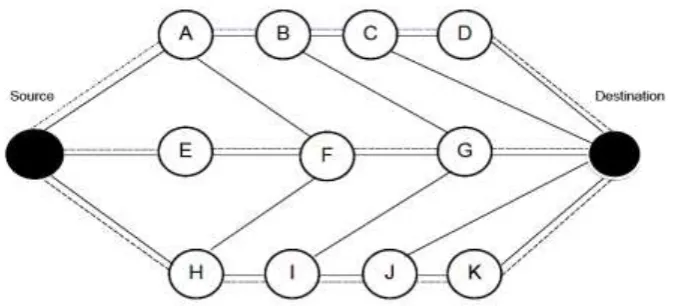
The proposed scheme is based on the PTCP and FeWTCP. We have used the Multipath
topology structure as described in Figure 1 for the transformation of the packets from sender
node to receiver node. The Multipath structure can be varying up to the N number of sensor nodes. The proposed architecture uses the TCP friendly equation[12] with combination of
Equation 1, Equation 2 and Equation 3 to control the congestion. In Figure 1; we have used
the multipath structure with source and destination nodes; source node sends the number of
packets from multiple paths to the destination node. The data sending refers the hop-by-hop
mechanism.
Figure 1:WSN Multipath Network Model.
ii. The RPD Routing
In RPD; when two or more than two sensor nodes are communicating between each other the
two routing protocols are used, one is DSR and other is 802.11 MAC. In our simulation we
consider these two routing protocols for to route the receiver to sender nodes.
a. Dynamic Source Routing Protocol (DSR)
This is specifically designed for wireless communication. This protocol allows the network to
be completely self-organizing and self –configuring, without the need for any existing
network infrastructure.
DSR consists on: (1) Route discovery, (2) Route maintenance, the route discovery allows
The DSR protocol allows multiple routes to any destination and allows each sender to select
and control the routes used in routing its packets. The DSR includes easily guaranteed
loop-free routing, it rapidly recovers when route in network changes.
b. 802.11 MAC (Media Access Control Protocol)
The 802.11 family uses a MAC layer known as CSMA/CA (Carrier Sense Multiple
Access/Collision Avoidance).[14]
In CSMA/CA a wireless node that wants to transfer data can perform the following tasks:
Listen on desired channel.
If channel is idle send the packets.
If channel is busy node will wait until the transmission stops than a further
CONTENTION period.
If channel is still idle at the end of contention period the node transmits its packet
otherwise it repeats the process as in above steps.
c. Contention Period
The contention period is a random period after every transmit on every node and statistically
allows every node equal access to media.[12] To allow Tx to Rx turn around; the contention
time is slotted 50 micro seconds for FH and 20 micro seconds for DS system.
iii. RPD Mathematical Model
First we have considered the TCP use friendly equation as given in Equation 4.
(4)
Now after consideration of Equation 1, Equation 2 , Equation 3 and Equation 4; we introduce
the mathematical model for our proposed scheme, that is in given in Equation 5.
2
1.33 (1 32 )
W T
p p
(5)
Where 1 5 8 3 W p
T = Packets Sending Rate in bytes/sec
W = Average Congestion Window β = Packets Gain Parameter
p = Packets Loss Rate
α = Growth rate of TCP Windows
Conditions
- When p is greater that T will be reduces.
- When αis greater than T will be greater.
- When β is greater than T will reduce.
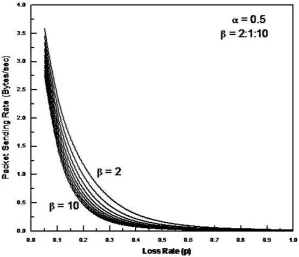
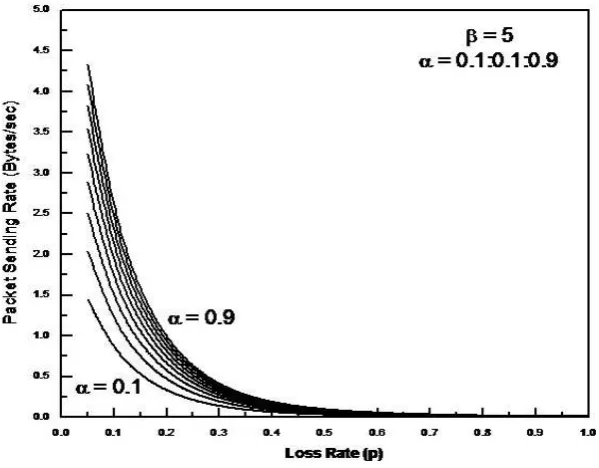
We can control the loss of packets by varying the values of α and β, the Figure 2 and Figure 3
focuses the controllable loss of packets by sending the packets in byte/sec. The sending rate
focuses the window size adjustment.
Figure 3: Loss Rate on fixed β=5 and α=0.1:0.1:0.9.
SIMULATION RESULTS AND COMPARISON
We have used the NS2 simulator for the RPD scheme and compare the results with traditional
TCP, FeWTCP and PTCP. The simulation parameters are given the Table 1.
Table 1: Parameters used in NS2 for RPD (Multipath Architecture).
Parameters Value
Data Rate 2 Mbps Buffer Size 20 Packets Number of Sensors 12 Radio Propagation 250 m Carrier Sense Range 550 m Interference Range 550 m Initial Energy 2J Data Packets Size 512 bits Time Interval T 1 sec
Routing Protocols DSR & 802.11MAC No. of Nodes 250
i. Packets loss rate
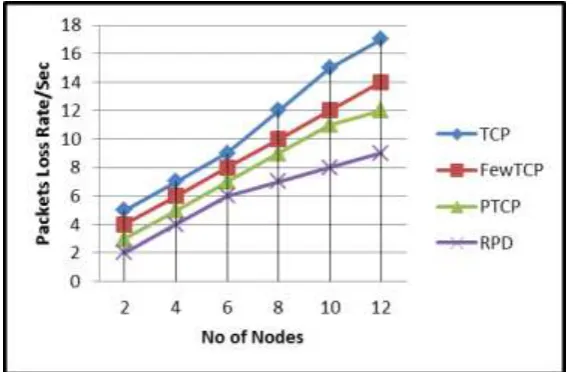
When we vary the values of α and β the loss rate on different nodes is given in Figure 4. In
Figure 4; the loss rate is measured in loss of packets per second; the loss rate of RPD is less
Figure 4:Packets Loss Rate in Multipath architecture.
ii. Packets Delivery Ratio
Packets delivery ratio can be measure as the ratio of total packet received by the destination
node to the total of packet sent from the source node during the time of simulation. The
higher the packet received the better the network performance.
100
s r dr
P P P
(6)
Equation 6; shows the Packets delivery is the ratio of packets sending over packets received.
The packets delivery ratio can be measured in %. Figure 5 focuses the packets delivery ratio
with respects to number of nodes. If we consider the two number of nodes are involved in
packets sending than the RDP is on 98% and rest of the schemes as TCP is on 90%, FeWTCP
is on 94% and PTCP is on 95% and in same way if 12 number are nodes are involved in
packets sending than RDP is on 93% and rest of the schemes as TCP is on 80%, FeWTCP is
on 84% and PTCP is on 85%. The results in Figure 5 shows that the RDP is more efficient in
Figure 5: Packets Delivery Ratio for Multipath architecture.
iii. Network throughput
Network throughput can be measured the average of packets transferred within a time period
over a communication link or channel. The higher the throughput the more efficient the
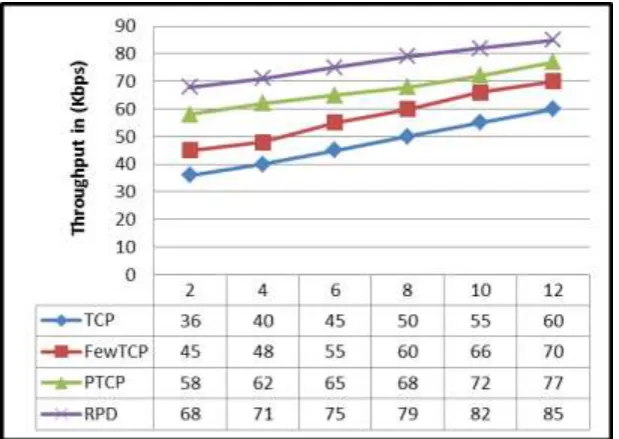
network. Figure 6 shows on 2 number of nodes the throughput of RPD is 68 Kbps and rest of
the schemes TCP has 36 Kbps, FeWTCP has 45 Kbps and PTCP has 58 Kbps. If we see on
number of 12 nodes the RPD has 85 Kbps, TCP has 60 Kbps, FeWTCP has 70 Kbps and
PTCP has 77 Kbps; it means that when the number of nodes increases the throughput of RPD
is also increased in comparison of other schemes.
CONCLUSION
The RPD Scheme gives us the good throughput than TCP, PTCP and FeWTCP Schemes, the
clear difference we have seen in the simulation results.
The results are tested on Multipath Network architecture and we have considered the
mathematical model as given in Equation 5; here we have varied the α and β parameters for
controlling the congestion which can also controls the size of the packets sending TCP
window. The NS2 based results focuses that the RPD congestion control scheme is more
efficient than other schemes.
REFERENCES
1. L. Li, Y. Li, Q. Chen, and N. Nie, "PTCP: Phase-divided tcp congestion control scheme
in wireless sensor networks," in Mobile Ad-Hoc and Sensor Networks, ed: Springer, 2007;
281-290.
2. H. Wu, Z. Feng, C. Guo, and Y. Zhang, "ICTCP: incast congestion control for TCP in
data-center networks," IEEE/ACM Transactions on Networking (TON), 2013; 21: 45-358.
3. C. Sergiou, P. Antoniou, and V. Vassiliou, "A comprehensive survey of congestion
control protocols in wireless sensor networks," Communications Surveys & Tutorials,
IEEE, 2014; 16: 1839-1859.
4. D. Estrin, R. Govindan, J. Heidemann, and S. Kumar, "Next century challenges: Scalable
coordination in sensor networks," in Proceedings of the 5th annual ACM/IEEE
international conference on Mobile computing and networking, 1999; 263-270.
5. C. Wang, K. Sohraby, B. Li, and W. Tang, "Issues of transport control protocols for
wireless sensor networks," in Proceedings of International Conference on
Communications, Circuits and Systems (ICCCAS), 2005; 422-426.
6. C. Wang, K. Sohraby, B. Li, M. Daneshmand, and Y. Hu, "A survey of transport
protocols for wireless sensor networks," Ieee Network, 2006; 20: 34-40.
7. A. A. Rezaee, M. H. Yaghmaee, A. M. Rahmani, and A. H. Mohajerzadeh, "HOCA:
healthcare aware optimized congestion avoidance and control protocol for wireless sensor
networks," Journal of Network and Computer Applications, 2014; 37: 216-228.
8. C.-Y. Wan, S. B. Eisenman, and A. T. Campbell, "CODA: congestion detection and
avoidance in sensor networks," in Proceedings of the 1st international conference on
9. Y. Sankarasubramaniam, Ö. B. Akan, and I. F. Akyildiz, "ESRT: event-to-sink reliable
transport in wireless sensor networks," in Proceedings of the 4th ACM international
symposium on Mobile ad hoc networking & computing, 2003; 177-188.
10.M. A. Kafi, D. Djenouri, J. Ben-Othman, and N. Badache, "Congestion control protocols
in wireless sensor networks: A survey," Communications Surveys & Tutorials, IEEE,
2014; 16: 1369-1390.
11.C. Wang, K. Sohraby, and B. Li, "SenTCP: A hop-by-hop congestion control protocol for
wireless sensor networks," in IEEE INFOCOM, 2005; 107-114.
12.K. Nahm, A. Helmy, and C.-C. Jay Kuo, "TCP over multihop 802.11 networks: issues
and performance enhancement," in Proceedings of the 6th ACM international symposium
on Mobile ad hoc networking and computing, 2005; 277-287.
13.J. Chen, M. Zhou, D. Li, and T. Sun, "A priority based dynamic adaptive routing protocol
for wireless sensor networks," in Intelligent Networks and Intelligent Systems, 2008.
ICINIS'08. First International Conference on, 2008; 160-164.
14.N. Dukkipati, T. Refice, Y. Cheng, J. Chu, T. Herbert, A. Agarwal, et al., "An argument
for increasing TCP's initial congestion window," Computer Communication Review,