Preventing Early Infant Sleep and Crying Problems and
Postnatal Depression: A Randomized Trial
WHAT’S KNOWN ON THIS SUBJECT: Infant sleep and crying problems are common and associated with postnatal depression. No programs aiming to prevent all 3 issues have been rigorously evaluated.
WHAT THIS STUDY ADDS: A prevention program targeting these issues improves caregiver mental health, behaviors, and cognitions around infant sleep. Implementation at a population level may be best restricted to infants who are frequent feeders because they experience fewer crying and daytime sleep problems.
abstract
OBJECTIVE:To evaluate a prevention program for infant sleep and cry problems and postnatal depression.
METHODS:Randomized controlled trial with 781 infants born at 32 weeks or later in 42 well-child centers, Melbourne, Australia. Follow-up occurred at infant age 4 and 6 months. The intervention including supplying information about normal infant sleep and cry patterns, settling techniques, medical causes of crying and parent self-care, delivered via booklet and DVD (at infant age 4 weeks), telephone consultation (8 weeks), and parent group (13 weeks) versus well-child care. Outcomes included caregiver-reported infant night sleep problem (primary outcome), infant daytime sleep, cry and feeding problems, crying and sleep duration, caregiver depression symptoms, attendance at night wakings, and formula changes.
RESULTS:Infant outcomes were similar between groups. Relative to control caregivers, intervention caregivers at 6 months were less likely to score .9 on the Edinburgh Postnatal Depression Scale (7.9%, vs 12.9%, adjusted odds ratio [OR] 0.57, 95% confidence interval [CI] 0.34 to 0.94), spend.20 minutes attending infant wakings (41% vs 51%, adjusted OR 0.66, 95% CI 0.46 to 0.95), or change formula (13% vs 23%, P,.05). Infant frequent feeders (.11 feeds/24 hours) in the intervention group were less likely to have daytime sleep (OR 0.13, 95% CI 0.03 to 0.54) or cry problems (OR 0.27, 95% CI 0.08 to 0.86) at 4 months.
CONCLUSIONS:An education program reduces postnatal depression symptoms, as well as sleep and cry problems in infants who are fre-quent feeders. The program may be best targeted to frefre-quent feeders. Pediatrics2014;133:e346–e354
AUTHORS:Harriet Hiscock, MBBS, MD,a,b,cFallon Cook, BSci, PhD,b,dJordana Bayer, PhD M, Clin Pscyh,b,eHa ND Le, MHEcon, MBA,fFiona Mensah, BSc, MSc, PhD,c,gWarren Cann, BBSc, MSc,dBrian Symon, BSc, MBBS, MD,hand Ian St James-Roberts, PhDi
aCentre for Community Child Health, The Royal Children’s
Hospital, Parkville, Australia;bMurdoch Childrens Research
Institute, andgClinical Epidemiology and Biostatistics Unit,
Murdoch Childrens Research Institute, The Royal Children’s Hospital, Melbourne, Australia;cDepartment of Paediatrics,
University of Melbourne, Melbourne, Australia;dParenting
Research Centre, East Melbourne, Australia;eSchool of
Psychological Science, La Trobe University, Bundoora, Australia;
fDeakin Health Economics, Deakin University, Burwood, Australia; hDepartment of General Practice, University of Adelaide,
Australia; andiThomas Coram Research Unit, Institute of
Education, University of London, United Kingdom
KEY WORDS
infant, sleep, colic, postpartum depression, randomized controlled trial
ABBREVIATIONS
CI—confidence interval
EPDS—Edinburgh Postnatal Depression Scale MCH—maternal and child health
MCISQ—Maternal Cognitions About Infant Sleep Questionnaire OR—odds ratio
SEIFA—Socio-Economic Indexes for Areas
Dr Hiscock conceptualized and designed the study and drafted the initial manuscript; Dr Cook contributed to the
conceptualization and design of the study and the initial draft of the manuscript, oversaw study data collection, carried out the initial analyses in conjunction with Dr Mensah, and reviewed and revised the manuscript; Drs Bayer, Simon, St James-Roberts, and Mr Cann contributed to the conceptualization and design of the study and reviewed and revised the manuscript; Ms Le conducted the economic analysis and reviewed and revised the manuscript; Dr Mensah carried out the initial analyses in conjunction with Dr Cook, and reviewed and revised the manuscript; and all authors approved thefinal manuscript as submitted.
Infant sleep and crying problems such as frequent night waking and in-consolable bouts of crying are common during thefirst few months of life.1–3 They are associated with maternal de-pression, premature weaning, and frequent formula changes.4,5Formula changes often occur when infant cry-ing is misdiagnosed as gastroesopha-geal reflux or food allergy.6 Infant crying is the most common proximal risk factor for abusive head trauma.7 Together, infant sleep and cry prob-lems make up the most common rea-sons parents seek help from health care professionals in the first few months.8Yet despite their prevalence, few evaluated programs have tried to prevent early infant crying or sleep problems, and only 1 randomized con-trolled trial has explicitly aimed to prevent both.9
Programs aiming to prevent infant sleep problems have focused on parent education about infant self-settling strategies, normal sleep/wake patterns, low stimulation during the night, and increasing the interval between waking and night feeds. These programs have demonstrated modest improvements in parent report of infant sleep duration at 12 weeks of age.9–11
Programs aiming to prevent infant crying have been less successful. This may be in part because at least some crying is unsoothable in infants,12 regardless of parenting practices.13 Unsoothable crying is the most worri-some for parents.14Thus although re-ducing the amount of unsoothable crying may be impossible, reducing parent perception of crying as “a problem”could be possible if parents accept that some crying is normal. A program to address this and provide parents with information about normal sleep and cry patterns and ways to encourage infants to self-settle, might reduce parental perception of infant sleep and crying as problems15,16and
in doing so reduce their adverse se-quelae. We therefore aimed to see if an education program, “Baby Business,” could prevent infant nighttime sleep problems (primary outcome), daytime sleep, cry and feeding problems, and number of formula changes and improve caregiver depression symptoms, cogni-tions, and behaviors around infant sleep, sleep quality and quantity, and health service use for the infant’s behavior and caregiver well-being. We hypothesized that compared with control caregivers, intervention caregivers would report improved infant and caregiver outcomes at infant age 4 and 6 months.
METHODS
Study Design and Participants
We invited caregivers of infants seen by their maternal and child health (MCH) nurse at theirfirst home visit (day 7–10 postpartum) in 4 Local Government Areas in Melbourne, Australia, to take part between March 1, 2010, and June 1, 2011. The MCH nursing service is a free service offered to all Victorian families with scheduled visits covering 93% of all births. We excluded parents with insufficient English and infants born before 32 weeks’ gestation or with a serious health concern.
The research team mailed a participant information statement, consent form, and baseline questionnaire to families interested in participating. Upon re-ceipt of written informed consent and completed questionnaire, families were randomized to either the intervention or control group, using a computer-generated random number sequence created by an independent statistician. Randomization was stratified by the referring nurse’s MCH center. The re-search team and families remained blind to group allocation at the time of consent and recruitment, after which blinding was not possible due to the nature of the intervention.
This trial was approved by the Human Research Ethics Committee at the Royal Children’s Hospital, Melbourne (HREC 28130). Research approval was obtained from the Victorian state Department of Education and Early Childhood Development.
Intervention
Intervention families were mailed a 27-page booklet and 23-minute DVD. The booklet contained information about normal infant sleep cycles, crying pat-terns, strategies to promote independent settling, and self-care for parents. The DVD contained similar information and included parents discussing settling techniques and infant tired signs, as well as settling technique demon-strations. Intervention families were also offered an individual telephone consultation at infant age 6 to 8 weeks (ie, peak infant crying time15) and a 1.5-hour parent group session at ap-proximately infant age 12 weeks. Both encouraged parents to discuss cry or sleeping problems and to develop a tailored management plan (eg, es-tablish a bedtime routine) to address any problems. Telephone consultations and group sessions were facilitated by trained health professionals (nurses, psychologists) with a background in infant care and followed standardized scripts. The group session was sup-ported by a training manual (details published elsewhere).17 Staff conduct-ing the telephone and group inter-ventions met on a regular basis with HH (pediatrician) and JB (clinical psychol-ogist) to monitorfidelity to content and troubleshoot clinical issues. Families allocated to the control condition re-ceived usual care provided through the MCH service.
Outcome Measures
Baseline Questionnaire
frequency) and whether their infant’s sleep, crying, and feeding were a problem (yes/no). Primary caregivers also com-pleted the“Doubt”subscale of the Maternal Cognitions About Infant Sleep Questionnaire (MCISQ)18and rated themselves as a relaxed or tense person.17Each family was assigned a local neighborhood Index of Relative Disadvantage score by home postal code (higher scores indicate better socioeconomic status) using the Socio-Economic Indexes for Areas (SEIFA).19
Infant Measures
Infant outcomes were measured by postal survey at approximately 4 and 6 months of age. The primary outcome was caregiver report of infant night sleep as a problem (yes/no; the period of“night sleep”was determined by the caregiver). Caregivers were also asked if they had experienced a problem (yes/ no) with infant day sleep, crying, or feeding, and if they responded in the affirmative, to rate the severity of each problem on a 7-point Likert scale, from 1 =“hardly any problem”to 7 =“a se-vere problem.”20,21 The primary care-giver completed a 72-hour infant behavior diary,22measuring sleeping, feeding, and crying in 10-minute epochs and reported on the number and duration of night attendances to their infant over the previous week.
Caregiver Measures
Caregiver outcomes were measured at the same time points and included the Edinburgh Postnatal Depression Scale (EPDS),23,24 with scores.9 indicative of postnatal depression in community samples,24 and sleep quality and quantity measured by 2 items adapted from the Pittsburgh Sleep Quality In-dex.25–27 Caregiver cognitions about infant sleep were measured by 4 sub-scales of the MCISQ18: limit setting (eg,“I should respond straightaway when my child wakes crying at night”), anger, doubt, and safety. Caregivers rated their
efficacy as a parent on a single item ranging from 1 (“not very good”) to 5 (“a very good parent”).28Caregivers reported on breastfeeding duration and whether they had changed their infant’s formula to“manage”their infant’s sleep or cry-ing. Finally, caregivers reported on the number of visits they made to a health professional for either their infant’s sleep/crying or their own well-being. Intervention caregivers also reported on the usefulness of intervention materials and components and the helpfulness of strategies given. Addi-tional details have been published pre-viously.17
Sample Size
To detect a relative reduction in the prevalence of caregiver reported infant sleep problems (yes/no) by 30% at infant age 4 months (ie, from 30% to 20%), 780 infants were required, with 80% power, assuming 20% loss to follow-up and a 5% significance level. This is based on 2 community surveys in which ∼30% of Australian parents reported infant sleep problems at 4 months of age.4,29
Statistical Analysis
Intention-to-treat comparisons of the trial arms were conducted for each follow-up. Linear regression models were fitted to estimate mean differ-ences between trial arms for continu-ous outcomes and logistic regression to estimate odds ratios (ORs) comparing binary outcomes between trial arms. We conducted analyses both with and without adjustment for potential con-founders chosen a priori through re-view of the literature (ie, infant age, gender, socioeconomic status, parenting doubt surrounding infant sleep at baseline (excluded when doubt was examined as an outcome), parenting self-efficacy and parental rating of self as a tense person). We conducted em-pirical bootstrap estimates to confirm the validity of the inferences made. We
then examined trends in treatment response from 4 to 6 months of infant age, using random effects regression models. We performed 2 additional post hoc tests not described in our pro-tocol.17These were a test of interaction between frequent feeding at baseline (ie, feeding.11 times/24 hours) and the outcomes of infant night sleep, day sleep, and crying problems as a pre-vious sleep problem prevention trial found greater benefits for these infants30; and a comparison of whether the benefits of the intervention differed for first and later born children for these outcomes. The frequency and patterns of missing data were exam-ined, and sensitivity analyses were performed comparing the results of analyses restricted to families with complete data and analyses for which missing data were imputed by using a conservative approach.31All analyses were implemented by using Stata 12.0.32
RESULTS
Sample Characteristics and Retention
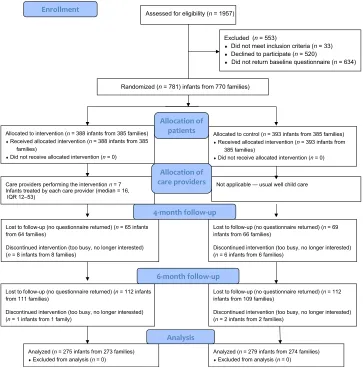
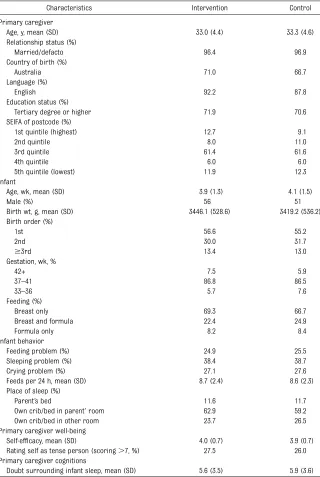
Nurses invited 1957 families to take part, of whom 770 were eligible and recruited (total of 781 infants including twins; re-sponse rate 55% of families, see Fig 1). Families were randomized to either the intervention (n= 385 families with 388 infants) or the control group (n = 385 families with 393 infants; baseline char-acteristics of the groups are shown in Table 1). Participating families were more likely than nonparticipating families to be of higher socioeconomic status (12.7% vs 9.1% from the highest SEIFA quintile*).33
Almost all primary caregivers (99.6%) were mothers, with a mean age of 33 years. Infant mean age was 4.0 weeks
*SEIFA quintiles were calculated from 2011 Victo-rian SEIFA data (Australian Bureau of Statistics). Thefirst quintile represents the least disadvan-taged one-fifth of the Victorian population, and the
(61.4), and more than half were boys andfirstborn. Aside from the primary caregiver being more likely to speak English as afirst language, intervention families did not differ demographically from control families.
At 4 months’infant age, follow-up ques-tionnaires were completed for 315 of 388 (81.2%) intervention and 318 of 393 (80.9%) control group infants, with behavior diaries completed for 264 of 388 (68.0%) intervention and 259 of 393 (65.9%) control group infants. At 6 months, follow-up questionnaires were completed for 275 of 388 (70.9%) in-tervention and 279 of 393 (70.9%) control group infants and behavior diaries for 224 of 388 (57.7%) intervention and 215 of 393 (54.7%) control group infants.
Diaries were discarded if they had.20% of data missing from any 24-hour period or,2 days of data recorded.
Caregivers who did not complete follow-up questionnaires were more likely than those who did to report a sleep problem at baseline (control group only, P,.04), to have a lower socio-economic status (interventionP= .01, controlP= .02), to have completed high school or less (intervention P = .03, control P= .001), and to speak a lan-guage other than English at home (in-tervention group only,P= .02). Similarly, caregivers who did not complete 4- or 6-month diaries sufficiently compared with those who did were more likely to be of a lower socioeconomic status, speak a language other than English at
home, and to have completed high school or less (all P , .01). All in-tervention families received the book-let/ DVD; 92.5% received the telephone consultation (mean infant age 8.862.3 weeks), and 50.9% attended the group session (mean infant age 13.4 6 2.3 weeks).
Infant Outcomes at 4 and 6 Months
There were no differences between groups in caregiver report of infant sleep, crying, or feeding problems at either follow-up (Table 2).
There was a differential effect of con-dition arm on those classified as fre-quent feeders (ie,.11 feeds/24 hours) at 4 but not 6 months. Infants in the intervention versus control group who
FIGURE 1
fed frequently at baseline had 87% lower odds of having daytime sleep problems (OR 0.13, 95% confidence interval [CI] 0.03 to 0.54) and 73% lower odds of having crying problems (OR 0.27, 95% CI 0.08 to 0.86, re-spectively). Nighttime sleep problems were similar between the 2 groups of frequent feeders. No differential effects of condition arm for infants
who were firstborn compared with later born were evident for crying problems or daytime or nighttime sleep problems.
Caregiver Outcomes at 4 and 6 Months
There were no group differences in caregiver reports of depression symp-toms at 4 months. However, at 6
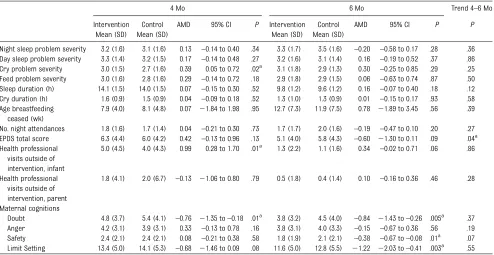
months, intervention group caregivers were significantly less likely to score.9 on the EPDS than control group care-givers (7.9% vs 12.9%, adjusted OR 0.57,95%CI 0.34 to 0.94,P= .03). Between 4 and 6 months, there was a greater reduction in intervention caregivers scoring.9 on the EPDS compared with control caregivers (P,.01) and simi-larly a greater fall in total depression symptom scores (P= .04). Intervention caregivers also had fewer doubts re-garding their ability to manage their infant’s sleep at both time points (both P,.02). At 6 months, intervention com-pared with control caregivers were less likely to spend$20 minutes attending to their infant overnight (41% vs 51%, adjusted OR 0.66, 95% CI 0.46 to 0.95,P= .03) or have changed infant formula (13% vs 23%, adjusted OR 0.41, 95% CI 0.21 to 0.82,P= .01) and reported less difficulty setting limits (adjusted mean difference–1.22, 95% CI–2.03 to–0.41, P = .003) and less excessive concern about sudden infant death (adjusted mean difference–0.38, 95% CI–0.67 to
–0.08,P= .01, see Table 3). At 4 months, intervention caregivers had sought help more often from health pro-fessionals for their infant than control group caregivers, but there was no difference at 6 months.
Program Costs
The total cost of providing the Baby Business program was A$23 056 or approximately A$60 per family. This comprised the cost of training health professionals (A$1140), delivering con-sultation phone calls (A$7520), running the parent group sessions (A$6743), distribution of intervention materials (A $3042), and overhead costs (A$4612). Training cost was estimated as the time of trainers and trainees plus training materials. Consultation phone call cost included time spent making appoint-ments, rescheduling families, and pre-paring for and delivering calls (∼20 minutes). Parent group costs included TABLE 1 Baseline Characteristics of Randomized Groups
Characteristics Intervention Control
Primary caregiver
Age, y, mean (SD) 33.0 (4.4) 33.3 (4.6)
Relationship status (%)
Married/defacto 96.4 96.9
Country of birth (%)
Australia 71.0 66.7
Language (%)
English 92.2 87.8
Education status (%)
Tertiary degree or higher 71.9 70.6
SEIFA of postcode (%)
1st quintile (highest) 12.7 9.1
2nd quintile 8.0 11.0
3rd quintile 61.4 61.6
4th quintile 6.0 6.0
5th quintile (lowest) 11.9 12.3
Infant
Age, wk, mean (SD) 3.9 (1.3) 4.1 (1.5)
Male (%) 56 51
Birth wt, g, mean (SD) 3446.1 (528.6) 3419.2 (536.2)
Birth order (%)
1st 56.6 55.2
2nd 30.0 31.7
$3rd 13.4 13.0
Gestation, wk, %
42+ 7.5 5.9
37–41 86.8 86.5
33–36 5.7 7.6
Feeding (%)
Breast only 69.3 66.7
Breast and formula 22.4 24.9
Formula only 8.2 8.4
Infant behavior
Feeding problem (%) 24.9 25.5
Sleeping problem (%) 38.4 38.7
Crying problem (%) 27.1 27.6
Feeds per 24 h, mean (SD) 8.7 (2.4) 8.6 (2.3)
Place of sleep (%)
Parent’s bed 11.6 11.7
Own crib/bed in parent’room 62.9 59.2
Own crib/bed in other room 23.7 26.5
Primary caregiver well-being
Self-efficacy, mean (SD) 4.0 (0.7) 3.9 (0.7)
Rating self as tense person (scoring.7, %) 27.5 26.0 Primary caregiver cognitions
Doubt surrounding infant sleep, mean (SD) 5.6 (3.5) 5.9 (3.6)
time spent booking appointments, rescheduling families, preparing (15 minutes), facilitating the group session
(∼1 hour), and travel expenses. Pro-gram costs were assigned to families who received any component of the
program. Costs were valued in 2011 Australian dollars. No discount factor was applied.
TABLE 2 Adjusted Regression Analyses at Infant Age 4 and 6 Months and Trends Between 4 and 6 Months for Categorical Variables
4 Mo 6 Mo Trend
4–6 Mo Interventionn(%) Controln(%) AOR 95% CI P Interventionn(%) Controln(%) AOR 95% CI P P
Infant
Night sleep problem 147 (47) 149 (47.2) 1.01 0.73 to 1.39 .97 138 (51.1) 148 (53.4) 0.89 0.63 to 1.26 .51 .35 Day sleep problem 185 (59.3) 187 (58.8) 1.01 0.73 to 1.41 .94 104 (38.7) 120 (43.3) 0.81 0.57 to 1.16 .25 .82 Cry problem 108 (34.6) 105 (33) 1.07 0.76 to 1.51 .71 62 (23.0) 63 (22.7) 1.09 0.72 to 1.65 .69 .62 Feed problem 89 (28.3) 91 (28.6) 1.00 0.70 to 1.44 .98 43 (16.2) 57 (20.7) 0.79 0.50 to 1.24 .30 .99
$20 min spent with baby during each night attendance
176 (61.1) 182 (62.5) 0.94 0.66 to 1.34 .74 100 (41.3) 130 (51.0) 0.66 0.46 to 0.95 .03a .15
Formula change 24 (21.2) 38 (27.7) 0.64 0.34 to 1.19 .16 18 (13.0) 31 (22.6) 0.41 0.21 to 0.82 .01a .92 Caregiver
EPDS community cutoff (.9)
67 (22.9) 54 (18.5) 1.48 0.97 to 2.27 .07 31 (7.9) 51 (12.9) 0.57 0.34 to 0.94 .03a .003a
Sleep quality not good enough
146 (47.1) 143 (45.7) 0.91 0.65 to 1.26 .57 124 (45.9) 137 (50.4) 1.16 0.82 to 1.65 .39 .28
Sleep quantity not enough
184 (59.2) 171 (54.6) 0.79 0.57 to 1.10 .16 153 (56.7) 153 (56.3) 0.99 0.69 to 1.41 .95 .81
Diet change while breastfeeding
89 (30.6) 88 (30.4) 0.99 0.69 to 1.41 .94 74 (29.5) 70 (28.3) 1.05 0.71 to 1.57 .79 .91
Analyses adjusted for infant age, gender, SEIFA rating, parent education, parenting doubt surrounding infant sleep as measured at baseline, parenting self-efficacy, and parental rating of self as a tense person. AOR, adjusted odds ratio.
aSignificantPvalue.
TABLE 3 Adjusted Regression Analyses at Infant Age 4 and 6 Months for Continuous Variables
4 Mo 6 Mo Trend 4–6 Mo
Intervention Mean (SD)
Control Mean (SD)
AMD 95% CI P Intervention Mean (SD)
Control Mean (SD)
AMD 95% CI P P
Night sleep problem severity 3.2 (1.6) 3.1 (1.6) 0.13 –0.14 to 0.40 .34 3.3 (1.7) 3.5 (1.6) –0.20 –0.58 to 0.17 .28 .36 Day sleep problem severity 3.3 (1.4) 3.2 (1.5) 0.17 –0.14 to 0.48 .27 3.2 (1.6) 3.1 (1.4) 0.16 –0.19 to 0.52 .37 .86 Cry problem severity 3.0 (1.5) 2.7 (1.6) 0.39 0.05 to 0.72 .02a 3.1 (1.8) 2.9 (1.3) 0.30 –0.25 to 0.85 .29 .25 Feed problem severity 3.0 (1.6) 2.8 (1.6) 0.29 –0.14 to 0.72 .18 2.9 (1.8) 2.9 (1.5) 0.06 –0.63 to 0.74 .87 .50 Sleep duration (h) 14.1 (1.5) 14.0 (1.5) 0.07 –0.15 to 0.30 .52 9.8 (1.2) 9.6 (1.2) 0.16 –0.07 to 0.40 .18 .12 Cry duration (h) 1.6 (0.9) 1.5 (0.9) 0.04 –0.09 to 0.18 .52 1.3 (1.0) 1.3 (0.9) 0.01 –0.15 to 0.17 .93 .58 Age breastfeeding
ceased (wk)
7.9 (4.0) 8.1 (4.8) 0.07 21.84 to 1.98 .95 12.7 (7.3) 11.9 (7.5) 0.78 21.89 to 3.45 .56 .39
No. night attendances 1.8 (1.6) 1.7 (1.4) 0.04 –0.21 to 0.30 .73 1.7 (1.7) 2.0 (1.6) –0.19 –0.47 to 0.10 .20 .27 EPDS total score 6.3 (4.4) 6.0 (4.2) 0.42 –0.13 to 0.96 .13 5.1 (4.0) 5.8 (4.3) –0.60 21.30 to 0.11 .09 .04a Health professional
visits outside of intervention, infant
5.0 (4.5) 4.0 (4.3) 0.99 0.28 to 1.70 .01a 1.3 (2.2) 1.1 (1.6) 0.34 –0.02 to 0.71 .06 .86
Health professional visits outside of intervention, parent
1.8 (4.1) 2.0 (6.7) –0.13 21.06 to 0.80 .79 0.5 (1.8) 0.4 (1.4) 0.10 –0.16 to 0.36 .46 .28
Maternal cognitions
Doubt 4.8 (3.7) 5.4 (4.1) –0.76 21.35 to–0.18 .01a 3.8 (3.2) 4.5 (4.0) –0.84 21.43 to–0.26 .005a .37 Anger 4.2 (3.1) 3.9 (3.1) 0.33 –0.13 to 0.78 .16 3.8 (3.1) 4.0 (3.3) –0.15 –0.67 to 0.36 .56 .19 Safety 2.4 (2.1) 2.4 (2.1) 0.08 –0.21 to 0.38 .58 1.8 (1.9) 2.1 (2.1) –0.38 –0.67 to–0.08 .01a .07 Limit Setting 13.4 (5.0) 14.1 (5.3) –0.68 21.46 to 0.09 .08 11.6 (5.0) 12.8 (5.5) 21.22 22.03 to–0.41 .003a .55
Use and Helpfulness of Intervention Strategies
All families reported reading the booklet, and 98% reporting watching the DVD. The majority of intervention families found the booklet to be either
“quite a bit” or “a great deal” useful (40% and 38%, respectively) with sim-ilarfindings for the DVD (41% and 35%, respectively). Caregivers indicated that the telephone consultation was “a lit-tle” useful (41%), followed by “quite a bit”(24%) and“a great deal”(21%) useful, whereas usefulness of the par-ent group was lower (“a little” 28%,
“quite a bit”32%,“a great deal”34%). Information about normal infant sleep patterns, normal crying patterns, and learning about tired signs was most helpful (see Table 4). Despite program advice, some parents struggled to consistently put their infant down awake (only 33% did so), recognize tired signs before the infant became overtired (only 23% did so), or settle their infant without picking her or him up (only 11%; see Table 5). Ninety-five percent of families said they would
recommend the program to their friends.
DISCUSSION
In this community-based, randomized controlled trial of a program designed to prevent early infant sleep and cry problems and associated caregiver depression symptoms, we found mod-est benefits largely favoring caregivers. Intervention caregivers reported a slightly greater reduction in depression symptoms between 4 and 6 months and fewer symptoms at 6 months. In-tervention caregivers were less likely to attend infant night wakings, change formulas to manage their infant’s problems, and had less doubt, difficulty setting limits, and concerns about safety with respect to infant sleep. Such parental behaviors reduce the likelihood of the infant developing later sleep problems.34 In the subgroup of infants who were frequent feeders, in-tervention caregivers reported fewer daytime sleep and crying problems at 4 months of age. This subgroup may represent an at-risk group whose
parents feed to try to settle, and as such, the advice in the program may have had a greater impact on parent perception of feeding and crying as problems. The effects faded by 6 months, which may reflect the natural improvement in infant crying and day-time sleep.2,5
Unlike previous prevention trials aimed at improving infant nighttime sleep duration,9,11,30,35we found no such im-provement. This is despite our pro-gram including similar information. Our findings may differ for a number of reasons. First, the dosage of our program may be insufficient. In St James-Robert’s trial,9 parents were telephoned at 3, 6, 9, and 12 weeks to discuss program implementation. How-ever, Symon and colleagues11 found improvements in infant sleep duration at age 12 weeks with a single 45-minute nurse consultation and booklet. Second, caregivers may not have implemented the program strategies known to foster self-settling in infants. This includes putting an infant into the crib while he or she is awake, which only one-third of our caregivers said they were able to do consistently. Third, the way in which the information was delivered may not have been effective; that is, the only face-to-face contact with parents occurred late in the intervention (mean infant age 13 weeks) and was only attended by half the parents.
Few randomized controlled trials have sought to prevent infant crying. One trial of increased carrying reduced the duration of infant crying,36but results have not been replicated.37,38 No ran-domized controlled trials have sought to reduce parent report of infant crying TABLE 4 Helpfulness of Intervention Strategies (n= 294–298)
Strategy Helpful (%) Unhelpful (%) Does not apply (%)
Information on normal baby sleep patterns 98.6 1.0 0.4 Information about normal baby crying patterns 97.3 1.7 1.0
Learning about tired signs 97.3 2.0 0.7
Information about sleep cycles 95.9 3.0 1.1
Learning about sleep cues 93.6 4.4 2.0
Learning about putting baby to bed awake 90.2 7.1 2.7
Learning how to settle my baby 89.6 8.7 1.7
Learning about baby care myths 85.8 10.5 3.7
Having someone to talk to about my baby 85.4 5.1 9.5
Learning about common medical causes of crying 84.7 8.5 6.8 Learning how to resettle my baby after a catnap 81.8 15.2 3.0
Learning about roll over feeds 74.8 15.2 10.0
Telephone numbers for other sources of help 72.6 13.0 14.4 Having someone to talk to about my own feelings 68.5 8.1 23.4
Learning about cosleeping 54.9 15.3 29.8
TABLE 5 Frequency of Use of Intervention Strategies at 6 Month of Infant Age (n= 246–247)
Never A little About half the time Most of the time All of the time Not applicable
Put baby down awake but drowsy (%) 2.0 9.3 12.2 43.5 32.9 0.0
Recognize tired signs before overtired (%) 0.0 0.4 8.9 67.5 22.8 0.4
Settle baby without picking up (%) 8.1 17.4 19.4 43.3 10.9 0.8
as a problem. Our trial did but was unsuccessful, suggesting that for parents to accept crying as a normal infant be-havior, more than education is required.
The benefits for caregiver mental health happened in the absence of an im-provement in infant sleep, contrary to previous studies.4,39 It may be that having more knowledge and appropri-ate expectations about infant sleep and crying behavior resulted in the ob-served reduction in caregiver doubt, facilitating a reduction in postnatal depression symptoms, given that the 2 have previously been linked.40
Thefinding that intervention caregivers accessed more health services for their infants compared with control families at 4 months was surprising. The pro-gram booklet provided a list of other sources of help, and this may have prompted intervention families to ac-cess services.
Our study had a number of strengths. We recruited a large community sample with a diversity of sociodemographic characteristics, including infants born to experienced caregivers. We used validated measures of infant behavior (diary) and caregiver mental health. We used multiple imputation to account for missing data at follow-up with little change in our outcomes, suggesting that sample attrition has not biased our
findings. Limitations include attrition rate at 6 months, use of caregiver re-port, and a lack of blinding of the intervention, which may lead to re-sponder bias. However, an absence of group differences in infant outcomes suggests that the latter is unlikely. Compared with adults residing in the state of Victoria,41our caregivers were better educated (70% with a tertiary degree or higher vs 64%, respectively) and more likely to speak English as the main language at home (87.8%–92.2%
vs 72%), so our results may not gen-eralize to less well educated or non-English-speaking parents.
CONCLUSIONS
A relatively brief program designed to prevent infant sleep and cry problems did so, but only in infants who fed fre-quently. Overall, the program improved caregiver report of depression symp-toms, cognitions, and behaviors around infant sleep and reduced formula changes. A population-based random-ized trial is needed to determine whether the program could be more effective if it targeted frequent feeders in thefirst month of life or other at-risk groups such as depressed mothers. Whether the program impacts could be improved by face-to-face delivery or increased contacts and whether a more prescriptive approach would improve outcomes remains to be tested.
REFERENCES
1. France KG. Behavior characteristics and security in sleep-disturbed infants treated with extinction.J Pediatr Psychol. 1992;17 (4):467–475
2. Messer D, Richards M. The development of sleeping difficulties. In: St James-Roberts I, Harris G, Messer D, eds. Infant Crying, Feeding and Sleeping: Development, Prob-lems and Treatments. London, UK: Wheat-sheaf; 1993:150–173
3. Goodlin-Jones B, Burnham M, Anders T. Sleep and sleep disturbances: regulatory processes in infancy. In: Sameroff A, Lewis M, Miller M, eds.Handbook of Developmental Psychopathology. New York, NY: Kluwer Aca-demic; 2000:309–325
4. Bayer JK, Hiscock H, Hampton A, Wake M. Sleep problems in young infants and ma-ternal mental and physical health. J Pae-diatr Child Health. 2007;43(1–2):66–73 5. Wake M, Morton-Allen E, Poulakis Z, Hiscock
H, Gallagher S, Oberklaid F. Prevalence, stability, and outcomes of cry-fuss and sleep problems in thefirst 2 years of life: prospective community-based study. Pedi-atrics. 2006;117(3):836–842
6. Lakshman R, Ogilvie D, Ong KK. Mothers’ experiences of bottle-feeding: a systematic review of qualitative and quantitative stud-ies.Arch Dis Child. 2009;94(8):596–601 doi: 10.1136/adc.2008.151910
7. Barr RG, Barr M, Fujiwara T, Conway J, Catherine N, Brant R. Do educational mate-rials change knowledge and behavior about crying and shaken baby syndrome? A ran-domized controlled trial.CMAJ. 2009;180(7): 727–733
8. Morris S, James-Roberts IS, Sleep J, Gill-ham P. Economic evaluation of strategies for managing crying and sleeping prob-lems.Arch Dis Child. 2001;84(1):15–19 9. St James-Roberts I, Sleep J, Morris S, Owen
C, Gillham P. Use of a behavioural pro-gramme in the first 3 months to prevent infant crying and sleeping problems. J Paediatr Child Health. 2001;37(3):289–297 10. Pinilla T, Birch LL. Help me make it through
the night: behavioral entrainment of breast-fed infants’sleep patterns. Pediat-rics. 1993;91(2):436–444
11. Symon BG, Marley JE, Martin AJ, Norman ER. Effect of a consultation teaching behaviour
modification on sleep performance in infants: a randomised controlled trial.
Med J Aust. 2005;182(5):215–218 12. Douglas PS, Hiscock H. The unsettled baby:
crying out for an integrated, multidisci-plinary primary care approach.Med J Aust. 2010;193(9):533–536
13. St James-Roberts I, Alvarez M, Csipke E, Abramsky T, Goodwin J, Sorgenfrei E. Infant crying and sleeping in London, Copenhagen and when parents adopt a“proximal”form of care. Pediatrics. 2006;117(6). Available at: www.pediatrics.org/cgi/content/full/117/ 6/e1146–e1155
14. Fujiwara T, Barr RG, Brant R, Barr M. Infant distress atfive weeks of age and caregiver frustration.J Pediatr. 2011;159(3):425–430, e1–e2
15. St James-Roberts I. Infant crying and sleeping: helping parents to prevent and manage problems.Sleep Med Clin. 2008;35 (3):547–567
17. Cook F, Bayer J, Le HND, Mensah F, Cann W, Hiscock H. Baby Business: a randomised controlled trial of a universal parenting program that aims to prevent early infant sleep and cry problems and associated parental depression.BMC Pediatr. 2012;12:13 18. Morrell JM. The role of maternal cognitions in infant sleep problems as assessed by a new instrument, the maternal cognitions about infant sleep questionnaire. J Child Psychol Psychiatry. 1999;40(2):247–258 19. Australian Bureau of Statistics. Socio-economic
In dex es for Areas. 2006. Available at : www.abs.gov.au/AUS STATS/[email protected]/ allprimarymainfeatures/356A4186CCDDC4D1 CA257B3B001AC22C?opendocument. Accessed November 29, 2011
20. Smart J, Hiscock H. Early infant crying and sleeping problems: a pilot study of impact on parental well-being and parent-endorsed strategies for management.J Paediatr Child Health. 2007;43(4):284–290
21. Hiscock H, Bayer JK, Hampton A, Ukoumunne OC, Wake M. Long-term mother and child mental health effects of a population-based infant sleep intervention: cluster-randomized, controlled trial.Pediatrics. 2008;122(3). Avail-able at: www.pediatrics.org/cgi/content/full/ 122/3/e621–e627
22. Barr RG, Kramer MS, Boisjoly C, McVey-White L, Pless IB. Parental diary of infant cry and fuss behaviour. Arch Dis Child. 1988;63(4): 380–387
23. Cox JL, Holden JM, Sagovsky R. Detection of postnatal depression. Development of the 10-item Edinburgh Postnatal Depression Scale.Br J Psychiatry. 1987;150:782–786
24. Murray L, Carothers AD. The validation of the Edinburgh Post-natal Depression Scale on a community sample.Br J Psychiatry. 1990;157:288–290
25. Hiscock H, Wake M. Infant sleep problems and postnatal depression: A community-based study. Pediatrics. 200;1(107):1317– 1322
26. Hiscock H, Wake M. Randomised controlled trial of behavioural infant sleep intervention to improve infant sleep and maternal mood.
BMJ. 2002;324(7345):1062–1065
27. Buysse DJ, Reynolds CF III, Monk TH, Berman SR, Kupfer DJ. The Pittsburgh Sleep Quality Index: a new instrument for psychiatric practice and research.Psychiatry Res. 1989; 28(2):193–213
28. Sanson A, Nicholson J, Ungerer J, et al.
Introducing the Longitudinal Study of Aus-tralian Children(LSAC Discussion Paper No. 1). Melbourne, Australia: Australian In-stitute of Family Studies; 2002
29. Armstrong KL, Quinn RA, Dadds MR. The sleep patterns of normal children.Med J Aust. 1994;161(3):202–206
30. Nikolopoulou M, St James-Roberts I. Pre-venting sleeping problems in infants who are at risk of developing them.Arch Dis Child. 2003;88(2):108–111
31. Sterne JA, White IR, Carlin JB, et al. Multiple imputation for missing data in epidemio-logical and clinical research: potential and pitfalls.BMJ. 2009;338:b2393
32. StataCorp.Stata Statistical Software: Release 12. College Station, TX: StataCorp LP; 2011 33. Australian Bureau of Statistics. Socio-economic
Indexes for Areas. 2011. Available at: www.abs.
gov.au/websitedbs/censushome.nsf/home/ seifa2011?opendocument&navpos=260. Acces-sed April 18, 2013
34. Tikotzky L, Sadeh A. Maternal sleep-related cognitions and infant sleep: a longitudinal study from pregnancy through the 1st year.
Child Dev. 2009;80(3):860–874
35. Wolfson A, Lacks P, Futterman A. Effects of parent training on infant sleeping patterns, parents’ stress, and perceived parental competence.J Consult Clin Psychol. 1992;60 (1):41–48
36. Hunziker UA, Barr RG. Increased carrying reduces infant crying: a randomized con-trolled trial.Pediatrics. 1986;77(5):641–648 37. St James-Roberts I, Hurry J, Bowyer J, Barr RG. Supplementary carrying compared with advice to increase responsive parenting as interventions to prevent persistent infant crying.Pediatrics. 1995;95(3):381–388 38. Walker AM, Menaheim S. Intervention of
supplementary carrying on normal baby crying patterns: a randomized study.J Dev Behav Pediatr. 1994;15:174–178
39. Armstrong KL, Van Haeringen AR, Dadds MR, Cash R. Sleep deprivation or postnatal depression in later infancy: separating the chicken from the egg. J Paediatr Child Health. 1998;34(3):260–262
40. Hall P. Mothers’experiences of postnatal depression: an interpretative phenomeno-logical analysis.Community Pract. 2006;79 (8):256–260
41. Australian Bureau of Statistics Census data. 2011. Available at: www.abs.gov.au/websitedbs/ censushome.nsf/home/quickstats?opendocument &navpos=220. Accessed April 18, 2013
(Continued fromfirst page)
This trial has been registered at www.isrctn.org (identifier ISRCTN63834603). www.pediatrics.org/cgi/doi/10.1542/peds.2013-1886
doi:10.1542/peds.2013-1886
Accepted for publication Nov 25, 2013
Address correspondence to Harriet Hiscock, MBBS, MD, Centre for Community Child Health, The Royal Children’s Hospital Melbourne, 50 Flemington Rd, Parkville, Victoria 3052, Australia. E-mail: [email protected]
PEDIATRICS (ISSN Numbers: Print, 0031-4005; Online, 1098-4275).
Copyright © 2014 by the American Academy of Pediatrics
FINANCIAL DISCLOSURE:The authors have indicated they have nofinancial relationships relevant to this article to disclose.
FUNDING:Supported by the Victorian Department of Education and Early Childhood Development and the Scobie and Claire Mackinnon Trust. Dr Hiscock is supported by National Health and Medical Research Council Career Development Award 607351, Ms Le by Deakin Population Health SRC and Dr Mensah by National Health and Medical Research Council Early Career Fellowship 1037449. Murdoch Childrens Research Institute research is supported by the Victorian Government’s Operational Infrastructure Support Program.
DOI: 10.1542/peds.2013-1886 originally published online January 6, 2014;
2014;133;e346
Pediatrics
Cann, Brian Symon and Ian St James-Roberts
Harriet Hiscock, Fallon Cook, Jordana Bayer, Ha ND Le, Fiona Mensah, Warren
Services
Updated Information &
http://pediatrics.aappublications.org/content/133/2/e346 including high resolution figures, can be found at:
References
http://pediatrics.aappublications.org/content/133/2/e346#BIBL This article cites 32 articles, 15 of which you can access for free at:
Subspecialty Collections
http://www.aappublications.org/cgi/collection/sleep_medicine_sub
Sleep Medicine
y_sub
http://www.aappublications.org/cgi/collection/psychiatry_psycholog
Psychiatry/Psychology
following collection(s):
This article, along with others on similar topics, appears in the
Permissions & Licensing
http://www.aappublications.org/site/misc/Permissions.xhtml in its entirety can be found online at:
Information about reproducing this article in parts (figures, tables) or
Reprints
DOI: 10.1542/peds.2013-1886 originally published online January 6, 2014;
2014;133;e346
Pediatrics
Cann, Brian Symon and Ian St James-Roberts
Harriet Hiscock, Fallon Cook, Jordana Bayer, Ha ND Le, Fiona Mensah, Warren
Randomized Trial
Preventing Early Infant Sleep and Crying Problems and Postnatal Depression: A
http://pediatrics.aappublications.org/content/133/2/e346
located on the World Wide Web at:
The online version of this article, along with updated information and services, is
by the American Academy of Pediatrics. All rights reserved. Print ISSN: 1073-0397.