
PERFORMANCE ANALYSIS OF FIXED AND MOBILE
WIMAX SYSTEM BASED ON OFDM AND MC-CDMA
SYSTEMS
Harish Sharma
1, Yogesh Bansal
21
Student, M.Tech, Computer Science & Engineering,
Baddi University of Emerging Sciences & Technology, Himachal Pradesh, (India)
2
Assistant Professor, Computer Science & Engineering,
Baddi University of Emerging Sciences & Technology, Himachal Pradesh, (India)
ABSTRACT
The architectural specifications of IEEE 802.16 standard – WIMAX or Worldwide Interoperability for
Microwave Access and its working principle including its services are discussed in this paper. The different
parts give details of advancement in wireless broadband and mobile multimedia services. It also provides brief
descriptions on its salient features of this technology and how it benefits the networking industry. A brief outline
of the basic building blocks or equipment of WiMAX architecture is also provided. This paper propose the
simulation model to determine the performance of IEEE 802.16 OFDM PHY layer which is then measured and
analysed with the help of MATLAB.
Keywords:
WiMAX, 802.16, OFDM, SUI, PHY, CDMAI.
INTRODUCTION
Wireless communication is facing one of the fastest developments of the last years in the fields of technology
and computer science in the world. According to the Ericsson’s official forecasts, the addressable global market
of wireless internet broadband connectivity had reached to 320 million users by the end of 2010 [1]. Third
Generation (3G) mobile communication systems are already in deployment in several countries and this has
enabled whole new ways to communicate, access information, conduct business and be entertained, liberating
users from slow, cumbersome equipment and immovable points of access. In a way, 3G has been the right
bridge for mobile telephony and the internet. 3G services enable users to make video calls to the office and
access to the internet simultaneously, or play interactive games wherever they may be second and third
generation systems like EDGE, IS-95 and WCDMA can provide nominal data rates of about 50 – 384 Kbps [2].
While 3G is just transforming itself into a reality from an engineer’s dream, research efforts are already on to
look into systems that can provide even higher data rates and seamless connectivity [3]. The current and future
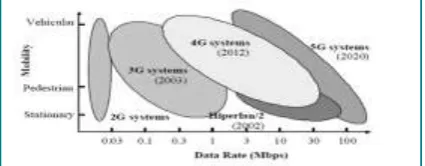
mobile systems are shown in Figure 1 where noted that the increase in data rates and mobility is a major goal in
wireless communication systems advance.
Before describing the requirements of the next generation, we can look at Figure 2 that shows the evolution of
radio access. The first generation systems were analog and could not provide data access. The second generation
systems, which were launched around 1995, had digital technologies and could work with data access. However,
the data transmission rate of these systems was not sufficient to provide multimedia services. The third
generation systems were launched around 2000 to provide multimedia services [4].
Figure 2 Mobile Multimedia Services [4].
The rapid growth of internet and increasing interest in portable computing devices are likely to push demand for
high-speed wireless data services with aggregated higher information bit rates. High throughput is needed
especially in the downlink because the number of downloads of large data files from web sites and servers are
expected to increase. 3G and Wireless broadband technologies are converging to accommodate these
requirements by Beyond 3rdGeneration (B3G) systems [5].Such systems are categorized under Fourth
Generation (4G) and are predicted to provide packet data transmission rates of 100 Mbps in outdoor
macro-cellular environments and up to 1 Gbps in indoor and micromacro-cellular environments. While wide-band systems
could be a natural choice to provide high data rates, service providers have to pay dearly for the spectrum
necessary. Hence, spectrum efficiency is always a factor on the choice of any wireless technology. Very
wide-band systems usually require complex receivers as the channel is frequency selective due to the presence of
large number of resolvable multi-paths .Table 1 shows a comparison between 2G, 2.5G, 3G and 4G.
Research has just recently begun on the development of 4th generation (4G) mobile communication systems.
Currently, there are several ongoing research projects regarding the design and development of a high flexible
and scalable next generation (4G) mobile radio access concept with respect to high data rates and spectral
efficiency. For these 4G systems, several attractive candidates of transmission systems exist [678].
Ultimately, 4G networks should encompass broadband wireless services, such as High Definition Television
(HDTV) (4-20 Mbps) and computer network applications (1 - 100 Mbps). This will allow 4G networks to
reduced significantly from 3G networks. The spectral efficiency of 3G networks is too low to support high data
rate services at low cost.
As a consequence one of the main focuses of 4G systems will be to significantly improve the spectral efficiency.
In addition to high data rates, future systems must support a higher Quality of Service (QoS) than current
cellular systems, which are designed to achieve 90 – 95 % coverage [9], i.e. network connection can be obtained
over 90 – 95 % of the area of the cell. This will become inadequate as more systems become dependent on
wireless networking. As a result, 4G systems are likely to require a QoS closer to 98 - 99.5 %.
II.
RELATED
WORK
What has been seen and observed in recent years is a remarkable increase in the Broadband Wireless Access
(BWA) networks as the need for broadband and mobile services are getting into demand. BWA is increasingly
acquiring a great deal of popularity as an alternative "last-mile” technology to DSL and cable modems.
In today’s world, a large number of wireless transmission technologies exist. These technologies are distributed
over different network families depending upon the network scale such as PAN, WLAN, WMAN and WAN. As
the demand for data transmission with higher rates changed so is the focus on the deployment of wireless
networks. Technologies that promise to deliver higher data rates are attracting more and more vendors and
operators towards them. One of the most promising candidates of such arising technologies is WiMAX.
Many researchers do believe that WiMAX can move the wireless data transmission concept into a new
dimension. There are basically three limiting factors for transmitting high data rate over the wireless medium
that mainly include multi-path fading, delay spread and co-channel interference. The published WiMAX
standard (IEEE 802.16d) describes a MAC layer and five physical layers, each suitable for particular application
and frequency range [10]. Wireless MAN-OFDM is one of them [11]. The Wireless MAN-OFDM interface can
be extremely limited by the presence of fading caused by multi-path propagation and as result, the reflected
signals arriving at the receiver are multiplied with different delays, which cause Inter-symbol interference (ISI).
OFDM basically is designed to overcome this issue and for situations where high data rate is to be transmitted
over a channel with a relatively large maximum delay. If the delay of the received signals is larger than the
guard interval, ISI may cause severe degradations in system performance.
Recent studies have combined CDMA with Orthogonal Frequency Division Multiplexing (OFDM) to allow
efficient use of available spectrum while retaining many advantages available in the CDMA system. This
combination of OFDM-CDMA (MC-CDMA) is a useful technique for 4G systems where you need variable data
rates as well as reliable communication systems. By making a hybrid combination of OFDM and CDMA,
MC-CDMA enjoys the advantages of both systems.
WiMAX is one of the hottest broadband wireless technologies around today. And this gave me motivation to
make this research for study and comparison the performance of the OFDM and MC-CDMA systems used for
fixed and mobile WiMAX.
III.
DESIGN
ISSUES
3.1 Simulation Model
This section discusses the simulation model proposed in this paper. As we have stated before, our research goal
is to evaluate performance of physical layer for fixed and mobile WiMAX using OFDM and MC-CDMA, then
as the propagation environment. A system model is created and implemented in MATLAB 7. The basic of
creating this model is to understand OFDM system in general and to evaluate the performance of 802.16d&e
OFDM and MC-CDMA PHY layers used for fixed and mobile WiMAX , respectively.
Before simulation, the OFDM symbol parameters are discussed. The parameters values are taken from the IEEE
802.16d&e standards developed for WiMAX. The relations between these parameters are illustrated in the
following section.
3.2 OFDM Symbol Description
The IEEE 802.16d PHY layer is based on OFDM modulation. OFDM waveform is created by Inverse Fast
Fourier transforming (IFFT). Once the OFDM signal is converted into time domain, this time duration is
referred to as useful symbol time Tb [10]. A copy of the last part of the useful symbol period (Tb), termed cyclic
prefix (CP), is appended at the beginning of each symbol to maintain the orthogonality of the tones. From all
these OFDM symbol characteristics, some parameters can be defined. Figure 3 shows the OFDM symbol
representation in the time domain.
Figure 3 Time Domain Structure of OFDM Symbol
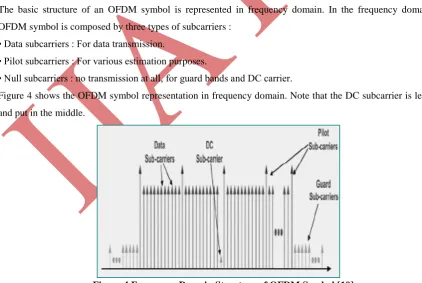
The basic structure of an OFDM symbol is represented in frequency domain. In the frequency domain, an
OFDM symbol is composed by three types of subcarriers :
• Data subcarriers : For data transmission.
• Pilot subcarriers : For various estimation purposes.
• Null subcarriers : no transmission at all, for guard bands and DC carrier.
Figure 4 shows the OFDM symbol representation in frequency domain. Note that the DC subcarrier is left zero
and put in the middle.
Figure 4 Frequency Domain Structure of OFDM Symbol [10]
3.3 OFDM Symbol Parameters For Wimax
In order to describe an OFDM system, a number of terms are used to specify the parameters of the physical
Figure 5 Definitions Of OFDM Terms In Wimax [12]
There are two types of OFDM parameters (primitive and derived) that characterize OFDM symbol completely.
The later one can be derived from the former one because of fixed relation between them. The following are
some important definitions of OFDM parameters.
Number of data sub-carriers, Ndata:
It is the subcarriers that data symbols are allocated on at the transmitter.
Number of pilots sub-carriers, Npilot :
They are used to synchronize the receiver to the transmitter by means of phase , frequency and timing. They are
used to estimate the channel at the receiver.
Number of guard subcarriers, Nguard:
The guard subcarriers are the outer carriers , which are not used for transmission. They are , also, called virtual
sub-carriers.
Number of used subcarriers, Nused :
N used = Ndata + Npilot
FFT size ,N FFT:
N FFT specifies the number of samples for this processing step and is always a power of 2. It is specified to be
the smallest power of two, and greater than Nused. It can be found as in the following formula.
Nominal Channel Bandwidth, BW: The bandwidth which is allocated for example by the governmental
authorities. For WiMAX, BW extends from 1.75 MHz to 20 MHz.
Used Channel bandwidth,BWused:
The used bandwidth can be calculated by:
BWused = Nused. Δf
Sampling factor ,n :
Sampling time,Ts:
Subcarrier spacing,Δf:
The distance between two adjacent physical OFDM subcarriers is called subcarrier spacing. Its value is calculated
by:
Useful symbol time,Tb:
Guard period ratio,G:
To completely eliminate even the very small ISI that results, a particular ratio of the useful symbol is added to
the OFDM symbol. This ratio is called guard ratio (typical values of G: 1 / 4, 1 / 8, 1 / 16,1 / 32 ).
IV.
IMPROVED
ALGORITHMS
The simulation contains two systems, the first one is Fixed and Mobile WiMAX with OFDM system, the other is
Fixed and Mobile WiMAX with MC-CDMA.
They are described as following.
4.1 Simulation of WiMAX with OFDM System
The baseband PHY transmitter/Receiver consists of three major parts :
1. Channel Coding / Decoding.
2. Modulation / Demodulation.
3. OFDM transmitter / Receiver.
General block diagram of OFDM system is shown below in Figure 6.
Figure 6 General Block Diagram of OFDM System
In brief, the simulation can be summarized in the following steps:
Step-1: Implementation of OFDM Transmitter Module.
Step-2: Implementation of Channel Module
Step-3: Implementation of Receiver Module.
Step-5: Complete system implementation.
Step-6: BER and spectral efficiency plots for the complete system model.
Step-7: Do the same steps with MC-CDMA (just add spreading to OFDM system).
The main procedure of the code contains initialization parameters and input data. The parameters that can be set
at the time of initialization are the number of sub-carriers, the nominal bandwidth, CP length, symbol
modulation level and coding rate, range of the bit energy to noise rate (Eb/No) values (from 0 to 40 dB) and
channel model parameters for simulation. The input data stream is randomly generated. Output variables are
available in MATLAB workspace while bit error rate (BER) values for different Eb/No are stored in text files which facilitate to draw plots. Each single block of the transmitter is tested with its counterpart of the receiver
side to confirm that each block works perfectly. In our model, the simulation of the system is repeated and the
number of transmitted bits and bit errors are calculated for each simulation. At the end, BER is estimated as the
ratio of the total number of observed errors and the total number of transmitted bits. The performance of the
system model is tested using different modulation schemes i.e., BPSK, QPSK, 16-QAM and 64-QAM with an
SUI-3 channel model for Fixed WiMAX and COST 231 Hata model for Mobile WiMAX with various mobile
receiver speeds.
Simulation can be summarizing into 4 types:
1. Fixed WiMAX with OFDM system.
2. Mobile WiMAX with OFDM system.
3. Fixed WiMAX with MC-CDMA system.
4. Mobile WiMAX with MC-CDMA system.
The objective behind simulating in MATLAB is to study BER performance under different parameters that
characterize the performance. These parameters are taken from standard IEEE802.16 which is designed for
WiMAX. After simulation of OFDM system, we just add the spreading to the system to get MC-CDMA system.
We chose Hadamard code with different spreading code lengths.
Through numerous comparisons between simulation results that will be obtained with different simulation
parameters, some discussions about the use of these different parameters and options that intern reflects
complete view on the better manner of performance of the transmission.
V.
CONCLUSION
Among the study of advancing toward the next generation of wireless systems (4G), we find that the wireless
communications industry is gaining momentum in both fixed and mobile applications. WLANs and 3G cellular
networks are experiencing several difficulties for reaching a complete mobile broadband access, bounded by
factors such as bandwidth, coverage area, or infrastructure costs.
Wireless technologies are currently limited to some restricted services, but by offering high mobility, high data
rate and high QoS wireless technologies will offer new alternatives. Offering a trade-off between coverage, data
rate, and mobility with generic air interface architecture is the primary goal of the next generation of wireless
systems (4G).
Besides the introduction of new technologies to cover the need for higher data rates and new services, the
integration of existing technologies in a common platform is an important objective of the next generation of
Therefore, new physical layer and multiple access technologies are needed to provide high-speed data rates with
flexible bandwidth allocation. By comparing the WiMAX, Wi-Fi and 3G technology, we observed that
WiMAX offers better services than the Wi-Fi and 3G. WiMAX network can be a good choice to fill up the gap
between the Wi-Fi hotspots. It also resolves some of the technical difficulties of cellular network.
This paper aim at study of the Fixed and Mobile WiMAX system based on OFDM and MC-CDMA systems.
The performance study of these systems is proposed by MALAB simulation and the parameters are depending
on the IEEE 802.16 standards
.
VII.
FUTURE
WORK
For the optimization of WiMAX system performance a lot of related work can be done in the future as Adaptive
modulation and coding mechanism can be used at the receiver and the transmitter according to the channel
conditions, Turbo coding can be used to study the performance comparing with the other channel coding types,
Adaptive antenna systems (AAS) can be simulated to enhance the performance, IEEE 802.16 standard provides
the support for implementing advanced multi-antenna solutions which improve the system performance,
Adaptive sub-carriers and power allocation is another field of study in WiMAX, In our MC-CDMA, we applied
the spreading in the frequency domain but it can be two-dimensional spreading, One can study by simulation,
the trade-off between the system performance and the bandwidth used, WiMAX MAC layer architecture
supports various types of QoS requirements. Finally, WiMAX is really a very attractive technology to
researchers and wireless communications vendors. I think WiMAX with LTE will give huge advance to reach
4G requirements in the next days
REFERENCES
[1] Ahmadzadeh, A. (2008) Capacity and Cell-Range Estimation for Multitraffic Users in Mobile WiMAX ,
Master Thesis , University of Borås : Högskolan.
[2] Suleesathira, R. (2007) Adaptive MIMO MC-CDMA Communications Design for Future Cellular Systems,
Access date, April 20, 2009, from: http://www.kmutt.ac.th/rippc/mimo.htm.
[3] Eric, P. (2001) Adaptive Techniques for Multiuser OFDM , Ph.D. Thesis, James Cook University,
Australia.
[4] Kawabata, K., Ohuchi, K. and Seki, H. (2006) Radio Access Schemes and Technologies for
Next-Generation Network, FJITSU Sci. Tech. J., (vol.42, no.4): pp. 494-501.
[5] Thenmozhi1, K., Varadarajan, R. and Prithviraj, V. (2006) MC-CDMA promises wireless broadband
beyond 3G, India :Electronic Engineering Times-Asia.
[6] Fazel , K. and Kaiser, S. (2003) Multi-Carrier and Spread Spectrum System, 2nd edition, New York : John
Wiley and Sons Ltd.
[7] Atarashi, H., Maeda, N., Abeta, S., and Sawahashi, M. (2002) Broadband packet wireless access based on
VSF-OFCDM and MC/DS-CDMA, in Proc. PIMRC (Lisbon, Portugal) , September 2002: pp. 992–997.
[8] Svensson, A., Ahlen, A., Brunstrom, A., Ottosson, T., and Sternad, M. (2003) An OFDM based system
proposal for 4G downlinks , in Proc. MC-SS 2003, (Oberpfaffenhofen, Germany), September 2003: pp.
[9] Sanjiv, N., Krishna, B., and Sarath, K. (2002) Adaptation Techniques in Wireless Packet Data Services,
IEEE Communications Magazine, January 2000: pp. 54 – 64.
[10] IEEE (2004) ,IEEE standard for local and metropolitan area networks Part 16: Air Interface for Fixed
Broadband Wireless Access Systems , New York : IEEE.
[11] Li, Y. and Kenyon, D. (2005) An Examination of the Processing Complexity of an Adaptive Antenna
System (AAS) for WiMAX (Lecture), Southampton : The 2nd IEE/EURASIP DSP Enabled Radio
Conference , September 2005.
![Figure 2 Mobile Multimedia Services [4].](https://thumb-us.123doks.com/thumbv2/123dok_us/9218455.1457365/2.595.68.524.145.653/figure-mobile-multimedia-services.webp)
![Figure 5 Definitions Of OFDM Terms In Wimax [12]](https://thumb-us.123doks.com/thumbv2/123dok_us/9218455.1457365/5.595.170.416.78.200/figure-definitions-ofdm-terms-wimax.webp)

