RUSC Vol. 12 No. 1 |UniversitatObertadeCatalunyaandUniversityofNewEngland|Barcelona, January2015 CC L. Y. Alemán de la Garza, T. Sancho-Vinuesa and M. G. Gómez Zermeño |CC by FUOC, 2015 |Indicators of pedagogical quality for the design… Recommended citation
Alemán, L. Y., Sancho-Vinuesa, T., &GómezZermeño, M. G. (2015). IndicatorsofpedagogicalqualityforthedesignofaMassiveOpenOnline Courseforteachertraining. RUSC. Universities and Knowledge Society Journal, 12(1). pp. 104-118. doihttp://dx.doi.org/10.7238/rusc.v12i1.2260
Abstract
MassiveOpenOnlineCourses(MOOCs)havegeneratedhighexpectationsandrevolutionizedsomeeducational practicesbyprovidingopeneducationalresourcesforreference, usageandadaptation;therefore, theirpedagogical qualityisoftenquestioned. Theobjectiveofthisstudyistoidentifyindicatorsrelatedtopedagogical, functional,
technologicalandtimefactorsinordertoassessthequalityoftheMOOCentitled“Liderazgo en gestión educativa
estratégica a través del uso de la tecnología”(Leadershipinstrategiceducationalmanagementthroughtheuseof
technology), offeredasateachertrainingprogramthroughCourserato10.161participants. ViatheDelphimethod,
agroupof55expertsagreedthattimeisakeyfactortobeconsideredinthedesignoflearningactivities. Itwas concludedthatwithoutmeasuringresults, thesuccessofaMOOCcouldnotbeevaluated;thus, institutionsand consortiamustestablishevaluationindicatorstofocustheireffortsontheenhancementofpedagogicalquality. By providingrelevantinformation, thelearningpotentialofeducationalresourcesbasedonconnectivismprinciples canbeevaluated, and socanthequalityofMOOCs. The goalistocontributetoavisionofafuture inwhich everyonehasaccesstoaworld-classeducation.
Keywords
MassiveOpenOnlineCourses, MOOC, evaluation, pedagogicalquality, teachertraining
Indicators of pedagogical quality for the design of
a Massive Open Online Course for teacher training
Lorena Yadira Alemán de la Garza
1, Teresa Sancho-Vinuesa
2and Marcela Georgina Gómez Zermeño
31. MonterreyInstituteof TechnologyandHigherEducation(ITESM), Mexico|
2. OpenUniversityofCatalonia(UOC), Spain|[email protected]
3. MonterreyInstituteof TechnologyandHigherEducation(ITESM), Mexico|
Submittedin:June2014
RUSC Vol. 12 No. 1 |UniversitatObertadeCatalunyaandUniversityofNewEngland|Barcelona, January2015 CC L. Y. Alemán de la Garza, T. Sancho-Vinuesa and M. G. Gómez Zermeño |CC by FUOC, 2015 |Indicators of pedagogical quality for the design…
Indicadoresdecalidadpedagógicaparael diseñodeuncursoen líneamasivoyabierto
deactualizacióndocente
Resumen
Los cursos en línea, masivos y abiertos (MOOC) han generado importantes expectativas y han revolucionado algunas prácticas educativas, al ofrecer recursos educativos abiertos para su consulta, uso y adaptación; sin embargo, con fre-cuencia se cuestiona su calidad pedagógica. El objetivo de este estudio es identificar indicadores relacionados con factores pedagógicos, funcionales, tecnológicos y de tiempo, para evaluar la calidad del MOOC Liderazgo en gestión educativa estratégica a través del uso de la tecnología, ofrecido como recurso de actualización docente en Coursera a 10.161 parti-cipantes. Mediante el método Delphi, un grupo de 55 expertos acordó que el tiempo es un factor clave a considerarse en el diseño de las actividades de aprendizaje. Se concluye que sin medición de los resultados no se puede valorar el éxito de un MOOC, por ello instituciones y consorcios deben establecer indicadores de evaluación para enfocar sus esfuerzos para la mejora de su calidad pedagógica. Si se proporciona información relevante se podrá evaluar el potencial de aprendizaje que poseen los recursos educativos basados en principios conectivistas y reconocer la calidad pedagógica de los MOOC, con el objetivo de coadyuvar a la visión de un futuro en el que todos tengan acceso a una educación de clase mundial.
Palabras clave
RUSC Vol. 12 No. 1 |UniversitatObertadeCatalunyaandUniversityofNewEngland|Barcelona, January2015 CC L. Y. Alemán de la Garza, T. Sancho-Vinuesa and M. G. Gómez Zermeño |CC by FUOC, 2015 |Indicators of pedagogical quality for the design…
1. Introduction
Currently, Massive Open Online Courses, or MOOCs, have generated high expectations and revolutionized
pedagogicalpracticesbyprovidingopeneducationalresourcesforreference, usageandadaptation(UNESCO, 2012).
c-MOOCs, whichgaverisetothisphenomenon, adoptedapedagogicalstrategywithanepistemologicalbasis
groundedinconnectivism;theyalsopromotededucationalchange, notonlythroughtechnologicaladvances, but
alsothroughthetheoreticaldevelopmentsthatemergedfromthis fieldofstudy(Zapata-Ros, 2013). Theyprovided
accessopportunitiestothegeneralpublicandwerefacilitatedbyrenownedprofessionalswhotookavitalrole.
Thus, c-MOOCsmadeknowledgefromawiderangeofprestigiousuniversitiesavailabletothewholeworldata
speed, scope, scaleandpricethatnotraditionalcoursewouldbeinapositiontooffer(Bell, 2012). Justadecade
ago, thistypeoftrainingwouldhavebeenimpossiblewithoutthecurrentadvancesoftechnology(Friedman, 2013;
Skiba, 2013).
Siemens(2004)positsthatconnectivismisaneducationaltheorycharacterizedbyconsideringlearningasan
extensionofapersonalnetworkthroughwhichparticipantslearn, shareknowledgeandcomprehend. Heclaimed
thatthemost importantcontributionofMOOCsresidedintheirpotentialtochangetherelationshipbetween
studentsandteachers, academiaandthecommunityat large, byofferingabroadand diversevirtual space, a
meetingplacefortheexchangeofideas. HeemphasizedthatanyoneenrollingonaMOOCwouldprobably find
learninginitsmostexposedform, throughplatformsthatnotonlyinvitedparticipantstoseeandhear, butalsoto
participateandcollaborate.
Despiteitsrapidintegrationintotheeducationaloffering, theInstituteforProspective TechnologicalStudies
claimsthatthecriteriaforevaluatingtheeducationalqualityofaMOOClacktransparencyandwarnsthat, forthe
moment, theimplementededucationalmodels areevidentlynotsustainable(Aceto, Borotis, Devine, &Fischer,
2014).
ForSangràandWheeler(2013), themassiveaspectofthecourses, whichispromotedassomethingpositive,
hasneverbeenafeatureofsuccessfultraining. Theybelievethat, inMOOCs, informallearninghasfoundaperfect
allyinICT ingeneral, andinonlinelearninginparticular. ThisemphasizestheneedtoinvestigateMOOCsindepth
inordertoestablishwhethertheyrepresentrealopportunitiesforlearningininformalsettings, oriftheyaresimply
attemptstoformalizetheinformal.
ThisarticlepresentstheresultsofastudyaimedatidentifyingindicatorsfortheeducationalqualityofaMOOC,
whichwillgreatlyimprovethedesignofthecourseentitled“Liderazgo en gestión educativa estratégica a través del
uso de la tecnología”(Leadershipinstrategiceducationalmanagementthroughtheuseoftechnology), offeredasa
teachertrainingupdatestrategybyahighereducationinstitution. Intheanalysis, theassessmentoftheindicators
byagroupof55expertsispresented, andtheprofileandexpectationsof10,161participantsinthe firsteditionof
thecoursearedescribed.
1
.
1
.
Background
Although the history of MOOCs may seem short in absoluteterms, Boven (2013) locates its origins in open
anddistance education. Henotesthatmanyemergingmovementshaveadoptedtheprinciplesadvocatedby
RUSC Vol. 12 No. 1 |UniversitatObertadeCatalunyaandUniversityofNewEngland|Barcelona, January2015 CC L. Y. Alemán de la Garza, T. Sancho-Vinuesa and M. G. Gómez Zermeño |CC by FUOC, 2015 |Indicators of pedagogical quality for the design…
havesooftenbeendescribedas“recurrentresourcesinthediscourseofeducationalopenness”(McAuley, Stewart,
Siemens, &Cormier, 2010, p. 46).
Asitsname suggests, aMOOCisanonlinecourseaccessibletovirtuallyanyone whowishes toparticipate
withunlimitedattendance(EDUCAUSE, 2011). For TschofenandMackness(2012), MOOCsareonlinecoursesthat
appealtoawidevarietyofparticipantsaroundtheworld;theyaremassivebecauseliterallythousandsofpeople
canparticipateinthem, andtheyareopenbecauseparticipantscanopenlyshareresources, ideasandexperiences
withoutanyrequirements. Theyconstituteacollectivecreationofknowledge, resultinginacompositiongreaterthan
thesumofitsparts. Inmanyways, theyareamicrocosmofanation(Liyanagunawardena, Adams, &Williams, 2013).
Whilereviewingtheeducationalresearchundertaken, ever-increasinginterestinthestudyofMOOCsinrecent
yearswasnoted. Thiscontemporaryinterestismanifestedintheevolutionoftheirconceptualreferencesandthe
definitionoftheirmainfeatures. AccordingtoRodriguez(2012), theterm‘MOOC’wascoinedbyDaveCormierwhen
thenumberofstudentsonthe courseentitled“Connectivism andConnectiveKnowledge(CCK08)”offeredby
GeorgeSiemensandStephenDownesreachedatotalof2,300. Afteranalyzingtheresultsoftheirexperience, they
couldseeMOOCsasanewmodalityofonlineeducationandstatedthatitsimplementationrequiredconceptual
changesintheprocessesofteachingandlearning, fromtheperspectiveofteachersandstudentsalike.
1
.
2
. T
heoretical
perspectives
on
learning
In pedagogy, learning theories are the basis of educational processes, and they often refer to principles of
behaviorism, cognitivismandconstructivismtocreateinstructionalenvironments. Addingtechnologytoexisting
learningtheoriesraisesmanyquestions andpromptstheorists toreviewthem continuously, inordertoadapt
them as learning conditions change. These three theories weredeveloped at a time when learning had not
beenimpactedbytheuseoftechnologyineducation. Atsomepoint, theunderlyingconditionshavebeenso
significantlyalteredthatadditionalmodificationsare nolongerfeasible. Aninterconnected worldallowsusto
explorehowinformationisacquired;connectivistenvironmentshavefacilitatedthecreationofnetworkstoshare
resources, ideasandexperiences, andtheymustbeevaluated. Facedwiththisnewreality, acompletelydifferent
approachisnecessary(Siemens, 2004).
The SCOPEO (2013) report confirms that the“first generation”of MOOCs was based on connectivism, a
pedagogicaltheorythatpositsthatpersonalknowledgeiscreatedfromanetworkthatprovidesitsmemberswith
information. Inturn, thesemembersprovidefeedbackwithadditional informationgeneratedwithin thesame
network. Theprocessendswhenthisinformation, whichmaycomefromdifferentnodes, transformsandaltersthe
knowledgebase, andgeneratesnewlearningforindividuals. ForChiecherandDonolo(2013), MOOCshavebroken
curricularrigidity, questioningtheabilityoftraditionalteachingtomeettrainingneedsinchangingconditions.
Training offerings in which teaching differs from the what is commonly referred toas “traditional classroom
education”arebeingoverwhelminglyadopted. Thishasgivenrisetocriticalreflectionontheperceptionoflearners
–andissomethingthatdemandsaparadigmshift.
AddressingthefutureofMOOCs, someexpertspredictthattheywillmutateintodifferentformsoflearningwith
agreateremphasisonparticipants’supportandadecreaseontheirnumbertoallowadequateattention. Experts
emphasizetheneedtoimplementevaluationsystemstoestablishpedagogicalqualitycriteriathatgobeyond
RUSC Vol. 12 No. 1 |UniversitatObertadeCatalunyaandUniversityofNewEngland|Barcelona, January2015 CC L. Y. Alemán de la Garza, T. Sancho-Vinuesa and M. G. Gómez Zermeño |CC by FUOC, 2015 |Indicators of pedagogical quality for the design…
1
.
3
.
Indicators
of
the
educational
quality
of
a
MOOC
Fortheeducational community, itis arealitythat the useoftechnology in teachingpractices has ledtothe
emergenceofmodernsocialstructuresandorganizationalforms, inwhichthetraditionalspaceandtimereferents
arenolongervalid(Garrido, 2003). Giventhelackofspaceandthegrowingdemandforadmissiontoeducational
institutions, onlineeducationisrenownedforofferingopportunitiestoexpandtheeducationalrangeandcoverage.
ForMoore(2013), distanceeducationisapsychologicalconstructthatdependsonmacrofactorssuchasdialogue,
structureandautonomy.
Inrelationtotheirpedagogicaldesignandtothelearningexpectationsofstudents, MOOCsimplyachangeof
instructionalschemes. At first, theirstructurewasthoughtofinaminimalistwaytoallowparticipantstodesigntheir
ownlearning, butresearch findingshavesincerevealedthat, inordertoimprovetheirpedagogicalquality, multiple
factorsrelatedtohow, whereandwhenparticipantslearnmustbeconsidered(TheNewMediaConsortium&
UniversitatObertadeCatalunya, 2012).
Although MOOCs imply the design of new schemes that recognize studies outside the classroom, the lack
ofstandardsforevaluatingtheirpedagogicqualityisoftenquestioned(Bernal, Molina, &Perez, 2013). ForGómez
-Zermeñoand Alemán(2012), the integrationoftechnologyintoeducationalprocessesrequiresthe establishment
ofboththeoreticalfoundationsand evaluationmechanisms toidentifytheirnumeroussourcesofinfluence. They
pointoutthatthedesignoftechnology-basedstrategiesthatseektostrengthenaccesstoqualityeducationposes
significantchallengestoeducationalresearchersyetoffersattractiveadvantagesthatcouldencouragetheiradoption.
IntheMOOCQualityProjectbytheEuropeanFoundationforQualityeLearning, itbecameapparentthatthe
evaluationofMOOCswasmorecomplicatedthaninotheronlineofferingsduetothelackofanagreeddefinition
onwhattheyare, totheinvolvementofperceivedexternalfactorsandtothelackofconsensusontheirpurpose
(EFQUEL, 2013). Bernal etal. (2013)recommendthat MOOCsshouldapplythesamequalitystandardsused in
formalopenanddistancecourses. Thefactthattheyaremassive, openandonlinecallsforgreaterrigorintheir
qualityinordertoovercomedissimilarprofilesandalackofmonitoringofresultsandobjectiveattainment.
Inassessingtheeducationalqualityofdistanceeducationandopenlearningresources, Arias(2007), Cabero
and Romero (2007), Gómez-Zermeño (2012), Gómez-Zermeño, Rodríguez, and Márquez (2013), Domingo and
Marquès(2011), andRoigetal. (2013)usedindicatorsrelatedtopedagogical, functionalandtechnologicalfactors.
ForBarbera, Gros, andKirschner(2012), timeisacriticalfactorthathasalsobeenusedasaqualitymeasure, since
itisrelatedtotheamountandthesequenceinwhichpeoplelearnthroughtheaccumulationofexperiences. In
collaborativelearningenvironments, theimplementationofstrategiesthatpromoteparticipants’self-regulationis
recommended(Franco-Casamitjana, Barbera, &Romero, 2013).
2. Method
Theobjectives ofthisresearchcanbeaddressed viadifferentmethodologies. Given theobject ofstudy, aquasi
-experimental design was adopted. Cross (2013) claims that educational research into MOOCs generates large
methodologicalandinterpretivechallenges, asitposesnewdynamicsintheteaching-learningprocess. Strengthening
RUSC Vol. 12 No. 1 |UniversitatObertadeCatalunyaandUniversityofNewEngland|Barcelona, January2015 CC L. Y. Alemán de la Garza, T. Sancho-Vinuesa and M. G. Gómez Zermeño |CC by FUOC, 2015 |Indicators of pedagogical quality for the design…
researchintoaneducationalinnovationmayhaveaquasi-experimentaldesignthatdoesnotrequireevaluationofa
randomsample. Moreover, theresultsaremeasurablewithonepost-testgroup(Shadish, Cook, &Campbell, 2002).
Regardingqualityindicatorstostrengthenthedesignofacourseofthisnature, asetofindicatorswasselected
fromstudiesby Arias(2007), Barberaetal. (2012), CaberoandRomero (2007), Franco-Casamitjanaetal. (2013),
Gómez-Zermeño(2012), Gómez-Zermeñoetal. (2013), Domingo andMarquès(2011), andRoigetal. (2013). A
groupofexpertsreviewedandvalidatedtheseindicatorsusingtheDelphimethod. Thismethodinvolvesselecting
a groupof experts, who are asked theiropinion on issues relating to the future, implementing consecutive
anonymousroundstoensuretheautonomyofparticipants. Thepredictivepowerofthismethodisbasedonthe
systematicuseofintuitivejudgmentbyallexperts(Astigarraga, 2003).
Oncethesetofselectedindicatorshadbeenidentified, aquestionnaireentitled“MOOC-I-QualityIndicators”
wasdesigned,consistingofclosedquestionsthatassess50indicatorsona4-pointLikertscale. Fortheanalysis, the
indicatorswereclassifiedinto15subcategoriesrelatedtoPedagogical, Functional, Technologicaland Timefactors
(Table1). Thisinstrumentwasappliedtoagroupof55expertsinvolvedinthedesign, developmentanddeliveryof
MOOCs, aswellasindistanceeducationcoursesandopenlearningresourcesofferedbytheinstitution. Thisgroup
wasformedby14lecturersresponsiblefordesignandcontentgeneration, andatotalof41tutors, instructional
designers, graphicdesigners, programmersandaudiovisualproducers.
Based on studies by Breslow, Pritchard, DeBoer, Stump, Ho, and Seaton (2013), the“MOOC-I-Participants’
Information”questionnaire, madeupof30questionsgatheringdemographic, employment, educationalupdate,
expectationandopiniondatafromthoseonthecourse, wasdesigned. Takingintoconsiderationtheassessment
madeby the experts for indicatorsof pedagogicalquality, the MOOC entitled“Liderazgo en gestión educativa
estratégica a través del uso de la tecnología”(Leadershipinstrategiceducationalmanagementthroughtheuseof
technology)wasdesignedandofferedasateachertrainingupdatestrategy;thisquestionnairewasadministered
to10,161participantsonthe firsteditionoftheMOOC.
3. Results Analysis
Alignedwiththeobjectivesofthisresearch, theanalysisoftwodifferentissuesispresented. First, theassessment
ofqualityindicatorsforthedesignofMOOCsand, second, aftertheMOOCinquestionhadbeendesignedand
implemented, thestudents’profilesandexpectations.
3
.
1
.
Indicators
for
assessing
the
pedagogical
quality
of
a
MOOC
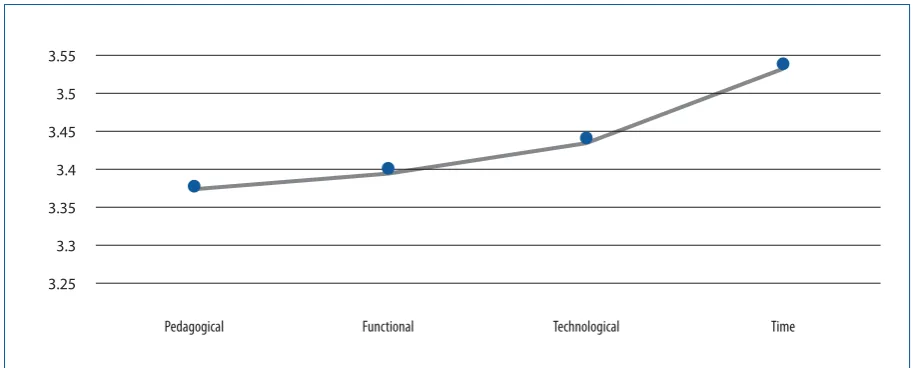
TheresultsoftheDelphimethodshowthatwhileexpertsratedtheindicatorsrelatedtothe Timefactorhigher, they
alsorecognizedthatthequalityofaMOOCmusttaketheotherfactorsintoaccount(Figure1). Itisworthnotingthat
theindicatorforthetimetoTake examswasratedthehighest. StudiesbyBarberaetal. (2012)corroboratethattime
remainsacrucialstrategicissueinonlineteaching, requiringexplicitattentionfromteachersanddesigners, since
itaffectsstudents’learning. ForFranco-Casamitjanaetal. (2013), timemanagementskillsdetermineself-regulation
ofstudentsandmembersofagroupalike(Guitert, 2011). Indistanceeducation, autonomyreferstotheextentto
RUSC Vol. 12 No. 1 |UniversitatObertadeCatalunyaandUniversityofNewEngland|Barcelona, January2015 CC L. Y. Alemán de la Garza, T. Sancho-Vinuesa and M. G. Gómez Zermeño |CC by FUOC, 2015 |Indicators of pedagogical quality for the design…
Figure 1.Indicator categories
Pedagogical Functional Technological Time
3.25 3.3 3.35 3.4 3.45 3.5 3.55
%
%
%
%
When analyzingthe results by subcategory (Table 1), the expertsconsidered the pedagogical quality of
thecontentofaMOOCtobearelevantfactor. Theyalsorecommendedareviewofthepedagogicalapproach, the
provisionoftutorialsandthespecificationoftheevaluationprocessofeducationalactivities. ForMoore(1983),
the contentortopicofstudy determinesthedialoguebetweenteachersandlearners;italsoconstitutesone
ofthemaincharacteristicsofopeneducationalresources. Thus, excellentqualityshouldbeensured(UNESCO,
2012).
Table 1.Results of indicator assessment by subcategory
Category Subcategory Result
Pedagogical 3.37
Contents
Pedagogical approach
Tutorial andevaluation
Adequacyandadaptationtousers
Motivational capacity
Resources 3.60 3.47 3.44 3.29 3.27 3.15 Functional 3.4
Ease of use
Autonomyandusercontrol
Functionalityofthedocumentation
3.72 3.44 3.03
Technological 3.43
Interaction and dialogues Navigation
Visual environment
Designandtechnology
Versatility
3.61 3.52 3.52 3.44 2.97 Time 3.53 Take exams Performactivities Performexercises
Studythetopics
Calendar / Schedule
Participateindiscussionboards
RUSC Vol. 12 No. 1 |UniversitatObertadeCatalunyaandUniversityofNewEngland|Barcelona, January2015 CC L. Y. Alemán de la Garza, T. Sancho-Vinuesa and M. G. Gómez Zermeño |CC by FUOC, 2015 |Indicators of pedagogical quality for the design…
Regardingthesubcategoriesoffunctionalfactors, expertsbelievethatEase of useisanimportantfactor, followed
byAutonomy and user control, andFunctionality of the documentation. UnderthesubcategoryEase of use, theindicator
“Exerciseinstructionsareclearandeasytounderstand”waspositivelyvalued, while“Theactivitiessuggesttheuse
of additional documents (blogs, wikis, etc.)” was considered less important. Among the Technological factors,
the subcategories Interaction and dialogues, Navigation and Visual environmentwere rated highly, while Versatility
was not considered relevant. The experts mentioned, in relation to the indicators of Interaction and dialogues,
that communication is one ofthe mostimportant elements, emphasizing the importance of makingmeans of
communicationavailabletofosterexchangesamongandbetweenparticipants(discussionboards, news, etc.)andtutors.
Intheexperts’opinion, MOOCsenablethecomprehensivedevelopmentofcompetitivecitizenswhoareable
topositionthemselvesasagentsofchange. Expertsrecognizethattomeetthegrowingdemandforeducation,
theadoptionofinnovativemodelsthatdevelopcommitmentandlinkagebetweenparticipantsisrequired(Brown,
2013). Suchmodelsshouldalsoemphasizetheneedtoimplementanevaluationsysteminordertoimprovethe
educationalqualityofresourceslikeMOOCs.
3
.
2
.
Participants’
pro
fi
les
and
expectations
Basedonthequalityindicatorsassessedbyexperts, theMOOCentitled“Liderazgo en gestión educativa estratégica
a través del uso de la tecnología”(Leadershipinstrategiceducationalmanagementthroughtheuseoftechnology)
wasdesignedandimplementedusingtheCoursera’®platform. Forthreeweeks, thecallformassparticipationin
thecoursewasdisseminatedviainstitutionalelectronicmediaandsocialnetworks. A totalof10,161participants
enrolledontheMOOCinquestion. Theparticipantswerefrom79countrieslocatedinallcontinents: The Americas
90.0%, Europe9.0%, Asia0.6%, Oceania0.1%and Africa0.1%. AccordingtoCoursera, 85%ofthestudy’spopulation
camefrom emergingeconomies. OneofthemainfeaturesofaMOOCisits opennesstoenrolment;soallthe
participantswhoconfirmedtheirinterestinvoluntarilyregisteringforfreebyansweringthequestionnaire“MOOC-I-
Participants’Information”formedthepopulationofthisstudy. Table2describestheirmainfeatures.
Table 2: Participants’ profiles on the MOOC entitled “Liderazgo en gestión educativa estratégica a través del uso de la tecnología” (Leadership
in strategic educational management through the use of technology)
Data Characteristics Responses
S
O
C
IODE
M
OGR
AP
HI
C
Country of residence
Mexico57%,Colombia 7%,Peru6%,Argentina3%,Chile3%, Ecuador2%,UnitedStates2%,Venezuela
2%,DominicanRepublic2%,Guatemala1%,Brazil 1%, Honduras0.7 %, El Salvador0.7%,CostaRica
0.6%,Bolivia0.5%,Uruguay0.5%,PuertoRico0.3%,Nicaragua0.3%,Paraguay0.3%,Panama0.2%,
Canada0.2%,andwith0.1% Trinidadand Tobago, Haiti, FrenchGuyana
Spain 7%,UnitedKingdom0.3%, Italy0.2%,Russian Federation0.2%,Portugal 0.2%,Germany0.2%,
France0.2%,andwith0.1%Greece,Poland,Switzerland,Belgium, Ireland,Denmark,Ukraine, Turkey,
Norway, TheNetherlands,CzechRepublic, Hungary,Austria,Sweden,Serbia,Romania,Moldavia,Malta,
Macedonia,Lithuania,Latvia,Cyprus,Croatia,Aruba,Andorra
China0.3%,andwith0.1% HongKong,Korea, India,Vietnam, Taiwan,Australia,Philippines, Thailand,
Singapore,New Zealand,NewCaledonia,Mauritius,Malaysia, Japan,Morocco,SouthAfrica,Angola,
Algeria,Pakistan,Kazakhstan, Israel, Iran, IslamicRepublic
Gender Female59.4%andMale40.6%
Age Averageof37 years9monthsold,highestfrequency34yearsold,rangefrom14to 76; 75.0%is45or
RUSC Vol. 12 No. 1 |UniversitatObertadeCatalunyaandUniversityofNewEngland|Barcelona, January2015 CC L. Y. Alemán de la Garza, T. Sancho-Vinuesa and M. G. Gómez Zermeño |CC by FUOC, 2015 |Indicators of pedagogical quality for the design… Data Characteristics Responses
O
CCUP
A
TIO
NAL
Occupation Teacher60.9%,Principal 11.0%,Pedagogical advisor10.9%, Higher2.5%, Inspector0.4%,Student14.2%
Educational level Preschool 8.5%, ElementarySchool 17.6%,SecondarySchool 18.7%, HighSchool 21.4%,Superior33.8%
Geographical zone Urban 76.0%,Rural 11.3%andUrban/Rural 12.7%
Type of school Public56.2%,Private32.8%andPublic/private11.0%
School equipment Mediaroom20.1%, Internetinmediaroom18.8%,Classroom10.4%, Internetinclassroom12.7%,
Principal’soffice17.5%, InternetinPrincipal’soffice17.8%andnone2.7%
TE AC HER TR A I N I N G UP D A TE
Educational level Undergraduate52%,Graduate37%, HighSchool 7%,PhD4%
Years of Service 5yearsor less28.6%,6to10years20.6%,11to15years14.6%,16to20years11.7%,21to25years
7.4%,26to30years5.9%,morethan31years3.5%,Noyearsofservice 7.7%
Frequency of teacher training update
courses
1to2courses53.7%,3to4courses22.0%,5to6courses4.5%,morethan 7 courses2.0%,doesnot
participateinteachertrainingupdatecourses17.7%
Types of teacher training update
courses
National CatalogueofContinuing Education11.3%,Centrefor Trainingand TeachertrainingUpdate9.7%,
National Programof TeachingCareer 7.4%,Requestedcourses21.6%,coursesfrompublicinstitutions
16.5%andcoursesfromprivateinstitutions18.7%andothercourses14.8%
Modality Classroom35.8%,Online19.4%,Blended40.7%andother4.1%
Use of ICT level None0.6%,Basic20.5%, Intermediate38.5%,Advanced32.7%, Expert 7.7%
Development of ICT
level None3.0%,Basic30.2%, Intermediate39.3%,Advanced22.7%, Expert4.9%
EX P E C T A TIVE S Reason for participating
TakeaMOOC15.4%,Model ofStrategic Educational Management31.1%, Technological tools25.4%,
TécnologicodeMonterreycourse17.7%,LearnwhataMOOCis10.1%andOther0.3%
Main expectation
Teacherprofessional development46.5%,Pointsfor TeachingCareer4.8%,KnowaMOOC14.7%,
EvidenceofMOOCparticipation13.6%, Evidenceof TecnológicodeMonterrey18.2%,
Economicstimulus2.3%
Workspace School 26.9%, Home67.7%andCybercafé 5.4%
Hours participation Nospecifichour27.1%,8:00am-10:59am9.1%,11:00am-02:59pm 7.3%,03:00pm-05:59pm8.3%,
06:00pm-08:59pm22.0%,09:00pm-12:00am26.2%
Intention to complete the course
I intendtofinishthecourse96.03%, I justwanttoknowtheagenda2.01%, I justwanttoparticipatein
someactivities1.52%and I donotintendtofinishthecourse0.45%
Inrelationtotheirexpectations, 43.3%oftheparticipantsbelievedthatthroughMOOCstheycouldacquire
enrichedlearningand23.6%mentionedthattheywouldexperiencehigherlearningproficiencycomparedtoa
classroomcourse, while29.8%thoughtthattheywouldbegettingthesamelearningexperience. Itisrelevantthat
96%oftheparticipantsexpressedcommitmenttothesuccessfulcompletionofthecourse, and68.99%reaffirmed
theirassurancetostrengthentheirprofessionaldevelopmentthroughparticipationinotherMOOCsofferedaspart
ofateachertrainingupdatestrategy.
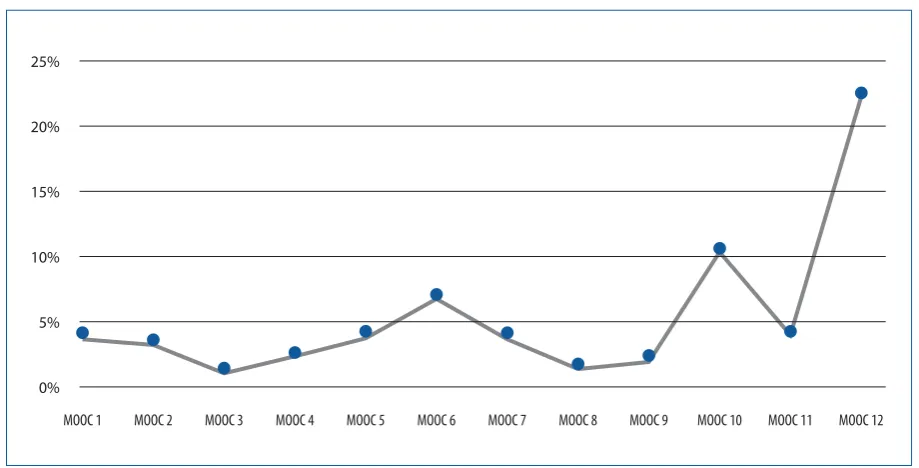
Oncompletion, theMOOCachievedaterminalefficiencyrateexceeding22%(seeMOOC12inFigure2), which
isconsidered“atypical”, aswellasahighercommitmentratefromparticipants, whichreached52.15%. Itisnoted
thattheaverageterminalefficiencyrateofallMOOCsthisinstitutionhasofferedis4%, whichcoincideswiththe
RUSC Vol. 12 No. 1 |UniversitatObertadeCatalunyaandUniversityofNewEngland|Barcelona, January2015 CC L. Y. Alemán de la Garza, T. Sancho-Vinuesa and M. G. Gómez Zermeño |CC by FUOC, 2015 |Indicators of pedagogical quality for the design…
Figure 2.Terminal efficiency rate with highest number of enrolments
0% 5% 10% 15% 20% 25%
%
%
%
%
%
%
%
%
%
%
%
%
MOOC 1 MOOC 2 MOOC 3 MOOC 4 MOOC 5 MOOC 6 MOOC 7 MOOC 8 MOOC 9 MOOC 10 MOOC 11 MOOC 12
4. Conclusions
Inthispaper, qualityindicatorsendorsingthedesignofaMOOConLeadershipinstrategiceducationalmanagement
havebeenidentified, ashavetheprofilesofparticipantsinits firsteditionandtherateofterminalefficiency.
ThemainconclusionfromthisresearchisthatthesuccessofaMOOCcannotbeevaluatedwithoutmeasuring
results. Thus, institutionsandconsortiashouldestablishindicatorstofocuseffortsonimprovingtheirpedagogical
quality. Designchangesanddevelopmentcannotbeplannedeither, astheseactionsrequiretheimplementation
of appropriate mechanisms to measure the participants’performance, which should be integrated into the
standardsoftheireducationalmodel. Whenapplyingqualitycriteria, itshouldbeconsideredthattheindicators
cannotoperateinisolation, soitisnecessarytodefinetheminordertobuildacompletepictureoftheeducational
systemthatwillreceivefeedback.
Accordingto55experts, timeisakeyfactorthatimpactsthepedagogicalqualityofaMOOC;however, they
emphasizethattheresultsarealogicalconsequenceoftheinterrelationshipbetweenthePedagogical, Functional,
Technologicaland Timefactors. WhendesigningaMOOC, thetimeitwilltakeparticipantstoreviewthecontent,
videos, resources, exercisesandtests, andtotakeanactivepartinactivitiesandcollaborativelearningdiscussion
boardsshouldbeconsidered(Gros, Barbera, & Kirschner, 2010). The designedsysteminvolves promotingself
-regulationskills, andmustincludetheelementsandapproachesthatsupportthetheoryofconnectivisminorder
tobeabletoofferopeneducationalresourcesthatprovidearealstrategicopportunitytoimprovethequalityof
education(UNESCO, 2012).
As the use of technology in education advances, the understanding of the elements and principles of
connectivismwillbechallenged, andeducationalresearchwillprovideevidenceonthenetworkcapacitiesand
possibilitiesintertwinedwiththe variouslearningstyles ofindividuals. By providingpertinent information, the
RUSC Vol. 12 No. 1 |UniversitatObertadeCatalunyaandUniversityofNewEngland|Barcelona, January2015 CC L. Y. Alemán de la Garza, T. Sancho-Vinuesa and M. G. Gómez Zermeño |CC by FUOC, 2015 |Indicators of pedagogical quality for the design…
ofMOOCsofferedbyeducationalinstitutionsberecognizedandcontributetothevisionofafuture inwhich
everyonehasaccesstoaworld-classeducation.
4
.
1
.
Future
research
There are significant areas of opportunity related to the evaluation of MOOCs, as standards regarding their
pedagogicalqualityhaveyettobeagreedupon. Littleisknownabouttheirusesandscope, orabouttheways
inwhichtheyareintegratedintotheeducationalmodelsofdifferentinstitutionsandconsortia. Separatelinesof
researcharethereforeproposedtoaddressthisissue. Ontheonehand, itiscrucialtocarryonstudyingindetailthe
resultsofeachoftheindicatorsthatmakeupthedifferentsubcategoriesinordertounderstandtheinterplayof
allfactorsandtheirlevelofimpactonpedagogicalquality. Ontheotherhand, thedefinitionofsuccessofasimilar
courseshouldgofurtherthantherateofterminalefficiencyanddelvedeeperintotheanalysisoftrafficpatternsto
understandtheinterestsandbehaviorofitsparticipants.
5. References
Aceto, S., Borotis, S., Devine, J., &Fischer T. (2014). Mapping and Analysing Prospective Technologies for Learning.Seville,
Spain:JointResearchCentre, InstituteforProspective TechnologicalStudies.
Arias, J. (2007). Evaluación de la calidad de Cursos Virtuales: Indicadores de Calidad y construcción de un cuestionario de
medida (Doctoraldissertation).UniversityofExtremadura, Extremadura, Spain.
Astigarraga, E. (2003). El método delphi.SanSebastián, Spain:UniversidaddeDeusto.
Barbera, E., Gros, B., &Kirschner, P. (2012). Temporalissuesine-learningresearch: A literaturereview. British Journal of
Educational Technology, 43(2), 53-55. doi:10.1111/j.1467-8535.2011.01255.x
Bell, M. (2012). MassiveopenonlinecoursesmovingaheadwithMOOCs. Internet@Schools, 19(5). Retrievedfrom
http://www.internetatschools.com/Articles/Column/Belltones/BELLTONES-Massive-Open-Online-Courses
--Moving-Ahead-With-MOOCs-85936.aspx
Bernal, Y., Molina, M., & Pérez, M. (2013). LaCalidad de laEducación aDistancia: Elcaso de losMOOC. Revista
Iberoamericana para la Investigación y el Desarrollo Educativo, 3(10), 1-13. Retrievedfrom http://www.ride.org.mx/
docs/publicaciones/10/psicologia_y_educacion/E06_.pdf
Boven, D. (2013). The Next GameChanger: The Historical Antecedentsofthe MOOC Movementin Education.
eLearning Papers, 33, 1-7. Retrievedfrom http://www.openeducationeuropa.eu/en/download/file/fid/26967
Breslow, L., Pritchard, D., DeBoer, J., Stump, G., Ho, A., & Seaton, D. (2013). Studyinglearning inthe worldwide
classroom:ResearchintoedX’s firstMOOC. Research & Practice in Assessment Journal, 8, 13-25. Retrievedfrom
http://www.rpajournal.com/dev/wp-content/uploads/2013/05/SF2.pdf
Brown, S. (2013). BacktothefuturewithMOOCs. ICICTE 2013Proceedings, 237-246. Retrievedfrom http://www.icicte.
org/Proceedings2013/Papers%202013/06-3-Brown.pdf
Cabero, J., &Romero, R. (2007). Diseño y producción de TIC para la formación.Barcelona, Spain:UOC.
Chiecher, A., &Donolo, D. (2013). Trabajogrupalmediadoporforos. Aportesparaelanálisisdelapresenciasocial,
RUSC Vol. 12 No. 1 |UniversitatObertadeCatalunyaandUniversityofNewEngland|Barcelona, January2015 CC L. Y. Alemán de la Garza, T. Sancho-Vinuesa and M. G. Gómez Zermeño |CC by FUOC, 2015 |Indicators of pedagogical quality for the design…
virtuales y aprendizaje. Nuevas perspectivas de estudio e investigaciones(pp. 151-198). Mendoza, Argentina:Editorial
Virtual Argentina.
Cross, S. (2013). Evaluation of the OLDS MOOC curriculum design course: participant perspectives, expectations and
experiences.OLDSMOOCProject, MiltonKeynes, UnitedKingdom.
Domingo, M., &Marquès, P. (2011). Classroom2.0ExperiencesandBuildingontheUseofICT in Teaching. Comunicar,
18(37), 169-174. http://dx.doi.org/10.3916/C37-2011-03-09
EDUCAUSE(2011). 7 things you should know about MOOCs. EDUCAUSELearningInitiative.
EuropeanFoundationforQualityine-Learning[EFQUEL](2013). The MOOC Quality Project. Retrievedfrom http://
mooc.efquel.org/the-mooc-quality-project/
Franco-Casamitjana, M., Barbera, E., &Romero, M. (2013). A MethodologicalDefinitionfor TimeRegulationPatterns
andLearningEfficiencyinCollaborativeLearningContexts. eLC Research Paper Series, 6, 52-62. Retrievedfrom
http://journals.uoc.edu/index.php/elcrps/article/download/1871/n6-franco-casamitjana
Friedman, T. (2013, January26). Revolutionhitstheuniversities. The New York Times, The opinion pages. Retrieved
from http://www.nytimes.com/
Garrido, A. (2003). El aprendizaje como identidad de participación en la práctica de una comunidad virtual(Doctoral
dissertation). UniversitatObertadeCatalunya, Barcelona.
Gómez-Zermeño, M. G. (2012). Bibliotecas digitales: recursos bibliográficos electrónicos en educación básica.
Comunicar, 20(39), 119-128. Retrievedfrom http://www.revistacomunicar.com/index.php?contenido=detalles
&numero=39&articulo=39-2012-14
Gómez-Zermeño, M. G., & Alemán, L. Y. (2012). Administración de proyectos de capacitación basados en tecnología.
Monterrey, Mexico:EditorialDigitaldel TecnológicodeMonterrey.
Gómez-Zermeño, M. G., Rodríguez, J. A., & Márquez, S. (2013). Estudio Exploratorio-Descriptivo“CursoHíbrido:
ContabilidadV”. Revista de Investigación Educativa de la Escuela de Graduados en Educación, 4(7), 70-79. Retrieved
from http://rieege.tecvirtual.mx/index.php/rieege/article/view/126
Gros, B., Barbera, E., &Kirschner, P. (2010). Timefactorine-Learning:impactliteraturereview. eLC Research Paper
Series, 0, 16-31. Retrievedfrom http://journals.uoc.edu/index.php/elcrps/article/download/issue0-gros-barbera
-kirshner/issue0-gros-barbera-kirshner
Guitert, M. (2011). Time management in virtual collaborative learning: the case of the Universitat Oberta de
Catalunya(UOC). eLC Research Paper Series, 2, 5-16. Retrievedfrom http://journals.uoc.edu/index.php/elcrps/
article/download/n2-guitert-catasus/n2-guitert-catasus
ITESM(2014). Formación que transforma vidas.Monterrey, Mexico: TecnológicodeMonterrey.
Liyanagunawardena, T., Adams, A., & Williams, S. (2013). MOOCs: A systematicstudy ofthepublishedliterature
2008-2012. The International Review of Research in Open and Distance Learning, 14(3), 202-227. Retrievedfrom
http://www.irrodl.org/index.php/irrodl/article/download/1455/2602
McAuley, A., Stewart, B., Siemens, G., &Cormier, D. (2010). The MOOC model for digital practice. Digital ways of knowing
and learning.Charlottetown, Canada:UniversityofPrinceEdward.
Menéndez, L. (2013). Estudiar‘online’ygratis. Escritura Pública, 80, 18-21. Retrievedfrom http://www.notariado.org/
liferay/c/document_library/get_file?folderId=12092&name=DLFE-89971.pdf
Moore, M. G. (1983). Theoryoftransactionaldistance. InD. Keegan(Ed.), Theoretical Principles of Distance Education
RUSC Vol. 12 No. 1 |UniversitatObertadeCatalunyaandUniversityofNewEngland|Barcelona, January2015 CC L. Y. Alemán de la Garza, T. Sancho-Vinuesa and M. G. Gómez Zermeño |CC by FUOC, 2015 |Indicators of pedagogical quality for the design…
Moore, M. G. (2013). Thetheory oftransactional distance. InM. G. Moore (Ed.), Handbook of distance education
(3rded., pp. 66-85). NewYork, USA:Routledge.
ObservatoriodeInnovaciónEducativa(May, 2014). Reporte Edu Trends. Monterrey, Mexico:TecnológicodeMonterrey.
Retrievedfrom http://www.observatorioedu.com/redutrends
PennGSE(2013). Study shows MOOCs have relatively few active users, with only a few persisting to course end.University
ofPennsylvania:Graduate SchoolofEducation. Retrievedfrom http://www.gse.upenn.edu/pressroom/press
-releases/2013/12/penn-gse-study-shows-moocs-have-relatively-few-active-users-only-few-persisti
Rodriguez, O. (2012). MOOCs and the AI-Stanfordlike Courses: twosuccessful and distinct courseformats for
massiveopenonlinecourses. European Journal of Open, Distance, and E-Learning, 2012(2), 1-13. Retrievedfrom
http://www.eurodl.org/materials/contrib/2012/Rodriguez.pdf
Roig, R., Flores, C., Álvarez, J., Blasco, J., Grau, S., Guarinos, I., … Tortosa, M. (2013). Características de los ambientes de
aprendizaje on-line para una práctica docente de calidad. Indicadores de evaluación. Alicante, Spain:Universidad
de Alicante.
Romero, M. (2011). Thetimefactorinanonlinegroupcoursefromthepointofviewofitsstudents. eLC Research
Paper Series, 2,17-28. Retrievedfrom http://journals.uoc.edu/index.php/elcrps/article/download/n2-romero/n2
-romero
Sangrà, A., &Wheeler, S. (2013). NewInformalWaysofLearning:Or AreWeFormalisingtheInformal?RUSC. Universities
and Knowledge Society Journal, 10(1), 286-293. http://dx.doi.org/10.7238/rusc.v10i1.1689
Schmelkes, S. (2001). La investigación en la innovación educativa.Mexico:CINVESTAV.
SCOPEO(2013). MOOC: Estado de la situación actual, posibilidades, retos y futuro. SCOPEOReportNo2, June2013.
Retrievedfrom http://scopeo.usal.es/wp-content/uploads/2013/06/scopeoi002.pdf
Shadish, W. R., Cook, T. D., &Campbell, D. T. (2002). Experimental and quasi-experimental designs for generalized causal
inference.Boston, USA:HoughtonMifflin.
Siemens, G. (2004). Connectivism. A learningtheoryforthedigitalage. International Journal of Instructional Technology
and Distance learning, 2(1), 3-10. Retrievedfrom http://www.itdl.org/journal/jan_05/Jan_05.pdf
Skiba, D. (2013). MOOCsandtheFutureofNursing. Nursing Education Perspectives, 34(3), 202-204. doi: 10.5480/1536
-5026-34.3.202
TheNewMediaConsortium&UniversitatObertadeCatalunya(2012). Perspectivas tecnológicas: educación superior
en Iberoamérica 2012-2017: Un Análisis Regional del Informe Horizon del NMC y la UOC. Barcelona, Spain:UOC.
Tschofen, C., &Mackness, J. (2012). Connectivismanddimensionsofindividualexperience. The International Review
of Research in Open and Distance Learning, 13(1), 124-143. Retrievedfrom http://www.irrodl.org/index.php/irrodl/
article/download/1143/2117
UNESCO(2012). 2012 Paris OER Declaration. 2012 World Open Educational Resources (OER) Congress.Paris, France:
UNESCO.
Zapata-Ros, M. (2013). MOOCs, una visión crítica y una alternativa complementaria: La individualización del aprendizaje y
de la ayuda pedagógica. Universidadde AlcaládeHenares, Spain. Retrievedfrom http://eprints.rclis.org/18658/7/
RUSC Vol. 12 No. 1 |UniversitatObertadeCatalunyaandUniversityofNewEngland|Barcelona, January2015 CC L. Y. Alemán de la Garza, T. Sancho-Vinuesa and M. G. Gómez Zermeño |CC by FUOC, 2015 |Indicators of pedagogical quality for the design…
About the authors
Lorena Yadira Alemán de la GarzaCoordinatorofSpecialProjectsandContinuingEducation, MonterreyInstituteof Technology
andHigherEducation(ITESM), Mexico
DoctoralcandidateontheEducationandICT (e-learning)doctoralprogramattheOpenUniversityofCatalonia(UOC),
Spain. Sheholdsamaster’sdegree, withhonors, inEducationalInstitution AdministrationfromITESM, andabachelor’s degree, withhonors, inBusiness Administrationfrom TecMilenioUniversity, Mexico. Shehasworkedasapostgraduate lecturer in the Graduate School of Education at ITESM on master’s degree programs in Educational Institution
Administration, inEducationandinEducational Technology. SheisamemberoftheResearchChairin TheSchoolasa KnowledgeOrganization. SheisthetechnicalmanageroneducationalresearchprojectsoftheMexicanNationalCouncil ofScienceand Technology(CONACYT). Sheisthecoordinatorofuniversityextensionprogramsandspecialprojects.
OfnoteamongtheseistheHigherMiddleEducation Teacher Trainingprogram(PROFORDEMS)andtheNew Teaching Profilediploma.
Instituto TecnológicoydeEstudiosSuperioresdeMonterrey(ITESM)
Avda. EugenioGarzaSada, 2501 Sur EdificioCEDES, pisoSS1
64849 Monterrey(NuevoLeón)
Mexico
Teresa Sancho-Vinuesa
LecturerandIN3 Researcher, OpenUniversityofCatalonia(UOC), Spain
Vice-rectorforResearchandInnovationattheUOC. SheholdsadoctorateinElectronicEngineeringandabachelor’s degreeinMathematics. SheistheprincipalresearcheroftheCIMANET (OnlineScienceandMathematics)RD&Igroupat theUOC. Shehaslecturedinthe fieldofnumericalanalysis, probabilitytheoryandstochasticprocessesatLaSalleSchool ofEngineeringand Architecture, Spain. Shehasbeenamemberofthe TEXTOpedagogicalandeditorialteam, andhas coordinatedMathematicsonInformation TechnologyStudiesattheUOC. Shehasbeentheacademiccoordinatorand directorofthedoctoralprograminInformationandKnowledgeSocietyattheUOC. Sheiscurrentlyresponsibleforthe Mathematicssubjectsonthebachelor’sdegreeprogramin TechnicalEngineeringand Telecommunications. Shehasbeen aresearcherontheinterdisciplinaryresearchprogramontheInformationSocietyinCatalonia(ProjectInternetCatalonia),
jointlyledbyManuelCastellsandImma Tubella;withinthisframework, sheheadedastudyonchangesoccurringin CatalanuniversitiesbyanalyzingInternetuse. Shehasnowresumedheractivitiesinthe fieldofMathematicsteachingfor Network-basedEngineering.
UniversitatObertadeCatalunya(UOC) RambladelPoblenou, 156
RUSC Vol. 12 No. 1 |UniversitatObertadeCatalunyaandUniversityofNewEngland|Barcelona, January2015 CC L. Y. Alemán de la Garza, T. Sancho-Vinuesa and M. G. Gómez Zermeño |CC by FUOC, 2015 |Indicators of pedagogical quality for the design…
Marcela Georgina Gómez Zermeño
Researcher-Lecturer, DirectoroftheEducationResearchCenter, MonterreyInstituteof Technology
andHigherEducation(ITESM), Mexico
SheholdsadoctorateinEducationalInnovationfromtheGraduateSchoolofEducationatITESM, andamaster’sdegree inInformationandCommunication TechnologyEngineeringSciences. INT-CITCOM, France TélécomsHigherEducation.
Shealsoholdsabachelor’sdegreeinComputerand AdministrationSystemsfromITESM. Sheisatenuredlecturerat theGraduateSchoolofEducationatITESMonmaster’sdegreeprogramsinEducationandinEducational Technology,
andonthedoctoralprogram inEducationalInnovation. SheisamemberoftheResearchChairsin TheSchoolasa KnowledgeOrganizationandinInnovationin TechnologyandEducation, andoftheMexicanEducationResearchCouncil (COMIE). SheisthetechnicalmanageroneducationalresearchprojectsoftheMexicanNationalCouncilofScienceand
Technology(CONACYT)andonthe ALFA programoftheEuropeanCommission. SheformspartoftheNationalSystem ofResearchers(SNI)Level 1.
Instituto TecnológicoydeEstudiosSuperioresdeMonterrey(ITESM)
Avda. EugenioGarzaSada, 2501 Sur EdificioCEDES, pisoSS1
64849 Monterrey(NuevoLeón)
Mexico
Thetextspublishedinthisjournalare–unlessindicatedotherwise–coveredbytheCreativeCommons Spain Attribution 3.0 licence. Youmaycopy, distribute, transmitandadaptthework, providedyouattribute it(authorship, journalname, publisher)inthemannerspecifiedbytheauthor(s)orlicensor(s). Thefulltext ofthelicencecanbeconsultedhere:<http://creativecommons.org/licenses/by/3.0/es/deed.en><http:// creativecommons.org/licenses/by/3.0/es/deed.es>