R E S E A R C H
Open Access
A view of programming scalable data
analysis: from clouds to exascale
Domenico Talia
Abstract
Scalability is a key feature for big data analysis and machine learning frameworks and for applications that need to analyze very large and real-time data available from data repositories, social media, sensor networks, smartphones, and the Web. Scalable big data analysis today can be achieved by parallel implementations that are able to exploit the computing and storage facilities of high performance computing (HPC) systems and clouds, whereas in the near future Exascale systems will be used to implement extreme-scale data analysis. Here is discussed how clouds currently support the development of scalable data mining solutions and are outlined and examined the main challenges to be addressed and solved for implementing innovative data analysis applications on Exascale systems.
Keywords:Big data analysis, Cloud computing, Exascale computing, Data mining, Parallel programming, Scalability
Introduction
Solving problems in science and engineering was the first motivation for inventing computers. After a long time since then, computer science is still the main area in which innovative solutions and technologies are being developed and applied. Also due to the extraordinary ad-vancement of computer technology, nowadays data are generated as never before. In fact, the amount of struc-tured and unstrucstruc-tured digital datasets is going to in-crease beyond any estimate. Databases, file systems, data streams, social media and data repositories are increas-ingly pervasive and decentralized.
As the data scale increases, we must address new chal-lenges and attack ever-larger problems. New discoveries will be achieved and more accurate investigations can be carried out due to the increasingly widespread availabil-ity of large amounts of data. Scientific sectors that fail to make full use of the huge amounts of digital data avail-able today risk losing out on the significant opportun-ities that big data can offer.
To benefit from the big data availability, specialists and researchers need advanced data analysis tools and applications running on scalable architectures allowing for the extraction of useful knowledge from such huge data sources. High performance computing (HPC) sys-tems and cloud computing syssys-tems today are capable
platforms for addressing both the computational and data storage needs of big data mining and parallel know-ledge discovery applications. These computing architec-tures are needed to run data analysis because complex data mining tasks involve data- and compute-intensive algorithms that require large, reliable and effective stor-age facilities together with high performance processors to get results in appropriate times.
Now that data sources became very big and pervasive, reliable and effective programming tools and applica-tions for data analysis are needed to extract value and find useful insights in them. New ways to correctly and proficiently compose different distributed models and paradigms are required and interaction between hard-ware resources and programming levels must be ad-dressed. Users, professionals and scientists working in the area of big data need advanced data analysis pro-gramming models and tools coupled with scalable archi-tectures to support the extraction of useful information from such massive repositories. The scalability of a par-allel computing system is a measure of its capacity to re-duce program execution time in proportion to the number of its processing elements (TheAppendix intro-duces and discusses in detail scalability in parallel sys-tems). According to scalability definition, scalable data analysis refers to the ability of a hardware/software par-allel system to exploit increasing computing resources effectively in the analysis of (very) large datasets.
Correspondence:[email protected] DIMES, Università della Calabria, Rende, Italy
Today complex analysis of real-world massive data sources requires using high-performance computing sys-tems such as massively parallel machines or clouds. However in the next years, as parallel technologies ad-vance, Exascale computing systems will be exploited for implementing scalable big data analysis in all the areas of science and engineering [23]. To reach this goal, new design and programming challenges must be addressed and solved. The focus of the paper is on discussing current cloud-based designing and programming solu-tions for data analysis and suggesting new programming requirements and approaches to be conceived for meet-ing big data analysis challenges on future Exascale platforms.
Current cloud computing platforms and parallel com-puting systems represent two different technological so-lutions for addressing the computational and data storage needs of big data mining and parallel knowledge discovery applications. Indeed, parallel machines offer high-end processors with the main goal to support HPC applications, whereas cloud systems implement a com-puting model in which virtualized resources dynamically scalable are provided to users and developers as a service over the Internet. In fact, clouds do not mainly target HPC applications; they instrument scalable com-puting and storage delivery platforms that can be adapted to the needs of different classes of people and organizations by exploiting the Service Oriented (SOA) approach. Clouds offer large facilities to many users that were unable to own their parallel/distributed computing systems to run applications and services. In particular, big data analysis applications requiring access and ma-nipulating very large datasets with complex mining algo-rithms will significantly benefit from the use of cloud platforms.
Although not many cloud-based data analysis frame-works are available today for end users, within a few years they will become common [29]. Some current so-lutions are based on open source systems, such as Apache Hadoop and Mahout, Spark and SciDB, while others are proprietary solutions provided by companies such as Google, Microsoft, EMC, Amazon, BigML, Splunk Hunk, and InsightsOne. As more such platforms emerge, researchers and professionals will port increas-ingly powerful data mining programming tools and frameworks to the cloud to exploit complex and flexible software models such as the distributed workflow para-digm. The growing utilization of the service-oriented computing model could accelerate this trend.
From the definition of the big data term, which refers to datasets so large and complex that traditional hard-ware and softhard-ware data processing solutions are inad-equate to manage and analyze, we can infer that conventional computer systems are not so powerful to
process and mine big data [28] and they are not able to scale with the size of problems to be solved. As men-tioned before, to face with limits of sequential machines, advanced systems like HPC, clouds and even more scal-able architectures are used today to analyze big data. Starting from this scenario, Exascale computing systems will represent the next computing step [1, 34]. Exascale systems refers to high performance computing systems capable of at least one exaFLOPS, so their implementation represents a very significant research and technology challenge. Their design and development is currently under investigation with the goal of building by 2020 high-performance computers composed of a very large number of multi-core processors expected to deliver a performance of 10^18 operations per second. Cloud computing systems used today are able to store very large amounts of data, however they do not provide the high performance expected from massively parallel Exascale systems. This is the main motivation for devel-oping Exascale systems. Exascale technology will repre-sent the most advanced model of supercomputers. They have been conceived for single-site supercomputing cen-ters not for distributed infrastructures as multi-clouds or fog computing systems that are aimed to decentralized computing and pervasive data management that could be interconnected with Exascale systems that could used as backbone for very large scale data analysis.
The development of Exascale systems urges to address and solve issues and challenges both at hardware and software level. Indeed it requires to design and imple-ment novel software tools and runtime systems able to manage a very high degree of parallelism, reliability and data locality in extreme scale computers [14]. New pro-gramming constructs and runtime mechanisms able to adapt to the most appropriate parallelism degree and communication decomposition for making scalable and reliable data analysis tasks are needed. Their dependence from parallelism grain size and data analysis task decom-position must be deeply studied. This is needed because parallelism exploitation depends on several features like parallel operations, communication overhead, input data size, I/O speed, problem size, and hardware configur-ation. Moreover, reliability and reproducibility are two additional key challenges to be addressed. Indeed at pro-gramming level, constructs for handling and recovering communication, data access, and computing failures must be designed. At the same time, reproducibility in scalable data analysis asks for rich information useful to assure similar results on environments that dynamically may change. All these factors must be taken into ac-count in designing data analysis applications and tools that will be scalable on exascale systems.
for massive data analysis and software architectures enab-ling the scalable extraction of knowledge from data, are needed [28]. To reach this goal, models and technologies enabling cloud computing systems and HPC architectures must be extended/adapted or completely changed to be reliable and scalable on the very large number of proces-sors/cores that compose extreme scale platforms and for supporting the implementation of clever data analysis al-gorithms that ought to be scalable and dynamic in re-source usage. Exascale computing infrastructures will play the role of an extraordinary platform for addressing both the computational and data storage needs of big data ana-lysis applications. However, as mentioned before, to have a complete scenario, efforts must be performed for imple-menting big data analytics algorithms, architectures, pro-gramming tools and applications in Exascale systems [24].
Pursuing this objective within a few years, scalable data access and analysis systems will become the most used platforms for big data analytics on large-scale clouds. In a longer perspective, new Exascale computing infrastructures will appear as the platforms for big data analytics in the next decades, and data mining algo-rithms, tools and applications will be ported on such platforms for implementing extreme data discovery solutions.
In this paper we first discuss cloud-based scalable data mining and machine learning solutions, then we exam-ine the main research issues that must be addressed for implementing massively parallel data mining applica-tions on Exascale computing systems. Data-related is-sues are discussed together with communication, multi-processing, and programming issues. Section II in-troduces issues and systems for scalable data analysis on clouds and Section III discusses design and program-ming issues for big data analysis in Exascale systems. Section IV completes the paper also outlining some open design challenges.
Data analysis on clouds
Clouds implement elastic services, scalable performance and scalable data storage used by a large and everyday increasing number of users and applications [2, 12]. In fact, clouds enlarged the arena of distributed computing systems by providing advanced Internet services that complement and complete functionalities of distributed computing provided by the Web, Grid systems and peer-to-peer networks. In particular, most cloud com-puting applications use big data repositories stored within the cloud itself, so in those cases large datasets are analyzed with low latency to effectively extract data analysis models.
Big data is a new and over-used term that refers to massive, heterogeneous, and often unstructured digital content that is difficult to process using traditional data
management tools and techniques. The term includes the complexity and variety of data and data types, real-time data collection and processing needs, and the value that can be obtained by smart analytics. However we should recognize that data are not necessarily im-portant per se but they become very imim-portant if we are able to extract value from them; that is if we can exploit them to make discoveries. The extraction of useful knowledge from big digital datasets requires smart and scalable analytics algorithms, services, programming tools, and applications. All these solutions need to find insights in big data will contribute to make them really useful for people.
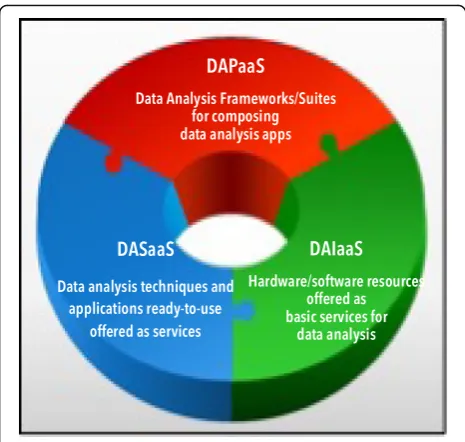
The growing use of service-oriented computing is ac-celerating the use of cloud-based systems for scalable big data analysis. Developers and researchers are adopt-ing the three main cloud models, software as a service (SaaS), platform as a service (PaaS), and infrastructure as a service (IaaS), to implement big data analytics solu-tions in the cloud [27,31]. According to a specialization of these three models, data analysis tasks and applica-tions can be offered as services at infrastructure, platform or software level and made available every time form everywhere. A methodology for implementing them defines a new model stack to delivery data analysis solutions that is a specialization of the XaaS (Everything as a Service) stack and is called Data Analysis as a Ser-vice (DAaaS). It adapts and specifies the three general service models (SaaS, PaaS and IaaS), for supporting the structured development of Big Data analysis systems, tools and applications according to a service-oriented approach. The DAaaS methodology is then based on the three basic models for delivering data analysis services at different levels as described here (see also Fig.1):
Data analysis infrastructure as a service (DAIaaS). This model provides a set of hardware/software virtualized resources that developers can assemble and use as a an integrated infrastructure where storing large datasets, running data mining applications and/or implementing data analytics systems from scratch;
Data analysis platform as a service (DAPaaS). This model defines a supporting software platform that developers can use for programming and running their data analytics applications or extending existing ones without concerning about the underlying infrastructure or specific distributed architecture issues; and
a Web browser. According to this approach, every data analysis software is provided as a service, avoid-ing end users to worry about implementation and execution details.
Cloud-based data analysis tools
Using the DASaaS methodology we designed a cloud-based system, the Data Mining Cloud Framework (DMCF) [17], which supports three main classes of data analysis and knowledge discovery applications:
Single-task applications, in which a single data mining task such as classification, clustering, or association rules discovery is performed on a given dataset; Parameter-sweeping applications, in which a dataset
is analyzed by multiple instances of the same data mining algorithm with different parameters; and
Workflow-based applications, in which knowledge
discovery applications are specified as graphs linking together data sources, data mining tools, and data mining models.
DMCF includes a large variety of processing patterns to express knowledge discovery workflows as graphs whose nodes denote resources (datasets, data analysis
tools, mining models) and whose edges denote depend-encies among resources. A Web-based user interface al-lows users to compose their applications and submit them for execution to the Cloud platform, following the data analysis software as a service approach. Visual workflows can be programmed in DMCF through a lan-guage called VL4Cloud (Visual Lanlan-guage for Cloud), whereas script-based workflows can be programmed by JS4Cloud (JavaScript for Cloud), a JavaScript-based lan-guage for data analysis programming.
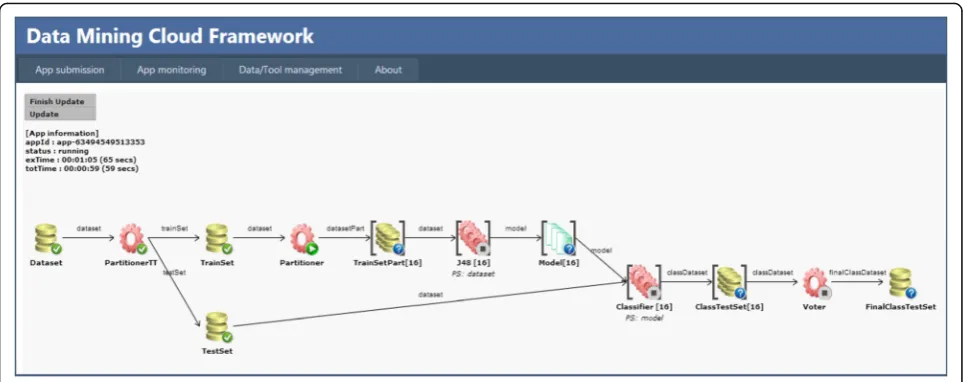
Figure 2 shows a sample data mining workflow com-posed of several sequential and parallel steps. It is just an example for presenting the main features of the VL4Cloud programming interface [17]. The example workflow analyses a dataset by using n instances of a classification algorithm, which work on n portions of the training set and generate the same number of knowledge models. By using the n generated models and the test set, n classifiers produce in parallel n classified datasets (n classifications). In the final step of the workflow, a voter generates the final classification by assigning a class to each data item, by choosing the class predicted by the majority of the models.
Although DMCF has been mainly designed to coordin-ate coarse grain data and task parallelism in big data analysis applications by exploiting the workflow para-digm, the DMCF script-based programming interface (JS4Cloud) allows also for parallelizing fine-grain opera-tions in data mining algorithms as it permits to program in a JavaScript style any data mining algorithm, such as classification, clustering and others. This can be done because loops and data parallel methods are run in par-allel on the virtual machines of a Cloud [16,26].
Like DMCF, other innovative cloud-based systems de-signed for programming data analysis applications are: Apache Spark, Sphere, Swift, Mahout, and CloudFlows. Most of them are open source. Apache Spark is an open-source framework developed at UC Berkeley for in-memory data analysis and machine learning [34]. Spark has been designed to run both batch processing and dynamic applications like streaming, interactive queries, and graph analysis. Spark provides developers with a programming interface centered on a data struc-ture called the resilient distributed dataset (RDD), that is a read-only multi-set of data items distributed over a cluster of machines, that is maintained in a fault-tolerant way. Differently from other systems and from Hadoop, Spark stores data in memory and queries it repeatedly so as to obtain better performance. This feature can be use-ful for a future implementation of Spark on Exascale systems.
Swift is a workflow-based framework for implementing functional data-driven task parallelism in data-intensive applications. The Swift language provides a functional Fig. 1The three models of the DAaaS software methodology. The
programming paradigm where workflows are designed as a set of calls with associated command-line argu-ments and input and output files. Swift uses an implicit data-driven task parallelism [32]. In fact, it looks like a sequential language, but being a dataflow language, all variables are futures, thus execution is based on data availability. Parallelism can be also exploited through the use of the foreach statement. Swift/T is a new imple-mentation of the Swift language for high-performance computing. In this implementation, a Swift program is translated into an MPI program that uses the Turbine and ADLB runtime libraries for scalable dataflow pro-cessing over MPI. Recently a porting of Swift/T on very large cloud systems for the execution of very many tasks has been investigated.
DMCF, differently from the other frameworks dis-cussed here, it is the only system that offers both a visual and a script-based programming interface. Visual pro-gramming is a very convenient design approach for high-level users, like domain-expert analysts having a limited understanding of programming. On the other hand, script-based workflows are a useful paradigm for expert programmers who can code complex applications rapidly, in a more concise way and with greater flexibil-ity. Finally, the workflow-based model exploited in DMCF and Swift make these frameworks of more gen-eral use with respect to Spark that offers a very re-stricted set of programming patterns (e.g., map, filter and reduce) so limiting the variety of data analysis appli-cations that can be implemented with it.
These and other related systems are currently used for the development of big data analysis applications on
HPC and cloud platforms. However, additional research work in this field must be done and the development of new models, solutions and tools is needed [13, 24]. Just to mention a few, active and promising research topics are listed here ordered by importance factors:
Programming models for big data analytics. New
abstract programming models and constructs hiding the system complexity are needed for big data analytics tools. The MapReduce model and workflow models are often used on HPC and clouds, but more research effort is needed to develop other scalable, adaptive, general-purpose higher-level models and tools. Research in this area is even more important for Exascale systems; in the next section we will dis-cuss some of these topics in Exascale computing. Reliability in scalable data analysis. As the number
fail and assuring its completion. Reliability is an issue much more important in the Exascale domain where the number of processing elements is massive and fault occurrence increases making detection and re-covering vital.
Application reproducibility. Reproducibility is another open research issue for designers of complex applications running on parallel systems. Reproducibility in scalable data analysis must face, for example, with data communication, data parallel manipulation and dynamic computing
environments. Reproducibility demands that current data analysis frameworks (like those based on Map-Reduce and on workflows) and the future ones, es-pecially those implemented on Exascale systems, must provide additional information and knowledge on how data are managed, on algorithm characteris-tics and on configuration of software and execution environments.
Data and tool integration and openness. Code
coordination and data integration are main issues in large-scale applications that use data and computing resources. Standard formats, data exchange models and common APIs are needed to support interoper-ability and ease cooperation among design teams using different data formats and tools.
Interoperability of big data analytics frameworks. The service-oriented paradigm allows running large-scale distributed applications on cloud heteroge-neous platforms along with software components developed using different programming languages or tools. Cloud service paradigms must be designed to allow worldwide integration of multiple data analyt-ics frameworks.
Exascale and big data analysis
As we discussed in the previous sections, data analysis gained a primary role because of the very large availabil-ity of datasets and the continuous advancement of methods and algorithms for finding knowledge in them. Data analysis solutions advance by exploiting the power of data mining and machine learning techniques and are changing several scientific and industrial areas. For ex-ample, the amount of data that social media daily gener-ate is impressive and continuous. Some hundreds of terabyte of data, including several hundreds of millions of photos, are uploaded daily to Facebook and Twitter.
Therefore it is central to design scalable solutions for processing and analysis such massive datasets. As a gen-eral forecast, IDC experts estimate data generated to reach about 45 zettabytes worldwide by 2020 [6]. This impressive amount of digital data asks for scalable high performance data analysis solutions. However, today only one-quarter of digital data available would be a
candidate for analysis and about 5% of that is actually analyzed. By 2020, the useful percentage could grow to about 35% also thanks to data mining technologies.
Extreme data sources and scientific computing
Scalability and performance requirements are challen-ging conventional data storages, file systems and data-base management systems. Architectures of such systems have reached limits in handling very large pro-cessing tasks involving petabytes of data because they have not been built for scaling after a given threshold. This condition claims for new architectures and analyt-ics platform solutions that must process big data for extracting complex predictive and descriptive models [30]. Exascale systems, both from the hardware and the software side, can play a key role to support solutions for these problems [23].
An IBM study reports that we are generating around 2.5 exabytes of data per day.1Because of that continuous and explosive growth of data, many applications require the use of scalable data analysis platforms. A well-known example is the ATLAS detector from the Large Hadron Collider at CERN in Geneva. The ATLAS infrastructure has a capacity of 200 PB of disk and 300,000 cores, with more than 100 computing centers connected via 10 Gbps links. The data collection rate is very high and only a portion of the data produced by the collider is stored. Several teams of scientists run complex applications to analyze subsets of those huge volumes of data. This ana-lysis would be impossible without a high-performance infrastructure that supports data storage, communica-tion and processing. Also computacommunica-tional astronomers are collecting and producing larger and larger datasets each year that without scalable infrastructures cannot be stored and processed. Another significant case is repre-sented by the Energy Sciences Network (ESnet) is the USA Department of Energy’s high-performance network managed by Berkeley Lab that in late 2012 rolled out a 100 gigabits-per-second national network to accommo-date the growing scale of scientific data.
the management of hospitals and health centers. Very complex data analysis in this area will need novel hard-ware/software solutions, however Exascale computing is still promising in other scientific fields where scalable stor-ages and databases are not used/required. Examples of sci-entific disciplines where future Exascale computing will be extensively used are quantum chromodynamics, materials simulation, molecular dynamics, materials design, earth-quake simulations, subsurface geophysics, climate fore-casting, nuclear energy, and combustion. All those applications require the use of sophisticated models and algorithms to solve complex equation systems that will benefit from the exploitation of Exascale systems.
Programming models features for exascale data analysis
Implementing scalable data analysis applications in Exas-cale computing systems is a very complex job and it re-quires high-level fine-grain parallel models, appropriate programming constructs and skills in parallel and dis-tributed programming. In particular, mechanisms and expertise are needed for expressing task dependencies and inter-task parallelism, for designing synchronization and load balancing mechanisms, handling failures, and properly manage distributed memory and concurrent communication among a very large number of tasks. Moreover, when the target computing infrastructures are heterogeneous and require different libraries and tools to program applications on them, the programming is-sues are even more complex. To cope with some of these issues in data-intensive applications, different scal-able programming models have been proposed [5].
Scalable programming models may be categorized by i. Their level of abstraction: expressing high-level and
low-level programming mechanisms, and
ii. How they allow programmers to develop applications: using visual or script-based formalisms.
Using high-level scalable models, a programmer de-fines only the high-level logic of an application while hides the low-level details that are not essential for ap-plication design, including infrastructure-dependent exe-cution details. A programmer is assisted in application definition and application performance depends on the compiler that analyzes the application code and opti-mizes its execution on the underlying infrastructure. On the other hand, low-level scalable models allow pro-grammers to interact directly with computing and stor-age elements composing the underlying infrastructure and thus define the applications parallelism directly.
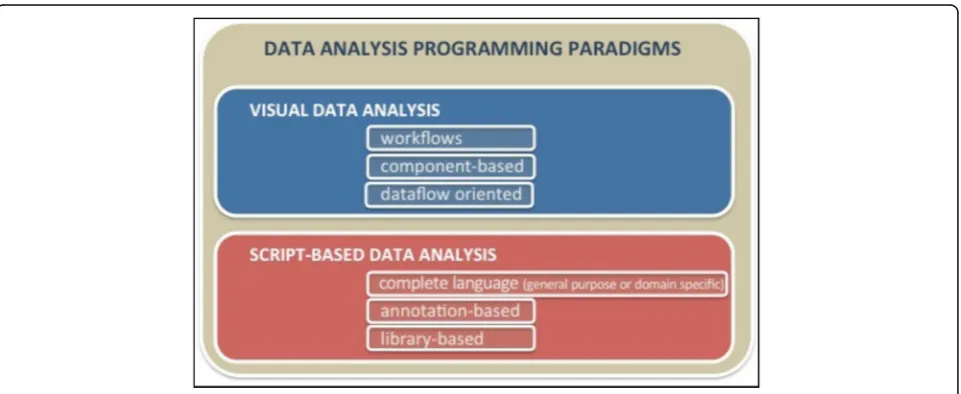
Data analysis applications implemented by some frameworks can be programmed through a visual inter-face, which is a convenient design approach for high-level users, for instance domain-expert analysts having a limited understanding of programming. In addition, a visual representation of workflows or compo-nents intrinsically captures parallelism at the task level, without the need to make parallelism explicit through control structures [14]. Visual-based data analysis typic-ally is implemented by providing workflows-based lan-guages or component-based paradigms (Fig. 3). Also dataflow-based approaches, that share with workflows the same application structure, are used. However, in da-taflow models, the grain of parallelism and the size of data items are generally smaller with respect to work-flows. In general, visual programming tools are not very flexible because they often implement a limited set of visual patterns and provide restricted manners to configure them. For addressing this issue, some visual
languages provide users with the possibility to customize the behavior of patterns by adding code that can specify operations executed a specific pattern when an event occurs.
On the other hand, code-based (or script-based) for-malism allows users to program complex applications more rapidly, in a more concise way, and with higher flexibility [16]. Script-based applications can be designed in different ways (see Fig.3):
With a complete language or a language extension that allows to express parallelism in applications, according to a general purpose or a domain specific approach. This approach requires the design and implementation of a new parallel programming language or a complete set of data types and parallel constructs to be fully inserted in an existing
language.
With annotations in the application code that allow the compiler to identify which instructions will be executed in parallel. According to this approach, parallel statements are separated from sequential constructs and they are clearly identified in the program code because they are denoted by special symbols or keywords.
Using a library in the application code that adds parallelism to the data analysis application. Currently this is the most used approach since it is orthogonal to host languages. MPI and MapReduce are two well-known examples of this approach.
Given the variety of data analysis applications and classes of users (from skilled programmers to end users) that can be envisioned for future Exascale systems, there is a need for scalable programming models with different levels of abstractions (high-level and low-level) and dif-ferent design formalisms (visual and script-based), ac-cording to the classification outlined above.
As we discussed, data-intensive applications are soft-ware programs that have a significant need to process large volumes of data [9]. Such applications devote most of their processing time to run I/O operations and ex-changing and moving data among the processing ele-ments of a parallel computing infrastructure. Parallel processing in data analysis applications typically involves accessing, pre-processing, partitioning, distributing, ag-gregating, querying, mining, and visualizing data that can be processed independently.
The main challenges for programming data analysis applications on Exascale computing systems come from potential scalability, network latency and reliability, reproducibility of data analysis, and resilience of mecha-nisms and operations offered to developers for accessing, exchanging and managing data. Indeed, processing very
large data volumes requires operations and new algo-rithms able to scale in loading, storing, and processing massive amounts of data that generally must be parti-tioned in very small data grains, on which thousands to millions of simple parallel operations do analysis.
Exascale programming systems
Exascale systems force new requirements on program-ming systems to target platforms with hundreds of homogeneous and heterogeneous cores. Evolutionary models have been recently proposed for Exascale gramming that extend or adapt traditional parallel pro-gramming models like MPI (e.g., EPiGRAM [15] that uses a library-based approach, Open MPI for Exascale in the ECP initiative), OpenMP (e.g., OmpSs [8] that ex-ploits an annotation-based approach, the SOLLVE project), and MapReduce (e.g., Pig Latin [22] that imple-ments a domain-specific complete language). These new frameworks limit the communication overhead in mes-sage passing paradigms or limit the synchronization con-trol if a shared-memory model is used [11].
As Exascale systems are likely to be based on large dis-tributed memory hardware, MPI is one of the most nat-ural programming systems. MPI is currently used on over about one million cores, therefore is reasonable to have MPI as one programming paradigm used on Exascale systems. The same possibility occurs for MapReduce-based libraries that today are run on very large HPC and cloud systems. Both these paradigms are largely used for implementing Big Data analysis applica-tions. As expected, general MPI all-to-all communica-tion does not scale well in Exascale environments, thus to solve this issue new MPI releases introduced neighbor collectives to support sparse “all-to-some” communica-tion patterns that limit the data exchange on limited re-gions of processors [11].
On the other hand, new complete languages such as X10 [29], ECL [33], UPC [21], Legion [3], and Chapel [4] have been defined by exploiting in them a data-centric approach. Furthermore, new APIs based on a revolutionary approach, such as GA [20] and SHMEM [19], have been implemented according to a library-based model. These novel parallel paradigms are devised to address the requirements of data processing using massive parallelism. In particular, languages such as X10, UPC, and Chapel and the GA library are based on a partitioned global address space (PGAS) memory model that is suited to implement data-intensive Exascale appli-cations because it uses private data structures and limits the amount of shared data among parallel threads.
Together with different approaches, such as Pig Latin and ECL, those programming models, languages and APIs must be further investigated, designed and adapted for providing data-centric scalable programming models useful to support the reliable and effective implementa-tion of Exascale data analysis applicaimplementa-tions composed of up to millions of computing units that process small data elements and exchange them with a very limited set of processing elements. PGAS-based models, data-flow and data-driven paradigms, local-data approaches today represent promising solutions that could be used for Exascale data analysis programming. The APGAS model is, for example, implemented in the X10 language where it is based on the notions of places and asynchrony. A place is an abstraction of shared, mutable data and worker threads operating on the data. A single APGAS computation can consist of hundreds or potentially tens of thousands of places. Asynchrony is implemented by a single block-structured control construct async. Given a statement ST, the construct async ST executes ST in a separate thread of control. Memory locations in one place can contain references to locations at other places. To compute upon data at another place, the
at pð ÞST
statement must be used. It allows the task to change its place of execution to p, executes ST at p and returns, leaving behind tasks that may have been spawned during the execution of ST.
Another interesting language based on the PGAS model is Chapel [4]. Its locality mechanisms can be ef-fectively used for scalable data analysis where light data mining (sub-)tasks are run on local processing elements and partial results must be exchanged. Chapel data local-ity provides control over where data values are stored and where tasks execute so that developers can ensure parallel data analysis computations execute near the var-iables they access, or vice-versa for minimizing the com-munication and synchronization costs. For example,
Chapel programmers can specify how domains and ar-rays are distributed amongst the system nodes. Another appealing feature in Chapel is the expression of synchronization in a data-centric style. By associating synchronization constructs with data (variables), locality is enforced and data-driven parallelism can be easily expressed also at very large scale. In Chapel, localesand domains are abstractions for referring to machine re-sources and map tasks and data to them.Localesare lan-guage abstractions for naming a portion of a target architecture (e.g., a GPU, a single core or a multicore node) that has processing and storage capabilities. A lo-cale specifies where (on which processing node) to exe-cute tasks/statements/operations. For example, in a system composed of 4locales
constLocs:½ 4 locale;
for executing the methodFilter(D)on the firstlocale, we can use
onLocs 0½ doFilter Dð Þ;
and to execute the K-means algorithm on the 4 locales we can use
foralllcinLocs ið Þdo onlcdoKmeansðÞ;
Whereas locales are used to map tasks to machine nodes, domain maps are used for mapping data to a tar-get architecture. Here is a simple example of a declar-ation of a rectangular domain
constD:domainð Þ ¼2 f1::n;1::ng;
Domains can be also mapped to locales. Similar con-cepts (logical regions & mapping interfaces) are used in the Legion programming model [3,5].
Exascale programming is a strongly evolving research field and it is not possible to discuss in details all pro-gramming models, languages and libraries that are con-tributing to provide features and mechanisms useful for exascale data analysis application programming. How-ever, the next section introduces, discusses and classifies current programming systems for Exascale computing according to the most used programming and data man-agement models.
Exascale programming systems comparison
Since Exascale systems will be composed of millions of processing nodes, distributed memory paradigms, and message passing systems in particular, are candidate tools to be used as programming systems for such class of systems. In this area, MPI is currently the most used and studied system. Different adaptations of this well-known model are under development such as, for example, Open MPI for Exascale. Other systems based on distributed memory programming are Pig Latin, Charm++, Legion, PaRSEC, Bulk Synchronous Parallel (BSP), AllScale API, and Enterprise Control Language (ECL). Just considering Pig Latin, we can notice that some of its parallel operators such as FILTER, which se-lects a set of tuples from a relation based on a condition, and SPLIT, which partitions a relation into two or more relations, can be very useful in many highly parallel big data analysis applications.
On the other side, we have shared-memory models where the major system is OpenMP that offers a simple parallel programming model although it does not pro-vide mechanisms to explicitly map and control data dis-tribution and includes non-scalable synchronization operations that are making very challenging its
implementation on massively parallel systems. Other programming systems in this area are Threading Build-ing Blocks (TBB), OmpSs, and Cilk++. The OpenMP synchronization model based on locks, atomic and se-quential sections that limit parallelism exploitation in Exascale systems are going to be modified and integrated in recent OpenMP implementations with new tech-niques and routines that increase asynchronous opera-tions and parallelism exploitation. A similar approach is used in Cilk++ that supports parallel loops and hyperob-jects, a new construct designed to solve data race prob-lems created by parallel accesses to global variables. In fact, a hyperobject allows multiple tasks to share state without race conditions and without using explicit locks. As a tradeoff between distributed and shared memory organizations, the Partitioned Global Address Space (PGAS) model has been designed for implementing a global memory address space that is logically partitioned and portions of it are local to single processes. The main goal of the PGAS model is to limit data exchange and isolate failures in very large-scale systems. Languages and libraries based on PGAS are Unified Parallel C (UPC), Chapel, X10, Global Arrays (GA), Co-Array
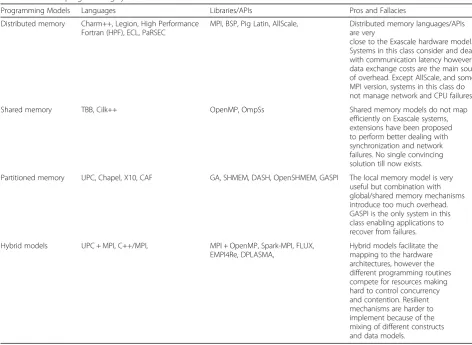
Table 1Exascale programming systems classification
Programming Models Languages Libraries/APIs Pros and Fallacies
Distributed memory Charm++, Legion, High Performance
Fortran (HPF), ECL, PaRSEC
MPI, BSP, Pig Latin, AllScale, Distributed memory languages/APIs
are very
close to the Exascale hardware model. Systems in this class consider and deal with communication latency however data exchange costs are the main source of overhead. Except AllScale, and some MPI version, systems in this class do not manage network and CPU failures.
Shared memory TBB, Cilk++ OpenMP, OmpSs Shared memory models do not map
efficiently on Exascale systems, extensions have been proposed to perform better dealing with synchronization and network failures. No single convincing solution till now exists.
Partitioned memory UPC, Chapel, X10, CAF GA, SHMEM, DASH, OpenSHMEM, GASPI The local memory model is very
useful but combination with global/shared memory mechanisms introduce too much overhead. GASPI is the only system in this class enabling applications to recover from failures.
Hybrid models UPC + MPI, C++/MPI, MPI + OpenMP, Spark-MPI, FLUX,
EMPI4Re, DPLASMA,
Fortran (CAF), DASH, and SHMEM. PGAS appears to be suited for implementing data-intensive exascale appli-cations because it uses private data structures and limits the amount of shared data among parallel threads. Its memory-partitioning model facilitates failure detection and resilience. Another programming mechanism useful for decentralized data analysis is related to data synchronization. In the SHMEM library it is imple-mented through the shmem_barrier operation that per-forms a barrier operation on a subset of processing elements, then enables them to go further by sharing synchronized data.
Starting from those three main programming ap-proaches, hybrid systems have been proposed and devel-oped to better map application tasks and data onto hardware architectures of Exascale systems. In hybrid systems that combine distributed and shared memory, message-passing routines are used for data communica-tion and inter-node processing whereas shared-memory operations are used for exploiting intranode parallelism. A major example in this area is given by the different MPI + OpenMP systems recently implemented. Hybrid systems have been also designed by combining message passing models, like MPI, with PGAS models for restricting data communication overhead and improving MPI efficiency in execution time and memory consump-tion. The PGAS-based MPI implementation EMPI4Re, developed in the EPiGRAM project, is an example of this class of hybrid systems.
Associated to the programming model issues, a set of challenges concern the design of runtime systems that in exascale computing systems must be tightly integrated with the programming tools level. The main challenges for runtime systems obviously include parallelism ex-ploitation, limited data communication, data dependence management, data-aware task scheduling, processor het-erogeneity, and energy efficiency. However, together with those main issues, other aspects are addressed in run-time systems like storage/memory hierarchies, storage and processor heterogeneity, performance adaptability, resource allocation, performance analysis, and perform-ance portability. In addressing those issues the currently used approaches aim at providing simplified abstractions and machine models that allow algorithm developers and application programmers to generate code that can run and scale on a wide range of exascale computing systems.
This is a complex task that can be achieved by exploit-ing techniques that allow the runtime system to cooper-ate with the compiler, the libraries and the operating system to find integrated solutions and make smarter use of hardware resources by efficient ways to map the application code to the exascale hardware. Finally, due to the specific features of exascale hardware, runtime
systems need to find methods and techniques that allow bringing the computing system closer to the application requirements. Research work in this area is carried out in projects like XPRESS, StarPU, Corvette DEGAS, lib-Water [10], Traleika-Glacier, OmpSs [8], SnuCL, D-TEC, SLEEC, PIPER, and X-TUNE that are proposing innova-tive solutions for large-scale parallel computing systems that can be used in exascale machines. For instance a system that aims at integrating the runtime with the lan-guage level is OmpSs where mechanisms for data de-pendence management (based on DAG analysis like in libWater) and for mapping tasks to computing nodes and handling processor heterogeneity (the target con-struct) are provided. Another issue to be taken into ac-count in the interaction between the programming level and the runtime is performance and scalability monitor-ing. In the StarPU project, for example, performance feedback through task profiling and trace analysis is provided.
In very large-scale high performance machines and in Exascale systems, the runtime systems are more complex than in traditional parallel computers. In fact, perform-ance and scalability issues must be addressed at the inter-node runtime level and they must be appropriately integrated with intra-node runtime mechanisms [25]. All these issues relate to system and application scalability. In fact, vertical scaling of systems with multicore paral-lelism within a single node must be addressed. Scalabil-ity is still an open issue in Exascale systems also because speed-up requirements for system software and runtimes are much higher than in traditional HPC systems and different portions of code in applications or runtimes can generate performance bottlenecks.
checkpointing, instead of checkpointing the entire ad-dress space of the application, as occurs in OpenMP and MPI, the minimal state of the tasks needed to be check-pointed for the fault recovery must be identified thus limiting data size and recovery overhead.
Requirements of exascale runtime for data analysis
One of the most important aspect to ponder in applica-tions that run on Exascale systems and analyze big data-sets is the tradeoff between sharing data among processing elements and computing things locally to re-duce communication and energy costs, while keeping performance and fault-tolerance levels. A scalable pro-gramming model founded on basic operations for data intensive/data-driven applications must include mecha-nisms and operations for
Parallel data access that allows increasing data access bandwidth by partitioning data into multiple chunks, according to different methods, and accessing several data elements in parallel to meet high throughput requirements.
Fault resiliency that is a major issue as machines expand in size and complexity. On Exascale systems with huge amount of processes, non-local communi-cation must be prepared for a potential failure of one of the communication sides; runtimes must fea-tures failure handing mechanisms for recovering from node and communication faults.
Data-driven local communication that is useful to limit the data exchange overhead in massively parallel systems composed of many cores; in this case data availability among neighbor nodes dictates the operations taken by those nodes.
Data processing on limited groups of cores allows concentrating data analysis operations involving limited sets of cores and large amount of data on localities of Exascale machines facilitating a type of data affinity co-locating related data and
computation.
Near-data synchronization to limit the overhead generated by synchronization mechanisms and protocols that involve several far away cores in keeping data up-to-date.
In-memory querying and analytics needed to reduce query response times and execution of analytics operations by caching large volumes of data in the computing node RAMs and issuing queries and other operation in parallel on the main memory of computing nodes.
Group-level data aggregation in parallel systems is useful for efficient summarization, graph traversal and matrix operations, therefore it is of great
importance in programming models for data analysis on massively parallel systems.
Locality-based data selection and classification for limiting the latency of basic data analysis operations running in parallel on large scale machines in a way that the subset of data needed together in a given phase are locally available (in a subset of nearby cores).
A reliable and high-level programming model and its associated runtime must be able to manage and provide implementation solutions for those operations together with the reliable exploitation of a very large amount of parallelism.
Real-world big data analysis applications cannot be practically solved on sequential machines. If we refer to real-world applications, each large-scale data mining and machine learning software that today is under develop-ment in the areas of social data analysis and bioinfor-matics will certainly benefit from the availability of Exascale computing systems and from the use of Exas-cale programming environments that will offer massive and adaptive-grain parallelism, data locality, local com-munication and synchronization mechanisms, together with the other features discussed in the previous sec-tions that are needed for reducing execution time and making feasible the solution of new problems and chal-lenges. For example, in bioinformatics applications par-allel data partitioning is a key feature for running statistical analysis or machine learning algorithms on high performance computing systems. After that, clever and complex data mining algorithms must be run on each single core/node of an Exascale machine on subsets of data to produce data models in parallel. When partial models are produced, they could be checked locally and must be merged among nearby processors to obtain, for example, a general model of gene expression correlations or of drug-gene interactions. Therefore for those appli-cations, data locality, highly parallel correlation algo-rithms, and limited communication structures are very important to reduce execution time from several days to a few minutes. Moreover, fault tolerance software mech-anisms are also useful in long-running bioinformatics applications to avoid restarting them from the beginning when a software/hardware failure occurs.
huge amount of geo-referenced data that include exten-sive knowledge about human dynamics and mobility be-haviors. A methodology for discovering behavior and mobility patterns of users from social media posts and tweet includes a set of steps such as collection and pre-processing of geotagged items, organization of the input dataset, data analysis and trajectory mining algo-rithm execution, and results visualization. In all those data analysis steps, the utilization of scalable program-ming techniques and tools is vital to obtain practical re-sults in feasible time when massive datasets are analyzed. The Exascale programming features and re-quirements discussed here and in the previous sections will be very useful in social data analysis for executing parallel tasks like concurrent data acquisition (thus data items are collected exploiting parallel queries from dif-ferent data sources), parallel data filtering and data parti-tioning by the exploitation of local and in-memory algorithms, classification, clustering and association min-ing algorithms that are very computmin-ing intensive and need a large number of processing elements working asynchronously to produce learning models from billions of posts containing text, photos and videos. The man-agement and processing of Terabytes of data that are in-volved in those applications cannot be done efficiently without solving issues like data locality, near-data pro-cessing, large asynchronous execution and the other ones addressed in Exascale computing systems.
Together with an accurate modeling of basic operations and of the programming languages/APIs that include them, supporting correct and effective data-intensive ap-plications on Exascale systems will require also a signifi-cant programming effort of developers when they need to implement complex algorithms and data-driven applica-tions such that used, for example, in big data analysis and distributed data mining. Parallel and distributed data min-ing strategies, like
collective learning, meta-learning, and ensemble learning,
must be devised using fine grain parallel approaches to be adapted on Exascale computers. Programmers must be able to design and implement scalable algo-rithms by using the operations sketched above specif-ically adapted to those new systems. To reach this goal, a coordinated effort between the operation/lan-guage designers and the application developers would be very fruitful.
In Exascale systems, the cost of accessing, moving, and processing data across a parallel system is enormous [24, 30]. This requires mechanisms, techniques and operations for capable data access, placement and
querying. In addition, scalable operations must be de-signed in such a way to avoid global synchronizations, centralized control and global communications. Many data scientists want to be abstracted away from these tricky, lower level, aspects of HPC until at least they have their code working and then po-tentially to tweak communication and distribution choices in a high level manner in order to further tune their code. Interoperability and integration with the MapReduce model and MPI must be investigated with the main goal of achieving scalability on large-scale data processing.
Different data-driven abstractions can be combined for providing a programming model and an API that allow the reliable and productive programming of very large-scale heterogeneous and distributed memory sys-tems. In order to simplify the development of applications in heterogeneous distributed memory environments, large-scale data-parallelism can be exploited on top of the abstraction of n-dimensional arrays subdivided in par-titions, so that different array partitions are placed on different cores/nodes that will process in parallel the array partitions. This approach can allow the comput-ing nodes to process in parallel data partitions at each core/node using a set of statements/library calls that hide the complexity of the underlying process. Data dependency in this scenario limits scalability, so it should be avoided or limited to a local scale.
Abstract data types provided by libraries, so that they can be easily integrated in existing applications, should support this abstraction. As we mentioned above, another issue is the gap between users with HPC needs and ex-perts with the skills to make the most of these technolo-gies. An appropriate directive-based approach can be to design, implement and evaluate a compiler framework that allows generic translations from high-level languages to Exascale heterogeneous platforms. A programming model should be designed at a level that is higher than that of standards, such as OpenCL, including also check-pointing and fault resiliency. Efforts must be carried out to show the feasibility of transparent checkpointing of Exascale programs and quantitatively evaluate the runtime overhead. Approaches like CheCL show that it is possible to enable transparent checkpoint and restart, also in high-performance and dependable GPU computing including support for process migra-tion among different processors such as a CPU and a GPU.
Concluding remarks and future work
Cloud-based solutions for big data analysis tools and systems are in an advanced phase both on the research and the commercial sides. On the other hand, new Exas-cale hardware/software solutions must be studied and designed to allow the mining of very large-scale datasets on those new platforms.
Exascale systems raise new requirements on applica-tion developers and programming systems to target architectures composed of a very large number of homogeneous and heterogeneous cores. General issues like energy consumption, multitasking, scheduling, reproducibility, and resiliency must be addressed to-gether with other data-oriented issues like data distribu-tion and mapping, data access, data communicadistribu-tion and synchronization. Programming constructs and runtime systems will play a crucial role in enabling future data analysis programming models, runtime models and hardware platforms to address these challenges, and in supporting the scalable implementation of real big data analysis applications.
In particular, here we summarize a set of open design challenges that are critical for designing Exascale pro-gramming systems and for their scalable implementa-tion. The following design choices, among others, must be taken into account:
Application reliability: Data analysis programming models must include constructs and/or mechanisms for handling task and data access failures and for recovering. As new data analysis platforms appear ever larger, the fully reliable operations cannot be implicit and this assumption becomes less credible, therefore explicit solutions must be proposed. Reproducibility requirements. Big data analysis
running on massively parallel systems demands for reproducibility. New data analysis programming frameworks must collect and generate metadata and provenance information about algorithm
characteristics, software configuration and execution environment for supporting application
reproducibility on large-scale computing platforms.
Communication mechanisms: Novel approaches
must be devised for facing network unreliability [7] and network latency, for example by expressing asynchronous data communications and locality-based data exchange/sharing.
Communication patterns: A correct paradigm design
should include communication patterns allowing application dependent features and data access models, limiting data movement and simplify the burden on Exascale runtimes and interconnection. Data handling and sharing patterns: Data locality
mechanisms/constructs, like near-data computing
must be designed and evaluated on big data applica-tions when subsets of data are stored in nearby pro-cessors and by avoiding that locality is imposed when data must be moved. Other challenges con-cern data affinity control data querying (NoSQL ap-proach), global data distribution and sharing patterns.
Data-parallel constructs: Useful models like data-driven/data-centric constructs, dataflow parallel op-erations, independent data parallelism, and SPMD patterns must be deeply considered and studied. Grain of parallelism: from very fine-grain to
process-grain parallelism must be analyzed also in combination with the different parallelism degree that Exascale hardware supports. Perhaps different grain size should be considered in a single model to address hardware needs and heterogeneity.
Finally, since big data mining algorithms often require the exchange of raw data or, better, of mining parameters and partial models, to achieve scalability and reliability on thousands of processing elements, metadata-based infor-mation, limited-communication programming mecha-nisms, and partition-based data structures with associated parallel operations must be proposed and implemented.
Endnotes
1
https://www.ibm.com/annualreport/2013/bin/assets/ 2013_ibm_annual.pdf
Appendix
Scalability in parallel systems
Parallel computing systems aim at exploiting the capacity of usefully employing all its processing elements during application execution. Indeed, only an ideal parallel system can do that fully because of its sequential times that can-not be parallelized (As the Amdahl’s law suggests [35]) and due to several sources of overhead such as sequential operations, communication, synchronization, I/O and memory access, network speed, I/O system speed, hard-ware and softhard-ware failures, problem size and program in-put. All these issues related to the ability of parallel systems to fully exploit their resources are referred as sys-tem or program scalability [36].
The scalability of a parallel computing system is a measure of its capacity to reduce program execution time in proportion to the number of its processing ele-ments. According to this definition, scalable computing refers to the ability of a hardware/software parallel sys-tem to exploit increasing computing resources effectively in the execution of a software application [37].
always be made cost-optimal if the number of processing elements, the size of memory, the network bandwidth and the size of the problem are chosen appropriately.
For evaluation and measuring scalability of a parallel program some metrics have been defined and are largely used: parallel runtime T(p), speedup S(p) and efficiency E(p). Parallel runtime is the total processing time of the program using p processor (with p > 1). Speedup is the ratio between the total processing time of the program on 1 processor and the total processing time on p pro-cessors: S(p) = T(1)/T(p). Efficiency is the ratio between speedup and the total number of used processors:E(p) = S(p)/p.
Application scalability is influenced by the available hardware and software resources, their performance and reliability, and by the sources of overhead discussed be-fore. In particular, scalability of data analysis applications are tight related to the exploitation of parallelism in data-driven operations and the overhead generated by data management mechanisms and techniques. More-over, application scalability also depends on the pro-grammer ability to design the algorithms reducing sequential time and exploiting parallel operations. Fi-nally, the instruction designers and the runtime imple-menters contribute to exploitation of scalability [38]. All these arguments mean that for realizing exascale com-puting in practice many issues and aspects must ne taken into account by considering all the layers of hard-ware/software stack involved in the execution of Exas-cale programs.
In addressing parallel system scalability it must be also tackled system dependability. As the number of processors and network interconnection increases and as tasks, threads and message exchanges increase, the rate of failures and faults increases too [39]. As dis-cussed in reference [40], the design of scalable paral-lel systems requires assuring system dependability. Therefore understanding of failure characteristics is a key issue to couple high performance and reliability in massive parallel systems at Exascale size.
Abbreviations
APGAS:Asynchronous partitioned global address space; BSP: Bulk Synchronous Parallel; CAF: Co-Array Fortran; DAaaS: Data Analysis as a Service; DAIaaS: Data analysis infrastructure as a service; DAPaaS: Data analysis platform as a service; DASaaS: Data analysis software as a service; DMCF: Data Mining Cloud Framework; ECL: Enterprise Control Language; ESnet: Energy Sciences Network; GA: Global Array; HPC: High Performance Computing; IaaS: Infrastructure as a service; JS4Cloud: JavaScript for Cloud; PaaS: Platform as a service; PGAS: Partitioned global address space; RDD: resilient distributed dataset; SaaS: Software as a service; SOA: Service Oriented Computing; TBB: Threading Building Blocks; VL4Cloud: Visual Language for Cloud; XaaS: Everything as a Service
Acknowledgments Not applicable.
Funding
This work has been partially funded by the ASPIDE Project funded by the European Union’s Horizon 2020 research and innovation programme under grant agreement No 801091.
Availability of data and materials
Data sharing not applicable to this article as no datasets were generated or analyzed during the current study.
Authors’contributions
DT carried out all the work presented in the paper. The author read and approved the final manuscript.
Authors information Not applicable.
Competing interests
The author declare that he/she has no competing interests.
Publisher’s Note
Springer Nature remains neutral with regard to jurisdictional claims in published maps and institutional affiliations.
Received: 23 October 2018 Accepted: 29 January 2019
References
1. Amarasinghe S et al (2009) Exascale software study: software challenges in extreme-scale systems. In: Defense Advanced Research Projects Agency. Arlington, VA, USA
2. Armbrust M et al (2010) A view of cloud computing. Commun ACM 53(4 (April 2010)):50–58
3. Bauer M et al (2012) Legion: Expressing locality and independence with logical regions. In: Proc. International Conference on Supercomputing. IEEE CS Press
4. Bradford L, Chamberlain CD, Zima HP (2007) Parallel programmability and the chapel language. International Journal of High Performance Computing Applications 21(3):291–312
5. Diaz J, Munoz-Caro C, Nino A (2012) A survey of parallel programming models and tools in the multi and many-core era. IEEE Trans Parallel Distributed Systems 23(8):1369–1386
6. http://www.emc.com/leadership/digital-universe/2014iview/executive-summary.htm
7. Fekete A, Lynch N, Mansour Y, Spinelli J (1993) The impossibility of implementing reliable communication in the face of crashes. Journal of ACM 40(5):1087–1107
8. Fernandez A et al (2014) Task-based programming with OmpSs and its application. In: Proc. euro-par 2014: parallel processing workshops, pp 602–613 9. Gorton I, Greenfield P, Szalay AS, Williams R (2008) Data-intensive
computing in the 21st century. Computer 41(4):30–32
10. Grasso I, Pellegrini S, Cosenza B, Fahringer T (2013) LibWater: heterogeneous distributed computing made easy.Procs of the 27th international ACM conference on International conference on supercomputing (ICS '13), New York, USA, pp 161–172
11. Gropp W, Snir M (2013) Programming for exascale computers. Computing in Science & Eng 15(6):27–35
12. Gu Y., Grossman R. L., Sector and Sphere: the design and implementation of a high-performance data cloud. Philosophical transactions Series A, Mathematical, physical, and engineering sciences 367 1897, 2429–2445, 2009
13. Lucas et al (2014) Top ten Exascale research challenges. In: Office of Science, U.S. Department of Energy, Washington, D.C
14. Maheshwari K, Montagnat J (2010) Scientific workflow development using both visual and script-based representation.Proc. of the Sixth World
Congress on Services SERVICES‘10, Washington, DC, USA, pp 328–335
15. Markidis S et al (2016) The EPiGRAM project: preparing parallel programming models for exascale. In: Proc. ISC high performance 2016 international workshops, pp 56–58
17. Marozzo F, Talia D, Trunfio P (2013) A cloud framework for big data analytics workflows on azure. In: Catlett C, Gentzsch W, Grandinetti L, Joubert G, Vazquez-Poletti J (eds) Cloud Computing and Big Data. IOS press, advances in Parallel Computing, pp 182–191
18. Marozzo F, Talia D, Trunfio P (2012) P2P-MapReduce: parallel data processing in dynamic cloud environments. J Comput Syst Sci 78(5):1382– 1402
19. Meswani MR et al (2012) Tools for benchmarking, tracing, and simulating SHMEM applications. In: Proceedings Cray user group conference (CUG) 20. Nieplocha J (2006) Advances, applications and performance of the global
arrays shared memory programming toolkit. International Journal of High Performance Computing Applications 20(2):203–231
21. Nishtala R et al (2011) Tuning collective communication for partitioned global address space programming models. Parallel Comput 37(9):576–591 22. Olston C et al (2008) Pig Latin: a not-so-foreign language for data
processing. In: Proceedings SIGMOD '08. Vancouver, Canada, pp 1099–1110 23. Pectu, D. et al., On processing extreme data, Scalable Computing: Practice
and Experience, 16, 4, 467–489, 2015
24. Reed DA, Dongarra J (2015) Exascale computing and big data. Commun ACM 58(7):56–68
25. Sarkar V, Budimlic Z, Kulkarni M (eds) (2016) Runtime systems report - 2104 runtime systems summit, U.S. Dept of Energy, USA
26. Talia D (2013) Clouds for scalable big data analytics. Computer 46(5):98–101 27. Talia D, Trunfio P, Marozzo F (2015) Data Analysis in the Cloud - Models,
Techniques and Applications. Elsevier, Amsterdam, Netherlands 28. Talia D (2015) Making knowledge discovery services scalable on clouds for
big data mining. In: Proc. 2nd IEEE International Conference on Spatial Data Mining and Geographical Knowledge Services (ICSDM), IEEE computer society press, pp 1–4
29. Tardieu O et al (2014) X10 and APGAS at petascale. In: Proc. of the ACM SIGPLAN symposium on principles and practice of parallel programming (PPoPP'14)
30. U.S (2013) Department of Energy, Synergistic Challenges in Data-Intensive Science and Exascale Computing. In: Report of the advanced scientific computing advisory committee subcommittee
31. Hwang K (2017) Cloud computing for machine learning and cognitive applications, MIT Press
32. Wozniak JM, Wilde M, Foster IT Language features for scalable distributed-memory dataflow computing. In: . Proceedings of the workshop on data-flow execution models for extreme-scale computing at PACT, Edmonton, Canada, p 2014
33. Yoo A, Kaplan Y (2009) Evaluating use of data flow systems for large graph analysis. In: Proceedings of the 2nd workshop on many-task computing on grids and supercomputers (MTAGS)
34. Zaharia M et al (2014) Apache spark: a unified engine for big data processing. Commun ACM 59(11):56–65
35. Amdahl GM (1967) Validity of single-processor approach to achieving large-scale computing capability.Proc. of AFIPS Conference, Reston, VA, pp 483– 485
36. Bailey D (1991) Twelve ways to fool the masses when giving performance results on parallel computers, RNR technical report, RNR-90-020, NASA Ames Research Center
37. Grama, A. et al.,Introduction to Parallel Computing, Addison Wesley, 2003 38. Gustafson JL (1988) Reevaluating Amdahl's Law. Commun ACM 31(5):532–
533
39. Shi JY et al (2012) Program scalability analysis for HPC cloud: applying Amdahl’s law to NAS benchmarks. In: Proc. High Performance Computing, Networking, Storage and Analysis (SCC), IEEE, CS, pp 1215–1225 40. Schroeder B, Gibson G (2006) A large-scale study of failures in