ISSN (e): 2250-3021, ISSN (p): 2278-8719
Vol. 04, Issue 09 (September. 2014), ||V1|| PP 51-55
An Analytical Approach is Developed to Estimate the Values of
Range of Alpha Particles Emitted from Radon Gas
Ali Farhan Nader; Abdul R.H. Subber; Noori.H.N. Al-Hashimi;
Department of Physics; College of Education for pure science, University of Basra; Basra; Iraq
Abstract: Numerical assessments of radon exhalation from soil samples together with the detection probability of alpha particles by CR39 and LR115 detectors were the first objective of this work with demonstration of how radon propagates in various media using SRIM2013 software. The analytical approach was developed to estimate the values of range and detection probabilities by SSNTDs of alpha particles emitted from radon gas and progenies. It was found that the new version of SRIM2013 produced a deviation in stopping power, alpha range and detection probability of both alpha detectors.
Keywords: alpha energy, alpha range, detection probability, SRIM, CR39, LR115
I. INTRODUCTION
Historically, the first expression for the stopping power was given by Bohr . That was a classical consideration of the particle interaction with a free electron, where the energy lost in the collision with one electron was integrated in some assumed limits of interaction and the expression for the stopping power was derived [1]. Niels Bohr's early work is analysis of the stopping of charged particles by matter. One of Bohr's original conclusions was that the energy loss of ions passing through matter could be divided into two components; nuclear stopping (energy loss to the medium's atomic positive cores) and electronic stopping (energy loss to the medium's light electrons). Bohr, in his first papers, correctly deduced that the electronic stopping would be far greater than the nuclear stopping for energetic light ions such as are emitted by radioactive sources. His conclusion was based on recoil kinematics considering only the relative masses and abundance of the target electrons and nuclei [2]. In 1900 Marie Curie found that energetic particles having left radioactive materials could penetrate thin foils. Then further experiments on the interaction of α-particles with different gases gave rise to the discovery of the energy deposition maximum, the so called Bragg peak. The first theoretical treatment about scattering of electrically charged particles was published by J.J.Thomson in his book on electricity [3]. When a fast ion passes through matter, it loses energy principally by scattering electrons within the matter it passes through and, more importantly at low energies, by scattering from the nuclei of the atoms [4-6]. Stopping power and range have applied a crucial role in many aspects of physics such as heavy-ion physics, nuclear physics, atomic physics, and solid-state physics and in any applied areas involving particle-interaction see for example [7-13]; this have fostered ongoing revisions and new calculations of these quantities. Due to the complexity of the atomic structures of both projectile and target, the various studies have all had to adopt some approximation in order to simplify the calculation and/or to rely on a semi-phenomenological treatment and compassion with experimental data must be carried out [14]. The aim of the present work is to calculate the range of alpha particle using SRIM2013 and compare the results with data from SRIM2008 and SRIM2003. Next is the calculation of detection probability in SSNTDs using SRIM2013.
II. THEORY
The interaction of α-particle with matter depends on the following [15]. The type of energy of radiation.
Nature of absorbing medium.
Alpha-particle interact with electrons and nuclei via coulomb interaction. Due to coulomb interaction, α-particle may excite an electron to higher energy state. Ionization and excitation break chemical bond and generate reactive species that cause for further chemical reactions. This particles move at high speed. For example α-particle has 1Mev kinetic energy will move with a speed of 6:9x10⁶
transfer which occurs when α-particle has a head on collision with an electron. One can assume the velocity of the orbiting electron is negligible to the velocity V0 of the incident α- particle. After the collision the electron moves with a velocity u and α-particle moves with the velocity v [16]. Using conservation of energy and momentum for the elastic collision for the electron and α-particle we get:
1 2𝑀𝑉0
2=1 2𝑀𝑣
2+1 2𝑚𝑢
2 Conservation of kinetic energy (1)
𝑀𝑉0= 𝑀𝑣 + 𝑚𝑢 Conservation of momentum (2)
Where m, and M are the mass of the electron and α-particle. By solving equations (1) and (2) we get: 𝑣 = 𝑀−𝑚 𝑉0
(𝑀+𝑚 ) (3)
Therefore, the energy lost (E) by an α-particle in a single collision with an electron is 𝐸 = 𝐸𝛼
4𝑀𝑚
𝑀+𝑚 2 (4)
Where Eα is the energy of the incident α-particles. Energy lost by α-particle in a single collision is very small. However the energy gained by the orbiting electron is often more than the binding energy of the atom and is therefore removed from the atom. The interacting atom is said to be ionized due to this α-particle electron collision. The physical quantity that describes the slowing down of charged particles in mater is the stopping power dE/dx where dE is the energy lost in the distance dx. Stopping power is given in J/m or in keV/m. The energy lost by a particle in the distance dx is the energy transferred to the material so this quantity is also called the linear energy transfer (LET). The Bohr relation for stopping power of heavy particle is given by [17] ;
−𝑑𝐸
𝑑𝑥 =
4𝜋𝑁𝑧2𝐾𝑜𝑒4
𝑚𝑜 𝑣2 𝑙𝑛(
2𝑚𝑜𝑣2
𝐼 ) (5)
where z is charge of incoming particle, 𝑁 =𝑁𝐴𝑣𝑜𝑔 𝜌
𝐴 is number of electron per unit volume in the stopping
material, mo is rest mass of electron, υ is the velocity of the particle, e is the electron charge, Ko=1/4ᴫ€o, and I is the mean excitation energy of the medium and is normally taken from experimental data. This was modified by taking into account the quantum effects by Bethe, and the relativistic effects by Bloch, and finally the well-known Bethe–Bloch expression for the stopping power was given as:
−𝑑𝐸
𝑑𝑥 = 𝑍2𝑒4
4𝜋𝜖𝑜2𝑚𝑜𝜐2 𝑁 𝑙𝑛
2𝑚𝑜𝜐2𝑊𝑚𝑎𝑥 𝐼2 1−𝛽2 2𝛽
2− 𝛿 − 𝑈 ] (6)
where β =υ/c, mo the rest mass of the electron, I the average excitation potential of electrons in the stopping material, Wmax the maximal value of transferred energy of electron, Ϩ the correction for polarization of the material and U takes into account non-participation of inner electrons in the collision. The stopping power given in the above equation takes into account only collisions with electrons. Events with nuclei are not considered in this formula. There is one important drawback of this formula. It was derived using the perturbation theory and the first Born approximation [18-19].
The stopping of high velocity light ions in matter usually assumes two major simplification in stopping theory; (1) the ion is moving much faster than the target electrons and is fully stripped of its electrons, and (2) the ion is much heavier than the target electrons [2].
III. RESULT AND DISCUSSION
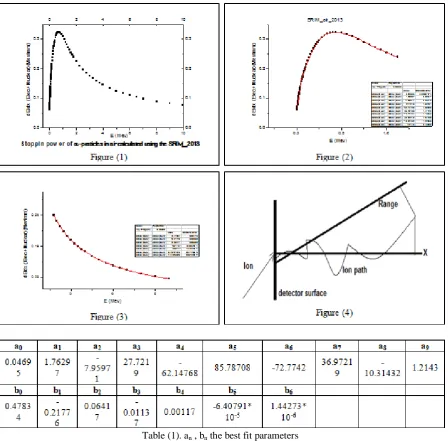
First of all we study the stopping power of alpha particles in air as presented in figure (1). In this figure we assume that the maximum energy of incident alpha particle is 10 MeV. On can conclude from these figures that the stopping power of alpha particle increases rapidly as the energy of alph particle increase this picture is dominates these figures as long as the energy of alpha particle less than 1,8 MeV this picture can be seen in more details for air in figure (2). When the energy of the alpha particles increases from 1.8 MeV to 10 Mev the behavior of the stopping power is exactly difference. One can conclude that there is almost an exponential decay of the stopping power of alpha particle, this pictures can be seen in more details in figure (3) for air. In passing through matter, charged particles ionize and thus loss energy gradually but continuously along its path until their energy is (almost) zero, after traveling a certain distance. This distance is called the range of the particle, which usually approximated to a straight line as seen in figure (4). The range of alpha particle in a given medium can be calculated from the flowing integral [10]
𝑅 𝐸 = − 𝑑𝐸
𝑆(𝐸) 0
𝐸𝑜 where 𝑆 𝐸 = − 𝑑𝐸
𝑑𝑥 (7)
Eo (MeV) is the initial energy of ion. Since particle energy in SRIM software started from 0.01 MeV – 10 MeV ,the range can be written as;
𝑅 𝐸 = − 𝑑𝐸 −𝑑𝐸 𝑑𝑥 = 𝑑𝐸 −𝑑𝐸 𝑑𝑥 = 𝑑𝐸 𝑆(𝐸) 10 0.01 10 0.01 0.01
10 (8)
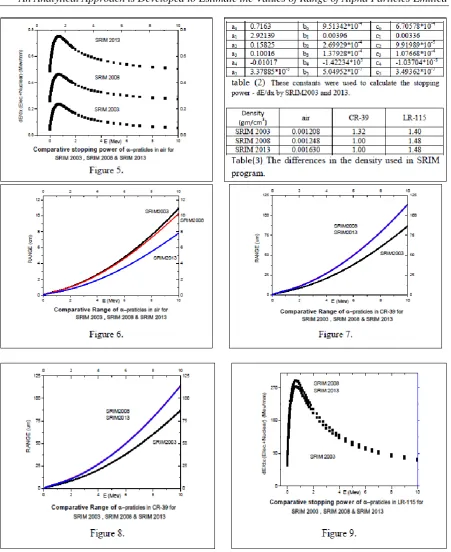
By using numerical integration in Fortran language to solve the range integration with change in energy step (0.01 MeV), the range of charged particle is computed. We can use the same procedure for CR and LR detectors. Figure (5), shows the calculated values of the range as a function of alpha particle energy plotted for air using SRIM2003,SRIM2008 and SRIM2013. Using the polynomial fitting procedure to these plots, 5th degree polynomials were used to find the relation between R(E) and E.
𝑅 𝐸 = 𝑎𝑜+ 𝑎1𝐸 + 𝑎2𝐸2+ 𝑎3𝐸3+ 𝑎4𝐸4+ 𝑎5𝐸5 𝑓𝑜𝑟 𝑎𝑖 (10)
𝑅 𝐸 = 𝑏𝑜+ 𝑏1𝐸 + 𝑏2𝐸2+ 𝑏3𝐸3+ 𝑏4𝐸4+ 𝑏5𝐸5 𝑓𝑜𝑟 𝐶𝑅 − 39 (11)
𝑅 𝐸 = 𝑐𝑜+ 𝑐1𝐸 + 𝑐2𝐸2+ 𝑐3𝐸3+ 𝑐4𝐸4+ 𝑐5𝐸5 𝑓𝑜𝑟 𝐿𝑅 − 1 (12)
where R in mm , E in MeV, The fitting parameters are presented in table (2). Because of continuously update to SRIM library, the calculated results of the range and stopping power should be changed with. One of these updates for example is; the air ( medium) density which is an important input data for the program. Table 3 shows the differences in the density used in SRIM program. From this table, one can see that air density increased with time, due to increases of pollutant specially CO2 in local air, and this phenomenon will increases the stopping power and reduce the range of alpha particle in air as seen in figures (6-9).
Table (4) contains, the alpha range in air for
REFERENCES
[1] D.Nikezic, K.N. Yu, (2004),"Formation and groth of tracks in nuclear track materials", Materials Science and Engineering R46,51-123.
[2] J.F.Ziegler (1999),"The stopping of Energetic Light ions in elemental matter",J.Appl. Phys/Rev.,85,1272. [3] Thomson, 1906] J. Thomson (1906). Conduction of electricity through gases , pp. 370382. Cambridge
University Press 2nd rev. edition.
[7] Ahlen, S.P., 1980. Theoretical and experimental aspects of the energy-loss ofrelativistic heavily ionizing particles. Rev. Mod. Phys. 52 (1), 121–173.
[8] International Commission of Radiation Units and Measurements, 1993. Stopping powers and ranges for protons and alpha particles. ICRU Report 49, International Commision of Radiation Units and Measurements, Marylad.
[9] Littmark, U., Ziegler, J.F., 1980. Handbook ofRange Distributions for Energetic Ions in All Elements. Pergamon, New York. US Department ofHealth, Education, and Welfare, 1970. Radiological Health Handbook. Bureau of Radiological Health, US Department ofHealth, Education, and Welfare, Rockville. [10] Ziegler, J.F., 1978. Helium Stopping Powers and Ranges in All Elements. Pergamon, New York.
[11] Ziegler, J.F., 1980. Handbook ofStopping Cross Sections for Energetic Ions in All Elements. Pergamon, New York.
[12] Ziegler, J.F., 2001. SRIM-2000. http://www.srim.org/
[13] Ziegler, J.F., Biersack, J.P., Littmark, U., 1985. The Stopping and Range ofIons in Solids. Pergamon, New York
[14] F.Hubert, R.Bimbot, H.Gauvin (1990), "Range and stopping-power tables for 2.5-500Mev/ nucleon hevy ions in solids", Atomic data and Nuclear data Tables 46,1-213.
[15] John David Jackson, Classical electrodynamics third edition, University of California, Berkeley, 1925. [16] www.gsi.de/forschung/pp/pub/thesis/korostiy2006. Date 31/03/2011
[17] Andnet Nigussie Habte (2011),"Calculations of stopping power and range of alpha particles of several energyies in different materials", Addis Ababa University.
[18] D.Nikezic, K.N. Yu, (2004),"Formation and groth of tracks in nuclear track materials", Materials Science and Engineering R46,51-123.