Error Truncate & Fast Gabor Filter Algorithm
for the Application of Texture Segmentation
Sourabh Kumar Kashyap Jitendra Kumar Mishra
PG Scholar Assistant Professor & Head of Dept.
Department of Electronics & Communication Engineering Department of Electronics & Communication Engineering Patel College of Science & Technology, RGPV, Bhopal (M.P) Patel College of Science & Technology, RGPV, Bhopal (M.P)
Abstract
In applications of image analysis and computer vision, Gabor filters have maintained their popularity in feature extraction. The reason behind this is that the resemblance between Gabor filter and receptive field of simple cells in visual cortex. Being successful in applications like face detection, iris recognition, fingerprint matching; where, Gabor feature based processes are amongst the best performers. The Gabor features can be derived by applying signal processing techniques both in time and frequency domain. The methods have been proposed to extract low dimension features from Gabor filtered images by considering the sparseness of the filter bank responses. Approaches like unsupervised segmentation of textured images have provided good approximation of Fisher's multiple linear discriminants with added advantage that they don't require a-priori-knowledge. Local texture properties are extracted from local linear transforms that have been optimized for maximal texture discrimination. Local statistics are estimated at the output of an equivalent filter bank by means of a non-linear transform followed by an iterative Gaussian smoothing algorithm. This process generates multiresolution sequence of feature planes with a half octave scale progression. The models like human preattentive texture perception have been proposed which involves steps like convolution, inhibition and texture boundary detection. Texture features are based on the local power spectrum obtained by a bank of Gabor filters. The concept of sparseness to generate novel contextual multiresolution texture descriptors is described. Image quality assessment (IQA) aims to provide computational models to measure the image quality in a perceptually consistent manner. The tradeoff between power consumption and speed performance has become a major design consideration when devices approach the sub-100 nm regime. It is especially critical when dealing with large data set, whereby the system is degraded in terms of power and speed. If the application can accept some errors, i.e. the application is Error- tolerant (ET), a large reduction in power and an increased in speed can be simultaneously achieved. Here we will use some scientific parameter for image quality like signal to noise ratio, FSIM, RFSIM, GMSD, SSIM MATLAB codes required in calculating these parameters are developed. Here algorithm is devolving by using of Matlab.
Keywords: Gabor filter, Gabor energy, image quality assessment, Gabor features
________________________________________________________________________________________________________
I. INTRODUCTION
Introduction to Image Texture:
An image texture is a set of metrics calculated in image processing designed to quantify the perceived texture of an image. Image texture gives us information about the spatial arrangement of color or intensities in an image or selected region of an image. Image textures can be artificially created or found in natural scenes captured in an image. Image textures are one way that can be used to help in segmentation or classification of images. For more accurate segmentation the most useful features are spatial frequency and an average grey level. To analyze an image texture in computer graphics, there are two ways to approach the issue: Structured Approach and Statistical Approach for more than 50 years understanding of processes occurring in the early stages of visual perception has been a primary research topic. For regular properties like color, brightness, size and the slopes of lines composing gures preattentive segmentation occurs strongly (Beck 1966, 1972, 1973, 1983; Olson and Attneave 1970). Research into the statistical properties of preattentively discriminable texture was started by 3 Julesz in early 1960's. Complex topic where psychophysics meets physiology Beck and Julesz were among the rst to deep in.
working in parallel which is used by the filter-bank model. These filters gives rise to concept of joint space/ spatial-frequency decomposition by simultaneously concentrate on local spatial interactions and on particular range of frequencies.
II. LITERATURE REVIEW
The module performs a linear feature reduction by using texture measurements at two successive levels of resolution. [1]
Traditional speculations of surface recognition by Julesz'- 3 and Beck-6 property pre mindful surface separation to contrasts in first-arrange insights of boost components, for example, introduction, size, and splendor of constituent components. These hypotheses have commonly been built for highly contrasting spot or line designs and are not straightforwardly relevant to dark scale pictures (however Voorhees and Poggio7 give a meaning of content on dim scale pictures). Exploratory outcomes depicting marvels that are not all around clarified by these hypotheses have been accounted for While these endeavors have shown that a separating methodology can clarify a few wonders that are not predictable with the content on hypo paper, a total model has not yet been displayed. Such a model ought to fulfill the accompanying criteria:
Natural Credibility:
The phases of the model ought to be roused by, and be steady with, known physiological instruments of early vision. 2. All inclusive statement: The model ought to be sufficiently general that it can be tried on any discretionary dark scale picture. 3. Quantitative match with psychophysical information: The model ought to make a quantitative forecast about the striking nature of the limit between any two finished districts. Rank requesting of the discriminability of various surface sets ought to concur with that deliberate psychophysically. [2]
Different elements identified with the neighborhood control range of pictures have been proposed in the writing and utilized as a part of somehow for surface examination, order, as well as division. In the majority of these reviews the connection to the nearby range is set up through (halfway) highlights that are gotten by sifting the information picture with an arrangement of two-dimensional(2-D) Gabor channels. Such a channel is direct and nearby. Its convolution part is a result of a Gaussian and a cosine work. The channel is portrayed by a favored introduction and a favored spatial recurrence. Generally, a 2-D Gabor channel goes about as a neighborhood band-pass channel with certain ideal joint confinement properties in the spatial space and in the spatial recurrence area. Regularly, a picture is sifted with an arrangement of Gabor channels of various favored introductions and spatial frequencies that cover properly the spatial recurrence area ,and the components acquired from an element vector field that is additionally utilized for investigation, characterization, or division .Gabor include vectors can be utilized straightforwardly as contribution to a grouping or a division administrator or they can first be changed into new element vectors that are then utilized all things considered an information. [4].
The idea of meager condition (additionally called sparsity), when all is said in done terms, alludes to the property of being scattered, daintily appropriated. With regards to information preparing, it alludes to the centralization of data into few coefficients. For channel bank reactions, high inadequacy values hence allude to few activated channels. In established flag handling applications, meager portrayal has turned out to be a capable apparatus for getting, speaking to, and compacting high-dimensional signs. It has assumed a vital part in the accomplishment of many machine learning calculations and methods. It has additionally been prominent in PC vision applications, as meager portrayals can encourage the recovery of semantic information from images.[12].
Feature Extraction
Gabor Features:
A core of Gabor filter based feature extraction is the 2D Gabor filter function expressed as,
𝛹(𝑥, 𝑦) = 𝑓2 𝜋𝛾𝜂𝑒
−(𝑓2 𝛾2𝑥
′2+ 𝑓2 𝜂2𝑦
′2)
𝑒−𝑖2𝜋𝑓𝑥′ (1)
𝑥′= 𝑥 𝑐𝑜𝑠𝜃 + 𝑦 𝑠𝑖𝑛𝜃
𝑦′= −𝑥 𝑠𝑖𝑛𝜃 + 𝑦 𝑐𝑜𝑠𝜃
In the spatial space (Eq. (1)) the Gabor channel is a mind boggling plane wave (a 2D Fourier premise work) duplicated by a root focused Gaussian. is the focal recurrence of the filter the revolution angle, γ sharpness (data transmission) along the Gaussian real hub, and η sharpness along the minor axis (opposite to the wave). In the given shape, the aspect ratio of the Gaussian is η/γ. This capacity has the following analytical frame in the recurrence area,
𝛹(𝑢, 𝑣) = 𝑒− 𝜋2 𝑓2(𝛾
2(𝑢′−𝑓)2+ 𝜂2𝑣′2)
(2) 𝑢′ = 𝑢 𝑐𝑜𝑠𝜃 + 𝑣 𝑠𝑖𝑛𝜃
𝑣′= −𝑢 𝑠𝑖𝑛𝜃 + 𝑣 𝑐𝑜𝑠𝜃
Gabor features, referred to as Gabor jet, Gabor bank or multi-resolution Gabor feature, are constructed from responses of Gabor filters in (1) or (2) by using multiple filters on several frequencies 𝑓𝑚 and orientations 𝜃𝑛. Frequency in this casecorresponds to scale information and is thus drawn from,
𝑓𝑚= 𝑘−𝑚𝑓𝑚𝑎𝑥 , 𝑚 = {0, . … . , 𝑀 − 1} (3)
Where, 𝑓𝑚 is the 𝑚th frequency, 𝑓0= 𝑓𝑚𝑎𝑥 is the highest frequency desired and 𝑘 > 1 is the frequency scaling factor. The filter orientations are drawn as,
𝜃𝑛= 2𝜋𝑛
𝑁 , 𝑛 = {0, . … . , 𝑁 − 1} (4)
Where, 𝜃𝑛is the 𝑛 𝑡ℎ orientation and 𝑁 is the total number of orientations. Scales of a filter bank are selected from exponential (octave) spacing and orientations from linear spacing.
a) Local Linear Transform:
The key for this approach is to describe the Nth request likelihood thickness work (pdf) of the pixels in a confined neighborhood by N initially request pdf's evaluated along an arrangement of appropriately picked pivot. These projections are picked by neighborhood straight change.
This plan sets up a correspondence between the first image{x_(k,l)}and a N channel multivariate sequence of nearby neighborhood vectors {x_(k,l)}defined forall spatial indices{k,l}. The parts of the nearby neighborhood vector x_(k,l) are the consecutively requested gray level values having a place with a N point neighborhood focused on the spatial position filed by{k,l}. A local linear change is characterized by the lattice relationship:
𝑦𝑘,𝑙= 𝑇 𝑥𝑘,𝑙 (5) Where, 𝑇 is a𝑁 ∗ 𝑁 non-singular transformation matrix.
b) Transform Selection:
The execution of the framework relies on upon the change grid T. The most insignificant illustration is to consider the utilization the character lattice or any of its stages. This specific decision is the slightest ideal, on the grounds that the insights of the underlying segments of the nearby neighborhood vector are all indistinguishable and contain no area data. The ideal answer for dissecting a given surface was appeared to be the nearby Karhunen-Loeve change that diagonalizes the spatial covariance network. This change has the amazing property of delivering the channel measurements that are the most unique in relation to each other; it likewise de-associates the changed coefficients, along these lines legitimizing the estimate of the Nth request pdf by the result of N initially request pdf's. The utilization of these arrangements, be that as it may, is confined by and by in light of the fact that they are surface ward. They are consequently not appropriate to unsupervised surface division. Luckily, it has been shown that practically comparable exhibitions could be acquired with imperfect distinct changes, for example, the discrete sine (DST),cosine (DCT), Hadamard (DHT), and genuine even Fourier(DREFT) changes.
c) Gabor Energy Features:
The yields of a symmetric and an antisymmetric piece filter in each picture point can be consolidated in a solitary amount thatis called the Gabor vitality. This component is identified with the model of a particular sort of introduction specific neuron in the primary visual cortex called the mind boggling cell and is characterized in the accompanying way:
𝑒𝜆,𝜃(𝑥, 𝑦) = √𝛾𝜆,𝜃,02 (𝑥, 𝑦) + 𝛾𝜆,𝜃,−(1 2)𝜋
2 (𝑥, 𝑦) (6)
Where, the terms in square root sign are the reactions of the straight symmetric and antisymmetric Gabor channels separately. The outcome is another non-direct channel bank of 24 channels. The Gabor vitality is firmly identified with the nearby power spectrum. The neighborhood control range related with a pixel in an image is characterized as the squared modulus of the Fourier transform of the result of the picture work and a window function that limits the Fourier examination to an area of the pixel of intrigue. Utilizing a Gaussian windowing capacity and considering the Gabor highlight picture and (3) the following relation between the neighborhood control spectrum_(λ,θ) and the Gabor energy elements can be demonstrated:
𝑝𝜆,𝜃(𝑥, 𝑦) = 𝒆𝝀,𝜽2(𝑥, 𝑦) (7)
d) Texture Sparseness:
Hoyer's measure was chosen in [Latest_Paper] to figure the meager condition of the Gabor descriptor. The fundamental reason is that this measure has everything except one of the attractive sparseness measure characteristics exhibited by Hurley and Rickard, failing just the "cloning" property (unimportant to our application). Hoyer's measure depends on the proportion amongst theL1 and L2 standards. We changed the first detailing to accommodate the instance of nonappearance of surface, for which all filter bank reactions would be zero (invalid vector):
𝑠𝑝𝑎𝑟𝑠𝑒𝑛𝑒𝑠𝑠(𝑥⃗) =
{
0 ∀𝑥𝑖 : 𝑥𝑖= 0
√𝑛 − 〈 ∑ 𝑥𝑖
√∑ 𝑥𝑖2〉
√𝑛 − 1 ∃𝑥𝑖∶ 𝑥𝑖≠ 0 (8)
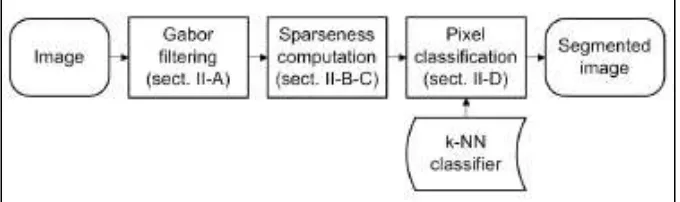
Fig. 2 Block diagram of texture segmentation using sparseness III. METHODOLOGY & IMPLEMENTATION DETAILS
Here we will also design some previous existing Gabor filter. Then we will do comparative analysis with our proposed Gabor filter in terms of:
1) Time
2) Quality Level
After that we will apply previous existing Gabor filter on texture segmentation process and again do comparative analysis between previous and proposed approach. Here we will design all algorithms by using of Matlab. For analysis point of view we will use image quality parameters which I was already discuss in literature review. In this work we are expect that we can achieve 10% improvement in time complexity. As you can see on our proposed block diagram where we put approximation logic in Gabor filter. According to propose design initially we will apply some input parameters like GAMMA, LAMBDA,THETA, SHARP, NORMLIZE. All these parameters will calculate value of signma. Here we will also take a input image. Now after calculation of sigma we calculate approximate value of Xp and YY using Xp and YY we also calculate Yp and XX here Yp is equal to Xp and YY is equal to XX. Using these parameters we calculate Gabor signal.
After this calculation we apply convolution operation between our generated Gabor signal and input image this convolution operation will generate output image which is filtered output by using of Gabor filter. For quality check we use some of the existing scientific parameters which will calculate the quality level of output image. Now for application validation we used texture segmentation where we generate the segmented output.
IV. RESULT & ANALYSIS
Here we are presenting the comparative analysis of different approaches with all parameters:
V. CONCLUSION
According to this paper we will resolve the previous existing problem which is time complexity with maintain the quality level of the generated output images. The key contribution of this work is to develop a fast algorithm. Using this work we will develop a timing complexity aware system which will reduce the speed issue. This proposed algorithm will require less time and also maintain the quality of output images. For quality measurement we use some image parameters like PSNR, SSIM, FSIM, RFSIM, GMSD. According to these parameters our generated output is up to the mark as compare to previous existing approaches. In this approach I will propose a new approach of approximation approach. Using this approach I we reduce the timing complexity with 30-40%.
ACKNOWLEDGMENT
The authors would like to thank the Department of ECE for facilitating the development of the project, making available resources for testing the system and also for final deployment.
REFERENCES
[1] Perona and Malik, "Preattentive texture discrimination with early vision mechanisms," J. Opt. Soc. Am. A, Vol. 7, No. 5, May 1990
[2] Unser, Michael, and Murray Eden. "Multiresolution feature extraction and selection for texture segmentation." Pattern Analysis and Machine Intelligence, IEEE Transactions on 11.7 (1989): 717-728.
[3] 3. A. K. Jain, F. Farrokhnia, "Unsupervised texture segmentation using Gabor filters,"Pattern Recognition, vol. 24, no. 12, pp.1167-1186, 1991
[4] 4. Grigorescu, Simona E., Nicolai Petkov, and Peter Kruizinga. "Comparison of texture features based on Gabor filters." Image Processing, IEEE Transactions on 11.10 (2002): 1160-1167.
[5] Kamarainen, Jukka. "Gabor features in image analysis." Image Processing Theory, Tools and Applications (IPTA), 2012 3rd International Conference on. IEEE, 2012.
[6] Lee, Kyoungwoo, et al. "Error-exploiting video encoder to extend energy/qos tradeoffs for mobile embedded systems." Distributed Embedded Systems: Design, Middleware and Resources. Springer US, 2008. 23-34.
[7] Kyaw, Khaing Yin, Wang Ling Goh, and Kiat Seng Yeo. "Low-power high-speed multiplier for error-tolerant application." 2010 IEEE International Conference of Electron Devices and Solid-State Circuits (EDSSC). 2010.
[8] Wang, Zhou, et al. "Image quality assessment: from error visibility to structural similarity." Image Processing, IEEE Transactions on 13.4 (2004): 600-612. [9] 18. Zhang, Lin, Lei Zhang, and Xuanqin Mou. "RFSIM: A feature based image quality assessment metric using Riesz transforms." Image Processing
(ICIP), 2010 17th IEEE International Conference on. IEEE, 2010.
[10] 19. Zhang, Lin, et al. "FSIM: a feature similarity index for image quality assessment." Image Processing, IEEE Transactions on 20.8 (2011): 2378-2386. [11] 20. Xue, Wufeng, et al. "Gradient magnitude similarity deviation: a highly efficient perceptual image quality index." Image Processing, IEEE Transactions
on 23.2 (2014): 684-695.