Volume 4, No. 9, July-August 2013
International Journal of Advanced Research in Computer Science
RESEARCH PAPER
Available Online at www.ijarcs.info
ISSN No. 0976-5697
Energy Efficient Ad-Hoc On-Demand Distance Vector (Ee-Aodv) Routing Protocol For
Mobile Ad Hoc Networks
B.Narasimhan
Assistant Professor
Department of Computer Technology Dr. N.G.P. Arts and Science College
(Affiliated to Bharathiar University) Coimbatore – 641 048. [email protected]
R. Balakrishnan
Assistant Professor
Department of Information Technology Dr. N.G.P. Arts and Science College (Affiliated to Bharathiar University)
Coimbatore – 641 048. [email protected]
Abstract: The emergence of wireless technology leads to design and development of mobile ad hoc networks. Design and development of energy efficient routing is the challenging task in the field of mobile ad hoc networks. Such challenge gives birth to more vibrant research dimensions. Ad hoc on-demand distance vector routing is one of the conventional unipath routing protocol and this paper incorporates an energy efficient mechanism with AODV. In this research works, an energy efficient mechanism is incorporated with AODV routing protocol. Energy consumption and throughput which are the prime performance metrics for determining energy efficiency are taken into account under two different scenarios by varying number of nodes and pausetime. An extensive NS2 simulation result shows that the proposed EE-AODV outperforms the conventional AODV routing protocol.
Keywords: component; formatting; style; styling; insert (Minimum 5 to 8 key words)
I. INTRODUCTION
All Staying connected anywhere to a network is in fact the primary objective of mobile technologies. Mobile Ad hoc Network (MANET) will provide such a solution. Mobile ad hoc network (MANET) is a communication faction that is formed by wireless mobile nodes without centralized control and minimum or infrastructure less setup. Mobile ad hoc networks have been exposed due to its fast and easy deployment and self-organizing capabilities in many fields, such as rescue missions and military applications. Data transmission in MANETs can be performed by either unicasting or multicasting. With MANET, all nodes are routers and forward packets without any infrastructure. This kind of network is impulsive, self-organized and self-maintained.
In this context, energy efficient routing the data is the ever demanding task since many issues is covered: scalability, security, lifetime of network, wireless transmissions, increasing needs of applications. Many routing protocols have been developed for ad hoc networks. They can be classified according to different criteria. The most important is by the type of route discovery. It enables to separate the routing protocols into two categories: proactive and reactive. In reactive protocols, e.g. Dynamic Source Routing (DSR) and Ad hoc On-demand Distance Vector routing (AODV), the routing request is sent on-demand: if a node wants to communicate with another, then it broadcasts a route request and expects a response from the destination. Conversely, proactive protocols update their routing information continuously in order to have a permanent overview of the network topology (e.g. OLSR).
II. LITERATURESTUDY
Cooperation among mobile devices in wireless networks has the potential to provide notable performance gains in terms of increasing the network throughput [1], [2], [3], [4], [5], extending the network coverage [6], [7], [8], decreasing the end-user communication cost [9], and decreasing the energy consumption [10], [15], [11]. For example, the ICAM architecture presents an integrated cellular and ad hoc multicast scheme to increase the cellular multicast throughput through the use of mobile stations (MSs) as ad hoc relays [3]. In the UCAN architecture [2], the MSs use their WLAN interface to enhance the throughput and increase the coverage of a wireless wide area network. In [9], MSs are assumed to be connected to several wireless networks with different characteristics in terms of bandwidth, packet loss probability, and transmission cost. A near optimal solution is shown to reduce end user cost while meeting distortion and delay constraints.
over cooperative networks with general topologies has not been tackled yet in the literature.
III. EE-AODV
AODV followed a pure on demand route acquisition system nodes that does not lies on active paths neither maintain any routing information nor participate in any periodic routing table exchanges. Further a node does not have to discover and maintain a route to another node until the two needs to communicate unless the former node is offering its services as an intermediate forwarding station to maintain connectivity between two other nodes. When the local connectivity of the mobile node is of interest each mobile node can become aware of the other nodes in its neighbourhood by the use of several techniques. The routing tables of the nodes within the neighbourhood are organized to optimize response time to local movements and provide quick response time for requests for establishment of new routes. The algorithm's primary objectives are
To broadcast discovery packets only when necessary To distinguish between local connectivity management neighbourhood detection and
General topology maintenance
To disseminate information about changes in local connectivity to those neighboring mobile nodes those are likely to need the information AODV uses a broadcast route discovery mechanism. Instead of source routing AODV relies on dynamically establishing route table entries at intermediate nodes. This difference pays off in networks with many nodes where a larger overhead is incurred by carrying source routes in each data packet.
To maintain the most recent routing information between nodes, AODV borrowed the concept of destination sequence numbers from DSDV. Unlike in DSDV, however each ad hoc node maintains a monotonically increasing sequence number counter which is used to supersede stale cached routes. The combination of these techniques yields an algorithm that uses bandwidth efficiently by minimizing the network load for control and data traffic is responsive to changes in topology and ensures loop free routing. It uses the periodic beaconing and sequence numbering procedure of DSDV and a similar route discovery procedure as in DSR. However, there are two major differences between DSR and AODV. The most distinguishing difference is that in DSR each packet carries full routing information, whereas in AODV the packets carry the destination address. This means that AODV has potentially less routing overheads than DSR. The other difference is that the route replies in DSR carry the address of every node along the route, whereas in AODV the route replies only carry the destination IP address and the sequence number. The advantage of AODV is that it is adaptable to highly dynamic networks. However, node may experience large delays during route construction, and link failure may initiate another route discovery, which introduces extra delays and consumes more bandwidth as the size of the network increases.
A. Ee – Aodv:
In this research, intermediate node switching algorithm is proposed which reduces the total energy outflow in heterogeneous mobile ad hoc networks during Time T. The objective function can be formulated as
dt
t
a
E
a
U
b B b T oin
.
(
)
)
(
∑∫
∈
=
,Where Ein is the intermediate node energy consumption;
}
1
,
0
{
)
(
t
∈
a
b is the activity indicator of intermediate node b attime
t
∈
[
0
,
T
]
which is determined by the intermediate node switching strategy, and a is a vector of the activity indicators of all intermediate nodes during T.The energy cutback problem considering the intermediate node switching can be mathematically modelled as,
)
(
min
U
a
a
A load threshold is modelled which is
joules
a
U
a
(
)
.
2
min
+
to balance trade-offs between thesystem stability / reliability and the energy efficiency towards the problem model.
For instance, with a low threshold value, intermediate nodes operate in a conventional manner with a low system load on average. As a result data transmission would experience lesser delay along with lesser packets drop. But finding the optimum solution to this energy efficient routing has two major complexities. They are
Requires high computational complexity for finding the optimum active intermediate nodes among on/off combination
Needs a centralized controller that requires information from all intermediate mobile nodes.
B. Switching-Off State:
Since intermediate nodes are typically deployed on the basis of peak traffic volume and stayed turned-on irrespective of traffic load, it is possible to save huge energy by switching off some underutilized intermediate nodes during off-peak times.
It requires examining the possibility whether a particular intermediate node can be turned on / off. It is defined that the set of neighboring mobile intermediate nodes b by Nb and it is
denoted by
n
∈
N
b. The neighboring mobile node provides the best signal strength as mentioned by the below equation.b N
i
g
i
x
P
n
b).
,
(
max
arg
∈=
To quantify the system load of the network are affected by the switching-off process, a notion is introduced called network-impact which has the parameter additional load increments. Hence mathematically, the network-impact decision of switching-off intermediate node is defined by
ON n b n N n b
B
F
b),
(
max
→ ∈+
=
ρ
ρ
The proposed mechanism switches off the intermediate nodes which has the least network-impact, as given below:
b B b
F
b
ON ∈=
arg
min
The above action repeats until there is no active intermediate node whose neighbors would satisfy the feasibility condition.
C. Switching-On State:
In order to implement the switching-on algorithm, the reverse of switching-off algorithm could be performed. The essential concept of the switching-on algorithm is that the intermediate node would be switched on when the system load reaches the same value that the intermediate node was originally switched off. Yet, the turned-off intermediate node cannot make a switching-on decision by itself since it does not have information about the current system load. Hence the switching-on process needs to rely on neighboring intermediate nodes. Before an intermediate node is turned off, the intermediate node and its neighboring intermediate nodes will exchange the information about the switching-off status. As a result, the neighboring intermediate nodes are known when and under what conditions the intermediate node goes to turn off.
When the system load of intermediate node
b
' reaches the recorded system load when its neighboring intermediate node b was switched off, the intermediate nodeb
' wakes up the intermediate node b by sending the request to switch-on. If multiple system loads have been recorded for several neighboring switched-off intermediate nodes, then the last recorded system load is considered. Therefore, the last switching-off intermediate node is the first to be switched on. The switching-on decision can be done using the below model:If
[
pb
'
>
p
br'eb',
]
then send the request to the switching-on to the neighboring intermediate node b which was switched off.IV. SIMULATIONSETTINGS
[image:3.612.329.572.66.285.2]Network Simulator 2 (NS2) is used to simulate AODV and EE-AODV routing protocols; 100 mobile nodes starting from IP address 192.168.1.1 to 192.168.1.100 move in a 1500 x 1500 meter rectangular region for 100 seconds simulation time. The channel capacity of mobile nodes is set to 256 kbps. The distributed coordination function (DCF) of IEEE 802.11 for wireless LANs is used. It has the functionality to notify the network layer about link breakage. It is assumed that each node moves independently with the same mobility speed 2 m/s. All nodes have the same transmission range of 250 meters. The simulated traffic is Constant Bit Rate (CBR) with initial energy 2.5 joules. The simulation settings are also represented in tabular format as shown in Table 1.
Table I. Simulation Settings
No. of Nodes 100
Terrain Size 1500 X 1500 m
MAC 802.11b
Radio Transmission Range 250 meters Simulation Time 100 seconds
Traffic Source CBR (Constant Bit Rate)
Packet Size 512 KB
Mobility Model Random Waypoint Model
Speed 2 m/s
[image:3.612.327.574.534.720.2]V. RESULTSANDDISCUSSION
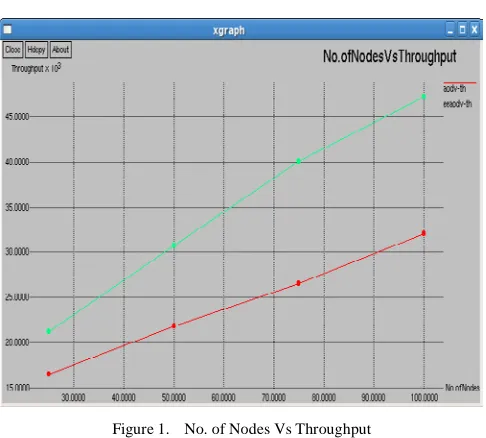
Figure 1. No. of Nodes Vs Throughput
In Fig.1 comparison of AODV routing protocol and the proposed EE-AODV protocol is shown with subject to throughput performance. From the Fig.1 it can be observed that the proposed EE-AODV protocol attains high throughput than the conventional AODV protocol.
In Fig.2 the AODV routing protocol is compared with the proposed EE-AODV protocol that is shown with subject to energy consumption. From the Fig.2 it is inferred that the proposed EE-AODV protocol consumes less energy (in joules) than the conventional AODV protocol.
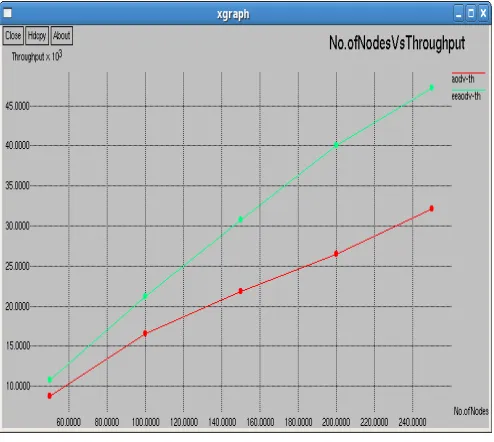
In Fig.3 comparison of AODV routing protocol and the proposed EE-AODV protocol is shown with subject to throughput performance. From the Fig.3 it can be observed that the proposed EE-AODV protocol attains high throughput than the conventional AODV protocol.
In Fig.4 the AODV routing protocol is compared with the proposed EE-AODV protocol that is shown with subject to energy consumption. From the Fig.4 it is inferred that the proposed EE-AODV protocol consumes less energy (in joules) than the conventional AODV protocol.
[image:3.612.40.284.603.707.2]Figure 3. Pausetime Vs Throughput
Figure.4 Pausetime Vs Energy Consumption
VI. CONCLUSIONS
This paper has proposed an energy efficient mechanism which is combined with the conventional Ad hoc On-Demand Distance Vector (AODV) routing protocol. The proposed work aims in reducing the energy cost occurred when the mobile nodes are even unused. Extensive simulation results show that EE-AODV routing protocol outperforms AODV in terms of energy consumption of nodes and throughput.
VII.ACKNOWLEDGMENT
The authors thank the Management of Dr. N. G. P. Educational Institutions for providing career opportunity as Assistant Professor at Dr. N. G. P. Arts and Science College and also motivating this research.
VIII.REFERENCES
[1] H. Wu, C. Qiao, S. De, and O. Tonguz, “Integrated Cellular and Ad Hoc Relaying Systems: iCAR,” IEEE J. Selected Areas in Comm., vol. 19, no. 10, pp. 2105-2115, Oct. 2001. [2] H. Luo, R. Ramjeey, P. Sinha, L.E. Li, and S. Lu, “UCAN: A
Unified Cellular and Ad Hoc Network Architecture,” Proc. ACM MobiCom, Sept. 2003.
[3] R. Bhatia, L.E. Li, H. Luo, and R. Ramjee, “ICAM: Integrated Cellular and Ad Hoc Multicast,” IEEE Trans. Mobile Computing, vol. 5, no. 8, pp. 1004-1015, Aug. 2006. [4] L. Popova, T. Herpel, W. Gerstacker, and W. Koch,
“Cooperative Mobile-to-Mobile File Dissemination in Cellular Networks within a Unified Radio Interface,” Int’l J. Computer and Telecomm. Networking, vol. 52, no. 6, pp. 1153-1165, Jan. 2008.
[5] M. Peng and W. Wang, “Investigation of Cooperative Relay Node Selection in Heterogeneous Wireless Communication Systems,” Proc. IEEE Int’l Conf. Comm., May 2008.
[6] J.-C. Chen, S.-H. Chan, J.-Y. He, and S.-C. Liew, “Mixed-Mode WLAN: The Integration of Ad Hoc “Mixed-Mode with Wireless LAN Infrastructure,” Proc. IEEE GlobeCom, Dec. 2003.
[7] Z. Dawy, S. Davidovic, and I. Oikonomidis, “Coverage and Capacity Enhancement of CDMA Cellular Systems via Multihop Transmission,” Proc. IEEE GlobeCom, Dec. 2003. [8] J. Chen, S. Li, S.-H.G. Chan, and J. He, “WIANI: Wireless
Infrastructure and Ad-Hoc Network Integration,” Proc. IEEE Int’l Conf. Comm., May 2005.
[9] K.-J. Peng and Z. Tsai, “Distortion and Cost Controlled Video Streaming in a Heterogeneous Wireless Network Environment,” Proc. IEEE Int’l Symp. Personal, Indoor and Mobile Radio Comm., Sept. 2006.
[10] F. Fitzek and M. Katz, Cooperation in Wireless Networks: Principles and Applications. Springer, 2006.
[11] M. Ramadan, L. Zein, and Z. Dawy, “Implementation and Evaluation of Cooperative Video Streaming for Mobile Devices,” Proc. IEEE Int’l Symp. Personal, Indoor, and Mobile Radio Comm., Sept. 2008.
[12] D. Zhu and M. Mutka, “Cooperation among Peers in an Ad Hoc Network to Support an Energy Efficient IM Service,” J. Pervasive and Mobile Computing, vol. 4, no. 3, pp. 335-359, June 2008.
[13] B.J. Oh and C.W. Chen, “Energy Efficient H.264 Video Transmission over Wireless Ad Hoc Networks Based on Adaptive 802.11e EDCA MAC Protocol,” Proc. IEEE Int’l Conf. Multimedia and Expo, June 2008.
[15] Q. Zhang, F.H.P. Fitzek, and V.B. Iversen, “Design and Performance Evaluation of Cooperative Retransmission Scheme for Reliable Multicast Services in Cellular Controlled P2P Networks,” Proc. IEEE Int’l Symp. Personal, Indoor and Mobile Radio Comm., Sept. 2007.