A Reliability-based Routing Protocol For
Vehicular Ad-Hoc Network
Monika R. Mangave, Prof. P.P.Belagali
Student II Year M.E, Dept. of E &Tc, J.J.M.C.O.E., Jaysingpur, India
Associate Professor, Dept. of Electronics Engineering
,
J.J.M.C.O.E., Jaysingpur, IndiaABSTRACT: Vehicular ad hoc networks (VANETs) are a special form of wireless networks which is formed by
vehicles which are communicating among themselves on roads. The conventional routing protocols proposed for mobile ad hoc networks (MANETs) are not suitable for VANETS they work poorly in VANETs. As communication links break more frequently in VANETs than in MANETs, the routing reliability of such highly dynamic networks needs to be pay special attention. A very little research has focused on the routing reliability of VANETs on highways. In this paper, we use the evolving graph theory to model the VANET communication graph on a highway. This paper is to propose an evolving graph-based reliable routing scheme for VANETs to provide quality-of-service (QoS) which support in the routing process..
KEYWORDS: Evolving graph(EG), most reliable journey (MRJ) ,mobile ad hoc networks (MANETs) ,quality of
service (QoS), vehicular ad hoc network (VANET).
I. INTRODUCTION
Every day, a lot of people die, and many more are injured in traffic accidents around the world. The desire to provide road safety information among vehicles to prevent accidents and improve road safety. The main aim of VANETs is to avoid such accidents and provides road safety information&quality-of-service. So there is need of communication to know traffic condition monitoring, dynamic route scheduling, emergency-message dissemination and, most importantly, safe driving. Vehicular Ad hoc NETworks (VANETs) are special form of MANETs.it is an emerging technology, which allow vehicles to form a self-organized network without the aid of a permanent infrastructure. Vehicular ad hoc networks (VANETs) are a promising technology to enable the communications among vehicles on one hand and between vehicles and road side units on the other hand. These are highly mobile, thus the network topology is frequently changing. The conventional routing protocols proposed for mobile ad hoc networks (MANETs) work poorly in VANETs ,as communication links break more frequently in VANETs than in MANETs, VANETs tend to operate without an infrastructure;
The ad hoc network connectivity is equipped with wireless communication which is provided by each and every vehicle. Each vehicle in the network can send, receive, and relay messages to other vehicles in the network. In this way, vehicles can exchange real-time information, and drivers can be informed about road traffic conditions and other travel-related information. VANETs have attractive& unique feature than MANET such as normally higher transmission power, higher computational capability, The special behavior and characteristics of VANETs raise important technical challenges that should be considered to deploy these networks effectively. So this is the to propose an evolving graph-based VANETs to provide quality-of-service (QoS) which support in the routing process. Here a new algorithm is developed to find the most reliable route in the VANET evolving graph from the source to the destination
II. RELATED WORK
graph-based routing protocol, and then, it is used to provide a benchmark when comparing four major ad hoc routing protocols. Monteiro showed that an evolving graph-based routing protocol is well suited for networks with known connectivity patterns and that the model, as a whole, may be a powerful tool for the development of routing protocols.
G. Pallis, D. Katsaros, M. D. Dikaiakos, N. Loulloudes, and L. Tassiulas, “On the structure and evolution of vehicular networks,” 2009 [2] the objective of this system focuses on providing a thorough study of the topological characteristics and statistical features of a VANET communication graph. Specifically, answers are provided for some critical questions such as the following: How do VANET graphs evolve over time and space? What is the spatial distribution of these nodes? Which are the critical link duration statistics in a VANET when the vehicles move in urban areas? How robust is a VANET? The obtained results could have a wide range of implications for the development of high performance, reliable, scalable, secure, and privacy-preserving vehicular technologies
.
J. Monteiro, A. Goldman, and A. Ferreira, “Performance evaluation of dynamic networks using an evolving graph combinatorial model,” 2006 [3] The highly dynamic behavior of wireless networks make them very difficult to evaluate, e.g. as far as the performance of routing algorithms is concerned. However, some of these networks, such as intermittent wireless sensors networks, periodic or cyclic networks, and low earth orbit (LEO) satellites systems have more predictable dynamics, as the temporal variations in the network topology are somehow deterministic. Recently, a graph theoretic model the evolving graphs was proposed to help capture the dynamic behavior of these networks, in view of the construction of least cost routing and other algorithms. The algorithms and insights obtained through this model are theoretically very efficient and intriguing. However, there is no study on the uses of these theoretical results into practical situations. Therefore, the objective of this work is to analyze the applicability of the evolving graph theory in the construction of efficient routing protocols in realistic scenarios.
M. Rudack, M. Meincke, K. Jobmann, and M. Lott, “On traffic dynamical aspects of inter vehicle communications (IVC),”,2003 [4] This system focuses on the impact of vehicular traffic dynamics on protocols for ad hoc networks. Based on analytical treatment of vehicular traffic and on realistic traffic scenarios, they deduce requirements and their interdependencies for the developed ad hoc networking protocols, and verify them by simulation. They showed that the proposed MAC and RRM protocols are suitable for Inter Vehicle Communication with its high dynamics in freeway environments.
J. J. Blum, A. Eskandarian, and L. J. Hoffman, “Challenges of inter vehicle ad hoc networks,”,2004 [5] Inter vehicle communication (IVC) networks, a subclass of mobile adhoc networks (MANETs), have no fixed infrastructure and instead rely on the nodes themselves to provide network functionality. However, due to mobility constraints, driver behavior, and high mobility, IVC networks exhibit characteristics that are dramatically different from many generic MANETs. This paper elicits these differences through simulations and mathematical models and then explores the impact of the differences on the IVC communication architecture, including important security implications.
S. Jiang, D. He, and J. Rao, “A prediction-based link availability estimation for mobile ad hoc networks,”2001 [6] & V. Thilagavathe and K. Duraiswamy, “Prediction based reliability estimation in MANETs with Weibull nodes,”,2001 [7] The specialty of this proposed system is a scheme that uses the information on vehicle headings to predict a possible link breakage prior to its occurrence. Vehicles are grouped according to their velocity vectors. When a vehicle shifts to a different group and a route involving the vehicle is about to break, the proposed scheme searches for a more stable route that includes other vehicles from the same group.
III.PROPOSED WORK
A. Scope:
with evolving graph theory to propose reliable routing protocol EG-RAODV. So a new reliability based routing scheme which is using evolving graph so as to establish a more reliable route between the source and the destination nodes.
For the purpose of routing data packets reliably in VANETs, we design a new routing protocol that can take benefit from the VoEGit’s advantages and properties. The new routing protocol uses the VoEG model and considers the routing reliability constraint while searching for the route from the source to the destination. A new routing algorithm to find the MRJ is needed first. Then, this algorithm will be applied to design the route discovery process for our proposed EG-RAODV routing protocol. Here AODV stands for the Ad hoc On-Demand Distance Vector routing protocol.
B. Motivation:
To fulfil VANETs’ requirements, we extend the current evolving graph model. The extended version of the evolving graph model, is called asVoEG, here VoEG considers the reliability of communication links among vehicles. In the following, we briefly introduce the basis of the evolving graph theory and then extend the current evolving graph model to propose the VoEG model.
A new algorithm called bidirectional search algorithm has been used to find the most reliable routing in the VANET from the source to the destination. Instead of searching the reliable lane route in one direction bidirectional search algorithm searches the most sophisticated route from both the directions (i.e.) from source to destination and destination to source
C. Methodology:
1. VANET-Oriented Evolving Graph (VOEG) Model
We proposed VoEG to model and formalize the VANET communication graph. So We associate a model considering the time & link reliability value at that time. In the VoEG model, the communication link between two vehicles is not available if its reliability value is equal to zero & the communication link between two vehicles is available if its reliability value is not equal to zero. Thus the VoEG model is used to find out whether the communication link between two vehicles is possible or not. where Link reliability is defined as the probability that a direct communication link between two vehicles will stay continuously available over a specified time period. The objective is to find the most reliable journey (MRJ) instead of using the conventional approaches of finding the foremost, shortest, or fastest journey. The MRJ has the highest journey reliability value among all possible journeys from the source to the destination.
2. Evolving Graph Reliable Ad hoc On-demand Distance Vector Routing (EG-RAODV) Protocol
We extend the well-known ad hoc on-demand distance vector (AODV) routing protocol with evolving graph theory to propose reliable routing protocol EG-RAODV. But first A newrouting algorithm to find the MRJ is needed. Then, this algorithm will be applied to design the route discovery process for our proposed EG-RAODV routing protocol.
a) EG-Dijkstra Algorithm :
The normal Dijkstra algorithm cannot be directly applied in this context. We modify it and propose the evolving graph Dijkstra’s algorithm (EG-Dijkstra) to find the MRJ based on the journey reliability definitions. EG-Dijkstra algorithm maintains an array called the reliable graph (RG) that contains all vehicles and their corresponding MRJ values.
3. Route Discovery Process in EG-RAODV:
vehicle knows the most reliable valid journey to the destination. It will create a routing request message (RREQ) and assign the hops of the MRJ as extensions to this RREQ. Note that this extension field in the RREQ is not used in the traditional ad hoc routing protocols and was left for future use.
In EG-RAODV, by utilizing the extension information in the RREQ, intermediate nodes are able to forward the routing request to the next hop without broadcasting. At each vehicle along the route, when an RREQ is received, the information about from which vehicle it heard is recorded. Then, the RREQ will be forwarded to the next hop based on the extension’s information. Intermediate vehicles are not allowed to send a routing reply message (RREP) to the source vehicle, even if they have a valid route to the destination. Since the time domain is incorporated in the routing process and the mobility of nodes is highly dynamic, the reliability values at intermediate vehicles might be out dated. An RREP will be sent back to the source vehicle to start data transfer.
Sr. No Simulation Parameter Value
1 Protocol AODV/EGRAODV
2 Simulation Time 150s
3 Antenna Type Omni directional
4 Varying No. of Vehicles 10-50
5 Packet Size 150
6 Mac layer Protocol 802_11
4. Flow Chart
a)
IV.SIMULATION RESULTS
1) End to End Delay:
When we conducted experimental analysis for END to END Delay, we found that we obtain lower E2E delay value for EGRAODV compared with AODV. The experiment is conducted for both protocols by taking same no of nodes such as 10,20,30,40,50. The graph is plotted for E2E delay with respect to no. of nodes
Analysis Network
Collect the information from vehicles aboutroutes
Send updated data based on prediction result
To evaluate performance using Trace file
Analysis Node configuration
Node Power (tm power. Re power)
To model the graph using evolvingtheory
Check the vehicle data using prediction algorithm
To find most reliable route using EG-Dijkstra Algorithm
Table 1 : For calculating End to End Delay
Fig1:End to End Delay for AODV & EGRAODV
2) Packet Delivery Ratio:
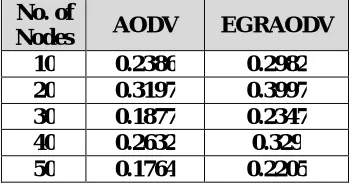
This experiment is conducted for analysis of Packet delivery ratio.we found that we obtain highest packet delivery ratio for EGRAODV than compared with AODV. The experiment is conducted for both protocols by taking same no of nodes such as 10,20,30,40,50. The graph is plotted for PDR against no of nodes
Table 2 : For calculating Packet Delivery Ratio No. of
Nodes AODV EGRAODV
10 06814 0.5451
20 1.0144 0.8115
30 0.8744 0.6995
40 0.6115 0.4892
50 0.9252 0.7403
No. of
Nodes AODV EGRAODV
10 0.2386 0.2982
20 0.3197 0.3997
30 0.1877 0.2347
40 0.2632 0.329
Fig 2:Packet Delivery Ratiofor AODV & EGRAODV
3) Throughput:
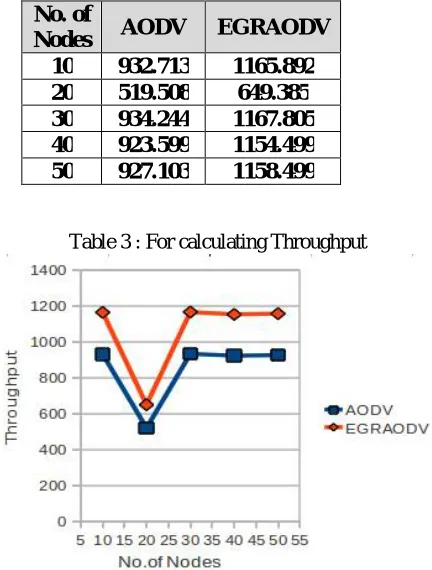
This experiment is conducted for analysis of Throughput. we found that we obtain highest throughput for EGRAODV than compared with AODV. The experiment is conducted for both protocols by taking same no of nodes such as 10,20,30,40,50. The graph is plotted for throughput against no of nodes
Table 3 : For calculating Throughput
Fig3:Throughputfor AODV & EGRAODV
V. CONCLUSION
Above graph show the simulation parameter for proposed system EG-RAODV which evaluate the Throughput, Average End-to-End to delay, PDR for 10,20,,30,40,50 numbers of nodes. Comparing outcome of EG-RAODV and AODV it is clear that throughput& PDR increase as compare to AODV and average end to end delay reduce. Figure 1,
No. of
Nodes AODV EGRAODV
10 932.713 1165.892
20 519.508 649.385
30 934.244 1167.805
40 923.599 1154.499
2, 3 shows comparisons of throughput, average end to end delay and normalized routing overhead.so we obtain better results for EGRAODV compared to AODV.
REFERENCES
[1] J. Monteiro, “ The use of evolving graph combinatorial model in routing protocols for dynamic networks,” in Proc. XV ConcursoLatinoamericano de Tesis de Maestrìa, , pp. 1–17, 2008
[2] G. Pallis, D. Katsaros, M. D. Dikaiakos, N. Loulloudes, and L. Tassiulas, “ On the structure and evolution of vehicular networks,” inProc. 17thIEEE/ACM Annu. Meeting Int. Symp. MASCOTS, ,pp. 1–10,2009
[3] J. Monteiro, A. Goldman, and A. Ferreira, “ Performance evaluation of dynamic networks using an evolving graph combinatorial model,” in Proc.IEEE Int. Conf. WiMobComput., Netw. Commun.,pp. 173–180, 2006,
[4] M. Rudack, M. Meincke, K. Jobmann, and M. Lott, “On traffic dynamical aspects of inter vehicle communications (IVC),” in Proc. IEEE Veh.Technol. Conf., , pp. 3368–3372,2003
[5] J. J. Blum, A. Eskandarian, and L. J. Hoffman, “Challenges of inter vehicle ad hoc networks,” IEEE Trans. Intell. Transp. Syst., vol. 5, no. 4, pp. 347–351, Dec. 2004
[6] S. Jiang, D. He, and J. Rao, “A prediction-based link availability estimation for mobile ad hoc networks,” in Proc. IEEE INFOCOM, pp. 1745– 1752., 2001
[7] V. Thilagavathe and K. Duraiswamy, “Prediction based reliability estimation in MANETs with Weibull nodes,” Eur. J. Sci. Res., vol. 64, no. 2,pp. 325–329, Nov. 2011
[8] K . T. Feng, C. H. Hsu, and T. E. Lu, “Velocity-assisted predictive mobility and location-aware routing protocols for mobile ad hoc networks,” IEEE Trans. Veh. Technol., vol. 57, no. 1, pp. 448–464, Jan. 2008
[9] V. Namboodiri and L. Gao, “Prediction-based routing for vehicular ad hoc networks,” IEEE Trans. Veh. Technol., vol. 56, no. 4, pp. 2332– 2345, Jul. 2007.