Characterization of antiepileptic drug therapy for achieving seizure
cessation in patients with benzodiazepine-resistant status epilepticus
Introduction
According to the 2012 Neurocritical Care Society guidelines, status epilepticus (SE) is
defined as greater than 5 minutes of continuous seizure activity or greater than or equal to 2
discrete seizures without full recovery of consciousness. Refractory SE (RSE) or
benzodiazepine-resistant SE is defined as SE that does not respond to adequate doses of initial
benzodiazepines and requires treatment with a second acceptable antiepileptic drug (AED). 1
SE is one of the most commonly encountered neurological emergencies with
approximately 150,000 cases in the United States, accounting for 40,000 deaths per year.2 The
overall mortality associated with SE approaches 20%, with generalized convulsive SE
representing about 45-75% of all cases and estimated direct inpatient cost of $4 billion in the
USA.8
SE shows a time-dependent increase in mortality and resistance to treatment. 3 The
primary concern is that epilepsy will develop in about 20 to 40% of patients after a single
episode of SE.9Pathologically, however, hippocampalneurons begin to die after 30 minutes of
sustained seizure activity and those patients who do survive RSE are more likely to experience
further epileptic episodes than those with benzodiazepine-responsive SE (88% vs 22%). 1,9
Therefore, timely treatment of these episodes is indicated to prevent potentially deleterious
complications such as chronic encephalopathy and consequently, severe disability. 1,4,9
As a first line, benzodiazepines fail to provide seizure cessation for 35-45% of patients
with SE and additional treatments are needed, for which convincing evidence is lacking.4
on expert opinion and less rigorous data, where use of one or more of the following agents is not
unreasonable: valproate, levetiracetam, phenytoin, lacosamide, phenobarbital, topiramate, and/or
pentobarbital.1
In 2013, a meta-analysis of 27 papers comparing effectiveness of five AEDs for the
treatment of RSE was published, in which 77.7% of studies were observational and characterized
by considerable heterogeneity and wide confidence intervals. This analysis concluded that
valproate, levetiracetam, and phenobarbital could all be used as first line therapy in RSE;
however, the evidence did not support the first-line use of phenytoin, which is the only AED
with an FDA-approved indication for SE. Additionally, lacosamide studies were excluded due to
insufficient data.5, 6
The medication profiles of currently available AEDs for the treatment of RSE vary
widely in their severity of side effects, drug-drug interactions, and necessity for blood level
monitoring. In approximately 25% of patients, side effects lead to the discontinuation of the
selected treatment and have a substantial negative impact on patients’ quality of life.3
Due to a lack of evidence regarding choice of AED for RSE, there is a need to elucidate
the comparative effectiveness and safety of these agents in patients with seizures not responding
to benzodiazepines. The purpose of this study was to characterize the utilization of antiepileptic
drugs for the induction of seizure cessation in patients with benzodiazepine-resistant status
epilepticus at a community hospital in comparison to current literature.
Methods
This institutional review board approved study was a retrospective electronic chart
review of adults presenting with a SE event during the study period of December 2006 through
least one episode of benzodiazepine-resistant SE with AED therapy during the admission who
had continuous EEG monitoring for at least 1 hour. Patients with subclinical seizures were
included in the study. Patients were excluded for the following reasons: re-admittance for seizure
event within the study period, hypothermia as indication for EEG monitoring and participation in
an AED clinical trial. Seizure cessation was defined as discontinuation of continuous EEG
(cEEG) monitoring and absence of reinitiating cEEG within 24 hours for seizure monitoring
purposes. Coma was defined as initiation of continuous infusion of anesthetic medications and
dose titration to burst suppression on cEEG. The primary outcome of this study was to identify
the average number of AEDs needed to stop benzodiazepine-resistant SE. Secondary outcomes
included the average number of AEDs used in patients with and without history of seizure;
average loading, maintenance, and total dose of AEDs used; percentage of patients with seizure
cessation, coma or death; and percentage of patients intubated. Data collected included patient
age, sex, race, ethnicity, weight, height, body mass index, estimated creatinine clearance, number
of AEDs taken prior to admission and at discharge, seizure type and history, seizure etiology,
rate of intubation, patient outcomes (seizure cessation, coma, death), individual AED dose,
frequency, route, rate, and documented adverse events. Data was analyzed using quantitative
statistics.
Results
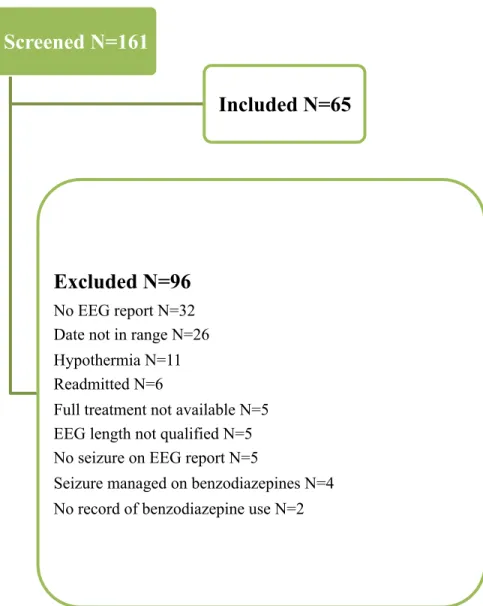
A total of 161 patients were screened for inclusion and 65 patients met the required
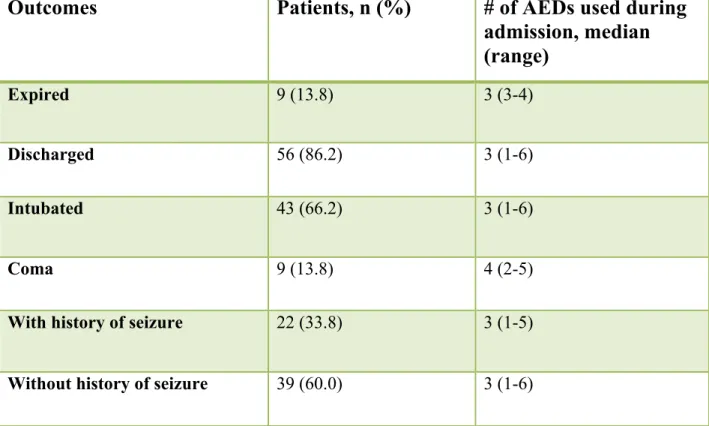
criteria (figure 1). Baseline characteristics are presented in Table 1. Patients needed a median of
3 AEDs (interquartile 1-6) to achieve seizure cessation. However, patients with medically
induced coma required median of 4 AEDs (interquartile 2-5) for seizure cessation that reflected
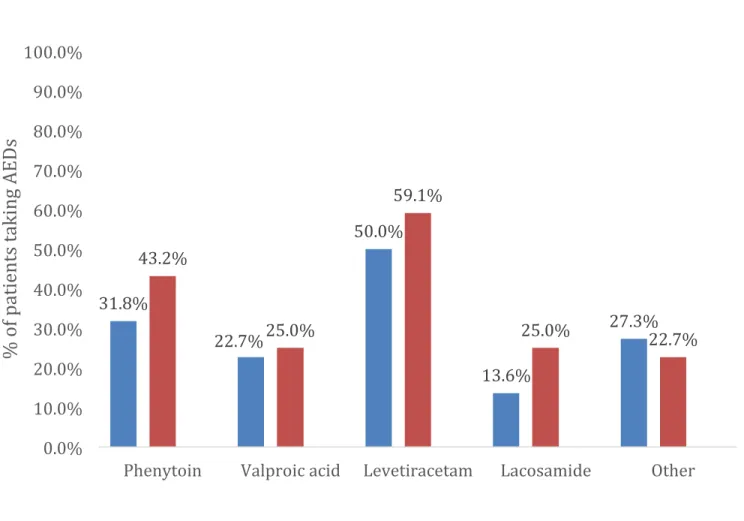
at discharge, respectively, with levateracetam being the most frequently prescribed AED (figure
2). The most frequently used first or second line AEDs were levetiracetam (35.4%) and
phenytoin (26.2%, table 3). Utilization of AEDs including loading, maintenance, total doses and
dosing interval is similar to current guideline recommendations (table 4).
Discussion
In our study population patients with benzodiazepine-resistant SE required a median of 3
AEDs for treatment with levateracetam and phenytoin being the most frequently utilized agents
after benzodiazepine failed. These findings are consistent with other observational study results7.
However, levateracetam was more frequently used as a second line compared to phenytoin in the
present study (35.4 vs 26.2%, respectively), whereas 2012 study found phenytoin to be more
frequently used AED than levateracetam (33.3 vs 10%, respectively)7. The lower number of
patients with the history of seizure in this study compared to previous literature and the high
frequency of levateracetam utilization in patients prior to admission may explain the difference
in our findings.
This study has several limitations that are worse mentioning. First, retrospective nature of
the study, single center involvement and small sample size resulted in low generalizability and
inability to ascertain causative relations. Reliance on ICD-9 codes and manual chart reviewing
presented challenges in accurate patients inclusion, missing information concerning seizure
features, adverse events and outcomes. Second, due to not stratifying patients based on
adherence, we could not determine weather patients had progression of their condition or
decreased seizure control. Third, not well defined and time-sensitive nature of status epilepticus,
additive effect of previously administered AEDs, led to difficulty in determining the true number
Conclusion
This study adds to the body of literature by affirming similar practice pattern among
different institutions in terms of management of status epilepticus. Primarily, the average number
of AEDs administered that is associated with seizure cessation in the settings of
benzodiazepine-resistant status epilepticus. Conversely, the most frequently used agent in our institution was
levateracetam. The future avenues to study may include adverse events profile, cost savings and
Figures and Tables
Figure 1: Patient Selection
Screened N=161
Included N=65
Excluded N=96
No EEG report N=32 Date not in range N=26 Hypothermia N=11 Readmitted N=6
Full treatment not available N=5 EEG length not qualified N=5 No seizure on EEG report N=5
a4 patients with history unknown Table 1: Baseline Characteristics
Total participants (n)
65
Age in years, median (range) 62 (18-89)
Sex, n (%)
Female 39 (60.0)
Race, n (%)
White 55 (84.6)
Other/Unknown 10 (15.5)
Weight in kg, median (range) 69 (34-120)
BMI in kg/m2, median (range) 25 (17-41)
Patients with history of seizure (n, %)a 22 (33.8) Seizure etiology, n (%)
Primary epilepsy 11 (16.9)
Trauma 6 (9.2)
Subarachnoid hemorrhage 5 (7.7)
Infectious 5 (7.7)
Unknown 27 (41.5)
Seizure type, n (%)
Generalized 37 (56.9%)
Focal 17 (26.2%)
Outcomes
Patients, n (%)
# of AEDs used during
admission, median
(range)
Expired 9 (13.8) 3 (3-4)
Discharged 56 (86.2) 3 (1-6)
Intubated 43 (66.2) 3 (1-6)
Coma 9 (13.8) 4 (2-5)
With history of seizure 22 (33.8) 3 (1-5)
Without history of seizure 39 (60.0) 3 (1-6)
Figure 2: AED Therapy Prescribed 31.8%
22.7%
50.0%
13.6%
27.3% 43.2%
25.0%
59.1%
25.0% 22.7%
0.0% 10.0% 20.0% 30.0% 40.0% 50.0% 60.0% 70.0% 80.0% 90.0% 100.0%
Phenytoin Valproic acid Levetiracetam Lacosamide Other
%
o
f p
at
ie
nt
s
ta
ki
ng
AE
D
s
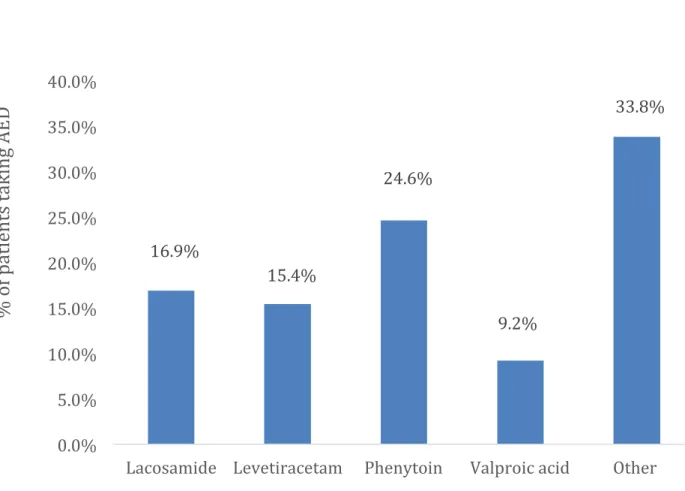
a last is last AED given in the treatment, could be 1st – 6th AED used depending on patient Other: phenobarbital, pentobarbital, propofol, midazolam
Figure 3: Last AED Used for Seizure Cessation 16.9%
15.4%
24.6%
9.2%
33.8%
0.0% 5.0% 10.0% 15.0% 20.0% 25.0% 30.0% 35.0% 40.0%
Lacosamide Levetiracetam Phenytoin Valproic acid Other
%
o
f p
at
ie
nt
s
ta
ki
ng
AE
D
Drug,
n (%)
1
stline
2
ndline
3
rdline
4
thline
5
thline
6
thline
Last AED
an=65 n=61 n=40 n=18 n=5 n=1 n=65
Lacosamide 5 (7.7) 6 (9.8) 8 (20.0) 3 (16.7)
- - 11 (16.9)
Levetiracetam 23 (35.4) 12 (19.7) 5 (12.5) 1 (5.6)
- - 10 (15.4)
Phenytoinb 17
(26.2) 16 (26.2) 10 (25.0) - 1 (20.0) - 16 (24.6)
Valproic Acid 6 (9.2)
9 (14.8) 4 (10.0)
3 (16.7)
1 (20.0)
- 6 (9.2)
Fosphenytoin 3
(4.6) 5 (8.2) 2 (5.0) - - - -
Other 11
(16.9) 13 (21.3) 11 (27.5) 11 (61.1) 3 (60.0) 1 (100) 22 (33.8)
a last is last AED given in the treatment, could be 1st – 6th AED used depending on patient b one patient received phenytoin as first and third AEDs
Phenytoin (n=43)a Levetiracetam (n=41) Valproic Acid (n=23)b Lacosamide (n=22) Fosphenytoin (n=10)c Loading dose administered (n, %)
33 (76.7) 28 (68.3) 21 (91.3) 12 (54.5) 9 (90)
Loading dose in mg,
median (range)
1000
(180-2000) 1000 (500-1500) 1000 (250-2300) 150 (50-200) 900 (450-1458) mg/PE
Interval frequency in hr, median
8 12 8 12 8
Maintenance dose in mg, median (range) 100 (100-500) 1000 (100-2000) 500 (250-750) 100 (50-200) 613 (125-1100) mg/PE Total dose administered in mg, median (range) 1600 (200-4700) 6500 (500-16500) 5220 (1250-13300) 875 (200-2650) 1175 (450-4225) mg/PE
a one patient received phenytoin as first and third AEDs; two patients had loading dose but no maintenance dose noted
b one patient had no frequency recorded
c only 2 patients had maintenance doses given; only 1 patient had a frequency reported
Reference:
1. Brophy, Gretchen M., et al. "Guidelines for the evaluation and management of status epilepticus." Neurocritical care 17.1 (2012): 3-23.
2. Manno, Edward M. "Status Epilepticus Current Treatment Strategies." The Neurohospitalist 1.1 (2011): 23-31.
3. De Kinderen, Reina JA, et al. "Side-effects of antiepileptic drugs: The economic burden." Seizure (2013).
4. Alvarez, Vincent, et al. "Second-line status epilepticus treatment: Comparison of phenytoin, valproate, and levetiracetam." Epilepsia 52.7 (2011): 1292-1296
5. Yasiry, Zeid, and Simon D. Shorvon. "The relative effectiveness of five antiepileptic drugs in treatment of benzodiazepine-resistant convulsive status epilepticus: A meta-analysis of published studies." Seizure (2013).
6.
http://www.uptodate.com.libproxy.lib.unc.edu/contents/phenytoin-drug-information?source=search_result&search=phenytoin&selectedTitle=1~150, accessed July 1, 2014.
7. Cook, Aaron M., et al. "Practice variations in the management of status epilepticus." Neurocritical care 17.1 (2012): 24-30.
8. Betjemann, John P., and Daniel H. Lowenstein. "Status epilepticus in adults." The Lancet
Neurology 14.6 (2015): 615-624.
9. Manno, Edward M. "Status Epilepticus Current Treatment Strategies." The