Cervical Cancer Prevention: A Screening
Program in Southeastern Nigeria
By
Nesochi Adimorah
A Master’s Paper submitted to the faculty of
the University of North Carolina at Chapel Hill
in partial fulfillment of the requirements for
the degree of Master of Public Health in
the Public Health Leadership Program.
Chapel Hill
2013
____________________________________
Advisor:
____________________________________
Date
___________________________________________
Second Reader:
_____________________________________
Page | 1
Table of Contents
ACRONYMS ... 2
AIMS AND OBJECTIVES ... 3
INTRODUCTION ... 4
SYSTEMATIC REVIEW ... 6
INTRODUCTION ... 6
METHODS ... 6
SUMMARY OF PROGRAMS ... 7
ANALYSIS ... 18
CONCLUSIONS ... 19
PROGRAM PLAN ... 19
PROGRAM CONTEXT ... 19
PROGRAM THEORY... 22
PROGRAM GOALS AND OBJECTIVES ... 25
PROGRAMIMPLEMENTATION ... 27
SUSTAINABILITY ... 30
EVALUATION PLAN ... 31
RATIONALE AND APPROACH TO EVALUATION ... 31
EVALUATION STUDY DESIGN ... 33
EVALUATION METHODS... 34
EVALUATIONPLANNINGTABLES ... 35
DISSEMINATION PLAN ... 41
DISCUSSION ... 42
ACKNOWLEDGEMENTS ... 45
REFERENCES ... 46
APPENDIX ... 51
TABLE 1.SUMMARY OF CERVICAL CANCER SCREENING PROGRAMS ANALYZED ... 51
LOGIC MODEL ... 54
Page | 2
Acronyms
HIV – Human Immunodeficiency Virus AIDS – Autoimmune Deficiency Syndrome VIA – Visual Inspection with Acetic Acid VILI – Visual Inspection with Lugol’s Iodine WHO – World Health Organization
LEEP – Loop Electrosurgery Excision Procedure HPV – Human Papillomavirus
ANC – Antenatal Clinic PNC – Postnatal Clinic FPC – Family Planning Clinic PHC – Primary Health Center
CIN – Cervical Interaepithelial Neoplasia NMA – Nigerian Medical Association
NANNM – National Association of Nigerian Nurses and Midwives NYSC – National Youth Service Corps
Page | 3
Aims and Objectives
Aim:
To provide a structure for the implementation of cervical cancer screening using thescreen-and-treat method within a local government area in Anambra State with the goal of statewide implementation and possible adoption at the national level.
Objectives:
1. To provide information on the current state of cervical cancer and current screening options in Nigeria
2. To highlight cervical cancer screening programs, through a systematic review, in other low-income and middle-low-income countries and identify strengths and weaknesses of those programs with the goal of incorporating lessons learned into the proposed program.
3. To describe the local and national context within which the program will be implemented 4. To determine the appropriate program theories that will form the basis upon which the
program will be built.
5. To establish the goals and objectives of the program plan and the implementation of said goals and objectives
Page | 4
Introduction
Cervical cancer is the third most commonly diagnosed cancer in the world, and most cervical cancer cases and deaths occur in low-income countries1. Cervical cancer is the second most frequent cancer among women in Nigeria1. Cervical cancer, however, is easily prevented in many women through screening and treatment of precursor lesions2. Cervical cancer screening in the developed world has been a great public health achievement as most cases are caught in the precancerous stages and prevented from proceeding to invasive cancer3. The high burden of this disease in low- and middle-income countries and, the success of cervical cancer screening in high-middle-income countries mean that a very large impact can be made through raising awareness and instituting adequate cervical cancer screening and follow-up programs in the developing world.
Page | 5 In the developed world, a large dent has been made on the prevention of cervical cancer
through systemized screening with Pap smear, however, low and middle-income countries face unique challenges that prevent the implementation of large-scale screening programs using the Pap smear. Some of these challenges include a lack of infrastructure, few trained personnel and a lack of awareness in the public about the disease. In addition, loss-to-follow up is a problem due to multiple visits for screening and treatment. For low- and middle-income countries, the “screen-and-treat” method where visual inspection with acetic acid (VIA) or Lugol’s iodine (VILI) is used to identify pre-cancerous lesions and cryotherapy is used to treat the lesions has been approved by the WHO as a sufficient method for preventing cervical cancer9. Given the low cost of this method and the need for very little resources as compared to the more conventional Papanicolau smear and/or liquid cytology, a wider impact can be made in the developing world. A meta-analysis of the “screen-and-treat” method showed sensitivity to be 80% with a range of 79% to 82%. The specificity of the test was 92% with a range between 91% and 92%10. The moderate specificity and sensitivity makes screening through visual inspection an adequate option. Cryotherapy, the treatment modality in this screening method, is easier to perform than other treatment modalities such as the loop electrosurgery excision procedure (LEEP) or cone biopsy. It requires minimal equipment and can be performed by mid-level health care providers. The ease of performance of the “screen-and-treat” method and limited equipment requirements makes it a good option for resource-constrained settings. Because screening and treatment occur at the same time, loss to follow-up becomes less of a problem. Of concern however, is the fact that diagnosis is entirely subjective. The moderate sensitivity causes concern for false positives and overtreatment. Method standardization, on-going training and quality-control measures are needed in areas that adopt the “screen-and-treat” method.
Page | 6 private clinics. A program targeted towards raising awareness in the general population and
empowering hospitals and clinics to conduct screening and/or referral may serve to decrease the incidence of cervical cancer in Nigeria. Given the cultural and geographical variety present in Nigeria, a program would be more likely to be successful if limited to a particular area. For this reason, I propose a program based on the principles of the screen-and-treat method targeted to southeastern Nigeria, specifically, Anambra State. Different approaches to planning may be suitable for this project; however, a communication action approach combined with advocacy will likely produce the best results. An example of a program that successfully incorporates the communication action approach in its cervical cancer screening program in a low-resource area is Grounds for Health11. This organization combines social entrepreneurship with community empowerment to increase access to cervical cancer screening.
Systematic Review
Introduction
The primary purpose of this literature review is to identify programs aimed at cervical cancer prevention in the developing world, particularly in Africa. The programs highlighted in this literature review have certain features that are salient towards developing a cervical cancer screening program in Nigeria. These features are:
1. The target population is African women
2. The goal is to increase the number of women who get screened for cervical cancer 3. Identify challenges to (2) above
4. Incorporate education and awareness into their strategy
5. A long-term goal of changing cervical cancer screening policy by involving the respective Ministries of Health
Page | 7 Research Question: In conducting this literature review, I attempted to answer the following question: What programs currently exist in the developing world, particularly in Africa that would inform the development of a cervical cancer screening program for Southeastern Nigeria?
Search Strategy: My search strategy included searching Google Scholar for relevant literature. In Google Scholar, I used the search terms “evaluation” AND "cervical cancer screening program" AND ("africa" OR "developing world" OR "developing country"). Articles that fulfilled the inclusion criteria were selected. In addition, the reference lists of articles were searched for additional papers. Non-governmental organizations with publications of their cervical screening programs were also identified. Inclusion criteria include:
6. The article is in English
7. The article describes a program actually being implemented in any of the sub-Saharan countries 8. The program has been evaluated.
9. The program reflects some of the goals of the cervical cancer screening program being developed.
Summary of Programs
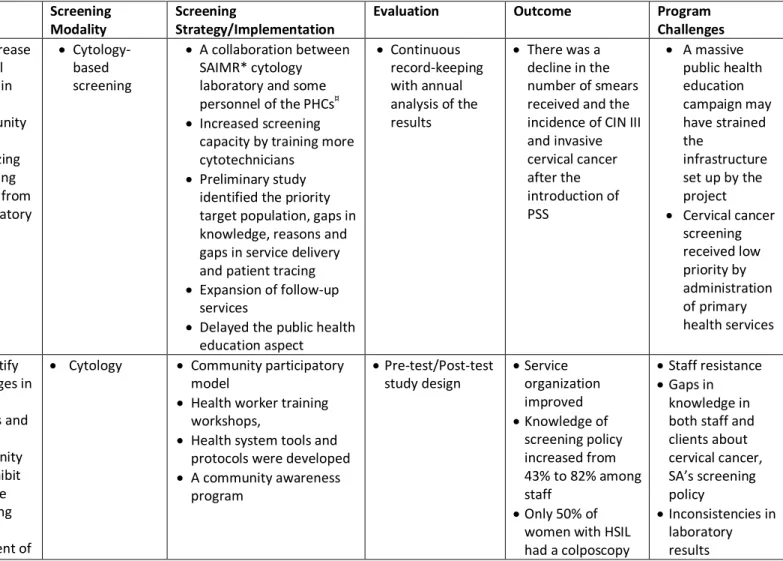
Project Screen Soweto (PSS)12
Page | 8 Strategy and Implementation
The program developers recognized that the Baragwanath cytology service was understaffed with only 2 cytotechnologists and 6 cytotechnician. The staff of 8 had a screening capacity of only 20 cases per day or 35 000 slides per year. With a view to expand screening facilities, the SAIMR trained an additional 8 cytotechnicians and increased the workloads of the existing screeners. At the end of 3 years, with 15 screeners, the capacity of cases increased to 110 000 slides per year.
A demographic profile of patients with cervical cancer was built by administering a
questionnaire to 100 patients with biopsy-confirmed cervical cancer. In addition to demographic data, the questionnaire attempted to assess awareness of and previous exposure to the Pap smear, how and where they were diagnosed with cervical cancer. Pilot studies of Pap smears were done on women attending antenatal clinic (ANC), postnatal clinic (PNC), family planning clinic (FPC) and primary health centers (PHC).
Preliminary studies showed that over 70% of abnormal Pap smears were not being followed-up. To combat loss to follow-up, a full-time clerk was hired. The clerk sent out letters to women with abnormal smears to encourage them to return to clinic. The clerk also explained to patients in the gynecological outpatient and colposcopy clinics the importance of follow-up and ensured that cytological reports were included in the patient’s files. A nursing sister was also appointed to make home visits to women who did not respond to letters to bring them back to the hospital for treatment. By combining the efforts of the clerk and the nursing sister, successful follow-up and treatment rose to 60-65%. Visits were made to clinics involved in taking Pap smears. The personnel were shown how to correctly take smears. The quality of the smears was constantly monitored.
Page | 9 this form of public education would alienate women with low literacy. Also, they believed that public education early on would overwhelm the screening facilities.
Results
Preliminary studies helped the program developers create a profile of the primary target for screening: unemployed women with screening facilities near her home. The questionnaire administered to the 100 women with cervical cancer showed that delays in diagnosis could be attributed both to the patient’s lack of information about preventive measures and symptoms of cervical cancer. It was also discovered that medical personnel were also responsible for delays in diagnosis. The pilot studies conducted at the clinics (ANC, PNC, FPC and PHC) showed that patients that attended family planning clinics would be a good population to expand screening to for the following reasons:
The cervixes of women attending ANCs tend to bleed easily due to the effects of pregnancy,
thereby, compromising the quality of the smears. Also, many women were lost to follow-up after the delivery of their babies.
The study authors presumed that screening done on women post-partum may yield more
false-negative results due to the nature of the post-partum cervix; therefore, enhanced quality control was necessary in this group of women.
The pilot studies showed that women presenting to FPCs had high rates of cervical
intraepithelial neoplasia (CIN) but also more stable housing situations that allowed them to be traceable.
Page | 10 Barriers to follow-up included incorrect addresses for patients. Also, the follow-up staff noted that barriers that prevented women who underwent colposcopy from returning for definitive treatment included lack of understanding of the disease, a lack of desire to undergo hysterectomy and poor doctor-patient relationships. The author implies that an unwillingness to undergo hysterectomy may be cultural in nature.
After the launch of PSS, there was a drop in the number of cervical smears received by the cytology unit from 32,365 in 1982 to 24,251 in 1983 and 26,216 in 1984. This is the opposite of what was expected. The overall numbers of invasive and in-situ carcinoma dropped from 345 cases in 1982 to 247 and 249 in 1983 and 184 respectively. An increase in screening, should have led to an increase in the number of smears analyzed in the cytology unit. Also, given that this population of women was mostly unscreened, the numbers of invasive and in-situ carcinomas should increase and then drop-off. The failure of the data to reflect what was expected indicated that the program was not going to succeed.
Challenges
A weakness of PSS was the decision to delay public education. The program developers believed that this was the right decision despite the failure of PSS. Instead, they believe that the major
contributor to the failure of PSS lay at the level of the primary health services since cervical cancer screening was given a low priority. Economic reasons were not considered to be a reason why the project failed since the system’s capacity was not reached.
The Cervical Health Implementation Project (CHIP)13
Page | 11 interventions for improving cervical cancer screening services. The program was done from January 2001 to May 2003. The cervical screening modality used was Pap smear with cytology. A pre-test/post-test design was used to evaluate the program interventions.
Strategy and Implementation
The researchers identified 3 provinces in South Africa “to represent the different socio-economic, geographical and health system contexts”.13 Districts 1 and 2 were low to middle income urban areas with a mostly Colored population in District 1 and a majority Black population in District 2. District 3 was a rural area with a mostly low income Black population. External interviewers conducted a pre-test survey on staff, as well as clients. Knowledge and attitudes about cervical cancer screening was assessed in both staff and clients. They also audited the facilities.
The CHIP researchers used a participatory theoretical framework to design interventions. These included creating a facility planning tool to enable clinics set annual and monthly screening targets and decide how best to meet the target. The staff was trained on the national screening policy, the
epidemiology of cervical cancer, the techniques required for taking adequate smears and the health system interventions. A key part of the interventions was developing a uniform cytology request and report forms. Cytology reporting was standardized according to the New Bethesda System. Staff was trained on proper patient referral and an algorithm was developed. Other system interventions included the development of a cervical cancer registry including patient contact, smear results and next steps. Improving community awareness was a key intervention for this program. Posters and pamphlets were created in the local languages and distributed. Radio stations and local newspapers were enlisted to disseminate information. Peer educators also educated women on cervical screening. A formal launching of the project was held to create public awareness.
Page | 12 The pretest survey revealed gaps in both staff and client knowledge with regards to cervical cancer. Facility audits revealed poor smear quality, no standardized reporting of cytology results,
unreliable client management guidelines, poor record-keeping and, poor referral and feedback systems.
Posttest results showed that the percentage of staff trained to do Pap smears increased from 58% to 86%. Health authorities provided adequate equipment for Districts 1 and 2; however, District 3 remained poorly supplied with equipment despite requests for assistance. Staff knowledge improved in all three districts, along with those who agreed with the policy. The number of new smears done also increased in all three Districts. The standardized reporting forms and the Pap smear registers were received well; however, the information in the registers was not being used to monitor services. Community awareness in district 1 was high prior to the implementation of the interventions; hence there was no increase in knowledge of Pap smears. The same result was seen in District 2. District 3 showed an increase in knowledge from 10% to 22%. Overall, the number of Pap smears performed increased by 77%.
Most of the women with cervical abnormalities did not receive timely referral and treatment. Some reasons for this included poor mechanisms for informing women of results, referral centers not readily accessible to many women and difficulty in keeping track of patients after they have left the primary care level.
Challenges
It is important to note that the evaluation of this project occurred shortly after the implementation of the interventions; hence the results may only reflect short term effects of the intervention. Some challenges include long turnaround times for cytology results due to limited cytology staff and inadequate administrative and transportation systems. There was significant
Page | 13 information systems. Referral and loss to follow-up was a significant problem in this program. Finally, although there was an increase in the number of Pap smears done, the annual coverage was 3.3%, less than the 7% annual goal.
SAFE/Cervicare14,15
The SAFE demonstration project was collaboration from 2001 to 2004 between Jhpiego’s Cervical Cancer Prevention Program, the Ghanaian Ministry of Health, Ghana Health Services and Korle Bu Teaching Hospital to assess the safety, accessibility and feasibility of the single visit approach using visual inspection with acetic acid as a screening method. I chose it as a part of this literature review because it highlights some of the successes and challenges that come with implementation of visual inspection with acetic acid as a screening modality and treatment with cryotherapy. Its long term goals of being transferred completely from Jhpiego’s auspices to country ownership and expansion align with the goals of the cervical cancer screening program being proposed in Southeastern Nigeria.
Strategy and Implementation
The project was phased in from the urban setting of Accra to a more rural setting. Starting in an urban setting was convenient as there was a tertiary referral center, Korle Bu hospital, within reach. Four providers were selected to perform screening and cryotherapy. The providers were mid-level providers, i.e. registered nurses, who were experienced in family planning, counseling and health promotion and competent in performing pelvic exams. These providers worked under the supervision of five experienced Ob/Gyn physicians. Both providers and supervisors were trained to perform VIA, cryotherapy and cervical cancer screening counseling. By using nurses experienced in family planning, cervical cancer screening was integrated with existing family planning services.
Page | 14 history of cervical cancer as well as previous studies done using VIA. The project reached out to women through newspaper advertisements, health educators and more informally with providers recruiting women through religious and social gatherings. Education concerning cervical cancer occurred when women presented to the testing site. Screening and treatment was provided according to Jhpiego’s study protocol. Afterwards, women were counseled on self-care, follow-up visits and alarm symptoms. Follow-up was scheduled between 12 and 16 weeks following treatment and 1 year after. Women who tested negative were asked to return in 5 years. To tackle problems with follow-up, a public health nurse was hired to actively trace women who missed their first follow-up visit. Also, radio advertisements were used to encourage women to return for their follow-up visits. Interviews were conducted at the onset, after the first follow-up visit, a problem visit and the 1-year follow up.
Results
The initial evaluation was conducted on an observational basis and focused on results from Ridge Hospital in Accra. A total of 3,665 women were screened during the study period. Most women were less than 30 years old, had greater than 11 years of education, and had between 2 and 4 children. Many of the women who presented to the clinic for cervical screening had heard about the program through word-of-mouth.
Page | 15 complaints after cryotherapy. Nine percent of women experienced pain/cramping not associated with their menses. Overall, staff and patients were satisfied with this method of cervical cancer prevention and the study was deemed feasible based on accessibility to clinic, staff or facility-related factors and women’s acceptance of cryotherapy.
Challenges
This project showed that VIA was a more than adequate screening modality. The primary drawback of VIA is its low specificity as compared to Pap smear, however, sensitivity equals that of cytology-based screening14. A key advantage of VIA over the Pap smear is that cryotherapy can be performed immediately in most cases which mitigates the effects of the loss to follow-up; however, loss to follow-up continued to remain a problem with only 77% of women returning for their first follow-up visit and 53% of women returning for the second follow-up visit. Overall coverage was not determined because the study was unable to define a catchment area for the hospital as women came in from various distances.
The Outcomes Research Study, conducted from 2006 to 2007, was a follow-up study to assess how well the level of quality was maintained after withdrawal of funding by Jhpiego. Providers maintained a high level of performance for both screening and cryotherapy. Although, it is unknown if quality will be maintained if services are scaled up, it provides assurance that adequate services can be provided without external funding.16
The Cervical Cancer Prevention Program in Zambia (CCPPZ)17-19
Page | 16 number of women screened and not the frequency of screening. They take a unique approach, as a PEPFAR-supported program, to cervical cancer screening by integrating it into HIV care.
Strategies and Implementation
The CCPPZ used a multi-pronged approach to tackle the problem of cervical cancer screening. First, cervical cancer screening services were integrated into the services already provided by
government-operated clinics. This served to “normalize” the provision of screening. By linking it with HIV/AIDS care, the program had additional access to resources including 53 clinics where PEPFAR-funded UAB-CIDRZ HIV care services were already active. Due to Zambia’s sparse physician/population density, CCPPZ decided that its goals would be better achieved by training Zambian nurses to perform VIA, low –risk minor surgical procedures, to be familiar with the reproductive tract anatomy, physiology and pathology. Quality was ensured by ongoing monitoring and retraining. Nurse retention was
enhanced by providing financial incentives. The rationale behind the use of VIA as a screening modality is that it is a low-cost method that relies on very little infrastructure. Also, Zambia has no formally trained cytotechonologists and no functioning colposcopy facility. The fact that cryotherapy can be done within the same visit limits the number of visits the women would need to make to the clinic. The CCPZ also created a referral center were procedures such as biopsies, loop electrosurgical excision procedure (LEEP) and histopathologic evaluation could be done. Women with invasive cancer were treated at the University Teaching Hospital.
Page | 17 outreach and education component and helped patients with navigating the system. Community
outreach occurred in the form of health promotion talks and even acting in street dramas. HIV testing was offered for women who had not yet been tested.
Results
Program effectiveness was assessed 2 years after the program began. A total of 21000 women with a mean age of 33.1 years have been screened. Approximately 31.3% of these women were HIV positive, 35.1% were seronegative and 33.6% did not know their status. The following data reflect patients who were HIV positive. Fifty-four percent of the women who were screened were VIA positive and 59% of these women were eligible for cryotherapy. Of the women eligible, 1603 out of 2061 (78%) underwent treatment. The rest were lost to follow-up. Of the women who needed further histologic evaluation, 75% showed up at the referral center while the rest were no shows. Of the HIV positive women who tested positive upon VIA, only one-third underwent either cryotherapy or a LEEP and less than 20% of all women screened showed up for their follow-up visits. Based on the results of the evaluation, the members of the CCPPZ projected that 142 cancer deaths were prevented by screening 6572 HIV positive women. From 2006 to 2011, more than 58,000 women have been screened regardless of HIV status.
Challenges:
Some of the challenges faced by the CCPPZ are similar to those experienced by the other programs above. Limited resources were a feature during the program’s implementation. Biopsy samples
Page | 18 Analysis
All the programs reviewed shared very similar characteristics and goals with the cervical screening program in Southeastern Nigeria and they offer many lessons. Some interesting questions raised by the studies surround the use of cytotechnology versus visual inspection with acetic acid as a screening modality. For countries, such as South Africa, that have consistent and reliable
cytotechnological services, screening using Pap smears may be feasible. However, barriers such as loss to follow up and long wait times for results mean that there will be many people that could be treated who would be untraceable. Hence VIA or a combination of both VIA and Pap smears would be a good option for countries that have the capacity to offer both.
Page | 19 Loss to follow-up was a significant challenge for all the programs analyzed. Better patient tracing may be beyond the scope of health care services and may speak more to poor national infrastructure as well as socio-cultural factors that are more difficult to pinpoint and address through programmatic change.
Conclusions
Key lessons from the programs highlighted above include the effectiveness of using VIA as a screening tool, involvement of stakeholders as essential to a program’s success and community outreach programs to engage the public on recognizing the importance of cervical cancer screening. Also, systems needed to ensure patient tracing need to be incorporated into a program’s plan. The lessons mentioned above will inform decisions made concerning future screening efforts in
Southeastern Nigeria.
Program Plan
Program Context
Cervical cancer screening in the developing world provides challenges that are unique and yet similar to those in the United States for example, certain issues such as financial resources, time and stakeholders may be recurring themes in both regions; however the extent and the manner in which they affect a program may be different. Some of the challenges to be expected from planning a cervical cancer screening program in Nigeria include the following:
Sociopolitical Environment
Page | 20 undercurrents of tension from the war continue to this day. In addition to ethnic differences, Nigeria has experienced religious violence particularly in the North. A large part of Northern Nigeria is Muslim with most of the South being Christian. Although the violence seems to be drawn across religious lines, the causes of the violence are likely multifactorial20,21. The religious and ethnic strife means that program planning in some parts of Nigeria will be difficult. For this reason, I have chosen to focus primarily on Southeastern Nigeria. The majority ethnic group in this region is the Igbos. By limiting the cervical cancer screening program to one culturally homogenous region, we avoid some of the issues that may arise as a result of clashing beliefs and ethnic differences.
Corruption
Corruption is one of Nigeria’s biggest problems and a hindrance to its progress. It has infiltrated almost all facets of life. Corruption has many forms and it will be difficult to anticipate the problems it will cause.
Financial Resources
Financial resources will be limited. Financial support from the government may be difficult due to competing interests; however, with the right stakeholders and sponsors, enough interest may be generated to encourage the government and non-governmental organizations to provide financial resources. Financial support from the government implies support that can be further nurtured into permanent positive changes in health policy.
Consistency with State and National Priorities
Page | 21 connects sexual health with HIV/AIDS. The human papillomavirus is sexually transmitted and, women with HIV/AIDS are more susceptible to developing cervical cancer23. The link between HIV/AIDS and cervical cancer will provide a push for stakeholders at the state level to place a more comprehensive cervical cancer screening program high on their priority list.
Consistency with Individual Priorities
Although good health is an integral part of a happy life, sometimes the pursuit of good health is in direct competition with more salient necessities such as food and shelter. Also, because cervical cancer is a silent disease until it is widespread and does not affect functioning until it is advanced, it is often not a high priority. To what extent these will affect community participation is difficult to anticipate. However, incentives in cash or kind may help decrease the personal or family financial burden of seeking screening and treatment services and educational activities may serve to alert people to the importance of making screening a priority.
Technical feasibility
1. Raising awareness: For any screening program to be successful, awareness of the disease being screened for is necessary. Educating the public will need a multi-faceted approach due to differing literacy levels, socioeconomic statuses and locations. Community-based focus groups will be used to provide education about cervical cancer. Also, local media outlets will be
necessary to get the word out about the importance of screening, as well as screening locations. Billboards will also be an effective way of reaching out to many (literate) people at once.
Page | 22 developing world is because it requires less laboratory expertise than cytological screening; however, training in the technique for providers is still required. Also, follow-up after screening is an issue, this is why the “screen and treat” method is gaining favor. The “screen and treat” method involves visual inspection with acetic acid followed by immediate treatment with cryotherapy. This reduces loss to follow-up but again requires training and access to materials for cryotherapy.
Program Theory
A cervical cancer screening program targeted towards the women in Southeastern Nigeria requires a model that not only incorporates individual theoretical frameworks, but also, community approaches. The frameworks explored in this paper include the Health Belief Model, the Precaution Adoption Process Model, Social Cognitive Theory and Communication Theory. While these represent the primary building blocks on which the screening program will be built, elements of other theories will act as guiding principles for its successful implementation.
The Health Belief Model
The Health Belief Model aims to look at the reasons why people engage in or abstain from certain behaviors. It comprises of six main constructs: perceived susceptibility, perceived severity, perceived benefits, perceived barriers, cue to action and self-efficacy 24. This model is particularly applicable to women of southeastern Nigeria. In one study 31.8% of women who were aware of cervical cancer did not believe that they were susceptible to cervical cancer25. The majority of women who knew
Page | 23 get screened because they believed that the cons of screening outweighed the benefits26. This same study revealed an increase in screening behavior when different forms of communication (including reminders, phone counseling and educational brochures) were used. These different forms of
communication served as cues to action for these women. A comprehensive program will be based on an understanding of how women in southeastern Nigeria view their susceptibility to cervical cancer screening and their perceived pros and cons of screening.
The Precaution Adoption Process Model (PAPM)
The Precaution Adoption Process Model explores the journey an individual makes from unawareness of a health concern to deciding, acting and maintaining a beneficial health behavior. Although there are similarities between the Precaution Adoption Process Model and the Stages of Change Model, the PAPM is more applicable because it takes into account the fact that there are women who are unaware of cervical cancer and/or cervical cancer prevention. In a study of 388 female civil servants in North-Central Nigeria, only half of the study participants were aware of cervical cancer and 39% of them were aware of cervical cancer screening27. With such poor awareness levels among women who are fairly educated, we can assume that less educated women will be less aware of cervical cancer and cervical cancer screening. A good program will need to direct its activities towards those in the stages prior to the active decision-making stages characteristic of the Transtheoretical Model.
Social Cognitive Theory
Page | 24 services will be one of the initial actions of a cervical cancer screening program. Some personal barriers identified by Hyacinth et al include lack of awareness and the belief that cervical cancer is not
preventable27. The belief that cervical cancer is not preventable may illustrate a gap in knowledge but it could also highlight a more fatalistic world view. Fatalism has been highlighted as a reason for poor uptake of cervical cancer screening among Hispanic women28. Exploring how fatalism may guide health-seeking behaviors would fall under the framework of social cognitive theory. Other barriers may include social and political barriers. A possible social barrier would be disapproval from their spouse or
community leaders. A study showed that support from their spouses or community leaders was a key motivation for women to engage in cervical cancer screening29. Observational learning has been shown to have some benefit in increasing screening among Hispanic women in the Por La Vida program30. In this program, consejeras (community workers) conducted educational sessions on cervical cancer screening. These women were identified within their communities as natural helpers and served as role models for other women in those communities. Exploring the various principles of the social cognitive theory and applying them to a cervical cancer screening program will take into account the societal and environmental factors that govern health-seeking behavior.
Communication Theory
Communication theory is primarily concerned with the dissemination of public health
Page | 25 media outlets and billboards. Engaging the media in this manner may pave the way for policy changes. Communication at the interpersonal level includes the relay of information between doctors and their patients. In a descriptive cross-sectional study of HIV positive women in Lagos State University Teaching Hospital, 70% of the women who were aware but not screened were not recommended by their doctors to be screened31. This is particularly concerning as cervical cancer is considered an AIDS-defining illness.
The theories highlighted will form the guiding principles for the development of the goals and objectives of the cervical cancer screening program in southeastern Nigeria. The theories mentioned above apply not only to the women who are targets for cervical cancer screening, but also, their primary care providers. Another theory not covered in detail but worthy of mention and equally applicable is the Diffusion of Innovations Theory, which relates to the sequential adoption of new information or skills, such as VIA/cryotherapy. It is important that doctors become knowledgeable about the screen-and-treat method to determine the most appropriate screening modality for their patients.
Program Goals and Objectives
The primary aim of this project is to decrease the number of cases of invasive cervical cancer that present to tertiary care centers in Anambra State, Nigeria. To achieve this aim, goals and objectives have been developed and are discussed below.
Short Term Objectives:
Goal 1:Determine baseline knowledge, attitudes and practice in the community
Page | 26 2. Within 6 months, administer short questionnaires in verbal or written form to women and men in the community using volunteers and incentives to maximize the number of women reached.
Goal 2: Improve knowledge in the community about cervical cancer and its prevention
1. Within 1 year of program initiation, establish recruitment and training activities of peer educators through the National Youth Service Corps, churches and labor organizations.
2. Within 18 months, implement continuous educational and outreach activities in the community using peer educators, media outlets and a booming Nigerian movie industry to target individuals in churches, the markets, universities and other formal organizations.
Long Term Objectives:
Goal 3: Widespread adoption of the screen-and-treat method for cervical cancer screening
1. Within 3 years, train and certify a group of strategically chosen providers in VIA and cryotherapy, identified with the support of the Nigerian Medical Association (NMA) and the National Association of Nigerian Nurses and Midwives (NANNM). Providers will be chosen based on their location, and hence, ability to reach the maximum number of women.
2. Within 4 years, supply the providers with the equipment needed to perform VIA and cryotherapy
3. Within 4 years, develop a referral system with tertiary care hospitals for cases not eligible for cryotherapy
Page | 27 PROGRAM IMPLEMENTATION
Activities
Due to the complex nature of this program, the limited support resources within Nigeria, it is important that the program implementation be achieved in a step-wise progression and expansion of training and services. Two major challenges the program faces is how to adequately compensate physicians/health workers for their screening efforts while minimizing cost to the patient and, how to deal with referral cases. Many women with cervical dysplasia not amenable to cryotherapy will require referral to a tertiary hospital. The financial resources to seek treatment at these tertiary centers may not be readily available. These challenges will be better illustrated and solutions determined through a demonstration project. Success with a demonstration project will provide impetus and generate support to expand cervical cancer screening statewide. The activities required for appropriate program
implementation will be based on the following 5 broad categories: identifying project sites and community involvement, staff and volunteer training, information dissemination and participant recruitment, delivery of services, continuous data collection.
Identifying Project Sites and Community Involvement
Page | 28 nurses in this phase of the program implementation as insufficient buy-in at the primary care level can be detrimental to the success of the program12.
Staff and Volunteer Training
The staff needed for proper implementation include: a program manager, administrative assistants and trainers. Ancillary staff includes a consultant who will train health professionals in VIA with cryotherapy and will be responsible for quality assurance, and community health workers. Health professionals will be trained on the provision of this mode of screening according to the WHO
guidelines. There are also training modules available through Jhpiego that could be used. All staff training will be directed towards understanding the objectives and aims of the program. CHWs and health professionals will receive additional training on education and counseling of patients as well as proper referral and follow-up protocol. Infection control will also be integrated into the training of health professionals
Information Dissemination and Participant Recruitment
Page | 29 screening awareness into the community development program will not only lend the project credibility but also raise and spread awareness. Since the Corpers are paid through the NYSC and their place of internship, their participation in the program will be on a volunteer basis and will go towards fulfilling their community development requirements. The NYSC will be particularly useful down the line as the cervical cancer screening program becomes more widespread. Mass media campaigns will also be utilized further down the line to reach more people.
Service Delivery
As mentioned above, adequate buy-in at the primary care level is crucial for program success, hence, helping practices incorporate cervical cancer screening in a way that is the least disruptive to their practice will enhance program success. Encouraging practices to have their nurses train in VIA will free up physicians to attend to their other patients. In some cases, additional nurses may need to be hired to meet demand. Bolstering practices and preparing them to meet these changes will decrease provider attrition. Women will be screened at clinics in this LGA. Referral for women with advanced lesions will be set up with the tertiary care center that is the most convenient for the patient. Loss –to-follow-up has been a big issue for previous programs. One of the administrative assistants’
Page | 30 meetings during which feedback will be provided by physicians that are expert in the field of cervical cancer. 1
Continuous Data Collection
Data on program performance, including, outreach data, number of women screened and challenges faced will be collected throughout the life of the program so that continuous adjustments can be made. The Plan-Do-Study-Act (PDSA) framework will be the primary tool used in this stage of implementation.
Sustainability
The scope of this program and its emphasis on women’s health has the potential to attract enough support to make it highly sustainable. Integrating cervical cancer screening services within already existent services makes it more likely to be sustainable. For this reason, this program has the potential for high sustainability.
Strategies for Sustainability
1. Vision: It is important that the vision of this project be aligned with that of the State Commission for Health, which is the governing body for health at the state level. If the goals and objectives are aligned with that of the governing body, it is more likely that it will be taken up and supported using state resources.
2. Results oriented: an increase in knowledge and awareness of cervical cancer and an increase in the number of women screened are the primary goals of this project. This project is designed to
1 This is a modified version of the CIDRZ model and mirrors the current practice at National Hospital, Abuja,
Page | 31 get results. Attaining results provides the impetus for other non-governmental organizations and the state government to support a more widespread screening program
3. Financial strategies: one of the primary duties of the program manager is grant writing and seeking out funding sources. Funding can be provided by the government and supported by NGOs. Recognizing that funds are limited, a more business-like model can be used where cryotherapy tools are leased to physicians who in turn pass some of that cost to patients who can pay for it. The government can subsidize screening costs for women who are not able to pay for their screening. Other approaches include encouraging communities or discrete
organizations such as the Market Women’s Association to pool funds or create fundraising opportunities to pay for screening and referral care. This model of shared community responsibility is similar to that used by the organization, Grounds for Health, in which coffee cooperatives provide transportation, childcare and treatment funds for the women in their cooperatives who get screened11. These are possible approaches to mitigating costs and ensuring that cervical cancer screening is continued.
EVALUATION PLAN
Rationale and Approach to Evaluation
Page | 32 cervical cancer screening rates, but for screening to become more widespread. Dissemination of
screening practices requires buy-in from the government so that policy-level changes can be made. An evaluation of the program will provide the information necessary to move forward with expansion of the program.
Ideally, this cervical cancer screening program would use an internal evaluator because an internal evaluator will be knowledgeable about the programs’ goals, objectives and methods; however, bias due to evaluator investment in the program might prove a challenge to a fair evaluation process. For this reason, the program will use an internal evaluator with an external consultant to assess implementation and outcomes. This particular evaluator combination is critical because an internal evaluator will be finely tuned to the goals of the program as well as the barriers the program faces. An external consultant will provide an unbiased view of the program and technical expertise. The
sociopolitical and cultural context in which the program will be implemented requires the following crucial skills: conflict-resolution skills, public representation skills, and the ability to communicate with individuals of different cultures, team-building skills, high integrity and a strong sense of ethics32. Important technical skill for the evaluator/s will be knowledge and application of the screen-and-treat method of cervical cancer screening. This skill will allow the evaluators detect nuances in delivery of care.
Page | 33 arise as a result of screening. Program staff will address logistic issues encountered during the program implementation. The government representatives will highlight key aspects of implementation and evaluation that may influence widespread dissemination. Involving critical stakeholders such as
government representatives, increases the likelihood that they will support the evaluation and minimize challenges the evaluators may encounter33.
The inherently political nature of the program may result in political challenges to the
evaluation, especially with regards to statewide implementation. Resistance may be faced at the clinic level if physicians are unwilling to be critiqued on their delivery of care. Other challenges involve
logistical challenges, for example, transportation and safety to-and-from the clinic sites. Communication may also provide a unique challenge as some of the local stakeholders may be more comfortable speaking Igbo. This will be particularly important in the creation of pretest-posttest materials for the assessment of cervical cancer screening knowledge among women in the general public.
Evaluation Study Design
Page | 34 unbounded data, that is, data that is not dependent on time or an event34, in this case knowledge, attitudes and practice among women and their providers concerning cervical cancer and cervical cancer screening.
Evaluation Methods
The evaluators will use a mixed-methods approach in evaluating this study, that is, both quantitative and qualitative methods will be used. Both methods have their strengths and weaknesses which means that the overall evaluation will be subject to the biases of both methods. That being said, incorporating both methods allows for the extraction of different types of data and allows the
evaluators detect the nuances of factors that affect behavior in this population of women. Using both methods allows for objective data to be merged with the personal experiences of both program staff and participants.
Qualitative methods are particularly useful for detecting common themes and cultural
influences that influence behavior34. Some of the qualitative methods that will be used in the program evaluation include focus groups to determine how thoughts and perspectives have driven cervical cancer screening behavior in providers and participants. Also, in-depth individual interviews of select providers and participants will address how participants view their ability to control/prevent cervical cancer34. Focus groups and surveys with open-ended questions will highlight cultural barriers that prevent cervical cancer screening. Observation will be used to assess skill of providers and methods of service delivery to participants. This will highlight key gaps that should be addressed. These loopholes are likely to be missed using other methods.
Page | 35 exposed to some form of educational intervention34. Extraction of data from patient logs will provide information on how many women come in to be screened and how many receive screening. Participant logs from training sessions will provide useful data on how many people were trained in VIA, for
example.
EVALUATION PLANNING TABLES
Short Term Objectives #1:
Goal 1:Determine baseline knowledge, attitudes and practice in the community
1. Within 6 months, administer questionnaires assessing knowledge, attitudes and practice to health personnel including PCPs, Ob/Gyns, nurses and midwives utilizing incentives, program staff and volunteers to ensure an adequate response rate
Evaluation Questions Participant Evaluation Method
Were questionnaires administered within 6 months to providers? If no, why not?
Program staff and volunteers Open-ended interviews; Log of questionnaires
administered What challenges were encountered
by program staff and volunteers?
Program staff and volunteers Open-ended interviews; focus groups
What incentives were used and did this create bias?
Program staff and volunteers Participant log, Program records
Were the incentives effective? Program staff and volunteers Open-ended interviews Did any of the providers decline to
participate? Why?
Program staff and volunteers Open-ended interviews; Log of questionnaires completed How did providers perform on
knowledge items of the questionnaire?
Providers Questionnaire
What were the attitudes of providers towards cervical cancer and cervical cancer screening
Providers Questionnaire
How many providers conducted cervical cancer screening, and at regular intervals? Opportunistic screening or scheduled?
Providers Questionnaire
Page | 36
Evaluation Questions Participants Evaluation Method
Were questionnaires
administered within 6 months to women and men in the
community?
Program staff and volunteers Open-ended interviews; Log of questionnaires administered
How were community members identified?
Program staff, volunteers Open-ended questions; Participant log
What incentives were used? Program staff, volunteers Participant log
Were the incentives effective? Program staff, volunteers Open-ended interviews What challenges were
encountered in administering the questionnaires?
Program staff, volunteers Open-ended interviews
Which was more effective: written questionnaire or verbal questionnaire?
Program staff, volunteers, community members
Open-ended interviews
How
user-friendly/understandable was the questionnaire?
Community members, program staff, volunteers
Survey, open-ended interviews
How many men and women who filled out the questionnaire knew of/about cervical cancer and cervical cancer prevention
Community members Questionnaire
What do people believe causes cervical cancer and how has this changed?
Community members Questionnaire
Had any of the women or female relatives of the men been screened for cervical cancer before?
Community members Questionnaire
Goal 2: Improve knowledge in the community about cervical cancer and its prevention
1. Within 1 year of program initiation, establish recruitment and training activities of peer educators through the National Youth Service Corps (NYSC), churches and labor organizations
Evaluation Questions Participants Evaluation Method
Recruitment
Within 1 year, did the program staff recruit peer educators through the NYSC, churches and labor organizations?
Program staff Program records
What was the best way to recruit peer educators
Program staff, volunteers Open-ended interviews; focus group
Page | 37 for recruiting peer educators?
How many peer educators were recruited?
Program staff Program records
What challenges were
encountered in recruiting peer educators?
Program staff Open-ended interviews; focus group
For those who declined
participation as peer educators, what were the reasons for declining?
Potential recruits, program staff Open-ended interviews; focus group
What improvements could be made to the recruitment process?
Program staff Open-ended questions; focus groups
Training
Were peer educators trained within 1 year?
Program staff Program records
How were training activities developed? Was there
collaboration between program staff and relevant stakeholders to develop training activities?
Program staff, health care providers
Program records
Did peer educators participate in training?
Peer educators Program records; participant log Did any peer educators decline
to participate in training? Why?
Peer educators, program staff Focus group; Program records What were the challenges faced
during training?
Peer educators, program staff Surveys, open-ended interviews What were the successes during
training?
Peer educators, program staff Surveys, open-ended interviews Were the peer educators and
trainers satisfied with the content and structure of the training?
Peer educators, trainers Survey; focus groups
Were peer educators able to demonstrate proficiency in cervical cancer knowledge and did they show ability to educate others on this knowledge?
Trainers, peer educators Pre-test/Post-test Questionnaire Peer Education Training log Open-ended interviews
In what ways can training be improved?
Page | 38 2. Within 18 months, implement continuous educational and outreach activities in the community using peer educators, media outlets and a booming Nigerian movie industry to target individuals in churches, the markets, universities and other formal organizations.
Evaluation Questions Participants Evaluation Method
Were educational and outreach activities implemented within 18 months?
Program staff, peer educators Program records
What educational and outreach activities were the most
successful?
Peer educators, community members, program staff
Survey; focus groups
What were the barriers to effective education and outreach?
Peer educators, Program staff Survey
How much did knowledge improve compared to baseline?
Community members Pre-/posttest questionnaires How many women knew where
to get screened for cervical cancer?
Community members Pre-/posttest questionnaire
What were the persistent gaps in knowledge?
Community members Pre-/Posttest questionnaire How can educational and
outreach activities be improved?
Peer educators, community members
Survey
Long Term Objectives:
Goal 3: Widespread adoption of the screen-and-treat method for cervical cancer screening
1. Within 3 years, train and certify a group of strategically chosen providers in VIA and cryotherapy, identified with the support of the NMA and the NANNM. Providers will be chosen based on their location, and hence, ability to reach the maximum number of women.
Evaluation Questions Participants Evaluation Methods
Were providers trained and certified in VIA and cryotherapy within 3 years?
Program staff, health care providers
Program records
By what criteria were providers identified and chosen?
Program staff, health care providers
Program records Did all identified providers
participate in training? If no, why not?
Program staff, providers Program records; surveys; open-ended interview
Page | 39 improved?
Were adequate resources to facilitate training, for example, mannequins, VIA and
cryotherapy training tools?
Trainer, providers Observation; surveys
How many providers were able to adequately perform VIA and cryotherapy at the end of training?
Trainer, providers Observation; questionnaires
How many providers were ready to conduct VIA and cryotherapy at the end of training?
Providers Surveys; focus groups
2. Within 4 years, develop a referral system with tertiary care hospitals for cases not eligible for cryotherapy.
Evaluation Questions Participants Evaluation Method
Was a referral system developed with tertiary care hospitals within 4 years
Program staff, providers, liaisons from tertiary care centers
Observation, provider interviews, focus groups How many providers used a
standard algorithm for the referral of patients?
Providers Surveys, observation
How was the algorithm developed? Was there
collaboration between program staff, community providers and providers at the tertiary care level?
Program staff, community health care providers, tertiary care providers
Focus groups
Did providers communicate either verbally or written with the tertiary care center?
Providers Surveys
How did providers keep track of patients who were referred to tertiary centers?
Providers Patient log
How was follow-up maintained? Program staff, Providers Program records, Provider records
How many patients that were referred actually kept the appointment?
Patients, Providers Patient log; patient interview; provider interview
Was there communication between tertiary care centers and physicians concerning patient outcomes?
Tertiary care liaisons, Providers Focus groups
Open-ended interviews Provider logs
Page | 40 improved?
3. Within 5 years, increase the rates of screening among women in the community
Evaluation Questions Participants Evaluation Method
How many women received screening in the 5th year and how does this compare with the baseline?
Providers Patient log
How many cases of invasive cervical cancer were observed?
Providers Patient log
IRB Considerations
The primary purpose of this evaluation study is to improve on program service delivery. In order to achieve this purpose, women who were screened and those from the community will be asked to fill out questionnaires, participate in focus groups and interviews. Program staff and volunteers will also be interviewed and asked to fill out questionnaires. Due to the nature of the evaluation procedure, there is minimal risk of harm. There is risk of harm if patient data is leaked, therefore, all identifying data will be removed for women who participate in the evaluation process. Participant identifiers will be used. These numbers will not be linked in any way to actual patient information. All surveys and questionnaires will be kept in a secure file cabinet in the program office. Part of the data that the evaluators will collect will be the number of invasive cervical neoplasia diagnosed, the number of women who were referred and actually followed up with referral and received treatment. While the personal information of these women will not be collected, the evaluators will be directly handling personal data. For this reason, all evaluators will be required to complete human research certification training through the IRB.
Page | 41 Information about the evaluation process along with potential risks will be provided in the language the participant is most comfortable with. Due to the minimal risk associated with the evaluation methods, the use of the data primarily for improvement of service delivery and the linking and
de-identification of participants, we will apply to be exempt from IRB review. Because this program will be conducted in Nigeria, it will be important to ensure that evaluation methods are also in line with the local laws governing research and that in country IRB approval is also obtained as possible as well as permission from government/MOH authorities.
Dissemination Plan
For evaluation to be truly successful it also has to be useful, therefore, for the dissemination part of the evaluation, stakeholders will be involved from the beginning. Their input will be necessary to tailor both the evaluation and the results to them. Some specific considerations to have in mind include identifying key targets, level of knowledge concerning cervical cancer screening and the process, what they need to know and how they need the information provided to them and very importantly, the timeframe within which to use the results of the evaluation. Some of the target audience identified includes the funding agency, program staff, physicians and healthcare professionals who provide the care, program participants, the tertiary hospitals to which patients have been referred and the general public.
Page | 42 recommendations based on evaluation results. It is important that the program continue to provide support to health care providers as they incorporate changes into their practices. Health care workers will also receive a summary sheet of where they stand in the area of service delivery at the end of every meeting. The tertiary hospitals will receive bulletins with data on the number of women diagnosed and treated and, the number referred for advanced care and the number lost to follow-up. The evaluating team will provide recommendations that strengthen the link between referring health workers and the tertiary care centers.
Dissemination of updates on the project to the general public will occur on a yearly basis. Volunteers will provide information in the vernacular in outreach programs in churches and
marketplaces. Brief summaries of the success stories will be published in the local newspapers. The evaluating team will also use public service announcements through television and radio to reach a wider audience. The primary goal will be to promote the progress of the program1. The funding agency will be provided a yearly report of the program’s progress. Within 90 days of the termination of funding, the funding agency will receive an in-depth evaluation report.
DISCUSSION
A program focused on cervical cancer screening targeted to the local environment and
Page | 43 As highlighted by the systematic review, access to cervical cancer screening is limited by lack of human and financial resources at the individual and at the institutional level. Therefore, a program such as that delineated above, that places a minimal burden on individuals as well as the existing
infrastructure is ideal. The systematic review was useful in identifying specific strategies that were integrated into the program plan. First and foremost, the systematic review highlighted the benefits of the screen-and-treat method over cytology in low-resource settings, reinforcing the need for VIA to be incorporated into any program facing similar challenges. One such challenge is that of cost. Although the systematic review did not explicitly compare the cost-effectiveness of VIA over the traditional
Papanicolau smear, one can infer that the more traditional route would be more expensive as it requires a functioning laboratory and cytotechnician. In fact, a systematic review of all the evidence concerning VIA up to 2003, supports this conclusion35. The program plan engages key stakeholders in addition to implementing appropriately timed outreach efforts to ensure uptake by the local communities. Uniform training of health providers and staff combined with quality assurance monitoring limits variability in services provided and places an emphasis on the delivery of high quality services. By taking a multi-pronged approach of education and outreach, advocacy, quality assurance monitoring, in addition to, mobilization of human resources from different levels of society, the efficacy and sustainability of the program is ensured. Continuous data collection throughout the life of the program provides real-time data for continuous program improvement and allows program physicians and staff to engage in academic research based on the work being done.
Page | 44 staff highlights nuances and allows for better tailoring of the program to suit the needs of the local community. Evaluation is focused on assessing changes in knowledge, attitudes and practice, assessing referral and follow-up, and uptake of screening by both health care providers and women in the
community. Determining the effect of screening on incidence of invasive cervical cancer is limited by the lack of baseline data. Also, proving that changes in the incidence of invasive cervical cancer is directly linked to the screening program would require a randomized controlled trial, hence, the true effect of the program will have to be deduced indirectly. The evaluation results will be used to improve the program. Favorable results will be presented to the Anambra State Commissioner of Health to lobby for adoption at the state government level.
Page | 45
Acknowledgements
I would like to thank Dr. Diane Calleson, my MPH adviser for all her assistance in developing this program plan. I would also like to thank Spencer Lindgren who assisted with the logistics. I would like to
thank my second reader Dr. Martha Carlough, whose insight proved invaluable. I would finally like to thank Dr. Yinka Olaniyan, my practicum adviser who provided country context and whose experience and expertise with the screen-and-treat method contributed greatly to the completion of this Master’s
Page | 46
References
1. Jemal A, Bray F, Center MM, Ferlay J, Ward E, Forman D. Global cancer statistics. CA: a cancer journal for clinicians. 2011;61(2):69-90.
2. Vesco KK, Whitlock EP, Eder M, Burda BU, Senger CA, Lutz K. Risk factors and other epidemiologic considerations for cervical cancer screening: A narrative review for the US preventive services task force. Ann Intern Med. 2011;155(10):698-705.
3. Committee on Practice Bulletins--Gynecology. ACOG practice bulletin number 131: Screening for cervical cancer. . 2012;120(5).
4. WHO/ICO Information Centre on HPV and Cervical Cancer (HPV Information Centre). Human papillomavirus and related cancers in nigeria. summary report. . 2010.
5. Jedy-Agba EE, Curado MP, Oga E, Samaila MO, Ezeome ER, Obiorah C, Erinomo OO, Ekanem IO, Uka C, Mayun A, Afolayan EA, Abiodun P, Olasode BJ, Omonisi A, Otu T, Osinubi P, Dakum P, Blattner W, Adebamowo CA. The role of hospital-based cancer registries in low and middle income countries-the nigerian case study. . 2012;36.
6. Muñoz N, Castellsagué X, de González AB, Gissmann L. Chapter 1: HPV in the etiology of human cancer. Vaccine. 2006;24, Supplement 3(0):S1-S10. Accessed 7/7/2013 2:04:10 PM. doi:
http://dx.doi.org.libproxy.lib.unc.edu/10.1016/j.vaccine.2006.05.115.
7. Stanley M. Pathology and epidemiology of HPV infection in females. Gynecol Oncol. 2010;117(2, Supplement):S5-S10. Accessed 7/7/2013 3:23:11 PM. doi:
Page | 47 8. Kane MA, Sherris J, Coursaget P, Aguado T, Cutts F. Chapter 15: HPV vaccine use in the developing world. Vaccine. 2006;24, Supplement 3(0):S132-S139. Accessed 7/7/2013 1:47:20 PM. doi:
http://dx.doi.org.libproxy.lib.unc.edu/10.1016/j.vaccine.2006.05.128.
9. African Population and Health Research Center, International Agency for Research on Cancer, World Health Organization. Prevention of cervical cancer through screening using visual inspection with acetic acid (VIA) and treatment with cryotherapy. . 2012.
10. Sauvaget C, Fayette JM, Muwonge R, Wesley R, Sankaranarayanan R. Accuracy of visual inspection with acetic acid for cervical cancer screening. Int J Gynaecol Obstet. 2011;113(1):14-24. doi:
10.1016/j.ijgo.2010.10.012; 10.1016/j.ijgo.2010.10.012.
11. Grounds for Health. Grounds for health. http://www.groundsforhealth.org/. Updated 2013. Accessed January 15, 2013.
12. Leiman G. Project screen soweto. a planned cervical screening programme in a high-risk population.South African Medical Journal. 1987;2:61-68.
13. Moodley J, Kawonga M, Bradley J, Hoffman M. Challenges in implementing a cervical screening program in south africa. Cancer Detect Prev. 2006;30(4):361-368.
14. Blumenthal PD, Gaffikin L, Deganus S, Lewis R, Emerson M, Adadevoh S. Cervical cancer prevention: Safety, acceptability, and feasibility of a single-visit approach in accra, ghana. Obstet Gynecol.
2007;196(4):407. e1-407. e9.