Unfriended: The Role of Computer-Mediated Communication in
Maintaining Long-Distance Friendships
By: Zachary Stamper
Honors Essay Sociology
University of North Carolina at Chapel Hill
4/11/14
Table of Contents
Abstract 3
Introduction 3
Literature Review 5
Methods 16
Results 22
Discussion 32
Conclusion 36
References 40
Appendix A 41
Abstract
In recent years, social media has become a significant communication medium through
which friends interact. As the ease of interaction increases, social network services, specifically
Facebook, have come to facilitate friendships differently than in previous generations by making
physical proximity less necessary for communication. However, proximity, or propinquity, is an
important aspect of both communication and friendship because it promotes more face-to-face
interaction. Face-to-face interaction is defined social presence theory as the most potent form of
communication. In this study, I examine the role of face-to-face interaction in friendship
maintenance, and how computer-mediated communication affects strength of friendship over
time. I ask how important is the amount of face-to-face interaction, influenced by propinquity, to
maintaining friendships? Furthermore, how effective is Facebook in maintaining the strength of
friendships when propinquity declines? I administered a survey to college students to learn about
their relationships with high school friends. I found that respondents who interact with these
friends less frequently in person reported a greater decrease in friendship strength over time.
Also, respondents who text these friends less frequently reported a similar decline in friendship
strength. This questions the relevance of propinquity, face-to-face interaction, and social
presence theory. However, I found more frequent Facebook interaction between friends to be
strongly associated with a decrease in friendship, suggesting its inability to maintain friendship
strength when propinquity is reduced.
Introduction
The power of Facebook, and the Internet in general, is hard to ignore. Communicating
with people is now easier than it has ever been before. But, is computer-mediated
become separated by increased geographic distance? My thesis seeks to examine the significance
of face-to-face interaction in maintaining friendship strength, in a world where friends can
connect and communicate with ease over the Internet. Is face-to-face interaction necessary for
maintaining strong friendships, or do social networking websites like Facebook have the power
to keep friendships strong when propinquity is reduced?
To answer these questions, friendship and its relative strength first need to be defined.
Using Granovetter’s (1973) theory of tie strength, I developed a working definition of friendship
to test over time. I also draw from a concept outlined in the most detail by Amichai-Hamburger
et al. (2013) called propinquity, or geographic distance. This definition of friendship includes
measures of mutual confiding, mutual support, similarity, and, of course, propinquity. Short et
al.’s (1976) social presence theory explains why face-to-face interaction is the richest form of
communication. To answer the question of how important face-to-face interaction is to
maintaining friendships, these aspects of friendship need to be put in the context of
computer-mediated communication.
Computer-mediated communication has become part of everyday life over the last few
decades. The advent of social networking services has risen out of this form of communication.
Recently, Facebook has excelled to be the most widely used social networking service (Wilson et
al. 2009), making it the best choice to study friendships. By assessing the relevance of
computer-mediated communication in maintaining the strength of friendships over time, we can assess the
significance of propinquity, face-to-face interaction, and social networking services.
How important is the amount of face-to-face interaction, influenced by propinquity, to
maintaining friendships, and how effective is Facebook in maintaining the strength of friendships
college students, many of whom may have recently experienced a sharp decrease in face-to-face
interaction with their best friends from high school due to leaving for different colleges or the
workforce. Analysis of the survey results shed much light on the importance of propinquity,
face-to-face interaction, and computer-mediated communication in regards to maintaining
friendships.
Literature Review
Digital technology is prevalent in almost every aspect of our lives, from the way we get
around, to the way we interact with others. The ways we communicate with complete strangers
and with the best of friends are constantly changing due to technological developments. One of
the most influential technological advances, the Internet, provides many different means of
correspondence, some of which have become so popular their use is integrated into everyday life
(Lambert, 2013). One of the reasons internet communication is becoming so commonplace is
that the ease of transferring information via text over the web reduces the time and effort that
phone calls and face-to-face interaction demand, which is a major transition from the necessity
of these forms of communication. Naturally, people that we interact with frequently, namely our
friends, also interact with us over the computer. What is the impact of this kind of
communication on friendships?
Friendship has been studied and described many ways and by many scholars over the
decades. I build from these definitions to create a more synthetic definition of friendship.
Granovetter’s (1973) concept of tie strength forms the basis of my definition of friendship. Tie
strength is a commonly used measure of friendship strength (Maxwell, 1985;Ishii, 2010).
Previous research also notes the importance of propinquity, or geographic distance, which
Amichai-Hamburger et al. (2013), propinquity can dictate the amount of face-to-face
communication that can occur. Aspects of the concepts of tie strength and propinquity constitute
the definition of friendship used in my thesis.
I define the strength of friendship as being composed of four concepts: mutual confiding,
mutual support, homophily (similarity), and propinquity. I believe the relative presence of these
traits correlates directly with the strength, or closeness of friendship. In regards to maintaining
closeness over time once a friendship is established, it is important that these traits remain at a
similar level for the friendship to maintain its relative strength. Using Short et al.’s (1976) theory
of social presence, which defines the strength of various forms of communication, I analyze the
importance of propinquity to maintaining friendship strength. As the alternatives to face-to-face
interaction increase with the advent of computer-mediated communication, the importance of
face-to-face interaction for maintaining friendship strength is called into question.
I put computer-mediated communication’s role in maintaining friendship in the context
of Facebook, the largest social networking site in the world (Wilson et al., 2009). Facebook,
created in 2004 by Mark Zuckerberg and associates, has become a social networking giant in
years since. This website has become integrated into everyday life in several ways, such as
romantic relationships being ‘Facebook official’, and social gatherings often being organized
through ‘events’. For many, Facebook has become as normal and frequent an interactive medium
as phone calls or face-to-face contact. Much of this frequency is due to the ease of simply writing
on somebody’s ‘wall’ or shooting them a ‘message’. Lambert (2013:1) argues, "Facebook offers
amazing opportunities to enrich interpersonal life and generate intimacy". This claim, along with
the sheer volume of its over one billion users, are the reasons why I am using Facebook in this
Amichai-Hamburger et al. also cite the influence of Facebook: “The advent of Facebook
has been seen by many to have modified the definition of the word ‘friend’” (2013:1). The use of
social networking services, such as Facebook, reduces the necessity of in-person interaction
because communicating online is so accessible. This means the potential, and therefore
frequency, of face-to-face interaction can be easily overlooked as an integral part of maintaining
a strong friendship, since computer-mediated communication has become so commonplace.
Like Allan (1979), I argue that without in-person interaction, friendships will typically
degrade and fail. Lambert states that a lack of face-to-face interaction means that a friendship
could be “less meaningful as those which are actively maintained” (2013:77). How important is
computer-mediated communication, relative to other forms of communication, for effectively
maintaining friendships? Short et al. (1976) argue that face-to-face interaction provides a certain
richness unmatched by other forms of communication. This richness of communication is
important because more cues, be they visual or auditory, equate to conveyance of more
meaningful information. This is a significant enough concern in modern society that some go as
far as to say computer-mediated communication as a substitute for face-to-face interaction is in
fact making us lonely instead of increasing connection (Turkle, 2011). Using social presence
theory, I will analyze the benefits of face-to-face interaction in regards to mutual confiding,
mutual support, and similarity, and what the lack of this kind of interaction can do to the relative
strength of friendship over time.
Defining Friendship
Friendship seems to be one of the most basic constructs of human existence, but it is not
easy to define. Many social scientists have attempted to delineate this concept, with several
about these relationships makes some stronger than others, and what makes them last? Numerous
terms have been used to define the strength of relationships. One of the most well known is tie
strength, a concept developed by Mark Granovetter in the early 1970s.
Granovetter (1973:1361) describes the basic concept of tie strength between individuals
as “a (probably linear) combination of the amount of time, the emotional intensity, the intimacy
(mutual confiding), and the reciprocal services which characterize the tie". These traits are noted
as being independent yet correlated, making them a good base for defining the relative strength
of relationships. The type of relationship Granovetter examines in regards to tie strength is
friendship. The influence of Granovetter’s ideas can be seen through the years as numerous other
scholars, such as Marsden and Campbell (1984) and Gilbert and Karahalios (2009), continue to
cite tie strength as an important concept in defining friendship strength. Marsden & Campbell
(1984) also note that greater tie strength translates to more frequent interaction, which
Amichai-Hamburger et al. (2013) cite as a result of propinquity.
However, these are not the only factors that can be used to define the closeness of a
friendship. For instance, Maxwell (1985:231) notes
separation distress, disclosure, naturalness, similarity, sharing of attitudes and values and
interests, following (in the sense of seeking out and spending time with), giving and
receiving help and communicating about important issues are all areas of self-report
behavior which seem to be associated with closeness.
Ishii (2010:366) posits, “Close relationships are characterized by high levels of psychological
intimacy, attachment, self-disclosure, perceived similarity, and mutual support”. The
aforementioned definition of intimacy is described by Granovetter (1973) as mutual confiding
services, which is also noted by Marsden and Campbell, and defined by Ishii as mutual support.
Granovetter also notes a correlation between similarity and friendship. The sharing of attitudes,
values, and interests, or, as Ishii describes, perceived similarity, is defined by
Amichai-Hamburger et al. (2013) as homophily. This concept is most easily understood as general
similarity. It is clear that many definitions of these friendship dimensions overlap, but there are
unique aspects to each. With that said, it is important to note it is difficult to objectively define
friendship. Based on my review of friendship literature, I believe there are three facets of
friendship strength stemming from Granovetter’s concept of tie strength that are mentioned most
often and therefore most integral: mutual confiding, mutual support, and homophily or perceived
similarity.
Mutual confiding refers to the amount of detail friends share with each other about their
lives. The more confided between one another, the stronger the friendship. For example,
sensitive family problems are usually shared with only the closest of friends. Confiding delicate
issues does not occur without a certain level of trust between the individuals that the information
shared will not be divulged. Mutual support refers to friends being there for each other when
needed. The more support there is in a friendship, the stronger it will be. Finally, homophily, or
perceived similarity, refers to how similar friends feel they are to each other in regards to
interests, personality, and background. Studies have found there is a positive relationship
between the strength of a tie and the similarity between individuals, or friends (Granovetter,
1973). However, there is one other important concept that I, and others, believe can also affect
the strength of friendship.
In addition to homophily, Amichai-Hamburger et al. (2013) outline another important
factor that leads to and sustains friendship: propinquity. Propinquity refers to the geographical
distance between where two individuals live. The greater the relative propinquity, or the closer
individuals live, the greater the opportunity for interaction, and potential for friendship. Some
scholars, such as Ishii (2010), include propinquity in their definition of friendship, whereas
others, such as Gilbert & Karahalios (2009) and Maxwell (1985) do not. This difference
exemplifies the debate about the importance of geographic distance to friendship. For instance,
you are much more likely to interact with somebody who lives on your street than with
somebody who lives 50 miles away. In fact, Amichai-Hamburger et al. (2013) note that children
tend to form friendships with those they are in close proximity with, whether that means at
school or in their neighborhood. Propinquity influences the amount of face-to-face interaction
individuals can have, which I, and others, cite as an important aspect of friendship
Going beyond friendship development, face-to-face interaction is also noted as integral
for the maintenance of friendship (Fehr, 1995). However, some scholars question the importance
of propinquity, arguing that friendships can be formed or maintained online and do not have to
be initiated or sustained by frequent, if any, face-to-face interaction (McKenna et al., 2002).
Marsden & Campbell (1984) and Granovetter (1973) have noted the relationship between tie
strength and frequency of interaction, which can be attributed to the amount of propinquity
between friends. I argue the amount of face-to-face interaction, influenced by propinquity, is not
just essential for friendship formation, but also for the maintenance of friendship strength.
Essentially, the more face-to-face interaction that occurs, the stronger a friendship will be. I
don’t believe propinquity has been considered as important to friendship over the last few
greater tie strength (Mesch and Talmud, 2006). It has even been said that friendships formed and
maintained online can be just as strong as friendships formed and maintained in person (Chan
and Cheng, 2004). I posit a decline in the importance of face-to-face interaction is correlated to
the advent of the technology that promotes easy interaction without the necessity of face-to-face
communication, specifically social networking sites. Before I discuss computer-mediated
communication, social networking sites, and Facebook in greater detail, it is important to explain
why the concept of propinquity, which facilitates more face-to-face interaction, is important to
friendship.
Social Presence Theory: Defining the Strength of Communications
Social presence theory outlines the relative strength of communication by comparing
face-to-face interaction to other forms of communication. As mentioned above, social presence
theory is important in assessing the strength of friendships because propinquity allows for more
face-to-face interaction to occur, but this form of communication is no longer a necessity for
maintaining relationships due to technologies like computer-mediated communication (Lambert,
2013). Social presence theory explains why face-to-face interaction is in fact important. Short et
al. define social presence as “a single dimension representing a cognitive synthesis of… facial
expression, direction of looking, posture, dress and non-verbal vocal cues” and that different
“communication mediums have different degrees of social presence” (1976:65).
The more cues available for interpretation, the more social presence exists. Naturally,
some forms of communication do not allow information to be conveyed through all types of
cues. Short et al. cite (1976) a study done by Snyder and Wiggins that rated the amount of social
presence using three different communication mediums. Communication was monitored between
screen with audio, and just audio. Face-to-face interaction was found to have the highest rating
of social presence, followed by TV screen with audio, and then just audio. What does this say
about the amount of social presence available through computer-mediated communication?
Although computer-mediated communication did not exist at the time of this study, dress,
verbal, and non-verbal cues are still important today. Short et al. note (1976:72) that
communication methods with higher degrees of social presence are rated higher in terms of being
warm, personal, sensitive, sociable and intimate. Social presence theory rates face-to-face
interaction as the best kind of interaction in regards to a friendly social setting.
Based on its rating as the best kind of communication, face-to-face interaction would
have a much higher social presence rating than computer-mediated communication. In a more
recent study, Mesch & Talmud (2006:31) support this assertion:
early conceptualizations, assuming technological determinism of the Internet, described
the weakness of electronic media in supporting social ties. The 'reduced social cues
perspective' is based on the observation that computer-mediated communication allows
for the exchange of fewer cues than face-to-face environments and suggest that
computer-mediated communication is less appropriate for the support of emotional
exchanges and the delivery of complex information and a sense of social presence.
Relating back to my argument, more propinquity therefore allows a greater degree of social
presence. This means that less propinquity will reduce the amount of interaction rated by social
presence theory as the most effective. This could lead to potential degradation of a relationship,
even if a form of communication with less social presence, such as computer-mediated
communication, remains or is even increased in use. In the next section, I describe
Computer-Mediated Communication, Social Networking Services, and Friendship
It is almost shocking how quickly social media has been integrated into everyday life.
These virtual communication pathways are found on the Internet, ushering in the term
computer-mediated communication. Computer-computer-mediated communication is widespread: found in the most
formal (business transactions over email) and informal (sharing an amusing photo on Tumblr)
settings. Computer-mediated communication is also broad in its degree of privacy, ranging from
public forums that anybody can access to private Facebook ‘messages’. One of the most
common means of computer-mediated communication, social networking websites, can also be
used for public and private communication. Facebook facilitates both public and private
communication, making it a holistic medium to express relationships to an audience of ‘friends’,
through ‘wall-posts’, ‘comments’, and ‘liking’, and interactions that only two people can see,
such as ‘messages’. Social networking websites can also provide extremely accessible interaction
to anybody with a computer. Social networking services have gained a massive following due to
their fun, uncomplicated means of communicating between friends. The name says it all, social
networking in itself means organizing social connections.
Many of the connections on social networking websites are preexisting friendships or
acquaintances, even though it is not unheard of to make friends online. As previously mentioned,
there are several studies claiming that friendships established and maintained online through
computer-mediated communication and social networking websites are equitable in strength to
those formed in person (Chen & Cheng 2004:317; McKenna, 2002). This is important to mention
because the formation of these online friendships can be used to exemplify one of the biggest
with somebody by eliminating the necessity to speak with them on the phone or meet with them
in person.
However, this creates a potential problem. If more interactions are occurring by means
that are not as comprehensive as face-to-face interaction (Short et al. 1976), less information can
be conveyed due to the lack of cues, and the strength of the relationship will suffer. Walther &
Boyd (2002) argue for the strength of computer-mediated communication, stating it can benefit
friendships because interactions are “arguably more deliberative and effective than one might
manage offline." Elaborating on that statement, Walther and Boyd touch on the idea of
computer-mediated communication allowing more communication clarity because you have time
to think things through and edit communication before it is sent. They even go so far as to say
that computer-mediated communication has the ability to hide differences that individuals may
have, which they cite as a potentially good thing for friendship.
Even though there is the potential for more frequent interaction between friends near and
far through computer-mediated communication (Hampton & Wellman, 2001), social presence
theory defines these interactions as inferior to those in person, which propinquity promotes. It is
easy for things to be lost in translation when communicating via the computer. This occurs
because there are fewer social cues occurring. This means that according to social presence
theory, computer-mediated communication is a less rich and effective means of communication,
especially when juxtaposed with face-to-face interaction. Computer-mediated communication
certainly allows effortless connections, but are friendships just as strong even if propinquity is
removed?
Despite the lack of communication richness in computer-mediated communication,
Facebook is specifically mentioned as a great means of maintaining relationships. Viswanath et
al. (2009) note the more you interact with somebody on Facebook, the longer these interactions
are likely to continue. In Lambert’s (2013) interviews of Facebook users, many stated they
would have had a poorer connection with distant friends if they did not use Facebook. More
precisely, participants cited valuing Facebook as a means of connecting with people who have
moved out of their immediate “life-worlds”. When thinking in a broad sense, these conclusions
make sense because Facebook does provide a certain amount of ease in interacting with others
despite how far away they may be from each other geographically. Lambert argues that not only
does Facebook provide connection and means for friendship maintenance, but that it also
“intensifies dispositions which already exist” (2013:15). But friendships have been shown to
fade when face-to-face interaction is removed (Allan, 1979). This makes Facebook the perfect
medium to test the maintenance of friendship strength over time once propinquity, and therefore
more frequent face-to-face interaction, is likely reduced.
Expectations on the Importance of Propinquity to Friendship Strength
I posit there is greater opportunity for friendship with more propinquity, which results in
more face-to-face interaction. Computer-mediated communication and social network services
may reduce the significance of face-to-face interaction to a certain degree. Social presence theory
leads us to believe that computer-mediated communication’s weakness is that it is not as potent a
form of communication as speaking with somebody face-to-face. Communication is an
undoubtedly important aspect of friendship, as it is the most basic concept of human relations;
without communication, there would simply be no friendship. This is why I ask how important is
Without strong communication, I believe that any sort of relationship will lose strength
and eventually fail, including friendship. Lambert (2013) mentions that Facebook is often used to
connect with people who no longer have an immediate relationship, which is often a result of
distance. Amichai-Hamburger et al. (2013:12) elaborate on this by noting “it has been found that
Facebook is used by college students to connect with high school friends and those that are
distant physically”. My survey targets undergraduates, most of whom have had much less
face-to-face communication with their closest friends from high school. Like Gilbert & Karahalios
(2009), I will also use Granovetter’s (1973) concept of tie strength to measure friendship through
social media. I expect many close high school friendships, most of them now being
long-distance, to degrade over the years, despite many of these relationships having an online
presence. This would show that computer-mediated communication is not a replacement for
face-to-face interaction, and that propinquity is integral to friendship strength. In summation,
Hampton and Wellman state that computer-mediated communication makes for easier local and
long distance contact, but that it “should lessen, but not eliminate, the constraints of distance on
maintaining personal communities.” (2001:497). I seek to discover the accuracy of this
statement.
Methods
To assess the relationship between propinquity and friendship strength, I administered an
online survey to acquire quantitative data on perceived friendship strength over time,
communication patterns, and Facebook usage. The survey asked participants to list their three
best friends from the end of high school and rate the four components of friendship strength
(mutual confiding, mutual support, similarity, propinquity) in the past and present. The survey
concludes with questions about the participants’ Facebook use. As the most widely used social
networking website in the world, Facebook is an ideal site for the focus of this study. I also
collected basic demographic information about participants and their three friends. After data
collection ended, I analyzed the data looking for relationships between demographic information,
measures of friendship strength and Facebook usage, all in regards to face-to-face interaction.
This data allowed me to draw conclusions about the importance of physical proximity and
face-to-face interaction to friendship strength, and how this relates to Facebook use.
Recruitment
I recruited undergraduate students at the University of North Carolina at Chapel Hill, a
large public university in the Southeast, for this study. An email (Appendix B) containing a link
to an online survey (Appendix A) was sent to a random sample of undergraduate students to
reach as many students as possible. To induce participation, respondents who completed the
survey were entered into a raffle to win one of three $50 Amazon.com gift cards.
Participants
Participants’ consent was confirmed once they submitted the survey upon its completion.
If they did not wish to complete the survey for any reason, their responses were not recorded,
and their name was not entered in the gift card raffle. The survey did not ask participants to
answer any sensitive questions, but privacy was still a concern. In order to maintain
confidentiality, participants’ names, or any factors that could reveal their identity (besides their
email) were not collected. The only link to participants’ identity was their email, which was kept
separately from responses only to notify the winners of the raffle. Data was further protected by
beginning of the survey explaining the consent process, confidentiality of the data, and how the
raffle process would work upon the completion of data collection.
The desired sample size for completed surveys was 200 participants. After the survey was
closed, I was left with 398 usable responses. Participants’ demographics could be guessed before
the survey by looking at the University’s demographics as a whole1. UNC-Chapel Hill has
18,503 undergraduate students, most of which are between ages 18 and 22 and are 58% female
and 42% male. The racial makeup of UNC-Chapel Hill undergraduates is mostly white, with
each minority subgroup (Asian, African American, Hispanic) making up about 8%-9% of the
population.
The university’s larger female population materialized in my sample, as over three
quarters of my respondents were female. Difference in gender proportions from the University
demographics to the participants’ demographics is important to remember when interpreting the
results. Just like the University demographics, the average age of the participants was 20 years
old, with age distributed evenly. Participants aged 19, 20, and 21 each make up about 24% of the
distribution. I removed 25 respondents who were older than 23 from the sample to control for
excessive amounts of time between high school and college. The survey yielded greater
percentage of White students than the University as a whole. Consequently, there are a lower
percentage of Black and Hispanic respondents. Demographic statistics can be seen in Table 1A
below:
1University of North Carolina at Chapel Hill student demographics can be found at
Table 1A: Participant Demographics
Characteristic Number Percent
Gender* Male Female Race White Black Asian Hispanic Other/Multiracial Age 18 19 20 21 22 Year in school
First-Year Sophomore Junior Senior
Graduating year of High School 2009 2010 2011 2012 2013 94 303 303 23 35 21 15 74 95 92 100 37 116 77 108 96 5 91 102 77 115 23.6% 76.1% 76.3% 6.3% 8.8% 5.3% 3.8% 18.6% 23.9% 23.1% 25.1% 9.3% 29.2% 19.4% 27.2% 24.2% 1.3% 23.3% 26.2% 19.7% 29.5% *=Excludes one response of “other”
There are some potential weaknesses with the sample that can be attributed to
demographics of college undergraduates and the way the survey is being administered. The
participants attend a highly regarded university, which could underrepresent certain racial and
social class demographics. Sampling through email did not cause any problems in regards to
under sampling, which was a possibility due to low interest or the email containing the survey
being deleted before it was read. Although my survey is fairly detailed, an interview would be
Measures
The measures of the survey consist of basic demographic information such gender, race,
age, current year in school, and graduating year of high school. Demographic information about
the participant and about their three best friends from the end of high school was obtained.
Detailed information about specific friendships was obtained by asking the participants to name
their three best friends from the end of high school and answer questions about factors that
defined the strength of their friendship at the end of high school and at the present time.
Friendship strength was measured on a five-point Likert scale for each trait: mutual confiding,
mutual support, and similarity. A difference measure was created by recording the change in
each of the 3 variables when measuring for the end of high school and for the present. These
friendship change measures serve as dependent variables in my statistical analysis.
In the survey, I used Granovetter’s tie strength definition of intimacy, which is defined as
the amount of mutual confiding between friends. Mutual confiding is the phrase the survey used
to pose questions about intimacy to avoid confusion on this potentially vague term. Granovetter’s
concept of reciprocal services was captured as mutual support in the survey. Homophily, or
similarity, describes the relative similarity of friends’ interests, traits, and background. Similarity
was measured in my survey the same way as mutual confiding and mutual support, but with a
separate question for interests, traits, and background. Propinquity is defined as the geographic
distance between where two friends live. Greater propinquity means a greater potential for
face-to-face interaction, and therefore more meaningful interactions, as described by Short et al.’s
(1976) social presence theory. Propinquity was measured as the travel time to the friend’s house
Sample friendship questions include: How much did you and ____ confide in each other? On a
scale of 1-5, with one meaning “didn’t share anything personal” and 5 meaning “shared the most
intimate details about each others’ lives”, How much mutual support was in your relationship
with ____? On a scale of 1-5, with 1 meaning ”none” and 5 meaning “could always count on
them for support no matter what” (#), and How similar were your and ____’s interests? On a
scale of 1-5, with 1 meaning “not similar” and 5 meaning “very similar” (#) How similar were
your and ____’s personalities? On a scale of 1-5, 1 meaning “not similar” and 5 meaning “very
similar” (#)
I then asked questions about Facebook usage. These questions focus on the general frequency
and use of the website by the participant.
I asked questions about Facebook interactions between the participant and their three
friends. Questions about Facebook and frequency of interaction will have more specific answer
choices regarding frequency of use and interaction. Participants were asked to cite the frequency
of different types of Facebook interaction, such as ‘liking’, commenting, wall-posts, and private
messages. Answers to these questions form a more comprehensive understanding of how the
participants use Facebook in general, and with their three best friends from high school.
Sample Question: How often do you interact with ____ on Facebook? (Several times a
day, about once a day, 3-5 days a week, 1-2 days a week, every few weeks, less often, never) see
Appendix A
The differences in propinquity at the end of high school and in the present are compared
to the strength of other friendship traits to see if they remain the same, degrade, or improve over
of Facebook usage to determine a correlation between the computer-mediated communication
use and the strength of friendship over time.
Results
I present bivariate and multivariate analyses to examine the relationships between the
frequency of Facebook, phone, and face-to-face interaction, and a change in the friendship
strength variables (mutual confiding, mutual support, and similarity) between the end of high
school and the present. My first research question is: how important is the amount of face-to-face
interaction, influenced by propinquity, to maintaining friendships? Looking at correlations
between the frequency of face-to-face interaction and a change in the friendship strength
variables revealed a strong positive relationship: a decrease in the frequency of face-to-face
interaction is associated with a decrease in friendship strength over time. Linear regressions with
the three friendship change measures as dependents variable revealed a similar relationship when
controlling for demographic variables. This relationship remained present when controlling for
other forms of communication, exemplifying the importance of face-to-face interaction to
maintaining friendship.
Next, the relationship between Facebook and friendship strength is analyzed. Facebook
results are also similar to what I expected, as there is no positive relationships between the
frequency of its use and the three friendship strength variables. In fact, correlations revealed a
negative relationship with the frequency of every form of Facebook interaction and a change in
each form of friendship strength, suggesting that Facebook does not facilitate the maintenance of
friendships. This relationship also exists between general Facebook use and friendship variables
able to speculate and draw more informed conclusions about propinquity, face-to-face
communication, and Facebook’s role in maintaining friendship strength over time.
Dependent and Independent Variables
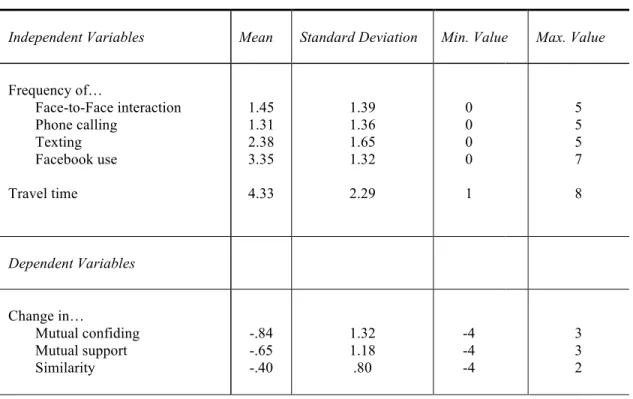
I use frequency measures of different forms of communication as independent variables
to test the dependent friendship variables. Frequency of face-to-face interaction is measured on a
6-point Likert scale, with ‘daily’ as the maximum value and ‘less than several times a year’ as
the minimum. Frequency of phone calling and texting is measured on the same scale. Texting is
the most frequently used method of communication out of the three, followed by face-to-face
interaction, and finally phone calling2. Frequency of Facebook use is measured on an 8-point
Likert scale, with ‘several times a day’ as the maximum value and ‘never’ as the minimum3.
Travel time represents the amount of time it takes for the respondent to get to their friend’s
house, serving as a measure of propinquity. Travel time is measured on an 8-point Likert scale,
with ‘more than 12 hours of travel’ as the maximum value and ‘less than 15 minutes of travel’ as
the minimum. Descriptive statistics for both independent and dependent variables can be seen in
Table 1B below:
2 Frequency of face-to-face, phone calling, and texting measure come from the GSS first used in Hoellinger,Franz
Haller,Max "Kinship and Social Networks in Modern Societies: A Cross-cultural Comparison Among Seven Nations",European Sociological Review, Volume( 9,1990) , 103-124
Table 1B: Independent and Dependent Variables
Independent Variables Mean Standard Deviation Min. Value Max. Value
Frequency of… Face-to-Face interaction Phone calling Texting Facebook use Travel time 1.45 1.31 2.38 3.35 4.33 1.39 1.36 1.65 1.32 2.29 0 0 0 0 1 5 5 5 7 8 Dependent Variables Change in… Mutual confiding Mutual support Similarity -.84 -.65 -.40 1.32 1.18 .80 -4 -4 -4 3 3 2
Moving on from the independent variables, I clarify the relationship between the
dependent friendship variables: mutual confiding, mutual support, and similarity. I present
correlations between the reported differences in friendship strength from the past to the present
and each form of communication. Taking the 5-point Likert scale responses of each friendship
variable in the past and present and subtracting the former from the latter, a measure of
friendship change is calculated. The distribution of these values ranges from -4 (a drastic
decrease in friendship strength) to 2 (a significant increase in friendship strength). There is also a
strong positive correlation between each dependent friendship variable, significant at the .01
level. The strong relationships between these variables confirm their significance as defining
aspects of friendship.
After compiling and analyzing demographic and friendship data, I address the first
research question that motivates this study: how important is the amount of face-to-face
interaction, dictated by propinquity, to maintaining friendships?
First, I isolate the relationship between physical distance between friends and the change
in their friendship strength over time using correlations. There is a strong negative correlation of
-.596 at the .01 level between the time it takes to get to a friends house, which serves as my
measure of geographic distance, and the frequency of face-to-face interaction between those two
friends. This means the less time it takes to get to where a friend lives, face-to-face interaction
occurs more frequently. After establishing this link, I go on to analyze the relationship between
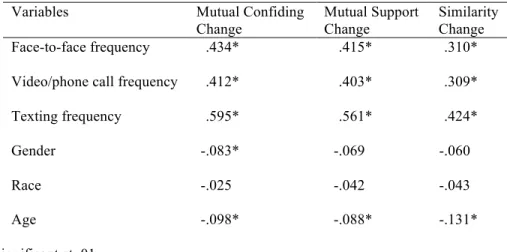
face-to-face interaction and change in friendship strength. Consequently, Table 2A indicates a
strong, positive correlation between frequency of face-to-face interaction and the three friendship
change variables. It is important to note that race is recoded into a dichotomous variable with
‘White’ as 1 and ‘Non-White’ as 0 because of the small number of minority participants.
Table 2A: Face-to-Face & Phone Interaction and Friendship Change
Variables Mutual Confiding Change Mutual Support Change Similarity Change Face-to-face frequency
Video/phone call frequency Texting frequency Gender Race Age .434* .412* .595* -.083* -.025 -.098* .415* .403* .561* -.069 -.042 -.088* .310* .309* .424* -.060 -.043 -.131* *=Significant at .01
other in person and all friendship variables (mutual confiding, mutual support, and similarity).
Just as frequency of face-to-face interaction is correlated with the friendship variables, frequency
of video or phone calls and texting are also strongly correlated. In fact, frequency of texting is
correlated more strongly with each friendship variable than frequency of face-to-face interaction.
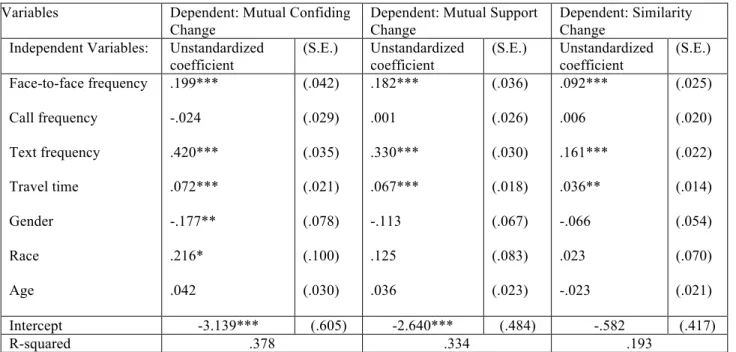
I revisit this surprising finding below using linear regression models (Table 3B). A few
demographic variables are also strongly correlated with several of the friendship variables. There
is a negative correlation between gender and a change in mutual confiding, meaning that being
female is more strongly correlated with a decline in mutual confiding than being male. There is
also a strong negative correlation between age and all three friendship variables. This means that
friendships have declined more among older students, and suggesting a decline in friendship
could be caused by elapsed time after going to college and moving further away from each
friend.
Regressions
To better understand the relationship between face-to-face interaction and friendship
strength, I use linear regressions to further analyze relationships I found using correlations. Each
of the three friendship variables (mutual confiding, mutual support, similarity) is used as a
dependent variable, with frequency of face-to-face interaction as the independent. Gender, age,
and race are added as controls for the relationship between frequency of face-to-face interaction
and friendship strength Finally, the amount of time it takes to get to the friends’ residence from
Table 3A: Face-to-Face & Demographics Regressions
Variables Dependent: Mutual Confiding Change
Dependent: Mutual Support Change
Dependent: Similarity Change
Independent Variables: Unstandardized coefficient
(S.E.) Unstandardized coefficient
(S.E.) Unstandardized coefficient (S.E.) Face-to-face frequency Travel time Gender Race Age .555*** .146*** -.129 .122 -.031 (.035) (.022) (.087) (.102) (.030) .473*** .128*** -.076 .047 -.023 (.032) (.019) (.070) (.083) (.024) .238*** .066*** -.046 -.016 -.053** (.024) (.014) (.054) (.071) (.020) Intercept -1.591* (.616) -1.379** (.498) .066 (.410)
R-squared .233 .213 .128
Two-tailed test, ***= significant at .001, **=significant at .01, *=significant at .05
Frequency of face-to-face interaction is found to have a strong, positive association with
mutual confiding of .555, mutual support of .473, and similarity of .236, all significant at the
.001 level. This means a decrease in frequency of face-to-face interaction is associated with a
decrease in each friendship change variable, again confirming the importance of face-to-face
interaction in maintaining friendship strength. Age is the only demographic variable to have a
significant relationship with any of the dependent variables, in this case similarity. But
interestingly enough, there is a strong positive association between the amount of time it takes to
travel to a friends’ residence and each friendship variable. This means that greater amount of
travel time is associated with stronger friendship, and is counterintuitive to my theory. However,
these findings support the hypothesis that a decrease in face-to-face interaction, results in a
Table 3B: Face-to-Face & Phone Interaction Regressions
Variables Dependent: Mutual Confiding Change
Dependent: Mutual Support Change
Dependent: Similarity Change
Independent Variables: Unstandardized coefficient
(S.E.) Unstandardized coefficient
(S.E.) Unstandardized coefficient (S.E.) Face-to-face frequency Call frequency Text frequency Travel time Gender Race Age .199*** -.024 .420*** .072*** -.177** .216* .042 (.042) (.029) (.035) (.021) (.078) (.100) (.030) .182*** .001 .330*** .067*** -.113 .125 .036 (.036) (.026) (.030) (.018) (.067) (.083) (.023) .092*** .006 .161*** .036** -.066 .023 -.023 (.025) (.020) (.022) (.014) (.054) (.070) (.021) Intercept -3.139*** (.605) -2.640*** (.484) -.582 (.417)
R-squared .378 .334 .193
Two-tailed test, ***= significant at .001, **=significant at .01, *=significant at .05
Looking at the change of frequency of other non-Facebook forms of interaction that are
positively correlated with change in friendship strength, face-to-face interaction is joined by
another significant variable: texting (Table 3B). In fact, frequency of texting appears to have a
stronger association with the friendship change variables than frequency of face-to-face
interaction. For example, texting has a positive association of .420, significant at the .001 level
with mutual confiding, but the association with the same dependent variable and frequency of
face-to-face interaction is only .199, still at the .001 level. This suggests that the change in
frequency of texting is more closely related to a change in friendship strength compared to
face-to-face interaction. The positive association between travel time and each friendship variable
remains. There is also a strong positive relationship between race and mutual confiding, meaning
that minorities report a smaller decrease in friendship than white respondents. Also, just like the
Facebook’s role in maintaining friendship
This part of the results sections focuses on my second research question: How effective is
Facebook in maintaining the strength of friendship when propinquity declines? Most
participants’ best friends from high school do not also attend the University of North Carolina at
Chapel Hill, creating a response group that uses Facebook to interact with friends they are not as
physically close to as they used to be. This gives me the means to analyze how Facebook affects
friendship maintenance when a change in propinquity occurs. Also, 71% of respondents use
Facebook more than any other social networking service, indicating it as a good choice for this
study. Those that used other websites more are left out of my analysis because I am primarily
concerned with the connection between Facebook use and friendship.
Correlations
When analyzing correlations between a change in friendship strength and forms of
Facebook activity, I found strong relationships, but the variables were correlated negatively, in
the opposite direction of the relationships seen in table 2A. This means certain forms of
Facebook interaction are correlated with measures of friendship strength, and that an increase in
interaction is correlated with a decrease in strength. As seen in Table 2B, there is a negative
correlation between each type of Facebook activity and a change in friendship strength. Each
form of Facebook activity is correlated with each friendship variable at a very similar level to its
counterparts. This strong negative relationship between every variable suggests Facebook’s lack
Table 2B: Facebook Interaction and Friendship Change
Variables Mutual Confiding Change
Mutual Support Change
Similarity Change Facebook interaction frequency
‘Liking’ frequency Commenting frequency Wall-post frequency Messaging frequency Gender Race Age -.271* -.332* -.352* -.309* -.262* -.083* -.025 -.098* -.260* -.347* -.348* -.318* -.230* -.069 -.042 -.088* -.239* -.297* -.293* -.261* -.230* -.060 -.043 -.131* *=Significant at .01
Regressions
To further test Facebook’s role in maintaining friendship, I run similar regressions to the
ones that quantified face-to-face interaction’s role in friendship change. First, mutual confiding,
mutual support, and similarity are used as dependent variables, with frequency of Facebook
interaction as the independent variable while controlling for demographic variables (Table 4A).
A strong negative relationship is present between each friendship change variable and frequency
of Facebook interaction in the regressions, with -.258 for mutual confiding, -.218 for mutual
support, and -.137 for similarity, all significant at the .001 level. This is consistent with
correlations seen in Table 2B indicating that more Facebook use is associated with a decrease in
friendship. A few demographic variables are significant to friendship variables in Table 4A, most
notably gender. There is a strong negative association between gender and mutual confiding,
consistent with Table 3B, but in 4A the negative association also exists between mutual support
strongly associated with mutual confiding and mutual support, but now negatively, meaning
longer travel time is associated with a decrease in friendship.
Table 4A: Facebook & Demographics Regressions
Variables Dependent: Mutual Confiding Change
Dependent: Mutual Support Change
Dependent: Similarity Change
Independent Variables: Unstandardized coefficient
(S.E.) Unstandardized coefficient
(S.E.) Unstandardized coefficient (S.E.) Facebook interaction frequency Travel time Gender Race Age -.258*** -.061** -.302** -.069 -.059 (.043) (.021) (.100) (.117) (.038) -.218*** -.041* -.187* -.195 -.063 (.041) (.019) (.092) (.101) (.033) -.137*** -.012 -.139* -.123 -.066** (.026) (.013) (.067) (.087) (.025) Intercept 1.784* (.768) 1.733** (.666) 1.580** (.499)
R-squared .099 .085 .078
Two-tailed test, ***= significant at .001, **=significant at .01, *=significant at .05
Table 4B: Comprehensive Communication & Demographics Regression
Variables Dependent: Mutual Confiding Change
Dependent: Mutual Support Change
Dependent: Similarity Change
Independent Variables: Unstandardized coefficient
(S.E.) Unstandardized coefficient
(S.E.) Unstandardized coefficient (S.E.) Facebook interaction frequency Text frequency Face-to-face frequency Travel time Gender Race Age -.073** .375*** .185*** .060* -.242** .251* .051 (.028) (.034) (.047) (.025) (.093) (.120) (.036) -.066* .299*** .163*** .061** -.136 .065 .027 (.030) (.034) (.044) (.022) (.087) (.100) (.030) -.064** .128*** .126*** .053** -.103 .007 -.018 (.021) (.021) (.032) (.016) (.068) (.083) (.024) Intercept -2.809*** (.751) -2.028** (.649) -.431 (.513)
R-squared .378 .313 .205
Next, I analyze the relationship between Facebook interaction controlling for other forms
of interaction that are significant in both the correlations and regressions: texting and
face-to-face communication. Travel time between respondents’ and friends’ residences, representing
propinquity, is also included in Table 4B. The strong positive relationship between frequency of
texting and all three friendship change variables remains as it is in table 3B. The same is true for
face-to-face interaction. The negative association seen between frequency of Facebook
interaction and the friendship change variables remains present with -.073 and -.064 for mutual
confiding and similarity at the .01 level and -.066 for mutual support at the .05 level. This
confirms the importance of both texting and face-to-face interaction in maintaining friendship
strength, and the lack-there-of for Facebook. Finally, Table 4B indicates another negative
association between gender and mutual confiding of -.242 at the .01 level, and the strong
associations between travel times and each friendship variable are once again positive.
Discussion
Summary, Strengths & Weaknesses
My results are compelling along the lines of frequency of face-to-face interaction’s
relationship to friendship strength. The unexpectedly strong relationship between frequency of
texting and friendship is also intriguing. Positive associations were found between both
face-to-face interaction and texting, and each friendship change variable. In fact, the relationship
between a change in friendship and texting is stronger than that and face-to-face interaction.
Facebook’s relationship with friendship also yielded significant results, namely the negative
associations between friendship and Facebook interaction.
Out of the friendship variables I measured, mutual confiding and mutual support are
these three indicators of friendship strength, and shows why they were noted by Granovetter
(1973), Maxwell (1985), and more recently Ishii (2010) and Amichai-Hamburger et al. (2013).
Since the relevance of these three variables has been established, the significance of propinquity
as the final friendship variable is called into question by my results.
The most notable strengths of my study are the size of my sample, and the detail and
breadth of my survey questions. The extensive amount of data I gathered about different types of
communication such as face-to-face interaction, video/phone calls, texting, and Facebook
interaction provide data beyond the scope of my research questions. Weaknesses are also
present, one of which is the retrospective nature of questions that ask participants to recall certain
levels of friendship strength from high school, which could be as long as four years ago. Another
limitation to keep in mind is the sample is from a single University. It is possible that a small
private college, or a school located in a different geographic region could yield different results.
Although a survey allowed a large number of responses, an actual dialogue would have the
potential to form a more comprehensive story about how specific friendships progressed and
Facebook habits in regards to those friendships. Sampling several Universities and including an
interview aspect to alleviate some retrospective bias and to more comprehensively understand
the dynamics of friendships and Facebook usage could improve future studies on this topic.
The Importance of Propinquity
The definition of propinquity is the amount of geographic distance between two
individuals. This concept is important to friendship because the relative closeness of two friends
can influence the frequency they can see each other in person (Amichai-Hamburger et. al, 2013).
This is shown in my results by a strong, negative correlation between the time it takes to travel
deemed important by Short et al.’s (1976) social presence theory, which states that it is the
richest form of communication. This is shown in my results by both correlations and regressions
describing the significance of face-to-face interaction to other friendship variables originated
from Granovetter’s (1973) tie strength. The relevance of propinquity to friendship certainly does
seem to exist.
I test and confirm the significance of the relationship between frequency of face-to-face
interaction and friendship strength with correlations and linear regression analysis, making my
results consistent with Amichai-Hamburger et al.’s (2013) assertions. Although the relationship
between travel time and friendship strength varies in my results, less face-to-face interaction is
consistently associated with a decrease in friendship strength over time. The importance of
face-to-face interaction in maintaining friendships is a big takeaway from this project, but the
significance of another form of communication also needs to be addressed. The associations
between frequency of face-to-face interaction and the three friendship strength variables provide
evidence of the significance of this relationship, but texting is more strongly correlated with the
friendship variables than face-to-face interaction. This relationship remains constant when
running regressions using both forms of communication and friendship change measures as
dependent variables. The fact that texting becomes very strongly associated with a change in
friendship strength while face-to-face interaction becomes less significant is certainly
noteworthy. If texting is a better indicator of friendship strength than face-to-face interaction, is
it possible that non-face-to-face forms of communication are becoming more relevant in regards
to maintaining friendship strength?
Texting is a relatively new technology but it is more strongly correlated and associated
frequency of face-to-face interaction is less correlated with friendship change than the frequency
of texting, Amichai-Hamburger et al.’s (2013) proposed importance of propinquity, and the
conclusions I draw from Short et al.’s (1976) social presence theory are both questioned. If
propinquity is a defining factor of friendship strength, then why is it less associated with
friendship strength than texting, a communication medium that ranks much lower on the social
presence theory scale?
This could possibly be explained by the completely voluntary nature of texting friends.
Actively texting a friend requires a consistent drive to communicate, and it is very easy to ignore
a text, or forget to pick up a phone and use it. An ignored or missed text can easily be chalked up
to ‘being busy’ or a number of other reasons. These factors suggest the friends somebody texts
the most are important or close enough to instill a desire to actively communicate. These results
point away from face-to-face interaction being the most important means of communication
between friends, calling both social presence theory and the integrality of propinquity to
friendship into question. As another lower ranking form of communication, how does
computer-mediated communication through social networking services, specifically Facebook, play a role
in maintaining friendship over time when propinquity declines?
Maintaining Friendship through Facebook
Now that the relationships between basic forms of interaction (face-to-face, video/phone
calling, texting) are better understood, how does Facebook come into the picture as a means of
maintaining relative friendship strength over time? At the correlation stage of my results,
Facebook interaction does seem to be related to friendship strength, but not in the same way as
face-to-face and phone communication. All forms of Facebook activity are negatively correlated
Facebook interaction (‘liking’, commenting, wall-posts, messages) is correlated with a decrease
in friendship. What does this mean in terms of how and why people are using Facebook, and its
relevance in maintaining friendship strength?
The negative correlation between frequency of Facebook interaction and friendship
strength makes me question how Facebook is being used. Facebook as keeping people connected
(Lambert, 2013), but those connections appear to by dying ones. My results indicate
inconsistencies with Lambert’s findings. It seems that Facebook is being used more frequently
with declining relationships. This could mean Facebook is used to maintain already weak
connection, and could even mean Facebook is the last form of consistent communication before
a friendship fails altogether. The ease of Facebook interaction seems to make maintaining
connections almost effortless, but its non-intimate nature, as defined by social presence theory,
would make it a great medium for phasing out friendships. The same would be thought about
texting in relation to friendship, but my results showed the opposite, as texting is in fact the best
indicator of friendship strength. Facebook appears to lack something that both face-to-face
communication and texting possess in terms of maintaining friendship.
Facebook is so widely and easily used that it seems like a great way to maintain
friendship strength, but the data from my correlations and regression indicate otherwise. More
research needs to be done to find out why social networking services are being used with
declining friendships, but my results have made one thing certain: frequency Facebook
interaction is negatively associated with change in friendship strength over time.
Conclusion
How important is amount of face-to-face interaction, influenced by propinquity, to
when propinquity declines? I set out to answer these questions and was not left empty-handed.
Granovetter (1973) defines tie strength and Short et al. (1976) showcase the richness and of
face-to-face interaction; scholars like Fehr (1995) bring these concepts together by noting the
importance of face-to-face interaction to maintaining a friendship. Next enters propinquity
(geographic distance), a concept outlined by Amichai-Hamburger et al. (2013) as an important
aspect of friendship. The closer the friends are geographically, more frequent face-to-face
interaction occurs.
But many believe face-to-face interaction is not integral to maintaining the strength of a
friendship. Amichai-Hamburger et al. (2013) also state the Internet allows interaction with others
without regard for the constraints of physical distance. Others (McKenna et al., 2002) take this
further, stating friendships can be maintained online, and that face-to-face interaction is not
necessary. Online interaction between friends frequently occurs on social networking sites, the
most widely used of these being Facebook. This made it the perfect choice to analyze friendship
strength to discover if propinquity and face-to-face interaction really are that important.
Building on concepts from Granovetter’s tie strength, I created a definition of friendship
borrowing from several scholars such as Marsden & Campbell (1984), Ishii (2010), and others,
to test my research questions using an original survey. Administered to nearly 400 college
undergraduates who had recently moved away from most of their high school friends
(exemplifying a change in propinquity), my results yielded significant findings.
I found that frequency of face-to-face interaction is consistently very strongly associated
with a change in friendship strength, meaning interacting with a friend less frequently in person
is linked to a decrease in friendship strength. This solidifies the positive relationship between
communication more strongly associated with friendship strength than face-to-face interaction:
texting. As a form of communication that is not contingent on propinquity, texting raises
questions about the validity of social presence theory and propinquity’s role in maintaining
friendship strength. Although frequency of face-to-face interaction is shown to be a good
indicator of a change in friendship strength, the advent of texting and technology’s relationship
to friendship cannot be ignored.
Another form of technology, computer-mediated communication (specifically Facebook),
did have strong associations with a change in friendship strength, but not in a positive way. I
found frequency of Facebook interaction had a consistently strong, negative association with a
change in friendship strength, meaning that interacting with a friend more often on Facebook is
linked to a decrease in friendship strength. This indicates Facebook is not in fact a good medium
for maintaining friendships.
My main findings are compelling, but limitations are always present. Most notably,
retrospective bias can be present when recalling details about different friendships from years
ago. Sampling a single University also limits the responses to a certain academic demographic
and region of the country. If this project were to be repeated or elaborated on in the future, these
limitations should be kept in mind and possibly adjust for.
The implications of my research are important to both friendship and social networking
service studies. Face-to-face interaction is shown to be closely linked to friendship strength,
which in turn raises questions about the abilities of technologies that can be used instead, namely
computer-mediated communication. Yet texting is also shown to be strongly associated with
friendship strength, similarly to face-to-face interaction. Technology seems to be changing the
References
Allan, G. A. (1979). A sociology of friendship and kinship. London: G. Allen & Unwin.
Amichai-Hamburger, Y., Kingsbury, M., & Schneider, B. H. (2013). Friendship: An old concept with a new meaning?. Computers in Human Behavior, 29(1), 33-39.
Chan, D. K. S., & Cheng, G. H. L. (2004). A comparison of offline and online friendship qualities at different stages of relationship development. Journal of Social and Personal Relationships, 21(3), 305-320.
Gilbert, E., & Karahalios, K. (2009, April). Predicting tie strength with social media. In Proceedings of the SIGCHI Conference on Human Factors in Computing Systems (pp. 211-220). ACM.
Granovetter, M. (1973). The strength of weak ties. American journal of sociology, 78(6), l.
Hampton, K., & Wellman, B. (2001). Long Distance Community in the Network Society Contact and Support Beyond Netville. American Behavioral Scientist, 45(3), 476-495.
Ishii, K. (2010). Conflict management in online relationships. Cyberpsychology, Behavior, and Social Networking, 13(4), 365-370.
Lambert, A. (2013). Intimacy and Friendship on Facebook. Palgrave Macmillan.
Marsden, P. V., & Campbell, K. E. (1984). Measuring tie strength. Social forces, 63(2), 482-501.
Maxwell, G. M. (1985). Behaviour of lovers: Measuring the closeness of relationships. Journal of Social and Personal Relationships, 2(2), 215-238.
McKenna, K. Y., Green, A. S., & Gleason, M. E. (2002). Relationship formation on the Internet: What’s the big attraction?. Journal of social issues, 58(1), 9-31.
Mesch, G. S., & Talmud, I. (2006). Online friendship formation, communication channels, and social closeness. International Journal of Internet Science, 1(1), 29-44.
Short, J., Williams, E., & Christie, B. (1976). The social psychology of telecommunications.
Turkle, S. (2012). Alone together: Why we expect more from technology and less from each other. Basic books.
Viswanath, B., Mislove, A., Cha, M., & Gummadi, K. P. (2009, August). On the evolution of user interaction in facebook. In Proceedings of the 2nd ACM workshop on Online social networks (pp. 37-42). ACM.
Walther, J. B., & Boyd, S. (2002). Attraction to computer-mediated social support. Communication technology and society: Audience adoption and uses, 153188.