2nd International Conference on Current Research Trends in Engineering and Technology
© 2018 IJSRSET | Volume 4 | Issue 5 | Print ISSN: 2395-1990 | Online ISSN : 2394-4099 Themed Section: Engineering and Technology
Lip Movement Feature Detection and Classification Methods
Siddharth Mujumdar
1, Monika Borse
2, Jignasa Shah
3, Gunjan Soni
4, Dr. Sheshang Degadwala
51-4 UG Student, Computer Engineering, Sigma Institute of Engineering, Vadodara, Gujarat, India
5Head of Department, Computer Engineering, Sigma Institute of Engineering, Vadodara, Gujarat, India
ABSTRACT
Computerized lip reading has been one of the most actively researched areas of computer vision in recent past because of its crime fighting potential and invariance to acoustic environment. However, several factors like fast speech, bad pronunciation, and poor illumination, movement of face, moustaches and beards make lip reading difficult. In present work, we propose a solution for automatic lip contour tracking and recognizing numbers 1-10 of English language spoken by speakers using the information available from lip movements. In this method first, we are detecting Face then in that ROI Lip detection. Lip movements as the only input and without using any speech recognition system in parallel. The approach used in this work is found to significantly solve the purpose of lip reading when size of database is small. In this paper also compare LBP and HOG feature with Support Vector Machine Classification. The system is use for the modern sign in PASSWORD systems.
Keywords: Lip detection, Lip Movement, Contour Tracking, LBP, HOG, SVM
I.
INTRODUCTIONDue to rapid growth in the field of design and technology improvement it is impossible to detect any problem. Thus, a computer connected with internet cannot be considered to be secured. Now the exploration is how to access different types of account and manage all of them at once. There are so many intruders now so managing your accounts with security is major problem. In all the accounts on internet, security begins with the authentication process. Authentication generally involves one or more basic factors. In any of the methods, key elements like passwords can be hacked and misused. So here we propose an algorithm to secure the user’s information using Lip Based Password. User wants to avoid the unauthorized access and protect the
accounts. Firstly, User needs to register with specified information and train lip for security purpose. In first part Face detection will be done using viola jones algorithm [5] then ROI mouth
Detected using LBP and HOG. Lip time interval moment will be capture and its feature will save in database. When user login to they can perform Lip, recognition is performing for same account he/she wants to use.
speech under noisy environments or when privacy is required in a public place. Are some methods developed earlier for Silent Speech Interface? One of the methods used ultrasound and optical camera to detect tongue and lip movements [1]. Another
technique used electromagnetic device for tracking tongue and lip movements [2]. Electromyography of
speech articulated muscles and the larynx can also be used for SSI [3], [4]. But these methods are expensive,
invasive and cause discomfort to the users.
Figure 1: Lip Contour
II.
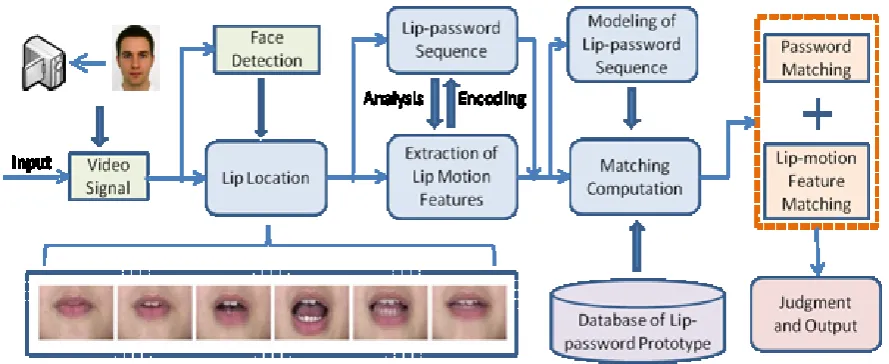
SYSTEM WORKING FLOWFigure 2: System Block Diagram
System Input: Real Time Camera Capture. Output: Display Lip Identification Result.
Implementation of Algorithm for Problem Description: Tracking & Identification of Person. Step 1: Start
Step 2: Real-time Camera Capture. Step 3: Converted into frames.
Step 4: Applying Contrast Enhancement and Histogram Equalization.
Step 5: Face Detection using Viola Jones Algorithm.
Step 6: Crop the Lip Region of Interest (ROI). Step 7: Extract Histogram Oriented Gradient (HOG) Features.
Step 8: Match the Feature from database and Classify using SVM.
Step 9: Repeat above steps for all Lip detected in Frames.
Step 10: Extract Label to each Lip with him/her Name as identification.
Step 11: Stop
A. Feature Extraction
Feature Extraction is important stage for the Lip Movement Classification system. Here In this paper two basic methods are described one is Histogram of
Gradient (HOG) and other is Low Binary Pattern (LBP).
I. LBP:
by Thresolding the neighbourhood of each pixel and considers the result as a binary number. Due to its discriminative power and computational simplicity, LBP texture operator has become a popular approach in various applications. It can be seen as a unifying approach to the traditionally divergent statistical and structural models of texture analysis. Perhaps the most important property of the LBP operator in real-world applications is its robustness to monotonic grey-scale changes caused, for example, by illumination variations. Another important property is its computational simplicity, which makes it possible to analyse images in challenging real-time settings [7].
Figure 3: LBP Descriptor
B. Classification
I. SVM :
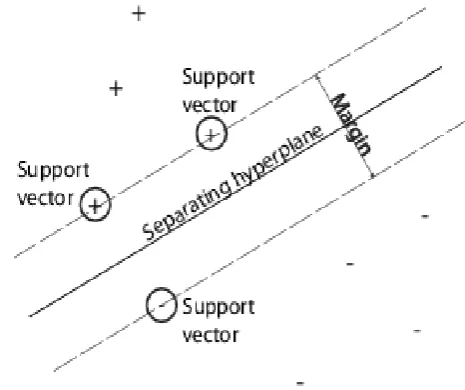
A support vector machine (SVM) is machine learning algorithm that analyses data for classification and regression analysis. SVM is a supervised learning method that looks at data and sorts it into one of two categories. An SVM outputs a map of the sorted data with the margins between the two as far apart as possible. SVMs are used in text categorization, image classification, handwriting recognition and in the sciences [10]. Those standard SVM is A
non-probabilistic double classifier binary straight classifier, i. E. It predicts, for each provided for input, which for two could reasonably be expected classes those enter is A part about. Since an SVM is a classifier, afterward provided for A set of preparing examples, every stamped Similarly as having a place with a standout amongst two categories, an SVM preparing algorithm manufactures a model that predicts if another case falls under person classification or the opposite. Likewise focuses over space, mapped Along these lines that the illustrations of the separate Classes are
isolated Toward an acceptable hole that is totally Likewise time permits.
Figure 4: SVM Classifier
III.
COMPARATIVE STUDYTABLEI:FEATURE EXTRACTION
Method Advantage Disadvantage
LBP [13] Save memory with a
non-uniform pattern there is 2p possible combinations while for uniform LBP there are patterns of p(p-1)+2.
It does calculation in integer
It is less accurate.
HOG [15] HOG (Histogram of
Oriented
Gradients) can be used to detect any kind of objects, as to a computer, an image is a bunch of pixels and you may extract features regardless of their contents.
Complete processing is time
consuming.
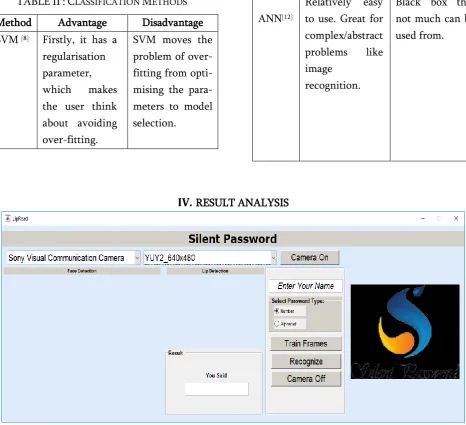
TABLEII:CLASSIFICATION METHODS
Method Advantage Disadvantage
SVM [8] Firstly, it has a
regularisation parameter, which makes the user think about avoiding over-fitting.
SVM moves the problem of over-fitting from opti-mising the para-meters to model selection.
ANN[12]
Relatively easy to use. Great for complex/abstract problems like image
recognition.
Black box that not much can be used from.
IV.
RESULT ANALYSISFigure 5: System GUI Design
TABLE III: Analysis
Method Accuracy Time
PCA 78.55% 5.45sec
HOG 82.45% 5.00sec
LBP 89.86% 4.66sec
Figure 6: Analysis
V.
CONCLUSIONThe paper is all about studied different methods for features extraction and classification to lip recognition. The work deals with real-time algorithms and techniques for Lip detection and Lip sequence tracking in videos. In these paper among all presented method LBP Feature and SVM Classifier are incorporated into the Viola-Jones face detection algorithm, allowing the algorithm to classify lip with greater efficiency. This lead to solution for the online password security.
VI.
REFERENCES[1] Hueber T, Benaroya E-L, Chollet G, Denby B, Dreyfus G, Stone M. .” Development of a silent speech interface driven by ultrasound and optical images of the tongue and lips. Speech Communication”. 52 288–300.,2010
[2] Wang, J., Samal, A., & Green, J. R. . Preliminary test of a realtime, interactive silent speech
interface based on electromagnetic
articulograph, the 5th ACL/ISCA Workshop on Speech and Language Processing for Assistive Technologies, Baltimore, MD, 38-45.,2014 [3] Jorgensen C, Dusan S. . Speech interfaces based
upon surface electromyography. Speech Communication.,2010
[4] Schultz T, Wand M. (2010). Modeling Coarticulation in EMGbased Continuous Speech Recognition. Speech Communication. 52: 341-353.
[5] P. Viola and M. Jones, “Robust real-time face detection,” Int. J. Comput.Vis., vol. 57, no.2, pp. 137–154, 2004.
[6] N. Eveno, A. Caplier, and P. Y. Coulon, 2002, “Key points based segmentation of lips,” in Proc. ICME, pp. 125–128
[7] Shreyansh Jain, Prem C. Pandey, and Rajbabu Velmurugan Department of Electrical Engineering, Lip Contour Detection for Estimation of Mouth Opening Area, 978-1-4673-8564-0/15/$31.00 ©2015 IEEE
[8] Lalitha. S.D. , Dr. Thyagharajan K.K, A Study on Lip Localization Techniques used for Lip reading from a Video, International Journal of Applied Engineering Research ISSN 0973-4562 Volume 11, Number 1 (2016) pp 611-615
[9] Ho Lip Chin,Marsyita Hanafi, Tanko Danial Salk, Integrated Face And Facial Components Detection0 2166-8523/15 $31.00 © 2015 IEEE [10] Schultz T, Wand M. (2010).Modeling
Coarticulation in EMGbased Continuous Speech Recognition. Speech Communication. 52: 341-353
[11] L. G. ves da Silveira, J. Facon, and D. L. Borges, “Visual speech recognition: A solution from feature extraction to words classification,” Proc. XVI Brazilian Symposium on Computer Graphics and Image Processing, pp. 399-405, 2003.
[12] Y. Ogoshi, H. Ide, C. Araki, and H. Kimura, “Active Lip Contour Using Hue Characteristics Energy Model for A Lip Reading System,” Trans. IEEJ, Vol.128, No.5, pp. 811-812, 2008.
[13] S. Saha and P. C. Pandey, “Estimation of the area of mouth opening during speech production,” in Proc. 8th Indian Conference on Vision, Graphics and Image Processing, Mumbai, India, 2012
[14] A. Anchit and S. Mathur, “Comparative analysis of Haar and Skin color method for face detection,” Recent Advances and Innovations in Engineering (ICRAIE), pp. 15, 2014.
[15] Alan Wee-Chung Liewa, Shu Hung Leungb, Wing Hong Laua, Nov 2002, “Lip contour extraction from color images using a deformable model”, The Journal of Pattern Recognition Society