HEAVY METAL REMEDIATION OF WASTEWATER
BY AGROWASTES
Choudhari Deepika
[a], Sharma Dipak
[a]and Phadnis Anjani
[a]Keywords: wastewater treatment, low cost adsorbent, non biodegradable heavy metals.
Corresponding Authors
E-Mail: [email protected]
[a] Department of Chemical Sciences, Maharaja Ranjit Singh College, Indore, M. P. , India
Introduction
Water pollution due to toxic heavy metals has been a major cause of concern for environmental engineers. The industrial and domestic wastewater is responsible for causing several damages to the environment and adversely affecting the health of the people. Several episodes due to heavy metal contamination in aquatic environment increased the awareness about the heavy metal toxicity. Metals can be distinguished from other toxic pollutants, since they are non-biodegradable and can accumulate in living tissues, thus becoming concentrated throughout the food chain. A variety of industries for the release of heavy metals into the environment through their wastewater as suggested by Braukmann et al.1
However years of increased industrial, agricultural and domestic activities have resulted in the generation of large amount of wastewater containing a number of toxic pollutants, which are polluting the available fresh water continuously. With the realization that pollutants present in water adversely effect human and animal life domestic and industrial activities, pollution control and management is now a high priority area. The availability of clean water for various activities is becoming the most challenging task for researcher and practitioners worldwide.
Heavy metals have been excessively released into the environment due to rapid industrialization and have created a major global concern. Cadmium, zinc, copper, nickel, lead, mercury and chromium are often detected in industrial wastewaters, which originate from metal plating, mining activities, smelting, battery manufacture, tanneries, petroleum refining, paint manufacture, pesticides, pigment manufacture, printing and photographic industries, etc.2,3
Unlike organic wastes, heavy metals are non-biodegradable and they can be accumulated in living tissues, causing various diseases and disorders; therefore they must be
removed before discharge. Namasivayam C.J. et al.4 interest
into the production of cheaper adsorbents to replace costly wastewater treatment methods such as chemical precipitation, ion-exchange, electroflotation, membrane separation, reverse osmosis, electrodialysis solvent extraction, etc. are attracting attention of scientists. Adsorption is one the physico-chemical treatment processes found to be effective in removing heavy metals from aqueous solutions. Most of the adsorption studies have been focused on untreated plant wastes such as Eucalyptus Bark,5
almond and apricot shell,6 bael fruit,7
Moringa oleifera
pods,8 Opuntia,9
Thespesia Populnea Bark,10 Adathoda vasica,11 Jaswand Leaf Powder.12
In general, an adsorbent can be termed as a low cost adsorbent if it requires little processing, is abundant in nature, or is a by-product or waste material from another industry. Of course improved sorption capacity may compensate the cost of additional processing as suggested by Bailey et al.13 Therefore there is an urgent need that all
possible sources of agro-based inexpensive adsorbents should be explored and their feasibility for the removal of heavy metals should be studied in detail. The objective of this study is to contribute in the search for less expensive adsorbents and their utilization possibilities for various agricultural waste by-products, which are in many cases also pollution sources.
Relevant Literature
Reviews of some agricultural adsorbents for the removal of heavy metals from wastewater are presented as follows:
Rice husk: Rice husk is an agricultural waste material
generated in rice producing countries, especially in Asia. The annual world rice production is approximately 500 million metric tons, of which 10 – 20 % is rice husk. Dry rice husk contains 70– 85 % of organic matter (lignin, cellulose, sugars, etc) and the remainder consists of silica, which is present in the cellular membrane carried out by Vempati et al.14 Srinivasan et al.36 studied on chromium
removal by rice husk carbon. The activated carbon prepared
Advanced wastewater treatment techniques such as adsorption are economiycally and environmentally essential in the removal of non biodegradable heavy metals from wastewater. Adsorption by activated carbon is being widely used but activated carbon remain an expensive material. In recent years, the need for safe and economical methods for the elimination of heavy metals from contaminated waters has necessitated research interest towards the production of low cost alternatives to commercially available activated carbon. Therefore there is an urgent need that all possible sources of agro-based inexpensive adsorbents should be explored and their feasibility for the removal of heavy metals should be studied in detail. This review focuses on the use of low cost adsorbent prepared from rice husk, cajanus cajan, maize cob, sago waste, mosambi fruit peel, watermelon shells, almond shells, apricot shells etc.
by carbonization of rice husk with sulphuric acid followed by CO2 activation showed 88 % removal of total chromium
and greater than 99 % removal of hexavalent chromium. Column studies showed capacity of 8.9 mg g-1 and 6.3 mg
g-1 for rice husk and commercial carbons respectively, for
Cr(VI) removal. Ayub S. et al.16 studied on chromium
removal by rice husk carbon. The activated carbon prepared by carbonization of rice husk with sulphuric acid followed by CO2 activation showed 88 % removal of total chromium
and greater than 99 % removal of hexavalent chromium. Column studies showed capacity of 8.9 mg g-1 and 6.3 mg g -1 for rice husk and commercial carbons respectively, for Cr
(VI) removal. Guo Y. et al.17 studied on adsorption of
Cr(VI) on micro- and mesoporous rice husk-based activated carbon. They have concluded that the rice husk carbon is a good sorbent for the removal of Cr(VI) from aqueous solution range from 5 to 60 mg L-1 with adsorbent dose of
0.8 g L- at pH< 5 under the minimum equilibration time of 2
hours. There is a sharp decrease in adsorption above pH 5.0 and the adsorption in the higher pH range would be negligible. Maximum reported adsorption is >95 % removal of Cr(VI). A study on utilization of agro-residues (rice husk) in small wastewater treatment plans was done by Daifullah et al.18 They have characterized and evaluated two types of
sorbents made from rice husk. The efficiency of both sorbents in the removal of the complex matrix containing six heavy metal was nearly 100 %. These metals are Fe, Mn, Zn, Cu, Cd, and Pb, which are found in the drain containing the agricultural and sewage wastewater. Wong et al.19 using
tartaric acid modified rice husk as adsorbent have carried out batch studies for the removal of lead and copper and reported the effects of various parameters such as pH, initial concentration of adsorbent, particle size, temperature etc. It was reported that modified rice husk is a potentially useful material for the removal of Cu and Pb from aqueous solutions. The rapid uptake and high adsorption capacity makes it a very attractive alternative adsorption material. It was also shown that the uptake of Cu and Pb was maximum when pH was increased from 2 to 3, thereafter remained relatively constant. Adsorption behaviour of Ni(II), Zn(II), Cd(II), and Cr(VI) on untreated and phosphate treated rice husk (PRH) by Ajmal M. et al.20 showed that adsorption of
Ni(II) and Cd(II) was greater when PRH was used as adsorbent. Adsorption of Cd(II) was dependent on contact time, concentration, temperature, adsorbent doses and pH of the solution. It was also reported that the maximum adsorption (>90%) was obtained at a pH value of 12. Subramaniam P.21 studied on raw rice on the removal of
Cr(VI). The overall result indicated that the maximum removal (66 %) of Cr(VI) for raw rice husk was obtained at pH 2, when it is given adsorbent dose of 70 g L- for 2 hours.
It has also showed good fit to Freundlich isotherm with 1/n value of 2.863. The adsorption behavior of Zn2+ and Pb2+
ions on rice husk was investigated by Asrari et al22 using rice
husk to remove the metals ions in dairy wastewater. The removal of heavy metal ions from aqueous solutions was studied by batch method. The main parameters that influencing Zn2+ and Pb2+ sorption on rice husk were:
amount of adsorbent, contact time and pH value of wastewater. The influences of pH (2–9), contact time (5-70 min) and adsorbent amount (0.5-3 g) have been studied. The percent adsorption of Zn2+ and Pb2+ ions increased with an
increase in contact time and dosage of rice husk. The binding process was strongly affected by pH and the optimum pH for Zn2+ and Pb2+ ions were 7.0 and 9.0,
respectively. The experimental data were analyzed by
Langmuir isotherm. The maximum adsorption capacity of the adsorbent for Zn2+ and Pb2+ ions was calculated from the
Langmuir isotherm and found to be 19.617 and 0.6216 mg g-1, respectively. The percent of removing Zn2+ and Pb2+
ions reached maximum to 70 % and 96.8 %, respectively. Nhapi I et al.23 reported that, adsorbents, carbonized rice
husk (CRH) and activated rice husk (ARH) made out of rice husks, available as agriculture waste, are investigated as viable materials for treatment of Pb, Cd, Cu, and Zn containing industrial wastewater at controlled pH. The results obtained from the batch experiments revealed a relative ability of the rice husk in removing some heavy metals at pH 7. One hand one, the CRH adsorption capacity decreases in the order of Cu>Pb>Zn>Cd in batch adsorption whereas during rapid small scale column tests the adsorption capacity decrease as follow Cu>Zn>Pb>Cd. On the other hand, ARH adsorption capacity performance is similar to CRH. However, during rapid small scale column tests the adsorption capacity decreases in the order Zn>Cu>Pb>Cd. The kinetic removal in batch experiment shows that the net uptake of Pb, Cd, Cu, Zn was 54.3 %, 8.24 %, 51.4 % and 56.7 %, respectively whereas using CRH, while it varied as 74.04 %, 43.4 %, 70.08 % and 77.2 % for the same dosages of ARH. Therefore, it is concluded that as regards to CRH, ARH demonstrated higher potential to remove relatively all selected heavy metals. Biosorption of cadmium ions from simulated wastewater using rice husk was studied by Ebrahim et al.24 with initial concentration of 25 mg L-.
Equilibrium isotherm was studied using Langmuir, Freundlich, BET and Timken models. The results show that the Freundlich isotherm is the best fit model to describe this process with high determination coefficient equals to 0.983. There was a good compliance between the experimental and theoretical results. Highest removal efficiency 97 % was obtained at 2.5g of adsorbent, pH 6 and contact time 100 min. Singh25 reported that, adsorbent is prepared from rice
husk, a low cost by product from a rice mill. The rice husk carbon is activated using H3PO4 (40 %). The stock solution
of Cr(VI) is prepared by dissolving 2.828 g of potassium dichromate (Central Drug House (CDH), India) in 1 litre of demineralized water. Batch mode experiments are done. The effect of various parameters like adsorbent dose, pH and contact time are studied. The studies demonstrate that the rice husk carbon (RHC) has a significant capacity for adsorption of Cr(VI) from aqueous solution. The RHC characteristics are reported as FTIR. The break through capacity for Cr(VI) (100 mg L-1, pH 2) is on average 38.1
mg g-1. The adsorption of chromium(VI) was found to be
maximum (93-94 %) at low values of pH (around 2) for the carbon dosage of 1000 mg L-1 and nearly 100 % for carbon
dosage of 1200 mg L-1. RHC exhibits high degree of
selectivity for Cr(VI) adsorption. Table 1 summarizes the usage of types of rice husk as an adsorbent:
Maize/Corn Cob: The study on oxidation of corncob by
citric acid and nitric acid was carried out by Leyva-Ramos et al.26 Upon oxidation of corncob, a significant increase in
Table 1. Types of rice husk as adsorbent for heavy metal
Heavy metal removal efficiency, % Adsorbent
Cr(VI) Ni(II) Cu(II) Zn(II) Cd(II) Hg(II) Pb(II)
References
Rice husk carbon >99 - - - 16
Phosphate treated
rice husk - - - - >90 - - 20
Tartaric acid
modified rice husk - - >80 - - - >95 19
Rice husk carbon - - ≈ 100 ≈ 100 ≈ 100 - ≈ 100 18
Raw rice husk 66 - - - 21
Rice husk - - - 70 - - 96.8 22
Carbonised rice
husk - - 51.4 56.7 8.24 - 54.3 23
Activated rice husk - - 70.08 77.2 43.4 - 74.04 23
Rice husk - - - - 97 - - 24
Rice husk carbon
using H3PO4 (40 %) 93-94 - - - 25
Table 2. Types of Maize/Corn Cob as adsorbent for heavy metal
Heavy metal removal efficiency, % Adsorbent
Cu(II) Cr(VI) Ni(II) Fe(II) Co(II) Zn(II) Cd(II) References Sulfuric acid
treated corncobs 90 - - - 27
Maize cob - - 99 - - - - 32
Corn cob - >90 - - - 31
Besides carbonization at high temperature, an adsorbent can be activated by chemical treatment using a concentrated acid. Khan and Wahab et al.27 in the study of
adsorption of copper by concentrated sulfuric acid treated corncobs. It was reported that upon treatment of corncobs with sulfuric acid and heated at 150C, the pHzpc of the adsorbent reduced from 5.2 (untreated) to 2.7 (treated) and the functional groups present in the adsorbent are mainly oxygen containing groups such as –OH, –COOH and –COO-. The maximum adsorption capacity obtained
from Langmuir isothem was 31.45 mg L-1. Adsorption
was more favored at higher pH value (4.5) due to low competing effect of protons for the adsorption sites. Effect of interfering ions such as Zn(II), Pb(II) and Ca(II) was also studied. It was noticed that copper removal efficiency was reduced by 53 %, 27 % and 19 % in the presence of Pb(II), Ca(II) and Zn(II), respectively. Regeneration study indicates that sulfuric acid treated corncobs can be regenerated by acidified hydrogen peroxide solution and as much as 90 % copper could be recovered. Daniela et al.28 describe chemical modeling of
metal biosorption requires the characterization of biomass used as sorbent. The (local) structural environment of Cu(II) and Zn(II) sorbed on corn cobs biomass has been investigated by secondary electron microscopy (SEM) and energy-dispersive X-ray analysis (EDX). The IR spectrum obtained for the above said biomass render a complex nature of the corn cobs biomass. Despite this complexity some characteristic peaks may be identified and assigned, revealing the presence of hydroxyl, carboxyl, carbonyl and amino functional groups in the structure of investigated biomass. The paper also deals with studies of physical and biochemical properties of the
sorbent: bulk density, apparent density, surface area, iodine number, CEC. From biomass characterization a possible mechanism of biosorption is suggested. The sorption experiments were carried out at a pH of 5.5 and low and high ionic strength in a 0.01 M Na2SO4 solution.
The results showed a high capacity of corn cobs with respect to the removal of the investigated metals cations. Akporhonor et al.29 was prepared maize cob carbon was
prepared by pyrolysis at 300 oC and 400 oC for 35 min.
This was followed by steeping in saturated ammonium chloride. The activated carbon which was characterized for bulk density, surface area, surface area charge, abrasion resistance and pH was used in the removal of Cd2+, Ni2+, Cd2+ and Zn2+. The surface areas of the maize
cob carbon at 300 oC and 400 oC were 0.010 and 0.021 g
sample per mg iodine, respectively. The effectiveness of the modified maize cobs in removing the metal ions from solution was found to be Zn>Ni>Cd. The removal efficiency of the metal ions is depended on the metal ion concentration and temperature of carbonization. Igwe30
plot confirmed that the sorption process was particle diffusion controlled. The regression models that were generated for these equations could be used as predictive models for these heavy metals sorption on maize cob at any other contact time. Also, the results of this study could serve as parameters for designs of treatment plants for the treatment of heavy metal bearing effluents using maize cob or even any other agricultural by-products as adsorbents. Therefore, maize cob which is a waste has been employed in treating another waste, which is heavy metal wastewater, thereby achieving environmental friendliness. Study of Abdullahi Balarabe Sallau31
explores the potential of corn cob powder for adsorption of Cr(VI) in aqueous solution. Effects of adsorbent dosage, pH, temperature, contact time and Cr(VI) concentration were investigated. Maximum adsorption was observed at 80 oC under acidic condition of pH 4
with a contact time of 120 min. The percentage removal efficiency was more than 90 % at lower initial Cr(VI) concentrations. Both Langmuir and Freundlich adsorption isotherms fitted reasonably well with the data and showed high correlation coefficient (R2) values of 0.999 and
0.991, respectively. Based on this, the adsorbent can be used as a low cost alternative in biosorption of wastewaters containing lower concentrations of Cr(VI). The adsorption of Ni(II) on maize cob has been studied by Muthusamy et al.32 using atomic absorption
spectroscopy for metal estimation. Parameters like heavy metal concentration, adsorbent dose, contact time and agitation speed were studied. Langmuir and Freundlich isotherms were employed to describe adsorption equilibrium. Maximum amount of nickel adsorbed as evaluated by Freundlich isotherm is up to 99 %. Study concluded that maize cob, a waste material, have good potential as an adsorbent to remove toxic heavy metal like nickel from industrial wastewater. Table 2 summarizes the usage of types of rice maize/corn cob as an adsorbent.
Cajanus Cajan: Husk of tur dal (Cajanus cajan) was
investigated by Ahalya et al.33 as a new biosorbent for the
removal of Fe(III) and Cr(VI) ions from aqueous solutions. Parameters like agitation time, adsorbent dosage and pH were studied at different initial Fe(III) and Cr(VI) concentrations. The biosorptive capacity of the tur dal husk was dependent on the pH of the chromium and iron solution, with pH 2 and 2.5 respectively being optimal. The adsorption data fit well with Langmuir and Freundlich isotherm models. The practical limiting adsorption capacity (qmax) calculated from the Langmuir
isotherm was 96.05 mg of Cr(VI)/g of the biosorbent at an initial pH of 2.0 and 66.65 mg g-1 at pH 2.5. The
infrared spectra of the biomass revealed that hydroxyl, carboxyl and amide bonds are involved in the uptake of Cr(VI) and Fe(III) ions. Characterisation of tur dal husk has revealed that it is an excellent material for treating wastewaters containing low concentration of metal ions. Karunakaran et al.34
Cajanus Cajan (L) milsp seed shell
activated carbons (CCC), an agricultural waste, abundance, cheapness and environmentally friendly nature could be used as potential adsorbent for the removal of Fe(III) from aqueous solution contains heavy metals and polluted water. The Freundlich adsorption isotherm model describes the adsorption behaviour with good correlation coefficient. The adsorption of Fe(III) was depended on the pH of the solution. Based on the results, the optimum contact time is 30 minutes and
adsorbent dosage is 50 mg L-1. Polypyrrole conducting
polymer is the most important conducting polymer that can be synthesized by chemical polymerization as coated form on the surface of CCC from aqueous solution. It was found that polypyrrole based conducting polymer was better adsorbent for removal Fe(III) compared to CCC from aqueous solution. The metal ion adsorption obeyed the pseudo- second order model based on the experimental and calculated qe values. The removal of
Fe(III) is simultaneously increased with increase in the temperature from 30 oC to 50 oC. The adsorptive removal
of Ni(II) from aqueous solution using Cajanus Cajan (L)
Milsp seed shells activated carbon and polypyrrole coated
Cajanus cajan (L) milsp seed shells activated carbon
(PPy/CCC) has been carried out by Thamilarasu et al.35
under various experimental conditions. Quality of Ni(II) uptake at 50 mg of activated carbon is 25.75 mg g-1 for
CCC and 29.60 mg g-1 for PPy/CCC. Adsorption data are
modeled with Freundlich, Langmuir and Temkin adsorption isotherm. Thermodynamic parameters such as
∆Ho, ∆So and ∆Go have been calculated and the findings
indicate that the adsorption is spontaneous and endothermic. Enthalpy change values range from 8.90 kJ mol-1 to 23.04 kJ mol-1, and based on these values the
adsorption of Ni(II) by CCC could be a physiorption. A mechanism involving intra particle diffusion and surface adsorption has been proposed for adsorption of Ni(II) onto adsorbent. Adsorbent used in this study is also characterized by FT-IR and SEM before and after the adsorption of metal ions. Table 3 summarizes the usage of types of Cajanus cajan as an adsorbent.
Other agricultural waste product: Quek et al.36 in their
study on the use of sago waste for the sorption of lead and copper. Sago processing waste, which is both a waste and a pollutant, was used to adsorb lead and copper ions from solution. The sorption process was examined in terms of its equilibria and kinetics. The most effective pH range was found to be 4 to 5.5 for both metals. The equilibria data for both metals fitted both the Langmuir and the Freundlich models and based on the Langmuir constants, the sago waste had a greater sorption capacity for lead (46.6 mg g-1) than copper (12.4 mg g-1). The kinetic
studies showed that the sorption rates could be described well by a second-order expression than by the more commonly applied Lagergren equation. Kadirvelu et al.37
studied on utilization of various agricultural wastes for activated carbon preparation and application for the removal of dyes and metal ions from aqueous solution. Mercury(II) and nickel(II) were used in the study for various adsorbents. Activated carbon was prepared from agricultural solid wastes such as, silk cotton hulls, coconut tree sawdust, sago waste, maize cob and banana pitch. Erhan Demirbas et al.38 reported that the batch
removal of Cr(VI) from aqueous solution using low-cost adsorbents such as cornelian cherry, apricot stone and almond shell under different experimental conditions was investigated in this study. The influences of initial Cr(VI) ion concentration (20 to 300 mg·L-1), pH (1 to 4) and
diffusion kinetic models, respectively. Results show that the pseudo second-order kinetic model was found to correlate the experimental data well.In the investigation of Hema Krishna et al.39 the powder of mosambi fruit
peelings (PMFP) was used as an inexpensive and efficient adsorbent for Ni(II) removal from aqueous solutions. The influence of physico-chemical key parameters such as the initial metal ion concentration, pH, agitation time, particle
Table 3. Types of Cajanus Cajan as adsorbent for heavy metal
Heavy metal removal efficiency, % Adsorbent
Cr(VI) Fe(III) Ni(II)
References
Tur dal husk 96.05 66.63 - 33
CCC (50 mg L-1) at 50 oC - 86.39 -
PPy/CCC (50 mg L-1) at 50 oC - 90.47 - 34
CCC (50 mg L-1) at 50 oC - - 88.60
PPy/CCC (50 mg L-1) at 50 oC - - 93.7 35
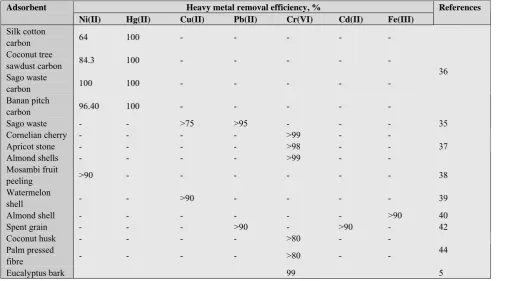
Table 4. Other types of agricultural wastes as adsorbent for heavy metal
Heavy metal removal efficiency, % Adsorbent
Ni(II) Hg(II) Cu(II) Pb(II) Cr(VI) Cd(II) Fe(III)
References
Silk cotton
carbon 64 100 - - - - -
Coconut tree
sawdust carbon 84.3 100 - - - - -
Sago waste
carbon 100 100 - - - - -
Banan pitch
carbon 96.40 100 - - - - -
36
Sago waste - - >75 >95 - - - 35
Cornelian cherry - - - - >99 - -
Apricot stone - - - - >98 - -
Almond shells - - - - >99 - -
37
Mosambi fruit
peeling >90 - - - 38
Watermelon
shell - - >90 - - - - 39
Almond shell - - - >90 40
Spent grain - - - >90 - >90 - 42
Coconut husk - - - - >80 - -
Palm pressed
fibre - - - - >80 - -
44
Eucalyptus bark 99 5
size and adsorbent dosage has been considered in batch tests. Sorbent ability to adsorb Ni(II) ions was examined and the mechanism involved in the process investigated. The optimum results were determined at an initial metal ion concentration of 50 (mg L-1), pH=4, agitation time – 90 min, an adsorbent dose (125 mg/50 ml) and the particle size (0.6 mm). The % adsorption, Langmuir constants [Q0=29.41 mg g-1 and b=0.4789 L mg-1],
Freundlich constant Kf= 23.92 mg g-1 and n=2.24 L mg-1,
Lagergren rate constants [Kad=4.37x10⁻² min-1] for
[Ni(II)] 50 mg L-1, were determined for the adsorption
system as a function of sorbate concentration. The equilibrium data obtained were tested using Langmuir, Freundlich adsorption isotherm models, and the kinetic data obtained were fitted to pseudo first order model. The study of Koel Banerjee et al.40 deals with the application
of watermelon shell, an agricultural waste, for the adsorptive removal of Cu(II) from its aqueous solutions. This paper incorporates the effects of time, dose, temperature, concentration, particle size, agitation speed
and pH. Analytical techniques have been employed to find pore properties and characteristics of adsorbent materials. Batch kinetic and isotherm studies have also been performed to understand the ability of the adsorbents. The adsorption behavior of the Cu(II) has been studied using Freundlich, Langmuir and Tempkin adsorption isotherm models. The monolayer adsorption capacity determined from the Langmuir adsorption equation has been found as 111.1 mg g-1. Kinetic
measurements suggest the involvement of pseudo-second-order kinetics in adsorptions and is controlled by a particle diffusion process. Adsorption of Cu(II) on adsorbents was found to increase on decreasing initial concentration, increasing pH up to 8, increasing temperature, increasing agitation speed and decreasing particle size. Overall, the present findings suggest that watermelon outer shell is environmentally friendly, efficient and low-cost biosorbent which is useful for the removal of Cu(II) from aqueous media. G. Anusha et al.41
carbon in removing iron from the synthetic solution. The results clearly indicate that the carbon was effective in removing iron from the synthetic solution. For synthetic solution it was observed that the percentage removal of iron with increase in time of contact up to 20 minutes and after that there was no appreciable increase in the percentage removal. Hence the optimum contact time for synthetic solution was taken as 20 minutes. For synthetic solution, it was found that the percentage Iron removal increases from pH 1-9. Optimum pH is 5.0 which is the original pH of the solution. Spent grain obtained from brewery can be used to treat Pb(II) and Cd(II) ions as demonstrated by Low et al.41 Treatment of spent grain
with NaOH greatly enhanced adsorption of Cd(II) and Pb(II) ions, whereas HCl treated spent grain showed lower adsorption than the untreated spent grain. The increase in adsorption of heavy metal ions after base treatment could be explained by the increase in the amount of galacturonic acid groups after hydrolysis of O-methyl ester groups. The best pH range for metal adsorption was 4–6. Kinetic study reveals that the equilibrium time of adsorption was 120 min for both metal ions and adsorption followed pseudo-second-order model. The maximum adsorption capacity for lead was two times higher than cadmium. The effect of organic ligands (EDTA, nitrilotriacetic acid and salicylic acid) on adsorption efficiency was assessed and adsorption was greatly reduced by EDTA and nitrilotriacetic acid at molar ratio of 1:1 (metal:ligand). EDTA and nitrilotriacetic acid could chelate the heavy metal ions, therefore more metal ions would remain in the solutions rather than being adsorbed as suggested by Jeon and Park et al.42 Salicylic acid on the other hand slightly reduced
the percentage of cadmium adsorption but did not affect adsorption of lead. Halim et al.43 studied on removal of
lead ions from industrial wastewater by different types of natural materials. From the research done it was reported that at lead concentration of 4 mg L-1 and pH 6 the
adsorption capacity is maximum for Nile rose plant powder at 80 % removal and at the same concentration and pH it was also reported that bone powder removed 98.8 % of lead. Tan et al.44 Studied on removal of
chromium (VI) from solution by coconut husk and palm pressed fibres and it was investigated using batch and column techniques. For both substrates, the optimum pH for maximum removal is at 2.0 which corresponds to > 80 % removal. Sarin et al.5 reported that removal of
poisonous hexavalent form of chromium from solutions was possible using selected adsorbents. Eucalyptus bark (EB) was the most effective for which the removal reached more than 99 % for Cr(VI) at concentration of 200 ppm and at pH 2. Increase in the dose of adsorbent, initial concentration of Cr(VI) and increase in contact time upto 2 h are favorable for all increase the adsorption of Cr(VI). The kinetic of the Cr(VI) adsorption on EB was found to follow first order mechanism. The Gibbs free energy was obtained for each system. It was found to be -1.884 kJ mol-1 for Cr(VI) and -3.872 kJ mol-1 for
Cr(III) for removal from industrial effluent. The adsorption data can be satisfactorily explained by Freundlich isotherm. Higher sorption capacity of this sorbent indicates that eucalyptus bark can be used for the treatment of chromium effluent. Table 4 summarizes the usage of some of agricultural waste as an adsorbent:
Conclusion
According to literature data adsorption is very popular method for the removal of heavy metals from wastewater. In this paper, the removal performance of low cost adsorbent derived from agricultural waste such as rice husk, maize cob, Cajanus cajan, sago waste, apricot shell,
almond shell, mosambi fruit peel, watermelon shell etc. has been reviewed. It is evident from Table 1 to table 4 that low cost adsorbent have outstanding removal capabilities for heavy metals like Cu(II), Fe(III), Ni(II), Cd(II), Hg(II), Cr(VI), Pb(II) etc. Adsorption capacity of an adsorbent depands on several parameters like dosage of adsorbent, initial concentration of heavy metals insolution, pH value and tempreture. It is important to note, adsorption capacities of the adsorbents presented in this article vary, depending on the characteristics of the individual adsorbents. Low-cost, effectiveness and availability of described materials suggest that they can be used in place of expensive activated carbon for the removal of heavy metal ions from solutions.
Reference
1Braukmann, B. M., Industrial solution amenable to biosorption,
In Biosorption (Edited by Volusky B), CRC Press, Boca
Raton, FL, 1990.
2Kadirvelu, K., Thamaraiselvi, K., and Namasivayam, C., Bioresour. Technol., 2001, 76, 63–65.
3Williams, C. J., Aderhold, D. and Edyvean, G. J.,
Water Res., 1998, 32, 216–224.
4Namasivayam, C. and Ranganathan, K.,
Environ. Technol. 1995, 16, 851– 860.
5Sarin, V. and Pant K. K.,
Bioresource Technology,2006, 97,
15–20.
6Khazaei, I., Aliabadi, M. and Hamed Mosavian, H. T., Iranian J. Chem. Eng., 2011, 8(4), 11-23.
7Anusha, G., 2nd Int. Conf. Environ. Sci. Technol., IPCBEE
vol. 6, IACSIT Press, Singapore, 2011. 8Adelaja, O. A., Amoo, I. A and Aderibigbe, A. D.,
Archiv. Appl. Sci. Res., 2011, 3(6), 50-60.
9Mane, P. C, Bhosle, A. B., Jangam, C. M. and Mukate, S. V., J. Nat. Prod. Plant Resour.,2011, 1(1), 75-80.
10Prabakaran, R. and Arivoli, S.,
Arch. Appl. Sci. Res., 2011, 3(6), 218-232.
11Ahamed, A. J. and Begum, A. S.,
Arch. Appl. Sci. Res., 2012, 4(3), 1532-1539.
12Shelke, R. S., Bharad, J. V., Madje, B. R. and Ubale, M. B., Arch. Appl. Sci. Res., 2010, 2(3), 260-266.
13Bailey, S. E., Olin, T. J., Bricka, R. M. and Adrian, D. D., Water Res.,1999, 33, 2469–2479.
14Vempati, R. K., Musthyala, S. C., Molleh, Y. A., and Cocke,
D. L., Fuel, 1995, 74(11), 1722-1725.
15Srinivasan, K., Balasubramaniam, N. and Ramakrishna, T. V., Indian J. Environ. Health, 1998,30(4), 376-387.
16Ayub, S., Ali, S. I., and Khan, N. A.,
Environ. Pollut. Control J., 2001, 4(4), 34 – 38.
17Guo Y., Qi, S., Yang, S., Yu, K., Wang, Z., and Xu, H., Mater. Chem. Phys., 2002, 78, 132–137.
19Wong, K. K., Lee, C. K., Low, K. S. and Haron, M. J., Chemosphere,2003, 50, 23-28.
20Ajmal, M., Rao, R. A. K., Anwar, S., Ahmad, J. and Ahmad,
R., Bioresour. Tech., 2003, 86, 147-149. 21Subramaniam P., Khan N.A., and Ibrahim S.,
Rice husk as an adsorbent for heavy metal. Proc. Int. Conf. Water
Wastewater (ASIAWATER), Kuala Lumpur, Malaysia 2004.
22Elham, A., Hossein, T., Mahnoosh, H.,
J. Appl. Sci. Environ. Manage. JASEM 2010, 1119-8362 .
23Nhapi, I., Banadda, N., Murenzi R., Sekomo, C. B. and Wali,
U. G., The Open Environ. Eng. J., 2011, 4, 170-180. 24Ebrahim, S. E. and Mohammed, S. Y.,
J. Eng., 2012, 7(18),
868-875.
25Singh, S. R. and Singh, A. P.,
Int. J. Environ. Res., 2012, 6(4), 917-924.
26Leyva-Ramos, R., Bernal-Jacome, L. A. and
Acosta-Rodriguez, I., Sep. Purif. Technol., 2005, 45, 41–49. 27Khan, M. N. and Wahab, M. F.,
J. Hazard. Mater. B, 2006, 141, 237–244 .
28Stefan, D. S., Stefan, M. and Vaireanu, D. I.,
Rev. Roum. Chim., 2006, 51(6), 541–546.
29Akporhonor, E. E. and Egwaikhide, P. A.,
Sci. Res. Essay, 2007, 2(4), 132-134.
30Igwe, J. C. and Abia, A. A.,
Int. J. Phys. Sci., 2007, 2(5),
119-127.
31Sallau, A. B., Aliyu, S., Ukuwa, S.,
Int. J. Env.Bioener., 2012, 4(3), 131-140.
32Muthusamy, P., Murugan, S. and Smitha, M.,
ISCA J. Biol. Sci., 2012, 1(2), 7-11.
33Ahalya1, N. Kanamadi R. D. and Ramachandra, T. V., J. Environ. Biol., 2007, 28(4), 765-769.
34Karunakaran, K., Thamilarasu, P.,
Arch. Appl. Sci. Res., 2010, 2(1), 176-186.
35Thamilarasu, P. Sivakumar P. and Karunakar, K.,
Indian J. Chem. Technol., 2011, 18, 414-420.
36Quek, S. Y., Wase, D. A. J. and Forster, C. F.,
Water S.A., 1998, 24(3), 251-256.
37Kadirvelu, K., Kavipriya, M., Karthika, C., Radhika, M.,
Vennilamani N. and Pattabhi, S., Bioresour. Tech., 2003, 87, 129-132.
38Demirbas, E., Kobya, M., Senturk, E., Ozkan, T.,
Water SA, 2004, 30(4), 533-540.
39Hema Krishna, R., Swamy, A. V. V. S.,
Chem. Sci. J., 2011, 1-13.
40Banerjee, K., Ramesh, S. T., Gandhimathi, R., Nidheesh, P. V.,
and Bharathi, K. S., Iran. J. Energy Environ.,2012, 3(2), 143-156.
41Low, K. S., Lee, C. K., Liew, S. C.,
Process Biochem., 2000, 36, 59–64.
42Jeon, C., Park, K. H.,
Water Res,,2005, 36, 3938–3944. 43Halim S. H. A., Shehata, A. M. A. and El-Shahat, M. F.,
Water Res., 2003, 37, 1678–1683. 44Tan, W. T., Ooi, S. T., and Lee, C. K.,
Environ. Technol., 1993, 14, 277-282.
45Nasim, A. K., Shaliza, I. and Piarapakaran, S.,
Malaysian J. Sci., 2004, 23, 43–51.
46Kumar, U.,
Sci. Res. Essay, 2006, 1(2), 33-37. 47Wan Ngah W. S., Hanafiah, M. A. K. M.,
Bioresour. Technol., 2008, 99, 3935–3948.