Enhancing the Mathematical Sciences Workforce
Department of Mathematics and Program in Applied Mathematics
University of Arizona
1
Introduction
The Department of Mathematics and the Program in Applied Mathematics at the University of Arizona propose a far-reaching workforce enhancement program that will prepare young American men and women for careers as professional mathematicians. The mathematical sciences workforce of the 21st century must be diverse not only with respect to gender and ethnicity but also with respect to training to ensure that it can serve the full spectrum of societal needs in mathematical research and education. Furthermore, in order to be truly effective at the national level such a training program must reach far beyond local institu-tional boundaries—both geographically and culturally—in order to maximize its impact on the growth and development of the emergent professional community. We will achieve this by integrating the University of Arizona’s unique intellectual environment in the mathematical sciences with an innovative summer program which will disseminate our professional culture over a broad geographical region and, at the same time, en-hance the flow of talented students from diverse backgrounds to the University of Arizona and other Research 1 institutions.
Our institution offers:
• A unique and collegial institutional structure of a disciplinary Department of Mathematics and an
in-dependent interdisciplinary Program in Applied Mathematics that has consistently generated research and education of the highest quality in the mathematical sciences.
• World-class research programs in many areas of mathematics and its applications ranging from
math-ematical biology to nonlinear optics, and number theory to partial differential equations.
• A proven track record in innovative mathematics education and outreach activities, including
award-winning undergraduate courses, unique laboratory training at the graduate and advanced undergrad-uate levels, and nationally prominent research-based training at the gradundergrad-uate and post-doctoral levels.
• A highly ranked Ph.D.-granting Mathematics Education program that is a leader in research on K-12
teaching and learning with an emphasis on socio-cultural perspectives, equity, and the use of student thinking in teacher education.
The University of Arizona’s location in the Southwestern United States puts it at the heart of many Hispanic and Native American communities and the educational institutions that serve them. Our goal is to create a hub of workforce enhancement activities in the Southwest of a bi-directional nature; namely a structure that brings studentsand facultyfrom these institutions to Arizona to inform us about educating and mentoring students from diverse backgrounds, and exports our approaches to mathematics education and research back to those institutions in ways that will benefit them and enhance the pipeline of talented students to our own and other schools.
The combined intellectual and institutional resources of the Mathematics Department and the Program in Applied Mathematics make it possible for us to offer an unusually broad spectrum of intellectual and professional development opportunities including: a wide range of high-quality courses for both undergrad-uates and graduate students; two unique experimental laboratories used for training at the interface of
mathematics and experimentation; a host of research seminars and colloquia; disciplinary and interdisci-plinary research opportunities for undergraduates, graduate students, and post-docs; national laboratory and industrial internships; and cross-disciplinary collaborations with faculty in other departments and the Mathematics Education program. Complementing these research and educational opportunities is a wide range of instructional training activities, including carefully supervised classroom teaching, individual and group tutoring, and many mentoring and outreach activities.
During our first VIGRE grant, we developed a variety of individual and team-based mentoring mechanisms to help students make the many transitions necessary for their personal and intellectual development into self-motivated and creative researchers, teachers, communicators, and team players. At the undergraduate level these transitions are effected by a combination of good advising structures and a variety of capstone ex-periences for seniors, often in a vertically integrated setting. To facilitate the transition from undergraduate life to the rigors of graduate school, the Department of Mathematics and the Program in Applied Math-ematics have developed a variety of support and assessment mechanisms to integrate their new graduate students into the intellectual and cultural life of their respective degree programs, stimulate their appetite for enquiry-based learning, and to reduce attrition. Their professional and intellectual development at the intermediate and advanced graduate levels is further developed by the very successful system (developed under our first VIGRE grant) of competitively awarded fellowship support in which students are required to write and submit proposals mapping out the intended use of the funds to fulfill their research and ed-ucational objectives. At the post-doctoral level we will continue to provide careful faculty mentoring and oversight to further enhance their professional training for careers in the mathematical sciences. Overall, our teaching and training paradigm is one in which vertical integration between different academic levels and horizontal integration across different fields of mathematics is well mentored, collegial, natural, and flexible—allowing for interactions between groups and individuals at those transition points in their careers when such activities will be most beneficial to them. All our current and proposed activities are designed to be authentic experiences in research, education, and communication that integrate naturally with the participants’ scholarly development—thereby creating organizational and motivational structures that will be highly sustainable beyond the lifetime of the grant.
We believe that this model and culture of integrative and interdisciplinary research and education in the mathematical sciences is one that could be profitably spread beyond our institutional boundaries in ways that will make an impact, far greater than the dollar value of grant, on the development of the professional workforce. This will be achieved through an innovative summer program that will not only provide partici-pating students with stimulating research experiences that reflect our particular culture, but also support the development of faculty and programs at a network of regional schools, many of which serve large minority communities and which may lack the institutional infrastructure necessary to compete for, and support, VIGRE-like programs. While most undergraduate summer programs usually operate in an institutionally localized sense—in that the program is run at the host institution by local faculty—our model will involve faculty from schools in our regional network with the goal of not only informing one another of the academic requirements and styles of our respective programs, but also of assisting our partners develop complementary programs at their own institutions. At the same time we look forward to working with, and learning from, some of the established summer programs around the country to ensure the integration of established best practices into our efforts.
Our post-VIGRE plan, which involves funds from private donors and a very substantial financial commitment from the University of Arizona in the form of ten, post-grant, fellowships insures that the needed resources and infrastructure will be in place to continue these activities beyond the period of VIGRE funding. These post-VIGRE sources have been carefully planned to phase in over the term of this VIGRE grant, leading to a smooth transition from the NSF-funded project to a permanent and effective training program that will produce a broadly trained workforce of mathematical scientists who are well-prepared for the challenges of the 21st century.
2
Results from Prior Support
2.1
Graduate Programs
Our previous VIGRE grant supported graduate students via fellowships and travel funds. We begin our discussion of results by explaining the uses to which fellowship and travel support were put. Then we turn to a more global discussion of the impact of VIGRE on our program as a whole. Finally, we round out the discussion with a series of vignettes which illustrate the types of students we produce and how VIGRE support affected their trajectories.
2.1.1 Fellowship and travel support
As we described in the main project description, students obtain VIGRE fellowship support either as part of a recruiting package or through a competitive proposal process. Competitive proposals must discuss an intellectual, research-oriented, goal to be achieved during the period of support and are generally expected to have an integration component as well. Typical intellectual goals include: (i) study for qualifying exams; (ii) pursue a reading course or independent study with a faculty member; (iii) prepare for the written and oral comprehensive exam; (iv) organize a research seminar; (v) undertake a research project with a faculty member; (vi) prepare a paper for publication; (vii) present a paper or poster at a conference; (viii) completion of the dissertation. Activities that would add weight to a proposal include planned seminar talks and conference participation.
Integration activities might include any of the following: (i) organize (jointly with a faculty member) a research tutorial group (RTG) project; (ii) run a summer study session for the qualifying exams; (iii) act as “super-TA” for a graduate course or for Math 323, the critical transition to the mathematics major; (iii) act as a senior graduate student mentor in the Integration Workshop, or the Professional Skills seminar; (iv) work with a faculty member and an undergraduate on an undergraduate research project; (v) organize the undergraduate research seminar; (vi) participate in the High School Workshops program; (vii) visit, with a faculty member and an undergraduate, a local high school class; (viii) participate in Native American outreach activities, such as the Apache Summer Math Camp.
VIGRE funding provided on average slightly over 14 graduate fellowships per semester and about 15 summer fellowships per year. There is not sufficient space here to detail all the intellectual goals achieved and integration activities undertaken, but a comprehensive accounting, obtained from students’ post-fellowship reports, is available. We feel that the number and range of activities undertaken is quite impressive and that students in the program during the period of VIGRE support obtained deeper and broader mathematical training as well as improved professional development.
VIGRE funding supported about 15 travel proposals per year. These were typically for conferences, both domestic and international, closely tied to the dissertation research of the recipient or for the joint annual meeting in January. Cases where students were presenting their own research were a priority. In many instances students were able to combine VIGRE funding with other sources (conference organizers, faculty in other departments, etc), leveraging the effectiveness of the VIGRE grant.
2.1.2 Program Statistics
We now turn to an analysis of the impact of VIGRE on our two graduate programs as a whole, comparing the pre-VIGRE period with the period of VIGRE support, 1999-2004. For this comparison, we feel that the appropriate time-frame for the earlier period is 1995-1999, the four-year period immediately preceding the VIGRE award. There were significant changes in admissions policies and program size for both the Mathematics Graduate Program and the Program in Applied Mathematics in 1995 (for example, both programs stopped accepting in most cases students they could not financially support), and so data for 1994 would skew the picture. (However that data for the full five-year period preceding the award is included in the appendix.)
Degree production The overall size of our graduate PhD programs declined somewhat between the two periods, averaging 91.3 students in the earlier period and 81.2 in the later period. The number of PhD students admitted was roughly constant in the two periods at an average of about 18.7 students per year.
The number of students leaving with no degree dropped from an average of about 4.5 per year to about 4.0 a year, i.e., an annual failure rate of only 5%. The number of PhD students leaving with a terminal Master’s degree fell from an average of 5.7 per year to an average of 4.2 per year. (We remark that in the Mathematics program, a terminal Master’s degree requires a thesis, and in the Applied program it requires a Master’s level pass on the qualifying exams; in both programs the award of a Masters degree is far from automatic.) Most importantly, PhD production held essentially constant at about 10 degrees per year. We note by comparison that nationally, the number of PhDs awarded by Group I and II departments dropped by almost a third between 1997 and 2002. Moreover, the PhDs produced during the VIGRE period benefited form the extensive research and professional development opportunities afforded by VIGRE support. See the vignettes section for some examples. Overall, the picture is one of effective recruiting from a decreasing national pool, a steady success rate aided by VIGRE fellowship funding, and better mentoring leading to fewer total drop outs and fewer terminal Master’s degrees.
Citizens, women, and minorities The proportion of US citizens and minorities in our incoming PhD classes held steady at approximately 71% and 31% respectively. (Here and elsewhere we abbreviate “citizens, nationals, and permanent residents” to “citizens.”) The proportion of minorities among US citizens in our incoming PhD classes almost doubled, from 11.3% to 20.9%.
Among PhD degree recipients, the proportion of citizens decreased from 72.5% to 57.1%. Although this is a decline, the ending number is above the corresponding national average of 51.8% for the period ’99-00 to ’01-’02 (latest available, [Med04, p. 773]). Keeping in mind that there is a time lag of five to six years between admission and degree, the students graduating in the later period entered our programs between 1993 and 1999. Two factors may explain the lower percentage of citizens among graduates in the later period: the recruitment period was a time of great economic growth and many potential PhD students went directly from undergraduate degrees into the job market; and prior to 1995 we admitted some students without financial support; most of whom were eligible to work in the US, i.e., citizens and permanent residents. Looking ahead, we expect that the percentage of citizens among our graduates will rise in line with their rate of admission, which as noted above is about 70%.
The proportion of women among PhD recipients increased from 22.5% to 28.6%. (We note that among PhD programs of roughly our size, the top three percentages of PhDs awarded to females during 1995-2003 are 41%, 26%, and 25% [Jac04, p. 779].) The proportion of minorities among citizen degree recipients increased from 6.9% to 10.7%. (Over the last 10 years, approximately 4.8% of the PhDs awarded to US citizens and permanent residents have gone to minorities [Med04, p. 773].) Thus our record of producing female and minority PhDs is already among the best and we hope to see further improvements: we are only now beginning to see the graduation of students who have benefited from VIGRE during their full program of study and so we expect to see further improvements in these numbers, in line with the numbers for incoming students. Overall the picture is one of steady recruitment of citizens and women—in keeping with, or better than, national norms—along with improvements in minority recruiting, and improved graduation rates among women and minorities.
Placement The percentage of our PhD graduates obtaining academic or technical employment increased from 82.5% in the earlier period to 85.7% in the VIGRE period with a corresponding decrease from 17.5% to 14.3% in unemployment or temporary positions at the University of Arizona. This provides some evidence that our students are becoming more attractive to employers.
Among the employed the balance shifted from 73% academic, 27% industrial in the earlier period to 64% academic, 36% industrial in the VIGRE period, in line with VIGRE goals of broadening career prospects.
2.1.3 Vignettes
Sarah Frey Sarah Frey entered the Program in Applied Mathematics in Fall 2000 and, as one of the Program’s top recruits that year, received a VIGRE fellowship in her first year, which was subsequently followed by a VIGRE fellowship in her fourth year. During her four years in the Program she has pursued interdisciplinary research on planetary stability under the joint supervision of Professor Michael Tabor (Applied Mathematics) and Professor Rick Greenberg (Lunar and Planetary Sciences). This work has already resulted in two publications with several more anticipated. In addition to a full slate of course
work Sarah taught several entry level mathematics courses and acted as a super-TA in one of the Applied Mathematics core courses. Sarah was strongly committed to outreach and, for 2001-2002, had an NSF GK-12 Fellowship working on curriculum development at a local Native American high school. Her professional training was enhanced by two summer internships at Los Alamos National Laboratory working on problems in computational fluid dynamics. During her fourth year she was offered a tenure-track assistant professor position in the Mathematics Department at Cal State Hayward. Given her very strong commitment to undergraduate education and outreach she decided to accept the offer and has just started her new job this semester.
Jack Hoppin Jack Hoppin joined the Program in Applied Mathematics in Fall 1998. During his time in the Program he received 6 semesters of VIGRE Fellowship support, four semesters of TA support, and additional semesters of RA support. He joined the University of Arizona’s renowned medical imaging group under Regents Professor Harrison Barrett which has been the source of many interdisciplinary dissertation projects for Applied Mathematics students over the years. During his first year in the Program, he had considerably difficulty making the transition to some of the advanced graduate level courses and required extra faculty and senior student mentoring. Once over this hurdled he blossomed, and by the time of his graduation in 2003 he had received the Michael B. Merickel Best Student Paper Award at the 2003 Medical Imaging conference in San Diego, and was awarded a prestigious Humboldt fellowship for a post-doctoral position in Germany.
Guadelupe Lozano Guadelupe Lozano entered the Mathematics PhD program in 1996 and graduated in Summer 2004. Three years of VIGRE support enabled her to simultaneously pursue her primary research interest in integrable systems theory as well as a strong minor program in Mathematics Education. Her integration activities spanned the full range: helping to organize the Math Education research seminar, helping develop new courses for future teachers, organizing an RTG, serving as a super-TA, and being involved in outreach to the local high schools. She recently accepted a post-doctoral position at the University of Michigan where she is collaborating with faculty on extensions of her dissertation work in the area of Poisson Geometry as well as directing Michigan’s Undergraduate pre-calculus program.
Tyler McMillen Tyler McMillen joined the Program in Applied Mathematics in Fall 1997. During his time in the Program he received a total of six semesters of VIGRE Fellowship support complemented by TA support in the other semesters (and was on a leave of absence for one semester for personal reasons). His vertical integration activities included involvement in high school workshops, super-TA work, and running review sessions for fellow students preparing for the qualifying exams. His dissertation research on “Perver-sion and whips: static and dynamic problems of elastic filaments” excited much popular interest, was cited in many professional and popular journals, and was featured on National Public Radio. By graduation this work resulted in three publications in major journals. Tyler graduated in 2003 and was awarded an NSF Post-doctoral Fellowship to work with Philip Holmes at Princeton.
Christopher Rasmussen Chris Rasmussen entered the Mathematics PhD program in 1998 and graduated in Spring 2004. He benefited from three years of VIGRE support, during which time he had a very strong research focus in arithmetical algebraic geometry. He gave a huge number of talks (averaging 3 a semester) attended several conferences, including two where he lectured, and organized a graduate student algebraic geometry seminar. His outreach activities focussed on high school AP calculus class visits. Chris accepted a VIGRE post-doctoral fellowship at Rice University in Fall 2004.
Patrick Shipman Patrick Shipman entered the Mathematics PhD program in 1999 and graduated in Spring 2004. He also benefited from about 3 years of VIGRE support, with a strong research emphasis on applied partial differential equations. He published one paper, gave three talks at conferences, attended 5 other conferences, and gave several talks in local seminars. His integration activities included participating in two Saturday workshops for high school students, organizing the undergraduate research seminar, and working twice as a super-TA in advanced courses. Patrick wrote his dissertation with Alan Newell and accepted a post-doctoral position at the Max Planck Institute in Leipzig.
There are many more interesting success stories among our current graduate students which may be discussed during a site visit.
2.2
Undergraduate Program
2.2.1 Statistics
Our previous VIGRE grant supported undergraduate students directly via fellowships for research projects and indirectly (with matching funds) for teaching projects; there were also funds for travel. The mechanics of these programs are discussed in Section 4.2, and here we will show that they have had a positive impact on both the numbers of graduates and their preparedness for careers in the mathematical sciences.
The number of undergraduate mathematics majors has increased (steadily except for a dip last year) from 282 in ’98-’99 to 339 in ’03-’04. The number of degrees awarded has been variable, with a peak of 59 in ’02-’03 and an average of about 50 per year over the last five years. The percentage of degree recipients who have engaged in an independent research, teaching, or internship experience has increased substantially from about 25% in ’98-’99 to over 53% in ’03-’04, well above the national average. Based on a possibly non-representative sample, the percentage of degree recipients going on to graduate school increased from 18.7% in ’96-’99 to 23.7% in ’99-’04. (Our evaluation plan calls for much better data collection for statistics such as this one.)
The percentage of our undergraduate degrees going to women has held steady at about 40% over the last decade; this is roughly the national average. The percentage of degrees going to underrepresented minorities went from an average of 14.8% in the 1994-1999 period to 16.8% in the 1999-2004 period. The number of underrepresented minority mathematics majors is currently 20%, which compares favorably with the overall University of Arizona minority undergraduate student body percentage of 18%.
2.2.2 Additional facts
There is growing evidence that our undergraduates are improving in quality and professionalism. For Fall 2004 the first semester, upper level, courses in abstract algebra (Math 415a) and advanced calculus (Math 425a) are both oversubscribed, with enrollments of 35 and 44 students respectively. These very challenging courses are generally taken by students thinking of going on to graduate school in some mathematics-based field. At the professional development level, many of our undergraduates have undertaken research projects on both disciplinary and interdisciplinary problem, and in modalities ranging from traditional individual faculty supervision to vertically integrated teams. Furthermore, 16 of our students have internships for the summer of 2004 in companies and national laboratories.
2.2.3 Vignettes
Nathaniel Blair-Stahn. Nathan graduated with a B.S. degree in mathematics in December 2002. He was a UTA in a calculus class with duties that included holding weekly review sessions. He also held a URA, under the tutelage of post-doctoral associate Dr. Kelly Wieand, working on a project involving random matrices. During the summers of 2001 and 2002, he held internships at Sandia National Laboratory, where he worked on cryptography. He is currently in his second year of graduate study at the University of Washington.
David Brown. David graduated with a B.S degree in mathematics in December 2003. He worked on research projects with Professors Madden and McCallum (both in Mathematics), and with Professor van Klock (Physics). He spent the Spring semester, 2002 at the Budapest program. In the summer of 2003, he participated in a REU project at the University of Notre Dame, where he worked in combinatorics. He spent a year as a CAATS fellow, an NSF funded project, at Ha:San Native American preparatory school. David began graduate school at University of California, Berkeley in Fall 2004.
2.3
Post-doctoral Program
The post-doctoral aspect of our VIGRE program is small in numbers, but an important component. To document its success, we describe the trajectories of four of our VIGRE post-doctoral fellows, complemented by one statistic: all six of our former VIGRE post-docs are currently employed in the mathematical sciences.
2.3.1 Patrick Hagerty
Patrick Hagerty joined the Applied Mathematics Program in Fall 2001. In addition to developing his own research program in control theory, he engaged in highly productive vertical and horizontal integration activities. In 2001/2002 he mentored a mathematics undergraduate on a mathematical physics problem (cluster growth) proposed by senior faculty member Tom Kennedy; and working with a team of faculty members from the College of Engineering he supervised a research project for two engineering students on satellite stability and control. In addition he taught two undergraduate mathematics courses, and co-organized our annual Los Alamos-Applied Mathematics research conference. (Patrick’s wife was assigned a medical internship in Baltimore and after one year at Arizona he accepted a position at the NSA in Washington so that they could be together.)
2.3.2 Maurice Hasson
Maurice Hasson joined the Applied Mathematics Program in the Fall of 2001 as its second VIGRE post-doc after completing his PhD at Rutgers. Having made a bold mid-career change to become a professional mathematician he brought the intellectual and personal maturity of an older individual to this position. This was quickly evidenced by the independence and productivity of his research program and sophistication of his pedagogy. Over the past three years he has taught a broad range of undergraduate mathematics courses and two graduate level course on wavelets and harmonic analysis which are one of his areas of expertise. In addition to these courses he has run a series of intense and comprehensive review sessions for Applied Mathematics students preparing for their qualifying exams. Since being here he has produced and submitted seven manuscripts of which four are independent work and three have already been accepted for publication. He is mentored by Professor Michael Tabor (Head of Applied Mathematics) with whom he has co-authored two papers.
2.3.3 Mark Inlow
Mark Inlow received a PhD in Statistics in 2001 from Texas A&M University and joined the Mathematics Department as a VIGRE post-doc in Fall 2001. He was a notable example of “horizontal integration,” i.e., integration across fields. He had numerous interactions with the Arizona Cancer Center through their bioinformatics colloquium and he taught Advanced Biostatistics in the School of Public Health. In the Mathematics Department, he organized the statistics colloquium and actively advanced his own research program, publishing three papers and beginning another which he presented at a national conference. He left Arizona in 2003 to take up a tenure-track position at Rose-Hulman Institute of Technology.
2.3.4 Romyar Sharifi
Romyar Sharifi received his doctorate in Mathematics from the University of Chicago in 1999 and joined the University of Arizona Mathematics Department in January 2000 after a semester at MSRI. While here he initiated a powerful research program centered around the structure of certain infinite Galois groups, Iwasawa theory, and modular forms, which resulted in several papers, one of them joint with Professor William McCallum. He supervised an RTG in 2000-2001 on number theory. In Spring of 2001 he was awarded an NSF post-doctoral fellowship to work with Barry Mazur at Harvard and so left Arizona after three semesters. He is currently a tenure-track assistant professor at McMaster University and he is being nominated for a Canada Research Chair.
2.4
Faculty Involvement
Faculty involvement in our VIGRE program has been widespread. Defining “involved” as supervising a URA, UTA, or RTG project, a Master’s or PhD thesis, teaching a core course, or participating in the Integration Workshop (all activities that involve extensive student contact), at least 50 of our 64 tenured or tenure track faculty members have been involved with VIGRE in the 1999-2004 time frame. This represents a participation rate of over 78%. In fact, several of the non-participating faculty members were hired recently and so one may expect even higher rates of involvement in the next VIGRE project.
3
Outcome of Curriculum Review
3.1
Graduate Programs
Both the Mathematics and Applied Mathematics graduate programs consider curriculum review to be a continuousprocess and while some aspects of the two programs’ curricular structures are similar, others take advantage of their unique individual strengths. The guiding principles enunciated in Section 4.1.1 apply equally to both programs and govern the approach to curriculum development undertaken by the programs, a process that involves broad representation of research groups, graduate students, and, in the case of the Applied Mathematics program, faculty from other disciplines.
As a starting point in our thinking about this proposal, we conducted an in-depth analysis of our students’ trajectories over the last 10 years, focussing on the reasons why students might not complete a degree, or take overly long to do so. Not surprisingly, we found that the main stumbling points were the qualifying exams and, to a much lesser extent, the transition from course work to preparation for the comprehensive oral exam and the thesis. Among those students not getting past the qualifying exams, some were simply weak students and thus represent missteps in recruiting; our analysis indicates that others might well have done better with more structured advising and pro-active placement into undergraduate courses needed to fill gaps in their backgrounds. Thus we have undertaken new initiatives in recruiting, described in Section 5.1 and in the first two years of the program, described below and in Sections 4.1.2-4.1.4. That the transition to the thesis is much less of a problem indicates that our post-core advising mechanisms are working well, although here too we have some improvements to propose.
Over the past three years both graduate programs have introduced significant changes to the curricular structure and assessment mechanisms used in the first two years of study. The transitional phase into the first year of graduate school is supported through two components developed under the previous VIGRE grant, namely the “Integration Workshop” in the Mathematics program and a “Skills and professional development seminar” in the Applied Mathematics program. These components are complemented by the successful system of Research Tutorial Groups used by both graduate programs, which provide a mechanism to start students on supervised research experiences as soon as possible. As originally formulated, RTGs were successful in helping students begin the transition from course work to research, but a careful assessment indicated that their scheduling (Spring of the first year) put an undue burden on the typical student preparing for qualifying exams. Accordingly, they were shifted, for both graduate programs, to the third semester and implemented in an expanded form. In addition, the RTG system has been complemented by a system of core-course related term papers in the first year. These provide a first transition point to independent student effort under careful faculty guidance. All these recent changes implement our principle of introducing authentic mathematical practice as early as possible, and of maximizing the opportunities for the students to demonstrate their individual strengths outside the framework of traditional course-work and exams.
In the past year both graduate programs have undertaken sweeping reviews of their “post-core” require-ments and set new standards for satisfactory academic progress. In the case of the Mathematics graduate program these changes are focussed on aiding with, and realistically advising students about, the transi-tion from the qualifying exam stage to the dissertatransi-tion stage by way of the Comprehensive exam, and on making the professional development requirements for the PhD more flexible and “authentic.” Specifically, the Mathematics Program’s new satisfactory progress guidelines institute checkpoints at which the graduate committee may require, based on all available evidence (qualifying exams, Research Tutorial Groups, term papers, and course work) that certain students complete a Master’s thesis before continuing to the PhD. Our experience is that rather than adding time to the degree, the MS thesis forces students to confront various issues, such as time management, significant writing, and efficient mastery of new material, in a more man-ageable context that will help them gain the skills and confidence necessary to attack the Comprehensive exam and PhD dissertation research. Regarding professional development requirements, the Mathematics Program is moving to a system of projects and other activities, reflective of things mathematicians really do as part of their professional lives, as the preferred way to demonstrate competencies in computing, com-munications, and foreign languages. Thus rather than taking a timed exam in a programming language, students will carry out a computing project related to their research using the appropriate language or package. Moreover, students are free to choose two of the three requirements, with the proviso that faculty advisors are free to require some, or even all three, of the professional development requirements for their
students. Thus students working in areas, such as arithmetical algebraic geometry, where reading French is crucial will have that skill while others, such as those working in certain areas of applications oriented mathematics, will focus more on computing. The goal is that students amass, naturally and in the course of their PhD programs, the set of skills most relevant to their careers.
In the case of the Applied Mathematics Program the post-core changes have also been quite substantial. One of the most notable, and original, features of the Program’s course requirements was that of five courses outside mathematics. After careful analysis of the historical data, this is now being changed to a new “3+3+3” requirement in which students are required to take, beyond the core courses, at least three courses outside mathematics, three approved advanced-level courses in mathematics, and three others of their choosing either in or out of mathematics. This change gives the students greater flexibility in their programs of study, while still preserving the interdisciplinary principles of the Program by ensuring that neither their advanced mathematical training nor their interdisciplinary education are compromised at the expense of the other. In order to monitor satisfactory academic and professional progress the Program is now adding additional components to the oral comprehensive exam: at the time of the exam students must also present (i) a “road map” of their post-exam plan of study and professional development; (ii) an up-to-date and professional looking resum´e; (iii) a professional web-page. Students who have not completed their oral comprehensive exams by the end of their third year will now be required to undergo a third year review process with a small faculty committee with the goal of helping them find an appropriate research area, and to discuss any corrective strategies that may be deemed necessary to ensure timely progress. Finally, the old foreign language exam requirement has been completely dropped in favor of the optional alternative of proposal writing. Now, all students will be required to submit a draft proposal for an NSF (or other national funding entity) post-doctoral fellowship before their final dissertation defense.
Other changes of the past few years have included the introduction of “super-TA” positions in which senior graduate students who assist in various upper level undergraduate and graduate courses—especially the core courses for first-year graduate students. (See Sections 4.1 and 4.2.5.) Several important course development projects have also been implemented: The Applied Mathematics core courses, especially Methods of Applied Mathematics (Math 583) and Numerical Analysis (Math 575), have been refined and restructured; and the advanced graduate courses in Banach and Hilbert Spaces (Math 528) and Ordinary Differential Equations (Math 554) have been revitalized, and a new graduate introduction to Mathematical Physics has been added.
3.2
Undergraduate Program
Our undergraduate program also operates a system of continuous curriculum review, overseen by the As-sociate Head for Undergraduate Affairs and by the Undergraduate Committee, which is governed by the guiding principles of our undergraduate program (enumerated in Section 4.2.1). Again, the committee has broad representation of regular faculty, post-docs, adjunct faculty, graduate students, and departmental administration and major initiatives are reviewed by the entire voting faculty.
We have instituted a special course, Math 250ab, for incoming freshman with a score of 4 or 5 on the AB Advanced calculus placement exam. This course gives students an integrated approach to integral calculus and differential equations, and in the hands of master teacher David Lomen has proved an effective means of recruitment into the major.
More recently, we have been looking at ways to improve the success rate in our transition to the major course, Math 323, Formal Mathematical Reasoning and Writing. We have involved graduate students in the course as super-TAs and have initiated a dialog on incorporating results from research in mathematics education into our classroom practice. We are also planning a one-unit course for math majors as an aid in the transition to the major and the profession. See 4.2.5 for more on these initiatives.
Several new upper-division courses have been developed to broaden the math major and introduce stu-dents to career directions other than graduate school: at the 300-level, Math 381, the Mathematics of Finance, was introduced in Spring 2001, and Math 396C, Undergraduate Research Seminar, a one-unit course designed to ease students into our undergraduate research program, was introduced in Spring 2004 (and ran informally for three years before that). At the 400 level, we started Math 408, Harmonic Analysis, in Fall 2002, in order to give students an experience where both analysis and algebra were combined to study one phenomenon, and Math 445, Introduction to Cryptography, was introduced in Spring 2004. We are also starting to develop capstone courses; these are described more fully in Section 4.2.6.
4
Proposed Project
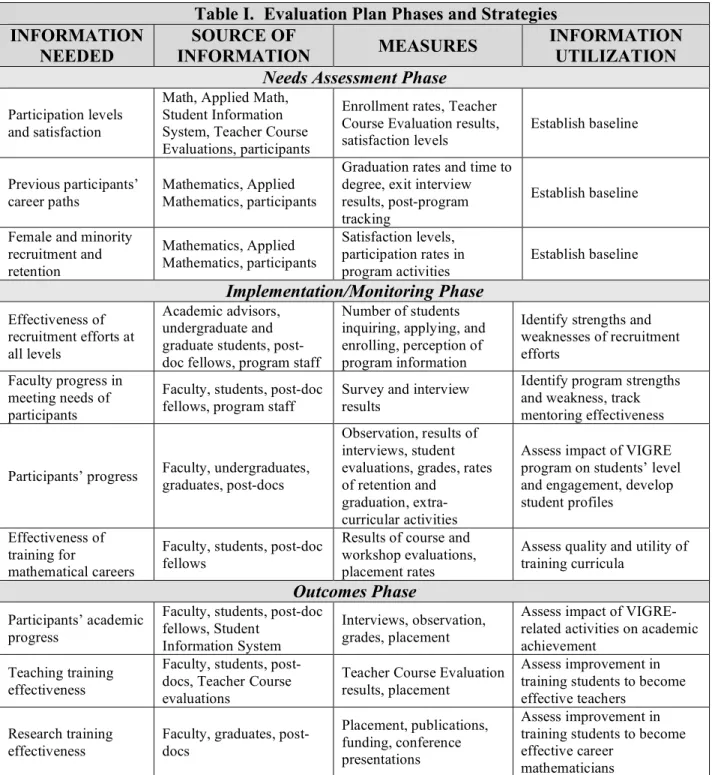
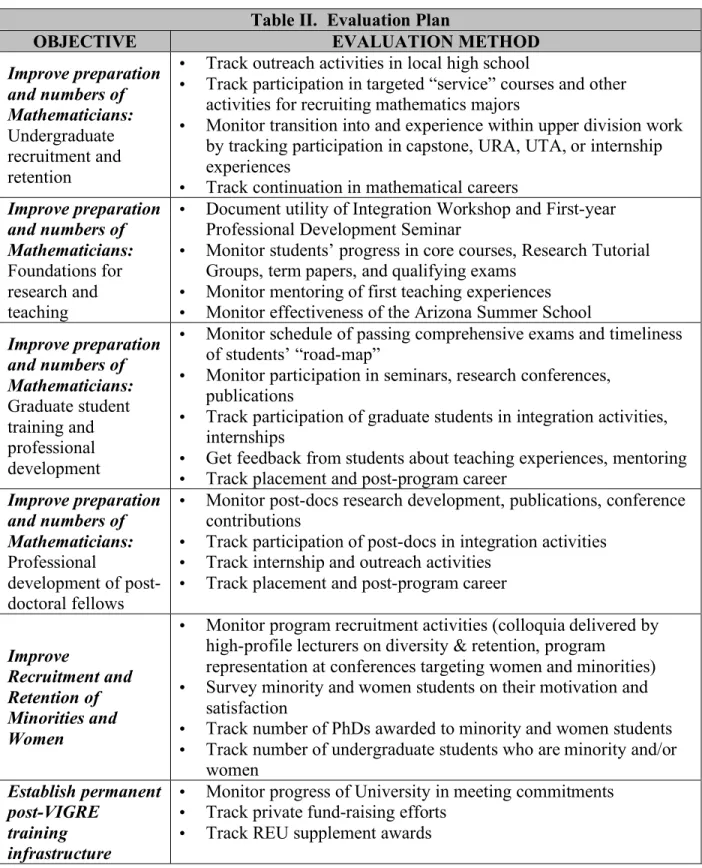
In the following sections we give detailed descriptions of our graduate, undergraduate, post-doctoral, and summer training programs. These programs do not operate in isolation and, as described below, an infras-tructure of vertical and horizontal integration mechanisms, set in a vibrant and collegial academic environ-ment, weave them all together into a cohesive and mutually supportive community of students, researchers, and teachers. The new summer program will be an integral part of this environment: contributing to and reflecting our inclusive culture of research and education in the mathematical sciences. The project activities described below are a combination of new initiatives and the successful components developed under our past VIGRE grant. The latter include the system of competitive proposal writing, the Integration Work-shop, the Skills seminar, first-year term papers and third-semester research projects, and new or revised undergraduate courses. These recent components, and the new programmatic activities, will be subject to careful evaluation and assessment as the project evolves.
4.1
The Graduate Programs
4.1.1 Goals and guiding principles
We describe, in approximately chronological order, the various transition points experienced by our graduate students and the mechanisms for guiding the students through them. The described programmatic design, for both graduate programs, is the result of years of careful experimentation and evaluation based on the following principles:
• Study plans must be designed flexibly to accommodate diversity of educational backgrounds.
• Students should be able to demonstrate their abilities and research potential outside traditional
course-work and examination metrics.
• Verbal and written communications skills must be developed at all stages of students’ graduate careers. • Students need to be exposed to a broad range of authentic research and teaching experiences as early
as possible in both vertically and horizontally integrated settings.
• Professionally broadening experiences, ranging from outreach to internships, are valuable preparation
for careers in the mathematical sciences
Although there are many differences in the curricular requirements of the Mathematics and Applied Mathe-matics programs, the overall goal of giving each student the very best opportunities to maximize his or her potential is the same.
4.1.2 The transition from undergraduate to graduate school
Our goal is to effect a smooth integration of new students into their respective graduate programs, and to begin their preparation for the study of mathematics at the highest level. For both graduate programs the process begins at the Spring Recruitment Workshop (see Section 5.1 for more details) and continues over the summer prior to the first semester. During this period faculty are in communication with the entering classes about the expectations of graduate school, background study and summer reading suggestions, and teams of current graduate students are available to advise students about practical and logistical issues.
In August, just prior to the beginning of classes, the Mathematics Department holds a week-long, “Inte-gration Workshop” to initiate incoming graduate students into the Mathematics program. The goals of this workshop, which was started two years ago and modeled on the long standing Arizona Winter School, are to: (i) prepare students for core classes by reviewing undergraduate material from a graduate point of view; (ii) introduce students to the process by which complex mathematical problems are broken down and tackled by the appropriate mathematical tools; (iii) establish an esprit de corps among the students, and acquaint them with key faculty and current graduate students. The workshop is led by the Associate Head for the Graduate Program of the Mathematics Department assisted by a team of faculty and a selected group senior graduate students for whom it is a valuable professional experience in mentoring and instruction. Design
elements borrowed from the Arizona Winter School, such as a very intense schedule and significant projects presented at the end of the workshop, have transferred well to this context. The integration workshop is followed up with a series of interviews with each participant to design a first-year program of study that will maximize their probability of success in the first year.
In Applied Mathematics the integration transition is accomplished through a semester-long “Professional Skills and Development seminar” in the Fall which takes advantage of the Program’s unique experimental facilities. It currently consists of: (i) carefully designed, laboratory-based, team projects to provide the first taste of training in the scientific methodologies so necessary for applied mathematics; (ii) communication skills training in which each project is presented in a Power-Point-based talk, and as journal-style article prepared in LATEX; (iii) additional activities that include a number of case-study based scientific ethics
discussions relevant to interdisciplinary research. This course is taught by the Head of Applied Mathematics and a highly experienced senior laboratory manager. (More details of our unique laboratory facilities can be found in Section 4.6.1.) Graduate students taking the course are encouraged to consider ways in which their projects could be used to demonstrate the applications of mathematics at the undergraduate and high-school levels, and the experimental modules used in this course will, with appropriate modification, be used in our summer program.
4.1.3 Laying the foundations: core courses and first research and teaching experiences
This all-important foundational phase, which typically covers the first three to four semesters in each graduate program, is critical for both preparing the students for advanced research and teaching, and assessing their ability to complete a PhD. During this phase students in both programs take a rigorous and integrated set of core courses. Subject to a careful analysis of their background, students have the option to complete their core studies in one or two years. As they undertake these studies, students are expected to develop independent and efficient work habits in their coursework. There is careful coordination among the core course instructors, and regular contact between them and the appropriate program head who monitors each student’s overall progress. Senior graduate students play the role of “super-TAs” in the core courses by providing review and problem sessions for the entering class.
During their second semester students in both graduate programs undertake a substantial term paper project connected with one of their core courses. The term paper provides the students with the opportunity for creative exploration of an advanced topic, and provides a first indicator of their ability to function independently. Students are required to submit journal style reports in LATEX of their project, and present
their papers at the end of the semester in term paper mini-conferences. The introduction of term papers into the first-year syllabus was a consequence of a careful assessment of a previous requirement of an independent first-year research project: in many cases the students had insufficient technical background for the project to be an authentic research experience. By tying the term paper to the core courses and the core instructors a much greater uniformity of level, and faculty oversight, has been achieved.
With two semesters of rigorous core courses behind them, the students are equipped to undertake a first, and meaningful, independent research project in their third semester - this is our Research Tutorial Group (RTG) system. Each project, which can be individual or team based, is vetted by the appropriate program head at the beginning of the semester and is presented at the end of the semester at research conferences held by each program. Opportunities for possible projects are presented to students, in both programs, during the course of their first year through a system of evolving (and separately organized) mini-courses, case-study talks by faculty, and “data-blitz” style sessions that enable a larger number of faculty to briefly introduce themselves and their research programs to the students. Both the third semester research project and second semester term paper play a significant role in the assessment of each student’s progress.
Students have their first teaching experiences in either their first or second year. This takes the form of teaching a section of an entry level course (usually college algebra or trigonometry), and students are expected to take full responsibility for their course section. Each TA is under the supervision of an experienced course coordinator, and is required to attend a weekly course meeting. Moreover, all first-time TAs participate in a year-long, one-unit Professional Development Workshop in Teaching Mathematics. These mentoring and support mechanisms enable the students to learn basic teaching skills in a carefully supervised environment.
4.1.4 Qualifying exams, performance assessment, and the transition to advanced course-work
In both graduate programs, students have up to two years and two attempts to pass their qualifying exams at a satisfactory level. Students who complete their core course requirements in their first year usually take their exams during the summer at the end of that year, while students on a two-year core attempt to complete their exam requirements by the end of their second summer. During the summer session prior to the exam, advanced graduate students and post-doctoral fellows run review sessions and support teams to help students in their respective graduate programs prepare for the qualifying exams. For the student mentors this activity can be part of their VIGRE fellowship activities.
While the qualifying exams are a traditional and useful measure of technical expertise, they need to be combined with other metrics to assess a student’s ability to successfully complete a PhD. It is here that their performance in the term paper and, for students on a two-year core or retaking the exam, the third semester research project play a very valuable role. Implementation of this multiple-component assessment process has resulted in more satisfactory students outcomes, and will help minimize attrition in the future.
The consequences of the exam results are essentially the same for students in both graduate programs. Based on the results, students plan their next year of study in careful consultation with their program head. Students with PhD passes have considerable flexibility in selecting advanced course work, while those needing to retake the exams design their programs of study with an eye to the appropriate remedial actions.
In mapping out a comprehensive program of course work, breadth of education is an important component for both graduate programs. Students in the Mathematics program are required to take two courses outside mathematics, and students in the Applied Mathematics program are required to take a balance of courses outside mathematics and advanced mathematics courses.
4.1.5 The intermediate phase: finding a research area, developing an individual teaching style, and the Comprehensive exams
This phase, which typically begins after successful completion of the qualifying exams, marks the beginning of a much more independent effort on the part of the students as they make the transition from being a consumer of knowledge to a producer of (their own) ideas, and an effective teacher. This critical transition has many components: acquiring advanced technical knowledge, in-depth exploration of research opportunities, and developing the ability to strategize and prioritize a research project—all set in a collegial climate in which research is discussed enthusiastically and openly without regard to academic rank. The expected outcome of this phase is the identification of an advisor and likely dissertation topic, and preparation for the comprehensive exam.
An important mechanism for fostering independence and developing a research strategy at this stage is the writing of competitive grant proposals for VIGRE funding. All students seeking VIGRE fellowship support after completing their qualifying exam requirements must write a research proposal describing the specific goals they intend to achieve with the funding in the areas of research, teaching, and outreach; and the proposal must contain at least one vertical integration component. Mentorship is provided by a review process in which the first draft of the proposal is discussed in an interview with the VIGRE management committee—which makes suggestions for changes—leading to a final version of the proposal which must be accompanied by a letter of support from the faculty member most involved with the proposed activities. It should be noted that not all VIGRE proposals are funded—an experience which constitutes an important lesson in the realities of academic life.
The exploration of possible research areas is achieved in a variety of ways including: pursuing outgrowths of the required third-semester research project; arranging independent study projects with faculty mem-bers; taking advanced and special topics courses (for students in the Applied Mathematics Program this often includes substantial cross-disciplinary course work in areas outside mathematics); and attending and participating in working seminars of the many research groups on a regular basis.
An important component of a student’s transition to an independent thinker is the University-mandated comprehensive exam. This stage requires the student to have identified an official advisor, and to have assembled his or her dissertation committee. The essence of the exam is for the student to demonstrate the necessary intellectual maturity to undertake dissertation-level research through convincing written and oral presentations of a research topic, and the ability to respond to intense questioning on and around it. Furthermore, both graduate programs have introduced the additional requirement that students must
present a multi-year “road-map” that describes their plan of study and pursuit of professional development opportunities to be undertaken after the exam. As part of our process of continuous curriculum review we note that both graduate programs are now introducing additional mentoring and monitoring components appropriate to this phase to ensure timely progress in these intermediate years. These are discussed in more detail in Section 3.
In the case of research in applied mathematics additional components are required to achieve greater research maturity: namely exposure to the scientific methodologies associated with the analysis and inter-pretation of data, and the ability to master the fundamentals of other scientific disciplines. The Applied Mathematics Laboratory provides a unique and advanced experience in empirical methodologies through projects involving the synthesis of sophisticated mathematical modeling with non-trivial laboratory exper-imentation and data analysis; while the degree requirement of taking courses in other fields—usually tied directly to their interdisciplinary research goals—significantly broadens the students’ knowledge base.
The teaching goal of this phase is for the students to develop into more confident instructors with a flexible approach to different courses and students with diverse backgrounds, and to develop a competitive portfolio of teaching experiences. VIGRE support provides students with the opportunity for additional instructional experiences including: supervising an undergraduate research project in a vertically integrated team involving faculty and postdocs; being a super-TA in a graduate course; and organizing or participating in outreach projects involving high school and minority students.
4.1.6 The dissertation phase and professional development
Successful completion of the comprehensive exam marks the beginning of the student’s dissertation phase. At this stage the primary mentoring is provided by the student’s advisor, but the process of applying for VIGRE fellowships continues to provide an important mechanism for students and their advisors to assess progress and discuss career options.
The dissertation phase is often an appropriate time for the student to engage in various professional development opportunities, such as participating in a conference or workshop, or undertaking a summer internship to explore career options outside academia. There is already a long-standing tradition among students in the Applied Mathematics Program of undertaking summer internships at Los Alamos National Laboratory, and a growing interest in such opportunities among the Mathematics students. Mac Hyman, a senior figure at Los Alamos and an Adjunct Professor in the Mathematics Department, frequently visits the department and advertises research opportunities at the laboratory. Abbie Warrick and Evi Dube (both graduates of the Mathematics undergraduate program and the Applied Mathematics graduate program) from Lawrence Livermore, and Cheryl Beaver (a graduate of the Mathematics graduate Program) currently at Sandia, visit regularly to give talks to our graduate students about opportunities at their respective laboratories.
Attending workshops and conferences, and presenting research results at professional society meetings, is an important part of a graduate student’s professional development. Students in both programs regularly participate in national and international meetings, and VIGRE funds are a valuable source of support to help them do this. We also encourage participation in programs sponsored by the various NSF national institutes in the mathematical sciences and, in particular, participation by local graduate students in the Arizona Winter School, a premier program for graduate students working in number theory and algebraic geometry near completion of their dissertations. Over the last five years the Applied Mathematics Program has organized an annual biomathematics workshop at which local students interested in this field participate. One of the pleasures of academic life is to see graduate students blossom into enthusiastic and creative researchers and teachers with ideas and opinions of their own making, able to engage and challenge faculty and visitors in scientific and professional discussions, and able to inspire and mentor the younger students. These are the young men and women that our collegial academic environment aims to produce.
4.2
Undergraduate Program
4.2.1 Goals and guiding principles
Our undergraduate program also involves several phases and critical transition points supported by the ap-propriate mentoring mechanisms. The overall design of the undergraduate program and associated mentoring
structures is guided by the following principles:
• Recruitment into the major can begin as early as high school and continues through the Mathematics
Department’s “service” courses such as calculus, linear algebra, and differential equations.
• Particular attention is paid to the recruitment and needs of women and under-represented groups. • The mathematics major opens the doors to many professions, as well as graduate study, and should
provide options that prepare students for a variety of career trajectories.
• A well-designed undergraduate mathematics major should include research, teaching, and internship
experiences.
Graduate students and postdocs, as part of their VIGRE integration activities, will often be key players in the teams that help undergraduates pass critical transition points. They are often less intimidating than faculty and can help build an excellent mentoring environment for undergraduates.
4.2.2 The Math Center
Most of our efforts in outreach to undergraduates are coordinated by the Department’s Math Center which is led by Associate Head for Undergraduate Affairs, William Velez. The Math Center is the hub of activities for undergraduate mathematics majors with responsibility for coordinating recruitment, outreach, retention, and advising. Additionally, Velez continues our serious efforts to increase the diversity of the undergraduate program; and he also serves as industrial liaison for the Department with the goal of increasing the number of students applying for summer internships with industry and national laboratories.
The Department’s commitment to the undergraduate mathematics program is demonstrated by its sig-nificant allocation of space and personnel to the Math Center: it now has a full time academic professional and a full time Administrative Assistant to coordinate the growing number of activities that have resulted from the increasing number of undergraduate mathematics majors and minors.
4.2.3 The transition from high school to university
Many high school students are unaware of the benefits of studying advanced mathematics, or of the career opportunities available to math majors. During our first VIGRE grant we started a program of sending three-person teams (faculty, graduate student, and undergraduate) to visit calculus classes in local high schools, with the goal of encouraging these students to enroll in more mathematics classes when they attend the university and to think about becoming mathematics majors. In parallel with this we now have a program in which graduate students organize and present after-school workshops for high school students. This activity is entirely organized by the graduate students, who contact local high schools and set up two-to four-hour long workshops. Several workshops are held each semester on a variety of mathematical two-topics. Both the high-school visits and outreach workshops will continue under the new VIGRE program.
It is well recognized that incoming undergraduates frequently have a difficult time making the transition to the university setting, especially when the first semester consists of courses in calculus, science, and computer science. Students often do not understand the change of pace that is about to occur in their university classes, and we have developed a variety of mechanisms (such as reading assignments and exercises) to help ready them for their first calculus course on campus. This approach builds on an advising program for minority calculus students run for many years by Associate Head Velez.
Further efforts to help minority students make the transition from high school will be aided by CEMELA (the Center for Mathematics Education of Latinos/as), a newly established, NSF-funded Center for Learning and Teaching (see Section 4.6.6 for more details).
4.2.4 Lower division course work
Once future mathematics majors arrive on campus they take a rigorous program of courses in calculus, dif-ferential equations, and linear algebra. We use enrollments in calculus classes as a mechanism for identifying potential mathematics majors. Furthermore, many of the minority students enrolled in calculus are inter-viewed and encouraged to take more advanced classes, and to consider becoming mathematics majors. The
result of these efforts has been that over the last three years the University of Arizona has had on average over 300 mathematics majors and currently 60 of these are minorities.
Building on this success, the teaching staff for the lower division courses, with the support of the Math Center, are participating more fully in recruiting students into the mathematics major. Towards this end the Department has developed a new protocol involving letters and emails to instructors and potential majors that is proving to be effective in encouraging students to become mathematics majors.
A successful VIGRE-related program that impacts on lower division course work is our Undergraduate Teaching Assistant (UTA) program, described more fully below. In this program, advanced undergraduates serve as teaching assistants in lower division math courses.
4.2.5 The transition to upper division work
During the first semester of the junior year students typically take Math 323, Formal Mathematical Reasoning and Writing, in which they learn how to master logical reasoning and to construct a proof. While our best students often bypass this course and move to upper division coursework directly, it is immensely challenging for our typical students, and is probably the single most important transition point for a successful mathematics major. We have two initiatives to improve the success rate in this course. First, beginning in Spring 2004, we assigned a special graduate student teaching assistant (a “super-TA”) to each section of this course, in order to give students an additional resource to learn the material. Second, we have initiated a dialog between the instructors, the super-TA, and the Associate Head for Undergraduate Affairs around recent research in math education relevant to this course. Specifically, recently published research on students’ understanding of the concept of mathematical definition (see [EW04]) has implications for classroom practice. It is currently rare for research in math education to motivate changes in classroom practice (as opposed to the other way around) and we hope to see this integration of education research and education spread to other courses. It is worth noting that the topic of learning at the critical transition to upper-level course work has been the topic of two recent dissertations by students in our Math Education Program ([Smi02] and [Jim04]).
4.2.6 Upper division course work
Once they have mastered the foundational lower-division material, math majors at Arizona have an ex-ceptionally rich choice of further topics to study. Our undergraduate program currently has six tracks (Comprehensive; Applied; Probability and Statistics; Computer Science; Economics and Finance; and Ed-ucation) with another (Biomathematics) under development. We have also recently introduced several new upper division courses, including Mathematics of Finance, an Undergraduate Research Seminar, Harmonic Analysis, and Cryptography.
We continue to add capstone courses to our major. One example is the redesigned Mathematical Modeling course, which received financial support from the University for upgrading classroom technology. The new version of this course, which first ran in the Spring of 2005, involves VIGRE-supported graduate students who begin the course by giving presentations describing various modeling projects (which could include an Applied Mathematics Laboratory component), and then help mentor the undergraduates as they work on their chosen projects during the semester. The course emphasizes communication skills: students have significant writing assignments, and prepare posters about their projects. The teams that put together the best posters are sent to the undergraduate poster session of the next Joint Mathematics Meeting, and also present their work in the undergraduate research seminar described below. Further topics for the modeling course will be developed by teams of VIGRE-supported undergraduates and graduate students during the summer program described in Section 4.4. Other candidates for capstone courses include Cryptography and Synthesis of Mathematical Concepts, a course for future high school teachers which investigates high school mathematics from an advanced perspective.
4.2.7 Enrichment opportunities and the transition to professional careers in mathematics
In this all-important phase, students learn to consolidate what they have learned as undergraduates and put together various concepts in order to solve a problem, work on a research project, or present sophisticated mathematics in preparation for future careers as mathematical professionals. To support this transition, the
Department has for many years offered Undergraduate Teaching Assistantships and Undergraduate Research Assistantships, and the Math Center and faculty advisors also help students apply for summer internships. Participation in some or all of these activities gives a student a very well-rounded undergraduate experience involving the creation, application, and communication of mathematics.
Undergraduate research program. For undergraduates, the experience of trying to solve large, often poorly formulated problems is of tremendous value, and they have repeatedly told us how much difference this makes in their appreciation of mathematics. Furthermore, graduate students involved in mentoring undergraduate research projects gain valuable experience in communicating mathematical concepts and developing research strategies. And faculty also benefit—the enthusiasm of young students, and the “outside the box” questions that they often raise, re-invigorate our own investigations.
Undergraduate research opportunities are presented in our Undergraduate Research Seminar offered in the Spring semester. It is modeled on the expository phase of the graduate Research Tutorial Groups, in which faculty give a three- or four-week overview of selected topics. These faculty are then available to supervise research projects in the following semester. These projects can include both students supported by VIGRE and those supported by departmental funds (available for non-U.S. students).
The continued vitality of this activity is important for our undergraduate program and we are seeking ways to permanently fund it with other resources. As an additional mechanism in the transition to post-VIGRE funding, we plan to involve research groups in the generation of URA funding by encouraging (senior) faculty members in the group to apply for funding for undergraduate research in their research proposals. These modes of funding will be phased in over five years while the URA component of our VIGRE budget is phased out—with the goal of maintaining a steady state of funded undergraduate research activities.
Another new initiative related to undergraduate research is the Arizona Mathematics Undergraduate Conference (AMUC), started in 2004, at which students present their research and interact with other mathematics majors from around the state. AMUC is a yearly event which rotates among the three state universities of Arizona. The Conference also serves as a valuable recruiting tool for both of our graduate programs since it provides a venue for our faculty to identify and interact with some of the brightest students in the region. Participating students from the University of Arizona will be supported by the undergraduate travel budget of our VIGRE grant.
Undergraduate teaching assistants. Each semester the Department supports ten Undergraduate Teach-ing Assistants (UTAs) in a program managed by a teachTeach-ing post-doc (see Section 4.6.10 for a brief description of this program). Each UTA works ten hours per week. Four hours are devoted to tutoring in the Depart-ment’s tutoring program. Five hours are spent working with an assigned course instructor on a range of activities: some UTAs run extra problem sessions for the course; others help the instructors with special projects (e.g. developing software to help explain a topic in the course); and others may give a lecture, or part of a lecture, in the course that they have been assigned to. The work-load is completed with a weekly, one-hour, session run by the teaching post-doc for all the UTAs to discuss common concerns and the activities that they are involved in.
To our knowledge, there are no federal sources of funding for activities such as the UTA program. Therefore, as part of our post-VIGRE plan, we have begun the process of shifting funding for the UTA program from VIGRE to an endowed scholarship fund. We have established the Lusk scholarship (funded by a private donor) which is currently sufficient to fund a small number of UTAs and we hope to expand this over the next five years in order to fully fund ten UTAs per semester. Simultaneously, the UTA component of our VIGRE budget will be phased out over the lifetime of the grant.
Internships. Summer internships can be seen as huge reward for those students who are willing to work diligently on their studies. Internship leads have been developed by Associate Head Velez (acting as industrial liaison on our first VIGRE grant) and by Professor Juan Restrepo, through the internship program (AIMES) he originally developed at UCLA.
These internships are very competitive and handling the challenges of applying is an important step in a young student’s professional development; guidance is provided by the Associate Head and Math Center staff.