1 | P a g e
COAG CONSULTATION
REGULATION IMPACT STATEMENT
2 | P a g e
Contents
ABBREVIATIONS ... 6
PURPOSE OF THIS COAG CONSULTATION REGULATION IMPACT STATEMENT (RIS) ... 7
INTRODUCTION ... 7
BACKGROUND TO THE DISABILITY SECTOR ... 8
Size and scope ... 8
Disability prevalence... 8
Aboriginal and Torres Strait Islander people ... 9
Disability Services in Australia ... 9
Profile of disability providers ... 9
Disability users by States and Territories ... 11
Disability support services workforce ... 12
Role of governments ... 14
National Disability Agreement... 14
Funding ... 15
Funding arrangements by State and Territories ... 16
Safeguards and quality assurance frameworks by States and Territories ... 20
Productivity Commission Report... 25
Problems identified in the PC’s report ... 26
State and Territory variations ... 28
The PC’s vision for the provision of disability support in Australia ... 30
How the NDIS would operate under the PC’s vision ... 31
Governments consideration of PC report to date ... 33
STATEMENT OF THE PROBLEM ... 35
The case for government intervention in a market for disability support ... 36
POLICY OBJECTIVES ... 38
STATEMENT OF THE OPTIONS ... 39
Option 1 – Choice limited to government funded providers ... 41
Option 2 – Choice from providers that meet regulatory standards. ... 42
Option 3 – Choice limited only in higher risk circumstances ... 44
3 | P a g e
IMPACT ANALYSIS (COSTS AND BENEFITS) ... 48
Option 1 - Impacts ... 48
The Market ... 48
Participants - people with disability ... 48
Carers and families of people with disability ... 49
Providers ... 50
State and Territory governments ... 50
Australian Government ... 51 Community ... 51 Distributional impacts ... 51 Summary ... 51 Option 2 - Impacts ... 52 The market ... 52
Participants - people with disability ... 53
Carers and families of people with disability ... 54
Providers ... 55
State and Territory governments ... 60
Commonwealth Government ... 60 Community ... 61 Distributional impacts ... 61 Summary ... 61 Option 3 – Impacts ... 62 The market ... 62
Participants - people with disability ... 63
Carers and families of people with disability ... 64
Providers ... 64
Distributional impacts ... 65
Summary ... 65
Option 4 – Impacts ... 66
The market ... 66
Participants - people with disability ... 66
4 | P a g e
Providers ... 67
State and Territory governments ... 67
Commonwealth Government ... 67
Community ... 68
Summary ... 68
Summary of costs and benefits relative to the status quo ... 69
CONSULTATION ... 71
Consultations to date ... 71
NDIS Engagement ... 71
NDIS Advisory Group ... 71
Expert Groups ... 71
Online engagement ... 72
National Disability and Carer Alliance ... 72
Engagement on the key design aspects of eligibility and reasonable and necessary support ... 73
Opportunity for further comment ... 73
EVALUATION AND CONCLUSION ... 74
IMPLEMENTATION AND REVIEW ... 76
NDIS Implementation ... 76
Implementation plans for each launch site ... 76
The NDIS at the five launch sites ... 77
Participants and the NDIS ... 77
Providers of disability supports and the NDIS ... 81
Further work ... 83
Implementation planning for launch sites ... 83
Review of the NDIS launch sites ... 84
Attachment A - Legislation Outline - National Disability Insurance Scheme... 85
The National Disability Insurance Scheme Bill ... 86
Chapter 1 – Introduction ... 86
Chapter 2 – Assistance for people with disability and others ... 87
Chapter 3 – Participants and their plans ... 87
5 | P a g e
Chapter 5 - Compensation ... 96
Chapter 6 - NDIS Launch Transition Agency ... 97
Chapter 7 – Other Matters ... 102
6 | P a g e
ABBREVIATIONS
ABI Acquired Brain Injury
ABS Australian Bureau of Statistics ACT Australian Capital Territory
AFDO Australian Federation of Disability Organisations AIHW Australian Institute of Health and Welfare
ASD Autism Spectrum Disorder
CAC Act Commonwealth Authorities and Companies Act CEO Chief Executive Officer
COAG Council of Australian Governments
CSDA Commonwealth/State Disability Agreement DAAWS Disabled Australian Apprentice Wage Support DCSI Department of Communities and Social Inclusion DES Disability Employment Service
DS NMDS Disability Services National Minimum Data Set
FTE Full time equivalent
GDP Gross Domestic Product
GP General Practitioner
HACC Home and Community Care
ICT Information and communications technology ISP Individual Support Package
LACs Local Area Coordinators
MS Multiple Sclerosis
NATSISS National Aboriginal and Torres Strait Islander Social Survey NDA National Disability Agreement
NDCA National Disability Carers Alliance NDIA National Disability Insurance Agency NDIS National Disability Insurance Scheme
NGO Non-Government Organisation
NIIS National Injury Insurance Scheme
NSW New South Wales
NT Northern Territory
PC Productivity Commission
QA Quality Assurance
QLD Queensland
RIS Regulation Impact Statement RTO Registered Training Organisation
SA South Australia
SCRGSP Steering Committee for the Review of Government Service Provision
TAS Tasmania
TOR Terms of Reference
TTY Teletypewriter – a special type of phone
VIC Victoria
7 | P a g e
PURPOSE OF THIS COAG CONSULTATION
REGULATION IMPACT STATEMENT (RIS)
The National Disability Insurance Scheme (NDIS) will be implemented in five launch sites in 2013 as a ‘first stage, noting this will inform the move to a national insurance-based
approach to disability care and support’. ‘All governments also agreed that the funding and governance arrangements agreed for launch do not create a precedent for the full scheme.’ (COAG Communiqué, 25 July 2012)
Early in 2013 Council of Australian Governments (COAG) will consider for agreement the design details of the NDIS that will be implemented at the five launch sites in July 2013. The purpose of this COAG Consultation Regulation Impact Statement (RIS) is to elicit feedback on the options and impacts, including costs and benefits, of the proposed approaches to the design of the NDIS. The COAG Decision RIS will follow this COAG Consultation RIS. The Decision RIS will factor in your comments and other information provided. It will include the best conceptual approach and analysis of the design details that will underpin the NDIS.
The NDIS launch sites will be subjected to intensive scrutiny and evaluation. Information of the outcomes achieved, what works well and what requires
modification will be provided to COAG for its consideration of any further roll out of the NDIS.
INTRODUCTION
COAG RISs are required when agreements or decision to be given effect through principal and delegated legislation, administrative directions or other measures (at the
Commonwealth or State/Territory level or both) encourage or force businesses or
individuals to pursue their interests in ways that would not otherwise have done. A RIS is not required for agreements or decisions that results in regulation that has minor regulatory or machinery impact on the business and not-for-profit sector in the first instance. A RIS is not required for the establishment of an NDIS administering agency since that is ‘machinery of government’.
The NDIS changes have two categories of impact that will affect the disability service provider sector, both commercial and not-for-profit, therefore warranting a RIS:
1. Market impact – the change from ‘block funding’ to Individual Support Packages (ISPs) will mean that existing providers will need to modify the way they do business. This will happen progressively from July 2013 (depending on the transition arrangements still to be determined).
8 | P a g e 2. Regulatory impact - regulatory changes (for example, Quality Assurance (QA) and other
safeguards, reporting requirements, registration requirements for payment, etc). In addition to potentially adding costs and/or modifying the way the existing providers do business, the level of regulation will impact on the degree of competition with
commensurate flow-on consequences for consumers. Again regulation changes will happen progressively from July 2013.
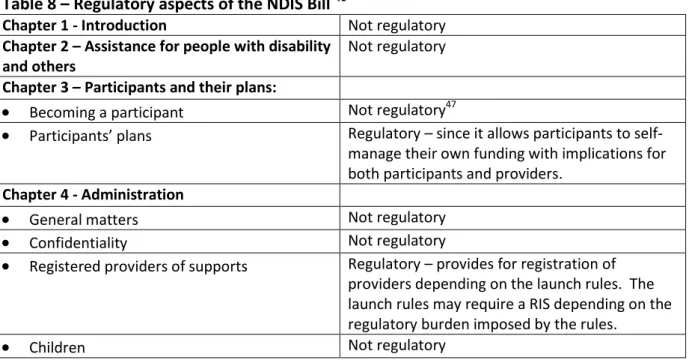
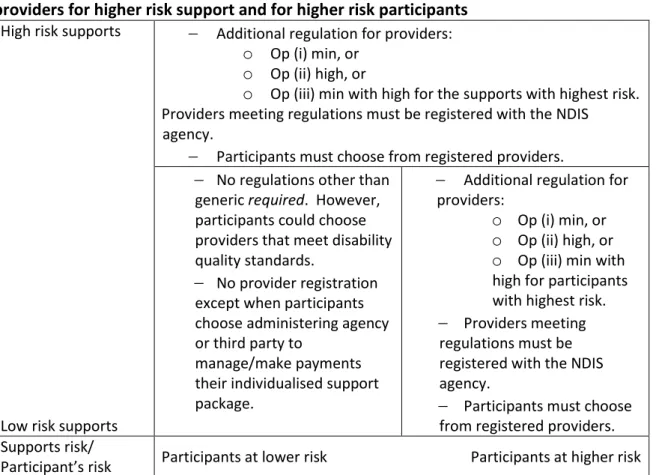
This Consultation RIS is designed to capture further data, encourage further discussions and impacts to determine the optimal balance of regulation (where the benefits are maximised). To do this, the RIS outlines two market based mechanisms (Option 1 - largely status quo with disability supports obtained from block funded providers, compared with Options 2, 3 and 4 where providers would rely on the patronage of consumers since supports would be obtained by consumers through funded ISPs), with regulations ranging from Option 1, a greater degree of regulation specific to disability with less choice for participants
(consumers of the NDIS), to Option 4, no specific regulations beyond generic protections provided to all consumers with maximum choice for participants.
Each option, therefore, involves a trade-off: greater regulatory involvement will mitigate risks to a higher degree but will commensurately limit choice and control for participants. For the NDIS, this discussion and analysis is complicated since each jurisdiction is already some way through introducing a ‘market’ for disability supports although each is different, and each jurisdiction has different levels of regulation.
If the NDIS as described in the Decision RIS - and implemented in the launch sites – changes in any significant way, further RISs will be required to enable discussion and analysis. Further RISs may or may not be as significant as the current over-arching RIS process (Consultation and Decision), depending on the nature and scope of the changes proposed.
BACKGROUND TO THE DISABILITY SECTOR
Size and scope
Disability prevalence
Estimates of the number of people with disability vary. A number of sources have been used in this RIS to describe various aspects of the nature of disability. These include ABS data, Productivity Commission (PC) and PricewaterhouseCoopers (PwC) research as well as the Australian Institute of Health and Welfare (AIHW).
Further information and data will be sought during the consultation process, especially from large service providers and regulators, in order to provide a more
9 | P a g e accurate picture of the number of people with disability. This will assist in better assessment of the impacts of the various options considered in this RIS.
The ABS estimates that 1 in 5 people in the Australian population (4,026,213) had one or more disabilities (that is, a core activity limitation, a schooling or employment restriction or an impairment) in 2009 (ABS 2011), compared with 3,958,300 in 2003 (ABS 2004). Of the population aged 5–64 years in 2009 (ABS 2011), an estimated 16.0 per cent had a core activity limitation or specific restriction compared with 13.0 per cent in 2003 (ABS 2004). This proportion comprised 5.8 per cent who had a profound or severe core activity
limitation, 8.6 per cent who had a mild to moderate core activity limitation and 1.6 per cent who had a schooling or employment restriction only (ABS 2011).
Based on the ABS statistics1 – of all people aged less than 65 years: approximately 2.6 million people have a permanent disability;
approximately 992,000 people have permanent disability and need assistance with mobility, self-care, communication and/or cognition;
an estimated 583,000 people have a need for support of the type that would be provided by the NDIS either with or without a funded package; and
it is estimated that about 410,000 people with permanent disability and severe functional limitation would require support through an individually funded package.
Aboriginal and Torres Strait Islander people
Indigenous people have significantly higher rates of profound or severe core activity limitation than non-Indigenous people. Disability data on ‘core activity need for assistance’ are available from the ABS 2008 National Aboriginal and Torres Strait Islander Social Survey (NATSISS).
Nationally, 10.3 per cent of Indigenous people aged 18 years and over reported a profound or severe core activity restriction in 2008, around twice the rate for non-Indigenous people (4.7 per cent) (ABS 2009). The disparity between Indigenous and non-Indigenous people is consistent across age groups. This is in part due to a range of risk factors such as poverty, discrimination, lower rates of education and higher rates of risky behaviours such as smoking, substance abuse and poor nutrition.2
Disability Services in Australia
Profile of disability providers
Historically, providers of support services to people with disability were often founded as charities or self-help groups of parents, families and friends of people with disability that became reliant on the support of government funding and community philanthropy.
1
Population estimates based on 2009 ABS Survey of Disability, Ageing and Caring.
2 Centre of Aboriginal Economic Policy Research and the Australian Institute of Health and Welfare, Indigenous Australian and the National Disability Insurance Scheme: The extent and nature of disability, measurement issues and service delivery models, October 2012, pages 8-10.
10 | P a g e Today, the Australian disability service provider market is dominated by not-for-profit organisations. Their primary objective is to support improvement in the lives of people with a disability, rather than commercial objectives.3 Government providers also play a
significant role.
The majority of providers rely on ‘block funding’ payments from State/Territory
governments as their major source of income to continue their day to day operations. As such government, as the main purchaser, determines the products, quantity and price of services provided to people with a disability, and government regulation provides for safety and quality standards. Services are provided according to the amount of block funding provided instead of the actual price of support for an individual. Reporting to government has focused on services and outputs with a limited focus on the outcomes achieved. In addition to block funding, the sector has relied on ‘charitable’ structures and contributions from the Australian public.4
In 2010-11 there were 2,283 disability support service agencies funded by State/Territory or Australian governments throughout Australia, managing 13,883 service type outlets.5 The majority of service providers (82 per cent) were in the non-government sector and the majority of these (86 per cent) were income tax exempt charities. Together they provide services ranging from6:
Accommodation support – large residential institutions (more than 20 people) offering 24 hour care , hostels, group homes, attendant/personal care, in-home accommodation support, alternative family placements, and other accommodation support;
Community support – therapy for individuals, early childhood intervention, behaviour intervention, counselling, regional support and support teams, case management and coordination, other community support;
Community access – learning and life skills development, recreation/holiday programs;
Respite– in own home, centre-based, host family respite, and other flexible arrangements;
Employment – open employment, supported employment or a combination of both; Advocacy, information/referral services, as well as mutual support or self-help
groups, and alternative formats of communication; and
3 PricewaterhouseCoopers draft Final Report: Planning for a sustainable disability sector, pages 14, for the Department of Families, and Housing, Community Services and Indigenous Affairs.
4 PricewaterhouseCoopers draft Final Report: Planning for a sustainable disability sector, page 14, for the Department of Families, and Housing, Community Services and Indigenous Affairs.
5
Australian Institute of Health and Welfare, Disability support services, services provided under the National Disability Agreement 2010-11, pages 3- 4.
6
Australian Institute of Health and Welfare, Disability support services, services provided under the National Disability Agreement 2010-11, pages 4, 52-57.
11 | P a g e Other support services provided by the sector include research and evaluation,
training and development, peak bodies and other support services (such as one-off funding for promotional activities or buying aids and equipment).
Mainstream services7 are services provided to the community as a whole. Mainstream services complement specialist disability services. Under the National Disability Strategy all Australian governments have agreed to ‘strive’ to ensure that all people with disability have access to mainstream government services within their jurisdictions. Some mainstream services give priority to people with disability (for example, public housing) or have programs to meet the special needs of people with disability (for example, school education).
Statistics on the profile of the totality of service providers around Australia are scarce. A nationwide survey of disability service providers undertaken by PricewaterhouseCoopers in mid-2012 shows that overall a large number of providers support a small number of clients. Approximately 280 providers support around 1,500 clients while the four largest providers service around 95,000 clients. In addition, the next 56 largest providers support around 66,000 clients. Overall, a large number of providers receive a small amount of funding but the majority of funding is taken up by a few of the largest providers. About 295 service providers receive less than $200,000 in disability funding or $25 million of total disability funding. In contrast, the largest 18 providers receive over $1 billion of total disability funding while the next 34 largest receive about $0.5 billion.8
The survey showed that about 80 per cent of those surveyed relied on government funding for 60 per cent or more of their income, with other income being fees charged for services, income from commercial revenue, income from fundraising, and investment and other income.9
Disability users by States and Territories
The Australian Institute of Health and Welfare estimates that in 2010-11 there were 314,252 users of disability services.
7
Productivity Commission, Report of Government Services 2012, Chapter 14 Services for people with disability, page 14.6. 8
PricewaterhouseCoopers draft Final Report: Planning for a sustainable disability sector, pages 30-31, for the Department of Families, and Housing, Community Services and Indigenous Affairs.
9
PricewaterhouseCoopers draft Final Report: Planning for a sustainable disability sector, page 15, for the Department of Families, and Housing, Community Services and Indigenous Affairs.
12 | P a g e Table 1: Users of disability support services provided under the National Disability
Agreement 2010-11, service group by State and Territory, 2010-1110
Service Group NSW VIC Qld WA SA TAS ACT NT Total Accommodation Support 9,487 15,486 6,899 3,308 5,468 1,280 454 211 42,579 Community Support 35,479 48,219 16,653 13,385 16,727 4,527 3,733 1,956 140,156 Community Access 14,490 23,052 9,334 4,630 6,719 1,579 486 255 60,509 Respite 9,499 15,676 5,191 3,315 1,735 461 341 97 36,266 Total State/Territory services 50,993 77,657 25,012 16,577 21,822 6,356 4,213 2,378 204,226 % of total: Total State/Territory services 25.0% 38.0% 12.2% 8.1% 10.7% 3.1% 2.1% 1.2% 100% Employment 42,266 32,213 26,175 10,631 11,914 3,139 1,578 596 128,321 Total Number 88,822 105,309 48,478 24,344 31,052 9,100 5,523 2,908 314,252 % of total: Total No. 28.3% 33.5% 15.4% 7.7% 9.9% 2.9% 1.8% 0.9% 100%
Note: (i) Totals may not sum the components since individuals may have accessed more than one service group and/or in more than one jurisdiction.
(ii) the mix of services is different within categories across jurisdictions. For example, in Victoria, the Accommodation Support figure includes a wide range of quite different accommodation types – large residential/institution, hostels, group homes, attendant care/personal care, in-home accommodation support, alternative family placement, other
accommodation support. Data for Vic, Qld and WA includes Psychiatric Disability Rehabilitation and Support Services activity which is not included in other jurisdictions.
Disability support services workforce
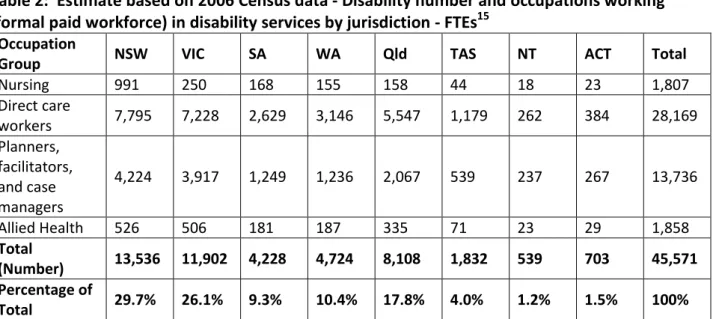
The disability services workforce includes a wide range of people who are either in the formal paid workforce, formal unpaid workforce (voluntary workforce), or informal care workers (families and friends. The formal paid workforce can be split into the following categories: support workers/social workers; community and mental health nurses; allied health professionals/therapists; planners, case managers and coordinators, social work and counselling staff; and management and administrative staff. The disability workforce is characterised by a high proportion of casual and part-time staff, and high staff turnover.11 In 2006, it is estimated that around 62,000 employees (about 11,000 government
employees and 51,000 non-government employees) or about 46,000 full time equivalent (FTE) staff worked in the disability sector with females making up about 78 per cent of the workforce (Table 2)12. About 20 per cent of the workforce worked up to 15 hours a week, 36 per cent worked 16 to 34 hours a week, 32 per cent 35 to 44 hours a week, and 10 per cent
10 Taken and derived from Table 2.5, Australian Institute of Health and Welfare, Disability support services, services provided under the National Disability Agreement 2010-11, page 7.
11
PricewaterhouseCoopers draft Final Report: Planning for a sustainable disability workforce, page 14, for the Department of Families, and Housing, Community Services and Indigenous Affairs.
12
PricewaterhouseCoopers draft Final Report: Planning for a sustainable disability workforce, pages 17-21 and 27, for the Department of Families, and Housing, Community Services and Indigenous Affairs.
13 | P a g e 45 hours or more. About 49 per cent were aged 45 to 64 years.13 It is estimated that nearly 70 per cent are support workers and case managers, 20 per cent are management and administration and 10 per cent are professionals (mainly nurses, allied health).14
Table 2: Estimate based on 2006 Census data - Disability number and occupations working (formal paid workforce) in disability services by jurisdiction - FTEs15
Occupation
Group NSW VIC SA WA Qld TAS NT ACT Total
Nursing 991 250 168 155 158 44 18 23 1,807 Direct care workers 7,795 7,228 2,629 3,146 5,547 1,179 262 384 28,169 Planners, facilitators, and case managers 4,224 3,917 1,249 1,236 2,067 539 237 267 13,736 Allied Health 526 506 181 187 335 71 23 29 1,858 Total (Number) 13,536 11,902 4,228 4,724 8,108 1,832 539 703 45,571 Percentage of Total 29.7% 26.1% 9.3% 10.4% 17.8% 4.0% 1.2% 1.5% 100%
Source: PWC. NB: Excluding managerial and administrative staff.
In 2009, non-professional workers made up about 76 per cent (62 per cent of FTE staff) of disability workers (personal carers, home care workers, community care workers, and disability and residential support workers), nine per cent (12 per cent of FTE staff) were professional service providers (allied health, social workers and disability care managers), and 14 per cent (25 per cent FTE staff) were service managers, coordinators or
administrators. Most of the non-professional disability workforce (79 per cent) had some form of post school qualification, typically Certificates III or IV or Diploma. About 75 per cent were either permanent full-time or permanent part-time.16
In 2006, there were about 155,000 voluntary workers (8,750 FTE) that provided a total of 15.7 million hours of assistance in the disability sector.17 This is currently estimated at between 3,000 and 8,000 FTE staff.18
People with disabilities also use informal carers (family, friends and work colleagues) as primary care providers. In 2009, it is estimated there were 746,344 primary care givers of which 44 per cent worked less than 20 hours a week and 35 per cent worked 40 hours or
13
PricewaterhouseCoopers draft Final Report: Planning for a sustainable disability workforce, page 19, for the Department of Families, and Housing, Community Services and Indigenous Affairs.
14 PricewaterhouseCoopers draft Final Report: Planning for a sustainable disability workforce, page 1, for the Department of Families, and Housing, Community Services and Indigenous Affairs
15 PricewaterhouseCoopers draft Final Report: Planning for a sustainable disability workforce, Table 6, page 19, for the Department of Families, and Housing, Community Services and Indigenous Affairs; Percentage lines: derived.
16
PricewaterhouseCoopers draft Final Report: Planning for a sustainable disability workforce, pages 22-24, for the Department of Families, and Housing, Community Services and Indigenous Affairs. From a National Institute of Labour Studies project to gather information from a representative sample of surveys of community service ‘outlets’ in four sectors including disability and of workers in each sector, 2009. 17
PricewaterhouseCoopers draft Final Report: Planning for a sustainable disability workforce, page 33, for the Department of Families, and Housing, Community Services and Indigenous Affairs.
18
PricewaterhouseCoopers draft Final Report: Planning for a sustainable disability workforce, page 1, for the Department of Families, and Housing, Community Services and Indigenous Affairs
14 | P a g e more a week. A further 1,799,084 were non-primary carers. About 60 to 70 per cent of the estimated informal carer workforce were caring for people with a disability aged under 65 years.19 The number of informal carers is currently estimated at between 400,000 and 500,000 FTE people.20
Role of governments
In Australia, disability services for personal care and support are currently the responsibility of State and Territory governments. State/Territory governments are responsible for assessing the needs of people with disability, and funding and coordinating the services provided to them.
The Commonwealth Government provides income support (Disability Support Pension) and disability-specific payments such as the Mobility Allowance, Carer Allowance, Carer
Supplement and Child Disability Assistance Payment. It also provides funds for support for employment services and has a role in mental health and other programs such as autism.
National Disability Agreement
The National Disability Agreement (NDA) defines the roles and responsibilities of the Australian, State and Territory governments in the provision of services and supports to people with disability and their carers.21
The Commonwealth Government is responsible for:
provision of employment services for people with disability (which includes regulation, service quality and assurance, assessment, policy development service planning, and workforce and sector development) in a manner that most effectively meets the needs of people with disability consistent with local needs and priorities;
provision of income support targeted to the needs of people with disability, their families and carers;
provision of funds to States and Territories to contribute to the achievement of the NDA objective and outcomes;
where appropriate, investing in initiatives to support nationally agreed policy priorities, in consultation with State and Territory governments;
ensuring that Commonwealth legislation and regulations are aligned with the
national policy reform directions and the United Nations Convention on the Rights of Persons with Disabilities.
19 PricewaterhouseCoopers draft Final Report: Planning for a sustainable disability workforce, page 1, for the Department of Families, and Housing, Community Services and Indigenous Affairs.
20
PricewaterhouseCoopers draft Final Report: Planning for a sustainable disability workforce, page 1, for the Department of Families, and Housing, Community Services and Indigenous Affairs.
21
Unless otherwise identified, taken from the Report of Government Services 2012, Chapter 14 Services for people with disability, pages 14.8-14.11.
15 | P a g e State and Territory governments are responsible for:
the provision of specialist disability services, except disability employment services (which includes regulation, service quality and assurance, assessment, policy
development, service planning, and workforce and sector development) in a manner which most effectively meets the needs of people with disability, their families and carers, consistent with local needs and priorities;
ensuring that State and Territory legislation and regulations are aligned with the national policy and reform directions; and
where appropriate, investing in initiatives to support nationally agreed policy priorities, in consultation with the Commonwealth Government.
Commonwealth, State and Territory governments are jointly responsible for:
development of national policy and reform directions to meet the agreed objectives and outcomes of the NDA;
funding and pursuing research that provides an evidence base for national policy and reform directions;
developing and implementing reforms to improve outcomes for Indigenous people with disability; and
the provision of data, including a commitment to providing data for the Disability Services National Minimum Data Set and a commitment to the improvement of data.
Funding
Commonwealth and State and Territory governments funded both government and non-government providers of specialist disability services under the NDA. Total non-government expenditure on these services was $6.2 billion in 2010-11 — a real increase of 1.5 per cent on the expenditure in 2009-10 ($6.1 billion). State and Territory governments funded the majority of this expenditure in 2010-11 (69.4 per cent, or $4.3 billion). The Commonwealth Government funded the remainder (30.6 per cent, or $1.9 billion), which included
$1.1 billion in transfer payments to States and Territories.
Direct government expenditure on specialist disability services (excluding expenditure on administration) under the NDA was $5.7 billion in 2010-11. The distribution of direct government expenditure varied across jurisdictions. The main areas of State and Territory government expenditure were accommodation support services (48.8 per cent of total direct service expenditure) and community support (16.9 per cent of total direct service expenditure). Employment services were the main area of Commonwealth Government expenditure in 2010-11 (11.9 per cent of total direct service expenditure and 86.2 per cent of Commonwealth Government direct service expenditure).
Table 3 below is an estimate of funding provided by State and Territory governments as well as the Commonwealth government in 2010-11. Funding includes payments made under the
16 | P a g e National Disability Agreement22, Home and Community Care Services (HACC), psychiatric disability, residential and community aged care (for people with disability aged under 65 years of age), equipment, etc.
Table 3: Total government expenditure on services under the National Disability Agreement Cwlth NSW $m Vic $m Qld $m WA $m SA $m TAS $m ACT $m NT $m Total $m 2010-11 844 1,788 1,454 904 539 388 149 79 57 6,201
Source: Report on Government Services 2012, Table 14A.4.
Funding arrangements by State and Territories
Block funding is government funding to service providers that is used by providers to deliver support services (underpinned by safeguard and quality assurance standards). The
alternative form of funding is ‘individualised’ or ‘self directed’ funding where government funds are identified for particular people with disability and self-managed funding where funds are given directly to users to then purchase services which means that providers receive funding after they have been chosen by a service user.23
Block funding is currently the dominant funding for specialist disability services. Its
advantages include that service providers are known to government and they have a greater certainty of funding. However, it also can lead to weaker competition and creates
incentives to please governments rather than service users, offers less scope for service users to take their portion of funding to a new provider, and provides less choice and control for service users.
Summary of individualised approaches in Australia
Over the last 20 years, most jurisdictions have sought to enhance opportunities for
individual choice and control although each jurisdiction is at a different stage of reform. All jurisdictions endorse person centred philosophy although the translation to practice varies. Many disability service providers have changed their practices to offer more person centred approaches as part of respecting and implementing a rights-based, self-direction agenda. There are common themes with complementary reforms to planning, decision making and funding.24
Western Australia and Victoria
Western Australia and Victoria have the most extensive experience. Both jurisdictions assist people with disability to participate in and drive decision making and planning, and
22 The National Disability Agreement (NDA) is an intergovernmental agreement on federal financial relations in regard to disability funded through the Specific Purpose Payments for Disability Services (Disability SPP). The NDA funds (a) services that provide skills and supports to people with disability to enable them to live as independently as possible; (b) services that assist people with disability to live in stable and sustainable living arrangements; (c) income support for people with disability and their carers; and (d) services that assist families and carers in their caring role. Funding for Part (c) is not included in this table as it is not funded through the Disability SPP and will not be provided through an NDIS.
23 Productivity Commission, Disability Care and Support, Productivity Commission Inquiry Report, pages 151-152. 24
KPMG NSW Ageing Disability and Home care Draft Policy framework for Choice and Control in the National Disability Insurance Scheme, 24 July 2012, pages 14 – 15, and other information provided by States/Territories.
17 | P a g e individualised attached funding comprises a substantial proportion of disability funding and there is a provision for direct payment options. An individualised support package includes a plan and a funding allocation. WA local area coordinators provide tailored guidance and assistance to individuals to plan and access disability–related support.
In Victoria, independent facilitators provide decision support to individuals during planning and decision making about support arrangements. Victoria also provides a continuum of support options to assist people to manage their funding packages. Both jurisdictions are testing the feasibility of direct employment, that is where the participant directly employs the service providers rather than through an intermediary. Victoria has trialled direct employment and is now expanding availability of this option across the State from
December 2012. Resource documents have been released in December 2012 to support this initiative.
NSW, Tasmania, SA the ACT and Qld
NSW, Tasmania, SA, the ACT and Queensland have some elements of person centred practice in place and have introduced individually attached funding across some programs. NSW is well advanced with its commitment to providing individualised, portable funding for people with a disability across their life span. NSW provides self-directed options across a number of program areas and pilots covering over 6,000 people. The Self Managed Model available across a range of Life Skills and Employment Initiatives in NSW provides increased flexibility and choice for individuals. NSW has arrangements in place for flexible respite and Life Skills and Employment programs. NSW is developing a direct payment framework and contract reflecting the experiences of other jurisdictions and internationally to allow for take up of individualised and direct funding for any client that wishes to take up that option form 1 July 2014. Trials of direct payment in broader contexts than Attendant Care are underway. There is limited availability of direct payment to purchase support from an open market, with most take up in the Attendant care program.
In Tasmania individualised support packages are configured as support hours for respite and personal care that are individually allocated but the funding agreement is between
government and a service provider.
Queensland has individualised allocations of funding but the funding agreement is between the government and the provider. Some people have established their own company (as a service provider) to be able to manage their funding (since legislation only provides for the funding of non-government service providers that are established as a company). South Australia has introduced a small scale self-managed funding program that includes direct payments to individuals. This is being expanded later this year to offer self-directed (including direct payments) to all people receiving individualised funding amounts, and by 2014 to all people receiving disability support.
18 | P a g e NT
The NT has utilised ISPs for at least 10 years and has a significant proportion of its budget allocated to ISPs. . ISPs are used when all natural support networks have been explored but found inadequate with limited potential to be developed in the immediate short term, and there are no block funded services available to the client. The ISPs identify areas of need and the way that supports will be provided to allow people with disability to achieve the greatest level of self-reliance and independence. Within ISPs, Direct Consumer Funding is provided in circumstances where the funding is minimal, there is a lack of service providers and where natural support networks are maintained and client outcomes enhanced.
Table 4 summarises the funding mechanisms employed in each jurisdiction.
Table 4 – Individualised funding by jurisdiction25
Outline of disability services Individualised funding approaches. Australian Capital
Territory (ACT)
Mainly block funding remains the primary funding method for service providers. About 15 per cent of disability government funding to NGOs relates to Individual Support Packages (ISPs).
Individualised funding is through ISPs held by service providers. Funds are portable between service providers.
Funds can be spent on a limited range of support services and are not able to be spent on services available from other funded schemes. In 2010 the ACT introduced a limited Direct Funding Pilot. In 2013 this
will be extended to allow up to 30 people (initially) to directly receive and manage their individual support package.
New South Wales (NSW)
Mainly block funding though NSW has several years of experience with individualised funding.
Individualised funding is portable and delivered through programs that target people with disability (and/or their families and carers) at particular life stages. These include Life Choices, Active Ageing, Attendant Care, Community Participation, Extended Family Support, Individual Accommodation Support Package, Early Start, Older Carers and Younger People in Residential Aged care. Individualised funding provides greater control and choice for people with disability and their families and enables them to select their supports.
As of June 2012 there were over 6,000 participants in these programs of which 1,400 were using self managed arrangements.
The Self Managed Model (SMM), accessible in the NSW suite of Life Skills and Employment initiatives, provides the flexibility for people with disability and their families to design a customised program of activities and support. Through this model, funds are allocated to an individual and paid to an intermediary service provider chosen by the client. The intermediary manages financial, legal and administrative requirements and may also be one of a range of service providers identified by the individual with disability.
NSW is well advanced in its commitment to introducing further
25
PricewaterhouseCoopers draft Final Report: Planning for a sustainable disability sector, pages 27-29, for the Department of Families, and Housing, Community Services and Indigenous Affairs, June 2012, and information provided by jurisdictions.
19 | P a g e individualised funding options, NSW has begun significant work to
transition block funded programs into a more focused life span approach, ensuring programs are flexible and responsive to individual needs. The 0 -8 years programs are being reformed to provide packaged of support on a continuum for children and their families rather than a programmatic framework. This approach is being applied also to the 9-18 year cohorts.
In the adult years Community Engagement, Respite, Case Management and Specialised services are also being revised to promote
individualised approaches which will provide the mechanism to attach funding to an individual in the emerging person centred framework. Northern Territory
(NT)
A wide range of non-government organisations are funded through block funding to provide services to people with disability living in the community.
Funding is also provided through ISPs to purchase services (such as respite, accommodation support) where providers are unavailable. Funding service providers is preferred, however, this is not always possible in some rural and remote areas where there were limited service providers.
Queensland Block funding remains a central funding mechanism although a discretionary component of spending has been introduced into disability Family Support Programs.
Self-directed funding is beginning and initially funds will be paid to incorporated NGOs because of legislative requirements. Legislation amendments are being considered to enable direct payment to clients. Queensland has piloted a hybrid model with block funding for
accommodation and individual funding for individual care needs and community access.
South Australia (SA)
Block funding receding with over a third of total government funding to NGOs has been individualised and more services being funded this way.
Individualised funding is held by a service provider chosen by the person with disability. Self-managed funding, including direct payment, is about to be offered to these individuals. Self-directed funding will be offered to all clients by 2014.
Tasmania Mainly block funded. Although about 10 per cent of total disability government funding has been individualised, this is provided directly to service providers. There have been isolated trials of direct
payments to service users.
The ISP funding is held by the service providers chosen by the person and is portable. Individuals are encouraged to be involved in day to day management as far as possible.
There have been some trials where the person was funded to hire and manage their own support workers.
Victoria Since 1996, Victoria has been progressively transitioning block funding to individual funding. Currently 30 per cent of the total disability budget is individualised funding. As of June 2012, there
20 | P a g e are over 14000 people accessing individualised funding.
In addition, the separate programs have been combined into flexible Individual Support Packages that can be used for a range of supports based on individual needs, rather than service types. An individual planning process in conjunction with the person, their family and carers, where relevant, assists the person to identify their goals, preferred supports and funding administration arrangement.
Individual Support Packages are able to be managed according to the choice of the person, by a registered disability service provider, the financial intermediary, or as a direct payment. Approximately 2000 people have chosen to use the financial intermediary. There has been small trial of direct employment of support
workers by ISP recipients and as of December 2012, direct employment is an option available across the State.
Western Australia (WA)
Though a notional allocation of funding rather than an individual package, all funding in WA is individualised (except for some respite and therapy).
Management of support is managed by individuals and the service provider. Individuals can choose varying degrees of shared
involvement with support from LACs (Local Area Coordinators). Self-directed funding options are also available through LACs.
The focus is on an individual’s ability to make decisions about how funding is directed. However, a person may not know they have individual funding held by a service provider and therefore do not use it more flexibly then that used through block funding.
Direct consumer payments make up a low proportion of LAC funding. The focus is more on the ability of people to direct how the funds are spent.
Commonwealth Government
The Commonwealth government provides up to $12,000 over two years to Australian families with children less than six years of age diagnosed with Autism Spectrum Disorder. The funds can be used to purchase the services of autism advisors, early intervention services, attend playgroups and family workshops. Funds are accessed through Medicare.
Safeguards and quality assurance frameworks by States and Territories
Safeguards
Each jurisdiction has a range of safeguarding mechanisms within disability support and service provision:26
System level safeguards – All jurisdictions have enabling legislation, mandated standards, contract management and quality management arrangements in place,
26
21 | P a g e however, implementation of these vary. Legislation establishes the rights of people with disability and these underpin the practice and cultural change.
Service level safeguards – A range are in place in States and Territories. Many follow from system level requirements and include organisational quality frameworks, governance arrangements, complaints mechanisms, and workforce requirements regarding qualifications and screening. These are generally targeted at people receiving specialist disability services.
Individual level – practice based safeguards – All jurisdictions have safeguard
mechanisms that relate to and influence their day to day interactions with individuals in the provision of support. These relate to assessment, planning, access and receipt of services and focus on risk assessment, approaches to enable choice and control, health management, serious incident reporting, and provisions for restrictive practices. Community based safeguards – These include community visitor schemes,
administrative review tribunals, public advocate/guardian offices and complaints commissions. The form and functions of these bodies varied between jurisdictions.
Quality Assurance
The National Standards for Disability Services were developed in the context of the first Commonwealth/State Disability Agreement (CSDA). They were originally developed in 1992 by a Working Party comprising consumer and service provider representatives and
Commonwealth and State Government representatives.
In September 2011, the Select Council on Disability Reform (Select Council), comprised of Ministers and Treasurers from each of the States and Territories and the Commonwealth Government, agreed to build on the work already underway to revise the National Standards.
The new National Standards will be considered by the Select Council in early 2013 with subsequent decisions regarding implementation, however, jurisdictions will map back to the standards that can be summarised as:
Rights - decision making and choice, privacy, dignity and confidentiality; Participation and integration – valued status;
Individual Outcomes;
Feedback, Complaints and Disputes; Service Access;
Service Management.
Each jurisdiction has its own regulatory regime for disability service providers with the level of regulation varying between jurisdictions – summarised in Table 5 below.
22 | P a g e Table 5 – Quality Assurance - by jurisdiction
Outline of disability Quality Assurance Australian
Capital Territory (ACT)
The ACT’s framework sets key activities that aim to improve safety and quality. It sets out actions in three themes that align with the Australian Commission on Safety and Quality in Health Care. The themes are: consumer centred; driven by information; and organised for safety. There is a mandatory annual baseline self-assessment by all service
providers against the National Standards and action plans are required where agencies rate below competent.
A copy of the assessment is provided to the agency administering disability support and compliance is monitored through contract management. Each service area develops plans and indicators and report against these
annually. New South
Wales (NSW)
A new Disability Quality Framework is being phased in over three years from July 2012.
NSW Standards have been updated to reflect the National Standards framework and the shift to a person centres and individualised support environment that NSW is progressing under Stronger Together 2.
The framework uses existing accreditation arrangements prevalent across the sector to inform the quality of organisations.
Providers must establish quality management systems, self- assess against the standards, establish client and community user feedback mechanisms and undertake a third party verification to assess any gaps between existing accreditation and the NSW standards.
A subsidy programs is in place across NSW to support providers in making the transition to the new framework.
Northern Territory (NT)
The NT is currently developing a Quality Framework with a focus on continuous improvement. All funded service providers must have a complaints mechanism and report on complaints received and resolved. Clients can take complaints to the Health and Community Services
Complaints Commission, the Children’s Commissioner or the Ombudsman. While not yet in place, it is planned that funded organisations will
undertake an independent review against the Disability Services Standards with the involvement of service users. All services will be required to self- assess and provide feedback about actions taken to meet or improve service delivery in line with the National Disability Services standards. Queensland The Disability Services Act 2006 (Qld) establishes a system for third party
auditing of funded disability service providers against disability service standards with the audit process and the standards being approved by the Minister.
The approved quality system under s46 of the Act is known as the Disability Sector Quality System, and the approved standards under s34 of the Act are known as the Queensland Disability Service Standard (QDSS) and the Queensland Disability Advocacy Standards (QDAS).
From January 2013 it is currently proposed the new Human Services Quality Framework will be implemented through a transition process. As funded organisations are due to undergo their next scheduled audit, they will be assessed against the new Framework.
23 | P a g e The new Framework does not include any new requirements and includes
six quality standards:
o Governance and management;
o Services access (on the basis of relative need within available resources);
o Responding to individual; o Safety, well-being and rights;
o Feedback, complaints and appeals; and
o Human resources (recruitment, selection and development of paid and unpaid staff).
Providers must go through a five-step process including undergo an external audit of their quality management systems.
Once certified, service providers must engage in post-implementation activities, including a mid-cycle maintenance audits at 18 months. South Australia
(SA)
Disability services are provided in accordance with the South Australian Disability Services Act 1993.
Funded providers are required to meet criteria to become an approved provider and comply with quality assurance conditions as per the terms of the Master Agreement and service agreement. These include engagement with a quality improvement program as well as annual performance reviews by the Department of Communities and Social Inclusion (DCSI) as the funding body.
DCSI does not mandate which quality assurance systems providers must use but recognises a variety of accredited and independently audited quality systems.
Tasmania Tasmania utilises the Quality and Safety Standards with the Quality Assurance system comprising three core components:
o Continuous quality improvement demonstrated every six months; o Compliance with generic and service specialist standards is required
at a set point during a three year period; and
o Consumer related incidents and feedback are reported.
Generic standards cover: safe environment; consumer focus; workforce; incidents and feedback; consumer information; and governance.
Service specialist standards apply by type of service provided.
Core monitoring requires organisations to self-report every six months; desk-top reviews are conducted by government including consumer feedback and incident reports; and service reviews.
Changes to Tasmania’s framework are being implemented following an evaluation of its effectiveness. Under the new Quality and Safety
Framework there will be a requirement for departmental staff to conduct one site visit per annum with more frequent visits if required.
Victoria Victoria is implementing a single set of Department of Human Service Standards which replace the Industry Standards and Outcome Standards for Disability Services. The Standards can be summarised as follows:
o Empowerment
o Access and Engagement o Wellbeing
24 | P a g e The standards:
o acknowledge people’s rights;
o focus on measurable outcomes, including client outcomes; o include standards that are clear in intent and few in number o encourage continuous quality improvement;
o incorporate the strengths of the existing program standards;
o focus on improving services and creating greater consistency across services for clients; and
o seek to reduce administrative duplication.
State wide application of independent monitoring of disability service providers commenced in March 2010. All disability service providers were required to undertake a certification audit by 30 June 2012, and be certified compliant by 31 December 2012. From July 2012, disability service
organisations that provide services directly to clients will be required to be accredited by a department endorsed independent review body once every three years and need to demonstrate compliance with the new DHS
standards. This accreditation will review both service provision and the organisation’s governance and management.
The standards contain a combination of structure, process and client outcome indicators to support the need for quality to be evidenced not only in a service provider’s policies, procedures, and training but for quality to also be represented in practice through the outcomes achieved for clients. Specific indicators have been developed for disability services. Full compliance with the standards will be a requirement of registration
under the Disability Act 2006 (Vic) as well as a requirement of service agreements with disability service providers.
Western Australia (WA)
Government funded service providers are expected to progressively implement strategies to help consumers achieve outcomes including ‘aspirational’ outcomes.
Each service outcome (accommodation support, advocacy, alternatives to employment, disability professional services, family support services, local area coordination, and recreational services) have performance indicators to measure quality.
Nine standards cover: service access; individual needs; decision making and choice; privacy, dignity and confidentiality; participation and integration; valued status; service management; and protection of human rights and freedom from abuse and neglect.
Providers must conduct an annual self-assessment against their outcomes, with consumer input. Baseline assessment surveys occur every five years, including surveys of clients and performance reporting. Independent evaluation and audit services are undertaken every three to four years, and financial audits as required.
Commonwealth Government
All disability employment services must meet the requirements of the independent quality assurance system to receive funding from the Commonwealth Government.
The legislation containing this requirement is the Disability Services Act (1986).
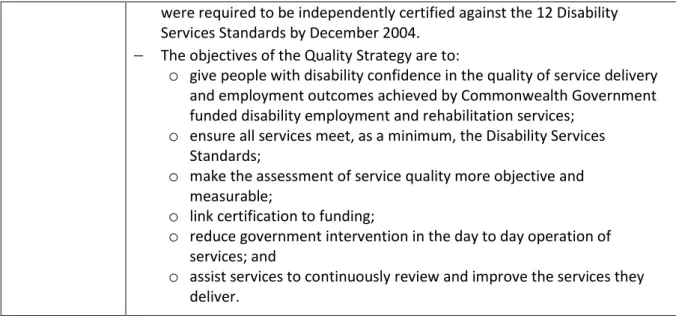
The Quality Strategy for disability employment and rehabilitation services was introduced in 2002. All Commonwealth Government funded services
25 | P a g e were required to be independently certified against the 12 Disability
Services Standards by December 2004. The objectives of the Quality Strategy are to:
o give people with disability confidence in the quality of service delivery and employment outcomes achieved by Commonwealth Government funded disability employment and rehabilitation services;
o ensure all services meet, as a minimum, the Disability Services Standards;
o make the assessment of service quality more objective and measurable;
o link certification to funding;
o reduce government intervention in the day to day operation of services; and
o assist services to continuously review and improve the services they deliver.
Table 6 below is a snap-shot summary of the quality assurance systems approaches across the State/Territories.
Table 6 – Summary of Quality Assurance approaches taken across jurisdictions.27
Frameworks Underpinned by principles Connected to standards Self -Assessment Independent Assessment Performance Measures Mandated for Sector Cwlth ACT NSW NT QLD SA TAS VIC WA
Source: KPMG 2012 and additional information provided by States/Territories.
Productivity Commission Report
Following general community concern, the issue of the long-term care and support of people with a severe or profound disability was referred to Productivity Commission (PC) in February 2010. The Terms of Reference (TOR) included an assessment of a National
Disability Long-Term Care and Support Scheme, including consideration of: the cost and benefits;
feasibility;
the range of support options;
the package of care services for a person’s lifetime;
27
KPMG Victorian Department of Human Services, National Disability Insurance Scheme Quality Assurance Project Revised Draft Report, July 2012, page 25.
26 | P a g e assistance with decisions about support; and
support for employment where possible.
The PC’s final report, Disability Care and Support, was released on 10 August 2011. The report found that the current disability support system is underfunded, unfair,
fragmented and inefficient, and gives people with disability little choice and no certainty of access to appropriate supports.
In 86 recommendations, the PC recommended that there should be a new National Disability Insurance Scheme (NDIS) that provides insurance cover for all Australians in the event of significant disability, including funding for long-term high quality care and support for people with significant disabilities. Recommendations also included the establishment of a National Injury Insurance Scheme (NIIS).
Problems identified in the PC’s report
‘People with disability and their families face many social and financial challenges and, as a group, are among the most disadvantaged in Australia… there appears to be a strong link between observed disadvantage and a lack of support services.’ ‘Support levels are generally insufficient and the provision of support is often inequitable – this places greater costs on people with a disability and their families’.28
The PC noted a range of problems and systemic inefficiencies with the current arrangements for the care and support of people with disabilities that result in poor outcomes and lack of support, as well as constraining individual’s decisions on where and how to live, is
unsustainable and increasingly unstable. In summary the PC found that the disability support sector29:
does not have clear coverage for disabled people;
limits consumer choice - choice is generally not a common aspect of the disability support system as many decisions are made by support workers, service providers or governments;
is inequitable - coverage is dependent on place of residence;
is underfunded (by about $6.5 billion a year) and economically unsustainable - with long waiting lists;
fails to intervene early and consequently adds to long term costs;
is fragmented, uncoordinated and without portability across borders and support providers;
lacks person-centred planning and a general lack of consumer choice. It
disempowers and provides little choice to the people it purports to support and who are best placed to determine their needs and timing. The sector uses out-dated service models which distort allocation decisions;
28
Productivity Commission, page 119. 29
27 | P a g e devalues family and carers and has little engagement with the community. The lack of certainty around waiting times and the availability of supports mean that families cannot plan for the future;
is inefficient with weak governance. There is a lack of essential frameworks that would allow the system to identify and solve problems. These include a strong governance structure and data systems;
has little planning of future needs, and provides people with little confidence about the future and whether services will or will not be available; and
provides poor evidence base with little information and poor data collection for disability services. Currently the availability of data is not sufficient, especially given its importance to efficient management and policy development and does not support transparency and efficient management.
The PC provided greater detail on why real change is needed (Chapter 2):
Social isolation - the PC found that social isolation affected people with disability and their families at a disproportionately high rate – while most people with disability did participate in at least one activity outside of the house, some people did not and people with profound core activity limitation were nine times more likely not to participate than the general population.
Low labour-force participation– the PC found significant differences in the levels of
education and training among people with disability. People with disability and their carers are also less likely to participate in the labour force (31 per cent of people with severe or profound core activity limitation, compared to 54 per cent of people with disability and around 83 per cent of people without disability). Informal carers tend to have less capacity for paid work than non-carers, and the labour force participation rate for primary carers is only 54 per cent compared to 77 per cent for primary carers and 80 per cent for non-carers.30
Reliance on public housing - people with disability are more likely to live in public housing than the wider community, while those in private market housing face constrained accommodation prospects due to lower average incomes.
Health and Relationship issues - Carers are also disadvantaged with significant differences found in their physical and mental health. Many families caring for people with disability experience relationship breakdowns with a higher probability of separation among carers. This often results in carers being the sole provider of informal care.31
Unmet needs and reliance on informal care– the PC found that most people who require assistance with core activities had their needs fully met but with informal support alone. Informal support that often fills the gap conceals an underlying unmet need for formal support. Many needs were partly met or not met at all by formal support. Providing
30
Productivity Commission, page 115. 31
28 | P a g e intensive informal support can have an impact on primary care givers with most indicating more need for support ranging from emotional and financial support to respite.32
Long waiting periods – the PC noted that there is a likely underestimate of overall unmet need as many people do not apply for support due to excessive and uncertain waiting times or as the service is simply not available. Further, some support is provided from other less appropriate services such as the number of younger people with disability in aged care homes and in long stay care in hospitals. People often wait for services indefinitely since there is no certainty about when their support needs will be adequately met. Waiting times for basic support are often several years with longer waiting periods for supported
accommodation, (several years) and therapies (12 to 18 months) which then impacts on therapeutic outcomes.
Uncertainty regarding future - lack of certainty over the provision of funding means that continuity of services into the future is often unknown, and as a result, people are unable to plan for the future.
Ageing carers - further, evidence suggests that the reliance on ageing carers is growing due to an ageing population profile as well as the longer life expectancy of people with disability. Consequently, after years of struggle, many carers are forced to relinquish their adult child into State care. 33
Poor information - information is lacking regarding the system, its quality or
appropriateness. People with less common conditions often lack information and support and the level of support accessed dependent on whether or not a person qualified for a particular program.34
Poor timeliness of support – the timeliness of support is important as it can reduce or prevent further injury. Long delays result in reduced independence and participation, depression and helplessness, save money from disability service budgets over the longer term. Often these kinds of potential savings are not realised due to separation of service areas or because relevant appliances are unavailable. 35Regional disparities within
jurisdictions – participants in rural and remote areas within jurisdictions face poorer provision of supports than would be available to cities and metropolitan areas. Often people in non-metropolitan areas either have to go without supports or pay to travel long distances to receive supports36.
State and Territory variations
Funding and coverage variations and trade-offs - the PC also observed variation in the amount of funding per service user and service coverage (the number of people using each type of support as a proportion of the potential population). The PC noted the trade-off
32
Productivity Commission, page 125. 33
Productivity Commission, page 133. 34 Productivity Commission, page 150. 35
Productivity Commission, page 153. 36