Development as a dynamic system
Linda B. Smith and Esther Thelen
Department of Psychology, Program in Cognitive Science, Indiana University, 1101 East 10th Street, Bloomington, IN 47405, USA
Development is about creating something more from something less, for example, a walking and talking tod-dler from a helpless infant. One current theoretical fra-mework views the developmental process as a change within a complex dynamic system. Development is seen as the emergent product of many decentralized and local interactions that occur in real time. We exam-ine how studying the multicausality of real-time pro-cesses could be the key to understanding change over developmental time. We specifically consider recent research and theory on perseverative reaching by infants as a case study that demonstrates this approach.
Contemporary developmental psychologists are still ask-ing the same question that has intrigued philosophers and scientists since ancient times. How does the human mind, with all its power and imagination, emerge from the human infant, a creature so unformed and helpless? Some see the transformation as so remarkable that they endow infants with genetically programmed and pre-existing mental structures trapped in an immature body: latent capabilities for language, number, and physical and social reasoning that await revelation as infants mature. We also see the transformation as remarkable, but suggest that development is better understood as the emergent product of many decentralized and local interactions that occur in real time. That is, the developmental process is viewed as change within a complex dynamic system. There are several good introductions available to the concepts and mathematics of dynamic systems theory for cognitive scientists[1,2].
Development as a dynamic system
The idea of emergence – the coming into existence of new forms through ongoing processes intrinsic to the system – are not new to developmental psychology. Developmental theorists such as Kuo, Oyama and Gottlieb have long emphasized the probabilistic, epigenetic nature of onto-genetic processes. Biologists and psychologists such as Waddington, von Bertalanffy, Lewin and Gesell have envisioned behaviour and development as morphogenetic fields that unify multiple, underlying components. But only in the past decade or so have the concepts and models of non-linear dynamic systems made in-roads into tra-ditional developmental psychology, becoming a contender for a new developmental theory[3 – 9]and fundamentally changing the way development is studied (seeBox 1).
Developmental psychologists have used dynamic sys-tems ideas both as a conceptual theory [3,7,9] and in
various formal mathematical treatments of developmental change. These include connectionist models [10], cata-strophe theories of structural change from a neo-Piagetian perspective [11] and models based on prey – predator relationships in which skills are envisioned as arising from recursive interacting ‘growers’ [6,12]. Moreover, dynamic views of development have encompassed many different content domains, including mother– infant relationships, imitation, language, social relationships, perception and action, and atypical patterns of develop-mental change[13 – 18].
What unifies these diverse applications is their commit-ment to self-organization and emergence: systems can generate novelty through their own activity. We amplify these shared assumptions of dynamic approaches and show how we have applied them conceptually and formally to understand a particular task. We concentrate on two major tenets of dynamic systems theory as it applies to the self-organization of human development.
Multicausality
The first assumption of the dynamic approach is that developing organisms are complex systems composed of very many individual elements embedded within, and open to, a complex environment. As in many other complex systems in nature, such systems can exhibit coherent behaviour: the parts are coordinated without an executive
Box 1. Variability: a new meaning
Traditionally, variability in behavioural data is a researcher’s night-mare. Too much within- or between-subject variability swamps any experimental effects. Thus, researchers deliberately choose tasks to make people look alike. But real behaviour in real children is not like that. Their performance is notably fragile and context dependent. Abilities seemingly come and go. Indeed, even skilled adults might perform tasks differently each time [35]. Dynamic systems theory turns variability from a scourge into a blessing. In dynamic systems theory, the metric is not whether a child ‘has’ some static ability or unchanging concept. Rather, as systems are always in flux, the important dimension is the relatively stability of behaviour in its particular context over time [36]. New measures of variability allow researchers to see trajectories of change over the short timescales of problem-solving or over a longer developmental span. For example, Yan and Fischer [35] tracked adults learning a new computer programme and found that the performance of each person varied, but that the patterns of variability differed in novices and experts. Weerth and van Geert [37] collected dense longitudinal samples of basal cortisol in infants and their mothers. Cortisol levels in infants decreased with age and did not show circadian rhythms, but each infant had great variability from measurement to measurement. Mothers, conversely, were individually very stable, but more different from each other than were the infants.
agent or a programme that produces the organized pattern. Rather, the coherence is generated solely in the relationships between the organic components and the constraints and opportunities of the environment. This self-organization means that no single element has causal priority.
When such complex systems self-organize, they are characterized by the relative stability or instability of their states. Development can be envisioned, then, as a series of evolving and dissolving patterns of varying dynamic stability, rather than an inevitable march towards maturity. Take infant crawling as an example. Crawling is a coherent behaviour that infants use to locomote when they have sufficient strength and coordination to assume a hands-and-knees posture, but are not balanced and strong enough to walk upright. Crawling is a stable behaviour for several months. But when infants learn to walk, the crawling pattern becomes destablilized by the patterns of standing and walking. There is no ‘programme’ for crawling assembled in the genes or wired in the nervous system. It self-organizes as a solution to a problem (move across the room), later to be replaced by a more efficient solution.
Nested timescales
The second key assumption of the dynamics systems approach is that behavioural change occurs over different timescales. Neural excitation, for example, happens in milliseconds. Reaction times are of the order of hundreds of milliseconds. People learn skills after hours, days and months of practice. Developmental change occurs over weeks, months and years, and evolution over a much longer time period. Traditionally, psychologists have
considered action, learning, development and evolution as distinct processes. But for the organism (and its descendants), time is unified and coherent, as are the collaborating elements of the system. Every neural event is the initial condition for the next slice of time. Every cell division sets the stage for the next. The coherence of time and levels of the complex system mean that the dynamics of one time-scale (e.g. neural activity) must be continuous with and nested within the dynamics of all other time-scales (e.g. growth, learning and development). Thus, in the study of development, we must be concerned with how different timescales interact (seeBox 2).
The A-not-B error
We present an example of how we have used the dynamic concepts of multicausality and nested time to revisit a classic issue in developmental psychology. The question originally posed by Piaget [19] was ‘when do infants acquire the concept of object permanence?’ He devised a simple object-hiding task, which has been adopted by several generations of researchers. The experimenter hides a tantalizing toy under a lid at location A and the infant reaches for the toy. This A-location trial is repeated several times. Then, there is the crucial switch trial: the experimenter hides the object at new location, B. At this point, 8- to 10-month-old infants make a curious ‘error’. If there is a short delay between hiding and reaching, they reach not to where they saw the object disappear, but back to A, where they found the object previously.
This ‘A-not-B’ error is especially interesting because it is tightly linked to a highly circumscribed developmental period: infants older than 12 months of age search Box 2. Emotional episodes, moods and personality development
How do we shift from being happy to sad when we are told of an unhappy event? How and why do moods settle in (e.g. depressions, contentment)? Why are some of us more prone to these moods than others? How do these happy and unhappy episodes and these moods create our personalities? How do our personalities create and play out in our emotional episodes, in our mood swings?
Understanding emotion requires understanding how processes at different timescales influence each other. In a recent new theory of emotion and personality development, Lewis [38] likens the relationship between emotional episodes, moods and personality to circular causality across different scales of analyses that characterize coastlines. The large-scale or macrosopic properties of a coastline – the bays, the ridges, the peninsulas – set the conditions for the small-scale or microscopic processes – waves, tidal forces, erosion. But these microscopic properties causally contribute to the long-standing macroscopic properties. This is an example of circular causality. Understanding emotion and personality development requires working out the same kind of circularly causal relationships – from the microsopic emotional states through the mid-scale of moods to the more stable personality.
Table I summarizes Lewis’s three scales of emotional development, showing parallels and distinctions across scales and the current understanding of the psychological and neurobiological mechanisms.
Table I. Scales of emotional development (from Lewis [38])
Emotional episode Mood Personality
Timescale Seconds, minutes Hours, days Years
Description Rapid convergence of a cognitive interpretation with an emotional state
Lasting entrainment of interpretative bias with a narrow emotional range
Lasting interpretive – emotional habits specific to classes of situations
Dynamic system formalism
Atttractor Temporary modification of state space Permanent structure of state space
Possible
neurobiological mechanism
Cortical coherence mediated by orbito-frontal organization entrained with limbic circuits
Orbitofrontal-corticolimbic entrainment, motor rehearsal, and preafference, sustainded neurohormone release
Selection and strengthening of some corticocortical and corticolimbic connections, pruning of others, loss of plasiticity
Higher-order form
correctly on the crucial B trials. Why this dramatic shift? Do 12-month-old infants know something that 10-month-old infants do not? Piaget suggested that only at 12 months of age do infants know that objects can exist independently of their own actions. Others have suggested that during that two month period, infants shift their representations of space, change the functioning of their prefrontal cortices, learn to inhibit responses, change their under-standing of the task or increase the strength of their representations[20 – 23].
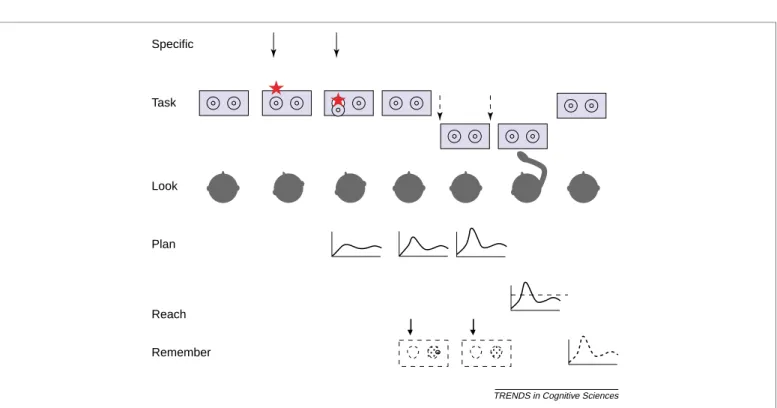
There is merit to all of these ideas, but none can explain the full pattern of experimental results[24]. This might be because these accounts seek an explanation in terms of a single cause when there is no single cause. In collaboration with Schoner and Scheier[25], we offer a formal theory, the dynamic field model[26], to explain how the A-not-B error is the emergent product of multiple causes interacting over nested timescales. The account begins with an analysis of the looking, reaching and memory events that comprise the task, as illustrated inFig. 1.
Task dynamics
The dynamic field simulates the decisions of infants to reach to location A or B by integrating, over time, the various influences on that decision. The field model is neurally inspired, of the type described and characterized analytically by Amari [27], but it is abstract and not anatomically specific. The model has a one-dimensional activation field, defining a parameter space of potential activation states (in this case the locations of targets A and B). Inputs are represented by their location and their influence on the field. Most importantly, points within the field provide input to one another, which allows the field to become self-organizing. A highly activated point will exert
a strong inhibitory influence over the points around it, allowing an activation to be maintained in the absence of external input.
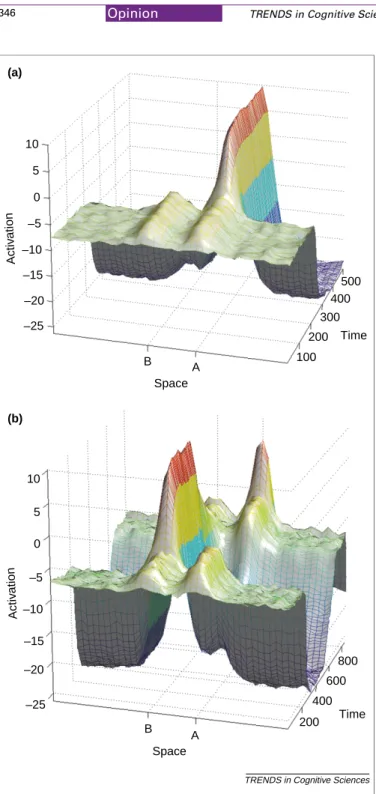
Fig. 2aillustrates the evolution of activation on the very first A trial. Before the infant has seen any object hidden, there is activation in the field at both the A and B locations from the two covers. As the experimenter directs attention to the A location by hiding the toy, it produces a high, transient activation at A. Then the field evolves a decision over time. When the activation peak crosses a threshold, the infant reaches to that location.
Most crucial for this account is that once infants reach, a memory of that reach becomes another input to the next trial. Thus, at the second A trial, there is some increased activation at site A because of the previous activity there. This combines with the hiding cue to produce a second reach to A. Over many trials to A, a strong memory of previous actions builds up. Each trial embeds the history of previous trials.
Now consider the crucial B trial (Fig. 2b). The experimenter provides a strong cue to B. But as that cue decays, the lingering memory of the actions at A begin to dominate the field, and indeed, over time, to shift the decision back to the habitual, A side. The model clearly predicts that the error is time dependent: there is a brief period immediately after the hiding event when infants should search correctly, and indeed they do[28].
Using this model as a guide, experimenters can experimentally make the error come and go, almost at will. This is achieved by changing the delay, by heighten-ing the attention-grabbheighten-ing properties of the covers or the hiding event, and by increasing and decreasing the number of prior reaches to A [24,29]. We have even made the error occur (and not occur!) even when there is no Fig. 1. A task analysis of the A-not-B error, depicting a typical A-location hiding event. The box and hiding wells constitute the continually present visual input. The specific or transient input (top row) consists of the hiding of the toy in the ‘A’ well (on the left here). A delay is imposed between hiding and allowing the infant to search. During these events, the infant looks at the objects in view, remembers the cued location and undertakes a planning process leading to the activation of reach parameters, followed by reaching itself. Finally, the infant remembers the parameters of the current reach.
TRENDS in Cognitive Sciences
Look Task Specific
Plan
Reach
toy to be hidden [24]. Directing attention to an in-view object (A) heightens activation at the location and, in the experiment, infants reach to that continually in-view object. Subsequently, when the experimenter directs attention to a different nearby in-view object (B), infants watch, but then reach back to the original object (A).
Experimenters have also made the error vanish by making the reaches on the B trials different in some way from the A trial reaches. In the model, these differences decrease the influence of the A trial memories on the activations in the field. One experiment achieved this by
shifting the posture of the infant[24]. An infant who sat during the A trials would then be stood up, as shown in
Fig. 3, to watch the hiding event at B, during the delay and during the search. This posture shift causes even 8- and 10-month-old infants to search correctly, just like 12-month-olds. In another experiment, we changed the similarity of reaches on A and B trials by putting on and taking off wrist weights [25]. Infants who reached with ‘heavy’ arms on A trials but ‘light’ ones on B trials (and vice versa) did not make the error, again performing as if they were 2 – 3 months older. These results suggest that the relevant memories are in the language of the body and close to the sensory surface. In addition, they underscore the highly decentralized nature of error: the relevant causes include the covers on the table, the hiding event, the delay, the past activity of the infant and the feel of the body of the infant.
This multicausality demands a rethinking of what is meant by knowledge and development. Do 10-month-old infants know something different when they make the error compared with when they do not? The answer is ‘yes’ if we conceptualize knowledge and knowing as emergent, that is, made at a precise moment from multiple components in relation to the task and to the immediately preceding activity of the system. What do 12-month-olds know that 10-month-olds do not? There can be no single cause, no single mechanism and no one knowledge structure that distinguishes 10-month-olds from 12-month-10-month-olds because there are many causes that make the error appear and disappear. Instead, both 10-and 12-month-olds can be regarded as complex systems that self-organize in the task. How-ever, just as trial dynamics are nested in task dynamics, so are task dynamics nested in develop-mental dynamics.
Developmental dynamics
The A-not-B error has been important to developmental theory because it is tightly linked to a few months in infancy. However, the neural field model suggests that the dynamics that create the error in infants are basic processes involved in goal-directed actions at all ages. Indeed, by changing the task, researchers can make perseverative errors come and go in older children and adults, just as in infants. Recently, Spencer and colleagues Fig. 2. (a) The time evolution of activation in the planning field on the first A trial.
The activation rises as the object is hidden and, owing to self-organizing properties in the field, is sustained during the delay. (b) The time evolution of activation in the planning field on the first B trial. There is heightened activation at A before the hiding event, owing to memory for prior reaches. As the object is hidden at B, acti-vation rises at B, but as this transient event ends, owing to the memory properties of the field, activation at A declines and that at B rises.
TRENDS in Cognitive Sciences
B A
Space
100 200
300 400
500
Time –25
–20 –15 –10 –5 0 5 10
Activ
ation
B A Space
200 400
600 800
Time –25
–20 –15 –10 –5 0 5 10
Activ
ation
(a)
(b)
Fig. 3. An infant sitting for an A trial (left) and standing for a B trial (right). This change in posture causes younger infants to search as 12-month-old infants do (see text for details).
[30]invented an A-not-B task that was suitable for 2-year-olds by hiding toys in a sandbox. The surface of the sand presents a uniform field so there are no markers to indicate the two possible hiding locations. Experimenters gave toddlers many trials at location A, then hid the toy at location B. With a delay of 10 s, the toddlers, having watched the toy being hidden at location B, still returned to the A location to dig in the sand for the toy. Indeed there are many other situations in which both children and adults fall back on a habit despite new information[31,32]. Nonetheless, in the standard A-not-B task, infants change their behaviour over 2 months. In the field model, this is simulated this by increasing the resting activation of the field. This makes it easier for the input from the hiding cue to form a self-sustaining peak at B to compete with the A memory. Similarly, in her model of the error (also a dynamics systems model), Munakata [23] simulates development by stronger self-sustaining memories for the hiding event. If self-sustaining memories drive the successes of older children, then we must ask where they come from. What are infants doing every day that improves their location memory? One possibility is their self-locomotion. Crawling appears to improve the spatial memories of infants [33]. But there are also other possibilities. Their fine motor control improves markedly during the last part of the first year after birth. Perhaps more experience perceiving objects and manipulating them improves the flexibility of infants to notice differ-ences in the targets or to be less tied to their previous actions. Indeed simply practising the A-not-B task repeatedly improves performance[34]. In this way, real-time activity in the task is unified with developmental time. Developmental change evolves from the real-time activities of the infant.
Implications of a dynamic approach
A dynamic systems theory of development helps to resolve an apparent theoretical contradiction. At a very global level, the constraints imposed by our biological heritage and by the similarities in human environments seem to result in similar developmental outcomes. All intact human infants learn to walk, to progress from making the A-not-B error to not making it, to speak their native language and to form intense social relationships. But when one looks at the details of development, the picture seems far less deterministic. Children from the same family grow up to be amazingly different from one another. Children with social and economic advantages sometimes fail in life, whereas those from impoverished backgrounds
sometimes overcome them. There is considerable indeter-minancy within processes that have globally similar outcomes.
Complex systems of embedded levels and timescales can have both of these properties. On the one hand, they can self-organize to produce cohesive patterns. On the other, they may be highly non-linear, sometimes called ‘sensi-tivity to initial conditions’. This means that small changes in one or more components of the dynamic system can lead to reorganization and to large differences in behaviour. Such non-linearities might be reflected in development as stage-like shifts and might underlie the dramatic differ-ences between 10- and 12-month-olds in the standard A-not-B task. But if development is made from real-time events, then these non-linearities might also create individual differences. Even very small differences in beginning states and in developmental histories can amplify and lead to large individual differences. If this is so, then at the microlevel, development will be messier and very much tied to the idiosyncratic real-time activities of the infant. From a dynamic perspective, then, it is important to understand the processes by which the everyday activities of children create developmental change – both the universal attainments and the individual pathways (see also Box 3. Questions for Future Research).
Conclusion
The major problem for a theory of development is to explain how to get something more from something less. At multiple levels of analysis at multiple timescales, many components open to influence from the external world interact and in so doing yield coherent higher-order behavioural forms that then feedback on the system, and change that system. In human development, every neural event, every reach, every smile and every social encounter sets the stage for the next and the real-time causal force behind change. If this is so, then we will gain a deeper understanding of development by studying multicausality, nested timescales and self-organization.
References
1 Kelso, J.A.S. (2000) Principles of dynamic pattern formation and change for a science of human behavior. InDevelopmental Science and
the Holistic Approach (Bergman, L.R. and Cairns, R.B., eds),
pp. 63 – 83, Erlbaum
2 Beer, R.D. (2000) Dynamical approaches to cognitive science.Trends
Cogn. Sci.4, 91 – 99
3 Thelen, E. and Ulrich, B.D. (1991) Hidden skills: a dynamic systems analysis of treadmill stepping during the first year.Monogr. Soc. Res.
Child Dev.56, 104
4 Smith, L.B. and Thelen, E. (1993)A Dynamic Systems Approach to
Development: Applications, MIT Press
5 Thelen, E. and Smith, L.B. (1994)A Dynamic Systems Approach to the
Development of Cognition and Action, MIT Press
6 Van Geert, P. (2000) The dynamics of general developmental mechanisms: from Piaget and Vygotsky to dynamic systems models.
Curr. Dir. Psychol. Sci.9, 64 – 68
7 Fogel, A. (1999) Systems, cycles, and developmental pathways.Hum. Dev.42, 213 – 216
8 Newell, K.M. and Molenaar, P.C.M. (1998)Applications of Nonlinear
Dynamics to Developmental Process Modeling, Erlbaum
9 Lewis, M.D. and Granic, I. (2000) Emotion, Development, and Box 3. Questions for future research
†How can we identify when behavioural patterns are stable and when they are unstable and easily changed?
† Can we design research paradigms to address multiple contri-butions to developmental change?
† Can we understand the interaction of real-time task dynamics and change on a longer time-scale?
† What is the nature of real experiences of infants and children in the world?
Self-Organization: Dynamic Systems Approaches to Emotional
Devel-opment, Cambridge University Press
10 Elman, J. et al. (1996) Rethinking Innateness: A Connectionist
Perspective on Development, MIT Press
11 van der Maas, H.L.J. and Molenaar, P.C.M. (1992) Stage-wise cognitive development: an application of catastrophe theory.Psychol. Rev.99, 395 – 417
12 Fischer, K.W. and Bidell, T.R. (1998) Dynamic development of psychological structures in action and thought. In Handbook of
Child Psychology In Theoretical Models of Human Development
(Vol. 1), 5th edn, (Lerner, R.M. and Damon, W., eds), pp. 117 – 121, Plenum
13 Courage, M. and Howe, L. From infant to child: the dynamics of cognitive change in the second year of life.Psychol. Bull.128, 250 – 277 14 Gerhskoff-Stowe, L. (2002) Object naming, vocabulary growth, and the development of word retrieval abilities.J. Mem. Lang.46, 665 – 687 15 Gogate, L.et al.(2001) The intersensory origins of word
comprehen-sion: an ecological – dynamic systems view.Dev. Sci.4, 1 – 18 16 MacWhinney, B. (1999)The Emergence of Language, Erlbaum 17 Fogel, A. (2000) Systems, attachment, and relationships.Hum. Dev.
43, 314 – 320
18 Johnson, M. et al. (2002) Neuroimaging of typical and atypical development: a perspective from multiple levels of analysis. Dev.
Psychopathol.14, 521 – 536
19 Piaget, J. (1963)The Origins of Intelligence in Children, W.W. Norton 20 Acredolo, L. (1979) Laboratory versus home: the effect of the environment on the 9-month-old infant’s choice of spatial reference system.Dev. Psychol.15, 666 – 667
21 Bremner, J.G. (1978) Egocentic versus allocentric spatial coding in none-month-old infants: factors influencing the choice of a code.Dev.
Psychol.14, 346 – 355
22 Diamond, A. (1998) Understanding the A-not-B error: working memory vs. reinforced response, or active vs. latent trace.Dev. Sci.1, 185 – 189
23 Munakata, Y. (1998) Infant perseveration and implications for object permancence theories: a PDP model of the A-not-B task.Dev. Sci.1, 161 – 184
24 Smith, L.B.et al.(1999) Knowing in the context of acting: the task dynamics of the A-not-B error.Psychol. Rev.106, 235 – 260
25 Thelen, E.et al.(2001) The dynamics of embodiment: a field theory of infant perseverative reaching.Behav. Brain Sci.24, 1 – 86
26 Erlhagen, W. and Schoener, G. (2002) Dynamic field theory of movement preparation.Psychol. Rev.109, 545 – 572
27 Amari, S. (1977) Dynamics of pattern formation in lateral inhibition type neural fields.Biol. Cybern.27, 77 – 87
28 Wellman, H.M.et al.(1986) Infant search and object permanence: a meta-analysis of the A-not-B error.Monogr. Soc. Res. Child Dev.No. 54 29 Diedrich, F.J.et al.(2001) The role of target distinctiveness in infant
perseverative reaching.J. Exp. Child Psychol.78, 263 – 290
30 Spencer, J.P.et al.(2001) Tests of a dynamic systems account of the A-not-B error: the influence of prior experience on the spatial memory abilities of two-year-olds.Child Dev.72, 1327 – 1346
31 Butler, S.C.et al.(2002) Two-year-olds’ search strategies and visual tracking in a hidden displacement task.Dev. Psychol.38, 581 – 590 32 Hood, B.et al.(2000) Predicting the outcomes of physical events:
two-year-olds fail to reveal knowledge of solidity and support.Child Dev.
71, 1540 – 1554
33 Bertenthal, B.I. and Campos, J.J. (1990) A systems approach to the organizing effects of self-produced locomotion during infancy. In
Advances in Infancy Research 6(Rovee-Collier, C. and Lipsitt, L.P.,
eds), pp. 134 – 156, Elsevier
34 Diamond, A. (1990) The development and neural bases of memory functions as indexed by the AB and delayed response tasks in human infants and infant monkeys. InThe Development and Neural Bases of
Higher Cognitive Functions(Diamond, A., ed.), pp. 637 – 676, New York
Academy of Sciences
35 Yan, Z. and Fischer, K. (2002) Always under construction: dynamic variations in adult cognitive microdevelopment. Hum. Dev. 45, 141 – 160
36 Van Geert, P. (2002) Developmental dynamics, intentional action, and fuzzy sets. InMicrodevelopment: Transition Processes in Development
and Learning (Granott, N. and Parziale, J., eds), Cambridge
University Press
37 De Weerth, C. and van Geert, P. (2002) A longitudinal study of basal cortisol in infants: intra-individual variability, circadian rhythm, and developmental trends.Infant Behav. Dev.25, 375 – 398
38 Lewis, M.D. (2000) Emotional self-organization at three time scales. In
Emotion, Development, and Self-Organization (Lewis, M.D. and
Granic, I., eds), pp. 37 – 69, Cambridge University Press
Could you name the most significant papers published in
life sciences this month?
Updated daily,Research Updatepresents short, easy-to-read commentary on the latest hot papers, enabling you to keep abreast with advances across the life sciences.
Written by laboratory scientists with a keen understanding of their field,Research Updatewill clarify the significance and future impact of this research.
Our experienced in-house team are under the guidance of a panel of experts from across the life sciences who offer suggestions and advice to ensure that we have high calibre authors
and have spotted the ‘hot’ papers.
Visit theResearch Updatedaily at http://update.bmn.com and sign up for email alerts to make sure you don’t miss a thing.
This is your chance to have your opinion read by the life science community, if you would like to contribute contact us at [email protected]