Bottom-up Segmentation for Top-down Detection
Sanja Fidler
1Roozbeh Mottaghi
2Alan Yuille
2Raquel Urtasun
11
TTI Chicago,
2UCLA
{fidler, rurtasun}@ttic.edu
,
{roozbehm@cs, yuille@stat}.ucla.eduAbstract
In this paper we are interested in how semantic segmen-tation can help object detection. Towards this goal, we propose a novel deformable part-based model which ex-ploits region-based segmentation algorithms that compute candidate object regions by bottom-up clustering followed by ranking of those regions. Our approach allows every detection hypothesis to select a segment (including void), and scores each box in the image using both the traditional HOG filters as well as a set of novel segmentation features. Thus our model “blends” between the detector and segmen-tation models. Since our features can be computed very effi-ciently given the segments, we maintain the same complex-ity as the original DPM [14]. We demonstrate the effective-ness of our approach in PASCAL VOC 2010, and show that when employing only a root filter our approach outperforms Dalal & Triggs detector [12] onallclasses, achieving 13% higher average AP. When employing the parts, we outper-form the original DPM [14] in19out of20classes, achiev-ing an improvement of 8% AP. Furthermore, we outperform the previous state-of-the-art on VOC’10 test by4%.
1. Introduction
Over the past few years, we have witnessed a push to-wards holistic approaches that try to solve multiple recog-nition tasks jointly [29,6, 20,18,33]. This is important as information from multiple sources should facilitate scene understanding as a whole. For example, knowing which ob-jects are present in the scene should simplify segmentation and detection tasks. Similarly, if we can detect where an ob-ject is, segmentation should be easier as only figure-ground segmentation is necessary. Existing approaches typically take the output of a detector and refine the regions inside the boxes to produce image segmentations [22,5,1,14]. An alternative approach is to use the candidate detections produced by state-of-the-art detectors as additional features for segmentation. This simple approach has proven very successful [6,19] in standard benchmarks.
In contrast, in this paper we are interested in
exploit-ing semantic segmentation in order to improve object de-tection. While bottom-up segmentation has been often be-lieved to be inferior to top-down object detectors due to its frequent over- and under- segmentation, recent approaches [8, 1] have shown impressive results in difficult datasets such as PASCAL VOC challenge. Here, we take advantage of region-based segmentation approaches [7], which com-pute a set of candidate object regions by bottom-up cluster-ing, and produce a segmentation by ranking those regions using class specific rankers. Our goal is to make use of these candidate object segments to bias sliding window object detectors to agree with these regions. Importantly, unlike the aforementioned holistic approaches, we reason about all possible object bounding boxes (not just candidates) to not limit the expressiveness of our model.
Deformable part-based models (DPM) [14] and its vari-ants [2,35,10], are arguably the leading technique to object detection1. However, so far, there has not been many
at-tempts to incorporate segmentation into DPMs. In this pa-per we propose a novel deformable part-based model, which exploits region-based segmentation by allowing every de-tection hypothesis to select a segment (including void) from a small pool of segment candidates. Towards this goal, we derive simple features, which can capture the essential in-formation encoded in the segments. Our detector scores each box in the image using both the traditional HOG filters as well as the set of novel segmentation features. Our model “blends” between the detector and the segmentation models by boosting object hypotheses on the segments. Further-more, it can recover from segmentation mistakes by exploit-ing a powerful appearance model. Importantly, as given the segments we can compute our features very efficiently, our approach has the same computational complexity as the original DPM [14].
We demonstrate the effectiveness of our approach in PASCAL VOC 2010, and show that when employing only a root filter our approach outperforms Dalal & Triggs detec-tor [12] by 13% AP, and when employing parts, we outper-form the original DPM [14] by 8%. Furthermore, we out-perform the previous state-of-the-art on VOC2010 by4%.
1Poselets [4] can be shown to be very similar in spirit to DPMs
We believe that these results will encourage new research on bottom-up segmentation as well as hybrid segmentation-detection approaches, as our paper clearly demonstrates the importance of segmentation for object detection.
In the remainder of the paper, we first review related work and then introduce our novel deformable part-based model, which we callsegDPM. We then show our experi-mental evaluation and conclude with future work.
2. Related Work
Deformable part-based model [14] and its variants have been proven to be very successful in difficult object detec-tion benchmarks such as PASCAL VOC challenge. Several approaches have tried to augment the level of supervision in these models. Azizpour et al. [2] use part annotations to help clustering different poses as well as to model oc-clusions. Hierarchical versions of these models have also been proposed [35], where each part is composed of a set of sub-parts. The relative rigidity of DPMs has been alle-viated in [10] by leveraging a dictionary of shape masks. This allows a better treatment of variable object shape. De-sai et al. [13] proposed a structure prediction approach to perform non-maxima suppression in DPMs which exploits pairwise relationships between multi-class candidates. The tree structure of DPMs allows for fast inference but can suf-fer from problems such as double counting observations. To mitigate this, [27] consider lateral connections between high resolution parts.
In the past few years, a wide variety of segmentation algorithms that employ object detectors as top-down cues have been proposed. This is typically done in the form of unary features for an MRF [19], or as candidate bounding boxes for holistic MRFs [33,21]. Complex features based on shape masks were exploited in [33] to parse the scene holistically in terms of the objects present in the scene, their spatial location as well as semantic segmentation. In [26], heads of cats and dogs are detected with a DPM, and seg-mentation is performed using a GrabCut-type method. By combining top-down shape information from DPM parts and bottom-up color and boundary cues, [32] tackle seg-mentation and detection task simultaneously and provide shape and depth ordering for the detected objects. Dai et al. [11] exploit a DPM to find a rough location for the object of interest and refine the detected bounding box according to occlusion boundaries and color information. [25] find silhouettes for objects by extending or refining DPM boxes corresponding to a reliably detectable part of an object.
DPMs provide object-specific cues, which can be ex-ploited to learn object segmentations [3]. In [24], masks for detected objects are found by employing a group of seg-ments corresponding to the foreground region. Other object detectors have been used in the literature to help segmenting object regions. For instance, while [4] finds segmentations
for people by aligning the masks obtained for each Poselet [4], [23] integrates low level segmentation cues with Pose-lets in a soft manner.
There are a few attempts to use segments/regions to im-prove object detection. Gu et al. [17] apply hough trans-form for a set of regions to cast votes on the location of the object. More recently, [28] learn object shape model from a set of contours and use the learned model of con-tours for detection. In contrast, in this paper we proposed a novel deformable-part based model, which allows each de-tection hypothesis to select candidate segments. Simple fea-tures express the fact that the detections should agree with the segments. Importantly, these features can be computed very efficiently, and thus our approach has the same com-putational complexity as DPM [14].
3. Semantic Segmentation for Object Detection
We are interested in utilizing semantic segmentation to help object detection. In particular, we take advantage of region-based segmentation approaches, which compute candidate object regions by bottom-up clustering, and rank those regions to estimate a score for each class. Towards this goal we frame detection as an inference problem, where each detection hypothesis can select a segment from a pool of candidates (those returned from the segmentation as well as void). We derive simple features, which can be computed very efficiently while capturing most information encoded in the segments. In the remainder of the section, we first dis-cuss our novel DPM formulation. We then define our new segment-based features and discuss learning and inference in our model.
3.1. A Segmentation-Aware DPM
Following [14], letp0be a random variable encoding the location and scale of a bounding box in an image pyramid as well as the mixture component id. As shown in [14] a mixture model is necessary in order to cope with variabil-ity in appearance as well as the different aspect ratios of the training examples. Let {pi}i=1,···,P be a set of parts
which encode bounding boxes at double the resolution of the root. Denote with hthe index over the set of candi-date segments returned by the segmentation algorithm. We frame the detection problem as inference in a Markov Ran-dom Field (MRF), where each root filter hypothesis can se-lect a segment from a pool of candidates. We thus write the score of a configuration as
E(p, h) = P X
i=0
wTi ·φ(x, pi) + P X
i=1
wTi,def·φ(x, p0, pi) +
+wsegT φ(x, h, p0) (1)
whereh ∈ {0,1,· · ·, H(x)}, withH(x)the total number of segments for this class in imagex. Note thath= 0
im-segment
rootf ilter
seg in(x, h, p0)
h
p0
segment
rootf ilter h
p0
seg out(x, h, p0)
segment
rootf ilter h
p0
back in(x, h, p0) back out(x, h, p0)
segment h
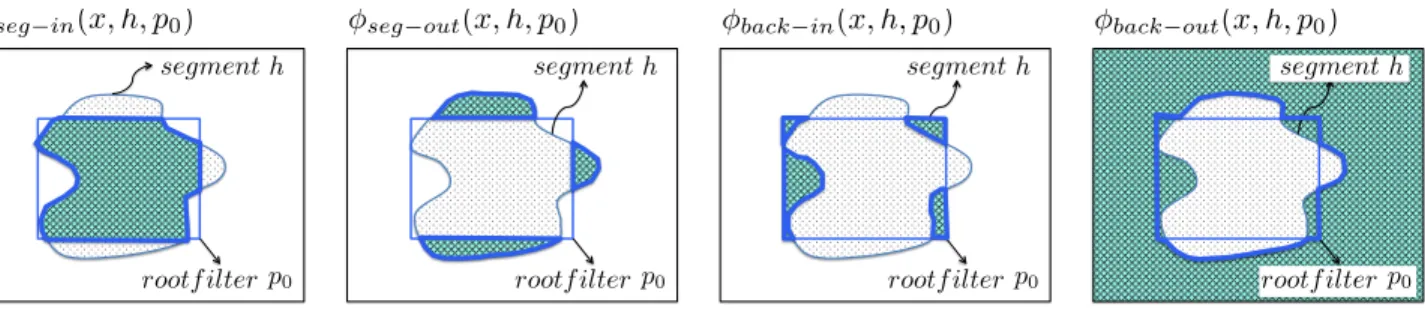
rootf ilter p0 Figure 1. The box-segment features:φseg−inandφseg−out, encourage the box to contain as many segment pixels as possible. This pair
of features alone could result in box hypotheses that “overshoot” the segment. The purpose of the second pair of features,φback−inand
φback−out, is the opposite: it tries to minimize the number of background pixels inside the box and maximize its number outside. In
synchrony these features would try to tightly place a box around the segment.
plies that no segment is selected. We will useS(h)to denote the segment thathindexes. As in [14], we employ a HOG pyramid to computeφ(x, p0), and use double resolution to compute the part featuresφ(x, pi). The featuresφ(x, h, p0)
link segmentation and detection. In this paper, we define features at the level of the root, but our formulation can be easily extended to include features at the part level.
3.2. Segmentation Features
Given a set of candidate segments, we would like to en-code features linking segmentation and detection while re-maining computationally efficient. We would also like to be robust to over- and under- object segmentations, as well as false positive or missing segments. Towards this goal, we derive simple features which encourage the selected seg-ment to agree with the object detection hypothesis. Most of our features employ integral images which makes them extremely efficient, as this computation can be done in con-stant time. We now describe the features in more details. Segment-In: Given a segment S(h), our first feature counts the percentage of pixels inS(h)that fall inside the bounding box defined byp0. Thus
φseg−in(x, h, p0) =
1 |S(h)|
X
p∈B(p0)
1{p∈S(h)}
where|S(h)|is the size of the segment indexed byh, and
B(p0) is the set of pixels contained in the bounding box
defined byp0. This feature encourages the bounding box to contain the segment.
Segment-Out: Our second feature counts the percentage of segment pixels that are outside the bounding box,
φseg−out(x, h, p0) = 1
|S(h)| X
p /∈B(p0)
1{p∈S(h)}
This feature discourages boxes that do not contain all seg-ment pixels.
Background-In: We additionally compute a feature counting the amount of background inside the bounding box as follows
φback−in(x, h, p0) = 1
N− |S(h)|
X
p∈B(p0)
1{p /∈S(h)}
with N the size of the image. This feature captures the statistics of how often the segments leak outside the true bounding box vs how often they are too small.
Background-Out: This feature counts the amount of background outside the bounding box
φback−out(x, h, p0) =
1
N− |S(h)|
X
p /∈B(p0)
1{p /∈S(h)}
It tries to discourage bounding boxes that are too big and do not tightly fit the segments.
Overlap: This feature penalizes bounding boxes which do not overlap well with the segment. In particular, it computes the intersection over union between the candidate bounding box defined byp0 and the tighter bounding box around the segmentS(h). It is defined as follows
φoverlap(x, h, p0) = B(p0)∩B(S(h))
B(p0)∪B(S(h))−λ
withB(S(h))the tighter bounding box aroundS(h),B(p0)
the bounding box defined byp0, andλa constant, which is the intersection over union level that defines a true positive. We employ in practiceλ= 0.7.
Background bias: The value of all of the above features is0when h= 0. We incorporate an additional feature to learn the bias for the background segment (h = 0). This puts the scores of the HOG filters and the segmentation po-tentials into a common referential. We thus simply define
φbias(x, h, p0) = (
1 ifh= 0
0 otherwise.
Fig. 1 depicts our features computed for a specific bounding boxp0and segmentS(h). Note that the first two features,φseg−inandφseg−out, encourage the box to
con-tain as many segment pixels as possible. This pair of fea-tures alone could result in box hypotheses that “overshoot” the segment. The purpose of the second pair of features,
φback−in andφback−out, is the opposite: it tries to
mini-mize the number of background pixels inside the box and maximize its number outside. In synchrony these features would try to tightly place a box around the segment. The overlap feature has a similar purpose, but helps us better tune the model to the VOC IOU evaluation setting.
3.3. Efficient Computation
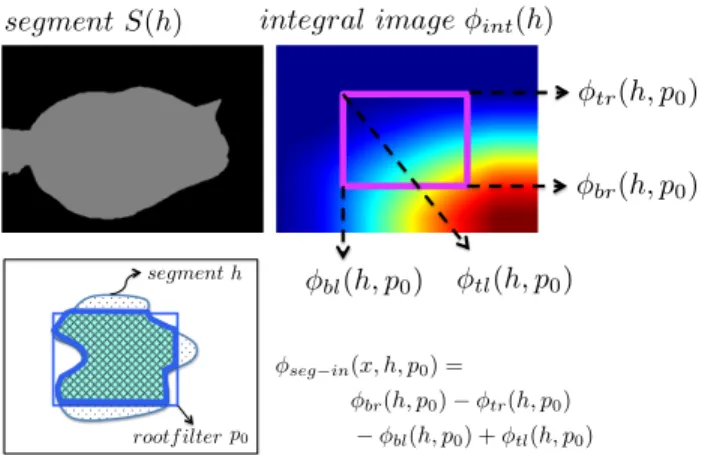
Given the segments, all of our proposed features can be computed very efficiently. Note that the features have to be computed for each segmenth, but this is not a problem as there are typically only a few segments per image. We start our discussion with the first four features, which can be computed in constant time using a single integral image per segment. This is both computationally and memory ef-ficient. Let φint(h)be the integral image for segmenth, which, at each point(u, v), counts the % of pixels that be-long to this segment and are contained inside the subimage defined by the domain[0, u]×[0, v]. This is illustrated in Fig.2. Given the integral imageφint(h)for theh-segment, we compute the features as follows
φseg−in(x, h, p0) = φbr(h, p0)−φtr(h, p0)
−φbl(h, p0) +φtl(h, p0)
φseg−out(x, h, p0) = |S(h)| −φseg−in(x, h, p0)
φback−in(x, h, p0) = |B(p0)| −φseg−in(x, h, p0)
φback−out(x, h, p0) = (N− |S(h)|)−φback−in(x, h, p0)
where as shown in Fig. 2, (φtl, φtr, φbl, φbr) indexes the integral image of segmentS(h)at the four corners, i.e., top-left, top-right, bottom-top-left, bottom-right, of the bounding box defined byp0.
The overlap feature between a hypothesisp0and a seg-mentS(h)can also be computed very efficiently. First, we compute the intersection as:
B(p0)∩B(S(h)) =
max
0,min(x0,right, xS(h),right)−max(x0,left, xS(h),left)
·
max
0,min(y0,bottom, yS(h),bottom)−max(y0,top, yS(h),top)
Note that the overlap will be non-zero only when each of the terms is larger than0. Given that the segment bounding box
B(S(h))is fixed and the width and height ofp0at a
partic-ular level of the pyramid are fixed as well, we can quickly
int(h)
segment S(h) integral image
segment
rootf ilter h
p0
seg in(x, h, p0) =
br(h, p0) tr(h, p0)
bl(h, p0) + tl(h, p0)
br(h, p0) tr(h, p0)
bl(h, p0) tl(h, p0)
Figure 2. Segment feature computation via integral image.
compute the bounds of where in the image the feature needs to be computed (i.e., when the feature is different than 0). The denominator, B(p0)∪B(S(h)), can then be simply computed as the sum of the box areas minus the overlap.
3.4. Inference
Inference in our model can be done by solving the fol-lowing optimization problem
max p0
w0T·φ(x, p0) + P X i=1
max pi
(wi,defT ·φ(x, p0, pi) +
+wTi ·φ(x, pi)) + max
h (w
T
seg·φ(x, h, p0))
Note that this can be done efficiently using dynamic pro-gramming as the structure of the graphical model forms a tree. The algorithm works as follows: First, we compute maxhwT
segφ(x, h, p0)as well asmaxpi(w
T i,def ·
φ(x, p0, pi))for each root filter hypothesis p0. We then
compute the score as the sum of the HOG and segment score for each mixture component at the root level. Finally, we compute the maximum over the mixture components to get the score of an object hypothesis.
3.5. Learning
We learn a different weight for each feature using a la-tent structured-SVM [15]. Allowing different weights for the different segmentation features is important in order to learn how likely is for each class to have segments that un-dershoot or overshoot the detection bounding box. We em-ploy as loss the intersection over the union of the root fil-ters. As in DPM [14], we initialize the model by first train-ing only the root filters, followed by traintrain-ing a root mixture model. Finally we add the parts and perform several addi-tional iterations of stochastic gradient descent [14].
Note that we expect the weights for φseg−in(x, h, p0),
we would like to maximize the overlap, the amount of fore-ground inside the bounding box and backfore-ground outside the bounding box. Similarly, the weights forφseg−out(x, h, p0)
andφback−in(x, h, p0) are expected to be negative as we
would like to minimize the amount of background inside the bounding box as well as the amount of foreground seg-ment outside. In practice, as the object’s shape can be far from rectangular, and the segments are noisy, the sign of the weights can vary to best capture the statistics of the data.
3.6. Implementation Details
We use CPMC [7] to get the candidate segments. In par-ticular, for most experiments we use the final segmentation output of [7]. For each class, we find all connected compo-nents in the segmentation output, and remove those that do not exceed1500pixels. Unless otherwise noted, we do not use the score of the segments. On average, this gives us one segment per image. We also provide one experiment where we used more segments (5on average per image), which we describe in Sec.4.
4. Experimental Evaluation
We first evaluate our detection performance onval sub-set of PASCAL VOC 2010 detection datasub-set, and compare it to the baselines. We train all methods, including the base-lines on thetrainsubset. We use the standard PASCAL criterion for detection (50% IOU overlap) and report aver-age precision (AP) as the measure of evaluation.
As baselines we use the Dalal&Triggs detector [12] (which for fairness we compare to our detector when only using the root filters), the DPM [14], as well as CPMC [7] when used as a detector. To compute the latter, we find all the connected components in the final segmentation output of CPMC [7], and place the tightest bounding box around each component. To compute the score of the box we utilize the CPMC ranking scores for the segments.
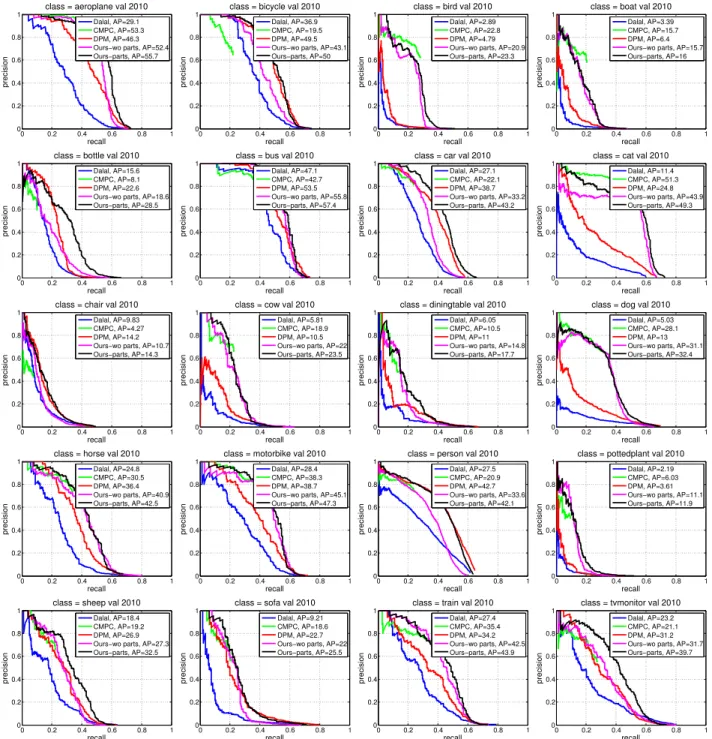
The comparison with [12] and our approach (segDPM) without parts is shown in the top Table1, while the bot-tom table compares CPMC-based detector, DPM and our approach with parts. We significantly outperform the base-lines: Dalal & Triggs detector by13%and the CPMC base-line by 10%. Our model also achieves a significant boost of 8% AP over the DPM, which is a well established and difficult baseline to beat. Importantly, we outperform DPM in19out of20classes. The main power of our approach is that it blends between DPM (appearance) and segmentation (CPMC). When there is no segment, the method just scores a regular DPM. When there is a segment, our approach is encouraged to tightly fit a box around it. However, in cases of under- or over- segmentation, the appearance part of our model can still correctly position the box. Note that our results well demonstrate the effectiveness of using blended detection and segmentation models for object detection.
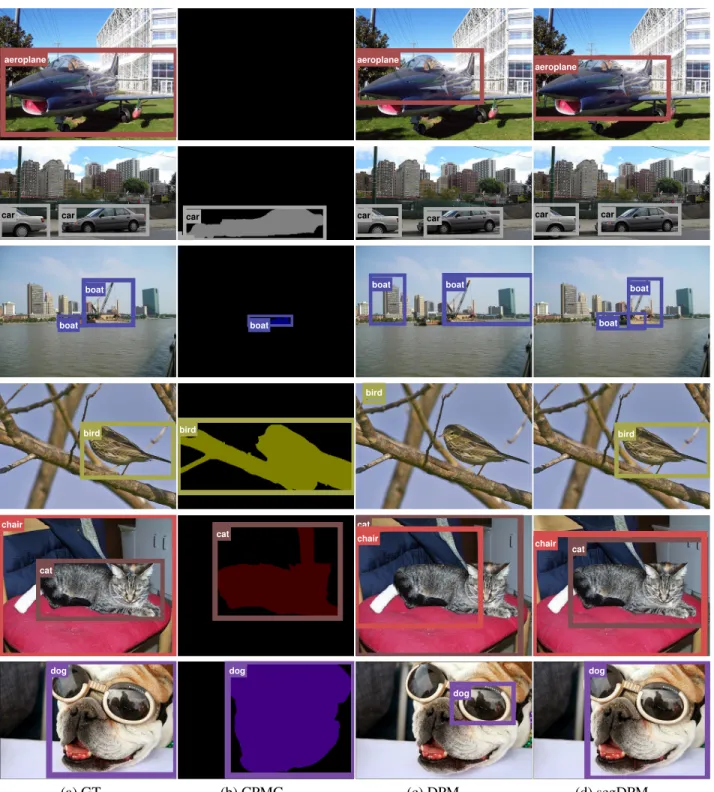
Fig.4 depicts examples illustrating the performance of our approach. Note that our approach is able to both retrieve detections where there is no segment as well as position the bounding box correctly where there is segment evidence.
We evaluate our approach on VOC 2010test in Ta-ble2. Here, we trained CPMC [7], as well as our model on
VOCtrainval. We compare segDPM with DPM
with-out the post-processing steps, i.e., bounding box prediction and context-rescoring, in the top of Table 2. In the bot-tom of Table2we compare our full approach with existing top scoring approaches. For the full approach, we show re-sults when typical context-rescoring approach is used (same as in DPM), which we refer to as segDPM+rescore. We also show results when we rescored the detections by us-ing the classification scores for each class, kindly pro-vided to us by [9]. The classification (presence/absence of class in an image) accuracy measured by mean AP on VOC2010 is 76.2%. We refer to this approach with segDPM+rescore+classif. We outperform the competitors by3.6%, and achieve the best result in13out of20classes. We also experimented with using more segments, on the VOC 2010 train/val split. In particular, among150
segments per image returned by [8], we selected a top-ranking subset for each class, so that there was an average of
5segments per image. The results are reported in Table3. We compare it to CPMC when using the same set of seg-ments. One can see that with more segments our approach improves by1.5%. As such, it outperforms DPM by10%.
5. Conclusion
In this paper, we have proposed a novel deformable part-based model, which exploits region-part-based segmentation by allowing every detection hypothesis to select a segment (in-cluding void) from a pool of segment candidates. We derive simple yet very efficient features, which can capture the es-sential information encoded in the segments. Our detector scores each box in the image using both the HOG filters as in original DPM, as well as a set of novel segmentation fea-tures. This way, our model “blends” between the detector and the segmentation model, by boosting object hypotheses on the segments, while recovering from making mistakes by exploiting a powerful appearance model. We demon-strated the effectiveness of our approach in PASCAL VOC 2010, and show that when employing only a root filter our approach outperforms Dalal & Triggs detector [12] by 13% AP and when employing parts, we outperform the original DPM [14] by 8%. We believe that this is just the beginning of a new and exciting direction. We expect a new genera-tion of object detectors which are able to exploit semantic segmentation yet to come.
Acknowledgments R.M. was supported in part by NSF 0917141 and ARL 62250-CS.
plane bike bird boat bottle bus car cat chair cow table dog horse motor person plant sheep sofa train tv Avg. VOC 2010 val, no parts
Dalal [12] 29.1 36.9 2.9 3.4 15.6 47.1 27.1 11.4 9.8 5.8 6.0 5.0 24.8 28.4 27.5 2.2 18.4 9.2 27.4 23.2 18.1
segDPM (no parts) 52.4 43.1 20.9 15.7 18.6 55.8 33.2 43.9 10.7 22.0 14.8 31.1 40.9 45.1 33.6 11.1 27.3 22.0 42.5 31.7 30.8 VOC 2010 val, with parts
CPMC (no score) [7] 49.9 15.5 18.5 14.7 7.4 35.0 19.9 41.4 3.9 16.2 8.5 24.4 26.0 32.1 18.9 5.7 15.3 14.1 29.8 18.7 20.8
CPMC (score) [7] 53.3 19.5 22.8 15.7 8.1 42.7 22.1 51.3 4.3 18.9 10.5 28.1 30.5 38.3 20.9 6.0 19.2 18.6 35.4 21.1 24.4
DPM [14] 46.3 49.5 4.8 6.4 22.6 53.5 38.7 24.8 14.2 10.5 10.9 12.9 36.4 38.7 42.6 3.6 26.9 22.7 34.2 31.2 26.6
segDPM (parts) 55.7 50 23.3 16.0 28.5 57.4 43.2 49.3 14.3 23.5 17.7 32.4 42.6 44.9 42.1 11.9 32.5 25.5 43.9 39.7 34.7
Table 1. AP performance (in %) onVOC 2010 valfor our detector with parts, the DPM [14], and the CPMC-based detector [7].
plane bike bird boat bottle bus car cat chair cow table dog horse motor person plant sheep sofa train tv Avg. VOC 2010 test, no post-processing
DPM no postproc. [14] 47.2 50.8 8.6 12.2 32.2 48.9 44.4 28.1 13.6 22.7 11.3 17.4 40.4 47.7 44.4 7.6 30 17.3 38.5 34.3 29.9
segDPMno postproc. 56.4 48.024.3 21.8 31.3 51.3 47.3 48.2 16.1 29.4 19.0 37.5 44.1 51.5 44.4 12.6 32.1 28.8 48.9 39.1 36.6 VOC 2010 test, with post-processing
segDPM+rescore+classif 61.4 53.425.6 25.2 35.5 51.750.6 50.8 19.3 33.826.8 40.4 48.3 54.4 47.1 14.8 38.7 35.0 52.8 43.1 40.4 segDPM+rescore 58.7 51.425.3 24.1 33.8 52.549.2 48.8 11.7 30.4 21.6 37.7 46.0 53.1 46.0 13.1 35.7 29.452.541.8 38.1
NLPR HOGLBP [34] 53.3 55.319.2 21.0 30.0 54.4 46.7 41.2 20.0 31.5 20.7 30.3 48.6 55.3 46.5 10.2 34.4 26.5 50.3 40.3 36.8
MITUCLA HIERARCHY [35] 54.2 48.5 15.7 19.2 29.2 55.543.5 41.7 16.9 28.5 26.7 30.9 48.3 55.0 41.7 9.7 35.8 30.8 47.2 40.8 36.0
NUS HOGLBP CTX [9] 49.1 52.4 17.8 12.0 30.6 53.5 32.8 37.3 17.7 30.6 27.7 29.5 51.9 56.3 44.2 9.6 14.8 27.9 49.5 38.4 34.2
van de Sande et al. [30] 58.2 41.9 19.2 14.0 14.3 44.8 36.7 48.8 12.9 28.128.7 39.4 44.1 52.5 25.8 14.1 38.8 34.2 43.1 42.6 34.1
UOCTTI LSVM MDPM [31] 52.4 54.3 13.0 15.6 35.1 54.2 49.1 31.8 15.5 26.2 13.5 21.5 45.4 51.6 47.5 9.1 35.1 19.4 46.6 38 33.7
Gu et al. [16] 53.7 42.9 18.1 16.5 23.5 48.1 42.1 45.4 6.7 23.4 27.7 35.2 40.7 49.0 32.0 11.6 34.6 28.7 43.3 39.2 33.1
UVA DETMONKEY [30] 56.7 39.8 16.8 12.2 13.8 44.9 36.9 47.7 12.1 26.9 26.5 37.2 42.1 51.9 25.7 12.1 37.8 33.0 41.5 41.7 32.9
UVA GROUPLOC [30] 58.4 39.6 18 13.3 11.1 46.4 37.8 43.9 10.3 27.5 20.8 36 39.4 48.5 22.9 13 36.8 30.5 41.2 41.9 31.9
BONN FGT SEGM [8] 52.7 33.7 13.2 11.0 14.2 43.1 31.9 35.6 5.7 25.4 14.4 20.6 38.1 41.7 25.0 5.8 26.3 18.1 37.6 28.1 26.1
Table 2. AP performance (in %) onVOC 2010 testfor our detector with parts and the DPM [14], without post processing (top table), and comparison with existing methods (only top11shown), with post-processing (table below).
References
[1] P. Arbelaez, B. Hariharan, C. Gu, S. Gupta, L. Bourdev, and J. Malik. Finding animals: Semantic segmentation using regions and parts. In
CVPR, 2012.1
[2] H. Azizpour and I. Laptev. Object detection using
strongly-supervised deformable part models. InECCV, 2012.1,2
[3] L. Bertelli, T. Yu, D. Vu, and B. Gokturk. Kernelized structural svm learning for supervised object segmentation. InCVPR, 2011.2 [4] L. Bourdev, S. Maji, T. Brox, and J. Malik. Detecting people using
mutually consistent poselet activations. InECCV, 2010.1,2 [5] T. Brox, L. Bourdev, S. Maji, and J. Malik. Object segmentation by
alignment of poselet activations to image contours. InCVPR’11.1 [6] G. Cardinal, X. Boix, J. van de Weijer, A. D. Bagdanov, J. Serrat,
and J. Gonzalez. Harmony potentials for joint classification and seg-mentation. InCVPR, 2010.1
[7] J. Carreira, R. Caseiroa, J. Batista, and C. Sminchisescu. Semantic segmentation with second-order pooling. InECCV, 2012.1,5,6,7 [8] J. Carreira, F. Li, and C. Sminchisescu. Object Recognition by
Se-quential Figure-Ground Ranking.IJCV, 2011.1,5,6
[9] Q. Chen, Z. Song, Y. Hua, Z. Huang, and S. Yan. Hierarchical match-ing with side information for image classification. InCVPR, 2012. 5,6
[10] Y. Chen, L. Zhu, and A. Yuille. Active mask hierarchies for object detection. InECCV, 2010.1,2
[11] Q. Dai and D. Hoiem. Learning to localize detected objects. In
CVPR, 2012.2
[12] N. Dalal and B. Triggs. Histograms of oriented gradients for human detection. InCVPR, pages I: 886–893, 2005.1,5,6
[13] C. Desai, D. Ramanan, and C. Fowlkes. Discriminative models for multi-class object layout. InICCV, 2009.2
[14] P. Felzenszwalb, R. Girshick, D. McAllester, and D. Ramanan. Ob-ject detection with discriminatively trained part based models.PAMI, 32(9), 2010.1,2,3,4,5,6
[15] R. Girshick, P. Felzenszwalb, and D. McAllester. Object detection with grammar models. InNIPS, 2009.4
[16] C. Gu, P. Arbelaez, Y. Lin, K. Yu, and J. Malik. Multi-component models for object detection. InECCV, 2012.6
[17] C. Gu, J. Lim, P. Arbelaez, and J. Malik. Recognition using regions. InCVPR, 2009.2
[18] G. Heitz, S. Gould, A. Saxena, and D. Koller. Cascaded classifica-tion models: Combining models for holistic scene understanding. In
NIPS, 2008.1
[19] P. Kr¨ahenb¨uhl and V. Koltun. Efficient inference in fully connected crfs with gaussian edge potentials. InNIPS, 2011.1,2
[20] L. Ladicky, C. Russell, P. Kohli, and P. H. Torr. Graph cut based inference with co-occurrence statistics. InECCV, 2010.1 [21] L. Ladicky, P. Sturgess, K. Alahari, C. Russell, and P. H. Torr. What,
where and how many? combining object detectors and crfs. In
ECCV, 2010.2
[22] V. Lempitsky, P. Kohli, C. Rother, and B. Sharp. Image segmentation with a bounding box prior. InICCV, 2009.1
[23] M. Maire, S. X. Yu, and P. Perona. Object detection and segmentation from joint embedding of parts and pixels. InICCV, 2011.2 [24] A. Monroy and B. Ommer. Beyond bounding-boxes: Learning object
shape by model-driven grouping. InECCV12.2
[25] R. Mottaghi. Augmenting deformable part models with irregular-shaped object patches. InCVPR, 2012.2
[26] O. Parkhi, A. Vedaldi, C. V. Jawahar, and A. Zisserman. The truth about cats and dogs. InICCV, 2011.2
[27] M. Pedersoli, A. Vedaldi, and J. Gonzlez. A coarse-to-fine approach for fast deformable object detection. InCVPR, 2011.2
[28] P. Srinivasan, Q. Zhu, and J. Shi. Many-to-one contour matching for describing and discriminating object shape. InCVPR, 2010.2 [29] E. Sudderth, A. Torralba, W. T. Freeman, and A. Wilsky. Learning
0 0.2 0.4 0.6 0.8 1 0 0.2 0.4 0.6 0.8 1 recall precision
class = aeroplane val 2010
Dalal, AP=29.1 CMPC, AP=53.3 DPM, AP=46.3 Ours−wo parts, AP=52.4 Ours−parts, AP=55.7
0 0.2 0.4 0.6 0.8 1
0 0.2 0.4 0.6 0.8 1 recall precision
class = bicycle val 2010 Dalal, AP=36.9 CMPC, AP=19.5 DPM, AP=49.5 Ours−wo parts, AP=43.1 Ours−parts, AP=50
0 0.2 0.4 0.6 0.8 1
0 0.2 0.4 0.6 0.8 1 recall precision
class = bird val 2010 Dalal, AP=2.89 CMPC, AP=22.8 DPM, AP=4.79 Ours−wo parts, AP=20.9 Ours−parts, AP=23.3
0 0.2 0.4 0.6 0.8 1
0 0.2 0.4 0.6 0.8 1 recall precision
class = boat val 2010
Dalal, AP=3.39 CMPC, AP=15.7 DPM, AP=6.4 Ours−wo parts, AP=15.7 Ours−parts, AP=16
0 0.2 0.4 0.6 0.8 1 0 0.2 0.4 0.6 0.8 1 recall precision
class = bottle val 2010 Dalal, AP=15.6 CMPC, AP=8.1 DPM, AP=22.6 Ours−wo parts, AP=18.6 Ours−parts, AP=28.5
0 0.2 0.4 0.6 0.8 1
0 0.2 0.4 0.6 0.8 1 recall precision
class = bus val 2010 Dalal, AP=47.1 CMPC, AP=42.7 DPM, AP=53.5 Ours−wo parts, AP=55.8 Ours−parts, AP=57.4
0 0.2 0.4 0.6 0.8 1
0 0.2 0.4 0.6 0.8 1 recall precision
class = car val 2010 Dalal, AP=27.1 CMPC, AP=22.1 DPM, AP=38.7 Ours−wo parts, AP=33.2 Ours−parts, AP=43.2
0 0.2 0.4 0.6 0.8 1
0 0.2 0.4 0.6 0.8 1 recall precision
class = cat val 2010
Dalal, AP=11.4 CMPC, AP=51.3 DPM, AP=24.8 Ours−wo parts, AP=43.9 Ours−parts, AP=49.3
0 0.2 0.4 0.6 0.8 1
0 0.2 0.4 0.6 0.8 1 recall precision
class = chair val 2010 Dalal, AP=9.83 CMPC, AP=4.27 DPM, AP=14.2 Ours−wo parts, AP=10.7 Ours−parts, AP=14.3
0 0.2 0.4 0.6 0.8 1
0 0.2 0.4 0.6 0.8 1 recall precision
class = cow val 2010
Dalal, AP=5.81 CMPC, AP=18.9 DPM, AP=10.5 Ours−wo parts, AP=22 Ours−parts, AP=23.5
0 0.2 0.4 0.6 0.8 1
0 0.2 0.4 0.6 0.8 1 recall precision
class = diningtable val 2010 Dalal, AP=6.05 CMPC, AP=10.5 DPM, AP=11 Ours−wo parts, AP=14.8 Ours−parts, AP=17.7
0 0.2 0.4 0.6 0.8 1
0 0.2 0.4 0.6 0.8 1 recall precision
class = dog val 2010 Dalal, AP=5.03 CMPC, AP=28.1 DPM, AP=13 Ours−wo parts, AP=31.1 Ours−parts, AP=32.4
0 0.2 0.4 0.6 0.8 1
0 0.2 0.4 0.6 0.8 1 recall precision
class = horse val 2010
Dalal, AP=24.8 CMPC, AP=30.5 DPM, AP=36.4 Ours−wo parts, AP=40.9 Ours−parts, AP=42.5
0 0.2 0.4 0.6 0.8 1
0 0.2 0.4 0.6 0.8 1 recall precision
class = motorbike val 2010 Dalal, AP=28.4 CMPC, AP=38.3 DPM, AP=38.7 Ours−wo parts, AP=45.1 Ours−parts, AP=47.3
0 0.2 0.4 0.6 0.8 1
0 0.2 0.4 0.6 0.8 1 recall precision
class = person val 2010
Dalal, AP=27.5 CMPC, AP=20.9 DPM, AP=42.7 Ours−wo parts, AP=33.6 Ours−parts, AP=42.1
0 0.2 0.4 0.6 0.8 1 0 0.2 0.4 0.6 0.8 1 recall precision
class = pottedplant val 2010 Dalal, AP=2.19 CMPC, AP=6.03 DPM, AP=3.61 Ours−wo parts, AP=11.1 Ours−parts, AP=11.9
0 0.2 0.4 0.6 0.8 1
0 0.2 0.4 0.6 0.8 1 recall precision
class = sheep val 2010 Dalal, AP=18.4 CMPC, AP=19.2 DPM, AP=26.9 Ours−wo parts, AP=27.3 Ours−parts, AP=32.5
0 0.2 0.4 0.6 0.8 1
0 0.2 0.4 0.6 0.8 1 recall precision
class = sofa val 2010 Dalal, AP=9.21 CMPC, AP=18.6 DPM, AP=22.7 Ours−wo parts, AP=22 Ours−parts, AP=25.5
0 0.2 0.4 0.6 0.8 1
0 0.2 0.4 0.6 0.8 1 recall precision
class = train val 2010
Dalal, AP=27.4 CMPC, AP=35.4 DPM, AP=34.2 Ours−wo parts, AP=42.5 Ours−parts, AP=43.9
0 0.2 0.4 0.6 0.8 1
0 0.2 0.4 0.6 0.8 1 recall precision
class = tvmonitor val 2010 Dalal, AP=23.2 CMPC, AP=21.1 DPM, AP=31.2 Ours−wo parts, AP=31.7 Ours−parts, AP=39.7
Figure 3. Precision-recall curves on PASCAL VOC 2010val. Note that our approach significantly outperforms all baselines.
plane bike bird boat bottle bus car cat chair cow table dog horse motor person plant sheep sofa train tv Avg.
VOC 2012 val, more segments
CPMC (1 seg) [7] 53.3 19.5 22.8 15.7 8.1 42.7 22.1 51.3 4.3 18.9 10.5 28.1 30.5 38.3 20.9 6.0 19.2 18.6 35.4 21.1 24.4
CPMC (5 seg) [7] 59.8 27.6 27.1 19.6 12.7 53.1 31.2 56.6 8.2 25.6 17.5 34.8 39.8 42.3 25.9 10.3 29.8 26.6 46.7 33.4 31.4
segDPM (1 seg) 55.7 50.0 23.3 16.0 28.5 57.4 43.2 49.3 14.3 23.5 17.7 32.4 42.6 44.9 42.1 11.9 32.5 25.5 43.9 39.7 34.7
segDPM (5 seg) 56.1 49.0 22.9 18.2 34.0 58.9 42.9 49.8 15.4 25.0 22.7 32.3 46.2 45.6 39.2 13.6 33.3 30.6 46.7 41.5 36.2
Table 3. AP performance (in %) onVOC 2010 valfor our detector when using more segments.
[30] K. E. A. van de Sande, J. R. R. Uijlings, T. Gevers, and A. W. M. Smeulders. Segmentation as selective search for object recognition.
InICCV, 2011.6
ker-aeroplane aeroplane
aeroplane
car car
car
car car car car car
boat boat
boat
boat boat
boat boat
bird bird
bird
bird
cat chair
cat
cat chair
cat chair
dog dog
dog
dog
(a) GT (b) CPMC (c) DPM (d) segDPM
Figure 4. For each method, we show topkdetections for each class, wherekis the number of boxes for that class in GT. For example, for an image with a chair and a cat GT box, we show the top scoring box for chair and the top scoring box for cat.
nels for object detection. InICCV, 2009.6
[32] Y. Yang, S. Hallman, D. Ramanan, and C. Fowlkes. Layered object models for image segmentation.PAMI, 2011.2
[33] J. Yao, S. Fidler, and R. Urtasun. Describing the scene as a whole: Joint object detection, scene classification and semantic segmenta-tion. InCVPR, 2012.1,2
[34] Y. Yu, J. Zhang, Y. Huang, S. Zheng, W. Ren, C. Wang, K. Huang, and T. Tan. Object detection by context and boosted hog-lbp. In
ECCV w. on PASCAL, 2010.6
[35] L. Zhu, Y. Chen, A. Yuille, and W. Freeman. Latent hierarchical structural learning for object detection. InCVPR, 2010.1,2,6