256 | P a g e
EFFECT OF WELDING ON MILD STEEL MATERIAL
ON ITS MICROSTRUCTURE AND PROPERTIES
Rohan
1, Dr. S. Chakradhar Goud
21
Research Scholar, Department of Mechanical Engineering,
Shri JJT University Churu Road, Rajasthan, (India)
2
Principal and Professor, Sri Sarada Institute of Science and Technology, Telangana, (India)
ABSTRACT
As the change in the technology in day todays requirement of the different types of structures are needed. To
obtain the required shape and size of the model joining of the materials also became important aspect. There
are different types of joining process and welding one of them. Though there are different types of welding
process are available but all have their own advantage and disadvantages. Here in this study we are using arc
welding procedure to join a metal of industrial low carbon steel. This is the basic study of changes in the
microstructure and properties due to the heat generated and the heat affected zone during the welding process.
In olden days forging was also one of the joining process.
keywords:
forging, welding, grain structure, haz
I. INTRODUCTION
Welding is a type of joining process., usually joins meta ls and also a form of thermoplastics. In this process
me lting of the base metal ta kes due to the high heat generat ion during the welding process. A filler materia l is
used to join the metal by forming a pool of molten meta l. When it cools it forms the joint and it beco mes
stronger in strength than the base metal.
Welding process can be done in different type of enviro n ments such as open air, under water etc. during weld ing
process some precautions have to be taken in order to avoid damages to human as high heat is produced and the
intensity of the arc is high and also it produces fumes which may be ha zardous to human b eings.
Till the 19th century one of the common type of we lding process was forge weld ing , wh ich was e mp loyed by the
blacksmiths to join iron and steel by the involvement of heating the metal and hammering it. After this decade a
new type of technology emerged that is arc we lding and o xyfuel we lding. In most we lding is preferred for
joining metals. And the mechanical properties and the mic rostructure depend on the composition of carbon
content and the addition of the other ele ment. In this study we have chos en low carbon steel which is Hav ing
0.25% carbon because this material is easy to weld without any special tools. As per the previous study
pertaining to the low carbon steels, Zakaria et. al[1] have studied the change in grain structure as well as
257 | P a g e
But for this study we utilized electrode 6018 to weld two metal piece and electronic microscope utilized to view
the microstructure.
II. METHODOLOGY
Two flat plate pieces of lo w carbon steel metal is choosen of dimension 50x30x5mm. it is welded by 601 8
electrode in single pass weld at a norma l speed. Later sa me another set of metal p ieces were joined with same
electrode in a single pass but at slower speed.
For the observation of metallographic the part is passed through different process. Firstly the specimen is cutted
with dimension 20mm of lenth for observation. Then it is carried out for the surface finish with different coarse
of e mery paper such as 1/0, 2/0, 3/ 0, 4/0.
After the process of emery paper it is polished on the disc polishing machine and then it is itched with 2% natal
for 15sec and so mic rostructure of the metal and weld defined.
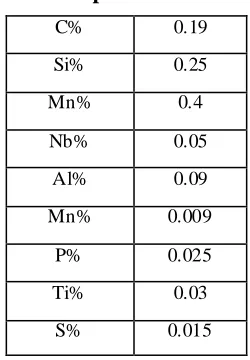
The composition of the low carbon steel is shown in th e table 1. And the composition of the 6018 e lectrode is
shown in the table 2.
Table 1. Composition of Mild steel
C% 0.19
Si% 0.25
Mn% 0.4
Nb% 0.05
Al% 0.09
Mn% 0.009
P% 0.025
Ti% 0.03
S% 0.015
Table 2. Chemical composition of electrode 6018
E6018 %
C 0.028
Mn 0.560
Si 0.330
P 0.016
S 0.010
Ni 0.022
Cr 0.047
Mo 0.01
258 | P a g e
Table 3. Mechanic al Properties of Me tal de positionYie ld Po int Re l(Mpa) 400
Tensile Strength Rm(Mpa) 500
Elongation A5 (% 25
Akv Va lue (J) 95
Figure 1. Parts of welded plate which is used for study
Figure 2. Cutted part for the study
III. RESULT AND DISCUSSION
In this study firstly we studied the microstructure of the base metal and the microstructure of the after welding,
so the effect of microstructure is illustrated.
259 | P a g e
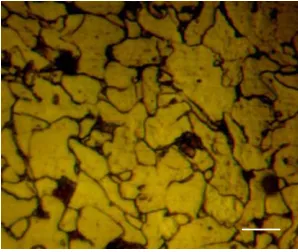
As per observational result of the base metal co mprise of ferrite and region of pearlite (α-Fe +Fe3C) at the edges
as shown in fig 3. The pearlite bands are observed as shown in fig 4. Which is due to the presence of Mn in the
zones.
3.2 Structure after welding
As we know heat will affect the structure of the materia l, to e mphasize it we observ ed the change in the
structure in optical microscope. Zakaria et al[1], has shown the elongationof ferrite grains which is due to heat
flow. And jo ints are of presence of large gra ins at the fussion line.
Now at the heat affected zone a particular type is observed that is widmanstatten ferrite and some pearlite wh ich
is called as solid state phase transformation. At the heat affected zone it contains larger g rains as compared to
base metal. After the heat affected zone there exist two phase. At the first phase i.e high temperature change of
δ-Fe to γ-Fe and the another one is change of γ-Fe to α-Fe [7].
Figure 3. Microstructure of MS plate
Figure 4. Microstructure of MS plate in base metal
As per the welding process, the effect of it at different parts varies and the hardness testing is the usual
approach. As per the many researchers to know the ma in effect is can be done by the hardness testing. By the
hardness testing at a values of 195-240 HV. One of the researcher though observed highest value [2]. In thid
study the hardness is affected by the type of electrode deposition and type of weld ing process is odopted.
IV. CONCLUSIONS
This study represents the arc welding effect on the Mild steel plate. The deposition rate also effect the
generation of the heat affected zones. As the time taken more then the transformat ion of the heat will be more on Bands of
260 | P a g e
the plate which effects the grain structure near the weld metal, and which prolongs the heat affected area. And
due to this heat involvement on the plate, the strength changes and the widmanstatten is present in the heat
affected zones.
REFERENCES
[1
] Zakaria Boume rzoug, Chemseddine Derfouf, Thie rry Baudin , “ Effect of welding on mechanical properties”. Engineering, 2010, 2, 502-506 doi:10.4236/eng.2010.27066 Published Online July 2010[2] A. Güral, B. Bostan and A. T. Özde mir, “Heat Treat ment in Two Phase Region and its Effect on Welding
of a Lo w Carbon Steel,” Materials and Design, Vo l.28, No. 3, 2007, pp. 897-903.
[3] O. Grong and O. M. Akselsen, “HAZ Gra in Growth Me- chanism in Welding of Low Carbon
Microalloyed Steels,” Acta Metallurgica, Vo l. 34, No. 9, 1986, pp. 1807-1815.
[4] C. Thaulow, A. J. Paauw, A. Gun leiksrud and O. J. Naess, “Heat Affected Zone Toughness of Low
Carbon Mic ro- a lloyed Steel,” Metal Construct, Vo l. 17, No. 2, 1985, pp. 94-99.
[5] K. Ohaya, J. Kim, K. Yokoya ma and M. Nagu mo, “Mi- crostructures Relevant to Brittle Fracture
Initiation at the Heat-affected Zone of Weldment of Low Carbon Steel,” Metallurgical and Materials
Transactions A, Vo l. 27, No. 9, 1996, pp. 2574-2582.
[6] A. G. Olab i and M. J. S. Hashmi, “The Microstructure and Mechanical Properties of Low Carbon Steel
Welded Co mponents after the Application of PWHT,” Journal of Material Processing Technology, Vol.
56, No. 1-4, 1996, pp. 88-97.
[7] J. W. Elmer, J. Wong, T. Ressler and T. A. Palmer, 6th International Conference on Trends in Welding