1. General
description
The TJA1043 high-speed CAN transceiver provides an interface between a Controller Area Network (CAN) protocol controller and the physical two-wire CAN bus. The transceiver is designed for high-speed CAN applications in the automotive industry, providing differential transmit and receive capability to (a microcontroller with) a CAN protocol controller.
The TJA1043 belongs to the third generation of high-speed CAN transceivers from NXP Semiconductors, offering significant improvements over first- and second-generation devices such as the TJA1041A. It offers improved ElectroMagnetic Compatibility (EMC) and ElectroMagnetic Discharge (ESD) performance, very low power consumption, and passive behavior when the supply voltage is turned off. Advanced features include:
•
Low-power management controls the power supply throughout the node while supporting local and remote wake-up with wake-up source recognition•
Several protection and diagnostic functions including bus line short-circuit detection and battery connection detection•
Can be interfaced directly to microcontrollers with supply voltages from 3 V to 5 V The TJA1043 implements the CAN physical layer as defined in the current ISO11898 standard (ISO11898-2:2003, ISO11898-5:2007). Pending the release of the updated version of ISO11898-2 including CAN FD, additional timing parameters defining loop delay symmetry are specified. This implementation enables reliable communication in the CAN FD fast phase at data rates up to 2 Mbit/s.These features make the TJA1043 the ideal choice for high speed CAN networks containing nodes that need to be available all times, even when the internal VIO and VCC
supplies are switched off.
2. Features and benefits
2.1 General
Fully ISO 11898-2:2003 and ISO 11898-5:2007 compliant
Loop delay symmetry timing enables reliable communication at data rates up to 2 Mbit/s in the CAN FD fast phase
Suitable for 12 V and 24 V systems
Low ElectroMagnetic Emission (EME) and high ElectroMagnetic Immunity (EMI)
VIO input allows for direct interfacing with 3 V and 5 V microcontrollers SPLIT voltage output for stabilizing the recessive bus level
Listen-only mode for node diagnosis and failure containment
Available in SO14 and HVSON14 packages
Leadless HVSON14 package (3.0 mm4.5 mm) with improved Automated Optical
Inspection (AOI) capability
AEC-Q100 qualified
Dark green product (halogen free and Restriction of Hazardous Substances (RoHS) compliant)
2.2 Low-power management
Very low current Standby and Sleep modes, with local and remote wake-up
Capability to power down the entire node while supporting local, remote and host wake-up
Wake-up source recognition
Transceiver disengages from the bus (zero load) when VBAT absent Functional behavior predictable under all supply conditions
2.3 Protection and diagnosis (detection and signalling)
High ESD handling capability on the bus pins Bus pins and VBAT protected against transients in automotive environments Transmit Data (TXD) dominant time-out function with diagnosis
TXD-to-RXD short-circuit handler with diagnosis
Thermal protection with diagnosis
Undervoltage detection and recovery on pins VCC, VIO and VBAT Bus line short-circuit diagnosis
Bus dominant clamping diagnosis
Cold start diagnosis (first battery connection)
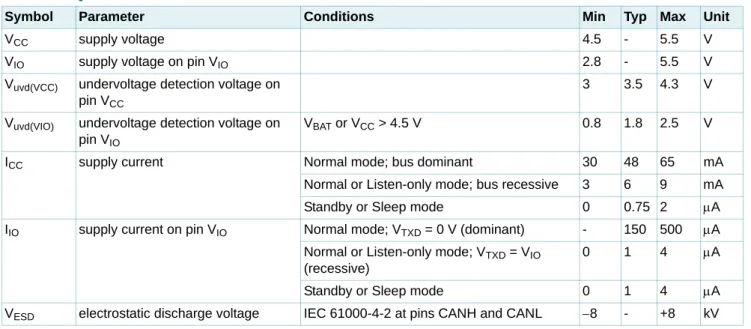
3. Quick reference data
Table 1. Quick reference dataSymbol Parameter Conditions Min Typ Max Unit
VCC supply voltage 4.5 - 5.5 V
VIO supply voltage on pin VIO 2.8 - 5.5 V
Vuvd(VCC) undervoltage detection voltage on
pin VCC
3 3.5 4.3 V
Vuvd(VIO) undervoltage detection voltage on
pin VIO
VBATor VCC > 4.5 V 0.8 1.8 2.5 V
ICC supply current Normal mode; bus dominant 30 48 65 mA
Normal or Listen-only mode; bus recessive 3 6 9 mA Standby or Sleep mode 0 0.75 2 A IIO supply current on pin VIO Normal mode; VTXD= 0 V (dominant) - 150 500 A
Normal or Listen-only mode; VTXD= VIO
(recessive)
0 1 4 A Standby or Sleep mode 0 1 4 A VESD electrostatic discharge voltage IEC 61000-4-2 at pins CANH and CANL 8 - +8 kV
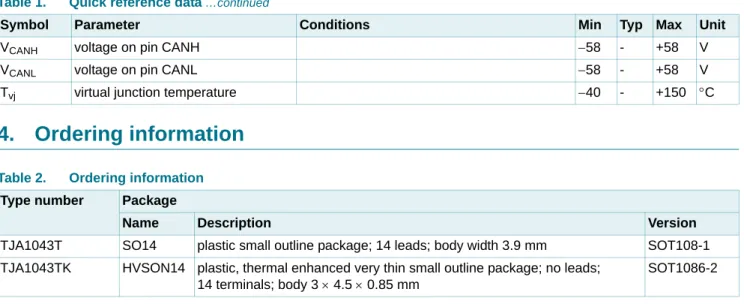
4. Ordering
information
VCANH voltage on pin CANH 58 - +58 V
VCANL voltage on pin CANL 58 - +58 V
Tvj virtual junction temperature 40 - +150 C
Table 1. Quick reference data …continued
Symbol Parameter Conditions Min Typ Max Unit
Table 2. Ordering information
Type number Package
Name Description Version
TJA1043T SO14 plastic small outline package; 14 leads; body width 3.9 mm SOT108-1 TJA1043TK HVSON14 plastic, thermal enhanced very thin small outline package; no leads;
14 terminals; body 3 4.5 0.85 mm
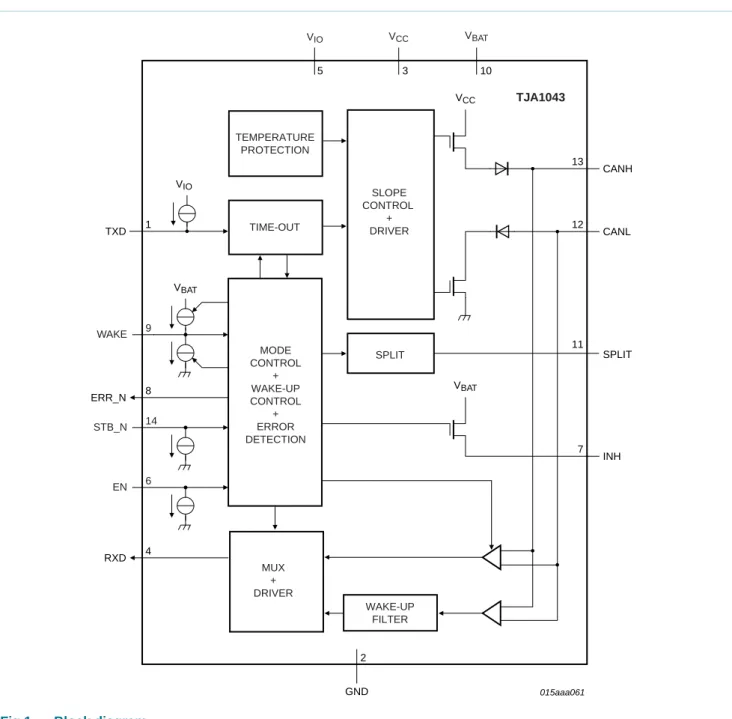
5. Block
diagram
Fig 1. Block diagram
TEMPERATURE PROTECTION
TIME-OUT
MODE CONTROL
+ WAKE-UP CONTROL
+ ERROR DETECTION
MUX + DRIVER
TXD 1 VIO
RXD 4
SLOPE CONTROL
+ DRIVER
VCC
CANH
CANL 13
12
5 3
2
GND
TJA1043
SPLIT 11 SPLIT
WAKE-UP FILTER
015aaa061
10
VCC
VIO VBAT
14 STB_N
6 EN
ERR_N 8 VBAT
9 WAKE
VBAT
INH 7
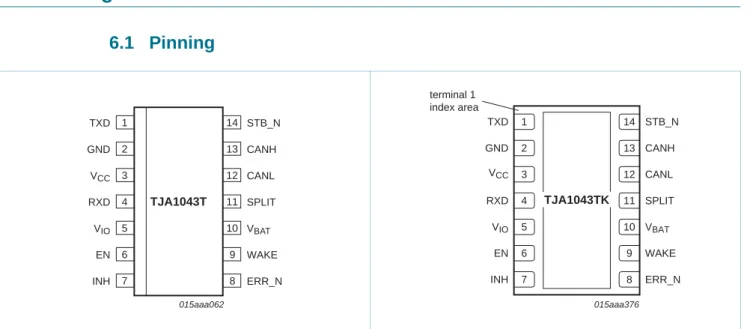
6. Pinning
information
6.1 Pinning
6.2 Pin description
[1] For enhanced thermal and electrical performance, the exposed center pad of the HVSON14 package should be soldered to board ground.
7. Functional
description
The TJA1043 is a stand-alone high-speed CAN transceiver with a number of operating modes, fail-safe features and diagnostic features that offer enhanced system reliability and advanced power management. The transceiver combines the functionality of the
Fig 2. Pin configuration diagram: SO14 Fig 3. Pin configuration diagram: HVSON14
TJA1043T
TXD STB_N
GND CANH
VCC CANL
RXD SPLIT
VIO VBAT
EN WAKE INH ERR_N 015aaa062 1 2 3 4 5 6 7 8 10 9 12 11 14 13 terminal 1 index area TJA1043TK TXD 1 GND 2 RXD 4 VIO 5
EN 6 INH 7 STB_N 14 CANH 13 CANL 12 SPLIT 11 VBAT 10 WAKE 9 ERR_N 8 3 VCC 015aaa376
Table 3. Pin description
Symbol Pin Description
TXD 1 transmit data input GND[1] 2 ground supply
VCC 3 transceiver supply voltage
RXD 4 receive data output; reads out data from the bus lines VIO 5 supply voltage for I/O level adaptor
EN 6 enable control input
INH 7 inhibit output for switching external voltage regulators ERR_N 8 error and power-on indication output (active LOW) WAKE 9 local wake-up input
VBAT 10 battery supply voltage
SPLIT 11 common-mode stabilization output CANL 12 LOW-level CAN bus line
CANH 13 HIGH-level CAN bus line
TJA1041A with improved EMC and ESD capability and quiescent current performance. Improved slope control and high DC handling capability on the bus pins provide additional application flexibility.
7.1 Operating modes
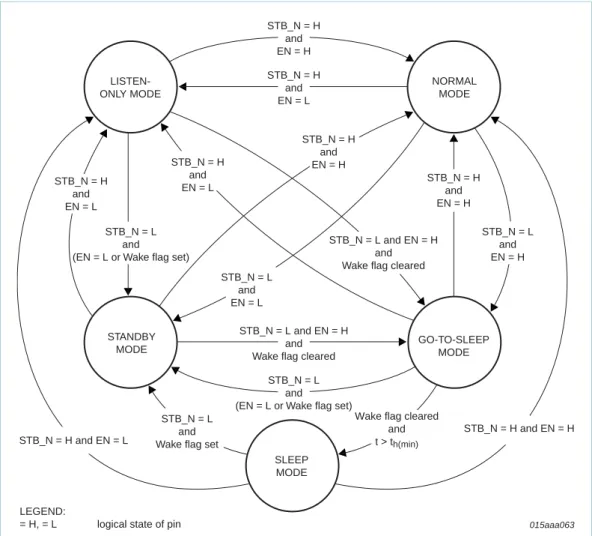
The TJA1043 supports five operating modes. Control pins STB_N and EN are used to select the operating mode. Switching between modes allows access to a number of diagnostics flags via pin ERR_N. Table 4 describes how to switch between modes.
Figure 4 illustrates the mode transitions when VCC, VIO and VBAT are valid.
[1] Setting the UVNOM flag will clear the WAKE flag. [2] Setting the Wake flag will clear the UVNOM flag.
[3] A LOW-to-HIGH transition on pin STB_N will clear the UVNOM flag
[4] After the minimum hold time, in Go-to-Sleep mode, th(min), the transceiver will enter Sleep mode and pin INH will be set floating.
Table 4. Operating mode selection
Internal flags Control pins Operating mode Pin INH
UVNOM[1] UVBAT Wake[2] STB_N[3] EN
From Normal, Listen-only, Standby and Go-to-Sleep modes
set X X X X Sleep mode floating cleared set X HIGH X Standby mode HIGH cleared X set LOW X Standby mode HIGH cleared X cleared LOW LOW Standby mode HIGH cleared X cleared LOW HIGH Go-to-Sleep mode[4] HIGH[4] cleared cleared X HIGH LOW Listen-only mode HIGH cleared cleared X HIGH HIGH Normal mode HIGH
From Sleep mode
set X X X X Sleep mode floating cleared set X HIGH X Standby mode HIGH cleared X set LOW X Standby mode HIGH cleared X cleared LOW X Sleep mode floating cleared cleared X HIGH LOW Listen-only mode HIGH cleared cleared X HIGH HIGH Normal mode HIGH
7.1.1 Normal mode
In Normal mode, the transceiver can transmit and receive data via the bus lines CANH and CANL (see Figure 1 for the block diagram). The differential receiver converts the analog data on the bus lines into digital data which is output to pin RXD. The slopes of the output signals on the bus lines are controlled internally and are optimized in a way that guarantees the lowest possible EME. The bus pins are biased to 0.5VCC (via Ri). Pin INH
is active, so voltage regulators controlled by pin INH (see Figure 8) will be active too.
7.1.2 Listen-only mode
In Listen-only mode, the transceiver’s transmitter is disabled, effectively providing a transceiver listen-only feature. The receiver will still convert the analog bus signal on pins CANH and CANL into digital data, available for output on pin RXD. As in Normal mode, the bus pins are biased at 0.5VCC and pin INH remains active.
Fig 4. Mode transitions when valid VCC, VIO and VBAT voltages are present
015aaa063 STANDBY MODE NORMAL MODE GO-TO-SLEEP MODE LEGEND:
= H, = L logical state of pin
SLEEP MODE
LISTEN-ONLY MODE
Wake flag cleared and t > th(min)
STB_N = H and EN = H STB_N = H and EN = L
STB_N = L and Wake flag set
STB_N = L and (EN = L or Wake flag set)
STB_N = L and EN = H and Wake flag cleared
STB_N = H and EN = H STB_N = H
and EN = L
STB_N = L and (EN = L or Wake flag set)
STB_N = L and EN = H and Wake flag cleared
STB_N = L and EN = H STB_N = H
and EN = H
STB_N = L and EN = L STB_N = H
and EN = L
STB_N = H and EN = H STB_N = H
and EN = L
7.1.3 Standby mode
Standby mode is the TJA1043’s first-level power saving mode, offering reduced current consumption. In Standby mode, the transceiver is unable to transmit or receive data and the low-power receiver is activated to monitor bus activity. The bus pins are biased at ground level (via Ri). Pin INH is still active, so voltage regulators controlled by this pin will
also be active.
Pins RXD and ERR_N will reflect any active wake-up requests (provided that VIO and
VBAT are present).
7.1.4 Go-to-Sleep mode
Go-to-Sleep mode is the controlled route for entering Sleep mode. In Go-to-Sleep mode, the transceiver behaves as in Standby mode, with the addition that a go-to-sleep
command is issued to the transceiver. The transceiver will remain in Go-to-Sleep mode for the minimum hold time (th(min)) before entering Sleep mode. The transceiver will not enter
Sleep mode if the state of pin STB_N or pin EN is changed or if the Wake flag is set before th(min) has elapsed.
7.1.5 Sleep mode
Sleep mode is the TJA1043’s second-level power saving mode. Sleep mode is entered via Go-to-Sleep mode, and also when the undervoltage detection time on either VCC or
VIO elapses before the relevant voltage level has recovered. In Sleep mode, the
transceiver behaves as described for Standby mode, with the exception that pin INH is set floating. Voltage regulators controlled by this pin will be switched off, and the current into pin VBAT will be reduced to a minimum. Pins STB_N, EN and the Wake flag can be used to
wake up a node from Sleep mode (see Table 4).
7.2 Internal flags
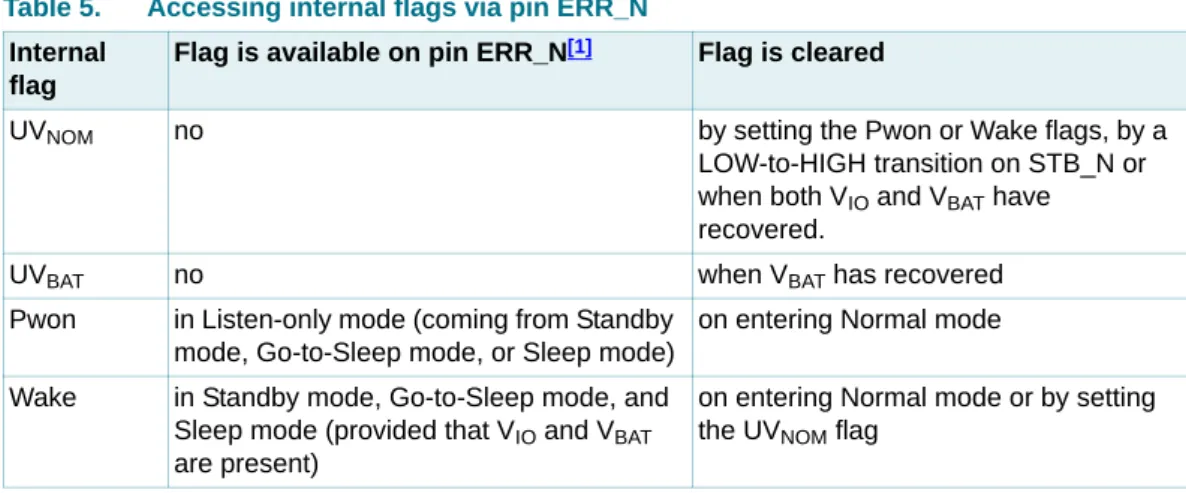
The TJA1043 makes use of seven internal flags for its fail-safe fallback mode control and system diagnosis support. Five of these flags can be polled by the controller via pin ERR_N. Which flag is available on pin ERR_N at any time depends on the active operating mode and on a number of other conditions. Table 5 describes how to access these flags.
Table 5. Accessing internal flags via pin ERR_N
Internal flag
Flag is available on pin ERR_N[1] Flag is cleared
UVNOM no by setting the Pwon or Wake flags, by a
LOW-to-HIGH transition on STB_N or when both VIO and VBAT have
recovered.
UVBAT no when VBAT has recovered
Pwon in Listen-only mode (coming from Standby mode, Go-to-Sleep mode, or Sleep mode)
on entering Normal mode
Wake in Standby mode, Go-to-Sleep mode, and Sleep mode (provided that VIO and VBAT
are present)
on entering Normal mode or by setting the UVNOM flag
[1] Pin ERR_N is an active-LOW output, so a LOW-level indicates a set flag and a HIGH-level indicates a cleared flag. Allow pin ERR_N to stabilize for at least 8s after changing operating modes.
[2] Allow for a TXD dominant time of at least 4s per dominant-recessive cycle.
7.2.1 UV
NOMflag
UVNOM is the VCC and VIO undervoltage detection flag. The flag is set when the voltage on
pin VCC drops below the VCC undervoltage detection voltage, Vuvd(VCC), for longer than the
undervoltage detection time, tdet(uv), or when the voltage on pin VIO drops below Vuvd(VIO)
for longer than tdet(uv). When the UVNOM flag is set, the transceiver enters Sleep mode to
save power and to ensure the bus is not disturbed. In Sleep mode the voltage regulators connected to pin INH are disabled, avoiding any extra power consumption that might be generated as a result of a short-circuit condition.
Any wake-up request, setting the Pwon flag or a LOW-to-HIGH transition on STB_N will clear UVNOM and the timers, allowing the voltage regulators to be reactivated (at least until
UVNOM is set again). UVNOM will also be cleared if both VCC and VIO recover for longer
than the undervoltage recovery time, trec(uv). The transceiver will then switch to the
operating mode indicated by the logic levels on pins STB_N and EN (see Table 4).
7.2.2 UV
BATflag
UVBAT is the VBAT undervoltage detection flag. This flag is set when the voltage on
pin VBAT drops below Vuvd(VBAT). When UVBAT is set, the transceiver will try to enter
Standby mode to save power and will disengage from the bus (zero load). UVBAT is
cleared when the voltage on pin VBAT recovers. The transceiver will then switch to the
operating mode indicated by the logic levels on pins STB_N and EN (see Table 4).
7.2.3 Pwon flag
Pwon is the VBAT power-on flag. This flag is set when the voltage on pin VBAT recovers
after previously dropping below Vuvd(VBAT) (usually because the battery was
disconnected). Setting the Pwon flag clears the UVNOM flag and timers. The Wake and
Wake-up source flags are set to ensure consistent system power-up under all supply conditions. In Listen-only mode the Pwon flag can be polled via pin ERR_N (see Table 5). The flag is cleared when the transceiver enters Normal mode.
7.2.4 Wake flag
The Wake flag is set when the transceiver detects a local or remote wake-up request. A local wake-up request is detected when the logic level on pin WAKE changes, and the new level remains stable for at least twake. A remote wake-up request is triggered by two
bus dominant states of at least twake(busdom), with the first dominant state followed by a
Wake-up source
in Normal mode (before the fourth dominant-to-recessive edge on pin TXD[2])
on leaving Normal mode
Bus failure in Normal mode (after the fourth
dominant-to-recessive edge on pin TXD[2])
on re-entering Normal mode or by setting the Pwon flag
Local failure in Listen-only mode (coming from Normal mode)
on entering Normal mode or when RXD is dominant while TXD is recessive (provided that all local failures are resolved) or by setting the Pwon flag
Table 5. Accessing internal flags via pin ERR_N …continued
Internal flag
recessive state of at least twake(busrec) (provided the complete
dominant-recessive-dominant pattern is completed within tto(wake)bus). The Wake flag can
be set in Standby mode, Go-to-Sleep mode or Sleep mode. Setting the Wake flag clears the UVNOM flag and timers. Once set, the Wake flag status is immediately available on
pins ERR_N and RXD (provided VIO and VBAT are present). This flag is also set at
power-on and cleared when the UVNOM flag is set or the transceiver enters Normal mode.
7.2.5 Wake-up source flag
Wake-up source recognition is provided via the Wake-up source flag, which is set when the Wake flag is set by a local wake-up request via the WAKE pin. The Wake-up source flag can be polled via the ERR_N pin in Normal mode (see Table 5). This flag is also set at power-on and cleared when the transceiver leaves Normal mode.
7.2.6 Bus failure flag
The Bus failure flag is set if the transceiver detects a bus line short-circuit condition to VBAT, VCC or GND during four consecutive dominant-recessive cycles on pin TXD, while
trying to drive the bus lines dominant. The Bus failure flag can be polled via the ERR_N pin in Normal mode (see Table 5). This flag is cleared at power-on or when the transceiver re-enters Normal mode.
7.2.7 Local failure flag
In Normal and Listen-only modes, the transceiver can distinguish four different local failure events, any of which will cause the Local failure flag to be set. The four local failure events are: TXD dominant clamping, TXD-to-RXD short circuit, bus dominant clamping and an overtemperature event. The nature and detection of these local failures is described in Section 7.3. The Local failure flag can be polled via the ERR_N pin in Listen-only mode (see Table 5). This flag is cleared at power-on, when entering Normal mode or when RXD is dominant while TXD is recessive, provided that all local failures have been resolved.
7.3 Local failures
The TJA1043 can detect four different local failure conditions. Any of these failures will set the Local failure flag, and in most cases the transmitter of the transceiver will be disabled.
7.3.1 TXD dominant clamping detection
A permanent LOW level on pin TXD (due to a hardware or software application failure) would drive the CAN bus into a permanent dominant state, blocking all network
communications. The TXD dominant time-out function prevents such a network lock-up by disabling the transmitter if pin TXD remains LOW for longer than the TXD dominant time-out time tto(dom)TXD. The tto(dom)TXD timer defines the minimum possible bit rate of
40 kbit/s. The transmitter remains disabled until the Local failure flag has been cleared.
7.3.2 TXD-to-RXD short-circuit detection
A short-circuit between pins RXD and TXD would lock the bus in a permanent dominant state once it had been driven dominant, because the low-side driver of RXD is typically stronger than the high-side driver of the controller connected to TXD. TXD-to-RXD short-circuit detection prevents such a network lock-up by disabling the transmitter. The transmitter remains disabled until the Local failure flag has been cleared.
7.3.3 Bus dominant clamping detection
A CAN bus short circuit (to VBAT, VCC or GND) or a failure in one of the other network
nodes could result in a differential voltage on the bus high enough to represent a bus dominant state. Because a node will not start transmission if the bus is dominant, the normal bus failure detection will not detect this failure, but the bus dominant clamping detection will. The Local failure flag is set if the dominant state on the bus persists for longer than tto(dom)bus. By checking this flag, the controller can determine if a clamped bus
is blocking network communications. There is no need to disable the transmitter. Note that the Local failure flag does not retain a bus dominant clamping failure, and is released as soon as the bus returns to recessive state.
7.3.4 Overtemperature detection
If the junction temperature becomes excessive, the transmitter will shut down in time to protect the output drivers from overheating without compromising the maximum operating temperature. The transmitter will remain disabled until the Local failure flag has been cleared.
7.4 SPLIT pin
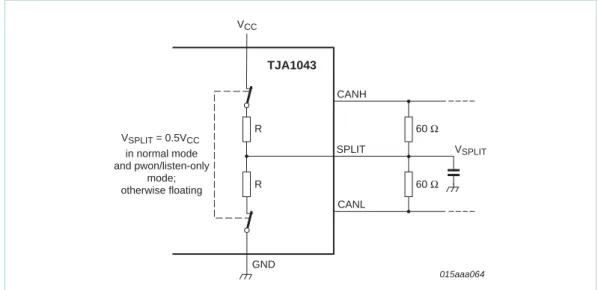
Using the SPLIT pin on the TJA1043 in conjunction with a split termination network (see
Figure 5 and Figure 8) can help to stabilize the recessive voltage level on the bus. This will reduce EME in networks with DC leakage to ground (e.g. from deactivated nodes with poor bus leakage performance). In Normal and Listen-only modes, pin SPLIT delivers a DC output voltage of 0.5VCC. In Standby, Go-to-Sleep and Sleep modes, pin SPLIT is
floating.
7.5 V
IOsupply pin
Pin VIO should be connected to the microcontroller supply voltage (see Figure 8). This will
cause the signal levels of pins TXD, RXD, STB_N, EN and ERR_N to be adjusted to the I/O levels of the microcontroller, facilitating direct interfacing without the need for glue logic.
Fig 5. Stabilization circuit and application GND VCC
VSPLIT = 0.5VCC
in normal mode and pwon/listen-only
mode; otherwise floating
TJA1043
SPLIT
60 Ω
60 Ω R
R
015aaa064 VSPLIT
CANH
7.6 WAKE pin
A local wake-up event is triggered by a LOW-to-HIGH or HIGH-to-LOW transition on the WAKE pin, allowing for maximum flexibility when designing a local wake-up circuit.To minimize current consumption, the internal bias voltage will follow the logic state on the pin after a delay of twake. A HIGH level on pin WAKE is followed by an internal pull-up to
VBAT. A LOW level on pin WAKE is followed by an internal pull-down towards GND. In
applications that don’t make use of the local wake-up facility, it is recommended that the WAKE pin be connected to VBAT or GND to ensure optimal EMI performance.
8. Limiting
values
[1] Verified by an external test house to ensure pins CANH, CANL, SPLIT and VBAT can withstand ISO 7637 part 3 automotive transient test pulses 1, 2a, 3a and 3b.
[2] According to IEC TS 62228 (2007), Section 4.3; DIN EN 61000-4-2. [3] According to AEC-Q100-002.
[4] According to AEC-Q100-003.
[5] According to AEC-Q100-011 Rev-C1. The classification level is C4B.
[6] In accordance with IEC 60747-1. An alternative definition of virtual junction temperature is: Tvj= Tamb+ PRth(vj-a), where Rth(vj-a) is a fixed value to be used for the calculation of Tvj. The rating for Tvj limits the allowable combinations of power dissipation (P) and ambient temperature (Tamb).
9. Thermal
characteristics
Table 6. Limiting values
In accordance with the Absolute Maximum Rating System (IEC 60134).
Symbol Parameter Conditions Min Max Unit
VBAT battery supply voltage 0.3 +58 V
load dump - 58 V
Vx voltage on pin x on pins CANH, CANL and SPLIT 58 +58 V
on pins INH and WAKE 0.3 +58 V on pins VCC, VIO, TXD, RXD, STB_N, EN,
ERR_N
0.3 +7 V
IWAKE current on pin WAKE - 15 mA
Vtrt transient voltage on pins CANH, CANL, SPLIT and VBAT [1] 200 +200 V
VESD electrostatic discharge voltage IEC 61000-4-2 (150 pF, 330) [2]
at pins CANH and CANL 8 +8 kV Human Body Model (HBM); 100 pF, 1.5 k [3]
at pins CANH and CANL 8 +8 kV at any other pin 4 +4 kV Machine Model (MM); 200 pF, 0.75 H, 10 [4]
at any pin 300 +300 V Charged Device Model (CDM); field Induced
charge; 4 pF
[5]
at corner pins 750 +750 V at any pin 500 +500 V Tvj virtual junction temperature [6] 40 +150 C
Tstg storage temperature 55 +150 C
Table 7. Thermal characteristics
Value determined for free convection conditions on a JEDEC 2S2P board.
Symbol Parameter Conditions Typ Unit
Rth(vj-a) thermal resistance from virtual junction to ambient SO14 package; in free air 68 K/W
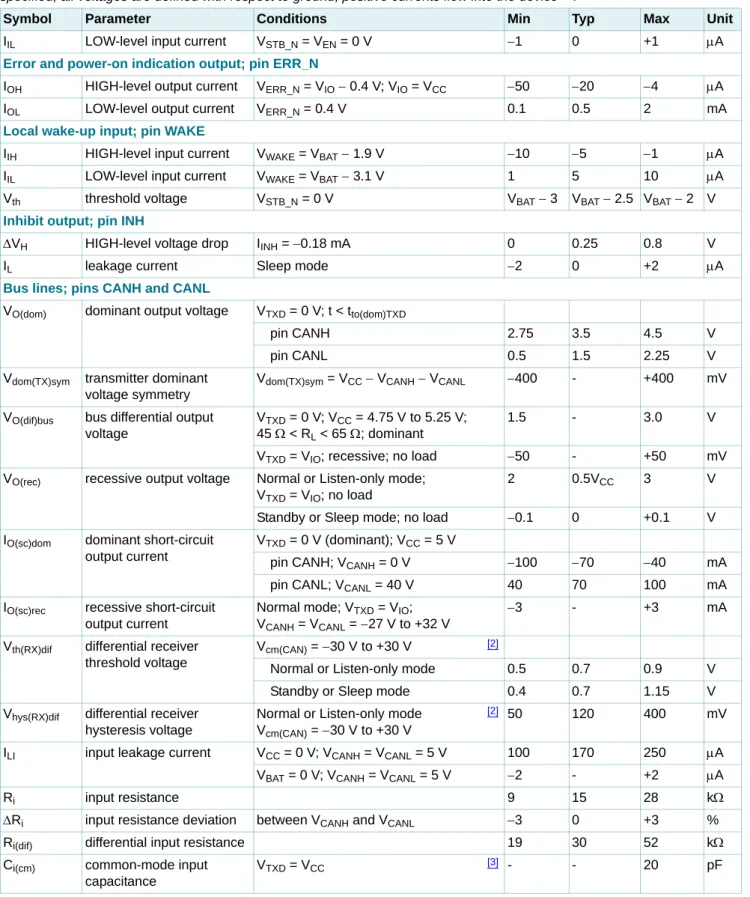
10. Static characteristics
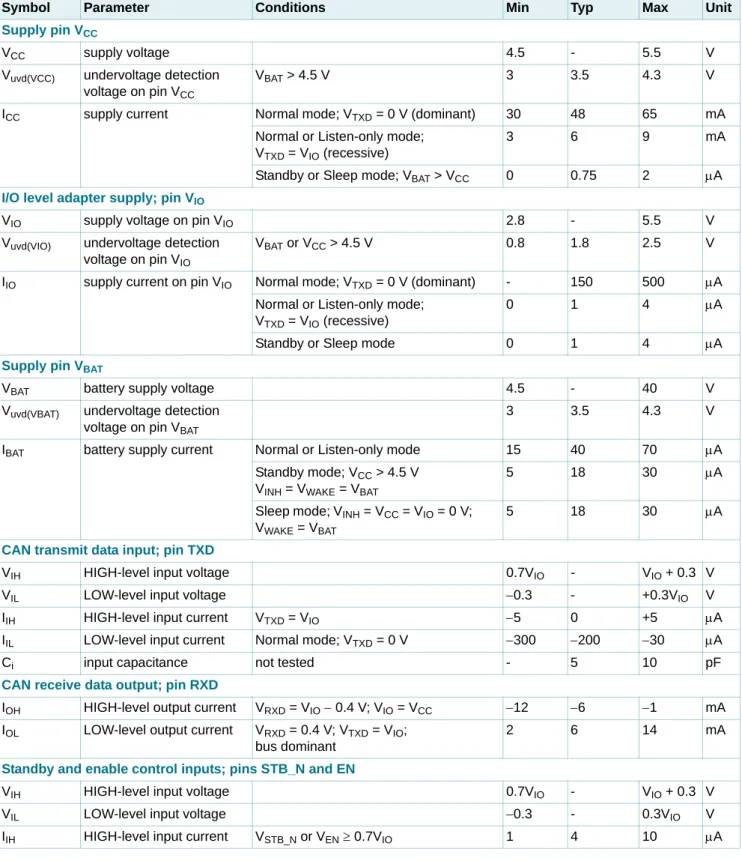
Table 8. Static characteristicsVCC= 4.5 V to 5.5 V; VIO = 2.8 V to VCC; VBAT= 4.5 V to 40 V; RL= 60; Tvj=40C to +150C; unless otherwise
specified; all voltages are defined with respect to ground; positive currents flow into the device [1].
Symbol Parameter Conditions Min Typ Max Unit
Supply pin VCC
VCC supply voltage 4.5 - 5.5 V
Vuvd(VCC) undervoltage detection
voltage on pin VCC
VBAT> 4.5 V 3 3.5 4.3 V
ICC supply current Normal mode; VTXD= 0 V (dominant) 30 48 65 mA
Normal or Listen-only mode; VTXD= VIO (recessive)
3 6 9 mA
Standby or Sleep mode; VBAT > VCC 0 0.75 2 A
I/O level adapter supply; pin VIO
VIO supply voltage on pin VIO 2.8 - 5.5 V
Vuvd(VIO) undervoltage detection
voltage on pin VIO
VBATor VCC > 4.5 V 0.8 1.8 2.5 V
IIO supply current on pin VIO Normal mode; VTXD= 0 V (dominant) - 150 500 A
Normal or Listen-only mode; VTXD= VIO (recessive)
0 1 4 A
Standby or Sleep mode 0 1 4 A
Supply pin VBAT
VBAT battery supply voltage 4.5 - 40 V
Vuvd(VBAT) undervoltage detection
voltage on pin VBAT
3 3.5 4.3 V
IBAT battery supply current Normal or Listen-only mode 15 40 70 A
Standby mode; VCC> 4.5 V
VINH= VWAKE= VBAT
5 18 30 A
Sleep mode; VINH= VCC= VIO= 0 V;
VWAKE= VBAT
5 18 30 A
CAN transmit data input; pin TXD
VIH HIGH-level input voltage 0.7VIO - VIO+ 0.3 V
VIL LOW-level input voltage 0.3 - +0.3VIO V
IIH HIGH-level input current VTXD= VIO 5 0 +5 A
IIL LOW-level input current Normal mode; VTXD= 0 V 300 200 30 A
Ci input capacitance not tested - 5 10 pF
CAN receive data output; pin RXD
IOH HIGH-level output current VRXD= VIO0.4 V; VIO= VCC 12 6 1 mA
IOL LOW-level output current VRXD= 0.4 V; VTXD= VIO;
bus dominant
2 6 14 mA
Standby and enable control inputs; pins STB_N and EN
VIH HIGH-level input voltage 0.7VIO - VIO+ 0.3 V
VIL LOW-level input voltage 0.3 - 0.3VIO V
IIL LOW-level input current VSTB_N= VEN= 0 V 1 0 +1 A
Error and power-on indication output; pin ERR_N
IOH HIGH-level output current VERR_N= VIO0.4 V; VIO= VCC 50 20 4 A
IOL LOW-level output current VERR_N= 0.4 V 0.1 0.5 2 mA
Local wake-up input; pin WAKE
IIH HIGH-level input current VWAKE= VBAT1.9 V 10 5 1 A
IIL LOW-level input current VWAKE= VBAT3.1 V 1 5 10 A
Vth threshold voltage VSTB_N= 0 V VBAT3 VBAT2.5 VBAT2 V
Inhibit output; pin INH
VH HIGH-level voltage drop IINH=0.18 mA 0 0.25 0.8 V
IL leakage current Sleep mode 2 0 +2 A
Bus lines; pins CANH and CANL
VO(dom) dominant output voltage VTXD= 0 V; t < tto(dom)TXD
pin CANH 2.75 3.5 4.5 V pin CANL 0.5 1.5 2.25 V Vdom(TX)sym transmitter dominant
voltage symmetry
Vdom(TX)sym= VCCVCANHVCANL 400 - +400 mV
VO(dif)bus bus differential output
voltage
VTXD= 0 V; VCC= 4.75 V to 5.25 V;
45< RL< 65; dominant
1.5 - 3.0 V
VTXD= VIO; recessive; no load 50 - +50 mV
VO(rec) recessive output voltage Normal or Listen-only mode;
VTXD= VIO; no load
2 0.5VCC 3 V
Standby or Sleep mode; no load 0.1 0 +0.1 V IO(sc)dom dominant short-circuit
output current
VTXD= 0 V (dominant); VCC= 5 V
pin CANH; VCANH= 0 V 100 70 40 mA
pin CANL; VCANL= 40 V 40 70 100 mA
IO(sc)rec recessive short-circuit
output current
Normal mode; VTXD= VIO;
VCANH= VCANL=27 V to +32 V
3 - +3 mA
Vth(RX)dif differential receiver
threshold voltage
Vcm(CAN)=30 V to +30 V [2]
Normal or Listen-only mode 0.5 0.7 0.9 V Standby or Sleep mode 0.4 0.7 1.15 V Vhys(RX)dif differential receiver
hysteresis voltage
Normal or Listen-only mode Vcm(CAN)=30 V to +30 V
[2] 50 120 400 mV
ILI input leakage current VCC= 0 V; VCANH= VCANL= 5 V 100 170 250 A
VBAT= 0 V; VCANH= VCANL= 5 V 2 - +2 A
Ri input resistance 9 15 28 k
Ri input resistance deviation between VCANHand VCANL 3 0 +3 %
Ri(dif) differential input resistance 19 30 52 k
Ci(cm) common-mode input
capacitance
VTXD= VCC [3] - - 20 pF
Table 8. Static characteristics …continued
VCC= 4.5 V to 5.5 V; VIO = 2.8 V to VCC; VBAT= 4.5 V to 40 V; RL= 60; Tvj=40C to +150C; unless otherwise
specified; all voltages are defined with respect to ground; positive currents flow into the device [1].
[1] All parameters are guaranteed over the virtual junction temperature range by design. Factory testing uses correlated test conditions to cover the specified temperature and power supply voltage range.
[2] Vcm(CAN) is the common mode voltage of CANH and CANL. [3] Not tested in production; guaranteed by design.
Ci(dif) differential input
capacitance
VTXD= VCC [3] - - 10 pF
Common-mode stabilization output; pin SPLIT
VO output voltage Normal or Listen-only mode;
500A < ISPLIT< 500A
0.3VCC 0.5VCC 0.7VCC V
Normal or Listen-only mode RL= 1 M
0.45VCC 0.5VCC 0.55VCC V
IL leakage current Standby or Sleep mode;
58 V < VSPLIT< +58 V
3 0 +3 A
Temperature detection
Tj(sd) shutdown junction
temperature
[3] - 190 - C
Table 8. Static characteristics …continued
VCC= 4.5 V to 5.5 V; VIO = 2.8 V to VCC; VBAT= 4.5 V to 40 V; RL= 60; Tvj=40C to +150C; unless otherwise
specified; all voltages are defined with respect to ground; positive currents flow into the device [1].
11. Dynamic characteristics
[1] All parameters are guaranteed over the virtual junction temperature range by design. Factory testing uses correlated test conditions to cover the specified temperature and power supply voltage range.
[2] See Figure 7.
Table 9. Dynamic characteristics;
VCC= 4.5 V to 5.5 V; VIO = 2.8 V to VCC; VBAT= 4.5 V to 40 V; RL= 60; Tvj=40C to +150C; unless otherwise
specified; all voltages are defined with respect to ground; positive currents flow into the device[1].
Symbol Parameter Conditions Min Typ Max Unit
Timing characteristics; Figure 6
td(TXD-busdom) delay time from TXD to bus dominant Normal mode - 70 - ns
td(TXD-busrec) delay time from TXD to bus recessive Normal mode - 90 - ns
td(busdom-RXD) delay time from bus dominant to RXD Normal or Listen-only mode - 60 - ns
td(busrec-RXD) delay time from bus recessive to
RXD
Normal or Listen-only mode - 70 - ns
tPD(TXD-RXD) propagation delay from TXD to RXD Normal mode 40 - 240 ns
tdet(uv) undervoltage detection time 100 - 350 ms
trec(uv) undervoltage recovery time 1 - 5 ms
tbit(RXD) bit time on pin RXD tbit(TXD)= 500 ns [2] 400 - 550 ns
tto(dom)TXD TXD dominant time-out time VTXD= 0 V 0.3 0.6 1.5 ms
tto(dom)bus bus dominant time-out time VO(dif)(bus) > 0.9 V 0.3 0.6 1.5 ms
th hold time from issuing go-to-sleep
command to entering Sleep mode
20 35 50 s twake(busdom) bus dominant wake-up time Standby or Sleep mode;
VBAT= 12 V
0.5 1.75 5 s twake(busrec) bus recessive wake-up time Standby or Sleep mode;
VBAT= 12 V
0.5 1.75 5 s tto(wake)bus bus wake-up time-out time 0.5 - 2 ms
twake wake-up time in response to a falling or rising
edge on pin WAKE; Standby or Sleep mode
Fig 6. CAN transceiver timing diagram
Fig 7. Loop delay symmetry timing diagram CANH
CANL
td(TXD-busdom)
TXD
VO(dif)(bus)
RXD
HIGH
HIGH LOW
LOW dominant
recessive 0.9 V
0.5 V
0.3VIO
0.7VIO
td(busdom-RXD)
td(TXD-busrec)
td(busrec-RXD)
tPD(TXD-RXD)
tPD(TXD-RXD) 015aaa025
WELW7;'
[WELW7;'
WELW5;'
DDD
7;'
12. Application information
12.1 Application diagram
12.2 Application hints
Further information on the application of the TJA1043 can be found in NXP application hints AH1014 Application Hints - Standalone high speed CAN transceiver
TJA1042/TJA1043/TJA1048/TJA1051.
Fig 8. Typical application with 3 V microcontroller SPLIT
CAN bus wires
TJA1043
MICRO-CONTROLLER WAKE
VIO
INH
VBAT VCC
5 7
10 3 VCC
Port x, y, z
RXD TXD STB_N
GND 9
2
CANL CANH
11 12
13
015aaa060 EN
TXD RXD ERR_N 14
6
1 4 8 5 V
BAT
13. Test information
13.1 Quality information
This product has been qualified in accordance with the Automotive Electronics Council (AEC) standard Q100 Rev-G - Failure mechanism based stress test qualification for integrated circuits, and is suitable for use in automotive applications.
Fig 9. Hysteresis of the receiver
Fig 10. Test circuit for timing characteristics
PJV
95;'
+,*+
/2: K\VWHUHVLV
9LGLIEXV9
10 μF 100 nF
47 μF
100 pF RL
TJA1043
WAKE TXD EN
5 1 6 14 9
2
3 10
13
12 11 STB_N
VIO
GND VCC VBAT
SPLIT CANL CANH
8 ERR_N 7 INH
015aaa163 15 pF
4 RXD +5 V
14. Package outline
Fig 11. Package outline SOT108-1 (SO14)
81,7 PD[$ $ $ $ ES F ' ( H +( / /S 4 Y Z \ = ș
5()(5(1&(6 287/,1(
9(56,21
(8523($1
352-(&7,21 ,668('$7(
,(& -('(& -(,7$
PP LQFKHV R R ',0(16,216LQFKGLPHQVLRQVDUHGHULYHGIURPWKHRULJLQDOPPGLPHQVLRQV 1RWH 3ODVWLFRUPHWDOSURWUXVLRQVRIPPLQFKPD[LPXPSHUVLGHDUHQRWLQFOXGHG 627 ; Z0 ș $ $ $ ES ' +( /S 4 GHWDLO; ( = H F /
Y0$
$ $ \ ( 06 SLQLQGH[ PP VFDOH 62SODVWLFVPDOORXWOLQHSDFNDJHOHDGVERG\ZLGWKPP 627
Fig 12. Package outline SOT1086 (HVSON14) 5HIHUHQFHV 2XWOLQH YHUVLRQ (XURSHDQ SURMHFWLRQ ,VVXHGDWH ,(& -('(& -(,7$
627 02
VRW 8QLW PP PD[ QRP PLQ $ 'LPHQVLRQV +9621SODVWLFWKHUPDOHQKDQFHGYHU\WKLQVPDOORXWOLQHSDFNDJHQROHDGV WHUPLQDOVERG\[[PP 627
$ E
F ' 'K ( (K
H H N
/ Y Z \ \ PP VFDOH % $ WHUPLQDO LQGH[DUHD ' ( ; GHWDLO; $ F $ & \ & \ $ & % Y & Z E WHUPLQDO LQGH[DUHD H H 'K (K / N
15. Handling information
All input and output pins are protected against ElectroStatic Discharge (ESD) under normal handling. When handling ensure that the appropriate precautions are taken as described in JESD625-A or equivalent standards.
16. Soldering of SMD packages
This text provides a very brief insight into a complex technology. A more in-depth account of soldering ICs can be found in Application Note AN10365 “Surface mount reflow soldering description”.
16.1 Introduction to soldering
Soldering is one of the most common methods through which packages are attached to Printed Circuit Boards (PCBs), to form electrical circuits. The soldered joint provides both the mechanical and the electrical connection. There is no single soldering method that is ideal for all IC packages. Wave soldering is often preferred when through-hole and Surface Mount Devices (SMDs) are mixed on one printed wiring board; however, it is not suitable for fine pitch SMDs. Reflow soldering is ideal for the small pitches and high densities that come with increased miniaturization.
16.2 Wave and reflow soldering
Wave soldering is a joining technology in which the joints are made by solder coming from a standing wave of liquid solder. The wave soldering process is suitable for the following:
•
Through-hole components•
Leaded or leadless SMDs, which are glued to the surface of the printed circuit board Not all SMDs can be wave soldered. Packages with solder balls, and some leadless packages which have solder lands underneath the body, cannot be wave soldered. Also, leaded SMDs with leads having a pitch smaller than ~0.6 mm cannot be wave soldered, due to an increased probability of bridging.The reflow soldering process involves applying solder paste to a board, followed by component placement and exposure to a temperature profile. Leaded packages, packages with solder balls, and leadless packages are all reflow solderable. Key characteristics in both wave and reflow soldering are:
•
Board specifications, including the board finish, solder masks and vias•
Package footprints, including solder thieves and orientation•
The moisture sensitivity level of the packages•
Package placement•
Inspection and repair•
Lead-free soldering versus SnPb soldering16.3 Wave soldering
•
Process issues, such as application of adhesive and flux, clinching of leads, board transport, the solder wave parameters, and the time during which components are exposed to the wave•
Solder bath specifications, including temperature and impurities16.4 Reflow soldering
Key characteristics in reflow soldering are:
•
Lead-free versus SnPb soldering; note that a lead-free reflow process usually leads to higher minimum peak temperatures (see Figure 13) than a SnPb process, thus reducing the process window•
Solder paste printing issues including smearing, release, and adjusting the process window for a mix of large and small components on one board•
Reflow temperature profile; this profile includes preheat, reflow (in which the board is heated to the peak temperature) and cooling down. It is imperative that the peak temperature is high enough for the solder to make reliable solder joints (a solder paste characteristic). In addition, the peak temperature must be low enough that the packages and/or boards are not damaged. The peak temperature of the package depends on package thickness and volume and is classified in accordance withTable 10 and11
Moisture sensitivity precautions, as indicated on the packing, must be respected at all times.
Studies have shown that small packages reach higher temperatures during reflow soldering, see Figure 13.
Table 10. SnPb eutectic process (from J-STD-020D)
Package thickness (mm) Package reflow temperature (C) Volume (mm3)
< 350 350
< 2.5 235 220
2.5 220 220
Table 11. Lead-free process (from J-STD-020D)
Package thickness (mm) Package reflow temperature (C) Volume (mm3)
< 350 350 to 2000 > 2000
< 1.6 260 260 260
1.6 to 2.5 260 250 245
For further information on temperature profiles, refer to Application Note AN10365 “Surface mount reflow soldering description”.
17. Soldering of HVSON packages
Section 16 contains a brief introduction to the techniques most commonly used to solder Surface Mounted Devices (SMD). A more detailed discussion on soldering HVSON leadless package ICs can found in the following application notes:
•
AN10365 ‘Surface mount reflow soldering description”•
AN10366 “HVQFN application information”MSL: Moisture Sensitivity Level
Fig 13. Temperature profiles for large and small components
001aac844
temperature
time minimum peak temperature
= minimum soldering temperature maximum peak temperature = MSL limit, damage level
peak temperature
18. Revision history
Table 12. Revision historyDocument ID Release date Data sheet status Change notice Supersedes
TJA1043 v.4 20150119 Product data sheet - TJA1043 v.3 Modifications:
•
Section 1: text revised (1st paragraph); paragraph added•
Section 2: minor amendments to text•
Section 2.1: features added•
Table 1: added parameters VIO, Vuvd(VIO) and IIO; measurements conditions changed: VCANH, VCANL•
Table 3: Table note 1: text revised•
Section 7.1.1: minor changes to text•
Table 6: measurements conditions changed: VBAT, Vx, IWAKE, VESD; table note section revised•
Table 8: parameter values/conditions changed: IOH and IOL for pin RXD, IIH for pins STB_N and EN;parameters renamed: IO(sc)dom and IO(sc)rec
•
Table 9: measurements conditions changed (tPD(TXD-RXD)); parameter tbit(RXD) added; Table note 2 andFigure 7 added
•
Section 12.2 “Application hints”: added•
Section 19.3: ‘Translations’ disclaimer addedTJA1043 v.3 20130424 Product data sheet - TJA1043 v.2 TJA1043 v.2 20110620 Product data sheet - TJA1043 v.1 TJA1043 v.1 20100330 Product data sheet -
-19. Legal information
19.1 Data
sheet
status
[1] Please consult the most recently issued document before initiating or completing a design. [2] The term ‘short data sheet’ is explained in section “Definitions”.
[3] The product status of device(s) described in this document may have changed since this document was published and may differ in case of multiple devices. The latest product status information is available on the Internet at URLhttp://www.nxp.com.
19.2 Definitions
Draft — The document is a draft version only. The content is still under internal review and subject to formal approval, which may result in modifications or additions. NXP Semiconductors does not give any representations or warranties as to the accuracy or completeness of information included herein and shall have no liability for the consequences of use of such information.
Short data sheet — A short data sheet is an extract from a full data sheet with the same product type number(s) and title. A short data sheet is intended for quick reference only and should not be relied upon to contain detailed and full information. For detailed and full information see the relevant full data sheet, which is available on request via the local NXP Semiconductors sales office. In case of any inconsistency or conflict with the short data sheet, the full data sheet shall prevail.
Product specification — The information and data provided in a Product data sheet shall define the specification of the product as agreed between NXP Semiconductors and its customer, unless NXP Semiconductors and customer have explicitly agreed otherwise in writing. In no event however, shall an agreement be valid in which the NXP Semiconductors product is deemed to offer functions and qualities beyond those described in the Product data sheet.
19.3 Disclaimers
Limited warranty and liability — Information in this document is believed to be accurate and reliable. However, NXP Semiconductors does not give any representations or warranties, expressed or implied, as to the accuracy or completeness of such information and shall have no liability for the consequences of use of such information. NXP Semiconductors takes no responsibility for the content in this document if provided by an information source outside of NXP Semiconductors.
In no event shall NXP Semiconductors be liable for any indirect, incidental, punitive, special or consequential damages (including - without limitation - lost profits, lost savings, business interruption, costs related to the removal or replacement of any products or rework charges) whether or not such damages are based on tort (including negligence), warranty, breach of contract or any other legal theory.
Notwithstanding any damages that customer might incur for any reason whatsoever, NXP Semiconductors’ aggregate and cumulative liability towards customer for the products described herein shall be limited in accordance with the Terms and conditions of commercial sale of NXP Semiconductors.
Right to make changes — NXP Semiconductors reserves the right to make changes to information published in this document, including without limitation specifications and product descriptions, at any time and without notice. This document supersedes and replaces all information supplied prior to the publication hereof.
Suitability for use in automotive applications — This NXP Semiconductors product has been qualified for use in automotive
applications. Unless otherwise agreed in writing, the product is not designed, authorized or warranted to be suitable for use in life support, life-critical or safety-critical systems or equipment, nor in applications where failure or malfunction of an NXP Semiconductors product can reasonably be expected to result in personal injury, death or severe property or environmental damage. NXP Semiconductors and its suppliers accept no liability for inclusion and/or use of NXP Semiconductors products in such equipment or applications and therefore such inclusion and/or use is at the customer's own risk.
Applications — Applications that are described herein for any of these products are for illustrative purposes only. NXP Semiconductors makes no representation or warranty that such applications will be suitable for the specified use without further testing or modification.
Customers are responsible for the design and operation of their applications and products using NXP Semiconductors products, and NXP Semiconductors accepts no liability for any assistance with applications or customer product design. It is customer’s sole responsibility to determine whether the NXP Semiconductors product is suitable and fit for the customer’s applications and products planned, as well as for the planned application and use of customer’s third party customer(s). Customers should provide appropriate design and operating safeguards to minimize the risks associated with their applications and products.
NXP Semiconductors does not accept any liability related to any default, damage, costs or problem which is based on any weakness or default in the customer’s applications or products, or the application or use by customer’s third party customer(s). Customer is responsible for doing all necessary testing for the customer’s applications and products using NXP
Semiconductors products in order to avoid a default of the applications and the products or of the application or use by customer’s third party customer(s). NXP does not accept any liability in this respect.
Limiting values — Stress above one or more limiting values (as defined in the Absolute Maximum Ratings System of IEC 60134) will cause permanent damage to the device. Limiting values are stress ratings only and (proper) operation of the device at these or any other conditions above those given in the Recommended operating conditions section (if present) or the Characteristics sections of this document is not warranted. Constant or repeated exposure to limiting values will permanently and irreversibly affect the quality and reliability of the device.
Terms and conditions of commercial sale — NXP Semiconductors products are sold subject to the general terms and conditions of commercial sale, as published at http://www.nxp.com/profile/terms, unless otherwise agreed in a valid written individual agreement. In case an individual agreement is concluded only the terms and conditions of the respective agreement shall apply. NXP Semiconductors hereby expressly objects to applying the customer’s general terms and conditions with regard to the purchase of NXP Semiconductors products by customer.
Document status[1][2] Product status[3] Definition
Objective [short] data sheet Development This document contains data from the objective specification for product development. Preliminary [short] data sheet Qualification This document contains data from the preliminary specification.
No offer to sell or license — Nothing in this document may be interpreted or construed as an offer to sell products that is open for acceptance or the grant, conveyance or implication of any license under any copyrights, patents or other industrial or intellectual property rights.
Export control — This document as well as the item(s) described herein may be subject to export control regulations. Export might require a prior authorization from competent authorities.
Quick reference data — The Quick reference data is an extract of the product data given in the Limiting values and Characteristics sections of this document, and as such is not complete, exhaustive or legally binding.
Translations — A non-English (translated) version of a document is for reference only. The English version shall prevail in case of any discrepancy between the translated and English versions.
19.4 Trademarks
Notice: All referenced brands, product names, service names and trademarks are the property of their respective owners.
20. Contact information
For more information, please visit: http://www.nxp.com
© NXP Semiconductors N.V. 2015. All rights reserved.
For more information, please visit: http://www.nxp.com
For sales office addresses, please send an email to: [email protected]
Date of release: 19 January 2015
Please be aware that important notices concerning this document and the product(s) described herein, have been included in section ‘Legal information’.
21. Contents
1 General description . . . 1
2 Features and benefits . . . 1
2.1 General . . . 1
2.2 Low-power management . . . 2
2.3 Protection and diagnosis (detection and signalling) . . . 2
3 Quick reference data . . . 2
4 Ordering information . . . 3
5 Block diagram . . . 4
6 Pinning information . . . 5
6.1 Pinning . . . 5
6.2 Pin description . . . 5
7 Functional description . . . 5
7.1 Operating modes . . . 6
7.1.1 Normal mode . . . 7
7.1.2 Listen-only mode . . . 7
7.1.3 Standby mode. . . 8
7.1.4 Go-to-Sleep mode . . . 8
7.1.5 Sleep mode . . . 8
7.2 Internal flags . . . 8
7.2.1 UVNOM flag . . . 9
7.2.2 UVBAT flag . . . 9
7.2.3 Pwon flag . . . 9
7.2.4 Wake flag . . . 9
7.2.5 Wake-up source flag. . . 10
7.2.6 Bus failure flag . . . 10
7.2.7 Local failure flag . . . 10
7.3 Local failures . . . 10
7.3.1 TXD dominant clamping detection . . . 10
7.3.2 TXD-to-RXD short-circuit detection . . . 10
7.3.3 Bus dominant clamping detection. . . 11
7.3.4 Overtemperature detection . . . 11
7.4 SPLIT pin . . . 11
7.5 VIO supply pin . . . 11
7.6 WAKE pin . . . 12
8 Limiting values. . . 13
9 Thermal characteristics . . . 13
10 Static characteristics . . . 14
11 Dynamic characteristics . . . 17
12 Application information. . . 19
12.1 Application diagram . . . 19
12.2 Application hints . . . 19
13 Test information . . . 20
13.1 Quality information . . . 20
14 Package outline . . . 21
15 Handling information . . . 23
16 Soldering of SMD packages . . . 23
16.1 Introduction to soldering. . . 23
16.2 Wave and reflow soldering. . . 23
16.3 Wave soldering . . . 23
16.4 Reflow soldering . . . 24
17 Soldering of HVSON packages . . . 25
18 Revision history . . . 26
19 Legal information . . . 27
19.1 Data sheet status . . . 27
19.2 Definitions . . . 27
19.3 Disclaimers . . . 27
19.4 Trademarks . . . 28
20 Contact information . . . 28