Return Predictability
John H. Cochrane
University of Chicago GSB and NBER
If returns are not predictable, dividend growth must be predictable, to generate the observed variation in divided yields. I find that theabsenceof dividend growth predictability gives stronger evidence than does thepresenceof return predictability. Long-horizon return forecasts give the same strong evidence. These tests exploit the negative correlation of return forecasts with dividend-yield autocorrelation across samples, together with sensible upper bounds on dividend-yield autocorrelation, to deliver more powerful statistics. I reconcile my findings with the literature that finds poor power in long-horizon return forecasts, and with the literature that notes the poor out-of-sampleR2of return-forecasting regressions. (JELG12, G14, C22)
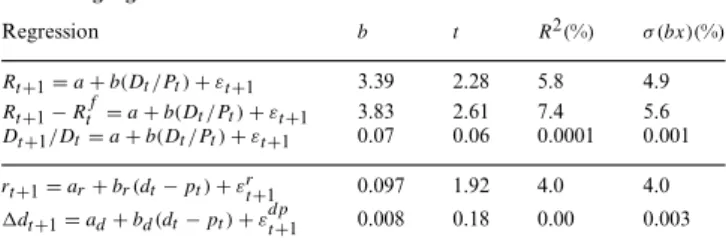
Are stock returns predictable? Table 1 presents regressions of the real and excess value-weighted stock return on its dividend-price ratio, in annual data. In contrast to the simple random walk view, stock returns do seem predictable. Similar or stronger forecasts result from many variations of the variables and data sets.
Economic significance
The estimates in Table 1 have very large economic significance. The standard deviation of expected returns in the last column of Table 1 is about five percentage points, almost as large as the 7.7% level of the equity premium in this sample. The equity premium apparently varies over time by as much as its unconditional mean. The 4–7%R2 do not look that impressive, but theR2rises with horizon, reaching values between 30 and 60%, depending on time period and estimation details, as emphasized by Fama and French (1988). The slope coefficient of over three in the top two rows means that when dividend yields rise one percentage point, pricesriseanother two percentage points on average, rather than declining one percentage point to offset the extra dividends and render returns unpredictable. Finally, the regressions of Table 1 imply thatallvariation in market price-dividend ratios corresponds to changes in expected excess
I acknowledge research support from CRSP and from a NSF grant administered by the NBER. I thank Alan Bester, John Campbell, John Heaton, Lars Hansen, Anil Kashyap, Sydney Ludvigson, Lubos Pastor, Ivo Welch, and an anonymous referee for very helpful comments. Address correspondence to John H. Cochrane, Graduate School of Business, 5807 S. Woodlawn, Chicago IL 60637, 773 702 3059, or e-mail: [email protected].
Table 1
Forecasting regressions
Regression b t R2(%) σ (bx)(%)
Rt+1=a+b(Dt/Pt)+εt+1 3.39 2.28 5.8 4.9
Rt+1−Rtf=a+b(Dt/Pt)+εt+1 3.83 2.61 7.4 5.6
Dt+1/Dt=a+b(Dt/Pt)+εt+1 0.07 0.06 0.0001 0.001
rt+1=ar+br(dt−pt)+εrt+1 0.097 1.92 4.0 4.0
dt+1=ad+bd(dt−pt)+εdpt+1 0.008 0.18 0.00 0.003
Rt+1is the real return, deflated by the CPI,Dt+1/Dtis real dividend growth, and Dt/Pt is the dividend-price ratio of the CRSP value-weighted portfolio.Rft+1is the real return on 3-month Treasury-Bills. Small letters are logs of corresponding capital letters. Annual data, 1926–2004.σ (bx)gives the standard deviation of the fitted value of the regression.
returns—risk premiums—and none corresponds to news about future dividend growth. I present this calculation below.
Statistical significance
Thestatistical significance of the return forecast in Table 1 is marginal,
however, with at-statistic only a little above two. And the ink was hardly dry on the first studies1 to run regressions like those of Table 1 before a large literature sprang up examining their econometric properties and questioning that statistical significance. The right-hand variable (dividend yield) is very persistent, and return shocks are negatively correlated with dividend-yield shocks. As a result, the return-forecast regression inherits the near-unit-root properties of the dividend yield. The coefficient is biased upward, and thet-statistic is biased toward rejection. Stambaugh (1986, 1999) derived the finite-sample distribution of the return-forecasting regression. In monthly regressions, Stambaugh found that in place of OLS
p-values of 6% (1927–1996) and 2% (1952–1996), the correctp-values are 17 and 15%. The regressions are far from statistically significant at conventional levels.2
Does this evidence mean return forecastability is dead? No, because there are more powerful tests, and these tests give stronger evidence against the null.
First, we can examine dividend growth. In the regressions of Table 1, dividend growth is clearly not forecastable at all. In fact, the small point
1Rozeff (1984), Shiller (1984), Keim and Stambaugh (1986), Campbell and Shiller (1988), and Fama and
French (1988).
2
Precursors include Goetzmann and Jorion (1993) and Nelson and Kim (1993) who found the distribution of the return-forecasting coefficient by simulation and also did not reject the null. Mankiw and Shapiro (1986) show the bias point by simulation, though not applied to the dividend-yield/return case. Additional contributions include Kothari and Shanken (1997), Paye and Timmermann (2003), Torous, Valkanov, and Yan (2004), Campbell and Yogo (2006), and Ang and Bekaert (2007).
estimates have the wrong sign—a high dividend yield means a low price, which should signal lower, not higher, future dividend growth.
Ifboth returns and dividend growth are unforecastable, then present value logic implies that the price/dividend ratio is constant, which it obviously is not. Alternatively, in the language of cointegration, since the dividend yield is stationary,one of dividend growth or price growth must be forecastable to bring the dividend yield back following a shock. We cannot just ask, ‘‘Are returns forecastable?’’ and ‘‘Is dividend growth forecastable?’’ We must ask, ‘‘Which of dividend growth or returns is forecastable?’’ (Or really, ‘‘How much of each?’’) A null hypothesis in which returns are not forecastable must also specify that dividend growth
isforecastable, and the statistical evaluation of that null must also confront thelackof dividend-growth forecastability in the data.
I set up such a null, and I evaluate the joint distribution of return and dividend-growth forecasting coefficients. I confirm that the return-forecasting coefficient, taken alone, is not significant: Under the unforecastable-return null, we see return forecast coefficients as large or larger than those in the data about 20% of the time and at-statistic as large as that seen in the data about 10% of the time. However, I find that the
absenceof dividend–growth forecastability offers much more significant
evidence against the null. The best overall number is a 1–2% probability value (last row of Table 5)—dividend growthfailsto be forecastable in only 1–2% of the samples generated under the null. The important evidence, as in Sherlock Holmes’s famous case, is the dog that does not bark.3
Second, we can examine the long-horizon return forecast implied by one-year regressions. It turns out to be most convenient to look at
blrr ≡br/ (1−ρφ)whereφis the dividend-yield autocorrelation,ρ ≈0.96
is a constant related to the typical level of the dividend yield, andbr is
the return-forecast coefficient as defined in Table 1. The ‘‘long horizon’’ label applies becausebrlris the implied coefficient of weighted long-horizon returns∞j=1ρj−1rt+jon dividend yields. The null hypothesis produces a long-horizon return regression coefficientblr
r larger than its sample value
only about 1–2% of the time, again delivering much stronger evidence against the null than the one-period return coefficientbr.
Why are these tests more powerful? They exploit a feature of the data and a feature of the null hypothesis that the conventionalbr test ignores.
The feature of the data is that return shocks εr and dividend-yield
shocksεdpare strongly and negatively correlated. Briefly, a price rise raises returns and lowers dividend yields. This correlation means that regression
3
Inspector Gregory: ‘‘Is there any other point to which you would wish to draw my attention?’’ Holmes: ‘‘To the curious incident of the dog in the night-time.’’
‘‘The dog did nothing in the night time.’’ ‘‘That was the curious incident.’’
estimatesbr andφare strongly and negatively correlated across samples.
A large long-run coefficientblr
r =br/(1−ρφ)requires both a largebrand
a largeφ, so that the coefficients can build with horizon as they do in our data. But sincebr andφare negatively correlated, samples with unusually
largebrtend to come with unusually lowφ, so it is much harder for the null
to generate large long-run coefficients. The dividend-growth test works the same way.
The feature of the null is that we know something about the dividend-yield autocorrelation φ. The Wald test on br uses no
information about other parameters. It is the appropriate test of the null {br =0, φ=anything}. But we know φ cannot be too big. If
φ >1/ρ≈1.04, the present value relation explodes and the price-dividend ratio is infinite, which it also is obviously not. If φ≥1.0, the dividend yield has a unit or larger root, meaning that its variance explodes with horizon. Economics, statistics, and common sense mean that if our null is to describe a coherent world, it should contain someupper bound on
φ as well asbr=0, something like
br =0,φ< φ
. A good test uses information onbothbˆr andφˆ to evaluate such a null, drawing regions in {br, φ}space around the null
br =0,φ< φ
, and exploiting the fact that under the null bˆr should not be too big and φˆ should not be too
big. The test regions in{br, φ}described by the long-run return coefficient
blrr =br/(1−ρφ)and by the dividend-growth coefficient slope downward
in{br, φ}space in just this way.
The long-run return forecasting coefficients also describe a more
economically interesting test region. In economic terms, we want our
test region to contain draws ‘‘more extreme’’ than the observed sample. Many of the draws that produce a one-period return forecast coefficient
br larger than the sample value also have forecastable dividend growth, and dividend-yield variation is partially due to changing dividend-growth forecasts—their dogs do bark; volatility tests are in them a half-success rather than the total failure they are in our data. It makes great economic sense to consider such draws ‘‘closer to the null’’ than our sample, even though the one-year return-forecast coefficientbris greater than it is in our
sample. This is how the long-run coefficients count such events, resulting in small probability values for events that really are, by this measure, ‘‘more extreme’’ than our data. The long-run return and dividend-growth forecast coefficients are also linked by an identitybrlr−blrd =1, so the test is exactly the same whether one focuses on returns or dividend growth, removing the ambiguity in short-horizon coefficients.
Powerful long-horizon regressions?
The success of long-horizon regression tests leads us to another econometric controversy. Fama and French (1988) found that return-forecastt-statistics rise with horizon, suggesting that long-horizon return
regressions give greater statistical evidence for return forecastability. This finding has also been subject to great statistical scrutiny. Much of this literature concludes that long-horizon estimates do not, in fact, have better statistical power than one-period regressions. Boudoukh, Richardson, and Whitelaw (2006) are the most recent examples and they survey the literature. Their Table 5, top row, gives probability values for return forecasts from dividend-price ratios at 1 to 5 year horizons, based on simulations similar to mine. They report 15, 14, 13, 12 and 17% values. In short, they find no advantage to long-horizon regressions.
How do I find such large power advantages for long-horizon regression coefficients? The main answer is that typical long-horizon estimates, going out to 5-year or even 10-year horizons, do not weight φ enough to see the power benefits. For example, the 2 year return coefficient is b(r2)=br(1+φ). Since br ≈0.1, this coefficient weights variation in
φ by 0.1 times as much as it weights variation in br. But φ and br
estimates vary about one-for-one across samples, so a powerful test needs to construct a region in{br, φ} space with about that slope, which the
implied infinite-horizon coefficientblr
r =br/(1−ρφ)does.
This finding does not imply that one should construct 30-year returns and regress them on dividend yields or other forecasting variables. I calculate ‘‘long-horizon’’ coefficients implied from the one-year regression coefficients, and they are here just a convenient way of combining those one-year regression coefficientsbr, φ to generate a test region in {br, φ}
space that has good power and strong economic intuition.
We therefore obtain a nice resolution of this long-running statistical controversy. I reproduce results such as Boudoukh, Richardson, and Whitelaw’s (2006), that direct regressions at 1-year to 5-year horizons have little or no power advantages over 1-year regressions, but I also agree with results such as Campbell (2001) and Valkanov (2003), that there are strong power advantages to long-horizon regressions, advantages that are maximized at very long horizons and, to some extent, by calculating long-horizon statistics implied by VARs rather than direct estimates.
Out-of-sampleR2
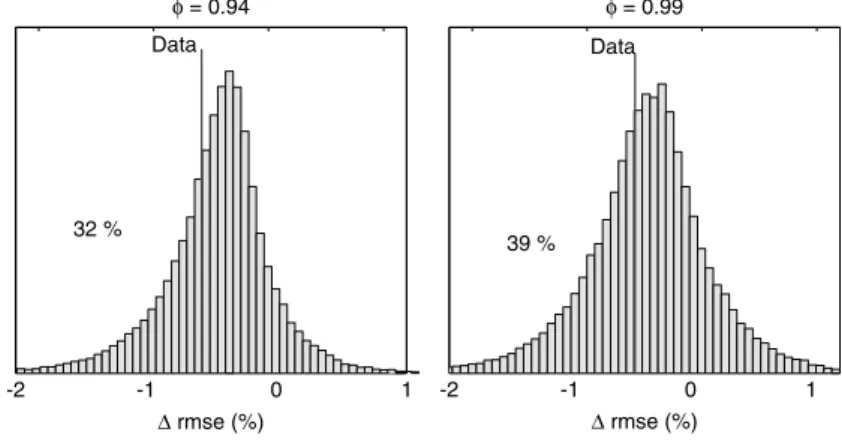
Goyal and Welch (2003, 2005) found that return forecasts based on dividend yields and a number of other variables do not work out of sample. They compared forecasts of returns at time t+1 formed by estimating the regression using data up to timet, with forecasts that use the sample mean in the same period. They found that the sample mean produces a better out-of-sample prediction than do the return-forecasting regressions.
I confirm Goyal and Welch’s observation that out-of-sample return forecasts are poor, but I show that this result is to be expected. Setting up a null in whichreturnforecasts account for all dividend-yield volatility, I find
out-of-sample performance as bad or worse than that in the data 30–40% of the time. Thus, the Goyal–Welch calculations do not provide a statistical rejection of forecastable returns. Out-of-sampleR2 is not atest; it is not a statistic that somehow gives us better power to distinguish alternatives than conventional full-sample hypothesis tests. Instead, Goyal and Welch’s findings are an important caution about the practical usefulness of return forecasts in forming aggressive real-time market-timing portfolios given the persistence of forecasting variables and the short span of available data.
Common misunderstandings
First, one should not conclude that ‘‘returns are not forecastable, but we can somehow infer their forecastability from dividend evidence.’’ The issue is hypothesis tests, not point estimates. The point estimates are, as in Table 1, that returns areveryforecastable, where the adjective ‘‘very’’ means by any economic metric. The point estimate (possibly with a bias adjustment) remains anyone’s best guess. Hypothesis tests ask, ‘‘What is the probability that we see something as large as Table 1 by chance, if returns are truly not forecastable?’’ Stambaugh (1999) answer is about 15%. Even 15% is still not 50 or 90%, so zero return forecastability is still not a very likely summary of the data. ‘‘Failing to reject the null’’ does not mean that we wholeheartedlyacceptthe i.i.d. worldview. Lots of nulls cannot be rejected.
In this context, I point out that the unforecastable-return null has other implications that one can also test—the implication that we should see a large dividend-growth forecast, a low dividend-yield autocorrelation, and a small ‘‘long-run’’ return forecast. Looking at these other statistics, we can say that there is in fact less than a 5% chance that our data or something more extreme is generated by a coherent world with unpredictable returns. But this evidence, like the return-based evidence, also does nothing to change the point estimate.
Second, this paper is about the statisticsof return forecastability, not ‘‘how best to forecast returns.’’ Simple dividend-yield regressions do not provide the strongest estimates or the best representation of return forecastability. If one really wants to forecast returns, additional variables are important, and one should pick variables and specifications that reflect repurchases, dividend smoothing, and possible changes in dividend payment behavior.
I use the simplest environment in order to make the statistical points most transparently. Better specifications can only increase the evidence for forecastable returns. For this reason, the point of this article is not to vary the specification until the magic 5% barrier is crossed. The point of this article is to see how different and more comprehensive statistical analysis yields different results, and in particular how tests based on
dividend growth and long-run regressions yield stronger evidence. Those points carry over to more complex and hence more powerful forecasting environments, and it is there that the real search for 5% values (or 1%, or the appropriate Bayesian evaluation) should occur.
1. Null Hypothesis
To keep the analysis simple, I consider a first-order VAR representation of log returns, log dividend yields, and log dividend growth,
rt+1=ar+br(dt−pt)+εrt+1 (1)
dt+1=ad +bd(dt−pt)+εdt+1 (2)
dt+1−pt+1=adp+φ(dt−pt)+εdpt+1 (3) Returns and dividend growth do not add much forecast power, nor do further lags of dividend yields. Of course, adding more variables can only make returns more forecastable.
The Campbell-Shiller (1988) linearization of the definition of a return4 gives the approximate identity
rt+1 =ρ(pt+1−dt+1)+dt+1−(pt−dt) (4)
whereρ=PD/(1+PD),PDis the price-dividend ratio about which one linearizes, and lowercase letters are demeaned logarithms of corresponding capital letters.
This identity applies to each data point, so it links the regression coefficients and errors of the VAR (1)–(3). First, projecting ondt−pt,
4Start with the identity
Rt+1=
Pt+1+Dt+1
Pt =
1+Pt+1
Dt+1
Dt+1
Dt Pt Dt
Loglinearizing,
rt+1 =log
1+e
pt+1−dt+1 +dt+1−(pt−dt)
≈k+1+P /D P /D
pt+1−dt+1 +dt+1−(pt−dt)
whereP /Dis the point of linearization. Ignoring means, and definingρ=1+P /DP /D,we obtain Equation (4).
identity (4) implies that the regression coefficients obey the approximate identity
br =1−ρφ+bd (5)
Second, the identity (4) links the errors in (1)–(3) by
εrt+1=εdt+1−ρεdpt+1 (6)
Thus, the three equations (1)–(3) are redundant. One can infer the data, coefficients, and error of any one equation from those of the other two.
The identity (5) shows clearly how we cannot form a null by taking
br =0 without changing the dividend-growth forecastbd or the
dividend-yield autocorrelation φ. In particular, as long as φ is nonexplosive,
φ <1/ρ≈1.04, we cannot choose a null in whichbothdividend growth and returns are unforecastable—br =0 andbd =0. To generate a coherent
null withbr =0, we must assume a negativebd, and then we must address
theabsenceof this coefficient in the data.
By subtracting inflation from both sides, Equations (4)–(6) can apply to real returns and real dividend growth. Subtracting the risk-free rate from both sides, we can relate the excess log return(rt+1−rtf)on the left-hand
side of Equation (4) to dividend growth less the interest rate(dt+1−rtf)
on the right-hand side. One can either introduce an extra interest rate term or simply understand ‘‘dividend growth’’ to include both terms. I follow the latter convention in the excess return results below. One can form similar identities and decompositions with other variables. For example, starting with the price/earnings ratio, we form a similar identity that also includes the earnings/dividend ratio.
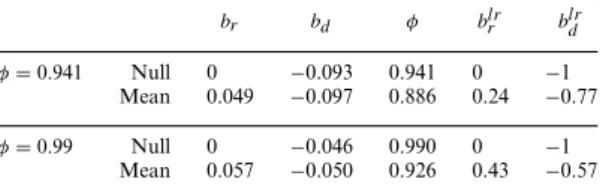
To form a null hypothesis, then, I start with estimates of Equations (1)–(3) formed from regressions of log real returns, log real dividend growth and the log dividend yield in annual Center for Research in Security Prices (CRSP) data, 1927–2004, displayed in Table 2. The coefficients are worth keeping in mind. The return-forecasting coefficient isbr ≈0.10, the
dividend-growth forecasting coefficient isbd ≈0, and the OLS estimate
of the dividend-yield autocorrelation isφ≈0.94. The standard errors are about the same, 0.05 in each case.
Alas, the identity (5) is not exact. The ‘‘implied’’ column of Table 2 gives each coefficient implied by the other two equations and the identity, in which I calculateρfrom the mean log dividend yield as
ρ= e
E(p−d)
1+eE(p−d) =0.9638
The difference is small, about 0.005 in each case, but large enough to make a visible difference in the results. For example, the t-statistic calculated from the implied br coefficient is 0.101/0.050=2.02 rather
Table 2
Forecasting regressions and null hypothesis
εs. d. (diagonal) Estimates and correlation.
Null 1 Null 2
ˆ
b,φˆ σ (ˆb) implied r d dp b, φ b, φ r 0.097 0.050 0.101 19.6 66 −70 0 0
d 0.008 0.044 0.004 66 14.0 7.5 −0.0931 −0.046
dp 0.941 0.047 0.945 −70 7.5 15.3 0.941 0.99 Each row represents an OLS forecasting regression on the log dividend yield in annual CRSP data 1927–2004. For example, the first row presents the regression
rt+1=ar+br(dt−pt)+εrt+1. Standard errorsσ (ˆb)include a GMM correction for heteroskedasticity. The ‘‘implied’’ column calculates each coefficient based on the other two coefficients and the identitybr=1−ρφ+bd, usingρ=0.9638.
The diagonals of the ‘‘εs. d.’’ matrix give the standard deviation of the regression errors in percent; the off-diagonals give the correlation between errors in percent. The ‘‘Null’’ columns describes coefficients used to simulate data under the null hypothesis that returns are not predictable.
than 0.097/0.05=1.94, and we will see as much as two to three percentage point differences in probability values to follow.
The middle three columns of Table 2 present the error standard deviations on the diagonal and correlations on the off-diagonal. Returns have almost 20% standard deviation. Dividend growth has a large 14% standard deviation. In part, this number comes from large variability in dividends in the prewar data. In part, the standard method for recovering dividends from the CRSP returns5 means that dividends paid early in the year are reinvested at the market return to the end of the year. In part, aggregate dividends, which include all cash payouts, are in fact quite volatile. Most importantly for the joint distributions that follow, return and dividend-yield shocks are strongly negatively correlated (−70%), in contrast to the nearly zero correlation between dividend-growth shocks and dividend-yield shocks (7.5%).
The final columns of Table 2 present the coefficients of the null hypotheses I use to simulate distributions. I setbr =0. I start by choosing
φat its sample estimateφ=0.941. I consider alternative values ofφbelow.
5CRSP gives total returnsRand returns without dividendsRx. I find dividend yields by
Dt+1
Pt+1 =
Rt+1
Rxt+1−
1=Pt+1+Dt+1
Pt Pt Pt+1 −
1
I then can find dividend growth by
Dt+1
Dt =
(Dt+1/Pt+1)
(Dt/Pt)
Rxt+1=
Dt+1
Pt+1
Pt Dt
Pt+1
Pt
Cochrane (1991) shows that this procedure implies that dividends paid early in the year are reinvested at the returnRto the end of the year. Accumulating dividends at a different rate is an attractive and frequently followed alternative, but then returns, prices, and dividends no longer obey the identity
Givenbr =0 andφ, the necessary dividend forecast coefficientbdfollows
from the identitybd =ρφ−1+br ≈ −0.1.
We have to choose two variables to simulate and then let the third follow from the identity (4). I simulate the dividend-growth and dividend-yield system. This is a particularly nice system, since we can interpret the errors as essentially uncorrelated ‘‘shocks to expected dividend growth’’ and ‘‘shocks to actual dividend growth’’ respectively. (Formally, the VAR (7) can be derived from a model in which expected dividend growth follows an AR(1),Et(dt+1)=xt =φxt−1+δxt, returns are not forecastable, and
dividend yields are generated from the present value identity (9)). However, the identity (4) holds well enough that this choice has almost no effect on the results.
In sum, the null hypotheses takes the form
⎡
⎣ dt+d1−t+p1t+1
rt+1
⎤ ⎦=
⎡
⎣ ρφφ−1 0
⎤
⎦(dt−pt)+
⎡ ⎢ ⎣
εdpt+1 εdt+1 εdt+1−ρεdpt+1
⎤ ⎥ ⎦ (7) I use the sample estimate of the covariance matrix of εdp and εd. I simulate 50,000 artificial data sets from each null. For φ <1, I draw the first observation d0−p0 from the unconditional density
d0−p0 ∼N
0, σ2εdp /(1−φ2). For φ≥1, I start at d
0−p0=0. I then drawεd
t andε
dp
t as random normals and simulate the system forward. 2. Distribution of Regression Coefficients andt-statistics
2.1 Return and dividend-growth forecasts
In each Monte Carlo draw I run regressions (1)–(3). Figure 1 plots the joint distribution of the returnbr and dividend-growthbd coefficients, and
the joint distribution of theirt-statistics. Table 3 collects probabilities.
Themarginaldistribution of the return-forecast coefficientbrgives quite
weak evidence against the unforecastable-return null. The Monte Carlo draw produces a coefficient larger than the sample estimate 22% of the time, and a largert-statistic than the sample about 10% of the time (points to the right of the vertical line in the top panels of Figure 1, top left entries of Table 3). Taken on its own, we cannot reject the hypothesis that the return-forecasting coefficientbr is zero at the conventional 5% level. This
finding confirms the results of Goetzmann and Jorion (1993), Nelson and Kim (1993), and Stambaugh (1999).
However, the null must assume that dividend growth is forecastable. As a result, almost all simulations give a large negative dividend-growth forecast coefficient bd. The null and cloud of estimates in Figure 1 are
vertically centered a good deal below zero and below the horizontal line of the sample estimatebˆd.Dividend-growth forecasting coefficients larger
Table 3
Percent probability values under theφ=0.941null
br tr bd td
Real 22.3 10.3 1.77 1.67 Excess 17.4 6.32 1.11 0.87
Each column gives the probability that the indicated coefficients are greater than their sample values, under the null. Monte Carlo simulation of the null described in Table 2 with 50,000 draws.
-0.2 0 0.2 0.4
-0.3 -0.2 -0.1 0 0.1 0.2
br
bd
0.0 % 1.8 %
77.6 %
20.6 % Coefficients, φ = 0.94
-2 0 2 4
-8 -6 -4 -2 0 2
t, br
t, b
d
0.1 % 1.6 %
89.7 %
8.7 % t-stats, φ = 0.94
-0.2 0 0.2 0.4
-0.3 -0.2 -0.1 0 0.1 0.2
br
bd
0.8 % 5.6 %
77.6 %
16.1 % Coefficients, φ = 0.99
-2 0 2 4
-8 -6 -4 -2 0 2
t, br
t, b
d
0.8 % 5.7 %
82.4 %
11.1 % t-stats, φ = 0.99
Figure 1
Joint distribution of return and dividend-growth forecasting coefficients (left) andt-statistics (right). The lines and large dots give the sample estimates. The triangle gives the null. One thousand simulations are plotted for clarity; each point represents 1/10% probability. Percentages are the fraction of 50,000 simulations that fall in the indicated quadrants.
than the roughly zero values observed in sample are seen only 1.77% of the time, and the dividend-growtht-statistic is only greater than its roughly zero sample value 1.67% of the time (points above the horizontal lines in Figure 1,bd andtd columns of Table 3). Results are even stronger for
excess returns, for whichbd >bˆd is observed only 1.11% of the time and
thet-statistic only 0.87% of the time (Table 3).
In sum, thelackof dividend forecastability in the data gives far stronger statistical evidence against the null than does the presence of return
forecastability, lowering probability values from the 10–20% range to the 1–2% range. (I discuss theφ=0.99 results seen in Figure 1 below.)
2.2 Long-run coefficients
If we divide the identity (5) br−bd =1−ρφ by 1−ρφ, we obtain the
identity
br
1−ρφ − bd
1−ρφ =1 (8)
brlr−blrd =1 The second row defines notation.
The terms of identity (8) have useful interpretations. First, blr r is the
regression coefficient oflong-runreturns∞j=1ρj−1rt+jon dividend yields
dt−pt, and similarly for blrd, hence thelr superscript. Second, blrr and −bdlr represent the fraction of the variance of dividend yields that can be attributed to time-varying expected returns and to time-varying expected dividend growth, respectively.
To see these interpretations, iterate the return identity (4) forward, giving the Campbell–Shiller (1988) present value identity
dt−pt =Et ∞
j=1
ρj−1rt+j−Et ∞
j=1
ρj−1dt+j (9)
Multiply by(dt−pt)−E(dt−pt)and take expectations, giving
var(dt−pt)=cov
⎛ ⎝∞
j=1
ρj−1rt+j, dt−pt
⎞ ⎠
−cov
⎛ ⎝∞
j=1
ρj−1dt+j, dt−pt
⎞
⎠ (10) This equation states that all variation in the dividend-price (or price-dividend) ratio must be accounted for by its covariance with, and thus ability to forecast, future returns or future dividend growth. Dividing by var(dt−pt) we can express the variance decomposition in terms of
regression coefficients
β
⎛ ⎝∞
j=1
ρj−1rt+j, dt−pt
⎞ ⎠−β
⎛ ⎝∞
j=1
ρj−1dt+j, dt−pt
⎞
whereβ(y, x)denotes the regression coefficient ofy onx. In the context of our VAR(1) representation we have
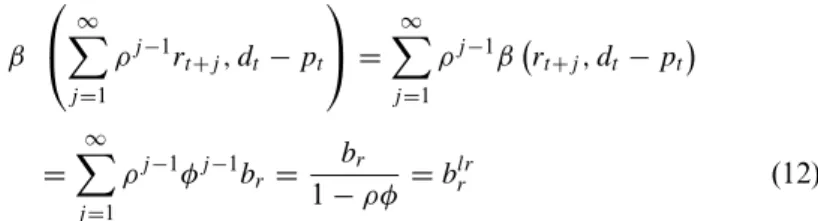
β
⎛ ⎝∞
j=1
ρj−1rt+j, dt−pt
⎞ ⎠=∞
j=1
ρj−1βrt+j, dt−pt =
∞
j=1
ρj−1φj−1br =
br
1−ρφ =b
lr
r (12)
and similarly for dividend growth. This sort of calculation is the standard way to adapt the ideas of Shiller (1981) and LeRoy and Porter (1981) volatility tests to the fact that dividend yields rather than prices are stationary. See Campbell and Shiller (1988) and Cochrane (1991, 1992, 2004) for more details.
2.3 Long-run estimates and tests
Table 4 presents estimates of the long-horizon regression coefficients. These are not new estimates, they are simply calculations based on the OLS estimatesbˆr,bˆd,φˆ in Table 2. I calculate asymptotic standard errors
using the delta-method and the heteroskedasticity-corrected OLS standard errors from Table 2.
Table 4 shows that dividend-yield volatility is almost exactly accounted for by return forecasts, bˆlr
r ≈1, with essentially no contribution from
dividend-growth forecastsbˆlrd ≈0. This is another sense in which return forecastability is economically significant. This finding is a simple consequence of the familiar one-year estimates. bˆd ≈0 means bˆlrd ≈0,
of course, and
ˆ
blrr = bˆr
1−ρφˆ ≈
0.10
1−0.96×0.94 ≈1.0
Table 4
Long-run regression coefficients
Variable bˆlr s. e. t %pvalue
r 1.09 0.44 2.48 1.39–1.83
d 0.09 0.44 2.48 1.39–1.83
Excessr 1.23 0.47 2.62 0.47–0.69
The long-run return forecast coefficientbˆlrr is computed asbˆlrr = ˆbr/(1−ρφ)ˆ , wherebˆr is the
regression coefficient of one-year returnsrt+1ondt−pt,φˆ is the autocorrelation ofdt−pt,ρ =0.961, and similarly for the long-run dividend-growth forecast coefficientbˆlrd. The standard error is calculated from standard errors forbˆr andφˆ by the delta method. Thet-statistic fordis the
statistic for the hypothesisbˆlrd = −1. Percent probability values (%pvalue) are generated by Monte Carlo under theφ=0.941null. The range of probability values is given over the three choices of which coefficient (bˆr,φ,ˆ bˆd)is implied from the other two.
In fact, the point estimates in Table 4 show slightly more than 100% of dividend-yield volatility coming from returns, since the point estimate of dividend-growth forecasts go slightly the wrong way. The decomposition (10) is not a decomposition into orthogonal components, so elements can be greater than 100% or less than 0% in this way. Excess returns in the last row of Table 4 show slightly stronger results. In the point estimates, high price-dividend ratios actually signal slightly higher interest rates, so they signal even lower excess returns.
The first two rows of Table 4 drive home the fact that, by the identity
blrr −blrd =1, the long-horizon dividend-growth regression givesexactly
the same results as the long-horizon return regression.6 The standard errors are also exactly the same, and thet-statistic forblr
r =0 is exactly the
same as thet−statistic forblrd = −1.
One great advantage of using long-horizon regression coefficients is that we do not need to choose between return and dividend-growth tests, as they give precisely the same results. As a result, we can tabulate the small-sample distribution of the test in a conventional histogram, rather than a two-dimensional plot.
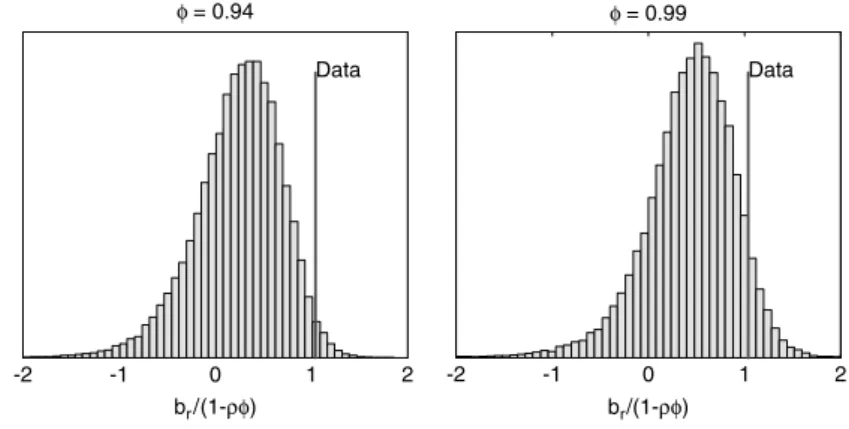
Figure 2 tabulates the small-sample distribution of the long-run return-forecast coefficients, and Table 4 includes the probability values—how many long-run return forecasts are greater than the sample value under the unforecastable-return nullbrlr=0. There is about a 1.5% probability value of seeing a long-run forecast larger than seen in the data. (The range of probability values in Table 4 derives from the fact that the identities are only approximate, so the result depends on which of the three parameters (br, φ, bd) is implied from the other two.) The long-run
return (or dividend-growth) regressions give essentially the same strong rejections as the short-run dividend-growth regression.
The last row of Table 4 shows the results for excess returns. Again, excess returns paint a stronger picture. The probability values of 0.38–0.64% are lower and the evidence against the null even stronger.
3. Power, Correlation, and theφView
Where does the greater power of dividend-growth and long-run return tests come from? How do we relate these results to the usual analysis of the{br, φ}coefficients in a two-variable VAR consisting of the return and
the forecasting variable?
6
The identities are only approximate, so to display estimates that obey the identities one must estimate two ofbr,bd, andφ, and imply the other using the identitybr−bd=1−ρφ. In the top two lines of
Table 4, I use the directbˆrandbˆdestimates from Table 2. I then useρφˆimpl=1− ˆbr+ ˆbdand I construct
long-run estimates bybˆlrr = ˆbr/(1−ρˆφimpl). Sinceφˆ=0.94andφˆimpl=0.95, the difference between
these estimates and those that useφˆis very small. Using the direct estimateφˆrather thanφˆimpl, we have ˆ
-2 -1 0 1 2 Data
φ = 0.94
br/(1-ρφ)
-2 -1 0 1 2
Data
φ = 0.99
br/(1-ρφ)
Figure 2
Distribution ofbrlr=br/(1−ρφ). The vertical bar gives the corresponding value in the data.
-0.1 0 0.1 0.2 0.3 0.4
0.6 0.7 0.8 0.9 1
br
φ
17.3 %
0.0 %
60.4 %
22.3 %
br and φ, φ = 0.94
bd br
-0.1 0 0.1 0.2 0.3 0.4
0.6 0.7 0.8 0.9 1
br
φ
46.7 %
0.6 %
31.7 %
21.0 %
br and φ, φ = 0.99
bd br
lr lr
Figure 3
Joint distribution of return and dividend yield forecasting coefficientsbr, φ. In each graph the triangle
marks the null hypothesis used to generate the data and the circle marks the estimated coefficientsbˆr,φˆ. The diagonal dashed line marked ‘‘bd’’ marks the linebr=1−ρφ+ ˆbd; points above and to the right are
draws in whichbdexceeds its sample value. The solid diagonal line marked ‘‘blrr’’ marks the line defined
bybr/(1−ρφ)= ˆbr/(1−ρφ);ˆ points above and to the right are draws in whichblrr exceeds its sample
value. Numbers are the percentage of the draws that fall in the indicated quadrants.
Figure 3 addresses these questions by plotting the joint distribution of estimates{br, φ}across simulations. We see again that a high return coefficientbr by itself is not so unusual, occurring about 22% of the time
(area to the right of the vertical line). We learn, however, thatbr andφ
estimates are negatively correlated across samples. Though we often see largebrand largeφ, we almost never seebrlarger than in the datatogether
withφ larger than in the data. (Figure 3 is the same as Lewellen (2004) Figure 1, Panel B, except Lewellen calibrates to monthly postwar data. Lewellen focuses on a different distributional calculation.)
This observation on its own is not a good way to form a test statistic. Though the northeast quadrant of the plot is suggestively empty, we would
not want to commit to accepting the null forφ just below a rectangular rejection region and arbitrarily largebr.
The{br, φ}plot is more important to help us to digest why the
dividend-growth test bd and the long-horizon regression test blrr give so many
fewer rejections under then null than the usual one-period return br
test. The diagonal dashed line marked bd in Figure 3 uses the identity
br =1−ρφ+bd to mark the regionbd >bˆd in this{br, φ}space. Points above and to the right of this dashed line are exactly the points above
bd >bˆd in Figure 1. The similar diagonal solid line markedblrr uses the
definition blrr =br/ (1−ρφ)to mark the region brlr>bˆrlr in this{br, φ}
space. Points above and to the right of this line are exactly the points abovebrlr>bˆlrr in the histogram of Figure 2.
Viewed in {br, φ} space, dividend-growth bd and long-run regression
blr tests capture in a single number and in a sensible test region the fact that samples with high br typically come with low φ, and they exploit
that negative correlation to produce more powerful tests. By the definition
br/ (1−ρφ), samples with highbrbut lowφproduce a low long-run return
forecast blrr . Generating a large long-run return forecast requires both a large one-year return forecast and a large autocorrelation, so forecasts can build with horizon. Because most large return forecasts come with low autocorrelation, it is much harder for the null to deliver a large long-run return forecast. By the identitybd =br +ρφ−1, dividend growth works
the same way.
3.1 The source of negative correlation
The strong negative correlation of estimates br and φ across samples,
which underlies the power of long-horizon return and dividend-growth tests, stems from the strong negative correlation of theshocksεrt+1andεdpt+1
in the underlying VAR, (1)–(3). If shocks are negatively correlated in two regressions with the same right-hand variable, then a draw of shocks that produces an unusually large coefficient in the first regression corresponds to a draw of shocks that produces an unusually small coefficient in the second regression.
It is important to understand this correlation. We do not want the power of long-run or dividend-growth tests to hinge on some arbitrary and inessential feature of the null hypothesis, and strong correlations of shocks are usually not central parts of a specification.
From the identity
εrt+1=εdt+1−ρεdpt+1 (13) the fact that return shocks and dividend-yield shocks are strongly and negatively correlated is equivalent to the fact that dividend-yield shocks and dividend-growth shocksare notcorrelated. Intuitively, we can see this
fact by looking at the definition of return
Rt+1=
(1+Pt+1/Dt+1)
Pt/Dt
Dt+1
Dt
that underlies (13): a decline in dividend yieldDt+1/Pt+1is a rise in prices, which raises returns, but only so long as there is no offsetting change in dividend growthDt+1/Dt. More precisely, multiply both sides of (13) by
εdpt+1and take expectations, yielding
cov
εrt+1, εdpt+1
=cov
εdpt+1, εdt+1
−ρσ2
εdpt+1
(14) When dividend growth and dividend yields are uncorrelated
cov(εdpt+1, εd
t+1)=0, we obtain a strong negative correlation between returns and dividend yieldscov(εrt+1, εdpt+1).
Dividend yields move on news of expected returns (in the point estimates) or news of expected dividend growth (in the null) (see (9)). Thus, the central fact in our data is that shocks to expected returns (data) or expected
dividend growth (null) are uncorrelated with shocks toex postdividend growth. The strong negative correlation of dividend-yield shocks with return shocks follows from the definition of a return.
It seems that we can easily imagine other structures, however. For example, in typical time-series processes, like an AR(1), shocks toex post
dividend growth are correlated with shocks to expected dividend growth; only rather special cases do not display this correlation. In economic models, it is not inconceivable that a negative shock to current dividends would raise risk premia, raising expected returns and thus dividend yields. However, identity (13) makes it hard to construct plausible alternatives. There are only three degrees of freedom in the variance-covariance matrix of the three shocks, since any one variable can be completely determined from the other two. As a result, changing one correlation forces us to change the rest of the covariance matrix in deeply counterfactual ways.
For example, let us try to construct a covariance matrix in which return and dividend-yield shocks are uncorrelated, cov(εr
t+1, ε
dp
t+1)=0.
Let us continue to match the volatility of returns σ (εr
t+1)=0.2 and dividend yieldsσ (εdpt+1)=0.15. We cannot, however, match the volatility of dividend growth. Writing the identity (13) as
εdt+1=εrt+1+ρεdpt+1 (15) we see that in order to produce cov(εrt+1, εdpt+1)=0, we must specify dividend-growth shocks that are more volatile than returns! We need to specify 25% dividend-growth volatility, rather than the 14% volatility in
our data:
σ (εd)=
σ2(εr
t+1)+ρ2σ2(ε
dp t+1)
=0.202+0.962×0.152=0.25
It is a quite robust fact that return variation is dominated by variation of
prices orvaluationswith little change in cashflows, and more so at high
frequencies. The variance of returns far exceeds the variance of dividend growth. By (15) that fact alone implies that positive innovations to current returnsεr
t+1must come with negative innovations to dividend yields. Continuing the example, we can find the required correlation of dividend-growth shocks and dividend-yield shocks by multiplying (15) byεdpt+1giving
covεd, εdp =cov(εr, εdp)+ρσ2εdp corrεd, εdp =ρσ
εdp
σ (εd) =0.96×
0.15 0.25 =0.58
rather than 0.07, essentially zero, in the data (Table 2). In this alternative world, good news about dividend growth is frequently accompanied by an increase in dividend yield, meaning prices do not move that much. In turn, that means the good news about dividend growth comes either with news that future dividend growth will be low—dividends have a large mean-reverting component—or with news that future expected returns will be high. In our data, dividend-yield shocks typically raise prices proportionally, leading to no correlation with dividend yields.
Needless to say, the changes to the covariance matrix required to generate apositivecorrelation between return and dividend-yield shocks are even more extreme. In sum, the negative correlation of estimates{br, φ},
which ultimately derives from the negative correlation of shocksεrt+1, εdpt+1
or equivalently from the near-zero correlation of shocksεdpt+1, εdt+1is a deep and essential feature of the data, not an easily changed auxiliary to the null.
3.2 Which is the right region? — economics
We now have three tests: the one-period regression coefficientsbr andbd,
and the long-horizon regression coefficientblr. Which is the right one to look at? Should we testbr >bˆr, or should we test bd >bˆd,orblrr >bˆlrr ?
Or perhaps we should test some other subset of the{br, φ}region?
The central underlying question is, how should we form a single test statistic from the joint distribution of many parameters? We have three parameters,br, bd, φ. The identitybr =1−ρφ+bdmeans we can reduce
the issue to a two-dimensional space, but we still have two dimensions to think about.
Ineconomicterms, we want the most interesting test. The issue comes down to defining what is the ‘‘event’’ we have seen, and what other events we would consider ‘‘more extreme,’’ or ‘‘further from the null’’ than the event we have seen. If we focus on the one-year return regression, we think of the ‘‘event’’ as the return forecast coefficient seen in the data
br = ˆbr ≈0.1, and ‘‘more extreme’’ events as those with greater
one-year return-forecast coefficients,br >bˆr. But, as the joint distributions point out, most of the events withbr >bˆr,have dividend-growth forecast
coefficients larger (more negative) than seen in the data,bd <bˆd, they
have dividend-yield autocorrelations lower than seen in the dataφ <φˆ, they have long-run return coefficients less than seen in the datablr
r <bˆlrr ,
and thus (by identity) they have long-run dividend-growth coefficients larger (more negative) than seen in the data,blr
d <bˆlrd ≈0.In these events,
dividend-growth is forecastable, prices are moving to some extent on forecasts of future dividend growth, and in the right direction. Volatility tests are a half-success, rather than the total failure that they are in our data. The long-run coefficients count these draws as ‘‘closer to the null’’ than our data, despite the larger values of br. From this point of view,
the test on the long-run coefficient is the economically interesting test. If we want to view that test in the{br, φ}space of one-period regression
coefficients, diagonal test regions as marked byblrr in Figure 3 are the right ones to look at.
The dividend-growth coefficient tests bd >bˆd give almost exactly the
same answers as the long-run coefficient tests, as can be seen both in the tables and by the fact that the dividendbd and long-run brlr regions of
Figure 3 are nearly the same. In fact, these tests are different conceptually and slightly different in this sample. The long-run return coefficient test
blrr >bˆlrr meansbdlr>bˆdlr which meansbd/(1−ρφ) >bˆd/(1−ρφ)ˆ . If we
had bˆd =0 exactly, this would mean bd >bˆd =0 and the two regions
would be exactly the same. Withbˆd =0, a different sampleφcan affect the
long-run dividend-growth coefficientblrd =bd/(1−ρφ)for a given value
ofbd, perhaps pushing it across a boundary. In a sample withbˆd further from zero, the two test statistics could give substantially different answers. When there is a difference, I find the long-run coefficients more economically attractive than the dividend-growth coefficients. As an important practical example, think about the specification of the null. In long-run coefficient terms, we specify the null asblrd = −1, blr
r =0, that
is, all variation in dividend yields is due to time-varying expected dividend growth and none to time-varying expected returns. In short-run coefficient terms, this specification is equivalent tobd =1/(1−ρφ). At the sample
φ= ˆφ≈0.96, we havebd ≈ −0.1. As we varyφ, however, we varybd to
keepbdlr= −1. This is exactly how I specify theφ=0.99 null above and how I specify the null for differentφvalues below.
Suppose instead that we specify the null in short-run coefficient terms as bd = −0.1 for any value of φ. Now, different values of φ give us specifications in which expected returns do explain nonzero fractions of dividend yield and in which returns are predictable. For example, at φ=0.99, we would haveblrd = −0.1/(1−0.96×0.99)≈ −2 and thus
blr
r ≈ −1, with br ≈(1−0.96×0.99)×(−1)≈0.05. In this null, a rise
in prices signals so much higher dividend growth that it must also signal much higher future returns. Obviously, this is not a very interesting way to express the null hypothesis that returns are unpredictable. The same sorts of things happen to test regions ifbd =0.
If one accepts that the null should be expressed this way, in terms of long-horizon coefficients to accommodate variation inφ, it seems almost inescapable that the economically interestingtest regionshould be specified in the same way.
3.3 Which is the right region? — statistics
In statistical terms we want the most powerful test. It is clear that the
dividend growthbd and long-runbrlr tests, implying a test of a diagonal
region in{br, φ}space, are more powerful. It is important to understand
the source of that power.
‘‘Power,’’ of course, is not the probability under the null of finding more extreme statistics that I have calculated. To document power, I should set up regions based onbr,bd, andblr that reject at a given level, say 5% of
the time, under the null. Then I should evaluate the probability that draws enter those rejection regions under alternatives, in particular generating data from the estimated parameters bˆr and φˆ. I should document that
draws do enter the long-run or dividend-growth rejection regions more frequently. I do not perform these calculations in the interest of brevity, since it is clear from the graphs how they work out. Since thebr vertical
line in Figure 3 demarks a 22% probability value now, the boundary of the 5% region under the null is farther to the right. Since thebd andblr
diagonal lines demark 1–2% probability values now, the boundaries of the 5% regions under the null are a bit to the left of the current lines. Under the alternative, the cloud of points in Figure 3 moves to the right—drag the triangle to the circle and move the cloud of points with it. Because of the negative correlation between br andφ estimates, that operation will
drag roughly half of the simulated data points across the diagonal lines, but it will still leave the bulk of the data points shy of the 5% verticalbr
region. The long-run and dividend-growth tests do have more power. Therefore, one key to the extra power is the negative correlation between
brandφcoefficients, documented by Figure 3. If the cloud sloped the other
way, there would be no power advantage.
The other key to extra power is a limitation onφin the null. So far, I have calculated test statistics from apointnull, specifying{br =0, φ=0.941}.
One wants obviously to think about other, and particularly larger, values ofφ. As we raiseφin the null, the cloud of points in Figure 3 rises. The right-hand panel of Figure 3 shows this rise forφ=0.99. If we were to raiseφarbitrarily, say to 2 or 3, the cloud of points would rise so much that all of them would be above the diagonal lines. The null would generate greater long-run and dividend predictability than the sample 100% of the time, and the power would decline to zero. Thebr test, based on a vertical
rejection region, would still have something like the same probability of rejection, and we would reverse the power advantages.
But of course φ=2 or φ=3 are ridiculous null hypotheses. The null should be a coherent, economically sensible view of the world, and explosive price-dividend ratios do not qualify. I argue in detail below for upper limits betweenφ=0.99 andφ=1.04. For the moment, it is enough to accept that there issomeupper limitφthat characterizes coherent and economically sensible null hypotheses.
This observation solves a statistical mystery. How can it be that a powerful test of a simple null hypothesis like br =0 involves other
parameters, or a joint region in {br, φ} space? The answer is that the
null hypothesis is not{br =0, φ=anything},but it is
br=0,φ< φ
(Going further, one-sided tests make more sense in this context.) Given such a joint null hypothesis, any sensible test will set up a region surrounding the null hypothesis, and thus use information on both parameters. For example, if the upper bound isφ=1.04, the observation
ˆ
φ=3 would reject the null even if the estimate isbˆr =0. A test region
surrounding the null br =0, φ< φ
will be downward sloping in
{br, φ}space in the region of our sample estimates, with largebˆr and large ˆ
φ, exactly as the long-run regression test or dividend-growth coefficient test give downward sloping regions in{br, φ}space.
For example, for φ<1 and in large samples, we can write the likelihood ratio test statistic as7
LR≈(T −1)ln
1+ bˆ 2
1− ˆφ2
σ2(εdpt+1) σ2(εr
t+1)
7The likelihood ratio is the ratio of constrained (b
r=0) to unconstrained (OLS) residual variances. We
can write
LR=(T−1)lnσ 2(r
t+1)
σ2(εrt+1)=(T−1)ln
σ2(b (dˆ t−pt)+εrt+1)
σ2(εrt+1)
=(T−1)ln
ˆ b2σ
2(d
t−pt) σ2(εrt+1) +1
=(T−1)ln
⎡
⎣ bˆ2
1− ˆφ2 σ2(εdpt+1) σ2(εrt+1)+1
⎤ ⎦
where σ2(εrt+1) and σ2(εdpt+1) are the unconstrained, OLS regression errors. The corresponding test regions in {br, φ} space are ellipses
surrounding the line {br =0,φ<1}, and slope downward through
the data point
ˆ
br,φˆ
with, it turns out, almost exactly the same slope as the long-runbrlr or dividend-growthbd regions. If we expand the null
to{br =0, φ=anything}, then of course the likelihood ratio test becomes
asymptotically the same as the Wald test onbr alone. (It turns out that
the likelihood ratio test is not as powerful as the long-horizon or dividend-growth regressions in this data set, in part because it is a two-sided test and in part because it does not exploit the correlation of errors, so I do not pursue it further.)
4. Autocorrelationφ, Unit Roots, Bubbles, and Priors
Higher values ofφlower the power of the dividend-growth and long-run test statistics. Thus, we have to ask, first, how large a value ofφshould we consider in our null hypothesis, and second, how large, quantitatively, is the loss of power as we move toward sensible upper limits forφ?
4.1 How large canφbe?
We can start by ruling outφ >1/ρ≈1.04, since this case implies an infinite price-dividend ratio, and we observe finite values. Iterating forward the return identity (4), we obtain the present value identity
pt−dt =Et ∞
j=1
ρj−1dt+j−Et ∞
j=1
ρj−1rt+j+ lim
k→∞ρ
kE
t(pt+k−dt+k)
(16) In our VAR(1) model, the last term isρkφk(pt−dt), and it explodes if
φ >1/ρ.
If we have φ=1/ρ≈1.04, then it seems we can adopt a null with both br =0 and bd =0, and respect the identity br =1−ρφ+bd. In
fact, in this case we must have br =bd =0, otherwise terms such as
Et∞j=1ρj−1dt+j =∞j=1ρj−1φj−1bd(dt−pt)in Equation (16) do not converge. This is a ‘‘rational bubble.’’ If φ=1/ρ exactly, then price-dividend ratios can vary on changing expectations of future price-price-dividend ratios, the last term of Equation (16), with no news at all about dividends or expected returns. This view is hard to hold as a matter of economic theory, so I rule it out on that basis. Since I will argue against anyφ≥1, it does not make sense to spend a lot of time on a review of the rational bubbles literature to rule outφ=1.04.
At φ=1, the dividend yield follows a random walk. φ=1 still implies some predictability of returns or dividend growth, br+bd =
dividend-yield rise, the higher dividend yield still means more dividends and thus a higher return. φ=1 does not cause trouble for the present value model;φ=1 is the point at which thestatisticalmodel explodes to an infinite unconditional variance.φ=1 does cause trouble for loglinear approximation of course, since that approximation is only valid near the expansion point. To takeφ=1 seriously, one really has to move past local approximations.
Can we consider a unit root in dividend yields? The dividend yield does pass standard unit root tests (Craine (1993)), but with φˆ =0.941 that statistical evidence will naturally be tenuous. In my simulations with
φ=1, the observedφˆ =0.941 is almost exactly the median value, so I do not rejectφ=1 on that basis.
However, we do not need a continuous data set to evaluate statistical questions, and evidence over very long horizons argues better against a random walk for the dividend yield. Stocks have been trading since the 1600s, giving spotty observations of prices and dividends, and privately held businesses and partnerships have been valued for a millennium. A random walk in dividend yields generates far more variation than we have seen in that time. Using the measured 15% innovation variance of the dividend yield, and starting at a price/dividend ratio of 25 (1/0.04), the one-century one-standard deviation band—looking backwards as well as forwards—is a price-dividend ratio between8 5.6 and 112, and the ±2 standard deviation band is between91.24 and 502. In 300 years, the bands are±1σ =1.9 to 336, and±2σ =0.14 to 4514. If dividend yields really follow a random walk, we should have seen observations of this sort. But market-wide price-dividend ratios of two or three hundred have never been approached, let alone price-dividend ratios below one or over a thousand. Looking forward, and as a matter of economics, do we really believe that dividend yields will wanderarbitrarily far in either the positive or negative direction? Are we likely to see a market price-dividend ratio of one, or one thousand, in the next century or two? Is the unconditional variance of the dividend yield reallyinfinite?
In addition, the present value relation (9) means that a unit root in the dividend yield requires a unit root in stock returns or dividend growth: if r and d are stationary, then pt−dt =Et
ρj−1dt+j−rt+j is stationary as well, and conversely. Almost all economic models describe stationary returns and stationary dividend-growth rates, and the same sort of long-run volatility calculations give compelling intuition for that specification.
8
That is betweeneln(25)−0.15√100=5.6andeln(25)+0.15√100=112.
9
That iseln(25)−2×0.15 √
Having argued against φ=1, how close to one should we seriously consider as a null forφ? Neither the statistical nor the economic arguments against φ=1 rest on an exact random walk in dividend yields. Both arguments center on the conditional variance of the price-dividend ratio, returns, and dividend-growth rates over long horizons, andφ=0.999 or
φ=1.001 generate about the same magnitudes as φ=1.000. Thus, if
φ=1.00 is too large to swallow, there is some range ofφ <1 that is also too large to swallow.
4.2 Results for differentφvalues
Table 5 collects probability values for various events as a function of
φ. The previous figures include the case φ=0.99. As φ rises, Figure 3 shows that more points cross the bd and blr boundaries, giving higher
probabilities. We see the same point in the{br, bd}region of Figure 1: as
φrises,bd =1−ρφ+0 also rises, so the cloud of points rises, and more
of them cross the bd >bˆd line. However, probability values are not so
simple as a vertical translation of the sampling draws. The small-sample biases increase asφrises, so the clouds do not rise quite as far as the null hypothesis, and this attenuates the loss of power somewhat. A quantitative evaluation of the effects of higherφis important.
Table 5 verifies the conjecture that asφrises, the probability of the one-period return coefficientbr exceeding its sample value is little changed, at
about 20–22% for all values ofφ.
Looking down the bd column of Table 5, the bd >bˆd probability for
real returns rises withφ. It crosses the 5% mark a bit aboveφ=0.98 and is still below 10% atφ=1. Excess returns give stronger results as usual, with thebd probability value still below 5% atφ=1. The probability values of the long-run coefficientsblrare nearly the same as those of the
dividend-growth coefficients bd, which we expect since the dividend-growth and
long-run regression regions are nearly the same in our data. (This would not be true of a data set with an estimatebˆd not so close to zero.)
Since the dividend-yield regression is a very simplified specification, and since 5% is an arbitrary cutoff, the main point is not exactly where a test crosses the 5% region. The main point is that in all cases, the dividend-growth bd and long-run regression tests blr still have a great deal more
power than the one-period return regressionsbr for any reasonable value
ofφ.
To get additional insight on upper limits for φ, the final columns of Table 5 include the unconditional variance of dividend yields and the half-life of dividend yields implied by various values of φ. The sample estimate φˆ =0.941 is consistent with the sample standard deviation of
σ (dp)=0.45, and a 11.4-year half-life of dividend-yield fluctuations. In theφ=0.99 null, the standard deviation of log dividend yields is actually 1.14, more than twice the volatility that has caused so much consternation