A New Set of Conservation Equations
Based on the Kinetic Theory
Applied to Gas Mixture Problems
R. Kamali
1, H. Emdad
1and M.M. Alishahi
In this work, the hydrodynamics of multicomponent ideal gas mixtures have been studied. Starting from kinetic equations, the Eulerian approach is used to derive equations of motion for a multicomponent system, where each component may have a dierent velocity and kinetic temperature. The equations are based on Grad's method of moment derived from the kinetic model, in a Relaxation Time Approximation (RTA). Based on this model, a computer code has been developed for numerical computation of compressible ows of a binary gas mixture in generalized curvilinear boundary conforming coordinates. Since these equations are similar to the Navier-Stokes equations for the single uid systems, the same numerical methods are applied to these new equations. The Roe's numerical scheme is used to discretize the convective terms of governing uid ow equations. The prepared algorithm and the computer code are capable of computing and presenting the ow elds of each component of the system separately, as well as the average ow eld of the multicomponent gas system as a whole. A comparison between the present code results and those of a more common algorithm based on the mixture theory in a supersonic converging-diverging nozzle provides the validation of the present formulation. Afterwards, a more involved nozzle cooling problem with a binary ideal gas (Helium-Xenon) is chosen to compare the present results with those of the ordinary mixture theory. The present model provides the details of the ow elds of each component separately which is not available otherwise.
INTRODUCTION
Almost all ows encountered in nature and technology are of a gas mixture. The ow of air is the most common example, which is usually disregarded as a multispecies ow of gas. In many practical ows, involving pollutant dispersion, chemical processing and combustor mixing and reaction, mass and momentum transport within multispecies uids play an important role. Recent years have witnessed a growing interest in developing numerical methods suitable for computing multicomponent ows, as well as their ecient imple-mentation in studying complex ow phenomena [1-13]. Modeling of the multicomponent uid ows can be separated into two groups. The rst one consists of conservation equations, based on the Navier-Stokes
1. Department of Mechanical Engineering, Shiraz Univer-sity, Shiraz, I.R. Iran.
*. Corresponding Author, Department of Mechanical Engi-neering, Shiraz University, Shiraz, I.R. Iran.
equations [e.g., 14,15]. The second group of models is based on the kinetic theory, i.e., models derived from the Boltzmann equation [e.g., 16].
Based on the rst model, the uid dynamics of a mixture of gases (e.g., a binary gas mixture) is de-scribed by the Navier-Stokes equations for the mixture as a whole, with an additional equation expressing conservation of mass for the rst component. The last equation, in conjunction with the conservation of mass for the mixture, implies a conservation of mass for the second component as well. This approach is called a Mixture Model. Numerical modeling using the mixture model is traditionally based on Euler solver methods.
Gases can be studied by considering the small scale action of individual molecules or by considering the large scale action of the gas as a whole. Although one can directly measure, or sense, the action of the gas, the action of the molecules can be studied theoretically. This theoretical model, called the kinetic theory of gases, assumes only that the molecules are very small, relative to the distance between molecules.
The molecules are in constant, random motion and frequently collide with each other and with the walls of any container.
The kinetic theory approach for a multicompo-nent gas system is based on Boltzmann equations, including collision integrals for each component of the gas mixture. In the case of low Knudsen numbers, dened as the ratio between the mean free path of the molecules and the relevant macroscopic length scale, these equations are solved using the traditional Chapman-Enskog method [17] or Grad's method of moment [18]. This process results in the equations for the conservation (balance) of mass, momentum and energy for a multicomponent gas mixture. Some of the recent works in this area are, as follows.
In 1954, Bhatnagar, Gross and Krook (BGK) [19] presented a model for molecular collisions for single gas. The eect of the molecular collisions in this model is represented by an exponential relaxation toward a Local Thermodynamic Equilibrium (LTE). In 1962, Sirovich [11] gave a generalization of the BGK model for a gas mixture. In 1964, Morse [12] presented free parameters, which were computed, based on conservation relations. In 1971, Wu and Lee [13] studied the one-dimensional binary gas mixture ow in a shock tube, using the kinetic model. In 1989, Garzo, Santos and Bery [14] proposed a kinetic model for a dilute multicomponent gas system, especially when the particle masses of the components are comparable. In 1999, Lian and Xu, Kun [20] dened a gas-kinetic scheme for a mixture of gases. They used a multi-component gas-kinetic BGK-type scheme. They also studied its application in chemical reactions. In 2003, Luo and Girimanji [21] applied the Lattice Boltzmann Model for the binary mixtures of gases. The model is derived formally from the kinetic theory by discretizing the Boltzmann equation. The proposed model can simulate miscible and immiscible uids by changing the sign of the mutual-collision term.
The Eulerian multiuid approach for the mixture of gases, based on the kinetic theory without actually determining the form of the distribution function, has not been evaluated yet and has been done in the present work. Contrary to most of the known models, this model consists of separate conservation equation sets for each component of the mixture and which, there-fore, is capable of presenting, in detail, the behavior of each component. Using this new formulation, diusion processes can be automatically modeled without use of any coecients of an ordinary pressure and thermal diusion, which are required in the ordinary mixture models.
In this paper, starting from kinetic equations, the Eulerian approach is used to derive hydrodynamic equations of motion for a multicomponent gas system. These equations are based on Grad's method of
mo-ment in a relaxation approximation. Based on this model, an individual set of ow equations is obtained for each species. Since these equations are similar to the Navier-Stokes equations for single uid systems, the same conventional numerical methods can be applied. A computer code has been developed for numerical computation of these separate sets of equations for compressible ows of a binary gas system in generalized curvilinear coordinates.
MODEL EQUATIONS
In the kinetic theory, the state of a mixture of zideal
gases is characterized by the set of one-particle velocity distribution functions f(x;c;t)( = 1;2;;z),
such thatf(x;c;t)dxdcgives, at timet, the number
of particles of constituent in the volume element betweenxandx+dx, with velocities betweenc and c+dc. In the absence of external forces, the
one-particle velocity distribution function of constituent
satises the Boltzmann equation [22]:
@f
@t +ci@f@xi =K+ z
X
6=
K; (1)
where K denotes the non-linear Boltzmann collision operators. This collision term poses the greatest mathematical diculties. The rst term, on the right-hand side of Equation 1, is the standard collision operator for a gas of a single species, while the second term represents the eect of inter-collision between the two dierent species. While the term \collisions" may stand for various kinds of encounters between two par-ticles, it is used here only for elastic collisions of non-reacting gases. The mathematical complexity of the collision term in gaseous mixtures can be avoided if one replaces the collision operators by simple relaxation-time terms, based on the work of Gross and Krook [23]. Let the mixture consist of two components; gasand gas , with number densities,n and n, and masses
of gas molecules, m and m. Each component has
its own temperature, T, and its macroscopic or ow
velocity, v, with molecular velocity, c, and peculiar
velocity,C=c v. According to Wu and Lee [13]:
@f
@t +ci@f@xi =(F f) +(
F f); (2)
@f
@t +ci@f@xi =(F f) +(
F f); (3)
wherefandfare the velocity distribution functions
for species and , respectively, and are the
frequencies for self-collisions and and are the
The total number of collisions between species and
should be balanced, i.e.,
n=n: (4)
The Maxwellian distribution functions,F,F,
Fand
F are dened as follows:
F= (2Rn T)3
2
exp( (c v) 2
2RT ); (5)
F =(2Rn T)3
2
exp( (c v) 2
2RT ); (6)
F= n
(2R
T)3 2
exp( (c v)
2
2R
T ); (7)
F = n
(2R
T)3 2
exp( (c v)
2
2R
T ): (8)
The collision parameters,
T,
T, vand
v, in terms
of macroscopic velocities and temperatures are [12], as follows:
v=
v=
mv+mv
m+m ; (9)
T=T+ 2(mm+mm)2(T T+
m
6k(v v) 2);
(10)
T =T+ 2(mm+mm)2(T T+
m
6k(v v) 2);
(11) wherekis the Boltzmann constant.
Starting from Equations 2 and 3, the hydrody-namics equations are obtained by taking the dierent velocity moments of those equations, i.e., the zeroth, the rst and the second moments. Namely, multiplying both sides of the kinetic equations by 1, c and c
2=2,
for each component and integrating over the velocity,
R
d3c, the equations of mass, momentum and energy
conservation will be obtained. This is compatible with the so-called Grad's 5-moment theory. Using this method of moments, it can be easily shown that, for the inviscid binary gas system, the conservation equations of each component will become, as follows:
@(nm)
@t +@@x
:(nmv) =Sm; (12)
@(nmv)
@t +@@x
:(nmvv+P) =Sm; (13)
@E
@t +@@x
:((E+P)v) =S
E ; (14)
@(nm)
@t +@@x
:(nmv) =Sm; (15)
@(nmv)
@t +@@x
:(nmvv+P) =Sv; (16)
@E
@t +@@x
:((E+P)v) =S
E ; (17)
where Sm, Sv and SE refer to mass, momentum and
energy exchange terms, respectively and P and P
are the partial pressure tensors for the species. Summing up Equations 12 and 15, the continuity equation for the average ow eld of the gas mixture as a whole is obtained, as follows :
@(nm)
@t +@@x
:(nmv) =Sm+Sm; (18)
wheren=n+n andm= nm +n
m
n+n
.
The momentum and the energy equations for the average ow eld of the gas mixture as a whole can be obtained in a similar manner, as follows:
@(nmv)
@t +@@x
:(nmvv+P) =Sv+Sv; (19)
@E @t +@@x
:((E+P)v) =S
E +SE : (20)
It will be seen that the right hand sides of Equations 18 to 20 are equal to zero.
COMPUTATION OF EXCHANGE TERMS
The exchange terms can be calculated by direct inte-gration of the zeroth, the rst and the second moment of the right hand sides of Equations 2 and 3. From the kinetic theory, the distribution functions have the following relations with macroscopic parameters of the gas:
Z
fdc= Z
Fdc= Z
Fdc=nm=; Z
c
Fdc=nm v; Z
Cfdc= Z
CFdc= Z
C
Fdc= 0; Z
c 2
2 fdc= Z
c 2
2Fdc=E; Z c 2 2
Fdc=
E: (21)
It is noted that, since only elastic collisions are con-sidered here, self-collisions conserve mass, momentum and energy in each component and, therefore, the three
moments of the self-collision terms on the right-hand sides of Equations 2 and 3, will vanish [14], as follows:
Z
(F f)dc= 0; Z
(F f)cdc= 0; Z
(F f)c 2
2 dc= 0: (22)
According to Expression 18, integration over the mo-ments of the inter-collision terms on the right-hand sides of Equations 2 and 3 gives:
Z
(
F f)dc= Z
Fdc Z
fdc
=(nm nm) = 0;
Z
(
F f)cdc= Z
Fcdc Z
fcdc
=(nm
v nmv)
=S
v ; Z
(
F f)c 2
2dc= Z
Fc 2
2dc Z
fc 2
2 dc
=(
E E) =SE; (23)
where,
E= nm
v 2 2 + P 1;
P=nmR
T: (24)
Therefore, for gases and , the exchange terms are of the following forms:
Sm=Sm= 0; (25)
S
v =nm(
v v);
S
v =nm(
v v); (26)
SE=(
E E);
SE=(
E E): (27)
According to Equation 4 (n=n=A):
S
v +S
v =nm(
v v)
+nm( v v)
=A(m+m)mv+mv
m+m
A(mv+mv) = 0: (28)
And, in a similar manner:
SE+SE= 0; (29) that coincides with momentum and energy conserva-tion. In conclusion, the present formulation, i.e., Equa-tions 18 to 20, is compatible with ordinary conservation of mass, momentum and energy for the mixtures that were derived in the above equations.
The collision frequency, , which depends on
temperature and the law of interaction between the particles, can be calculated from Chapman-Cowling collision integrals, (l;r)
[24], as follows:
= 163n(1;1)
: (30)
Finally, the (i;j)
are the Chapman-Cowling
inte-grals [16], which, for the rigid sphere interaction, read, as follows:
(i;j)
= (j+ 1)!2
1 1 + ( 1)2(i+ 1)i
kT 2m 1 2
d+d
2
2
; (31)
wheredanddare the particle diameters andmis
called reduced mass, i.e.:
m= mm+mm: (32)
The Relaxation Time Approximation (RTA) approach interprets the eect of collisions as a combination of two dierent relaxation processes, as follows:
(i) Collisions between the same particles, e.g., of uid
, which tend to relax this uid into its own Local Thermodynamic Equilibrium (LTE) state. This is the faster of the two processes;
(ii) Intercollisions between particles of uidsand, which tend to relax each uid from its own LTE towards a common LTE. In this common LTE, the two uids have the same ow velocity and kinetic temperature.
NUMERICAL PROCEDURE
To solve Equations 12 to 14 and Equations 18 to 20, an explicit dierence scheme was applied, where the steady-state solution was obtained as the limit of a time-evolving process. Roe's numerical scheme is used to discretize the convective terms of the uid ow equations. The equations in Cartesian coordinates, in the conservative form are, as follows:
Qt+ (E E)x+ (F F)y=H; (33)
Q= 2 6 6 4 e u v 3 7 7 5;
E=
2 6 6 4
(e+p)u
u
u2
+p
uv
3 7 7 5;
F= 2 6 6 4
(e+p)v v uv v
2
+p; 3 7 7
5; (34)
E=
2 6 6 4 u xx+ v
xy qx
0 xx xy 3 7 7 5;
F= 2 6 6 4 u yx+ v
yy qy
0 yx yy 3 7 7
5; (35)
H=
2 6 6 4 Se 0 Su Sv 3 7 7
5; (36)
in which:
e= p
1 +2 ( u
2
+v2
); (37)
ij= 2X
=1
@v<i
@xj>; (38)
qi= X
=1
@T@xi
1 X
=1
M(vi vi); (39)
where,
@v<i
@xj> = 12
@vi
@xj +@v@xji
1
3@x@vkkij; (40)
and the quantities, andMare transport
co-ecients associated with viscous, thermal and thermal-diusion eects, respectively, which can be calculated using the Chapman-Cowling collision integrals [17].
RESULTS
To validate the formulation and the algorithm, a compressible ow in a two dimensional supersonic converging-diverging nozzle for a binary perfect gas mixture (He-Xe) has been considered. The problem properties are, as follows:
1. Nozzle geometry: area ratio: Ae
At = 1:38,
length of nozzle = 2cm,
inlet and exit diameters = 2cm. 2. Reference properties:
pr= 5000 pa,
Tr= 700 k,
and, at the inlet: p0
pr = 1:4,
T0
Tr = 1:1,
c= 0:85.
where, Ae and At denote exit and throat areas,
respectively, subscript r denotes reference, subscript 0 represents stagnation conditions and c shows the concentration ( He
He +
Xe) distribution for the gas
mix-ture. The problem was solved using 1072(15171) grids
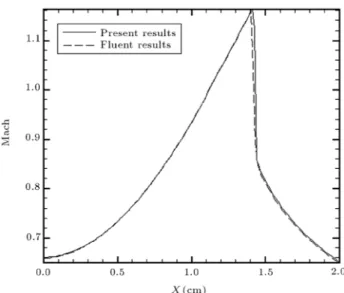
with a stretching ratio of 1.05 in a normal direction, according to the Robertson formula [25] (Figure 1). When rening the grid by a factor of 2, the dierences between the computational results were extremely small, which meant that grid independency had been reached. The comparisons of the obtained results at the centerline of the nozzle are given in Figures 2 to 4,
Figure2. Temperature distribution.
Figure3. Mach number distribution.
which show good agreement with numerical results obtained by the commercial FLUENT software that uses the mixture model.
The high gradient region caused by the shock wave (Figures 2, 3 and 5), is equally well resolved by both algorithms. Therefore, a new formulation provides the same results for such a nozzle problem.
WALL-COOLING OF THENOZZLE
As the next example, the wall-cooling of a two dimen-sional supersonic converging-diverging nozzle has been considered. The same nozzle geometry and the same grids as in the preceding example are chosen here. The problem properties are:
pr= 510 3pa;
Tr= 700 K;
Figure 4. Concentration contours from the present and the mixture models.
and, at the inlet:
p0
pr = 1:4; and T
0
Tr = 1:1:
A binary ideal gas system (Helium-Xenon) is chosen as the media. Lighter gas (He) enters from the inlet of the converging part of the nozzle with a temperature of about 740 K and the heavier gas (Xe), as the coolant, is blown from the wall fromx= 1:145 cm, afterwards, with a temperature of about 300 K and with Cartesian velocity components equal to (100,5) m/s.
Figure 4 shows the concentration distribution for the mixture ( He
He +
Xe) obtained from the present
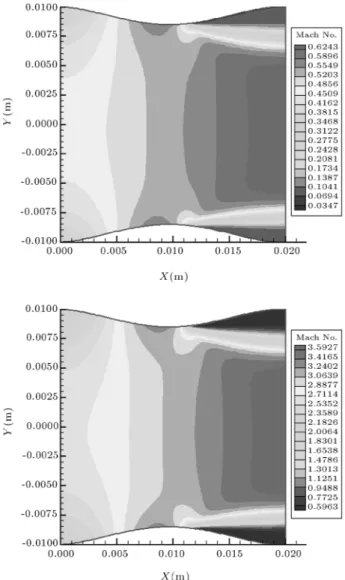
method and the mixture model (FLUENT), respec-tively. The comparison of the results shows that the present method is more diusive. This may be due to the diusive nature of the exchange terms in the conservation equations. This method can provide details of the ow elds of each component of the mixture separately, e.g. the Mach number contours for helium and xenon are shown in Figure 6. It is seen that, although the gas mixture ow is subsonic, Figure 7, the xenon component is supersonic in most of the region. This is due to the large dierence in the properties of each component of the mixture. Additionally, the x-velocity and temperature distributions of each component are presented in Figures 8 and 9. As seen, both components have the same temperature and velocity at each location of the nozzle. This means that the components of the mixture have reached the same thermodynamics equilibrium. In fact, although at the interface of the helium and xenon mixing, the particles of the two gases meet each other with two dierent temperatures, the relaxation time is too small to detect this temperature dierence transition zone.
Figure 7 shows the Mach number contours for the whole mixture obtained from the Fluent computer code, based on the mixture model, which is almost identical with the mixture results obtained from the present model. From Figure 7, it is seen that the eec-tive shape of the nozzle would be converging instead of the converging-diverging nozzle, due to xenon blowing from the diverging part downstream. Therefore, the main ow remains subsonic, as can be seen in Figure 7.
CONCLUSION
In this work, starting from kinetic equations, the Eule-rian approach was used to derive new hydrodynamic equations of motion for a multicomponent system, where each component may have a dierent velocity and kinetic temperature. The new equations are based on Grad's method of moment, derived from the kinetic model in a Relaxation Time Approximation (RTA). Based on this binary model, which contains
Figure6. Mach no. contours for the helium and the xenon from the present model.
Figure7. Mach no. contours for the whole mixture from the mixture model.
Figure8. X-velocity distribution for helium and xenon.
a separate equation set for one component of the system and an equation set for average quantities of the mixture, a computer code was developed for numerical computation of compressible ows of binary gas mixtures in generalized curvilinear boundary con-forming coordinates. Since these equations are similar to the Navier-Stokes form for the single uid systems, they can be solved by conventional numerical schemes, which are also used for solving Navier-Stokes equations. The prepared algorithm and the computer code are capable of computing and presenting the ow elds of each component of the system separately, as well as the ow eld of the gas mixture as a whole. Some examples were used to evaluate the model and the relevant computer code. It was concluded that, for most ordinary problems, the results of the Eulerian multiuid model and the mixture model are almost identical, mainly due to small relaxation times. It is suggested that the separate uids treatment is crucial when considering time scales on the order of (or shorter
Figure 9. Temperature distribution for helium and xenon.
than) intercollision relaxation times. Therefore, one may nd more applications of this new formulation and the algorithm in unsteady problems, including sudden changes in the ow properties or ows of rareed gases that bring about larger relaxation times.
REFERENCES
1. Chern, I.L., Glimm, J., McBryan, O., Plohr, B. and Yaniv, S. \Front tracking for gas dynamics", J. Comput. Phys.,62, pp 83-90 (1986).
2. Karni, S. \A level-set scheme for compressible in-terfaces", Numerical Methods for Wave Propagation, Kluwer Academic Publishers, Dordrecht, pp 253-274 (1988).
3. Larouturou, B. and Fezoui, L. \On the equations of multicomponent perfect or real gas inviscid ow",
Lecture Notes in Mathematics, Springer-Verlag,1402 (1989).
4. Chargy, D., Abgrall, R., Fezoui, L. and Larrouturou, B. \Conservative numerical schemes for
multicom-ponent inviscid ows", Rech. A'erosp., 2, pp 61-69 (1992).
5. Karni, S. \Multi-component ow calculations by a consistent primitive algorithm", J. Comput. Phys., 112, pp 31-42 (1994).
6. Abgrall, R. \How to prevent pressure oscillations in multicomponent ows: A quasi-conservative ap-proach",J. Comput. Phys.,125, pp 150-157 (1996). 7. Shyue, K.M. \An ecient shock-capturing algorithm
for compressible multicomponent problems",J. Com-put. Phys.,1, pp 208-216 (1998).
8. Shyue, K.M. \A uid-mixture type algorithm for compressible multicomponent ow with Van der Waals equation of state", J. Comput. Phys., 1, pp 43-52 (1999).
9. Abgrall, R. and Karni, S. \Computations of compress-ible multiuids", J. Comput. Phys., 169, pp 594-623 (2001).
10. Marquina, A. and Mulet, P. \A ux-split algorithm applied to conservative models for multicomponent compressible ows", J. Comput. Phys., 185, pp 120-138 (2003).
11. Sirovich, L. \Kinetic modeling of gas mixtures",Phys. Fluids,5(8), pp 908-918 (1962).
12. Morse, T.F. \Kinetic model equation for gas mixture",
Phys. Fluids,7(12), pp 2012-2013 (1964).
13. Wu, Y. and Lee, C.H. \Kinetic theory of shock tube problems for binary mixtures",Phys. Fluids,14(2), pp 313-322 (1971).
14. Garzo, V., Santos, A. and Brey, J.J. \A kinetic model for a multicomponent gas", Phys. Fluids, A1(2), pp 380-383 (1989).
15. Ivings, M.J., Causon, D.M. and Toro, E.F. \On hybrid high resolution upwind methods for multicomponent ows", Z. Angew. Math. Mech., 77(9), pp 645-653 (1997).
16. Hirschfelder, J.O., Curtiss, C.F., Bird, R.B.,Molecular Theory of Gases and Liquids, Wiley (1954).
17. Chapman, S. and Cowling, T.G., The Mathematical Theory of Non-Uniform Gases, Cambridge University Press, Cambridge (1952).
18. McCourt, F.R.W., Beenakker, J.I.M., Kohler, W.E. and Kuscer, I.,Non-Equilibrium Phenomena in Polyu-tomic Gases,1and2, Clarendon Press, Oxford (1990). 19. Zhadanov, V.M.,Transport Processes in Multicompo-nent Plasma, Taylor and Francis, London, UK (2002). 20. Lian, Y. and Xu, Kun \A gas-kinetic scheme for mul-ticomponent ows" ICASE Report No. 99-28 (1999). 21. Luo, L. and Girimanji, S. \Theory of the lattice
Boltz-mann method: Two-uid model for binary mixtures",
Phys. Rev. E 67(2003).
22. Bhatnagar, P.L., Gross, E.P. and Krook, M. \A model for collision processes in gases. I. Small amplitude pro-cesses in charged and neutral one-component systems",
Phys. Rev.,94(1954).
23. Gross, E.P. and Krook, M. \Model for collision pro-cesses in gases: Small-amplitude oscillations of charged two-component systems",Phys. Rev.,102, pp 593-598 (1956).
24. Burgers, J.M., Flow Equations for Composite Gases, Academic Press, London, UK (1969).
25. Anderson, D.A., Tannehill, J.C. and Pletcher, R.H.,
Computational Fluid Mechanics and Heat Transfer, Hemisphere Publishing Corporation (1984).