Stefan Brüggemann
Astrium Space Transportation, Germany
Claudia d’Amato
Università degli Studi di Bari “A. Moro”, Italy
Semantic Web:
Collaboration and the Semantic Web: social networks, knowledge networks and knowledge resources / Stefan Bruggemann and Claudia d’Amato, editors.
p. cm.
Includes bibliographical references and index.
Summary: “This book showcases cutting-edge research on the intersections of Semantic Web, collaborative work, and social media research, exploring how the resources of so-called social networking applications, which bring people together to interact and encourage sharing of personal information and ideas, can be tapped by Semantic Web techniques”--Provided by publisher.
ISBN 978-1-4666-0894-8 (hbk.) -- ISBN 978-1-4666-0895-5 (ebook) -- ISBN 978-
1-4666-0896-2 (print & perpetual access) 1. Semantic Web. 2. Online social networks. 3. Internet--Social aspects. I. Bruggemann, Stefan, 1978- II. d’Amato, Claudia, 1977-
TK5105.88815.C64 2012 025.04’27--dc23
2012001349
British Cataloguing in Publication Data
A Cataloguing in Publication record for this book is available from the British Library.
All work contributed to this book is new, previously-unpublished material. The views expressed in this book are those of the authors, but not necessarily of the publisher.
Development Editor: Hannah Abelbeck Acquisitions Editor: Erika Gallagher Typesetter: Nicole Sparano
Cover Design: Nick Newcomer, Lisandro Gonzalez
Published in the United States of America by
Information Science Reference (an imprint of IGI Global) 701 E. Chocolate Avenue
Hershey PA 17033 Tel: 717-533-8845 Fax: 717-533-8661 E-mail: [email protected] Web site: http://www.igi-global.com
Copyright © 2012 by IGI Global. All rights reserved. No part of this publication may be reproduced, stored or distributed in any form or by any means, electronic or mechanical, including photocopying, without written permission from the publisher. Product or company names used in this set are for identification purposes only. Inclusion of the names of the products or companies does not indicate a claim of ownership by IGI Global of the trademark or registered trademark.
Chapter 11
DOI: 10.4018/978-1-4666-0894-8.ch011
INTRODUCTION
Given the vast amounts of text available on the Web, it is becoming increasingly clear that Internet based tools (e.g., search engines, content creation and management) and applications (e.g.,
Wikipe-dia, social networking, blogs) need to understand at least rudimentary semantics of the contents of the Web, which is of course the fundamental motiva-tion for Semantic Web (Shadbolt et al 2006). While semantics is a complex subject and understanding (and using) the complete meaning of a piece of text may well be impossible, it is easy to identify limited types of semantic elements in a text.
Girish Keshav Palshikar
Tata Research Development and Design Centre, India
Techniques for Named
Entity Recognition:
A Survey
ABSTRACT
Named entities (NE) − like names of persons, organizations, locations and dates, times, phone numbers, amounts, zip codes – are just such basic semantic elements of a text that carry a specific and limited kind of meaning. An ability to automatically perform named entity recogni-tion (NER) – i.e., identify occurrences of NE in Web contents – can have multiple benefits, such as improving the expressiveness of queries and also improving the quality of the search results. Examples where processing queries containing NE as keywords requires NER: Kawasaki the person and Kawasaki the manufacturing company, Jack-son the scientist and JackJack-son the musician, dates in different formats, identifying that Robert Feynman and Dick Feynman are the same persons, Jobs as a person versus jobs as a common noun, high blood pressure and hypertension as synonymous medical terms. As another example, identifying two successive dates in a text can help compute the duration of some event (e.g., of a project). Lack of NER abilities make representation and execution of queries such as “Find all European physicists who lived for at least 70 years” difficult for many of today’s search engines. Given the frequent use and relatively well-defined semantics of NE, it is possible to use NER to automatically annotate the occurrences of NE in web contents, which can then be used for improving search and other functions. NE are frequently used as sources (origins) of hyperlinks. Further, since NE occur frequently as part of annotations, notes, comments, bookmarks, hyperlinks etc., NE play an important role in collaborative semantic web applications.
Given the importance of NER in semantic processing of text, this paper presents a detailed (but not necessarily exhaustive) survey of NER techniques. We focus on NER in English text, though there is a considerable work for other languages, which presents complex challenges. We focus mainly on NER for generic NE. How-ever, there is a large amount of work on NER for extracting domain-specific NE. NE in the
bio-medical domain are the most well-explored, among the various possible domains.
NER is an important sub-problem in text pro-cessing − particularly in information extraction (IE) − and is useful in many practical applications in the Semantic Web context. The goal of NER is to identify all occurrences of specific types of
named entities in the given document collection.
NE may be divided into several categories. • Generic NE consist of names of persons
(PERSON), organizations (ORG), loca-tions (LOCATION), amounts, dates, times, email addresses, URLs, phone numbers etc. Other generic NE include: film title, book title etc. In a richer problem setting (called fine-gained NER), the problem is to identify generic NE which are hierar-chically organized; e.g., PERSON may be sub-divided into politicians, sports per-sons, film stars, musicians etc.
• Domain-specific NE (DSNE) consist of, for example, names of proteins, enzymes, organisms, genes, cells etc., in the biologi-cal domain. As another example, DSNE in the manufacturing domain are: names of manufacturer, product, brand and attri-butes of the product (Fig. 1).
Often the NER needs to be performed on a fixed type of input text; e.g., news items or research paper abstracts. NER in speech is a much more difficult problem, since information such as capitalization, punctuation etc. is not available in speech data (though some other kinds of informa-tion, such as emphasis, may be available). In this paper, we focus on the NER for English text.
Challenges in NER
are error-prone; words may be wrongly capitalized and capitalization of first words in a sentence may lead to some confusion as in Jobs said ... or Jobs are harder to find .... Complex techniques such as co-reference resolution are needed to detect indirect occurrences of NE; e.g., through the use of pronouns. In Prospects of ABC Corp. are looking bright. It has declared a dividend ..., the pronoun It stands for ABC Corp. and may need to be identified as an occurrence of ORG. Another problem is the overlap between NE types; e.g., Washington can be used both as a PERSON or a LOCATION; White House can be used as both a LOCATION and an ORG. Many NE are multi-word (e.g., Bank of America). In such cases, identifying the boundary (i.e., the exact sequence of words) of a NE occurrence can be tricky; e.g., is Boston Gas and Light Company a single or-ganization or a conjunction of two oror-ganizations? Also, NER is (at least partly) a language-specific task. For example, capitalization may be used in English to indicate a PERSON name but such a method is not available in many languages (like Hindi) which do not have capital letters. Alterna-tively, the form of a verb in a sentence indicates the gender of the subject in many languages (not English), which can help in NER (e.g., to detect PERSON names).
Another difficulty arises due to the different ways of referring to the same NE in the same docu-ment: abbreviations (IBM versus International Business Machines) and shortened names ( Mit-subishi Motor Company versus Mitsubishi). It requires some reasoning to decide that Boston Gas
and Light Company is a single ORG and does not denote a conjunction of two ORG here, unlike in Microsoft and Google). While most NER can be done when processing each individual sen-tence, sometimes long distance clues from other sentences may be helpful. For example, we can decide that MURDOCH is a PERSON (though it is in all capitals) in MURDOCH SATELLITE EXPLODES ON TAKE OFF if we were able to determine when processing ... Rupert Murdoch’s ambition ... later in the document that Murdoch
is a PERSON. Thus a lazy approach to NER – where local decisions or evidences are effectively combined - might be useful, where some NE oc-currences may initially be left untagged and which are tagged after sufficient evidence is available later. A one use per document principle might be useful to decide that all occurrences of Philip Morris (or Morris) are an ORG throughout a document, if even one sentence in the document provides a strong clue that Philip Morris is an ORG (... president of Philip Morris said ...). An effective NER system would require the use of use of a large amount of prior common-sense knowledge. For example, occurrence of a phrase like Mitsubishi and Nissan suggests that both these words should be assigned the same NE type. The task of assigning the correct NE type to a group of words in a sentence becomes quite subtle due to the complex nature of interdependencies among various parts of sentences. Overall, it is quite a technical challenge to build NER systems that rival human performance.
Desirable Characteristics
of an NER System
Some desirable properties that a good NER system should possess are as follows. First, the system should obviously be highly accurate in its output. Next, it should be as efficient as possible; e.g., in terms of the time taken to tag a set of documents. The system should be robust in the presence of noise such as spelling and grammatical errors, wrong capitalization, incorrect sentence boundar-ies (e.g., missing periods) etc. The NER system should be as much corpus independent as possible i.e., it should be possible to reuse it on documents in different corpora, such as news items, emails, reports or blogs. Sometimes it is desirable to de-sign an NER system which is portable or language independent and can identify NE in documents written a variety of (related) languages. Further, ideally an NER system should be designed to be largely domain independent, which can be adapted with little or no effort to identify new types of NE, possibly from different domains such as banking or manufacturing. Another aspect of an NER system is extendibility, which is the ability of the expert users to extend the knowledge sources used by the system (e.g., rules and gazetteers of known examples of a NE). Clearly, meeting all (or even most) of these goals is difficult and hence build-ing a good NER system is a challengbuild-ing task. Evaluation of the accuracy of an NER system is critical for enabling comparison between systems.
Techniques for NER
Approaches to build an NER system can be broadly divided into 4 groups. It should be emphasized that while this grouping helps in understanding the broad category of techniques, many NER systems reported in the literature contain two or more techniques.
1. Rule-based Approaches: Here, a set of rules is manually crafted by experts to recognize
a particular NE type. The rules are based on syntactic, linguistic and domain knowledge. 2. Supervised Learning Approaches: Here,
a large hand-tagged corpus is manually created by human experts, where instances of the given NE type are explicitly identi-fied. Supervised learning algorithms from machine learning are used to generalize and discover NER rules from this labeled training dataset.
3. Unsupervised Approaches: Here, usually the system is provided a small set of seed instances (or examples) of the NE type; e.g., cities {’New York’, Boston, London, Seoul}. The system then examines the given document collection and learns some rules from the sentences in which the seed NE examples occur. These rules are applied to identify new examples of NE and then learn a new set of rules. The system continues to learn in this way and stops when no new rules can be discovered.
4. NE Extraction (NEX): The NEX task is quite similar to the unsupervised approaches, except that the goal is not to learn rules for NER but to create a gazette (list or gazetteer) of examples of the NE. Also, NEX is often applied to learn from web pages rather than documents. The idea is that once a compre-hensive list of NE examples is created, NER in a given document corresponds to simple look up in this list.
availability of several corpora tagged with named entities has given a boost to the research in NER.
This chapter is organized as follows. First, the tagged datasets available for evaluating accuracy of an NER system are surveyed. Then methods to compute the accuracy of an NER system are presented. Next, specific types of NER techniques are reviewed. Lastly, the techniques are compared and some open problems are discussed.
TAGGED DATASETS FOR NER
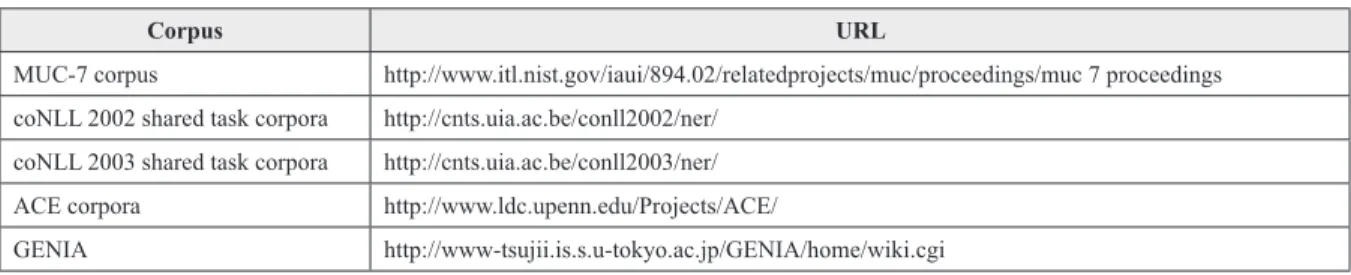
Table 1 shows a list of some tagged corpora for NER tasks; see (Fort et al 2009) for guiding prin-ciples and a methodology for creating effective tagged NE datasets (tagging is also called NE
annotation); see similar guidelines from LDC
(http://projects.ldc.upenn.edu/ace/docs/English-Entities-Guidelinesv6.1.pdf). The Message Un-derstanding Conferences MUC-6 and MUC-7 had a special track for NER tasks. There were a few broad classes of NE. The class Enamex consisted of 3 types of generic NE: PERSON (name of a person), LOCATION (name of a physical location such as city, state, country etc.) and ORG (name of an organization). The class Timex consisted of types of NE such as DATE and TIME. The class Numex consisted of various expressions used to state numeric quantities like state amounts, rates, numbers etc. MUC-7 provided a tagged corpus for these NE. This corpus contains 100 news items containing 4091 Enamex occurrences: 1880 ORG (46%), 1324 LOCATION (32%) and 887 PERSON
(22%). The corpus was tagged by several experts and there was substantial (97%) agreement among them. See Fig. 2 for an example.
The CoNLL-2003 shared task corpus for English contains a collection of news wire articles (there is a German corpus as well). The data files contain four columns separated by a single space. Each word is put on a separate line and there is an empty line after each sentence. The first item on each line is a word, the second a POS tag, the third a syntactic chunk tag and the fourth the NE tag. The chunk tags and the NE tags have the format I-TYPE which means that the word is inside a phrase of type TYPE. Only if two phras-es of the same type immediately follow each other, the first word of the second phrase will have tag B-TYPE to show that it starts a new phrase. A word with tag O is not part of a phrase. The sentence U.N. official Ekeus heads for Baghdad. is tagged as follows:
U.N. NNP I-NP I-ORG official NN I-NP O Ekeus NNP I-NP I-PER heads VBZ I-VP O for IN I-PP O
Baghdad NNP I-NP I-LOC . . O O
EVALUATION OF NER ALGORITHMS
The steps for evaluating any NER system are fairly standardized:
Table 1. Some Tagged corpora for English NER
Corpus URL
MUC-7 corpus http://www.itl.nist.gov/iaui/894.02/relatedprojects/muc/proceedings/muc 7 proceedings coNLL 2002 shared task corpora http://cnts.uia.ac.be/conll2002/ner/
coNLL 2003 shared task corpora http://cnts.uia.ac.be/conll2003/ner/ ACE corpora http://www.ldc.upenn.edu/Projects/ACE/
1. Select a gold standard (or key) tagged corpus containing documents, each of which con-tains annotated instances of the given types of named entities. This corpus is often tagged manually. Randomly divide the documents in the corpus into training and testing sets (often in 80% − 20% proportion).
2. Use the training set to learn and to tune the NER knowledge base. Usually 10-fold cross validation is used to estimate the training error. No further changes should be made to the knowledge base after the training step is declared complete. Care should be taken to avoid any manual knowledge engineer-ing specifically for improvengineer-ing the accuracy of the proposed algorithm over the given corpus.
3. Use the learned and tuned knowledge base to extract entities from the documents in the test set.
4. For each NE type, compute the precision, recall and an overall accuracy measure such as the F-measure.
Let A = {a1, a2, . . ., aN} denote (multi)set of
N occurrences of the chosen type of NE in the test corpus. Let B = {b1, b2, . . ., bM} denote the (multi)set of the M occurrences of the chosen
type of NE identified by the algorithm in the test corpus. An occurrence bi∈ B is classified as a
true positive (TP) (as false positive (FP)) if bi∈ A (bi∉A respectively). Thus the number of true positives identified by the algorithm is the number of occurrences which are in both B and A i.e., #TP
= |A ∩ B|. The number of occurrences which are in B but not in A is the number of false positives: #FP = |B − A|. An occurrence ai in A is classified as a false negative (FN) if ai∉B. The number of occurrences which are in A but not in B is the number of false negatives: #FN = |A − B|. Then the precision P, recall R and F-measure accuracy of the algorithm are:
P TP B
TP TP FP
= =
+
# #
# #
R TP A
TP TP FN
= =
+
# #
# #
F PR P R
= +
2
Precision P indicates the fraction of the
extracted entities that are correct. Recall R indi-cates the fraction of the correct entities that are
extracted. Low precision indicates high value of #FP i.e., lot of noise in extraction. Low recall indicates high value of #FN i.e., lots of misses in extraction. The F-measure computes an overall accuracy by combining precision and recall. There are other ways of measuring the performance of NER algorithms, though P, R and F are most commonly used.
A delicate issue is how to compare the extracted occurrence and the occurrence in the gold copy. For example, suppose the gold copy marks Bill Clinton as a PERSON in a sentence and an NER algorithm extracts only Clinton as a PERSON in that sentence. Is this a correct match? An exact matching scheme treats such extraction as a mis-match i.e., FP. But often a more forgiving scheme is employed, which accepts partial matches; e.g., left match or right match; see (Tsai et al 2006).
RULE-BASED NER
While one can often use lexical (word-level) and syntactic cues for recognizing an NE type (e.g., a person name often begins with a capital letter), these rules are not sufficient; there are many special cases and most rules have exceptions. Following are some example rules to identify the occurrence of a PERSON in a sentence.
• Often consists of a sequence of words each of which begins with a capital letter followed by all lowercase letters (John Ryder); the first word is often a known first name (John) and the next word is un-known (Ryder).
• May contain a prefix title such as Mr., Dr.
or Prof. (Dr. Enrico Fermi)
• May contain an initial in the middle or be-ginning (Winston S. Churchil, A. John Northrop)
• May contain a suffix such as Jr. or III (as in George Bush Sr.)
• May contain a designation indicator prefix such as President, Justice, Sen., Colonel
or CEO (President Clinton)
• May be followed by an appositive NP suf-fix whose head word is singular and indi-cates a profession or a relation (Malviya, a retired analyst, said ...; or Nielson, whose stepfather ...)
• Does not include special characters such as
$, & or % (Johnson & Johnson)
• Does not include prepositions (Castle Of Windsor)
Clearly, the rules are not sufficient to identify all occurrences of PERSON in a document. For one, the rules use many hand-crafted lists (e.g., titles, suffixes, designation or profession indicators etc.), which are likely to be incomplete. Also, the rules themselves are incomplete; e.g., they do not cover many examples: White, 33, was arrested ... and
Murdoch himself arrived ... etc. In fact, many more rules can be defined based on a much deeper syntactic or semantic knowledge; e.g., a copula-based rule can be defined to cover examples like
Ryder is a popular juggler. Another set of rules can be used to identify Spasky as a PERSON in
Spasky alighted quickly from the train ... but this will require deep knowledge of what verbs (e.g., alight) can take only a PERSON as subject and under what situations. Rule-based approaches usually lack robustness and portability. Each new source of text requires significant tweaking of rules to maintain optimal performance and the maintenance efforts tend to be quite steep.
Some well-known rule-based NER systems are Univ. of Sheffield’s LaSIEII (Humphreys et al
LaSIE-II system (Humphreys et al 1998) is a modular IE system and uses a combination of NLP techniques for NER, including word sense disambiguation, co-reference resolution, a shal-low semantic representation of the text in quasi-logical form and representation of the domain of discourse as a semantic net. Nodes represent con-cepts (along with properties) and edges represent hierarchy and support property inheritance; e.g., node launch_event has sub-nodes like vehicle,
payload, astronaut and has properties such as
launch_date, launch_site, launch_org etc. NER
is posed essentially as a co-reference task. When processing a sentence, a set of presupposition rules may detect a new instance of a node (e.g., rule if launch of X then X is-a vehicle) and a set of consequence rules may fill up properties of an already detected instance of a node (e.g., if launch
... from Y then Y is-a launch_site property). The FACILE system (Black et al 1998) con-sists of a set of hand-crafted patterns for NER in a regular expression like rule notation. The rules include a co-reference mechanism that detects and uses common text from previous occurrence of the same NE (foreign secretary Robin Cook
and Mr. Cook). Interestingly, each rule predicts a NE type, with a certainty factor, if a condition is satisfied. An evidence combination mechanism is used to combine the certainty values of two matched rules for the same NE type.
The LTG system (Mikheev et al 1999) uses a lazy approach to NER where the rules are applied in phases, starting with the ”sure fire” rules and proceeding to rules which are more ”relaxed” and tag the NE occurrences left untagged by the previous phases, by making use of the already tagged occurrences of NEs. A grammar-like for-malism is used for defining the rules. (Fukuda et al 1998) discussed a rule-based NER system for identifying protein names (e.g., p53, interleukin 1 (IL-1)-responsive kinase, insulin) in biomedical documents. (Bellot et al 2002) describes an NER system based on hand-crafted patterns (regular
expression transducers) and its application to a question-answering system.
SUPERVISED LEARNING
APPROACHES
In supervised learning approaches, NER is es-sentially posed as a classification problem. A set of labeled training dataset is given as input, where instances of the named entities in these documents are identified by human experts. A classification algorithm is used to generalize from these examples and discover a set of rules that can be applied to a new document to identify any instances of the named entities in it. Several distinct approaches to classification algorithms are developed in the machine learning, pattern recognition and statistics literature. Figure. 3 shows the conceptual architecture of an NER system based on supervised learning approach.
Hidden Markov Model Based
Approaches
Several authors have used Hidden Markov Models (HMM) for NER; e.g., (Bikel et al 1999), (Sey-more et al 1999), (Collier et al 2000), (Miller et al 1998), (Klein et al 2003). HMM approach has also been used for NER in languages other than English. HMM approach has also been used for DSNE; e.g., biomedical domain (Shen et al 2003), (Zhang et al 2002), (Zhao 2004); see also (Liu et al 2005) who used HMM for identifying NE such as product names. HMM models the sequence dependencies well and hence are useful for NER because the NE type of a particular word intui-tively depends on previous words. The approaches using HMM differ mainly in the structure of the model and in the methods used to compute the associated probabilities.
has a probability and transitions are not labeled with any symbol. The HMM also has a set of emission symbols. Each state emits a symbol with a particular probability. Given an observed sequence σ of emitted symbols, the decoding problem for HMM is efficiently solved by the Viterbi algorithm, which identifies a most prob-able sequence of states through which the HMM may have passed so as to generate σ. Typically, emission symbols are words and σ is the observed sequence of words. The corresponding state se-quence obtained by decoding σ is the sese-quence of NE types, one for each word in σ.
We describe the approach of (Collier et al
2000), who used an HMM to detect NEs in the biomedical domain: PROTEIN, DNA, RNA, VIRUS, TISSUE, CELLLINE, CELLTYPE etc. Each state in the HMM represents an NE type. There are special states for start and end of a sen-tence. Each state emits a word W. Each word is represented as a tuple (W, F) where W is an actual word and F is a vector of features of that word. Features used include DigitNumber (15),
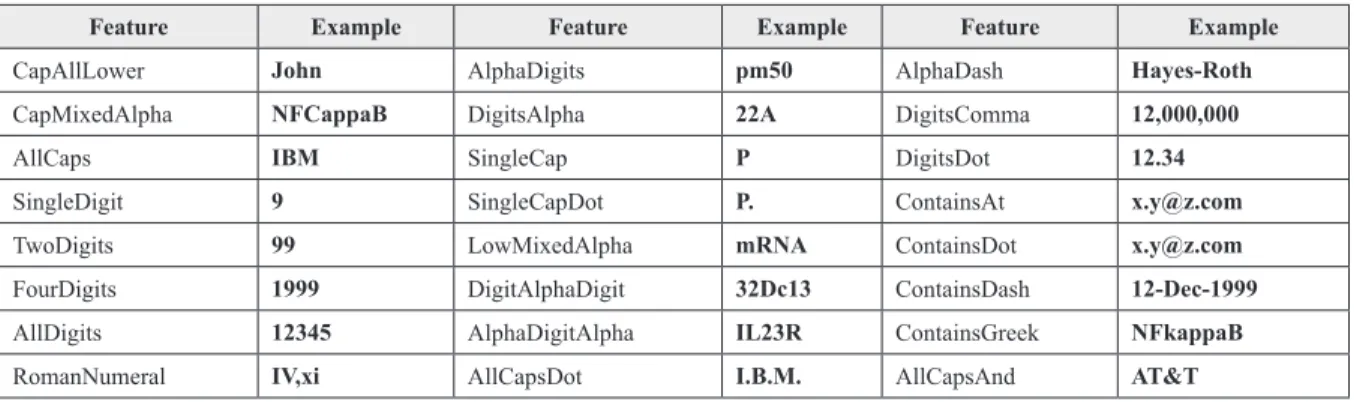
Single-Cap (M), GreekLetter (alpha), Single-CapsAndDigits (I2), TwoCaps (RalGDS), InitCap (Interleukin), LowCaps (kappaB), lowercase (kinases), Hyphen (-), Fullstop (.) etc. (see Table 2 for more lexical word features). The probability P(Ci|Ci−1) of transi-tion from the current state (i.e., NE type) Ci−1 to next state Ci depends on the current and previous word and their features and the current state. It is computed as follows in Exhibit 1.
The λI’s are constants such that λi
i
=
=
∑
11 5
. The authors manually set the values of λI’s; but techniques such as Baum re-estimation algorithm could be used to estimate them. f(X|Y) denotes the maximum likelihood estimate of the correspond-ing probability P(X|Y); e.g., f(X|Y) = #(X∧Y)/#Y, where #(X∧Y) and #Y denote the number of oc-currences of event (X and Y) and Y respectively. The above formula employs a progressive back-off to lesser details. For example, suppose Ci−1 = PERSON, Wi−1 = Thomas, Wi = Alva. Suppose we use only 2 word features: InitCap and Low-ercase; thus Fi−1 = (1, 0), Fi = (1, 0). If the sequence
of words Thomas followed by Alva has not oc-curred in the corpus, then the transition probabil-ity is estimated using only Fi without using the word Alva. If the corpus does not contain Thom-as followed by a word with features (1, 0) then the probability is estimated using only the Fi−1
and Fi and so on. The probability that the first word in a sentence will belong to some NE type
Cj is computed using a similar but separate for-mula and depends only on the first word and its features, since there is no previous state and pre-vious word.
(Zhou and Su 2002) is also an HMM-based NER system. One distinguishing feature of this system is the use of an HMM-based chunk tag-ger to identify chunks (i.e., sequences of words) which are candidates for NE. A separate HMM is then used to assign an NE type to each chunk. Another interesting aspect of this work is the use of a feature which checks whether any of the words in the current chunk are part of an NE already identified in the text. The system also integrates
various gazetteers (e.g., holidays, cities) and uses match of the current chunk with any of the gazet-teers as a feature.
In a different HMM-based approach to NER, called character-level HMM, characters (rather than words and phrases) are taken as the primary representation of the text. The idea is to use character-level features to perform NER; e.g., PERSON names often begin with a capital letter, have a mixed case and are preceded by character sequences such as Mr.
We describe the model of (Klein et al 2003). States encode an NE type and observations are characters (a character is emitted one at a time). Each state is a pair (t, k), where t is an NE type (such as PERSON, LOCATION, ORG etc. includ-ing OTHER) and k is the length of the time the model has been in state t; e.g., the state (PERSON, 2) indicates the state reached after processing the second letter in a person’s name. The final letter of a word is followed by a space (inserted, if not present in the text) and the model transitions to
P C C P C W F W F C
f C W F
i i i i i i i i
i i i
( | ) ( | , , , , )
( | , ,
− = < > < − − > −
= < > <
1 1 1 1
0
λ WW F C f C F W F C
f C
i i i i i i i i
i
− − > − + < > < − − > −
+ <
1 1 1 1 1 1 1
2
, , ) ( | _, , , , )
( |
λ
λ W FWi, i> <, _,Fi−1>,Ci−1)+λ3f C( i| _,< Fi > <, _,Fi−1>,Ci−1)+λ4f C( i || )
( )
C f C
i
i
−
+
1
4
λ
Exhibit 1.
Table 2. Orthographic features useful for NER
Feature Example Feature Example Feature Example CapAllLower John AlphaDigits pm50 AlphaDash Hayes-Roth CapMixedAlpha NFCappaB DigitsAlpha 22A DigitsComma 12,000,000
AllCaps IBM SingleCap P DigitsDot 12.34
SingleDigit 9 SingleCapDot P. ContainsAt [email protected]
a special state like (PERSON, F). Also, when k
reaches n (the n-gram history order), it is not in-cremented any further. The transitions are defined in such a way that a state like (PERSON, 2) can transition to (PERSON, 3) or (PERSON, F) only. A final state like (PERSON, F) can only transition a beginning state like (OTHER, 1).
Probability of emitting a particular character in state s depends on the last n−1 observed charac-ters: P(c0|c−5c−4c−3c−2c−1, s), where c0 is the current character, c−1 is the previous character and so on. Empirically, n = 6 is recommended. For example,
P(s|Thoma,PERSON,6) is the probability of emit-ting character s in state (PERSON, 6) when the last 5 observed characters were Thoma. This prob-ability is estimated from the corpus and smoothed using the method of deleted interpolation. The state transition probabilities (e.g., probabilities of going from (PERSON, 2) to either (PERSON, 3) or (PERSON, F)) are also estimated from the corpus. The Viterbi decoding is done in a standard way. For example, given the observed character sequence I flew from Washington to Denver the most likely sequence of states can now be found using the Viterbi algorithm.
Maximum Entropy Models
Several authors have used a maximum entropy
(ME) based approach for NER; e.g., (Bender et al 2003), (Curran and Clark 2003), (Chieu and Ng 2003). ME based approaches have also been used for languages other than English, such as German, Spanish and Dutch. ME based approaches have been used for detecting DSNE in biological domain; e.g., (Lin et al 2004), (Raychaudhuri et al 2002). ME approach (which is a supervised approach) is used for NER because of its superior method of estimating a most uniform PDF from training data i.e., one which makes the least ad-ditional assumptions. This PDF is then used for predicting the NE type for given sequence of words. The ME approach is often used in conjunc-tion with an HMM approach. The specific works of
various authors differ mainly in the features used. See (Berger et al 1996) for a good introduction to ME methods for natural language applications.
Given a labeled training dataset (e.g., a corpus containing tagged occurrences of NE), many fea-tures (or summary statistics) can be defined, each of which characterizes a particular aspect of the phenomenon (rules used for NE tagging, in our case). Often each feature is modeled as a binary-valued function fj of arity more than 1, where the first argument denotes the NE type for the ith word in a sentence and the rest of the arguments denote the context of that word. A feature can be thought of as a black box that takes some context of the current word as input and produces the NE tag for the current word as output. Let Wi and Ci
denote the random variables (RV) which take on values as words and NE types respectively (Wi is the ith word in a sentence and C
i is its NE type).
Then some examples of features are as follows:
f1(Ci, Wi) = 1 if Wi begins with a capital letter and
Ci = PERSON; 0 otherwise
f2(Ci, Wi−1) = 1 if POS tag of Wi−1 is verb and Ci = PERSON; 0 otherwise
f3(Ci, Wi−1) = 1 if POS tag of Wi−1 is preposition and Ci = OTHER; 0 otherwise
Expected value of each feature may be consid-ered as a summary statistic of the training dataset. For example, in a particular corpus, one may find that 37% words that begin with a capital letter were tagged as PERSON; 19% words that follow a verb may be found to be tagged as PERSON; and 88% words that follow a preposition may be found to be tagged as OTHER. The empirically observed expected values of f1, f2 and f3 are EOBS(f1) = 0.37,
EOBS(f2)= 0.19 and EOBS(f3)= 0.88 respectively. The expected value of feature f1 in the training dataset is defined as follows:
EOBS f POBS c w f c w
c C w
( ) ( , ) ( , )
,
1 = 1
where POBS(c, w) is the probability of observing the word w tagged with NE type c in the training dataset; this probability is estimated as relative frequency.
Suppose that we want to identify a probability distribution function (PDF) P(Ci|Wi, Wi−1) that predicts the NE type of the current word given its previous word. The observed statistics impose three constraints on the desired PDF: the expected values of features f1, f2 and f3 as computed using P
should be the same as those empirically observed in the training dataset.
E(f1) = EOBS(f1) i.e., E(f1) = 0.37 and
E(f2) = EOBS(f2) i.e., E(f2) = 0.19 and
E(f3) = EOBS(f3) i.e., E(f3) = 0.88
In general, an infinite number of PDFs may be consistent with the given constraints. The an-cient principle of insufficient reason says that one should choose that hypothesis which is consistent with the given facts and which makes the fewest possible additional assumptions. A mathematical formalization of this principle is the principle of
maximum entropy (ME): choose that PDF (among
those consistent with the given constraints) which is as uniform as possible i.e., one which has the maximum entropy. It can be shown that such a PDF always exists and is unique. Entropy of a PDF P(X) is the expected number of bits required to specify values of RV X drawn according to P.
H P X
P x x P x P x
( ( ))
log ( ( )) ( )log ( ( ))
= = −
∑
E 1 2 2Here, x varies over all values of the discrete RV X. Analogously, the entropy of a conditional PDF P(Y |X) is defined as:
H P Y X P x P y x P y x
y x
( ( | ))= −
∑
( )∑
( | )log ( ( | ))2In our case, the principle of ME has suggested to identify a conditional PDF (e.g., P(C|W , W))
which satisfies the given constraints and which has the maximum conditional entropy. This is a problem in constrained optimization: maximize a function having the form of conditional entropy under given constraints having the form EOBS(fj) = EP(fj). The method of Lagrangian multipliers can be applied to find the optimal solution to this constrained optimization problem. It can be shown that the required conditional CDF (which is consistent with the given constraints and has the maximum entropy) has a particular form. In our example, the required conditional PDF P(Ci|Wi−1,
Wi) has the following form:
P C c W u W v e
e
i i i
f c v f c v f c v f d
( | , )
( , ) ( , ) ( , ) ( ,
= −1= = = 1 1 +2 2 +3 3
1 1
λ λ λ
λ vv f d v f d v d C
)+ ( , )+ ( , )
∈
∑
λ2 2 λ3 3λ1, λ2, λ3 are unknown Lagrangian multipliers, one for each constraint. Once their values are determined, we can compute the required prob-ability for any situation; e.g., the probprob-ability that the NE type for John given its previous word is
to is computed as:
P C PERSON W W e e
i i i
( = | −= , = )=
⋅ + ⋅ + ⋅ ⋅ + ⋅ + ⋅ 1
1 0 0 1 0
1 2 3 1 2 3
to John λ λ λλ00λ λ10 20 31
1 1 3
+e⋅ + ⋅ + ⋅ = +
e e e
λ λ λ λ λ λ
Assuming that the predicted NE type for John, given its previous word is to is PERSON, we have f1(PERSON, John) = 1, f2(PERSON, to) = 0, f3(PERSON, to) = 0 and f3(OTHER, to) = 1. In the testing phase, the NE type for John would be unknown. The above probability computation can be made for all NE types (e.g., LOCATION, OTHER etc.) and the one having the maximum value is output as the prediction. The optimal values for the Lagrangian multipliers can be found using algorithms such as the Generalized Iterative Scaling.
on a labeled training dataset. The ME approach crucially depends on the feature functions used as summary statistics for the training dataset. The chosen features must be relevant and suf-ficient for NER. Hundreds of different features can be defined, based on orthographic, lexical and syntactic analysis of the given word and its context. Hence, selection of appropriate features is an important task in the ME approach. Feature selection is a large research area in itself; see (Berger et al 1996) for a discussion relevant to the ME approach.
The ME approach has been extended in several ways when used for NER. A common approach (Barthowick 1999) simultaneously assigns NE types to all words in a sentence, rather than one word at a time. Given a sequence of words w1, …, wn in a sentence, the corresponding sequence of NE types c1, …, cn is one which has the high-est posterior probability among all possible NE type sequences:
c cn P d d w w
d dn n n
1 1 1
1
, arg max ( , , | , , )
, ,
=
Such a maximum posterior probability se-quence is computed using the Viterbi algorithm. Basically, one defines a Hidden Markov Model, where each state corresponds to an NE type. Transition probability matrix (probability pij that an NE type i is followed by NE type j) is estimated from the training dataset.
Each state has a probability distribution for emitting a word (or its corresponding feature vec-tor). The Viterbi algorithm efficiently estimates the most likely sequence of states traversed by the HMM in order to generate the given word sequence.
(Chieu and Ng 2003) have proposed the use of global features, based on the entire corpus, in addition to features based on only the local con-text of a word in a sentence. For example, they compile various lists from the corpus: UNI is a list of words that frequently precede the
occur-rence of a given NE type; UBI is a list of bigrams that frequently precede the occurrence of a given NE type (e.g., city of for LOCATION); SUF is a list of 3-letter suffixes that frequently terminate words in a given NE type (e.g., inc for ORG); FUN is a list of function words that frequently occur in occurrences NE type (e.g., van der for PERSON). They defined features based on these lists; e.g., whether a word contained a suffix from SUF. They also include features that detect use of acronyms. For example, if Federal Communica-tions Commission is detected to be an ORG in a document then the word FCC in that document should get tagged as an ORG, since it matches with the sequence of first letters in a known ORG.
(Park et al 2006) has used a 2-step approach
− NE identification (also called NE boundary
detection) followed by NE classification − for biomedical NER, where they used a separate ME classifier for each step. Mostly lexical features were used in each step and they were divided into groups such as salient words, morphological patterns and collocations.
(Chen and Rosenfeld 1999) proposed a smoothing method to compute the ME model parameters (i.e., the Lagrange multipliers) by assuming a Gaussian prior distribution on their values; all Langrage multipliers have the same Gaussian distribution. This method avoids very large values and also eliminates features that “fire” rarely. (Bender et al 2003) and (Curran and Clark 2003) used this method for their ME-based NER.
Support Vector Machines
Consider a labeled training dataset {(x1, y1), (x2,
the hyperplane from the origin. Both w and b are learned from the training dataset. Given a query point q∈Rn, the classification decision is made
as follows: if w · x + b > 0 then predict class label +1 else predict class label −1. Margin is defined as the distance between the hyperplane and the
support vectors (i.e., points from the training dataset which are nearest to the hyperplane). Hyperplane with the maximum margin tends to be more accurate for classifying unseen data i.e., it has a better generalization. Identifying the maximum margin hyperplane can be formulated as a quadratic optimization problem. Its solution (i.e., formulas to compute the values for w and b) requires only computations of the inner products
xi • xj of the feature vectors in the training dataset. Note that a hyperplane is a linear separator for the training dataset.
If the training dataset is not linearly separable, then SVM employs the so-called kernel trick. Each
n−dimensional point xi in the training dataset is transformed into a (usually higher dimensional) point Φ(xi) such that the inner product in the transformed space is computed efficiently using the kernel function K i.e., Φ(xi) • Φ(xj) = K(xi, xj). Hopefully, the training dataset in the transformed space is linearly separable and then the hyperplane in the transformed space can be used to classify query points. A linear separator in the transformed space corresponds to a non-linear separator in the original space. The kernel function K is required to satisfy certain conditions (e.g., K should be positive definite). For example, the transformation
Φ( , )x x1 2 x x12, , x , x ,
2 2
1 2
2 2 1
=
(
)
maps a 2-dimensional point (x1, x2) to a 5 dimen-sional point. The polynomial kernel function
K(u, v) = (u • v + 1)m (m = 2 here) satisfies the
required property that Φ(u) • Φ(v) = K(u, v), as can be checked.
SVM is a binary classifier i.e., it handles only 2 classes. But in general, the number of NE types M is more than 1 (e.g., PERSON, LOCATION,
ORG). For this reason, several methods have been proposed to extend SVM for multi-class classification. In one-vs-rest method, M SVMs are constructed where the ith SVM predicts class +1 for ith class (NE type) and −1 for the rest of the classes together. The query point q is given to all
M SVMs and the predicted class for q is the one which has the maximum value of w • q + b. In
the pair-wise method (Krebel 1999), M(M−1)/2
SVMs are constructed, where a particular SVM predicts whether the given point belongs to class
i or class j. Treating the decision of each SVM as a vote, the predicted class for a given query point q is the one that gets the maximum votes. (Isozaki and Kazawa 2002) uses a one-vs-rest approach for multi-class NER using SVM for Japanese; they also propose a feature selection method as well as a method for reducing the dot product computations of the given sample with all support vectors in all the SVMs.
In the training phase, each word in the labeled input text is represented as a vector of numeric features and a class label (NE type). Features for a word can be lexical (AllCap, AllCapDot, InitCap, AllLowerCase, CapDot, ContainsDash, ContainsGreek etc.), POS tag, syntactic tag (NP, VP etc.). Other features can also be used such as whether the word contains a specific prefix, suffix (e.g., enese) or substring. Some features for a word may refer to properties of previous or next words.
Several implementations of SVM are avail-able in the public domain such as LIBSVM and SVMlight. Several approaches have been developed
for using SVM for NER (Yamamoto et al 2003), (Lee et al 2004), (Kazama et al 2002), (Song et al 2005), (Takeuchi and Collier 2002) which have more or less followed the above approach, with some modifications for efficiency improvements.
(Lee et al 2004) split the NER task into two parts: identification or boundary detection
(identifying the contiguous sequence of words called region that forms a NE) and classification
classification task: T (current word is part of a NE) or O (current word not part of an NE). One SVM is created for identification and M SVMs are created for classification (M = number of NE types). They correct the errors made by the SVM in identifying the boundary using an entity-word dictionary.
Since NE occurrences are relatively less frequent, there is severe class imbalance in the training dataset; e.g., PERSON occurs much less frequently than OTHER NE type. One solution to handle such class imbalance (Kazama et al
2002) is to split the OTHER NE type into several sub-types (e.g., one sub-type for each of the 45 POS tags in Penn TreeBank). Other problem is related to data sparseness: creating a large and high quality tagged corpus is difficult. One ap-proach to handle data sparseness is to use more general features (e.g., disjunctions) which apply to more instances. Another approach has used the state of an HMM trained on an untagged corpus as a word feature.
Since a tagged corpus is difficult to create, (Yi
et al 2004) and (Sasano 2003) have developed
techniques to expand the corpus by adding virtual examples using domain knowledge. (Yi et al 2004) also proposed the use of M edit distances as word features: average edit distance of a given word from each entry in a dictionary for a specific NE type. Edit distance captures structural similarity between two words; if a word is similar (less edit distance) to a known example of an NE type, then it is likely to have the same NE type. Edit
(or Levenshtein) distance between two strings X
and Y is defined as the minimum number insert, delete, substitute operations required to transform
X into Y. For example, the edit distance between
kitten and sitting is 3.
Other Approaches
Other supervised learning approaches have been used for NER; e.g., decision trees (Sekine 1998), conditional random fields (CRF) (Lafferty 2001),
(Watanabe 2002), (McCallum and Li 2003) and so on. Since the Web is a vast knowledge source, (Kazama and Torisawa 2007) uses category labels from Wikipedia definition of a word as a feature when learning a CRF-based NE classifier. (Settles 2004) uses CRF for biomedical NER, which used, apart from standard features, a number of gazetteers containing semantic knowledge (such as known genes, chromosome locations, viruses, amino acids, proteins and cell-lines etc.). (Gliozzo
et al 2005) describes some pre-processing
tech-niques that helps in improving classifier perfor-mance and accuracy. (Meulder and Daelemans 2003) uses a feature-weighted nearest neighbour classifier: all training examples, along with their features and NE type are stored and when given a new candidate word (and its features), the NE type for it is decided from the NE types of the k
nearest examples to it. (Krishnan and Manning 2006) uses two coupled CRF classifiers that use non-local (i.e., long-range dependency) features; e.g., label consistency or one use per document
(all occurrences of New York should get the same NE type in a document).
(Sun et al 2002) used the n-gram statistical
language models (LM) for performing NER in
layer. DBN is claimed to have both an efficient learning mechanism and good expressive power.
UNSUPERVISED LEARNING
APPROACHES
A basic problem with supervised learning ap-proaches to classification is their crucial depen-dence on the availability of large, representative and high-quality labeled training datasets. Typi-cally, such labeled datasets are created manually by experts. This makes creation of labeled datasets an expensive, time-consuming and error-prone task. Further, sometimes even the experts disagree among themselves, and this needs to be handled.
Unsupervised learning approaches work on an
unlabeled set of documents to automatically infer occurrences of NE. One typically starts with a small given seed list of known NE of a specific NE type (e.g., a small list of known person names) and attempts to discover additions to this list. This is done by detecting common patterns in the us-age of given examples and conjecturing that any words that fit into these patterns are candidate NE occurrences. For example, examining the sentences in which cities from the seed list occur, one may find that in several sentences they were preceded by words city of. Generalizing this pat-tern, in another sentence the word following city of is a candidate occurrence of NE type CITY. The main question then is: how to discover common patterns in the usage of a given instances of an NE type? We discuss two prominent unsupervised approaches to NER. Such approaches are also called bootstrapping or weakly supervised.
Unsupervised approaches are somewhat dif-ferent from semi-supervised approaches typically used in classification tasks. Here, in addition to the seed list, a large set of unlabeled examples is also available; e.g., in NER, occurrences of proper nouns may be considered as unlabeled examples and each NE type corresponds to a class. The
classifier design takes into account this unlabeled examples.
(Collins and Singer 1999) start with a given list of simple decision rules; e.g.,
contains(Incorporated) → ORG and full_string
= Microsoft → ORG. An untagged corpus is
then examined (using syntactic rules) to identify candidate proper names (sequence of consecu-tive proper nouns). For example, one syntactic rule extracts a proper name if it occurs within an NP and its last word is the head of the NP (e.g.,
Al Gore is extracted from the NP vice president Al Gore). Another rule extracts a proper name in an NP X if X has an appositive modifier NP whose head is a singular noun; e.g., proper name
Maury Cooper in ..., says Maury Cooper, a vice president at S&P. is extracted because the head of the appositive modifier NP is a singular noun (president). In each iteration of their DL-coTrain algorithm, first context rules and then spelling rules are discovered as follows. The unlabeled text is labeled using current rules. Then context rules (e.g., context = president or context_type =
appos) having precision above a given threshold
are extracted. Next, using these new and old rules, new spelling rules (of the form AllCap1
→ ORG or nonalpha = .) having high precision
are extracted in a similar manner. The iterations stop when a limit on the maximum number of new rules is exceeded.
Clearly, a look up approach to NER would be very efficient. It would also be accurate, provided the lists (gazetteers) of known NE are guaranteed to be complete. Named Entity Extraction (NEX) also called automatic gazetteer construction
names may start with a seed set of 4 cities {’New York’, Berlin, London, Seoul}. The NEX task is somewhat different from the NER task because of ambiguity. For example, even if Jobs is present in the previously created list of PERSON instances, it still remains a challenge to recognize whether the word Jobs in a given document is used as a person name or as a common noun.
KNOWITALL (Etzioni et al 2005) is an un-supervised NEX system that uses the Web as a corpus to create a list of instances of the given NE type (e.g., CITY or FILM). It starts with a set of domain independent patterns instantiated for the given NE type. One such pattern is that if one entry in a list is of the given NE type then all others in the list must also be of the same NE type. This pattern is specified as: NP1 such as ListOfNP2, where head of NP1 is a plural form of the NE label (cities) and head of each NP2 is a proper noun (cities such as London, Paris and Tokyo). There are additional constraints such as NP1 and each of NP2 must be simple noun phrases and the NE label should be the head of NP1 (which avoids pitfalls such as city clubs such as ... where city is not the head of the NP. The proper noun test of NP2 is important to avoid examples such as
Detailed maps for several cities such as street maps, railway maps .... Whenever an occurrence of an extractor rule is detected in the given text, an assessor module checks whether there is high
point-wise mutual information (PMI) between
the occurrence and some automatically generated discriminator phrases. For example, to check whether Liege is a CITY, the assessor module computes the PMI between Liege and phrases such as Liege is a city. PMI between an instance
I and a discriminator phrase D is computed as the ratio of the number of times I and D occur together (e.g., in the same sentence) to the number of times I occurs alone:
PMI I D D I I
( , ) #( )
#
= ∧
If there are m discriminator phrases, then we have m PMI values for the given instance. These
m PMI values are converted to a Boolean feature vector FI = (f1, f2, . . ., fm) for I where fi = 1 if the
ith PMI value is above its threshold and 0 oth-erwise. KNOWITALL then uses a Naive Bayes Classifier (NBC) to classify FI as belonging to the given NE type or not. To estimate the conditional probabilities needed by the NBC, KNOWITALL uses a labeled training dataset of k = 10 positive and k = 10 negative seed examples for each NE type. KNOWITALL has a simple bootstrapping algorithm to automatically select these 2k seed ex-amples (based on their hit counts and PMI scores). Some examples of the discriminator phrases automatically identified by the bootstrapping method are: <I> is a city, <I> and other towns,
cities <I> and citiesincluding. The threshold for each discriminator phrase is also automatically determined using a separate labeled training da-taset of k = 10 positive and k = 10 negative seed examples for each NE type. KNOWITALL also contains a learning algorithm to automatically discover additional extractor patterns (which are very different from the given “built-in” patterns like NP1 such as NP2List discussed above); e.g.,
headquartered in <CITY>. Essentially, this algorithm finds phrases that co-occur frequently with known examples of the given NE type and evaluates them using a metric based on a modified notion of precision and recall.
Among other work on unsupervised NER, (Watanabe et al 2003) uses CRF to create gazetteers from Wikipedia. (Jimeno et al 2008) compares various NER methods for automatically creating a gazetteer as well as an annotated NER corpus for disease names in medicine. Given a seed list of NE type examples, (Talukdar et al 2006) learns a pattern (as an automaton) from their contexts (k
with weak probability are pruned. (Meulder and Daelemans 2003) use a simple conjunction-based generalization to construct a gazetteer from a seed list (if a word in a conjunction is a known NE type then the other words in the conjunction also have the same NE type). (Liao and Veeramachaneni 2009) is an iterative unsupervised algorithm that starts by learning a CRF NE classifier from seed examples, and then identifies NE occurrences from the text that the classifier classifies with low confidence but for which strong indepen-dent evidence is available; e.g., if Safeway Inc.
is known to be ORG then Safeway in Safeway has recently opened ... is also likely to be ORG with high confidence, even though the classifier may have low confidence on it. The CRF clas-sifier is retrained after adding such examples to the training dataset. The process stops when no new examples are found. (Kim et al 2002) use a similar iterative approach (seed examples, train classifier, add new examples re-train) for NER in Korean text, except that they used an ensemble of 3 machine learning methods (nearest-neighbour, network of Winnows and ME). Final NE type is selected by a voting mechanism based on the probability of correct decision for each of the 3 classifiers. (Shinyama and Sekine2004) propose an interesting method to identify NE from a set of comparable news articles (e.g., news articles reporting the same events but from different newspapers and on different days). The idea is that a general word like killed will have a very different distribution (in the corpus of comparable articles) than a NE word such as Yitzhak (e.g., diffuse versus spiky).
Unsupervised approaches have also been ap-plied to the task of fine-grained NER, where the goal is to assign an appropriate sub-class from a given ontology T to each occurrence of a NE; e.g., each PERSON may be assigned a sub-class such as politician, scientist, sports-person, film-star or
musician. The ontology T is generally organized
as a hierarchy; e.g., a scientist may be physicist,
chemist or biologist. Due to the large and changing nature of the ontology, it is very effort-intensive to create a manually tagged corpus with sufficient examples of each class. Hence, unsupervised approaches are attractive for fine-grained NER. Fine-grained NER is likely to be more useful for tasks related to semantic web.
(Fleischman and Hovy 2002) use supervised classification methods (decision trees, neural network, nearest neighbour, SVM and Naive Bayes) to classify PERSON NE into 8 subclasses (athlete, politician, clergy, businessperson, artist,
lawyer, scientist, police) based on local context, topic-specific terms and as WordNet hypernyms for the context words. (Tanev and Magnini 2008) combines dependency-analysis results obtained from all the contexts in which a given seed example occurs into a single graph. Context of a candidate NE is then compared (for similarity) with each of these syntactic models (graphs) to decide its class. In a similar manner, (Ganti et al 2008) take the union of the words present around each occurrence of the given NEs and use frequently occurring n-grams in these aggregated contexts as features. For example, painted by may frequently occur around a given NE Picasso. They also use memberships of the context words in given lists of known NEs as features; e.g., if NBA is known to be a sport ORG then Ming is drafted by NBA
NER IN OTHER LANGUAGES
Along with English, NER techniques have been developed for many other languages. These techniques can be broadly understood as either (i) language-specific NER techniques designed to use characteristics and linguistic knowledge of a particular language; or (ii) application of a language-independent NER technique across a class of related languages. Conferences CoNLL-2002 and coNLL2003 included a shared task for language independent NER. Here, we review only a scattering of the work in this area, as a more complete review of NER in other lan-guages needs a separate paper. NER techniques have been applied to European languages (French, German, Spanish, Greek etc.), Asian languages (Arabic, Chinese, Japanese, Korean, Vietnam-ese) and Indic languages (Hindi, Urdu, Bengali, Tamil, Marathi, Oriya etc.). Several differences - such as richer morphology, gender sensitive word-forms, different word ordering and lack of capitalization - between English and many of the other languages make the NER task different (and sometimes harder). As an example, detect-ing whether a word (e.g., Ganga) is a proper or a common noun (POS tag is an important feature for NER) is difficult in Indic languages, because there is no capitalization - a problem that may also occur in noisy English texts such as blogs. One may have to refer to a lexicon to make such a decision (proper nouns are generally not present in a lexicon). Word segmentation itself is a major problem in many languages including Chinese and Japanese.
CONCLUSION AND FUTURE
RESEARCH DIRECTIONS
We have reviewed (in a far from exhaustive man-ner) some major approaches to English NER. We now discuss some open areas in NER research.
One critical issue that has received less atten-tion is that of post-processing of results produced by an NER system. NER is often accompanied by some post-processing to correct classification errors that may have occurred. (Lin et al 2004) propose a simple method to correct classification errors. They also propose a method for correcting NE boundary errors when only part of the NE has been detected correctly (e.g., rules for extending the detected NE to right or left). Combining the outputs of several NER systems, in the spirit of classifier ensembles, also has not received as much attention as it should have. Such classifier
ensemble methods have shown promise in that the overall accuracy is better than that of the constituent classifiers, in standard statistical classification tasks (not necessarily NER). (Flo-rian et al 2003) uses a class-error based voting scheme to combine the outputs of NER classifiers based on ME, HMM, Robust risk minimization and transformation-based learning. (Thao et al
2007) compares 3 voting mechanisms (majority, total accuracy, class-wise accuracy) to combine CRF, SVM, Naive Bayes and decision tree based NER classifiers for Vietnamese (see also (Tsai
et al 2006)). (Wang and Patrick 2009) reports a
combination scheme to combine SVM, ME and CRF classifiers and its application to perform NER from clinical notes. (Ekbal and Bandyopadhyay 2010) use a majority voting approach to combine NER classifiers for Bengali based on ME, CRF and SVM and demonstrate an increase of about 11% over the best performing SVM classifier for this task.
Systematic comparison of various NER tech-niques, particularly for different languages, over different domains and across varied and unseen corpora, is an important issue. (Krishnarao et al