EFFICIENT TECHNIQUES FOR WAVE-BASED SOUND PROPAGATION IN INTERACTIVE APPLICATIONS
Ravish Mehra
A dissertation submitted to the faculty at the University of North Carolina at Chapel Hill in partial fulfillment of the requirements for the degree of Doctor of Philosophy in the Department of
Computer Science.
Chapel Hill 2015
Approved by:
Dinesh Manocha
Ming Lin
Anselmo Lastra
Turner Whitted
ABSTRACT
RAVISH MEHRA: Efficient Techniques for Wave-Based Sound Propagation in Interactive Applications
(Under the direction of Dinesh Manocha)
Sound propagation techniques model the effect of the environment on sound waves and predict
their behavior from point of emission at the source to the final point of arrival at the listener. Sound
is a pressure wave produced by mechanical vibration of a surface that propagates through a medium
such as air or water, and the problem of sound propagation can be formulated mathematically as a
second-order partial differential equation called thewave equation. Accurate techniques based on solving the wave equation, also called the wave-based techniques, are too expensive computationally
and memory-wise. Therefore, these techniques face many challenges in terms of their applicability
in interactive applications including sound propagation in large environments, time-varying source
and listener directivity, and high simulation cost for mid-frequencies.
In this dissertation, we propose a set of efficient wave-based sound propagation techniques
that solve these three challenges and enable the use of wave-based sound propagation in interactive
applications. Firstly, we propose a novel equivalent source technique for interactive wave-based
sound propagation in large scenes spanning hundreds of meters. It is based on the equivalent source
theory used for solving radiation and scattering problems in acoustics and electromagnetics. Instead
of using a volumetric or surface-based approach, this technique takes an object-centric approach to
sound propagation. The proposed equivalent source technique generates realistic acoustic effects and
takes orders of magnitude less runtime memory compared to prior wave-based techniques.
Secondly, we present an efficient framework for handling time-varying source and listener
directivity for interactive wave-based sound propagation. The source directivity is represented as
a linear combination of elementary spherical harmonic sources. This spherical harmonic-based
directivity function at runtime. Unlike previous approaches, the listener directivity approach can be
used to compute spatial audio (3D audio) for a moving, rotating listener at interactive rates. Lastly,
we propose an efficient GPU-based time-domain solver for the wave equation that enables wave
simulation up to the mid-frequency range in tens of minutes on a desktop computer. It is demonstrated
that by carefully mapping all the components of the wave simulator to match the parallel processing
capabilities of the graphics processors, significant improvement in performance can be achieved
compared to the CPU-based simulators, while maintaining numerical accuracy.
We validate these techniques with offline numerical simulations and measured data recorded in
an outdoor scene. We present results of preliminary user evaluations conducted to study the impact
of these techniques on user’s immersion in virtual environment. We have integrated these techniques
with the Half-Life 2 game engine, Oculus Rift head-mounted display, and Xbox game controller to
ACKNOWLEDGEMENTS
First and foremost, I would like to thank my adviser, Prof. Dinesh Manocha, who gave me
the freedom to pursue my own research problems and provided me with all the necessary tools to
solve those problems. His guidance and support was of tremendous help and kept me focused on my
research goals.
I would also like to thank my committee member, Prof. Ming Lin, for introducing me to the
fascinating field of sound propagation and guiding me through many of the initial hurdles of this
field. I am grateful to my committee members, Prof. Alselmo Lastra, Prof. Marc Niethammer, and
Prof. Turner Whitted, for their guidance and insightful feedback which enabled me to refine and
polish this dissertation to the highest standards.
This dissertation would not have been possible without the help of my colleagues who spent
countless late nights in the lab alongside me to make sure we met the many SIGGRAPH deadlines. I
had the great fortune of collaborating with some of the sharpest minds and would like to personally
thank the following people: Nikunj Raghuvanshi for providing valuable guidance during the
GPU-ARD parallelization and ESM projects, Lakulish Antani for co-discovering the derivative-based
plane wave decomposition method, Anish Chandak for helping out with initial framework for the
acoustic validation work, and Atul Rungta for helping me conduct user evaluations for the equivalent
source technique. I would also like to thank Zhimin Ren, Hengchin Yeh, Sujeong Kim, Carl Schissler,
Nicoles Morales, Alok Meshram, and Abhinav Golas, for collaborating with me over the last five
years. I am also grateful to my fellow GAMMA group members, Rahul Narain, Jason Sewall, and
Micah Taylor, for the countless stimulating discussions.
I also had the the privilege to work with some of the leading minds in the field of acoustics and
computer graphics. I am grateful to Dr. Keith Wilson and Dr. Donald Albert from the US Army
Microsoft Research. They were instrumental in various project discussions and provided me with
feedback on my research ideas.
The love and support of my parents, Sushil Kumar Mehra and Geeta Mehra, and my sister Neha
Mehra has been instrumental in the successful completion of this dissertation. My time in graduate
school has been made easier and enjoyable due to the many amazing people that I met here and
now have the privilege to call my friends: Debapriya Basu, Abhinav Golas, Shabbar Ranapurwala,
Rebecca Bruening, Aleksandra Rebeka, Elizabeth Rogawski, and Sridutt Balachandra.
Last but not the least, I would like to thank the various funding agencies whose support enabled
this research: Link Foundation Fellowship in Advanced Simulation and Training, ARO Contracts
W911NF-12-1-0430, W911NF-13-C-0037,W911NF-14-1-0437, and the National Science
TABLE OF CONTENTS
LIST OF TABLES . . . xii
LIST OF FIGURES . . . xiii
LIST OF ABBREVIATIONS . . . xv
1 Introduction . . . 1
1.1 Motivation . . . 1
1.2 Sound propagation in Interactive Applications . . . 3
1.3 Challenges and Goals . . . 5
1.4 Thesis Statement . . . 7
1.5 Main Results . . . 7
1.5.1 Equivalent Source Method for Sound Propagation . . . 8
1.5.2 Source and Listener Directivity Framework . . . 9
1.5.3 Parallel Adaptive Rectangular Decomposition . . . 10
1.6 Thesis Organization . . . 11
2 Background and Previous Research . . . 13
2.1 Acoustic Wave Equation . . . 13
2.2 Sound Propagation Techniques . . . 14
2.3 Directional Sources . . . 21
2.4 Spatial Audio . . . 22
2.5 Parallel Wave Solvers . . . 23
3 Equivalent Source Method for Sound Propagation . . . 24
3.2 Background . . . 25
3.3 Equivalent Source Method for Sound Propagation . . . 28
3.3.1 Offset Surface Calculation . . . 30
3.3.2 Per-object Transfer Function . . . 30
3.3.3 Inter-object Transfer Function . . . 32
3.3.4 Equivalent Source Positions . . . 34
3.3.5 Global Solve . . . 37
3.3.6 Runtime Computation . . . 38
3.4 Implementation . . . 39
3.5 Results and Analysis . . . 44
3.6 Conclusion . . . 50
4 Directional Sources and Listeners . . . 52
4.1 Introduction. . . 52
4.2 Background . . . 53
4.3 Source and Listener Directivity Formulation . . . 56
4.3.1 Source Directivity . . . 56
4.3.2 Spatial Audio . . . 60
4.4 Integration with Sound Propagation Techniques . . . 62
4.4.1 Boundary element method (BEM) . . . 62
4.4.2 Equivalent source method (ESM) . . . 64
4.5 Implementation . . . 65
4.6 Results . . . 67
4.7 Conclusion . . . 70
5 Parallel Adaptive Rectangular Decomposition . . . 73
5.1 Introduction. . . 73
5.2 Background . . . 74
5.3.1 ARD Computation Pipeline . . . 76
5.3.2 Mathematical Background . . . 77
5.3.3 Accuracy and computational aspects . . . 80
5.4 GPU-based ARD Solver . . . 81
5.4.1 Our GPU approach . . . 81
5.4.2 Details . . . 84
5.4.3 Optimization . . . 86
5.5 Implementation . . . 87
5.6 Results . . . 90
5.7 Conclusion . . . 92
6 Validation . . . 95
6.1 Introduction. . . 95
6.2 Background . . . 96
6.3 Validation of Equivalent Source Method . . . 98
6.3.1 Validation of Pressure Fields . . . 98
6.3.2 Validation of Spectral Extrapolation . . . 100
6.4 Validation of Directivity Formulation . . . 101
6.4.1 Validation of Source Directivity . . . 101
6.4.2 Validation of Sound propagation . . . 102
6.5 Validation of Parallel Adaptive Rectangular Decomposition . . . 103
6.5.1 Validation with Analytical Solutions . . . 103
6.5.2 Validation with Measurements . . . 105
6.6 Conclusion . . . 122
7 User Evaluation . . . 124
7.1 Introduction. . . 124
7.2 User Evaluation of Task Performance . . . 124
7.4 Conclusion . . . 135
8 Conclusions . . . 136
8.1 Summary of Results . . . 136
8.2 Limitations . . . 137
8.3 Future Work . . . 138
A Equivalent Source Method for Sound Propagation . . . 140
A.1 Two-object Steady State Field Solution . . . 140
A.2 Multiple Objects Steady State Field Solution . . . 142
A.3 Computational Complexity . . . 142
LIST OF TABLES
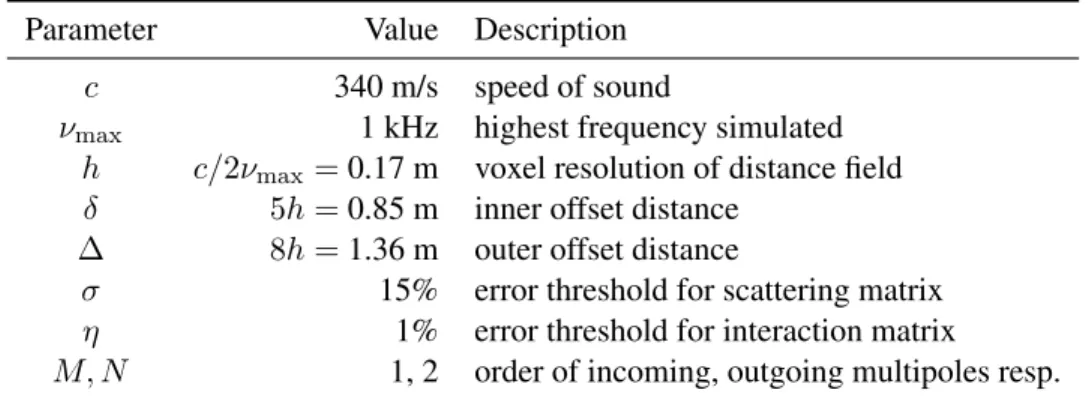
3.1 Implementation parameters. . . 39
3.2 Precomputation performance statistics. . . 40
3.3 Runtime performance statistics. . . 43
3.4 Runtime memory. . . 50
4.1 Precomputation cost statistics. . . 69
4.2 Runtime performance statistics. . . 69
5.1 Computational cost comparison. . . 81
5.2 Benchmarks statistics. . . 88
LIST OF FIGURES
2.1 Different geometric techniques. . . 15
3.1 Diagram illustrating the scattering problem. . . 26
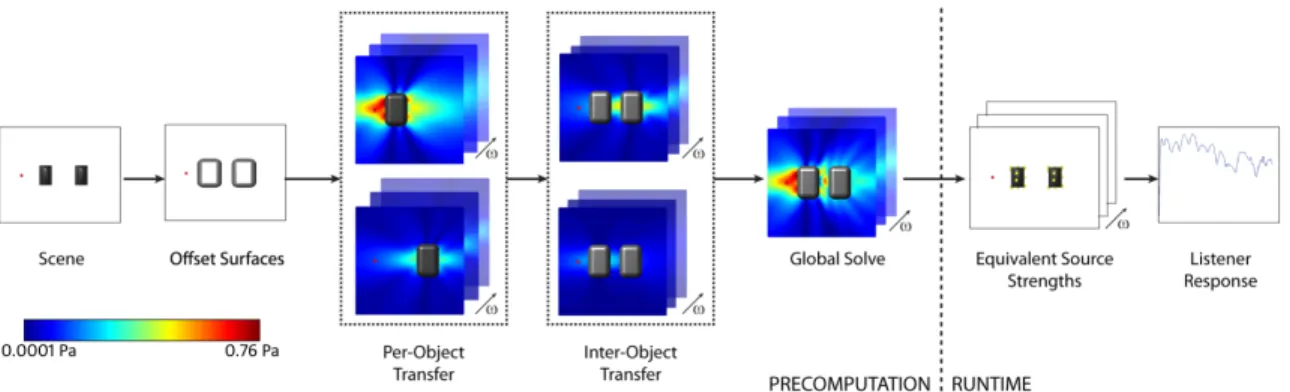
3.2 Stages of the proposed equivalent source technique. . . 29
3.3 Classification of objects in a scene. . . 31
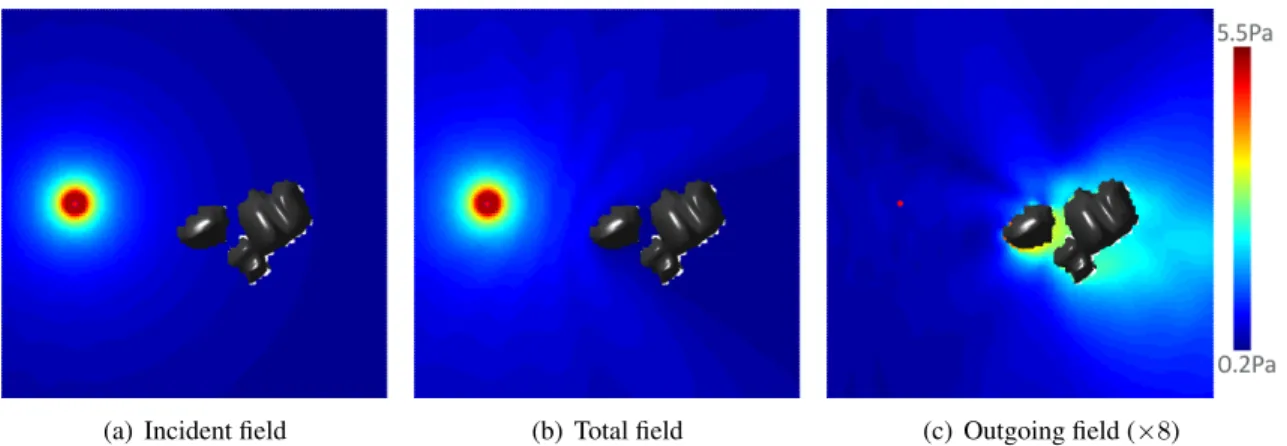
3.4 Outgoing scattered field. . . 33
3.5 Scattering behavior of different objects. . . 45
3.6 Benchmarks. . . 47
3.7 Convergence. . . 48
3.8 Scaling with frequency. . . 49
4.1 Stages of the directivity formulation. . . 57
4.2 Scaling with frequency. . . 70
4.3 Directivity affects propagation. . . 71
4.4 Directivity variation with frequency. . . 72
5.1 GPU architecture. . . 74
5.2 Stages of adaptive rectangular decomposition method. . . 75
5.3 Collision scenario. . . 85
5.4 Benchmark scenes. . . 89
5.5 Performance comparison of GPU- and CPU-based ARD. . . 90
5.6 Performance comparison of GPU-based ARD and FDTD. . . 94
6.1 ESM, BEM and FMM-BEM comparison. . . 99
6.2 Convergence of directivity formulation. . . 101
6.3 Directivity integration with sound propagation techniques. . . 102
6.5 ARD-BTM comparison for edge scattering. . . 105
6.6 Outdoor scene layout. . . 106
6.7 Source signal used for experimental validation. . . 107
6.8 Pressure field visualization for source SP1. . . 109
6.9 Waveform comparison for source position SP2. . . 113
6.10 Waveform comparison for source position SP3. . . 115
6.11 Waveform comparison for source position SP1. . . 117
6.12 Waveform comparison for source position SP4. . . 119
6.13 Rooftop diffraction response. . . 120
6.14 Rooftop diffraction visualization. . . 121
6.15 Error variation with source-receiver distance. . . 122
7.1 User study benchmark scene. . . 126
7.2 Sound propagation system. . . 127
7.3 Navigation performance comparison. . . 129
7.4 Benchmark scenes. . . 130
7.5 User study survey form. . . 131
7.6 User scores. . . 133
LIST OF ABBREVIATIONS
ADM Average Decibel Metric
ARD Adaptive Rectangular Decomposition
BEM Boundary Element Method
BTM Biot-Tolstoy-Medwin
CPU Central Processing Unit
DCT Discrete Cosine Transform
DTW Dynamic Time Warping
ESM Equivalent Source Method
FDTD Finite-Difference Time Domain
FEM Finite Element Method
FFT Fast Fourier Transform
FMM Fast Multipole Method
GPU Graphics Processing Unit
GA Geometric Acoustics
HRTF Head-Related Transfer Function
HMD Head-Mounted Display
IDCT Inverse Discrete Cosine Transform
LOS Line-Of-Sight
NLOS Non-Line-Of-Sight
PML Perfectly Matched Layer
SDM Spectrogram Difference Metric
CHAPTER 1: INTRODUCTION
Sound is ubiquitous in the physical world surrounding us and forms the basic medium of human
communicationvialanguage and human artistic expressionviamusic. Sound is a pressure wave produced by mechanical vibration of a surface that propagates through a medium, such as air and
water, and consists of frequencies within the range of human hearing (20 Hz - 20 kHz). Sound
waves with frequencies lower than 20 Hz are calledinfrasoundand higher than 20 kHz are called ultrasound.
Sound propagation or acoustic wave propagation is the process of transmission of sound waves
as they are emitted by the source, interact with the environment, and reach the listener to generate
the sensation of hearing. The interaction of sound waves with the environment leads to multiple
propagation effects such as specular reflection, diffuse reflection, scattering, diffraction, and
inter-ference. Therefore, the sound waves that reach the listener become different from the sound waves
emitted by the source. Mathematically, the phenomenon of sound propagation can be modeled as a
second-order partial differential equation called theacoustic wave equationin time-domain or the Helmholtz equationin frequency domain.
1.1 Motivation
Sound propagation has applications in wide variety of areas including engineering, architecture,
entertainment and music, telephony, and noise control. In the field of virtual reality (VR), realistic
sound propagation is crucial to immerse the user in the virtual environment and create asense of presence. In augmented reality (AR), sound propagation can be used to reinforce the physicality of virtual objects in AR environments by producing sound events that are synchronized with the
interaction of virtual objects with the real-world. Sound propagation is important in the field
This is extremely critical for large scale projects, such as designing airports or concert halls, where
the cost of fixing an acoustic defect post-construction is exorbitantly high. In urban planning and
city design, sound propagation can be used to determine noise levels at different places in the urban
environment and help inform decisions regarding the locations of noise sensitive buildings such as
schools or hospitals. In computer gaming and visual effects industry, sound propagation effects can
make the gaming environment more immersive and improve the overall gaming experience. In the
field of data visualization, well designed visualization techniques are used to convey information
about scientific, engineering, or medical data. Similarly, sound can be used as a channel for conveying
information byauralizingthe data also known assonification. A simple example of sonification would be the clicking rate of a Geiger counter to convey information about the level of radiation in the
vicinity. In the field of human-computer interaction, sound propagation effects, such as ultrasound
interference and Doppler shift, can be used to create novel user interfaces for volumetric haptics and
hands-free gestures.
Sound propagation techniques model the effect of the environment on the sound waves and
predict the behaviour of sound waves from the point of emission at the source to the final point of
arrival at the listener. The existing techniques for performing sound propagation can be classified
into three categories: (a) heuristic, (b) geometric, and (c) wave-based techniques. Typical heuristic
techniques involve parametric digital filters to describe the overall acoustics of the space such as
loudness and reverberation. These filters are manually designed by artists and game-audio designers
based on their intuition and experience, and assigned to different locations in the game environment.
Due to the fast runtime computation and low memory requirements, these techniques are typically
used in computer gaming applications. Geometric techniques assume rectilinear propagation of
sound waves i.e. ray-like behavior. This assumption is valid for high frequencies of sound where
the wavelength of sound waves is much smaller than the size of everyday objects. These techniques
trace rays (or beams) of sound from each sound source, propagate (reflect, scatter) these rays
through the environment, and accumulate contributions at the listener. Typical geometric techniques
include image source method, ray tracing, and beam tracing. Geometric techniques are approximate
techniques which are used for high-frequency sound propagation. Due to their low computational and
memory requirements, these techniques are used for sound propagation in interactive applications
called numerical acoustic techniques, solve the wave equation of sound propagation numerically
and compute the propagated sound pressure field in the environment. Since these techniques solve
the physics of sound propagation from first principles, they can achieve high accuracy for all the
frequencies of sound. Typical wave-based techniques are based on numerical solution methods
such as finite element method, boundary element method, and finite-difference time-domain. These
techniques have high computational and memory requirements due to which they are mainly used for
high-accuracy simulations in offline engineering applications such as underwater acoustics, aircraft
design, and automotive design.
1.2 Sound propagation in Interactive Applications
The state-of-the-art of sound propagation techniques for interactive applications is as follows:
Virtual Reality VR simulations have wide applications in training, therapy, and education. These simulations have been used for military training purposes in combat, flight and submarine simulators,
for treating post-traumatic stress disorder (PTSD) in war veteransviaVR exposure therapy, and for training medical personnel for emergency scenarios. Realistic sound propagation is extremely
important in VR for improving the sense of presence and immersion of the user in the virtual
environment and augmenting the visual sense of the user for increased situational awareness. For
combat training simulations (Pellerin, 2011), sound propagation cues can provide additional
infor-mation about the environment (small vs big, inside vs outside), about events happening outside the
field-of-view (enemy sneaking from behind, fellow soldier giving instructions), and can help localize
the direction of gunfire, etc. These cues would be available to the soldier in real-life scenario and it
would be important for him/her to train with these cues in the VR simulation (Hughes et al., 2006).
In VR exposure therapy, patients are asked to experience the trauma-related virtual environment
and exposed to “trigger” stimuli (visual, auditory, olfactory, and tactile) in a controlled manner for
therapeutic gain (Rizzo et al., 2007). In this scenario, sound propagation is necessary to generate
accurate auditory cues to increase the patient’s sense of immersion in the virtual environment.
Accurate propagation is crucial for creating high-fidelity VR simulations since the consequences
of approximate (or low accuracy) technique could be severe, for example mis-learning and wrong
techniques used in most VR systems are either based on heuristic or geometric techniques. The first
class of techniques has no direct correlation with the real world acoustics and the second one is an
approximation that cannot accurately capture propagation effects dominant at low frequencies such
as diffraction and interference. Therefore, it is important to develop efficient wave-based propagation
techniques to perform accurate and realistic sound propagation for these interactive VR applications.
Gaming Computer graphics and visual effects have reached the pinnacle of visual realism in current generation games. However, game sound is still at its infancy and based on 15 year old
technology (IASIG, 1999). The current state-of-the-art for sound propagation in games is based
on heuristic techniques such as artist-designed reverb filter, ambient sound zones, and real-time
parameter control (Damian, 2010). These techniques are not physically accurate and require a
significant amount of manual-effort and precious artist time. Artists and game audio designers have
developed good intuition for designing sound filters for simple indoor scenes. However, this intuition
does not extend well to outdoor scenes such as forest, desert, etc. Realistic sound effects generated
from wave-based techniques have the capability of making the gaming world more immersive and
improve the overall gaming experience. In addition, wave-based propagation can provide a good
starting point for these sound filters which the artists can then tune based on the game requirements.
Therefore, there is need for interactive wave-based techniques which can fulfill the strict performance
and memory constraints of these computer gaming applications.
Acoustic Auralization Auralization refers to the creation and reproduction of sound based on computer data. Acoustic auralization is the auralization of sound based on propagation of sound
waves in a 3D environment. It has applications in many fields such as architectural acoustics, aircraft
and automobile design, and city planning. The main purpose of acoustic auralization in these
applications is to get a sense of how an environment would sound like before actually building it.
Virtual walkthroughs that includes visual and aural feedback can be extremely useful in getting
a sense of the space, improving the design and removing any acoustic defects. Current acoustic
auralization softwares are based on geometric sound propagation techniques such as image source
method, ray-tracing or a combination of both. These techniques employ the geometric approximation
applications contain objects whose size is of the order of wavelength (like pillars, chairs, tables, trees,
etc), due to which modeling the wave effects becomes extremely important. Therefore, there is a
need to develop efficient wave-based techniques for these auralization applications.
1.3 Challenges and Goals
The state-of-the-art of wave-based sound propagation techniques include standard numerical
solvers such as finite-difference time domain (FDTD), boundary element method (BEM), and finite
element method (FEM). The computation complexity of these techniques scales with the volume
or surface area of the scene and at least fourth power of frequency; the memory complexity scales
as at least third power of frequency. Due to high computational and memory requirements, these
techniques are mostly limited to offline applications. Recently, there has been some work on
developing interactive wave-based sound propagation techniques (James et al., 2006; Tsingos et al.,
2007; Raghuvanshi et al., 2010). These techniques typically split the computation in an offline
preprocessing step and an interactive runtime step. This is similar to visual rendering approaches
used for global illumination in the field of computer graphics (Sloan et al., 2002). The key is to keep
the precomputation times feasible (turnaround time of few hours), and keep the runtime computation
lightweight (10-100s of ms) and runtime memory low (in MBs). These techniques can perform
wave-based sound propagation at interactive rates for certain cases such as sound radiation in free
space (James et al., 2006), first-order scattering from surfaces (Tsingos et al., 2007), and sound
propagation in small-to-medium sized scenes (Savioja, 2010; Raghuvanshi et al., 2010). However,
interactive wave-based sound propagation still faces many challenges:
Large Environments Large scenes, which arise in many interactive applications ranging from games to VR simulations to auralization, present significant challenges for interactive, wave-based
sound propagation techniques. The computational complexity of prior wave-based techniques scale
as the fourth power of the scene dimension and the memory complexity scales as the third power
of the scene dimension (Savioja, 2010; Raghuvanshi et al., 2010). These techniques take hours of
precomputation and gigabytes of runtime memory for sound propagation in small to medium-sized
typically found in interactive applications, it would not be feasible to run these prior interactive
wave-based techniques.
Directional Sources and Listeners Most sound sources we encounter in real life, ranging from human voices through speaker systems, machines noises, and musical instruments, are directional
sound sources with specific directivity pattern. Source directivity has a significant effect on the
propagation of sound waves and the corresponding acoustics of the environment (Vigeant, 2008).
Analogous to directional sources, listeners also do not receive sound equally from all directions.
The directional sound at the listener combined with scattering of sound around the listener’s head
generates subtle differences in the sound received at the left and right ear. The human auditory
system obtains significant directional cues from these subtle differences in the sound at each ear and
can use it to perceive the direction of incoming sound. An audio signal containing these directional
cues which when played at the listener’s ears to give him/her a sense of direction of incoming sound
is calledspatial audioor3D audio.
Current interactive wave-based techniques can only model source directivity during the offline
precomputation phase. As a result, the source directivity gets baked (precomputed and stored) into
the final solution. Since current wave-based techniques have a high precomputation overhead, it is not
possible to modify the directivity at runtime for interactive applications. This can be a problem for
sound sources with time-varying directivity such as a person moving around or turning while talking.
Additionally, integrating listener directivity into wave-based techniques requires decomposition of
sound field into plane waves, also called theplane-wave decomposition. All the previous techniques for performing plane-wave decomposition are computationally expensive and limited to offline
applications.
Mid-frequencies The frequency range of sound propagation can be divided into three categories: low-, mid- and high-frequencies (Hidaka et al., 1995; Abdou and Guy, 1996; Savioja, 2010). Low
frequency range consists of frequencies less than few hundred Hz. In this range, the wavelength
is of the same order as the size of the everyday objects and wave-effects, such as diffraction and
interference, are dominant. High frequency range consists of frequencies greater than few kHz and
less than the maximum audible frequency (20 kHz). In this frequency range, sound waves can be
Mid-frequency range contains sounds with frequency greater than few hundred Hz and less than few
kHz. This is a transition region where the acoustic effects transition from wave-effects to ray-based
effects. Sound propagation modeling in the mid-frequency range is critical since many everyday
sound sources emit sound in this range, for example human voice. For sound propagation at low-and
mid-frequencies, wave-based sound propagation is necessary as wave-effects are prevalent at these
frequencies. Current interactive wave-based propagation techniques have a high precomputation
cost which varies as the fourth power of frequency. This results in hours of a preprocessing time for
low frequencies and tens of hours (or even days) for mid-frequencies. This is too slow a turnaround
time for scene design, noise control and auralization applications in games, architectural acoustics
and virtual reality. Therefore, there is need to develop efficient wave-based techniques with faster
precomputation time that can compute simulation results for both low and mid-frequencies in few
hours.
1.4 Thesis Statement
Complex acoustic effects, such as diffraction, interference, high-order reflection, scattering, directivity, and spatial sound, can be simulated efficiently and practically for interactive applications through the use of wave-based sound propagation techniques.
In this dissertation, we propose a set of efficient wave-based sound propagation techniques that
can handle large environments, source and listener directivity, and mid-frequencies of sound. The
preprocessing times of these techniques is few hours, the runtime compute is in tens to hundreds
of milliseconds, and the runtime memory is in tens to hundreds of megabytes. By solving the
challenges faced by wave-based propagation techniques and satisfying the practical compute and
memory requirements, these techniques have enabled wave-based sound propagation in interactive
applications. We have integrated these techniques in a commercial game engine and demonstrated
complex acoustic effects generated by wave-based sound propagation in a variety of scenarios.
1.5 Main Results
In this thesis, we present three efficient wave-based sound propagation techniques for interactive
scenes which has a small runtime compute and memory footprint. Secondly, we present a general
source and listener directivity framework to incorporate time-varying source directivity and interactive
spatial audio in wave-based sound propagation techniques. Lastly, we present the GPU-based adaptive
rectangular decomposition technique to precompute wave-based propagation results efficiently for
mid-frequencies of sound. We discuss each of these contributions in detail:
1.5.1 Equivalent Source Method for Sound Propagation
Equivalent source method (ESM) is an interactive wave-based sound propagation technique
based on the fundamental solutions of the wave equation known asequivalent sources. This is a novel technique for wave-based sound propagation in large, open scenes spanning hundred of meters with
a small runtime memory footprint. In the preprocessing stage, the scene is decomposed into disjoint
right objects. The free-field acoustic behavior of each object is captured by a compact per-object
transfer function that relates the incoming field of each object to the outgoing scattered field. Pairwise
acoustic interactions between the objects are computed analytically to yield inter-object transfer
functions. The global sound field accounting for all orders of interaction (reflection, diffraction,
scattering) is computed by solving a linear system consisting of the per-object and inter-object
transfer functions. This field is stored compactly using the equivalent sources which form an efficient
basis for representing the sound field. The runtime system uses a fast summation over the equivalent
sources to auralize the sound field for a moving listener at interactive rates. Realistic acoustic effects,
such as diffraction low-passing behind objects, sound focusing by concave reflectors, sound scattering
by rough surfaces, high-order reflections, and echoes, are demonstrated. The key contributions of
this work includes:
1. Object-based sound field decomposition: This technique takes an object-centric approach to wave-based sound propagation by decomposing the sound field into per-object and inter-object
interactions of sound, thereby enabling interactive, wave-based sound propagation for large
open scenes.
3. Compact analytical coupling of objects: The analytical coupling between the objects is achieved by expressing the inter-object transfer functions in the same equivalent source basis
as the per-object transfer function.
4. Fast, memory efficient runtime: This enables interactive auralization for a moving listener while requiring tens of megabytes of runtime memory.
This technique has been tested on a variety of scenarios and integrated with the Valve’s SourceT M
game engine. This equivalent source technique generates realistic acoustic effects and takes orders of
magnitude less runtime memory compared to other state-of-the-art wave-based techniques, enabling
interactive performance.
1.5.2 Source and Listener Directivity Framework
This is an approach to model time-varying source and listener directivity in interactive
wave-based sound propagation techniques. The source directivity is represented as a linear combination
of elementary spherical harmonic sources. In the preprocessing stage, the propagated sound fields
corresponding to each spherical harmonic source are precomputed, encoded, and stored for runtime
use. At runtime, the spherical harmonic decomposition of the time-varying source directivity is
performed at interactive rates to compute the spherical harmonic coefficients. The total sound field
at the listener is computed as a linear combination of precomputed propagated sound fields of the
spherical harmonic sources with their respective coefficients. A novel plane-wave decomposition
technique based on derivatives of the pressure field is proposed. This technique can compute spatial
audio for a moving listener with a time-varying listener directivity at interactive rates. A general
framework is proposed for incorporating source and listener directivity in interactive wave-based
propagation techniques. The main contributions of this work are as follows:
1. Time-varying source directivity: The spherical harmonic-based representation of source directivity can support analytical, data-driven, rotating or any time-varying function at runtime.
Pressure field due to spherical harmonic sources are precomputed and then used at runtime to
to compute the pressure field due to a time-varying directional source.
technique can compute plane-wave decomposition at interactive rates. This enables listener
motion, head rotation, and dynamic listener directivity at runtime.
3. General framework to integrate both the source and listener directivity approach in any offline or interactive wave-based sound propagation technique.
4. Fast, memory efficient auralization system: This technique has a low runtime memory footprint and computes wave-based sound propagation at interactive rates.
This approach has been incorporated in the equivalent source technique and integrated with Valve’s
SourceT M game engine. Realistic acoustics effects due to source and listener directivity are
demon-strated on a variety of scenes, such as people talking on the street, loudspeakers between buildings, a
rotating siren, and musical instruments being played in amphitheater.
1.5.3 Parallel Adaptive Rectangular Decomposition
In this work, an efficient GPU-based time-domain solver for the acoustic wave equation is
presented. It is based on the adaptive rectangular decomposition (ARD) algorithm (Raghuvanshi
et al., 2009b) which uses analytical solutions within rectangular partitions for spatial invariant speed
of sound. The proposed GPU-based ARD technique is suitable for performing fast computations
for wave-based sound propagation in both low- and mid-frequency range. It is demonstrated that
by carefully mapping all the components of the ARD algorithm to match the parallel processing
capabilities of the graphics processors, significant improvement in performance can be achieved
compared to the corresponding CPU-based solver whilst maintaining numerical accuracy. Substantial
performance gain over a high-order finite-difference time-domain method is observed. Using this
technique, a 1 second long simulation can be performed on scenes of air volume 7500m3till 1650 Hz within 18 minutes compared to the corresponding CPU-based ARD solver that takes around 5
hours and a high-order finite-difference time-domain solver that could take up to three weeks on a
desktop computer. The main results of this work are as follows:
1. Mid-frequency simulations: A parallel technique in combination with efficient utilization of the GPU architecture to enable wave simulation in the mid frequency range on a desktop
2. Two levels of parallelism: The technique exploits both coarse- and fine-grained parallelism exhibited by the ARD algorithm to achieve high performance.
3. Avoiding host-device data transfer bottleneck: The technique avoids any host-device data transfer bottleneck between the host (CPU) and the device (GPU) by parallelizing all the steps
of the algorithm on the GPU.
4. Computationally-efficient decomposition: The approach utilizes a modified rectangular decomposition to take advantage of the computational efficiency of the Fast Fourier Transform
(FFT) operations on grids of size powers of two. This results in significant speedup for the
computationally heavy steps of the algorithm.
This technique demonstrates that it is possible to effectively parallelize all the steps of the ARD
algorithm on current GPU architectures and to exploit the raw computational power of the high
number of GPU cores. The parallel GPU-based ARD solver achieves a speedup of up to 25 times over
the optimized CPU-based ARD solver, and three orders of magnitude speedup over the high-order
CPU-based finite difference solver.
1.6 Thesis Organization
The rest of the dissertation is organized as follows.
• In Chapter 2, the mathematical details of sound propagation are provided along with a literature review of the prior sound propagation techniques, and existing work in the area of
directional sources and listeners.
• Chapter 3introduces the equivalent source method for performing wave-based sound prop-agation in large environments. The chapter starts by providing background on the theory of
equivalent sources, discusses the different steps of the technique, provides implementation
details, and presents the results and analysis of the proposed technique.
• InChapter 4, the source and listener directivity formulation based on spherical harmonics is introduced. A general framework is provided for integrating these directivities with wave-based
sound propagation techniques along with implementation details and results of the proposed
• Chapter 5starts with the background on the adaptive rectangular decomposition technique. Next, it discusses the GPU-based adaptive rectangular decomposition solver for efficiently
computing simulation results in the mid-frequency range for wave-based sound propagation.
• Chapter 6 deals with the validation of the techniques discussed in the previous chapters by comparing their results with analytical solutions, state-of-the-art numerical solvers and
measured data from real world.
• Chapter 7 presents the results of the two preliminary user evaluations conducted for the equivalent source method and the source and listener directivity approach.
CHAPTER 2: BACKGROUND AND PREVIOUS RESEARCH
This chapter provides a literature review of the field of sound propagation.
2.1 Acoustic Wave Equation
Sound is a pressure wave produce by mechanical vibration of a surface. Sound propagation
algorithms predict the behavior of sound waves as they interact with the environment. The physics
of sound propagation can be described by the well-known time-domain formulation of the acoustic
wave equation:
∂2p ∂t2 −c
2∇2p=f(x, t). (2.1)
The wave equation models sound waves as a time-varying pressure fieldp(x, t). While the speed of sound in air (denoted byc) exhibits fluctuations due to variations in temperature and humidity, the acoustic effects of these fluctuations are ignored for most indoor scenes and many outdoor
scenes i.e. a homogenous media assumption is made. Sound sources in the scene are modeled
by the forcing field denoted byf(x, t) on the right hand side in the Equation 2.1. The operator ∇2= ∂2
∂x2 + ∂ 2
∂y2 + ∂ 2
∂z2 is the Laplacian operator in 3D. The wave equation succinctly captures wave
propagation phenomena, such as interference and diffraction, observed in real world.
In the frequency-domain, sound propagation can be expressed as a boundary value problem for
the Helmholtz equation:
∇2P+w 2
c2P = 0 inΩ, (2.2)
2.2 Sound Propagation Techniques
The techniques for computing the propagated sound field in an environment can be classified
into three categories:
Heuristic Techniques These are propagation techniques that do not solve the physics of sound propagation but are geared more towards quick evaluation and artist-control. These are light-weight
techniques that typically have very small runtime memory or compute requirement. Due to these
reasons, these techniques are popular in the gaming industry to generate different types of acoustic
effects. The first among these isreverb, short forreverberation, which corresponds to the decay envelope of the sound field in an environment. Sound produced by the source undergoes reflections,
scattering and absorption in the environment resulting in decay of sound pressure over time. Reverb
gives the player a sense of size and type of the environment (small vs large, indoor vs outdoor, cave vs
desert). In case of heuristic techniques, predetermined reverb filters designed by artists are assigned
to different regions in the environment also calledreverb zones. At runtime, based on the position of the player with respect to the reverb region, an appropriate reverb filter is applied to the sound.
Additionally, these reverb settings can be extended to the sources such that the sound coming from a
source in a different reverb zone can use the reverb setting of its origin.
The second most popular technique is called real-time parameter control (RTPC). In this
tech-nique, the parameters of the audio content are changed based on the events or actions in the game, for
example, the tempo of the footstep sound can be changed based on the walking speed of the character,
“swoosh” sound of a sword can be made shriller based on its swinging speed, or loudness of the sound
can be reduced based on the distance between the source and the player. Audio middleware toolsets,
such as AudioKinetic’s WWise or FMOD, support such capabilities. In recent years, certain advanced
heuristic techniques have been developed, for example, ray-tracing and convolution technique were
used in the game Crackdown. In this technique, few rays are shot in the scene to get an approximation
of the size of the environment. Based on this information, the reverb filter is changed dynamically
and applied to the source audio signal using the convolution operation. Dolby has recently introduced
the Axon middleware toolkit that enables surround-sound live chat between the game players (Dolby,
Geometric Techniques These techniques are based on the high-frequency approximation for sound propagation which assumes that the wavelength of sound waves is smaller than the object size. Under
this assumption, sound waves can be treated as rays and sound propagation can be performed using
ray-based techniques (Funkhouser et al., 2003). However, this assumption is only valid for high
frequencies of sound (>few kHz) thereby preventing the applicability of these techniques in the
low-or mid-frequency range (<few kHz).
(a) (b)
(c)
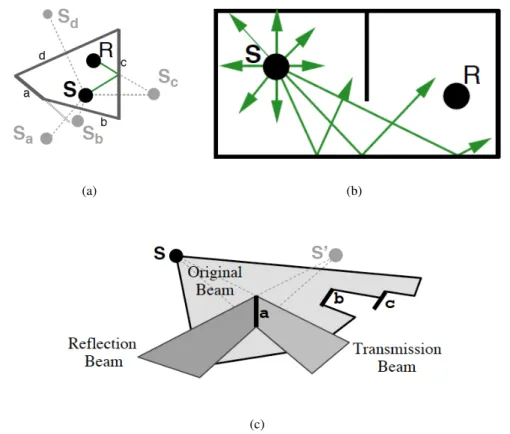
Figure 2.1: The most common geometric techniques of sound propagation: (a) Image Source Method, (b) Ray Tracing, and (c) Beam Tracing (images © (Funkhouser et al., 2003)).
The most common geometric technique is the image source method (Allen and Berkley, 1979;
Borish, 1984). This technique is used for modeling specular reflections of sound. It computes the
specular reflection paths of sound by mirroring the sound source over the polygonal surfaces of the
environment thereby creatingvirtual sources. First-order specular reflection paths are constructed by joining the lines between the virtual sources and the listener. This process can be repeated recursively
grows exponentially with the order of reflections. Also, each specular path needs to be validated to
make sure it is feasible since not all specular paths generated are physically realizable.
Ray tracing is another method to compute sound propagation paths from sources to listener
as the sound ray gets specularly reflected, diffusely reflected, scattered, or transmitted by the
environment. It is interesting to note that ray tracing methods were first developed for sound
propagation (Krokstad et al., 1968) before being widely adopted for light transport in the computer
graphics community (Whitted, 1980). The primary operation used in all ray tracing techniques is the
ray-surface intersection test. This technique is popular due to ease of implementation and sub-linear
growth in computational complexity with number of polygons. One of the main drawbacks is the
aliasing artifact caused by discrete sampling of a continuous sound field. In order to minimize these
artifacts, a large number of rays are required. Image source method and ray tracing are among the
two most popular geometric techniques and widely used in acoustic prediction softwares, such as
ODEAN, CATT, EASE, in the field of architectural and room acoustics.
Beam and frustum tracing are geometric techniques that use pyramidal beams/frusta to compute
propagation paths from source to listener through the environment (Dadoun et al., 1985; Funkhouser
et al., 1998; Lauterbach et al., 2007; Chandak et al., 2008). These techniques trace pyramidal beams
(or frusta) through the environment and compute beam-polygon (or frustum-polygon) intersection.
After the intersection, the original beam (frustum) is split into reflection and transmission parts
which are recursively traced in the scene to compute high-order reflections. Similar to ray-tracing,
beam and frustum tracing can handle specular and diffuse reflections. However, in contrast with
ray-tracing, these techniques take advantage of the spatial coherence in the scene to reduce the
aliasing artifacts. Beam and frustum tracing are more computationally-expensive techniques due to
complicated geometric operations involved in beam-polygon and frustum-polygon intersection test.
Geometric techniques are applicable only when the wavelength of sound is much smaller
than the object size. Therefore, modeling of wave-effects, such as diffraction, has to be done
separately. Diffraction is a wave phenomenon of sound that arises when the wavelength of waves
is proportional to the object size. In this case, the sound waves bend around the object resulting
in gradual reduction in the loudness as one enters the occluded region. The two formulations that
incorporate diffraction in geometric techniques are the Uniform Theory of Diffraction (UTD) and
diffraction filter of a propagation path over an edge (Kouyoumjian and Pathak, 1974; McNamara
et al., 1990). In this technique, a ray incident on a diffraction edge gives rise to a cone of diffraction
rays to which frequency-dependent diffraction coefficients are applied. UTD is an approximate but
efficient formulation used mainly for interactive applications (Tsingos et al., 2001). BTM is a more
accurate formulation for modeling the diffraction phenomenon (Svensson et al., 1999). It computes a
dense sampling of diffraction edges using elementary point sources which are then used to compute
the frequency-dependent diffraction filter. BTM is an offline technique and used mainly for room
acoustic prediction applications (Torres et al., 2001). Recently, interactive geometric techniques
based on the UTD formulation have been proposed to handle high-order diffraction effects (Taylor
et al., 2009; Schissler et al., 2014).
Wave-based Techniques These techniques discretize the volume or surface area of the scene and solve the wave equation numerically on this discretization to compute the propagating pressure field
in the environment. Based on the type of discretization, these techniques can be classified as either
volumetricorsurface-basedtechniques. Volumetric techniques discretize the entire volume of the scene into grid cells and perform the numerical computation on a per-grid cell basis. The number
of grid cells along with the computational and memory complexity of these techniques scale as at
least the third power of scene dimension. Surface-based techniques, on the other hand, discretize the
surface area of the scene into discrete surface elements and perform numerical computations on each
discrete element. The number of surface elements as well as the compute and memory requirements
of surface-based techniques scale as at least the square of scene dimension. Volumetric techniques
are well-suited for scenes with high surface area and low air volume, which makes them highly
applicable to indoor spaces. Similarly, surface-based techniques are better suited for scenes with high
volume and (comparatively) smaller surface area such as outdoor scenes. Wave-based techniques can
also be grouped intotime-domainorfrequency-domaintechniques based on whether they are solving the acoustic wave equation (equation 2.1) or the Helmholtz equation (equation 3.1), respectively.
The Finite Difference Time Domain (FDTD) method is a volumetric technique which was
explic-itly designed for solving the time-domain wave equation, although in the context of electromagnetic
simulation (Yee, 1966). The FDTD method for sound propagation solves for the time-dependent
opera-tors and using an explicit time-stepping scheme. Assuming that the space has been discretized into a
uniform Cartesian grid with spatial spacinghand the time-step is∆t, the pressure fieldp(ih, jh, kh)
at timen∆tcan be denoted as p(i,j,kn) . The spatial derivative is approximated in finite-difference approaches by applying a constant linear stencilβof sizedas –
∇2p= d
X
l=−d
βl(pi+l,j,k+pi,j+l,k+pi,j,k+l) +O(h2d) (2.3)
The spatial differentiation error isO(h2d). The stencil has a compact support of2d+ 1. For most FDTD implementations,d= 1, yielding second-order spatial accuracy, withβ= h12{1,−2,1}. The same analysis can be applied for the time derivative as well. It is typical in time-domain solvers to
use second-order accurate time-stepping –
∂2p ∂t2
(n)
= 1
∆t2
p(n+1)−2p(n)+p(n−1)+O(∆t2). (2.4)
Standard von Neumann analysis can be used to show that the spatio-temporal errors in FDTD appears
as frequency-dependent phase velocity, known as numerical dispersion: as waves propagate, their
shape is gradually destroyed due to loss of phase-coherence. FDTD has been applied to medium-sized
scenes in 3D for room acoustic computations (Sakamoto et al., 2006, 2008). The authors calculated
typical room acoustic parameters and compared the calculated values with the actual measured values
in the scene. The implementation can take days of computation on a small compute cluster. A recent
technique proposed in (Savioja, 2010) allows for real-time auralizations till a usable frequency of
roughly 500 Hz on geometries with large volume using the Interpolated Wideband (IWB) FDTD
scheme running on GPUs. The IWB-FDTD scheme uses optimized compact stencils for reducing
numerical dispersion while keeping the computational expenditure low (Kowalczyk and van Walstijn,
2010).
Spectral techniques achieve much higher accuracy by expanding the field in terms of global basis
functions. Typically, the basis set is chosen to be the Fourier basis or Chebyshev polynomials (Boyd,
2001) as the fast fourier transform (FFT) can be employed for the basis transformation. The
Pseudo-Spectral Time Domain (PSTD) method is a spectral method proposed for underwater acoustics as
a volumetric technique that solves the time-domain wave equation. The key difference in PSTD
compared to FDTD is to utilize spectral approximations for the spatial derivative (Liu, 1997). The
spatial error in PSTD showsgeometric convergence,O(hn), ∀n >0, n∈Z, allowing for meshes with samples per wavelength approaching the Nyquist limit, and still allowing vanishingly small
dispersion errors in the spatial derivative. However, this holds only if the pressure field is periodic
which is not commonly the case. Errors in ensuring periodicity appear as wrap-around effects where
waves exiting from one end of the domain enter from the opposite end. Time update is done using a
second-order explicit scheme similar to the FDTD method. Therefore, although spatial errors are
controlled in PSTD, the errors due to temporal derivative approximation are still present and are of a
similar magnitude as FDTD.
The most common wave-based techniques in frequency-domain include the boundary element
method (BEM) (Cheng and Cheng, 2005) and the finite element method (FEM) (Zienkiewicz et al.,
2006; Thompson, 2006). BEM is a numerical solution technique that solves the wave equation
of sound propagation in the frequency-domain, i.e. the Helmholtz equation. BEM transforms the
Helmholtz equation into boundary integral equations and solves the boundary integral equations on
the surface of the scene by expressing the pressure field as the sum of elementary fields radiating from
monopole and dipole sources placed on a uniform, sub-wavelength sampling of the scene’s surface.
Next, BEM reformulates the integral equations into a linear system and solves for the strengths of
these monopole/dipole sources. These strengths can then be used to evaluate pressure at any point
inside the acoustic domain by evaluating the boundary integral equations. Traditional BEM scales
as the square of the surface area but recent research on the fast multipole method for BEM
(FMM-BEM)(Liu et al., 2009; Gumerov and Duraiswami, 2009) has improved the complexity to linear in
surface area. This was made possible by creating a hierarchical clustering of BEM monopoles and
dipoles using an octree, and approximating their interactions compactly using high-order multipole
Green’s functions.
FEM is a volumetric technique that solves Helmholtz equation on a volumetric discretization
of the scene (Zienkiewicz et al., 2006; Thompson, 2006). One of the main strengths of FEM is the
capability to use unstructured grids cells with complex shapes, typically tetrahedras, thus allowing
the scene boundary to be represented with much higher accuracy. One of the main concerns of FEM
FEM computations be severely impacted by “thin” tetrahedras. Both FEM and BEM are employed
for solving the Helmholtz equation, with FEM applied mainly to interior and BEM to exterior
scattering problems.
In recent years, there has been increasing interest in developing interactive wave-based sound
propagation techniques in indoor and outdoor spaces for applications in the field of computer graphics
and visual effects. The first among these techniques deals with the problem of sound radiation from
vibrating objects in free space (empty space with no surrounding objects) (James et al., 2006).
In the first step, modal analysis is performed on the object to compute all the different modes of
vibration. Sound radiation behavior of each mode of the vibrating object is then computed by solving
the exterior radiation problem of the Helmholtz equation. This radiation behavior is efficiently
encoded in terms of the acoustic transfer function which approximate the radiation behavior of a
complicated geometry by expressing it in terms of an efficient basis of pressure field called the
equivalent sources. The use of equivalent sources enables quick runtime evaluation of pressure field and interactive performance. However, this technique only handles sound radiation by an object in
empty space and does not model sound propagation between different objects in the scene. (Tsingos
et al., 2007) handles sound scattering between objects by solving the boundary integral formulation
of the Helmholtz equation subject to the Kirchhoff approximation. The approximation enables
efficient computation on graphics processors to achieve interactive performance. However, by using
this approximation, only the first-order effects between the objects are modeled and high-order
interactions, such as multiple reflections, diffractions, are ignored. In the work of (Raghuvanshi et al.,
2010), wave-based sound propagation for dynamic source and listeners is performed by precomputing
a volumetric sampling of impulse responses on a spatial grid of source and listener positions. This
dataset is compressed by using perceptual encoding based on the acoustic properties of indoor spaces
and stored for runtime use. At runtime, the impulse response for the instantaneous position of source
and listener is computed by looking up the closest match in the dataset and interpolating the resulting
2.3 Directional Sources
Most sound sources that we come across in real life have a characteristic directivity pattern
that varies with frequency (Meyer and Hansen, 2009). Source directivity has a significant effect
on the propagation of sound in 3D space and the acoustics of an environment (Vigeant, 2008).
Vigeant’s PhD thesis is an excellent reference for details on the effect of source directivity on room
acoustics (Vigeant, 2008). Over the last decade, many researchers have tried to measure directivity
of real world sound sources. Meyer et al. measure the directivity of brass, woodwind and string
instruments in an anechoic chamber (Meyer and Hansen, 2009). This data contains magnitude
information only, measured in terms of relative sound pressure levels as a function of directions in
different octave bands. (Otondo and Rindel, 2004) measured the tone-specific directivity of a trumpet,
French horn, and clarinet. (Ahnert, 2005) have investigated the use of complex frequency response
data (magnitude and phase) for loudspeaker directivity. They demonstrated that incorporating the
phase data reduces the acoustic prediction error by an order of magnitude as compared to the
magnitude-only data. Recently, directivities of male and female singing voices have also been
measured (Jers, 2005). Many of these datasets are publicly available and have been widely in various
sound propagation techniques.
The development of sound propagation algorithms for direction sources is a topic of ongoing
research. Physically-based sound synthesis algorithms can simulate sound radiation from directional
sources directly (Chadwick et al., 2009). However, these techniques handle only free-space sound
radiation and do not model propagation effects (reflections, diffraction, reverberation) from other
objects in the scene. Interactive GA techniques can incorporate high-frequency source directivities
at runtime (Funkhouser et al., 2003; Otondo and Rindel, 2004). These methods essentially involve
enumerating sound propagation paths from the source to the listener. The directions of rays emitted
from the source (received at the listener) can be used to apply attenuation to the corresponding
propagation paths based on any arbitrary source (listener) directivity. (Rindel and Otondo, 2005)
proposed a data-driven approach using GA techniques for multi-channel auralization to account for
time-variant nature of the directivity of musical instruments. In this method, a musical instrument is
placed in an anechoic chamber and sound signals emitted by it is captured by microphones placed
the computer acoustic simulation, a virtual source with directivity corresponding to the solid angle
captured by each microphone, is simulated and its impulse response convolved with the appropriate
channel and then combined to created a complete auralization. However, the geometric techniques are
not accurate in the low frequency range (e.g. 20-1000Hz), as sound waves can diffract (bend) around
obstacles and undergo interference and other wave effects. Interactive wave-based sound propagation
techniques (Raghuvanshi et al., 2010; Mehra et al., 2013) can handle elementary directional sources
such as monopoles, dipoles, quadrupoles, and their linear combinations. Other techniques have been
proposed to incorporate measured directivities in wave-based techniques (Hacihabiboglu et al., 2008;
Southern and Murphy, 2009). But the source directivity is modeled during the offline simulation
stage and its effects on the sound propagation gets baked into the simulation results. Therefore, a
source which at runtime either rotates or has a time-varying directivity, cannot modeled by current
interactive wave-based techniques.
2.4 Spatial Audio
The human auditory system obtains significant directional cues from the subtle differences in
sound received by each ear, caused by the scattering of sound around the head (Begault, 1994).
These effects are represented using a head-related transfer function (HRTF). Measurements to compute the HRTF are performed in controlled environments and the recorded data is available
online (Algazi et al., 2001). Interactive GA techniques can incorporate high-frequency HRTF-based
listener directivity at runtime by enumerating sound propagation paths from the source to the listener.
The directions of rays received at the listener can be used to look up into the HRTF and apply the
corresponding attenuation to the propagation paths. However, handling listener directivity effects
at low frequency arising due to the wave nature of sound (e.g. diffraction, interference) remains a
significant challenge with interactive GA techniques. Integrating HRTFs into wave-based techniques
involves computation of propagation directions usingplane wave decomposition. Prior plane-wave decomposition techniques either use spherical convolution (Park and Rafaely, 2005; Rafaely and Avni,
2010) or solve a linear system (Zotkin et al., 2010), and are computationally expensive. Interactive
wave-based techniques resort to simpler listener directivity models based on a spherical head and
for sound localization and externalization, both of which are necessary for immersion in virtual
environments (Begault, 1994).
2.5 Parallel Wave Solvers
State-of-the-art wave solvers, such as FDTD or BEM, can take hours of compute and gigabytes
of memory to solve the wave equation in a small-to-medium sized scene up to a few hundred Hz. The
computational complexity of wave solvers scales as the fourth power of simulation frequency and
memory complexity scales as third power of frequency. Therefore, for large scenes and frequencies
up to a few kiloHertz, these solvers can take days (or even weeks) of compute and terabytes of
memory making them unfeasible for most applications in the field of virtual reality, gaming, and
auralizations. Significant research effort has been spent on parallelization of these wave solvers on
modern generation graphics processor units (GPUs) and large compute clusters.
The FDTD method is by far the most popular choice for parallelization due to its simplicity and
ease of implementation. Over the last two decades, many parallel solvers based on the FDTD method
have been proposed on both GPUs (Sypek et al., 2009; Savioja, 2010) as well as on large compute
clusters (Guiffaut and Mahdjoubi, 2001; Yu et al., 2005; Komatitsch et al., 2010). Other techniques
have explored parallelization of the FEM method on distributed memory systems such as CPU
clusters (Diekmann et al., 1996; Bhandarkar and Kal, 2000). Besides these solvers, many specialized
parallel solvers have been developed for solving the wave equation in specific applications. These
include a scalable distributed-memory solver for the non-linear wave equation (Alghamdi et al., 2011),
a parallel numerical solver for modeling for the elastic wave equation in heterogenous media (Bao
et al., 1998), and a discontinuous Galerkin solver for solving electromagnetic and aeroacoustic wave
equations (Bernacki et al., 2006).
This concludes the discussion of previous work in the field of sound propagation, directional
sources, spatial audio, and parallel wave-solvers. The next chapter discusses the first contribution of
CHAPTER 3: EQUIVALENT SOURCE METHOD FOR SOUND PROPAGATION
3.1 Introduction
Large, open scenes, which arise in many applications ranging from games to training simulations,
present a significant challenge for interactive, wave-based sound propagation techniques.
State-of-the-art wave-based propagation methods can take hours of computation and gigabytes of memory
for performing sound propagation in indoor scenes such as concert halls (Sakamoto et al., 2006;
Raghuvanshi et al., 2009b). For large, open scenes spanning hundreds of meters, these techniques
would take days or even weeks of compute and terabytes of memory, making them unfeasible for
interactive applications in virtual reality, gaming, and architectural acoustics. On the other hand,
geometric acoustic techniques can provide interactive performance for such applications. However,
geometric techniques are better suited for higher frequencies of sound due to the inherent assumption
of rectilinear propagation (ray-like behavior) of sound waves. Accurately modeling wave effects,
such as diffraction and interference, remains a significant challenge with these techniques.
In this chapter, we present a novel approach for precomputed, wave-based sound propagation
in large, open scenes. It is based on theequivalent source method, a technique widely studied for radiation and scattering problems in acoustics and electromagnetics (Doicu et al., 2000) and more
recently used for free-space sound radiation in computer graphics (James et al., 2006). we extend
this technique for wave-based sound propagation in large, open spaces spanning hundreds of meters.
This technique takes an object-centric approach to wave-based sound propagation. The scene is
decomposed into disjoint rigid objects. The free-field acoustic behavior of each object is captured by
a compact per-object transfer-function relating incoming pressure fields to outgoing pressure fields.
Pairwise acoustic interactions between objects are computed analytically to yield compact
field accounting for all orders of interaction between objects is computed using the per-object and
inter-object transfer functions. The runtime system uses fast summation over the outgoing equivalent
sources for all objects to auralize the sound field for a moving listener in real-time. Realistic acoustic
effects such as diffraction, low-passed sound behind obstructions, focusing, scattering, high-order
reflections, and echoes, are demonstrated on a variety of scenes.
3.2 Background
The equivalent source method is a frequency-domain technique for solving sound radiation or
scattering problems by using free-space, radiating functions called theequivalent sources. In this section, we give a brief overview of the equivalent source method as used in sound radiation.
Helmholtz Equation Consider the exterior scattering problem (Thompson and Pinsky, 2004): a solid three-dimensional objectAimmersed in an unbounded air volume radiating sound (see Figure 3.1). By considering only time-harmonic vibrations, with angular frequencyωand a homogeneous medium with constant speed of soundc, acoustic wave propagation can be expressed as a boundary value problem for the Helmholtz equation:
∇2P +w 2
c2 P = 0 inA
+, (3.1)
whereP =P(x, ω)is the (complex-valued) pressure field varying with space and frequency,A+is the domain exterior to the object, and∇2 = ∂2
∂x2 + ∂ 2
∂y2 + ∂ 2
∂z2 is the Laplacian operator.
Since sound radiation in three-dimensional space is considered, the behavior of pressureP at infinity must be specified by theSommerfeld radiation condition(Pierce, 1989) which can also be interpreted as a boundary condition at infinity:
lim r→∞r
∂P
∂r −ˆj w
cP
= 0, (3.2)
where r = kxk = px2+y2+z2 is the distance of point x = (x, y, z) from the origin and ˆ
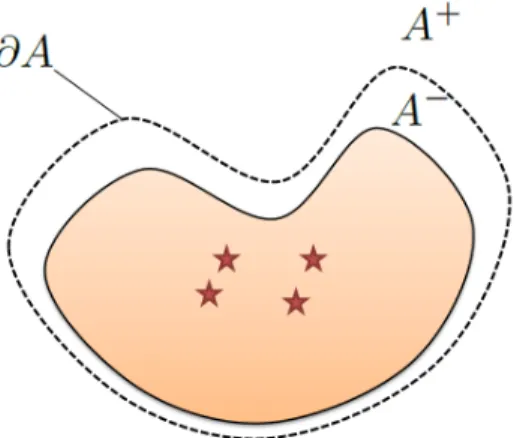
Figure 3.1: A diagram illustrating a radiating objectA, its corresponding boundary∂A, exterior regionA+, interior regionA−, and the set of equivalent sources (denoted by star shapes).
Dirichlet boundary condition:In this case, pressure on the domain of the boundary is specified:
P = Υ(x) on∂A. (3.3)
Neumann boundary condition:The gradient of pressure in the normal direction or the normal velocityvis specified.
∂P
∂n =−ˆjωρv= Υ on∂A, (3.4)
whereρis the fluid velocity.
Mixed boundary condition: This is also called the general impedance boundary condition where both pressure and gradient of pressure are specified:
Z∂P
∂n +P = Υ on∂A, (3.5)
whereZ andΥare functions defined on the domain boundary.
Equivalent Sources Mathematically, the equivalent source is the solution of the Helmholtz equation (3.1) subject to the Sommerfeld radiation condition (3.2). The equivalent source, also called the
Green’s function, can be represented as a pressure fieldq(x,yi)generated by a point source located atyi(x6=yi) and can be expressed as
q(x,yi) = L−1
X
l=0 l
X
m=−l
dilmϕilm(x) = L2 X
k=1
![Table 3.2: Precomputation performance: Abbreviations are as follows : “#objs.” denotes the number of objects in the scene, “#freq.” is the number of frequency samples in the range [0-1 kHz]](https://thumb-us.123doks.com/thumbv2/123dok_us/8310979.2201119/55.918.148.770.110.267/precomputation-performance-abbreviations-follows-denotes-objects-frequency-samples.webp)
![Table 3.3: Runtime performance: Abbreviations are as follows : “#objs.” denotes the number of objects in the scene, “#freq.” is the number of frequency samples in the range [0-1 kHz] and “#srcs”](https://thumb-us.123doks.com/thumbv2/123dok_us/8310979.2201119/58.918.188.731.110.328/runtime-performance-abbreviations-follows-denotes-objects-frequency-samples.webp)