Fast Bayesian Methods for Genetic Mapping Applicable for
High-Throughput Datasets
Yu-Ling Chang
A dissertation submitted to the faculty of the University of North Carolina at Chapel Hill in partial fulfillment of the requirements for the degree of Doctor of Philosophy in the Department of Biostatistics.
Chapel Hill 2008
Approved by
Advisor: Dr. Fred A. Wright
Reader: Dr. Fei Zou
Reader: Dr. Gary Koch
©2008 Yu-Ling Chang ALL RIGHTS RESERVED
Abstract
QTL mapping is a statistical method for detecting possible gene locations (called
Quan-titative Trait Loci or QTL) and those genes’ effects on the variation in a quanQuan-titative
phenotype, such as the height of a corn plant, etc. QTL mapping has become an important
issue in genetic analysis and has made important contributions to the fields of medicine and
agriculture. Traditional QTL mapping methods scan the whole genome and calculate the
profile likelihood ratios test statistic at each putative QTL location. The maxima of the
test statistics for all putative QTL locations are compared with the genome-wide threshold
to identify the QTL.
In this thesis, we propose several fast Bayesian methods for QTL mapping, which not
only provide direct approximate QTL posterior probabilities at all putative gene locations,
but also offer highly interpretable posterior densities for linkage, without the need for Bayes
factors in model selection. The applications to simulated data and real data show these
methods are highly efficient and more rapid than the alternatives, grid search integration,
importance sampling, Markov Chain Monte Carlo (MCMC) sampling or adaptive
quadra-ture. Our results also provide insight into the connection between the profile likelihood
ratios test statistic and the posterior probability for linkage. The results of these methods
are easy to interpret and have the advantage of producing posterior densities for all model
parameters. We infer the presence of QTL at locations with largest posterior probabilities.
Because of the high speed and high accuracy of these methods, they are highly suitable
for studying high-throughput data sets, e.g. eQTL data sets. The eQTL analysis is a
very important application of QTL mapping to a microarray data set, where thousands of
transcripts are treated as the phenotypes and provides us insight into the natural variation
in gene expression levels. The approach offers highly interpretable direct linkage posterior
densities for each transcript, and opens new avenues for research in this area.
Biologi-cally attractive priors involving explicit hyperparameters for probabilities of cis-acting and
trans-acting QTL are easily incorporated.
We also extend the one QTL Bayesian method to multiple QTL. The advantage of this
joint effects. Multiple QTL mapping can be computationally intensive, even for our efficient
Bayesian approaches. Thus, a fully Bayesian multiple QTL approach for high-throughput
datasets remains challenging. We investigate a heuristic for conditional search on the
two-location search space that shows promise for identifying the global maximum, and offers
the potential for extended approximate Bayesian approaches.
ACKNOWLEDGEMENTS
I would like to express my deepest thanks and appreciation to my advisor, Dr. Fred
A. Wright for his tremendous help, patience and encouragement during my Ph.D. work.
Dr. Wright leads me to this interesting quantitative trait loci statistical analysis field. His
sound advice and guidance were invaluable during my research. I have also enjoyed the
inspiring discussions with my coadvisor Dr. Fei Zou who keeps encouraging me to explore
different problems and providing many useful comments and resources during my research.
I am extremely grateful for the kind assistance, generosity, and advice I received from
Dr. Gary Koch at different stages of my study. Thanks to his help and guidance, I can
complete my graduate study for both Master and Ph.D. degrees. I would also like to thank
him for giving me the opportunity to work in the Biometric Consulting Lab. During my
stay in the lab, I have learned so much from the projects, which I participate in. I want to
express my thanks to all members in the lab for encouraging and supporting me during my
studies.
I am grateful to my committee members for investing time and energy discussing ideas
with me. I have benefited greatly from their advice. I thank Dr. Amy Herring for carefully
reviewing my dissertation and providing statistical suggestions in Bayesian perspective. I
also would like to express my thanks to Dr. Daniel Pomp for providing helpful statistical
references and giving useful suggestions from Biological perspective.
This dissertation is dedicated to all my family members for their support and
CONTENTS
List of Figures vii
1 Introduction 1
1.1 QTL Introduction . . . 2
1.1.1 QTL Experiments . . . 2
1.1.2 QTL Statistical Model . . . 5
1.1.3 Likelihood-Based One QTL Methods . . . 7
1.1.4 Likelihood-Based Multiple QTL Methods . . . 11
1.1.5 Bayesian QTL Methods . . . 13
1.2 Microarrays Introduction . . . 16
1.3 eQTL Introudction . . . 19
1.4 Thesis Summary . . . 21
2 One QTL Model 23 2.1 Methods . . . 25
2.1.1 The Laplace Approximation . . . 28
2.1.2 Approximating the null integrated likelihood . . . 29
2.1.3 Extension to F2 populations . . . 34
2.2 Relationship between Linkage Posterior Probability and LOD Score . . . . 36
2.3 Simulation Studies . . . 38
2.3.1 BC QTL Data . . . 38
2.3.2 F2 QTL Data . . . 39
2.3.3 Simulation Results . . . 40
2.4 Real Data Analysis . . . 61
2.5 Application to eQTL analysis . . . 65
2.6 Discussions . . . 72
2.7 Appendix A: E-M algorithm for BC population in one QTL model . . . 73
2.8 Appendix B: Fisher Information Matrix Derivation under HA for Backcross in One QTL Model . . . 75
2.8.1 The First Derivatives of the Loglikelihood Function . . . 75
2.8.2 The Second Derivatives of the Loglikelihood Function . . . 76
2.9 Appendix C: Fisher Information Matrix Derivation under HA for F2 in One QTL Model . . . 79
2.9.1 The First Derivatives of the Loglikelihood Function . . . 80
2.9.2 The Second Derivatives of the Loglikelihood Function . . . 80
2.10 Appendix D: Derivation of MCMC Method for Backcross in One QTL Model 84 3 Multiple QTL Model 88 3.1 Methods . . . 89
3.1.1 The Laplace Approximation . . . 92
3.1.2 Approximating the null integrated likelihood . . . 93
3.1.3 Posterior Curves for All Nuisance Parameters . . . 94
3.1.4 Sequential Multiple QTL Bayesian Model . . . 95
3.2 Simulation Studies . . . 97
3.2.1 Simulation Results for the Joint Bayesian Multiple QTL Model . . . 97
3.2.2 Simulation Results for Sequential Bayesian Multiple QTL model . . 102
3.3 Real Data Analysis . . . 105
3.4 Conclusions . . . 107
3.5 Appendix: Fisher Information matrix under HA for Backcross in Two QTL Model . . . 111
3.5.1 The First Derivatives of the Loglikelihood Function . . . 113
3.5.2 The Second Derivatives of the Loglikelihood Function . . . 113
LIST OF FIGURES
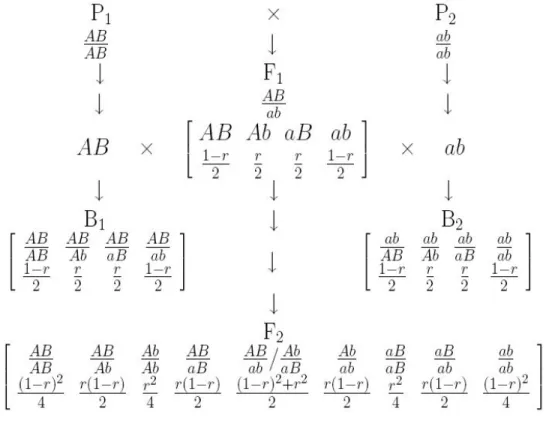
1.1 The breeding process of experimental populations and their recombination rate information, Zeng (2000). . . 4
1.2 Microarray data structure. . . 18
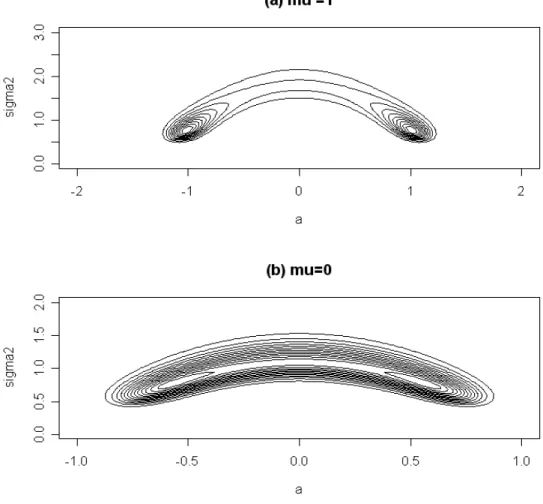
2.1 Contour plot of Laplace approximation for BC data under the null hypothesis: (a) n(sample size)=100,µ= 1 (b) n(sample size)=100,µ= 0. . . 30
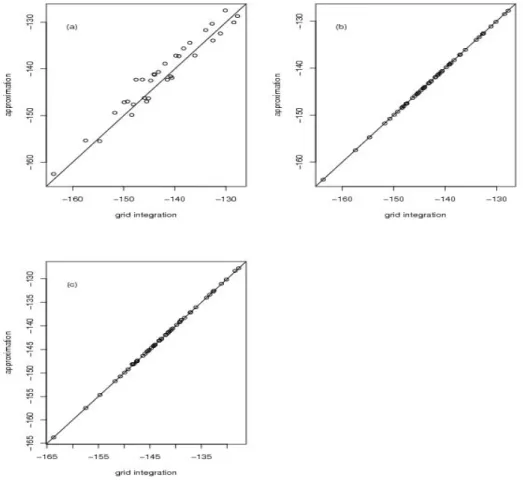
2.2 BC data simulation results for {µ, a, σ2} = {0,0,1} and n = 100 under the null hypothesis: (a)naive null Laplace approximation (b)improved null
Laplace approximation (c) fast nullLaplace approximation. . . 32
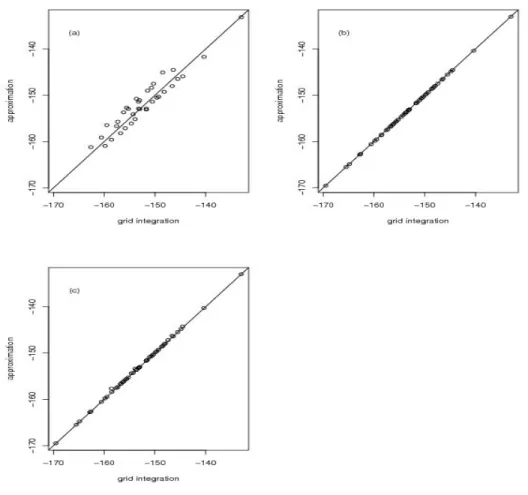
2.3 BC data simulation results for {µ, a, σ2} = {0,0.5,1} and n = 100 under the null hypothesis: (a)naive null Laplace approximation (b)improved null
Laplace approximation (c) fast nullLaplace approximation. . . 33
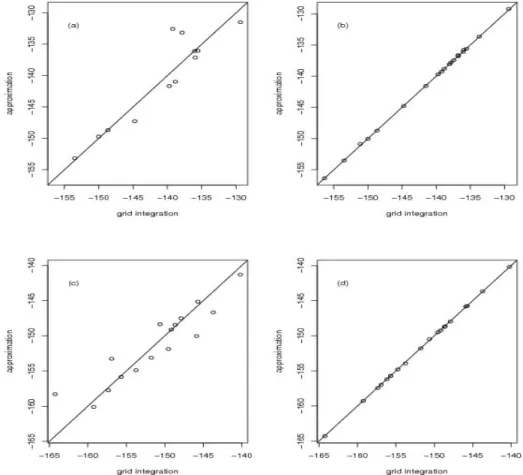
2.4 F2 data simulation results for n= 100 under the null hypothesis: (a) naive nullLaplace approximation (b)fast nullLaplace approximation under{µ, a, d, σ2}=
{0,0,0,1}; (c)naive nullLaplace approximation (d)fast nullLaplace approx-imation under {µ, a, d, σ2}={0,0.5,0.5,1}. . . 35 2.5 Posterior distributions of QTL locations for the chromosome 12 of the F2
data in Naoki et al. 2004. Several methods are applied and compared with the grid search method. The solid curves are for the grid search method, and the red scatter points are for the other methods. . . 63
2.6 The difference of posterior probabilities from each method, compared with the grid search method along chromosome 12. . . 64
2.7 The eQTL plot for budding yeast data. . . 68
2.8 Posterior probability against all genome plot for transcript with the highest cis-acting posterior probability. . . 69
2.9 Posterior probability against all genome plot for transcript with the highest trans-acting posterior probability. . . 70
3.1 The sequential Bayesian QTL method algorithm for detecting two QTL. . 96
3.2 300 simulation results for data generated fromH0,H1 and H2. . . 99
3.3 ROC curve for all three hypotheses. . . 100
3.4 100 simulation results for detecting QTL locations by using joint Bayesian two QTL method. . . 101
3.5 100 simulation results for detecting QTL locations by using sequential Bayesian two QTL method. . . 103
3.6 Compare 100 simulation results of joint method and sequential method for detecting QTL locations. . . 104
3.7 Posterior distributions of QTL locations on the chromosome 6 and 15 of the BC data from paper Sugiyamaet al.(2001). Joint two QTL Bayesian method is used in this real data analysis. . . 107
3.8 The contour plot of QTL locations on the chromosome 6 and 15 of the BC data from paper Sugiyamaet al. (2001). Joint two QTL Bayesian method is used in this real data analysis. . . 108
CHAPTER 1
Introduction
In this thesis, we are addressing the problem of detecting the locations and effects of
genes which contribute to the variation of some phenotype. This is called QTL mapping.
Moreover, we also expand the idea of QTL mapping to microarray data and gain insight
into the effect of variations in gene expression levels. This is called eQTL mapping. Most
traditional QTL methods use thelog10 of profile likelihood ratios test statistic (also called
the LOD score in the genetics field) to detect QTL. With these methods, a LOD score for
every putative location is computed. We infer the presence of QTL at locations where the
LOD scores are above some pre-specified threshold.
In most Bayesian QTL methods, it is customary to draw samples of nuisance
parame-ters from the posterior distributions by applying Monte Carlo sampling methods and then
obtain estimates for the unknown parameters based on averaging the samples drawn from
these posterior distributions. In our Bayesian method for detecting one QTL, we propose to
use the Laplace approximation for the integration of the likelihood function with respect to
the nuisance parameters, assuming that the priors of the nuisance parameters are properly
uniform distributed. This method is very fast and accurate compared to all other existing
Bayesian methods. Thus, our Bayesian method is suitable for high-throughput applications
such as eQTL studies. We expand this Bayesian method to detect multiple QTL
simulta-neously and further propose the iterative Bayesian method via the Laplace approximation
for the multiple QTL model. This iterative method has been shown to be relatively fast
and has very high accuracy for detecting multiple QTL locations.
In Section 1.1, we introduce QTL mapping as well as some commonly used
likelihood-based QTL methods and Bayesian QTL methods in this section. In Section 1.2,
the introduction to microarray data analysis is provided. In Section 1.3, we explain what the
expression Quantitative Trait Loci (eQTL) is, and briefly review some recently developed
eQTL methods.
1.1
QTL Introduction
The history of QTL mapping can be traced back to Gregor Mendel’s study of the shape
of the peas. This classical genetics study involved binary traits, in the sense that the
phenotype has only two outcomes, i.e. the shape of peas is round or not. However, most
natural phenotypes are quantitative, such as heights or yields of crops. This has motivated
the statistical study of the distribution of phenotypes while considering the effects of QTL.
In the 1920s, the development of the chromosome theory and genetic linkage helped us to
understand the effects of genes on phenotypic variation. In the 1990s, biomedical markers
such as Restriction Fragment Length Polymorphisms (RFLPs) and microsatellites were
discovered. Since then, there have been many articles studying traits on different organisms,
such as pigs (Andersson et al. (1994)), maize (Beavis et al. (1991), Stuber et al. (1992)),
mice (Berrettini et al. (1994)) and tomatoes (deVicente and Tanksley (1993)) based on
these linkage maps. By using linkage maps, additional statistical and biological discoveries
have been made.
In the following subsections, we will discuss the experiments that produce backcross and
F2 progeny and the statistical models for QTL mapping, and include literature reviews of
the existing likelihood-based and Bayesian QTL mapping methods.
1.1.1 QTL Experiments
We focus below on the data from experimental crosses: backcross (BC) population and
F2 intercross population. There are also some experimental crosses, such as double haploid and some types of recombinant inbred strains, but we will not introduce them here. The
breeding process of the experimental crosses usually involves choosing two highly divergent
parental strains, each of which is homozygous, e.g. if the genotype of the parental strain is
strain is aa at this locus, we called it the “low” parental strain. In the following context,
we will focus on the genotypes of their progeny at the same locus. By crossing those two
parental strains, we can produceF1 progeny. TheF1 individuals are heterozygous because
they receive one chromosome from the high parental strain and the other chromosome from
the low parental strain. The chromosome from the high parental strain has genotype Aat
the locus and the other chromosome has genotype a at the same locus. Thus all the F1
individuals have the same genotype Aa at this locus. In order to produce the backcross
population, F1 progeny are crossed back to one of their parents, e.g. the high parental strain withAA. The genotype of the backcross progeny could beAAandAawith the same
probability 12. Then two F1 strains are intercrossed to produce F2 progeny. The possible genotypes for theF2 individuals at this locus areAAwith probability 14,Aawith probability
1
2, and aa with probability 1 4.
When we consider the genotypes at two loci, the chromosomes of the parental strains
during meiosis (the formation of the sex cells) may cross over and recombine. This affects
the joint distribution of the genotypes at two loci. The probability of recombinationr(also
called the recombination rate or recombination fraction) is calculated by Haldane’s map
function here.
r= 1 2(1−e
−2x). (1.1)
In this formula, x is the map distance between two loci, the expected number of
crossovers between two loci, and it is described in unit: Morgan (M). The
recombina-tion rate r increases from 0 to 0.5, as the map distance between the loci increases from 0
to∞.
When using Haldane’s map function, “no crossover interference” is assumed, which
means that for more than two markers, the recombination event between any two of them
is independent of the recombination event between any other non-overlapping two markers.
Many other map functions have been proposed, for example, the Morgan map function and
Kosambi map function (Ott (1991)) are also very popular, and are used under different
assumptions in a more complicated biological process.
Suppose that the high parental line (P1) has genotypesAAandBBat two loci in which we are interested. The other low parental line (P2) has genotypes aa and bb at the same
two loci. Figure 1.1 shows the cross process of backcross progeny and F2 progeny. It also
shows the distribution of genotypes at these two loci, assuming that the recombination rate
between the two loci isr. In this Figure, B1 shows the distribution of the genotypes of the
backcross progeny, which are from the crossing of the F1 population and the high parental
strainP1. B2 shows the other distribution of the genotypes of the backcross progeny, which are from the crossing of the F1 population and the low parental strain P2. The last line shows the distribution of the genotypes of F2 progeny, which are from the intercross of theF1 strain. The purpose of the cross process is to increase the genetic variability of the progeny strains and therefore allows us to detect the possible genes for the variation in the
quantitative phenotype.
1.1.2 QTL Statistical Model
Suppose that yi (i = 1,2,· · ·, n) represents the ith individual’s phenotype and also assume that the QTL are located somewhere between the markers in our model. We intend
to find the locations and effects of QTL given the markers’ genotypes, the markers’ locations,
and the phenotypes of all individuals.
One QTL model:
First, we consider the most simple model: the one QTL model for backcross progeny. The
following equation represents how one QTL genotype affects the distribution of phenotypes:
yi =µ+a·gi(x∗) +i, (1.2)
whereµis the intercept, ais the additive effect of the QTL, x∗ signifies the location of the
unknown QTL, gi(x∗) represents the QTL genotype for the ith individual,gi(x∗) = 1 or -1
if the QTL genotype is Aa(heterozygote) oraa (homozygote), andi is the environmental
variation with a distribution ofN(0, σ2).
Similarly, the one QTL linear model of phenotypes yi for the F2 population is shown
below:
yi =µ+a·gi(x∗) +d·(1− |gi(x∗)|) +i, (1.3)
where a and d are the additive and dominance effects for the QTL, gi(x∗) equals 1 if the
QTL genotype of theith individual is AA, 0 if it isAa, and -1 if it is aa, andµ and i are
defined the same usually as before in the backcross model.
In the above two models, the phenotypes of the individuals follow a mixture normal
distribution since gi(x∗) is unobserved if x∗ is not located at one of the marker locations.
The variance σ2 is defined as a constant. Multiple QTL model
Some phenotypes are affected by more than one QTL, so multiple QTL models are discussed
here. We assume that these QTL act additively, and there may be some interactions between
them in our model.
The equations below show two QTL models for the backcross and F2 populations,
re-spectively, under the condition that two QTL act additively and independently.
For a backcross population:
yi =µ+a1·gi(x∗1) +a2·gi(x∗2) +i, (1.4)
where a1 and a2 are the additive effects of two QTL, respectively; x∗1 and x∗2 specify the locations of two QTL on the chromosome.
For aF2 population:
yi =µ+a1·gi(x∗1) +a2·gi(x∗2) +d1·(1− |gi(x∗1)|) +d2·(1− |gi(x∗2)|) +i, (1.5)
whered1 and d2 are the dominance effects of two QTL, respectively.
If two QTL exhibit deviation from additivity (i.e. there is an interaction effect between
two QTL), called epistasis, the model will become more complicated. The following equation
is the two QTL model with the pairwise interaction for a backcross population:
yi =µ+a1·gi(x∗1) +a2·gi(x2∗) +δ·gi(x∗1)·gi(x∗2) +i, (1.6)
whereδ is the epistasis effect between two QTL.
For the kQTL problem, the model can be generally expressed as:
yi=µgi1,gi2,···,gik+i, (1.7)
wheregi1, gi2,· · ·, gik are the joint QTL genotypes for theith individual,µgi1,gi2,···,gik
rep-resents the phenotypic mean ofyiif theithindividual has QTL genotypes: gi1, gi2,· · ·, gik, i follows N(0, σ2). For the backcross population, the maximum number of unknown pa-rameters is 2k+ 1 and the maximum number of unknown parameters for F2 population is
1.1.3 Likelihood-Based One QTL Methods
The quantitative inheritance was discovered in the 19th century and arise via the
seg-regation of multiple genetic factors, modified by environmental effects. In this section, we
will describe some major one QTL likelihood-based methods that have been used since the
early 19th century. For each method, we will discuss the main idea, its advantages and its
possible disadvantages.
Binary traits were first described by Gregor Mendel through extensive experiments with
the breeding of peas; he found that the shape of peas is either round or wrinkled, i.e. it is a
binary trait. However, there are also many other traits which exhibit quantitative variation
and which require further investigation.
Thoday (1961) addressed the idea of using genetic markers for identifying multiple genes
that control the quantitative variation of some phenotypes. This idea are examined
exper-imentally after biochemical markers such as Restriction Fragment Length Polymorphisms
(RFLPs) and microsatellites were discovered. The advantages of using biochemical markers
to characterize QTL are their phenotypic neutrality, highly polymorphic properties, and
their abundance in the genome.
The following methods are based on whole genome analysis:
Analysis of Variance (ANOVA)
Soller et al. (1976) used ANOVA for QTL analysis. The phenotypes of individuals are
grouped by the genotypes of the markers. Instead of testing the significance of QTL at
some putative locus, we compare the group means between two genotypes of the marker.
If the QTL is tightly linked to this marker, then grouping phenotypes according to the
genotypes of this marker is essentially the same as grouping phenotypes according to the
genotypes of the QTL.
Analysis of variance (ANOVA) is a simple and naive method that permits very fast
com-putation. However, there are some drawbacks with this method. First, we can’t estimate
the precise location of the QTL. ANOVA only shows which marker is closest to the QTL.
Second, when the markers are not dense enough, the linkage between a QTL and its closest
marker is weak. The power to detect the presence of a QTL is quite small. Third, if we
estimated the QTL effect by the effect of its nearest marker, we would underestimate its
effect; see Lander and Bostein (1989).
The Maximum Likelihood Method (MLE)
To avoid the drawbacks of ANOVA, Weller (1986), Weller (1987) and Simpson (1989)
con-sidered the difference between QTL and markers. They include the recombination rate r
between a QTL and its markers in the model and test every marker one after another to
find whether there is a QTL close to any of them. This method works via the following
process: taking the backcross population as an example, it assumes that the individuals
with QTL genotype AA have phenotypes distributed as N(µA, σ2), and the individuals with QTL genotypeAahave phenotypes distributed as N(µa, σ2).
For those individuals with the genotype AA at the marker which you are testing, the
phenotype has the following distribution:
yi ∼(1−r)×N(µA, σ2) +r×N(µa, σ2).
But if the individuals have the genotype Aaat the test marker, the phenotype follows the
distribution below:
yi ∼r×N(µA, σ2) + (1−r)×N(µa, σ2).
yi is the phenotype of the ith individual. r is the recombination rate between the
QTL and the marker you are testing. The method uses the EM algorithm to find the
maximum likelihood estimates (MLE) for the unknown parameters. One way we can test
H0:r = 12 vs. HA:r6= 12 with the LOD score:
LOD=−log10L(ˆµA,µˆa,σˆ
2, r= 1 2) L(ˆµA,µˆa,σˆ2,rˆ)
.
Alternatively, we calculate the LOD score for each marker locus to test whether there is
a QTL around the marker and for eachr, the formula of LOD score for testingH0 :µA= µa vs. HA:µA6=µa is:
LOD(r) =−log10L(ˆµA= ˆµa,σˆ 2) L(ˆµA,µˆa,ˆσ2)
The second test is a special case of the first one. The LOD scores are then compared to
a genome-wide threshold to infer the presence of a QTL. This method considers the fact
that the LOD score is computed between markers. However, when using this method it is
hard to combine the results for testing each marker and get a single estimation of the QTL
location and effect.
Interval Mapping
Lander and Bostein (1989) introduced a significant improvement on QTL analysis by using
the flanking markers to detect a QTL in experimental populations; this method is called
“interval mapping”. In this paper, they assume that there is no crossover interference
for any pair of markers on the chromosomes under study and the phenotype is normally
distributed. One has the information on the markers’ locations and markers’ genotypes. A
backcross population is used here to explain this method. The phenotype of each individual
follows a normal distribution with the mean equal to µA orµa depending on whether the
QTL genotype isAAorAa, and the varianceσ2 is defined as a common constant.
In a backcross population, there are two kinds of QTL genotypes and four possible
genotypes at two flanking markers. Suppose the map distance between flanking markers is
d. The map distance between the QTL and the left marker is dL. According to Haldane’s
mapping function, the recombination rate between two markers is r = 12(1−e−2d). The recombination rate between the QTL and the left marker is rL = 12(1−e−2dL). And the recombination rate between the QTL and the right marker is rR = 12(1−e−2(d−dL)) = (r−rL)(1−2rL). We calculate the conditional probability for two possible genotypes of the QTL, given the flanking marker genotypes, by using a recombination rate. The results
are shown in Table 1.1.
Suppose that for individuals with QTL genotypesAA, their phenotypes are distributed
asN(µA, σ2), and for individuals with QTL genotypesAa, their phenotypes are distributed asN(µa, σ2). Then for any given putative QTL locationx, we can calculate the conditional probability assuming that the QTL genotype is AA for the ith individual (i = 1,· · · , n), given its flanking markers, and we note it as Pi(x). Then the ith individual’s phenotype
follows a mixture normal distribution:
Table 1.1: The conditional probability of a QTL genotype given two flanking makers’ geno-types
is
marker genotype QTL Genotypes
left right Aa AA
Aa Aa (1−rL)(1−rR)/(1−r) rLrR/(1−r) Aa AA (1−rL)rR/r rL(1−rR)/r AA Aa rL(1−rR)/r (1−rL)rR/(1−r) AA AA rLrR)/(1−r) (1−rL)(1−rR)/(1−r)
yi∼Pi(x)×N(µA, σ2) + (1−Pi(x))×N(µa, σ2)
.
For each fixed location x, we use an EM algorithm to maximize the joint likelihood
function and get the estimation for the unknown parameters (See Dempster et al. (1977)).
Considering the null hypothesis that there is no single QTL on the chromosome, the LOD
scores are calculated and plotted against x. The formula of LOD score for test H0 :µA= µa vs. HA:µA6=µa is:
LOD=−log10L(ˆµA= ˆµa,ˆσ 2) L(ˆµA,µˆa,σˆ2)
.
We infer the presence of a QTL, if the LOD score at this position exceeds the genome-wide
threshold.
The interval mapping method and the above MLE method are not identical. In the MLE
method, we only consider the recombination rate between the QTL and one marker. But
with interval mapping, we consider the distribution of QTL’s genotype, given two flanking
markers’ information. The interval mapping method can give a precise estimate of the
location and effect of a QTL. Therefore, many QTL statistical methods in the 1990s are
the extensions based on the interval mapping methods. However, it has the drawback: it
1.1.4 Likelihood-Based Multiple QTL Methods
Many traits may be influenced by multiple genes, so one QTL model is not sufficient
to deal with this situation. We need to develop more complicated models because using
one QTL model to detect multiple QTL data may fail to identify and estimate the
multi-ple QTL locations. The detection power therefore is compromised and estimations of the
QTL locations and their effects will be biased (Lander and Bostein (1989); Knapp (1991)).
Sometimes “ghost QTL” may appear, in the sense that if there are two QTL on a
chromo-some evaluated with one QTL mapping method, you may detect a QTL located chromo-somewhere
between two true QTL locations instead of detecting either one of them (Haley and Knott
(1992); Martinez and Curnow (1992); Yi (2005)).
Multiple QTL can be mapped more accurately and more efficiently with a multiple QTL
model. We will discuss three main likelihood-based methods for multiple QTL mappings:
multiple linear regression, composite interval mapping (CIM) and multiple interval mapping
(MIM).
Multiple Linear Regression Analysis
This multiple QTL method is an extension of the ANOVA method for one QTL model.
In this method, the phenotypes of individuals are regressed on the markers’ genotypes.
The basic idea is that the effects of a QTL will be partially absorbed by linked markers
(Stam (1991)). Cowen (1989) used stepwise selection and backward deletion techniques to
select a class of markers, which are linked to a QTL. More recently, Doerge and Churchill
(1996) described using forward selection and permutation tests to determine the number of
markers in the model. However, when the distances between markers and QTL are large,
only a small part of the QTL effect is absorbed by the markers. The power of detection
thus becomes very small. We cannot estimate the precise locations and effects of a QTL
using this method.
Composite interval mapping
With one QTL interval mapping, the likelihood function for a single QTL is assessed at
each putative location on the chromosome. However, a QTL located somewhere else on
the genome can have an interference effect. Jansen (1993), Zeng (1993) and Zeng (1994)
independently proposed the idea of combining interval mapping with multiple regression on
markers’ genotypes. Zeng (1994) named this method Composite Interval Mapping (CIM).
The method is achieved by fitting one QTL interval mapping method and using part of the
markers as co-factors to eliminate the effects of additional QTL. By fitting other genetic
markers in the model as a control, it confines the test of one QTL to a region, which changes
the problem from a multi-dimensional search to a one-dimensional search. Compared to
one QTL interval mapping, CIM improves both the sensitivity and accuracy by including
the markers, which may absorb the effects of other QTL. The parameters in the model
are estimated by the expectation/conditional maximization (ECM) algorithm (Meng and
Rubin (1993)).
The main challenge in this model lies in determining which markers to use as regressors.
Jansen and Stam (1994) used backward deletion to pick up the subset of most significant
markers with Akaike’s Information Criterion (AIC). Zeng (1994) recommended that one
include all the markers except those that are within 10 CM of the putative location.
Multiple interval mapping
If there are multiple QTL in the model, Lander and Botstein suggest detecting QTL one
by one, i.e. they fix the position of the first QTL, then look for the next QTL location.
This is a forward selection procedure (Miller (1990)). However, there is the drawback of a
“ghost QTL” effect, in the sense that if there are two or more linked QTL, then interval
mapping often gives a maximum LOD score at a location between the two QTL; see Haley
and Knott (1992).
Kao et al. (1999) extend one QTL interval mapping model to a multiple QTL interval
model. They use multiple marker intervals simultaneously to detect multiple putative QTL
in the model. This method uses the general formulas derived by Kao and Zeng (1997) to
obtain maximum likelihood estimates (MLEs) for the parameters. Compared with the
re-gression method, this method gives accurate and precise locations and the effects of multiple
QTL. However, the selection of the QTL involves multidimensional search, which is very
1.1.5 Bayesian QTL Methods
Likelihood-based QTL methods detect the locations and effects of QTL mainly by
max-imizing the likelihood and evaluating the presence of QTL by using the LOD score. When
computing confidence intervals, likelihood-based methods do not properly account for
un-certainties in the parameters. With Bayesian methods, the prior information is incorporated
into the analysis and the inferences are based on the marginal posterior distributions of the
parameters, which are easy to interpret.
Satagopan et al. (1996) applied the standard Markov chain Monte Carlo (MCMC)
method to map a given number of multiple QTL on the genome. MCMC is a Bayesian
method commonly used to approximate a multi-dimensional integral of the likelihood
func-tion, which has no closed form. We generate a sequence of samples from the joint conditional
probability distribution to get the integral. For the posterior probability of the parameter
we are interested in, we sample each parameter from its conditional distribution given the
rest of the parameters. The samples of the parameters are generated sequentially until the
chains converge. Satagopanet al.(1996) used Gibbs sampling as well as Metropolis-Hastings
algorithms to sample unknown parameters and missing data from their joint posterior
dis-tribution. The parameters were inferred based on their marginal posterior distributions,
which can be obtained from the joint posterior distribution by integrating over the other
unknowns. It is hard to get the exact integrations over multiple parameters, however, a
Monte Carlo approximation is quite feasible for estimating the integrations. In the paper,
the probability intervals for locations of multiple loci and their effects are discussed. This
method accounts for the uncertainties in the parameters by considering the marginal
pos-teriors, which average over such uncertainties in the parameters. The present paper also
discusses the number of loci affecting the trait of interest. We estimate the number of QTL
by fitting various models with different numbers of QTL, then we use a Bayes factor (Kass
and Raftery (1995)) to compare these models.
The above Bayesian inference is complicated when the number of QTL is unknown.
Essentially, the parameter space is the product of the spaces of different numbers of QTL.
Most conventional techniques can’t be applied. Green (1995) proposed using reversible jump
Markov chain Monte Carlo alogrithms specifically for such problems. This method combines
the traditional MCMC algorithm with Metropolis-Hasting (Hastings (1970), Metropolis
et al.(1953)) for jumping between different number of QTL. Satagopan and Yandell (1996)
used a reversible jump MCMC to fit a multiple QTL model by including the number of
QTL as unknown parameters. The locations, effects, and number of QTL can be estimated
from the samples. Their application to the Brassica flowering data (Satagopan and Yandell
(1996)) shows similar results compared to the results obtained using Bayes factors
(Sa-tagopan et al. (1996)). Because the reversible jump MCMC algorithm is very general and
widely applicable, many effective approaches for detecting multiple (non-)epistatic QTL
are based on it in different experimental populations or in pedigrees (Stephens and Fisch
(1998); Sillanpaa and Arjas (1998); Thomaset al.(1997); Yi and S. (2000); Gaffney (2001);
Yi and Xu (2002); Yiet al.(2003)). However this method also has its drawbacks: it is very
poor to mix the chain for updating QTL locations and it is very slow for chain convergence.
The Bayesian approach above provides a sensible inferential framework for multiple
QTL mapping. But it suffers from an intense computational burden. Berry (1998) has
proposed another Bayesian model, which is also a Markov chain Monte Carlo method, but
one with moderate computational speed. Usually the joint likelihood function is integrated
over all other unknown parameters to get the posterior distributions of the number and
the locations of QTL. When the number of parameters is large, the computation becomes
very intensive. In Berry (1998), the ease of the computational burden was achieved by
several approximations. Berry (1998) uses a first order approximation of the likelihood
function, and the Laplace approximation to estimate the posterior distribution on the whole
genome. The computation is improved through these approximations. Gibbs sampling is
used to generate samples from the approximated posterior distributions. The number and
the locations of QTL are inferred from the samples. The strength of this method is the
moderate computation speed achieved by using fast approximations. However, this method
is applied only in backcross populations and the accuracy of this approximation still requires
further investigation.
Yi (2004) improved the efficiency of the reversible jump Markov chain Monte Carlo
QTL. This method is based on a composite space representation of the problem, which was
developed by Carlin and Chib (1995). It provides a new viewpoint on the model selection
problem. The advantage of this new method is that it allows Markov chain Monte Carlo
simulation to be performed on a space of fixed dimension, thus avoiding the complexities
of reversible jump technique. The Bayesian approach is finally simplified. The composite
model space approach is extended to include epistatic effects in the model (Yiet al.(2005);Yi
et al. (2007a)). They developed a computationally efficient Markov chain Monte Carlo
algorithm using a Gibbs sampler and Metropolis-Hastings algorithm to study the posterior
distribution of the parameters.
There are also some other Bayesian methods that can be used to calculate the posterior
probabilities: numerical grid search integration, adaptive numerical integration, and
impor-tance sampling. Numerical grid search integration is a method that is used to approximate
the integral function with no closed form by using a set of grid points. We obtain those grid
points in a user-defined size domain for each nuisance parameter. We also know that the
domains of the nuisance parameters for the integral likelihood is on the space Ω, and Ω can
be arbitrarily large. If we truncate Ω to a reasonable rectangle size such that the likelihood
would be very small outside of the rectangle, numerical grid search integration can divide
this rectangle into many small cubes by the grid points we define, and get the integral
value for each small cube. Then we can add up all the integral values on these small cubes
to find the approximate value for the integral likelihood function. If the cubes are small
enough, we should get a good approximation for the integration of the likelihood function.
The disadvantage of this method is that it has a computationally intensive problem, so it
is hard to apply it to high-throughput applications.
Adaptive numerical integration is a method used to approximate the integral over a
multidimensional finite range by a recursive adaptive method, which divides the interval
into two and compares the values given by Simpson’s rule and the trapezium rule (Venables
and Ripley (1994)). In R software, the “adapt” command in the package “adapt” is used
to apply this method. It works well when models have only a few nuisance parameters.
But when we apply this method to a model with many nuisance parameters or to a very
complicated model, the adapt command in R software is very computationally intensive,
and can crash easily.
Importance sampling is a Monte Carlo method used to approximate an integral function
by the average of ratios of likelihood density to the proposal density. A set of samples are
evaluated to obtain the average ratios. We have to find a good proposal density, which is
easy to simulate and “near” the density we want to integrate.
Sometimes, the traits we are interested in are binary responses. With most existing QTL
mapping methods, the linkages between markers and QTL are tested with a simple
chi-square test because of the binary traits. Xu (1996) proposed a composite interval mapping
method, which treats a binary trait as the outcome from an underlying normally distributed
liability. The quantitative liability is modelled by the usual QTL mapping method, since it
is quantitative and continuous. Huang et al.(2007) have proposed a new Bayesian method
which combines the unified Bayesian method and the liability model for studying binary
traits. This Bayesian method uses all the markers on the entire genome simultaneously.
Huanget al.(2007) developed the method for the case in which the QTL are located at the
observed markers, and for the case in which QTL are located between markers. If the QTL
are located between markers, the first method will lead to biased estimations. However, if
the markers are dense enough, the first method will be quite accurate and could save much
computation.
1.2
Microarrays Introduction
Microarray technology has become very popular in recent years and plays an increasingly
important role in biomedical research. Disruptions or changes in genes can cause disease or
morphological anomalies. By using microarray technology, we can detect changes in gene
expression and prevent the genetic defects in advance. With microarray technology, we can
measure thousands of genes simultaneously for different types of cells or tissues and use
gene expression to describe their DNA information. Many statistical problems have arisen
recently in the use of microarray data. Well-developed statistical methods that can assist
us in locating the genes of interest are urgently needed.
A microarray data structure is shown in Figure 1.2 on the next page. In Figure 1.2,
genes. Each row in the gene expression matrix represents the expression values for each
gene with respect to all samples. Each column in the gene expression matrix represents the
expression values of each sample for all genes.
Spotted cDNA microarrays and oligonucleotide arrays (Affymetrix, Santa Clara CA)
are two of the most commonly used gene expression arrays. In spotted cDNA microarray
experiments, the ratio of red and green fluorescence intensity for each spot (gene) is
in-dicative of the relative abundance of the corresponding DNA probe in the two nucleic acid
target samples. The red (R, Cy5) labeled and green (G, Cy3) labeled mRNAs represent test
and control samples, respectively. Probes are cDNA fragments attached on a solid support
(a nylon or glass slide). The process works like this: first, the red and green labeled RNA
samples are mixed and hybridized to the microarrays, which the supplier has spotted with
cDNA from thousands of genes, each spot representing one gene. After hybridization, the
red or green fluorescent signal from each spot is determined and the ratio of red to green is
the primary measurement considered. If one gene has a signal closer to red, this means that
gene is expressed at a higher level in the test sample than in the control sample. Newton
et al.(2001), Dudoit et al.(2002) and Leeet al.(2000) represent some early representative
papers for two-color microarrays.
In oligonucleotide arrays, instead of using one probe per gene, 11 to 20 probes are used to
represent each gene (Lockhartet al.(1996)). Each probe represents a unique DNA fragment
of one gene so a group of probes identifying a gene is called a probe set; in principle, one can
obtain a better estimate of the expression level for the gene on probe-set arrays than for the
gene on single-probe arrays. In Affymetrix technology, there is a perfect match (PM) probe
for the target DNA sample, as well as a corresponding paired ”mismatch” probe (MM).
This mismatch probe contains only a single base change in the nucleotide located in the
middle of the 25-base probe sequence; it is designed to measure non-specific hybridization
as well as provide the information on background and cross-hybridization (Lipshutz et al.
(1999)). A perfect match probe and its mismatch probe are called a probe-pair.
There are some differences between these two arrays. For spotted cDNA microarrays,
one probe represents one gene; each array has two target samples or one target sample, and
one reference sample; probe length on spotted cDNA microarrays varies. For oligonucleotide
arrays, there are 11-20 probe-pairs per gene, each array has one target sample, and probe
length is fixed with 25-mers (base pairs).
Statistical problems in this field involve microarray pre-processing like image analysis,
background correction, expression quantification, normalization and quality assessment.
There are also interesting problems when one is comparing two different conditions, like
normal/disease, control/treatment, or when one is comparing more than two different
con-ditions with microarray data. Statistical methods, like estimates and hypothesis testing, are
applied to solve these problems. Exploratory analysis using microarrays is also important.
Let us say we need to find a group of genes for a novel disease by using clustering or
pro-jection methods. There are also many other statistical problems and developed statistical
methods in microarray analysis, which is not the focus in this dissertation and will not be
discussed here.
1.3
eQTL Introudction
Quantitative geneticists are now interested in detecting expression quantitative trait
loci (eQTL) for gene expression abundances because transcript abundances are considered
to correlate with some important phenotypes. Transcript abundances can be treated as
a surrogate of phenotypes (Schadt et al. (2003)). eQTL methods have been developed
to identify major-effect eQTL for transcripts by combining quantitative trait loci (QTL)
mapping methods with microarray data, and “eQTL” are statistically significant peaks
in a genome-wide scan for linkage analysis. In eQTL analysis, the experimental design
is very similar to traditional quantitative trait loci analysis. The difference is that the
expression values for the gene transcripts are treated as the phenotypes, so one must analyze
thousands of phenotypes in eQTL analysis. Because of this difference, traditional QTL
statistical methods, designed for testing (at most) tens of phenotypes, cannot be easily
applied. Experimental design issues need to be addressed to handle these large data sets
and new statistical methods are still being evaluated.
Bremet al.(2002) used the Wilcoxon-Mann-Whitney method for testing the significance
of the linkage between each marker and transcript. This test has shown some promise in
important biological situations and the resulting p-values for some transcripts are sufficiently
small. Schadt et al. (2003) have used a traditional QTL interval mapping method for
analyzing maize, mouse and human data sets. This likelihood-based approach can be used
to obtain transcript-specific significance profile likelihood curves. However, those methods
are still not well refined for problems like the potential increase in type I error by testing
multiple markers, or power loss. Kendziorski et al. (2006) have proposed a
Mixture-over-Markers (MOM) model to localize eQTL and have controlled the false discovery rate without
sacrificing power. This method is a marker-based model. If the marker density is not
sufficiently dense, the results for loci between markers may have some bias. New statistical
methods are still needed to evaluate the eQTL data and optimize the test results.
Many eQTL studies based on the statistical methods mentioned above or some other
very simple statistical methods have been published for many creatures, e.g. yeast (Brem
et al.(2002); Yvertet al.(2003)), eucalyptus (Kirstet al.(2004)), mice (Schadtet al.(2003);
Bystrykh et al. (2005); Chesler et al. (2005)), rats (Hubner et al. (2005)), maize (Schadt
et al.(2003)) and humans (Morleyet al.(2004); Monkset al.(2004); Hubneret al.(2005)).
For those main regulated transcripts, results reported in several papers show that up to
one-third of the significant genes are cis-acting, which means the gene expression values can be
trans-acting, which means that the gene expression values are regulated by other physical gene
locations. Most of the cis-acting genes explain a greater proportion of expression variation
than trans-acting genes. Trans-acting genes usually explain little variation individually, but
we have more of them. This is similar to our expectation that DNA variation can affect a
large portion of gene expression for that gene.
In summary, eQTL analysis has the potential to impact biological endeavors in a wide
range of biomedical and agricultural fields. Applying traditional QTL methods to
microar-ray data also gives us insight into gene networks, as well as their evolution. Because of
the computational demands in eQTL analysis, the current statistical methods are not
suit-able for this high-through application. Well-developed and fast statistical methods are still
needed to handle thousands of phenotypes efficiently.
1.4
Thesis Summary
In Chapter 1, we introduced QTL mapping and summarized some existing methods
for detecting QTL. We also provided a brief introduction to microarray data and eQTL
analysis.
In Chapter 2, Bayesian methods via the Laplace approximation for detecting single
QTL are proposed. They can be easily applied to a backcross (BC) population and anF2
intercross population. They can also be trivially extended to double haploid and other types
of recombinant inbred strains. The applications to simulated data and real data demonstrate
the high speed and high efficiency of these methods compared to alternative grid search
integration, importance sampling, MCMC and adaptive quadrature methods. Our results
also provide insight into the connection between the LOD curve and the posterior probability
for linkage. In the application of our Bayesian method, we extend our approximate Bayesian
linkage analysis approach to the expression quantitative trait loci (eQTL) model, in which
microarray measurements of thousands of transcripts are examined for linkage to genomic
regions. This approach uses the Laplace approximation to integrate over genetic model
parameters (not including genomic position), and has been fully developed for different
types of recombinant inbred crosses. The method is much faster than the more
commonly-used Monte Carlo approaches, and thus is suitable for the extreme computational demands
of eQTL analysis. The approach offers highly interpretable direct posterior densities for
linkage for each transcript at each genomic position. Biologically attractive priors involving
explicit hyperparameters for probabilities of cis-acting and trans-acting QTL are easily
incorporated.
In Chapter 3, we extend the one QTL Bayesian method via Laplace approximation
method to the Bayesian method of detecting multiple QTL simultaneously. This joint
multiple QTL Bayesian method has the advantage of providing the posterior probability
at putative QTL locations and can detect QTL with interaction effects. The computation
is intensive when you detect multiple QTL at the same time even using our efficient joint
multiple QTL Bayesian method. Therefore, we also propose an iterative multiple QTL
Bayesian method based on the Laplace approximation for detecting multiple QTL locations
without the posterior probability calculation. The speed of this method is much faster than
that of the joint multiple QTL Bayesian method. In this Chapter, we use the two QTL
model as an example to demonstrate both our methods. We also apply our methods to
CHAPTER 2
One QTL Model
For the problem of mapping quantitative trait loci in experimental crosses, the interval
mapping maximum likelihood approach of Lander and Bostein (1989) inspired a number
of extensions, including regression approximations (Haley and Knott (1992)), composite
interval mapping (CIM), multiple-QTL mapping (MQM)( Jansen (1993); Jansen and Stam
(1994); Zeng (1993), Zeng (1994)) and multiple interval mapping (MIM) (Kaoet al.(1999)).
The asymptotic results in Kong and Wright (1994) detailed non-standard behavior of
maximum likelihood estimates for QTL positions. Moreoever, model selection remains
a challenging and important aspect of linkage mapping, for which standard asymptotic
approximations in traditional likelihood ratio testing may not work well. These are among
the reasons for the popularity of Bayesian QTL mapping methods, which have an advantage
in producing posterior densities for all model parameters.
However, most published Bayesian QTL approaches use Monte Carlo sampling of the
pa-rameter space (Satagopanet al.(1996); Berry (1998); Sillanpaa and Arjas (1998); Stephens
and Fisch (1998); Yi and S. (2000), Yi and Xu (2001), Yi (2004), Huang et al. (2007)),
which is too slow for high-throughput applications in which the analysis must be repeated
thousands of times. The model introduced here formally applies to the single-QTL setting
(per phenotype), and extensions to the multiple QTL setting are underway. Nonetheless,
our model has an immediate application to the analysis of expression quantitative trait loci
(eQTL), in which tens of thousands of transcripts are analyzed as phenotypes for linkage
(Schadtet al. (2003)). Previous eQTL methods are based on likelihood (Kendziorski et al.
(2006)), or are computationally intensive Bayesian approaches for which posteriors are
efficient Bayesian eQTL approach would open up new avenues for research, enabling flexible
incorporation of prior biological information.
The present chapter describes the mechanics of our approach in detail, which
incorpo-rates important simplifications in the model and in integration over nuisance parameters.
Our method has utility beyond eQTL anaysis. For example, a fast Bayesian method can
be used in sensitivity testing to various parameter settings. Other uses include
empiri-cal Bayesian methods in which the posterior linkage probabilities are used to evaluate the
likelihood for population hyperparameters, for example in meta-analyses of multiple
exper-imental crosses.
The major problem in linkage analysis concerns inference on the existence and position
of a QTL. Accordingly, Bayesian QTL analysis fundamentally involves integration over
nuisance parameters, i.e., any parameters other than the QTL position itself. As a Monte
Carlo alternative to MCMC, we may consider importance sampling of the posterior of the
likelihood in the vicinity of the maximum likelihood estimate (m.l.e.). Noting that there are
relatively few nuisance parameters in experimental cross models, it also may be reasonable
to consider direct numerical integration, including grid search integration (Thisted (Mar.
1998)) and adaptive quadrature (Venables and Ripley (1994)). However, as we demonstrate
in Results below, none of these approaches is practical for high-throughput applications.
As a fundamentally different approach, we consider theshapeof the likelihood in order to
obtain insight into the problem. We note that the non-standard asymptotic behavior of the
likelihood is confined to the QTL position estimate (Kong and Wright (1994)). At a fixed
putative position, the likelihood for the nuisance parameters typically follows regularity
conditions for standard inference (Azevedo-Filho and Shachter (1994)). As a consequence,
integration over the nuisance parameters may employ the Laplace approximation, which
essentially involves approximating the likelihood by an unscaled multivariate normal density
(Crawford (1994)). Integration then becomes equivalent to determining the scaling factor,
for which we will use the m.l.e. and analytic derivations of the Fisher information. Thus
the necessary computation is of the same order as standard LOD approaches. The Laplace
approximation has been used to speed up an evaluation step in the MCMC method of Berry
Here we employ the Laplace approximation to obtain the linkage posterior for backcross
(BC) and F2 intercross data. The backcross approach also applies to double haploid
popula-tions, and essentially applies to recombinant inbred data sets, albeit with a higher effective
recombination rate (Haldane and Waddington (1931)). For completeness, we provide
com-parisons MCMC and alternative integration approaches as described above, demonstrating
that the Laplace approximation is highly accurate and, due to its speed, uniquely suitable
for high-throughput applications. Simulations indicate that the advantages hold over a wide
range of sample sizes, heritability, and other conditions. We further illustrate our approach
by analyzing a real F2 mouse data set for plasma HDL cholesterol concentration (HDL)
(Ishimoriet al.(2004)) and use the budding yeast data from Bremet al.(2002) to illustrate
the eQTL analysis.
2.1
Methods
Throughout this dissertation we use the normal linear phenotype model commonly
ap-plied to quantitative trait data (Lander and Bostein (1989)). However, the general approach
is applicable to a wide variety of parametric phenotype models, and the vast majority of
QTL models fall within the exponential family (Wright and Kong (1997)).
Let yi denote the phenotype for the ith individual. For a BC individual, we have the
model
yi =µ+a·gi(x∗) +i, (2.1)
whereais the additive effect of the QTL;gi(x) is a numerical representation of the genotype
for the ith individual at position x, x∗ is the true QTL location, and i is residual error,
distributed N(0, σ2). We code gi(x) as 1 or -1 according to whether the genotype atx is AA (homozygote) or Aa (heterozygote). We use β = {µ, a, σ2} to represent the nuisance parameters, occupying a possibly finite region Ω for which the prior p(β)>0. We wish to
obtain the posterior probability of the QTL at any gene location x, given phenotypes and
marker genotype data,
p(x|data) =p(x)p(data|x) p(data) =
p(x)R
Ωp(data,β|x)dβ p(data) =
p(x)R
Ωp(β)p(data|x,β)dβ p(data) . (2.2)
Herexdenotes the true QTL position, so for example the location priorp(x) will be
under-stood to mean p(x∗ = x). This prior is intentionally flexible, as for future applications it
might be sensible to consider prior information from previous studies, or to place mass only
on the genomic positions of genes, implicitly favoring gene-rich genomic regions. Our goal
is to enable direct probability statements for the posterior ofxat each position, so that the
posterior for entire regions/chromosomes may be obtained via summation or integration. In
contrast, numerous Bayesian QTL methods are inherently dependent on Bayes Factors for
inference (Satagopanet al. (1996); Berry (1998) etc.), for which evaluation of the evidence
is less formal (Kass and Raftery (1995)). Nonetheless, Bayes Factors may also be easily
obtained from our approach (see Discussion).
The right-hand side of (2.2) follows from the assumption of independence of QTL
posi-tion and effect size, p(x,β) =p(x) p(β). We will denote the marker positions by the vector
xm, and the markers flankingxby {xlef t, xright}. The quantityp(data|x,β) is the ordinary interval mapping likelihood fornindividuals:
p(data|x,β) = p(g(xm)) n
Y
i=1
h X
k=−1,1
p yi|gi(x) =k, x,β, gi(xlef t), gi(xright)
× p gi(x) =k|β, gi(xlef t), gi(xright)
i
, (2.3)
for which we use model (2.2) and Haldane’s map function for genotype probabilities.
Thus far, our presentation is simply a standard Bayesian outline of the problem. In
contrast to other Bayesian QTL approaches (e.g. Satagopan et al. (1996); Berry (1998);
Sillanpaa and Arjas (1998); Stephens and Fisch (1998); Yi and S. (2000), Yi and Xu (2001),
Yi (2004), Huanget al.(2007)), however, we state the null hypothesis in terms of the QTL
position x∗. If x∗ is on the chromosome or chromosomes under study, the alternative
hypothesis holds. Otherwise, the null hypothesis holds, which we denote H0: x∗ = ∞
Lander and Bostein (1989), is ano-genenull specified in terms of the nuisance parameters as
β∈Ω0 ⊂Ω. The latter approach enables pointwise significance testing to follow standard likelihood ratio approximations in nested models (Lander and Bostein (1989)). However,
in a Bayesian setting there is no inherent reason to favor this specification. Note that our
null hypothesis can accommodate the situation where no gene exists - as the sample size
increases, evidence will accrue that the effect size is negligibly small. In practical terms,
for likelihood ratio testing the two forms of null hypotheses may be very similar, as the
maximum null likelihood typically represents a similar fit to the data using either form.
An exception occurs when a QTL with large effect is present on a chromosome other than
the one under study, causing a bimodal phenotype distribution. Indeed, this situation is
examined in Lander and Bostein (1989) as an example where no-gene specification produces
poor inference. However, this situation presents no conceptual difficulty for our approach,
because the possibility is explicitly considered that an unobserved QTL may produce such
a phenotype mixture distribution.
A second and important advantage to our null hypothesis specification is that inference
for x will be relatively insensitive to the prior for β, because p(β) appears in both null
and alternative terms in p(data). In contrast, when using the no-gene null hypothesis,
inference can be highly sensitive to the prior for β, where the subspace Ω0 is typically of lower dimension than Ω. We use a flat (proper) prior in our illustrations of the Bayesian
approach, p(β) = |Ω1|. Thus Ω must technically be finite. However, for realistic sample sizes, we can let Ω get arbitrarily large, with essentially no change in our inference. This
phenomenon is illustrated in the Simulations section.
Using the assumed prior for β, the integral in the numerator of (2.2) becomes
Z
Ω
p(β)p(data|x,β)dβ= 1
|Ω|
Z
Ω
p(data|x,β)dβ= 1
|Ω|C(x), (2.4)
whereC(x) is the integrated likelihood for a fixedx. The denominator of (2.2) is
p(data) =
Z
x0
p(x0){
Z
Ω
p(β)p(data|x,β)dβ}dx0 = 1
|Ω|
Z
x0
p(x0)C(x0)dx0, (2.5)
so the |Ω1| term cancels out in numerator and denominator. We obtain
p(x|data) = R p(x)C(x)
x0p(x0)C(x0)dx0
= R p(x)C(x)
x0<∞p(x0)C(x0)dx0+p(∞)C(∞)
, (2.6)
where the denominator is partitioned into HA and H0 portions, and p(∞) is the prior for H0: x∗ =∞.
For notational simplicity, we use integral notation for summing over x positions. In
practice, the prior onxmay be either continuous or discrete. Note that (2.6) neatly
decom-poses the posterior intop(x) andC(x) terms. Thus if the priorp(x) is changed or updated
from external sources, the posterior may be easily computed with no need to recompute
C(x). In this dissertation, we will use a discrete uniformp(x) over a grid with respect to
genetic map position. However, this choice of prior entails no loss of generality.
Finally, it simply remains to obtain C(x) for each x, including the null value C(∞). No analytic solution is available, and we will use the results of a numerical grid search as
the gold standard, to which we compare our proposed Laplace approximation, as well as
a crude version of the Laplace approximation that is even more computationally efficient.
For completeness, we also examine alternate methods for evaluating the integral,
includ-ing adaptive numerical quadrature, importance samplinclud-ing, and Markov chain Monte Carlo
(MCMC) sampling.
2.1.1 The Laplace Approximation
We focus on a single chromosome, with H0 :x∗ = ∞ corresponding to the hypothesis that theQT Lis unlinked to the chromosome (although the approach is just as easily applied
to an entire genome scan). For fixed x, we define f(β) = p(data|x,β). The applicability of the Laplace approximation relies on standard behavior for the log-likelihood for large
sample sizes: the function is continuous, unimodal, twice differentiable, with a maximum
in the interior of Ω (Azevedo-Filho and Shachter (1994)). The Laplace approximation may
be motivated by a Taylor expansion at ˆβ for a fixedx:
log(f(β)) =log(f( ˆβ))−1
2(β−β)ˆ
The m.l.e. ˆβ may be obtained using a standard maximization routine such as E-M, as is
routinely performed in standard interval mapping. ˆΣ =I−1( ˆβ) is obtained by inverting the analytically-derived information matrix at ˆβ.
After exponentiating both sides and integrating over β, we obtain
C(x) =
Z
β∈Ω
f(β)dβ≈
Z
f(β)dβ≈f( ˆβ)(2π)dim(β)/2|Σˆ|1/2≡Cˆ(x), (2.8)
where the indefinite integral assumes the space Ω is “large,” and the (2π)dim(β)/2|Σˆ|1/2 term arises from integration over a multivariate normal density with mean ˆβand covariance
matrix ˆΣ. Finally, we substitute ˆC(x) for C(x) in equation (2.6) for x <∞.
Our Laplace approximation is already very fast, but can be made even faster with a
slight decrease in accuracy if the posterior tends to concentrate in a small genomic region.
Under this scenario, we may replace|Σ(ˆ x)|1/2 by the single estimate|Σˆ|1/2 evaluated at the maximum posterior x location, because the uncertainty in β does not vary much in that
region. We refer to this approach as ourLaplace fixedapproximation
2.1.2 Approximating the null integrated likelihood
For the null value C(∞), the Laplace method may technically be applied, and will be asymptotically accurate. However, we have performed simulations demonstrating that the
full Laplace approximation does not perform well under the null hypothesis for realistic
sample sizes when a true gene exists, but outside of the genomic region under study. Note
that this is not a problem for the Bayesian approach, but affects the accuracy of the Laplace
approximation. The difficulty is illustrated in Figure 2.1, which shows likelihood contours
for{a, σ2}for two choices ofµwhenn=100. The null likelihood is a mixture of two normal densities, with each of the two genotype probabilities in equation (2.3) replaced by 1/2. In
addition to the curvature in the likelihood contours, the likelihood can remain relatively high
and flat spanninga= 0, and it is difficult to prescribe a parameter transformation that will
make the likelihood approximately normal in shape. Furthermore, if such a transformation
was available, it would be non-linear, and difficult to transform back to integration over the
original Ω.
One approach to this problem would be to apply numerical integration over Ω. However,
we have devised the following approximation requiring integration over only one parameter,
using the fact that the Laplace approximation for{µ, σ2}works well for a fixeda(see Figure 2.2 (b) for an illustration). Definef(a, µ, σ2) =p(data|x=∞, a, µ, σ2), and ˆµa,σˆa2(obtained numerically) as the conditional m.l.e.s for fixed a, with corresponding covariance matrix
estimate ˆΣaon the restricted space. We then have theimproved nullLaplace approximation
ˆ
C(∞) =
Z
a [
Z Z
µ,σ2
f(a;µ, σ2)dµdσ2]da (2.9)
=
Z
a
f(a,µˆa,σˆ2a)2π|Σˆa|1/2da. (2.10)
This improved nullcan be sped up with a further approximation. For fixed a, model (2.1)
implies E(Y|a) = µ and σ2 = var(Y|a)−a2. For small to moderate a, the values y are approximately normal, with approximate conditional m.l.e.s ˆµa= ¯y, ˆσa2 =s2y(n−1)/n−a2/4. The variance matrix terms are var(ˆc µa) = s
2
y/n, var(ˆc σ
2
a) = 2s4y/(n−1) and covariances=0. For largera, we find empirically that the m.l.e. approximations continue to work well, and
the covariance of the sample mean and variance remains zero (because the distribution of
y is symmetric). These further approximations are used in equation (2.9) and termed the
fast nullLaplace approximation.
The accuracy of the all three Laplace null approximations is compared to that of a
numerical grid search in Figure 2.2 for 20 simulations under the model{µ, a, σ2}={0,0,1}
for n = 100. The naive null Laplace performs poorly (in Figure 2.2 (a)), and in fact
will often not compute at all due to numerical instability arising from flat regions in the
likelihood. In contrast, the improved null and fast null approximations are quite accurate
(in Figure 2.2 (b) and (c)). The simulated results of all three Laplace approximations under
other nuisance parameter values, such as {µ, a, σ2} = {0,0.5,1} for n = 100, are similar and shown in Figure 2.3.
Figure 2.3: BC data simulation results for{µ, a, σ2}={0,0.5,1}andn= 100 under the null hypothesis: (a)naive nullLaplace approximation (b)improved null Laplace approximation (c)fast nullLaplace approximation.