Effect of Insulin Glargine Up-titration vs Insulin
Degludec/Liraglutide on Glycated Hemoglobin Levels
in Patients With Uncontrolled Type 2 Diabetes
The DUAL V Randomized Clinical Trial
Ildiko Lingvay, MD, MPH, MSCS; Federico Pérez Manghi, MD; Pedro García-Hernández, MD; Paul Norwood, MD; Lucine Lehmann, MD; Mads Jeppe Tarp-Johansen, PhD; John B. Buse, MD, PhD; for the DUAL V Investigators
IMPORTANCEAchieving glycemic control remains a challenge for patients with type 2 diabetes, even with insulin therapy.
OBJECTIVETo assess whether a fixed ratio of insulin degludec/liraglutide was noninferior to continued titration of insulin glargine in patients with uncontrolled type 2 diabetes treated with insulin glargine and metformin.
DESIGN, SETTING, AND PARTICIPANTS Phase 3, multinational, multicenter, 26-week,
randomized, open-label, 2-group, treat-to-target trial conducted at 75 centers in 10 countries from September 2013 to November 2014 among 557 patients with uncontrolled diabetes treated with glargine (20-50 U) and metformin (ⱖ1500 mg/d) with glycated hemoglobin (HbA1c) levels of 7% to 10% and a body mass index of 40 or lower.
INTERVENTIONS1:1 randomization to degludec/liraglutide (n = 278; maximum dose, 50 U of degludec/1.8 mg of liraglutide) or glargine (n = 279; no maximum dose), with twice-weekly titration to a glucose target of 72 to 90 mg/dL.
MAIN OUTCOMES AND MEASURES Primary outcome measure was change in HbA1clevel after 26 weeks, with a noninferiority margin of 0.3% (upper bound of 95% CI, <0.3%). If noninferiority of degludec/liraglutide was achieved, secondary end points were tested for statistical superiority and included change in HbA1clevel, change in body weight, and rate of confirmed hypoglycemic episodes.
RESULTS Among 557 randomized patients (mean: age, 58.8 years; women, 49.7%), 92.5% of patients completed the trial and provided data at 26 weeks. Baseline HbA1clevel was 8.4% for the degludec/liraglutide group and 8.2% for the glargine group. HbA1clevel reduction was greater with degludec/liraglutide vs glargine (−1.81% for the degludec/liraglutide group vs −1.13% for the glargine group; estimated treatment difference [ETD], –0.59% [95% CI, –0.74% to –0.45%]), meeting criteria for noninferiority (P< .001), and also meeting criteria for statistical superiority (P< .001). Treatment with degludec/liraglutide was also associated with weight loss compared with weight gain with glargine (–1.4 kg for degludec/liraglutide vs 1.8 kg for glargine; ETD, –3.20 kg [95% CI, –3.77 to –2.64],P< .001) and fewer confirmed hypoglycemic episodes (episodes/patient-year exposure, 2.23 for degludec/liraglutide vs 5.05 for glargine; estimated rate ratio, 0.43 [95% CI, 0.30 to 0.61],P< .001). Overall and serious adverse event rates were similar in the 2 groups, except for more nonserious gastrointestinal adverse events reported with degludec/liraglutide (adverse events, 79 for degludec/liraglutide vs 18 for glargine).
CONCLUSIONS AND RELEVANCEAmong patients with uncontrolled type 2 diabetes taking glargine and metformin, treatment with degludec/liraglutide compared with up-titration of glargine resulted in noninferior HbA1clevels, with secondary analyses indicating greater HbA1c level reduction after 26 weeks of treatment. Further studies are needed to assess longer-term efficacy and safety.
TRIAL REGISTRATIONclinicaltrials.gov Identifier:NCT01952145 JAMA. 2016;315(9):898-907. doi:10.1001/jama.2016.1252
Corrected on May 17, 2016.
Supplemental contentat jama.com
CME Quizat jamanetworkcme.com
Author Affiliations:Author affiliations are listed at the end of this article.
Group Information:The DUAL V investigators are listed at the end of this article.
Corresponding Author:John B. Buse, MD, PhD, University of North Carolina School of Medicine, 160 Dental Cir, CB# 7172, Burnett-Womack 8027, Chapel Hill, NC 27599-7172 ([email protected]).
A
chieving optimal glucose control is a challenge for the majority of patients with type 2 diabetes, with less than one-third of patients treated with basal insulin reach-ing a glycated hemoglobin (HbA1c) level of less than 7.0%.1 De-spite this, many patients continue basal insulin without treat-ment intensification.2Traditionally, such patients and their clinicians intensify the insulin regimen, generally by further up-titration of the basal in-sulin dose or with the ad-dition of 1 or more meal-time insulin injections. Both options increase the risk of hypoglycemia and weight gain. In addition, there may be a practical limit to the glucose-lowering efficacy achievable with insulin titration alone, irrespective of the regimen. Recently, combi-nations of glucagon-like peptide-1 receptor agonists (GLP-1RAs) and basal insulin have been recommended as an alternative in international guidelines, extending the intensification op-tions available.3In this trial, we addressed the practical and patient-centered question of the relative efficacy and safety of opti-mized and unlimited titration of a once-daily injection of basal insulin (glargine) vs a once-daily injection of the fixed-ratio combination of basal insulin degludec (dose limit of 50 U) and the GLP-1RA liraglutide (dose limit of 1.8 mg) (hereafter re-ferred to as degludec/liraglutide). Although comparisons of de-gludec/liraglutide to more complex insulin regimens are being studied in an ongoing trial,4the use of basal insulin in combi-nation with oral agents is the dominant treatment strategy for refractory hyperglycemia and the most relevant comparator for clinicians.
The primary objective of this trial was to determine whether degludec/liraglutide was noninferior to up-titration of glargine in change from baseline in HbA1clevel in patients with uncon-trolled type 2 diabetes treated with glargine and metformin. If the primary objective was met, secondary objectives were to as-sess whether degludec/liraglutide was statistically superior com-pared with glargine in change from baseline of HbA1clevel, body weight, and rate of confirmed hypoglycemia.
Methods
The trial was reviewed and approved by institutional review boards, and all patients provided written, informed consent forms prior to participation. DUAL V was a phase 3, multinational, mul-ticenter, randomized clinical trial conducted from September 2013 to November 2014 with a total length of 29 weeks (2 weeks from screening to randomization, 26-week treatment period, and 1 week posttreatment follow-up). This treat-to-target trial enrolled adults (aged ≥18 years) with type 2 diabetes with an HbA1clevel of 7% to 10% (inclusive), who were taking a stable dose of glargine (total daily dose, 20-50 U, inclusive, allowing individual fluctua-tions of ±10% for at least 56 days prior to screening), with stable daily dosing of metformin (≥1500 mg or maximum tolerated dose), body mass index (BMI; calculated as weight in kilograms
divided by height in meters squared) of 40 or lower, and able to adhere to the protocol. The trial protocol and statistical analy-sis plan are available inSupplement 1.
Interventions
Patients were randomized 1:1 via an interactive voice/web re-sponse system to receive degludec/liraglutide or continued glargine, each treatment titrated to the same fasting glucose tar-get. Patients randomized to degludec/liraglutide discontinued glargine and initiated degludec/liraglutide at 16 dose steps (16 U of degludec/0.6 mg of liraglutide), irrespective of the dose of glargine at the time of randomization, and dosed once daily at any time of day, preferably at the same time every day. The maxi-mum allowed dose was 50 dose steps providing 50 U of de-gludec and 1.8 mg of liraglutide (the maximum dose of liraglu-tide approved for the type 2 diabetes indication).
Patients randomized to glargine continued treatment with their pretrial dosing, with no maximum daily dose during the trial period. Glargine was dosed once daily according to the lo-cally approved prescribing information.
In both groups, target-driven titration was performed twice weekly based on the mean of 3 previous daily self-monitored prebreakfast blood glucose measurements. If this mean was above or below the 72 to 90 mg/dL target (to convert glucose to mmol/L, multiply by 0.0555), patients were to respec-tively increase or decrease their dose by 2 dose steps or 2 U.
Main Outcomes and Measures
The primary end point was change in HbA1clevel from line to 26 weeks. Secondary end points were change from base-line in body weight and number of treatment-emergent hy-poglycemic episodes during 26 weeks. Exploratory prespecified end points included insulin dose, change from baseline in fast-ing plasma glucose (FPG) level, 9-point self-measured blood glucose (SMBG) profile, responders for HbA1clevel (pre-defined targets of <7.0% and ≤6.5%), and for composite tar-gets based on HbA1clevel without hypoglycemia and/or with-out weight gain. Time points included in the 9-point SMBG profile were breakfast, 90 minutes after breakfast, lunch, 90 minutes after lunch, dinner, 90 minutes after dinner, bed-time, 4:00AM, and breakfast the next day. Post-hoc analysis of mean blood glucose at each time point in the 9-point SMBG profile and analysis of confirmed hypoglycemia by end of treat-ment HbA1clevel were also performed. Safety end points in-cluded number of treatment-emergent adverse events and noc-turnal hypoglycemic episodes during the 26-week treatment period, change from baseline in standard laboratory analyses (including lipid profile, amylase, lipase, and calcitonin), blood pressure, electrocardiogram, and pulse.
Confirmed hypoglycemic episodes were defined as epi-sodes in which plasma glucose was biochemically confirmed as less than 56 mg/dL, with or without symptoms or in which the patient required assistance. A hypoglycemic episode was classified as severe if the patient required assistance, and noc-turnal if it occurred between 12:01AMand 05:59AM(both in-clusive). Patient-reported outcomes were measured using the Treatment-Related Impact Measure for Diabetes (TRIM-D) and 36-Item Short Form Survey (SF-36).
ETDestimated treatment difference
FPGfasting plasma glucose
GLP-1RAglucagon-like peptide-1 receptor agonist
PYEpatient-year of exposure
Ethnicity and race were recorded to meet regulatory re-quirements and were self-reported by the participant from a predefined list.
All collected blood samples were processed and shipped immediately to a central laboratory (Quintiles), where all para-meters were analyzed.
Statistical Analysis
The trial was powered to the primary objective of demonstrat-ing noninferiority usdemonstrat-ing attest under the following assump-tions: no treatment difference, a noninferiority margin of 0.3%, 1:1 randomization, nominal power of 90%, standard devia-tion of 1%, and 15% drop out. The noninferiority margin of 0.3% was selected based on existing US Food and Drug Administra-tion (FDA) guidance, and is considered in the field the mini-mal clinically significant change for HbA1clevel.5
In total, 554 patients were planned to be randomized. The primary end point was analyzed using a standard analysis of covariance (ANCOVA) model, including treatment and region as fixed factors and baseline HbA1clevel as covariate. For sec-ondary end points the family-wise type I error was controlled using 1-sided testing at the 2.5% level using the following pre-specified test procedure that combines hierarchical testing and the Holm-Bonferroni method. First, the primary end point was tested for noninferiority using 1-sided testing at the 2.5% level. Second, if statistical significance was obtained, testing pro-ceeded (hierarchical part) to the secondary end points. In turn,
these end points were tested by the Holm-Bonferroni method comparing 1-sidedPvalues against 2.5% significance levels ad-justed for multiplicity.6Exploratory end points were tested 2-sided at the 5% level and not adjusted for multiplicity.
Continuous end points were analyzed by ANCOVA with treatment and region as fixed factors and corresponding base-line value as covariate (plus basebase-line HbA1clevel for dose); fast-ing lipid laboratory analyses were log-transformed prior to the analysis. The 9-point SMBG profile values were analyzed jointly using a linear mixed-model with an unstructured residual co-variance matrix for measurements within patient and with treatment, time point, region, and interaction between treat-ment and time point as fixed effects and baseline 9-point SMBG profile values as covariates. Hypoglycemic episodes were ana-lyzed using a negative binomial regression model with a log-link function and log of the exposure time as offset that in-cluded treatment and region as fixed factors. Responder end points (proportion of patients achieving HbA1clevel <7.0%, HbA1clevel ≤6.5%, and the composite end points described pre-viously) were analyzed by a generalized linear model with bi-nomial distribution and identity link that included treatment as a fixed factor. The choice of ANCOVA for continuous end points was based on European Medicines Agency (EMA)/FDA guidance and wide acceptance, and the negative binomial analysis of hypoglycemic events is widely accepted for diabe-tes trials.5,7,8Models were checked by residual plots and di-agnostic statistics. Statistical analyses were based on the full
Figure 1. Flow of Patients Through the DUAL V Trial
767Patients screened for eligibility
557Randomized
278Randomized to receive insulin degludec/liraglutide
278Received insulin degludec/ liraglutide as randomized
279Randomized to receive insulin glargine
279Received insulin glargine as randomized
250Completed the trial 265Completed the trial
278Included in the primary analysis 279Included in the primary analysis
28Withdrew
1At the discretion of the investigator
5Without explanation
1Other
9Adverse events
2Nonadherence
1Fasting SMBG or FPG exceeded the limit c
1Repeated asymptomatic and/or symptomatic hypoglycemia
8Randomized in contravention of the inclusion or exclusion criteria
14Withdrew
1Initiation of any systemic treatment b
4Without explanation
1Other
1Adverse events
1Nonadherence
1Fasting SMBG or FPG exceeded the limit c
1Repeated asymptomatic and/or symptomatic hypoglycemia
4Randomized in contravention of the inclusion or exclusion criteria
210Excluded (ineligible) a
168Did not meet inclusion criteria
19Impaired renal function
151Did not meet glycated hemoglobin criteria
43Met exclusion criteria
16Other reasons for ineligibility
FPG indicates fasting plasma glucose; SMBG, self-measured blood glucose. aPatients could have more than 1
exclusion or inclusion criteria. Details only provided for criteria accounting for more than 5% screening failure rate.
bInitiation of any systemic treatment
with products that, in the investigator’s opinion, could interfere with glucose metabolism. cFasting SMBG or FPG limits leading
analysis set (all randomized patients); efficacy and safety end point descriptive statistics are based on the full analysis set and safety analysis set (all patients receiving at least 1 dose of trial product), respectively (Figure 1). For the full analysis set analy-ses and descriptive statistics, a patient contributed with treat-ment “as randomized” (intention-to-treat principle). For safety analysis set descriptive statistics, a patient contributed with treatment “as treated” (principle of safety attributable to drug). In this particular trial, the 2 analysis sets are identical (ie, all randomized patients were exposed to their randomized treat-ment). Data are reported as mean (SD) unless otherwise noted. The estimated treatment differences (ETD) were calculated from the point estimates of the 2 treatments from the ANCOVA model (treatment factor levels) and associated standard error and covariance.
Sensitivity analyses were performed for secondary end points. For continuous end points (HbA1clevel and weight) re-peated measures and 2 multiple imputation–based methods with sequential ANCOVAs were conducted.9,10 Hypoglyce-mic episodes were analyzed by multiple imputation method using a posterior Bayesian approach.11
All statistical analyses were performed using SAS (SAS Institute), version 9.3.
Results
Patient Population
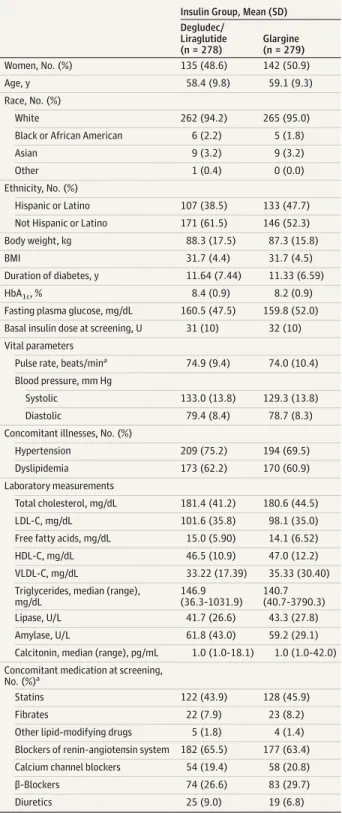
Patients from 10 countries were included, 767 were screened, and 557 were randomized and exposed to the trial products (Figure 1) from September 20, 2013, through November 4, 2014. Of the 557 patients randomized (mean: age 58.8 years; women, 49.7%), 92.5% completed the trial and provided data at 26 weeks. The treatment groups were comparable at baseline with respect to demographics and characteristics (Table 1). In total, 239 of 278 patients receiving degludec/liraglutide (86%) and 255 of 279 patients receiving glargine (91%) attended all sched-uled visits from week 0 to 26.
Primary Objective
HbA1clevel decreased from baseline for the degludec/ liraglutide group (8.4% [SD, 0.9%]) and glargine group (8.2% [SD, 0.9%]) over the first 16 weeks of treatment and stabilized at 6.6% for the degludec/liraglutide group (SD, 0.9%) and 7.1% for the glargine group (SD, 0.9%) by week 26. After 26 weeks of treatment, mean HbA1clevel had decreased by 1.81% for the degludec/liraglutide group (SD, 1.08%) and by 1.13% for the glargine group (SD, 0.98%) with glargine corresponding to an ETD of –0.59% (95% CI, –0.74% to –0.45%) (Table 2and
Figure 2A), demonstrating noninferiority of degludec/
liraglutide (upper bound of the 95% CI, –0.45%; less than the noninferiority margin of 0.3%, 1-sidedPfor noninferior-ity < .001) compared with glargine.
Secondary End Points
The ETD for change in HbA1clevel (–0.59% [95% CI, –0.74% to –0.45%], 1-sidedP< .001) also met criteria for statistical superiority of degludec/liraglutide vs glargine (Table 2 and
Table 1. Baseline Demographics and Patient Characteristics of the Full Analysis Set
Insulin Group, Mean (SD) Degludec/
Liraglutide (n = 278)
Glargine (n = 279)
Women, No. (%) 135 (48.6) 142 (50.9)
Age, y 58.4 (9.8) 59.1 (9.3)
Race, No. (%)
White 262 (94.2) 265 (95.0)
Black or African American 6 (2.2) 5 (1.8)
Asian 9 (3.2) 9 (3.2)
Other 1 (0.4) 0 (0.0)
Ethnicity, No. (%)
Hispanic or Latino 107 (38.5) 133 (47.7)
Not Hispanic or Latino 171 (61.5) 146 (52.3)
Body weight, kg 88.3 (17.5) 87.3 (15.8)
BMI 31.7 (4.4) 31.7 (4.5)
Duration of diabetes, y 11.64 (7.44) 11.33 (6.59)
HbA1c, % 8.4 (0.9) 8.2 (0.9)
Fasting plasma glucose, mg/dL 160.5 (47.5) 159.8 (52.0)
Basal insulin dose at screening, U 31 (10) 32 (10)
Vital parameters
Pulse rate, beats/mina 74.9 (9.4) 74.0 (10.4)
Blood pressure, mm Hg
Systolic 133.0 (13.8) 129.3 (13.8)
Diastolic 79.4 (8.4) 78.7 (8.3)
Concomitant illnesses, No. (%)
Hypertension 209 (75.2) 194 (69.5)
Dyslipidemia 173 (62.2) 170 (60.9)
Laboratory measurements
Total cholesterol, mg/dL 181.4 (41.2) 180.6 (44.5)
LDL-C, mg/dL 101.6 (35.8) 98.1 (35.0)
Free fatty acids, mg/dL 15.0 (5.90) 14.1 (6.52)
HDL-C, mg/dL 46.5 (10.9) 47.0 (12.2)
VLDL-C, mg/dL 33.22 (17.39) 35.33 (30.40)
Triglycerides, median (range), mg/dL
146.9 (36.3-1031.9)
140.7 (40.7-3790.3)
Lipase, U/L 41.7 (26.6) 43.3 (27.8)
Amylase, U/L 61.8 (43.0) 59.2 (29.1)
Calcitonin, median (range), pg/mL 1.0 (1.0-18.1) 1.0 (1.0-42.0)
Concomitant medication at screening, No. (%)a
Statins 122 (43.9) 128 (45.9)
Fibrates 22 (7.9) 23 (8.2)
Other lipid-modifying drugs 5 (1.8) 4 (1.4)
Blockers of renin-angiotensin system 182 (65.5) 177 (63.4)
Calcium channel blockers 54 (19.4) 58 (20.8)
β-Blockers 74 (26.6) 83 (29.7)
Diuretics 25 (9.0) 19 (6.8)
Abbreviations: BMI, body mass index (calculated as weight in kilograms divided by height in meters squared); HbA1c, glycated hemoglobin; HDL-C, high-density lipoprotein cholesterol; LDL-C, low-density lipoprotein cholesterol; VLDL-C, very low–density lipoprotein cholesterol.
SI Conversion: To convert FPG to mmol/L, multiply by 0.0555; total cholesterol, HDL-C, and LDL-C to mmol/L, multiply by 0.0259; fatty acids to mmol/L, multiply by 0.0355; triglycerides to mmol/L, multiply by 0.0113; calcitonin to pmol/L, multiply by 0.292; amylase and lipase to μkat/L, multiply by 0.0167. a
Figure 2A). A reduction in body weight of 1.4 kg (SD, 3.5) was observed in the degludec/liraglutide group from 88.3 kg (SD, 17.5) to 86.9 kg (SD, 17.2), whereas the glargine group had an increase in body weight of 1.8 kg (SD, 3.6) from 87.3 kg (SD, 15.8) to 89.1 kg (SD, 15.9); ETD, –3.20 kg (95% CI, –3.77 to –2.64),1-sidedP< .001 (Table 2 and Figure 2B). Confirmed hypoglycemia occurred in fewer patients receiving degludec/ liraglutide than those receiving glargine (28.4% for the degludec/liraglutide group and 49.1% for the glargine group), with reduced rates of 2.23 episodes vs 5.05 episodes per patient-year of exposure (PYE) (estimated rate ratio, 0.43 [95% CI, 0.30 to 0.61], 1-sidedP< .001) (Table 2; Figure 2C). One severe hypoglycemic episode was reported in the trial, which was in the glargine group. Sensitivity analyses all dem-onstrated similar results in terms of statistical significance and effect sizes (eTable 1 inSupplement 2).
Exploratory Prespecified End Points
FPG level had decreased in both groups after 26 weeks of treat-ment to 109.5 mg/dL (SD, 38.4) for the degludec/liraglutide group and 110.2 mg/dL (SD, 38.6) for the glargine group; ETD, –0.15 mg/dL (95% CI, –6.28 to 5.99),P= .96 (Figure 3A). Mean SMBG levels measured for dose adjustment decreased in both groups over the first 12 weeks (more rapidly with degludec/ liraglutide) and stabilized until week 26 at 105.8 mg/dL (SD, 26.0) for the degludec/liraglutide group and at 100.7 mg/dL (SD, 23.7) for the glargine group, as expected in a treat-to-target trial.
At week 26, the mean of the 9-point SMBG measure-ments had decreased in both groups, by 45.6 mg/dL (SD, 44.9) from baseline to 136.5 mg/dL (SD, 34.6) at 26 weeks for de-gludec/liraglutide and by 42.6 mg/dL (SD, 49.5) from base-line to 141.4 mg/dL (SD, 33.8) at 26 weeks for glargine. The be-tween-group ETD was –4.0 mg/dL (95% CI, –9.6 to 1.6),P= .16 (Figure 3B).
More patients randomized to degludec/liraglutide achieved HbA1ctargets (specifically, <7.0% as well as ≤6.5%) than with glargine, and did so without weight gain and/or hypoglyce-mia (P< .001 for all) (Table 3).
In the glargine group, 24.4% of patients reported noctur-nal confirmed hypoglycemic episodes, as did 6.1% in the degludec/liraglutide group, with event rates per PYE of 1.23 for
the glargine group and 0.22 for the degludec/liraglutide group. The estimated rate ratio for nocturnal hypoglycemia was 0.17 (95% CI, 0.10 to 0.31),P< .001 (Figure 3C).
After 26 weeks, there were increases in the mean daily dose of degludec/liraglutide to 41 dose steps (41 U of degludec/ 1.48 mg of liraglutide) (range, 16–50) and to 66 U for glargine (range, 17–153) (Figure 3D). The between-group ETD insulin dose was –25.47 U (95% CI, –28.90 to –22.05),P< .001. Approximately 40% of patients in the degludec/liraglutide group received the maximum 50 dose steps after 26 weeks, of which 68% achieved an HbA1clevel less than 7% compared with 74% of those who used less than the maximum allowed degludec/liraglutide dose.
Patient-Reported Outcomes
The physical component score of the SF-36 questionnaire improved with degludec/liraglutide (from 47.4 [95% CI, 46.4 to 48.5] at baseline to 49.0 [95% CI, 48.0 to 50.0] at week 26) and worsened with glargine (from 47.7 [95% CI, 46.7 to 48.7] at baseline to 47.2 [95% CI, 46.1 to 48.3] at week 26); ETD, 1.9 [95% CI, 0.8 to 3.1],P< .001 (eTable 2 inSupplement 2). This was also the case with physical functioning (ETD, 1.4 [95% CI, 0.0 to 2.7],P= .045) and bodily pain (ETD, 2.0 [95% CI, 0.4 to 3.6],P= .01) subdomains; the general health subdo-main score increased more with degludec/liraglutide (from 42.9 [95% CI, 41.9 to 44.0] at baseline to 46.2 [95% CI, 45.2 to 47.3] at week 26) than with glargine (from 43.6 [95% CI, 42.5 to 44.7] at baseline to 45.0 [95% CI, 43.9 to 46.1] at week 26; ETD, 1.7 [95% CI, 0.4 to 2.9],P= .008). There was no between-group difference in overall mental score (ETD, –0.1 [95% CI, –1.5 to 1.3],P= .93) or any component subdomains. Patient-reported outcome scores using the TRIM-D questionnaire im-proved in all subdomains and in total score in both groups. The increase in total score was greater with degludec/liraglutide (from 74.6 [95% CI, 73.1 to 76.2] at baseline to 82.1 [95% CI, 80.6 to 83.7] at week 26) compared with glargine (from 73.6 [95% CI, 72.1 to 75.1] at baseline to 78.9 [95% CI, 77.4 to 80.4] at week 26; ETD, 2.8 [95% CI, 0.9 to 4.7],P= .003), largely driven by higher scores than glargine in the treatment burden (ETD, 3.7 [95% CI, 0.7 to 6.8],P= .02) and diabetes manage-ment (ETD, 7.2 [95% CI, 4.2 to 10.2],P< .001) subdomains, indicating higher treatment satisfaction with degludec/ liraglutide (eTable 2 inSupplement 2).
Table 2. Summary of Primary and Secondary End Points for Degludec/Liraglutide vs Glargine
End Point
Insulin Group
Degludec/Liraglutide vs
Glarginea 1-SidedPValue
Degludec/ Liraglutide (n = 278)
Glargine (n = 279)
HbA1clevel at week 26, % 6.6 7.1
Change from baseline in HbA1clevel, % (95% CI)
−1.81 (−1.94 to −1.68)
−1.13 (−1.25 to −1.02)
ETD (95% CI): −0.59 (−0.74 to −0.45)
Noninferiority: <.001 Superiority: <.001
Body weight at week 26, kg 86.9 89.1
Change from baseline, body weight, kg (95% CI)
−1.4 (−1.8 to −1.0)
1.8 (1.4 to 2.2)
ETD (95% CI): −3.20 (−3.77 to −2.64)
Superiority: <.001
Total exposure, y 129.6 135.1
Rate of confirmed hypoglycemia, no. of events per PYE
2.23 5.05 ERR (95% CI): 0.43
(0.30 to 0.61)
Superiority: <.001
Abbreviations: ERR, estimated rate ratio; ETD, estimated treatment difference; HbA1c, glycated hemoglobin; PYE, patient-year of exposure.
a
Post Hoc Analyses
The lower rate of confirmed hypoglycemia observed with degludec/liraglutide compared with glargine was also seen irrespective of end-of-trial HbA1clevel (eFigure 1 inSupplement
2). Post hoc analysis of the 9-point SMBG measurements, using a linear mixed-model, showed a statistically signifi-cantly lower blood glucose level 90 minutes after lunch (ETD, –11.54 mg/dL [95% CI, –19.83 to –3.25],P= .006),
before dinner (ETD, –12.48 mg/dL [95% CI, –20.05 to –4.92],
P= .001), and after dinner (ETD, –10.24 mg/dL [95% CI, –19.45 to –1.02],P= .03), but a higher blood glucose level before breakfast (ETD, 8.28 mg/dL [95% CI, 2.98 to 13.59],
P= .002) and before breakfast on the following day (ETD, 7.23 mg/dL [95% CI, 1.42 to 13.04],P= .02) for degludec/ liraglutide than with glargine; blood glucose levels were similar at the other 4 time points.
Figure 2. Change in HbA1cLevels and Body Weight, and Cumulative Incidence of Confirmed Hypoglycemia Over
Time for Degludec/Liraglutide vs Glargine
2.0
0 0.5 1.0 1.5
–0.5
–1.0
–1.5
–2.0 8.5
8.0
7.5
7.0
6.5
6.0
5.5
0 4 26
HbA
1c
Le
ve
l,
%
Time, wk
2 6 8 10 12 14 16 18 20 22 24
HbA1c level
A
Insulin glargine (n = 279)
Insulin degludec/liraglutide (n = 278)
0 4 26
Change in B
ody W
eight
, k
g
Time, wk
2 6 8 10 12 14 16 18 20 22 24
Body weight
B
Insulin glargine (n = 279)
Insulin degludec/liraglutide (n = 278)
2.0 2.5
1.0 1.5
0.5
0
0 4 26
Mean Cumulativ
e No
. of E
vents per Patient
Time, wk
2 6 8 10 12 14 16 18 20 22 24
Confirmed hypoglycemia
C
Insulin glargine (n = 279)
Insulin degludec/liraglutide (n = 278)
Vital Parameters
After 26 weeks of treatment, heart rate increased in the de-gludec/liraglutide group and remained similar to baseline with glargine (ETD, 3.71 beats/min [95% CI, 2.33 to 5.08],P< .001). Systolic blood pressure decreased with degludec/liraglutide and remained unchanged with glargine (ETD, –3.57 mm Hg [95% CI, –5.54 to –1.59],P< .001). There was no difference in the change in diastolic blood pressure between the groups (ETD, 0.91 mm Hg [95% CI, –0.28 to 2.10],P= .14), which re-mained similar to baseline (eTable 3 inSupplement 2).
Laboratory Measurements
After 26 weeks of treatment, total cholesterol (estimated treatment ratio [ETR], 0.95 [95% CI, 0.92 to 0.98],P<.001), low-density lipoprotein cholesterol (ETR, 0.92 [95% CI, 0.88 to 0.97],P<.001) and free fatty acids (ETR, 0.85 [95% CI, 0.80 to 0.92],P <.001) were lower with degludec/ liraglutide than w ith glargine. No differences were observed for high-density lipoprotein, very low–density lipoprotein, and triglycerides between the groups at the end of trial.
Figure 3. Change in Fasting Plasma Glucose, 9-Point SMBG Profile, Nocturnal Hypoglycemia, and Insulin Dose Over Time for Degludec/Liraglutide vs Glargine
110 170
140 150 160
130
120
100
90
144 216
192
168
120
96 240
72
60
50
40 70
20 30
10
0 4 26
Fasting Blood Glucose, mg
/d
L
Time, wk
2 6 8 10 12 14 16 18 20 22 24
Mean fasting plasma glucose
A
Insulin glargine (n = 279)
Insulin degludec/liraglutide (n = 278)
0.6
0.5
0.4 0.7
0.2 0.3
0.1
0
0 4 26
Mean Cumulativ
e No
. of E
vents per Patient
Time, wk
2 6 8 10 12 14 16 18 20 22 24
Nocturnal confirmed hypoglycemia
C
Insulin glargine (n = 279)
Breakfast 4:00
AM Breakfast
Next Day Lunch
Plasma Glucose, mg
/d
L
Time Interval 90
min After Meal
90 min After Meal
Bedtime 90 min After Meal Dinner 9-Point SMBG profile
B
0
0 4 26
Dose, u
Time, wk
2 6 8 10 12 14 16 18 20 22 24
Mean daily insulin dose
D
Insulin glargine (n = 279)
Insulin degludec/liraglutide (n = 278)
Insulin degludec/liraglutide (n = 278) Week 0
Week 26 Insulin glargine (n = 279) Insulin degludec/liraglutide (n = 278)
ANCOVA indicates analysis of covariance; SMBG, self-measured blood glucose. To convert glucose to mmol/L, multiply by 0.0555. Time 0 indicates randomization. Error bars indicate 95% CIs. A, Based on observed values with missing data imputed by last observation carried forward for the full analysis set. The estimated treatment difference (ETD) at 26 weeks was –0.015 mg/dL (95% CI, –6.28 to 5.99),P= .96, estimated from an ANCOVA analysis based on the full analysis set. Change in mean fasting blood glucose for insulin degludec/liraglutide was −50.9 mg/dL; for insulin glargine, −49.9 mg/dL. B, Mean observed values were based on the full analysis set and missing values were imputed by last observation carried forward. At week 26, for breakfast, 90 minutes after lunch, dinner, 90 minutes after dinner, and breakfast the next day,P< .05 for degludec/liraglutide vs glargine based on linear mixed-model with an unstructured residual covariance matrix. C, Mean cumulative number of
There were increases in mean lipase (17.6 U/L [SD, 37.0]; to convert to μkat/L, multiply by 0.0167) and amylase (10.7 U/L [SD, 22.1]; to convert to μkat/L, multiply by 0.0167) activity dur-ing the treatment period in the degludec/liraglutide group and minimal change in the glargine group (–2.2 U/L [SD, 29.2] for lipase and 2.2 U/L [SD, 18.4] for amylase).
Calcitonin levels were similar between the degludec/ liraglutide and glargine groups throughout the trial and there was no clinically relevant change from baseline at week 26 in either group: median change from baseline 0.0 pg/mL (range, –3.4-47.7) for the degludec/liraglutide group and 0.0 pg/mL (range, –20.5-8.0) for the glargine group (to convert to pmol/L, multiply by 0.292).
Adverse Events
The overall rate of adverse events per 100 PYE was 343.3 for the degludec/liraglutide group and 286.4 for the glargine group. Serious adverse events per 100 PYE were 3.9 for the degludec/ liraglutide group and 6.7 for the glargine group. The majority of adverse events were mild and judged to be unlikely related to the trial products by the investigator. A higher proportion of adverse events were judged related to the trial product in the degludec/liraglutide group, these were mainly gastroin-testinal disorders. Accordingly, nausea was reported by more patients in the degludec/liraglutide group (9.4%; n = 26; 26.2 events per 100 PYE) than the glargine group (1.1%; n = 3; 2.2 events per 100 PYE). However, no more than 4% of patients experienced nausea with degludec/liraglutide at any given week during the trial (eFigure 2 inSupplement 2).
Of 5 cardiovascular events sent for adjudication, 4 were con-firmed by the external blinded event adjudication committee, 2 of which were major cardiovascular events (defined as nonfa-tal myocardial infarction, nonfanonfa-tal stroke, or cardiovascular death) (1 in each group). A patient treated with glargine died of hemorrhagic stroke, and a patient treated with degludec/ liraglutide had an ischemic stroke followed by full recovery. Both events were considered unlikely related to the trial product by the investigator. Seven potential events of neoplasm were sent to the event adjudication committee for adjudication; 3 were con-firmed (rectal adenocarcinoma, prostate cancer, and metastatic pancreatic carcinoma; the latter diagnosed 9 days after stopping treatment [day 54 of the trial]), all in the degludec/liraglutide group and all considered unlikely related to the trial product by
the investigator. Two thyroid disease events were sent for adju-dication; neither were confirmed as thyroid neoplasms. The single event of pancreatitis sent for adjudication was not con-firmed by the event adjudication committee.
Discussion
Among patients with uncontrolled type 2 diabetes treated with glargine and metformin, degludec/liraglutide achieved nonin-ferior HbA1clevel reduction (primary objective), and subse-quently statistically greater HbA1clevel reduction (secondary objective) compared with continued glargine titration, when both products were titrated to the same fasting glycemic tar-get. Further analyses demonstrated that degludec/liraglutide was associated with weight loss compared with weight gain with glargine and a lower rate of hypoglycemia.
Despite the initial reduction in insulin dose for patients randomized to the degludec/liraglutide group, from a mean of 31 U to 16 dose steps (including a liraglutide component of 0.6 mg), there was no deterioration in mean SMBG measure-ment immediately following this switch. The mean SMBG measurement decrease following randomization was greater in the degludec/liraglutide group, indicating a faster thera-peutic response to degludec/liraglutide initiation compared with glargine up-titration. The maximum allowed dose of degludec/liraglutide was 50 dose steps, whereas there was no predefined maximum daily dose of glargine. Despite the dos-ing cap, a statistically and clinically significantly greater HbA1c level reduction was achieved in the degludec/liraglutide group compared with the glargine group (final dose 41 U in the degludec/liraglutide group vs 66 U in the glargine group). The majority of patients treated with degludec/liraglutide met the less than 7.0% and 6.5% or less HbA1clevel targets, more than those in the glargine group, with a lower rate of hypoglyce-mia. These findings highlight the therapeutic benefits of the liraglutide component and its insulin-sparing effect.
The combination of basal insulin and GLP-1RA as a treat-ment option is well established.3,12Concern about hypogly-cemia is a barrier to good glycemic control, rendering pa-tients unwilling to optimize treatment with insulin13and clinicians reticent to recommend more aggressive treatment targets.14The burden of treatment complexity13,14and
con-Table 3. Proportion of Patients Achieving HbA1cand Composite Targets
Insulin, No. (%)a
Between-Group Treatment Difference, % (95% CI)b PValue
Degludec/
Liraglutide Glargine
HbA1clevel <7% 199 (71.6) 131 (47.0) 24.6 (16.7-32.5) <.001
No weight gain 139 (50.0) 55 (19.7) 30.3 (22.8-37.8) <.001
No hypoglycemic episodes 151 (54.3) 82 (29.4) 24.9 (17.0-32.9) <.001
No weight gain, no hypoglycemic episodes
108 (38.8) 34 (12.2) 26.7 (19.8-33.6) <.001
HbA1clevel ≤6.5% 154 (55.4) 86 (30.8) 24.6 (16.6-32.5) <.001
No weight gain 116 (41.7) 35 (12.5) 29.2 (22.2-36.2) <.001
No hypoglycemic episodes 115 (41.4) 53 (19.0) 22.4 (15.0-29.8) <.001
No weight gain, no hypoglycemic episodes
88 (31.7) 21 (7.5) 24.1 (17.8-30.4) <.001
Abbreviations: HbA1c, glycated hemoglobin.
aResponders were based on the full
analysis set and last observation carried forward imputed data. b
cerns about weight gain15may contribute to poor patient ad-herence to treatment intensification.16Equally, physicians cite lack of experience and time to educate patients as a barrier to initiating, modifying, and intensifying insulin treatment.17As a once daily, single injection that is effective, associated with weight loss, and a low risk of hypoglycemia, degludec/ liraglutide may overcome many of the barriers to treatment in-tensification in patients treated with basal insulin. This sug-gestion is supported by the patient-reported outcome results. Gastrointestinal complications are well-known adverse ef-fects of treatment with GLP-1RA.18In the liraglutide clinical development program, nausea was reported by between 14% and 40% of patients treated with 1.2 mg and 1.8 mg of liraglu-tide compared with glargine and placebo.19,20In this trial, a lower proportion of patients treated with degludec/ liraglutide reported 1 or more episodes of nausea (9.4%). This is likely due to a more gradual titration regimen for degludec/ liraglutide compared with that customarily used for liraglu-tide (0.6 mg weekly). The liragluliraglu-tide component in degludec/ liraglutide is up-titrated in smaller increments (up to 0.072 mg twice weekly) with the titration scheme used, contributing to the tolerability of the product. The open-label nature of this trial could have introduced an unconscious bias resulting in overreporting of these events, as even fewer patients re-ported nausea (6.5%) in a double-blinded trial comparing degludec/liraglutide with insulin degludec.21
This study had several important limitations. It was nec-essary to perform the trial with an open-label design as the maximum dose of degludec/liraglutide was 50 dose steps and otherwise a double-dummy design would have been re-quired with patients administering 2 injections daily in unla-beled syringes. The open-label nature of the trial may have biased reporting of adverse events by investigators or
patient-reported outcomes scoring by patients. However, the event ad-judication committee, who adjudicated cardiovascular, neo-plasm, thyroid disease, or pancreatitis events were blinded to randomized treatment. The clinical applicability of this trial is limited to those who fit the inclusion and exclusion crite-ria. In clinical practice, this means that care must be taken to avoid extrapolating expectations from these results to pa-tients with diabetes who were, for example, previously un-controlled on a higher dose of basal insulin (ie, >50 U) or basal insulin in combination with therapies other than metformin. Though the fasting glucose level achieved by study end is simi-lar between groups and to other treat to target trials and though the differences of rates of hypoglycemia were substantial, the mean glargine dose did not reach a plateau at study end; this does raise the possibility that with longer treatment duration or alternative insulin regimens differences in HbA1clevel may have been minimized, but at the expense of greater differ-ences in hypoglycemia and weight gain.
Further research is indicated to evaluate the durability of the effects of degludec/liraglutide in longer-term studies, in clinical practice, and to assess whether patients and physi-cians consider degludec/liraglutide a suitable treatment op-tion to overcome barriers to treatment intensificaop-tion.
Conclusions
Among patients with uncontrolled type 2 diabetes taking glargine and metformin, treatment with degludec/liraglutide compared with up-titration of glargine resulted in noninfe-rior HbA1clevels, with secondary analyses indicating greater HbA1clevel reduction after 26 weeks of treatment. Further stud-ies are needed to assess longer-term efficacy and safety.
ARTICLE INFORMATION
Author Affiliations:Department of Internal Medicine, University of Texas Southwestern Medical Center, Dallas (Lingvay); Department of Clinical Sciences, University of Texas Southwestern Medical Center, Dallas (Lingvay); Centro de Investigaciones Metabolicas, Buenos Aires, Argentina (Manghi); Servicio de Endocrinologia, Hospital Universitario de Monterrey “Dr José Eleuterio-González,” Nuevo León, México (García-Hernández); Valley Research, Fresno, California (Norwood); Novo Nordisk A/S, Søborg, Denmark (Lehmann, Tarp-Johansen); University of North Carolina School of Medicine, Chapel Hill (Buse).
Correction:This article was corrected for an error in a collaborator’s name on May 17, 2016.
Author Contributions:Drs Lingvay and Buse had full access to all of the data in the study and take responsibility for the integrity of the data and the accuracy of the data analysis.
Study concept and design:Lehmann. Acquisition, analysis, or interpretation of data: Lingvay, Manghi, Garcia-Hernández, Norwood, Lehmann, Tarp-Johansen, Buse.
Drafting of the manuscript:Lehmann, Tarp-Johansen. Critical revision of the manuscript for important intel-lectual content:Lingvay, Manghi, Garcia-Hernández, Norwood, Lehmann, Tarp-Johansen, Buse.
Statistical analysis:Tarp-Johansen. Study supervision:Lingvay, Garcia-Hernández, Norwood, Lehmann.
Conflict of Interest Disclosures:All authors have completed and submitted the ICMJE Form for Disclosure of Potential Conflicts of Interest. Dr Lingvay reports receiving grants from Novo Nordisk, Pfizer/Merck, and GI Dynamics; personal fees from AstraZeneca, Boehringer-Ingelheim, and Janssen; editorial assistance from Sanofi. Dr García-Hernández reports receiving grants and consulting fees from Ely Lilly, Pfizer/ Merck, and Amgen. Dr Lehmann reports being an employee of and holding shares in Novo Nordisk. Dr Tarp-Johansen reports being an employee of Novo Nordisk. Dr Buse reports receiving grants, nonfinancial support, and personal fees from Novo Nordisk, Eli Lilly, Bristol-Myers Squibb, GI Dynamics, Orexigen, Merck, PhaseBio, AstraZeneca, Takeda, Sanofi, and Lexicon; nonfinancial support and personal fees from Elcylex, Metavention, vTv Pharma, Dance Biopharm, and Quest; grants from Medtronic Minimed, Tolerex, Osiris, Halozyme, Johnson & Johnson, Andromeda, Boehringer-Ingelheim, GlaxoSmithKline, Astellas, MacroGenics, Intarcia Therapeutics, and Scion NeuroStim; and being a member of a variety of nonprofit boards. No other disclosures are reported.
Funding/Support:This study was funded by Novo Nordisk.
Role of the Funder/Sponsor:Novo Nordisk was involved in the study design and protocol development, provided logistical support, and obtained the data, which were evaluated jointly by the authors and the sponsor. All authors interpreted the data and wrote the manuscript together with the sponsor's medical writing services. The sponsor did not have the right to suppress or veto publications.
Ioannis Ioannidis, G.H. of N. Ionia “Agia Olga,” Nea Ionia; Kyparissia Karatzidou,
G.H. of Thessaloniki “Papageorgiou,” Thessaloniki; Emmanouil Pagkalos, Clinic "Thermi," Thessaloniki; Christos Sambanis, G.H. of Thessaloniki “Ippokrateio,” Thessaloniki; Nikolaos Tentolouris, G.H. of Athens “Laiko,” Athens; Stelios Tigas, U.H. of Ioannina, Ioannina.Hungary:Mihály Dudás, Pándy Kálmán Megyei Kórház Belgyógyászati Osztály, Gyula; Eleonóra Harcsa, Markhot Ferenc Oktatókórház és Rendelőintézet Belgyógyászati Osztály, Eger; Iván Őry, MH Egészségügyi Központ Belgyógyászati Osztály, Budapest; Barnabás Bakó, BAZ megyei Kórház és Egyetemi Oktató Kórház Belgyógyászati Osztály, Miskolc; Tibor Hidvégi, Petz Aladár Megyei Oktató Kórház, Győr.Mexico: Leobardo Sauque Reyna, Instituto de Diabetes, Obesidad y Nutrición S.C., Morelos; Israel Olvera Álvarez, Clínicos Asociados BOCM, S.C., Mexico City; Marco Antonio Morales de Teresa, Resultados Médicos, Desarrollo e Investigación S.C., Hidalgo; Guadalupe Morales Franco, Centro de Diabetes de Durango, Durango; Pedro Alberto García Hernández, Hospital Universitario “Dr. José Eleuterio González,” Nuevo León.Russia:Nina Petunina, I.M. Sechenov First Moscow State Medical University, Moscow; Alsou Zalevskaya, City Multifield Hospital #2, St Petersburg; Gagik Galstyan, Endocrinology Research Centre, Moscow; Vladimir Potin, Research Institute of Obstetrics and Gynecology, St Petersburg; Alexander Sobolev, Kirov Clinical Hospital #7, Kirov; Yulia Samoilova, Siberian State Medical University, Tomsk; Marina Kharakhulakh, Tomsk Regional Clinical Hospital, Tomsk; Vadim Klimontov, Institute of Clinical and Experimental Lymphology SB RAMS, Novosibirsk; Sergei Nedogoda, Volgograd State Medical University, Volgograd; Svetlana Zyangirova, City Endocrinology Dispensary, Kazan; Diana Alpenidze, City polyclinic #117, St Petersburg; Fatima Khetagurova, Vsevolozhsk Central Regional Clinical Hospital, Vsevolozhsk; Irina Ipatko, Consultative Diagnostic Center of Komi Republic, Syktyvkar. Slovakia:Emil Martinka, Národný endokrinologický a diabetologický ústav n.o., Diabetologické oddelenie, Ľubochňa; Jozef Lacka, JAL s.r.o. Diabetologická ambulancia, Trnava; Karol Rummer, Diabetologická ambulancia Komárňanská, Veľký Meder; Ján Truban, ENDIAMED s.r.o. Odbojárov, Dolný Kubín; Lucia Gajdošíkova s.r.o. Diabetologická ambulancia Nemocničná, Považská Bystrica; Adriana Philippiová, DIADA s.r.o. Bezručová, Bardejov; Milan Běhunčík, Železničné zdravotníctvo Košice s.r.o. Diabetologická ambulancia, Košice; Anna Vargová, DIA-KONTROL s.r.o. Ambulancia diabetológie poruchy látkovej premeny avýživy, Levice; Emília Pastrnáková, Interná ambulancia AGTO s.r.o. Trieda; Košice; Monika Košíková, DIAKOM s.r.o. diabetologická ambulancia Mnoheľová 2, Poprad; Jana Džuponová, DIA-CLARUS s.r.o. Hviezdoslavova, Prievidza; Emília Pastrnáková, EMPA s.r.o., diabetologicka ambulancia Mojzesova, Kosice.Spain:Pedro Mezquita Raya, Servicio de Endocrinologia, Clinica San Pedro, Almeria; Margarita Rivas Fernández, Servicio de Endocrinologia, Hospital Infanta Luisa San Jacinto, Sevilla; Santiago Tofé, Servicio Endocrinologia, Clinica Juaneda, Palma de Mallorca; Carmen de la Cuesta, Clinica Nuevas Tecnologias en Diabetes y Endocrinologia, Sevilla; Juan Francisco Merino Torres, El Servicio de Endocrino y Nutrición, Universitari i Politècnic La Fe, Valencia; Manuel Muñoz, Consultas Ext. Endocrinología, Hospital
Universitario San Cecilio, Granada.South Africa: Johanna Adriana Kok, Union Hospital, Alberton; Andrew Jacovides, Health Emporium, Midrand; Hans Hendrik Snyman, Armansis Medical Centre, Brits North West; Deenadalayan Pillay, Stanger. United States:Neil Farris, Research Group of Lexington; Kevin Cannon, PMG Research of Wilmington; Lon Lynn, Clinical Research of West Florida; Gary Bedel, Prestige Clinical Research; Louis Chaykin, Meridien Research; Clinton Corder, COR Clinical Research; Raul Gaona, Briggs Clinical Research; Judith Kirstein, Advanced Clinical Research; Wilfred McKenzie, M&O Clinical Research; Emily Morawski, Holston Medical Group; Ikeadi Ndukwu, Laporte County Institute for Clinical Research; Joseph Risser, San Diego Family Care; Jerry Thurman, SSM Medical Group; David Winslow, Kentucky Research Group; Kenneth Blaze, South Broward Research; Guenther Boden, Temple University Hospital; Michael Jardula, Desert Medical Group; Leslie Klaff, Rainier Clinical Research Center; Paul Norwood, Valley Research; Henry Stamps, Collierville Medical Specialists; Ileana Tandron; Gary Tarshis, ExpressCare Clinical Research; Lawrence Levinson, Tipton Medical & Diagnostic Center; John Agaiby, Clinical Investigation Specialists; Etsegenet Ayele, Pacific Clinical Studies; Sean Hurley, Rowan Research; Anthony Inzerello, Clinical Research Advantage/Family Medicine Associates; James Lane, Harold Hamm Diabetes Center; Kari Uusinarkaus, Clinical Research Advantage/Colorado Springs Health Partners; Ildiko Lingvay, University of Texas Southwestern Medical Center.
Additional Contributions:We thank Henrik Jarlov, MD (Novo Nordisk), for his review and input to the manuscript, and Helen White, PhD, and Gabrielle Parker, BSc (both from Watermeadow Medical), for medical writing and editorial assistance. All contributors received compensation from Novo Nordisk.
REFERENCES
1. Curtis B, Lage MJ. Glycemic control among patients with type 2 diabetes who initiate basal insulin: a retrospective cohort study.J Med Econ. 2014;17(1):21-31.
2. Blak BT, Smith HT, Hards M, Curtis BH, Ivanyi T. Optimization of insulin therapy in patients with type 2 diabetes mellitus: beyond basal insulin.
Diabet Med. 2012;29(7):e13-e20.
3. Inzucchi SE, Bergenstal RM, Buse JB, et al. Man-agement of hyperglycemia in type 2 diabetes, 2015: a patient-centered approach: update to a position statement of the American Diabetes Association and the European Association for the Study of Dia-betes.Diabetes Care. 2015;38(1):140-149. 4. Clinicaltrials.gov. A clinical trial comparing efficacy and safety of insulin degludec/liraglutide (IDegLira) vs basal-bolus therapy in subjects with type 2 diabetes mellitus.https://clinicaltrials.gov /ct2/show/NCT02420262.Accessed December 10, 2015.
5. US Department of Health and Human Services. Guidance for industry diabetes mellitus: developing drugs and therapeutic biologics for treatment and prevention.http://www.fda.gov/downloads/Drugs /.../Guidances/ucm071624.pdf.Accessed February 4, 2016.
6. Abdi H. Holm’s sequential Bonferroni procedure. In: Salkind N, ed.Encyclopedia of Research Design. Thousand Oaks, CA: Sage; 2010.
7. European Medicines Agency, Committee for Medicinal Products for Human Use (CHMP). Guideline on clinical investigation of medicinal products in the treatment or prevention of diabetes mellitus.http://www.ema.europa.eu/docs/en_GB /document_library/Scientific_guideline/2012/06 /WC500129256.pdf.Accessed February 4, 2016. 8. Luo J, Qu Y. Analysis of hypoglycemic events using negative binomial models.Pharm Stat. 2013; 12(4):233-242.
9. O’Kelly M, Ratitch B.Clinical Trials With Missing Data: A Guide for Practitioners. West Sussex, United Kingdom: John Wiley & Sons; 2014.
10. Koch GG. Comments on “current issues in noninferiority trials” by Thomas R. Fleming, statistics in medicine.Stat Med. 2008;27(3):333-342. 11. Keene ON, Roger JH, Hartley BF, Kenward MG. Missing data sensitivity analysis for recurrent event data using controlled imputation.Pharm Stat. 2014; 13(4):258-264.
12. Eng C, Kramer CK, Zinman B, Retnakaran R. Glucagon-like peptide-1 receptor agonist and basal insulin combination treatment for the management of type 2 diabetes: a systematic review and meta-analysis.Lancet. 2014;384(9961):2228-2234. 13. Kunt T, Snoek FJ. Barriers to insulin initiation and intensification and how to overcome them.Int J Clin Pract Suppl. 2009;62(164):6-10.
14. Peyrot M, Barnett AH, Meneghini LF, Schumm-Draeger PM. Insulin adherence behaviours and barriers in the multinational Global Attitudes of Patients and Physicians in Insulin Therapy study.Diabet Med. 2012;29(5):682-689. 15. Carver C. Insulin treatment and the problem of weight gain in type 2 diabetes.Diabetes Educ. 2006;32(6):910-917.
16. Vijan S, Hayward RA, Ronis DL, Hofer TP. Brief report: the burden of diabetes therapy: implications for the design of effective patient-centered treatment regimens.J Gen Intern Med. 2005;20(5):479-482.
17. Cuddihy RM, Philis-Tsimikas A, Nazeri A. Type 2 diabetes care and insulin intensification: is a more multidisciplinary approach needed? results from the MODIFY survey.Diabetes Educ. 2011;37(1):111-123. 18. Liu FP, Dong JJ, Yang Q, et al. Glucagon-like peptide 1 receptor agonist therapy is more efficacious than insulin glargine for poorly controlled type 2 diabetes: a systematic review and meta-analysis.J Diabetes. 2015;7(3):322-328. 19. Zinman B, Gerich J, Buse JB, et al; LEAD-4 Study Investigators. Efficacy and safety of the human glucagon-like peptide-1 analog liraglutide in combination with metformin and thiazolidinedione in patients with type 2 diabetes (LEAD-4 Met+TZD).
Diabetes Care. 2009;32(7):1224-1230. 20. Russell-Jones D, Vaag A, Schmitz O, et al; Liraglutide Effect and Action in Diabetes 5 (LEAD-5) met+SU Study Group. Liraglutide vs insulin glargine and placebo in combination with metformin and sulfonylurea therapy in type 2 diabetes mellitus (LEAD-5 met+SU): a randomised controlled trial.