PROJECT MANAGEMENT AND EFFECTIVE IMPLEMENTATION
OF DONOR FUNDED DEVELOPMENT PROJECTS IN BUSIA
COUNTY, KENYA
EDWINE SHELTONE OMOLLO
D53/OL/CTY/24271/2014
A RESEARCH PROJECT REPORT SUBMITTED TO SCHOOL OF
BUSINESS IN PARTIAL FULFILLMENT OF THE
REQUIREMENTS FOR THE AWARD OF DEGREE OF MASTER
OF BUSINESS ADMINISTRATION, PROJECT MANAGEMENT
OPTION OF KENYATTA UNIVERSITY
i
ii
ACKNOWLEDGEMENT
I appreciate the Almighty God, My Project Supervisor Dr. Frankline Kaburu Kinoti for
his patience, guidance and encouragement, My Parents John Namia Omolo and
Consolata Ajiambo Omolo, My wife Stacy Mutua Kyeni and Daughter Bianka Ajiambo
Omolo, Course Lecturers notably Ms. Kimutai for her guidance and views on this project
development, Friends and all those who have supported and stood by me during the
iii
TABLE OF CONTENTS
DECLARATION ...i
ACKNOWLEDGEMENT ... ii
TABLE OF CONTENTS ... iii
LIST OF TABLES ...vii
LIST OF FIGURES ... viii
ABBREVIATIONS AND ACCRONYMS ... ix
DEFINITION OF KEY TERMS ... x
ABSTRACT ... xi
CHAPTER ONE: INTRODUCTION ... 1
1.1 Background of the study ... 1
1.1.1 Effectiveness in implementation of donor funded development projects ... 3
1.1.2 Donor funded projects in Busia County ...5
1.2 Statement of the Problem ... 6
1.3 Research Objectives ... 8
1.3.1 General objective ...8
1.3.2 Specific Objectives ...8
1.4 Research Questions ... 9
1.5 Significance of the Study... 9
1.6 Scope of the Study ... 10
1.7 Limitations of the Study ... 11
1.8 Assumptions of the Study ... 11
CHAPTER TWO: LITERATURE REVIEW ... 12
iv
2.2 Theoretical Framework... 12
2.2.1 Stakeholder Theory ... 12
2.2.2 Systems Theory ... 14
2.3 Empirical Review ... 16
2.3.1 Monitoring and Evaluation ... 17
2.3.2 Managerial Factors ... 19
2.3.3 Involvement of Primary Stakeholders ... 21
2.3.4 Factors Attributed to Donor Behavior ... 23
2.3.5 Effective Implementation of Development Interventions ... 25
2.3.6 Review of Previous Studies ... 27
2.4 Conceptual Framework ... 31
CHAPTER THREE: METHODOLOGY ... 32
3.1 Introduction ... 32
3.2 Research design ... 32
3.3 Target population ... 33
3.4 Sampling design and procedure ... 33
3.4.1 Sample Size ... 35
3.5 Data collection ... 35
3.5.1 Data collection instruments ... 35
3.5.2 Pilot study ... 36
3.5.3 Validity of Data Collection Instrument ... 37
3.5.4 Reliability of Data Collection Instruments... 37
3.5.5 Data Collection Procedure ... 39
v
3.7 Ethical Considerations ... 41
CHAPTER FOUR: RESEARCH FINDINGS AND DISCUSSIONS ... 42
4.1 Introduction………...………...…………42
4.2 Background Information ... 42
4.2.1 Response rate ... 42
4.2.2 Gender distribution of respondents ... 43
4.2.3 Age distribution of respondents ... 44
4.2.4 Highest level of education attained ... 45
4.2.5 Number of Years worked in the current organization ... 46
4.2.6 Current position on the project ... 47
4.2.7 Number of years worked on the current project ... 47
4.2.8 Desire to receive a summary of the results from this research ... 48
4.3 Influence of monitoring and evaluation on effective implementation of projects ... 49
4.3.1 Stakeholders involvement in projects monitoring ... 49
4.3.2 Accountability by project managers ... 50
4.3.3 Community members’ empowerment in projects monitoring and evaluation ... 50
4.3.4 Extent of projects success ... 51
4.4 Influence of managerial factors on effective implementation of projects ... 53
4.5 Primary stakeholders’ empowerment and effective implementation of projects ... 55
4.5.1 Rating of empowerment of stakeholders in projects implementation ... 55
4.5.2 Community members’ empowerment ... 56
4.5.3 Stakeholders’ involvement in projects implementation ... 57
4.6 Factors attributed to donor behavior on effective implementation of projects ... 59
4.7 Effectiveness in implementation of donor funded development projects ... 61
vi
4.8.1 Test for normality ... 64
4.8.2 Test for Auto correlation ... 65
4.8.3 Test for multi Collinearity ... 66
4.9 Regression Results ... 67
4.9.1 Regression Coefficients ... 67
4.9.2 Coefficient of determinant ... 69
4.9.3 Analysis of Variance (ANOVA) ... 69
CHAPTER FIVE: SUMMARY, CONCLUSIONS AND RECOMMENDATIONS . 71 5.1 Introduction ... 71
5.2 Summary of key findings ... 71
5.2.1 Background Information ... 71
5.2.2 Influence of monitoring and evaluation on effective implementation of projects ... 73
5.2.3 Influence of managerial factors on effective implementation of projects... 74
5.2.4 Influence of primary stakeholders’ empowerment on effectiveness of projects ... 75
5.2.5 Influence of factors attributed to donor behavior on effectiveness of projects ... 76
5.3 Conclusions ... 77
5.4 Recommendations ... 78
5.5 Recommendations for further research ... 79
REFERENCES ... 81
APPENDIX I: INTRODUCTION LETTER ... 86
vii
LIST OF TABLES
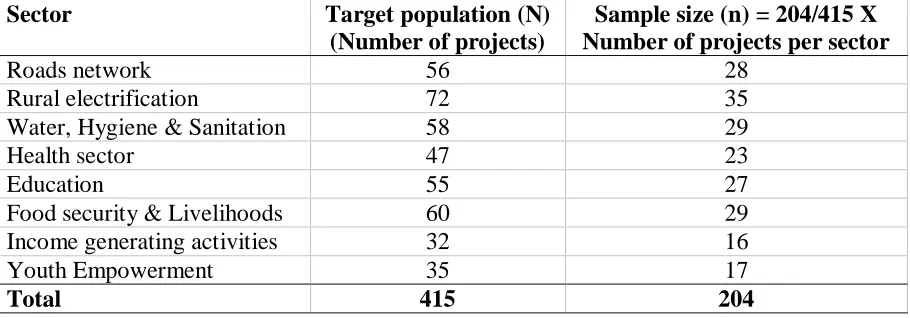
Table 3.1: Sample size ... 35
Table 3.2: Reliability of the Research Instrument ... 38
Table 4.1: Stakeholders involvement in projects monitoring ... 49
Table 4.2: Extent of projects success... 52
Table 4.3: Influence of managerial factors in projects implementation ... 54
Table 4.4: Extent to which community members are involved in projects activities ... 57
Table 4.5: Stakeholders’ involvement in projects implementation ... 58
Table 4.6: Factors attributed to donor behavior on effectiveness of projects ... 60
Table 4.7: Effectiveness in implementation of donor funded development projects ... 62
Table 4.8: Shapiro – Wilk test of Normality ... 65
Table 4.9: Durbin Watson Test for auto correlation... 65
Table 4.10: Test for multi collinearity using Tolerance and VIF... 66
Table 4.10: Coefficients table ... 67
viii
LIST OF FIGURES
Figure 2.1: Conceptual Framework ... 31
Figure 4.1: Response Rate ... 43
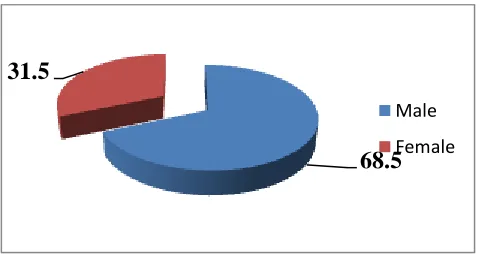
Figure 4.2: Gender distribution of respondents ... 43
Figure 4.3: Age distribution of respondents ... 44
Figure 4.4: Highest level of education attained ... 45
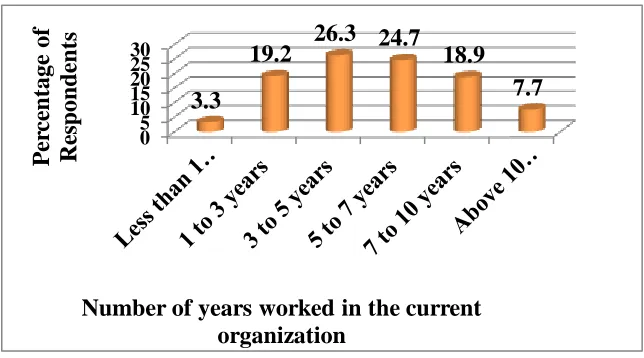
Figure 4.5: Number of Years worked in the current organization ... 46
Figure 4.6: Current position on the project ... 47
Figure 4.7: Number of years worked on the current project ... 48
Figure 4.8: Desire to receive a summary of the results from this research... 48
Figure 4.9: Accountability by project managers ... 50
Figure 4.10: Community members’ empowerment in projects M & E ... 51
ix
ABBREVIATIONS AND ACCRONYMS
DAC Development Assistance Committee
GDP Gross Domestic Product
GNP Gross National Product
ICRG International Country Risk Guide’s
KIHBS Kenya Integrated Household and Budget Survey
KNBS Kenya National Bureau of Statistics
MDGs Millennium Development Goals
NGOs Non-Governmental Organizations
ODA Official Development Assistance
OECD Organization for Economic Cooperation and Development
OID Overseas Institute of Development
SPSS Statistical Package for Social Sciences
SSA S u b-S a ha ra n Afr ic a
UNDP United Nations Development Program
US United States
x
DEFINITION OF KEY TERMS
Evaluation: Evaluation is a selective exercise that attempts to systematically and objectively assess progress towards the achievement of an
outcome.
Monitoring: This refers to a continuing function that aims primarily to provide the management and main stakeholders of an ongoing
intervention with early indications of progress, or lack thereof, in
the achievement of results.
Project: This refers to a unique endeavor which is undertaken in order to achieve a planned outcome or benefit.
Project
implementation effectiveness:
This refers to the process of implementing a project within
budget, on time, achieving the project stakeholder satisfaction
and conforming to the quality specification.
Project
Management:
This is the application of processes, methods, knowledge,
managerial skills, monitoring and evaluation techniques,
involvement of primary stakeholders and an understanding of the
factors attributed to donor behavior to achieve the project
xi
ABSTRACT
1
CHAPTER ONE
INTRODUCTION
1.1 Background of the studySince Kenya’s independence in 1963, the government’s strategies and priorities on
socio-economic development have recognized that rural development is essential for
reduction of inequalities and vulnerability to famine, water- stress and land degradation.
After four decades of trying, food insecurity has persisted, for example an estimated half of
Kenya’s estimated 38.5 million people are poor, and some 7.5 million people live in extreme
poverty, while over 10 million people suffer from chronic food insecurity and poor nutrition.
(Republic of Kenya (RoK), 2013).
Most donor funded development projects are implemented by Non-governmental
organizations (NGOs). NGOs are private, nonprofit making organizations that aim to serve
particular societal interests by focusing advocacy and or operational efforts on social,
political and economic goals, including equity, education, health, environmental protection
and human rights (Teegen, Doh & Vachani, 2004). In Kenya, the NGOs Co-ordination act,
1990 (No. 19 of 1990), amended through the Kenya Gazette Supplement No. 85 (Act No. 8)
23 October 1992, defines a Non-Governmental Organization as “a private voluntary grouping
of individuals or associations, not operated for profit or for other commercial purposes but
which have organized themselves nationally or internationally for the benefit of the public at
large and for the promotion of social welfare, development, charity or research in the areas
inclusive of, but not restricted to, health, relief, agriculture, education, industry, and the
2
Doh and Teegen (2003), described NGOs as non-profit, voluntary citizens groups that are
organized on a local, national or international level, and may be of three types: operational
NGOs, that provide goods and services to needy clients; advocacy NGOs, that promote the
interests of groups who do not have either voice or access to do so themselves; and hybrid
NGOs, which perform both of the previous functions. NGOs are organized around specific
issues, including health and environmental protection, human rights, and in their areas of
concern they can serve as early warning mechanisms or monitors of official agreements
(Teegen et al., 2004). NGOs offer a number of distinct advantages that can enhance the
provision of social services or the promotion of social needs, whether on their own or in
cooperation with business or government (Nancy & Yontcheva, 2006; Yaziji, 2004).
Within East Africa, a study done by Wairimu (2014) entitled “Transition or stagnation;
everyday life, food security and recovery in post-conflict northern Uganda” focused on the
impact of the NGOs in Northern Uganda” and concluded the legitimacy and impact of the
NGOs activities can be improved if they research and understand the local population. This
study gives impetus in the need to review if the donor and legal policies in Kenya are a
moderating variable that will then affect strategy implementation and organization
effectiveness.
Organization for Economic Co-operation and Development (OECD) noted that “the funds
that industrialized economies channeled through NGOs rose from 0.2% of their total bilateral
official development aid (ODA) in 1970 to 17% in 1996 (OECD, 2006). In Africa, by 1994
already 12% of foreign ODA was being channeled to the region through NGOs, and the
3
NGOs in 2006 total was more than $2bn of total ODA, about 123% more than in 2002
(OECD, 2006). Kapstein (2000) argued that though NGOs also suffer from some drawbacks,
chief among them their relative immunity from transparency and accountability and their
dependence on donors for funds, which are often scarce, their strengths have led
governments and multilateral institutions to direct more and more funding through them.
The extent of success of donor funded projects is determined by both technical and
managerial capacity of the human resources of the implementing agencies. In addition,
appropriate supportive infrastructure is a necessity. According to Arndt (2000), the officers in
the donor funds projects chain may lack the formal training in donor funded projects
management, budgeting and accounting. These weak skills may lead to poor understanding
of the donor expenditure protocols resulting in ineligible expenditures, which lead to
rejection for further funding by the donor. O’Connell & Soludo (2001) argued that
accountability is a key pillar of effectiveness. Accountability refers to full transparency
regarding the purpose, content, responsibility and performance of the development agency.
Martens et al. (2002) observed that because of the broken natural feedback loop in donor
funded projects, inserting an explicit evaluation function in donor funded projects is
necessary to eliminate performance problems.
1.1.1 Effectiveness in implementation of donor funded development projects
Effectiveness is the capability of the organization to meet its set vision and mission given the
resources it has in possession (Yukl, 2008). Project effectiveness is often used in measuring
results towards the vision, mission and goals attainment of the firm (Bartuseviciene &
4
strategic goals (Zheng, Yang & McLean, 2010). Business efficiency informs the performance
of input and output ratio, whereas organizational efficiency examines the enhancement of
internal processes of the organization such as structure and culture (Bartuseviciene &
Sakalyte, 2013). Efficiency is all about resource allocation across alternative uses (Kumar &
Gulati, 2010).
Several measures of project effectiveness are suggested, Campbell (1977) lists over 30
different measurement criteria from profitability, productivity, sales turnover, growth,
sustainability and collaboration. Chakravarthy (1986) provides various facets of
effectiveness; high quality of transformation, learning, improved financial performance,
profitability and stakeholder contentment. Different stakeholders to an organization will
emphasize different measures; managers lean on measures that focus on structure since it’s
within their control, staff members would prefer procedure and practice measurements
parameters and clients will lean on outcome measurements like speed of delivery, courtesy,
need met and sensitivity, (Cameron, 1978; Cameron & Whetten, 1996; Ashraf & Kadir,
2012). Seven dimensions are proposed for the measurement of organizational efficiency,
these are: motivation of staff commitment; management and business system building;
development of employee’s skills; corporate structure design; organizational strategy;
development of corporate and employee styles; and subordinate goals (Pinprayong &
Siengthai, 2012).
The term effectiveness has been addressed in the performance measurement literature of
NGOs. According to Sowa et al. (2004), effectiveness in NGOs can be divided into
5
is associated with structure, process, management systems and other organizational
functions. This term is closely linked to strategy implementation drivers. On the other hand,
project effectiveness, which is the main highlighted variable in this study, can be defined as a
measure aimed at determining how a project is meeting the stated objectives successfully. It
is about how an NGO fulfill its mission, short and long term objectives. Morley et al. (2001)
defined it as outcomes or “a specific desirable result or quality of an organization’s services.”
1.1.2 Donor funded projects in Busia County
Busia is one of the forty seven (47) counties of Kenya and it is situated at the extreme
western region of the country. The County borders three other counties which include:
Bungoma to the north, Kakamega to the east and Siaya to the south west. Part of Lake
Victoria is in the County on the South East and borders the Lake with the Republic of
Uganda to the west. It lies between latitude 0º and 0º 45 north and longitude 34º 25 east.
(Busia County Integrated Development Plan 2013-2017). The County covers an area of
1,694.5square kilometers with 10 divisions, 60 locations and 181 sub-locations based on the
previous administrative arrangement. Following the promulgation of the new Constitution in
2010, there are new administrative units covering the same area in form of sub-counties
numbering 7 and 35 wards. The 7 sub-counties are also constituencies, namely Funyula,
Budalang’i, Butula, Matayos, Nambale, Teso North and Teso South. The 2012 population of
Busia was estimated to be 816,452with females numbering 425,622 (53.13%) and the males
390,830 (47.87%) respectively. By the year 2017, the population is estimated to have grown
to a total of 953,337(456,356 males and 496, 981 females). Out of the estimated total
6
while in 2017 the number is expected to be 168, 862 (Busia County Integrated Development
Plan (2013-2017)).
The ongoing projects which were the main focus of this study are as follows: Rural roads
program to link inter and intra county road network; Busia energy center which was aimed at
reducing wood fuel reserves by introduction of more efficient energy saving technologies
such as bio gas, wind among others; Rural Electrification Program; Sio- Port jetty landing
aimed at improving fish and passenger landing; Multi lane highway connecting major
commercial centers countywide; Upgrading of level 3 facilities to level 4 in Nambale,
Funyula and Butula; STI/HIV/AIDS Control program; East Africa public health laboratory
network project (county outlook); Schools water, sanitation and hygiene (WASH) program;
Jigger infestations control program in Nambale, Funyula, Teso South; TB control program
aimed at up scaling the testing, treatment and adherence to treatment plan; Sewerage plant
installation program targeting one on each of the seven sub-counties; Establishment of child
friendly Early Child Development classrooms in all schools county wide; Establishment of
Technical Training institutes (TTIs); Adult and continuing Education program which targets
out of schools youths and adults learners countywide; School text books project; One village
one product (OVOP) program; Program for Agriculture and Livelihoods in western
communities; Entrepreneurial training program; Land Banking program; and Construction of
youth empowerment centers to equip the youth with skills.
1.2 Statement of the Problem
Since the late 20th Century, the call for NGOs to demonstrate their effectiveness has become
7
Schmitz, & Swedlund, 2011) with many paying more attention on how effective they
implement their strategies to achieve desired results. Muema (2012), analyzed factors
influencing strategy implementation among local non-governmental organizations in Nairobi
and concluded that the major factors influencing strategy implementation in NGOs are; poor
communication, lack of commitment of top management to strategy implementation, poor
leadership style of managers, inadequate funds, limited human resource skills, economic
forces and pressure from donors. Ochanda (2014), studied “The Local Development
Dynamics of the Third Sector in Kenya: The Empowerment Dimension” and reviewed how
the not for profit sector which is often labeled ‘third sector’ has developed within the legal,
bilateral agreements and political influences in Kenya.
Abok (2013) did a study on “Factors Affecting Effective Implementation of Strategic Plans
in NGOs in Kenya” with a focus on Nairobi District under Youth, Relief, Micro-finance and
health sectors and concluded four major aspects impact on effective implementation of
strategic plans in NGOs in Kenya; management style, communication, organizational culture,
stakeholders and organizational resources. However, Abok’s data analysis does not give
insights if there are any differences in the factors affecting effective implementation of donor
funded development projects. The study’s limitation is that it has focused only on five
organization facets namely management styles, communication, culture, stakeholders and
resources effect on strategic planning.
Abok, Waititu, Ogutu and Ragui, (2013), did a study on “A Resource-dependency
perspective on the implementation of strategic plans in Non-Governmental Organizations in
8
organization resources had a great significance on strategic plans implementation while
communication had some significance but not as strong as the other variables. This research
focused on donor funded development projects in the following sectors; agriculture, health
and education sectors different from sectors. The study did not focus on leadership styles and
organizational structure, hence the difference with the current study. This research adds to
the gap as echoed by Ochanda (2014) by adding onto the insights on how NGOs have used
strategy implementation to ensure better economic, positioning, social and technological
innovation. This study therefore, investigated the influence of project management on
effective implementation of donor funded development projects in Busia County, Kenya.
1.3 Research Objectives
1.3.1 General objective
This study sought to investigate the influence of project management on effective
implementation of donor funded projects in Busia County, Kenya.
1.3.2 Specific Objectives
The study was guided by the following specific objectives:
i. To evaluate the influence of monitoring and evaluation on effective implementation
of donor funded development projects in Busia County in Kenya.
ii. To assess the influence of managerial factors on effective implementation of donor
funded development projects in Busia County in Kenya.
iii. To investigate the influence of empowerment of primary stakeholders on effective
9
iv. To assess the influence of factors attributed to donor behavior on effective
implementation of donor funded development projects in Busia County in Kenya.
1.4 Research Questions
The study sought answers to the following research questions:
i. How does monitoring and evaluation influence effective implementation of donor
funded development projects in Busia County in Kenya?
ii. How do managerial factors influence effective implementation of donor funded
development projects in Busia County in Kenya?
iii. How primary stakeholders’ empowerment influence effective implementation of
donor does funded development projects in Busia County in Kenya?
iv. How do factors attributed to donor behaviors influence effective implementation of
donor funded development projects in Busia County in Kenya?
1.5 Significance of the Study
The study sought to raise ideas and issues in the hope that the various stakeholders and
persons directly addressing issues related to donor funded projects will continue the
discussion. It did not presume to offer a prescription for the ideal measures to be employed
by the stakeholders so as to reverse the trends. Specifically, it is hoped that the findings of
this study will be beneficial to various key stakeholders as discussed below:
The study findings will enable the Non-Governmental Organizations (NGOs) already
operating in Kenya to understand the missing link between the humanitarian services they
offer to the communities and the social and economic needs of the communities in order of
10
the barriers to effective implementation of donor funded projects for sustainable development
in Busia County, Kenya
The project managers will gain an understanding of the barriers to effectiveness of donor
funded projects in promoting sustainable development in Kenya and use the research findings
to improve on their own performance in managing donor funded projects; the donor
community will understand their role in the donor funds management and projects successes;
and this study will make a significant contribution to the growing body of research on
effective use of donor funds. Academic researchers can rely on the findings of this study by
duplicating the analysis undertaken in other locations and settings. In addition, academic
researchers may need the study findings to stimulate further research in this area and as such
form a basis of good background for further researches.
1.6 Scope of the Study
The focus of the study was donor funded projects implemented in Busia County, whose
number stood at 415 as at 30th June 2016. The responses were limited to one community
members per project and the project manager. Whereas review of the literature reveal many
barriers to effective implementation of donor funded projects for sustainable development,
including governance of the implementing agencies; stakeholder empowerment, capacity
building, factors attributed to donor behavior (including timeframe, donor regulations and
funding); Managerial factors (including human resources capacity); technical factors
(including appropriate technology and availability of infrastructure and equipment);
empowerment of primary beneficiaries; timely availability of resources; monitoring and
11
the following factors were examined: Monitoring and evaluation; Managerial factors;
Empowerment of primary stakeholders; and Factors attributed to donor behavior.
1.7 Limitations of the Study
Limitations included, but were not limited to the following: Restrictive organizational
confidentiality hindering provision of full responses to the study-this was addressed by
assuring respondents of utmost confidentiality and disclosing the academic purpose and
intention of the study; Loss of questionnaires by the respondents, incomplete questionnaires
and failure to provide objective responses by the respondents which was overcome by
organizing meetings outside working hours and seeking for personal contacts of would be
respondents; Some issues being misunderstood by the responses; unexpected occurrences
like respondents proceeding on leave before completing the questionnaires which was
mitigated through constant reminders to the respondents during the period they were
expected to complete the questionnaire.
1.8 Assumptions of the Study
The study assumed that in accomplishing the objectives of the study the independent
variables selected for the study would have a contribution to the dependent variables. In
addition, the study assumed that the respondents would not only be reached and cooperate,
but also provide sincere and honest information and views to enable objective results,
12
CHAPTER TWO LITERATURE REVIEW
2.1 Introduction
It is of importance to have established a sound literature base around which this study is
built, so as to address the aim of the research. The chapter presents a review of the theoretical
literature, review of the empirical studies, conceptual framework of the study, and the
research gaps. The review was undertaken in order to eliminate duplication of what has been
done and provide a clear understanding of existing knowledge base in the problem area. The
literature review is based on authoritative, recent, and original sources such as journals,
books and dissertations.
2.2 Theoretical Framework
The study was anchored on one theory - Stakeholder Theory, which was relevant to the study
since it articulates a link between key independent variables – stakeholders’ empowerment in
projects implementation, Donor behavior, Management and the dependent variable –
effective implementation of donor funded development projects. The theory is briefly
described below.
2.2.1 Stakeholder Theory
Stakeholder theory has its origins in management literature. Preston (1999) traces the notion
of stakeholders back to the Great Depression in the United States (1929-1941), when the
General Electric Company defined four major stakeholder groups - shareholders, employees,
13
conducted by the Stanford Research Institute, which defined it in 1963 as “those groups
without whose support the organization would cease to exist” (Freeman, 1984). Freeman
(1984) recommended a managerial perspective, which identifies four key stakeholders being
the firm-owners, customers, employees, and suppliers and also found that during late
Twentieth Century, the owners of corporation were no longer focusing on just their returns
on investment, but were also interested in “shareholder activism” and promoting social
justice.
The framework of the stakeholder model illustrates more clearly the relationships among the
various groups of actors in and around the organization. Based on extensive literature
reviews on organizational theory and corporate strategy along with a vast amount of research
and observation Freeman provided the notional view of the organization in a new and
simplified fashion. Freeman (1984) originally presented the stakeholder model as a map in
which the organization is the hub of a wheel and stakeholders are at the ends of spokes
around the rim (Freeman, 1999). It consisted of one central circle, or oval, representing the
firm, surrounded by a variable number of other circles or ovals with bi-directional arrows
toward and from the central oval, each oval representing a group of stakeholders. Freeman’s
original framework included eleven stakeholders on a non-exhaustive basis (Freeman, 1984).
Stakeholder Theory has three approaches: The descriptive approach which describes and
explains the characteristics and behavior of organizations including how companies are
managed and how board of directors consider corporate constituencies. Instrumental
approach uses empirical data to identify connections that exist between the management of
14
the function of corporation and identifies moral and philosophical guidelines for the
operation and management of the corporation. It has two principles: Principle of corporate
legitimacy - The Company should be managed for the benefit of its stakeholders.
Stakeholders must participate in decisions that substantially affect their welfare. The
stakeholder fiduciary principle - Managers must act in the interests of the stakeholders as
their agent in the interests of the corporation to ensure the survival of the firm (Ozturk,
2012).This study identified government and regulatory authorities, The National Council of
NGOs, the County Government of Busia, Local communities, suppliers an the media as some
of the stakeholders of donor funded projects in the county.
2.2.2 Systems Theory
Systems theory is a concept that originated from biology, economics, and engineering,
which explores principles and laws that can be generalized across various systems
(Dubrovsky, 2004; Yoon & Kuchinke, 2005; Alter, 2007). The concept of general
systems theory (GST) was first advanced by Ludwig von Bertanlanffy in 1940, and is
primarily concerned with how systems operate, and integrates with other broad range of
systems by naming and identifying patterns and processes common to all of them
(Bausch, 2002; Capps & Hazen, 2002). A system is a set of two or more elements
where; the behavior of each element has an effect on the behavior of the whole; the
behavior of the elements and their effects on the whole are interdependent; and while
subgroups of the elements all have an effect on the behavior of the whole, none has an
independent effect on it (Skyttner, 1996). Steele (2003) stated that “a system comprises
of subsystems whose inter-relationships and interdependence move toward equilibrium
within the larger system”.
GST provides a distinction between open and closed systems; closed systems is the
study of organizations by assuming that the main features of an organization are its
15
with the external environment as vital for organizational survival and success (Shafritz
& Russell, 2005; Wang, 2004). Since systems theory considers the input-output
component and their interactions both within themselves and with the external
environment, the elements of purpose, people, structure, techniques and information
must be coordinated and integrated by the managerial system, in order to maximize
value for the organization (Randolph and Blackburn, 1989; Montouri, 2000). In
analyzing organizations, the open-systems approach investigates the repeated cycles of
inputs, transformation, and output, which comprise organizational systems and
subsystems (Yoon & Kuchinke, 2005; Stewart & Ayres, 2001). Organizational structure
and design are important as they entail decisions related to resource allocation for
various units and activities within the business ecosystem (Brenes, Mena & Molina,
2008).
An effective organizational structure facilitates working relationships between various
entities in the organization and may improve the working efficiency within the
organization units (Johnson, 2009). Senge (1990) argued that an organization which is
continually expanding its capacity to create its future, learning takes place under two
conditions: When design of organizational action matches with the intended outcome
and when initial mismatch between intentions and outcomes is corrected, resulting in a
match.
Yoon and Kuchinke (2005), argue the systems theory does not specify when and how
collaboration with the organization needs to take place, nor what to do when the
analysis suggests that there are existing or potential conflicts between the organizational
environment, work environment and the structure of the organization. According to
Shrode and Voich (1974), systems theory has the following shortcomings, failure to
specify precisely what is meant by a system and the vagueness over what is to be
included within systems theory. The systems concept assumes that the boundaries
between the organization and its environment are distinct (Fioretti & Visser, 2004).
16
are not always easy when organizations have multiple nodes of interactions and
communication lines.
In a rapidly changing environment where tasks and group compositions become
intermingled, open-systems theory does not provide immediate answers to how
organizations need to address complex situations (Clippinger, 1999). Consequently,
Systems theory does not appear to provide a way forward when constituents of a system
are in conflict with each other and or are very ill matched in terms of power and
resources (Stewart & Ayres, 2001). Kast and Rosenzweig (1973), identify the
weaknesses in systems theory comparing organizations to organisms as espoused in
systems theory by making the analogy between living organisms and organizations too
literal. They also argue, the dichotomy between closed and open systems is difficult to
apply to social organizations since most organizations are partially “open” and partially “closed”.
Beeson and Davis (2000) argue that the systems theory emphasis on boundary,
environment, feedback and adaptive response presumes that management is readily
identified as the control center, which directs the organization’s operations. Thus, the model attributes a central role to management and overestimates management’s power
to control events and actions. With System theory informing that managers should
focus on the role played by each part of an organization; rather than dealing separately
with the parts (Hannagan, 2002), both interpersonal and group behavioral aspects
leading to a system of cooperation is emphasized (Koontz, 2001). Donor organizations
are open systems which respond to both internal and external influences.
2.3 Empirical Review
This section presents a review of literature related to the objectives of the study, articulated in
17 2.3.1 Monitoring and Evaluation
The organization for Economic Cooperation and Development (OECD) defines monitoring
and evaluation (M & E) as “a continuous function that uses the systematic collection of data
on specified indicators, to provide management and the main stakeholders of an ongoing
development intervention with indication of the extent of progress and achievement of
objectives and progress in the use of allocated funds”.
The aim is to determine the relevance and fulfillment of objectives, development efficiency,
effectiveness, impact, and sustainability. An evaluation should provide information that is
credible and useful, enabling the incorporation of lessons learned into the decision-making
process of both recipients and donors (Görgens & Kusek, 2009). Monitoring gives
information on where a policy, program or project is at any given time (and over time)
relative to respective targets and outcomes. It is descriptive in intent. Evaluation gives
evidence of why targets and outcomes are or are not being achieved. It seeks to address the
issues of casualty.
It allows learning from the experiences of previous projects and allows sharing these
outcomes with the development and scientific community. In particular, without some form of
follow-up, the benefits of the projects and the outcomes will remain unknown. By
incorporating feedback into the planning process, follow-up assesses the impact and thereby
enables learning from experience to occur. Through activities such as monitoring and
evaluation, follow-up provides concrete evidence of outcomes (Arts, 2004). This knowledge
can be utilized by the implementers or other agencies alike to improve future projects.
18
experiences. During the planning of subsequent projects, it is necessary to include the lessons
from the previous projects, based on the findings in the follow-up processes (Sansom et al.,
2001).
The consensus is that evaluation, like monitoring, is important because it allows lessons to be
learned, leading to improvement in future projects. But like monitoring, it is not done with
sufficient rigor. For example, "many projects cannot precisely pinpoint who has benefitted
and by how much or in what way. This does not indicate the projects are unsuccessful, but
that existing methods of appraisal and evaluation are too limited. There is a need for more
thinking on how to appraise projects for institutional development, sustainability, and
environmental impact (Butcher, 1988).
The last type of evaluation is that which is carried out some years after the completion of the
project. The World Bank is the only agency identified as having made a formal study of
projects ten to fifteen years after their completion. The observations from that study were
found to be very instructive and perhaps this type of evaluation should be carried out more
frequently. Most development workers are familiar with cases where past projects can only
be located by the project buildings, now serving some other purpose, or by the piles of
rusting machinery - which leads to the question of continuity and sustainability. As the
foregoing discussion notes, monitoring and evaluation is core to any project’s effectiveness.
Given that there is a lack of literature on Busia County, as far as the influence of monitoring
and evaluation on the effectiveness of donor funded projects is concerned, the present study
19 2.3.2 Managerial Factors
The extent of success of donor funded projects is determined by managerial capacity of the
human resources of the implementing agencies. Arndt (2000) argued that the officers in the
donor funds projects chain may lack the formal training in donor funded projects
management, budgeting and accounting. These weak skills may lead to poor understanding
of the donor expenditure protocols resulting to ineligible expenditures, which lead to
rejection for further funding by the donor. This may be affected by the quality and timeliness
of the liquidation documents which complicate the donor fund release, with obvious
implications on levels of donor aid effectiveness.
According to Mc Dade (2004), good management ensures that sufficient local resources and
capacity exist to continue the project in the absence of outside resources. Espinosa, et al.
(2007) opines that task familiarity is important in the community based projects and this is
usually linked to performance which in turn is linked to sustainability. Good management
goes beyond mere skills to technical and expertise required to successfully implementing the
project (Little, 1993). Empowered people have freedom of choice and action, which in turn
enables them to better influence the course of their lives and the decisions which affect them.
Competence in human resources is a standardized requirement for an individual to properly
perform a specific job. Cuban (2001) observed that there are many ways to define and
measure the adequacy of staff competency, capacity and the effectiveness of agencies tasked
with the projects. The effectiveness of the project team tasked with projects’ administration
depends to a large extent on the project staff capacity relative to the demands placed upon
20
mix of skills and expertise, the motivation and will to act, and the incentives and resources
necessary to achieve their mandate. Kent (2011) postulates that the ability of a project’s staff
to meet demands for its services depends on both its numbers and the skills and expertise
staff members bring to the job. A project team needs to have at least the minimum necessary
mix of skills and expertise and a sufficient number of staff with appropriate skills relative to
the scale of its responsibility.
Connectivity projects do not implement themselves. They require people to carry out laid
down work, there is need to understand who will work on the systems, what skills and
knowledge they have and the overall level of human resources available–both within the
team and externally – to support your project execution plan. The minimum required mix of
skills and expertise, and the required number of staff per unit managed or administered by the
agency can be established through estimates provided by knowledgeable informants
(Economic Stimulus Program Handbook, 2009). These informants could include current and
past managers of the stimulus project analysts, researchers, tracking the stimulus project
operations and functioning (Cambridge, 2000).
Coordination Problems due to incompetency of project manager may cause project delays
and even failure of completion. In a construction project there are many parties involved such
as contractor, consultant, sub- contractor and client. Often, it may be difficult for these
various separate parties to coordinate well in order to complete the project. Majid and
McCaffer (1998) found that there is difficulty in coordination between the parties is one of
21
Kalinova (2007) convey that planning and management of a project, irrespective of its
complexity require the opinions of a system based on the number of stakeholder’s
involved. Mutual communication between these stakeholders enhances division of labor,
development of individual competencies and responsibilities for effective decision
making. According to Harris et al (2006), support from senior management is a factor that
positively influences the success of a project. This category of staff provides direction,
guidelines and control in a project. The majority of the skilled operatives need to be told
what to do, either daily or weekly. The lower management staffs supervise the work of the
skilled workers while the top management oversees the entire system in terms of time,
quantity of materials, workmanship and cost. When there is inadequate
supervision/inspection of work it might result in rework, increased project cost, delay
and abandonment.
2.3.3 Involvement of Primary Stakeholders
Empowerment is a complex term that is not easily defined and has different interpretations,
just like participation. Empowerment focuses on the notions of power and capacity-building
(Oakley & Clayton, 2000) According to Narayan (2000), numerous conceptualizations of
power have been advanced in the literature, but little agreement has been reached among
academics as to what power is, how it can be identified and studied, where it is, and how it
operates. It thus comes as no surprise that the notion of empowerment has multiple and
contested meanings.
The World Bank (2008) defines empowerment as the process of enhancing the capacity of
22
outcomes. Central to this process are actions which both build individual and collective
assets, and improve the efficiency and fairness of the organizational and institutional context
which govern the use of these assets. Empowered people have freedom of choice and action.
This in turn enables them to better influence the course of their lives and the decisions which
affect them.
Perceptions of being empowered vary across time, culture and domains of a person's life: in
India, a low caste woman currently feels empowered when she is given a fair hearing in a
public meeting, which comprise men and women from different social and economic groups;
in Brazil, in Porto Allegre, citizens – both men and women -- feel empowered if they are able
to engage in decisions on budget allocations; in Ethiopia, citizens and civil society groups
report feeling empowered by consultations undertaken during the preparation of the poverty
reduction support program; in the USA, immigrant workers feel empowered through
unionization which has allowed them to negotiate working conditions with employers; and in
the UK, a battered woman feels empowered when she is freed from the threat of violence and
becomes able to make decisions about her own life (World Bank, 2008(b)).
Various mechanisms through which participation empowers the primary stakeholders of
development intervention can be drawn from participatory theory. Oakley (1991) contends
that participation empowers the primary stakeholders by helping break the mentality of
dependence, promoting self-awareness and confidence, by leading the poor to examine their
problems and to think positively about solutions. Participation also empowers the primary
stakeholders by helping the poor to acquire new skills and abilities which could enable them
to better defend and promote their livelihoods (Oakley et al., 2001). Participation helps in
23
increasing their access to and influence over resources and institutions (Karl, 2000). Karl
(2000) also asserts that participation helps in building social capital, promoting networks and
facilitating better management of risks by households through reciprocal self-help, sharing
information and strengthening local institutions. The World Bank (2002) further avers that
participation of primary stakeholders strengthen the poor’s voice.
Chambers (1983) points out that poverty often refers to powerlessness and exclusion from
social participation, resulting in discrimination; empowerment is seen as very crucial to
poverty reduction. This is because empowerment allows people to have access to productive
resources which enables them to increase their earning and obtain goods and services that
they need, and to participate in the decisions that affect them. As the foregoing review
reveals, empowerment as a factor that influences the effectiveness of donor funded projects
in Kenya has not been tackled by researchers. This present a knowledge gap on what
influence empowerment of primary stakeholders may pose on the effectiveness of such
projects thus a need to study the same in Busia County.
2.3.4 Factors Attributed to Donor Behavior
Accountability: Accountability is a key pillar of effectiveness. It refers to full transparency
regarding the purpose, content, responsibility and performance of the development agency
(O’Connell & Soludo, 2001). NPA (2008) defines accountability as responsibility, reliability,
confidence and transparency in the context of development cooperation; associated
specifically with financial issues, but includes all relevant matters of development concern
and cooperation between partners (NPA, 2008). A distinction can be made between political,
24
place through elections, administrative accountability is ensured through internal
accountability mechanisms both within and between agencies (ibid.). This study shall use the
definition of accountability in the context of development intervention where it is related to
information, reliability, confidence and transparency.
Participatory methods can be used to guarantee the inclusion of all the stakeholders, the
establishment of agreements between them, and the provision of appropriate information at
each level and for different purposes. Information is a key ingredient for accountability
because it is only when people know what resources are available, how they are being
channeled, and how decisions are being made, that they can hold project’s staff to account
(Sen, 1997).
Project evaluation complexities: Because of the broken natural feedback loop in donor
funded projects funding, inserting an explicit evaluation function in donor funded projects is
necessary to eliminate performance problems (Martens et al., 2002). If the evaluations are
well done, to the extent there is no mechanism in place to act on these evaluations (that is, no
mechanism to get the evaluation results out in the public), the aid agency’s behavior would
likely not be affected. An independent donor funded projects evaluation agency could be a
way around these problems. In addition, even if donors adopt formal evaluation as a key
component in aid programs, there would still be difficulties in exercising external influence
without undermining local accountability relationships (World Bank, 2003).
Fund disbursement bureaucracies: In all governments, resources earmarked for particular
uses flow within legally defined institutional frameworks. Typically, funds pass through
25
the responsibility of spending the funds. However, in developing countries, information on
actual public spending at the frontline level or by program is seldom available (Dehn et al.,
2003).
Multiple objectives and tasks: Most donors have multiple objectives. The Swedish foreign
aid agency, Sida, for example lists six goals for Swedish development cooperation:
Economic growth, Economic and social equality, Economic and political independence,
Democratic development, Environmental care, and Gender equality.
2.3.5 Effective Implementation of Development Interventions
For a long time, development agencies have had a long standing history of implementing
projects, which fail shortly after these agencies have withdrawn. Most of the interventions
implemented are not effective in achieving set goals and objectives. Participatory theory
states that stakeholder participation is one of the ways of enhancing effectiveness of
development projects. However, this has not been the case, the communities where projects
are being implemented have long been viewed as a hurdle to implementing projects and
historically have been engaged as little as possible.
According to Greenall & Revere (1999), implementing agencies both local and international
expressed several difficulties when engaging community right from the design stages to
withdrawal, citing slow implementation, but Karl (2000) is of the view that development
interventions will achieve their objectives if the people who are most affected are actively
involved. Participation is an effective mechanism for poverty reduction capable of achieving
26
targeting of benefits to the poor, increases the impact and ensures that the development gains
are equitably distributed (Chavangi,1995).
Chambers (1983) and Oakley (1991) aver that participation in projects ensures that the
development activities are based upon indigenous knowledge and are more relevant to locals.
Karl, (2000) asserts that local people understand their problems better and can therefore use
their skills and resources to find flexible solutions that are tailored to suit their unique needs.
Oakley et al. (1998) opines that in order for the development efforts to have sustainable
changes in the poor people’s lives, they must take into account local values. Generally, from
the authors view, stakeholder analysis should be done to ensure all parties/actors are actively
involved in all stages of project management cycle. This is in concurrence with (Rudqvist &
Woodford-Berger, 1996) that the community will help to detect problems during
implementation at early stages before they escalate into major sources of conflict and
wastefulness.
Interventions will be successful and sustainable when people have a voice in determining
their objectives, to support their implementation, to evaluate their outcomes, and to make
indigenous knowledge available. However, it is disappointing to note that in Kenya, most
donor funded projects do not give much consideration to community participation and
empowerment, hence becoming unsustainable. The authors argue that the determinant factors
for the sustainability of any community-based project are pre and post-implementation
factors.
According to Aras & Crowther (2008), there are four aspects of sustainability, which are
27
impact a society makes upon the corporation in terms of the social contract and stakeholder
influence; environmental impact, which is the effect of the actions of the corporation upon its
geophysics environment; organizational culture, which is the relationship between the
corporation and its internal stakeholders and finances, an adequate return for the level of risk
undertaken in pursuit of sustainable development and financial sustainability.
2.3.6 Review of Previous Studies
Recent research into NGO leaders in Kenya, Malawi and Uganda highlights that NGO’s
operate in three different worlds, the global aid world, the urban context in which they live
and work, and the rural village setting where many of their extended family still live (James,
2005a). Kaplan (2002) concludes that tight project schedules, over-hasty timeframes and
quick results demands placed by donors add to the pressure faced by national NGO leaders.
Allen, Smith and Silva (2013), assert that transformational leadership is positively related to
psychological climate towards organizational change readiness and creativity. Researchers
have also examined the influence of hierarchical leadership in implementing strategies;
O'Reilly, Caldwell, Chatman.
Hrebniak (2006), examined obstacles to effective strategy implementation and found that
poor or inadequate information sharing, unclear responsibility and accountability, and
working against the organizational power structure which are all part of organizational
structure results in a failed implementation processes. Chandler (1962) suggested that
organizational structure is influenced by the organization’s strategies that are ‘structure
follows strategy’. Concurring with Chandler’s (1962) study, Zaribaf and Bayrami (2010)
28
managers only implement the strategy unless a wide range of changes is required before
implementation which would then mean structure alignment with strategy. Lorange (1998)
presented a disquiet with business restructuring and proposed that an organization
restructuring efforts have to outweigh the anticipated gains of the new strategy and not lead
to the unintentional discarding of know-how that could have been used for future growth in
another context.
Hailey and James (2004), concluded that NGO leaders work long hours with limited
resources in uncertain and volatile political and economic circumstances to help the most
marginalized and disadvantaged members of communities while at the same time they are
expected to lead efficient organizations. NGO management pursue multiple bottom lines,
often these are fundraising, sustainability, achieving donor expectations; meet national and
international government regulations, management of environment and societal stakeholders,
forcing them to adapt for-profit strategy concepts (Schwenger, Straub & Borzillo,
2014).Despite changes in membership and leadership an organization's culture is traditionally
passed on from "generation" to "generation" creating a relatively high level of stability over
time (Janicijevic, 2012).
In a study involving 172 Slovenian companies, Cater and Pucko (2010) demonstrated that
managers mostly rely on planning and organizing activities when implementing strategies,
while the biggest obstacle to strategy implementation and execution is poor leadership. Their
results showed that adapting the organizational structure to serve the execution of strategy
has a positive influence on performance. Funk (1993) explored the process of product
29
concluded that Japanese firms, in contrast to American firms, implement strategies using a
combination of organic and mechanistic structures.
Samour (2010) did a study on “Strategic Management; the Case of NGOs in Palestine”, the
study revealed that majority of NGOs in Palestine practice strategic planning,
implementation and evaluation with challenge being limited freedom of operation from the
national regulator. Muzinda (2007) did a study on the ‘Monitoring and Evaluation practices
and challenges of Gaborone based local NGOs implementing projects in Botswana”, the
study concluded that the performance monitoring being done by NGOs was still below
international benchmarks and there is need to train on performance evaluation and
monitoring, allocate resources to performance measurement and improvement with the
consideration been made at the project design phase. Within East Africa a study that has been
done is by Wairimu (2007) who studied “Transition or Stagnation; everyday Life, Food
Security and Recovery in Post-conflict Northern Uganda” focused on the impact of the
NGOs in Northern Uganda” and concluded the legitimacy and impact of the NGOs activities
can be improved if they research and understand the local population.
Similarly, in a study involving Zimbabwe’s state-owned enterprises, Mapetere, Mavhiki,
Tonderai, Sikomwe, and Mhonde (2012) found that low leadership empowerment in projects
implementation led to partial strategy success in the organizations studied. While studying
factors that affect strategy implementation in NGOs in Kenya, Abok (2013) concluded NGO
leaders often face extraordinary challenges both at a personal and organizational level. Abok
(2013) concludes that four major aspects impact on effective implementation of strategic
30
culture, stakeholders and organizational resources. Kafashpoor, Shakoori and Sadeghian
(2013) studied the relationship between the following independent variables: culture,
structure, leadership style and strategy and organizational effectiveness, with knowledge
management playing the mediating roles. In this study, the measures of effectiveness were:
market share, profitability, growth rate and innovativeness. The study focused on 14
employees of Mashhad Municipality, the second largest city in Iran. Chi-square test and
linear regression were used to test the hypotheses.
Results indicate that all context variables are significantly associated with organizational
effectiveness. Moreover, there is a significant relationship between context variables and
knowledge management and also knowledge management plays a mediating role in
relationship between context variables and organizational effectiveness. Besides the sample
of only 14 employees from one organization, this was a case study of one Municipality in
Iran, whose findings may not be generalizable to other organizations in other sectors or
locations. Review of literature reveals many measure of organizational effectiveness. This
study focuses on market share, profitability, growth rate and innovativeness only but does not
justify the choice and justification for leaving the others out.
Pfister (2014), undertook a study entitled, “Sustainability Measurement Framework for
Development Aid NGOs, an integrated Approach for Development Aid NGOs to plan,
evaluate and increase the Impact of Projects and the Sustainability of the Organization” in
Germany, Switzerland, the United Kingdom, and the United States of America; the study
provides a performance measurement framework for nonprofit sector given the increased
31 2.4 Conceptual Framework
Mugenda and Mugenda (2006) defined conceptual framework as “the concise description of
the phenomenon under study accompanied by visual depiction of the variables under study”
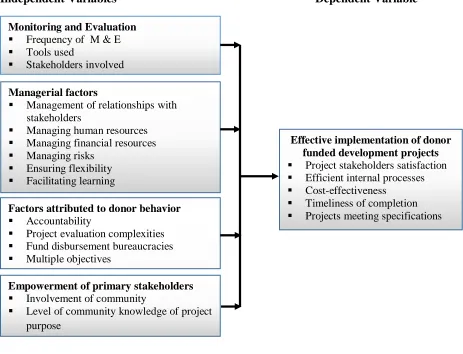
The conceptual framework, representing the relationship between independent variables, and
the dependent variable are depicted in figure 2.1 below.
Independent Variables Dependent Variable
Figure 2.1: Conceptual Framework Source: Author, 2016
Factors attributed to donor behavior
Accountability
Project evaluation complexities
Fund disbursement bureaucracies
Multiple objectives
Monitoring and Evaluation
Frequency of M & E
Tools used
Stakeholders involved
Managerial factors
Management of relationships with
stakeholders
Managing human resources
Managing financial resources
Managing risks
Ensuring flexibility
Facilitating learning
Empowerment of primary stakeholders
Involvement of community
Level of community knowledge of project
purpose
Effective implementation of donor funded development projects
Project stakeholders satisfaction
Efficient internal processes
Cost-effectiveness
Timeliness of completion
32
CHAPTER THREE
METHODOLOGY
3.1 Introduction
The research design, including the target population, data collection methods, research
procedures, data analysis, interpretation and presentation are described. The following
sections provide a detailed description of the research methodology used in the study.
3.2 Research design
Descriptive research design was used in this study. Descriptive design was best suited for this
study since it resulted in a description of the data, whether in words, pictures, charts, or
tables, and whether the data analysis shows statistical relationships or is merely descriptive.
Researchers based on a carefully selected representative sample can produce results that are
broad, credible and reliable to the whole population. Descriptive design was preferred since it
focused on data rather than theory besides the financial constraints. In this case, it was
possible to administer the data collection tools to the respondents in their duty stations with
relative ease, and this played a great role in increasing the response rate.
Mugenda and Mugenda (2006) noted that descriptive statistics enable meaningful description
of a distribution of scores or measurements using a few indices or statistics. Descriptive
statistics help to simplify large amounts of data in a sensible way. Each descriptive statistic
reduces lots of data into a simpler summary. Measures of central tendency were obtained